Đề thi Đánh giá năng lực Bộ Quốc phòng phần Tiếng Anh (có đáp án) - Đề số 1
50 câu hỏi
Who – that.
Which – what.
What – which.
That – which.
Kiến thức về đại từ quan hệ
- Chỗ trống đầu tiên cần điền từ để hỏi ‘what’ để tạo thành mệnh đề danh từ ‘what spoils the film’ đóng vai trò làm chủ ngữ của câu (Điều làm hỏng bộ phim).
- Loại ‘which’ vì ‘which’ được dùng khi muốn nhắc tới danh từ cụ thể được đề cập trước đó, nhưng trong câu này, trước đó không có danh từ nào được đề cập cả.
- Loại D vì theo sau ‘that’ trong mệnh đề danh từ phải là một cụm chủ-vị đầy đủ, loại ‘who’ vì không hợp nghĩa.
- Dùng đại từ quan hệ ‘which’ cho chỗ trống 2 sau dấu phẩy để thay thế cho danh từ ‘the ending’.
Chọn C.
Dịch: Điều làm hỏng bộ phim 500 Ngày yêu đối với tôi là cái kết, nó thật nực cười.
entirely.
full of.
lacking in.
without.
Kiến thức về cụm từ
A. entirely (adv): hoàn toàn
B. full + of (adj): đầy, có nhiều
C. lacking + in (v): thiếu
D. without (adv): không có
Chọn B.
Dịch: Vấn đề với đồ uống có ga như Coca-Cola và 7Up là chúng chứa đầy đường.
needn’t.
mustn’t.
couldn’t.
won’t.
Kiến thức về động từ khuyết thiếu
A. needn’t: dùng để nói điều gì đó không cần làm
B. mustn’t: dùng để nói điều gì đó không được phép làm
C. couldn’t: dùng để nói điều gì đó không thể làm (quá khứ)
D. won’t: dùng để nói điều gì đó sẽ không làm (tương lai)
Chọn A.
Dịch: Nếu ngày mai không cần phải đón Linda đi học về, chắc là ta có thể dành buổi chiều dạo phố.
alike.
like.
likely.
likable.
Kiến thức phân biệt các từ gần giống nhau dễ nhầm lẫn
A. alike /əˈlaɪk/ (adj, adv): rất giống nhau (tính từ, không dùng trước danh từ); như nhau (trạng từ, dùng sau khi nhắc đến hai người hoặc hai nhóm người).
B. like /laɪk/ (adj, prep.): tương tự (tính từ, chỉ dùng trước danh từ); giống như (giới từ)
C. likely /ˈlaɪkli/ (adj): có khả năng cao
D. likable /ˈlaɪkəbl/ (adj): dễ mến
Chọn B.
Dịch: Có lẽ sếp tôi mong đợi tôi phản ứng với những lời nhận xét và trò đùa thân thiện của ông ấy theo cách tương tự.
is answering.
is going to answer.
will answer.
will be answering.
Kiến thức về thì động từ
- Tương lai đơn diễn tả một sự việc sẽ xảy ra trong tương lai, thường dùng khi bối cảnh trang trọng hơn là dùng tương lai gần ‘be going to’.
- Thể khẳng định: S + will + V-inf.
Chọn C.
Dịch: Thủ tướng sẽ trả lời tất cả các câu hỏi vào thời điểm thích hợp.
industry.
industrial.
industrially.
industrious.
Kiến thức về từ loại
A. industry /ˈɪndəstri/ (n): ngành công nghiệp
B. industrial /ɪnˈdʌstriəl/ (adj): liên quan đến ngành công nghiệp
C. industrially /ɪnˈdʌstriəli/ (adv): liên quan đến ngành công nghiệp
D. industrious /ɪnˈdʌstriəs/ (adj): cần cù, chăm chỉ
Chỗ trống cần một tính từ đi trước và bổ nghĩa cho danh từ ‘dispute’.
Ta có: industrial dispute = labour dispute = trade dispute (n): tranh chấp lao động
Chọn B.
Dịch: Một cuộc tranh chấp lao động đang có nguy cơ làm chậm trễ việc sản xuất mẫu ô tô mới.
it for.
it hadn’t been for.
it to be for.
it not for.
Kiến thức về câu điều kiện
- Câu điều kiện hỗn hợp loại 2-3 đưa ra giả thiết về một hành động, sự việc đáng lẽ đã xảy ra trong quá khứ nếu điều kiện nói tới có thật.
- Dạng đặc biệt của mệnh đề điều kiện loại 2-3: Were it not for + N/V-ing, S + would/could + have + Vp2/V-ed (Nếu không nhờ...)
Chọn D.
Dịch: Nếu không nhờ có bố thì lúc đầu tôi đã chẳng bắt đầu chơi quần vợt.
invoice.
bill.
receipt.
recipe.
Kiến thức về từ vựng
A. invoice /ˈɪnvɔɪs/ (n): hóa đơn (dành cho hàng hóa, dịch vụ được cung cấp theo thỏa thuận, e.g. The builders sent an invoice for £250.)
B. bill /bɪl/ (n): hóa đơn mua hàng (e.g. the phone/electricity/gas bill, hotel/restaurant bill)
C. receipt /rɪˈsiːt/ (n): biên lai, bằng chứng đã trả tiền, nhận tiền
D. recipe /ˈresəpi/ (n): công thức nấu ăn (hay nhầm lẫn với ‘receipt’)
Chọn C.
Dịch: Tôi e rằng chúng tôi chỉ có thể chấp nhận hoàn trả sản phẩm nếu bạn vẫn còn giữ biên lai mua hàng.
to do.
do.
done.
doing.
Kiến thức về thể sai khiến
- Cấu trúc chủ động: S + get (chia động từ) + somebody + to V-inf.
= S + have (chia động từ) + somebody + V-inf.
Chọn B.
Dịch: Đừng tự mình trang trí lại làm gì – hãy nhờ chuyên gia làm để tránh phiền phức và đảm bảo mọi thứ trông hoàn hảo khi hoàn thành.
as a matter of fact.
on average.
in conclusion.
in an attempt.
Kiến thức về kết hợp từ
A. as a matter of fact: thực tế là
B. on average: trung bình
C. in conclusion: tổng kết lại
D. in an attempt to V: nỗ lực làm gì
Chọn D.
Dịch: Kính thiên văn sẽ chụp lại ảnh của các thiên hà xa xôi để tìm hiểu về quá khứ của chúng.
expect.
predict.
change.
determine.
Kiến thức về từ đồng nghĩa
- foresee /fɔːˈsiː/ (v): thấy trước
A. expect /ɪkˈspekt/ (v): mong đợi
B. predict /prɪˈdɪkt/ (v): dự đoán
C. change /tʃeɪndʒ/ (v): thay đổi
D. determine /dɪˈtɜːmɪn/ (v): xác định
→ foresee = predict. Chọn B.
Dịch: Người phụ nữ khẳng định rằng có thể thấy trước tương lai, nhưng tôi biết cô ta chỉ đang đoán mò thôi.
failed.
hit.
stopped.
died.
Kiến thức về từ đồng nghĩa
- break down (phr. v): hỏng hóc (máy móc)
A. fail (v): thất bại
B. hit (v): đâm vào
C. stop (v): dừng lại
D. die (v): chết đi (sinh vật sống), chết máy (xe cộ,...)
→ break down = die. Chọn D.
Dịch: Một chiếc xe tải đã bị hỏng trên đường cao tốc làm chúng tôi bị tắc hơn một giờ đồng hồ.
overemphasizing.
boasting.
contrasting.
understating.
Kiến thức về từ trái nghĩa
- exaggerate /ɪɡˈzædʒəreɪt/ (v): phóng đại
A. overemphasize /ˌəʊvərˈemfəsaɪz/ (v): nói quá tầm quan trọng
B. boast /bəʊst/ (v): khoe khoang
C. contrast /ˈkɒntrɑːst/, /ˈkɑːntræst/ (v): tương phản
D. understate /ˌʌndəˈsteɪt/ (v): nói giảm, nói nhẹ đi
→ exaggerate >< understate. Chọn D.
Dịch: Dave rõ ràng là đang phóng đại tầm ảnh hưởng của tạp chí đó. Nó thực chất chỉ có lượng độc giả rất nhỏ thôi.
failed to accomplish.
felt disappointed.
succeeded in achieving.
lost money.
Kiến thức về từ trái nghĩa
- fall short of the mark (idiom): thiếu hụt, không đạt tới mục tiêu
A. fail to accomplish: không hoàn thành
B. feel disappointed: cảm thấy thất vọng
C. succeed in achieving: thành công đạt được
D. lose money: mất tiền
→ fall short of the mark >< succeed in achieving. Chọn C.
Dịch: Tôi đã hy vọng sẽ kêu gọi quyên góp được tầm 1.000 euro cho bệnh viện địa phương, nhưng đã không đạt được mục tiêu vì thiếu vài trăm euro nữa.
Not really. They’re not that stylish.
Jackets are always in style, aren’t they?
True, I’ve seen a lot of people wearing them.
You’re very obsessed with fashion, aren’t you?
Kiến thức về ngôn ngữ giao tiếp
Emily: Mùa này áo khoác oversize ở khắp mọi nơi.
Camille: _______
A. Không hẳn. Chúng không hợp thời trang lắm.
B. Áo khoác luôn là mốt mà, đúng không?
C. Ừ, tớ thấy nhiều người mặc kiểu đó.
D. Cậu có vẻ bị ám ảnh thời trang nhỉ?
Chọn C.
I’m with you on that.
I’ve never tried it, so I can’t say.
No way, you’re wrong!
That’s not how I see it.
Kiến thức về ngôn ngữ giao tiếp
Enrico: Dứa không bao giờ nên đi cùng với pizza!
Lucy: _______ Mình thấy sự kết hợp này tạo nên sự tương phản mặn ngọt ngon miệng.
A. Mình đồng ý với bạn điều này. B. Mình chưa thử bao giờ nên không biết.
C. Không đời nào, bạn sai rồi! D. Mình không thấy thế.
- I’m with you on that: một cách thể hiện sự đồng tình.
- ‘No way’ và ‘That’s not how I see it’ đều là những cách thể hiện sự không đồng tình, nhưng ‘No way’ phản đối một cách quyết liệt, nên xem xét hoàn cảnh để dùng.
Chọn D.
I drew the long straw.
I drew the short straw.
I drew the lucky straw.
I drew the unlucky straw.
Kiến thức về thành ngữ trong giao tiếp
Andre: Ai sẽ trông Trina vào tối mai?
Tara: À, _______, vậy nên tớ sẽ ở nhà trông còn những người khác đi chơi.
- draw the short straw (idiom): rút phải que ngắn – bị chọn làm việc không ai muốn làm
Chọn B.
I guess we’ll see what happens.
I have to give credit where it’s due.
I’m glad it went well.
Please accept my deepest gratitude.
Kiến thức về ngôn ngữ giao tiếp
Quản lý: Khách hàng rất ấn tượng với bài thuyết trình của em.
Nhân viên: _______; đó là công sức của cả nhóm ạ.
A. Chắc là ta sẽ xem chuyện gì sẽ xảy ra.
B. Em phải ghi nhận công lao cho những người xứng đáng.
C. Em mừng vì mọi việc đã diễn ra suôn sẻ.
D. Xin hãy chấp nhận lòng biết ơn sâu sắc nhất của em.
Chọn B.a. I’m into mystery and thrillers.
b. Do you have any recommendations for a good book?
c. In that case, I’d suggest something by Agatha Christie.
d. It depends on what genre you like.
c-b-a-d.
c-d-a-b.
b-a-d-c.
b-d-a-c.
Kiến thức về sắp xếp đoạn hội thoại
Chọn D.
Dịch:
b. Bạn có gợi ý nào về một cuốn sách hay không?
d. Nó còn tùy thuộc vào thể loại bạn thích nữa.
a. Tôi thích thể loại bí ẩn và ly kỳ.
c. Vậy thì, tôi sẽ gợi ý một tác phẩm của Agatha Christie.
a. I find that staying calm and listening to their concerns helps.
b. That’s true; empathy can go a long way in those situations.
c. What’s the best way to handle a difficult customer?
d. And sometimes, offering a solution can resolve the issue quickly.
c-d-b-a.
c-a-b-d.
b-d-c-a.
b-c-d-a.
Kiến thức về sắp xếp đoạn hội thoại
Chọn B.
Dịch:
c. Cách xử lý tốt nhất khi gặp khách hàng khó tính là gì?
a. Tôi nhận thấy giữ bình tĩnh và lắng nghe mối lo lắng của họ sẽ hữu ích.
b. Đúng vậy; sự đồng cảm có thể giúp ích rất nhiều trong những tình huống đó.
d. Và đôi khi, đưa ra giải pháp có thể giải quyết vấn đề một cách nhanh chóng.
a. What kind of emergencies will we be practicing for?
b. Did you hear about the emergency drill happening at school tomorrow?
c. It’s good to be prepared, but I hope we never have to use those skills for real.
d. Yes, I did! It’s important for everyone to know what to do in case of a real emergency.
e. Same here! At least we’ll feel more confident if an emergency does occur.
f. I think we’ll cover fire evacuations and lockdown procedures.
b-f-e-a-d-c.
b-f-c-d-e-a.
b-d-e-c-a-f.
b-d-a-f-c-e.
Kiến thức về sắp xếp đoạn hội thoại
Chọn D.
Dịch:
b. Bạn đã nghe về cuộc diễn tập khẩn cấp diễn ra ở trường vào ngày mai chưa?
d. Có, tôi nghe rồi! Điều quan trọng là mọi người phải biết phải làm gì trong trường hợp khẩn cấp thực sự.
a. Chúng ta sẽ luyện tập để ứng phó với những trường hợp khẩn cấp nào thế?
f. Tôi nghĩ chúng ta sẽ học về sơ tán khi có hỏa hoạn và các quy trình phong tỏa.
c. Chuẩn bị là tốt, nhưng tôi hy vọng chúng ta không bao giờ phải sử dụng những kỹ năng đó ngoài đời thực.
e. Tôi cũng vậy! Ít nhất chúng ta sẽ cảm thấy tự tin hơn nếu trường hợp khẩn cấp thực sự xảy ra.
a. I saw a news report about the historic temple downtown being damaged.
b. That’s so unfortunate! Those places are so important to our culture.
c. Really? That’s concerning. What caused the damage?
d. I read they’re planning to restore it, but it will take a lot of time and resources.
e. It was a mix of vandalism and severe weather conditions last week.
f. I hope they can do it properly; preserving our history is essential.
a-b-d-c-e-f.
b-a-c-d-f-e.
a-c-e-b-d-f.
b-d-a-c-e-f.
Kiến thức về sắp xếp đoạn hội thoại
Chọn C.
Dịch:
a. Tôi thấy một bản tin về ngôi đền lịch sử ở trung tâm thành phố bị hư hại.
c. Thật sao? Thật đáng lo ngại. Nguyên nhân bị hư hại là gì?
e. Đó là sự kết hợp giữa hành vi phá hoại và điều kiện thời tiết khắc nghiệt vào tuần trước.
b. Thật không may! Những nơi đó rất quan trọng đối với nền văn hóa của chúng ta.
d. Tôi đọc được rằng họ đang có kế hoạch khôi phục lại nó, nhưng sẽ mất rất nhiều thời gian và nguồn lực.
f. Tôi hy vọng họ có thể làm đúng cách; việc bảo tồn lịch sử là điều cần thiết.
Traditional classrooms are likely more engaging than online learning platforms.
Online learning platforms are likely less engaging than traditional classrooms.
Online learning platforms might be more engaging for students than traditional classrooms.
Traditional classrooms might be more engaging for students than online learning platforms.
Kiến thức về câu so sánh
Dịch: Nền tảng học trực tuyến có thể lôi cuốn học sinh hơn so với lớp học truyền thống.
A. Lớp học truyền thống có thể lôi cuốn hơn so với nền tảng học trực tuyến. → Sai nghĩa.
B. Nền tảng học trực tuyến có thể ít lôi cuốn hơn so với lớp học truyền thống. → Sai nghĩa.
C. Nền tảng học trực tuyến có thể lôi cuốn hơn đối với học sinh so với lớp học truyền thống.
→ Đúng. Để diễn đạt dự đoán không chắc chắn về tương lai, chúng ta có thể dùng “could” hoặc “might”.
D. Lớp học truyền thống có thể lôi cuốn học sinh hơn so với nền tảng học trực tuyến. → Sai nghĩa.
Chọn C.She had so much time to finish the project that she met the deadline.
She had sufficient time to finish the project before the deadline.
She didn’t had enough time to finish the project before the deadline.
The project was finished by her because she had enough time.
Kiến thức vềcấu trúc đồng nghĩa
Dịch: Cô ấy có đủ thời gian để hoàn thành dự án trước thời hạn.
→ Cấu trúc: S + V + enough + N + (for sb) + to V: đủ…(để ai) làm gì
A. Cô ấy có quá nhiều thời gian để hoàn thành dự án đến mức cô ấy đã nộp đúng thời hạn.
→ Sai nghĩa. Cấu trúc: S + V + so + much/little + uncountable noun + that + S + V: quá nhiều…đến nỗi mà…
B. Cô ấy có đủ thời gian để hoàn thành dự án trước thời hạn. → Đúng. Cấu trúc: have sufficient time + to V: có đủ thời gian làm gì
C. Cô ấy không có đủ thời gian để hoàn thành dự án trước thời hạn. → Sai nghĩa và ngữ pháp. Động từ theo sau “didn’t” phải ở dạng nguyên thể, phải sửa lại là “have”.
D. Cô ấy đã hoàn thành dự án vì cô ấy có đủ thời gian. → Sai nghĩa.
Chọn B.He reacted quickly and avoided the accident.
He thought slowly, which caused the accident.
His quick thinking made the accident worse.
The accident happened because he was confused.
Kiến thức về cấu trúc câu, cụm từ đồng nghĩa
Dịch: Suy nghĩ nhanh nhạy của anh ấy đã ngăn chặn được tai nạn xảy ra.
A. Anh ấy phản ứng nhanh và tránh được tai nạn. → Đúng.
B. Anh ấy suy nghĩ chậm chạp, điều này đã gây ra tai nạn. → Sai nghĩa. Trong mệnh đề quan hệ không xác định, đại từ quan hệ “which” có thể được dùng thay thế cho cả mệnh đề phía trước nó.
C. Suy nghĩ nhanh nhạy của anh ấy đã khiến tai nạn trở nên tồi tệ hơn. → Sai nghĩa. Cấu trúc: make sth worse: khiến cho điều gì trở nên tồi tệ hơn
D. Tai nạn đã xảy ra vì anh ấy đã bối rối. → Sai nghĩa: because + clause: bởi vì
Chọn A.
Not until he had badly suffered cyberbullying himself did he realize the true dangers of social media
Such was his suffering of cyberbullying that he didn’t realize the true dangers of social media.
Only when he had realized the true dangers of social media did he badly suffer cyberbullying himself.
But for his terrible suffering of cyberbullying, he wouldn’t realize the true dangers of social media.
Kiến thức về câu đảo ngữ
Dịch: Bản thân anh ấy đã phải chịu đựng rất nhiều sự bắt nạt trên mạng. Chỉ đến lúc đó, anh ấy mới nhận ra những nguy hiểm thực sự của mạng xã hội.
A. Mãi đến khi bản thân anh ấy phải chịu đựng rất nhiều sự bắt nạt trên mạng, anh ấy mới nhận ra những nguy hiểm thực sự của mạng xã hội. → Đúng. Cấu trúc đảo ngữ: Not until + S + had + Vp2/V-ed + O + did + S + V-inf + O: Mãi đến khi…thì…
B. Anh ấy đã phải chịu đựng quá nhiều sự bắt nạt trên mạng đến nỗi anh ấy không nhận ra những nguy hiểm thực sự của mạng xã hội. → Sai nghĩa. Cấu trúc: Such + (N) + trợ động từ + S + that + clause: quá…đến nỗi mà…
C. Chỉ khi anh ấy nhận ra những nguy hiểm thực sự của mạng xã hội, anh ấy mới phải chịu đựng rất nhiều sự bắt nạt trên mạng. → Sai nghĩa. Cấu trúc đảo ngữ: Only when + S + had + Vp2/V-ed + O + did + S + V-inf + O: Chỉ khi…thì…
D. Nếu không vì phải chịu đựng rất nhiều sự bắt nạt trên mạng, anh ấy đã không nhận ra những nguy hiểm thực sự của mạng xã hội. → Sai nghĩa. Cấu trúc câu điều kiện hỗn hợp loại 1: But for + N/V-ing, S + would + V-inf + O: Giả thiết về một hành động, sự việc sẽ xảy ra ở hiện tại nếu điều kiện nói tới trong quá khứ có thật.
Chọn A
Choose A, B, C, or D that has the CLOSEST meaning to the given pair of sentences in each question.
The car is running out of fuel. It will definitely stop soon.
The car is full of fuel and will keep running.
The car is low on fuel, so it will stop shortly.
The car has enough fuel to drive for hours.
The car will never stop because it has plenty of fuel.
Kiến thức về động từ khuyết thiếu, trạng từ chỉ mức độ chắc chắn
Dịch: Chiếc xe sắp hết nhiên liệu. Chắc chắn nó sẽ sớm dừng lại.
A. Chiếc xe đang đầy nhiên liệu và sẽ tiếp tục chạy. → Sai nghĩa. Cấu trúc: be full of sth: đầy; keep + V-ing: tiếp tục làm gì
B. Chiếc xe sắp hết nhiên liệu, vì vậy nó sẽ sớm dừng lại. → Đúng. Cấu trúc: be low on sth: gần cạn kiệt cái gì.
C. Chiếc xe có đủ nhiên liệu để chạy trong nhiều giờ. → Sai nghĩa. Cấu trúc: S + V + enough + N + (for sb) + to V + O: đủ…(để ai) làm gì
D. Chiếc xe sẽ không bao giờ dừng lại vì nó có nhiều nhiên liệu. Sai nghĩa. Cấu trúc: have plenty of sth: có nhiều cái gì
Chọn B.We couldn’t go outside because the weather was cold enough.
The weather was too cold for us to go outside.
The weather was cold enough for us to stay outside.
The weather was so hot that we had to stay indoors.
Kiến thức về cấu trúc đồng nghĩa
Dịch: Thời tiết quá lạnh nên chúng tôi không thể ra ngoài.
→ Cấu trúc: S + be + so + adj + that + S + V: quá…đến nỗi mà…
A. Chúng tôi không thể ra ngoài vì thời tiết đủ lạnh. → Sai nghĩa. Cấu trúc: because + clause: bởi vì
B. Thời tiết quá lạnh để chúng tôi ra ngoài. → Đúng. Cấu trúc: S + be + too + adj + (for sb) + to V + O: quá…(để ai) làm gì
C. Thời tiết đủ lạnh để chúng tôi ở ngoài. → Sai nghĩa: Cấu trúc: S + be + adj + enough + (for sb) + to V + O: đủ…(để ai) làm gì
D. Thời tiết quá nóng đến nỗi chúng tôi phải ở trong nhà. → Sai nghĩa. Cấu trúc: S + be + so + adj + that + S + V + O: quá…đến nỗi mà…
Chọn B.He missed the deadline, even though he managed his time well.
Good time management helped him meet the deadline.
It was poor time management that caused him to miss the deadline.
The deadline was extended because of his poor time management.
Kiến thức về câu chẻ
Dịch: Việc quản lý thời gian kém khiến anh ấy trễ hạn.
→ Cấu trúc: make sb do sth: khiến cho ai làm gì
A. Anh ấy trễ hạn, mặc dù anh ấy quản lý thời gian tốt. → Sai nghĩa. Cấu trúc: even though + clause: mặc dù
B. Quản lý thời gian tốt đã giúp anh ấy hoàn thành đúng hạn. → Sai nghĩa. Cấu trúc: help sb do sth: giúp ai làm gì
C. Chính việc quản lý thời gian kém đã khiến anh ấy trễ hạn. → Đúng. Cấu trúc câu chẻ nhấn mạnh chủ ngữ: It + is/was + chủ ngữ nhấn mạnh + who/that + V + O.
D. Hạn chót đã được gia hạn vì anh ấy quản lý thời gian kém. → Sai nghĩa. Cấu trúc: because of + N/V-ing: bởi vì
Chọn C.Completing the marathon took her years of intense training.
She completed the marathon without needing any training.
It only took her a few days of preparation to finish the marathon.
She wasn’t able to finish the marathon, even after training for years.
Kiến thức về diễn đạt câu
Dịch: Sau nhiều năm luyện tập, cô ấy đã hoàn thành đường chạy marathon một cách thành công.
A. Cô ấy đã mất nhiều năm luyện tập cường độ cao để hoàn thành đường chạy marathon.
→ Đúng. Cấu trúc: take sb time: mất của ai bao nhiêu thời gian
B. Cô ấy đã hoàn thành đường chạy marathon mà không cần bất kỳ sự luyện tập nào. → Sai nghĩa. Cấu trúc: without + N/V-ing: mà không có/mà không cần…
C. Cô ấy chỉ mất vài ngày chuẩn bị để hoàn thành đường chạy marathon. → Sai nghĩa. Cấu trúc: It + take(s) + (sb) + time + to V: (Ai đó) mất bao nhiêu thời gian làm gì
D. Cô ấy đã không thể hoàn thành đường chạy marathon, ngay cả sau khi đã luyện tập trong nhiều năm. → Sai nghĩa. Cấu trúc: be able to + V-inf: có khả năng làm gì
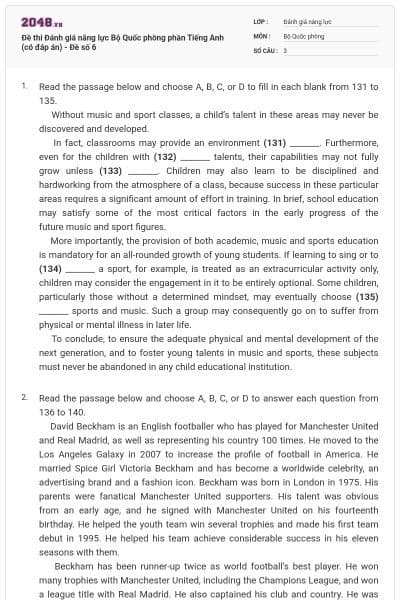
Chọn A.Read the passage below and choose A, B, C, or D to fill in each blank from 131 to 135.
It is natural for young people to be critical of their parents at times and to (131) _______ them for most of the misunderstandings between them. They have always complained, more or less justly, that their parents are old-fashioned, possessive and dominant; (132) _______ to deal with obstacles; that they talk too much about certain problems and that they have no (133) _______ of humor, at least in parent-child relationships. I think it is true that parents often underestimate their teenage children and also forget how they themselves felt when they were young.
Young people often irritate their parents with their choices in clothes and hairstyles, in entertainers and music. This is not their motive. They feel cut off from the adult world into which they have not yet been accepted. So they create a culture and society of their own. Then, if it turns out that their music or entertainers or vocabulary or clothes or (134) _______, this gives them additional enjoyment. They feel they are superior, at least in a small way, and that they are leaders in style and taste.
If you plan (135) _______ your life, co-operation can be part of that plan. You can charm others, especially parents, into doing things the ways you want, and impress others with your sense of responsibility and initiative, so that they will give you the authority to do what you want to do.
thank.
blame.
commend.
ignore.
Kiến thức về cụm động từ
blame sb for sth/doing sth: đổ lỗi cho ai về việc gì
Chọn B.
Dịch: Đôi khi, những người trẻ tuổi thường chỉ trích và đổ lỗi cho cha mẹ mình về hầu hết những hiểu lầm giữa họ.
that they do not trust their children.
that it does not trust their children.
that does not trust their children.
which they do not trust their children.
Kiến thức về cấu trúc câu
S1 + complain + that + S2 + V + O: phàn nàn → loại C và D
“they” ở câu A ám chỉ “parents” → Chọn A.
Dịch: Họ luôn phàn nàn, ít nhiều là đúng, rằng cha mẹ họ cổ hủ, kiểm soát quá mức và độc đoán; rằng họ không tin tưởng con cái mình có thể giải quyết được những trở ngại; …
sense.
amount.
degree.
level.
Kiến thức về từ vựng
sense of humor: khiếu hài hước
Chọn A.
Dịch: Họ luôn phàn nàn, ít nhiều là đúng, rằng cha mẹ họ cổ hủ, kiểm soát quá mức và độc đoán; rằng họ không tin tưởng con cái mình có thể giải quyết được những trở ngại; rằng họ nói quá nhiều về một vài vấn đề nào đó và rằng họ không có khiếu hài hước, ít nhất là trong mối quan hệ cha mẹ - con cái.
their parents hairstyles irritate.
irritates their parents hairstyles.
hairstyles irritate their parents.
hairstyles irritating their parents.
Kiến thức về cấu trúc câu
Ta thấy sau “that” cần 1 mệnh đề. Cụm “their music or entertainers or vocabulary or clothes or hairstyles” đóng vai trò làm chủ ngữ (số nhiều), nên sau đó cần 1 động từ chia nguyên thể.
Chọn C.
Dịch: Khi đó, nếu gu âm nhạc, nghệ sĩ yêu thích, ngôn ngữ, quần áo hoặc kiểu tóc của họ làm cha mẹ khó chịu, điều này sẽ mang lại cho họ thêm niềm vui.
controlled.
to be control.
to control.
controlling.
Kiến thức về cấu trúc – từ loại
plan to do sth: lên kế hoạch làm gì
Chọn C.
Dịch: Nếu bạn có kế hoạch làm chủ cuộc sống của mình, sự hợp tác có thể là một phần của kế hoạch đó.
Dịch bài đọc:
Đôi khi, những người trẻ tuổi thường chỉ trích và đổ lỗi cho cha mẹ mình về hầu hết những hiểu lầm giữa họ. Họ luôn phàn nàn, ít nhiều là đúng, rằng cha mẹ họ cổ hủ, kiểm soát quá mức và độc đoán; rằng họ không tin tưởng con cái mình có thể giải quyết được những trở ngại; rằng họ nói quá nhiều về một vài vấn đề nào đó và rằng họ không có khiếu hài hước, ít nhất là trong mối quan hệ cha mẹ - con cái. Tôi nghĩ đúng là cha mẹ thường đánh giá thấp con cái tuổi teen của mình và họ cũng quên mất họ cảm thấy như thế nào khi còn nhỏ.
Những người trẻ tuổi thường làm cha mẹ khó chịu với những lựa chọn về quần áo và kiểu tóc, về nghệ sĩ giải trí và âm nhạc của mình. Họ không hề cố ý làm điều đó. Họ cảm thấy bị tách biệt khỏi thế giới người lớn, nơi họ vẫn chưa được chấp nhận. Vì vậy, họ tạo ra một nền văn hóa và xã hội của riêng mình. Khi đó, nếu gu âm nhạc, nghệ sĩ yêu thích, ngôn ngữ, quần áo hoặc kiểu tóc của họ làm cha mẹ khó chịu, điều này sẽ mang lại cho họ thêm niềm vui. Họ cảm thấy mình vượt trội, ít nhất là ở một khía cạnh nhỏ, và rằng họ là người dẫn đầu về phong cách và thị hiếu.
Nếu bạn có kế hoạch làm chủ cuộc sống của mình, sự hợp tác có thể là một phần của kế hoạch đó. Bạn có thể thuyết phục người khác, đặc biệt là cha mẹ, làm mọi việc theo cách bạn muốn và gây ấn tượng với người khác bằng tinh thần trách nhiệm và chủ động của mình, để họ trao cho bạn quyền làm những gì bạn muốn.
Read the passage below and choose A, B, C, or D to answer each question from 136 to 140.
International Women’s Day, celebrated on March 8th, is a time to honor women’s progress and advocate for real change towards gender equality. This day, rooted in a 1908 demonstration where 15,000 women in New York City stood united for equal rights, better pay, shorter hours, and voting rights, has grown into a worldwide movement. Clara Zetkin, at a meeting in 1910, suggested a special day each year to focus on women’s rights, leading to the first International Women’s Day in 1911.
Despite some beliefs that women have equal chances as men, the reality often tells a different story. Girls worldwide face more household duties than boys and are more likely to miss out on school. In many countries, equal education for both genders is not guaranteed, and many girls are married off young, which can force them to end school early, lead to early pregnancy together with other health issues, and increase the chance of domestic violence.
On International Women’s Day, people participate in activities that raise awareness and call for gender equality. Wearing purple, a color of women’s rights history, is common. It is also a day when women are celebrated with gifts and social recognition in some places.
The journey towards full gender equality continues to face challenges. Yet, women’s groups across the globe remain strong and active, with younger women and teenagers adding their voices and energy to the cause. They are organizing, speaking out, and urging a shift in how we view and act towards each other regarding gender roles.
That women should wear purple to show unity.
That a global protest for women’s rights be organized.
That an international day each year be dedicated to women’s rights.
That women should receive gifts and social recognition on March 8th.
Kiến thức về đọc hiểu thông tin được nêu trong bài
Dịch: Clara Zetkin đã đưa ra đề xuất gì tại cuộc họp năm 1910?
A. Phụ nữ nên mặc màu tím để thể hiện sự đoàn kết.
B. Nên tổ chức một cuộc biểu tình toàn cầu vì quyền phụ nữ.
C. Mỗi năm, hãy dành một ngày quốc tế cho quyền phụ nữ.
D. Phụ nữ nên nhận được những món quà và sự công nhận của xã hội vào ngày 8 tháng 3.
Thông tin: Clara Zetkin, at a meeting in 1910, suggested a special day each year to focus on women’s rights, leading to the first International Women’s Day in 1911. (Tại một cuộc họp năm 1910, Clara Zetkin đã kiến nghị dành một ngày đặc biệt mỗi năm để tôn vinh quyền phụ nữ, dẫn đến Ngày Quốc tế Phụ nữ đầu tiên vào năm 1911.)
Chọn C.
The historical roots of International Women’s Day.
The challenges girls and women still face worldwide regarding education and equality.
The different ways International Women’s Day is celebrated globally.
The reasons why girls perform better in school than boys.
Kiến thức về đọc hiểu ý chính của đoạn văn
Dịch: Ý chính của đoạn 2 là gì?
A. Nguồn gốc lịch sử của Ngày Quốc tế Phụ nữ.
B. Những thách thức mà trẻ em gái và phụ nữ trên toàn thế giới vẫn phải đối mặt liên quan đến giáo dục và bình đẳng.
C. Những cách khác nhau để kỷ niệm Ngày Quốc tế Phụ nữ trên toàn cầu.
D. Những lý do tại sao trẻ em gái học giỏi hơn trẻ em trai.
Thông tin: Despite some beliefs that women have equal chances as men, the reality often tells a different story. Girls worldwide face more household duties than boys and are more likely to miss out on school. In many countries, equal education for both genders is not guaranteed, and many girls are married off young, which can force them to end school early, lead to early pregnancy together with other health issues, and increase the chance of domestic violence. (Mặc dù một số người tin rằng phụ nữ có cơ hội bình đẳng như nam giới, nhưng thực tế thường lại cho thấy một câu chuyện khác. Trẻ em gái trên toàn thế giới phải làm nhiều công việc nhà hơn trẻ em trai và có nhiều khả năng bỏ học hơn. Ở nhiều quốc gia, giáo dục bình đẳng cho cả hai giới không được đảm bảo và nhiều trẻ em gái kết hôn khi còn nhỏ, điều này có thể buộc các em phải nghỉ học sớm, dẫn đến mang thai sớm cùng với các vấn đề sức khỏe khác và tăng nguy cơ bạo lực gia đình.)
Chọn B.
International Women’s Day.
Awareness.
Gender equality.
Wearing purple.
Kiến thức về đại từ quy chiếu
Dịch: Từ “It” trong đoạn 3 ám chỉ điều gì?
A. Ngày Quốc tế Phụ nữ B. Nhận thức
C. Bình đẳng giới D. Mặc đồ màu tím
Thông tin: On International Women’s Day, people participate in activities that raise awareness and call for gender equality. Wearing purple, a color of women’s rights history, is common. It is also a day when women are celebrated with gifts and social recognition in some places. (Vào Ngày Quốc tế Phụ nữ, mọi người tham gia vào các hoạt động nâng cao nhận thức và kêu gọi bình đẳng giới. Mặc đồ màu tím, màu biểu trưng cho lịch sử quyền phụ nữ, là điều rất phổ biến. Ở một số nơi, đây cũng là ngày phụ nữ được tôn vinh bằng những món quà và sự ghi nhận của xã hội.)
Chọn A.
Organizing demonstrations against domestic violence.
Wearing purple, a color associated with women’s rights history.
Attending conferences led by Clara Zetkin.
Volunteering at women’s shelters.
Kiến thức về đọc hiểu thông tin được nêu trong bài
Dịch: Một cách phổ biến mà mọi người thể hiện sự ủng hộ đối với bình đẳng giới vào Ngày Quốc tế Phụ nữ là gì?
A. Tổ chức biểu tình chống bạo lực gia đình.
B. Mặc đồ màu tím, một màu gắn liền với lịch sử quyền phụ nữ.
C. Tham dự các hội nghị do Clara Zetkin chủ trì.
D. Làm tình nguyện tại các nhà tạm trú cho phụ nữ.
Thông tin: On International Women’s Day, people participate in activities that raise awareness and call for gender equality. Wearing purple, a color of women’s rights history, is common. (Vào Ngày Quốc tế Phụ nữ, mọi người tham gia vào các hoạt động nâng cao nhận thức và kêu gọi bình đẳng giới. Mặc đồ màu tím, màu biểu trưng cho lịch sử quyền phụ nữ, là điều rất phổ biến.)
Chọn B.
Which of the following would the author most likely support?
Gender equality has already been achieved, so International Women’s Day is no longer necessary.
Only women in developed countries face challenges related to gender inequality.
Celebrating women with gifts is the most important aspect of International Women’s Day.
International Women’s Day is crucial for raising awareness and advocating for ongoing gender equality issues.
Kiến thức về đọc hiểu - suy luận thông tin
Dịch: Tác giả có khả năng ủng hộ ý sau đây nhất?
A. Bình đẳng giới đã đạt được, vì vậy Ngày Quốc tế Phụ nữ không còn cần thiết nữa.
B. Chỉ phụ nữ ở các nước phát triển mới phải đối mặt với những thách thức liên quan đến bất bình đẳng giới.
C. Tôn vinh phụ nữ bằng những món quà là khía cạnh quan trọng nhất của Ngày Quốc tế Phụ nữ.
D. Ngày Quốc tế Phụ nữ có ý nghĩa quan trọng trong việc nâng cao nhận thức và ủng hộ các vấn đề bình đẳng giới đang diễn ra.
Thông tin: Dựa vào thông tin toàn bài.
Chọn D.
Dịch bài đọc:
Ngày Quốc tế Phụ nữ, được tổ chức vào ngày 8 tháng 3, là thời điểm để tôn vinh sự tiến bộ của phụ nữ và ủng hộ sự thay đổi thực sự hướng tới bình đẳng giới. Ngày này, bắt nguồn từ cuộc biểu tình năm 1908, trong đó 15.000 phụ nữ ở thành phố New York đoàn kết đấu tranh vì quyền bình đẳng, mức lương tốt hơn, giờ làm ngắn hơn và quyền bầu cử, đã phát triển thành một phong trào trên toàn thế giới. Tại một cuộc họp năm 1910, Clara Zetkin đã kiến nghị dành một ngày đặc biệt mỗi năm để tôn vinh quyền phụ nữ, dẫn đến Ngày Quốc tế Phụ nữ đầu tiên vào năm 1911.
Mặc dù một số người tin rằng phụ nữ có cơ hội bình đẳng như nam giới, nhưng thực tế thường lại cho thấy một câu chuyện khác. Trẻ em gái trên toàn thế giới phải làm nhiều công việc nhà hơn trẻ em trai và có nhiều khả năng bỏ học hơn. Ở nhiều quốc gia, giáo dục bình đẳng cho cả hai giới không được đảm bảo và nhiều trẻ em gái kết hôn khi còn nhỏ, điều này có thể buộc các em phải nghỉ học sớm, dẫn đến mang thai sớm cùng với các vấn đề sức khỏe khác và tăng nguy cơ bạo lực gia đình.
Vào Ngày Quốc tế Phụ nữ, mọi người tham gia vào các hoạt động nâng cao nhận thức và kêu gọi bình đẳng giới. Mặc đồ màu tím, màu biểu trưng cho lịch sử quyền phụ nữ, là điều rất phổ biến. Ở một số nơi, đây cũng là ngày phụ nữ được tôn vinh bằng những món quà và sự ghi nhận của xã hội.
Hành trình hướng tới bình đẳng giới hoàn toàn vẫn đang phải đối mặt với nhiều thách thức. Tuy nhiên, các nhóm nữ giới trên toàn cầu vẫn mạnh mẽ và năng động, trong đó phụ nữ trẻ và thanh thiếu niên đang đóng góp tiếng nói và năng lượng của mình cho mục tiêu này. Họ đang tổ chức, lên tiếng và thúc đẩy sự thay đổi trong cách chúng ta nhìn nhận và hành động đối với nhau liên quan đến vai trò giới.
Read the passage below and choose A, B, C, or D to answer each question from 141 to 145.
Sometimes people add to what they say even when they don’t talk. Gestures are the “silent language” of every culture. We point a finger or move another part of the body to show what we want to say. It is important to know the body language of every country or we may be misunderstood. In the United States, people greet each other with a handshake in a formal introduction. The handshake must be firm. If the handshake is weak, it is a sign of weakness or unfriendliness. Friends may place a hand on the other’s arm or shoulder. Some people, usually women, greet a friend with a hug.
Space is important to Americans. When two people talk to each other, they usually stand about two and a half feet away and at an angle, so they are not facing each other directly. Americans get uncomfortable when a person stands too close. They will move back to have their space. If Americans touch another person by accident, they say, “Pardon me.” or “Excuse me.” Americans like to look at the other person in the eyes when they are talking. If you don’t do so, it means you are bored, hiding something, or are not interested. But when you are staring at someone, it is not polite. For Americans, thumbs-up means yes, very good, or well done. Thumbs down means the opposite. To call a waiter, raise one hand to head level or above. To show you want the check, make a movement with your hands as if you are signing a piece of paper. It is all right to point at things but not at people with the hand and index finger. Americans shake their index finger at children when they scold them and pat them on the head when they admire them. Learning a culture’s body language is sometimes confusing. If you don’t know what to do, the safest thing to do is to smile.
The importance of understanding body language in different cultures.
The proper way to perform a handshake in formal introductions.
The various forms of physical greetings used in the United States.
How gestures can add meaning to communication and vary by culture.
Kiến thức về đọc hiểu ý chính của đoạn văn
Dịch: Đoạn 1 chủ yếu nói về điều gì?
A. Tầm quan trọng của việc hiểu ngôn ngữ cơ thể ở các nền văn hóa khác nhau.
B. Cách bắt tay đúng cách khi chào hỏi trang trọng.
C. Các hình thức chào hỏi bằng ngôn ngữ cơ thể khác nhau được sử dụng ở Hoa Kỳ.
D. Cử chỉ có thể thêm ý nghĩa vào giao tiếp như thế nào và khác nhau tùy theo nền văn hóa.
Thông tin: Đoạn 1 (Đôi khi mọi người thêm vào những gì họ nói ngay cả khi không cần dùng lời nói. Cử chỉ là “ngôn ngữ thầm lặng” của mọi nền văn hóa. Chúng ta chỉ tay hoặc di chuyển một bộ phận khác của cơ thể để biểu đạt những gì chúng ta muốn nói. Việc hiểu ngôn ngữ cơ thể của mọi quốc gia là điều rất quan trọng, nếu không chúng ta có thể bị hiểu lầm. Ở Hoa Kỳ, khi chào hỏi trang trọng, mọi người thường bắt tay để chào nhau. Cái bắt tay phải chắc chắn. Nếu cái bắt tay lỏng lẻo, đó là dấu hiệu của sự yếu đuối hoặc không thân thiện. Bạn bè có thể đặt tay lên cánh tay hoặc vai của người kia. Một số người, thường là phụ nữ, chào bạn bè bằng cái ôm.)
Chọn A.
Americans prefer to stand close to each other while talking and face each other directly.
Americans value personal space and generally maintain a distance of about two and a half feet, standing at an angle during conversations.
Americans like to stand far apart and avoid any physical contact during conversations.
Americans often face each other directly and stand close together when talking.
Kiến thức về dạng Paraphrase của một câu
Dịch: Câu nào dưới đây diễn giải đúng nhất những câu sau: “Space is important to Americans. When two people talk to each other, they usually stand about two and a half feet away and at an angle, so they are not facing each other directly.”?
A. Người Mỹ thích đứng gần nhau khi nói chuyện và đối mặt trực tiếp với nhau.
B. Người Mỹ coi trọng không gian cá nhân và thường duy trì khoảng cách khoảng hai feet rưỡi, đứng nghiêng trong khi trò chuyện.
C. Người Mỹ thích đứng cách xa nhau và tránh mọi tiếp xúc cơ thể trong khi trò chuyện.
D. Người Mỹ thường đối mặt trực tiếp với nhau và đứng gần nhau khi nói chuyện.
Thông tin: Space is important to Americans. When two people talk to each other, they usually stand about two and a half feet away and at an angle, so they are not facing each other directly. (Không gian rất quan trọng đối với người Mỹ. Khi hai người nói chuyện với nhau, họ thường đứng cách nhau khoảng hai feet rưỡi và hơi nghiêng để không đối mặt trực tiếp với nhau.)
Chọn B.
on purpose.
by mistake.
carefully.
secretly.
Kiến thức về cụm từ đồng nghĩa
Dịch: Cụm “by accident” ở đoạn 2 có nghĩa gần nhất với từ nào?
A. cố ý B. vô tình C. cẩn thận D. bí mật
Thông tin: If Americans touch another person by accident, they say, “Pardon me.” or “Excuse me.” (Nếu người Mỹ vô tình chạm vào người khác, họ sẽ nói “Thứ lỗi.” hoặc “Xin lỗi.”)
Chọn B.
Americans.
children.
fingers.
people.
Kiến thức về đại từ quy chiếu
Dịch: Từ “them” ở đoạn 2 ám chỉ điều gì?
A. người Mỹ B. trẻ em C. ngón tay D. mọi người
Thông tin: Americans shake their index finger at children when they scold them and pat them on the head when they admire them. (Người Mỹ lắc ngón trỏ với trẻ em khi họ mắng chúng và xoa đầu chúng khi khen ngợi.)
Chọn B.
Learning and understanding the body language of different cultures is crucial to avoid misunderstandings.
Americans prefer to maintain close physical contact during conversations.
Gestures such as thumbs-up and thumbs-down are universally understood.
It is more important to use verbal communication than to pay attention to body language.
Kiến thức về đọc hiểu - suy luận thông tin
Dịch: Tác giả có thể ủng hộ ý nào sau đây?
A. Việc học và hiểu ngôn ngữ cơ thể của các nền văn hóa khác nhau là rất quan trọng để tránh hiểu lầm.
B. Người Mỹ thích duy trì tiếp xúc cơ thể thân mật trong khi trò chuyện.
C. Giơ ngón tay cái lên và giơ ngón tay cái xuống là những cử chỉ chung mà mọi người đều hiểu ý nghĩa.
D. Việc sử dụng giao tiếp bằng lời nói quan trọng hơn là chú ý đến ngôn ngữ cơ thể.
Thông tin: It is important to know the body language of every country or we may be misunderstood. (Việc hiểu ngôn ngữ cơ thể của mọi quốc gia là điều rất quan trọng, nếu không chúng ta có thể bị hiểu lầm.)
Chọn A.
Dịch bài đọc:
Đôi khi mọi người thêm vào những gì họ nói ngay cả khi không cần dùng lời nói. Cử chỉ là “ngôn ngữ thầm lặng” của mọi nền văn hóa. Chúng ta chỉ tay hoặc di chuyển một bộ phận khác của cơ thể để biểu đạt những gì chúng ta muốn nói. Việc hiểu ngôn ngữ cơ thể của mọi quốc gia là điều rất quan trọng, nếu không chúng ta có thể bị hiểu lầm. Ở Hoa Kỳ, khi chào hỏi trang trọng, mọi người thường bắt tay để chào nhau. Cái bắt tay phải chắc chắn. Nếu cái bắt tay lỏng lẻo, đó là dấu hiệu của sự yếu đuối hoặc không thân thiện. Bạn bè có thể đặt tay lên cánh tay hoặc vai của người kia. Một số người, thường là phụ nữ, chào bạn bè bằng cái ôm.
Không gian rất quan trọng đối với người Mỹ. Khi hai người nói chuyện với nhau, họ thường đứng cách nhau khoảng hai feet rưỡi và hơi nghiêng để không đối mặt trực tiếp với nhau. Người Mỹ cảm thấy không thoải mái khi người khác đứng quá gần. Họ sẽ lùi lại để có không gian riêng. Nếu người Mỹ vô tình chạm vào người khác, họ sẽ nói “Thứ lỗi.” hoặc “Xin lỗi.” Người Mỹ thích nhìn vào mắt người khác khi đang nói chuyện. Nếu bạn không làm như vậy, điều đó có nghĩa là bạn đang chán, đang che giấu điều gì đó hoặc đang không quan tâm. Ngược lại khi bạn nhìn chằm chằm vào ai đó, điều đó là bất lịch sự. Đối với người Mỹ, ngón tay cái hướng lên có nghĩa là đồng ý, rất giỏi hoặc làm tốt. Ngón tay cái hướng xuống mang nghĩa ngược lại. Để gọi người phục vụ, hãy giơ một tay lên ngang đầu hoặc cao hơn. Để thanh toán, hãy làm một động tác bằng tay như thể bạn đang ký vào một tờ giấy. Chỉ vào đồ vật thì được nhưng không được chỉ vào người bằng tay và ngón trỏ. Người Mỹ lắc ngón trỏ với trẻ em khi họ mắng chúng và xoa đầu chúng khi khen ngợi. Học ngôn ngữ cơ thể của một nền văn hóa đôi khi rất khó hiểu. Nếu bạn không biết phải làm gì, điều an toàn nhất là mỉm cười.
Would it be okay if everyone joined in the activity?.
Balloons seem like a fantastic addition to the party!.
Could I have a chance to join in this activity, please?.
Wow! Those bright balloons really caught my attention.
Kiến thức xử lý tình huống giao tiếp
Bạn đang tham dự bữa tiệc sinh nhật của một người bạn, ở đó có nhiều người bạn khác đang chơi trò gì đó với bóng bay trông rất vui. Bạn hơi nhát và không quen biết những người đó. Tuy nhiên, bạn muốn chơi cùng họ. Bạn có thể nói gì?
A. Có ổn không nếu mọi người cùng tham gia hoạt động này?
B. Bóng bay có vẻ là một sự bổ sung tuyệt vời cho bữa tiệc!
C. Không biết tớ có thể tham gia trò chơi này không?
D. Wow! Những quả bóng bay sáng đó thực sự thu hút sự chú ý của tôi.
Chọn C.
Kate, the manager, is asking David, her assistant, about a report. What would be the best response for David in this situation?
Kate: Can you send me the report this weekend?
David: _______
Don’t mention it! I’ll need it for the meeting on Sunday.
That’s no big deal. I’ll have it done by Saturday.
That sounds great. Why don’t you send me all the details?.
I’m not surprised. The manager is going to check it on Monday.
Kiến thức xử lý tình huống giao tiếp
Kate, người quản lý, đang hỏi David, trợ lý của cô ấy, về bản báo cáo. Câu trả lời tốt nhất cho David trong tình huống này là gì?
Kate: Cậu có thể gửi cho tôi báo cáo vào cuối tuần này không?
David: ________
A. Đừng nhắc nữa! Tôi sẽ cần nó cho cuộc họp vào Chủ Nhật.
B. Không vấn đề gì. Tôi sẽ hoàn thành nó trước thứ Bảy.
C. Nghe có vẻ tuyệt đấy. Sao anh không gửi cho tôi tất cả các thông tin chi tiết nhỉ?
D. Tôi không ngạc nhiên. Người quản lý sẽ kiểm tra nó vào thứ Hai.
Chọn B.
The movie is the greatest ever made.
The movie is the director’s best so far.
The movie feels too long to sit through.
The movie won three Oscars last year.
Kiến thức phân biệt sự thật và ý kiến
Sau đây là những câu nói về một bộ phim. Câu nào có thể là sự thật?
A. Đó là bộ phim tuyệt vời nhất từng được quay.
B. Đó là bộ phim hay nhất của đạo diễn cho đến nay.
C. Bộ phim có vẻ quá dài để ngồi xem hết.
D. Bộ phim đã giành được ba giải Oscar vào năm ngoái.
Chọn D.
You’ve noticed that whenever the heater in your house is turned on, the lights in the living room flicker. What is the likely cause?
The heater and the lights are malfunctioning.
There is an issue with the living room’s light system.
The living room’s lights need more electrical power.
The heater and the lights are on the same electrical circuit.
Kiến thức về tư duy logic
Bạn nhận thấy rằng bất cứ khi nào máy sưởi trong nhà bạn được bật, đèn trong phòng khách sẽ nhấp nháy. Nguyên nhân có thể là gì?
A. Máy sưởi và đèn bị trục trặc.
B. Có vấn đề với hệ thống đèn của phòng khách.
C. Đèn ở phòng khách cần tiêu thụ nhiều điện năng hơn.
D. Máy sưởi và đèn nằm trên cùng một mạch điện.
→ Khi cả máy sưởi và đèn đều nằm trên cùng một mạch điện, máy sưởi có thể tiêu thụ một lượng điện áp cao hơn, gây ra hiện tượng sụt áp tạm thời, khiến đèn nhấp nháy.
Chọn D.
Which of the following situations best exemplifies “compensation” where someone makes up for a loss or damage they caused?
Sarah forgets to return her friend’s borrowed jacket on time. She apologizes and assures her friend that she will return it the next day.
Sarah accidentally spills juice on her friend’s favorite book. She invites her friend for coffee and presents him a new copy of the book.
Sarah breaks a plate while washing dishes at her friend’s house. She takes the time to carefully clean up the mess and apologizes sincerely.
Sarah borrows her friend’s bicycle and returns it with a flat tire. She promises to return the bicycle promptly after fixing the tire herself.
Kiến thức về nghĩa của từ, suy luận
Trong các tình huống sau đây, tình huống nào minh họa rõ nhất cho từ “bồi thường” khi ai đó bù đắp cho mất mát hoặc thiệt hại mà họ gây ra?
A. Sarah quên trả lại chiếc áo khoác mượn của bạn đúng hạn. Cô ấy xin lỗi và đảm bảo với bạn rằng cô ấy sẽ trả lại vào ngày hôm sau.
B. Sarah vô tình làm đổ nước trái cây lên cuốn sách yêu thích của bạn mình. Cô ấy mời bạn mình đi uống cà phê và tặng anh ấy một cuốn sách mới.
C. Sarah làm vỡ một chiếc đĩa khi rửa bát tại nhà bạn mình. Cô ấy dành thời gian để cẩn thận dọn dẹp đống bừa bộn và chân thành xin lỗi.
D. Sarah mượn xe đạp của bạn mình và trả lại với chiếc lốp xẹp. Cô ấy hứa sẽ trả lại xe đạp ngay sau khi tự mình vá lốp.
→ Hành động bồi thường khi làm hư hại đồ vật của ai đó.
Chọn B.