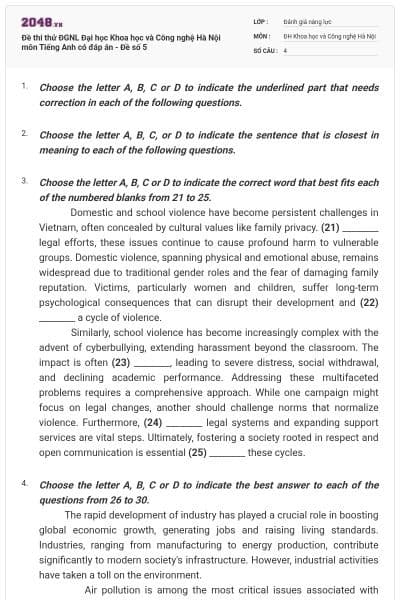
Đề thi thử ĐGNL Đại học Khoa học và Công nghệ Hà Nội môn Tiếng Anh có đáp án - Đề số 5
30 câu hỏi
Choose the letter A, B, C or D to indicate the word whose underlined part pronounced differently from the others.
psychology
stomach
champagne
technique
A. psychology /saɪˈkɒlədʒi/
B. stomach /ˈstʌmək/
C. champagne /ʃæmˈpeɪn/
D. technique /tekˈniːk/
Phương án C có phần gạch chân phát âm là /ʃ/, còn lại phát âm là /k/.
Choose the letter A, B, C or D to indicate the word whose underlined part pronounced differently from the others.
breath
mouth
wealthy
smooth
A. breath /breθ/
B. mouth /maʊθ/
C. wealthy /ˈwelθi/
D. smooth /smuːð/
Phương án D có phần gạch chân phát âm là /ð/, còn lại phát âm là /θ/.
Choose the letter A, B, C or D to indicate the word with a different stress pattern from the others.
notice
preserve
follow
govern
A. notice /ˈnəʊtɪs/ (trọng âm 1)
B. preserve /prɪˈzɜːv/ (trọng âm 2)
C. follow /ˈfɒləʊ/ (trọng âm 1)
D. govern /ˈɡʌvn/ (trọng âm 1)
Phương án B có trọng âm rơi vào âm tiết thứ 2, còn lại rơi vào âm tiết thứ 1.
Choose the letter A, B, C or D to indicate the best answer to complete each of the following questions.
much higher than
by far higher than
the highest compared to
as high as
- Xét nghĩa câu: Khi dân số thành thị tiếp tục tăng, giá nhà tại các thành phố lớn đang trở nên ________ so với mười năm trước, tạo ra áp lực tài chính đáng kể hơn cho giới trẻ.
Ta thấy câu đang so sánh hai đối tượng: giá nhà ở hiện tại và giá nhà thời điểm mười năm trước.
" Ta dùng công thức so sánh hơn của tính từ ngắn (“high” chỉ có 1 âm tiết): S + be + adj-er + than + N / pronoun.
- Để nhấn mạnh mức độ của sự so sánh hơn, ta dùng các trạng từ như “much” và “far” trước tính từ so sánh.
" Chọn A
Phương án B: sai vì “by far” dùng đứng trước và nhấn mạnh so sánh hơn nhất.
Phương án C dùng so sánh nhất không phù hợp ngữ cảnh “than”.
Phương án D là so sánh bằng, không phù hợp về nghĩa.
Dịch:
As urban populations continue to grow, housing prices in major cities are becoming much higher thanthey were just a decade ago, creating more significant financial pressure on young adults. (Khi dân số thành thị tiếp tục tăng, giá nhà tại các thành phố lớn đang trở nên cao hơn nhiều so với mười năm trước, tạo ra áp lực tài chính đáng kể hơn cho giới trẻ.)
economy
economic
economical
economically
A. economy (n): nền kinh tế
B. economic (adj): thuộc về kinh tế
C. economical (adj): tiết kiệm
D. economically (adv): một cách kinh tế / tiết kiệm
- Thông tin cần điền đứng trước danh từ “development” (sự phát triển).
" Thông tin cần điền là một tính từ. " Loại A và D.
- Xét nghĩa câu: Sự phát triển ________ của khu vực phải được cân bằng với việc bảo vệ môi trường để đảm bảo sự thịnh vượng lâu dài cho cư dân.
" Chọn B, phương án C không phù hợp về nghĩa.
Dịch:
The economic development of the region must be balanced with environmental protection to ensure long-term prosperity for the residents. (Sự phát triển kinh tế của khu vực phải được cân bằng với việc bảo vệ môi trường để đảm bảo sự thịnh vượng lâu dài cho cư dân.)
to be described
describing
described
to describe
Đây là dạng rút gọn mệnh đề quan hệ đặc biệt.
- “________ culture shock as a motivation for personal growth during the interview” là mệnh đề quan hệ bổ nghĩa cho cụm danh từ “ the only candidate”.
- Khi danh từ đứng trước có các từ chỉ thứ tự hoặc duy nhất như: the only, the first, the second, the last... hoặc so sánh nhất, ta rút gọn mệnh đề quan hệ bằng cụm To-V (nếu chủ động) hoặc To be V3 / V-ed (nếu bị động).
- Trong câu này, “the only candidate” là người thực hiện hành động “describe” (mô tả).
" Ta dùng thể chủ động, tức phương án D (to describe).
Dịch:
Was she the only candidate to describe culture shock as a motivation for personal growth during the interview? (Có phải cô ấy là ứng viên duy nhất đã mô tả cú sốc văn hóa như một động lực để phát triển cá nhân trong buổi phỏng vấn hay không?)
is / enhanced
was / enhance
is / enhances
was / enhanced
- Ta có cấu trúc giả định với cụm từ: It is (high / about) time + S + V-ed / V2 (Đã đến lúc ai đó phải làm gì).
" Chọn A
Dịch:
It is high time every graduate enhanced skills that machines cannot replicate, such as creative thinking and emotional intelligence. (Đã đến lúc mọi sinh viên tốt nghiệp cần nâng cao những kỹ năng mà máy móc không thể thay thế, chẳng hạn như tư duy sáng tạo và trí tuệ cảm xúc.)
had decided / would have captivated
decides / will captivate
decided / would captivate
had decided / would captivate
- Mệnh đề phụ có mốc thời gian trong quá khứ (“years ago”).
" Mệnh đề phụ nêu ra sự việc không có thật trong quá khứ.
" Ta dùng công thức mệnh đề phụ câu điều kiện loại III (diễn tả hành động sự việc không có thực trong quá khứ) với công thức: If + S + had + V 3 / V-ed.
- Mệnh đề chính có mốc thời gian ở hiện tại (“today”).
" Mệnh đề chính nêu ra kết quả trái với thực tế ở hiện tại.
" Ta dùng công thức mệnh đề chính câu điều kiện loại II (diễn tả hành động sự việc không có thực ở hiện tại) với công thức: S + would / could + Vnguyên thể.
" Chọn D (had decided, would captivate)
Dịch:
If that city had decided to restore the originality of the site years ago, it would captivate more visitors today. (Nếu thành phố đó đã quyết định khôi phục lại vẻ nguyên bản của di tích từ nhiều năm trước, thì ngày nay nó thu hút được nhiều khách du lịch hơn.)
put off
run on
call off
turn down
A. put off (phr.v): trì hoãn
B. run on (phr.v): tiếp tục chạy, kéo dài hơn dự kiến
C. call off (phr.v): hủy bỏ
D. turn down (phr.v): từ chối (lời mời, đề nghị) hoặc vặn nhỏ âm lượng.
- Xét nghĩa câu: Nhiều học sinh có xu hướng ________ bài tập về nhà cho đến tận phút cuối cùng, điều này thường dẫn đến căng thẳng không cần thiết và kết quả học tập kém.
" Chọn A, các phương án khác không thích hợp về nghĩa.
Dịch:
Many students tend to put off their assignments until the very last minute, which often leads to unnecessary stress and poor academic results. (Nhiều học sinh có xu hướng trì hoãn bài tập về nhà cho đến tận phút cuối cùng, điều này thường dẫn đến căng thẳng không cần thiết và kết quả học tập kém.)
impose
to impose
imposing
to be imposed
- Ta có cấu trúc: Consider + V-ing: xem xét / cân nhắc làm việc gì đó.
" Chọn C
Dịch:
The local authorities should consider imposing heavier penalties on companies that ignore environmental protection laws. (Chính quyền địa phương nên xem xét áp đặt các hình phạt nặng hơn đối với những công ty phớt lờ luật bảo vệ môi trường.)
throughout
between
along
among
A. throughout (giới từ): xuyên suốt, khắp (về cả không gian và thời gian)
B. between (giới từ): ở giữa (thường chỉ giữa hai đối tượng)
C. along (giới từ): dọc theo (thường dùng trước vật có hình dáng dài như con đường, dòng sông)
D. among (giới từ): giữa, nằm trong số (thường chỉ giữa một nhóm từ ba đối tượng trở lên)
- Xét nghĩa câu: Công cụ truy xuất nguồn gốc như mã QR cho phép người tiêu dùng theo dõi nguồn gốc sản phẩm ________ toàn bộ chuỗi cung ứng.
" Chọn A
Dịch:
Traceability tools like QR codes allow consumers to track the origin of products throughout the entire supply chain. (Các công cụ truy xuất nguồn gốc như mã QR cho phép người tiêu dùng theo dõi nguồn gốc của sản phẩm xuyên suốt toàn bộ chuỗi cung ứng.)
install
installing
installed
to install
- Ta có cấu trúc câu sai khiến (Causative form) với động từ Get:
Chủ động: Get + somebody + to-V (Nhờ / thuê ai đó làm gì).
Bị động: Get + something + V3 / V-ed (Có cái gì được làm bởi ai đó).
- Ở đây, “a new digital platform” (một nền tảng kỹ thuật số mới) là vật, nó phải được “cài đặt” (install) bởi con người.
" Ta phải dùng dạng bị động với quá khứ phân từ (installed).
" Chọn C
Dịch:
My school, aiming to enhance student engagement through modern methods, got a new digital platform installed last month. (Trường của tôi, với mục tiêu nâng cao sự tham gia của học sinh thông qua các phương pháp hiện đại, đã có một nền tảng kỹ thuật số mới được cài đặt vào tháng trước.)
to interact
spread
damage seriously
in
Đáp án đúng là C
- Trong tiếng Anh, trạng từ thường đứng trước động từ chính, hoặc sau tân ngữ.
Trong câu gốc, ta thấy trạng từ “seriously” đứng giữa động từ “damage” và tân ngữ “a person’s reputation”.
" Câu sai ở “damage seriously”. Ta sửa thành “seriously damage”.
Câu đúng:
Social media platforms allow users to interact with each other easily, but they can also spread false information that may seriously damage a person’s reputation in a short time. (Các nền tảng mạng xã hội cho phép người dùng dễ dàng tương tác với nhau, nhưng chúng cũng có thể lan truyền thông tin sai lệch, điều này có thể gây tổn hại nghiêm trọng đến danh tiếng của một người trong thời gian ngắn.)
is
has
implemented
over the past decade
Đáp án đúng là A
- Ta thấy “who” là đại từ quan hệ thay thế cho “people” (danh từ số nhiều) " Động từ chia theo “Who” cũng phải động từ dạng số nhiều.
" Câu sai ở động từ tobe “is”. Ta sửa thành “are”.
Câu đúng:
The number of people who are living in poverty has decreased significantly thanks to economic reforms implemented by the government over the past decade. (Số lượng người đang sống trong cảnh nghèo đói đã giảm đáng kể nhờ vào những cải cách kinh tế được chính phủ thực hiện trong thập kỷ qua.)
Having completed
leaving
enhances
satisfaction
- Ta có cấu trúc bị động của “allow” như sau: S + tobe + allowed + to-V: được cho phép làm gì.
" Câu sai ở “leaving”. Ta sửa thành “to leave”.
Câu đúng: Having completed all the required tasks, the employees are allowed to leave early, which enhances employee satisfaction. (Sau khi đã hoàn thành tất cả các nhiệm vụ được giao, nhân viên được phép ra về sớm, điều này giúp nâng cao sự hài lòng của nhân viên.)
Our daughter has participated in the cultural exchange program for three days.
Our daughter participated in the cultural exchange program for three days.
Our daughter started participating in the cultural exchange program three days ago.
Our daughter has participated in the cultural exchange program three days ago.
Our daughter was participating in the cultural exchange program for three days.
- Câu gốc: Our daughter has participated in the cultural exchange program for three days. (Con gái tôi đã tham gia chương trình trao đổi văn hóa được 3 ngày rồi.)
Câu gốc sử dụng thì Hiện tại hoàn thành với ý hiểu như sau: tính từ quá khứ đến hiện tại, “con gái tôi” đã tham gia được 3 ngày.
" Cách hiểu khác: “Con gái tôi” bắt đầu tham gia vào 3 ngày trước (three days ago). Cách hiểu mới đang miêu tả một sự việc đã xảy ra tại một thời điểm cụ thể trong quá khứ.
" Ta dùng thì Quá khứ đơn để diễn tả cách hiểu mới.
Ta có công thức chuyển từ thì Hiện tại hoàn thành (HTHT) sang Quá khứ đơn (QKĐ) như sau:
HTHT: S + has / have + V 3 / V-ed + for + khoảng thời gian.
QKĐ: S + started / began + V-ing / to-V + khoảng thời gian + ago.
" Ta được câu mới là: Our daughter started participating in the cultural exchange program three days ago.
" Chọn B
A. Our daughter participated in the cultural exchange program for three days. (Con gái tôi đã tham gia chương trình trao đổi văn hóa trong 3 ngày.)
" Sai vì dùng thì Quá khứ đơn ám chỉ việc tham gia đã kết thúc rồi (không còn tham gia nữa), lệch nghĩa câu gốc.
C. Our daughter has participated in the cultural exchange program three days ago.
" Sai ngữ pháp vì ta không dùng “ago” với thì Hiện tại hoàn thành.
D. Our daughter was participating in the cultural exchange program for three days.
" Sai vì dùng thì Quá khứ tiếp diễn (không phù hợp để diễn đạt sự việc đã xảy ra và kết thúc trong quá khứ).
Dịch:
Our daughter has participated in the cultural exchange program for three days. (Con gái tôi đã tham gia chương trình trao đổi văn hóa được 3 ngày rồi.)
= Our daughter started participating in the cultural exchange program three days ago. (Con gái tôi bắt đầu tham gia chương trình trao đổi văn hóa 3 ngày trước.)
She offered to help me carry the bags.
“Would you like to help me carry the bags?” she said to me.
“Help me carry the bags,” she said to me.
“Shall I help you carry the bags?” she said to me.
“You should help me carry the bags,” she said to me.
Đáp án đúng là C
Câu gốc: She offered to help me carry the bags. (Cô ấy đã ngỏ ý giúp tôi mang những chiếc túi.)
" Nói một cách dễ hiểu, câu mang nghĩa: cô ấy đề nghị giúp mình.
A. “Would you like to help me carry the bags?” she said to me. (“Bạn có muốn giúp tôi mang túi không?” cô ấy nói với tôi.)
" Sai vì đây là cô ấy nhờ mình giúp, không phải cô ấy đề nghị giúp mình.
B. “Help me carry the bags,” she said to me. (“Hãy giúp tôi mang túi đi,” cô ấy nói với tôi.)
" Sai vì đây là câu mệnh lệnh / yêu cầu, không phải lời đề nghị giúp đỡ người khác.
C. “Shall I help you carry the bags?” she said to me. (“Tôi giúp bạn mang túi nhé?” cô ấy nói với tôi.)
" Đúng. Động từ “offer to V” (ngỏ ý làm gì) là hình thức trực tiếp của cấu trúc “Shall I + V...?” dùng để đề nghị giúp đỡ người khác.
D. “You should help me carry the bags,” she said to me. (“Bạn nên giúp tôi mang túi,” cô ấy nói với tôi.)
" Sai vì đây là lời khuyên / ý kiến, không phải lời đề nghị giúp đỡ người khác.
Dịch:
She offered to help me carry the bags. (Cô ấy đã ngỏ ý giúp tôi mang những chiếc túi.)
= “Shall I help you carry the bags?” she said to me. (“Tôi giúp bạn mang túi nhé?” cô ấy nói với tôi.)
He didn’t study hard enough in the past. Now he struggles to keep up with his classmates.
If he had studied hard enough in the past, he would have kept up with his classmates now.
Had he studied hard enough in the past, he would not struggle to keep up with his classmates now.
If he studied hard enough in the past, he would not struggle to keep up with his classmates now.
Had he studied hard enough in the past, he would have struggled to keep up with his classmates now.
Đáp án đúng là B
- Ta cần kết hợp hai câu thành một câu điều kiện.
Câu gốc: He didn’t study hard enough in the past. Now he struggles to keep up with his classmates. (Anh ấy đã không học đủ chăm chỉ trong quá khứ. Giờ đây anh ấy vất vả để theo kịp bạn bè.)
- Câu thứ nhất: nêu thực tế trong quá khứ.
" Ta dùng công thức mệnh đề phụ câu điều kiện loại III (diễn tả hành động sự việc không có thực trong quá khứ) với công thức:
If + S + had + V 3 / V-ed = Had + S + V 3 / V-ed (dạng đảo ngữ).
- Câu thứ hai: nêu kết quả ở hiện tại.
" Ta dùng công thức mệnh đề chính câu điều kiện loại II (diễn tả hành động sự việc không có thực ở hiện tại) với công thức: S + would / could + (not) + Vnguyên thể.
" Ta được câu mới là:
If he had studied hard enough in the past, he would not struggle to keep up with his classmates now = Had he studied hard enough in the past, he would not struggle to keep up with his classmates now (nếu dùng dạng đảo ngữ).
" Chọn B
Dịch:
He didn’t study hard enough in the past. Now he struggles to keep up with his classmates. (Anh ấy đã không học đủ chăm chỉ trong quá khứ. Bây giờ anh ấy chật vật để theo kịp các bạn.)
= Had he studied hard enough in the past, he would not struggle to keep up with his classmates now. (Nếu anh ấy đã học đủ chăm chỉ trong quá khứ, anh ấy đã không chật vật theo kịp các bạn bây giờ.)
Governments should implement gender equality policies more effectively.
Gender equality policies should be implemented more effectively by governments.
Gender equality policies will be implemented more effectively by governments.
Gender equality policies were implemented more effectively by governments.
Gender equality policies are being implemented more effectively by governments.
Đáp án đúng là A
Câu gốc: Governments should implement gender equality policies more effectively. (Chính phủ nên thực thi các chính sách bình đẳng giới một cách hiệu quả hơn.)
- Câu gốc là câu chủ động sử dụng động từ khuyết thiếu “should”.
⭢ Cấu trúc bị động với động từ khuyết thiếu “should”: Something + should + be + V 3 / V-ed + (by somebody).
⭢ Chọn A. Các phương án khác đều dùng cấu trúc bị động của các thì, chứ không dùng cấu trúc bị động của động từ khuyết thiếu “should”.
Dịch:
Governments should implement gender equality policies more effectively. (Chính phủ nên thực thi các chính sách bình đẳng giới một cách hiệu quả hơn.)
= Gender equality policies should be implemented more effectively by governments. (Các chính sách bình đẳng giới nên được thực thi hiệu quả hơn bởi các chính phủ.)
He was extremely tired after working all night. He still managed to finish the report on time.
Because he was extremely tired after working all night, he still managed to finish the report on time.
Tiredness due to working all night didn’t prevent him from finishing the report on time.
He was extremely tired after working all night; but, he still managed to finish the report on time.
Despite he was extremely tired after working all night, he still managed to finish the report on time.
Câu gốc: He was extremely tired after working all night. He still managed to finish the report on time. (Anh ấy cực kỳ mệt mỏi sau khi làm việc cả đêm. Anh ấy vẫn xoay sở để hoàn thành báo cáo đúng hạn.)
" Hai câu gốc có mối quan hệ tương phản / nhượng bộ: Mặc dù mệt mỏi nhưng kết quả vẫn hoàn thành công việc.
A. Because he was extremely tired after working all night, he still managed to finish the report on time.
⭢ Sai vì dùng “Because” chỉ nguyên nhân - kết quả, không phù hợp để nối hai vế tương phản.
B. Tiredness due to working all night didn’t prevent him from finishing the report on time. (Sự mệt mỏi do làm việc cả đêm đã không ngăn cản anh ấy hoàn thành báo cáo đúng hạn.)
" Đúng vì khớp nghĩa với câu gốc và đúng ngữ pháp.
Ta có cấu trúc: (not) prevent somebody / something from doing something: không ngăn cản được ai / cái gì làm việc gì.
C. He was extremely tired after working all night; but, he still managed to finish the report on time.
⭢ Sai vì cách dùng “but” sai. Ta có cách dùng đúng: mệnh đề 1, but mệnh đề 2 (có dấu phẩy trước “but”).
D. Despite he was extremely tired after working all night, he still managed to finish the report on time.
⭢ Sai ngữ pháp. Ta có cấu trúc đúng: Despite + N / V-ing, chứ không dùng trước một mệnh đề (S + V).
Dịch:
He was extremely tired after working all night. He still managed to finish the report on time. (Anh ấy cực kỳ mệt mỏi sau khi làm việc cả đêm. Anh ấy vẫn xoay sở hoàn thành báo cáo đúng hạn.)
= Tiredness due to working all night didn’t prevent him from finishing the report on time. (Sự mệt mỏi do làm việc cả đêm đã không ngăn cản anh ấy hoàn thành báo cáo đúng hạn.)
Choose the letter A, B, C or D to indicate the correct word that best fits each of the numbered blanks from 21 to 25.
Domestic and school violence have become persistent challenges in Vietnam, often concealed by cultural values like family privacy. (21) ________ legal efforts, these issues continue to cause profound harm to vulnerable groups. Domestic violence, spanning physical and emotional abuse, remains widespread due to traditional gender roles and the fear of damaging family reputation. Victims, particularly women and children, suffer long-term psychological consequences that can disrupt their development and (22) ________ a cycle of violence.
Similarly, school violence has become increasingly complex with the advent of cyberbullying, extending harassment beyond the classroom. The impact is often (23) ________, leading to severe distress, social withdrawal, and declining academic performance. Addressing these multifaceted problems requires a comprehensive approach. While one campaign might focus on legal changes, another should challenge norms that normalize violence. Furthermore, (24) ________ legal systems and expanding support services are vital steps. Ultimately, fostering a society rooted in respect and open communication is essential (25) ________ these cycles.
Owing to
In spite of
Although
Whatever
A. Owing to + N / V-ing: Bởi vì
B. In spite of + N / V-ing: Mặc dù
C. Although + S + V: Mặc dù
D. Whatever: Bất cứ cái gì
- Xét nghĩa: ________ có những nỗ lực pháp lý, những vấn đề này vẫn tiếp tục gây ra tác hại sâu sắc cho các nhóm dễ bị tổn thương.
- Thông tin cần điền đứng sau cụm danh từ “legal efforts” (những nỗ lực pháp lý). Vế sau mang ý nghĩa trái ngược là bạo lực vẫn tiếp tục gây hại sâu sắc, nên cần một từ nối chỉ sự đối lập.
" Chọn B
Dịch:
In spite of legal efforts, these issues continue to cause profound harm to vulnerable groups. (Mặc dù có những nỗ lực pháp lý, những vấn đề này vẫn tiếp tục gây ra tác hại sâu sắc cho các nhóm dễ bị tổn thương.)
perpetuate
prolong
eliminate
retain
A. perpetuate: duy trì / làm cho kéo dài mãi (mang sắc thái tiêu cực, thường dùng cho các vòng lặp tiêu cực hoặc định kiến)
B. prolong: kéo dài thời gian cái gì (so với bình thường / dự kiến) (mang sắc thái trung tính hoặc tiêu cực)
C. eliminate: loại bỏ
D. retain: giữ lại / duy trì (tiếp tục có được cái gì, không để mất đi)
- Xét nghĩa: Các nạn nhân, đặc biệt phụ nữ và trẻ nhỏ, chịu đựng những hậu quả tâm lý lâu dài có thể làm gián đoạn sự phát triển của họ và ________ một vòng lặp bạo lực.
" Chọn A, phương án C không thích hợp về nghĩa, và hai phương án còn lại không thích hợp về sắc thái.
Ta có cụm từ: perpetuate a cycle (of violence / inequality / stereotypes): kéo dài vòng luẩn quẩn (bạo lực / bất bình đẳng / định kiến).
Dịch:
"Victims, particularly women and children, suffer long-term psychological consequences that can disrupt their development and perpetuate a cycle of violence." (Các nạn nhân đặc biệt phụ nữ và trẻ nhỏ phải chịu đựng những hậu quả tâm lý lâu dài có thể làm gián đoạn sự phát triển của họ và duy trì một vòng lặp bạo lực.)
far-reaching
far-flung
far-off
far-gone
A. far-reaching (adj): sâu rộng / có tác động lan rộng (đến nhiều người / lĩnh vực)
B. far-flung (adj): xa xôi (thường chỉ vị trí địa lý) / phân tán rộng
C. far-off (adj): xa xăm (về khoảng cách hoặc thời gian).
D. far-gone (adj): ở tình trạng rất tệ, không thể cứu vãn (thường nói về tình trạng bệnh tật, say rượu, hư hỏng về vật chất).
- Xét nghĩa: Tương tự như vậy, bạo lực học đường đã trở nên ngày càng phức tạp với sự xuất hiện của bắt nạt qua mạng, khiến việc quấy rối không còn chỉ gói gọn trong phạm vi lớp học. Hệ quả thường ________, dẫn đến tình trạng khủng hoảng tâm lý nghiêm trọng, xa lánh xã hội và giảm sút kết quả học tập.
- Ngữ cảnh đang nói về “impact” (tác động) của bạo lực học đường lên nhiều khía cạnh (tâm lý, xã hội, học tập).
" Chọn A, các từ khác không thích hợp về cách dùng.
Dịch:
Similarly, school violence has become increasingly complex with the advent of cyberbullying, extending harassment beyond the classroom. The impact is often far-reachingleading to severe distress, social withdrawal, and declining academic performance. (Tương tự như vậy, bạo lực học đường đã trở nên ngày càng phức tạp với sự xuất hiện của bắt nạt qua mạng, khiến việc quấy rối không còn chỉ gói gọn trong phạm vi lớp học. Hệ quả thường có tác động sâu rộng, dẫn đến tình trạng khủng hoảng tâm lý nghiêm trọng, xa lánh xã hội và giảm sút kết quả học tập.)
abolishing
ignoring
reinforcing
neglecting
A. abolishing: bãi bỏ (luật lệ, hệ thống)
B. ignoring: phớt lờ
C. reinforcing: củng cố / tăng cường
D. neglecting: sao nhãng / bỏ bê
- Xét nghĩa: Hơn nữa, ________ hệ thống pháp luật và mở rộng các dịch vụ hỗ trợ là những bước thiết yếu.
" Chọn C, các phương án khác không thích hợp về nghĩa.
Dịch:
Furthermore, reinforcing legal systems and expanding support services are vital steps. (Hơn nữa, việc củng cố hệ thống pháp luật và mở rộng các dịch vụ hỗ trợ là những bước thiết yếu.)
Ultimately, fostering a society rooted in respect and open communication is essential (25) ________ these cycles.
to break
breaking
to be broken
for breaking
- Ta có cấu trúc S + be + adj + to-V. Trong đó, to-V diễn tả mục đích.
" Chọn A
B. breaking " Sai vì Sau các tính từ chỉ tính chất / mức độ cần thiết (essential, important, necessary...), ta không dùng V-ing.
C. to be broken " Sai. Đây là dạng bị động. Khi dùng như vậy câu sẽ mang nghĩa “việc thúc đẩy xã hội … thiết yếu để được phá vỡ”, câu sẽ không hợp lý về nghĩa.
D. for breaking " Sai vì cấu trúc “adj + for + V-ing” thường dùng để chỉ chức năng cụ thể của vật dụng, nên không phù hợp dùng ở đây.
Dịch:
Ultimately, fostering a society rooted in respect and open communication is essential to break these cycles. (Cuối cùng, việc thúc đẩy một xã hội dựa trên sự tôn trọng và giao tiếp cởi mở là điều thiết yếu để phá vỡ những vòng lặp này.)
Dịch bài đọc:
Bài đọc | Dịch bài đọc |
Domestic and school violence have become persistent challenges in Vietnam, often concealed by cultural values like family privacy. In spite of legal efforts, these issues continue to cause profound harm to vulnerable groups. Domestic violence, spanning physical and emotional abuse, remains widespread due to traditional gender roles and the fear of damaging family reputation. Victims, particularly women and children, suffer long-term psychological consequences that can disrupt their development and perpetuate a cycle of violence.\
Similarly, school violence has become increasingly complex with the advent of cyberbullying, extending harassment beyond the classroom. The impact is often far-reaching, leading to severe distress, social withdrawal, and declining academic performance. Addressing these multifaceted problems requires a comprehensive approach. While one campaign might focus on legal changes, another should challenge norms that normalize violence. Furthermore, reinforcinglegal systems and expanding support services are vital steps. Ultimately, fostering a society rooted in respect and open communication is essential to break these cycles. | Bạo lực gia đình và học đường đã trở thành những thách thức dai dẳng tại Việt Nam, thường bị che giấu bởi các giá trị văn hóa như sự riêng tư của gia đình. Mặc dù có những nỗ lực pháp lý, những vấn đề này vẫn tiếp tục gây ra tác hại sâu sắc cho các nhóm dễ bị tổn thương. Bạo lực gia đình, bao gồm cả lạm dụng thể chất và tinh thần, vẫn còn phổ biến do các vai trò giới truyền thống và nỗi sợ làm tổn hại đến danh tiếng gia đình. Các nạn nhân đặc biệt phụ nữ và trẻ nhỏ phải chịu đựng những hậu quả tâm lý lâu dài có thể làm gián đoạn sự phát triển của họ và duy trì một vòng lặp bạo lực. Tương tự như vậy, bạo lực học đường đã trở nên ngày càng phức tạp với sự xuất hiện của bắt nạt qua mạng, khiến việc quấy rối không còn chỉ gói gọn trong phạm vi lớp học. Hệ quả thường có tác động sâu rộng, dẫn đến tình trạng khủng hoảng tâm lý nghiêm trọng, xa lánh xã hội và giảm sút kết quả học tập.. Giải quyết những vấn đề đa diện này đòi hỏi một cách tiếp cận toàn diện. Trong khi một chiến dịch có thể tập trung vào các thay đổi pháp lý, thì một chiến dịch khác nên thách thức các quy chuẩn đang bình thường hóa bạo lực. Hơn nữa, củng cố hệ thống pháp luật và mở rộng các dịch vụ hỗ trợ là những bước thiết yếu. Cuối cùng, việc thúc đẩy một xã hội dựa trên sự tôn trọng và giao tiếp cởi mở là điều thiết yếu để phá vỡ những vòng lặp này. |
Choose the letter A, B, C or D to indicate the best answer to each of the questions from 26 to 30.
The rapid development of industry has played a crucial role in boosting global economic growth, generating jobs and raising living standards. Industries, ranging from manufacturing to energy production, contribute significantly to modern society's infrastructure. However, industrial activities have taken a toll on the environment.
Air pollution is among the most critical issues associated with industrial growth. Factories and power stations release significant amounts of carbon dioxide, sulfur dioxide, and other harmful gases, accelerating climate change and increasing the risk of respiratory illnesses. Water pollution is equally alarming, as toxic waste is often discharged into rivers and oceans, harming marine ecosystems and contaminating water supplies. Moreover, the dependence on non-renewable resources like coal and oil is depleting natural reserves and worsening environmental damage. These problems highlight the urgent need for action. Combined, these factors underscore the urgent need to address the environmental repercussions of industrial activities.
To mitigate these effects, industries must adopt sustainable practices that reduce their environmental impact. One effective approach is the transition to clean energy sources, such as solar and wind, which produce minimal emissions compared to fossil fuels. Another solution is the implementation of stricter waste management practices to prevent hazardous materials from contaminating water bodies. Governments can also enforce regulations that limit emissions and incentivize companies to adopt green practices, further promoting sustainable industrial development.
Although these measures demand considerable investment and joint effort, they are crucial for the planet’s long-term well-being. By implementing sustainable practices, industries can spark a balance between economic growth and environmental protection, ensuring a future in which both the economy and nature can flourish.
What is the passage mainly about?
Industrial development boosts economic progress; however, environmental problems resulting from resource depletion can be addressed solely through government regulations.
While industrial activities have supported economic growth by generating employment, they also play a major role in causing pollution and exhausting natural resources.
Although industrial expansion has promoted economic advancement, it has also led to serious environmental harm, prompting demands for more sustainable solutions.
The growth of industry has provided economic benefits and improved living conditions, while environmental advocates call for stricter measures to control pollution.
Đáp án đúng là C
What is the passage mainly about? (Nội dung chính của đoạn văn là gì?)
A. Industrial development boosts economic progress; however, environmental problems resulting from resource depletion can be addressed solely through government regulations. (Phát triển công nghiệp thúc đẩy tiến bộ kinh tế; tuy nhiên, các vấn đề môi trường do cạn kiệt tài nguyên chỉ có thể được giải quyết duy nhất thông qua các quy định của chính phủ.)
⭢ Sai. Dựa vào thông tin “To mitigate these effects, industries must adopt sustainable practices that reduce their environmental impact” (Để giảm thiểu các tác động này, các ngành công nghiệp phải áp dụng các thực hành bền vững nhằm giảm bớt tác động môi trường của chính mình.), ta thấy bài đọc nhấn mạnh hành động từ phía các ngành công nghiệp (industries); do đó, việc dùng từ “solely” (duy nhất) cho chính phủ là sai.
B. While industrial activities have supported economic growth by generating employment, they also play a major role in causing pollution and exhausting natural resources. (Trong khi các hoạt động công nghiệp đã hỗ trợ tăng trưởng kinh tế bằng cách tạo ra việc làm, chúng cũng đóng một vai trò quan trọng trong việc gây ra ô nhiễm và làm cạn kiệt tài nguyên thiên nhiên.)
⭢ Sai vì quá hẹp. Phương án án này chỉ bao quát được nội dung ở đoạn 1 (phát triển kinh tế) và đoạn 2 (gây hại môi trường), chưa bao quát thông tin về giải pháp ở đoạn 3 và 4.
C. Although industrial expansion has promoted economic advancement, it has also led to serious environmental harm, prompting demands for more sustainable solutions. (Mặc dù mở rộng công nghiệp đã thúc đẩy tiến bộ kinh tế, nó cũng dẫn đến tác hại môi trường nghiêm trọng, thúc đẩy các yêu cầu về những giải pháp bền vững hơn.)
⭢ Đúng vì đã bao quát được 3 ý lớn: phát triển kinh tế (đoạn 1), gây hại môi trường (đoạn 2) , và giải pháp bền vững (đoạn 3 và 4).
D. The growth of industry has provided economic benefits and improved living conditions, while environmental advocates call for stricter measures to control pollution. (Sự tăng trưởng của công nghiệp đã mang lại lợi ích kinh tế và cải thiện điều kiện sống, trong khi các nhà vận động môi trường kêu gọi các biện pháp chặt chẽ hơn để kiểm soát ô nhiễm.)
⭢ Sai vì bài viết không đề cập đến “environmental advocates”. Ngoài ra, phương án này bỏ qua nội dung về ảnh hưởng cụ thể lên môi trường và các giải pháp cụ thể.
Industrial growth requires government regulations to control pollution and protect natural resources effectively.
Industries must adopt sustainable practices, including clean energy and better waste management, to reduce environmental damage.
The implementation of green practices is primarily driven by the high financial incentives provided by national governments.
Environment health can be improved through industries’ adopting sustainable practices and governmental policies.
Đáp án đúng là B
What is the main idea of the third passage? (Ý chính của đoạn văn thứ ba là gì?)
A. Industrial growth requires government regulations to control pollution and protect natural resources effectively. (Tăng trưởng công nghiệp yêu cầu các quy định của chính phủ để kiểm soát ô nhiễm và bảo vệ tài nguyên thiên nhiên một cách hiệu quả.)
⭢ Sai. Phương án này chỉ nói về chính phủ, thiếu các thực hành tự thân của các ngành công nghiệp đã nêu ở đầu đoạn.
B. Industries must adopt sustainable practices, including clean energy and better waste management, to reduce environmental damage. (Các ngành công nghiệp phải áp dụng các thực hành bền vững, bao gồm năng lượng sạch và quản lý chất thải tốt hơn, để giảm thiệt hại môi trường.)
⭢ Đúng. Ta thấy câu mở đầu đã đề cập đến vai trò của các ngành công nghiệp và sau đó là các cách tiếp cận cụ thể để giảm thiểu thiệt hại môi trường. Đoạn văn có nêu về vai trò của chính phủ; tuy nhiên, ta thấy vai trò chính phủ ở đây cũng hướng về ngành công nghiệp (thông qua thông tin “limit emissions and incentivize companies to adopt green practices”), và vai trò của chính phủ cũng chỉ chiếm thông tin nhỏ trong đoạn. Do đó, vai trò của chính phủ chỉ là một yếu tố bổ trợ, nên phương án B đã nêu hợp lý ý chính của đoạn văn.
C. The implementation of green practices is primarily driven by the high financial incentives provided by national governments. (Việc thực hiện các thực hành xanh chủ yếu được thúc đẩy bởi các ưu đãi tài chính cao do chính phủ quốc gia cung cấp.)
⭢ Sai. Thông tin “Governments can also enforce regulations that limit emissions and incentivize companies to adopt green practices, further promoting sustainable industrial development” (Chính phủ cũng có thể thực thi các quy định nhằm hạn chế lượng khí thải và khuyến khích các công ty áp dụng các phương pháp sản xuất xanh, từ đó thúc đẩy phát triển công nghiệp bền vững) chỉ nêu thêm một giải pháp từ phía chính phủ, không nêu rằng sự khuyến khích từ chính phủ là động lực thúc đẩy chủ yếu.
D. Environment health can be improved through industries’ adopting sustainable practices and governmental policies. (Sức khỏe môi trường có thể được cải thiện thông qua việc các ngành công nghiệp áp dụng các thực hành bền vững và các chính sách của chính phủ.)
⭢ Sai. Phương án D, với cách diễn đạt như trên, với “environmental health” là chủ ngữ thì trọng tâm đoạn văn sẽ là “environmental health”. Trong khi đó, xuyên suốt đoạn văn là các giải pháp để giảm thiểu ảnh hưởng của ngành công nghiệp lên môi trường. Nói cách khác, phương án D thiên về kết quả cuối cùng, đoạn 3 thiên về cách để có được kết quả đó, nên đây là phương án sai.
What is the purpose of mentioning “Governments can also enforce regulations that limit emissions and incentivize companies to adopt green practices” in the third paragraph?
To emphasize that governments are solely responsible for solving environmental problems caused by industries.
To provide an additional measure that supports the adoption of sustainable practices in industries.
To argue that government intervention is more effective than industrial efforts in reducing pollution.
To illustrate the negative impacts of strict regulations on industrial development.
What is the purpose of mentioning “Governments can also enforce regulations that limit emissions and incentivize companies to adopt green practices” in the third paragraph? (Mục đích của việc đề cập đến câu “Các chính phủ cũng có thể thực thi các quy định nhằm hạn chế khí thải và khuyến khích các công ty áp dụng các phương thức sản xuất xanh” trong đoạn văn thứ ba là gì?)
A. To emphasize that governments are solely responsible for solving environmental problems caused by industries. (Để nhấn mạnh rằng chính phủ chịu trách nhiệm duy nhất trong việc giải quyết các vấn đề môi trường do các ngành công nghiệp gây ra.)
⭢ Sai. Dựa vào thông tin “industries must adopt sustainable practices that reduce their environmental impact” (các ngành công nghiệp phải áp dụng các thực hành bền vững nhằm giảm bớt tác động môi trường của mình.), ta thấy các ngành công nghiệp cũng phải chịu trách nhiệm giải quyết vấn đề môi trường, chứ không chỉ riêng chính phủ.
B. To provide an additional measure that supports the adoption of sustainable practices in industries. (Để cung cấp một biện pháp bổ sung hỗ trợ việc áp dụng các thực hành bền vững trong các ngành công nghiệp.)
⭢ Đúng, dựa vào thông tin “Governments can also enforce regulations...” (Chính phủ cũng có thể thực thi các quy định...). Từ “also” (cũng) cho thấy đây là một biện pháp hỗ trợ thêm.
C. To argue that government intervention is more effective than industrial efforts in reducing pollution. (Để tranh luận rằng sự can thiệp của chính phủ hiệu quả hơn các nỗ lực của công nghiệp trong việc giảm ô nhiễm.)
⭢ Sai. Đoạn văn liệt kê các giải pháp song song, không có sự so sánh giữa các biện pháp từ chính phủ và các ngành nghiệp.
D. To illustrate the negative impacts of strict regulations on industrial development. (Để minh họa những tác động tiêu cực của các quy định chặt chẽ đối với sự phát triển công nghiệp.)
⭢ Sai vì bài đọc không cung cấp thông tin về “strict regulations”.
According to paragraph 2, which of the following is NOT a consequence of industrial growth?
an increase in respiratory health issues
depletion of natural resources
harm to marine ecosystems
decline in urban safety
According to paragraph 2, which of the following is NOT a consequence of industrial growth? (Theo đoạn 2, điều nào sau đây KHÔNG phải là hệ quả của tăng trưởng công nghiệp?)
A. an increase in respiratory health issues (sự gia tăng các vấn đề sức khỏe hô hấp)
⭢ Thông tin này được đề cập, cụ thể ở “Factories and power stations release significant amounts of carbon dioxide, sulfur dioxide, and other harmful gases, accelerating climate change and increasing the risk of respiratory illnesses” (Các nhà máy và trạm phát điện giải phóng một lượng đáng kể khí carbon dioxide, sulfur dioxide và các khí độc hại khác, làm tăng tốc độ biến đổi khí hậu và làm tăng nguy cơ mắc các bệnh về đường hô hấp).
B. depletion of natural resources (sự cạn kiệt tài nguyên thiên nhiên)
⭢ Thông tin này được đề cập, cụ thể ở “Moreover, the dependence on non-renewable resources like coal and oil is depleting natural reserves and worsening environmental damage” (Hơn nữa, sự phụ thuộc vào các nguồn tài nguyên không tái tạo như than đá và dầu mỏ đang làm cạn kiệt các nguồn dự trữ tự nhiên và làm trầm trọng thêm thiệt hại môi trường).
C. harm to marine ecosystems (gây hại cho hệ sinh thái biển)
⭢ Thông tin này được đề cập, cụ thể ở “Water pollution is equally alarming, as toxic waste is often discharged into rivers and oceans, harming marine ecosystems and contaminating water supplies” (Ô nhiễm nước cũng đáng báo động không kém, khi chất thải độc hại thường xuyên bị xả ra sông và đại dương, gây hại cho các hệ sinh thái biển và làm ô nhiễm nguồn cung cấp nước).
D. decline in urban safety (sự suy giảm an toàn đô thị)
⭢ Thông tin này không được đề cập.
What can be inferred from the passage?
The environmental damage caused by industry is an unavoidable byproduct that will persist regardless of any innovations.
Widespread sustainability efforts may limit the economic benefits of industrial development.
The adoption of sustainable industrial methods plays an integral part in the long term prosperity of both the economy and environment.
Focusing on economic expansion rather than environmental concerns may help industries avoid stricter regulations.
What can be inferred from the passage? (Có thể suy luận được điều gì từ đoạn văn?)
A. The environmental damage caused by industry is an unavoidable byproduct that will persist regardless of any innovations. (Thiệt hại môi trường do công nghiệp gây ra là một phụ phẩm không thể tránh khỏi và sẽ vẫn tồn tại bất kể có sự đổi mới nào.)
⭢ Sai. Phương án dùng cụm từ “that will persist regardless of any innovations” (sẽ tồn tại bất kể có sự đổi mới nào), điều này có nghĩa là trong tương lai, con người làm gì đi nữa thì môi trường vẫn sẽ tệ như cũ. Dựa vào thông tin: “By implementing sustainable practices, industries can spark a balance between economic growth and environmental protection” (Bằng việc thực hiện các thực hành bền vững, các ngành công nghiệp có thể tạo ra sự cân bằng giữa tăng trưởng kinh tế và bảo vệ môi trường), ta thấy nếu thực hiện các biện pháp bền vững, thì môi trường sẽ không bị thiệt hại nữa. Như vậy, thông tin trong bài đang mâu thuẫn với thông tin trong phương án.
B. Widespread sustainability efforts may limit the economic benefits of industrial development. (Các nỗ lực bền vững trên diện rộng có thể làm hạn chế lợi ích kinh tế của sự phát triển công nghiệp.)
⭢ Sai. Dựa vào thông tin “ … ensuring a future in which both the economy and nature can flourish." (...đảm bảo một tương lai mà cả nền kinh tế và tự nhiên đều có thể phát). Từ “flourish” (phát triển) bác bỏ ý “hạn chế lợi ích”.
C. The adoption of sustainable industrial methods plays an integral part in the long term prosperity of both the economy and environment. (Việc áp dụng các phương pháp công nghiệp bền vững đóng một phần không thể thiếu trong sự thịnh vượng lâu dài của cả nền kinh tế và môi trường.)
⭢ Đúng, dựa vào thông tin “By implementing sustainable practices... ensuring a future in which both the economy and nature can flourish” (Bằng cách thực hiện các thực hành bền vững... đảm bảo một tương lai mà cả nền kinh tế và tự nhiên đều hưng thịnh.). “Flourish” tương đương với “long term prosperity” (sự thịnh vượng lâu dài).
D. Focusing on economic expansion rather than environmental concerns may help industries avoid stricter regulations. (Tập trung vào mở rộng kinh tế thay vì các mối quan tâm về môi trường có thể giúp các ngành công nghiệp tránh được các quy định chặt chẽ hơn.)
⭢ Sai vì đi ngược với thông điệp bài đọc. Bài viết khuyến khích thực hành xanh và cân bằng, không nêu ra việc né tránh quy định bằng cách chỉ tập trung vào kinh tế.
Dịch bài đọc:
Sự phát triển nhanh chóng của công nghiệp đã đóng một vai trò quan trọng trong việc thúc đẩy tăng trưởng kinh tế toàn cầu, tạo ra việc làm và nâng cao mức sống. Các ngành công nghiệp, từ sản xuất đến sản xuất năng lượng, đóng góp đáng kể vào cơ sở hạ tầng của xã hội hiện đại. Tuy nhiên, các hoạt động công nghiệp đã gây ra những tổn thất nặng nề cho môi trường.
Ô nhiễm không khí là một trong những vấn đề nghiêm trọng nhất liên quan đến sự tăng trưởng công nghiệp. Các nhà máy và trạm phát điện giải phóng một lượng lớn khí carbon dioxide, sulfur dioxide và các loại khí độc hại khác, làm đẩy nhanh quá trình biến đổi khí hậu và làm tăng nguy cơ mắc các bệnh về đường hô hấp. Ô nhiễm nguồn nước cũng đáng báo động không kém, khi chất thải độc hại thường xuyên bị xả ra sông và đại dương, gây hại cho hệ sinh thái biển và làm ô nhiễm nguồn cung cấp nước. Hơn nữa, sự phụ thuộc vào các nguồn tài nguyên không tái tạo như than đá và dầu mỏ đang làm cạn kiệt nguồn dự trữ tự nhiên và làm trầm trọng thêm thiệt hại môi trường. Những vấn đề này nhấn mạnh nhu cầu hành động cấp thiết. Tổng hợp lại, các yếu tố này cho thấy việc giải quyết những hậu quả môi trường từ các hoạt động công nghiệp là vô cùng khẩn thiết.
Để giảm thiểu những tác động này, các ngành công nghiệp phải áp dụng các thực hành bền vững nhằm giảm bớt ảnh hưởng tiêu cực đến môi trường. Một cách tiếp cận hiệu quả là chuyển đổi sang các nguồn năng lượng sạch như năng lượng mặt trời và gió, vốn tạo ra lượng khí thải tối thiểu so với nhiên liệu hóa thạch. Một giải pháp khác là triển khai các biện pháp quản lý chất thải nghiêm ngặt hơn để ngăn chặn các vật liệu nguy hại làm ô nhiễm các nguồn nước. Chính phủ cũng có thể thực thi các quy định nhằm hạn chế khí thải và khuyến khích các công ty áp dụng các phương thức sản xuất xanh, từ đó thúc đẩy phát triển công nghiệp bền vững.
Mặc dù các biện pháp này đòi hỏi sự đầu tư đáng kể và nỗ lực chung, chúng lại đóng vai trò quyết định đối với sự an nguy lâu dài của hành tinh. Bằng cách thực hiện các thực hành bền vững, các ngành công nghiệp có thể tạo ra sự cân bằng giữa tăng trưởng kinh tế và bảo vệ môi trường, đảm bảo một tương lai nơi cả nền kinh tế và thiên nhiên đều có thể phát triển hưng thịnh.
Choose the letter A, B, C or D to indicate the underlined part that needs correction in each of the following questions.
Choose the letter A, B, C, or D to indicate the sentence that is closest in meaning to each of the following questions.