Đề thi thử ĐGNL Đại học Khoa học và Công nghệ Hà Nội môn Tiếng Anh có đáp án - Đề số 4
30 câu hỏi
Choose the letter A, B, C or D to indicate the word whose underlined part pronounced differently from the others.
punctual
sustain
substantial
submit
A. punctual /ˈpʌŋktʃuəl/
B. sustain /səˈsteɪn/
C. substantial /səbˈstænʃl/
D. submit /səbˈmɪt/
Phương án A có phần gạch chân phát âm là /ʌ/, các phương án còn lại phát âm là /ə/.
Choose the letter A, B, C or D to indicate the word whose underlined part pronounced differently from the others.
prohibit
whisper
honorable
exhaust
A. prohibit /prəˈhɪbɪt/
B. whisper /ˈwɪspər/
C. honorable /ˈɒnərəbl/
D. exhaust /ɪɡˈzɔːst/
Phương án A có phần gạch chân (âm h) được phát âm là /h/, các phương án còn lại âm h là âm câm (không phát âm).
Choose the letter A, B, C or D to indicate the word with a different stress pattern from the others.
forgive
comment
prolong
detect
A. forgive /fərˈɡɪv/ (trọng âm 2)
B. comment /ˈkɒment/ (trọng âm 1)
C. prolong /prəˈlɔːŋ/ (trọng âm 2)
D. detect /dɪˈtekt/ (trọng âm 2)
Phương án B có trọng âm rơi vào âm tiết thứ 1, các phương án còn lại trọng âm rơi vào âm tiết thứ 2.
Choose the letter A, B, C or D to indicate the best answer to complete each of the following questions.
into
in
with
on
- Ta có cấu trúc: immerse oneself in something (đắm mình vào / hòa mình vào cái gì đó).
" Chọn B
Dịch:
Participants are expected to immerse themselves in local traditions during the two-week-long exchange program. (Những người tham gia được kỳ vọng sẽ đắm mình vào các truyền thống địa phương trong chương trình trao đổi kéo dài hai tuần.)
announce
to announce
announcing
to be announced
- Ta có hai cấu trúc với “regret”:
Regret + V-ing: hối hận vì đã làm gì (việc đã xảy ra).
Regret + to V: lấy làm tiếc khi phải thông báo / làm gì (thường dùng cho thông báo trang trọng).
Trong ngữ cảnh này, các nhà nghiên cứu sắp đưa ra một thông báo không vui.
" Chọn B
Dịch:
The researchers regret to announce that the results of the experiment have been leaked to the press prematurely. (Các nhà nghiên cứu lấy làm tiếc khi phải thông báo rằng kết quả của cuộc thí nghiệm đã bị rò rỉ cho báo chí quá sớm.)
brush up on
look up to
get through
fall behind
A. brush up on: ôn tập lại, trau dồi lại (kỹ năng / kiến thức)
B. look up to: ngưỡng mộ, kính trọng
C. get through: hoàn thành, vượt qua
D. fall behind: tụt lại phía sau
- Xét nghĩa câu: Nếu bạn muốn thể hiện xuất sắc trong cuộc thi “Future Voices” sắp tới, bạn nên trau dồi kỹ năng nói trước công chúng và mở rộng vốn từ vựng của mình.
" Chọn A, các phương án khác không phù hợp về nghĩa.
Dịch:
If you want to excel in the upcoming “Future Voices” competition, you should brush up on your public speaking skills and expand your vocabulary. (Nếu bạn muốn thể hiện xuất sắc trong cuộc thi “Future Voices” sắp tới, bạn nên trau dồi lại kỹ năng nói trước công chúng và mở rộng vốn từ vựng của mình.)
as harmonious as
much harmonious compared with
more harmonious than
the most harmonious among
- Xét nghĩa câu: Tại những công ty mà các chính sách bình đẳng giới được thực thi một cách nghiêm ngặt, môi trường làm việc có xu hướng ________ những công ty thiếu đi các chính sách này, dẫn đến ít xung đột nội bộ và ít sự đố kỵ giữa các nhân viên hơn.
" Câu đang so sánh môi trường làm việc ở hai loại công ty khác nhau, và đây phải là so sánh hơn.
Cấu trúc so sánh hơn với tính từ dài (“harmonious” có 4 âm tiết): more + Adj + than.
" Chọn C
Dịch:
In companies where gender equality policies are strictly enforced, workplace environments tend to be more harmonious than those in companies where such policies are lacking, resulting in fewer internal conflicts and less employee jealousy. (Tại các công ty thực thi nghiêm ngặt chính sách bình đẳng giới, môi trường làm việc thường hài hòa hơn so với các công ty thiếu chính sách này, dẫn đến ít xung đột nội bộ và ít sự ganh tị giữa các nhân viên hơn.)
become / they will be
become / will they be
became / they would be
had become / would they be
Đây là kiến thức về cấu trúc đảo ngữ với “Only when”.
Cấu trúc: Only when + S + V, + trợ động từ + S + V (nguyên thể).
" Loại A và C.
- Xét nghĩa câu: Chỉ khi người tiêu dùng nhận thức rõ hơn về các quảng cáo trên mạng xã hội thì họ mới ít bị ảnh hưởng bởi chủ nghĩa tiêu dùng quá mức.
" Ta thấy mệnh đề phụ đang nêu một điều kiện ở hiện tại, và mệnh đề phụ nêu ra kết quả có thể xảy ra.
" Ta dùng thì tương lai đơn ở mệnh đề chính.
" Chọn B
Dịch:
Only when consumers become more aware of social media ads will they be less affected by excessive consumerism. (Chỉ khi người tiêu dùng nhận thức rõ hơn về các quảng cáo trên mạng xã hội thì họ mới ít bị ảnh hưởng bởi chủ nghĩa tiêu dùng quá mức.)
were conducting / found
conducted / were finding
have conducted / find
had conducted / had found
Đây là kiến thức về sự phối hợp thì (Sequence of tenses).
- Câu diễn tả một hành động đang xảy ra thì một hành động khác xen vào trong quá khứ:
Hành động đang xảy ra: chia Quá khứ tiếp diễn (were conducting).
Hành động xen vào: chia Quá khứ đơn (found).
" Chọn A
While the researchers were conducting the survey, they found that food insecurity played a vital role in child marriage. (Trong khi các nhà nghiên cứu đang tiến hành khảo sát, họ đã phát hiện ra rằng mất an ninh lương thực đóng một vai trò quan trọng trong nạn tảo hôn.)
which implemented
that was implemented
implementing
implemented
- “________ by the Ministry of Education last month” là mệnh đề quan hệ bổ nghĩa cho danh từ “the curriculum review”.
- Xét nghĩa câu: Việc xem xét chương trình học, ________ bởi Bộ Giáo dục tháng trước, tập trung vào việc thúc đẩy kỹ năng tư duy phản biện thay vì học vẹt.
- Khi sử dụng mệnh đề quan hệ dạng rút gọn bị động, ta không sử dụng đại từ quan hệ, và phải chia động từ dạng V3 / V-ed.
" Chọn D
Dịch:
The curriculum review, implemented by the Ministry of Education last month, focuses on fostering critical thinking skills rather than rote learning. (Việc xem xét chương trình học, được thực hiện bởi Bộ Giáo dục tháng trước, tập trung vào việc thúc đẩy kỹ năng tư duy phản biện thay vì học vẹt.)
practises
practices
practical
practically
A. practises (Vsố ít): thực hành
B. practices (n): những hoạt động, thực tiễn, phong tục
C. practical (adj): thực tế, thực tiễn
D. practically (adv): thực tế là
- Sau tính từ “cultural” ta cần một danh từ.
" Chọn B
Dịch:
Despite the rapid modernization, the local community still maintains various cultural practices that have been passed down for centuries. (Mặc dù hiện đại hóa nhanh chóng, cộng đồng địa phương vẫn duy trì các phong tục văn hóa khác nhau đã được truyền lại qua nhiều thế kỷ.)
develop
developed
developing
to develop
- Ta có cấu trúc:S + make + someone + Vnguyên thể: bắt ai đó làm gì / khiến ai đó làm gì.
" Chọn A
Dịch:
The manager, who is known for being decisive and determined, made his team develop a watertight plan before launching the project. (Người quản lý, người nổi tiếng là quyết đoán và kiên định, đã yêu cầu đội ngũ của mình phát triển một kế hoạch chặt chẽ trước khi bắt đầu dự án.)
comes
passed
on account of
working hard
Đáp án đúng là A
Ta có thành ngữ: It stands to reason (that): Điều đó là lẽ đương nhiên (rằng)
" Ta sửa “comes” thành “stands”.
Câu đúng:
It stands to reason that Jason passed the exam with flying colors on account of his working hard during the term. (Đó là lẽ đương nhiên rằng là Jason đã vượt qua kỳ thi với điểm số cao vì sự chăm chỉ của anh ấy trong suốt học kỳ.)
better
quality
benefits
live
Đáp án đúng là D
- Ta thấy “live in the area” là mệnh đề quan hệ bổ nghĩa cho “both humans and wildlife”, tuy nhiên mệnh đề quan hệ này đang sai ngữ pháp.
- Khi sử dụng mệnh đề quan hệ trong câu này, ta có hai cách sau:
+ Mệnh đề quan hệ dạng đầy đủ: dùng đại từ quan hệ “that” (vì thay thế cho đồng thời người và vật), và động từ chia thì Hiện tại đơn.
+ Mệnh đề quan hệ dạng rút gọn: không sử dụng đại từ quan hệ, và phải chia động từ dạng Ving.
" Ta sửa “live” thành “that live” hoặc “living”.
Câu đúng:
The more trees are planted, the better the air quality will become, which benefits both humans and wildlife that live / living in the area. (Càng nhiều cây được trồng, chất lượng không khí sẽ càng trở nên tốt hơn, điều này mang lại lợi ích cho cả con người và động vật hoang dã sống trong khu vực.)
take
encourage
rather than
any longer
- Ta có cấu trúc: It is (high / about) time + S + V-ed / V2: đã đến lúc phải làm gì
" Ta sửa “take” thành “took”.
Câu đúng:
It is high time governments took stricter measures to control pollution and encourage the use of renewable energy sources rather than relying heavily on fossil fuels any longer. (Đã đến lúc các chính phủ cần thực hiện các biện pháp nghiêm ngặt hơn để kiểm soát ô nhiễm và khuyến khích sử dụng các nguồn năng lượng tái tạo thay vì cứ phụ thuộc nặng nề vào nhiên liệu hóa thạch thêm nữa.)
My sister used to pay for goods in cash, but now she prefers digital payment methods.
My sister no longer pays for goods in cash but prefers digital payment methods.
My sister still pays for goods in cash and prefers digital payment methods.
My sister has always paid for goods in cash instead of using digital payment methods.
My sister began paying for goods in cash instead of using digital payment methods.
Đáp án đúng là A
My sister used to pay for goods in cash, but now she prefers digital payment methods. (Chị tôi đã từng trả tiền hàng bằng tiền mặt, nhưng bây giờ chị ấy thích các phương thức thanh toán kỹ thuật số hơn)
" Câu gốc dùng cấu trúc “Used to + V”: diễn tả một thói quen trong quá khứ nay không còn nữa.
A. My sister no longer pays for goods in cash but prefers digital payment methods. (Chị gái tôi không còn trả tiền mặt cho hàng hóa nữa mà thích các phương thức thanh toán kỹ thuật số hơn.)
" Đúng. Cấu trúc no longer (không còn nữa) diễn tả hành động không còn xảy ra.
B. My sister still pays for goods in cash and prefers digital payment methods. (Chị gái tôi vẫn trả tiền mặt và thích thanh toán kỹ thuật số.)
"Sai vì mâu thuẫn với nghĩa câu gốc.
C. My sister has always paid for goods in cash instead of using digital payment methods. (Chị gái tôi luôn luôn trả bằng tiền mặt thay vì dùng phương thức kỹ thuật số.)
"Sai vì mâu thuẫn với nghĩa câu gốc.
D. My sister began paying for goods in cash instead of using digital payment methods. (Chị gái tôi đã bắt đầu trả bằng tiền mặt thay vì dùng phương thức kỹ thuật số.)
" Sai nghĩa vì dùng “began” (bắt đầu), khiến câu ngược với thực tế là chị ấy đã làm việc đó trong quá khứ).
Dịch:
My sister used to pay for goods in cash, but now she prefers digital payment methods. (Chị tôi đã từng trả tiền hàng bằng tiền mặt, nhưng bây giờ chị ấy thích các phương thức thanh toán kỹ thuật số hơn)
= My sister no longer pays for goods in cash but prefers digital payment methods. (Chị gái tôi không còn trả tiền mặt cho hàng hóa nữa mà thích các phương thức thanh toán kỹ thuật số hơn.)
She asked him whether he would join the event the following day.
“Will you join the event tomorrow?” she said to him.
“Would you join the event tomorrow?” she said to him.
“Do you join the event tomorrow?” she said to him.
“Join the event tomorrow,” she said to him.
She asked him whether he would join the event the following day. (Cô ấy hỏi anh ta liệu anh ta có tham gia sự kiện vào ngày hôm sau hay không.)
Câu gốc là câu tường thuật (Reported Speech). Ta cần lùi thì và đổi trạng từ ngược lại câu trực tiếp:
- “whether” chuyển ngược lại thành câu hỏi Yes / No.
- “would” chuyển ngược lại thành “will”.
- “the following day” chuyển ngược lại thành “tomorrow”.
" Chọn A
Dịch:
She asked him whether he would join the event the following day. (Cô ấy hỏi anh ta liệu anh ta có tham gia sự kiện vào ngày hôm sau hay không.)
= “Will you join the event tomorrow?” she said to him. (“Anh có tham gia sự kiện ngày mai không?” cô ấy hỏi anh ta.)
Mary went abroad to pursue higher education. She realized the remarkable effects of culture differences.
Only when Mary realized the remarkable effects of culture differences did she go abroad to pursue higher education.
To realize the remarkable effects of culture differences, Mary decided to go abroad to pursue higher education.
Not until Mary had gone abroad to pursue higher education did she realize the remarkable effects of culture differences.
Mary went abroad to pursue higher education with a view to realizing the remarkable effects of culture differences.
Mary went abroad to pursue higher education. She realized the remarkable effects of culture differences. (Mary đã đi du học để theo đuổi giáo dục bậc cao. Cô ấy đã nhận ra những ảnh hưởng đáng kể của sự khác biệt văn hóa.)
" Câu gốc có hai hành động xảy ra tuần tự: đi du học trước, nhận ra sự khác biệt văn hóa sau.
A. Only when Mary realized the remarkable effects of culture differences did she go abroad to pursue higher education. (Chỉ khi Mary nhận ra sự khác biệt văn hóa thì cô ấy mới đi du học để theo đuổi giáo dục bậc cao.)
" Sai. Sai trình tự thời gian (đi du học trước rồi mới nhận ra sau).
B. To realize the remarkable effects of culture differences, Mary decided to go abroad to pursue higher education. (Để nhận ra sự khác biệt văn hóa, Mary đã đi du học để theo đuổi giáo dục bậc cao.)
" Sai, vì truyền đạt sai mục đích (đi du học để học tập, còn việc nhận ra khác biệt văn hóa là kết quả / trải nghiệm sau đó).
C. Not until Mary had gone abroad to pursue higher education did she realize the remarkable effects of culture differences. (Mãi cho đến khi Mary đi du học thì cô ấy mới nhận ra những ảnh hưởng đáng kể của sự khác biệt văn hóa.)
" Đúng. Cấu trúc đảo ngữ Not until + S + had V3 / V-ed + did + S + V dùng để nhấn mạnh việc hành động thứ nhất hoàn thành thì hành động thứ hai mới xảy ra.
D. Mary went abroad to pursue higher education with a view to realizing the remarkable effects of culture differences. (Mary đi du học để theo đuổi giáo dục bậc cao với mục đích là để nhận ra sự khác biệt văn hóa.)
" Sai, vì truyền đạt sai mục đích.
Dịch:
Mary went abroad to pursue higher education. She realized the remarkable effects of culture differences. (Mary đã đi du học để theo đuổi giáo dục bậc cao. Cô ấy đã nhận ra những ảnh hưởng đáng kể của sự khác biệt văn hóa.)
= Not until Mary had gone abroad to pursue higher education did she realize the remarkable effects of culture differences. (Mãi cho đến khi Mary đi du học thì cô ấy mới nhận ra những ảnh hưởng đáng kể của sự khác biệt văn hóa.)
It can take students a considerable amount of time to complete complex assignments if they lack proper guidance.
Students can spend a considerable amount of time completing complex assignments if proper guidance is provided insufficiently.
Students can spend a considerable amount of time completing complex assignments even if they have enough proper guidance.
Students hardly spend a considerable amount of time completing complex assignments if they lack proper guidance.
But for the lack of proper guidance, students would complete complex assignments much faster.
It can take students a considerable amount of time to complete complex assignments if they lack proper guidance. (Học sinh có thể mất một khoảng thời gian đáng kể để hoàn thành các bài tập phức tạp nếu họ thiếu sự hướng dẫn đúng đắn.)
A. Students can spend a considerable amount of time completing complex assignments if proper guidance is provided insufficiently. (Học sinh có thể dành một lượng thời gian đáng kể để hoàn thành bài tập nếu sự hướng dẫn được cung cấp không đầy đủ.)
" Đúng. Cụm“lack proper guidance” (thiếu hướng dẫn) đồng nghĩa với “guidance is provided insufficiently” (hướng dẫn được cung cấp không đủ).
B. Students can spend a considerable amount of time completing complex assignments even if they have enough proper guidance. (Học sinh có thể mất một khoảng thời gian đáng kể để hoàn thành các bài tập ngay cả khi có đủ hướng dẫn)
" Sai vì không khớp nghĩa với câu gốc.
C. Students hardly spend a considerable amount of time completing complex assignments if they lack proper guidance. (Học sinh hầu như không mất nhiều thời gian để hoàn thành các bài tập nếu họ thiếu hướng dẫn.)
" Sai vì không khớp nghĩa với câu gốc.
D. But for the lack of proper guidance, students would complete complex assignments much faster. (Nếu không vì thiếu sự hướng dẫn, học sinh hoàn thành bài tập nhanh hơn nhiều rồi.)
" Sai vì đây là câu điều kiện loại 2 (giả định trái thực tế), trong khi câu gốc là một khả năng / sự thật có thể xảy ra (can take).
Dịch:
It can take students a considerable amount of time to complete complex assignments if they lack proper guidance. (Học sinh có thể mất một khoảng thời gian đáng kể để hoàn thành các bài tập phức tạp nếu họ thiếu sự hướng dẫn đúng đắn.)
= Students can spend a considerable amount of time completing complex assignments if proper guidance is provided insufficiently. (Học sinh có thể dành một lượng thời gian đáng kể để hoàn thành bài tập nếu sự hướng dẫn được cung cấp không đầy đủ.)
They were repairing the road when the accident happened.
The road has been repaired when the accident happened.
The road was repaired when the accident was happened.
The road was being repaired when the accident happened.
The road was being repaired when the accident was happened.
They were repairing the road when the accident happened. (Họ đang sửa đường thì vụ tai nạn xảy ra.)
" Câu gốc dùng thì Quá khứ tiếp diễn (were repairing).
Khi chuyển sang bị động thì Quá khứ tiếp diễn, ta dùng cấu trúc: S + was / were + being + V3 / V-ed.
" Loại A vì dùng thì Hiện tại hoàn thành và loại B vì chia thì quá khứ đơn thể bị động.
- Ta có: “accident” là nội động từ, nên không dùng ở dạng bị động (was happened).
" Chọn C
Dịch:
They were repairing the road when the accident happened. (Họ đang sửa đường thì vụ tai nạn xảy ra.)
= The road was being repaired when the accident happened. (Con đường đang được sửa chữa thì tai nạn xảy ra.)
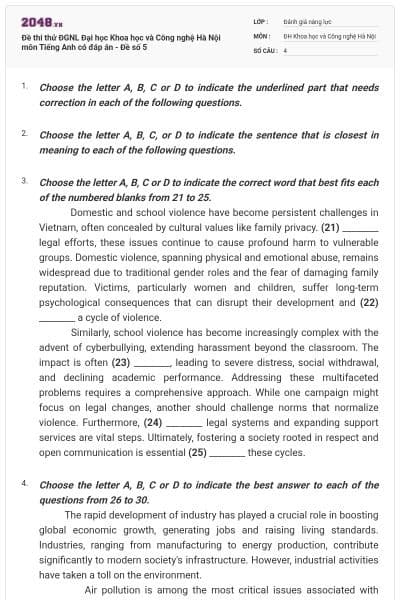
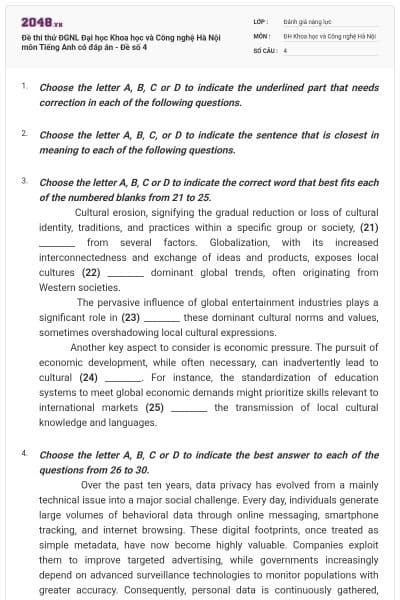
Choose the letter A, B, C or D to indicate the correct word that best fits each of the numbered blanks from 21 to 25.
Cultural erosion, signifying the gradual reduction or loss of cultural identity, traditions, and practices within a specific group or society, (21) ________ from several factors. Globalization, with its increased interconnectedness and exchange of ideas and products, exposes local cultures (22) ________ dominant global trends, often originating from Western societies.
The pervasive influence of global entertainment industries plays a significant role in (23) ________ these dominant cultural norms and values, sometimes overshadowing local cultural expressions.
Another key aspect to consider is economic pressure. The pursuit of economic development, while often necessary, can inadvertently lead to cultural (24) ________. For instance, the standardization of education systems to meet global economic demands might prioritize skills relevant to international markets (25) ________ the transmission of local cultural knowledge and languages.
resulting
results
resulted
which results
- “Cultural erosion” là chủ ngữ số ít, và “signifying … society” là mệnh đề quan hệ rút gọn bổ nghĩa cho cụm danh từ này.
" Từ cần điền là động từ chính trong câu, chia theo chủ ngữ số ít “cultural erosion”. Câu đang nêu một sự thật nên ta dùng thì Hiện tại đơn.
" Chọn B
Dịch:
Cultural erosion, signifying the gradual reduction or loss of cultural identity, traditions, and practices within a specific group or society, results from several factors. (Sự xói mòn văn hóa, biểu hiện qua sự suy giảm hoặc mất mát dần dần bản sắc văn hóa, truyền thống và phong tục trong một nhóm hoặc xã hội cụ thể, là kết quả của nhiều yếu tố.)
with
towards
against
to
Ta có cấu trúc: expose someone / something to something (cho ai / cái gì tiếp xúc / phơi nhiễm với cái gì).
" Chọn D
Globalization, with its increased interconnectedness and exchange of ideas and products, exposes local cultures to dominant global trends, often originating from Western societies. (Toàn cầu hóa, với sự gia tăng kết nối và trao đổi ý tưởng cũng như sản phẩm, đã đưa các nền văn hóa địa phương tiếp xúc với các xu hướng toàn cầu nổi bật, thường bắt nguồn từ các xã hội phương Tây.)
disseminating
dissemination
disseminated
disseminate
- Sau giới từ “in”, động từ cần chia dạng Ving.
→ Chọn A
The pervasive influence of global entertainment industries plays a significant role in disseminating these dominant cultural norms and values, sometimes overshadowing local cultural expressions. (Ảnh hưởng sâu rộng của các ngành công nghiệp giải trí toàn cầu đóng vai trò quan trọng trong việc lan truyền các chuẩn mực và giá trị văn hóa thống trị này, đôi khi lấn át cả các biểu hiện văn hóa địa phương.)
enrichment
preservation
homogenization
standardization
A. enrichment (n): sự làm giàu, làm phong phú
B. preservation (n): sự bảo tồn
C. homogenization (n): sự đồng nhất hóa (làm cho mọi thứ trở nên giống hệt nhau, mất đi bản sắc riêng)
D. standardization (n): sự tiêu chuẩn hóa
- Xét nghĩa câu: Việc theo đuổi phát triển kinh tế, dù thường là cần thiết, có thể vô tình dẫn đến ________ văn hóa.
" Chọn C, các từ khác không thích hợp cả về nghĩa và sắc thái tiêu cực ở đây.
Dịch:
The pursuit of economic development, while often necessary, can inadvertently lead to cultural homogenization. (Việc theo đuổi phát triển kinh tế, dù thường là cần thiết, có thể vô tình dẫn đến sự đồng nhất hóa văn hóa.)
over
above
against
to
Cấu trúc:prioritize something over something (ưu tiên cái gì hơn cái gì).
" Chọn A
Dịch:
For instance, the standardization of education systems to meet global economic demands might prioritize skills relevant to international markets over the transmission of local cultural knowledge and languages. (Ví dụ, việc chuẩn hóa hệ thống giáo dục để đáp ứng nhu cầu kinh tế toàn cầu có thể ưu tiên các kỹ năng phù hợp với thị trường quốc tế hơn là việc truyền đạt kiến thức văn hóa và ngôn ngữ địa phương.)
Bài đọc | Dịch bài đọc |
Cultural erosion, signifying the gradual reduction or loss of cultural identity, traditions, and practices within a specific group or society, results from several factors. Globalization, with its increased interconnectedness and exchange of ideas and products, exposes local cultures to dominant global trends, often originating from Western societies. The pervasive influence of global entertainment industries plays a significant role in disseminating these dominant cultural norms and values, sometimes overshadowing local cultural expressions. Another key aspect to consider is economic pressure. The pursuit of economic development, while often necessary, can inadvertently lead to cultural homogenization. For instance, the standardization of education systems to meet global economic demands might prioritize skills relevant to international markets over the transmission of local cultural knowledge and languages. | Sự xói mòn văn hóa, biểu hiện qua sự suy giảm hoặc mất mát dần dần bản sắc văn hóa, truyền thống và phong tục trong một nhóm hoặc xã hội cụ thể, là kết quả của nhiều yếu tố. Toàn cầu hóa, với sự gia tăng kết nối và trao đổi ý tưởng cũng như sản phẩm, đã đưa các nền văn hóa địa phương tiếp xúc với các xu hướng toàn cầu nổi bật, thường bắt nguồn từ các xã hội phương Tây. Ảnh hưởng sâu rộng của các ngành công nghiệp giải trí toàn cầu đóng vai trò quan trọng trong việc lan truyền các chuẩn mực và giá trị văn hóa thống trị này, đôi khi lấn át cả các biểu hiện văn hóa địa phương. Một khía cạnh quan trọng khác cần xem xét là áp lực kinh tế. Việc theo đuổi phát triển kinh tế, dù thường là cần thiết, có thể vô tình dẫn đến sự đồng nhất hóa văn hóa. Ví dụ, việc chuẩn hóa hệ thống giáo dục để đáp ứng nhu cầu kinh tế toàn cầu có thể ưu tiên các kỹ năng phù hợp với thị trường quốc tế hơn là việc truyền đạt kiến thức văn hóa và ngôn ngữ địa phương. |
Choose the letter A, B, C or D to indicate the best answer to each of the questions from 26 to 30.
Over the past ten years, data privacy has evolved from a mainly technical issue into a major social challenge. Every day, individuals generate large volumes of behavioral data through online messaging, smartphone tracking, and internet browsing. These digital footprints, once treated as simple metadata, have now become highly valuable. Companies exploit them to improve targeted advertising, while governments increasingly depend on advanced surveillance technologies to monitor populations with greater accuracy. Consequently, personal data is continuously gathered, processed, and reused, often without users fully understanding or truly consenting to it.
Although technology firms argue that data collection improves user experience through personalized recommendations, predictive search, and location-based services, these advantages hide a clear power imbalance. Most users do not clearly know how their information is stored, shared, or monetized. Privacy policies are typically long and complex, making informed consent largely superficial. This lack of transparency has normalized widespread data extraction.
Politically, reduced data privacy raises serious concerns. In authoritarian regimes, sophisticated surveillance systems track citizens’ activities, communications, and relationships, often without effective oversight. Even in democratic nations, tools such as facial recognition and biometric databases blur the line between security and intrusion. Once collected, data forms an enduring record that can later be used against journalists, activists, or vulnerable communities, threatening both individual freedom and democratic stability.
Economic pressures further worsen the problem. The expanding “surveillance economy” depends on personal data, as companies compete to build detailed user profiles. Data brokers, often weakly regulated, trade this information with advertisers and political actors with little transparency, encouraging aggressive data collection and reducing accountability, leaving even well-intentioned organizations conflicted about prioritizing user privacy.
Despite growing public concern, regulation remains inconsistent. Policies like the EU’s GDPR attempt to limit misuse, but enforcement is uneven and struggles to keep up with rapid AI development. Therefore, protecting privacy requires more than minor legal reforms; it demands a complete redesign of digital systems and their governance.
What is the passage mainly about?
The emergence of the surveillance economy as a primary driver of aggressive data collection.
The current situation of data privacy and the multifaceted challenges it faces, requiring reforms in legal and digital systems.
The utilization of digital footprints by global regimes to reinforce public security and political stability.
The need for legitimate frameworks and digital system reforms to enhance users’ data privacy.
Đáp án đúng là B
What is the passage mainly about? (Ý chính của toàn bài là gì?)
A. The emergence of the surveillance economy as a primary driver of aggressive data collection. (Sự xuất hiện của nền kinh tế giám sát như động lực chính của việc thu thập dữ liệu quyết liệt.)
" Sai vì quá hẹp. Đây chỉ là nội dung chính của đoạn 4.
B. The current situation of data privacy and the multifaceted challenges it faces, requiring reforms in legal and digital systems. (Tình trạng hiện tại của quyền riêng tư dữ liệu và những thách thức đa diện mà nó đối mặt, đòi hỏi những cải cách trong hệ thống pháp luật và kỹ thuật số.)
" Đúng vì bao quát được: thực trạng (đoạn 1), thách thức (đoạn 2, 3, và 4) và giải pháp (đoạn cuối).
C. The utilization of digital footprints by global regimes to reinforce public security and political stability. (Việc các chế độ toàn cầu sử dụng dấu vết kỹ thuật số để tăng cường an ninh công cộng và ổn định chính trị.)
" Sai. Bài viết nhấn mạnh sự xâm phạm quyền riêng tư và rủi ro chính trị, không phải ca ngợi việc củng cố an ninh. Ngoài ra, yếu tố chính trị chỉ được đề cập ở mỗi đoạn 3.
D. The need for legitimate frameworks and digital system reforms to enhance users’ data privacy. (Sự cần thiết của các khuôn khổ pháp lý và cải cách hệ thống kỹ thuật số để tăng cường quyền riêng tư dữ liệu của người dùng.)
" Sai vì một thông tin ở đoạn kết, không thể bao quát toàn bài.
The financial benefits that technology companies gain from selling personalized advertisements.
The reasons why users willingly share personal information with technology companies despite potential risks.
The strategies used by corporations to simplify privacy policies for better informed consent.
The limited transparency in how companies handle personal information and the low level of control users have over their own data.
Đáp án đúng là D
What is the main focus of the second paragraph? (Trọng tâm chính của đoạn văn thứ hai là gì?)
A. The financial benefits that technology companies gain from selling personalized advertisements. (Lợi ích tài chính mà các công ty công nghệ thu được từ việc bán quảng cáo cá nhân hóa.)
" Sai. Dù có nhắc đến “monetized” (kiếm tiền), nhưng đây chỉ là một ý nhỏ để minh họa cho việc người dùng không kiểm soát được dữ liệu, không phải chủ đề chính của cả đoạn.
B. The reasons why users willingly share personal information with technology companies despite potential risks. (Lý do tại sao người dùng sẵn sàng chia sẻ thông tin cá nhân với các công ty công nghệ bất chấp những rủi ro tiềm ẩn.)
" Sai vì không có thông tin này xuất hiện trong đoạn văn.
C. The strategies used by corporations to simplify privacy policies for better informed consent. (Các chiến lược mà các tập đoàn sử dụng để đơn giản hóa chính sách bảo mật nhằm đạt được sự đồng ý có hiểu biết tốt hơn.)
" Sai, vì mâu thuẫn với nội dung trong đoạn “Privacy policies are typically long and complex, making informed consent largely superficial”(Các chính sách bảo mật thường dài và phức tạp, điều này làm cho việc chấp thuận có hiểu biết phần lớn trở nên hời hợt).
D. The limited transparency in how companies handle personal information and the low level of control users have over their own data. (Sự thiếu minh bạch trong cách các công ty xử lý thông tin cá nhân và mức độ kiểm soát thấp mà người dùng có đối với dữ liệu của chính họ.)
" Đúng. Đoạn văn tập trung vào việc thiếu minh bạch (lack of transparency) và sự thật là người dùng không có quyền kiểm soát thực sự (low level of control).
In the passage, what is the purpose of mentioning the “EU’s GDPR” in the final paragraph?
To highlight the superiority of European data protection compared to other regions.
To demonstrate that strict laws have successfully solved most data privacy issues.
To provide an example of existing efforts to regulate data privacy, despite their limitations.
To explain how artificial intelligence is regulated under current legal frameworks.
In the passage, what is the purpose of mentioning the “EU’s GDPR” in the final paragraph? (Trong bài, mục đích của việc nhắc đến “GDPR của EU” ở đoạn cuối là gì?)
A. To highlight the superiority of European data protection compared to other regions. (Nhằm nhấn mạnh tính ưu việt của việc bảo vệ dữ liệu ở châu Âu so với các khu vực khác.)
B. To demonstrate that strict laws have successfully solved most data privacy issues. (Nhằm chứng minh rằng các luật nghiêm ngặt đã giải quyết thành công hầu hết các vấn đề về bảo mật dữ liệu.)
C. To provide an example of existing efforts to regulate data privacy, despite their limitations. (Nhằm đưa ra ví dụ về những nỗ lực hiện có để điều chỉnh bảo mật dữ liệu, mặc dù còn nhiều hạn chế.)
D. To explain how artificial intelligence is regulated under current legal frameworks. (Nhằm giải thích cách trí tuệ nhân tạo được điều chỉnh theo các khuôn khổ pháp lý hiện hành.)
" Chọn C, dựa trên thông tin: Despite growing public concern, regulation remains inconsistent. Policies like the EU’s GDPR attempt to limit misuse, but enforcement is uneven and struggles to keep up with rapid AI development. (Mặc dù mối quan tâm của công chúng ngày càng tăng, nhưng quy định vẫn không nhất quán. Các chính sách như GDPR của EU cố gắng hạn chế việc lạm dụng, nhưng việc thực thi không đồng đều và khó theo kịp sự phát triển nhanh chóng của trí tuệ nhân tạo.)
- Ta có:
“Existing efforts” (nỗ lực hiện tại) tương ứng với “GDPR attempt to limit misuse”.
“Limitations” (hạn chế) tương ứng với cụm “enforcement is uneven … development”.
Why is the “surveillance economy” considered problematic?
It promotes transparency and strengthens user control over personal data.
It encourages extensive data collection while limiting accountability.
It prevents companies from accessing detailed user information.
It leads to a shortage of personal data because too many brokers are competing for the same information.
Why is the “surveillance economy” considered problematic? (Tại sao “nền kinh tế giám sát” lại bị coi là có vấn đề?)
A. It promotes transparency and strengthens user control over personal data. (Nó thúc đẩy sự minh bạch và tăng cường quyền kiểm soát của người dùng.)
B. It encourages extensive data collection while limiting accountability. (Nó khuyến khích thu thập dữ liệu sâu rộng trong khi hạn chế trách nhiệm giải trình.)
C. It prevents companies from accessing detailed user information. (Nó ngăn cản các công ty truy cập vào thông tin chi tiết của người dùng.)
D. It leads to a shortage of personal data because too many brokers are competing for the same information. (Nó dẫn đến sự thiếu hụt dữ liệu vì có quá nhiều bên trung gian cạnh tranh.)
- Ta có thông tin: The expanding “surveillance economy” … encouraging aggressive data collection and reducing accountability, leaving even well-intentioned organizations conflicted about prioritizing user privacy. (Nền kinh tế “giám sát” ... khuyến khích việc thu thập dữ liệu một cách mạnh mẽ và làm giảm trách nhiệm giải trình, khiến ngay cả các tổ chức có thiện chí cũng phải cân nhắc việc ưu tiên quyền riêng tư của người dùng.)
" Chọn B
Which of the following is NOT mentioned in paragraph 1 as a way in which people generate behavioral data?
Sending messages on digital platforms
Travelling with smartphones tracking movement
Browsing various internet websites
Refining advertising systems
Which of the following is NOT mentioned in paragraph 1 as a way in which people generate behavioral data? (Điều nào sau đây KHÔNG được đề cập ở đoạn 1 như là một cách mà con người tạo ra dữ liệu hành vi?)
A. Sending messages on digital platforms (Gửi tin nhắn trên các nền tảng kỹ thuật số.)
B. Travelling with smartphones tracking movement (Di chuyển với điện thoại thông minh theo dõi vị trí.)
C. Browsing various internet websites (Duyệt các trang web internet khác nhau.)
D. Refining advertising systems (Cải thiện các hệ thống quảng cáo.)
" Chọn D, dựa trên thông tin “Every day, individuals generate large volumes of behavioral data through online messaging, smartphone tracking, and internet browsing” (Mỗi ngày, các cá nhân tạo ra một lượng lớn dữ liệu hành vi thông qua tin nhắn trực tuyến, theo dõi điện thoại thông minh và duyệt internet).
Dịch bài đọc:
Trong mười năm qua, quyền riêng tư dữ liệu đã phát triển từ một vấn đề chủ yếu mang tính kỹ thuật thành một thách thức xã hội lớn. Mỗi ngày, các cá nhân tạo ra một lượng lớn dữ liệu hành vi thông qua tin nhắn trực tuyến, theo dõi điện thoại thông minh và duyệt internet. Những dấu vết kỹ thuật số này, từng được coi là siêu dữ liệu đơn giản, giờ đây đã trở nên vô cùng giá trị. Các công ty khai thác chúng để cải thiện quảng cáo nhắm mục tiêu, trong khi các chính phủ ngày càng phụ thuộc vào các công nghệ giám sát tiên tiến để theo dõi dân số với độ chính xác cao hơn. Do đó, dữ liệu cá nhân liên tục được thu thập, xử lý và tái sử dụng, thường khi người dùng không hoàn toàn hiểu hoặc thực sự đồng ý.
Mặc dù các công ty công nghệ lập luận rằng việc thu thập dữ liệu cải thiện trải nghiệm người dùng thông qua các đề xuất được cá nhân hóa, tìm kiếm dự đoán và dịch vụ dựa trên vị trí, nhưng những lợi thế này che giấu một sự mất cân bằng quyền lực rõ ràng. Hầu hết người dùng không biết rõ thông tin của họ được lưu trữ, chia sẻ hoặc kiếm tiền như thế nào. Các chính sách về quyền riêng tư thường dài dòng và phức tạp, khiến sự đồng ý có hiểu biết phần lớn chỉ là mang tính hình thức. Sự thiếu minh bạch này đã bình thường hóa việc trích xuất dữ liệu trên diện rộng.
Về mặt chính trị, việc giảm quyền riêng tư dữ liệu làm dấy lên những lo ngại nghiêm trọng. Trong các chế độ độc tài, các hệ thống giám sát tinh vi theo dõi các hoạt động, liên lạc và mối quan hệ của công dân, thường không có sự giám sát hiệu quả. Ngay cả ở các quốc gia dân chủ, các công cụ như nhận dạng khuôn mặt và cơ sở dữ liệu sinh trắc học cũng làm mờ ranh giới giữa an ninh và xâm phạm. Một khi được thu thập, dữ liệu sẽ tạo thành một hồ sơ lâu dài có thể được sử dụng để chống lại các nhà báo, nhà hoạt động hoặc các cộng đồng dễ bị tổn thương, đe dọa cả tự do cá nhân và sự ổn định dân chủ.
Áp lực kinh tế càng làm trầm trọng thêm vấn đề. Nền kinh tế “giám sát” đang mở rộng phụ thuộc vào dữ liệu cá nhân, khi các công ty cạnh tranh để xây dựng hồ sơ người dùng chi tiết. Các nhà môi giới dữ liệu, thường được quản lý lỏng lẻo, trao đổi thông tin này với các nhà quảng cáo và các tác nhân chính trị mà thiếu minh bạch, khuyến khích việc thu thập dữ liệu một cách mạnh mẽ và làm giảm trách nhiệm giải trình, khiến ngay cả các tổ chức có thiện chí cũng gặp khó khăn trong việc ưu tiên quyền riêng tư của người dùng.
Mặc dù mối quan tâm của công chúng ngày càng tăng, nhưng quy định vẫn không nhất quán. Các chính sách như GDPR của EU cố gắng hạn chế việc lạm dụng, nhưng việc thực thi lại không đồng đều và khó theo kịp sự phát triển nhanh chóng của trí tuệ nhân tạo. Do đó, bảo vệ quyền riêng tư đòi hỏi nhiều hơn những cải cách pháp lý nhỏ; nó đòi hỏi phải thiết kế lại hoàn toàn các hệ thống kỹ thuật số và cách quản trị chúng.
Choose the letter A, B, C or D to indicate the underlined part that needs correction in each of the following questions.
Choose the letter A, B, C, or D to indicate the sentence that is closest in meaning to each of the following questions.