Đề thi thử ĐGNL Đại học Khoa học và Công nghệ Hà Nội môn Tiếng Anh có đáp án - Đề số 1
30 câu hỏi
Choose the letter A, B, C or D to indicate the word whose underlined part pronounced differently from the others.
increased
governed
vanished
impressed
Cách phát âm đuôi “ed”:
- /ɪd/: Khi động từ kết thúc bằng: /t/ hoặc /d/
- /t/: Khi động từ kết thúc bằng các âm vô thanh: /p/, /k/, /s/, /f/, /ʃ/, /tʃ/
- /d/: Khi động từ kết thúc bằng các âm hữu thanh và nguyên âm.
A. increased /ɪnˈkriːst/
B. governed /ˈɡʌvənd/
C. vanished /ˈvænɪʃt/
D. impressed /ɪmˈprest/
Phương án B có đuôi -ed phát âm là /d/, các phương án còn lại phát âm là /t/.
Choose the letter A, B, C or D to indicate the word whose underlined part pronounced differently from the others.
intellectual
escalate
responsible
governmental
A. intellectual /ˌɪntəˈlektʃuəl/
B. escalate /ˈeskəleɪt/
C. responsible /rɪˈspɒnsəbl/
D. governmental /ˌɡʌvənˈmentl/
Phương án C có phần gạch chân phát âm là /ɪ/, các phương án còn lại phát âm là /e/.
Choose the letter A, B, C or D to indicate the word with a different stress pattern from the others.
advice
device
justice
police
A. advice /ədˈvaɪs/ (trọng âm 2)
B. device /dɪˈvaɪs/ (trọng âm 2)
C. justice /ˈdʒʌstɪs/ (trọng âm 1)
D. police /pəˈliːs/ (trọng âm 2)
Phương án C có trọng âm rơi vào âm tiết thứ 1, còn lại rơi vào âm tiết thứ 2.
Choose the letter A, B, C or D to indicate the best answer to complete each of the following questions.
The gap between students' academic backgrounds is getting ________ due to unequal access to advanced technological devices.
wider and wider
more wide
widest
widely
Đây là kiến thức về so sánh càng … càng (Double Comparatives).
- Ta thấy “wide” là tính từ ngắn, và “get” là động từ nối (linking verb).
" Ta áp dụng cấu trúc sau: Get +Adj-er and Adj-er.
" Chọn A
Dịch:
The gap between students' academic backgrounds is getting wider and wider due to unequal access to advanced technological devices. (Khoảng cách giữa nền tảng học tập của học sinh đang ngày càng rộng hơn do việc tiếp cận thiết bị công nghệ không đồng đều.)
got
had
helped
let
- Ta có cấu trúc thể sai khiến (causative form): have someone do something: nhờ / thuê ai làm gì.
- Câu hỏi đang ở thì Quá khứ đơn, do đó “have” phải chia thành “had”.
" Chọn B
Dịch:
I read the news online about the Middle East conflict yesterday, but the font size was not big enough for me to see clearly. Fortunately, I had my grandson increase it for me. (Hôm qua tôi đọc tin tức trực tuyến về xung đột Trung Đông, nhưng cỡ chữ không đủ to để tôi nhìn rõ. May mắn là tôi đã nhờ cháu tôi tăng cỡ chữ giúp tôi.)
with
for
of
about
Ta có cụm từ cố định be appreciative of something: biết ơn / trân trọng điều gì
" Chọn C
Dịch:
Most candidates were appreciative of the guidance and support provided by their experienced colleagues. (Hầu hết các ứng viên đều biết ơn sự hướng dẫn và hỗ trợ từ các đồng nghiệp giàu kinh nghiệm của họ.)
preferred
preference
preferably
preferable
- Ta thấy từ cần điền đứng sau “to be” (is) và nằm trong cấu trúc chủ ngữ giả: It + is + Adj + to-V (Thật là... khi làm gì đó). Do đó, từ cần điền là một tính từ. " Loại B và C.
- Phân biệt hai tính từ “preferred” và “preferable”:
+ preferable (tốt hơn, đáng mong đợi hơn, phù hợp hơn): dùng để đánh giá một hành động là “hợp lý hơn / tốt hơn” trong hoàn cảnh cụ thể.
+ preferred (được ưa chuộng): đây là quá khứ phân từ đóng vai trò tính từ, thường dùng để chỉ một đối tượng được ưu tiên / được lựa chọn sẵn. Do đó, sau “preferred” sẽ có danh từ đi kèm.
" Chọn D (preferable) vì sau từ cần điền không có danh từ đi kèm.
Dịch
From a pedagogical perspective, it is preferable to provide students with constructive feedback rather than just giving them a final grade. (Từ góc độ sư phạm, việc cung cấp phản hồi mang tính xây dựng cho học sinh là tốt hơn so với việc chỉ cho họ điểm số cuối cùng.)
exacerbated
exacerbating
having exacerbated
to exacerbate
- “________ by the pervasive influence of digital connectivity” là mệnh đề quan hệ bổ nghĩa cho danh từ đứng trước nó là “Cultural erosion”.
- Khi sử dụng mệnh đề quan hệ dạng rút gọn, ta không sử dụng đại từ quan hệ, và phải chia động từ dạng Ving (nếu chủ động), hoặc V3 / V-ed (nếu bị động).
" Loại C và D.
- Xét nghĩa câu: Sự mai một văn hóa, ________ bởi ảnh hưởng lan rộng của kết nối số, đã khiến nhiều cộng đồng bản địa mất đi ngôn ngữ tổ tiên của họ.
" Đây là câu bị động.
" Chọn A (exacerbated)
Dịch
Cultural erosion, exacerbated by the pervasive influence of digital connectivity, has led many indigenous communities to lose their ancestral languages. (Sự mai một văn hóa, bị làm trầm trọng thêm bởi ảnh hưởng lan rộng của kết nối số, đã khiến nhiều cộng đồng bản địa mất đi ngôn ngữ tổ tiên của họ.)
will have been teaching / retires
will teach / will retire
has taught / retires
is teaching / is retiring
- Ta thấy câu có cụm từ “by the time” (vào lúc / trước lúc) kết hợp với một khoảng thời gian kéo dài đến thời điểm tương lai (for 30 years).
" Mệnh đề phụ ta sẽ dùng cấu trúc by the time + S + Vhiện tại đơn (diễn tả một mốc trong tương lai).
Như vậy, mệnh đề phụ hoàn chỉnh là: by the time she retires.
- Vì hành động “dạy học 30 năm” kéo dài và hoàn tất trước mốc thời gian đó, nên mệnh đề chính dùng tương lai hoàn thành (nhấn mạnh vào kết quả / sự hoàn tất) hoặc tương lai hoàn thành tiếp diễn (nếu muốn nhấn mạnh quá trình).
Như vậy, mệnh đề chính đầy đủ là: The professor will have taught at the university for 30 years hoặc The professor will have been teaching at the university for 30 years.
" Chọn A
Dịch:
The professor will have been teaching at the university for 30 years by the time she retires. (Bà sẽ đã dạy học được 30 năm tại trường đại học vào thời điểm bà nghỉ hưu.)
can’t tailor
won’t tailor
wouldn’t have tailored
couldn’t tailor
- Xét nghĩa câu: Nếu không có sự hỗ trợ của các hệ thống học tập thích ứng, giáo viên ________ việc hướng dẫn để đáp ứng nhu cầu đa dạng của học sinh một cách hiệu quả như họ đang làm hiện nay.
- Ta thấy ở mệnh đề chính có “as they do now” " Mệnh đề chính đang diễn tả sự việc trái với thực tế ở hiện tại.
" Ta dùng câu điều kiện loại II với “Without”: Without + N / Ving, S + would / could (not) + Vnguyên thể
→ Chọn D
Dịch:
Without the support of adaptive learning systems, teachers couldn’t tailor instruction to meet the diverse needs of their students as effectively as they do now. (Nếu không có sự hỗ trợ của các hệ thống học tập thích ứng, giáo viên không thể điều chỉnh việc giảng dạy để đáp ứng nhu cầu đa dạng của học sinh một cách hiệu quả như họ đang làm hiện nay.)
hold on
carry on
give up
phase out
A. hold on: giữ chặt, nắm giữ (thường dùng cho vật lý hoặc chờ đợi điện thoại)
B. carry on: tiếp tục làm gì đó
C. give up: từ bỏ, bỏ cuộc (thường dùng cho thói quen cá nhân hoặc khi nản chí)
D. phase out: loại bỏ dần dần
- Xét nghĩa: Bộ trưởng nhấn mạnh rằng các trường đại học nên ________ phương pháp học vẹt lỗi thời và chuyển đổi hướng tới một hệ sinh thái giáo dục năng động hơn.
+ Việc thay đổi phương pháp học tập của cả một hệ thống đại học (từ học vẹt sang hệ sinh thái năng động) không thể diễn ra trong một sớm một chiều.
"Chọn D, các phương án khác không phù hợp về nghĩa.
Dịch
The Minister emphasized that universities should phase out old-fashioned rote learning and transition towards a more dynamic educational ecosystem. (Bộ trưởng nhấn mạnh rằng các trường đại học nên loại bỏ dần phương pháp học vẹt lỗi thời và chuyển đổi hướng tới một hệ sinh thái giáo dục năng động hơn.)
impose
to impose
imposing
to be imposed
Ta có cấu trúc cố định sau: consider + Ving: cân nhắc làm việc gì
" Chọn C
Dịch:
The local authorities should consider imposing heavier penalties on companies that ignore environmental protection laws. (Chính quyền địa phương nên xem xét áp đặt các hình phạt nặng hơn đối với những công ty phớt lờ luật bảo vệ môi trường.)
A number of young people tends to underestimate the importance of soft skills, which are considered essential by employers who are looking for well-rounded candidates in today’s increasingly competitive job market.
tends
essential
looking for
increasingly
- Đây là lỗi sai về sự hòa hợp giữa chủ ngữ và động từ.
Ở đây, “A number of young people” (Nhiều người trẻ) đóng vai trò là chủ ngữ số nhiều.
" Động từ phải để dạng nguyên thể là “tend”.
Câu đúng:
A number of young people tend to underestimate the importance of soft skills, which are considered essential by employers who are looking for well-rounded candidates in today’s increasingly competitive job market. (Nhiều người trẻ có xu hướng đánh giá thấp tầm quan trọng của các kỹ năng mềm, vốn được các nhà tuyển dụng coi là thiết yếu khi tìm kiếm những ứng viên toàn diện trong thị trường việc làm ngày càng cạnh tranh hiện nay.)
independent
deal with
leads
stressfully
- Chúng ta có cấu trúc: feel + tính từ(cảm thấy như thế nào).
" Ta cần sửa trạng từ “stressfully” thành một tính từ.
+ stressful (adj): gây căng thẳng (chỉ tính chất, đặc điểm).
+ stressed (adj): căng thẳng (chỉ tâm trạng, cảm xúc).
- Xét nghĩa câu: Học sinh càng tự lập thì càng phải gánh vác nhiều trách nhiệm, điều này đôi khi khiến các em cảm thấy quá tải và ________.
" Từ cần điền là tính từ “stressed” vì câu đang nói về cảm xúc của những học sinh tự lập.
Câu đúng:
The more independent students become, the more responsibilities they have to deal with, which sometimes leads them to feel overwhelmed and stressed. (Học sinh càng tự lập thì càng phải gánh vác nhiều trách nhiệm, điều này đôi khi khiến các em cảm thấy quá tải và căng thẳng.)
At the opening ceremony, the guest speaker offered complementary remarks about the unique hospitality of the organizers, and then proceeded with his main presentation.
opening ceremony
complementary remarks
hospitality
proceeded
Đây là lỗi về từ vựng.
Ta có một cặp từ dễ nhầm:
- Complementary: bù đắp, bổ sung cho nhau
- Complimentary: ca ngợi, khen ngợi
Trong ngữ cảnh này, vị khách mời đưa ra những lời nhận xét “khen ngợi” về sự hiếu khách của ban tổ chức.
" Dùng từ complimentary, không phải complementary.
" Chọn B
Câu đúng:
At the opening ceremony, the guest speaker offered complimentary remarks about the unique hospitality of the organizers, and then proceeded with his main presentation. (Tại lễ khai mạc, diễn giả khách mời đã có những lời khen ngợi dành cho sự hiếu khách đặc biệt của ban tổ chức, sau đó bắt đầu bài thuyết trình chính của mình.)
He was suspended from school for violent behavior at school one week ago.
He has been suspended from school for violent behavior for one week.
He was suspended from school for violent behavior for one week.
He has suspended from school for violent behavior one week ago.
He was being suspended from school for violent behavior for one week.
He was suspended from school for violent behavior at school one week ago. (Anh ấy đã bị đình chỉ học vì hành vi bạo lực tại trường cách đây một tuần.)
" Câu gốc dùng thì Quá khứ đơn với “one week ago”: Nhấn mạnh vào mốc thời gian hành động xảy ra (cách đây 1 tuần).
A. He has been suspended from school for violent behavior for one week. (Anh ấy đã bị đình chỉ học vì hành vi bạo lực được một tuần rồi.)
" Câu này hợp lý về cách dùng thì: Sử dụng thì Hiện tại hoàn thành với “for one week” để diễn tả một trạng thái bắt đầu từ quá khứ và kéo dài liên tục đến hiện tại (đã bị đình chỉ được 1 tuần rồi và có thể vẫn đang bị).
" Câu áp dụng đúng công thức chuyển từ Quá khứ đơn sang Hiện tại hoàn thành:
S + V (quá khứ đơn) + [khoảng thời gian] + ago.
= S + have / has + been + V3 / V-ed + for + [khoảng thời gian].
B. He was suspended from school for violent behavior for one week. (Anh ấy đã bị đình chỉ học vì hành vi bạo lực trong vòng một tuần)
" Sai. Câu này ám chỉ việc đình chỉ đó đã kết thúc và nó chỉ kéo dài đúng 1 tuần trong quá khứ, lệch nghĩa với câu gốc.
C. He has suspended from school for violent behavior one week ago.
" Sai ngữ pháp 1: “He has suspended” là chủ động (Anh ấy đình chỉ ai đó), trong khi anh ấy “bị đình chỉ” (bị động)
" Sai ngữ pháp 2: Thì hiện tại hoàn thành (has suspended) không đi kèm với trạng từ chỉ thời gian xác định trong quá khứ như “ago”.
D. He was being suspended from school for violent behavior for one week. (Anh ấy đang bị đình chỉ học vì hành vi bạo lực trong một tuần.)
" Sai. Câu này dùng thì Quá khứ tiếp diễn dạng bị động. Thì này dùng để diễn tả một hành động đang xảy ra tại một thời điểm cụ thể trong quá khứ, không phù hợp để diễn tả một sự việc kéo dài từ quá khứ đến hiện tại.
Dịch:
He was suspended from school for violent behavior at school one week ago. (Anh ấy đã bị đình chỉ học vì hành vi bạo lực tại trường cách đây một tuần.)
= He has been suspended from school for violent behavior for one week. (Anh ấy đã bị đình chỉ học vì hành vi bạo lực được một tuần rồi.)
Đáp án đúng là A
“Would you like to take part in the charity event with us?” the manager said to his partner.
The manager encouraged his partner to take part in the charity event with them.
The manager invited his partner to take part in the charity event with them.
The manager forced his partner to take part in the charity event with them.
The manager warned his partner not to take part in the charity event with them.
Đáp án đúng là B
“Would you like to take part in the charity event with us?” the manager said to his partner.
(“Anh / Chị có muốn tham gia sự kiện từ thiện cùng chúng tôi không?” người quản lý hỏi cộng sự của mình.)
" Đây là cách hỏi lịch sự để mời ai đó làm gì.
A. The manager encouraged his partner to take part in the charity event with them. (Người quản lý khuyến khích cộng sự của mình tham gia sự kiện từ thiện cùng họ.)
" Sai ý nghĩa của câu. Encouraged (khuyến khích) dùng khi muốn động viên người khác, không phải mời người khác làm gì.
B. The manager invited his partner to take part in the charity event with them. (Người quản lý mời cộng sự của mình tham gia sự kiện từ thiện cùng họ.)
" Đúng. Cấu trúc “Would you like...?” là một lời mời lịch sự. Khi chuyển sang câu gián tiếp, ta dùng động từ “invite”.
C. The manager forced his partner to take part in the charity event with them. (Người quản lý ép buộc cộng sự của mình tham gia sự kiện từ thiện cùng họ.)
" Sai ý nghĩa của câu, phương án này mang tính chất ép buộc, không phải lời mời.
D. The manager warned his partner not to take part in the charity event with them. (Người quản lý cảnh báo cộng sự của mình không được tham gia sự kiện từ thiện cùng họ)
" Sai ý nghĩa của câu, phương án này mang tính chất cảnh báo, không phải lời mời.
Dịch:
“Would you like to take part in the charity event with us?” the manager said to his partner.
(“Anh / Chị có muốn tham gia sự kiện từ thiện cùng chúng tôi không?” người quản lý hỏi cộng sự của mình.)
= The manager invited his partner to take part in the charity event with them. (Người quản lý mời cộng sự của mình tham gia sự kiện từ thiện cùng họ.)
He finished his internship. He then applied for a full-time position at the company.
Without finishing his internship, he applied for a full-time position at the company.
Given that he applied for a full-time position at the company, he finished his internship.
Having finished his internship, he applied for a full-time position at the company.
He had scarcely applied for a full-time position at the company when he finished his internship.
He finished his internship. He then applied for a full-time position at the company. (Anh ấy đã hoàn thành thực tập. Sau đó anh ấy nộp đơn vào vị trí chính thức ở công ty.)
" Hành động “finished” xảy ra trước, hành động “applied” xảy ra sau.
A. Without finishing his internship, he applied for a full-time position at the company. (Chưa hoàn thành kỳ thực tập, anh ấy đã nộp đơn xin việc toàn thời gian tại công ty.)
" Sai nghĩa. Câu gốc nói anh ấy đã kết thúc kỳ thực tập rồi.
B. Given that he applied for a full-time position at the company, he finished his internship. (Vì anh ấy đã nộp đơn xin việc toàn thời gian tại công ty, nên anh ấy đã hoàn thành kỳ thực tập.)
" Sai nghĩa. Ngữ pháp đúng nhưng câu gốc không mang nghĩa nguyên nhân kết quả
C. Having finished his internship, he applied for a full-time position at the company. (Sau khi hoàn thành kỳ thực tập, anh ấy đã nộp đơn xin việc toàn thời gian tại công ty.)
" Đúng. Cấu trúc Having + V3 / V-ed, S + V một hành động đã hoàn tất xong xuôi rồi mới đến hành động thứ hai xảy ra. Hành động ở vế “Having + V3 / V-ed” luôn xảy ra trước hành động ở mệnh đề chính.
Lưu ý khi dùng cấu trúc này: hai mệnh đề phải đồng chủ ngữ.
D. He had scarcely applied for a full-time position at the company when he finished his internship. (Anh ấy vừa mới nộp đơn xin việc toàn thời gian tại công ty thì đã hoàn thành kỳ thực tập.)
" Sai vì đảo thứ tự hành động (“apply” trước, “finish” sau).
Dịch:
He finished his internship. He then applied for a full-time position at the company. (Anh ấy đã hoàn thành thực tập. Sau đó anh ấy nộp đơn vào vị trí chính thức ở công ty.)
= Having finished his internship, he applied for a full-time position at the company. (Sau khi hoàn thành kỳ thực tập, anh ấy đã nộp đơn xin việc toàn thời gian tại công ty.)
She had a technician fix her laptop yesterday.
She got a technician fix her laptop yesterday.
She had her laptop fixed by a technician yesterday.
Her laptop has been fixed by a technician yesterday.
She was fixing her laptop with a technician yesterday.
She had a technician fix her laptop yesterday. (Hôm qua cô ấy đã nhờ kỹ thuật viên sửa máy tính xách tay của mình.)
A. She got a technician fix her laptop yesterday.
" Sai ngữ pháp. Ta có cấu trúc đúng: Get + somebody + To-V.
B. She had her laptop fixed by a technician yesterday. (Cô ấy đã có cái máy tính xách tay của mình được sửa bởi một kỹ thuật viên vào ngày hôm qua.)
" Đúng. Đây là dạng bị động.
Cấu trúc thể sai khiến (causative forms): have somebody do something (có ai làm gì) = have something done by somebody (có cái gì được làm bởi ai).
C. Her laptop has been fixed by a technician yesterday.
" Sai thì. Câu gốc dùng “yesterday” (Quá khứ), câu này dùng Hiện tại hoàn thành.
D. She was fixing her laptop with a technician yesterday.
" Sai thì. Khi dùng thì Quá khứ tiếp diễn, câu này nghĩa là cô ấy trực tiếp tham gia sửa cùng thợ.
Dịch:
She had a technician fix her laptop yesterday. (Hôm qua cô ấy đã nhờ kỹ thuật viên sửa máy tính xách tay của mình.)
= She had her laptop fixed by a technician yesterday. (Cô ấy đã có cái máy tính xách tay của mình được sửa bởi một kỹ thuật viên vào ngày hôm qua.)
It often takes her nearly two hours to commute to work during rush hour because of heavy traffic.
She often spends nearly two hours commuting to work during rush hour despite heavy traffic.
She used to spend nearly two hours commuting to work during rush hour because of heavy traffic.
She rarely spends nearly two hours commuting to work during rush hour because of heavy traffic.
She often spends nearly two hours commuting to work during rush hour owing to heavy traffic.
It often takes her nearly two hours to commute to work during rush hour because of heavy traffic. (Cô ấy thường mất gần hai tiếng đồng hồ để đi làm vào giờ cao điểm vì tắc đường.)
A. She often spends nearly two hours commuting to work during rush hour despite heavy traffic. (Cô ấy thường mất gần hai tiếng đồng hồ để đi làm vào giờ cao điểm mặc dù giao thông tắc nghẽn.)
" Sai vì dùng despite (mặc dù) không nêu ra nguyên nhân như từ “because of”.
B. She used to spend nearly two hours commuting to work during rush hour because of heavy traffic. (Cô ấy đã từng mất gần hai tiếng đồng hồ để đi làm vào giờ cao điểm vì giao thông tắc nghẽn)
" Sai thì. Câu gốc dùng “often takes” (hiện tại), câu này dùng “used to” (quá khứ).
C. She rarely spends nearly two hours commuting to work during rush hour because of heavy traffic. (Cô ấy hiếm khi mất gần hai tiếng đồng hồ để đi làm vào giờ cao điểm vì giao thông tắc nghẽn.)
" Sai vì “rarely” trái nghĩa với “often”.
D. She often spends nearly two hours commuting to work during rush hour owing to heavy traffic. (Cô ấy thường mất gần hai tiếng đồng hồ để đi làm vào giờ cao điểm do giao thông tắc nghẽn.)
" Đúng. Chuyển It takes → Spend + V-ing và because of " owing to (đồng nghĩa).
Cấu trúc: It + takes + O + thời gian + to-V = S + spend + thời gian + Ving.
Dịch:
It often takes her nearly two hours to commute to work during rush hour because of heavy traffic. (Cô ấy thường mất gần hai tiếng đồng hồ để đi làm vào giờ cao điểm vì tắc đường.)
= She often spends nearly two hours commuting to work during rush hour owing to heavy traffic. (Cô ấy thường mất gần hai tiếng đồng hồ để đi làm vào giờ cao điểm do giao thông tắc nghẽn.)
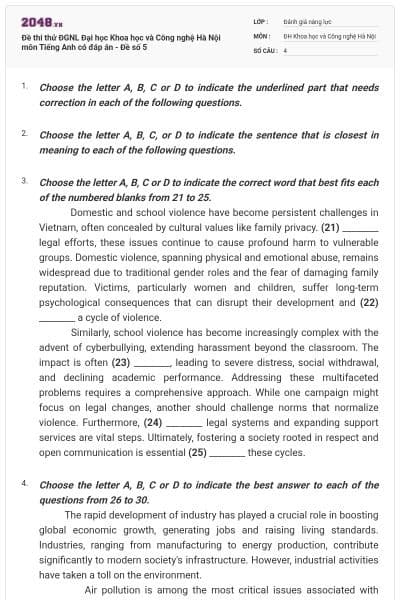
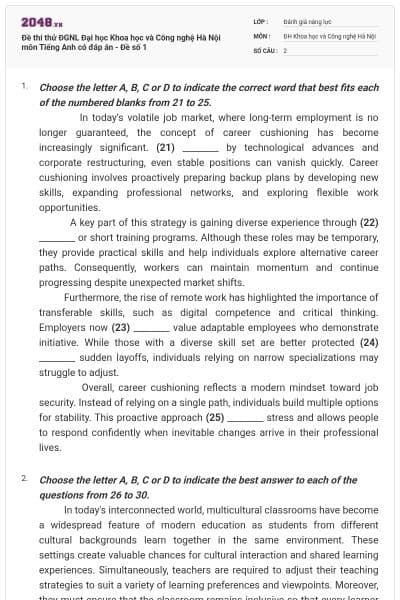
Choose the letter A, B, C or D to indicate the correct word that best fits each of the numbered blanks from 21 to 25.
In today’s volatile job market, where long-term employment is no longer guaranteed, the concept of career cushioning has become increasingly significant. (21) ________ by technological advances and corporate restructuring, even stable positions can vanish quickly. Career cushioning involves proactively preparing backup plans by developing new skills, expanding professional networks, and exploring flexible work opportunities.
A key part of this strategy is gaining diverse experience through (22) ________ or short training programs. Although these roles may be temporary, they provide practical skills and help individuals explore alternative career paths. Consequently, workers can maintain momentum and continue progressing despite unexpected market shifts.
Furthermore, the rise of remote work has highlighted the importance of transferable skills, such as digital competence and critical thinking. Employers now (23) ________ value adaptable employees who demonstrate initiative. While those with a diverse skill set are better protected (24) ________ sudden layoffs, individuals relying on narrow specializations may struggle to adjust.
Overall, career cushioning reflects a modern mindset toward job security. Instead of relying on a single path, individuals build multiple options for stability. This proactive approach (25) ________ stress and allows people to respond confidently when inevitable changes arrive in their professional lives.
Driving
Having driven
Driven
To be driven
Đáp án đúng là C
- “________ by technological advances and corporate restructuring” là mệnh đề trạng ngữ rút gọn. Khi sử dụng cấu trúc này, chủ ngữ ở cả hai mệnh đề phải đồng nhất với nhau.
- Xét nghĩa câu: ________ bởi sự tiến bộ công nghệ và tái cấu trúc doanh nghiệp, ngay cả những vị trí ổn định cũng có thể biến mất nhanh chóng.
" Mệnh đề phụ phải dùng thể bị động.
Khi rút gọn mệnh đề trạng ngữ, nếu mang nghĩa bị động, ta dùng V3 / V-ed.
" Chọn C
Dịch:
Drivenby technological advances and corporate restructuring, even stable positions can vanish quickly. (Được thúc đẩy bởi sự tiến bộ công nghệ và tái cấu trúc doanh nghiệp, ngay cả những vị trí ổn định cũng có thể biến mất nhanh chóng.)
apprenticeship
apprentice
apprenticing
apprenticed
A. apprenticeship (n): sự thực tập, thời gian học việc
B. apprentice (n): người học việc
C. apprenticing (Ving): học việc, thử việc
D. apprenticed (Ved): học việc, thử việc
- Sau giới từ “through” (thông qua) ta cần một danh từ. " Loại C và D.
- Xét nghĩa câu: Một phần quan trọng của chiến lược này là tích lũy kinh nghiệm đa dạng thông qua ________ hoặc đào tạo ngắn hạn.
" Chọn A, phương án B không phù hợp về nghĩa.
Dịch:
A key part of this strategy is gaining diverse experience through apprenticeship or short training programs. (Một phần quan trọng của chiến lược này là tích lũy kinh nghiệm đa dạng thông qua các chương trình học việc hoặc đào tạo ngắn hạn.)
strongly
widely
extremely
highly
Ta có cụm từ:highly value something: đánh giá cao điều gì.
" Chọn D, các phương án còn lại không đi với “value”.
Dịch:
Employers now highly value adaptable employees who demonstrate initiative. (Hiện nay, các nhà tuyển dụng đánh giá cao những nhân viên có khả năng thích ứng và thể hiện được tinh thần chủ động.)
against
for
beyond
towards
Ta có cấu trúc protect someone / something against / from something: bảo vệ ai đó trước cái gì.
" Chọn A
Dịch:
While those with a diverse skill set are better protected against sudden layoffs, individuals relying on narrow specializations may struggle to adjust. (Trong khi những người có nhiều kỹ năng đa dạng được bảo vệ tốt hơn trước các đợt sa thải bất ngờ, thì những người chỉ chuyên về một lĩnh vực hẹp có thể gặp khó khăn trong việc thích nghi.)
This proactive approach (25) ________ stress and allows people to respond confidently when inevitable changes arrive in their professional lives.
aggravates
alleviates
exacerbates
intensifies
A. aggravates: làm trầm trọng thêm
B. alleviates: làm giảm bớt (thường đi với stress, pain, suffering)
C. exacerbates: làm trầm trọng thêm, làm tăng thêm
D. intensifies: làm tăng cường
- Xét nghĩa câu: Nhìn chung, vùng đệm sự nghiệp phản ánh tư duy hiện đại về an ninh việc làm. Thay vì dựa vào một con đường duy nhất, các cá nhân xây dựng nhiều lựa chọn để ổn định. Cách tiếp cận chủ động này ________ căng thẳng và và cho phép mọi người tự tin ứng phó khi những thay đổi không thể tránh khỏi xảy đến trong cuộc sống nghề nghiệp của họ.
" Chọn B, các phương án khác không thích hợp về nghĩa.
Dịch:
Overall, career cushioning reflects a modern mindset toward job security. Instead of relying on a single path, individuals build multiple options for stability. This proactive approach alleviates stress and allows people to respond confidently when inevitable changes arrive in their professional lives. (Nhìn chung, vùng đệm sự nghiệp phản ánh tư duy hiện đại về an ninh việc làm. Thay vì dựa vào một con đường duy nhất, các cá nhân xây dựng nhiều lựa chọn để ổn định. Cách tiếp cận chủ động này giúp giảm bớt căng thẳng và cho phép mọi người tự tin ứng phó khi những thay đổi không thể tránh khỏi xảy đến trong cuộc sống nghề nghiệp của họ.)
Bài hoàn chỉnh | Dịch bài |
In today’s volatile job market, where long-term employment is no longer guaranteed, the concept of career cushioning has become increasingly significant. Drivenby technological advances and corporate restructuring, even stable positions can vanish quickly. Career cushioning involves proactively preparing backup plans by developing new skills, expanding professional networks, and exploring flexible work opportunities.
A key part of this strategy is gaining diverse experience through apprenticeship or short training programs. Although these roles may be temporary, they provide practical skills and help individuals explore alternative career paths. Consequently, workers can maintain momentum and continue progressing despite unexpected market shifts.
Furthermore, the rise of remote work has highlighted the importance of transferable skills, such as digital competence and critical thinking. Employers now highly value adaptable employees who demonstrate initiative. While those with a diverse skill set are better protected against sudden layoffs, individuals relying on narrow specializations may struggle to adjust.
Overall, career cushioning reflects a modern mindset toward job security. Instead of relying on a single path, individuals build multiple options for stability. This proactive approach alleviates stress and allows people to respond confidently when inevitable changes arrive in their professional lives. | Trong thị trường việc làm biến động ngày nay, nơi mà sự gắn bó lâu dài không còn được đảm bảo, khái niệm “vùng đệm sự nghiệp” ngày càng trở nên quan trọng. Được thúc đẩy bởi sự tiến bộ công nghệ và tái cấu trúc doanh nghiệp, ngay cả những vị trí ổn định cũng có thể biến mất nhanh chóng. Vùng đệm sự nghiệp bao gồm việc chủ động chuẩn bị các kế hoạch dự phòng bằng cách phát triển kỹ năng mới, mở rộng mạng lưới chuyên môn và tìm kiếm các cơ hội làm việc linh hoạt. Một phần quan trọng của chiến lược này là tích lũy kinh nghiệm đa dạng thông qua các chương trình học việc hoặc đào tạo ngắn hạn. Mặc dù những vai trò này có thể chỉ là tạm thời, chúng cung cấp các kỹ năng thực tế và giúp cá nhân khám phá các con đường sự nghiệp thay thế. Do đó, người lao động có thể duy trì đà phát triển và tiếp tục tiến bộ bất chấp những biến động bất ngờ của thị trường. Hơn nữa, sự gia tăng của làm việc từ xa đã làm nổi bật tầm quan trọng của các kỹ năng chuyển đổi, chẳng hạn như năng lực kỹ thuật số và tư duy phản biện. Hiện nay, các nhà tuyển dụng đánh giá cao những nhân viên có khả năng thích ứng và thể hiện được tinh thần chủ động. Trong khi những người có nhiều kỹ năng đa dạng được bảo vệ tốt hơn trước các đợt sa thải bất ngờ, thì những người chỉ chuyên về một lĩnh vực hẹp có thể gặp khó khăn trong việc thích nghi. Nhìn chung, vùng đệm sự nghiệp phản ánh tư duy hiện đại về an ninh việc làm. Thay vì dựa vào một con đường duy nhất, các cá nhân xây dựng nhiều lựa chọn để ổn định. Cách tiếp cận chủ động này giúp giảm bớt căng thẳng và cho phép mọi người tự tin ứng phó khi những thay đổi không thể tránh khỏi xảy đến trong cuộc sống nghề nghiệp của họ. |
Choose the letter A, B, C or D to indicate the best answer to each of the questions from 26 to 30.
In today's interconnected world, multicultural classrooms have become a widespread feature of modern education as students from different cultural backgrounds learn together in the same environment. These settings create valuable chances for cultural interaction and shared learning experiences. Simultaneously, teachers are required to adjust their teaching strategies to suit a variety of learning preferences and viewpoints. Moreover, they must ensure that the classroom remains inclusive so that every learner feels respected and supported, regardless of their origins. This helps students gradually build empathy and a deeper awareness of cultural diversity.
The shift from multicultural education to global citizenship requires effort from teachers and students. Educational institutions design international activities, student exchange programs, and collaborative projects to strengthen intercultural communication skills. These activities enable students to collaborate with peers from different backgrounds while discussing global challenges. Additionally, incorporating global issues into the curriculum allows students to further understand the interconnectedness of our world, while improving their critical thinking and social responsibility.
Technology plays a key role in connecting multicultural classrooms to the wider world in modern education systems. Online platforms make it possible for students to participate in virtual exchanges and interact with people they would not normally meet in person. These tools help eliminate geographical limitations and broaden students’ perspectives. In addition, digital resources give learners the opportunity to independently explore different cultures although guidance from teachers is necessary to help them evaluate online information accurately and avoid forming stereotypes.
Ultimately, multicultural education aims to shape responsible global citizens who can function effectively in diverse societies. Students gain essential skills that prepare them for international study and work environments. Research indicates that individuals with multicultural experiences demonstrate greater creativity and problem-solving capabilities. Most importantly, these global citizens contribute to creating a more peaceful world by challenging prejudice and promoting inclusive practices. This transformation represents one of education's most significant contributions to society.
What is the passage mainly about?
The increasing complexity of managing culturally diverse classrooms and the instructional challenges faced by educators in modern education systems.
The effectiveness of school-based international programs in improving students’ academic outcomes, intercultural communication, and cognitive development.
The role of multicultural education, supported by international collaboration and technology, in preparing students to become responsible global citizens.
The important factors in implementing multicultural classrooms effectively to foster inventiveness and problem-solving skills among students.
Đáp án đúng là C
What is the passage mainly about? (Ý chính của toàn bài là gì?)
A. The increasing complexity of managing culturally diverse classrooms and the instructional challenges faced by educators in modern education systems. (Sự phức tạp ngày càng tăng trong việc quản lý các lớp học đa văn hóa và những thách thức về giảng dạy mà các nhà giáo dục phải đối mặt trong hệ thống giáo dục hiện đại.)
" Sai vì quá hẹp. Đây chỉ là một ý nhỏ ở đoạn 1.
B. The effectiveness of school-based international programs in improving students’ academic outcomes, intercultural communication, and cognitive development. (Hiệu quả của các chương trình quốc tế tại trường học trong việc cải thiện kết quả học tập, giao tiếp liên văn hóa và phát triển nhận thức của học sinh.)
" Sai vì quá hẹp. Các chương trình quốc tế (international programs) chỉ là một phần nhỏ được nhắc đến ở đoạn 2.
C. The role of multicultural education, supported by international collaboration and technology, in preparing students to become responsible global citizens. (Vai trò của giáo dục đa văn hóa, được hỗ trợ bởi sự hợp tác quốc tế và công nghệ, trong việc chuẩn bị cho học sinh trở thành những công dân toàn cầu có trách nhiệm.)
" Đúng. Nó bao hàm cả: Giáo dục đa văn hóa (Đoạn 1), Hoạt động hợp tác quốc tế (Đoạn 2), Công nghệ (Đoạn 3) và mục tiêu Công dân toàn cầu (Đoạn 4).
D. The important factors in implementing multicultural classrooms effectively to foster inventiveness and problem-solving skills among students. (Các yếu tố quan trọng trong việc triển khai hiệu quả các lớp học đa văn hóa để thúc đẩy khả năng sáng tạo và kỹ năng giải quyết vấn đề ở học sinh.)
" Sai vì nhầm lẫn mục đích then chốt của multicultural classrooms. “Inventiveness and problem-solving skills” được nhắc đến ở đoạn cuối là để minh họa cho phẩm chất của công dân toàn cầu. Mục đích cuối cùng là tạo ra Global citizens (Công dân toàn cầu) chứ không chỉ đơn thuần là kỹ năng sáng tạo hay giải quyết vấn đề.
What is the main idea of the third paragraph?
The way to integrate technology to multicultural classrooms
The teachers’ role in guiding students to evaluate information and form informed viewpoints
The indispensable role of technology in connecting students and broadening their perspectives in multicultural education
Student-centered instruction becoming the most effective approach, supported by using technology in multicultural classrooms
Đáp án đúng là C
What is the main idea of the third paragraph? (Ý chính của đoạn 3 là gì?)
A. The way to integrate technology to multicultural classrooms (Cách tích hợp công nghệ vào lớp học đa văn hóa)
" Sai. Đoạn văn không liệt kê các bước hay hướng dẫn kỹ thuật về cách tích hợp này.
B. The teachers’ role in guiding students to evaluate information and form informed viewpoints (Vai trò của giáo viên trong việc hướng dẫn học sinh đánh giá thông tin và hình thành quan điểm có cơ sở)
" Sai vì quá hẹp. Ý này có xuất hiện ở cuối đoạn, nhưng nó chỉ là một lưu ý nhỏ, không phải mục đích chính của cả đoạn.
C. The indispensable role of technology in connecting students and broadening their perspectives in multicultural education (Vai trò không thể thiếu của công nghệ trong việc kết nối học sinh và mở rộng tầm nhìn của họ trong giáo dục đa văn hóa)
" Đúng. "indispensable" (không thể thiếu) đồng nghĩa với “key role” (vai trò then chốt) ở câu đầu đoạn văn. Cả đoạn tập trung vào việc công nghệ giúp học sinh kết nối và mở rộng tầm nhìn thế nào.
D. Student-centered instruction becoming the most effective approach, supported by using technology in multicultural classrooms. (Phương pháp giảng dạy lấy học sinh làm trung tâm trở thành cách tiếp cận hiệu quả nhất, được hỗ trợ bởi việc sử dụng công nghệ trong lớp học đa văn hóa)
" Sai. Thuật ngữ “Student-centered instruction” không được đề cập trực tiếp hay nhấn mạnh như một chủ đề chính trong đoạn này.
What is the purpose of mentioning online platforms and virtual exchanges in the passage?
To emphasize that modern education is becoming fully digital and no longer requires physical classroom interaction.
To illustrate how digital tools help students connect across borders and experience diverse cultural perspectives.
To argue that students can achieve global citizenship mainly through self-study on the internet without structured school activities.
To show that international collaboration in education is only effective when conducted through formal exchange programs.
What is the purpose of mentioning online platforms and virtual exchanges in the passage? (Mục đích của việc nhắc đến “nền tảng trực tuyến" và "trao đổi ảo” là gì?)
A. To emphasize that modern education is becoming fully digital and no longer requires physical classroom interaction. (Nhấn mạnh rằng nền giáo dục hiện đại đang trở nên hoàn toàn kỹ thuật số và không còn yêu cầu sự tương tác trực tiếp trong lớp học.)
B. To illustrate how digital tools help students connect across borders and experience diverse cultural perspectives. (Minh họa cách các công cụ kỹ thuật số giúp học sinh kết nối xuyên biên giới và trải nghiệm các quan điểm văn hóa đa dạng.)
C. To argue that students can achieve global citizenship mainly through self-study on the internet without structured school activities. (để tranh luận rằng học sinh có thể đạt được tư cách công dân toàn cầu chủ yếu thông qua tự học trên internet mà không cần các hoạt động học tập có cấu trúc tại trường.)
D. To show that international collaboration in education is only effective when conducted through formal exchange programs. (Cho thấy rằng sự hợp tác quốc tế trong giáo dục chỉ hiệu quả khi được thực hiện thông qua các chương trình trao đổi chính thức.)
- Ta có thông tin ở đoạn 3: Online platforms make it possible for students to participate in virtual exchanges and interact with people they would not normally meet in person. These tools help eliminate geographical limitations and broaden students’ perspectives. (Các nền tảng trực tuyến cho phép sinh viên tham gia vào các cuộc trao đổi ảo và tương tác với những người mà họ thường không gặp trực tiếp. Những công cụ này giúp xóa bỏ những hạn chế về địa lý và mở rộng tầm nhìn của học sinh.)
+ eliminate geographical limitations = connect across borders
+ broaden students’ perspectives = experience diverse cultural perspectives
" Chọn B
Which of the following is TRUE according to the passage?
Cultural diversity in classrooms limits students’ ability to develop empathy because of communication barriers.
Access to online resources may lead students to form more accurate perceptions of other cultures without guidance.
Students with multicultural experiences are certain to develop enhanced creativity and problem-solving abilities.
Digital interactions expose students to different viewpoints beyond their immediate environment.
Which of the following is TRUE according to the passage? (Câu nào sau đây ĐÚNG theo bài đọc?)
A. Cultural diversity in classrooms limits students’ ability to develop empathy because of communication barriers. (Sự đa dạng văn hóa trong lớp học hạn chế khả năng phát triển sự đồng cảm của học sinh do rào cản giao tiếp.)
" Sai vì ngược với thông tin ở đoạn 1 “multicultural classrooms... helps students gradually build empathy and a deeper awareness of cultural diversity” (lớp học đa văn hóa... giúp học sinh dần dần xây dựng sự đồng cảm và nhận thức sâu sắc hơn về sự đa dạng văn hóa).
B. Access to online resources may lead students to form more accurate perceptions of other cultures without guidance. (Việc tiếp cận các nguồn tài nguyên trực tuyến có thể giúp học sinh hình thành nhận thức chính xác hơn về các nền văn hóa khác mà không cần hướng dẫn.)
" Sai, dựa trên thông tin “guidance from teachers is necessary to help them evaluate online information accurately and avoid forming stereotypes” (Sự hướng dẫn từ giáo viên là cần thiết để giúp học sinh đánh giá thông tin trực tuyến một cách chính xác và tránh hình thành các định kiến).
C. Students with multicultural experiences are certain to develop enhanced creativity and problem-solving abilities. (Học sinh có trải nghiệm đa văn hóa chắc chắn sẽ phát triển khả năng sáng tạo và giải quyết vấn đề tốt hơn.)
" Sai. Thông tin “Research indicates that individuals with multicultural experiences demonstrate greater creativity and problem-solving capabilities” (Nghiên cứu chỉ ra rằng những cá nhân có trải nghiệm đa văn hóa thể hiện khả năng sáng tạo cao hơn):
- indicates = cho thấy / gợi ý (không tuyệt đối)
- demonstrate = thể hiện (không phải đảm bảo sẽ phát triển)
Trong khi đó, phương án dùng “are certain to” (chắc chắn) → mang tính tuyệt đối, bị phóng đại ý nghĩa.
D. Digital interactions expose students to different viewpoints beyond their immediate environment. (Các tương tác kỹ thuật số giúp học sinh tiếp cận với các quan điểm khác nhau vượt ra ngoài môi trường sống trực tiếp của họ.)
" Đúng. Dựa vào thông tin đoạn 3 “Online platforms make it possible for students to... interact with people they would not normally meet in person. These tools help... broaden students’ perspectives” (Các nền tảng trực tuyến cho phép học sinh... tương tác với những người mà họ thường không gặp trực tiếp. Những công cụ này giúp... mở rộng quan điểm của học sinh)
Ta có: “Not normally meet in person” (không thường gặp trực tiếp) tương đương với “beyond their immediate environment” (vượt ngoài môi trường sống trực tiếp), và “expose students to different viewpoints” (giúp học sinh tiếp cận với các quan điểm khác nhau) tương đương với “broaden students’ perspectives” (mở rộng quan điểm của học sinh).
Which of the following is NOT mentioned in the passage?
The role of parents in supporting students’ development in multicultural education.
The use of digital platforms to connect students with peers from other cultures.
The need for teachers to create inclusive classroom environments for students from different backgrounds.
The inclusion of global issues in the curriculum to enhance students’ understanding of the world.
Which of the following is NOT mentioned in the passage? (Câu nào sau đây KHÔNG được nhắc tới trong bài?)
A. The role of parents in supporting students’ development in multicultural education. (Vai trò của phụ huynh trong việc hỗ trợ sự phát triển của học sinh trong nền giáo dục đa văn hóa.)
" Thông tin này không được đề cập. Xuyên suốt bài chỉ nhắc đến giáo viên, học sinh và nhà trường, không hề nhắc đến phụ huynh.
B. The use of digital platforms to connect students with peers from other cultures. (Việc sử dụng các nền tảng kỹ thuật số để kết nối học sinh với bạn bè từ các nền văn hóa khác)
" Thông tin này được nhắc tới ở đoạn 3, cụ thể ở thông tin “Online platforms … participate in virtual exchanges and interact with people they would not normally meet in person. … eliminate geographical limitations.” (Các nền tảng trực tuyến tham gia vào các cuộc trao đổi ảo và tương tác với những người mà các em thường không có cơ hội gặp gỡ trực tiếp. … xóa bỏ hạn chế địa lý).
C. The need for teachers to create inclusive classroom environments for students from different backgrounds. (Sự cần thiết của việc giáo viên tạo ra môi trường lớp học hòa nhập cho học sinh đến từ các hoàn cảnh khác nhau.)
" Thông tin tin này được nhắc tới ở đoạn 1 “Simultaneously, teachers are required to adjust their teaching strategies to suit a variety of learning preferences and viewpoints. Moreover, they must ensure that the classroom remains inclusive so that every learner feels respected and supported, regardless of their origins” (Đồng thời, giáo viên cần điều chỉnh chiến lược giảng dạy của mình để phù hợp với nhiều sở thích và quan điểm học tập khác nhau. Hơn nữa, họ phải đảm bảo rằng lớp học vẫn mang tính toàn diện để mọi người học đều cảm thấy được tôn trọng và hỗ trợ, bất kể nguồn gốc của họ).
D. The inclusion of global issues in the curriculum to enhance students’ understanding of the world. (Việc đưa các vấn đề toàn cầu vào chương trình giảng dạy để nâng cao hiểu biết của học sinh về thế giới.)
" Thông tin này được nhắc tới ở đoạn 2, cụ thể ở “Additionally, incorporating global issues into the curriculum allows students to further understand the interconnectedness of our world...” (Ngoài ra, việc tích hợp các vấn đề toàn cầu vào chương trình giảng dạy cho phép học sinh hiểu rõ hơn về sự liên kết giữa thế giới của chúng ta…)
Dịch bài đọc:
Trong thế giới kết nối ngày nay, lớp học đa văn hóa đã trở thành một đặc điểm phổ biến của nền giáo dục hiện đại khi học sinh từ các nền văn hóa khác nhau cùng học tập trong cùng một môi trường. Môi trường này tạo ra những cơ hội quý giá cho sự tương tác văn hóa và trải nghiệm học tập chung. Đồng thời, giáo viên cần điều chỉnh chiến lược giảng dạy của mình để phù hợp với nhiều sở thích và quan điểm học tập khác nhau. Hơn nữa, họ phải đảm bảo rằng lớp học vẫn mang tính toàn diện để mọi người học đều cảm thấy được tôn trọng và hỗ trợ, bất kể nguồn gốc của họ. Điều này giúp học sinh dần dần xây dựng sự đồng cảm và nhận thức sâu sắc hơn về sự đa dạng văn hóa.
Sự chuyển đổi từ giáo dục đa văn hóa sang công dân toàn cầu đòi hỏi nỗ lực từ cả giáo viên và học sinh. Các cơ sở giáo dục thiết kế các hoạt động quốc tế, chương trình trao đổi sinh viên và các dự án hợp tác để tăng cường kỹ năng giao tiếp liên văn hóa. Những hoạt động này cho phép sinh viên hợp tác với các bạn cùng trang lứa từ các nền văn hóa khác nhau trong khi thảo luận về các thách thức toàn cầu. Ngoài ra, việc tích hợp các vấn đề toàn cầu vào chương trình giảng dạy cho phép sinh viên hiểu rõ hơn về sự liên kết của thế giới chúng ta, đồng thời cải thiện tư duy phản biện và trách nhiệm xã hội của họ.
Công nghệ đóng vai trò quan trọng then chốt trong việc kết nối các lớp học đa văn hóa với thế giới rộng lớn hơn trong hệ thống giáo dục hiện đại. Các nền tảng trực tuyến cho phép sinh viên tham gia vào các cuộc trao đổi ảo và tương tác với những người mà họ thường không gặp trực tiếp. Những công cụ này giúp xóa bỏ những hạn chế về địa lý và mở rộng tầm nhìn của học sinh. Ngoài ra, các nguồn tài nguyên kỹ thuật số mang đến cho người học cơ hội tự mình khám phá các nền văn hóa khác nhau, mặc dù sự hướng dẫn của giáo viên là cần thiết để giúp họ đánh giá thông tin trực tuyến một cách chính xác và tránh hình thành định kiến.
Cuối cùng, giáo dục đa văn hóa hướng đến việc hình thành những công dân toàn cầu có trách nhiệm, những người có thể hoạt động hiệu quả trong các xã hội đa dạng. Học sinh đạt được những kỹ năng thiết yếu mà trang bị cho họ đi vào môi trường học tập và làm việc quốc tế. Nghiên cứu chỉ ra rằng những cá nhân có kinh nghiệm đa văn hóa thể hiện khả năng sáng tạo và giải quyết vấn đề tốt hơn. Quan trọng nhất, những công dân toàn cầu này góp phần tạo ra một thế giới hòa bình hơn bằng cách thách thức định kiến và thúc đẩy các thực tiễn hòa nhập. Sự chuyển đổi này đại diện cho một trong những đóng góp quan trọng nhất của giáo dục đối với xã hội.