Đề thi tham khảo ĐGNL Đại học Sư phạm TP.Hồ Chí Minh môn Tiếng Anh có đáp án - Đề số 5
80 câu hỏi
A. LISTENING
In this section of the test, you will have an opportunity to demonstrate your ability to understand conversations and talks in English. There are three parts in this section with special directions for each part. Answer all the questions on the basis of what is stated or implied by the speakers in the recording. The recording will be played ONCE only.
Part 1: Question 1-8
In this part, you will hear EIGHT short announcements or instructions. There is one question for each announcement or instruction. For each question, choose the right answer A, B, C or D. First you have some time to look at questions 1 to 8.
On Monday
On Thursday
On Friday
On Saturday
Đáp án đúng là C
When will the consultations be held? (Các buổi tư vấn sẽ được tổ chức khi nào?)
A. On Monday (Vào thứ Hai)
" Sai vì thông tin này không được đề cập trong bài nghe.
B. On Thursday (Vào thứ Năm)
" Sai. Dựa trên thông tin “please sign up for an appointment at the accounting department before Thursday” (vui lòng đăng ký lịch hẹn tại bộ phận kế toán trước thứ Năm), thứ Năm là hạn chót để đăng ký chứ không phải thời gian tổ chức tư vấn.
C. On Friday (Vào thứ Sáu)
" Đúng, dựa trên thông tin “Individual consultations will be held on Friday from 9 a.m. to 1 p.m.” (Các buổi tư vấn cá nhân sẽ được tổ chức vào thứ Sáu, từ 9 giờ sáng đến 1 giờ chiều).
D. On Saturday (Vào thứ Bảy)
" Sai vì thông tin này không được đề cập trong bài nghe.
Bài nghe | Dịch bài nghe |
The accounting department is offering assistance in filling out tax forms for all employees. Individual consultations will be held on Friday from 9 a.m. to 1 p.m. If you are interested, please sign up for an appointment at the accounting department before Thursday. | Bộ phận kế toán đang cung cấp dịch vụ hỗ trợ điền tờ khai thuế cho toàn thể nhân viên. Các buổi tư vấn cá nhân sẽ được tổ chức vào thứ Sáu, từ 9 giờ sáng đến 1 giờ chiều. Nếu bạn có nhu cầu, vui lòng đăng ký lịch hẹn tại bộ phận kế toán trước thứ Năm. |
Use the audio equipment
Pay for their purchases
Return some books
Leave the building
Đáp án đúng là D
What are the tourists asked to do? (Khách tham quan được yêu cầu làm gì?)
A. Use the audio equipment (Sử dụng thiết bị âm thanh)
" Sai. Dựa trên thông tin “please return the audio equipment to the front desk” (vui lòng trả lại thiết bị âm thanh tại quầy lễ tân), khách tham quan được yêu cầu trả lại chứ không phải bắt đầu sử dụng.
B. Pay for their purchases (Thanh toán cho các món đồ đã mua)
" Sai vì thông tin này không được đề cập trong bài nghe.
C. Return some books (Trả lại một số cuốn sách)
" Sai vì thông tin này không được đề cập trong bài nghe.
D. Leave the building (Rời khỏi tòa nhà)
" Đúng, dựa trên thông tin “The Royal Gallery will be closing in just 10 minutes, so we ask that you make your way to the nearest exit” (Phòng trưng bày Royal sẽ đóng cửa chỉ trong 10 phút nữa, vì vậy chúng tôi yêu cầu quý vị vui lòng di chuyển đến lối thoát hiểm gần nhất).
Bài nghe | Dịch bài nghe |
Good evening, ladies and gentlemen. The Royal Gallery will be closing in just 10 minutes, so we ask that you make your way to the nearest exit. For those of you taking the audio tour, please return the audio equipment to the front desk in our lobby. Thank you for visiting us today, and we hope you enjoyed your visit to the gallery. | Chào buổi tối, thưa quý ông và quý bà. Phòng trưng bày Royal sẽ đóng cửa chỉ trong 10 phút nữa, vì vậy chúng tôi yêu cầu quý vị vui lòng di chuyển đến lối thoát hiểm gần nhất. Đối với những quý vị đang tham gia chuyến tham quan bằng thiết bị âm thanh, vui lòng trả lại thiết bị tại quầy lễ tân ở sảnh đợi của chúng tôi. Cảm ơn quý vị đã đến thăm chúng tôi ngày hôm nay, và chúng tôi hy vọng quý vị đã có một chuyến tham quan phòng trưng bày thật thú vị. |
A snack food
A vitamin supplement
A beverage
Mineral water
What is the advertisement for? (Bài quảng cáo dành cho cái gì?)
A. A snack food (Một món ăn nhẹ)
" Sai. Dựa trên thông tin “perfect for school lunches or with an afternoon snack” (hoàn hảo cho bữa trưa ở trường hoặc dùng kèm với món ăn nhẹ buổi chiều), sản phẩm này được dùng kèm với đồ ăn nhẹ chứ bản thân nó không phải là đồ ăn.
B. A vitamin supplement (Thực phẩm bổ sung vitamin)
" Sai. Thông tin “full of the nutrients” (chứa đầy dưỡng chất) chỉ là thông tin giới thiệu cho một loại thức uống, còn không có thông tin về vitamin xuất hiện trong bài nghe.
C. A beverage (Một loại thức uống)
" Đúng, dựa trên thông tin ngay đầu bài nghe “Looking for a new, refreshing and healthy beverage?” (Tìm kiếm một loại thức uống mới mẻ, sảng khoái và tốt cho sức khỏe?) và “Try Sunkiss's Fruitblast for a cool drink” (Hãy thử Fruitblast của Sunkiss để có một thức uống mát lạnh).
D. Mineral water (Nước khoáng)
" Sai. Thông tin “It comes in six different flavors” (Sản phẩm có sáu hương vị khác nhau) cho thấy đây là một loại nước trái cây hoặc nước giải khát có vị, không phải nước khoáng tinh khiết.
Bài nghe | Dịch bài nghe |
Looking for a new, refreshing and healthy beverage? Try Sunkiss's Fruitblast for a cool drink that is not only delicious, but good for your body. Fruitblast is full of the nutrients that your body needs. It comes in six different flavors and is perfect for school lunches or with an afternoon snack. So if you're tired of all those high-sugar drinks, try Fruitblast as a healthy and delicious alternative. Fruitblast is available at most convenience stores. | Tìm kiếm một loại thức uống mới mẻ, sảng khoái và tốt cho sức khỏe? Hãy thử Fruitblast của Sunkiss để có một thức uống mát lạnh, không chỉ thơm ngon mà còn tốt cho cơ thể bạn. Fruitblast chứa đầy đủ các dưỡng chất mà cơ thể bạn cần. Sản phẩm có sáu hương vị khác nhau và là lựa chọn hoàn hảo cho bữa trưa ở trường hoặc dùng kèm với món ăn nhẹ buổi chiều. Vì vậy, nếu bạn đã chán những loại đồ uống chứa nhiều đường, hãy thử Fruitblast như một sự thay thế lành mạnh và ngon miệng. Fruitblast hiện có bán tại hầu hết các cửa hàng tiện lợi. |
Take an alternate route
Use the subway
Avoid the city center
Drive slowly
What advice does the speaker give? (Người nói đưa ra lời khuyên gì?)
A. Take an alternate route (Đi theo một lộ trình thay thế)
" Đúng, dựa trên các thông tin “we suggest taking Highway 15 instead” (chúng tôi đề xuất bạn nên đi theo Đường cao tốc số 15 thay thế) và “You may want to take Valley View Drive as an alternate route” (Bạn có thể cân nhắc chọn đường Valley View làm lộ trình thay thế).
B. Use the subway (Sử dụng tàu điện ngầm)
" Sai vì thông tin này không được đề cập trong bài nghe.
C. Avoid the city center (Tránh khu vực trung tâm thành phố)
" Sai vì thông tin này không được đề cập trong bài nghe.
D. Drive slowly (Lái xe chậm lại)
" Sai. Mặc dù có tình trạng ngập lụt (flooding), nhưng người nói khuyên người nghe đổi lộ trình chứ không nhắc đến việc điều chỉnh tốc độ lái xe.
Bài nghe | Dịch bài nghe |
This is the KGBS traffic report. Traffic on Highway 6 headed west is heavy due to some flooding caused by last night's storm. If you are going west, we suggest taking Highway 15 instead, as the roads are clear in that area. Also, don't forget that Lakefront Road will be closed starting tomorrow because of the new bridge construction. You may want to take Valley View Drive as an alternate route. | Đây là bản tin giao thông của KGBS. Giao thông trên Đường cao tốc số 6 hướng về phía tây hiện đang rất đông đúc do tình trạng ngập lụt từ trận bão đêm qua. Nếu bạn đang di chuyển về hướng tây, chúng tôi đề xuất bạn nên đi theo Đường cao tốc số 15 thay thế, vì đường xá ở khu vực đó rất thông thoáng. Ngoài ra, đừng quên rằng đường Lakefront sẽ bị đóng cửa bắt đầu từ ngày mai để phục vụ việc xây dựng cây cầu mới. Bạn có thể cân nhắc chọn đường Valley View làm lộ trình thay thế. |
To provide information on a magazine
To introduce a new member of staff
To explain new projects
To inform staff of new policies
What is the purpose of the talk? (Mục đích của bài nói là gì?)
A. To provide information on a magazine (Để cung cấp thông tin về một tờ tạp chí)
" Sai. Dựa trên thông tin “Today, he will present some new design concepts for our magazine” (Hôm nay, ông ấy sẽ trình bày một số ý tưởng thiết kế mới cho tạp chí của chúng ta), ông sẽ trình bày ý tưởng cho tạp chí công ty, chứ không giới thiệu về một tờ tạp chí nào cả.
B. To introduce a new member of staff (Để giới thiệu một nhân viên mới)
" Đúng, dựa trên thông tin “It is my pleasure to introduce Colin Carey, our new artistic director” (Tôi rất hân hạnh được giới thiệu ông Colin Carey, giám đốc nghệ thuật mới của chúng ta).
C. To explain new projects (Để giải thích về các dự án mới)
" Sai. Bài nói chỉ đề cập đến việc trình bày “design concepts” (ý tưởng thiết kế), không tập trung vào việc giải thích các dự án (projects).
D. To inform staff of new policies (Để thông báo cho nhân viên về các chính sách mới)
" Sai vì đây là thông tin không được đề cập trong bài nghe.
Bài nghe | Dịch bài nghe |
Thank you for coming to the meeting this morning. It is my pleasure to introduce Colin Carey, our new artistic director. Mr. Carey has significant experience in layout, and most recently worked for Brady Publishing in Sydney. I am sure he will make a welcome addition to our staff. Today, he will present some new design concepts for our magazine. Please give a warm welcome to Colin Carey. | Cảm ơn quý vị đã đến tham dự cuộc họp sáng nay. Tôi rất hân hạnh được giới thiệu ông Colin Carey, giám đốc nghệ thuật mới của chúng ta. Ông Carey có kinh nghiệm dày dặn trong lĩnh vực thiết kế dàn trang và gần đây nhất đã làm việc cho nhà xuất bản Brady tại Sydney. Tôi tin chắc rằng ông ấy sẽ là một sự bổ sung tuyệt vời cho đội ngũ nhân viên của chúng ta. Hôm nay, ông ấy sẽ trình bày một số ý tưởng thiết kế mới cho tạp chí của chúng ta. Xin hãy dành một tràng pháo tay nồng nhiệt chào đón Colin Carey. |
One day
Five days
One week
Two weeks
How long is the orientation? (Buổi định hướng kéo dài bao lâu?)
A. One day (Một ngày)
" Sai vì đây là thông tin không được đề cập trong bài nghe.
B. Five days (Năm ngày)
" Sai. Con số 5được nhắc đến trong bài thuộc “5 years”, chỉ kinh nghiệm làm việc của người nói (I've been a television producer here at SATV for the past 5 years), không phải thời gian của buổi định hướng.
C. One week (Một tuần)
" Đúng. Dựa trên thông tin ở cuối bài nghe “Keep that in mind as we go through this 7-day seminar” (Hãy ghi nhớ điều đó khi chúng ta trải qua buổi hội thảo kéo dài 7 ngày này). 7 ngày tương đương với một tuần.
D. Two weeks (Hai tuần)
" Sai vì đây là thông tin không được đề cập trong bài nghe.
Bài nghe | Dịch bài nghe |
I'd like to welcome all our new interns this morning. I've been a television producer here at SATV for the past 5 years, and it's my pleasure to guide you through the orientation seminar this week. During my time here, I've learned about program scheduling, assisting directors and how to multitask. And as technology is constantly changing, I believe you will need to keep updated with all the advances in computer and camera equipment. These are the most valuable skills to those of you beginning your careers in this industry. Keep that in mind as we go through this 7-day seminar. | Chào buổi sáng, tôi rất vui mừng được chào đón tất cả các bạn thực tập sinh mới. Tôi đã là nhà sản xuất truyền hình tại SATV trong 5 năm qua, và tôi rất hân hạnh được hướng dẫn các bạn trong buổi hội thảo định hướng tuần này. Trong suốt thời gian làm việc tại đây, tôi đã học hỏi được về cách lập kế hoạch chương trình, hỗ trợ đạo diễn và cách làm việc đa nhiệm. Và vì công nghệ không ngừng thay đổi, tôi tin rằng các bạn sẽ cần phải liên tục cập nhật tất cả những tiến bộ về thiết bị máy tính và máy ảnh. Đây là những kỹ năng quý giá nhất đối với những bạn đang bắt đầu sự nghiệp trong ngành công nghiệp này. Hãy ghi nhớ điều đó khi chúng ta trải qua buổi hội thảo kéo dài 7 ngày này. |
An account number
A confirmation number
A form
A phone number
What might customers receive through email? (Khách hàng có thể nhận được gì qua email?)
A. an account number (Một số tài khoản)
" Sai vì đây là thông tin không được đề cập trong bài nghe.
B. a confirmation number (Một mã số xác nhận)
" Đúng, dựa trên thông tin ở cuối bài nghe “Fill out the form and we will e-mail you a confirmation number” (Điền vào mẫu đơn và chúng tôi sẽ gửi mã số xác nhận cho bạn qua email).
C. a form (Một mẫu đơn)
" Sai. Dựa trên thông tin “Fill out the form” (Điền vào mẫu đơn), khách hàng điền mẫu đơn này trực tiếp trên trang web sau khi truy cập, chứ không phải nhận nó qua email.
D. a phone number (Một số điện thoại)
" Sai vì đây là thông tin không được đề cập trong bài nghe.
Bài nghe | Dịch bài nghe |
This is Andrew Bank's account line. We now offer online service for customers manage their accounts. Simply visit our website at www.andrewbank.com to sign up for this service. Fill out the form and we will e-mail you a confirmation number. | Đây là tổng đài quản lý tài khoản của Ngân hàng Andrew. Hiện nay chúng tôi cung cấp dịch vụ trực tuyến để khách hàng quản lý tài khoản của mình. Đơn giản chỉ cần truy cập trang web của chúng tôi tạiwww.andrewbank.com để đăng ký dịch vụ này. Điền vào mẫu đơn và chúng tôi sẽ gửi mã số xác nhận cho bạn qua email. |
Electricians are repairing the lobby.
There will be a power cut.
Employees are working on their computers.
Employees are having lunch.
What is happening at 11 a.m this morning? (Điều gì xảy ra vào lúc 11 giờ sáng nay?)
A. Electricians are repairing the lobby (Các thợ điện đang sửa chữa sảnh)
" Sai. Dựa trên thông tin “electricians are going to be wiring the new lobby” (các thợ điện sẽ tiến hành đi dây điện cho khu vực sảnh mới), việc “đi dây điện” cho sảnh mới mang tính chất xây dựng / lắp đặt hơn là sửa chữa (repairing).
B. There will be a power cut (Sẽ có một đợt cắt điện)
" Đúng, dựa trên thông tin “Power will be down for two hours from 11 a.m. to 1 p.m.” (Nguồn điện sẽ bị ngắt trong hai giờ, từ 11 giờ sáng đến 1 giờ chiều).
C. Employees are working on their computers (Nhân viên đang làm việc trên máy tính)
" Sai. Mặc dù bài nghe có nhắc đến máy tính, nhưng đó là lời khuyên “Please save any work on your computer before 11 a.m.” (Vui lòng lưu lại công việc trên máy tính trước 11 giờ sáng) để chuẩn bị cho việc mất điện, chứ không phải mô tả hành động xảy ra tại thời điểm 11 giờ.
D. Employees are having lunch (Nhân viên đang ăn trưa)
" Sai. Thông tin trong bài không nhắc đến việc ăn trưa của nhân viên.
Bài nghe | Dịch bài nghe |
May I have your attention, please? This morning, electricians are going to be wiring the new lobby. Power will be down for two hours from 11 a.m. to 1 p.m. Please save any work on your computer before 11 a.m. to avoid losing it. | Xin vui lòng chú ý. Trong sáng nay, các thợ điện sẽ tiến hành đi dây điện cho khu vực sảnh mới. Nguồn điện sẽ bị ngắt trong hai giờ, từ 11 giờ sáng đến 1 giờ chiều. Vui lòng lưu lại mọi công việc trên máy tính của bạn trước 11 giờ sáng để tránh bị mất dữ liệu. |
Part 2: Questions 9-20
In this part, you will hear THREE conversations. The conversations will not be repeated. There are four questions for each conversation. For each question, choose the right answer A, B, C or D. You will hear the recording ONCE only.
Part 2: Questions 9-12
Choose the best answer. You will hear the recording ONCE only. First you will have some time to look at question 9 to 12.
What was Robin’s job in Argentina?
Translator
Tour guide
Salesman
Tourist
Đáp án đúng là C
What was Robin’s job in Argentina? (Công việc của Robin ở Argentina là gì?)
A. translator (thông dịch viên)
⭢ Sai. Robin nói rằng “I speak fluent Spanish, so I don’t need anyone to translate for me” (Tôi nói thạo tiếng Tây Ban Nha nên không cần ai thông dịch), ông nói thạo tiếng Tây Ban Nha nhưng không làm công việc này.
B. tour guide (hướng dẫn viên du lịch)
⭢ Sai. Ông nói rằng mình hiểu Argentina đến mức “I could be a tour guide if I wanted” (có thể làm hướng dẫn viên nếu muốn), chứ thực tế đó không phải việc của ông.
C. salesman (nhân viên bán hàng)
⭢ Đúng, dựa trên thông tin “My job involves travelling around selling products for my company” (Công việc của tôi là đi khắp nơi để bán các sản phẩm cho công ty).
D. tourist (khách du lịch)
⭢ Sai. Mặc dù ông đi tham quan nhiều nơi, nhưng mục đích chính ông ở Argentina là vì công việc (for my work).
A picture
A chair
A record
A CD
What did Robin buy from the market he visited? (Robin đã mua gì từ khu chợ mà ông ấy đã ghé thăm?)
A. a picture (một bức tranh)
⭢ Đúng, dựa trên thông tin “I came home with a beautiful painting of the area” (Tôi đã mang về nhà một bức tranh phong cảnh rất đẹp của vùng đó). “Painting” đồng nghĩa với “picture”.
B. a chair (một chiếc ghế)
⭢ Sai. Dựa trên thông tin “I also saw a wonderful antique chair, but unfortunately it was too big to bring back” (Tôi cũng thấy một chiếc ghế cổ tuyệt đẹp, nhưng tiếc là nó quá lớn để mang về), ông đã không mua nó vì nó quá to.
C. a record (một bản thu âm)
⭢ Sai. Dựa trên thông tin “I went to a wonderful market that sold everything from modern art to old recordings of traditional music, which I collect” (tôi đã đến một khu chợ tuyệt vời, nơi bán mọi thứ từ nghệ thuật hiện đại đến những bản thu âm nhạc truyền thống cũ mà tôi sưu tầm), “Collect” dùng thì Hiện tại đơn nên ta chỉ biết “a record” là thứ mà hiện tại ông sưu tầm.
D. a CD (một đĩa CD)
⭢ Sai vì thông tin về “CD” không được đề cập trong bài.
He wanted to get up and dance.
He wished he had continued his dance classes.
He was sad he didn’t dance well.
He thought Argentinean dancing was much easier than his country’s dancing.
How did Robin feel during the dance performance he saw? (Robin cảm thấy thế nào khi xem buổi biểu diễn khiêu vũ?)
A. He wanted to get up and dance. (Ông ấy muốn đứng dậy và nhảy cùng.)
⭢ Đúng. Dựa trên thông tin “But these dancers made it look so easy that at that moment I felt like joining in and dancing with them” (Nhưng những vũ công này nhảy trông quá dễ dàng, đến mức lúc đó tôi đã cảm thấy muốn tham gia và nhảy cùng họ). “Felt like” đồng nghĩa với “wanted”.
B. He wished he had continued his dance classes. (Ông ấy ước mình đã tiếp tục các lớp học nhảy.)
⭢ Sai. Dựa trên thông tin “It reminded me of when I used to attend dance classes. I enjoyed them although I was never very good. I’m sure my teacher was pleased when I said I wasn’t going to continue!” (Nó làm tôi nhớ lại khoảng thời gian tôi từng tham gia các lớp học nhảy. Tôi đã rất thích chúng mặc dù tôi nhảy không giỏi lắm. Tôi chắc là giáo viên của mình đã rất vui mừng khi tôi bảo rằng tôi sẽ không tiếp tục học nữa!), ta thấy ông không đề cập đến cảm xúc của mình khi dừng lớp học nhảy.
C. He was sad he didn’t dance well. (Ông ấy buồn vì mình nhảy không giỏi.)
⭢ Sai. Ông thừa nhận mình không giỏi (never very good) nhưng với thái độ vui vẻ khi kể lại, không thể hiện sự buồn bã.
D. He thought Argentinean dancing was much easier than his country’s dancing. (Ông ấy nghĩ điệu nhảy Argentina dễ hơn nhiều so với điệu nhảy của nước ông.)
⭢ Sai. Ông nói các vũ công “made it look so easy” (làm cho nó trông có vẻ dễ dàng), chứ không so sánh với điệu nhảy của nước nào khác.
The wildlife
The views
The peace
The weather
What did Robin like about his favourite place? (Robin thích điều gì về địa điểm yêu thích của mình?)
A. the wildlife (động vật hoang dã)
⭢ Sai. Ông nói “there were no birds or animals about” (không có chim chóc hay loài vật nào xung quanh cả).
B. the views (quang cảnh)
⭢ Sai. Ông cho biết lúc đó “it was very misty” (rất nhiều sương mù) và “You couldn’t see much” (bạn không thể nhìn thấy gì nhiều).
C. the peace (sự yên bình / tĩnh lặng)
⭢ Đúng, dựa trên thông tin “It was totally quiet, and I loved that” (Không gian hoàn toàn yên tĩnh, và tôi cực kỳ yêu thích điều đó).
D. the weather (thời tiết)
⭢ Sai. Thời tiết lúc đó có sương mù (misty), ông không nói mình thích thời tiết mà nhấn mạnh vào sự yên tĩnh.
Bài nghe | Dịch bài nghe |
W: Today I’m with Robin Marshall, who has just written a book about travelling in Argentina. Robin, tell us about yourself...
M: Well, I’ve travelled to South America a lot for my work and I know Argentina well now. So well that I could be a tour guide if I wanted! I speak fluent Spanish, so I don’t need anyone to translate for me. My job involves travelling around selling products for my company. I meet a lot of people doing that, and I wanted to share those experiences with others, so I decided to try writing.
W: So, tell us about your last visit to Argentina. What was the weather like?
M: Well, it was winter there, so mornings were cold, but I’d expected that. Every day they said on the radio that it would be sunny later and sure enough, it was! I wanted to go sightseeing, and the weather was perfect for that.
W: And where did you go when you went sightseeing? M: Well, I went to a wonderful market that sold everything from modern art to old recordings of traditional music, which I collect. I came home with a beautiful painting of the area. I also saw a wonderful antique chair, but unfortunately it was too big to bring back.
W: Now, Argentina is famous for its dancing. Did you see any performances during your trip?
M: I did, yes. It reminded me of when I used to attend dance classes. I enjoyed them although I was never very good. I’m sure my teacher was pleased when I said I wasn’t going to continue! But these dancers made it look so easy that at that moment I felt like joining in and dancing with them.
W: It sounds wonderful! And what else did you do? M: Well, I went to a small village on the coast. I took the bus there, and got a room in a small hotel. The hotel owner was very friendly. He took me down the river in his boat. It was very beautiful – you could see the forest in the distance. W: Do you have a favourite place in Argentina?
M: Definitely. It’s a mountain near Buenos Aires. It’s famous for its spectacular scenery. But when I went there it was very misty and the sun was just rising. You couldn’t see much. There were no birds or animals about. It was totally quiet, and I loved that. I shall go back one day.
W: We look forward to reading your book. Thank you, Robin. M: Thank you | W (Người dẫn chương trình): Hôm nay tôi có mặt ở đây cùng Robin Marshall, người vừa viết một cuốn sách về du lịch ở Argentina. Robin, hãy giới thiệu một chút về bản thân ông đi... M (Robin Marshall): À, tôi đã đến Nam Mỹ rất nhiều lần vì công việc và hiện giờ tôi biết khá rõ về Argentina. Rõ đến mức tôi có thể làm hướng dẫn viên du lịch nếu muốn đấy! Tôi nói thạo tiếng Tây Ban Nha, nên tôi không cần ai phải thông dịch cho mình cả. Công việc của tôi là đi khắp nơi để bán các sản phẩm cho công ty. Tôi gặp gỡ rất nhiều người khi làm việc đó, và tôi muốn chia sẻ những trải nghiệm ấy với mọi người, vì vậy tôi đã quyết định thử viết lách. W: Vậy, hãy kể cho chúng tôi về chuyến thăm Argentina gần nhất của ông. Thời tiết lúc đó thế nào? M: Khi đó đang là mùa đông, nên buổi sáng trời rất lạnh, nhưng tôi đã lường trước điều đó. Ngày nào trên đài phát thanh cũng dự báo là trời sẽ có nắng sau đó, và quả đúng như vậy! Tôi muốn đi tham quan, và thời tiết đó thật hoàn hảo cho việc này. W: Và ông đã đi những đâu khi đi tham quan? M: À, tôi đã đến một khu chợ tuyệt vời, nơi bán mọi thứ từ nghệ thuật hiện đại đến những bản thu âm nhạc truyền thống cũ mà tôi hay sưu tầm. Tôi đã mang về nhà một bức tranh phong cảnh rất đẹp của vùng đó. Tôi cũng thấy một chiếc ghế cổ tuyệt đẹp, nhưng tiếc là nó quá lớn để mang về. W: Argentina vốn nổi tiếng với các điệu nhảy. Ông có xem buổi biểu diễn nào trong chuyến đi không? M: Tôi có xem chứ. Nó làm tôi nhớ lại khoảng thời gian tôi từng tham gia các lớp học nhảy. Tôi đã rất thích chúng mặc dù tôi nhảy không giỏi lắm. Tôi chắc là giáo viên của mình đã rất vui mừng khi tôi bảo rằng tôi sẽ không tiếp tục học nữa! Nhưng những vũ công này nhảy trông quá dễ dàng, đến mức lúc đó tôi đã cảm thấy muốn tham gia và nhảy cùng họ. W: Nghe thật tuyệt vời! Và ông còn làm gì khác nữa không? M: À, tôi có đến một ngôi làng nhỏ ven biển. Tôi bắt xe buýt đến đó và thuê một phòng trong một khách sạn nhỏ. Chủ khách sạn rất thân thiện. Anh ấy đã đưa tôi đi dọc con sông trên chiếc thuyền của mình. Cảnh vật rất đẹp - bạn có thể nhìn thấy khu rừng ở phía xa. W: Ông có địa điểm yêu thích nào ở Argentina không? M: Chắc chắn là có rồi. Đó là một ngọn núi gần Buenos Aires. Nơi đó nổi tiếng với phong cảnh hùng vĩ. Nhưng khi tôi đến đó, trời rất nhiều sương mù và mặt trời vừa mới mọc. Bạn không thể nhìn thấy gì nhiều. Không có chim chóc hay loài vật nào xung quanh cả. Không gian hoàn toàn yên tĩnh, và tôi cực kỳ yêu thích điều đó. Tôi nhất định sẽ quay lại đó một ngày nào đó. W: Chúng tôi rất mong chờ được đọc cuốn sách của ông. Cảm ơn ông, Robin. M: Cảm ơn cô. |
Part 2: Questions 13-16
Choose the best answer. You will hear the recording ONCE only. First you will have some time to look at question 13 to 16.
Why did Jack go into his yard to take his winning photo?
He wanted to be out in the sunshine.
He was looking for shots of flowers.
He was trying out some new equipment.
He wanted to take photos of his own yard.
Đáp án đúng là C
Why did Jack go into his yard to take his winning photo? (Tại sao Jack ra sân vườn để chụp bức ảnh đạt giải?)
A. He wanted to be out in the sunshine. (Cậu ấy muốn ra ngoài trời nắng.)
⭢ Sai. Cậu ấy chỉ nói đó là ngày tạnh ráo đầu tiên sau một thời gian dài (first day of dry weather), không nói việc muốn tắm nắng.
B. He was looking for shots of flowers. (Cậu ấy đang tìm cách chụp những bông hoa.)
⭢ Sai. Việc con bướm đậu trên bông hoa là tình cờ (until this butterfly happened to land on a large flower).
C. He was trying out some new equipment. (Cậu ấy đang dùng thử một vài thiết bị mới.)
⭢ Đúng, dựa trên thông tin “I decided to go out and play around with some new kit for my camera” (Tôi quyết định ra ngoài để dùng thử một vài món đồ nghề mới cho máy ảnh của mình).
D. He wanted to take photos of his own yard. (Cậu ấy muốn chụp ảnh sân vườn của chính mình.)
⭢ Sai. Sân vườn chỉ là địa điểm bắt đầu (started off in my own yard), không phải mục đích chính là chụp cái sân.
Proud of how good it was.
Worried about the background.
The photo was terrible.
Unsure how clear the detail was.
Đáp án đúng là D
How did Jack feel when he first looked at his winning photo? (Jack cảm thấy thế nào khi lần đầu tiên nhìn vào bức ảnh đạt giải?)
A. proud of how good it was. (tự hào vì nó quá đẹp.)
⭢ Sai. Cậu ấy chỉ nhận ra nó đẹp khi xem trên máy tính, không phải lúc nhìn lần đầu trên máy ảnh (on the camera screen the butterfly didn’t look terribly amazing)
B. worried about the background. (lo lắng về phần hậu cảnh.)
⭢ Sai. Ngược lại, cậu ấy thấy phần nền rất tốt (the background scene was nice and clear).
C. the photo was terrible. (bức ảnh thật kinh khủng.)
⭢ Sai. Cậu ấy không nói bức ảnh tệ, chỉ nói nó trông “không quá ấn tượng” (didn’t look terribly amazing).
D. unsure how clear the detail was. (không chắc chắn về độ rõ nét của các chi tiết.)
⭢ Đúng, dựa trên thông tin “you couldn’t see the pattern on its wings because of the size of the screen” (bạn không thể nhìn thấy hoa văn trên cánh của nó vì kích thước màn hình quá nhỏ).
Why was Jack surprised by the other photos from the competition?
Because the quality was so high
Because the styles were so similar
Because the subjects were so unusual
Because they are sent from faraway places
Why was Jack surprised by the other photos from the competition? (Tại sao Jack ngạc nhiên trước những bức ảnh khác trong cuộc thi?)
A. because the quality was so high. (vì chất lượng quá cao.)
⭢ Đúng, Dựa trên thông tin “the standard is hard to believe” (trình độ của họ thật khó tin).
B. because the styles were so similar. (vì phong cách quá giống nhau.)
⭢ Sai. Thông tin này không được đề cập đến trong bài nghe.
C. because the subjects were so unusual. (vì các chủ đề quá lạ lẫm.)
⭢ Sai. Các bức hình chụp về động và thực vật (There are photos of animals and plants from all over the world), đây không phải là chủ đề quá lạ lẫm.
D. because they are sent from faraway places. (vì chúng được gửi đến từ những nơi xa xôi.)
⭢ Sai. Thông tin “you can see the work of photographers from places as far apart as Russia and Australia” (bạn có thể thấy tác phẩm của các nhiếp ảnh gia từ những nơi xa xôi như Nga và Úc) không thể hiện cảm xúc của Jack.
What does Jack want to do after winning the competition?
Get ideas from other photographers.
Come to London for another exhibition.
Take more photos of people.
Take more photos of landscapes.
What does Jack want to do after winning the competition? (Jack muốn làm gì sau khi giành chiến thắng cuộc thi?)
A. get ideas from other photographers. (lấy ý tưởng từ các nhiếp ảnh gia khác.)
B. come to London for another exhibition. (đến London dự một triển lãm khác.)
C. take more photos of people. (chụp nhiều ảnh người hơn.)
D. take more photos of landscapes. (chụp nhiều ảnh phong cảnh hơn.)
- Dựa trên thông tin “after coming to London for the exhibition and talking to all the other photographers, I intend to get more into doing shots of landscapes in different countries” (sau khi đến London dự triển lãm và trò chuyện với tất cả các nhiếp ảnh gia khác, tôi dự định sẽ tham gia nhiều hơn vào việc chụp ảnh phong cảnh ở các quốc gia khác nhau).
" Chọn D. Thông tin ở phương án A và B là tiền đề dẫn tới định hướng mới của Jack.
Phương án C sai vì nói về điều anh ta làm trước khi thắng cuộc thi (Before winning I’d been concentrating mainly on taking photos of people).
Bài nghe | Dịch bài nghe |
W: Jack Salter is a young Canadian who has just won the young photographer of the year competition. Jack, is that right you started out taking photos of Street signs?
M: That’s right. I’ve been serious about photography for about a year, maybe a year and a half, but I’ve been taking photos ever since I was little. I probably first picked up a camera when I was about seven and went around taking photos of street signs of all shapes and sizes. My mother tells me it was all down to my being attracted to the bright colours. I guess she’s right. W: Can you tell me a little about the winning photograph? M: It was the first day of dry weather for a while and I decided to go out and play around with some new kit for my camera. I started off in my own yard. There wasn’t much to photograph though until this butterfly happened to land on a large flower, and fortunately I was able to get what turned out to be the prize winning photo.
W: Were you happy with the photograph? M: I was lucky actually, because on the camera screen the butterfly didn’t look terribly amazing. I could see that it was in a great position and the background scene was nice and clear but you couldn’t see the pattern on its wings because of the size of the screen. It was only when I saw the picture on the computer that I realized how good it was. W: What do you think of the other photos from the competition? M: I’ve seen the work on display with mine and the standard is hard to believe. There are photos of animals and plants from all over the world and you can see the work of photographers from places as far apart as Russia and Australia. W: Has anything changed for you since winning the competition? M: That’s a hard question. Before winning I’d been concentrating mainly on taking photos of people, although after coming to London for the exhibition and talking to all the other photographers, I intend to get more into doing shots of landscapes in different countries. W: Do you have any advice for young people starting out in photography? M: Don’t make excuses. My entry was taken with an excellent camera but that’s not everything. My method is just to get out there, and do it and you don’t have to go far to get the shot, you’ll find something. You’ll start to love it. | W (Người dẫn chương trình): Jack Salter là một chàng trai trẻ người Canada vừa giành chiến thắng trong cuộc thi Nhiếp ảnh gia trẻ của năm. Jack này, có đúng là bạn bắt đầu bằng việc chụp ảnh các biển báo đường phố không? M (Jack Salter): Đúng vậy. Tôi bắt đầu nghiêm túc với nhiếp ảnh khoảng một năm, hoặc một năm rưỡi trở lại đây, nhưng tôi đã chụp ảnh từ khi còn nhỏ. Chắc là tôi cầm máy ảnh lần đầu khi khoảng bảy tuổi và đi loanh quanh chụp ảnh các biển báo đường phố đủ mọi hình dáng và kích cỡ. Mẹ tôi nói rằng tất cả là do tôi bị thu hút bởi những màu sắc rực rỡ. Tôi đoán là bà ấy nói đúng. W: Bạn có thể kể cho tôi một chút về bức ảnh đạt giải không? M: Đó là ngày tạnh ráo đầu tiên sau một khoảng thời gian dài và tôi quyết định ra ngoài để dùng thử một vài món đồ nghề mới cho máy ảnh của mình. Tôi bắt đầu ngay tại sân vườn nhà mình. Tuy nhiên, chẳng có gì nhiều để chụp cho đến khi con bướm này tình cờ đậu trên một bông hoa lớn, và thật may mắn là tôi đã kịp chụp được bức ảnh mà sau này trở thành tác phẩm đoạt giải. W: Bạn có hài lòng với bức ảnh đó không? M: Thực ra tôi đã gặp may, vì trên màn hình máy ảnh, con bướm trông không quá ấn tượng. Tôi có thể thấy nó đang ở một vị trí rất đẹp và khung cảnh nền thì đẹp và rõ nét, nhưng bạn không thể nhìn thấy hoa văn trên cánh của nó vì kích thước màn hình quá nhỏ. Chỉ đến khi xem ảnh trên máy tính, tôi mới nhận ra nó đẹp đến nhường nào. W: Bạn nghĩ sao về những bức ảnh khác trong cuộc thi? M: Tôi đã xem các tác phẩm được trưng bày cùng với ảnh của mình và trình độ của họ thật khó tin. Có những bức ảnh về động vật và thực vật từ khắp nơi trên thế giới, và bạn có thể thấy tác phẩm của các nhiếp ảnh gia từ những nơi xa xôi như Nga và Úc. W: Có điều gì thay đổi đối với bạn kể từ khi giành chiến thắng cuộc thi không? M: Đó là một câu hỏi khó. Trước khi thắng giải, tôi chủ yếu tập trung vào việc chụp ảnh người, mặc dù sau khi đến London dự triển lãm và trò chuyện với tất cả các nhiếp ảnh gia khác, tôi dự định sẽ tham gia nhiều hơn vào việc chụp ảnh phong cảnh ở các quốc gia khác nhau. W: Bạn có lời khuyên nào cho những bạn trẻ đang bắt đầu làm quen với nhiếp ảnh không? M: Đừng viện lý do. Tác phẩm dự thi của tôi được chụp bằng một chiếc máy ảnh xuất sắc, nhưng đó không phải là tất cả. Phương pháp của tôi chỉ đơn giản là hãy đi ra ngoài và thực hiện nó; bạn không cần phải đi đâu xa để có được một bức ảnh đẹp, bạn sẽ tìm thấy thứ gì đó ngay thôi. Rồi bạn sẽ bắt đầu yêu thích công việc này. |
Part 2: Questions 17-20
Choose the best answer. You will hear the recording ONCE only. First you will have some time to look at question 17 to 20.
What did Rachel do before her children were born?
An art teacher
A painter
An actor
A doll maker
What did Rachel do before her children were born? (Rachel đã làm gì trước khi các con của cô ấy chào đời?)
A. an art teacher (một giáo viên nghệ thuật)
⭢ Sai, dựa vào thông tin “I thought about teaching art classes part-time, but instead I started making dolls for my daughters” (Tôi từng nghĩ đến việc dạy các lớp nghệ thuật bán thời gian, nhưng thay vào đó, tôi bắt đầu làm búp bê cho con gái mình). Ý định dạy học không thành sự thực, và việc có ý định này xuất hiện sau khi cô ấy có con.
B. a painter (một họa sĩ)
⭢ Đúng, dựa trên thông tin “I gave up my career as an artist when my twin daughters were born” (Nhưng tôi đã từ bỏ sự nghiệp họa sĩ khi hai con gái sinh đôi của tôi chào đời).
C. an actor (một diễn viên)
⭢ Sai. Cô ấy nói mình thích diễn xuất (I love acting) như một sở thích giúp ích cho việc diễn kịch búp bê, không phải là nghề nghiệp chuyên nghiệp trước đây.
D. a doll maker (một người làm búp bê)
⭢ Sai. Dựa trên thông tin “I thought about teaching art classes part-time, but instead I started making dolls for my daughters” (Tôi từng nghĩ đến việc dạy các lớp nghệ thuật bán thời gian, nhưng thay vào đó, tôi bắt đầu làm búp bê cho con gái mình), cô ấy chỉ bắt đầu làm búp bê sau khi các con chào đời.
Rachel’s husband
Rachel’s children
Rachel’s parents
friends of Rachel’s daughter
Who first thought of doing a show at a party? (Ai là người đầu tiên nghĩ đến việc thực hiện một buổi diễn tại một bữa tiệc?)
A. Rachel’s husband (chồng của Rachel)
B. Rachel’s children (các con của Rachel)
C. Rachel’s parents (bố mẹ của Rachel)
D. friends of Rachel’s daughter (bạn bè của con gái Rachel)
- Dựa trên thông tin “When our daughters were five, my husband suggested using the dolls to entertain the children at their birthday party” (Khi các con gái tôi lên năm tuổi, chồng tôi đã gợi ý dùng những con búp bê đó để giải trí cho bọn trẻ trong bữa tiệc sinh nhật).
" Chọn A
How does Rachel’s neighbor, Lena, help?
Making some dolls for the shows
Performing in the shows
Writing the music for the shows
Recording music for the show
How does Rachel’s neighbour, Lena, help? (Lena, hàng xóm của Rachel, giúp đỡ như thế nào?)
A. makes some dolls for the shows. (làm một số búp bê cho các buổi diễn.)
⭢ Sai. Rachel nói chính cô là người thích làm búp bê (I love making the dolls).
B. performs in the shows. (biểu diễn trong các buổi diễn.)
⭢ Đúng, dựa trên thông tin “Luckily my neighbour, Lena, was keen to perform with me” (May mắn thay, cô hàng xóm của tôi là Lena rất hào hứng biểu diễn cùng tôi).
C. writes the music for the shows. (viết nhạc cho các buổi diễn.)
⭢ Sai. Bài nghe không nhắc đến việc ai là người sáng tác / viết nhạc.
D. records music for the show (thu âm nhạc cho buổi diễn)
⭢ Sai. Đây là công việc của chồng Lena (Her husband records the music), không phải của chính Lena.
They show new dolls to their school friends.
They think of ideas for new stories.
They give her their opinions on her new plays.
They help her make new dolls.
How do Rachel’s daughters help her? (Các con gái của Rachel giúp đỡ cô ấy như thế nào?)
A. They show new dolls to their school friends. (Chúng cho bạn học xem những con búp bê mới.)
⭢ Sai. Rachel nói chính cô là người mang búp bê đến trường tiểu học (I take new dolls to the local primary school).
B. They think of ideas for new stories. (Chúng nghĩ ra các ý tưởng cho những câu chuyện mới.)
⭢ Sai. Rachel và Lena là người nghĩ ra câu chuyện (Like me, Lena has two daughters, so whenever we've invented a new story we show it to our four girls first).
C. They give her their opinions on her new plays. (Chúng đưa ra ý kiến về các vở kịch mới của cô ấy.)
⭢ Đúng, dựa trên thông tin “whenever we've invented a new story we show it to our four girls first. They always tell us exactly what they think of it” (bất cứ khi nào chúng tôi nghĩ ra một câu chuyện mới, chúng tôi đều cho bốn đứa trẻ nhà mình xem trước. Chúng luôn nói chính xác cho chúng tôi biết chúng nghĩ gì về nó).
D. They help her make new dolls. (Chúng giúp cô ấy làm những con búp bê mới.)
⭢ Sai. Thông tin này không được đề cập đến trong bài nghe.
Bài nghe | Dịch bài nghe |
M: Rachel, tell us how your shows for children started. You studied art at college, didn’t you?
W: That’s right. But I gave up my career as an artist when my twin daughters were born. Painting took up too much time when I was looking after them. I thought about teaching art classes part-time, but instead I started making dolls for my daughters. I love acting, so I often invented little plays for the dolls, doing the voices myself.
M: And when did you start doing shows for other people? W: When our daughters were five, my husband suggested using the dolls to entertain the children at their birthday party. I wrote a little show and he built a dolls’ theatre. My daughters and their friends loved it. As a result, other parents asked me to come and do the show at their children’s parties. That’s how it all began.
M: It must be a lot of work for you?
W: Yes. I love making the dolls, but I decided that I needed someone to help me with the shows. Luckily my neighbour, Lena, was keen to perform with me. Her husband records the music to go with the shows. It would be impossible to do everything on my own.
M: Have you ever had any problems? W: Only once. I did a show for a group of three-year-olds, and I’d written a story about a lion. Unfortunately, the children were really afraid of the lion and started crying. I was worried the parents might complain but luckily they were all able to laugh about it afterwards. M: And what did you learn from that? W: The experience taught me that I had to find out beforehand just what children enjoy. Like me, Lena has two daughters, so whenever we've invented a new story we show it to our four girls first. They always tell us exactly what they think of it. And sometimes I take new dolls to the local primary school to check that children like them.
M: And the shows continue to be successful?
W: They do. I have a range of different shows for five to nine-year-olds. In fact, the shows have become so successful I could do one every day, but I don’t want to do that. The reason the shows have become popular, I think, is because I love every minute of every show and so other people love them too. I certainly didn’t realise when I organised that birthday party for my daughters all those years ago that it would change my life so much! | M (Người phỏng vấn): Rachel này, hãy kể cho chúng tôi nghe về việc các buổi diễn dành cho trẻ em của cô đã bắt đầu như thế nào đi. Cô đã học nghệ thuật ở đại học phải không? W (Rachael): Đúng vậy. Nhưng tôi đã từ bỏ sự nghiệp họa sĩ khi hai con gái sinh đôi của tôi chào đời. Việc vẽ tranh chiếm quá nhiều thời gian khi tôi phải chăm sóc các con. Tôi từng nghĩ đến việc dạy các lớp nghệ thuật bán thời gian, nhưng thay vào đó, tôi bắt đầu làm búp bê cho con gái mình. Tôi vốn yêu thích diễn xuất, nên tôi thường tự nghĩ ra những vở kịch nhỏ cho búp bê và tự mình lồng tiếng cho chúng. M: Vậy khi nào cô bắt đầu biểu diễn cho những người khác xem? W: Khi các con gái tôi lên năm tuổi, chồng tôi đã gợi ý dùng những con búp bê đó để giải trí cho bọn trẻ trong bữa tiệc sinh nhật của chúng. Tôi đã viết một kịch bản ngắn và anh ấy đã đóng một rạp hát búp bê. Con gái tôi và bạn bè của chúng đều rất thích. Kết quả là, những phụ huynh khác đã yêu cầu tôi đến biểu diễn tại tiệc của con cái họ. Mọi chuyện đã bắt đầu như thế đó. M: Chắc hẳn đó là một khối lượng công việc khổng lồ đối với cô? W: Đúng vậy. Tôi thích làm búp bê, nhưng tôi quyết định rằng mình cần một người giúp đỡ trong các buổi diễn. May mắn thay, cô hàng xóm của tôi là Lena rất hào hứng biểu diễn cùng tôi. Chồng cô ấy thì thu âm phần âm nhạc đi kèm. Sẽ là không tưởng nếu tôi phải tự mình làm mọi thứ. M: Cô có bao giờ gặp vấn đề gì không? W: Chỉ một lần duy nhất. Tôi đã biểu diễn cho một nhóm trẻ ba tuổi, và tôi đã viết một câu chuyện về một chú sư tử. Không may là lũ trẻ thực sự sợ chú sư tử đó và bắt đầu khóc. Tôi đã lo lắng rằng các phụ huynh sẽ phàn nàn, nhưng thật may là sau đó tất cả họ đều có thể cười vui về chuyện này. M: Và cô đã học được gì từ trải nghiệm đó? W: Kinh nghiệm đó dạy tôi rằng mình phải tìm hiểu trước xem trẻ em thực sự thích điều gì. Giống như tôi, Lena cũng có hai cô con gái, nên bất cứ khi nào chúng tôi nghĩ ra một câu chuyện mới, chúng tôi đều cho bốn đứa trẻ nhà mình xem trước. Chúng luôn nói chính xác cho chúng tôi biết chúng nghĩ gì về câu chuyện đó. Và đôi khi tôi mang những con búp bê mới đến trường tiểu học địa phương để kiểm tra xem trẻ em có thích chúng không. M: Và các buổi diễn vẫn tiếp tục thành công chứ? W: Đúng vậy. Tôi có nhiều buổi diễn khác nhau dành cho trẻ từ năm đến chín tuổi. Thực tế là các buổi diễn đã trở nên thành công đến mức tôi có thể diễn mỗi ngày, nhưng tôi không muốn làm vậy. Tôi nghĩ lý do các buổi diễn trở nên phổ biến là vì tôi yêu từng phút giây của mỗi chương trình, và vì thế những người khác cũng yêu mến chúng. Tôi thực sự đã không nhận ra rằng khi mình tổ chức bữa tiệc sinh nhật cho con gái vào nhiều năm trước, nó lại làm thay đổi cuộc đời mình nhiều đến thế! |
Part 3: Questions 21-35
In this part, you will hear THREE lectures. The lecture will not be repeated. There are five questions for the lecture. For each question, choose the right answer A, B, C or D. You will hear the recording ONCE only.
Part 3: Questions 21-25
Choose the best answer. You will hear the recording ONCE only. First you will have some time to look at question 21 to 25.
Which play will be performed in the smaller theatre?
The Wild Duck by Ibsen
Twelfth Night by Shakespeare
Spider and Rose by an Australian director
A play about the history of Russian ballet
Đáp án đúng là A
Which play will be performed in the smaller theatre? (Vở kịch nào sẽ được trình diễn tại nhà hát nhỏ hơn?)
A. The Wild Duck by Ibsen (Vở The Wild Duck của Ibsen.)
⭢ Đúng, dựa trên thông tin “while people going to the smaller theatre will see The Wild Duck by Ibsen” (trong khi những người đến nhà hát nhỏ hơn sẽ xem vở The Wild Duck của Ibsen).
B. Twelfth Night by Shakespeare (Vở Twelfth Night của Shakespeare.)
⭢ Sai, dựa trên thông tin "Those with tickets for the main theatre will see Shakespeare’s Twelfth Night..." (Những bạn có vé ở nhà hát chính sẽ xem vở Twelfth Night của Shakespeare...)
C. Spider and Rose by an Australian director (Vở Spider and Rose bởi một đạo diễn người Úc.)
⭢ Sai. Dựa trên thông tin “...I can get tickets for the Arts Centre cinema to see the Australian comedy film Spider and Rose” (...tôi có thể mua vé xem phim tại rạp của Trung tâm Nghệ thuật để xem bộ phim hài của Úc có tên Spider and Rose.)
D. A play about the history of Russian ballet (Một vở kịch về lịch sử ballet Nga.)
⭢ Sai. Dựa trên thông tin “In the Art Gallery there’s an exhibition of the history of Russian ballet” (Tại Phòng triển lãm nghệ thuật có một cuộc triển lãm về lịch sử múa ballet Nga), chỉ có buổi triển lãm về lịch sử ballet Nga, chứ không có phim chiếu về nội dung này.
According to the speaker, what is the main advantage of the student card?
It allows students to get into the Art Gallery very cheaply
It provides a free meal at the Balcony Restaurant
It can be used to buy clothes at the nearby shopping centre
It gives students a discount at the cinema kiosk
According to the speaker, what is the main advantage of the student card? (Theo người nói, lợi ích chính của thẻ học sinh là gì?)
A. It allows students to get into the Art Gallery very cheaply (Nó cho phép sinh viên vào Phòng triển lãm nghệ thuật với giá rất rẻ)
⭢ Đúng, Dựa trên thông tin “With your student card, you can get in very cheaply” (với thẻ học sinh, các bạn có thể vào cửa với giá rất rẻ).
B. It provides a free meal at the Balcony Restaurant (Nó cung cấp một bữa ăn miễn phí tại Nhà hàng Balcony.)
⭢ Sai, Dựa trên thông tin “The Balcony Restaurant has a menu with a wide range of meals and waiter service, but it is rather expensive” (Nhà hàng Balcony có thực đơn đa dạng và có phục vụ tại bàn nhưng khá đắt).
C. It can be used to buy clothes at the nearby shopping centre (Nó có thể được dùng để mua quần áo tại trung tâm mua sắm gần đó.)
⭢ Sai vì không có thông tin về việc dùng thẻ học sinh tại đó.
D. It gives students a discount at the cinema kiosk (Nó giảm giá cho sinh viên tại quầy bán đồ ở rạp phim)
⭢ Sai. Quầy này chỉ bán nước và kem, không nói về giảm giá bằng cách dùng thẻ học sinh: “You can get fruit juices and ice cream from the cinema kiosk” (Bạn có thể mua nước trái cây và kem từ quầy bán vé của rạp phim.)
Prize-winning paintings from a children’s competition
An expensive collection of Russian ballet dresses
A display of South American photographs
Books and souvenirs about the Arts Centre
What can be seen at the free exhibition on the ground floor? (Có thể xem gì tại triển lãm miễn phí ở tầng trệt?)
A. Prize-winning paintings from a children’s competition (Những bức tranh đoạt giải từ một cuộc thi dành cho trẻ em)
⭢ Đúng, Dựa trên thông tin “On the ground floor you can see prize-winning paintings from a children’s competition”(ở tầng trệt, các bạn có thể xem những bức tranh đoạt giải từ một cuộc thi dành cho trẻ em).
B. An expensive collection of Russian ballet dresses (Bộ sưu tập váy ballet Nga đắt tiền.)
⭢ Sai. Dựa trên thông tin triển lãm này nằm trong Art Gallery: “In the Art Gallery there’s an exhibition of the history of Russian ballet” (Tại Phòng triển lãm nghệ thuật có một cuộc triển lãm về lịch sử múa ballet Nga).
C. A display of South American photographs (Khu trưng bày ảnh Nam Mỹ)
⭢ Sai. Dựa trên thông tin “On the first floor there’s an exhibition of South American photographs...” (Ở tầng một có triển lãm ảnh về Nam Mỹ...)
D. Books and souvenirs about the Arts Centre (Sách và quà lưu niệm về Trung tâm Nghệ thuật.)
⭢ Sai. Đây là các mặt hàng trong cửa hàng, không phải trong buổi triển lãm “The Centre has a bookshop on the first floor and there’s a souvenir shop by the ticket office” (Trung tâm có một hiệu sách ở tầng một và một cửa hàng quà lưu niệm cạnh phòng bán vé.)
By the ticket office
Inside the cinema kiosk
On the first floor
Five minutes’ walk from the Centre
Where is the bookshop located within the Jubilee Arts Centre? (Hiệu sách nằm ở đâu trong Trung tâm Nghệ thuật Jubilee?)
A. By the ticket office. (Cạnh phòng bán vé.)
⭢ Sai. Đây là vị trí của cửa hàng quà lưu niệm: “there’s a souvenir shop by the ticket office” (một cửa hàng quà lưu niệm cạnh phòng bán vé).
B. Inside the cinema kiosk. (Bên trong quầy bán đồ của rạp phim.)
⭢ Sai. Thông tin này không được cung cấp trong bài nghe.
C. On the first floor. (Ở tầng một)
⭢ Đúng. Dựa trên thông tin "The Centre has a bookshop on the first floor..." (Trung tâm có một hiệu sách ở tầng một...)
D. Five minutes’ walk from the Centre. (5 phút đi bộ từ Trung tâm.)
⭢ Sai. Đây là vị trí của trung tâm mua sắm bên ngoài: “...there’s a large shopping centre five minutes’ walk from the Arts Centre.” (...có một trung tâm mua sắm lớn cách Trung tâm Nghệ thuật 5 phút đi bộ.)
The Fountain Restaurant is much more expensive than the Balcony
Charlie’s coffee bar only serves fruit juices and ice cream
The Balcony Restaurant offers a special three-course dinner
The Balcony Restaurant has a wide range of meals and waiter service
Which of the following is true about the dining options? (Điều nào sau đây là đúng về các lựa chọn ăn uống?)
A. The Fountain Restaurant is much more expensive than the Balcony. (Nhà hàng Fountain đắt hơn nhiều so với nhà hàng Balcony.)
⭢ Sai. Dựa trên thông tin “The Balcony Restaurant... is rather expensive. Or there’s the Fountain Restaurant whose special three-course dinner is good value for money” (Nhà hàng Balcony... khá đắt. Hoặc có Nhà hàng Fountain với bữa tối đặc biệt ba món có giá cả rất hợp lý), nhà hàng Balcony giá đắt, còn Fountain giá tốt.
B. Charlie’s coffee bar only serves fruit juices and ice cream. (Quầy cà phê Charlie’s chỉ phục vụ nước trái cây và kem.)
⭢ Sai. Quầy Charlie's phục vụ cà phê và bánh: "There’s also Charlie’s coffee bar which serves coffee, sandwiches and cakes." (Ngoài ra còn có quầy cà phê Charlie’s phục vụ cà phê, bánh mì sandwich và bánh ngọt.)
C. The Balcony Restaurant offers a special three-course dinner. (Nhà hàng Balcony cung cấp bữa tối đặc biệt ba món.)
⭢ Sai. Đây là thực đơn của nhà hàng Fountain: “Or there’s the Fountain Restaurant whose special three-course dinner is good value for money” (Hoặc có Nhà hàng Fountain với bữa tối đặc biệt ba món có giá cả rất hợp lý).
D. The Balcony Restaurant has a wide range of meals and waiter service (Nhà hàng Balcony có thực đơn đa dạng và có phục vụ tại bàn)
⭢ Đúng, dựa trên thông tin “The Balcony Restaurant has a menu with a wide range of meals and waiter service” (Nhà hàng Balcony có thực đơn đa dạng và có phục vụ tại bàn).
Bài nghe | Dịch bài nghe |
Right, everyone about the trip to the Jubilee Arts Centre next Wednesday. As you know, we have tickets for the Centre’s two theatres and the concert hall. Those of you with concert tickets will hear piano music by Chopin and Schumann. Those with tickets for the main theatre will see Shakespeare’s Twelfth Night while people going to the smaller theatre will see The Wild Duck by Ibsen. Although all the theatre and concert tickets have gone, if anyone else would like to join us on the trip I can get tickets for the Arts Centre cinema to see the Australian comedy film Spider and Rose. The shows begin at half past seven, but we’ll leave early so you can spend time looking round the Arts Centre. The coach will leave here at 3.30 and arrive at the Arts Centre at about a quarter to five. Let me tell you what you can do there.
The Centre has a lot for art-lovers. In the Art Gallery there’s an exhibition of the history of Russian ballet. It has dresses and shoes worn by famous dancers and photos of past performances. With your student card, you can get in very cheaply. There are also some interesting free exhibitions. On the ground floor, you can see prize-winning paintings from a children’s competition, and gold jewellery made by Scottish artists. On the first floor, there’s an exhibition of South American photographs, and there’s no charge for that either. I know some of you hope to do some shopping. The Centre has a bookshop on the first floor and there’s a souvenir shop by the ticket office. If you’re more interested in clothes and shoes, there’s a large shopping centre five minutes’ walk from the Arts Centre. You’ll probably want to eat before the show. The Balcony Restaurant has a menu with a wide range of meals and waiter service, but it is rather expensive. Or there’s the Fountain Restaurant whose special three-course dinner is good value for money. There’s also Charlie’s coffee bar which serves coffee, sandwiches and cakes. You can get fruit juices and ice cream from the cinema kiosk. After the shows the coach will pick us up at the Bridge Street exit. Everyone should be there by twenty past ten. The two plays will finish at around 10.10 or 10.15. I’m afraid concert-goers will have to wait, as the concert finishes earlier, at ten to ten. | Được rồi mọi người, về chuyến đi đến Trung tâm Nghệ thuật Jubilee vào thứ Tư tới. Như các bạn đã biết, chúng ta có vé cho hai nhà hát và phòng hòa nhạc của Trung tâm. Những bạn có vé xem hòa nhạc sẽ được thưởng thức âm nhạc piano của Chopin và Schumann, còn những bạn có vé ở nhà hát chính sẽ xem vở Twelfth Night của Shakespeare, trong khi những người đến nhà hát nhỏ hơn sẽ xem vở The Wild Duck của Ibsen. Mặc dù tất cả vé xem kịch và hòa nhạc đã hết, nhưng nếu có ai khác muốn tham gia chuyến đi cùng chúng ta, tôi có thể mua vé xem phim tại rạp của Trung tâm Nghệ thuật để xem bộ phim hài của Úc có tên Spider and Rose. Các buổi diễn bắt đầu lúc 7 giờ 30, nhưng chúng ta sẽ khởi hành sớm để các bạn có thời gian tham quan quanh Trung tâm Nghệ thuật. Xe khách sẽ rời đây lúc 3 giờ rưỡi và đến Trung tâm Nghệ thuật vào khoảng 4 giờ 45 phút. Để tôi nói cho các bạn biết các bạn có thể làm gì ở đó. Trung tâm có rất nhiều thứ dành cho những người yêu nghệ thuật, như tại Phòng triển lãm nghệ thuật có một cuộc triển lãm về lịch sử múa ballet Nga với các trang phục, giày của các vũ công nổi tiếng và ảnh của các buổi biểu diễn trong quá khứ. Với thẻ học sinh, các bạn có thể vào cửa với giá rất rẻ. Ngoài ra còn có một số triển lãm miễn phí thú vị, Ở tầng trệt, các bạn có thể xem những bức tranh đoạt giải từ một cuộc thi dành cho trẻ em và đồ trang sức bằng vàng do các nghệ sĩ Scotland chế tác. Ở tầng một có triển lãm ảnh về Nam Mỹ cũng hoàn toàn miễn phí. Tôi biết một số bạn hy vọng được đi mua sắm. Trung tâm có một hiệu sách ở tầng một và một cửa hàng quà lưu niệm cạnh phòng bán vé. Nếu bạn quan tâm hơn đến quần áo và giày dép thì có một trung tâm mua sắm lớn cách Trung tâm Nghệ thuật 5 phút đi bộ. Có lẽ các bạn sẽ muốn ăn trước buổi diễn. Các bạn có thể chọn Nhà hàng Balcony với thực đơn đa dạng và có phục vụ tại bàn nhưng khá đắt, hoặc Nhà hàng Fountain với bữa tối đặc biệt ba món có giá cả rất hợp lý. Ngoài ra còn có quầy cà phê Charlie’s phục vụ cà phê, bánh mì sandwich và bánh ngọtb. Các bạn có thể mua nước trái cây và kem từ quầy bán vé của rạp phim. Sau khi các buổi diễn kết thúc, xe khách sẽ đón chúng ta tại lối ra đường Bridge Street. Mọi người nên có mặt ở đó trước 10 giờ 20; hai vở kịch sẽ kết thúc vào khoảng 10 giờ 10 hoặc 10 giờ 15. Tôi e là những người đi xem hòa nhạc sẽ phải đợi vì buổi hòa nhạc kết thúc sớm hơn, vào lúc 10 giờ kém 10. |
Part 3: Questions 26-30
Choose the best answer. You will hear the recording ONCE only. First you will have some time to look at question 26 to 30.
What is the speaker’s main purpose in this talk?
To analyze Civil War military strategies.
To highlight the importance of Lincoln's speech.
To praise Edward Everett’s speaking skills.
To describe the Gettysburg battlefield.
Đáp án đúng là B
What is the speaker’s main purpose in this talk? (Mục đích chính của người nói trong bài nói này là gì?)
A. To analyze Civil War military strategies. (Để phân tích các chiến lược quân sự trong Nội chiến.)
⭢ Sai. Bài nói không tập trung vào các kế hoạch hay kỹ thuật quân sự.
B. To highlight the importance of Lincoln's speech. (Để làm nổi bật tầm quan trọng của bài phát biểu của Lincoln.)
⭢ Đúng. Bài nói kể về hoàn cảnh ra đời và giá trị lịch sử bền vững của Diễn văn Gettysburg.
C. To praise Edward Everett’s speaking skills. (Để ca ngợi kỹ năng diễn thuyết của Edward Everett.)
⭢ Sai. Mặc dù có nhắc đến ông, nhưng bài nói nhấn mạnh rằng Lincoln nói được nhiều điều hơn dù thời gian ngắn hơn nhiều.
D. To describe the Gettysburg battlefield. (Để mô tả chiến trường Gettysburg.)
⭢ Sai. Mô tả chiến trường chỉ là phần dẫn nhập để giải thích lý do Lincoln có mặt ở đó.
To lead a new military attack
To sign a peace treaty
To speak at a cemetery opening
To recruit more soldiers for the North
Đáp án đúng là C
Why did Lincoln go to Gettysburg in November 1863? (Tại sao Lincoln đến Gettysburg vào tháng 11 năm 1863?)
A. To lead a new military attack. (Để dẫn đầu một cuộc tấn công quân sự mới.)
B. To sign a peace treaty. (Để ký kết một hiệp ước hòa bình.)
C. To speak at a cemetery opening. (Để phát biểu tại buổi lễ khánh thành một nghĩa trang.)
D. To recruit more soldiers for the North. (Để tuyển thêm binh lính cho miền Bắc.)
- Dựa trên thông tin “President Abraham Lincoln came to Gettysburg. He was to speak at the opening of the cemetery there” (Tổng thống Abraham Lincoln đã đến Gettysburg để phát biểu tại buổi lễ khánh thành nghĩa trang ở đó).
" Chọn C
What can be inferred from Lincoln’s claim that his words would be forgotten?
He was unsure of the war's outcome.
He underestimated his speech’s impact.
He lacked confidence in his writing.
He thought the music was too loud.
What can be inferred from Lincoln’s claim that his words would be forgotten? (Có thể suy ra điều gì từ khẳng định của Lincoln rằng lời nói của ông sẽ bị lãng quên?)
A. He was unsure of the war's outcome. (Ông không chắc chắn về kết quả của cuộc chiến.)
⭢ Sai. Câu nói tập trung vào giá trị bài phát biểu, không phải dự đoán kết quả chiến tranh.
B. He underestimated his speech’s impact. (Ông đã đánh giá thấp tác động từ bài phát biểu của mình.)
⭢ Đúng, dựa trên thông tin “He said that, everyone would soon forget what was spoken that day” (Ông nói rằng mọi người sẽ sớm quên những gì được nói vào ngày hôm đó) và “Afterward, the newspapers said it was a great speech. And, as you know, Americans still remember it today” (Sau đó, các tờ báo đều cho rằng đó là một bài phát biểu vĩ đại, và như bạn đã biết, người Mỹ vẫn ghi nhớ nó cho đến tận ngày nay).
C. He lacked confidence in his writing. (Ông thiếu tự tin vào khả năng viết của mình.)
⭢ Sai. Dựa trên thông tin “he thought he should have planned his speech better” (ông nghĩ mình lẽ ra nên chuẩn bị bài phát biểu tốt hơn), ông thiếu tự tin vào sự chuẩn bị của mình, chứ không phải vào kỹ năng viết.
D. He thought the music was too loud. (Ông nghĩ rằng âm nhạc quá lớn.)
⭢ Sai. Thông tin này không được đề cập đến trong bài nghe.
What was the central message of Lincoln's two-minute speech?
The war should end immediately.
The soldiers died for no reason.
Pennsylvania should be a neutral state.
People must continue the fight for freedom.
What was the central message of Lincoln's two-minute speech? (Thông điệp chính trong bài phát biểu dài hai phút của Lincoln là gì?)
A. The war should end immediately. (Cuộc chiến nên kết thúc ngay lập tức.)
B. The soldiers died for no reason. (Những người lính đã chết vô ích.)
C. Pennsylvania should be a neutral state. (Pennsylvania nên là một bang trung lập.)
D. People must continue the fight for freedom. (Mọi người phải tiếp tục cuộc chiến vì tự do.)
- Dựa trên thông tin “They should keep fighting for freedom for all the people. Then, they could make sure the soldiers didn't die needlessly” (họ nên tiếp tục chiến đấu vì tự do cho tất cả mọi người. Khi đó họ có thể đảm bảo rằng những người lính đã không hy sinh một cách vô ích).
" Chọn D
He was modest about his performance.
He was angry at Edward Everett.
He regretted not speaking longer.
He didn't understand the crowd's reaction.
What does the conversation at the end reveal about Lincoln? (Cuộc trò chuyện ở đoạn cuối tiết lộ điều gì về Lincoln?)
A. He was modest about his performance. (Ông ấy khiêm tốn về phần thể hiện của mình.)
⭢ Đúng. Dựa trên thông tin “he thought he should have planned his speech better” (ông nghĩ mình lẽ ra nên chuẩn bị bài phát biểu tốt hơn), thực tế bài phát biểu của ông đã hoàn hảo.
B. He was angry at Edward Everett. (Ông ấy tức giận với Edward Everett.)
⭢ Sai. Dựa trên thông tin “Lincoln turned to Edward Everett. He said he thought he should have planned his speech better. Edward Everett didn't agree. He said, “It was perfect. You said more in two minutes than I did in two hours” (Lincoln quay sang Edward Everett và nói rằng ông nghĩ mình lẽ ra nên chuẩn bị bài phát biểu tốt hơn. Tuy nhiên Edward Everett không đồng ý, ông nói rằng: “Nó thật hoàn hảo. Ngài đã nói được nhiều điều trong hai phút hơn cả những gì tôi đã nói trong hai giờ”), ta không thây sự tức giận được bộc lộ ở đây.
C. He regretted not speaking longer. (Ông hối hận vì đã không phát biểu dài hơn.)
⭢ Sai. Dựa trên thông tin “he thought he should have planned his speech better” (ông nghĩ mình lẽ ra nên chuẩn bị bài phát biểu tốt hơn), ông chỉ cảm thấy mình nên chuẩn bị tốt hơn chứ không phải nói dài hơn.
D. He didn't understand the crowd's reaction. (Ông không hiểu phản ứng của đám đông.)
⭢ Sai. Thông tin này không được đề cập đến trong bài nghe.
Bài nghe | Dịch bài nghe |
So, you've heard of the Gettysburg Address. But do you know the story behind it? The worst battle of the American Civil War was fought in Gettysburg, Pennsylvania. The Northern Army fought back the Southern Army. The battle lasted three days. Afterward, the field was left covered with bodies of dead soldiers.
In November 1863, President Abraham Lincoln came to Gettysburg. He was to speak at the opening of the cemetery there. Music played and soldiers saluted. Edward Everett, governor of Massachusetts, talked first for almost two hours. Then Lincoln stood up. He looked out over the valley. Then, he began to speak. He said they couldn't do anything to make this place special. He said that the soldiers who had fought so hard had already done that. He said that, everyone would soon forget what was spoken that day but he said that what the soldiers did would never be forgotten. He said everyone should keep doing what these soldiers began. They should keep fighting for freedom for all the people. Then, they could make sure the soldiers didn't die needlessly.
The president’s speech only lasted two minutes! Everyone cheered and then left. Lincoln turned to Edward Everett. He said he thought he should have planned his speech better. Edward Everett didn't agree. He said, “It was perfect. You said more in two minutes than I did in two hours.” Afterward, the newspapers said it was a great speech. And, as you know, Americans still remember it today. | Vậy là bạn đã nghe nói về Diễn văn Gettysburg. Nhưng bạn có biết câu chuyện đằng sau nó không? Trận chiến tồi tệ nhất trong cuộc Nội chiến Mỹ đã diễn ra tại Gettysburg, Pennsylvania; quân đội miền Bắc đã đánh lui quân đội miền Nam. Trận chiến kéo dài ba ngày, và sau đó, chiến trường bị bao phủ bởi thi thể của những người lính đã ngã xuống. Vào tháng 11 năm 1863, Tổng thống Abraham Lincoln đã đến Gettysburg để phát biểu tại buổi lễ khánh thành nghĩa trang ở đó. Âm nhạc vang lên và những người lính thực hiện nghi thức chào; Edward Everett, thống đốc bang Massachusetts, đã nói chuyện trước trong gần hai giờ đồng hồ. Sau đó, Lincoln đứng dậy, ông nhìn ra thung lũng rồi bắt đầu bài phát biểu của mình. Ông nói rằng họ không thể làm bất cứ điều gì để khiến nơi này trở nên đặc biệt hơn nữa vì những người lính đã chiến đấu hết mình ở đây đã làm được điều đó rồi. Ông nói rằng mọi người sẽ sớm quên những gì được nói vào ngày hôm đó, nhưng những gì những người lính đã làm sẽ không bao giờ bị lãng quên; ông cũng nói rằng mọi người nên tiếp tục thực hiện những gì những người lính này đã bắt đầu - họ nên tiếp tục chiến đấu vì tự do cho tất cả mọi người, khi đó họ có thể đảm bảo rằng những người lính đã không hy sinh một cách vô ích. Bài phát biểu của tổng thống chỉ kéo dài có hai phút! Mọi người đã hò reo cổ vũ rồi rời đi; Lincoln quay sang Edward Everett và nói rằng ông nghĩ mình lẽ ra nên chuẩn bị bài phát biểu tốt hơn. Tuy nhiên Edward Everett không đồng ý, ông nói rằng: "Nó thật hoàn hảo. Ngài đã nói được nhiều điều trong hai phút hơn cả những gì tôi đã nói trong hai giờ." Sau đó, các tờ báo đều cho rằng đó là một bài phát biểu vĩ đại, và như bạn đã biết, người Mỹ vẫn ghi nhớ nó cho đến tận ngày nay. |
Part 3: Questions 31-35
Choose the best answer. You will hear the recording ONCE only. First you will have some time to look at question 31 to 35.
According to the speaker, what is TRUE about the new Brackenside Pool?
It was built using only local government funds.
It is a complete replica of the pool from 30 years ago.
It features a unique system that allows the use of seawater.
It has a modern 21st-century architectural style that stands out from the area.
According to the speaker, what is TRUE about the new Brackenside Pool? (Theo người nói, điều nào là ĐÚNG về hồ bơi Brackenside mới?)
A. It was built using only local government funds. (Nó được xây dựng chỉ bằng nguồn vốn của chính quyền địa phương.)
⭢ Sai, dựa trên thông tin “they have been realised using money from the SWRDC - the South West Regional Development Commission.” (chúng đã được hiện thực hóa bằng nguồn vốn từ SWRDC - Ủy ban Phát triển Khu vực Tây Nam).
B. It is a complete replica of the pool from 30 years ago. (Nó là một bản sao hoàn chỉnh của hồ bơi từ 30 năm trước.)
⭢ Sai. Dựa trên thông tin “combine a charming 1930s design … with up-to-the-minute features” (kết hợp thành công phong cách thiết kế quyến rũ từ những năm 1930 với những tính năng hiện đại nhất), nó kết hợp thiết kế những năm 1930 với các tính năng hiện đại, không phải bản sao nguyên mẫu.
C. It features a unique system that allows the use of seawater. (Nó có một hệ thống độc đáo cho phép sử dụng nước biển.)
⭢ Đúng, dựa trên thông tin “a recycling system the only one of its kind in the world which enables seawater to be used in the pool” (hệ thống tái chế duy nhất trên thế giới cho phép sử dụng nước biển trong hồ bơi).
D. It has a modern 21st-century architectural style that stands out from the area. (Nó có phong cách kiến trúc thế kỷ 21 hiện đại nổi bật so với khu vực.)
⭢ Sai. Dựa trên thông tin “combine a charming 1930s design which fits in so well with many of the other buildings in the area” (kết hợp thành công phong cách thiết kế quyến rũ từ những năm 1930 - vốn rất phù hợp với nhiều tòa nhà khác trong khu vực), nó có phong cách năm 1930 để phù hợp với các tòa nhà trong vùng.
Why does the speaker mention “older members of the audience”?
To encourage them to apply for jobs at the new pool.
To explain why the new pool will be restricted to certain age groups.
To remind them of the previous seafront pool that closed for safety reasons.
To ask for their help in designing the new sculpture.
Why does the speaker mention “older members of the audience”? (Tại sao người nói lại đề cập đến "những thành viên lớn tuổi trong hội trường"?)
A. To encourage them to apply for jobs at the new pool. (Để khuyến khích họ nộp đơn xin việc tại hồ bơi mới.)
B. To explain why the new pool will be restricted to certain age groups. (Để giải thích tại sao hồ bơi mới sẽ bị giới hạn cho một số nhóm tuổi nhất định.)
C. To remind them of the previous seafront pool that closed for safety reasons. (Để nhắc họ nhớ về hồ bơi bên bờ biển trước đây đã đóng cửa vì lý do an toàn.)
D. To ask for their help in designing the new sculpture. (Để yêu cầu họ giúp đỡ trong việc thiết kế bức tượng mới.)
- Dựa trên thông tin "As many of the older members of the audience will remember there used to be a wonderful open-air pool... but it had to close when it was judged to be unsafe" (chắc hẳn nhiều thành viên lớn tuổi trong hội trường vẫn còn nhớ từng có một hồ bơi ngoài trời tuyệt vời... nhưng nó đã phải đóng cửa khi bị đánh giá là không còn an toàn).
⭢ Chọn C
What is the speaker’s response to the concerns about the pool's capacity?
They plan to expand the pool size next year.
They admit the pool might be too small for the expected crowd.
They claim the design is deceptive and capacity has been rigorously checked.
They suggest that visitors should only come on weekdays.
Đáp án đúng là C
What is the speaker’s response to the concerns about the pool's capacity? (Phản hồi của người nói đối với những lo ngại về sức chứa của hồ bơi là gì?)
A. They plan to expand the pool size next year. (Họ dự định mở rộng quy mô hồ bơi vào năm tới.)
⭢ Sai. Thông tin này không được đề cập đến trong bài.
B. They admit the pool might be too small for the expected crowd. (Họ thừa nhận hồ bơi có thể quá nhỏ so với đám đông dự kiến.)
⭢ Sai. Dựa trên thông tin “the design is deceptive and there have been rigorous checks about capacity” (thiết kế này có sức chứa lớn hơn vẻ ngoài của nó và đã có những kiểm tra nghiêm ngặt về sức chứa), người nói khẳng định hồ bơi có sức chứa lớn hơn vẻ ngoài.
C. They claim the design is deceptive and capacity has been rigorously checked. (Họ khẳng định thiết kế gây nhầm lẫn về thị giác và sức chứa đã được kiểm tra nghiêm ngặt.)
⭢ Đúng, dựa trên thông tin “the design is deceptive and there have been rigorous checks about capacity” (thiết kế này có sức chứa lớn hơn vẻ ngoài của nó và đã được kiểm tra nghiêm ngặt về công suất thực tế).
D. They suggest that visitors should only come on weekdays. (Họ gợi ý rằng du khách chỉ nên đến vào các ngày trong tuần.)
⭢ Sai. Thông tin này không được đề cập đến trong bài.
What does the phrase “on schedule” probably mean in this context?
Happening at the planned time.
Costing more than expected.
Behind the original deadline.
Organized by a professional agency.
What does the phrase “on schedule” probably mean in this context? (Cụm từ “on schedule” có thể có nghĩa là gì trong ngữ cảnh này?)
A. Happening at the planned time. (Diễn ra đúng thời gian đã lập kế hoạch.)
B. Costing more than expected. (Tốn kém hơn dự kiến.)
C. Behind the original deadline. (Chậm hơn thời hạn ban đầu.)
D. Organised by a professional agency. (Được tổ chức bởi một cơ quan chuyên nghiệp.)
- Dựa trên thông tin “Also, just in case you were wondering, we’re on schedule for a June 15th opening date and well within budget - a testimony to the excellent work of local contractors Hickman’s” (Ngoài ra, nếu các bạn đang thắc mắc, thì chúng tôi vẫn on schedulecho ngày khai trương 15 tháng 6 và hoàn toàn trong phạm vi ngân sách — điều này là minh chứng cho công việc xuất sắc của nhà thầu địa phương Hickman’s).
⭢ Chọn A
What can be inferred about the Central Park Playground?
It was designed by the same architect as the pool, Ellen Wendon.
It focuses primarily on the history of the city’s famous figures.
It has been recognized for its safety standards through a recent award.
It features only animals native to the local area.
What can be inferred about the Central Park Playground? (Có thể suy ra điều gì về Sân chơi Công viên Trung tâm?)
A. It was designed by the same architect as the pool, Ellen Wendon. (Nó được thiết kế bởi cùng một kiến trúc sư với hồ bơi, Ellen Wendon.)
⭢ Sai. Phần nói về sân chơi này không nhắc đến nhà kiến trúc sư này.
B. It focuses primarily on the history of the city’s famous figures. (Nó tập trung chủ yếu vào lịch sử của các nhân vật nổi tiếng của thành phố.)
⭢ Sai. Dựa trên thông tin “The unique design is based on the concept of the Global Village” (thiết kế độc đáo của sân chơi dựa trên khái niệm “Ngôi làng toàn cầu”), sân chơi dựa trên khái niệm “Ngôi làng toàn cầu”.
C. It has been recognized for its safety standards through a recent award. (Nó đã được công nhận về các tiêu chuẩn an toàn thông qua một giải thưởng gần đây.)
⭢ Đúng. Dựa trên thông tin “it has just won the Douglas Award for safety” (nó vừa giành được giải thưởng Douglas về độ an toàn).
D. It features only animals native to the local area. (Nó chỉ mô phỏng các động vật bản địa của khu vực địa phương.)
⭢ Sai. Dựa trên thông tin “For example, there is a section on Asia and this is represented by rides and equipment in the shape of snakes, orang-utans, tigers and so on - fauna native to the forests of the region.” (ví dụ như có một khu vực về Châu Á và khu vực này được đại diện bởi các trò chơi và thiết bị có hình dạng của loài rắn, đười ươi, hổ và nhiều loài khác - những động vật bản địa trong các khu rừng của khu vực này), “the region” trong “fauna … region” đề cập đến “Asia”, chứ không phải khu vực địa phương.
Bài nghe | Dịch bài nghe |
Good morning, I’m very pleased to have this opportunity to say a little about two exciting new developments in the city: the Brackenside Open-Air Swimming Pool and the children's Adventure Playground in Central Park. As many of you may know, the idea for these initiatives came from you, the public, in the extensive consultation exercise with the city council conducted last year. And they have been realised using money from the SWRDC - the South West Regional Development Commission. First of all, Brackenside Pool. As many of the older members of the audience will remember, there used to be a wonderful open-air pool on the sea front 30 years ago, but it had to close when it was judged to be unsafe. For the design of this new heated pool, we were very happy to secure the talents of internationally renowned architect Ellen Wendon who has managed to combine a charming 1930s design which fits in so well with many of the other buildings in the area with up-to-the-minute features such as a recycling system, the only one of its kind in the world which enables seawater to be used in the pool. Now, there has been quite a bit of discussion in the local press about whether there would be enough room for the number of visitors we're hoping to attract, but the design is deceptive and there have been rigorous checks about capacity. Also, just in case you were wondering, we’re on schedule for a June 15th opening date and well within budget - a testimony to the excellent work of local contractors Hickman’s.
We hope that as many people as possible will be there on June 15th. We have engaged award-winning actress Coral White to declare the pool open, and there'll be drinks and snacks available at the pool side. There'll also be a competition for the public to decide on the sculpture we plan to have at the entrance. You will decide which famous historical figure from the city we should have.
And now moving on to the Central Park Playground which we’re pleased to announce has just won the Douglas Award for safety; the news came through only last week. The unique design is based on the concept of the Global Village with the playground being divided into six areas showing different parts of the world, each with a representative feature. For example, there is a section on Asia, and this is represented by rides and equipment in the shape of snakes, orang-utans, tigers and so on - fauna native to the forests of the region. | Chào buổi sáng, tôi rất vui khi có cơ hội được nói đôi chút về hai dự án phát triển mới đầy thú vị của thành phố: Hồ bơi ngoài trời Brackenside và Khu vui chơi Phiêu lưu dành cho trẻ em ở Công viên Trung tâm. Như nhiều người trong số các bạn đã biết, ý tưởng cho những dự án này đến từ chính các bạn, công chúng, thông qua cuộc tham vấn quy mô lớn với hội đồng thành phố được thực hiện vào năm ngoái. Và chúng đã được hiện thực hóa bằng nguồn tài trợ từ SWRDC — Ủy ban Phát triển Khu vực Tây Nam. Trước tiên là Hồ bơi Brackenside. Như nhiều khán giả lớn tuổi ở đây còn nhớ, đã từng có một hồ bơi ngoài trời tuyệt vời ở khu ven biển cách đây 30 năm, nhưng nó đã phải đóng cửa khi bị đánh giá là không an toàn. Đối với thiết kế của hồ bơi nước nóng mới này, chúng tôi rất vui khi có được tài năng của nữ kiến trúc sư nổi tiếng quốc tế Ellen Wendon, người đã kết hợp được phong cách quyến rũ của thập niên 1930, rất hài hòa với nhiều tòa nhà khác trong khu vực – cùng với những đặc điểm hiện đại nhất như hệ thống tái chế, hệ thống duy nhất trên thế giới cho phép sử dụng nước biển trong hồ bơi. Hiện nay đã có khá nhiều cuộc thảo luận trên báo chí địa phương về việc liệu nơi đây có đủ chỗ cho số lượng khách tham quan mà chúng tôi hy vọng thu hút hay không, nhưng thiết kế này dễ gây hiểu lầm và đã có những kiểm tra nghiêm ngặt về sức chứa. Ngoài ra, nếu các bạn đang thắc mắc, thì chúng tôi vẫn đang đúng tiến độ cho ngày khai trương 15 tháng 6 và hoàn toàn trong phạm vi ngân sách — điều này là minh chứng cho công việc xuất sắc của nhà thầu địa phương Hickman’s. Chúng tôi hy vọng sẽ có càng nhiều người càng tốt đến tham dự vào ngày 15 tháng 6. Chúng tôi đã mời nữ diễn viên từng đoạt giải Coral White đến tuyên bố khai trương hồ bơi, và sẽ có đồ uống cùng đồ ăn nhẹ được phục vụ bên hồ. Ngoài ra còn có một cuộc thi để công chúng quyết định bức tượng điêu khắc mà chúng tôi dự định đặt ở lối vào. Chính các bạn sẽ quyết định nên dựng tượng nhân vật lịch sử nổi tiếng nào của thành phố. Và bây giờ chuyển sang Khu vui chơi ở Công viên Trung tâm. Chúng tôi rất vui được thông báo rằng nơi này vừa giành giải thưởng Douglas về độ an toàn; tin này chỉ mới được báo về vào tuần trước. Thiết kế độc đáo của khu vui chơi dựa trên ý tưởng “Ngôi làng Toàn cầu”, với khu vui chơi được chia thành sáu khu vực đại diện cho các nơi khác nhau trên thế giới, mỗi khu có một đặc trưng tiêu biểu. Ví dụ, có một khu về châu Á, được thể hiện qua các trò chơi và thiết bị có hình dạng rắn, đười ươi, hổ và nhiều loài khác – những động vật bản địa của các khu rừng trong khu vực này. |
B. READING
In this section of the test, you will read FOUR different passages, each followed by 10 questions about it. For questions 1-40, you are to choose the best answer to each question. Answer all questions following a passage on the basis of what is stated or implied in that passage.
You have 60 minutes to answer all the questions.
Passage 1:
In recent years, there has been growing concern by researchers and indeed the older generation that the younger generation are somewhat disengaged from the news, and as a result have a very narrow view of the world around them. This, however, couldn't be further from the truth, as shown by a recent study carried out by the Media Insight Project (American Press Institute & Associated Press). According to this research, 85% of youngsters say that keeping up to date with the news is important to them, and 69% receive news on a daily basis.
Perhaps what some of the older generation fail to understand is that just because the younger generation does not buy a daily newspaper, it doesn't mean that they don't follow the news. Born into a digital age, or more specifically the age of the internet, the younger generation simply accesses news through the digital devices they grew up using: laptops, tablets, smartphones, etc. A recent study produced by Ofcom revealed that 60% of youngsters in the UK use the internet or apps for news, compared to just 21% of those in the older age range.
Social media also plays an important part in consuming the news for the younger generation. It was also revealed that most youngsters actually don't seek out news from social media, but choose to follow it once they see it there. In other words, they encounter it accidentally and therefore following the news is secondary. For example, when accessing social media sites, news headlines automatically appear. These catch the user's eye and consequently the news link is clicked and followed.
For the moment, social networks are being used selectively, however. For example, social media is used for breaking news, but is not relied on in terms of accuracy. For hard news topics, such as economics or local crime, youngsters continue to look to original sources. For accuracy and reliability, television is still the preferred choice for both generations.
According to Alison Preston, Head of Media Literacy Research at Ofcom, motivations for following the news also vary according to the generation. In her current report on the topic, she states that, for the younger generation, news is largely about convenience and being social. For the older generation, however, motivation is greatly linked to a sense of duty and habit.
(Adapted from Mindset for IELTS 2)
What would be a good title for this passage?
How the younger generation consumes the news
What motivates the young and old generation to keep informed
The facts about youngsters’ limited viewpoints of the world
The differences in ways different generations access news
Đáp án đúng là A
What would be a good title for this passage? (Đâu là tiêu đề tốt nhất cho bài đọc?)
A. How the younger generation consumes the news (Thế hệ trẻ tuổi tiếp nhận tin tức như thế nào?)
⭢ Đúng vì xuyên suốt bài, người viết đều tập trung về việc cập nhật tin tức của thế hệ trẻ: cách thức + động lực. Các thông tin về thế hệ đi trước là thông tin phụ.
B. What motivates the young and old generation to keep informed (Điều gì thúc đẩy thế hệ trẻ và thế hệ đi trước tiếp tục cập nhật tin tức)
⭢ Sai vì đây chỉ là thông tin được nhắc đến ở đoạn cuối, không phải thông tin bao quát toàn bài.
C. The facts about youngsters’ limited viewpoints of the world (Sự thực về quan điểm hạn chế về thế giới của giới trẻ)
⭢ Sai vì lệch trọng tâm bài. Bài đi sâu vào việc đọc tin tức ở giới trẻ, chứ không đi phân tích quan điểm hạn chế của giới trẻ về thế giới cụ thể như thế nào.
D. The differences in ways different generations access news (Sự khác biệt trong cách các thế hệ khác nhau truy cập tin tức)
⭢ Sai. D sai vì bài không tập trung so sánh hai thế hệ một cách cân bằng. Thay vào đó, bài chủ yếu nói về giới trẻ, còn thế hệ lớn tuổi chỉ được nhắc đến để làm nổi bật đặc điểm riêng của thế hệ trẻ.
interested in
indifferent to
worried about
excited by
The word “disengaged” in paragraph 1 is closest in meaning to ______. (Từ “disengaged” trong đoạn 1 có nghĩa gần nhất với ______.)
A. interested in: quan tâm, hứng thú
B. indifferent to: thờ ơ, không quan tâm
C. worried about: lo lắng về
D. excited by: phấn khích bởi
- Thông tin: In recent years, there has been growing concern by researchers and indeed the older generation that the younger generation are somewhat disengaged from the news, and as a result have a very narrow view of the world around them.
- Xét nghĩa: Trong những năm gần đây, các nhà nghiên cứu và cả thế hệ lớn tuổi ngày càng lo ngại rằng giới trẻ phần nào disengaged tin tức, và do đó có cái nhìn khá hạn hẹp về thế giới xung quanh.
⭢ Chọn B
Lưu ý: “disengaged” mang nghĩa “không tham gia / thờ ơ, không hứng thú”.
The word “This” in paragraph 1 refers to ______.
the growing concern of researchers
youth's news disengagement and their narrow worldview
a recent study carried out by the Media Insight Project
the 85% of youngsters who keep up to date with news
The word “This” in paragraph 1 refers to ______. (Từ “This” trong đoạn 1 đề cập đến)
A. the growing concern of researchers (nỗi lo ngại ngày càng tăng của các nhà nghiên cứu)
B. youth's news disengagement and their narrow worldview (sự thờ ơ với tin tức của giới trẻ và thế giới quan hạn hẹp của họ.)
C. a recent study carried out by the Media Insight Project (một nghiên cứu gần đây được thực hiện bởi Dự án Media Insight)
D. the 85% of youngsters who keep up to date with news (85% giới trẻ những người cập nhật tin tức)
- Thông tin: “the younger generation are somewhat disengaged from the news, and as a result have a very narrow view of the world around them. This, however, couldn't be further from the truth, as shown by a recent study carried out by the Media Insight Project.
- Xét nghĩa: Thế hệ trẻ có phần thờ ơ với tin tức, và do đó có cái nhìn rất hạn hẹp về thế giới xung quanh. Tuy nhiên, điều này hoàn toàn không đúng sự thật, như một nghiên cứu gần đây do Media Insight Project thực hiện đã chỉ ra.
Ta thấy đại từ chỉ định “This” thay thế cho cả câu đứng trước nó.
" Chọn B
69%
60%
85%
21%
According to the Media Insight Project, what percentage of young people believe staying updated with news is important? (Theo dự án Media Insight, bao nhiêu phần trăm người trẻ tin rằng việc cập nhật tin tức là quan trọng?)
A. 69%
⭢ Sai, dựa trên thông tin đoạn 1 “69% receive news on a daily basis” (69% nhận tin tức hàng ngày). Đây là con số chỉ số người đọc tin hàng ngày.
B. 60%
⭢ Sai, dựa trên thông tin đoạn 2 “60% of youngsters in the UK use the internet or apps for news” (60% thanh thiếu niên ở Anh sử dụng internet hoặc ứng dụng để xem tin tức). Đây là thông tin người trẻ ở UK sử dụng mạng Internet và các ứng dụng để đọc tin tức.
C. 85%
⭢ Đúng, dựa trên thông tin đoạn 1 “According to this research, 85% of youngsters say that keeping up to date with the news is important to them” (Theo nghiên cứu này, 85% thanh thiếu niên nói rằng việc cập nhật tin tức là quan trọng đối với họ).
D. 21%
⭢ Sai, dựa trên thông tin đoạn 2 “...compared to just 21% of those in the older age range” (so với chỉ 21% những người ở độ tuổi lớn hơn). Đây là con số dành cho thế hệ trước.
generally
particularly
vaguely
fortunately
The word “specifically” in paragraph 2 is closest in meaning to ______. (Từ “specifically” ở đoạn 2 gần nghĩa nhất với từ ______.)
A. generally: nói chung, nhìn chung
B. particularly: nói riêng, một cách cụ thể
C. vaguely: một cách mơ hồ
D. fortunately: một cách may mắn
- Thông tin: Born into a digital age, or more specifically the age of the internet, the younger generation simply accesses news through the digital devices they grew up using: laptops, tablets, smartphones, etc.
- Xét nghĩa: Sinh ra trong thời đại kỹ thuật số, specifically thời đại internet, thế hệ trẻ đơn giản là tiếp cận tin tức thông qua các thiết bị kỹ thuật số mà họ đã sử dụng từ khi còn nhỏ: máy tính xách tay, máy tính bảng, điện thoại thông minh, v.v.
⭢ Chọn B
Lưu ý: “specifically” mang nghĩa “cụ thể là”.
social media sites
news links
news headlines
users
The word “these” in paragraph 3 refers to ______. (Từ “these” trong đoạn 3 đề cập tới ______.)
A. social media sites: các trang truyền thông xã hội
B. news links: các đường liên kết tin tức
C. news headlines: các tiêu đề tin tức
D. users: người dùng
- Thông tin: For example, when accessing social media sites, news headlines automatically appear. These catch the user's eye and consequently the news link is clicked and followed.
- Xét nghĩa: Ví dụ, khi truy cập các trang truyền thông xã hội, các dòng tiêu đề tin tức tự động xuất hiện. These thu hút sự chú ý của người dùng, và kết quả là đường liên kết của tin tức đó sẽ được nhấp vào và theo dõi.
⭢ These ở đây phải thay thế cho “news headlines”.
⭢ Chọn C
According to the information mentioned in the text, which of the following is TRUE?
The majority of youngsters actively look for news on social media platforms.
Not purchasing printed newspapers means not updating news.
Social media is believed to give accurate information about hard news topics.
Regardless of generation, television remains the most trustworthy information source.
According to the information mentioned in the text, which of the following is TRUE? (Đâu là thông tin đúng được đề cập trong bài đọc?).
A. The majority of youngsters actively look for news on social media platforms. (Phần lớn người trẻ tuổi chủ động tìm kiếm tin tức trên các nền tảng truyền thông xã hội).
⭢ Sai, dựa trên thông tin “most youngsters actually don't seek out news from social media, but choose to follow it once they see it there” (hầu hết người trẻ tuổi thực tế không chủ động tìm kiếm tin tức từ truyền thông xã hội, mà chọn theo dõi tin tức khi họ tình cờ nhìn thấy nó ở đó).
B. Not purchasing printed newspapers means not updating news. (Không mua báo in đồng nghĩa với không cập nhật tin tức).
⭢ Sai, dựa trên thông tin “Perhaps what some of the older generation fail to understand is that just because the younger generation does not buy a daily newspaper, it doesn't mean that they don't follow the news” (Có lẽ điều mà thế hệ đi trước không hiểu là: không phải cứ vì không mua báo hàng ngày đồng nghĩa với việc thế hệ trẻ không theo dõi tin tức).
C. Social media is believed to give accurate information about hard news topics. (Truyền thông xã hội được tin là cung cấp thông tin chính xác về những chủ đề tin tức quan trọng).
⭢ Sai, dựa trên thông tin “social media is used for breaking news, but is not relied on in terms of accuracy. For hard news topics, such as economics or local crime, youngsters continue to look to original sources” (truyền thông xã hội được sử dụng để cập nhật các tin nóng, nhưng không được tin cậy về mặt chính xác. Đối với những chủ đề tin tức quan trọng như kinh tế hay tội phạm địa phương, giới trẻ tìm đến các nguồn tin gốc).
D. Regardless of generation, television remains the most trustworthy information source. (Bất kể thế hệ, truyền hình vẫn là nguồn thông tin đáng tin nhất)
⭢ Đúng, dựa trên thông tin “For accuracy and reliability, television is still the preferred choice for both generations” (Về tính chính xác và độ tin cậy, truyền hình vẫn là lựa chọn ưu tiên hàng đầu của cả hai thế hệ).
All of the following are mentioned as characteristics of how young people consume news on social media EXCEPT ______.
Their engagement with news is often secondary to other social activities.
They actively filter out breaking news to focus on original sources.
Headlines play a crucial role in capturing their attention and prompting clicks.
Their initial encounter with news stories is frequently unintentional.
All of the following are mentioned as characteristics of how young people consume news on social media EXCEPT ______. (Tất cả những điều sau đây đều được đề cập như là đặc điểm về cách người trẻ tiêu thụ tin tức trên mạng xã hội, NGOẠI TRỪ ______.)
A. Their engagement with news is often secondary to other social activities. (Việc họ tiếp cận tin tức thường chỉ là phụ sau các hoạt động xã hội khác)
⭢ Thông tin này được đề cập, dựa trên đoạn 3 “...following the news is secondary” (việc theo dõi tin tức chỉ là thứ yếu).
B. They actively filter out breaking news to focus on original sources. (Họ chủ động lọc bỏ tin nóng để tập trung vào các nguồn tin gốc)
⭢ Thông tin này không được đề cập.
C. Headlines play a crucial role in capturing their attention and prompting clicks. (Các tiêu đề đóng vai trò quan trọng trong việc thu hút sự chú ý và thúc đẩy họ nhấp vào)
⭢ Thông tin này được đề cập, dựa trên đoạn 3 “For example, when accessing social media sites, news headlines automatically appear. These catch the user's eye and consequently the news link is clicked and followed. (Ví dụ, khi truy cập các trang truyền thông xã hội, các dòng tiêu đề tin tức tự động xuất hiện. Chúng thu hút sự chú ý của người dùng, và kết quả là đường liên kết của tin tức đó sẽ được nhấp vào và theo dõi).
D. Their initial encounter with news stories is frequently unintentional. (Việc họ bắt gặp các câu chuyện tin tức ban đầu thường là vô tình)
⭢ Thông tin này được đề cập, dựa trên đoạn 3 “most youngsters actually don't seek out news from social media, but choose to follow it once they see it there. In other words, they encounter it accidentally” (Đa số bạn trẻ thực ra không chủ động tìm kiếm tin tức trên mạng xã hội, mà chỉ theo dõi khi thấy nó ở đó. Nói cách khác, họ vô tình bắt gặp thông tin).
According to paragraph 4, which of the following is TRUE about news sources?
Television continues to be regarded as the most dependable medium across generations.
Young people primarily depend on social media for accurate reporting on serious issues.
Breaking news on social platforms is generally considered sufficiently reliable by users.
Original sources are less frequently consulted for important topics such as crime.
According to paragraph 4, which of the following is TRUE about news sources? (Theo đoạn 4, điều nào sau đây là ĐÚNG về các nguồn tin tức?)
A. Television continues to be regarded as the most dependable medium across generations. (Truyền hình tiếp tục được xem là phương tiện đáng tin cậy nhất đối với cả hai thế hệ)
⭢ Đúng, dựa trên câu cuối của đoạn 4 “For accuracy and reliability, television is still the preferred choice for both generations” (Về tính chính xác và độ tin cậy, truyền hình vẫn là lựa chọn ưu tiên cho cả hai thế hệ).
B. Young people primarily depend on social media for accurate reporting on serious issues. (Người trẻ chủ yếu phụ thuộc vào mạng xã hội để có những báo cáo chính xác về các vấn đề nghiêm trọng)
⭢ Sai. Đoạn 4 tác giả chỉ ra rằng đối với những chủ đề khó / nghiêm trọng (hard news topics) như kinh tế hay tội phạm, người trẻ “continue to look to original sources” (tiếp tục tìm đến các nguồn gốc) chứ không phải dựa vào mạng xã hội.
C. Breaking news on social platforms is generally considered sufficiently reliable by users. (Tin nóng trên các nền tảng mạng xã hội thường được người dùng coi là đủ tin cậy)
⭢ Sai, dựa trên thông tin “...social media is used for breaking news, but is not relied on in terms of accuracy” (mạng xã hội được dùng để xem tin nóng, nhưng không được tin tưởng về mặt chính xác).
D. Original sources are less frequently consulted for important topics such as crime. (Các nguồn tin gốc ít được tham khảo hơn cho các chủ đề quan trọng như tội phạm)
⭢ Sai. Đoạn 4 nêu rõ “For hard news topics, such as economics or local crime, youngsters continue to look to original sources” (Đối với các chủ đề tin tức khó, như kinh tế hay tội phạm địa phương, giới trẻ tiếp tục tìm kiếm các nguồn tin gốc). Do đó, thông tin phương án D đưa ra trái với thông tin trong bài: nguồn tin gốc được tham khảo nhiều hơn chứ không phải ít đi.
According to Alison Preston, what primarily drives older individuals to stay informed about the news?
Their need for social interaction and convenience
External obligations related to their careers
A habitual and responsibility-based mindset
Their interest in improving technological competence
According to Alison Preston, what primarily drives older individuals to stay informed about the news? (Theo Alison Preston, điều gì chủ yếu thúc đẩy những người lớn tuổi cập nhật tin tức?)
A. Their need for social interaction and convenience (Nhu cầu tương tác xã hội và sự tiện lợi)
B. External obligations related to their careers (Các nghĩa vụ bên ngoài liên quan đến sự nghiệp của họ)
C. A habitual and responsibility-based mindset (Tư duy dựa trên thói quen và trách nhiệm)
D. Their interest in improving technological competence (Sở thích cải thiện năng lực công nghệ)
- Ta có thông tin đoạn cuối: For the older generation, however, motivation is greatly linked to a sense of duty and habit. (Tuy nhiên, đối với thế hệ lớn tuổi, động lực liên kết chặt chẽ với cảm giác về trách nhiệm/bổn phận và thói quen.)
⭢ Chọn C
Dịch bài đọc:
Trong những năm gần đây, các nhà nghiên cứu và cả thế hệ lớn tuổi ngày càng lo ngại rằng thế hệ trẻ dường nhưkhông quan tâm nhiều đến tin tức, và do đó có cái nhìn rất hạn hẹp về thế giới xung quanh. Tuy nhiên, điều này hoàn toàn không đúng sự thật, như một nghiên cứu gần đây của Dự án Media Insight (Viện Báo chí Hoa Kỳ & Hãng thông tấn Associated Press) đã chỉ ra. Theo nghiên cứu này, 85% người trẻ cho rằng việc cập nhật tin tức rất quan trọng đối với họ, và 69% nhận được tin tức hàng ngày.
Có lẽ điều mà một số người thuộc thế hệ lớn tuổi không hiểu là việc thế hệ trẻ không mua báo hàng ngày không có nghĩa là họ không theo dõi tin tức. Sinh ra trong thời đại kỹ thuật số, haycụ thể hơn là thời đại internet, thế hệ trẻ chỉ đơn giản là tiếp cận tin tức thông qua các thiết bị kỹ thuật số mà họ đã sử dụng từ nhỏ: máy tính xách tay, máy tính bảng, điện thoại thông minh, v.v. Một nghiên cứu gần đây của Ofcom cho thấy 60% người trẻ ở Anh sử dụng internet hoặc ứng dụng để đọc tin tức, so với chỉ 21% ở nhóm tuổi lớn hơn. Mạng xã hội cũng đóng vai trò quan trọng trong việc tiếp nhận tin tức đối với thế hệ trẻ. Nhiều nghiên cứu cũng cho thấy hầu hết thanh thiếu niên thực sự không chủ động tìm kiếm tin tức trên mạng xã hội, mà chỉ theo dõi khi thấy nó ở đó. Nói cách khác, họ tình cờ bắt gặp tin tức và do đó việc theo dõi chỉ là thứ yếu. Ví dụ, khi truy cập các trang mạng xã hội, tiêu đề tin tức tự động xuất hiện. Những tiêu đề này thu hút sự chú ý của người dùng và do đó, họ nhấp vào liên kết tin tức và theo dõi.
Tuy nhiên, hiện tại, mạng xã hội đang được sử dụng một cách chọn lọc. Ví dụ, mạng xã hội được sử dụng để cập nhật tin tức nóng hổi, nhưng không được tin cậy về độ chính xác. Đối với các chủ đề tin tức nghiêm túc, chẳng hạn như kinh tế hoặc tội phạm địa phương, thanh thiếu niên vẫn tìm đến các nguồn tin gốc. Về độ chính xác và độ tin cậy, truyền hình vẫn là lựa chọn ưu tiên của cả hai thế hệ.
Theo Alison Preston, Trưởng bộ phận Nghiên cứu về Giáo dục Truyền thông tại Ofcom, động cơ theo dõi tin tức cũng khác nhau tùy theo thế hệ. Trong báo cáo hiện tại của bà về chủ đề này, bà cho biết rằng, đối với thế hệ trẻ, tin tức chủ yếu là về sự tiện lợi và giao tiếp xã hội. Tuy nhiên, đối với thế hệ lớn tuổi hơn, động cơ lại gắn liền với ý thức trách nhiệm và thói quen.
Passage 2:
The so-called generation gap may be wider than ever, yet it is often misunderstood. Imagine a family dinner where a grandparent complains that young people are constantly on their screens, while a grandchild dismisses the elder as out of touch. Each withdraws into their own assumptions, leaving differences in values, priorities, and life experiences unexplored. Observers frequently attribute this divide to rapid technological acceleration: older people struggle with tools that younger ones learn naturally, and both sides interpret the other's unfamiliarity as evidence of deeper inadequacy.
Social media has turned what used to be a private issue into a highly visible cultural phenomenon. Viral content often stages conflicts between younger individuals and frustrated older ones, gaining attention by emphasizing generational tension. Older adults are portrayed as lacking technological skills and emotional flexibility, while younger people are labeled as entitled and incapable of sustained effort. Media features and corporate reports amplify these stereotypes, spreading them into boardrooms, classrooms, and policy chambers, where consequential decisions about employment, education, and social provision are made.
Although the phrase “generation gap” became popular in the 1960s, long before the advent of the digital age, the tendency to view generational differences as fixed and oppositional has grown stronger in recent years. Employers who criticize younger employees for entitlement often ignore their own resistance to change. Studies show that younger people are usually expected to adjust: they must alter how they communicate, lower their expectations, and show gratitude for opportunities that earlier generations received without question. This imbalance is especially clear in performance reviews, where standards of “professionalism” often reflect the preferences of those in senior positions.
This issue extends beyond simple interpersonal conflict. Superficial solutions such as reverse mentoring or generational training programs are often adopted by organizations eager to signal modernity, yet they fail to challenge deeper power hierarchies. Expecting different generations to get along without creating space for genuine listening is like asking musicians to play together without hearing one another. The potential for meaningful collaboration is wasted, not because the divide cannot be overcome, but because addressing it seriously would require a redistribution of power rather than a superficial rebranding.
Truly bridging the generation gap through fair systems, open communication, and a willingness to rethink long-held beliefs is essential if families and workplaces are to benefit from the full range of perspectives across different ages.
physically distant
poorly informed
technologically unskilled
emotionally isolated
The phrase “out of touch” in paragraph 1 is closest in meaning to ______. (Cụm từ “out of touch” ở đoạn 1 gần nghĩa nhất với ______.)
A. physically distant: xa cách về mặt địa lý / thể chất
B. poorly informed: thiếu thông tin, không cập nhật được thực tế
C. technologically unskilled: không có kỹ năng công nghệ
D. emotionally isolated: bị cô lập về mặt cảm xúc
- Thông tin: Imagine a family dinner where a grandparent complains that young people are constantly on their screens, while a grandchild dismisses the elder as out of touch.
- Xét nghĩa: Hãy tưởng tượng một bữa tối gia đình nơi người ông phàn nàn rằng giới trẻ dán mắt vào màn hình, trong khi người cháu gạt đi và cho rằng người lớn tuổi là out of touch.
Trong ngữ cảnh này, người cháu cho rằng người ông không hiểu gì về thế giới hiện đại, về công nghệ hay xu hướng của giới trẻ.
⭢ Chọn B
Lưu ý: “out of touch” là “mất liên lạc / lạc hậu, không nắm bắt được xu hướng”.
According to the text, how are older adults often portrayed in the media?
As entitled and unwilling to work hard
As eager and willing to share their life experiences
As emotionally flexible and technologically competent.
As technologically incompetent and emotionally rigid
According to the text, how are older adults often portrayed in the media? (Theo văn bản, những người lớn tuổi thường được khắc họa như thế nào trên truyền thông?)
A. As entitled and unwilling to work hard (Là những người tự cho mình có quyền và không sẵn lòng làm việc chăm chỉ)
B. As eager and willing to share their life experiences (Là những người hăng hái và sẵn lòng chia sẻ kinh nghiệm sống)
C. As emotionally flexible and technologically competent. (Là những người linh hoạt về cảm xúc và giỏi kỹ năng công nghệ)
D. As technologically incompetent and emotionally rigid (Là những người kém cỏi về công nghệ và cứng nhắc về cảm xúc)
- Ta có thông tin đoạn 2 “Older adults are portrayed as lacking technological skills and emotional flexibility while younger people are labeled as entitled and incapable of sustained effort” (Những người lớn tuổi được khắc họa là thiếu kỹ năng công nghệ và thiếu sự linh hoạt về cảm xúc trong khi giới trẻ bị gán cho là tự cho mình quyền lợi và không có khả năng nỗ lực bền bỉ).
⭢ Chọn D
simplify
exaggerate
create
minimize
The word “amplify” in paragraph 1 is closest in meaning to ______. (Từ “amplify” ở đoạn 2 gần nghĩa nhất với ______.)
A. simplify: đơn giản hóa
B. exaggerate: phóng đại, thổi phồng
C. create: tạo ra
D. minimize: giảm thiểu
- Thông tin: Media features and corporate reports amplify these stereotypes, spreading them into boardrooms, classrooms, and policy chambers...
- Xét nghĩa: Các bài báo trên phương tiện truyền thông và các báo cáo của doanh nghiệp amplify những định kiến này, lan truyền chúng vào các phòng họp, lớp học và các cơ quan hoạch định chính sách.
“Amplify” có nghĩa gốc là khuếch đại (âm thanh). Trong ngữ cảnh xã hội, nó nghĩa là làm cho một vấn đề, quan điểm hoặc định kiến trở nên lớn hơn, mạnh mẽ hơn hoặc rõ rệt hơn mức bình thường.
⭢ Chọn B
Which of the following is NOT mentioned as a consequence of generational stereotypes?
Influencing recruitment and employment decisions.
Shaping educational environments and classrooms.
Causing a complete breakdown of the global banking system.
Affecting the development of social and public policies.
Đáp án đúng là C
Which of the following is NOT mentioned as a consequence of generational stereotypes? (Điều nào sau đây KHÔNG được nhắc đến như là một hệ quả của các định kiến thế hệ?)
A. Influencing recruitment and employment decisions. (Ảnh hưởng đến các quyết định tuyển dụng và việc làm)
⭢ Thông tin này được đề cập, dựa trên thông tin đoạn 2 “Media features and corporate reports amplify these stereotypes, spreading them into boardrooms, classrooms, and policy chambers, where consequential decisions about employment, education, and social provision are made” (Các phương tiện truyền thông và các báo cáo doanh nghiệp khuếch đại những định kiến này, lan truyền chúng vào các phòng họp cấp cao, lớp học và các cơ quan hoạch định chính sách, nơi những quyết định quan trọng về việc làm, giáo dục và phúc lợi xã hội được đưa ra).
B. Shaping educational environments and classrooms. (Hình thành môi trường giáo dục và lớp học)
⭢ Thông tin này được đề cập, dựa trên thông tin đoạn 2 “… spreading them into boardrooms, classrooms, and policy chambers, where consequential decisions about education... are made." (lan truyền chúng vào các phòng họp, lớp học và các cơ quan hoạch định chính sách, nơi các quyết định quan trọng về giáo dục được đưa ra).
C. Causing a complete breakdown of the global banking system. (Gây ra một sự sụp đổ hoàn toàn của hệ thống ngân hàng toàn cầu)
⭢ Thông tin này không được đề cập trong bài.
D. Affecting the development of social and public policies. (Ảnh hưởng đến việc phát triển các chính sách xã hội và công cộng)
⭢ Thông tin này được đề cập, dựa trên thông tin đoạn 2 “… spreading them into... policy chambers, where consequential decisions about... social provision are made." (lan truyền chúng vào... các cơ quan hoạch định chính sách, nơi các quyết định quan trọng về... phúc lợi xã hội được đưa ra). “Social provision” tương ứng với “social and public policies”.
Which of the following is TRUE about the term “generation gap” according to the passage?
It became widespread in the 1960s and has since been viewed as a fixed and opposing divide.
It originated in the digital age and reflects conflicts mainly driven by social media.
It has gradually lost its relevance as different generations become more connected.
It was initially used to promote cooperation between generations in the workplace.
Đáp án đúng là A
Which of the following is TRUE about the term “generation gap” according to the passage? (Điều nào sau đây là ĐÚNG về thuật ngữ “khoảng cách thế hệ” theo đoạn văn?)
A. It became widespread in the 1960s and has since been viewed as a fixed and opposing divide. (Nó lan rộng vào những năm 1960 và kể từ đó đã được coi là một sự phân chia cố định và mang tính đối lập)
⭢ Đúng. Dựa trên thông tin đoạn 3 “Although the phrase “generation gap” became popular in the 1960s” (Mặc dù cụm từ “khoảng cách thế hệ” trở nên phổ biến vào những năm 1960).
B. It originated in the digital age and reflects conflicts mainly driven by social media. (Nó bắt nguồn từ thời đại kỹ thuật số và phản ánh những xung đột chủ yếu do mạng xã hội thúc đẩy)
⭢ Sai. Dựa trên thông tin đoạn 3 “Although the phrase “generation gap” became popular in the 1960s, long before the advent of the digital age” (Mặc dù cụm từ “khoảng cách thế hệ” trở nên phổ biến vào những năm 1960, từ rất lâu trước khi thời đại kỹ thuật số xuất hiện), thuật ngữ này xuất hiện trước sự xuất hiện của thời đại kỹ thuật số.
C. It has gradually lost its relevance as different generations become more connected. (Nó đã dần mất đi sự liên quan khi các thế hệ khác nhau trở nên kết nối hơn)
⭢ Sai. Bài viết khẳng định ở ngay câu đầu tiên “The so-called generation gap may be wider than ever” (Cái gọi là khoảng cách thế hệ có lẽ đang rộng hơn bao giờ hết).
D. It was initially used to promote cooperation between generations in the workplace. (Ban đầu nó được sử dụng để thúc đẩy sự hợp tác giữa các thế hệ tại nơi làm việc)
⭢ Sai vì bài viết không đề cập đến mục đích ban đầu của thuật ngữ là “thúc đẩy hợp tác”.
younger employees
employers
generational differences
earlier generations
The word “their” in paragraph 3 refers to ______? (Từ “their” ở đoạn 3 đề cập tới ______.)
- Thông tin: Employers who criticize younger employees for entitlement often ignore their own resistance to change.
- Xét nghĩa: Những người chủ - những người mà chỉ trích nhân viên trẻ về sự tự phụ - thường phớt lờ sự kháng cự đối với thay đổi của họ.
⭢ “Their” ở đây bổ nghĩa cho cụm “own resistance to change”. Tác giả đang chỉ ra sự mâu thuẫn: các ông chủ lo trách móc nhân viên nhưng lại quên mất rằng chính bản thân các ông chủ cũng rất bảo thủ và ngại thay đổi.
⭢ Chọn B
What do studies show about the expectations placed on younger people in the workplace?
They are encouraged to lead the senior staff in technological training.
They are expected to adjust their communication style and show gratitude.
They receive the same opportunities as earlier generations without any questions.
They are allowed to set their own standards for “professionalism”.
What do studies show about the expectations placed on younger people in the workplace? (Các nghiên cứu cho thấy điều gì về những kỳ vọng đặt lên người trẻ tại nơi làm việc?)
A. They are encouraged to lead the senior staff in technological training. (Họ được khuyến khích dẫn dắt nhân viên cấp cao trong việc đào tạo công nghệ)
⭢ Sai vì đây là thông tin không được đề cập trong bài.
B. They are expected to adjust their communication style and show gratitude. (Họ được kỳ vọng phải điều chỉnh phong cách giao tiếp và thể hiện lòng biết ơn)
⭢ Đúng, dựa trên thông tin đoạn 3 “Studies show that younger people are usually expected to adjust: they must alter how they communicate, lower their expectations, and show gratitude for opportunities..." (Các nghiên cứu cho thấy người trẻ thường được kỳ vọng sẽ phải điều chỉnh: họ phải thay đổi cách giao tiếp, hạ thấp kỳ vọng và thể hiện lòng biết ơn đối với những cơ hội...).
C. They receive the same opportunities as earlier generations without any questions. (Họ nhận được những cơ hội giống như các thế hệ trước mà không bị chất vấn. )
⭢ Sai đối tượng. Đoạn 3 viết: “...opportunities that earlier generations received without question” (những cơ hội mà các thế hệ trước nhận được mà không cần thắc mắc). Như vậy, đối tượng nhận cơ hội mà không bị chất vấn là thế hệ đi trước, không phải thế hệ trẻ.
D. They are allowed to set their own standards for “professionalism”. (Họ được phép tự thiết lập các tiêu chuẩn riêng cho “sự chuyên nghiệp”)
⭢ Sai, dựa trên đoạn 3 “...standards of 'professionalism' often reflect the preferences of those in senior positions” (tiêu chuẩn về 'sự chuyên nghiệp' thường phản ánh sở thích của những người ở vị trí cấp cao). Tức là tiêu chuẩn do người cũ đặt ra, người trẻ phải tuân theo chứ không được tự thiết lập.
Why does the author criticize “reverse mentoring” or “generational training” programs?
Because they leave underlying power hierarchies untouched.
Because they focus on technology rather than communication.
Because they are designed primarily to signal modernity and progress.
Because younger employees are usually unwilling to participate in them.
Why does the author criticize “reverse mentoring” or “generational training” programs? (Tại sao tác giả lại chỉ trích các chương trình "mentoring ngược" hoặc "đào tạo thế hệ"?)
A. Because they leave underlying power hierarchies untouched. (Bởi vì chúng để mặc cho các cấu trúc phân cấp quyền lực sâu xa không bị chạm tới)
B. Because they focus on technology rather than communication. (Bởi vì chúng tập trung vào công nghệ thay vì giao tiếp)
C. Because they are designed primarily to signal modernity and progress. (Bởi vì chúng được thiết kế chủ yếu để thể hiện sự hiện đại và tiến bộ)
D. Because younger employees are usually unwilling to participate in them. (Bởi vì những nhân viên trẻ thường không sẵn lòng tham gia vào chúng)
- Ta có thông tin đoạn 4: “Superficial solutions such as reverse mentoring or generational training programs are often adopted by organizations eager to signal modernity, yet they fail to challenge deeper power hierarchies.” (Các giải pháp hời hợt như chương trình cố vấn ngược hoặc đào tạo thế hệ thường được các tổ chức áp dụng nhằm thể hiện sự hiện đại, nhưng chúng lại không giải quyết được những thách thức sâu xa trong hệ thống phân cấp quyền lực).
⭢ Tác giả cho rằng các chương trình này không giải quyết được vấn đề cốt lõi là sự phân cấp quyền lực.
⭢ Chọn A
Which of the following can be inferred from the passage?
The primary responsibility for resolving generational conflict rests with older people, who hold the institutional power needed to initiate meaningful structural change.
HR departments are effectively dismantling intergenerational hierarchies through the consistent and rigorous application of reverse-mentoring programs.
Organizations play an active role in preserving the conditions that sustain intergenerational division, as redistributing power would threaten existing institutional structures.
Younger and older workers, having recognized their mutual biases, are increasingly collaborating to reform the professional review systems that disadvantage both groups.
Which of the following can be inferred from the passage? (Điều nào sau đây có thể được suy luận từ đoạn văn?)
A. The primary responsibility for resolving generational conflict rests with older people, who hold the institutional power needed to initiate meaningful structural change. (Trách nhiệm chính trong việc giải quyết xung đột thế hệ thuộc về những người lớn tuổi, những người nắm giữ quyền lực thể chế cần thiết để khởi xướng những thay đổi cấu trúc có ý nghĩa)
⭢ Sai. Dựa trên các thông tin “creating space for genuine listening” (tạo ra không gian cho việc lắng nghe chân thành), “fair systems, open communication, and a willingness to rethink long-held beliefs” (các hệ thống công bằng, giao tiếp cởi mở và sự sẵn sàng xem xét lại những niềm tin đã tồn tại lâu dài), ta thấy cả hai phía (người lớn tuổi và người trẻ tuổi) đều có trách nhiệm, chứ không chỉ mỗi người lớn tuổi.
B. HR departments are effectively dismantling intergenerational hierarchies through the consistent and rigorous application of reverse-mentoring programs. (Các bộ phận nhân sự đang phá bỏ hiệu quả các hệ thống phân cấp giữa các thế hệ thông qua việc áp dụng nhất quán và nghiêm ngặt các chương trình cố vấn ngược)
⭢ Sai. Điều này ngược hoàn toàn với thông tin ở đoạn 4 “Superficial solutions such as reverse mentoring or generational training programs are often adopted by organizations eager to signal modernity, yet they fail to challenge deeper power hierarchies.” (Các giải pháp hời hợt như chương trình cố vấn ngược hoặc đào tạo thế hệ thường được các tổ chức áp dụng nhằm thể hiện sự hiện đại, nhưng chúng lại không giải quyết được những thách thức sâu xa trong hệ thống phân cấp quyền lực).
C. Organizations play an active role in preserving the conditions that sustain intergenerational division, as redistributing power would threaten existing institutional structures. (Các tổ chức đóng vai trò tích cực trong việc duy trì các điều kiện củng cố sự chia rẽ giữa các thế hệ, vì việc phân phối lại quyền lực sẽ đe dọa các cấu trúc thể chế hiện có)
⭢ Đúng. Ta suy luận được điều này từ thông tin đoạn 4: “meaningful collaboration is wasted... because addressing it seriously would require a redistribution of power rather than a superficial rebranding” (Sự hợp tác có ý nghĩa bị lãng phí... bởi vì việc giải quyết nó một cách nghiêm túc sẽ đòi hỏi sự phân bổ lại quyền lực thay vì chỉ là đổi mới nhãn mác hời hợt). Ở đây, ta hiểu: các tổ chức không muốn thay đổi thực chất vì việc “chia lại quyền lực” sẽ đe dọa đến cấu trúc hiện tại của họ. Do đó, bằng cách duy trì những giải pháp bề nổi, họ gián tiếp bảo tồn (preserve) sự chia rẽ giữa các thế hệ.
D. Younger and older workers, having recognized their mutual biases, are increasingly collaborating to reform the professional review systems that disadvantage both groups. (Người lao động trẻ và người lao động lớn tuổi, sau khi nhận ra những định kiến lẫn nhau, đang ngày càng hợp tác để cải cách các hệ thống đánh giá chuyên môn vốn gây bất lợi cho cả hai nhóm)
⭢ Sai. Dựa trên thông tin đoạn 3 “This imbalance is especially clear in performance reviews, where standards of “professionalism” often reflect the preferences of those in senior positions” (Sự mất cân bằng này thể hiện đặc biệt rõ trong các buổi đánh giá hiệu suất làm việc, nơi mà các tiêu chuẩn về “tính chuyên nghiệp” thường phản ánh sở thích của những người ở vị trí cấp cao), ta thấy hệ thống đánh giá chuyên môn (performance reviews) hiện tại vẫn đang phản ánh sở thích của những người ở vị trí cấp cao (senior positions), và bài viết chưa hề đề cập đến một sự “hợp tác cải cách” nào đang diễn ra trên thực tế.
What is the author's purpose in writing this article?
To advocate for greater adaptation from younger employees in order to align with established professional norms.
To highlight the growing tension between age groups and suggest that technological change is the dominant cause of modern workplace conflict.
To evaluate existing organizational strategies and conclude that most fail due to poor implementation rather than flawed assumptions.
To argue that the generation gap is a complex issue rooted in power dynamics and stereotypes rather than just technology.
What is the author's purpose in writing this article? (Mục đích của tác giả khi viết bài báo này là gì?)
A. To advocate for greater adaptation from younger employees in order to align with established professional norms. (Kêu gọi sự thích nghi tốt hơn từ các nhân viên trẻ để phù hợp với các chuẩn mực nghề nghiệp đã được thiết lập)
⭢ Sai. Tác giả đang chỉ trích việc xã hội bắt người trẻ phải đơn phương điều chỉnh (đoạn 3). Tác giả không “ủng hộ” việc này mà đang phơi bày nó như một sự bất công.
B. To highlight the growing tension between age groups and suggest that technological change is the dominant cause of modern workplace conflict. (Nhấn mạnh sự căng thẳng ngày càng gia tăng giữa các nhóm tuổi và cho rằng sự thay đổi công nghệ là nguyên nhân chính gây ra xung đột nơi làm việc hiện đại)
⭢ Sai. Mặc dù bài có nhắc đến công nghệ, nhưng ở đoạn cuối, tác giả nêu vấn đề là do quyền lực: “not because the divide cannot be overcome, but because addressing it seriously would require a redistribution of power” (không phải vì khoảng cách không thể vượt qua, mà vì việc giải quyết nó đòi hỏi sự phân bổ lại quyền lực).
C. To evaluate existing organizational strategies and conclude that most fail due to poor implementation rather than flawed assumptions. (Đánh giá các chiến lược tổ chức hiện có và kết luận rằng hầu hết thất bại do thực hiện kém hiệu quả hơn là do giả định sai lầm)
⭢ Sai. Tác giả cho rằng các chiến lược này thất bại vì chúng là “superficial solutions” (giải pháp hời hợt) và không dám chạm vào “power hierarchies” (hệ thống quyền lực), tức là chúng sai ngay từ bản chất chứ không chỉ là do cách triển khai.
D. To argue that the generation gap is a complex issue rooted in power dynamics and stereotypes rather than just technology. (Để lập luận rằng khoảng cách thế hệ là một vấn đề phức tạp bắt nguồn từ động lực quyền lực và các định kiến thay vì chỉ là công nghệ)
⭢ Đúng. Đây chính là thông điệp xuyên suốt.
Tác giả nêu công nghệ chỉ là cái cớ bề ngoài: “Observers frequently attribute this divide to rapid technological acceleration” (Những người quan sát thường cho rằng sự chia rẽ này là do sự tăng tốc nhanh chóng của công nghệ). Ở xuyên suốt đoạn 3 và 4, tác giả khẳng định, phơi bày việc phân bổ quyền lực mới là chìa khóa. Đoạn 2 dành riêng để nói về việc các định kiến bị khuếch đại về cả người già và trẻ.
Dịch bài đọc:
Khoảng cách thế hệ, như người ta vẫn gọi, có thể đang ngày càng rộng lớn hơn bao giờ hết, nhưng lại thường bị hiểu sai. Hãy tưởng tượng một bữa tối gia đình, nơi một người ông/bà phàn nàn rằng giới trẻ lúc nào cũng dán mắt vào màn hình, trong khi người cháu lại cho rằng người lớn tuổi lạc hậu. Mỗi người đều chìm đắm trong những giả định riêng của mình, bỏ qua những khác biệt về giá trị, ưu tiên và kinh nghiệm sống. Người quan sát thường cho rằng sự chia rẽ này là do sự phát triển nhanh chóng của công nghệ: người lớn tuổi gặp khó khăn khi sử dụng các công cụ mà người trẻ học một cách dễ dàng, và cả hai bên đều coi sự thiếu quen thuộc của bên kia là bằng chứng của sự thiếu năng lực sâu sắc hơn.
Mạng xã hội đã biến vấn đề từng là riêng tư thành một hiện tượng văn hóa dễ thấy. Nội dung lan truyền thường dàn dựng các cuộc xung đột giữa những người trẻ tuổi và những người lớn tuổi thất vọng, thu hút sự chú ý bằng cách nhấn mạnh sự căng thẳng giữa các thế hệ. Người lớn tuổi được miêu tả là thiếu kỹ năng công nghệ và sự linh hoạt về cảm xúc, trong khi người trẻ bị gán mác là ích kỷ và không có khả năng nỗ lực bền bỉ. Các bài báo và báo cáo của các công ty khuếch đại những định kiến này, lan truyền chúng vào các phòng họp, lớp học và các cơ quan hoạch định chính sách, nơi đưa ra các quyết định quan trọng về việc làm, giáo dục và phúc lợi xã hội.
Mặc dù cụm từ “khoảng cách thế hệ” trở nên phổ biến vào những năm 1960, nhưng xu hướng coi sự khác biệt giữa các thế hệ là cố định và đối lập đã ngày càng mạnh mẽ hơn trong những năm gần đây. Các nhà tuyển dụng chỉ trích nhân viên trẻ vì thái độ tự cho mình quyền được hưởng đặc quyền thường bỏ qua sự kháng cự của chính họ đối với sự thay đổi. Các nghiên cứu cho thấy người trẻ thường được kỳ vọng phải thích nghi: họ phải thay đổi cách giao tiếp, hạ thấp kỳ vọng và thể hiện lòng biết ơn đối với những cơ hội mà các thế hệ trước nhận được mà không cần phải thắc mắc. Sự mất cân bằng này đặc biệt rõ ràng trong các đánh giá hiệu suất, nơi các tiêu chuẩn về “tính chuyên nghiệp” thường phản ánh sở thích của những người ở vị trí cao hơn.
Vấn đề này vượt ra ngoài xung đột cá nhân đơn thuần. Các giải pháp hời hợt như cố vấn ngược hoặc các chương trình đào tạo thế hệ thường được các tổ chức áp dụng nhằm thể hiện sự hiện đại, nhưng chúng lại không giải quyết được những hệ thống phân cấp quyền lực sâu sắc hơn. Việc kỳ vọng các thế hệ khác nhau hòa thuận mà không tạo không gian cho sự lắng nghe chân thành giống như yêu cầu các nhạc sĩ chơi nhạc cùng nhau mà không nghe thấy nhau. Tiềm năng hợp tác có ý nghĩa bị lãng phí, không phải vì sự khác biệt không thể vượt qua, mà vì việc giải quyết nó một cách nghiêm túc sẽ đòi hỏi sự phân phối lại quyền lực chứ không phải là một sự thay đổi hình ảnh hời hợt. Việc thực sự thu hẹp khoảng cách thế hệ thông qua các hệ thống công bằng, giao tiếp cởi mở và sẵn sàng xem xét lại những niềm tin đã tồn tại từ lâu là điều cần thiết nếu gia đình và nơi làm việc muốn hưởng lợi từ đầy đủ các quan điểm khác nhau ở các độ tuổi khác nhau.
Passage 3:
As the climate crisis worsens, millions of people are being displaced. These people, often called climate migrants or refugees, face serious challenges. Climate change is causing many areas to become less inhabitable. More and more people have to abandon their homes because of sudden disasters like floods or slower changes like rising sea levels. For example, low-lying Pacific countries like Kiribati are at risk of disappearing under the sea. In agricultural areas like sub-Saharan Africa, extreme droughts are taking their toll on food security, leading to massive migrations to more livable areas.
A critical issue for climate migrants is their lack of legal status under international law. Current laws, such as the 1951 Refugee Convention, protect people fleeing war, persecution, or violence, excluding environmental factors. Consequently, climate migrants don’t receive the same protections as traditional refugees. Since large-scale climate immigration is a relatively recent phenomenon, many nations still lack clear policies to address it.
In response, governments and organizations are providing aid and support to climate migrants. Humanitarian groups like the Red Cross are providing food, shelter, and medical care to people displaced by extreme weather events. Some efforts focus on adaptation, which means preparing communities for the effects of climate change. For example, in flood-affected areas, building flood defenses like dams and stronger river banks can allow people to remain in place. Unfortunately, many countries lack the resources to implement these measures effectively.
Some countries, like New Zealand, have initiated small-scale visa programs for victims of extreme weather, but these programs remain rare. Ultimately, global cooperation is vital to mitigate climate change and provide the necessary legal and humanitarian safety nets for those forced to move.
(Adapted from https://test-english.com/reading/b2/climate-migrants-b2-english-reading-test/)
inhospitable
unlivable
habitable
habitual
The word “inhabitable” in paragraph 1 is closest in meaning to ______. (Từ “inhabitable” ở đoạn 1 gần nghĩa nhất với từ ______.)
A. inhospitable: Khắc nghiệt, không hiếu khách
B. unlivable: Không thể sống được
C. habitable: Có thể sinh sống được
D. habitual: Thuộc về thói quen
- Thông tin: Climate change is causing many areas to become less inhabitable. More and more people have to abandon their homes...
- Xét nghĩa: Biến đổi khí hậu đang khiến nhiều khu vực trở nên inhabitable. Ngày càng có nhiều người phải bỏ nhà cửa...
“Inhabitable” có nguồn gốc từ động từ “inhabit” (cư trú), dùng để chỉ nơi có điều kiện phù hợp cho con người sinh sống.
⭢ Chọn C
According to paragraph 1, how are floods and rising sea levels different as causes of displacement?
Floods represent immediate events, whereas rising sea levels reflect gradual change.
Floods cause immediate damage, whereas rising sea levels lead to long-term impacts.
Floods occur unpredictably, whereas rising sea levels develop gradually over time.
Both floods and rising sea levels are described as rapid environmental changes.
According to paragraph 1, how are floods and rising sea levels different as causes of displacement? (Theo đoạn 1, lũ lụt và mực nước biển dâng khác nhau như thế nào với tư cách là nguyên nhân gây ra sự di dời?)
A. Floods represent immediate events, whereas rising sea levels reflect gradual change. (Lũ lụt là những sự kiện xảy ra ngay lập tức, trong khi mực nước biển dâng phản ánh sự thay đổi dần dần)
B. Floods cause immediate damage, whereas rising sea levels lead to long-term impacts. (Lũ lụt gây ra thiệt hại ngay lập tức, trong khi mực nước biển dâng dẫn đến những tác động lâu dài)
C. Floodsoccur unpredictably, whereas rising sea levels develop gradually over time. (Lũ lụt xảy ra một cách khó dự đoán, trong khi mực nước biển dâng phát triển dần theo thời gian)
D. Both floods and rising sea levels are described as rapid environmental changes. (Cả lũ lụt và mực nước biển dâng đều được mô tả là những biến đổi môi trường diễn ra nhanh chóng)
- Ta có thông tin đoạn 1: More and more people have to abandon their homes because of sudden disasters like floods or slower changes like rising sea levels. (Ngày càng có nhiều người phải rời bỏ nhà cửa của mình do những thảm họa đột ngột như lũ lụt hoặc những biến đổi chậm hơn như mực nước biển dâng)
" Như vậy, “floods” xảy ra nhanh chóng, và “rising sea levels” xảy ra chậm rãi.
" Chọn A
Which of the following is NOT mentioned as a cause of displacement in the passage?
The sudden occurrence of floods.
The gradual rise of sea levels.
The decline of food security due to droughts.
The impact of political persecution.
Which of the following is NOT mentioned as a cause of displacement in the passage? (Điều nào sau đây KHÔNG được đề cập là nguyên nhân gây ra sự di dời trong đoạn văn?)
A. The sudden occurrence of floods. (Sự xảy ra đột ngột của lũ lụt)
⭢ Thông tin này được đề cập, dựa trên thông tin đoạn 1 “...abandon their homes because of sudden disasters like floods...” (rời bỏ nhà cửa vì những thảm họa đột ngột như lũ lụt).
B. The gradual rise of sea levels. (Sự dâng lên dần dần của mực nước biển)
⭢ Thông tin này được đề cập, dựa trên thông tin đoạn 1 “... or slower changes like rising sea levels” (hoặc những thay đổi chậm hơn như mực nước biển dâng).
C. The decline of food security due to droughts. (Sự suy giảm an ninh lương thực do hạn hán.)
⭢ Thông tin này được đề cập, dựa trên thông tin đoạn 1 “...extreme droughts are taking their toll on food security, leading to massive migrations...” (hạn hán khắc nghiệt đang gây tổn hại cho an ninh lương thực, dẫn đến di cư hàng loạt).
D. The impact of political persecution. (Tác động của sự đàn áp chính trị)
⭢ Thông tin này không được đề cập.
According to paragraph 2, what is identified as a major challenge for climate migrants?
Their limited access to emergency assistance from international organizations
The absence of formal recognition within existing international legal frameworks
The financial burden associated with relocating to safer areas
The increasing competition for resources in host countries
According to paragraph 2, what is identified as a major challenge for climate migrants? (Theo đoạn 2, điều gì được xác định là một thách thức lớn đối với người di cư khí hậu?)
A. Their limited access to emergency assistance from international organizations (Sự tiếp cận hạn chế của họ đối với hỗ trợ khẩn cấp từ các tổ chức quốc tế)
B. The absence of formal recognition within existing international legal frameworks (Sự thiếu vắng sự công nhận chính thức trong các khuôn khổ pháp lý quốc tế hiện hành)
C. The financial burden associated with relocating to safer areas (Gánh nặng tài chính liên quan đến việc chuyển đến các khu vực an toàn hơn)
D. The increasing competition for resources in host countries (Sự cạnh tranh ngày càng tăng về tài nguyên tại các quốc gia tiếp nhận)
- Ta có thông tin thông tin đoạn 2: A critical issue for climate migrants is their lack of legal status under international law” (Một vấn đề then chốt đối với người di cư khí hậu là việc họ thiếu trạng thái pháp lý theo luật pháp quốc tế).
⭢ Chọn B. “A critical issue” tương đương với “a major challenge”, và “their lack of legal status under international law” tương đương với “The absence of formal recognition within existing international legal frameworks”.
international law
the 1951 Refugee Convention
large-scale climate immigration
a recent phenomenon
The word “it” in paragraph 2 refers to ______. (Từ “it” trong đoạn văn thứ hai đề cập tới ______.)
- Thông tin: Since large-scale climate immigration is a relatively recent phenomenon, many nations still lack clear policies to address it.
- Xét nghĩa: Vì nhập cư khí hậu quy mô lớn là một hiện tượng tương đối mới gần đây, nhiều quốc gia vẫn còn thiếu các chính sách rõ ràng để giải quyết nó.
Từ “it” ở đây đóng vai trò là tân ngữ, thay thế cho danh từ chính được nhắc đến ở vế trước là “large-scale climate immigration”.
⭢ Chọn C
The example of “building flood defenses like dams and stronger river banks” in paragraph 3 serves to illustrate ______.
the limited resources available for climate mitigation
the financial requirement for the preparation towards environmental shifts
specific adaptation strategies against climate change effects
the primary cause of displacement in flood-prone regions
The example of “building flood defenses like dams and stronger river banks” in paragraph 3 serves to illustrate ______. (Ví dụ về “xây dựng các công trình phòng chống lũ lụt như đập và bờ sông kiên cố hơn” ở đoạn 3 dùng để minh họa cho điều gì?)
A. the limited resources available for climate mitigation (Sự hạn chế về nguồn lực sẵn có cho việc giảm nhẹ biến đổi khí hậu)
B. the financial requirement for the preparation towards environmental shifts (Yêu cầu về tài chính cho việc chuẩn bị đối phó với những thay đổi môi trường)
C. specific adaptation strategies against climate change effects (Các chiến lược thích ứng cụ thể chống lại tác động của biến đổi khí hậu)
D. the primary cause of displacement in flood-prone regions (Nguyên nhân chính gây ra sự di dời ở các vùng dễ bị lũ lụt)
- Ta có thông tin: Some efforts focus on adaptation, which means preparing communities for the effects of climate change. For example, in flood-affected areas, building flood defenses like dams and stronger river banks... (Một số nỗ lực tập trung vào thích ứng, nghĩa là chuẩn bị cho cộng đồng đối phó với tác động của biến đổi khí hậu. Ví dụ, ở những khu vực bị ảnh hưởng bởi lũ lụt, việc xây dựng các công trình phòng chống lũ lụt như đập và bờ sông kiên cố hơn sẽ được thực hiện)
" Như vậy, “building flood defenses like dams and stronger river banks” chính là các chiến lược thích ứng cụ thể để giúp người dân có thể ở lại nơi cư trú thay vì phải di dời.
" Chọn C
humanitarian safety nets
small-scale visa programs
global cooperation efforts
legal protections under international law
The word “these programs” in the final paragraph refers to ________. (Từ “these programs” trong đoạn văn cuối đề cập tới ______.)
- Thông tin: Some countries, like New Zealand, have initiated small-scale visa programs for victims of extreme weather, but these programsremain rare.
- Xét nghĩa: Một số quốc gia, như New Zealand, đã khởi xướng các chương trình thị thực quy mô nhỏ cho các nạn nhân của thời tiết khắc nghiệt, nhưng những chương trình này vẫn còn hiếm hoi.
⭢ Chọn B
intensify
reduce
overlook
confirm
The word “mitigate” in the final paragraph is closest in meaning to ______. (Từ “mitigate” ở đoạn cuối gần nghĩa nhất với ______.)
A. intensify: tăng cường, làm dữ dội thêm
B. reduce: giảm thiểu, làm giảm bớt
C. overlook: lờ đi, bỏ qua
D. confirm: xác nhận
- Thông tin: Ultimately, global cooperation is vital to mitigate climate change and provide the necessary legal and humanitarian safety nets...
- Xét nghĩa: Cuối cùng, sự hợp tác toàn cầu là thiết yếu để mitigate biến đổi khí hậu và cung cấp các mạng lưới an toàn pháp lý và nhân đạo cần thiết...
“Mitigate” có nghĩa là làm cho một điều gì đó bớt đau đớn, bớt nghiêm trọng hoặc bớt gây hại. ⭢ Chọn B
Which statement is TRUE according to the final paragraph?
New Zealand is the only country helping climate migrants.
Global cooperation is currently sufficient to solve the problem.
Climate change mitigation is a key part of the ultimate solution.
Legal safety nets for climate migrants are already well-established.
Which statement is TRUE according to the final paragraph? (Phát biểu nào sau đây là ĐÚNG theo đoạn văn cuối?)
A. New Zealand is the only country helping climate migrants. (New Zealand là quốc gia duy nhất giúp đỡ người di cư khí hậu)
⭢ Sai. Đoạn cuối viết “Some countries, like New Zealand...” (Một số quốc gia, như là New Zealand...). Ta thấy, New Zealand chỉ là một ví dụ điển hình, không phải là duy nhất.
B. Global cooperation is currently sufficient to solve the problem. (Sự hợp tác toàn cầu hiện tại đã đủ để giải quyết vấn đề)
⭢ Sai, dựa trên thông tin “Ultimately, global cooperation is vital to mitigate...” (Cuối cùng, sự hợp tác toàn cầu là thiết yếu/sống còn để giảm nhẹ...). Điều này có nghĩa là chúng ta “cần” sự hợp tác toàn cầu để giải quyết vấn đề, tức là hiện tại chưa có đủ (not sufficient).
C. Climate change mitigation is a key part of the ultimate solution. (Giảm nhẹ biến đổi khí hậu là một phần then chốt của giải pháp cuối cùng)
⭢ Đúng, dựa trên thông tin ở câu cuối cùng của bài “Ultimately, global cooperation is vital tomitigate climate change and provide the necessary legal and humanitarian safety nets...” (Cuối cùng, sự hợp tác toàn cầu là thiết yếu để giảm nhẹ biến đổi khí hậu và cung cấp các mạng lưới an toàn pháp lý và nhân đạo cần thiết...).
D. Legal safety nets for climate migrants are already well-established. (Các mạng lưới an toàn pháp lý cho người di cư khí hậu đã được thiết lập tốt)
⭢ Sai, dựa trên thông tin ở câu cuối cùng của bài “Ultimately, global cooperation is vital to mitigate climate change and provide the necessary legal and humanitarian safety nets...” (Cuối cùng, sự hợp tác toàn cầu là thiết yếu để giảm nhẹ biến đổi khí hậu và cung cấp các mạng lưới an toàn pháp lý và nhân đạo cần thiết...), như vậy cần cung cấp các mạng lười này để giải quyết vấn đề, tức các mạng lưới này hiện tại chưa được thiết lập tốt (not already well-established).
What does the passage mainly discuss?
The worsening global climate crisis and the lack of serious response from governments and organizations
Increasing support from governments and organizations for climate migrants through humanitarian efforts
The significant impact of climate migration and the challenges in current legal and practical responses
Environmental changes reducing habitability in many regions and leading to rising global migration
What does the passage mainly discuss? (Đoạn văn chủ yếu thảo luận về vấn đề gì?)
A. The worsening global climate crisis and the lack of serious response from governments and organizations (Cuộc khủng hoảng khí hậu toàn cầu ngày càng tồi tệ và sự thiếu phản ứng nghiêm túc từ các chính phủ và tổ chức)
⭢ Sai. Mặc dù đoạn 1 đề cập đến cuộc khủng hoảng khí hậu, nhưng bài viết không nói rằng các tổ chức “thiếu phản ứng nghiêm túc” (the lack of serious response). Ngược lại, đoạn 3 có nêu: “governments and organizations are providing aid and support” (các chính phủ và tổ chức đang cung cấp viện trợ và hỗ trợ). Như vậy, các chính phủ và tổ chức đang có giải pháp nghiêm túc, tuy nhiên, những giải pháp này chưa đủ để giải quyết vấn đề.
B. Increasing support from governments and organizations for climate migrants through humanitarian efforts (Sự hỗ trợ ngày càng tăng từ các chính phủ và tổ chức dành cho người di cư khí hậu thông qua các nỗ lực nhân đạo)
⭢ Sai. Đây chỉ là một ý nhỏ ở đoạn 3 và 4, không bao quát được toàn bộ bài viết (thiếu phần nguyên nhân ở đoạn 1 và rào cản pháp lý ở đoạn 2).
C. The significant impact of climate migration and the challenges in current legal and practical responses (Tác động đáng kể của di cư do khí hậu và những thách thức trong các phản ứng pháp lý và thực tế hiện nay)
⭢ Đúng. Đáp án này bao quát được các ý chính của bài. Đoạn 1 nói về tác động của di cư do khí hậu. Đoạn 2 nói về những thách thức pháp lý trong việc hỗ trợ người di cư do khí hậu. Đoạn 3 và 4 nói về các nỗ lực hỗ trợ nhưng còn hạn chế do thiếu nguồn lực và các chương trình thị thực còn hiếm hoi.
D. Environmental changes reducing habitability in many regions and leading to rising global migration (Sự thay đổi môi trường làm giảm khả năng sinh sống ở nhiều khu vực và dẫn đến gia tăng di cư toàn cầu)
⭢ Sai. Đáp án D này chỉ mới tóm tắt được nội dung của đoạn 1 (nguyên nhân và hiện trạng di cư).
Dịch bài đọc:
Khi cuộc khủng hoảng khí hậu ngày càng trầm trọng, hàng triệu người đang phải di dời. Những người này, thường được gọi là người di cư do biến đổi khí hậu hoặc người tị nạn, phải đối mặt với những thách thức nghiêm trọng. Biến đổi khí hậu đang khiến nhiều khu vực trở nên khó sinh sống hơn. Ngày càng nhiều người phải bỏ nhà cửa vì những thảm họa bất ngờ như lũ lụt hoặc những thay đổi chậm hơn như mực nước biển dâng cao. Ví dụ, các quốc gia vùng trũng ở Thái Bình Dương như Kiribati đang có nguy cơ bị nhấn chìm dưới biển. Tại các khu vực nông nghiệp như châu Phi cận Sahara, hạn hán cực đoan đang gây thiệt hại nặng nề cho an ninh lương thực, dẫn đến các cuộc di cư ồ ạt đến những khu vực dễ sống hơn.
Một vấn đề quan trọng đối với người di cư do biến đổi khí hậu là việc họ thiếu tư cách pháp lý theo luật quốc tế. Các luật hiện hành, chẳng hạn như Công ước về người tị nạn năm 1951, bảo vệ những người chạy trốn chiến tranh, đàn áp hoặc bạo lực, loại trừ các yếu tố môi trường. Do đó, người di cư do biến đổi khí hậu không nhận được sự bảo vệ tương tự như những người tị nạn truyền thống. Vì di cư do biến đổi khí hậu trên quy mô lớn là một hiện tượng tương đối mới, nhiều quốc gia vẫn thiếu các chính sách rõ ràng để giải quyết vấn đề này.
Đáp lại, các chính phủ và tổ chức đang cung cấp viện trợ và hỗ trợ cho người di cư do biến đổi khí hậu. Các tổ chức nhân đạo như Hội Chữ thập đỏ đang cung cấp thực phẩm, chỗ ở và chăm sóc y tế cho những người bị di dời do các hiện tượng thời tiết cực đoan. Một số nỗ lực tập trung vào thích ứng, nghĩa là chuẩn bị cho cộng đồng đối phó với tác động của biến đổi khí hậu. Ví dụ, ở những khu vực bị ảnh hưởng bởi lũ lụt, việc xây dựng các công trình phòng chống lũ lụt như đập và bờ sông kiên cố hơn có thể cho phép người dân ở lại nơi họ sinh sống. Thật không may, nhiều quốc gia thiếu nguồn lực để thực hiện các biện pháp này một cách hiệu quả.
Một số quốc gia, như New Zealand, đã khởi xướng các chương trình cấp visa quy mô nhỏ cho nạn nhân của thời tiết cực đoan, nhưngcác chương trình này vẫn còn hiếm. Cuối cùng, hợp tác toàn cầu là rất quan trọng để giảm thiểu biến đổi khí hậu và cung cấp các mạng lưới an toàn pháp lý và nhân đạo cần thiết cho những người buộc phải di dời.
Passage 4:
[A] Why is it that many teenagers can stay up late playing computer games yet struggle to wake up on time for school? [B] A recent report warns that today’s youth may be getting dangerously little sleep, putting both their mental and physical well-being at risk. [C] Medical experts indicate that around one in five young people sleep between two and five hours less each night than their parents did at the same age. [D]
The link between lack of sleep and problems such as lapses in memory, impaired reactions, and reduced concentration is well documented. Studies reveal that even losing just half an hour of sleep per night can significantly affect a child’s performance the following day. Sleep is also especially important during adolescence because this is when the body releases a hormone necessary for rapid growth.
So why are teenagers not sleeping enough? Some specialists believe that devices like televisions, computers, and mobile phones in bedrooms are partly responsible. As these modern bedtime habits have become more widespread, traditional activities like reading have declined.
Research also shows that teenagers have different sleep patterns compared to children and adults. One key difference is the timing of melatonin production, the hormone that helps regulate sleep. While adults typically begin producing melatonin around 10 p.m., studies in sleep labs have found that teenagers often do not start until about 1 a.m. This delay may be linked to their nighttime habits, as playing with electronic gadgets late at night stimulates the brain and exposes the teenagers to bright lights which could cause the later release of melatonin.
Although sleep-related issues – such as how much sleep is needed and when - are often overlooked in efforts to boost academic performance, modern neuroscience suggests schools should reconsider. Experts argue that school schedules should better align with teenagers’ biological rhythms by starting classes later.
(Adapted from Solutions 2nd Edition)
In which space (marked [A], [B], [C], and [D] in the passage) will the following sentence fit?
“This brings up serious concerns about whether insufficient sleep is impacting children’s ability to focus at school.”
[A]
[B]
[C]
[D]
In which space (marked [A], [B], [C], and [D] in the passage) will the following sentence fit? (Câu sau đây phù hợp với vị trí nào (được đánh dấu [A], [B], [C], và [D] trong đoạn văn)?)
“This brings up serious concerns about whether insufficient sleep is impacting children’s ability to focus at school.” (Điều này làm dấy lên những lo ngại nghiêm trọng về việc liệu tình trạng thiếu ngủ có đang ảnh hưởng đến khả năng tập trung tại trường của trẻ em hay không.)
" Căn cứ trên đại từ chỉ định “This” và thông tin “insufficient sleep”, thông tin trước câu cần điền này phải liên quan đến việc thiếu ngủ. Ngoài ra, thông tin sau câu cần điền cũng phải liên quan đến “khả năng tập trung tại trường học” (ability to focus at school).
A. Vị trí [A] ⭢ Sai. Vị trí này nằm ở đầu đoạn văn; nếu để câu cần điền ở đây thì sẽ không biết “This” tham chiếu cho cái gì.
B. Vị trí [B] ⭢ Sai. Câu trước vị trí [B] chưa có thông tin về vấn đề thiếu ngủ.
C. Vị trí [C] ⭢ Sai. Câu trước vị trí [C] tuy đã có thông tin trực tiếp về vấn đề thiếu ngủ, nhưng câu sau vị trí [C] tiếp tục nói về số giờ ngủ, nên chưa cho thấy sự liên kết với “khả năng tập trung tại trường học” (ability to focus at school).
D. Vị trí [D] ⭢ Đúng.
Trước vị trí [D] là câu: “Medical experts indicate that around one in five young people sleep between two and five hours less each night than their parents did at the same age.” (Các chuyên gia y tế chỉ ra rằng cứ năm người trẻ thì có một người ngủ ít hơn từ hai đến năm tiếng mỗi đêm so với cha mẹ họ ở cùng độ tuổi).
⭢ Thông tin về việc ngủ ít hơn từ 2-5 tiếng đã liên kết với vấn đề thiếu ngủ ở câu cần điền. Ngoài ra, sau vị trí [D] là đoạn bắt đầu bằng “The link between lack of sleep and problems such as lapses in memory, impaired reactions, and reduced concentration is well documented … ” (Mối liên hệ giữa thiếu ngủ và các vấn đề như suy giảm trí nhớ, phản ứng kém đi và giảm tập trung đã được ghi chép rõ ràng). Các thông tin “lapses in memory, impaired reactions, and reduced concentration” đều có sự liên hệ với “ability to focus at school”.
temporary failures
long-term effects
emotional crises
personal qualities
The word “lapses” in paragraph 2 is closest in meaning to _______. (Từ “lapses” ở đoạn 2 gần nghĩa nhất với _______.)
A. temporary failures: sự suy giảm / thất bại tạm thời
B. long-term effects: những ảnh hưởng lâu dài
C. emotional crises: những cuộc khủng hoảng cảm xúc
D. personal qualities: các phẩm chất cá nhân
- Thông tin: The link between lack of sleep and problems such as lapses in memory, impaired reactions, and reduced concentration is well documented.
- Xét nghĩa: Mối liên hệ giữa việc thiếu ngủ và các vấn đề như lapses trí nhớ, phản ứng bị suy yếu và giảm tập trung đã được ghi chép rõ ràng.
Trong ngữ cảnh này, “lapses” chỉ những khoảng thời gian ngắn mà trí nhớ hoặc sự tập trung không hoạt động bình thường.
⭢ Chọn A
a child’s performance
half an hour of sleep
adolescence
a growth hormone
The word “this” in paragraph 2 refers to _______. (Từ “this” trong đoạn văn thứ hai ám chỉ điều gì?)
- Thông tin: Sleep is also especially important during adolescence because this is when the body releases a hormone necessary for rapid growth.
- Xét nghĩa: Ngủ cũng đặc biệt quan trọng trong suốt tuổi thiếu niên bởi vì đây là lúc cơ thể giải phóng một loại hormone cần thiết cho sự phát triển nhanh chóng.
Từ “this” đóng vai trò đại từ chỉ định thay thế cho giai đoạn “adolescence” vừa được nhắc đến ngay trước đó.
⭢ Chọn C
Traditional practices like reading only began to fade when newer bedtime habits among children became more widespread.
Had traditional activities like reading been encouraged more, new childhood pre-sleep habits would not have replaced them.
The decline of reading among children has resulted in the rising popularity of newer pre-sleep activities.
The rise of modern pre-sleep routines among teenagers has led to a decrease in the frequency of traditional activities like reading.
Which of the following best expresses the essential information in the highlighted sentence in paragraph 3? (Câu nào sau đây diễn đạt tốt nhất thông tin cốt lõi của câu được làm nổi bật trong đoạn 3?)
“As these modern bedtime habits have become more widespread, traditional activities like reading have declined.” (Khi những thói quen đi ngủ hiện đại này trở nên phổ biến hơn, các hoạt động truyền thống như đọc sách đã suy giảm.)
" Câu gốc nêu ra:
- modern bedtime habits have become more widespread: nguyên nhân
- traditional activities like reading have declined: kết quả
A. Traditional practices like reading only began to fade when newer bedtime habits among children became more widespread. (Các thói quen truyền thống như đọc sách chỉ bắt đầu mờ nhạt khi các thói quen đi ngủ mới hơn ở trẻ em trở nên phổ biến hơn.)
" Sai, vì phương án này thêm chi tiết “only”, làm tăng sắc thái câu quá mức.
B. Had traditional activities like reading been encouraged more, new childhood pre-sleep habits would not have replaced them. (Nếu các hoạt động truyền thống như đọc sách được khuyến khích nhiều hơn, các thói quen trước khi ngủ mới của trẻ em đã không thay thế chúng.)
" Sai vì thêm thông tin không có trong câu gốc là “khuyến khích hoạt động truyền thống như đọc sách”. Ngoài ra, nghĩa mệnh đề chính phương án này cũng không khớp với câu gốc.
C. The decline of reading among children has resulted in the rising popularity of newer pre-sleep activities. (Sự suy giảm việc đọc sách ở trẻ em đã dẫn đến sự phổ biến ngày càng tăng của các hoạt động trước khi ngủ mới hơn.)
" Sai vì phương án này đảo ngược mối quan hệ nguyên nhân – kết quả.
D. The rise of modern pre-sleep routines among teenagers has led to a decrease in the frequency of traditional activities like reading. (Sự gia tăng của các thói quen trước khi ngủ hiện đại ở thiếu niên đã dẫn đến sự sụt giảm tần suất của các hoạt động truyền thống như đọc sách.)
⭢ Đúng vì phương án này nêu đúng mối quan hệ nguyên nhân – kết quả theo câu gốc.
The word “this delay” in paragraph 4 refers to _______.
the late start of melatonin production in teenagers
the difference between children and adults
the use of electronic gadgets
the change in sleep patterns
The word “this delay” in paragraph 4 refers to _______. (Từ “this delay” trong đoạn văn thứ tư đề cập tới _______.)
- Thông tin: While adults typically begin producing melatonin around 10 p.m., studies... have found that teenagers often do not start until about 1 a.m. This delay may be linked to their nighttime habits...
- Xét nghĩa: Trong khi người lớn thường bắt đầu sản sinh melatonin vào khoảng 10 giờ tối, các nghiên cứu... đã phát hiện ra rằng thiếu niên thường không bắt đầu cho đến khoảng 1 giờ sáng. Sự chậm trễ này có thể liên quan đến thói quen ban đêm của họ...
Cụm từ "this delay" (sự chậm trễ này) thay thế cho việc mốc thời gian sản sinh melatonin bị đẩy lùi từ 10 giờ tối sang tận 1 giờ sáng ở lứa tuổi thiếu niên.
⭢ Chọn A
According to the text, how do electronic gadgets affect a teenager's sleep?
They relax the brain, helping teenagers fall asleep more easily at night.
They have little impact on sleep because teenagers naturally go to bed late.
They stimulate the brain and delay the release of melatonin, making it harder to fall asleep.
They mainly reduce total sleep time but do not affect the timing of sleep-related hormones.
According to the text, how do electronic gadgets affect a teenager's sleep? (Theo bài đọc, các thiết bị điện tử ảnh hưởng đến giấc ngủ của thiếu niên như thế nào?)
A. They relax the brain, helping teenagers fall asleep more easily at night. (Chúng làm thư giãn trí não, giúp thiếu niên dễ ngủ hơn vào ban đêm)
B. They have little impact on sleep because teenagers naturally go to bed late. (Chúng có ít tác động đến giấc ngủ vì thiếu niên vốn dĩ đã đi ngủ muộn tự nhiên)
C. They stimulate the brain and delay the release of melatonin, making it harder to fall asleep. (Chúng kích thích trí não và làm chậm quá trình giải phóng melatonin, khiến việc đi ngủ trở nên khó khăn hơn)
D. They mainly reduce total sleep time but do not affect the timing of sleep-related hormones. (Chúng chủ yếu làm giảm tổng thời gian ngủ nhưng không ảnh hưởng đến thời điểm tiết các hormone liên quan đến giấc ngủ)
- Ta có thông tin đoạn 4: ...playing with electronic gadgets late at night stimulates the brain and exposes the teenagers to bright lights which could cause the later release of melatonin. (việc chơi với các thiết bị điện tử muộn vào ban đêm kích thích trí não và khiến thiếu niên tiếp xúc với ánh sáng rực rỡ, điều này có thể gây ra việc giải phóng melatonin muộn hơn).
" Chọn C
According to the passage, which of the following is TRUE?
Using mobile phones in the bedroom is a traditional habit that improves sleep.
Changing school hours is considered more important than academic performance.
Teenagers often experience a delay in melatonin production until around 1 a.m.
Teenagers tend to fall asleep later than adults because their body is not fully developed.
According to the passage, which of the following is TRUE? (Theo đoạn văn, điều nào sau đây là ĐÚNG?)
A. Using mobile phones in the bedroom is a traditional habit that improves sleep. (Sử dụng điện thoại di động trong phòng ngủ là một thói quen truyền thống giúp cải thiện giấc ngủ)
⭢ Sai. Dựa trên thông tin “So why are teenagers not sleeping enough? Some specialists believe that devices like televisions, computers, and mobile phones in bedrooms are partly responsible” (Vậy tại sao thanh thiếu niên lại không ngủ đủ giấc? Một số chuyên gia cho rằng các thiết bị như tivi, máy tính và điện thoại di động trong phòng ngủ là một phần nguyên nhân), dùng điện thoại trong phòng ngủ là một phần nguyên nhân khiến thiếu niên không ngủ đủ giấc, chứ không phải yếu tố giúp cải thiện giấc ngủ.
B. Changing school hours is considered more important than academic performance. (Thay đổi giờ học được coi là quan trọng hơn hiệu quả học tập)
⭢ Sai. Đoạn cuối nói rằng các chuyên gia đề xuất đổi giờ học để nâng cao hiệu quả học tập (in efforts to boost academic performance), chứ không phải coi việc đổi giờ quan trọng hơn bản thân việc học.
C. Teenagers often experience a delay in melatonin production until around 1 a.m. (Thiếu niên thường gặp phải sự chậm trễ trong việc sản sinh melatonin cho đến khoảng 1 giờ sáng)
⭢ Đúng, dựa vào thông tin đoạn 4 “...studies in sleep labs have found that teenagers often do not start until about 1 a.m” (… các nghiên cứu trong phòng thí nghiệm về giấc ngủ đã phát hiện ra rằng thiếu niên thường không bắt đầu [sản sinh melatonin] cho đến khoảng 1 giờ sáng).
D. Teenagers tend to fall asleep later than adults because their body is not fully developed. (Thiếu niên có xu hướng đi ngủ muộn hơn người lớn vì cơ thể của họ chưa phát triển hoàn thiện)
⭢ Sai. Dựa trên thông tin “This delay may be linked to their nighttime habits, as playing with electronic gadgets late at night stimulates the brain and exposes the teenagers to bright lights which could cause the later release of melatonin” (Sự trì hoãn này có thể liên quan đến thói quen ban đêm của họ, vì việc sử dụng các thiết bị điện tử vào khuya kích thích não bộ và khiến thanh thiếu niên tiếp xúc với ánh sáng mạnh, điều này có thể làm melatonin được tiết ra muộn hơn), nguyên nhân đi ngủ muộn là do thói quen ban đêm (nighttime habits) và sự chậm trễ của hormone melatonin do tiếp xúc với ánh sáng từ thiết bị điện tử, chứ không phải do “cơ thể chưa phát triển hoàn thiện”.
noticed
studied
emphasized
ignored
The word “overlooked” in the final paragraph is closest in meaning to _______. (Từ “overlooked” ở đoạn cuối gần nghĩa nhất với _____)
A. noticed: chú ý
B. studied: nghiên cứu
C. emphasized: được nhấn mạnh
D. ignored: lờ đi, bị bỏ qua
- Thông tin: Although sleep-related issues... are often overlooked in efforts to boost academic performance, modern neuroscience suggests schools should reconsider.
- Xét nghĩa: Mặc dù các vấn đề liên quan đến giấc ngủ... thường bị overlooked trong những nỗ lực thúc đẩy kết quả học tập, thần kinh học hiện đại gợi ý rằng các trường học nên xem xét lại.
“Overlooked” có nghĩa là không nhận thấy, hoặc có thấy nhưng không dành cho nó sự quan tâm đúng mực.
⭢ Chọn D
informative and cautionary
critical and disapproving
humorous and entertaining
neutral and indifferent
What is the tone of the passage? (Giọng văn của đoạn văn là gì?)
A. informative and cautionary (mang tính cung cấp thông tin và cảnh báo)
B. critical and disapproving (chỉ trích và không tán thành)
C. humorous and entertaining (hài hước và mang tính giải trí)
D. neutral and indifferent (trung lập và thờ ơ)
⭢ Chọn A
Bài viết cung cấp các dữ liệu khoa học về hormone melatonin, nhịp sinh học của thiếu niên và các nghiên cứu từ phòng thí nghiệm giấc ngủ.
Ngay từ đoạn 1, tác giả đã đưa ra lời cảnh báo: “A recent report warns that today’s youth may be getting dangerously little sleep, putting... well-being at risk.” (Một báo cáo gần đây cảnh báo rằng thanh thiếu niên ngày nay đang ngủ ít đến mức nguy hiểm, gây rủi ro cho sức khỏe...).
⭢ Ta thấy giọng văn của đoạn văn: kết hợp giữa việc đưa thông tin khách quan và cảnh báo về hậu quả.
What could be the best title for this passage?
The Cost of Sleep Deprivation in Adolescents: Beyond the Bedroom
The Problem of Teenage Sleep: From Health Risks to Real Solutions
The Role of Technology in Shaping Teen Habits
The Necessity of Late Starts in the Education of Teenagers
What could be the best title for this passage? (Tiêu đề nào phù hợp nhất cho đoạn văn này?)
A. The Cost of Sleep Deprivation in Adolescents: Beyond the Bedroom (Cái giá của sự thiếu ngủ ở thiếu niên: Phía sau phòng ngủ)
" Sai vì quá hẹp. Phương án này chỉ tập trung vào tác hại, chưa bao quát được lí do (đoạn 2 và 3) và giải pháp (đoạn cuối).
B. The Problem of Teenage Sleep: From Health Risks to Real Solutions (Vấn đề giấc ngủ của thiếu niên: Từ rủi ro sức khỏe đến những giải pháp thực tế)
⭢ Đúng. Với thông tin “the problem of teenage sleep”, tiêu đề này đã bao quát được nội dung toàn bài. Ngoài ra, tiêu đề này cũng bao quát được tiến trình phân tích của bài đọc: bắt đầu từ yếu tố sức khỏe ở đoạn mở cho đến giải pháp ở đoạn cuối.
C. The Role of Technology in Shaping Teen Habits (Vai trò của công nghệ trong việc hình thành thói quen của giới trẻ)
" Sai vì lệch trong tâm. Bài đang đi sâu vào việc thanh thiếu niên thiếu ngủ, chứ không đi phân tích công nghiệp định hình thói quen giới trẻ như thế nào.
D. The Necessity of Late Starts in the Education of Teenagers (Sự cần thiết của việc bắt đầu muộn trong giáo dục thiếu niên)
⭢ Sai vì quá hẹp. Đây chỉ là giải pháp được đề cập ở đoạn cuối.
Dịch bài đọc:
Tại sao nhiều thanh thiếu niên có thể thức khuya chơi game máy tính nhưng lại khó dậy đúng giờ đi học? Một báo cáo gần đây cảnh báo rằng giới trẻ ngày nay có thể ngủ quá ít, gây nguy hiểm cho cả sức khỏe tinh thần và thể chất. Các chuyên gia y tế chỉ ra rằng khoảng một trong năm người trẻ ngủ ít hơn từ hai đến năm tiếng mỗi đêm so với cha mẹ họ ở cùng độ tuổi. Điều này làm dấy lên những lo ngại nghiêm trọng về việc liệu tình trạng thiếu ngủ có đang ảnh hưởng đến khả năng tập trung tại trường của trẻ em hay không.
Mối liên hệ giữa thiếu ngủ và các vấn đề nhưsuy giảm tạm thờitrí nhớ, phản xạ kém và giảm khả năng tập trung đã được chứng minh rõ ràng. Các nghiên cứu cho thấy chỉ cần mất nửa tiếng ngủ mỗi đêm cũng có thể ảnh hưởng đáng kể đến hiệu suất của trẻ vào ngày hôm sau. Giấc ngủ cũng đặc biệt quan trọng trong giai đoạn thanh thiếu niên vì đâylà thời điểm cơ thể giải phóng một loại hormone cần thiết cho sự phát triển nhanh chóng.
Vậy tại sao thanh thiếu niên lại ngủ không đủ giấc? Một số chuyên gia tin rằng các thiết bị như tivi, máy tính và điện thoại di động trong phòng ngủ là một phần nguyên nhân. Khi những thói quen trước khi đi ngủ hiện đại này trở nên phổ biến hơn, các hoạt động truyền thống như đọc sách đã giảm sút.
Nghiên cứu cũng cho thấy rằng thanh thiếu niên có kiểu ngủ khác so với trẻ em và người lớn. Một điểm khác biệt quan trọng là thời điểm sản xuất melatonin, hormone giúp điều chỉnh giấc ngủ. Trong khi người lớn thường bắt đầu sản xuất melatonin vào khoảng 10 giờ tối, các nghiên cứu trong phòng thí nghiệm giấc ngủ đã phát hiện ra rằng thanh thiếu niên thường không bắt đầu cho đến khoảng 1 giờ sáng. Sự chậm trễ này có thể liên quan đến thói quen ban đêm của họ, vì chơi các thiết bị điện tử vào đêm khuya kích thích não bộ và khiến thanh thiếu niên tiếp xúc với ánh sáng mạnh, điều này có thể gây ra sự giải phóng melatonin muộn hơn.
Mặc dù các vấn đề liên quan đến giấc ngủ - chẳng hạn như cần ngủ bao nhiêu và khi nào - thường bị bỏ qua trong nỗ lực nâng cao thành tích học tập, khoa học thần kinh hiện đại cho thấy các trường học nên xem xét lại. Các chuyên gia lập luận rằng lịch học nên phù hợp hơn với nhịp sinh học của thanh thiếu niên bằng cách bắt đầu các lớp học muộn hơn.
C. WRITING
In this section of the test, there are TWO writing tasks, with specific directions for each parts. You have 60 minutes to finish the two tasks.
Task 1: You should spend about 20 minutes on this task.
You received an email from your classmate, Jamie. He is the leader of your group project, and he wants to discuss how the team will work together. Read his email below.
Hi!
I’m writing because we need to start our group project for the Science class. I’ve been thinking about our schedule. When do you think would be the best time for us to meet for our first session?
Also, I’m not sure if we should meet in person at the school library or have a video call online. What do you think are the pros and cons of each, and which one should we choose?
Lastly, do you have any ideas on how we should divide the work, so everyone stays involved?
Best,
Jamie
Write an email to reply to Jamie and:
· Suggest a specific time and day for the first meeting.
· Compare the two meeting options (in-person vs. online) and recommend one.
· Suggest a way to divide the tasks among group members.
You should write at least 120 words. DO NOT include your name or addresses. Your response will be evaluated in terms of Task Fulfillment, Organization, Vocabulary, and Grammar.
Sample answer:
Dear Jamie,
I hope you’re having a great week. It’s exciting that we are starting our Science project! Regarding our first meeting, I suggest meeting this Friday at 4:00 PM after school because everyone will probably be available then.
As for the meeting format, both in-person and online meetings have their advantages. Meeting at the library can help us focus better and discuss ideas more easily, while a video call is more convenient and saves travel time. However, since this is our first meeting and we need to brainstorm ideas together, I think meeting at the library would be the better choice.
To make sure everyone participates, we could divide the tasks based on our strengths. For example, one person could do the research, another could prepare the presentation slides, and the third person could write the final report. This would make the work more balanced and organized.
I’m looking forward to seeing everyone soon!
Best,
A
Bản dịch:
Chào Jamie,
Hy vọng cậu đang có một tuần tuyệt vời. Thật hào hứng khi chúng ta bắt đầu dự án Khoa học này! Về buổi họp đầu tiên, tớ đề xuất gặp nhau vào thứ Sáu tuần này lúc 4 giờ chiều sau giờ học, vì có lẽ lúc đó mọi người đều rảnh.
Về hình thức họp, cả họp trực tiếp và trực tuyến đều có những ưu điểm riêng. Họp tại thư viện có thể giúp chúng ta tập trung hơn và thảo luận các ý tưởng dễ dàng hơn, trong khi gọi video thì thuận tiện hơn và tiết kiệm được thời gian đi lại. Tuy nhiên, vì đây là buổi họp đầu tiên và chúng ta cần cùng nhau lên ý tưởng, tớ nghĩ gặp nhau ở thư viện sẽ là lựa chọn tốt hơn.
Để đảm bảo mọi người đều tham gia, chúng ta có thể chia nhỏ các nhiệm vụ dựa trên thế mạnh của mỗi người. Ví dụ, một người có thể làm nghiên cứu, một người khác chuẩn bị các trang thuyết trình, và người thứ ba có thể viết báo cáo cuối cùng. Việc này sẽ giúp công việc cân bằng và có tổ chức hơn.
Tớ rất mong sớm được gặp mọi người!
Thân ái,
A
Task 2: You should spend about 40 minutes on this task.
Read the following topic.
Some people believe that social networking sites have a positive impact on the way people communicate. Others argue that these platforms are making our social lives worse and increasing isolation.
Write an essay to express your point of view.
Some people believe that social networking sites have a positive impact on the way people communicate. Others argue that these platforms are making our social lives worse and increasing isolation. (Một số người tin rằng các trang mạng xã hội có tác động tích cực đến cách con người giao tiếp. Những người khác lại lập luận rằng các nền tảng này đang làm cho đời sống xã hội của chúng ta trở nên tồi tệ hơn và gia tăng sự cô lập.)
Sample answer:
In recent years, social networking sites have become an integral part of people’s daily communication and social interaction. While some people believe social media enhances connectivity, others argue that it contributes to social isolation. In my opinion, although social media offers great convenience, it often diminishes the quality of real-life interactions.
On the one hand, social networking platforms have revolutionized the way we interact. Applications such as Facebook or Zalo enable people to maintain constant contact with friends and family, bridging the gap created by geographical distance. Additionally, these platforms allow users to exchange information rapidly and foster online communities based on shared interests, which can be particularly beneficial for those in remote areas.
On the other hand, I believe that the excessive reliance on social media can have a detrimental effect on genuine human interaction. Many individuals now spend a significant amount of time scrolling through digital feeds instead of engaging in meaningful, face-to-face conversations. Consequently, these virtual connections often become superficial, lacking the emotional depth of physical presence. Furthermore, the habit of comparing one's own life with the curated and idealized versions of others online can lead to increased stress, loneliness, and a decline in self-esteem.
In conclusion, while social networking sites are undoubtedly powerful communication tools, they should be used with moderation. Striking a healthy balance between digital engagement and real-life interaction is crucial to preserving the depth and sincerity of our social bonds.
Bản dịch:
Trong những năm gần đây, các trang mạng xã hội đã trở thành một phần quan trọng trong giao tiếp và tương tác xã hội hàng ngày của con người. Trong khi một số người tin rằng mạng xã hội tăng cường khả năng kết nối, những người khác lại lập luận rằng nó góp phần gây ra sự cô lập xã hội. Theo quan điểm của tôi, mặc dù mạng xã hội mang lại sự tiện lợi to lớn, nhưng nó thường làm giảm chất lượng của các tương tác trong đời thực.
Về một mặt, các nền tảng mạng xã hội đã cách mạng hóa cách chúng ta tương tác. Các ứng dụng như Facebook hay Zalo cho phép mọi người duy trì liên lạc thường xuyên với bạn bè và gia đình, xóa tan khoảng cách về mặt địa lý. Thêm vào đó, các nền tảng này cho phép người dùng trao đổi thông tin nhanh chóng và thúc đẩy các cộng đồng trực tuyến dựa trên sở thích chung, điều này đặc biệt có lợi cho những người ở vùng sâu vùng xa.
Về mặt khác, tôi tin rằng việc phụ thuộc quá mức vào mạng xã hội có thể gây ra tác động tiêu cực đến sự tương tác thực sự giữa người với người. Nhiều cá nhân hiện nay dành một lượng thời gian đáng kể để lướt các bảng tin kỹ thuật số thay vì tham gia vào các cuộc trò chuyện trực tiếp có ý nghĩa. Hệ quả là, những kết nối ảo này thường trở nên hời hợt, thiếu đi chiều sâu cảm xúc của sự hiện diện trực tiếp. Hơn nữa, thói quen so sánh cuộc sống của chính mình với những phiên bản được cắt tỉa và lý tưởng hóa của người khác trên mạng có thể dẫn đến gia tăng căng thẳng, cô đơn và suy giảm lòng tự trọng.
Tóm lại, mặc dù các trang mạng xã hội chắc chắn là công cụ giao tiếp mạnh mẽ, chúng nên được sử dụng một cách điều độ. Việc thiết lập một sự cân bằng lành mạnh giữa việc tham gia vào thế giới kỹ thuật số và tương tác thực tế là vô cùng quan trọng để gìn giữ chiều sâu và sự chân thành trong các mối quan hệ xã hội của chúng ta.
D. SPEAKING
PART ONE: SOCIAL INTERACTIONS
Let’s talk about Technology and Social Media
1. How much time do you spend on social media every day?
2. Do you think using social media is a good way to make new friends? Why or why not?
3. Should parents limit the time their children spend on the Internet?
Let’s talk about Festivals and Holidays
1. What is your favorite festival in your country?
2. Do you prefer spending holidays with your family or with your friends? Why?
3. Should schools give students more days off during traditional festivals?
Let’s talk about Technology and Social Media
1. How much time do you spend on social media every day? ((Bạn dành bao nhiêu thời gian cho mạng xã hội mỗi ngày?))
Sample answer: I usually spend about two hours a day on social media. I mostly use it in the evening to relax and check messages from my friends.
Bản dịch: Tôi thường dành khoảng hai tiếng mỗi ngày cho mạng xã hội. Tôi chủ yếu dùng vào buổi tối để thư giãn và kiểm tra tin nhắn từ bạn bè.
2. Do you think using social media is a good way to make new friends? Why? ((Bạn có nghĩ dùng mạng xã hội là cách tốt để kết bạn mới không? Tại sao?))
Sample answer: Yes, it is a convenient tool because we can connect with people who have similar hobbies. However, we must be careful to protect our personal information from strangers.
Bản dịch: Có, đó là một công cụ tiện lợi vì chúng ta có thể kết nối với những người có cùng sở thích. Tuy nhiên, chúng ta phải cẩn thận bảo vệ thông tin cá nhân khỏi người lạ.
3. Should parents limit the time their children spend on the Internet? (Cha mẹ có nên giới hạn thời gian con cái sử dụng Internet không?))
Sample answer: I definitely think so. Excessive Internet use can distract students from their studies and affect their physical health, such as causing eye strain.
Bản dịch: Tôi chắc chắn là có. Sử dụng Internet quá nhiều có thể làm học sinh xao nhãng việc học và ảnh hưởng đến sức khỏe thể chất, ví dụ như gây mỏi mắt.
Let’s talk about Festivals and Holidays
1. What is your favorite festival in your country? ((Lễ hội yêu thích của bạn ở đất nước mình là gì?)
Sample answer: My favorite is the Tet holiday. It is the most important traditional festival in Vietnam where families gather and enjoy special traditional food together.
Bản dịch: Lễ hội yêu thích của tôi là Tết Nguyên Đán. Đây là lễ hội truyền thống quan trọng nhất ở Việt Nam, nơi các gia đình đoàn tụ và cùng nhau thưởng thức những món ăn truyền thống đặc biệt.
2. Do you prefer spending holidays with your family or with your friends? Why? ((Bạn thích dành kỳ nghỉ với gia đình hay bạn bè hơn? Tại sao?)
Sample answer: I prefer spending my holidays with my family. Since I stay at school all day, holidays are a precious time for me to bond with my parents and siblings.
Bản dịch: Tôi thích dành kỳ nghỉ với gia đình hơn. Vì tôi ở trường cả ngày, nên các kỳ nghỉ là thời gian quý giá để tôi gắn kết với bố mẹ và anh chị em.
3. Should schools give students more days off during traditional festivals? ((Trường học có nên cho học sinh nghỉ thêm ngày vào các dịp lễ truyền thống không?)
Sample answer: Yes, because it gives students more time to learn about cultural traditions and participate in local celebrations with their families.
Bản dịch: Có, vì điều đó giúp học sinh có thêm thời gian tìm hiểu về các truyền thống văn hóa và tham gia vào các hoạt động kỷ niệm tại địa phương cùng gia đình.
PART TWO: SOLUTION DISCUSSION
Situation:
A group of high school students is planning their end-of-year trip to relax after the final exam. They are considering three destinations:
- A “Camping Trip” in a national park: Connecting with nature and participating in outdoor activities.
- A “Beach Resort”: Enjoying luxury services, swimming, and relaxing by the sea.
- A “City Tour” to a historic city: Visiting museums, landmarks, and learning about history.
Which do you think is the best option for a group of students? Why?
Sample answer:
Among the three suggested options, I believe that a Camping Trip in a national park is the best choice for high school students.
There are several reasons for this. Firstly, camping is very budget-friendly, which is suitable for students who do not have much money. Secondly, it is a great way to connect with nature. After a long semester of hard work, staying outdoors and breathing fresh air can help us reduce stress effectively. Finally, a camping trip encourages teamwork. Activities like pitching tents or cooking over a campfire will help us become closer before the school year ends.
In conclusion, while a beach resort is comfortable and a city tour is informative, I still think a camping trip provides the most meaningful and fun experience for our group.
Bản dịch:
Trong ba phương án được đề xuất, tôi tin rằng một chuyến cắm trại tại vườn quốc gia là lựa chọn tốt nhất cho học sinh cấp 3.
Có một vài lý do cho việc này. Thứ nhất, đi cắm trại rất tiết kiệm chi phí, phù hợp với những học sinh không có nhiều tiền. Thứ hai, đây là cách tuyệt vời để kết nối với thiên nhiên. Sau một học kỳ làm việc vất vả, việc ở ngoài trời và hít thở không khí trong lành có thể giúp chúng tôi giảm căng thẳng hiệu quả. Cuối cùng, một chuyến cắm trại khuyến khích tinh thần làm việc nhóm. Các hoạt động như dựng lều hay nấu ăn bên lửa trại sẽ giúp chúng tôi trở nên thân thiết hơn trước khi năm học kết thúc.
Tóm lại, mặc dù nghỉ dưỡng ở biển rất thoải mái và tham quan thành phố cung cấp nhiều thông tin, tôi vẫn nghĩ một chuyến cắm trại mang lại trải nghiệm ý nghĩa và vui vẻ nhất cho nhóm chúng tôi.
PART THREE: TOPIC DEVELOPMENT
TOPIC: Participating in community service is beneficial for high school students.
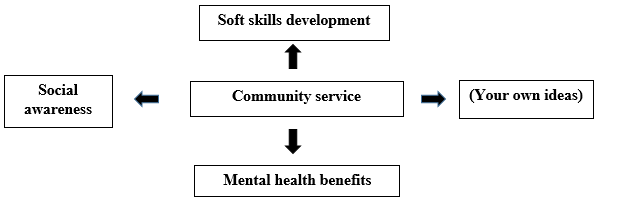
Follow-up questions:
1. Do you think community service should be a mandatory subject in high schools? Why?
2. How can schools encourage students who are shy or unmotivated to join volunteer activities?
Topic: Participating in community service is beneficial for high school students. (Tham gia hoạt động cộng đồng mang lại lợi ích cho học sinh cấp 3)
Sample answer:
I strongly believe that participating in community service offers numerous significant benefits for high school students.
Firstly, it promotes soft skills development, such as teamwork, communication, and leadership. By organizing charity events or working in groups, students can learn how to interact effectively with others. Secondly, volunteering enhances social awareness. It provides students with a chance to witness real-life challenges, helping them develop empathy and a deeper understanding of the world around them. Lastly, community service provides great mental health benefits. Helping those in need often gives students a sense of purpose and fulfillment, which can effectively reduce the stress of their heavy schoolwork. In my own experience, I also found that volunteering is a great way to make new friends who share the same passions.
In conclusion, community service is not only a way to give back to society but also a vital part of personal growth for every student.
Bản dịch:
Tôi tin mạnh mẽ rằng việc tham gia hoạt động cộng đồng mang lại nhiều lợi ích to lớn cho học sinh cấp 3.
Thứ nhất, nó thúc đẩy việc phát triển kỹ năng mềm, như là làm việc nhóm, giao tiếp và lãnh đạo. Thông qua việc tổ chức các sự kiện từ thiện hay làm việc nhóm, học sinh có thể học cách tương tác hiệu quả với người khác. Thứ hai, làm tình nguyện nâng cao nhận thức xã hội. Nó mang lại cho học sinh cơ hội chứng kiến những thử thách trong thực tế, giúp các em phát triển sự thấu cảm và hiểu biết sâu sắc hơn về thế giới xung quanh. Cuối cùng, dịch vụ cộng đồng mang lại lợi ích lớn cho sức khỏe tinh thần. Việc giúp đỡ những người khó khăn thường mang lại cho học sinh cảm giác về mục đích sống và sự mãn nguyện, điều này giúp giảm bớt căng thẳng từ việc học tập nặng nề một cách hiệu quả. Theo kinh nghiệm của bản thân, tôi cũng thấy rằng làm tình nguyện là một cách tuyệt vời để kết thêm những người bạn mới có cùng đam mê.
Tóm lại, hoạt động cộng đồng không chỉ là cách để đóng góp cho xã hội mà còn là một phần thiết yếu trong sự phát triển cá nhân của mỗi học sinh.
Follow-up questions:
1. Do you think community service should be a mandatory subject in high schools? Why? (Bạn có nghĩ hoạt động cộng đồng nên là một môn học bắt buộc ở trường cấp 3 không? Tại sao?)
Sample answer:
I personally believe that community service should be mandatory in high schools. Making it a requirement ensures that all students have the opportunity to develop social responsibility and essential life skills that are not taught in textbooks. However, instead of grading it like math or science, schools should focus on the quality of contribution. This approach helps students understand the value of giving back to society without feeling too much academic pressure.
Bản dịch:
Cá nhân tôi tin rằng hoạt động cộng đồng nên là bắt buộc ở các trường cấp 3. Việc đưa nó thành một yêu cầu bắt buộc đảm bảo rằng tất cả học sinh đều có cơ hội phát triển trách nhiệm xã hội và các kỹ năng sống thiết yếu vốn không được dạy trong sách giáo khoa. Tuy nhiên, thay vì chấm điểm như môn toán hay khoa học, nhà trường nên tập trung vào chất lượng đóng góp. Cách tiếp cận này giúp học sinh hiểu được giá trị của việc đóng góp cho xã hội mà không cảm thấy quá áp lực về mặt học tập.
2. How can schools encourage students who are shy or unmotivated to join volunteer activities? (Làm thế nào trường học có thể khuyến khích những học sinh nhút nhát hoặc thiếu động lực tham gia các hoạt động tình nguyện?)
Sample answer:
There are several ways schools can support these students. For shy individuals, schools can organize small-group tasks or pair them with supportive mentors to help them feel more confident. For those who lack motivation, schools should recognize their efforts through awards, certificates, or extra credit. Most importantly, creating a variety of projects, from environmental cleanup to teaching kids, allows students to find a cause they truly care about, which naturally boosts their interest.
Bản dịch:
Có một vài cách mà nhà trường có thể hỗ trợ những học sinh này. Đối với những bạn nhút nhát, trường có thể tổ chức các nhiệm vụ theo nhóm nhỏ hoặc ghép cặp các em với những người hướng dẫn nhiệt tình để giúp các em cảm thấy tự tin hơn. Đối với những bạn thiếu động lực, nhà trường nên ghi nhận nỗ lực của các em thông qua các giải thưởng, giấy chứng nhận hoặc cộng điểm rèn luyện. Quan trọng nhất là việc tạo ra đa dạng các dự án, từ dọn dẹp môi trường đến dạy học cho trẻ nhỏ, sẽ cho phép học sinh tìm thấy một mục tiêu mà các em thực sự quan tâm, từ đó thúc đẩy sự hứng thú một cách tự nhiên.