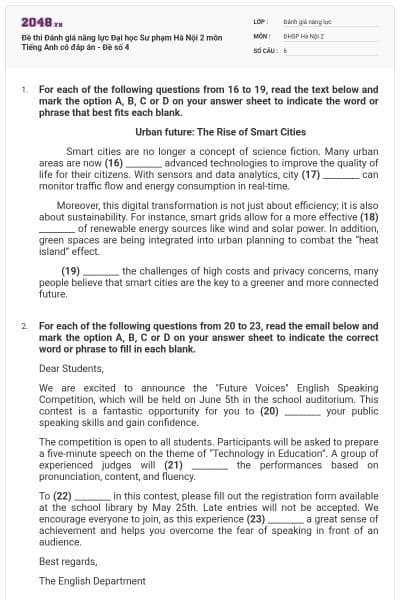
Đề thi Đánh giá năng lực Đại học Sư phạm Hà Nội 2 môn Tiếng Anh có đáp án - Đề số 4
50 câu hỏi
PART I: QUESTIONS 1 – 40
For questions 1 and 2, mark the option A, B, C or D on your answer sheet to indicate the word that is pronounced differently in the underlined part.
credible
emigrate
enduring
escalate
A. credible /ˈkredəbl/
B. emigrate /ˈemɪɡreɪt/
C. enduring /ɪnˈdjʊərɪŋ/
D. escalate /ˈeskəleɪt/
Phương án C có phần gạch chân phát âm là /ɪ/, các phương án còn lại phát âm là /e/.
For questions 1 and 2, mark the option A, B, C or D on your answer sheet to indicate the word that is pronounced differently in the underlined part.
diversity
interpret
versatile
dangerous
A. diversity /daɪˈvɜːrsəti/
B. interpret /ɪnˈtɜːrprət/
C. versatile /ˈvɜːrsətl/
D. dangerous /ˈdeɪndʒərəs/
Phương án D có phần gạch chân phát âm là /ə/, còn lại phát âm là /ɜː/.
For each of the following questions from 3 to 5, mark the option A, B, C or D on your answer sheet to indicate the word that differs from the other three in the position of the primary stress.
anxious
bizarre
unique
obscure
A. anxious /ˈæŋkʃəs/ (trọng âm 1)
B. bizarre /bɪˈzɑːr/ (trọng âm 2)
C. unique /juˈniːk/ (trọng âm 2)
D. obscure /əbˈskjʊər/ (trọng âm 2)
Phương án A có trọng âm rơi vào âm tiết thứ 1, còn lại rơi vào âm tiết thứ 2.
For each of the following questions from 3 to 5, mark the option A, B, C or D on your answer sheet to indicate the word that differs from the other three in the position of the primary stress.
translate
purchase
unwind
impose
A. translate /trænzˈleɪt/ (trọng âm 2)
B. purchase /ˈpɜːrtʃəs/ (trọng âm 1)
C. unwind /ˌʌnˈwaɪnd/ (trọng âm 2)
D. impose /ɪmˈpoʊz/ (trọng âm 2)
Phương án B có trọng âm rơi vào âm tiết thứ 1, còn lại rơi vào âm tiết thứ 2.
For each of the following questions from 3 to 5, mark the option A, B, C or D on your answer sheet to indicate the word that differs from the other three in the position of the primary stress.
maintenance
politics
disaster
paradise
A. maintenance /ˈmeɪntənəns/ (trọng âm 1)
B. politics /ˈpɑːlətɪks/ (trọng âm 1)
C. disaster /dɪˈzæstər/ (trọng âm 2)
D. paradise /ˈpærədaɪs/ (trọng âm 1)
Phương án C có trọng âm rơi vào âm tiết thứ 2, còn lại rơi vào âm tiết thứ 1.
For each of the following questions from 6 to 15, mark the option A, B, C or D on your answer sheet to indicate the correct answer to complete each sentence.
mustn’t they
aren't they
needn’t they
haven’t they
Đây là kiến thức về câu hỏi đuôi (Tag question) với động từ khuyết thiếu “must”.
- Mệnh đề chính đưa ra dự đoán về một trạng thái / sự việc ở hiện tại (must be: chắc hẳn là).
Ta có quy tắc: khi “must” dùng để dự đoán, câu hỏi đuôi sẽ chia theo động từ chính theo sau nó.
→ Ta dùng aren't để hỏi đuôi (Động từ chính ở đây là “be”, đi với chủ ngữ số nhiều “Your two brothers”).
" Chọn B
Dịch:
Your two brothers must be like chalk and cheese despite being twins, aren’t they? (Hai anh trai của bạn chắc hẳn là khác nhau một trời một vực dù là sinh đôi, đúng không?)
more impressive
more impressively
most impressive
as impressive as
- Sau động từ tobe “were” ta cần một tính từ → Loại B
- Ta sử dụng cấu trúc so sánh hơn dựa vào từ nhận biết “than” với tính từ dài “impressive”.
Công thức so sánh hơn của tính từ dài:S1 + tobe + more + tính từ dài + than + S2
→ Chọn A
Dịch:
The spectacular fireworks displays this year were more impressive than last year's performance. (Các màn trình diễn pháo hoa ngoạn mục năm nay ấn tượng hơn buổi biểu diễn năm ngoái.)
If I ________ firsthand experience as a salesman, I ________ for that position long ago.
had gained / would have applied
gained / would apply
gain / will apply
had gained / would apply
- Mệnh đề chính có mốc thời gian trong quá khứ (long ago).
" Mệnh đề chính diễn tả kết quả của một sự việc đáng lẽ đã xảy ra trong quá khứ.
" Đây là câu điều kiện loại III (diễn tả hành động sự việc không có thực trong quá khứ) với công thức: If + S + had + PII, S + would have + PII.
→ Chọn A
Dịch:
If I had gained firsthand experience as a salesman, I would have applied for that position long ago. (Nếu tôi đã có kinh nghiệm thực tế là một nhân viên bán hàng, tôi đã ứng tuyển vị trí đó từ lâu rồi.)
While the government ________ for new solutions to tackle slum issues last year, the city's population continued to grow.
look
is looking
was looking
has looked
- Xét nghĩa câu: Trong khi chính phủ ________ các giải pháp mới để giải quyết vấn đề khu ổ chuột vào năm ngoái, dân số thành phố vẫn tiếp tục tăng
" Căn cứ trên nghĩa câu, ta thấy mệnh đề phụ (While … last year) diễn tả hành động đang xảy ra tại một thời điểm trong quá khứ (last year).
" Ta chia thì Quá khứ tiếp diễn với công thức: S1 + was/were + V-ing.
→ Chọn C
Dịch:
While the government was looking for new solutions to tackle slum issues last year, the city's population continued to grow. (Trong khi chính phủ đang tìm kiếm các giải pháp mới để giải quyết vấn đề khu ổ chuột vào năm ngoái, dân số thành phố vẫn tiếp tục tăng.)
To many young people, being ________ YouTuber is an ideal job because of the flexibility.
∅
an
the
a
A. ∅ " Sai, danh từ “YouTuber” số ít đếm được cần mạo từ phía trước.
B. an " Sai, “YouTuber” /ˈjuːtjuːbə(r)/ phát âm bắt đầu bằng âm phụ âm /j/, không dùng “an”.
C. the " Sai, ở đây chỉ nói chung về một nghề nghiệp, chứ không có một đối tượng xác định nào.
D. a " Đúng. Ta dùng “a” trước danh từ số ít đếm được bắt đầu bằng âm phụ âm.
Dịch:
To many young people, being a YouTuber is an ideal job because of the flexibility. (Với nhiều người trẻ, trở thành một YouTuber là một công việc lý tưởng vì sự linh hoạt.)
Many people find it difficult to distinguish between ________ news and real information on the internet.
fabricate
fabrication
fabricator
fabricated
A. fabricate (v): bịa đặt
B. fabrication (n): sự bịa đặt
C. fabricator (n): người bịa đặt
D. fabricated (quá khứ phân từ): được bịa đặt
- Từ cần điền đứng trước danh từ “news”.
" Chọn D (quá khứ phân từ đóng vai trò như một tính từ, nhằm bổ nghĩa cho danh từ)
Dịch:
Many people find it difficult to distinguish between fabricated news and real information on the internet. (Nhiều người thấy khó khăn trong việc phân biệt giữa tin tức bịa đặt và thông tin chính thống trên internet.)
He was forced to ________ his resignation after the financial scandal was leaked to the press.
give up
hand in
step down
pull out
A. give up: từ bỏ, thôi bỏ (thường là một thói quen hay công việc)
B. hand in: nộp, đệ trình (thường dùng cho bài tập, đơn từ).
C. step down: từ chức, rời bỏ một vị trí quan trọng.
D. pull out: rút khỏi một thỏa thuận hoặc tổ chức.
- Xét nghĩa câu: Ông ấy bị buộc phải ________ từ chức sau khi vụ bê bối tài chính bị rò rỉ cho giới báo chí.
- Ta có cụm động từ: hand in one's resignation (nộp đơn từ chức).
" Chọn B
Dịch:
He was forced to hand in his resignation after the financial scandal was leaked to the press. (Ông ấy bị buộc phải nộpđơn từ chức sau khi vụ bê bối tài chính bị rò rỉ cho giới báo chí.)
Their daughter rose to ________ as a result of a viral video that captured her incredible singing talent.
star
stardom
starry
starlight
- Ta có thành ngữ rise to stardom: trở nên nổi tiếng nhanh chóng / bất ngờ.
" Chọn B
Dịch:
Their daughter rose to stardom as a result of a viral video that captured her incredible singing talent. (Con gái của họ trở nên nổi tiếng nhanh chóng nhờ một video lan truyền ghi lại tài năng ca hát đáng kinh ngạc của cô bé.)
Otherwise
Although
Given that
However
A. Otherwise: Nếu không thì (thường dùng sau một câu mệnh lệnh hoặc điều kiện)
B. Although: Mặc dù (đứng trước một mệnh đề (S + V) để chỉ sự đối lập)
C. Given that: Căn cứ trên / Bởi vì (dùng để đưa ra lý do hoặc căn cứ cho sự việc sau đó)
D. However: Tuy nhiên (Khi đứng đầu câu thì sẽ ngăn cách với mệnh đề sau bằng dấu phẩy: However, S + V)
- Xét nghĩa câu: ________ thời tiết cực kỳ xấu, lễ hội âm nhạc ngoài trời vẫn thu hút hàng ngàn người hâm mộ cuồng nhiệt.
" Chọn B
Dịch:
Although the weather was extremely bad, the outdoor music festival attracted thousands of enthusiastic fans. (Mặc dù thời tiết cực kỳ xấu, lễ hội âm nhạc ngoài trời vẫn thu hút hàng ngàn người hâm mộ cuồng nhiệt.)
The two nations are currently ________ with each other over the disputed maritime borders.
at odds
at rows
at peace
at fault
- Ta có thành ngữ be at odds with somebody: mâu thuẫn với ai.
" Chọn A
Phương án B (at rows) không tồn tại.
Phương án C (at peace: hòa bình) và phương án D (at fault: có lỗi) đều không phù hợp về nghĩa.
Dịch:
The two nations are currently at odds with each other over the disputed maritime borders. (Hai quốc gia hiện đang mâu thuẫn với nhau về các tranh chấp biên giới trên biển.)
For each of the following questions from 16 to 19, read the text below and mark the option A, B, C or D on your answer sheet to indicate the word or phrase that best fits each blank.
Urban future: The Rise of Smart Cities
Smart cities are no longer a concept of science fiction. Many urban areas are now (16) ________ advanced technologies to improve the quality of life for their citizens. With sensors and data analytics, city (17) ________ can monitor traffic flow and energy consumption in real-time.
Moreover, this digital transformation is not just about efficiency; it is also about sustainability. For instance, smart grids allow for a more effective (18) ________ of renewable energy sources like wind and solar power. In addition, green spaces are being integrated into urban planning to combat the “heat island” effect.
(19) ________ the challenges of high costs and privacy concerns, many people believe that smart cities are the key to a greener and more connected future.
adopting
adopted
adoption
adopt
- Câu này cần một động từ ở dạng V-ing để kết hợp với “are” tạo thành thì hiện tại tiếp diễn.
" Chọn A
Dịch:
Many urban areas are now adopting advanced technologies to improve the quality of life for their citizens. (Nhiều khu vực đô thị hiện nay đang áp dụng các công nghệ tiên tiến để cải thiện chất lượng cuộc sống cho người dân của họ)
With sensors and data analytics, city (17) ________ can monitor traffic flow and energy consumption in real-time.
inhabitants
authorities
supervisors
planners
Đáp án đúng là B
- Từ cần điền là người có thể thực hiện hoạt động giám sát lưu lượng giao thông và mức tiêu thụ năng lượng trong thời gian thực (monitor traffic flow and energy consumption in real-time).
A. inhabitants: cư dân " Sai, vì cư dân không có thẩm quyền giám sát hệ thống.
B. authorities: chính quyền / nhà chức trách " Đúng. Đây là nhóm người có thẩm quyền và trách nhiệm giám sát hoạt động công cộng.
C. supervisors: người giám sát " Sai. Từ này thường dùng cho người giám sát công nhân hoặc một nhóm nhỏ, không dùng cho quy mô quản lý thành phố.
D. planners: người lập kế hoạch " Sai. Công việc của họ là lập kế hoạch trước, không phải là người trực tiếp thực hiện giám sát thời gian thực.
Dịch:
With sensors and data analytics, city authorities can monitor traffic flow and energy consumption in real-time. (Với các cảm biến và phân tích dữ liệu, chính quyền thành phố có thể giám sát lưu lượng giao thông và mức tiêu thụ năng lượng trong thời gian thực.)
distribution
circulation
contribution
expansion
Đáp án đúng là A
A. distribution: sự phân phối
B. circulation: sự lưu thông (thường dùng cho tiền tệ, máu hoặc không khí)
C. contribution: sự đóng góp
D. expansion: sự mở rộng
- Xét nghĩa thông tin: Ví dụ, lưới điện thông minh cho phép ________ hiệu quả hơn các nguồn năng lượng tái tạo.
" Chọn A, các từ khác không thích hợp về nghĩa.
Dịch:
For example, smart grids allow for a more effective distribution of renewable energy sources. (Ví dụ, lưới điện thông minh cho phép sự phân phối hiệu quả hơn các nguồn năng lượng tái tạo.)
Because of
In spite of
Regardless of
Instead of
A. Because of: Bởi vì
B. In spite of: Mặc dù
C. Regardless of: Bất kể / Không quan tâm đến
D. Instead of: Thay vì
- Xét nghĩa câu: ________ những thách thức như chi phí đầu tư cao và các lo ngại về quyền riêng tư, nhiều người tin rằng thành phố thông minh chính là chìa khóa cho một tương lai xanh hơn và kết nối hơn.
" Chọn B, các từ khác không thích hợp về nghĩa.
Dịch:
In spite of the challenges of high costs and privacy concerns, many people believe that smart cities are the key to a greener and more connected future. (Mặc dù vẫn còn tồn tại những thách thức như chi phí đầu tư cao và các lo ngại về quyền riêng tư, nhiều người tin rằng thành phố thông minh chính là chìa khóa cho một tương lai xanh hơn và kết nối hơn.)
Bài đọc | Dịch bài đọc |
Urban future: The Rise of Smart Cities
Smart cities are no longer a concept of science fiction. Many urban areas are now adopting advanced technologies to improve the quality of life for their citizens. With sensors and data analytics, city authorities can monitor traffic flow and energy consumption in real-time.
Moreover, this digital transformation is not just about efficiency; it is also about sustainability. For instance, smart grids allow for a more effective distribution of renewable energy sources like wind and solar power. In addition, green spaces are being integrated into urban planning to combat the “heat island” effect. In spite of the challenges of high costs and privacy concerns, many people believe that smart cities are the key to a greener and more connected future. | Tương lai đô thị: Sự phát triển của các thành phố thông minh Thành phố thông minh không còn là một khái niệm trong phim khoa học viễn tưởng nữa. Nhiều khu vực đô thị hiện nay đang áp dụng các công nghệ tiên tiến để cải thiện chất lượng cuộc sống cho người dân của họ. Với các cảm biến và phân tích dữ liệu, chính quyền thành phố có thể giám sát lưu lượng giao thông và mức tiêu thụ năng lượng trong thời gian thực. Hơn nữa, sự chuyển đổi kỹ thuật số này không chỉ dừng lại ở hiệu quả; nó còn xoay quanh tính bền vững. Ví dụ, lưới điện thông minh cho phép sự phân phối hiệu quả hơn các nguồn năng lượng tái tạo như năng lượng gió và năng lượng mặt trời. Ngoài ra, các không gian xanh đang được tích hợp vào quy hoạch đô thị để chống lại hiệu ứng “đảo nhiệt”. Mặc dù vẫn còn tồn tại những thách thức như chi phí đầu tư cao và các lo ngại về quyền riêng tư, nhiều người tin rằng thành phố thông minh chính là chìa khóa cho một tương lai xanh hơn và kết nối hơn. |
For each of the following questions from 20 to 23, read the email below and mark the option A, B, C or D on your answer sheet to indicate the correct word or phrase to fill in each blank.
Dear Students,
We are excited to announce the "Future Voices" English Speaking Competition, which will be held on June 5th in the school auditorium. This contest is a fantastic opportunity for you to (20) ________ your public speaking skills and gain confidence.
The competition is open to all students. Participants will be asked to prepare a five-minute speech on the theme of “Technology in Education”. A group of experienced judges will (21) ________ the performances based on pronunciation, content, and fluency.
To (22) ________ in this contest, please fill out the registration form available at the school library by May 25th. Late entries will not be accepted. We encourage everyone to join, as this experience (23) ________ a great sense of achievement and helps you overcome the fear of speaking in front of an audience.
Best regards,
The English Department
discover
master
demonstrate
assess
Đáp án đúng là C
- Xét nghĩa thông tin: Cuộc thi này là một cơ hội tuyệt vời để các em ________ kỹ năng nói trước đám đông và có thêm sự tự tin.
A. discover: khám phá " Sai vì không thích hợp về nghĩa.
B. master: thành thục/làm chủ " Sai. Cuộc thi là nơi rèn luyện hoặc trình diễn, không phải là quá trình để trở nên thành thục một kỹ năng ngay lập tức.
C. demonstrate: thể hiện / trình diễn " Đúng. Phù hợp với việc trình bày kỹ năng nói trước đám đông.
D. assess: đánh giá " Sai. Thí sinh không tự đánh giá kỹ năng của mình mà là người biểu diễn.
Dịch:
This contest is a fantastic opportunity for you to demonstrate your public speaking skills and gain confidence. (Cuộc thi này là một cơ hội tuyệt vời để em thể hiện kỹ năng nói trước đám đông và có thêm sự tự tin.)
appreciate
evaluate
comment
deliver
Đáp án đúng là B
- Xét nghĩa thông tin: Một ban giám khảo giàu kinh nghiệm sẽ ________ các phần trình diễn dựa trên phát âm, nội dung và sự lưu loát.
A. appreciate: trân trọng " Sai, vì không thích hợp về nghĩa
B. evaluate: đánh giá " Đúng. Giám khảo dựa trên các tiêu chí (pronunciation, content, fluency) để đưa ra mức điểm / nhận xét.
C. comment: bình luận " Sai. Thường đi với giới từ “on”, và mang tính cá nhân hơn là một quy trình đánh giá bài thi chính thức.
D. deliver: trình bày " Sai. Giám khảo không trình bày phần thi.
Dịch:
A group of experienced judges will evaluate the performances based on pronunciation, content, and fluency. (Một ban giám khảo giàu kinh nghiệm sẽ đánh giá các phần trình diễn dựa trên phát âm, nội dung và sự lưu loát.)
attend
participate
enlist
register
- Xét nghĩa câu: Để ________ cuộc thi này, vui lòng điền vào mẫu đăng ký có sẵn tại thư viện trường trước ngày 25 tháng 5.
A. attend: tham dự " Sai. “attend” thường mang nghĩa có mặt, không nhấn mạnh tính tham gia / tương tác vào hoạt động.
B. participate: tham gia " Đúng, thường đi với giới từ “in”.
C. enlist: chiêu mộ, đăng ký nhập ngũ, nhờ vả " Sai vì không thích hợp về nghĩa.
D. register: đăng ký " Sai. “Register" đi với giới từ “for” để mang nghĩa “đăng kí tham gia”.
Dịch:
To participate in this contest, please fill out the registration form available at the school library by May 25th. (Để tham gia cuộc thi này, vui lòng điền vào mẫu đăng ký có sẵn tại thư viện trường trước ngày 25 tháng 5.)
We encourage everyone to join, as this experience (23) ________ a great sense of achievement and helps you overcome the fear of speaking in front of an audience.
provides
provide
are providing
will provide
- Từ cần điền là một động từ số ít thì Hiện tại đơn (để song hành với động từ “helps”).
" Chọn A
Dịch:
We encourage everyone to join, as this experience provides a great sense of achievement and helps you overcome the fear of speaking in front of an audience. (Chúng tôi khuyến khích tất cảcác em tham gia, vì trải nghiệm này không chỉ mang lạicảm giác thành tựu to lớn mà còn giúpcác em vượt qua nỗi sợ nói trước đám đông.)
Bài đọc | Dịch bài đọc |
Dear Students, We are excited to announce the “Future Voices” English Speaking Competition, which will be held on June 5th in the school auditorium. This contest is a fantastic opportunity for you to demonstrate your public speaking skills and gain confidence. The competition is open to all students. Participants will be asked to prepare a five-minute speech on the theme of “Technology in Education”. A group of experienced judges will evaluate the performances based on pronunciation, content, and fluency.
To participate in this contest, please fill out the registration form available at the school library by May 25th. Late entries will not be accepted. We encourage everyone to join, as this experience provides a great sense of achievement and helps you overcome the fear of speaking in front of an audience.
Best regards, The English Department | Thân gửi các em học sinh, Chúng tôi rất vui khi thông báo về cuộc thi diễn thuyết thường niên của trường chúng ta sẽ diễn ra vào ngày 5 tháng 6 tại hội trường nhà trường. Cuộc thi này là một cơ hội tuyệt vời để các em thể hiện kỹ năng nói trước công chúng và xây dựng sự tự tin của mình. Cuộc thi được tổ chức cho tất cả các học sinh. Các thí sinh tham gia sẽ được yêu cầu chuẩn bị một bài diễn thuyết dài 5 phút về chủ đề “Công nghệ trong Giáo dục”. Một ban giám khảo giàu kinh nghiệm sẽ đánh giá các phần trình diễn dựa trên phát âm, nội dung và sự lưu loát. Để tham gia cuộc thi này, vui lòng điền vào mẫu đăng ký có sẵn tại thư viện trường trước ngày 25 tháng 5. Những đơn nộp muộn sẽ không được chấp thuận. Chúng tôi khuyến khích tất cả các em tham gia, vì trải nghiệm này không chỉ mang lại cảm giác thành tựu to lớn mà còn giúp các em vượt qua nỗi sợ nói trước đám đông. Trân trọng, Khoa Tiếng Anh. |
For each of the following questions from 24 to 28, read the passage below and mark the option A, B, C or D on your answer sheet to indicate the phrase or clause that best fits each blank.
Choosing a field of study that aligns with one’s passion and strengths is the first step toward a successful career. When students select a major they are truly interested in, they can stay motivated and (24) ________. This enthusiasm often leads to higher academic achievement and a deeper understanding of the subject matter, which prepares them for future professional challenges.
Moreover, gaining practical experience during one's studies contributes to professional growth, (25) ________. When students participate in internships or vocational training, (26) ________. This hands-on approach allows them to apply theoretical knowledge to real-world situations, making them more competitive in the labor market.
Lastly, continuous learning in a chosen field fosters career longevity (27) ________. In a rapidly changing world, professionals who dedicate time to upskilling and attending workshops can adapt to new demands. (28) ________ can provide a sense of security, open doors to promotions, and ensure long-term job stability.
In conclusion, the synergy between a well-chosen field of study and active career development is essential for personal fulfillment and long-term professional prosperity.
increase the likelihood of dropping out early
enhance their ability to acquire new skills
bypass the need for theoretical academic knowledge
secure high salaries after graduation from university
Đáp án đúng là B
- Xét nghĩa đoạn đầu: Chọn một lĩnh vực học tập phù hợp với đam mê và thế mạnh của bản thân là bước đầu tiên hướng tới một sự nghiệp thành công. Khi sinh viên chọn một ngành học mà họ thực sự quan tâm, họ có thể duy trì động lực và (24) ________. Sự nhiệt huyết này thường dẫn đến thành tích học tập cao hơn và sự hiểu biết sâu sắc hơn về kiến thức chuyên môn, điều này giúp các em chuẩn bị cho những thách thức nghề nghiệp trong tương lai.
" Căn cứ trên nghĩa câu, thông tin cần điền phải là hệ quả tích cực của việc chọn ngành mà mình đam mê.
A. increase the likelihood of dropping out early (tăng khả năng bỏ học sớm)
⭢ Sai, vì đây là thông tin tiêu cực.
B. enhance their ability to acquire new skills (nâng cao khả năng tiếp thu các kỹ năng mới)
⭢ Đúng, vì phù hợp với tính tích cực của việc có động lực học tập.
C. bypass the need for theoretical academic knowledge (bỏ qua nhu cầu về kiến thức học thuật lý thuyết)
⭢ Sai, vì không hợp lý về nghĩa.
D. secure high salaries after graduation from university (có được mức lương cao sau khi tốt nghiệp đại học)
⭢ Sai, đây là kết quả xa vời, không trực tiếp đi kèm với “động lực” trong câu và cũng không phù hợp để kết nối với nội dung của câu ngay sau đó.
Dịch:
Choosing a field of study that aligns with one’s passion and strengths is the first step toward a successful career. When students select a major they are truly interested in, they can stay motivated and enhance their ability to acquire new skills. (Chọn một lĩnh vực học tập phù hợp với đam mê và thế mạnh của bản thân là bước đầu tiên hướng tới một sự nghiệp thành công. Khi sinh viên chọn một ngành học mà họ thực sự quan tâm, họ có thể duy trì động lực và nâng cao khả năng tiếp thu các kỹ năng mới.Sự nhiệt huyết này thường dẫn đến thành tích học tập cao hơn và sự hiểu biết sâu sắc hơn về kiến thức chuyên môn, điều này giúp các em chuẩn bị cho những thách thức nghề nghiệp trong tương lai.)
resulting in a broader range of academic interests
making it easier to skip entry-level positions
leading to a more seamless integration into the workforce
providing a clearer view of retirement benefits
- Xét nghĩa đoạn 2: Hơn nữa, việc tích lũy kinh nghiệm thực tế trong quá trình học tập sẽ góp phần vào sự phát triển chuyên môn, (25) ________. Khi sinh viên tham gia vào các kỳ thực tập hoặc đào tạo nghề, (26) ________. Cách tiếp cận thực tế này cho phép các em áp dụng kiến thức lý thuyết vào các tình huống thực tế, giúp các em trở nên cạnh tranh hơn trên thị trường lao động.
" Ta thấy câu đầu đoạn văn nêu ra lợi ích của việc: tích lũy kinh nghiệm thực tế. Hai câu còn lại bổ nghĩa cho câu đầu này.
" Như vậy, thông tin cần điền cũng phải bổ nghĩa cho việc tích lũy kinh nghiệm thực tế.
A. resulting in a broader range of academic interests (dẫn đến phạm vi sở thích học thuật rộng hơn)
⭢ Sai vì thông tin nhấn mạnh phạm vi học thuật, không phải kinh nghiệm thực tế.
B. making it easier to skip entry-level positions (giúp việc bỏ qua các vị trí khởi điểm trở nên dễ dàng hơn)
⭢ Sai, vì mâu thuẫn với thông tin trong câu tiếp theo “participate in internships or vocational training” (tham gia vào các kỳ thực tập hoặc đào tạo nghề).
C. leading to a more seamless integration into the workforce (dẫn đến sự hội nhập suôn sẻ hơn vào lực lượng lao động)
⭢ Đúng
D. providing a clearer view of retirement benefits (cung cấp cái nhìn rõ ràng hơn về các quyền lợi hưu trí)
⭢ Sai, vì không bổ nghĩa cho việc tích lũy kinh nghiệm thực tế trong đoạn thông tin.
Dịch:
Moreover, gaining practical experience during one's studies contributes to professional growth, leading to a more seamless integration into the workforce.(Hơn nữa, việc tích lũy kinh nghiệm thực tế trong quá trình học tập góp phần vào sự phát triển chuyên môn, dẫn đến sự hội nhập suôn sẻ hơn vào lực lượng lao động.)
they can bridge the gap between theory and practice
they find it unnecessary to pursue further education
they find it unchallenging to work under pressure
they are more likely to achieve top academic results
- Xét nghĩa thông tin: Khi sinh viên tham gia vào các kỳ thực tập hoặc đào tạo nghề, (26) ________. Cách tiếp cận thực tế này cho phép các em áp dụng kiến thức lý thuyết vào các tình huống thực tế, giúp các em trở nên cạnh tranh hơn trên thị trường lao động.
" Căn cứ vào nghĩa câu, thông tin cần điền nói về lợi ích thực tế của quá trình thực tập và đào tạo nghề.
A. they can bridge the gap between theory and practice (họ có thể rút ngắn khoảng cách giữa lý thuyết và thực hành)
⭢ Đúng. Đây là mục đích chính của thực tập và đào tạo nghề.
B. they find it unnecessary to pursue further education (họ thấy việc theo đuổi giáo dục cao hơn là không cần thiết)
C. they find it unchallenging to work under pressure (họ thấy làm việc dưới áp lực là không có gì thách thức)
D. they are more likely to achieve top academic results (họ có nhiều khả năng đạt được kết quả học tập hàng đầu)
" Chọn A, các phương án còn lại không thích hợp về nghĩa.
Dịch:
When students participate in internships or vocational training, they can bridge the gap between theory and practice.(Khi sinh viên tham gia vào các kỳ thực tập hoặc đào tạo nghề, họ có thể rút ngắn khoảng cách giữa lý thuyết và thực hành.)
unless individuals are satisfied with their current expertise
though individuals’ fields create few employment opportunities
although individuals might find some industry trends confusing
since individuals can stay informed about employment trends
- Xét nghĩa đoạn 3: Cuối cùng, việc học tập liên tục trong một lĩnh vực đã chọn sẽ thúc đẩy sự bền vững của sự nghiệp (27) ________. Trong một thế giới thay đổi nhanh chóng, các cá nhân mà dành thời gian để nâng cao kỹ năng và tham gia các buổi hội thảo có thể thích nghi với những yêu cầu mới.
A. unless individuals are satisfied with their current expertise (trừ khi các cá nhân hài lòng với chuyên môn hiện tại)
B. though individuals’ fields create few employment opportunities (mặc dù lĩnh vực của các cá nhân tạo ra ít cơ hội việc làm)
C. although individuals might find some industry trends confusing (mặc dù các cá nhân có thể thấy một số xu hướng ngành khó hiểu)
D. since individuals can stay informed about employment trends (bởi vì các cá nhân có thể cập nhật những xu hướng việc làm)
" Chọn D vì đã giải thích nguyên nhân cho “career longevity”. Ngoài ra, phương án D còn liên kết chặt chẽ với câu sau: phải nắm bắt được xu hướng việc làm thì các cá nhân mới biết mình cần nâng cao kỹ năng nào (upskilling) để thích nghi với yêu cầu mới (adapt to new demands) như đã đề cập ở câu ngay sau đó.
Dịch:
Lastly, continuous learning in a chosen field fosters career longevity since individuals can stay informed about employment trends.(Cuối cùng, việc học tập liên tục trong một lĩnh vực đã chọn thúc đẩy sự bền vững của sự nghiệp bởi vì các cá nhân có thể cập nhật những xu hướng việc làm. Trong một thế giới thay đổi nhanh chóng, các cá nhân mà dành thời gian để nâng cao kỹ năng và tham gia các buổi hội thảo có thể thích nghi với những yêu cầu mới.)
(28) ________ can provide a sense of security, open doors to promotions, and ensure long-term job stability.
Maintaining a consistent routine without any changes
Adopting a proactive approach to professional development
Establishing strong social bonds with non-colleagues
Focusing primarily on completing daily assigned tasks
- Xét nghĩa thông tin: (28) ________ có thể mang lại cảm giác an tâm, mở ra cánh cửa thăng tiến và đảm bảo sự ổn định công việc lâu dài.
A. Maintaining a consistent routine without any changes (Duy trì một thói quen nhất quán mà không có bất kỳ thay đổi nào)
⭢ Sai vì mâu thuẫn với thông tin “upskill” (nâng cao kỹ năng) và “adapt to new demands” (thích nghi với những yêu cầu mới) ở câu trước.
B. Adopting a proactive approach to professional development (Áp dụng một phương pháp chủ động để phát triển chuyên môn)
⭢ Đúng, sự chủ động được thể hiện qua thông tin “dedicate time to upskilling and attending workshops” (dành thời gian để nâng cao kỹ năng và tham gia các buổi hội thảo) ở câu trước.
C. Establishing strong social bonds with non-colleagues (Thiết lập các mối quan hệ xã hội bền chặt với những người không phải đồng nghiệp)
⭢ Sai, vì không liên quan trực tiếp đến thăng tiến chuyên môn.
D. Focusing primarily on completing daily assigned tasks (Tập trung chủ yếu vào việc hoàn thành các nhiệm vụ được giao hàng ngày)
⭢ Sai, đây chỉ là làm tròn vai, chưa đủ để “mở ra cánh cửa thăng tiến”.
Dịch:
Adopting a proactive approach to professional development can provide a sense of security, open doors to promotions, and ensure long-term job stability. (Áp dụng một phương pháp chủ động để phát triển chuyên môn có thể mang lại cảm giác an tâm, mở ra cánh cửa thăng tiến và đảm bảo sự ổn định công việc lâu dài.)
Bài đọc | Dịch bài đọc |
Choosing a field of study that aligns with one's passion and strengths is the first step toward a successful career. When students select a major they are truly interested in, they can stay motivated and enhance their ability to acquire new skills. This enthusiasm often leads to higher academic achievement and a deeper understanding of the subject matter, which prepares them for future professional challenges.
Moreover, gaining practical experience during one's studies contributes to professional growth, leading to a more seamless integration into the workforce. When students participate in internships or vocational training, they can bridge the gap between theory and practice. This hands-on approach allows them to apply theoretical knowledge to real-world situations, making them more competitive in the labor market. Lastly, continuous learning in a chosen field fosters career longevity since individuals can stay informed about employment trends. In a rapidly changing world, professionals who dedicate time to upskilling and attending workshops can adapt to new demands. Adopting a proactive approach to professional development can provide a sense of security, open doors to promotions, and ensure long-term job stability.
In conclusion, the synergy between a well-chosen field of study and active career development is essential for personal fulfillment and long-term professional prosperity. | Chọn một lĩnh vực học tập phù hợp với đam mê và thế mạnh của bản thân là bước đầu tiên hướng tới một sự nghiệp thành công. Khi sinh viên chọn một ngành học mà họ thực sự quan tâm, họ có thể duy trì động lực và nâng cao khả năng tiếp thu các kỹ năng mới. Sự nhiệt huyết này thường dẫn đến thành tích học tập cao hơn và sự hiểu biết sâu sắc hơn kiến thức chuyên môn, điều này giúp các em chuẩn bị cho những thách thức nghề nghiệp trong tương lai. Hơn nữa, việc tích lũy kinh nghiệm thực tế trong quá trình học tập sẽ góp phần vào sự phát triển chuyên môn, dẫn đến sự hội nhập suôn sẻ hơn vào lực lượng lao động. Khi sinh viên tham gia vào các kỳ thực tập hoặc đào tạo nghề, họ có thể rút ngắn khoảng cách giữa lý thuyết và thực hành. Cách tiếp cận thực tế này cho phép các em áp dụng kiến thức lý thuyết vào các tình huống thực tế, giúp các em trở nên cạnh tranh hơn trên thị trường lao động. Cuối cùng, việc học tập liên tục trong một lĩnh vực đã chọn sẽ thúc đẩy sự bền vững của sự nghiệp bởi vì các cá nhân có thể cập nhật những xu hướng việc làm. Trong một thế giới thay đổi nhanh chóng, những chuyên gia mà dành thời gian để nâng cao kỹ năng và tham gia các buổi hội thảo có thể thích nghi với những yêu cầu mới. Việc áp dụng phương pháp chủ động để phát triển chuyên môn có thể mang lại cảm giác an tâm, mở ra cánh cửa thăng tiến và đảm bảo sự ổn định công việc lâu dài. Tóm lại, sự kết hợp hỗ trợ lẫn nhau giữa việc chọn đúng ngành học và sự chủ động phát triển sự nghiệp là yếu tố cốt lõi để đạt được sự hài lòng cá nhân và sự thịnh vượng nghề nghiệp lâu dài. |
a. When combined with supportive policies and active community participation, these individual efforts can create a substantial positive impact on the global environment.
b. Adopting a green lifestyle has become essential in addressing today’s environmental challenges, as it not only helps preserve natural resources but also ensures the well-being of future generations.
c. By making simple changes, such as cutting down on plastic use, choosing energy-efficient appliances, and selecting eco-friendly transport options like cycling or electric vehicles, individuals can significantly lower their carbon footprint.
d. Moving towards a plant-based diet also supports sustainability, since the agricultural sector, especially livestock production, is a major source of deforestation and greenhouse gas emissions.
e. Furthermore, an increasing number of people are turning to renewable energy sources, such as solar and wind power, which not only reduce dependence on fossil fuels but also help save on electricity costs over time.
b – e – c – d – a
b – d – c – e – a
b – d – e – c – a
b – c – e – d – a
Giải thích: Dịch " Chức năng từng câu
b. Adopting a green lifestyle has become essential in addressing today's environmental challenges, as it not only helps preserve natural resources but also ensures the well-being of future generations. (Việc áp dụng lối sống xanh đã trở nên thiết yếu trong việc giải quyết các thách thức môi trường ngày nay, vì nó không chỉ giúp bảo tồn tài nguyên thiên nhiên mà còn đảm bảo hạnh phúc cho các thế hệ tương lai) " Nêu chủ đề chính của đoạn văn: áp dụng lối sống xanh.
c. By making simple changes, such as cutting down on plastic use, choosing energy-efficient appliances, and selecting eco-friendly transport options like cycling or electric vehicles, individuals can significantly lower their carbon footprint. (Bằng cách thực hiện những thay đổi đơn giản, như cắt giảm sử dụng nhựa, chọn các thiết bị tiết kiệm năng lượng và chọn các phương tiện giao thông thân thiện với môi trường như xe đạp hoặc xe điện, các cá nhân có thể giảm đáng kể lượng dấu chân carbon của mình) " Nêu cách áp dụng lối sống xanh đầu tiên và lợi ích đi kèm.
e. Furthermore, an increasing number of people are turning to renewable energy sources, such as solar and wind power, which not only reduce dependence on fossil fuels but also help save on electricity costs over time. (Hơn nữa, ngày càng có nhiều người chuyển sang các nguồn năng lượng tái tạo, chẳng hạn như năng lượng mặt trời và năng lượng gió, điều này không chỉ giảm sự phụ thuộc vào nhiên liệu hóa thạch mà còn giúp tiết kiệm chi phí điện theo thời gian) " Nêu cách áp dụng lối sống xanh thứ hai và lợi ích đi kèm.
Lưu ý: do có từ “Furthermore” bắt đầu câu nên bắt buộc câu này phải đứng sau câu c.
d. Moving towards a plant-based diet also supports sustainability, since the agricultural sector, especially livestock production, is a major source of deforestation and greenhouse gas emissions. (Chuyển sang chế độ ăn dựa trên thực vật cũng hỗ trợ tính bền vững, vì ngành nông nghiệp, đặc biệt là chăn nuôi, là nguồn gây mất rừng và phát thải khí nhà kính chính) " Nêu cách áp dụng lối sống xanh thứ ba và giải thích tại sao.
a. When combined with supportive policies and active community participation, these individual efforts can create a substantial positive impact on the global environment. (Khi kết hợp với các chính sách hỗ trợ và sự tham gia tích cực của cộng đồng, những nỗ lực cá nhân này có thể tạo ra tác động tích cực đáng kể đến môi trường toàn cầu) " Câu kết luận: Khẳng định sự cần thiết của việc kết hợp nỗ lực cá nhân và chính sách xã hội.
a. To improve, I intend to join school clubs where I can collaborate with others and become more comfortable voicing my ideas.
b. Sometimes, I hesitate to speak up because I worry about making mistakes or failing to express my thoughts clearly.
c. I’ve recently come to realize that I lack several soft skills, particularly in communication and teamwork, which makes me feel less confident when working in groups.
d. Gradually, I hope these efforts will boost my confidence and help me build the skills necessary to connect effectively in a global environment.
e. I also plan to learn from more confident classmates by observing how they communicate and interact with people from diverse backgrounds.
c – a – e – b – d
c – b – a – e – d
b – c – a – e – d
c – b – e – a – d
Giải thích: Dịch " Chức năng từng câu
c. I’ve recently come to realize that I lack several soft skills, particularly in communication and teamwork, which makes me feel less confident when working in groups. (Gần đây tôi nhận ra rằng mình còn thiếu một vài kỹ năng mềm, đặc biệt là trong giao tiếp và làm việc nhóm, điều này khiến tôi cảm thấy kém tự tin khi làm việc theo nhóm) " Nêu chủ đề chính của đoạn văn: Sự tự nhận thức về những khiếm khuyết trong kỹ năng mềm và sự thiếu tự tin của bản thân.
b. Sometimes, I hesitate to speak up because I worry about making mistakes or failing to express my thoughts clearly. (Đôi khi, tôi ngần ngại lên tiếng vì lo lắng về việc mắc lỗi hoặc không diễn đạt được ý nghĩ của mình một cách rõ ràng) " Phân tích biểu hiện cụ thể và nguyên nhân dẫn đến sự thiếu tự tin đã nêu ở câu c.
a. To improve, I intend to join school clubs where I can collaborate with others and become more comfortable voicing my ideas. (Để cải thiện, tôi dự định tham gia các câu lạc bộ của trường, nơi tôi có thể làm việc với những người khác và trở nên thoải mái hơn khi bày tỏ ý tưởng của mình) " Đưa ra giải pháp đầu tiên để khắc phục điểm yếu.
e. I also plan to learn from more confident classmates by observing how they communicate and interact with people from diverse backgrounds. (Tôi cũng định học hỏi từ những bạn cùng lớp tự tin hơn mình bằng cách quan sát cách họ giao tiếp và tương tác với những người có nền tảng khác nhau) " Đưa ra giải pháp thứ hai để khắc phục điểm yếu.
d. Gradually, I hope these efforts will boost my confidence and help me build the skills necessary to connect effectively in a global environment. (Dần dần, tôi hy vọng những nỗ lực này sẽ thúc đẩy sự tự tin của tôi và giúp tôi xây dựng các kỹ năng cần thiết để kết nối hiệu quả trong môi trường toàn cầu) " Câu kết luận: Nêu lên kỳ vọng và mục tiêu dài hạn sau khi thực hiện các giải pháp.
a. I’ve tried that, but my schedule is so packed with part-time jobs and classes. I’m just struggling to find the right balance.
b. Hi, Sarah. You look a bit exhausted today. Is everything going okay with your new semester?
c. That sounds tough. Maybe you should try using a time-management app to organize your tasks better.
d. I see your point. But remember to take it easy and prioritize your health above everything else.
e. Not really. I’ve been struggling to keep up with the heavy workload, and I feel quite overwhelmed.
b – e – c – a – d
b – c – e – a – d
b – a – e – c – d
b – e – a – c – d
Giải thích: Dịch " Chức năng từng câu
b. Mark: Hi, Sarah. You look a bit exhausted today. Is everything going okay with your new semester? (Mark: Chào Sarah. Hôm nay trông bạn hơi kiệt sức. Mọi chuyện với học kỳ mới của bạn vẫn ổn chứ?) " Câu mở đầu: Mark đưa ra lời chào và hỏi thăm tình hình của bạn.
e. Sarah: Not really. I’ve been struggling to keep up with the heavy workload, and I feel quite overwhelmed. (Sarah: Không hẳn vậy. Mình đang phải vật lộn để theo kịp khối lượng công việc nặng nề, và mình cảm thấy khá bị choáng ngợp) " Sarah phản hồi lời hỏi thăm bằng cách nêu ra vấn đề mình đang gặp phải.
c. Mark: That sounds tough. Maybe you should try using a time-management app to organize your tasks better. (Mark: Nghe có vẻ khó khăn đấy. Có lẽ bạn nên thử sử dụng một ứng dụng quản lý thời gian để sắp xếp các nhiệm vụ của mình tốt hơn) " Mark bày tỏ cảm nghĩa và đưa ra một lời khuyên cụ thể.
a. Sarah: I’ve tried that, but my schedule is so packed with part-time jobs and classes. I’m just struggling to find the right balance. (Sarah: Mình đã thử cách đó rồi, nhưng lịch trình của mình quá dày đặc với các công việc bán thời gian và các lớp học. Mình chỉ đang vật lộn để tìm được sự cân bằng phù hợp) " Sarah phản hồi về tính khả thi của lời khuyên và giải thích lý do khó khăn hơn.
d. Mark: I see your point. But remember to take it easy and prioritize your health above everything else. (Mark: Mình hiểu ý bạn. Nhưng cần nhớ thư giãn và ưu tiên sức khỏe của bạn lên trên hết)
" Mark kết thúc cuộc hội thoại bằng sự thấu hiểu và lời khuyên chân thành về sức khỏe.
a. I was in such a rush for the interview that I didn't have time to ask. I promise to have it dry-cleaned for you.
b. Wait, is that my favorite blazer you're wearing? I was planning to wear it tonight!
c. Apology accepted, but please don't let it happen again. My wardrobe isn't your personal shop!
d. Oh, I’m so sorry! I didn't think you'd mind since you weren't home this morning.
e. That's not the point. It’s about respecting my privacy and my belongings.
b – d – e – a – c
b – a – e – d – c
d – b – e – a – c
b – d – a – e – c
Giải thích: Dịch " Chức năng từng câu
b. Mark: Wait, is that my favorite blazer you're wearing? I was planning to wear it tonight! (Mark: Đợi đã, đó có phải áo khoác blazer yêu thích của mình mà bạn đang mặc không? Mình đã dự định mặc nó tối nay!) → Khởi đầu sự việc với câu hỏi đầy bất ngờ.
d. Linda: Oh, I'm so sorry! I didn't think you'd mind since you weren't home this morning. (Linda: Ôi, mình rất xin lỗi! Mình không nghĩ bạn sẽ để ý vì sáng nay bạn không có nhà) → Giải thích lý do và đưa ra lời xin lỗi.
e. Mark: That's not the point. It's about respecting my privacy and my belongings. (Mark: Đó không phải vấn đề. Vấn đề là ở việc tôn trọng quyền riêng tư và đồ đạc của mình) → Bày tỏ quan điểm về sự tôn trọng cá nhân.
a. Linda: I was in such a rush for the interview that I didn't have time to ask. I promise to have it dry-cleaned for you. (Linda: Mình đã vội đi phỏng vấn đến mức không có thời gian để hỏi. Mình hứa sẽ đem nó đi giặt khô cho bạn) → Giải thích hoàn cảnh vội vã và đưa ra cam kết sửa lỗi.
c. Mark: Apology accepted, but please don't let it happen again. My wardrobe isn't your personal shop! (Mark: Chấp nhận lời xin lỗi, nhưng làm ơn đừng để chuyện đó xảy ra lần nữa. Tủ đồ của mình không phải là cửa hàng cá nhân của bạn đâu!) → Kết thúc bằng việc chấp nhận lời xin lỗi nhưng có cảnh cáo.
MODERN STUDIO FOR SUBLET
Located in the city center, our studio is a ten-minute walk from the Central Library. It features a private balcony, though laundry facilities are shared with three other tenants. A smoke-free environment is strictly required. Rent is five million dongs monthly, with a mandatory one-month security deposit. Available from the final week of November. Call 0905 123 456 for viewing.Renting the room requires an additional initial payment.
It takes ten minutes to walk from the Central Library to the city center.
You can move in the studio on the twelfth of November.
The studio includes a private washing machine for the tenant.
Đáp án đúng là A
A. Renting the room requires an additional initial payment. (Thuê phòng yêu cầu một khoản thanh toán bổ sung ban đầu.)
→ Đúng. Vì studio yêu cầu “mandatory one-month security deposit” (tiền đặt cọc bảo đảm bắt buộc một tháng). Đây là khoản tiền ngoài tiền thuê hàng tháng.
B. It takes ten minutes to walk from the Central Library to the city center. (Mất mười phút để đi bộ từ Thư viện Trung tâm đến trung tâm thành phố.)
→ Sai, dựa trên thông tin “our studio is a ten-minute walk from the Central Library” (studio của chúng tôi cách Thư viện Trung tâm mười phút đi bộ).
C. You can move in the studio on the twelfth of November. (Bạn có thể chuyển vào studio vào ngày 12 tháng 11)
→ Sai, dựa trên thông tin “Available from the final week of November” (Có sẵn từ tuần cuối cùng của tháng 11).
D. The studio includes a private washing machine for the tenant. (Căn hộ studio bao gồm máy giặt riêng cho người thuê)
→ Sai, dựa trên thông tin “laundry facilities are shared with three other tenants” (các thiết bị giặt là được dùng chung với 3 người thuê khác).
Dịch bài:
CĂN HỘ STUDIO HIỆN ĐẠI CHO THUÊ LẠI
Nằm ở trung tâm thành phố, căn hộ studio của chúng tôi cách Thư viện Trung tâm 10 phút đi bộ. Căn hộ có ban công riêng, mặc dù các thiết bị giặt là được dùng chung với 3 người thuê khác. Yêu cầu nghiêm ngặt về môi trường không khói thuốc. Tiền thuê là 5 triệu đồng mỗi tháng, cùng với một khoản tiền đặt cọc bảo đảm bắt buộc là một tháng. Căn hộ có sẵn từ tuần cuối cùng của tháng 11. Vui lòng gọi 0905 123 456 để xem phòng.
ANNUAL TALENT SHOWCASE
Our school is hosting the Annual Talent Showcase this Thursday, November 14th, at the Grand Hall.
The event kicks off at 7:00 p.m. featuring various instrumental and vocal acts. Attendance is free of charge for all parents and local residents.
However, everyone is requested to arrive at the venue at least 15 minutes early to secure their seats.
Please note that photography and video recording are strictly prohibited during the performances to ensure a focused environment for our artists.The talent show is scheduled to start in the early morning.
Parents and local residents don’t need to pay to watch the show.
Guests are allowed to take photos of the performers on stage.
Those arriving 15 minutes late will still be seated.
Đáp án đúng là B
A. The talent show is scheduled to start in the early morning. (Chương trình tài năng được lên lịch bắt đầu vào sáng sớm)
" Sai, dựa trên thông tin “The event kicks off at 7:00 p.m.” (Sự kiện bắt đầu lúc 7 giờ tối.).
B. Parents and local residents don’t need to pay to watch the show. (Phụ huynh và cư dân địa phương không cần trả tiền để xem chương trình)
" Đúng, dựa trên thông tin “Attendance is free of charge for all parents and local residents.” (Việc tham dự là miễn phí đối với tất cả phụ huynh và cư dân địa phương.).
C. Guests are allowed to take photos of the performers on stage. (Khách được phép chụp ảnh các nghệ sĩ biểu diễn trên sân khấu.)
" Sai, dựa trên thông tin “photography and video recording are strictly prohibited during the performances” (việc chụp ảnh và quay phim bị nghiêm cấm trong suốt các phần biểu diễn).
D. Those arriving 15 minutes late will still be seated. (Những người đến muộn 15 phút vẫn sẽ được xếp chỗ ngồi.)
" Sai, dựa trên thông tin "everyone is requested to arrive at the venue at least 15 minutes early to secure their seats." (mọi người được yêu cầu đến địa điểm ít nhất 15 phút sớm để đảm bảo có chỗ ngồi).
Dịch bài:
BUỔI TRÌNH DIỄN TÀI NĂNG THƯỜNG NIÊN
Trường chúng ta sẽ tổ chức Buổi trình diễn Tài năng Thường niên vào Thứ Năm tuần này, ngày 14 tháng 11, tại Đại sảnh.
Sự kiện sẽ bắt đầu lúc 7 giờ tối với nhiều tiết mục biểu diễn nhạc cụ và thanh nhạc khác nhau. Việc tham dự là hoàn toàn miễn phí đối với tất cả phụ huynh và cư dân địa phương.
Tuy nhiên, mọi người được yêu cầu đến địa điểm ít nhất 15 phút sớm để đảm bảo có chỗ ngồi.
Vui lòng lưu ý rằng việc chụp ảnh và quay phim bị nghiêm cấm trong suốt các phần biểu diễn để đảm bảo một môi trường tập trung cho các nghệ sĩ.
? YOUNG PHOTOGRAPHERS’ CONTEST
Show us your perspective! We are now accepting submissions for our school’s photography competition held on Saturday, October 12th.
This contest is open strictly to students from Grade 10 to Grade 12.
Please email your digital photographs to Mr. David at the Media Lab or submit them via the school portal.
A team of professional photographers will choose the top 20 photos for the upcoming exhibition at the City Gallery.
All participants will receive a certificate of participation, regardless of the final result.The competition is available for students of all grade levels.
Submission process starts on Saturday, October 12th.
Students are required to submit their entries to Mr. David or through school portal.
Every photo submitted will be displayed at the City Gallery.
A. The competition is available for students of all grade levels. (Cuộc thi dành cho học sinh ở tất cả các khối lớp.)
" Sai, dựa trên thông tin “This contest is open strictly to students from Grade 10 to Grade 12.” (Cuộc thi này chỉ dành riêng cho học sinh từ khối 10 đến khối 12.).
B. Submission process starts on Saturday, October 12th. (Quá trình nộp bài bắt đầu vào Thứ Bảy, ngày 12 tháng 10.)
" Sai, dựa trên thông tin “photography competition held on Saturday, October 12th." (cuộc thi nhiếp ảnh được tổ chức vào Thứ Bảy, ngày 12 tháng 10.). Đây là ngày tổ chức cuộc thi, không phải ngày bắt đầu nộp bài.
C. Students are required to submit their entries to Mr. David or through school portal. (Học sinh được yêu cầu nộp bài dự thi cho ông David hoặc thông qua cổng thông tin trường.)
" Đúng, dựa trên thông tin “Please email your digital photographs to Mr. David at the Media Lab or submit them via the school portal.” (Vui lòng gửi email các bức ảnh kỹ thuật số của bạn cho thầy David tại Phòng Truyền thông hoặc nộp qua cổng thông tin của trường.).
D. Every photo submitted will be displayed at the City Gallery. (Mọi bức ảnh được nộp sẽ được trưng bày tại Phòng triển lãm Thành phố.)
" Sai, dựa trên thông tin “choose the top 20 photos for the upcoming exhibition at the City Gallery.” (chọn ra 20 bức ảnh hàng đầu cho cuộc triển lãm sắp tới tại Phòng triển lãm Thành phố).
Dịch bài:
CUỘC THI NHIẾP ẢNH TRẺ
Hãy cho chúng tôi thấy góc nhìn của bạn! Chúng tôi hiện đang tiếp nhận các bài dự thi cho cuộc thi nhiếp ảnh của trường được tổ chức vào Thứ Bảy, ngày 12 tháng 10.
Cuộc thi này chỉ dành riêng cho học sinh từ khối 10 đến khối 12.
Vui lòng gửi email các bức ảnh kỹ thuật số của bạn cho thầy David tại Phòng Truyền thông hoặc nộp qua cổng thông tin của trường.
Một đội ngũ các nhiếp ảnh gia chuyên nghiệp sẽ chọn ra 20 bức ảnh hàng đầu cho cuộc triển lãm sắp tới tại Phòng triển lãm Thành phố.
Tất cả những người tham gia sẽ nhận được giấy chứng nhận tham gia, bất kể kết quả cuối cùng như thế nào.
For each of the following questions from 36 to 40, read the passage below and mark the option A, B, C or D on your answer sheet to indicate the best answer.
Domestic and school violence remain serious and persistent issues in Vietnam, often hidden due to cultural values that emphasize family privacy and educational harmony. Although authorities and organizations have implemented various measures to raise awareness and protect victims, these problems continue to inflict profound psychological and physical harm on countless individuals, particularly the most vulnerable. Understanding these issues is essential for developing effective solutions.
Domestic violence, including physical, emotional, sexual, and economic abuse, is still widespread. Despite legal protections, cultural expectations such as preserving family reputation and traditional gender roles often discourage victims from reporting abuse or seeking help. Women and children are particularly affected, suffering long-term consequences such as mental health issues, poor academic performance, and difficulties in relationships. For example, children exposed to violence at home may develop anxiety or depression, which can affect their social and academic development and continue the cycle of violence.
School violence is also a complex issue, including bullying, physical aggression, and cyberbullying. With the rise of social media, harassment can extend beyond school environments, intensifying its impact. While bullying might seem like a minor issue to some, its impact on victims can be devastating, leading to severe emotional distress, declining academic performance, and even suicidal thoughts. Many students become withdrawn or avoid school due to fear or humiliation, while teachers often struggle to identify and address such cases effectively.
Addressing these problems requires a comprehensive and collaborative approach. Public awareness campaigns must challenge deep-seated cultural norms that normalize or excuse violence. Education also plays a key role, helping students understand healthy relationships and conflict resolution, and enabling teachers and parents to recognize and respond to signs of abuse. In addition, strengthening legal systems, expanding access to support services and ensuring timely intervention from authorities are essential. Ultimately, creating a society that values safety, respect, and open communication is crucial to breaking cycles of violence and protecting future generations in Vietnam.
According to paragraph 2, which of the following is NOT a reason why victims of domestic violence might be deterred from seeking help?
The desire to protect family reputation
The influence of traditional gender roles
The lack of legal protection for victims
The pressure to maintain educational harmony
Đáp án đúng là C
According to paragraph 2, which of the following is NOT a reason why victims of domestic violence might be deterred from seeking help? (Theo đoạn 2, điều nào sau đây KHÔNG phải là lý do khiến nạn nhân bạo lực gia đình bị ngăn cản trong việc tìm kiếm sự giúp đỡ?)
A. The desire to protect family reputation. (Mong muốn bảo vệ danh tiếng gia đình.)
" Đây là một lý do có được nhắc đến trong bài, cụ thể ở thông tin “cultural expectations such as preserving family reputation... often discourage victims from reporting abuse” (những kỳ vọng văn hóa như việc giữ gìn danh tiếng gia đình... thường làm nạn nhân nản lòng trong việc báo cáo sự lạm dụng).
B. The influence of traditional gender roles. (Sự ảnh hưởng của các vai trò giới tính truyền thống.)
" Đây cũng là lý do được bài nêu ra, cụ thể ở thông tin “...traditional gender roles often discourage victims from reporting abuse or seeking help.” (...các vai trò giới tính truyền thống thường làm nản lòng nạn nhân trong việc báo cáo hành vi lạm dụng hoặc tìm kiếm sự giúp đỡ.)
C. The lack of legal protection for victims. (Sự thiếu hụt bảo vệ pháp lý cho nạn nhân.)
" Đây không phải là lý do. Bài viết khẳng định điều ngược lại, cụ thể ở thông tin “Despite legal protections, cultural expectations... often discourage victims from reporting abuse or seeking help.” (Bất chấp các biện pháp bảo vệ pháp lý, những kỳ vọng văn hóa... thường làm nạn nhân ngại báo cáo hành vi lạm dụng hoặc tìm kiếm sự giúp đỡ). Điều này cho thấy hệ thống pháp luật có tồn tại sự bảo vệ, nhưng nạn nhân vẫn ngại vì lý do văn hóa.
D. The pressure to maintain educational harmony. (Áp lực phải duy trì sự hòa hợp trong giáo dục.)
" Đây là một lý do, tuy nhiên lại được nhắc đến ngay từ đoạn 1 như một giá trị văn hóa dẫn đến việc che giấu bạo lực, cụ thể ở thông tin “...often hidden due to cultural values that emphasize family privacy and educational harmony.” (...thường bị che giấu do các giá trị văn hóa nhấn mạnh vào quyền riêng tư của gia đình và sự hòa hợp trong giáo dục.)
The phrase “inflict profound psychological and physical harm” in paragraph 1 could be best replaced by ________.
create deep intellectual and physical well-being
bring about significant mental and bodily damage
result in negligible emotional and physical pain
cause minor emotional and bodily injury
Đáp án đúng là B
The phrase “inflict profound psychological and physical harm” in paragraph 1 could be best replaced by ________. (Cụm từ “inflict profound psychological and physical harm” ở đoạn 1 có thể được thay thế tốt nhất bằng ________)
A. create deep intellectual and physical well-being. (tạo ra sự khỏe mạnh sâu sắc về trí tuệ và thể chất)
B. bring about significant mental and bodily damage. (mang lại những thiệt hại đáng kể về tinh thần và cơ thể.)
C. result in negligible emotional and physical pain. (dẫn đến nỗi đau thể chất và cảm xúc không đáng kể.)
D. cause minor emotional and bodily injury. (gây ra những tổn thương nhỏ về cảm xúc và cơ thể)
- Xét nghĩa thông tin: Mặc dù các cơ quan chức năng và các tổ chức đã triển khai nhiều biện pháp nhằm nâng cao nhận thức và bảo vệ nạn nhân, những vấn đề này vẫn inflict profound psychological and physical harm cho vô số cá nhân, đặc biệt là những đối tượng dễ bị tổn thương nhất.
" Chọn B
Which of the following can be inferred from the passage?
Technological advancements like social media are the primary cause of increased school violence.
Most cases of domestic and school violence in Vietnam will be effectively handled by schools and authorities once they are reported.
Cultural values in Vietnam can unintentionally contribute to the persistence of domestic and school violence.
School violence occurs within school grounds and does not affect students’ lives outside of school.
Which of the following can be inferred from the passage? (Điều nào sau đây có thể được suy ra từ đoạn văn?)
A. Technological advancements like social media are the primary cause of increased school violence. (Những tiến bộ công nghệ như mạng xã hội là nguyên nhân chính dẫn đến sự gia tăng bạo lực học đường)
" Sai. Thông tin “With the rise of social media, harassment can extend beyond school environments, intensifying its impact” (Với sự trỗi dậy của mạng xã hội, hành vi quấy rối có thể mở rộng ra ngoài môi trường trường học, làm gia tăng mức độ ảnh hưởng của nó.) chỉ nói mạng xã hội làm gia tăng mức độ ảnh hưởng và mở rộng phạm vi, chứ không khẳng định nó là “nguyên nhân chính” (primary cause).
B. Most cases of domestic and school violence in Vietnam will be effectively handled by schools and authorities once they are reported. (Hầu hết các vụ bạo lực gia đình và học đường ở Việt Nam sẽ được nhà trường và cơ quan chức năng giải quyết hiệu quả khi được báo cáo.)
" Sai. Thông tin “Education also plays a key role … and enabling teachers and parents to recognize and respond to signs of abuse” (Giáo dục cũng đóng vai trò then chốt … và tạo điều kiện cho giáo viên và phụ huynh nhận biết và phản hồi các dấu hiệu lạm dụng) và “… ensuring timely intervention from authorities are essential” (… đảm bảo sự can thiệp kịp thời từ các cơ quan chức năng là điều thiết yếu) lần lượt cho thấy mục tiêu và một cách giải quyết vấn đề bạo lực, chứ không thể suy luận được về kết quả thực trong tương lai.
C. Cultural values in Vietnam can unintentionally contribute to the persistence of domestic and school violence. (Các giá trị văn hóa ở Việt Nam có thể vô tình góp phần vào sự tồn tại dai dẳng của bạo lực gia đình và học đường.)
" Đúng, dựa trên thông tin “Domestic and school violence remain serious and persistent issues in Vietnam, often hidden due to cultural values that emphasize family privacy and educational harmony.” (Bạo lực gia đình và học đường vẫn là những vấn đề nghiêm trọng và nhức nhối tại Việt Nam, thường bị che giấu do các giá trị văn hóa vốn nhấn mạnh vào quyền riêng tư gia đình và sự hòa hợp trong giáo dục).
D. School violence occurs within school grounds and does not affect students’ lives outside of school. (Bạo lực học đường xảy ra trong phạm vi trường học và không ảnh hưởng đến cuộc sống của học sinh bên ngoài nhà trường.)
" Sai, vì mâu thuẫn với thông tin trong bài “harassment can extend beyond school environments” (hành vi quấy rối có thể mở rộng ra ngoài môi trường trường học)
The phrase “deep-seated” in the final paragraph is closest in meaning to ________.
superficial
ingrained
flexible
permanent
The phrase “deep-seated”in the final paragraph is closest in meaning to ________. (Cụm từ “deep-seated” ở đoạn cuối gần nghĩa nhất với ________.)
A. superficial: nông cạn, hời hợt
B. ingrained: ăn sâu / bám rễ sâu
C. flexible: linh hoạt
D. permanent: vĩnh cửu
- Thông tin: Public awareness campaigns must challenge deep-seated cultural norms that normalize or excuse violence (Các chiến dịch nâng cao nhận thức cộng đồng phải thách thức những chuẩn mực văn hóa deep-seated vốn bình thường hóa hoặc bào chữa cho bạo lực).
" Chọn B
Which of the following is TRUE according to the passage?
The persistence of domestic and school violence in Vietnam is partly linked to victims’ reluctance to report incidents due to cultural expectations and fear of social judgment.
Both domestic and school violence are issues that only affect vulnerable groups such as women and children, with little impact on other members of society.
Efforts to address violence in Vietnam have focused more on eliminating cultural values than on improving legal frameworks and support systems.
The Vietnamese government has eliminated domestic and school violence through effective legal enforcement and public education campaigns.
Which of the following is TRUE according to the passage? (Điều nào sau đây là ĐÚNG theo đoạn văn?)
A. The persistence of domestic and school violence in Vietnam is partly linked to victims’ reluctance to report incidents due to cultural expectations and fear of social judgment. (Sự tồn tại dai dẳng của bạo lực gia đình và học đường ở Việt Nam một phần liên quan đến việc nạn nhân ngại báo cáo các vụ việc do các kỳ vọng văn hóa và nỗi sợ bị xã hội phán xét.)
" Đúng, dựa trên thông tin “cultural expectations such as preserving family reputation... often discourage victims from reporting abuse or seeking help.” (những kỳ vọng văn hóa như việc giữ gìn danh tiếng gia đình... thường làm nản lòng nạn nhân trong việc báo cáo sự lạm dụng hoặc tìm kiếm sự giúp đỡ.)
B. Both domestic and school violence are issues that only affect vulnerable groups such as women and children, with little impact on other members of society. (Cả bạo lực gia đình và học đường đều là những vấn đề chỉ ảnh hưởng đến các nhóm dễ bị tổn thương như phụ nữ và trẻ em, và tác động rất ít đến các thành viên khác trong xã hội.)
" Sai. Thông tin “particularly the most vulnerable” (đặc biệt là những người dễ bị tổn thương nhất) nhấn mạnh đối tượng hay bị ảnh hưởng nhất, chứ không phải các đối tượng duy nhất.
C. Efforts to address violence in Vietnam have focused more on eliminating cultural values than on improving legal frameworks and support systems. (Các nỗ lực giải quyết bạo lực ở Việt Nam tập trung nhiều hơn vào việc xóa bỏ các giá trị văn hóa hơn là cải thiện khung pháp lý và hệ thống hỗ trợ.)
" Sai. Bài viết đề xuất cần song hành cả hai, cụ thể ở thông tin “challenging deep-seated cultural norms” và “strengthening legal systems, expanding access to support services”. Không có thông tin nào nói rằng nỗ lực tập trung vào văn hóa “nhiều hơn” pháp lý.
D. The Vietnamese government has eliminated domestic and school violence through effective legal enforcement and public education campaigns. (Chính phủ Việt Nam đã xóa bỏ bạo lực gia đình và học đường thông qua việc thực thi pháp luật hiệu quả và các chiến dịch giáo dục công cộng.)
" Sai. Bài viết khẳng định bạo lực ngay từ mở bài đây là vấn đề “serious and persistent” (nghiêm trọng và dai dẳng), tức là chưa hề bị xóa bỏ (eliminated).
Dịch bài đọc:
Bạo lực gia đình và học đường vẫn là những vấn đề nghiêm trọng và dai dẳng tại Việt Nam, thường bị che giấu bởi các giá trị văn hóa vốn nhấn mạnh vào quyền riêng tư của gia đình và sự hòa hợp trong giáo dục. Mặc dù các cơ quan chức năng và các tổ chức đã triển khai nhiều biện pháp nhằm nâng cao nhận thức và bảo vệ nạn nhân, những vấn đề này vẫn tiếp tục gây ra những tổn thương sâu sắc về tâm lý và thể chất cho vô số cá nhân, đặc biệt là những đối tượng dễ bị tổn thương nhất. Hiểu rõ những vấn đề này là điều thiết yếu để phát triển các giải pháp hiệu quả.
Bạo lực gia đình, bao gồm lạm dụng về thể chất, tinh thần, tình dục và kinh tế, vẫn còn phổ biến. Bất chấp các biện pháp bảo vệ pháp lý, những kỳ vọng về văn hóa như giữ gìn danh tiếng gia đình và các vai trò giới tính truyền thống thường khiến nạn nhân ngại báo cáo hành vi lạm dụng hoặc tìm kiếm sự giúp đỡ. Phụ nữ và trẻ em là những đối tượng đặc biệt bị ảnh hưởng, phải chịu đựng những hậu quả lâu dài như các vấn đề về sức khỏe tâm thần, kết quả học tập kém và khó khăn trong các mối quan hệ. Ví dụ, trẻ em phải tiếp xúc với bạo lực tại nhà có thể nảy sinh tâm lý lo âu hoặc trầm cảm, điều này có thể ảnh hưởng đến sự phát triển xã hội, học tập và tiếp tục kéo dài vòng xoáy bạo lực.
Bạo lực học đường cũng là một vấn đề phức tạp, bao gồm bắt nạt, gây hấn về thể xác và bắt nạt qua mạng. Với sự trỗi dậy của mạng xã hội, hành vi quấy rối có thể mở rộng ra ngoài môi trường trường học, làm gia tăng mức độ ảnh hưởng của nó. Mặc dù việc bắt nạt có vẻ như là một vấn đề nhỏ đối với một số người, nhưng tác động của nó đối với nạn nhân có thể rất tàn khốc, dẫn đến đau khổ tột cùng về cảm xúc, giảm sút kết quả học tập và thậm chí có ý tưởng tự tử. Nhiều học sinh trở nên thu mình hoặc trốn học vì sợ hãi hoặc xấu hổ, trong khi giáo viên thường gặp khó khăn trong việc xác định và giải quyết các trường hợp này một cách hiệu quả.
Việc giải quyết những vấn đề này đòi hỏi một cách tiếp cận toàn diện và mang tính hợp tác. Các chiến dịch nâng cao nhận thức cộng đồng phải thách thức những chuẩn mực văn hóa đã ăn sâu vào tiềm thức vốn bình thường hóa hoặc bào chữa cho bạo lực. Giáo dục cũng đóng vai trò then chốt, giúp học sinh hiểu về các mối quan hệ lành mạnh và cách giải quyết xung đột, đồng thời tạo điều kiện cho giáo viên và phụ huynh nhận biết và phản hồi các dấu hiệu lạm dụng. Ngoài ra, việc tăng cường hệ thống pháp luật, mở rộng khả năng tiếp cận các dịch vụ hỗ trợ và đảm bảo sự can thiệp kịp thời từ các cơ quan chức năng là điều thiết yếu. Cuối cùng, việc tạo ra một xã hội coi trọng sự an toàn, tôn trọng và giao tiếp cởi mở là yếu tố quyết định để phá vỡ vòng xoáy bạo lực và bảo vệ các thế hệ tương lai tại Việt Nam.
PART II: QUESTIONS 41 – 44
Match each of the following questions from 41 to 44 with the most appropriate response by marking ONE of the options A, B, C, D, E or F on your answer sheet.
Questions | Responses |
Question 41: How would you gently remind a classmate about a book they borrowed from you a month ago? Question 42: What would you say to encourage a teammate who feels their contribution isn't good enough? Question 43: How would you respond to someone who just apologized for being 20 minutes late to a group study? Question 44: What would you say to a friend who is talking loudly in the library while you are trying to focus? | A. It's no big deal, we just started the introduction anyway. B. Do you mind keeping it down a bit? I’m having a hard time correcting my essay mistakes. C. I’m really sorry, I didn’t mean to keep you waiting so long. D. I was wondering if you’ve had a chance to finish that book I lent you? E. Actually, I think your ideas really helped us see the problem differently. F. You should probably find another place to study if you're bored. |
How would you gently remind a classmate about a book they borrowed from you a month ago? (Làm thế nào để bạn nhắc nhở nhẹ nhàng một người bạn cùng lớp về cuốn sách họ đã mượn bạn một tháng trước?)
D. I was wondering if you’ve had a chance to finish that book I lent you? (Mình tự hỏi liệu bạn đã có cơ hội đọc xong cuốn sách mình cho mượn chưa?)
What would you say to encourage a teammate who feels their contribution isn't good enough?
What would you say to encourage a teammate who feels their contribution isn't good enough? (Bạn sẽ nói gì để khích lệ một người đồng đội cảm thấy đóng góp của họ không đủ tốt?)
E. Actually, I think your ideas really helped us see the problem differently. (Thực ra, mình nghĩ những ý tưởng của bạn thực sự giúp chúng mình nhìn nhận vấn đề theo một cách khác)
How would you respond to someone who just apologized for being 20 minutes late to a group study?
How would you respond to someone who just apologized for being 20 minutes late to a group study? (Bạn sẽ phản hồi thế nào với một người vừa xin lỗi vì đã đến muộn 20 phút trong buổi học nhóm?)
A. It's no big deal, we just started the introduction anyway. (Không có gì to tát đâu, dù sao thì chúng mình cũng vừa mới bắt đầu phần giới thiệu thôi)
What would you say to a friend who is talking loudly in the library while you are trying to focus? (Bạn sẽ nói gì với một người bạn đang nói chuyện to trong thư viện khi bạn đang cố gắng tập trung?)
B. Do you mind keeping it down a bit? I’m having a hard time correcting my essay mistakes. (Bạn có phiền nếu nói khẽ lại một chút không? Mình đang gặp khó khăn khi sửa lỗi bài luận của mình)
PART III: QUESTIONS 45 – 50
For questions from 45 to 50, read the passage below and decide if each of the following statements is True (T), False (F) or Not given (NG). Mark the option T, F or NG on your answer sheet.
Global plastic production has increased at an extraordinary pace over the past decades. Since 1960, output has risen nearly 100 times, and by some estimates, the total weight of all plastic ever produced now exceeds that of all land and marine animals combined. A significant proportion of plastic products – over half according to the United Nations – are designed for single use, including items such as hotel toiletries, disposable hygiene tools, and rapid medical testing kits.
Once discarded, plastic does not disappear easily. Instead, it can persist in the environment for hundreds of years, gradually breaking down into microplastics. These tiny particles spread widely through ecosystems and may carry harmful chemicals. Alarmingly, microplastics have already been detected in drinking water, table salt, rainfall, and even human blood.
The rapid growth of plastic production is closely linked to the global availability of oil and gas, which serve as key raw materials. As efforts to reduce fossil fuel consumption intensify due to climate change concerns, the plastics industry is expected to become increasingly important for oil and gas companies. However, plastic manufacturing itself contributes significantly to environmental damage, releasing greenhouse gases and other pollutants. One study estimated that in 2015, plastics were responsible for about 4.5% of global greenhouse gas emissions, exceeding those produced by the entire aviation industry.
Although recycling is often promoted as a solution, many experts argue that it is insufficient. Only a small portion of plastic waste can be economically recycled, meaning that recycling alone cannot solve the problem of plastic pollution.
The total mass of all plastic produced to date is estimated to be heavier than all land and marine animals combined.
The total mass of all plastic produced to date is estimated to be heavier than all land and marine animals combined. (Tổng khối lượng của tất cả nhựa được sản xuất cho đến nay được ước tính là nặng hơn tất cả động vật trên cạn và dưới biển cộng lại.)
" Đúng, dựa trên thông tin “total weight of all plastic ever produced now exceeds that of all land and marine animals combined”. (tổng trọng lượng của tất cả các loại nhựa từng được sản xuất hiện đã vượt quá trọng lượng của tất cả các loài động vật trên cạn và dưới biển cộng lại.).
Microplastics have a tendency to filter out and remove hazardous chemicals from the ecosystems.
Microplastics have a tendency to filter out and remove hazardous chemicals from the ecosystems. (Vi nhựa có xu hướng lọc sạch và loại bỏ các hóa chất nguy hiểm khỏi hệ sinh thái)
→ Sai, dựa trên thông tin “These tiny particles spread widely through ecosystems and may carry harmful chemicals”. (Những vi hạt này lan truyền rộng rãi trong hệ sinh thái và có thể mang theo các hóa chất độc hại)
The cost of recycling many types of plastic is currently too high to be considered profitable.
The cost of recycling many types of plastic is currently too high to be considered profitable.(Chi phí tái chế nhiều loại nhựa hiện quá cao để được coi là có lãi.)
" Đúng. Dựa trên thông tin “Only a small portion of plastic waste can be economically recycled” (Chỉ một phần nhỏ rác thải nhựa có thể được tái chế một cách hiệu quả về mặt kinh tế), ta suy luận được phần nhiều khi tái chế sẽ không mang lại lợi ích kinh tế.
That microplastics appears in human body parts raises few concerns about plastic-related problems.
That microplastics appears in human body parts raises few concerns about plastic-related problems. (Việc vi nhựa xuất hiện trong các bộ phận cơ thể người gây ra rất ít lo ngại về các vấn đề liên quan đến nhựa.)
" Sai, dựa trên thông tin “Alarmingly, microplastics have already been detected in... human blood.” (Đáng báo động là vi nhựa đã được phát hiện trong... máu người). Từ “Alarmingly” (Đáng báo động) chứng tỏ đây là mối lo ngại rất lớn, không phải “ít lo ngại”.
Oil and gas companies are intentionally increasing plastic production to replace their lost income from fossil fuel energy.
Oil and gas companies are intentionally increasing plastic production to replace their lost income from fossil fuel energy. (Các công ty dầu khí đang cố tình tăng sản lượng nhựa để thay thế phần thu nhập bị mất từ năng lượng nhiên liệu hóa thạch.)
" Không được cung cấp. Dựa trên thông tin “the plastics industry is expected to become increasingly important for oil and gas companies” (ngành công nghiệp nhựa được kỳ vọng sẽ trở nên ngày càng quan trọng đối với các công ty dầu khí), ta biết ngành công nghiệp nhựa sẽ trở nên quan trọn khi nỗ lực giảm tiêu thụ nhiên liệu hóa thạch tăng lên, nhưng không đề cập đến chiến lược của các công ty.
The plastics industry is projected to lose economic importance for oil and gas companies as global policies rapidly eliminate fossil fuel dependency.
The plastics industry is projected to lose economic importance for oil and gas companies as global policies rapidly eliminate fossil fuel dependency. (Ngành công nghiệp nhựa được dự báo sẽ mất đi tầm quan trọng kinh tế đối với các công ty dầu khí khi các chính sách toàn cầu nhanh chóng loại bỏ sự phụ thuộc vào nhiên liệu hóa thạch.)
→ Sai, dựa trên thông tin “the plastics industry is expected to become increasingly important for oil and gas companies” (ngành công nghiệp nhựa được kỳ vọng sẽ trở nên ngày càng quan trọng đối với các công ty dầu khí)
Dịch bài đọc:
Sản lượng nhựa toàn cầu đã gia tăng với tốc độ bất thường trong những thập kỷ qua. Kể từ năm 1960, sản lượng đã tăng gần 100 lần, và theo một số ước tính, tổng trọng lượng của tất cả các loại nhựa từng được sản xuất hiện đã vượt quá trọng lượng của tất cả các loài động vật trên cạn và dưới biển cộng lại. Một tỷ lệ đáng kể của các sản phẩm nhựa – theo Liên Hợp Quốc là hơn một nửa – được thiết kế để sử dụng một lần, bao gồm các vật dụng như đồ vệ sinh cá nhân trong khách sạn, dụng cụ vệ sinh dùng một lần và các bộ xét nghiệm y tế nhanh.
Một khi bị vứt bỏ, nhựa không dễ dàng biến mất. Thay vào đó, nó có thể tồn tại trong môi trường hàng trăm năm, dần dần phân hủy thành các hạt vi nhựa. Những hạt nhỏ bé này phát tán rộng rãi khắp các hệ sinh thái và có thể mang theo các hóa chất độc hại. Đáng báo động là vi nhựa đã được phát hiện trong nước uống, muối ăn, nước mưa và thậm chí cả trong máu người.
Sự tăng trưởng nhanh chóng của sản lượng nhựa liên quan chặt chẽ đến nguồn cung dầu mỏ và khí đốt toàn cầu, vốn là những nguyên liệu thô then chốt. Khi các nỗ lực nhằm giảm tiêu thụ nhiên liệu hóa thạch được đẩy mạnh do những lo ngại về biến đổi khí hậu, ngành công nghiệp nhựa được kỳ vọng sẽ trở nên ngày càng quan trọng đối với các công ty dầu khí. Tuy nhiên, bản thân việc sản xuất nhựa cũng đóng góp đáng kể vào sự hủy hoại môi trường, giải phóng khí nhà kính và các chất ô nhiễm khác. Một nghiên cứu ước tính rằng vào năm 2015, nhựa chịu trách nhiệm cho khoảng 4,5% lượng khí thải nhà kính toàn cầu, vượt quá lượng khí thải do toàn bộ ngành hàng không tạo ra.
Mặc dù tái chế thường được quảng bá như một giải pháp, nhưng nhiều chuyên gia lập luận rằng nó vẫn chưa đủ. Chỉ một phần nhỏ rác thải nhựa có thể được tái chế một cách hiệu quả về mặt kinh tế, điều đó có nghĩa là chỉ riêng việc tái chế không thể giải quyết được vấn đề ô nhiễm nhựa.