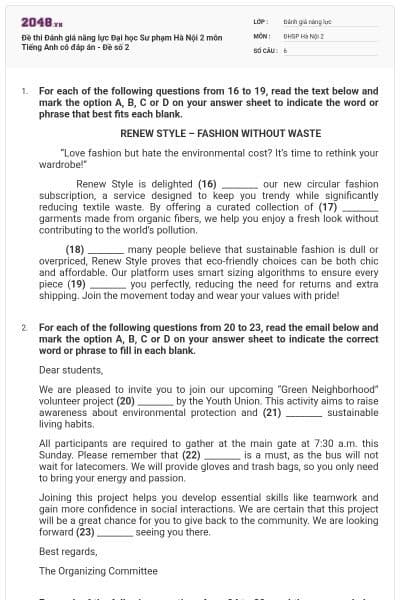
Đề thi Đánh giá năng lực Đại học Sư phạm Hà Nội 2 môn Tiếng Anh có đáp án - Đề số 2
50 câu hỏi
PART I: QUESTIONS 1 – 40
For questions 1 and 2, mark the option A, B, C or D on your answer sheet to indicate the word that is pronounced differently in the underlined part.
frustrate
fulfill
punctual
punish
A. frustrate /frʌˈstreɪt/
B. fulfill /fʊlˈfɪl/
C. punctual /ˈpʌŋ.tʃuəl/
D. punish /ˈpʌnɪʃ/
Phương án B có phần gạch chân phát âm là /ʊ/, còn lại phát âm là /ʌ/.
For questions 1 and 2, mark the option A, B, C or D on your answer sheet to indicate the word that is pronounced differently in the underlined part.
competitive
chemical
alternative
repellent
A. competitive /kəmˈpetətɪv/
B. chemical /ˈkemɪkəl/
C. alternative /ɔːlˈtɜːnətɪv/
D. repellent /rɪˈpelənt/
Phương án C có phần gạch chân phát âm là /ɜː/, còn lại phát âm là /e/.
For each of the following questions from 3 to 5, mark the option A, B, C or D on your answer sheet to indicate the word that differs from the other three in the position of the primary stress.
mammal
distant
clever
mature
A. mammal /ˈmæməl/ (trọng âm 1)
B. distant /ˈdɪstənt/ (trọng âm 1)
C. clever /ˈklevə/ (trọng âm 1)
D. mature /məˈtʃʊə/ (trọng âm 2)
Phương án D có trọng âm rơi vào âm tiết thứ 2, còn lại rơi vào âm tiết thứ 1.
For each of the following questions from 3 to 5, mark the option A, B, C or D on your answer sheet to indicate the word that differs from the other three in the position of the primary stress.
promise
pollute
convince
displace
A. promise /ˈprɒmɪs/ → trọng âm 1
B. pollute /pəˈluːt/ → trọng âm 2
C. convince /kənˈvɪns/ → trọng âm 2
D. displace /dɪsˈpleɪs/ → trọng âm 2
Phương án A có trọng âm rơi vào âm tiết thứ 1, còn lại rơi vào âm tiết thứ 2.
For each of the following questions from 3 to 5, mark the option A, B, C or D on your answer sheet to indicate the word that differs from the other three in the position of the primary stress.
monitor
overturn
renovate
standardize
A. monitor /ˈmɒnɪtə/ → trọng âm 1
B. overturn /ˌəʊvəˈtɜːn/ → trọng âm 3
C. renovate /ˈrenəveɪt/ → trọng âm 1
D. standardize /ˈstændədaɪz/ → trọng âm 1
Phương án B có trọng âm rơi vào âm tiết thứ 3, còn lại rơi vào âm tiết thứ 1.
For each of the following questions from 6 to 15, mark the option A, B, C or D on your answer sheet to indicate the correct answer to complete each sentence.
They have never experienced such a massive tailback on this road, ________?
don’t they
did they
have they
didn't they
Đây là kiến thức về câu hỏi đuôi (tag question).
- Ta thấy mệnh đề chính có “have never” mang nghĩa phủ định → câu hỏi đuôi phải ở dạng khẳng định.
- Ta thấy câu dùng chủ ngữ “they” và trợ động từ “have”.
→ Chọn C (have they)
Dịch:
They have never experienced such a massive tailback on this road, have they? (Họ chưa bao giờ gặp tình trạng tắc đường nghiêm trọng như vậy trên con đường này, đúng không?)
The new software update makes the system run ________ than the previous version, even when multiple applications are open.
more efficient
efficiently
most efficient
more efficiently
- Thông tin cần điền cần bổ nghĩa cho động từ “run”, vì vậy cần điền một trạng từ.
- Ta thấy sau thông tin cần điền có từ “than”.
" Thông tin cần điền là so sánh hơn của trạng từ.
Ta áp dụng công thức so sánh hơn của trạng từ dài (efficiently gồm 4 âm tiết): S + V + more adv + than + N / Ving.
" Chọn D
Dịch:
The new software update makes the system run more efficiently than the previous version, even when multiple applications are open. (Bản cập nhật phần mềm mới giúp hệ thống chạy hiệu quả hơn so với phiên bản trước.)
If he ________ a serious ankle sprain, he ________ the marathon last week.
hadn't had / would have finished
didn't have / would finish
hasn't had / will finish
hasn't had / would have finished
- Mệnh đề chính đang diễn tả một hành động sự việc đáng lẽ không xảy ra trong quá khứ (dựa vào mốc thời gian last week).
" Ta áp dụng câu điều kiện loại III (diễn tả hành động sự việc không có thực trong quá khứ) với công thức: If + S + had (not) + V3 / Ved, S + would/could/might (not) + have + V3 / Ved
" Chọn A
Dịch:
If he hadn't had a serious ankle sprain, he would have finished the marathon last week. (Nếu anh ấy không bị bong gân mắt cá nghiêm trọng, anh ấy đã hoàn thành cuộc marathon tuần trước.)
“We have run out of milk for the coffee.” – “Really? I ________ to the store to buy some now.”
will go
am going
go
have gone
- Đây là quyết định được đưa ra ngay tại thời điểm nói, ta dùng thì Tương lai đơn.
Ta áp dụng công thức thì Tương lai đơn: S + will + Vnguyên thể
" Chọn A
Dịch:
“We have run out of milk for the coffee.” – “Really? I will go to the store to buy some now.” (Chúng ta hết sạch sữa cho cà phê rồi - Thật à? Tôi sẽ đi ra cửa hàng mua ngay bây giờ.)
The electrician went to ________ school to repair the broken air conditioner in the staff room.
a
an
the
∅
Có 2 cách dùng với trường hợp này:
- go to school: dùng khi nói về mục đích chính của nơi đó (ví dụ: học sinh tới trường để học, giáo viên tới trường để dạy…)
- go to the school: dùng khi đối tượng đến trường vì mục đích khác (không phải mục đích học hay giảng dạy).
Ta thấy người thợ điện tới trường để làm mục đích khác (sửa điều hòa).
" Chọn C
Dịch:
The electrician went to theschool to repair the broken air conditioner in the staff room. (Người thợ điện đã đến ngôi trường đó để sửa chiếc điều hòa bị hỏng trong phòng giáo viên.)
Rather than self-studying, an increasing number of full-time employees opt for evening sessions or ________ learning courses to engage in lifelong education.
distance
distant
distancing
distanced
Ta có cụm từ cố định distance learning: học từ xa (học online, không đến lớp)
" Chọn A
Dịch:
Rather than self-studying, an increasing number of full-time employees opt for evening sessions or distance learning courses to engage in lifelong education. (Thay vì tự học, ngày càng nhiều nhân viên toàn thời gian chọn các lớp học buổi tối hoặc các khóa học từ xa để theo đuổi việc học suốt đời.)
The professor suggested that we ________ the data one more time to ensure there were no statistical anomalies.
look through
brush up on
go over
take in
A. look through: xem qua, đọc lướt, kiểm tra nhanh (không chi tiết)
B. brush up on: ôn lại kiến thức (đã học trước đó)
C. go over: xem lại, kiểm tra cẩn thận, chi tiết
D. take in: hiểu, tiếp thu thông tin
- Xét nghĩa câu: Giáo sư đề nghị chúng tôi ________ dữ liệu một lần nữa để đảm bảo không có sai lệch thống kê.
" Chọn C vì liên kết chặt chẽ với thông tin “để đảm bảo không có lỗi sai lệch thống kê”.
Dịch:
The professor suggested that we go over the data one more time to ensure there were no statistical anomalies. (Giáo sư đề nghị chúng tôi kiểm tra dữ liệu một lần nữa để đảm bảo không có sai lệch thống kê.)
The recent changes in the tax law had a ________ effect on the way small businesses manage their finances.
deep
profound
heavy
strong
- Ta có cụm từ profound effect: ảnh hưởng lớn, sâu sắc
" Chọn B
Dịch:
The recent changes in the tax law had a profound effect on the way small businesses manage their finances. (Những thay đổi gần đây trong luật thuế đã có ảnh hưởng sâu sắc đến cách các doanh nghiệp nhỏ quản lý tài chính của họ.)
I have been studying English for over ten years; ________, I still find it difficult to understand some regional accents.
but
nonetheless
besides
consequently
A. but: nhưng
B. nonetheless: tuy nhiên
C. besides: bên cạnh đó
D. consequently: hậu quả là
Ta thấy 2 vế câu mang ý nghĩa tương phản: học tiếng anh 10 năm - vẫn cảm thấy khó
" Loại C và D.
Ta có cấu trúc của “but”: Mệnh đề 1, but Mệnh đề 2.
và cấu trúc của “nonetheless”: Câu hoàn chỉnh. Nonetheless, hoặc Mệnh đề 1; nonetheless, Mệnh đề 2
" Chọn B (nonetheless)
Dịch:
I have been studying English for over ten years; nonetheless, I still find it difficult to understand some regional accents. (Tôi đã học tiếng Anh hơn 10 năm; tuy nhiên, tôi vẫn thấy khó hiểu một số giọng địa phương.)
The athlete was ________ of his career when he won three gold medals at the Olympic Games.
on the head
over the top
in the height
at the peak
Ta có cụm at the peak of his career: ở đỉnh cao sự nghiệp
Với các đáp án khác:
A. on the head of something: trên đầu của cái gì (về vị trí)
B. over the top of: vượt qua phía trên cái gì đó
C. in the height → sai cấu trúc
" Chọn D
Dịch:
The athlete was at the peak of his career when he won three gold medals at the Olympic Games. (Vận động viên đó đang ở đỉnh cao sự nghiệp khi anh ấy giành được ba huy chương vàng Olympic.)
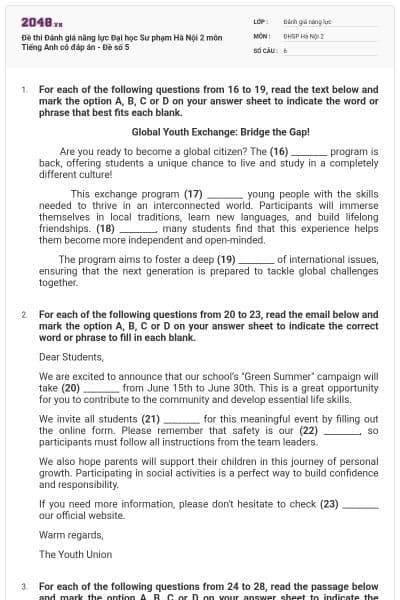
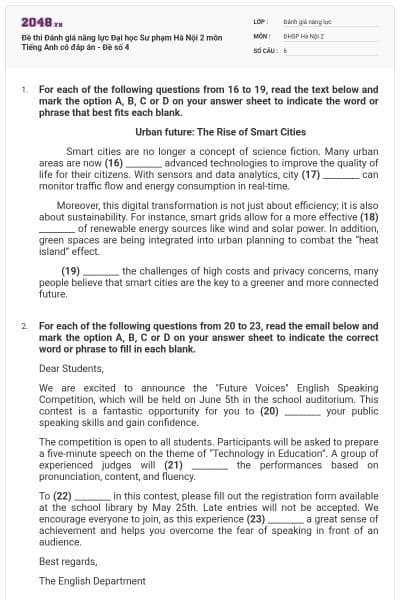
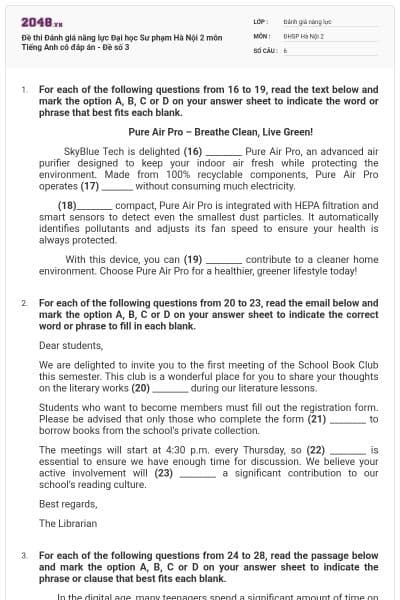
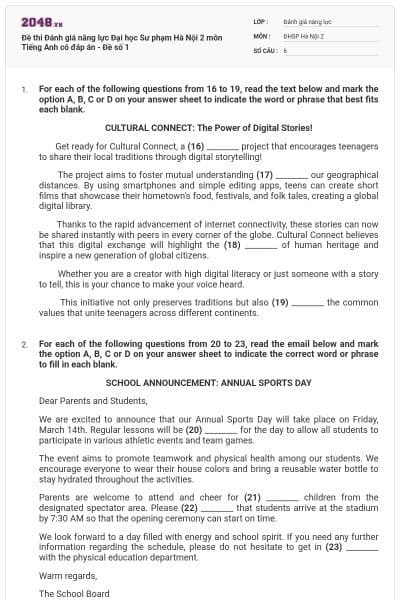
For each of the following questions from 16 to 19, read the text below and mark the option A, B, C or D on your answer sheet to indicate the word or phrase that best fits each blank.
RENEW STYLE – FASHION WITHOUT WASTE
“Love fashion but hate the environmental cost? It’s time to rethink your wardrobe!”
Renew Style is delighted (16) ________ our new circular fashion subscription, a service designed to keep you trendy while significantly reducing textile waste. By offering a curated collection of (17) ________ garments made from organic fibers, we help you enjoy a fresh look without contributing to the world’s pollution.
(18) ________ many people believe that sustainable fashion is dull or overpriced, Renew Style proves that eco-friendly choices can be both chic and affordable. Our platform uses smart sizing algorithms to ensure every piece (19) ________ you perfectly, reducing the need for returns and extra shipping. Join the movement today and wear your values with pride!
to launch
with launching
to launching
of launching
Ta có cấu trúc: be delighted to V: vui mừng, hoặc sẵn lòng làm gì
" Chọn A
Dịch:
Renew Style is delighted to launch our new circular fashion subscription, a service designed to keep you trendy while significantly reducing textile waste. (Renew Style rất vui khi ra mắt dịch vụ đăng ký thời trang tuần hoàn mới của chúng tôi, giúp bạn vừa hợp thời trang vừa giảm rác thải dệt may.)
high-end
high-quality
high-performance
high-skilled
A. high-end: cao cấp → thường nói về đồ xa xỉ
B. high-quality: chất lượng cao → phù hợp với sản phẩm / dịch vụ
C. high-performance: hiệu suất cao → thường dùng cho máy móc
D. high-skilled: có tay nghề cao → dùng cho người
- Xét nghĩa câu: Bằng cách cung cấp bộ sưu tập sản phẩm may mặc ________ được làm từ sợi hữu cơ, chúng tôi giúp bạn tận hưởng vẻ ngoài tươi mới mà không góp phần gây ô nhiễm môi trường.
" Chọn B, phương án C và D không đúng cách sử dụng. Đối với phương án A (high-end), ta phải loại vì ở đoạn 2 có thông tin “affordable” (giá cả phải chăng).
Dịch:
By offering a curated collection of high-quality garments made from organic fibers, we help you enjoy a fresh look without contributing to the world’s pollution. (Bằng cách cung cấp bộ sưu tập sản phẩm may mặc chất lượng cao được làm từ sợi hữu cơ, chúng tôi giúp bạn tận hưởng vẻ ngoài tươi mới mà không góp phần gây ô nhiễm môi trường.)
Because
Although
However
Despite
A. Because + Mệnh đề: Bởi vì
B. Although + Mệnh đề: Mặc dù
C. However(Cấu trúc:Câu hoàn chỉnh. However, hoặc Mệnh đề 1; however, Mệnh đề 2): Tuy nhiên
D. Despite + N / Ving: Mặc dù
- Xét nghĩa câu: ________ nhiều người tin rằng thời trang bền vững là nhàm chán hoặc đắt đỏ, Renew Style chứng minh rằng những lựa chọn thân thiện với môi trường vẫn có thể vừa hợp thời trang vừa hợp túi tiền.
" Chọn B, các phương án A và C không phù hợp về nghĩa, và phương án D sai cấu trúc.
Dịch:
Although many people believe that sustainable fashion is dull or overpriced, Renew Style proves that eco-friendly choices can be both chic and affordable. (Mặc dù nhiều người tin rằng thời trang bền vững là nhàm chán hoặc đắt đỏ, Renew Style chứng minh rằng những lựa chọn thân thiện với môi trường vẫn có thể vừa hợp thời trang vừa hợp túi tiền.)
matches
suits
goes with
fits
A. matches: hợp (thường về màu sắc / họa tiết / kiểu dáng)
B. suits: hợp (thường về phong cách / diện mạo)
C. goes with: phối với, đi kèm đẹp
D. fit + someone: vừa vặn (về kích cỡ / hình dáng)
- Xét nghĩa câu: Nền tảng của chúng tôi sử dụng thuật toán định cỡ thông minh để đảm bảo mọi sản phẩm đều ________ hoàn hảo với bạn.
→ Chọn D, dựa trên thông tin “smart sizing algorithms” (thuật toán kích cỡ thông minh).
Dịch:
Our platform uses smart sizing algorithms to ensure every piecefits you perfectly. (Nền tảng của chúng tôi sử dụng thuật toán kích cỡ thông minh để đảm bảo mọi sản phẩm đều vừa vặn hoàn hảo với bạn.)
Bài hoàn chỉnh | Dịch bài hoàn chỉnh |
RENEW STYLE – FASHION WITHOUT WASTE “Love fashion but hate the environmental cost? It’s time to rethink your wardrobe!”
Renew Style is delighted to launch our new circular fashion subscription, a service designed to keep you trendy while significantly reducing textile waste. By offering a curated collection of high-quality garments made from organic fibers, we help you enjoy a fresh look without contributing to the world’s pollution.
Although many people believe that sustainable fashion is dull or overpriced, Renew Style proves that eco-friendly choices can be both chic and affordable. Our platform uses smart sizing algorithms to ensure every piece fits you perfectly, reducing the need for returns and extra shipping. Join the movement today and wear your values with pride! | RENEW STYLE – THỜI TRANG KHÔNG RÁC THẢI “Bạn yêu thời trang nhưng lại lo ngại về cái giá mà môi trường phải trả? Đã đến lúc phải thay đổi tư duy về tủ đồ của mình rồi!” Renew Style rất vui mừng khi ra mắt dịch vụ đăng ký thời trang tuần hoàn mới, một dịch vụ được thiết kế để giúp bạn luôn bắt kịp xu hướng trong khi vẫn giảm thiểu đáng kể lượng rác thải dệt may. Bằng cách cung cấp một bộ sưu tập chọn lọc gồm các trang phục chất lượng cao làm từ sợi hữu cơ, chúng tôi giúp bạn tận hưởng một vẻ ngoài mới mẻ mà không góp phần gây ô nhiễm thế giới. Mặc dù nhiều người tin rằng thời trang bền vững là nhàm chán hoặc đắt đỏ, Renew Style chứng minh rằng các lựa chọn thân thiện với môi trường có thể vừa sành điệu, vừa có giá cả phải chăng. Nền tảng của chúng tôi sử dụng các thuật toán kích cỡ thông minh để đảm bảo mỗi món đồ đều vừa vặn với bạn một cách hoàn hảo, từ đó giảm thiểu nhu cầu đổi trả và chi phí vận chuyển phát sinh. Hãy tham gia phong trào ngay hôm nay và tự hào diện lên mình những giá trị mà bạn tin tưởng! |
For each of the following questions from 20 to 23, read the email below and mark the option A, B, C or D on your answer sheet to indicate the correct word or phrase to fill in each blank.
Dear students,
We are pleased to invite you to join our upcoming “Green Neighborhood” volunteer project (20) ________ by the Youth Union. This activity aims to raise awareness about environmental protection and (21) ________ sustainable living habits.
All participants are required to gather at the main gate at 7:30 a.m. this Sunday. Please remember that (22) ________ is a must, as the bus will not wait for latecomers. We will provide gloves and trash bags, so you only need to bring your energy and passion.
Joining this project helps you develop essential skills like teamwork and gain more confidence in social interactions. We are certain that this project will be a great chance for you to give back to the community. We are looking forward (23) ________ seeing you there.
Best regards,
The Organizing Committee
organize
organizing
organized
to organize
- “________ by the Youth Union” là mệnh đề quan hệ bổ nghĩa cho cụm danh từ “our upcoming “Green Neighborhood” volunteer project”.
Ta sẽ có hai cách như sau:
+ Mệnh đề quan hệ đầy đủ: dùng đại từ quan hệ “which”, chia động từ thì Hiện tại đơn.
+ Dùng mệnh đề quan hệ rút gọn thể bị động (vì dự án phải được tổ chức bởi Đoàn Thanh Niên): không dùng đại từ quan hệ, động từ để dạng quá khứ phân từ (V3 / Ved).
" Chọn C
Dịch:
We are pleased to invite you to join our upcoming “Green Neighborhood” volunteer project organized by the Youth Union. (Chúng tôi rất vui được mời bạn tham gia dự án tình nguyện “Khu phố xanh” được tổ chức bởi Đoàn Thanh niên.)
promote
promotion
promotional
promoted
A. promote (v): thúc đẩy, quảng bá, thăng tiến
B. promotion (n): sự thúc đẩy, sự quảng bá, sự thăng tiến
C. promotional (adj): thúc đẩy, quảng bá, khuyến mãi
D. promoted (Động từ dạng V2 / V-p2): đã thúc đẩy / được thăng chức
Ta có cấu trúc: Aim to + Vnguyênthể
Ở vế trước ta có: aims to raise awareness about environmental protection and …
" Từ cần điền là một động từ nguyên thể (để song hành cấu trúcvới động từ “raise”).
" Chọn A
Dịch:
This activity aims to raise awareness about environmental protection and promote sustainable living habits. (Hành động này nhằm nâng cao nhận thức về bảo vệ môi trường và thúc đẩy thói quen sống bền vững.)
punctual
punctually
punctuality
punctuate
A. punctual (adj): đúng giờ
B. punctually (adv): một cách đúng giờ
C. punctuality (n): sự đúng giờ
D. punctuate (v): đánh dấu câu, ngắt quãng
- Từ cần điền đứng trước động từ “is”.
" Từ cần điền là một danh từ, và danh từ này đóng vai trò chủ ngữ trong mệnh đề “________ is a must”.
" Chọn C
Dịch:
Please remember that punctuality is a must, as the bus will not wait for latecomers. (Xin hãy nhớ rằng việc đúng giờ là bắt buộc, vì xe buýt sẽ không đợi người đến muộn.)
for
at
to
on
Ta có cụm cố định: look forward to + V-ing: mong muốn làm gì
" Chọn C
Dịch:
We are looking forward to seeing you there. (Chúng tôi rất mong được gặp bạn tại đó.)
Bài hoàn chỉnh | Dịch bài hoàn chỉnh |
Dear students, We are pleased to invite you to join our upcoming “Green Neighborhood” volunteer project organized by the Youth Union. This activity aims to raise awareness about environmental protection and promote sustainable living habits. All participants are required to gather at the main gate at 7:30 a.m. this Sunday. Please remember that punctuality is a must, as the bus will not wait for latecomers. We will provide gloves and trash bags, so you only need to bring your energy and passion.
Joining this project helps you develop essential skills like teamwork and gain more confidence in social interactions. We are certain that this project will be a great chance for you to give back to the community. We are looking forward to seeing you there. Best regards, The Organizing Committee | Chào các em học sinh, Chúng tôi rất vui mừng được mời các em tham gia dự án tình nguyện “Khu phố Xanh” sắp tới được tổ chức bởi Đoàn Thanh niên. Hoạt động này nhằm mục đích nâng cao nhận thức về bảo vệ môi trường và thúc đẩy thói quen sống bền vững. Tất cả những người tham gia cần tập trung tại cổng chính vào lúc 7:30 sáng Chủ Nhật tuần này. Vui lòng ghi nhớ rằng việc đúng giờ là bắt buộc, vì xe buýt sẽ không đợi những người đến muộn. Chúng tôi sẽ cung cấp găng tay và túi đựng rác, vì vậy các em chỉ cần mang theo năng lượng và sự nhiệt huyết của mình. Việc tham gia dự án này giúp các em phát triển những kỹ năng thiết yếu như làm việc nhóm và trở nên tự tin hơn trong các tương tác xã hội. Chúng tôi chắc chắn rằng dự án này sẽ là một cơ hội tuyệt vời để các em đóng góp cho cộng đồng. Rất mong được gặp các em tại đó. Trân trọng, Ban Tổ chức |
For each of the following questions from 24 to 28, read the passage below and mark the option A, B, C or D on your answer sheet to indicate the phrase or clause that best fits each blank.
While social media is a great place to share happy moments, it also has a darker side known as cyberbullying. Many teenagers face negative comments or rumors (24) ________. Unlike traditional bullying, cyberbullying can happen 24/7, making it difficult for victims to find a safe space even in their own homes. This constant pressure can lead to serious emotional distress (25) ________.
One major reason for this behavior is anonymity. On the internet, bullies often hide behind fake accounts, which makes them feel powerful and (26) ________. They believe that because they are not saying these things face-to-face, their words will not have real-world consequences. However, the impact on the victim is very real and often long-lasting.
To combat this issue, schools and parents need to take active steps. (27) ________. Teaching young people to be "Upstanders" rather than "Bystanders" can change the culture of the internet. When others speak up against mean comments, the bully loses their power.
In conclusion, the internet should be a space for connection, not cruelty. (28) ________. By practicing digital kindness, we can create a safer online community for everyone.
whenever they post a selfie or a status
although they never use the internet
because they have too many real-life friends
so that they can become more famous
Đáp án đúng là A
- Thông tin: While social media is a great place to share happy moments, it also has a darker side known as cyberbullying. Many teenagers face negative comments or rumors (24) ________.
- Xét nghĩa: Mặc dù mạng xã hội là nơi tuyệt vời để chia sẻ những khoảnh khắc hạnh phúc, nhưng nó cũng có mặt tối là bắt nạt trực tuyến. Nhiều thanh thiếu niên phải đối mặt với những bình luận hoặc tin đồn tiêu cực _______.
" Căn cứ vào nghĩa đoạn thông tin, thông tin cần điền phải bổ nghĩa được cho câu đứng trước nó.
A. Whenever they post a selfie or a status (bất cứ khi nào họ đăng ảnh selfie hoặc trạng thái)
" Đúng vì hợp logic, nói về mạng xã hội, đăng bài bất cứ khi nào cũng có thể bị bình luận tiêu cực
B. Although they never use the internet (mặc dù họ không bao giờ dùng internet)
" Sai vì phi logic (vì nếu họ không dùng mạng Internet, thì sẽ không đối mặt với những bình luận / tin đồn ác ý trên mạng được).
C. because they have too many real-life friends (vì họ có quá nhiều bạn ngoài đời)
" Sai vì không liên quan đến bắt nạt online
D. so that they can become more famous (để họ trở nên nổi tiếng hơn)
" Sai vì không liên quan, sai mục đích câu
Dịch:
While social media is a great place to share happy moments, it also has a darker side known as cyberbullying. Many teenagers face negative comments or rumorswhenevertheypostaselfieorastatus. (Mặc dù mạng xã hội là nơi tuyệt vời để chia sẻ những khoảnh khắc hạnh phúc, nhưng nó cũng có mặt tối là bắt nạt trực tuyến. Nhiều thanh thiếu niên phải đối mặt với những bình luận hoặc tin đồn tiêu cực mỗi khi họ đăng một bức ảnh tự sướng hay một dòng trạng thái.)
This constant pressure can lead to serious emotional distress (25) ________.
which distracts victims from working effectively
that negatively affects a person’s mentality
which makes everyone feel mentally comfortable
that improves victims’ emotional well-being
Đáp án đúng là B
- Thông tin: This constant pressure can lead to serious emotional distress (25) ________.
- Xét nghĩa: Áp lực liên tục này có thể dẫn đến sự căng thẳng cảm xúc nghiêm trọng ________.
" Căn cứ vào nghĩa, thông tin cần điền sẽ chỉ kết quả, hậu quả tiêu cực liên quan tới tâm lý.
A. which distracts victims from working effectively (khiến nạn nhân mất tập trung khi làm việc)
" Sai vì ý quá hẹp, không đúng trọng tâm “emotional distress”.
B. that negatively affects a person’s mentality (mà ảnh hưởng tiêu cực đến tâm lý của một người)
" Đúng vì liên kết chặt chẽ với “emotional distress”.
C. which makes everyone feel mentally comfortable (khiến mọi người cảm thấy thoải mái)
" Sai vì phương án này nêu ra một kết quả tích cực về tâm lý.
D. that improves victims’ emotional well-being (cải thiện sức khỏe tinh thần)
" Sai vì phương án này nêu ra một kết quả tích cực về tâm lý.
Dịch:
This constant pressure can lead to serious emotional distressthat negatively affects a person’s mentality. (Áp lực liên tục này có thể dẫn đến sự căng thẳng cảm xúc nghiêm trọng, ảnh hưởng tiêu cực đến tâm lý con người.)
afraid of being caught by the police
less likely to hurt anyone's feelings
more comfortable attacking others online
worried about their own online reputation
- Thông tin: On the internet, bullies often hide behind fake accounts, which makes them feel powerful and (26) ________.
- Xét nghĩa: Trên internet, những kẻ bắt nạt thường ẩn mình sau những tài khoản giả mạo, điều này khiến chúng cảm thấy mạnh mẽ và ________.
A. afraid of being caught by the police (sợ bị cảnh sát bắt)
" Sai vì mâu thuẫn với thông tin “feel powerful” trong câu.
B. less likely to hurt anyone's feelings (ít có khả năng làm tổn thương người khác)
" Sai vì không phù hợp về nghĩa.
C. more comfortable attacking others online (cảm thấy thoải mái hơn khi tấn công người khác trên mạng)
" Đúng vì hợp lý về nghĩa.
D. worried about their own online reputation (lo lắng về danh tiếng của mình)
" Sai vì mâu thuẫn với thông tin “often hide behind fake accounts”.
Dịch:
On the internet, bullies often hide behind fake accounts, which makes them feel powerful and more comfortable attacking others online. (Trên Internet, những kẻ bắt nạt thường ẩn mình sau những tài khoản giả mạo, điều này khiến họ cảm thấy mạnh mẽ và thoải mái hơn khi tấn công người khác trên mạng.)
One practical solution is to foster digital apathy
Victims should report cyberbullying immediately
One effective way is to promote digital empathy
The first measure is to ignore cyberbullies
- Thông tin: To combat this issue, schools and parents need to take active steps. (27) ________. Teaching young people to be “Upstanders” rather than “Bystanders” can change the culture of the internet
- Xét nghĩa: Để giải quyết vấn đề này, các trường học và phụ huynh cần có những bước hành động tích cực. (27) ________. Việc dạy cho giới trẻ trở thành “người đứng lên bảo vệ lẽ phải” thay vì “người đứng ngoài cuộc” có thể thay đổi văn hóa của Internet.
" Thông tin cần điền phải là một giải pháp cho vấn đề bạo lực mạng. Ngoài ra, giải pháp này phải gắn kết chặt chẽ với câu ngay sau đó.
A. One practical solution is to foster digital apathy (Một giải pháp thực tế là khuyến khích sự thờ ơ)
" Sai vì mâu thuẫn với thông tin của câu ngay sau đó (dạy cho giới trẻ trở thành “người đứng lên bảo vệ lẽ phải”).
B. Victims should report cyberbullying immediately (Nạn nhân nên báo cáo bắt nạt ngay)
" Sai vì không liên kết chặt chẽ với câu sau (dạy cho giới trẻ trở thành “người đứng lên bảo vệ lẽ phải”).
C. One effective way is to promote digital empathy. (Một cách hiệu quả là thúc đẩy sự thấu cảm trên không gian số)
" Đúng. Chỉ khi một người có “sự thấu cảm” (empathy - biết đặt mình vào vị trí của nạn nhân để hiểu nỗi đau của họ), họ mới có động lực không làm ngơ (bystanders) mà dám lên tiếng bảo vệ nạn nhân (upstanders). Do đó, việc dạy về sự thấu cảm (empathy) chính là giải pháp (One effective way) để tạo ra những “Upstanders”.
D. The first measure is to ignore cyberbullies (Phương pháp đầu tiên là phớt lờ kẻ bắt nạt)
" Sai vì mâu thuẫn với thông tin trong câu sau (dạy cho giới trẻ trở thành “người đứng lên bảo vệ lẽ phải” thay vì là “người đứng ngoài cuộc”).
Dịch:
To combat this issue, schools and parents need to take active steps. One effective way is to promote digital empathy.Teaching young people to be "Upstanders" rather than "Bystanders" can change the culture of the internet. (Để giải quyết vấn đề này, các trường học và phụ huynh cần hành động. Một cách hiệu quả là thúc đẩy sự thấu cảm trên không gian số.. Việc dạy cho giới trẻ trở thành "người đứng lên bảo vệ lẽ phải" thay vì "người đứng ngoài cuộc" có thể thay đổi văn hóa của Internet.)
It is fun to tease others, but we must be careful
We must stand together, support victims, and stop the hate
It is relaxing to comment on somebody, but we must limit it
We should buy secure phones to stay safe from cyberbullying
- Thông tin: In conclusion, the internet should be a space for connection, not cruelty. (28) ________. By practicing digital kindness, we can create a safer online community for everyone.
- Xét nghĩa: Tóm lại, Internet nên là không gian để kết nối, chứ không phải là nơi để lan tỏa sự tàn ác. (28) ________. Bằng cách thực hành lòng tốt trên không gian mạng, chúng ta có thể tạo ra một cộng đồng trực tuyến an toàn hơn cho mọi người.
A. It is fun to tease others, but we must be careful (trêu chọc người khác là vui nhưng phải cẩn thận)
" Sai vì không phù hợp về thông điệp bài truyền tải (không bạo lực mạng, không chế giễu người khác).
B. We must stand together, support victims, and stop the hate (Chúng ta phải đoàn kết, hỗ trợ nạn nhân và chấm dứt sự thù ghét)
" Đúng vì phù hợp về nghĩa.
C. It is relaxing to comment on somebody, but we must limit it (Việc bình luận về người khác có thể giúp thư giãn, nhưng chúng ta cần phải hạn chế điều đó.)
" Sai vì không phù hợp về thông điệp bài truyền tải (không bạo lực mạng, không chế giễu người khác).
D. We should buy secure phones to stay safe from cyberbullying (chúng ta nên mua điện thoại bảo mật để giữ an toàn khỏi bắt nạt mạng)
" Sai vì bắt nạt mạng có thể xảy ra bất cứ khi nào mà ta sử dụng mạng xã hội. Ngoài ra, đây là một thông tin mới, hoàn toàn không phù hợp để đưa vào đoạn kết tổng hợp nội dung toàn bài.
Dịch:
In conclusion, the internet should be a space for connection, not cruelty. We must stand together, support victims, and stop the hate. By practicing digital kindness, we can create a safer online community for everyone. (Tóm lại, Internet nên là không gian để kết nối, chứ không phải để lan tỏa sự tàn ác. Chúng ta phải đoàn kết, hỗ trợ các nạn nhân và chấm dứt sự thù ghét. Bằng cách thực hành lòng tốt trên mạng, chúng ta có thể tạo ra một cộng đồng trực tuyến an toàn hơn cho tất cả mọi người.)
Bài hoàn chỉnh | Dịch bài hoàn chỉnh |
CYBERBULLYING: THE DARK SIDE OF SOCIAL MEDIA While social media is a great place to share happy moments, it also has a darker side known as cyberbullying. Many teenagers face negative comments or rumors whenever they post a selfie or a status. Unlike traditional bullying, cyberbullying can happen 24/7, making it difficult for victims to find a safe space even in their own homes. This constant pressure can lead to serious emotional distress that negatively affects a person’s mentality.
One major reason for this behavior is anonymity. On the internet, bullies often hide behind fake accounts, which makes them feel powerful and more comfortable attacking others online. They believe that because they are not saying these things face-to-face, their words will not have real-world consequences. However, the impact on the victim is very real and often long-lasting.
To combat this issue, schools and parents need to take active steps. One effective way is to promote digital empathy. Teaching young people to be “Upstanders” rather than “Bystanders” can change the culture of the internet. When others speak up against mean comments, the bully loses their power.
In conclusion, the internet should be a space for connection, not cruelty. We must stand together, support victims, and stop the hate. By practicing digital kindness, we can create a safer online community for everyone.
| BẮT NẠT QUA MẠNG: MẶT TỐI CỦA MẠNG XÃ HỘI Mặc dù mạng xã hội là một không gian tuyệt vời để chia sẻ những khoảnh khắc hạnh phúc, nhưng nó cũng tồn tại một mặt tối được gọi là bắt nạt qua mạng. Nhiều thanh thiếu niên phải đối mặt với những bình luận tiêu cực hoặc tin đồn mỗi khi họ đăng một bức ảnh tự sướng hay một dòng trạng thái. Khác với kiểu bắt nạt truyền thống, bắt nạt qua mạng có thể xảy ra 24/7, khiến nạn nhân khó lòng tìm thấy một nơi trú ẩn an toàn ngay cả trong chính ngôi nhà của mình. Áp lực liên tục này có thể dẫn đến nỗi đau tâm lý nghiêm trọng, ảnh hưởng tiêu cực đến tâm lý con người. Một lý do chính dẫn đến hành vi này chính là sự ẩn danh. Trên internet, những kẻ bắt nạt thường ẩn nấp sau các tài khoản giả, điều này khiến chúng cảm thấy mình có quyền lực và thoải mái hơn khi tấn công người khác trực tuyến. Chúng tin rằng vì mình không nói ra những điều đó trực tiếp mặt đối mặt, lời nói của chúng sẽ không gây ra hậu quả thực tế nào. Tuy nhiên, tác động lên nạn nhân là rất thực tế và thường kéo dài dai dẳng. Để giải quyết vấn đề này, nhà trường và phụ huynh cần có những biện pháp chủ động. Một cách hiệu quả là thúc đẩy sự thấu cảm trên không gian số. Việc dạy cho giới trẻ trở thành “người đứng lên bảo vệ lẽ phải” thay vì “người đứng ngoài cuộc” có thể thay đổi văn hóa của Internet. Khi có người lên tiếng phản đối các bình luận ác ý, kẻ bắt nạt sẽ không còn sức mạnh của mình nữa. Tóm lại, Internet nên là một không gian để kết nối chứ không phải để tàn nhẫn với nhau. Chúng ta phải đoàn kết, hỗ trợ các nạn nhân và chấm dứt sự thù ghét. Bằng cách thực hành sự tử tế trên môi trường số, chúng ta có thể tạo ra một cộng đồng trực tuyến an toàn hơn cho tất cả mọi người. |
a. As a result, an increasing number of individuals seek careers in knowledge-intensive sectors, where the ability to adapt, innovate, and integrate diverse fields of knowledge is essential.
b. In light of these labor market shifts, new graduates face heightened competition, requiring a combination of technological competence and strong interpersonal skills.
c. This transition has resulted in reduced labor demand in traditional sectors like manufacturing and retail as repetitive tasks are increasingly automated.
d. At the same time, the rise of telecommuting and the freelance market has reshaped perceptions of job security, encouraging individuals to pursue diversified career paths and commit to lifelong learning.
e. Over the last ten years, job market trends have undergone a dramatic transformation owing to technological breakthroughs and global integration.
e – c – a – d – b
e – c – d – b – a
e – d – b – a – c
e – b – a – c – d
Đáp án đúng là A
e. Over the last ten years, job market trends have undergone a dramatic transformation owing to technological breakthroughs and global integration. (Trong 10 năm qua, xu hướng thị trường lao động đã trải qua sự thay đổi lớn do những đột phá công nghệ và quá trình toàn cầu hóa.) " Mở bài, giới thiệu chủ đề: Sự chuyển đổi trong thị trường việc làm (do công nghệ và hội nhập).
c. This transition has resulted in reduced labor demand in traditional sectors like manufacturing and retail as repetitive tasks are increasingly automated. (Sự chuyển đổi này đã dẫn đến nhu cầu lao động giảm trong các ngành truyền thống như sản xuất và bán lẻ vì các công việc lặp lại ngày càng được tự động hóa.) " Nêu ra kết quả đầu tiên của sự chuyển đổi trong thị trường việc làm (nhu cầu lao động giảm trong một số ngành truyền thống)
a. As a result, an increasing number of individuals seek careers in knowledge-intensive sectors, where the ability to adapt, innovate, and integrate diverse fields of knowledge is essential. (Dođó,ngàycàngnhiềucá nhântìmkiếmsựnghiệptrongcáclĩnhvựcđòihỏikiếnthứcchuyênsâu,nơikhảnăngthíchứng,đổimớivàtíchhợpcáclĩnhvựckiếnthứcđadạng là điều thiết yếu.) " Nêu ra hệ quả của việc các ngành truyền thống giảm nhu cầu lao động (chuyển sang các ngành khác).
d. At the same time, the rise of telecommuting and the freelance market has reshaped perceptions of job security, encouraging individuals to pursue diversified career paths and commit to lifelong learning. (Đồng thời, sự phát triển của hình thức làm việc từ xa và thị trường việc làm tự do đã định hình lại nhận thức về sự ổn định công việc, khuyến khích các cá nhân theo đuổi những con đường sự nghiệp đa dạng và cam kết học tập suốt đời.) " Nêu ra kết quả tiếp theo của sự chuyển đổi trong thị trường việc làm.
b. In light of these labor market shifts, new graduates face heightened competition, requiring a combination of technological competence and strong interpersonal skills. (Trước những thay đổi của thị trường lao động, sinh viên mới tốt nghiệp phải đối mặt với sự cạnh tranh gay gắt hơn, đòi hỏi sự kết hợp giữa năng lực công nghệ và kỹ năng giao tiếp tốt.) " Thâu tóm lại nội dung toàn bài (In light of these labor market shifts), và đưa ra yêu cầu đối với những cử nhân mới ra trường.
a. As a result, urban planners are increasingly expected to balance economic development with environmental protection and social fairness.
b. While urbanization is often associated with better living conditions, its long-term implications are far more complex than they initially appear.
c. In many rapidly growing cities, uncontrolled population growth has worsened inequality and put pressure on limited resources.
d. This contradiction shows the importance of developing governance systems that focus not only on growth but also on inclusivity and resilience.
e. These challenges often weaken social unity, even though cities offer many opportunities.
b - c - d - e - a
c - e - b - d - a
b - c - e - d - a
b - e - c - a – d
Đáp án đúng là C
b. While urbanization is often associated with better living conditions, its long-term implications are far more complex than they initially appear. (Mặc dù đô thị hóa thường gắn với điều kiện sống tốt hơn, nhưng tác động lâu dài của nó phức tạp hơn nhiều so với vẻ bề ngoài.) " Giới thiệu vấn đề: tác động lâu dài của đô thị hóa.
c. In many rapidly growing cities, uncontrolled population growth has worsened inequality and put pressure on limited resources. (Ở nhiều thành phố đang phát triển nhanh chóng, sự tăng trưởng dân số không kiểm soát đã làm trầm trọng thêm tình trạng bất bình đẳng và gây áp lực lên các nguồn lực hạn chế.) " Nêu tác động đầu tiên của đô thị hóa (dân số gia tăng nhanh chóng " bất bình đẳng + áp lực tài nguyên)
e. These challenges often weaken social unity, even though cities offer many opportunities. (Những thách thức này thường làm suy yếu sự đoàn kết xã hội, mặc dù các thành phố mang lại nhiều cơ hội.) " Nêu ra hậu quả của tác động đầu tiên (làm suy giảm đoàn kết xã hội).
Lưu ý: Cụm “These challenges” (Những thách thức này) dùng để thay thế cho các vấn đề “inequality” và “pressure on resources” vừa nêu ở câu (c).
d. This contradiction shows the importance of developing governance systems that focus not only on growth but also on inclusivity and resilience. (Mâu thuẫn này cho thấy tầm quan trọng của việc phát triển các hệ thống quản trị tập trung không chỉ vào tăng trưởng mà còn vào tính toàn diện và khả năng phục hồi.) " Đưa ra giải pháp và hướng giải quyết vấn đề.
Lưu ý: Cụm “This contradiction” (Sự mâu thuẫn này) liên kết trực tiếp với ý “thách thức” với “Cơ hội” ở cuối câu (e).
a. As a result, urban planners are increasingly expected to balance economic development with environmental protection and social fairness. (Do đó, các nhà quy hoạch đô thị ngày càng được kỳ vọng phải cân bằng giữa phát triển kinh tế với bảo vệ môi trường và công bằng xã hội.) " Đưa ra kết luận và định hướng hành động.
a. That sounds tough. Have you found any way to deal with it?
b. Hi, Emma. How’s your exam preparation going?
c. Yeah. I’ve just started an online course.
d. That’s great to hear. Just keep working hard and stay positive.
e. It’s going okay. I’ve finished revising most subjects, but math is still a bit challenging.
b – e – a – c – d
b – a – e – c – d
e – b – a – c – d
b – e – c – a – d
b. Hi, Emma. How’s your exam preparation going? (Chào Emma. Việc ôn thi của bạn thế nào rồi?)" Chào hỏi, bắt đầu cuộc trò chuyện.
e. It’s going okay. I’ve finished revising most subjects, but math is still a bit challenging. (Cũng ổn. Mình đã ôn xong hầu hết các môn, nhưng toán vẫn hơi khó.) " Trả lời câu hỏi về tình hình ôn thi.
a. That sounds tough. Have you found any way to deal with it? (Nghe có vẻ khó nhỉ. Bạn đã tìm được cách nào để xử lý chưa?) " Bày tỏ quan điểm và cảm xúc với câu trả lời. Đưa thêm câu hỏi để tiếp tục cuộc trò chuyện.
c. Yeah. I’ve just started an online course. (Ừ. Mình vừa bắt đầu một khóa học online.) " Trả lời câu hỏi, đưa ra thông tin.
d. That’s great to hear. Just keep working hard and stay positive. (Thật tuyệt. Cứ tiếp tục cố gắng và giữ tinh thần tích cực nhé.) " Đưa ra lời động viên.
a. That would be great! I’m still a bit confused about the last two exercises.
b. I’ve just finished the math homework. Do you need any help with it?
c. Don't mention it. We’re a team, after all.
d. Let’s sit down and go through them together then. It shouldn't take long.
e. Thank you so much for your kindness. I really appreciate it.
b – a – d – e – c
b – d – a – e – c
a – b – d – e – c
b – a – e – d – c
b. I’ve just finished the math homework. Do you need any help with it? (Mình vừa làm xong bài tập toán. Bạn có cần giúp không?) " Đưa ra tình huống và đề nghị giúp đỡ.
a. That would be great! I’m still a bit confused about the last two exercises. (Tuyệt quá! Mình vẫn hơi bối rối về 2 bài cuối.) " Nhận lời giúp đỡ và nêu vấn đề.
d. Let’s sit down and go through them together then. It shouldn't take long. (Vậy chúng ta ngồi xuống và cùng làm nhé. Sẽ không mất nhiều thời gian đâu.) " Đề xuất giải pháp cùng làm.
e. Thank you so much for your kindness. I really appreciate it. (Cảm ơn bạn rất nhiều. Mình thật sự trân trọng điều đó.) " Đưa ra lời cảm ơn.
c. Don't mention it. We’re a team, after all. (Không có gì đâu. Dù sao chúng ta cũng là một đội mà.) " Đáp lại lời cảm ơn.
? ANNUAL SPRING CONCERT – THIS SATURDAY!
Experience the talent of our school choir and orchestra at the Spring Concert this Saturday, May 15th at 7.00 p.m. in the Grand Hall.
Enjoy a variety of performances, from classical masterpieces to modern pop hits, featuring students from the music department.
Complimentary snacks and drinks will be provided during the intervals.
Free admission for everyone! Don't forget to invite your neighbors!The spring concert this year takes place in the Grand Hall on weekdays.
Participants enjoy not only free entry but also free refreshments.
Participants can enjoy some snacks and drinks after concert.
The event is organized by students from the music department.
Đáp án đúng là B
A. The spring concert this year takes place in the Grand Hall on weekdays. (Buổi hòa nhạc mùa xuân năm nay sẽ diễn ra tại Đại sảnh vào các ngày trong tuần.)
" Sai, dựa trên thông tin “Experience the talent of our school choir and orchestra at the Spring Concert this Saturday” (Hãy trải nghiệm tài năng của dàn hợp xướng và dàn nhạc của trường chúng ta tại buổi hòa nhạc mùa xuân vào thứ Bảy này). Thứ Bảy không phải ngày trong tuần (weekdays).
B. Participants enjoy not only free entry but also free refreshments. (Người tham gia không chỉ được vào cửa miễn phí mà còn được phục vụ đồ ăn, nước uống miễn phí.)
" Đúng, dựa trên thông tin trong quảng cáo có “Free admission” (Vào cửa miễn phí) and “Complimentary snacks and drinks” (đồ ăn nhẹ và đồ uống miễn phí).
C. Participants can enjoy some snacks and drinks after the concert. (Người tham dự có thể thưởng thức đồ ăn nhẹ và đồ uống sau buổi hòa nhạc.)
" Sai. Thông tin “snacks and drinks will be provided during the intervals” (Đồ ăn nhẹ và đồ uống miễn phí sẽ được phục vụ trong giờ giải lao), không đề cập đến sau buổi hòa nhạc (after the concert).
D. The event is organized by students from the music department. (Sự kiện do sinh viên khoa âm nhạc tổ chức.)
" Sai. Thông tin “Enjoy a variety of performances, from classical masterpieces to modern pop hits, featuring students from the music department” (Thưởng thức nhiều tiết mục đa dạng, từ các kiệt tác cổ điển đến các bản nhạc pop hiện đại, với sự tham gia của học sinh thuộc khoa âm nhạc), chỉ nói rằng học sinh tham gia biểu diễn.
Dịch bài thông báo:
BUỔI HÒA NHẠC MÙA XUÂN HẰNG NĂM – THỨ BẢY NÀY!
Hãy trải nghiệm tài năng của dàn hợp xướng và dàn nhạc của trường chúng ta tại buổi hòa nhạc mùa xuân vào thứ Bảy này, ngày 15 tháng 5 lúc 7 giờ tối tại Đại sảnh.
Thưởng thức nhiều tiết mục đa dạng, từ các kiệt tác cổ điển đến các bản nhạc pop hiện đại, với sự tham gia của học sinh thuộc khoa âm nhạc.
Đồ ăn nhẹ và nước uống miễn phí sẽ được phục vụ trong giờ giải lao.
Vào cửa miễn phí cho tất cả mọi người! Đừng quên mời hàng xóm của bạn!
♻️ ECO-FRIENDLY EXCHANGE FAIR – GIVE & TAKE!
Join our Green Club this Sunday, May 12th from 8.30 a.m. to 11.30 a.m. at the Main Hall.
What to do:
· Bring at least three items (old books, clothes, or toys) in good condition to get an entry ticket.
· Use your ticket to exchange for up to five "new" items from other students.
· Note: We do not accept electronic devices or broken items.
Special Offer: The first 20 students to arrive will receive a reusable cloth bag for free!
Registration: No pre-registration is needed. Just show up and enjoy!You can bring three old smartphones to get an entry ticket.
The students arriving in the first 20 minutes will be given a free cloth bag.
Participants are not required to register in advance for the fair.
The event takes place in the morning on the twentieth of May.
Đáp án đúng là C
A. You can bring three old smartphones to get an entry ticket. (Bạn có thể mang ba chiếc điện thoại thông minh cũ để đổi lấy vé vào cửa.)
" Sai, dựa trên thông tin trong quảng cáo “We do not accept electronic devices or broken items” (Chúng tôi không chấp nhận các thiết bị điện tử hoặc đồ vật bị hỏng.)
B. The students arriving in the first 20 minutes will be given a free cloth bag. (Học sinh đến trong vòng 20 phút đầu tiên sẽ được tặng một túi vải miễn phí.)
" Sai. Thông tin trong quảng cáo đưa ra là “The first 20 students” (20 học sinh đầu tiên) sẽ nhận được túi vải miễn phí, không phải học sinh tới vào 20 phút đầu tiên.
C. Participants are not required to register in advance for the fair. (Người tham gia không cần đăng ký trước cho hội chợ.)
" Đúng, dựa trên thông tin “No pre-registration is needed” (Không cần đăng ký trước).
D. The event takes place in the morning on the twentieth of May. (Sự kiện diễn ra vào buổi sáng ngày 20 tháng 5.)
" Sai. Sự kiện diễn ra vào “May 12th” (12 tháng 5), không phải “twentieth of May” (20 tháng 5).
Dịch bài thông báo:
HỘI CHỢ TRAO ĐỔI THÂN THIỆN MÔI TRƯỜNG – CHO & NHẬN!
Hãy tham gia cùng Câu lạc bộ Xanh vào Chủ nhật, ngày 12 tháng 5 từ 8:30 sáng đến 11:30 sáng tại Hội trường chính.
Việc cần làm:
Mang ít nhất 3 món đồ (sách cũ, quần áo hoặc đồ chơi) còn tốt để nhận vé vào cửa.
Dùng vé đó để đổi tối đa 5 món đồ “mới” từ học sinh khác.
Lưu ý: Không chấp nhận thiết bị điện tử hoặc đồ hỏng.
Ưu đãi đặc biệt: 20 học sinh đến đầu tiên sẽ được tặng túi vải tái sử dụng miễn phí!
Đăng ký: Không cần đăng ký trước. Chỉ cần đến và tham gia!
? SCHOOL TREE PLANTING DAY – GO GREEN!
Join us to plant 50 new trees around the School Sports Field this Friday, May 5th.
· Time: 8.30 a.m. – 10.30 a.m.
· Target: Open to students in Grade 10 and 11 only.
· Requirements: Wear your school PE uniform and bring a pair of gardening gloves.
· Reward: Each volunteer will receive a "Green Hero" badge.
Registration: Sign up at the Library desk by Wednesday, May 3rd.Only participants in grade 10 and 11 can be rewarded a “Green Hero” badge.
Students can register for the event on Thursday, May 4th.
Volunteers can wear their PE uniforms.
The event takes place from May 3rd to 5th with a view to planting 50 trees.
A. Only participants in grades 10 and 11 can be rewarded a “Green Hero” badge. (Chỉ học sinh lớp 10 và 11 mới được nhận huy hiệu “Anh hùng Xanh”.)
" Đúng. Thông tin quảng cáo đưa ra “Target: Open to students in Grade 10 and 11 only” (Đối tượng: Chỉ dành cho học sinh lớp 10 và 11). Chỉ họ được tham gia nên chỉ họ được thưởng.
B. Students can register for the event on Thursday, May 4th. (Học sinh có thể đăng ký tham gia sự kiện vào thứ Năm, ngày 4 tháng 5.)
" Sai. Dựa theo thông tin “Sign up at the Library desk by Wednesday, May 3rd.” (Đăng ký tại quầy thư viện trước thứ Tư, ngày 3 tháng 5). Hạn là 3 tháng 5, nên học sinh không thể đăng ký tham gia vào ngày 4 tháng 5.
C. Volunteers can wear their PE uniforms. (Tình nguyện viên có thể mặc đồng phục thể dục)
" Sai. Dựa trên thông tin “Requirements: Wear your school PE uniform and bring a pair of gardening gloves” (Yêu cầu: mặc đồng phục thể dục và mang găng tay làm vườn), thì việc mặc đồng phục thể dục là điều bắt buộc, không phải việc có thể lựa chọn.
D. The event takes place from May 3rd to 5th with a view to planting 50 trees. (Sự kiện diễn ra từ ngày 3 đến ngày 5 tháng 5 với mục tiêu trồng 50 cây xanh.)
" Sai. Dựa trên thông tin “Join us to plant 50 new trees around the School Sports Field this Friday, May 5th” (Hãy tham gia trồng 50 cây mới quanh sân thể thao của trường vào thứ Sáu, ngày 5 tháng 5), sự kiện chỉ diễn ra trong ngày 5 tháng 5.
Dịch bài thông báo:
NGÀY TRỒNG CÂY CỦA TRƯỜNG – SỐNG XANH!
Hãy tham gia trồng 50 cây mới quanh sân thể thao của trường vào thứ Sáu, ngày 5 tháng 5.
Thời gian: 8:30 – 10:30 sáng
Đối tượng: chỉ dành cho học sinh lớp 10 và 11
Yêu cầu: mặc đồng phục thể dục và mang găng tay làm vườn
Phần thưởng: mỗi tình nguyện viên sẽ nhận huy hiệu “Anh hùng xanh”
Đăng ký: đăng ký tại thư viện trước thứ Tư, ngày 3 tháng 5
For each of the following questions from 36 to 40, read the passage below and mark the option A, B, C or D on your answer sheet to indicate the best answer.
In today’s highly digitalized world, threats from cybercriminals - particularly virus writers and hackers - remain ever-present. These individuals exploit weaknesses in computer systems, often resulting in serious financial damage and the loss of personal data. Virus writers create malicious software - viruses, worms, and ransomware to penetrate systems, whereas hackers might break into systems for various motives, including curiosity, financial gain, or political activism. Therefore, understanding how they operate is essential for reducing potential risks.
Generally, virus writers begin by detecting vulnerabilities in software or networks. After identifying these weaknesses, they create code capable of infecting devices, which can spread through networks or external devices. Hackers, on the other hand, may employ similar techniques but typically carry out more sophisticated intrusions, focusing on extracting confidential information rather than simply causing system damage.
Protection against these threats involves not only technological solutions, such as firewalls and antivirus software, but also user awareness. By recognizing suspicious behaviors, such as unexpected emails or unknown software installations, individuals can protect themselves from potential attacks. Ultimately, as technology evolves, so too must our strategies for defending against these cyber adversaries. A clear understanding of the intentions and methods of cyber attackers enables both individuals and organizations to take proactive steps in securing their digital systems.
According to the passage, what role does user awareness play?
It replaces the need for technical security measures such as firewalls and antivirus software.
It allows users to develop software that can prevent all types of cyberattacks.
It enables individuals to identify suspicious activities and avoid potential cyber threats.
It focuses mainly on tracking and punishing cybercriminals after attacks occur.
Đáp án đúng là C
According to the passage, what role does user awareness play? (Theo đoạn văn, nhận thức của người dùng đóng vai trò gì?)
A. It replaces the need for technical security measures such as firewalls and antivirus software. (Nó thay thế nhu cầu về các biện pháp bảo mật kỹ thuật như tường lửa và phần mềm diệt virus.)
" Sai. Dựa trên thông tin “Protection against these threats involves not onlytechnological solutions, such as firewalls and antivirus software, but alsouser awareness.” (Việc phòng chống những mối đe dọa này không chỉ bao gồm các giải pháp công nghệ, chẳng hạn như tường lửa và phần mềm chống virus, mà còn cả sự nhận thức của người dùng), ta thấy cần đồng thời cả hai yếu tố về “technical security” và “user awareness” để bảo vệ bản thân khỏi tội phạm mạng.
B. It allows users to develop software that can prevent all types of cyberattacks. (Nó cho phép người dùng phát triển phần mềm ngăn chặn mọi loại tấn công mạng.)
" Sai vì thông tin “người dùng phát triển phần mềm để ngăn chặn tấn công mạng” không được đề cập trong bài.
C. It enables individuals to identify suspicious activities and avoid potential cyber threats. (Nó giúp cá nhân nhận ra hoạt động đáng ngờ và tránh các mối đe dọa mạng)
" Đúng, dựa trên theo thông tin “By recognizing suspicious behaviors, such as unexpected emails or unknown software installations, individuals can protect themselves from potential attacks.” (Bằng cách nhận biết các hành vi đáng ngờ, chẳng hạn như email bất ngờ hoặc cài đặt phần mềm không rõ nguồn gốc, cá nhân có thể tự bảo vệ mình khỏi các cuộc tấn công tiềm tàng)
D. It focuses mainly on tracking and punishing cybercriminals after attacks occur. (Nó chủ yếu tập trung vào việc theo dõi và trừng phạt tội phạm mạng sau khi tấn công xảy ra)
" Sai. Thông tin chỉ đưa ra “A clear understanding of the intentions and methods of cyber attackers enables both individuals and organizations to take proactive steps in securing their digital systems” (Hiểu rõ ý định và phương pháp của tin tặc giúp cả cá nhân và tổ chức có thể chủ động bảo vệ hệ thống kỹ thuật số của mình) không đề cập tới trừng phạt tội phạm.
Which of the following is NOT a method virus writers use?
Infecting devices
Creating firewalls
Designing code
Identifying security flaws
Đáp án đúng là B
Which of the following is NOT a method virus writers use? (Đâu KHÔNG phải phương pháp của kẻ viết virus?)
A. Infecting devices (thiết bị lây nhiễm)
" Đây là một cách làm của người viết virus, dựa trên thông tin “Generally, virus writers… create code capable of infecting devices” (Nhìn chung, người viết virus … tạo ra các mã có khả năng lây nhiễm vào các thiết bị).
B. Creating firewalls (Tạo tường lửa)
" Đây không phải là cách làm của người viết virus. Đây là biện pháp phòng thủ, bảo vệ khỏi tin tặc, dựa theo thông tin “Protection against these threats involves not only technological solutions, such as firewalls and antivirus software” (Việc bảo vệ chống lại các mối đe dọa này không chỉ liên quan đến các giải pháp công nghệ, chẳng hạn như tường lửa)
C. Designing code (Thiết kế mã)
" Đây là một cách làm của người viết virus, dựa trên thông tin “After identifying these weaknesses, they create code capable of infecting devices,” (Sau khi xác định được những điểm yếu này, chúng tạo ra mã có khả năng lây nhiễm thiết bị).
D. Identifying security flaws (Tìm lỗ hổng)
" Đây là một cách làm của người viết virus, dựa trên thông tin “Generally, virus writers begin by detecting vulnerabilities in software or networks” (Nhìn chung, những kẻ viết virus bắt đầu bằng cách phát hiện các lỗ hổng trong phần mềm hoặc mạng).
Which of the following can be inferred from the passage?
Technical security tools alone are sufficient to fully protect users from cyber threats.
Cyber threats will disappear as technology becomes more advanced.
Installing antivirus software guarantees complete protection from hackers.
As cyber threats become more advanced, defensive strategies must continuously improve.
Which of the following can be inferred from the passage? (Điều nào sau đây có thể được suy luận từ đoạn văn?)
A. Technical security tools alone are sufficient to fully protect users from cyber threats. (Chỉ cần các công cụ bảo mật kỹ thuật là đủ để bảo vệ người dùng hoàn toàn khỏi các mối đe dọa trên mạng.)
" Sai. Dựa trên thông tin “Protection against these threats involves not onlytechnological solutions, such as firewalls and antivirus software, but alsouser awareness.” (Việc phòng chống những mối đe dọa này không chỉ bao gồm các giải pháp công nghệ, chẳng hạn như tường lửa và phần mềm chống virus, mà còn cả sự nhận thức của người dùng), ta thấy cần đồng thời cả hai yếu tố về “technical security” và “user awareness” để bảo vệ bản thân khỏi tội phạm mạng.
B. Cyber threats will disappear as technology becomes more advanced. (Các mối đe dọa trên mạng sẽ biến mất khi công nghệ ngày càng tiên tiến.)
" Sai. Dựa trên thông tin “as technology evolves, so too must our strategies for defending against these cyber adversaries” (Khi công nghệ tiến hóa, các chiến lược phòng thủ của chúng ta trước những kẻ thù mạng này cũng phải tiến hóa theo), ta suy luận được khi công nghệ phát triển, thì các mối đe dọa trên mạng cũng tăng theo, chứ không hề biến mất đi.
C. Installing antivirus software guarantees complete protection from hackers. (Cài đặt phần mềm chống virus đảm bảo bảo vệ hoàn toàn khỏi tin tặc.)
" Sai. Dựa trên thông tin “Protection against these threats involves not onlytechnological solutions, such as firewalls and antivirus software, but alsouser awareness.” (Việc phòng chống những mối đe dọa này không chỉ bao gồm các giải pháp công nghệ, chẳng hạn như tường lửa và phần mềm chống virus, mà còn cả sự nhận thức của người dùng), ta thấy một mình phần mềm không thể “đảm bảo hoàn toàn” (guarantees complete protection).
D. As cyber threats become more advanced, defensive strategies must continuously improve. (Khi các mối đe dọa trên mạng ngày càng tinh vi, các chiến lược phòng thủ phải liên tục được cải thiện.)
" Đúng. Dựa theo thông tin “Ultimately, as technology evolves, so too must our strategies for defending against these cyber adversaries” (Cuối cùng, khi công nghệ phát triển, các chiến lược phòng thủ chống lại những kẻ thù trên mạng này của chúng ta cũng phải phát triển theo).
The term “malicious software” in paragraph 1 refers to ________.
software designed to harm systems
software with no defined purpose
software solely used by corporations
software that improves performance
The term “malicious software” in paragraph 1 refers to ________. (Thuật ngữ “malicious software” ở đoạn 1 đề cập đến ________.)
A. software designed to harm systems (Phần mềm được thiết kế để gây hại cho hệ thống)
B. software with no defined purpose (Phần mềm không có mục đích xác định)
C. software solely used by corporations (Phần mềm chỉ được sử dụng bởi các tập đoàn)
D. software that improves performance (Phần mềm cải thiện hiệu suất)
- Thông tin: Virus writers create malicious software - viruses, worms, and ransomware to penetrate systems, whereas hackers might break into systems for various motives, including curiosity, financial gain, or political activism (Những người viết virus tạo ra malicious software - như virus, sâu máy tính và phần mềm tống tiền - để xâm nhập vào các hệ thống, trong khi đó các hacker có thể đột nhập vào hệ thống vì nhiều động cơ khác nhau, bao gồm sự tò mò, lợi nhuận tài chính hoặc hoạt động chính trị).
" Chọn A.
Which of the following is TRUE according to the passage?
Virus writers mainly aim to steal sensitive information from systems.
Virus writers may break into systems for reasons like curiosity or political purposes.
Virus writers and hackers have identical goals when attacking systems.
External devices and networks can spread malicious software between systems.
Which of the following is TRUE according to the passage? (Theo đoạn văn, phát biểu nào sau đây là ĐÚNG?)
A.Virus writers mainly aim to steal sensitive information from systems.(Mục tiêu chính của những người viết virus là đánh cắp thông tin nhạy cảm từ các hệ thống.)
" Sai. Dựa theo thông tin “Virus writers create malicious software” (Những kẻ viết virus tạo ra phần mềm độc hại) và “Hackers … focusing on extracting confidential information rather than simply causing system damage” (Tin tặc... tập trung vào việc trích xuất thông tin bảo mật thay vì chỉ đơn giản là gây hư hại hệ thống),đánh cắp thông tin là mục đích của tin tặc, không phải người viết virus.
B. Virus writers may break into systems for reasons like curiosity or political purposes. (Những người viết virus có thể xâm nhập vào hệ thống vì những lý do như tò mò hoặc mục đích chính trị.)
" Sai. Đây là mục đích của tin tặc, dựa theo thông tin “whereas hackers might break into systems for various motives, including curiosity, financial gain, or political activism” (trong khi đó tin tặc có thể đột nhập vào hệ thống vì nhiều động cơ khác nhau, bao gồm sự tò mò, lợi ích tài chính hoặc hoạt động chính trị).
C.Virus writers and hackers have identical goals when attacking systems. (Những người viết virus và tin tặc có mục tiêu giống nhau khi tấn công hệ thống.)
" Sai. Mục đích khác nhau, dựa theo thông tin “Virus writers create malicious software - viruses, worms, and ransomware to penetrate systems, whereas hackers might break into systems for various motives, including curiosity, financial gain, or political activism” (Những kẻ viết virus tạo ra phần mềm độc hại - virus, sâu máy tính và phần mềm tống tiền để xâm nhập hệ thống, trong khi tin tặc có thể đột nhập vào hệ thống vì nhiều động cơ khác nhau, bao gồm sự tò mò, lợi ích tài chính hoặc hoạt động chính trị).
D. External devices and networks can spread malicious software between systems. (Các thiết bị và mạng bên ngoài có thể phát tán phần mềm độc hại giữa các hệ thống.)
" Đúng, dựa theo thông tin “After identifying these weaknesses, they create code capable of infecting devices, which can spread through networks or external devices” (Sau khi xác định được những điểm yếu này, chúng tạo ra mã có khả năng lây nhiễm thiết bị, có thể lây lan qua mạng hoặc các thiết bị bên ngoài).
Dịch bài đọc:
Trong thế giới số hóa cao độ ngày nay, các mối đe dọa từ tội phạm mạng - đặc biệt là những kẻ viết virus và tin tặc - vẫn luôn hiện hữu. Những cá nhân này khai thác các điểm yếu trong hệ thống máy tính, thường dẫn đến thiệt hại tài chính nghiêm trọng và mất dữ liệu cá nhân. Những kẻ viết virus tạo ra phần mềm độc hại - virus, sâu máy tính và phần mềm tống tiền để xâm nhập hệ thống, trong khi tin tặc có thể đột nhập vào hệ thống vì nhiều động cơ khác nhau, bao gồm sự tò mò, lợi ích tài chính hoặc hoạt động chính trị. Do đó, hiểu cách thức hoạt động của chúng là điều cần thiết để giảm thiểu rủi ro tiềm tàng.
Nhìn chung, những kẻ viết virus bắt đầu bằng cách phát hiện các lỗ hổng trong phần mềm hoặc mạng. Sau khi xác định được những điểm yếu này, chúng tạo ra mã có khả năng lây nhiễm thiết bị, có thể lây lan qua mạng hoặc các thiết bị bên ngoài. Mặt khác, tin tặc có thể sử dụng các kỹ thuật tương tự nhưng thường thực hiện các cuộc xâm nhập tinh vi hơn, tập trung vào việc trích xuất thông tin bí mật hơn là chỉ gây thiệt hại cho hệ thống.
Việc bảo vệ chống lại các mối đe dọa này không chỉ liên quan đến các giải pháp công nghệ, chẳng hạn như tường lửa và phần mềm chống virus, mà còn cả nhận thức của người dùng. Bằng cách nhận biết các hành vi đáng ngờ, chẳng hạn như email bất ngờ hoặc cài đặt phần mềm không rõ nguồn gốc, cá nhân có thể tự bảo vệ mình khỏi các cuộc tấn công tiềm tàng. Cuối cùng, khi công nghệ phát triển, các chiến lược phòng thủ chống lại những kẻ thù trên mạng này của chúng ta cũng phải phát triển theo. Hiểu rõ ý định và phương pháp của tin tặc giúp cả cá nhân và tổ chức chủ động thực hiện các biện pháp bảo vệ hệ thống kỹ thuật số của mình.
PART II: QUESTIONS 41 – 44
Match each of the following questions from 41 to 44 with the most appropriate response by marking ONE of the options A, B, C, D, E or F on your answer sheet.
Questions | Responses |
Question 41: How would you offer to help a friend who is struggling with a heavy pile of books? Question 42: How would you respond to a teacher who just gave you constructive feedback on your essay? Question 43: What is a polite way to interrupt a conversation because you have a quick question? Question 44: Your neighbor is playing music very loudly late at night. How do you ask them to stop? | A. Excuse me, sorry to break in, but could I just ask a quick thing? B. That looks like a lot to carry! Do you need a hand with those? C. I’m really sorry to bother you so late, but could you possibly turn the music down? D. Thank you for your suggestions; I’ll make sure to revise those sections. E. I'm afraid I've already finished my homework, so I can't help you. F. You're welcome! I'm glad you enjoyed the performance tonight. |
How would you offer to help a friend who is struggling with a heavy pile of books?
Đáp án đúng là B
How would you offer to help a friend who is struggling with a heavy pile of books? (Bạn sẽ giúp đỡ một người bạn đang gặp khó khăn với một đống sách nặng như thế nào?)
- That looks like a lot to carry! Do you need a hand with those? (Trông có vẻ nhiều quá để mang đấy! Bạn có cần mình giúp không?)How would you respond to a teacher who just gave you constructive feedback on your essay?
Đáp án đúng là D
How would you respond to a teacher who just gave you constructive feedback on your essay? (Bạn sẽ phản hồi thế nào khi giáo viên vừa góp ý bài luận của bạn?)
- Thank you for your suggestions; I’ll make sure to revise those sections. (Cảm ơn những góp ý của thầy; em sẽ sửa lại những phần đó.)
What is a polite way to interrupt a conversation because you have a quick question?
What is a polite way to interrupt a conversation because you have a quick question? (Cách lịch sự để ngắt lời khi bạn có một câu hỏi nhanh là gì?)
- Excuse me, sorry to break in, but could I just ask a quick thing? (Xin lỗi, cho tôi ngắt lời một chút, tôi có thể hỏi nhanh một câu được không?)
Your neighbor is playing music very loudly late at night. How do you ask them to stop? (Hàng xóm bật nhạc rất to vào đêm khuya. Bạn sẽ yêu cầu họ dừng như thế nào?)
- I’m really sorry to bother you so late, but could you possibly turn the music down? (Xin lỗi vì làm phiền bạn muộn thế này, nhưng bạn có thể vặn nhỏ nhạc xuống được không?)
PART III: QUESTIONS 45 – 50
For questions from 45 to 50, read the passage below and decide if each of the following statements is True (T), False (F) or Not given (NG). Mark the option T, F or NG on your answer sheet.
Tourism has evolved into a leading global sector, with millions traveling annually to experience diverse cultures and landscapes. However, the rapid expansion of mass tourism is facing growing criticism due to its impact on local communities and the environment. As tourism grows, it raises concerns about sustainability and the long-term implications on the places and their residents. In many areas, tourism is linked to environmental damage, the loss of traditional values, and social disparities.
One of the key concerns associated with tourism is its ecological footprint. High visitor numbers often put immense pressure on local ecosystems, leading to issues like deforestation, pollution, and the disturbance of wildlife. For example, in the Galápagos Islands and Bali, tourism has led to the destruction of fragile ecosystems, overfishing, and coral reef damage. Air travel, in particular, contributes to carbon emissions, aggravating global warming and disproportionately affecting vulnerable regions.
Beyond the environment, tourism often leads to cultural identity erosion. Although it provides economic growth, it often turns local traditions into commercial products. Indigenous customs may be altered or simplified to meet the expectations of tourists. When sacred ceremonies are treated as mere entertainment, their authenticity is lost, and the cultural heritage of the community is weakened.
To conclude, the negative consequences of tourism can be reduced if governments, businesses, and travelers choose more responsible paths. Concepts like “eco-tourism” and “slow tourism” focus on environmental protection and deeper cultural connections. By adopting these methods, tourism can evolve into a positive force that preserves the planet and respects human heritage for years to come.
The destruction of ecosystems in Bali is primarily caused by local residents rather than high tourist numbers.
The destruction of ecosystems in Bali is primarily caused by local residents rather than high tourist numbers. (Sự phá hủy hệ sinh thái ở Bali chủ yếu do người dân địa phương gây ra chứ không phải do lượng khách du lịch đông.)
" Sai. Thông tin: “High visitor numbers often put immense pressure on local ecosystems, leading to issues like deforestation, pollution, and the disturbance of wildlife.” (Lượng khách du lịch đông đảo thường gây áp lực rất lớn lên hệ sinh thái địa phương, dẫn đến các vấn đề như phá rừng, ô nhiễm và sự xáo trộn đời sống hoang dã) chỉ ra rằng: Sự phá hủy sinh thái ở Bali do lượng khách du lịch đông.
Air travel is highlighted as a factor that worsens global warming and has an unequal impact on different parts of the world.
Air travel is highlighted as a factor that worsens global warming and has an unequal impact on different parts of the world. (Di chuyển bằng máy bay được nêu là yếu tố làm trầm trọng thêm hiện tượng nóng lên toàn cầu và ảnh hưởng không đồng đều đến các khu vực.)
" Đúng, dựa theo thông tin “Air travel, in particular, contributes to carbon emissions, aggravating global warming and disproportionately affecting vulnerable regions.” (Đặc biệt, vận tải hàng không góp phần vào lượng khí thải carbon, làm trầm trọng thêm hiện tượng nóng lên toàn cầu và ảnh hưởng không đồng đều đến các khu vực dễ bị tổn thương.)
Some traditional cultural practices are modified to satisfy tourists’ expectations.
Some traditional cultural practices are modified to satisfy tourists’ expectations. (Một số tập quán văn hóa truyền thống bị thay đổi để phù hợp với kỳ vọng của khách du lịch.)
" Đúng, dựa trên thông tin “Indigenous customs may be altered or simplified to meet the expectations of tourists.” (Các phong tục bản địa có thể bị thay đổi hoặc đơn giản hóa để đáp ứng kỳ vọng của khách du lịch.)
Tourism-related economic growth prevents the loss of cultural identity.
Tourism-related economic growth prevents the loss of cultural identity. (Sự tăng trưởng kinh tế từ du lịch ngăn chặn việc mất bản sắc văn hóa.)
" Sai, dựa trên thông tin “Although it provides economic growth, it often turns local traditions into commercial products” (Mặc dù mang lại tăng trưởng kinh tế, nhưng nó thường biến các truyền thống địa phương thành sản phẩm thương mại.) và “When sacred ceremonies are treated as mere entertainment, their authenticity is lost, and the cultural heritage of the community is weakened” (Khi các nghi lễ thiêng liêng bị coi như những hình thức giải trí đơn thuần, tính xác thực của chúng sẽ bị mất đi, và di sản văn hóa của cộng đồng sẽ bị suy yếu).
Sustainable travel models, such as eco-tourism and slow tourism, prioritize ecological preservation and foster more profound cultural engagement.
Sustainable travel models, such as eco-tourism and slow tourism, prioritize ecological preservation and foster more profound cultural engagement. (Các mô hình du lịch bền vững như du lịch sinh thái và du lịch chậm ưu tiên bảo vệ môi trường và thúc đẩy sự gắn kết văn hóa sâu sắc hơn.)
" Đúng, dựa trên thông tin “Concepts like “eco-tourism” and “slow tourism” focus on environmental protection and deeper cultural connections” (Các khái niệm như “du lịch sinh thái” và “du lịch chậm” tập trung vào bảo vệ môi trường và kết nối văn hóa sâu sắc hơn.)
Tourism is the primary cause of global warming and environmental damage in tourist areas.
Tourism is the primary cause of global warming and environmental damage in tourist areas. (Du lịch là nguyên nhân chính gây ra hiện tượng nóng lên toàn cầu và thiệt hại môi trường ở các khu du lịch.)
" Không được đề cập đến. Bài đọc chỉ đưa ra “In many areas, tourism is linked to environmental damage, the loss of traditional values, and social disparities.” (Ở nhiều khu vực, du lịch gắn liền với thiệt hại môi trường, sự mất mát các giá trị truyền thống và sự bất bình đẳng xã hội.), KHÔNG nói nó là nguyên nhân chính (primary cause).
Dịch bài đọc:
Du lịch đã phát triển thành một ngành hàng đầu toàn cầu, với hàng triệu người đi du lịch mỗi năm để trải nghiệm các nền văn hóa và cảnh quan đa dạng. Tuy nhiên, sự mở rộng nhanh chóng của du lịch đại chúng đang phải đối mặt với những chỉ trích ngày càng tăng do tác động của nó đến cộng đồng địa phương và môi trường. Khi du lịch phát triển, nó làm dấy lên những lo ngại về tính bền vững và những hệ lụy lâu dài đối với các địa điểm và cư dân của chúng. Ở nhiều khu vực, du lịch gắn liền với thiệt hại môi trường, sự mất mát các giá trị truyền thống và sự bất bình đẳng xã hội.
Một trong những mối quan ngại chính liên quan đến du lịch là dấu ấn sinh thái của nó. Số lượng khách du lịch cao thường gây áp lực rất lớn lên hệ sinh thái địa phương, dẫn đến các vấn đề như phá rừng, ô nhiễm và sự xáo trộn đời sống hoang dã. Ví dụ, ở quần đảo Galápagos và Bali, du lịch đã dẫn đến sự phá hủy các hệ sinh thái mong manh, đánh bắt cá quá mức và làm hư hại rạn san hô. Đặc biệt, du lịch hàng không góp phần vào lượng khí thải carbon, làm trầm trọng thêm hiện tượng nóng lên toàn cầu và ảnh hưởng không cân xứng đến các khu vực dễ bị tổn thương.
Ngoài vấn đề môi trường, du lịch thường dẫn đến sự xói mòn bản sắc văn hóa. Mặc dù mang lại tăng trưởng kinh tế, nhưng nó thường biến các truyền thống địa phương thành sản phẩm thương mại. Phong tục bản địa có thể bị thay đổi hoặc đơn giản hóa để đáp ứng kỳ vọng của khách du lịch. Khi các nghi lễ thiêng liêng bị coi như những hình thức giải trí đơn thuần, tính xác thực của chúng sẽ bị mất đi, và di sản văn hóa của cộng đồng sẽ bị suy yếu.
Tóm lại, những hậu quả tiêu cực của du lịch có thể được giảm thiểu nếu chính phủ, doanh nghiệp và du khách lựa chọn những con đường có trách nhiệm hơn. Các khái niệm như “du lịch sinh thái” và “du lịch chậm” tập trung vào bảo vệ môi trường và kết nối văn hóa sâu sắc hơn. Bằng cách áp dụng những phương pháp này, du lịch có thể phát triển thành một động lực tích cực giúp bảo tồn hành tinh và tôn trọng di sản nhân loại trong nhiều năm tới.