Đề ôn thi Đánh giá năng lực Đại học Sư phạm Hà Nội môn Tiếng Anh có đáp án - Đề số 2
33 câu hỏi
PART I. USE OF ENGLISH (4.5 points)
Mark the letter A, B, C, or D on your answer sheet to indicate the best answer to each of the following questions.
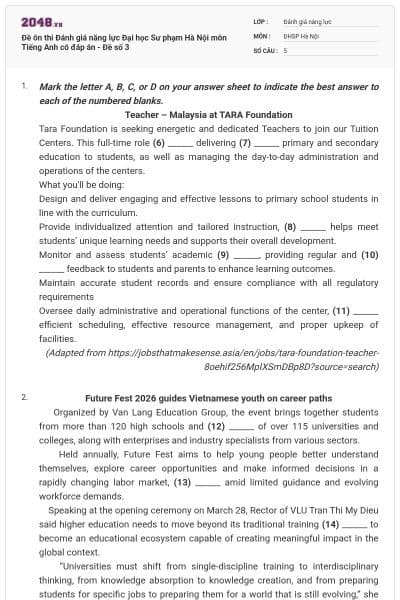
Maintenance workers are ______ great demand in industrial zones because many manual repetitive jobs have been replaced by machines, resulting in more frequent maintenance needs.
in
under
on
with
Đáp án đúng là: A
Ta có cụm từ in great demand: có nhu cầu lớn (được săn đón / cần tuyển dụng nhiều)
" Chọn A
Dịch:
Maintenance workers are in great demand in industrial zones because many manual repetitive jobs have been replaced by machines, resulting in more frequent maintenance needs. (Công nhân bảo trì đang rất được săn đón tại các khu công nghiệp vì nhiều công việc chân tay lặp đi lặp lại đã được thay thế bằng máy móc, dẫn đến nhu cầu bảo trì thường xuyên hơn)
wouldn’t have suffered from
wouldn’t suffer from
hadn’t suffered from
didn’t suffer from
Đáp án đúng là: B
Đây là Câu điều kiện hỗn hợp (Mixed Conditional) kết hợp giữa Loại 3 và Loại 2.
Vế giả thiết (If-clause): “Had it not been for...” là cấu trúc đảo ngữ của Câu điều kiện loại 3, dùng để nói về một sự việc đã xảy ra trong quá khứ (việc dùng thiết bị điện tử quá mức).
Vế kết quả (Main clause): Có trạng từ “now” (bây giờ). Do đó, kết quả này thuộc về hiện tại. Ta phải dùng cấu trúc của Loại 2: S + would / could (not) + V-inf.
" Chọn B (wouldn’t suffer from)
Dịch:
Had it not been for excessive electronic device use, she wouldn’t suffer from shortsightedness now. (Nếu không vì việc sử dụng thiết bị điện tử quá mức, cô ấy đã không bị cận thị như bây giờ)
Pursuing higher education in foreign countries, numerous students ______ culture shocks caused by language barriers, unfamiliar lifestyles, or different climates, which leads to intense pressure and homesickness.
handle
diminish
encounter
alleviate
Đáp án đúng là: C
A. handle (v): xử lý, giải quyết
B. diminish (v): làm giảm bớt (về kích thước, tầm quan trọng, giá trị)
C. encounter (v): chạm trán ai, đối mặt với (thường là khó khăn, rủi ro)
D. alleviate (v): làm nhẹ bớt, làm giảm bớt (nỗi đau, vấn đề)
- Xét nghĩa câu: Khi theo học tại nước ngoài, nhiều sinh viên ______ những cú sốc văn hóa do rào cản ngôn ngữ, lối sống lạ lẫm hoặc khí hậu khác biệt, dẫn đến áp lực nặng nề và nỗi nhớ nhà.
" Chọn C, các từ khác không thích hợp về nghĩa.
Dịch:
Pursuing higher education in foreign countries, numerous students encounter culture shocks caused by language barriers, unfamiliar lifestyles, or different climates, which leads to intense pressure and homesickness. (Khi theo học bậc cao tại nước ngoài, nhiều sinh viên phải đối mặt với những cú sốc văn hóa do rào cản ngôn ngữ, lối sống lạ lẫm hoặc khí hậu khác biệt, dẫn đến áp lực nặng nề và nỗi nhớ nhà)
In order to ______ traffic congestion and air pollution, Hanoi implemented the metro system with stable ticket prices and frequent service.
exacerbate
aggravate
mitigate
complicate
Đáp án đúng là: C
A. exacerbate (v): làm trầm trọng thêm
B. aggravate (v): làm tồi tệ hơn
C. mitigate (v): giảm thiểu, làm dịu bớt (tác hại, hậu quả)
D. complicate (v): làm phức tạp hóa
- Xét nghĩa câu: Để ______ tình trạng ùn tắc giao thông và ô nhiễm không khí, Hà Nội đã triển khai hệ thống tàu điện trên cao với giá vé ổn định và tần suất phục vụ cao.
" Chọn C, các từ khác không thích hợp về nghĩa.
Dịch:
In order to mitigate traffic congestion and air pollution, Hanoi implemented the metro system with stable ticket prices and frequent service. (Để giảm thiểu tình trạng ùn tắc giao thông và ô nhiễm không khí, Hà Nội đã triển khai hệ thống tàu điện trên cao với giá vé ổn định và tần suất phục vụ cao)
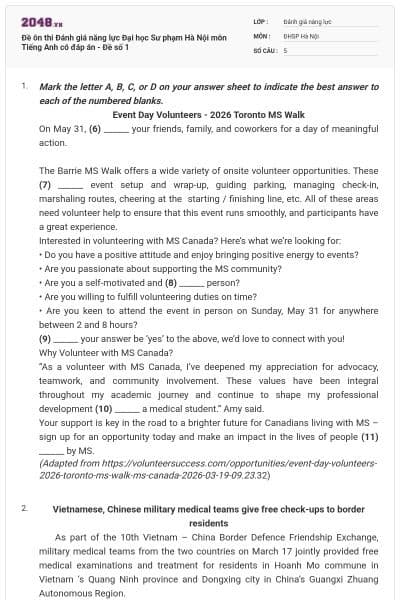
Given the current employment landscape with the rise of AI and robotics, it’s high time ______ that machines cannot replicate, like creative thinking and emotional intelligence.
every graduate enhances skills
for skills to be enhanced by every graduate
for every graduate enhancing skills
every graduate enhanced skills
Đáp án đúng là: D
- Ta có hai cấu trúc chính:
It's time + S + Vquá khứ đơn: nhấn mạnh đã đến lúc ai đó phải làm gì
It's time + for somebody + to V-inf: Đến lúc cho ai đó làm gì.
" Loại A (every graduate enhances skills) và C (for every graduate enhancing skills) vì sai cấu trúc ngữ pháp.
- Xét câu: Given the current employment landscape with the rise of AI and robotics, it’s high time ______ that machines cannot replicate, like creative thinking and emotional intelligence.
(Trong bối cảnh việc làm hiện nay với sự trỗi dậy của AI và robot, đã đến lúc ______ mà máy móc không thể sao chép được, như tư duy sáng tạo và trí tuệ cảm xúc)
+ Nếu điền B (for skills to be enhanced by every graduate), thì “that machines cannot … emotional intelligence” là mệnh đề quan hệ bổ nghĩa cho “every graduate” " Không hợp lý với ví dụ là tư duy sáng tạo (creative thinking) và trí tuệ cảm xúc (emotional intelligence).
+ Nếu điền D (every graduate enhanced skills) ), thì “that machines cannot … emotional intelligence” là mệnh đề quan hệ bổ nghĩa cho “skills” " Hợp lý với ví dụ là tư duy sáng tạo (creative thinking) và trí tuệ cảm xúc (emotional intelligence).
Mark the letter A, B, C, or D on your answer sheet to indicate the best answer to each of the numbered blanks.
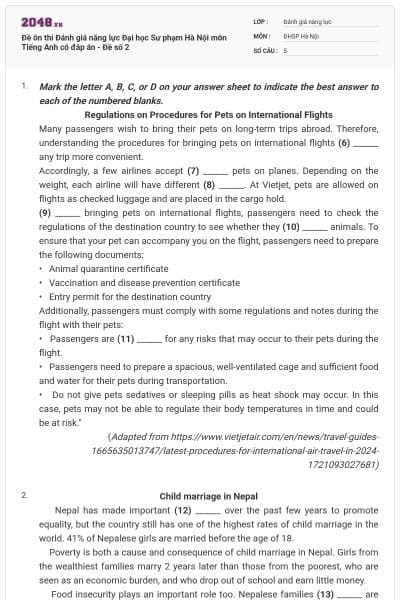
Regulations on Procedures for Pets on International Flights
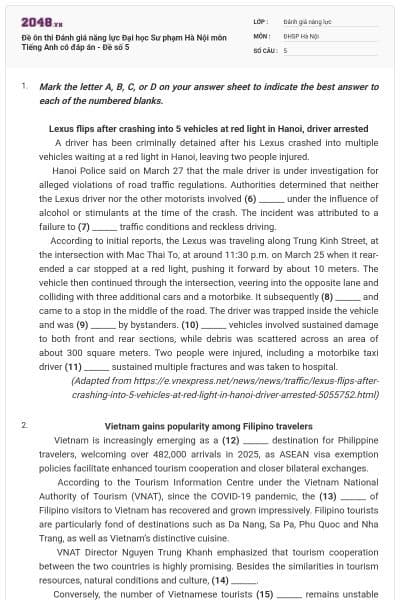
Many passengers wish to bring their pets on long-term trips abroad. Therefore, understanding the procedures for bringing pets on international flights (6) ______ any trip more convenient.
Accordingly, a few airlines accept (7) ______ pets on planes. Depending on the weight, each airline will have different (8) ______. At Vietjet, pets are allowed on flights as checked luggage and are placed in the cargo hold.
(9) ______ bringing pets on international flights, passengers need to check the regulations of the destination country to see whether they (10) ______ animals. To ensure that your pet can accompany you on the flight, passengers need to prepare the following documents:
• Animal quarantine certificate
• Vaccination and disease prevention certificate
• Entry permit for the destination country
Additionally, passengers must comply with some regulations and notes during the flight with their pets:
• Passengers are (11) ______ for any risks that may occur to their pets during the flight.
• Passengers need to prepare a spacious, well-ventilated cage and sufficient food and water for their pets during transportation.
• Do not give pets sedatives or sleeping pills as heat shock may occur. In this case, pets may not be able to regulate their body temperatures in time and could be at risk."
(Adapted from https://www.vietjetair.com/en/news/travel-guides-1665635013747/latest-procedures-for-international-air-travel-in-2024-1721093027681)
make
will make
makes
would make
Đáp án đúng là: C
- Many passengers wish to bring their pets on long-term trips abroad. Therefore, understanding the procedures for bringing pets on international flights (6) ______ any trip more convenient.
(Nhiều hành khách có mong muốn mang theo thú cưng trong những chuyến đi nước ngoài dài ngày. Do đó, việc hiểu rõ các thủ tục đưa thú cưng lên các chuyến bay quốc tế ______ mọi chuyến đi trở nên thuận tiện hơn)
" Đoạn văn đang diễn tả về một sự thật hiển nhiên " Ta dùng thì hiện tại đơn thể khẳng định với công thức: S + Vnguyên thể / V(s / es)
- Cụm danh động từ “Understanding the procedures for bringing pets on international flights” đóng vai trò là chủ ngữ số ít trong câu.
" Chọn C (makes)
Dịch:
Many passengers wish to bring their pets on long-term trips abroad. Therefore, understanding the procedures for bringing pets on international flights makes any trip more convenient. (Nhiều hành khách có mong muốn mang theo thú cưng trong những chuyến đi nước ngoài dài ngày. Do đó, việc hiểu rõ các thủ tục đưa thú cưng lên các chuyến bay quốc tế khiến cho mọi chuyến đi trở nên thuận tiện hơn)
transferring
transforming
transiting
transporting
Đáp án đúng là: D
A. transferring: chuyển đổi (trường, cuộc gọi), chuyển tiền, chuyển nhượng (tài sản, cầu thủ), chuyển tiếp (đổi máy bay / nhà ga)
B. transforming: biến đổi hình dạng / tính chất / cách thức
C. transiting: quá cảnh
D. transporting: vận chuyển (hàng hóa, hành khách, động vật)
- Thông tin: Accordingly, a few airlines accept (7) ______ pets on planes. (Theo đó, một số hãng hàng không chấp nhận ______ thú cưng trên máy bay)
" Chọn D, các từ khác không thích hợp về nghĩa.
Dịch:
Accordingly, a few airlines accept transporting pets on planes. (Theo đó, một số hãng hàng không chấp nhận vận chuyển thú cưng trên máy bay)
interest
tolls
fares
fees
Đáp án đúng là: D
A. interest: tiền lãi
B. tolls: phí cầu đường (xa lộ).
C. fares: giá vé (xe buýt, tàu hỏa, máy bay, taxi)
D. fees: các loại phí dịch vụ (phí hành lý, phí mang thêm thú nuôi, học phí).
- Thông tin: Accordingly, a few airlines accept transporting pets on planes. Depending on the weight, each airline will have different ______. (Theo đó, một số hãng hàng không chấp nhận vận chuyển thú cưng trên máy bay. Tùy vào trọng lượng, mỗi hãng sẽ có các mức______ khác nhau)
" Chọn D, các từ khác không thích hợp về nghĩa.
Dịch:
Accordingly, a few airlines accept transporting pets on planes. Depending on the weight, each airline will have different fees. (Theo đó, một số hãng hàng không chấp nhận vận chuyển thú cưng trên máy bay. Tùy vào trọng lượng, mỗi hãng sẽ có các mứcphí khác nhau)
During
Throughout
Within
When
Đáp án đúng là: D
A. During + cụm danh từ chỉ khoảng thời gian: Trong khoảng thời gian
B. Throughout + cụm danh từ chỉ khoảng thời gian / không gian: Xuyên suốt khoảng thời gian / Khắp không gian
C. Within + cụm danh từ chỉ khoảng thời gian / không gian: Trong vòng bao lâu / Trong phạm vi
D. When + Ving / Mệnh đề: Khi (ai đó) làm gì (Lưu ý: When + Ving là mệnh đề phụ, phải đồng chủ ngữ với mệnh đề chính)
- Thông tin (9) ______ bringing pets on international flights, passengers need to check the regulations of the destination country to see whether they (10) ______ animals.
" Chọn D, các từ khác không đúng cấu trúc sử dụng và cách dùng.
Dịch:
When bringing pets on international flights, passengers need to check the regulations of the destination country to see whether they (10) ______ animals. (Khi mang theo thú cưng trên các chuyến bay quốc tế, hành khách cần kiểm tra quy định của quốc gia điểm đến để xem họ có ______ nhập cảnh động vật hay không)
allow
allowed
had allowed
would allow
Đáp án đúng là: A
- Thông tin whether they (10) ______ animals đang nói về quy định của một quốc gia.
" Ta dùng thì Hiện tại đơn thể khẳng định với công thức: S + Vnguyên thể / V(s / es)
" Chọn A (allow)
Dịch:
When bringing pets on international flights, passengers need to check the regulations of the destination country to see whether they allow animals. (Khi mang theo thú cưng trên các chuyến bay quốc tế, hành khách cần kiểm tra quy định của quốc gia điểm đến để xem họ có cho phép nhập cảnh động vật hay không)
Passengers are (11) ______ for any risks that may occur to their pets during the flight.
accountable
inevitable
irresponsible
reliable
Đáp án đúng là: A
A. accountable (adj): chịu trách nhiệm (không đứng trước danh từ)
Ta có: accountable for something: chịu trách nhiệm về cái gì.
accountable to somebody: chịu trách nhiệm / báo cáo trước ai hoặc tổ chức nào
B. inevitable: không thể tránh khỏi
C. irresponsible: vô trách nhiệm
D. reliable: đáng tin cậy.
- Thông tin: Passengers are (11) ______ for any risks that may occur to their pets during the flight. (Hành khách ______ về bất kỳ rủi ro nào có thể xảy ra với thú cưng của mình trong chuyến bay)
" Chọn A, các phương án khác không thích hợp về nghĩa.
Dịch:
Passengers are accountable for any risks that may occur to their pets during the flight. (Hành khách phải chịu trách nhiệm về bất kỳ rủi ro nào có thể xảy ra với thú cưng của mình trong chuyến bay)
Bài đọc | Dịch bài đọc |
Regulations on Procedures for Pets on International Flights | Quy định về thủ tục mang thú cưng lên máy bay quốc tế |
Many passengers wish to bring their pets on long-term trips abroad. Therefore, understanding the procedures for bringing pets on international flights makes any trip more convenient. Accordingly, a few airlines accept transporting pets on planes. Depending on the weight, each airline will have different fees. At Vietjet, pets are allowed on flights as checked luggage and are placed in the cargo hold. When bringing pets on international flights, passengers need to check the regulations of the destination country to see whether they allowanimals. To ensure that your pet can accompany you on the flight, passengers need to prepare the following documents:
• Animal quarantine certificate • Vaccination and disease prevention certificate • Entry permit for the destination country Additionally, passengers must comply with some regulations and notes during the flight with their pets: • Passengers are accountable for any risks that may occur to their pets during the flight.
• Passengers need to prepare a spacious, well-ventilated cage and sufficient food and water for their pets during transportation.
• Do not give pets sedatives or sleeping pills as heat shock may occur. In this case, pets may not be able to regulate their body temperatures in time and could be at risk. | Nhiều hành khách có mong muốn mang theo thú cưng trong những chuyến đi nước ngoài dài ngày. Do đó, việc hiểu rõ các thủ tục đưa thú cưng lên các chuyến bay quốc tế khiến cho mọi chuyến đi trở nên thuận tiện hơn. Theo đó, một số hãng hàng không chấp nhận vận chuyển thú cưng trên máy bay. Tùy vào trọng lượng, mỗi hãng sẽ có các mứcphí khác nhau. Tại Vietjet, thú cưng được phép mang lên máy bay dưới dạng hành lý ký gửi và được đặt trong khoang hàng hóa. Khi mang theo thú cưng trên các chuyến bay quốc tế, hành khách cần kiểm tra quy định của quốc gia điểm đến để xem họ có cho phép nhập cảnh động vật hay không. Để đảm bảo thú cưng có thể đồng hành cùng bạn trên chuyến bay, hành khách cần chuẩn bị các loại giấy tờ sau: • Giấy chứng nhận kiểm dịch động vật • Giấy chứng nhận tiêm phòng và phòng chống dịch bệnh • Giấy phép nhập cảnh của quốc gia điểm đến Ngoài ra, hành khách phải tuân thủ một số quy định và lưu ý trong suốt chuyến bay cùng thú cưng: • Hành khách phải chịu trách nhiệm về bất kỳ rủi ro nào có thể xảy ra với thú cưng của mình trong chuyến bay. • Hành khách cần chuẩn bị lồng vận chuyển rộng rãi, thông thoáng, cũng như chuẩn bị đầy đủ thức ăn và nước uống cho thú cưng trong quá trình vận chuyển. • Không cho thú cưng uống thuốc an thần hoặc thuốc ngủ vì có thể xảy ra tình trạng sốc nhiệt. Trong trường hợp này, thú cưng có thể không kịp điều chỉnh thân nhiệt và gặp nguy hiểm. |
Child marriage in Nepal
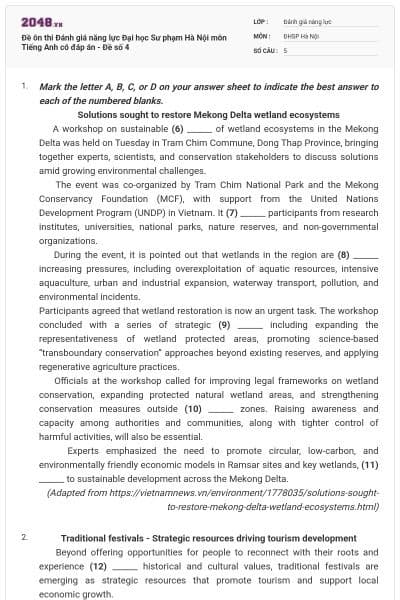
Nepal has made important (12) ______ over the past few years to promote equality, but the country still has one of the highest rates of child marriage in the world. 41% of Nepalese girls are married before the age of 18.
Poverty is both a cause and consequence of child marriage in Nepal. Girls from the wealthiest families marry 2 years later than those from the poorest, who are seen as an economic burden, and who drop out of school and earn little money.
Food insecurity plays an important role too. Nepalese families (13) ______ are more likely to marry their daughters at a young age to decrease the financial burden. One study shows that 91% of people who (14) ______ access to food married over the age of 19.
Dowry is also common practice in many communities. Parents marry their daughters as soon as possible because the money they have to pay to the groom’s family is higher if their daughter is older.
Since 2010, the legal age of marriage is 20 for both men and women, or 18 with parental consent, according to the Nepalese Country Code.
The law states that punishment for child marriage is (15) ______ for up to three years and a fine of up to 10,000 rupees (£102). But reports suggest that this law is rarely applied.
There has been quite a lot of progress in Nepal over the past 3 years with (16) ______ to ending child marriage and civil society cooperation.
The Ministry of Women, Children and Social Welfare is currently developing Nepal’s first national strategy on child marriage in collaboration with UNICEF Nepal and Girls Not Brides Nepal. However, (17) ______, the national strategy has been delayed.
(Adapted from https://test-english.com/reading/b1/child-marriage-nepal/)
advances
improvements
progress
development
Đáp án đúng là: C
- Ta có cụm make progress: có sự tiến triển / tiến bộ
" Chọn C
Dịch:
Nepal has made important progress over the past few years to promote equality, but the country still has one of the highest rates of child marriage in the world. (Nepal đã đạt được những tiến bộ quan trọng trong vài năm qua nhằm thúc đẩy bình đẳng, nhưng quốc gia này vẫn có một trong những tỷ lệ tảo hôn cao nhất thế giới)
that do not have food enough to eat
not having food enough to eat
which does not have enough food to eat
that do not have enough food to eat
Đáp án đúng là: D
- Thông tin: Nepalese families (13) ______ are more likely to marry their daughters at a young age to decrease the financial burden.
+ Thông tin cần điền là mệnh đề quan hệ bổ nghĩa cho “Nepalese families”.
- Ngoài ra ta có: enough + danh từ: đủ cái gì
A. that do not have food enough to eat " Sai trật tự từ.
B. not having food enough to eat " Sai trật tự từ.
C. which does not have enough food to eat " Chia động từ sai (phải để động từ nguyên thể, vì câu có chủ ngữ số nhiều)
D. that do not have enough food to eat " Đúng
Dịch:
Food insecurity plays an important role too. Nepalese families that do not have enough food to eat are more likely to marry their daughters at a young age to decrease the financial burden. (Tình trạng mất an ninh lương thực cũng đóng một vai trò quan trọng. Các gia đình Nepal không có đủ lương thực để ăn thường có xu hướng gả con gái ở độ tuổi còn trẻ để giảm bớt gánh nặng tài chính)
One study shows that 91% of people who (14) ______ access to food married over the age of 19.
assured
insured
ensured
secured
Đáp án đúng là: D
A. assured: cam đoan, quả quyết (dùng lời nói)
B. insured: bảo hiểm
C. ensured: bảo đảm (dùng hành động khiến việc gì xảy ra)
D. secured: có được, đạt được cái gì
- Thông tin: One study shows that 91% of people who (14) ______ access to food married over the age of 19. (Một nghiên cứu cho thấy 91% những người ______ tiếp cận với thực phẩm đã kết hôn khi trên 19 tuổi)
" Chọn D, các phương án khác chưa thích hợp về nghĩa.
Dịch:
One study shows that 91% of people who secured access to food married over the age of 19. (Một nghiên cứu cho thấy 91% những người có được sự tiếp cận với thực phẩm đã kết hôn khi trên 19 tuổi)
prison
imprisonment
imprison
imprisoned
Đáp án đúng là: B
- Từ cần điền phải là một danh từ (để song hành với danh từ “a fine” phía sau).
A. prison (n): nhà tù (địa điểm)
B. imprisonment (n): Sự bỏ tù, án tù (hình phạt)
C. imprison (v): Bỏ tù
D. imprisoned (v-ed / adj): Bị bỏ tù
- Thông tin: The law states that punishment for child marriage is (15) ______ for up to three years and a fine of up to 10,000 rupees (£102). (Luật quy định rằng hình phạt cho việc tảo hôn là ______ tối đa ba năm và phạt tiền lên đến 10.000 rupee (102 bảng Anh)
" Chọn B
Dịch:
The law states that punishment for child marriage is imprisonment for up to three years and a fine of up to 10,000 rupees (£102). (Luật quy định rằng hình phạt cho việc tảo hôn là sự bỏ tù tối đa ba năm và phạt tiền lên đến 10.000 rupee - 102 bảng Anh)
There has been quite a lot of progress in Nepal over the past 3 years with (16) ______ to ending child marriage and civil society cooperation.
a clear government commitment
an active government engagement
a genuine government devotion
a formal government resolution
Đáp án đúng là: A
A. a clear government commitment + to V-ing / Noun: Một sự cam kết rõ ràng từ chính phủ với cái gì
B. an active government engagement + in something: Một sự tham gia chủ động từ chính phủ vào cái gì
C. a genuine government devotion + to V-ing / Noun: Một sự tận tâm chân thành từ chính phủ
D. a formal government resolution + on something: Một nghị quyết chính thức của chính phủ về vấn đề gì
- Thông tin: There has been quite a lot of progress in Nepal over the past 3 years with (16) ______ to ending child marriage and civil society cooperation. (Trong 3 năm qua, Nepal đã đạt được khá nhiều tiến bộ nhờ vào ______ trong việc chấm dứt tảo hôn cùng với sự hợp tác của các tổ chức xã hội)
" Chọn A. Phương án B và D sai vì không đúng cấu trúc sử dụng, phương án B chưa thích hợp về bối cảnh nhà nước / chính phủ.
Dịch:
There has been quite a lot of progress in Nepal over the past 3 years with a clear government commitment to ending child marriage and civil society cooperation. (Trong 3 năm qua, Nepal đã đạt được khá nhiều tiến bộ nhờ vào cam kết rõ ràng của chính phủ trong việc chấm dứt tảo hôn cùng với sự hợp tác của các tổ chức xã hội)
However, (17) ______, the national strategy has been delayed.
as a consequence of the post-earthquake and post-fuel crisis environment
despite the post-earthquake and post-fuel crisis environment
resulting in the post-earthquake and post-fuel crisis environment
leading to the post-earthquake and post-fuel crisis environment
Đáp án đúng là: A
A. as a consequence of the post-earthquake and post-fuel crisis environment (Do hệ quả của môi trường sau động đất và sau cuộc khủng hoảng nhiên liệu)
B. despite the post-earthquake and post-fuel crisis environment (Mặc dù môi trường sau động đất và sau cuộc khủng hoảng nhiên liệu)
C. resulting in the post-earthquake and post-fuel crisis environment (Dẫn đến hệ quả là môi trường sau động đất và sau cuộc khủng hoảng nhiên liệu)
D. leading to the post-earthquake and post-fuel crisis environment (Dẫn đến môi trường sau động đất và sau cuộc khủng hoảng nhiên liệu)
- Thông tin:
The Ministry of Women, Children and Social Welfare is currently developing Nepal’s first national strategy on child marriage in collaboration with UNICEF Nepal and Girls Not Brides Nepal. However, (17) ______, the national strategy has been delayed. (Bộ Phụ nữ, Trẻ em và Phúc lợi Xã hội hiện đang xây dựng chiến lược quốc gia đầu tiên của Nepal về tảo hôn, phối hợp với UNICEF Nepal và tổ chức Girls Not Brides Nepal. Tuy nhiên, ______, chiến lược quốc gia này đã bị trì hoãn)
" Như vậy, “the national strategy has been delayed” là một kết quả, và thông tin cần điền phải nêu ra được nguyên nhân của kết quả này.
" Chọn A
Dịch:
The Ministry of Women, Children and Social Welfare is currently developing Nepal’s first national strategy on child marriage in collaboration with UNICEF Nepal and Girls Not Brides Nepal. However, as a consequence of the post-earthquake and post-fuel crisis environment,thenational strategy has been delayed. (Bộ Phụ nữ, Trẻ em và Phúc lợi Xã hội hiện đang xây dựng chiến lược quốc gia đầu tiên của Nepal về tảo hôn, phối hợp với UNICEF Nepal và tổ chức Girls Not Brides Nepal. Tuy nhiên, do hậu quả của môi trường sau động đất và khủng hoảng nhiên liệu, chiến lược quốc gia này đã bị trì hoãn)
Bài đọc | Dịch bài đọc |
Child marriage in Nepal Nepal has made important progress over the past few years to promote equality, but the country still has one of the highest rates of child marriage in the world. 41% of Nepalese girls are married before the age of 18. Poverty is both a cause and consequence of child marriage in Nepal. Girls from the wealthiest families marry 2 years later than those from the poorest, who are seen as an economic burden, and who drop out of school and earn little money. Food insecurity plays an important role too. Nepalese families that do not have enough food to eat are more likely to marry their daughters at a young age to decrease the financial burden. One study shows that 91% of people who secured access to food married over the age of 19. Dowry is also common practice in many communities. Parents marry their daughters as soon as possible because the money they have to pay to the groom’s family is higher if their daughter is older. Since 2010, the legal age of marriage is 20 for both men and women, or 18 with parental consent, according to the Nepalese Country Code. The law states that punishment for child marriage is imprisonment for up to three years and a fine of up to 10,000 rupees (£102). But reports suggest that this law is rarely applied. There has been quite a lot of progress in Nepal over the past 3 years with a clear government commitment to ending child marriage and civil society cooperation. The Ministry of Women, Children and Social Welfare is currently developing Nepal’s first national strategy on child marriage in collaboration with UNICEF Nepal and Girls Not Brides Nepal. However, as a consequence of the post-earthquake and post-fuel crisis environment,thenational strategy has been delayed. | Tảo hôn ở Nepal Nepal đã đạt được những tiến bộ quan trọng trong vài năm qua nhằm thúc đẩy bình đẳng, nhưng quốc gia này vẫn có một trong những tỷ lệ tảo hôn cao nhất thế giới. 41% trẻ em gái Nepal kết hôn trước 18 tuổi. Nghèo đói vừa là nguyên nhân vừa là hệ quả của nạn tảo hôn ở Nepal. Các bé gái từ những gia đình giàu có nhất kết hôn muộn hơn 2 năm so với những em từ những gia đình nghèo nhất - những người bị coi là gánh nặng kinh tế, phải bỏ học và kiếm được rất ít tiền. Tình trạng mất an ninh lương thực cũng đóng một vai trò quan trọng. Các gia đình Nepal không có đủ lương thực để ăn thường có xu hướng gả con gái ở độ tuổi còn trẻ để giảm bớt gánh nặng tài chính. Một nghiên cứu cho thấy 91% những người có được sự tiếp cận với thực phẩm đã kết hôn khi trên 19 tuổi. Hồi môn cũng là hủ tục phổ biến ở nhiều cộng đồng. Cha mẹ gả con gái càng sớm càng tốt vì số tiền họ phải trả cho gia đình chú rể sẽ càng cao hơn nếu con gái họ càng lớn tuổi.
Kể từ năm 2010, độ tuổi kết hôn hợp pháp là 20 đối với cả nam và nữ, hoặc 18 nếu có sự đồng ý của cha mẹ, theo Bộ luật quốc gia Nepal. Luật quy định rằng hình phạt cho việc tảo hôn là sự bỏ tù tối đa ba năm và phạt tiền lên đến 10.000 rupee (102 bảng Anh). Tuy nhiên, các báo cáo cho thấy luật này hiếm khi được thực thi. Trong 3 năm qua, Nepal đã đạt được khá nhiều tiến bộ nhờ vào cam kết rõ ràng của chính phủ trong việc chấm dứt tảo hôn cùng với sự hợp tác của các tổ chức xã hội. Bộ Phụ nữ, Trẻ em và Phúc lợi Xã hội hiện đang xây dựng chiến lược quốc gia đầu tiên của Nepal về tảo hôn, phối hợp với UNICEF Nepal và tổ chức Girls Not Brides Nepal. Tuy nhiên, do hậu quả của môi trường sau động đất và khủng hoảng nhiên liệu, chiến lược quốc gia này đã bị trì hoãn. |
Mark the letter A, B, C or D on your answer sheet to indicate the best arrangement of utterances to make a meaningful exchange in the following question.
a. Mark: Sounds cool! You didn’t just attend some language classes, right?
b. Linda: Exactly! I felt more confident with my teamwork and communication skills too.
c. Linda: Far from it! We were busy with cultural presentations and even hosted some green projects.
d. Linda: I’ve finished my cultural exchange program. It’s definitely my best experience ever.
e. Mark: That must have been quite a challenge, but I think you gained rewarding experience.
d – a – c – e – b
d – e – b – a – c
d – a – b – e – c
d – e – c – b – a
Đáp án đúng là: A
Giải thích: Dịch + Chức năng từng câu
d. Linda: I’ve finished my cultural exchange program. It’s definitely my best experience ever. (Tớ vừa kết thúc chương trình trao đổi văn hóa. Đó chắc chắn là trải nghiệm tuyệt vời nhất từ trước đến nay của tớ) " Đưa ra chủ đề chính của cuộc trò chuyện.
a. Mark: Sounds cool! You didn’t just attend some language classes, right? (Nghe tuyệt quá! Cậu không chỉ tham gia mấy lớp học ngôn ngữ thôi đâu đúng không?) " Phản hồi và đặt câu hỏi để Linda kể chi tiết hơn.
c. Linda: Far from it! We were busy with cultural presentations and even hosted some green projects. (Còn nhiều hơn thế nữa! Bọn tớ bận rộn với các buổi thuyết trình văn hóa và thậm chí còn tổ chức một số dự án xanh nữa) " Cung cấp thêm thông tin về chương trình trao đổi văn hóa.
e. Mark: That must have been quite a challenge, but I think you gained rewarding experience. (Đó hẳn là một thử thách khá lớn, nhưng tớ nghĩ cậu đã thu được những kinh nghiệm rất xứng đáng) " Đưa ra nhận xét bản thân về trải nghiệm của bạn mình.
b. Linda: Exactly! I felt more confident with my teamwork and communication skills too. (Đúng vậy! Tớ cũng cảm thấy tự tin hơn với kỹ năng làm việc nhóm và giao tiếp của mình nữa) " Đồng ý với quan điểm vừa được nêu và nêu thêm lợi ích khác.
PASSAGE 1
Read the following passage and mark the letter A, B, C or D on your answer sheet to indicate the best answer to each of the questions.
The Olympic Games have long been a symbol of unity, athleticism, and international cooperation. Dating back thousands of years, the history of the Olympic Games is as fascinating as it is inspiring. [I]
The roots of the Olympic Games can be traced back to 776 BC in Olympia, Greece. Initially established as a festival honoring Zeus, these athletic competitions were held every four years and featured participants from various Greek city-states. [II] The games included events like running, wrestling, boxing, and chariot racing, emphasizing physical prowess and skill. The Olympics not only showcased athletic talent but also served as a unifying event that fostered peace among rival city-states during its celebration.
As centuries passed, the Olympic Games evolved significantly. [III] However, in 393 AD Emperor Theodosius I banned pagan festivals including the Olympics as part of his effort to promote Christianity across his empire. This led to a decline in popularity until they faded into obscurity for over a millennium. [IV]
In 1896, French educator Pierre de Coubertin spearheaded efforts to revive the ancient tradition by establishing the International Olympic Committee (IOC). In the same year, the first modern Olympics took place in Athens with 13 nations participating in 43 events. This revival aimed not only to restore athletic competition but also to promote international unity through sportsmanship - principles that continue to define today’s games.
Since its revival in 1896, participation has expanded dramatically. The introduction of winter sports in 1924 allowed athletes from colder climates to compete alongside their summer counterparts. As countries worldwide began sending teams and athletes emerged on an international scale, barriers related to gender and race were gradually dismantled — culminating in significant milestones such as women competing for medals starting in 1900 and diverse representation becoming more prominent over time.
Today’s Olympic Games are celebrated globally but face challenges such as political controversies and concerns about doping among athletes. Despite these issues, they remain an enduring symbol of resilience and unity among nations — a platform where athletes can showcase their talents while inspiring hope across borders during times of uncertainty.
From their ancient beginnings rooted deeply within Greek culture to their current status as one of humanity’s most beloved sporting events; understanding the history behind the Olympic Games helps people appreciate both its past achievements and future potential.
(Adapted from https://www.simpli.com/world-events/unveiling-ancient-origins-comprehensive-history-olympic-games)
To prove the role of the Olympic Games in showcasing athletic talent and promoting community unity
To highlight challenges that the Olympic Games have faced to become global sports celebration
To provide an overview about the formation and evolution of the Olympic Games
To explain the Olympic Games' modern success and global expansion
Đáp án đúng là: C
What is the main purpose of the passage? (Mục đích chính của bài đọc là gì?)
A. To prove the role of the Olympic Games in showcasing athletic talent and promoting community unity (Để chứng minh vai trò của Thế vận hội Olympic trong việc phô diễn tài năng thể thao và thúc đẩy sự đoàn kết cộng đồng)
" Sai, vì đây chỉ là một khía cạnh nhỏ được nhắc đến rải rác trong bài, không phải thông tin tổng quát toàn bài.
B. To highlight challenges that the Olympic Games have faced to become global sports celebration (Để làm nổi bật những thách thức mà Thế vận hội Olympic đã phải đối mặt để trở thành một lễ hội thể thao toàn cầu)
" Sai vì đây chỉ là thông tin nằm ở đoạn 6, không phải thông tin tổng quát toàn bài.
C. To provide an overview about the formation and evolution of the Olympic Games (Để cung cấp một cái nhìn tổng quan về sự hình thành và quá trình tiến hóa của Thế vận hội Olympic)
" Đúng vì đã bao quát được toàn bài. Bài đọc đi theo dòng thời gian: bắt đầu từ nguồn gốc Hy Lạp cổ đại (formation), sau đó đến giai đoạn bị cấm, rồi được khôi phục và mở rộng quy mô đến hiện tại (evolution).
D. To explain the Olympic Games' modern success and global expansion (Để giải thích cho sự thành công hiện đại và sự mở rộng quy mô toàn cầu của Thế vận hội Olympic)
" Sai vì chỉ tập trung thành công ở hiện tại, không bao quát lịch sử hình thành và sự phục hồi của nó.
the Olympic Games
challenges
controversies
athletes
Đáp án đúng là: A
What does the word “they” in paragraph 6 refer to? (Từ “they” trong đoạn 6 đề cập tới gì?)
A. the Olympic Games: Thế vận hội Olympic
B. challenges: những thách thức
C. controversies: những tranh cãi
D. athletes: những vận động viên
- Thông tin: Today’s Olympic Games are celebrated globally but face challenges such as political controversies and concerns about doping among athletes. Despite these issues, they remain an enduring symbol of resilience and unity among nations (Thế vận hội ngày nay được tôn vinh trên toàn cầu nhưng cũng đối mặt với những thách thức như tranh cãi chính trị và lo ngại về vấn đề doping trong vận động viên. Bất chấp những vấn đề này, chúng vẫn là biểu tượng bền bỉ của sự kiên cường và đoàn kết giữa các quốc gia)
" “they” ở đây đề cập tới “the Olympic Games”.
According to the passage, women's participation in competing for medals _______.
was established at the very first modern Olympics.
took place four years after the revival of the games.
was introduced alongside winter sports in 1924.
had been a tradition since the ancient Greek period.
Đáp án đúng là: B
According to the passage, women's participation in competing for medals _______. (Theo đoạn văn, việc phụ nữ tham gia tranh huy chương _______)
A. was established at the very first modern Olympics (được thiết lập ngay tại kỳ Olympic hiện đại đầu tiên)
B. took place four years after the revival of the games. (diễn ra 4 năm sau khi đại hội được khôi phục)
C. was introduced alongside winter sports in 1924 (được đưa vào cùng với các môn thể thao mùa đông năm 1924)
D. had been a tradition since the ancient Greek period (đã là một truyền thống từ thời kỳ Hy Lạp cổ đại)
- Dựa trên thông tin:
+ Since its revival in 1896, participation has expanded dramatically (Kể từ khi được khôi phục vào năm 1896, quy mô tham gia đã mở rộng đáng kể) " Olympics được tổ chức trở lại bắt đầu vào năm 1896.
+ women competing for medals starting in 1900 (phụ nữ bắt đầu tranh huy chương từ năm 1900) " Phụ nữ bắt đầu tham gia thi đấu vào năm 1900.
" Chọn B
The phrase “faded into obscurity” in paragraph 3 is closest in meaning to ______.
completely disappeared
became forgotten
stood the test of time
rose to fame
Đáp án đúng là: B
The phrase “faded into obscurity” in paragraph 3 is closest in meaning to ______. (Cụm từ “faded into obscurity” trong đoạn 3 gần nghĩa nhất với ______)
A. completely disappeared: biến mất hoàn toàn
B. became forgotten: trở nên bị lãng quên
C. stood the test of time: trường tồn với thời gian
D. rose to fame: trở nên nổi tiếng
- Thông tin: As centuries passed, the Olympic Games evolved significantly. However, in 393 AD Emperor Theodosius I banned pagan festivals including the Olympics as part of his effort to promote Christianity across his empire. This led to a decline in popularity until they faded into obscurity for over a millennium. (Trải qua nhiều thế kỷ, Thế vận hội đã phát triển đáng kể. Tuy nhiên, vào năm 393 sau Công nguyên, Hoàng đế Theodosius I đã ban lệnh cấm các lễ hội đa thần, bao gồm cả Olympic, như một phần trong nỗ lực truyền bá Kitô giáo khắp đế quốc của mình. Điều này dẫn đến sự suy giảm mức độ phổ biến cho đến khi chúng ______ trong hơn một thiên niên kỷ)
" faded into obscurity = became forgotten
Where in the passage does the following sentence best fit?
They were integrated into Greek culture as a symbol of excellence and honor.
[I]
[II]
[III]
[IV]
Đáp án đúng là: B
Where in the passage does the following sentence best fit? (Câu sau đây phù hợp nhất với vị trí nào trong đoạn văn?)
They were integrated into Greek culture as a symbol of excellence and honor. (Chúng đã trở thành một phần của văn hóa Hy Lạp như một biểu tượng của sự xuất sắc và niềm danh dự)
- Câu này được chia ở thì Quá khứ đơn, và đề cập đến vị trí to lớn trong văn hóa Hy Lạp.
" Chọn vị trí [II].
Loại vị trí [I] vì đoạn đầu là đoạn giới thiệu chung, chưa đi vào chi tiết văn hóa Hy Lạp.
Loại vị trí [III] và [IV] vì đoạn văn số ba nói về giai đoạn Olympic bị thoái trào và bị cấm, không phù hợp để nói về sự "ưu tú và danh dự".
Dịch bài đọc:
Thế vận hội Olympic từ lâu đã là biểu tượng của sự đoàn kết, tinh thần thể thao và sự hợp tác quốc tế. Với lịch sử kéo dài hàng ngàn năm, quá trình phát triển của Olympic cũng đầy mê hoặc và truyền cảm hứng như chính bản chất của nó.
Nguồn gốc của Thế vận hội có thể bắt nguồn từ năm 776 trước Công nguyên tại Olympia, Hy Lạp. Ban đầu được thành lập như một lễ hội tôn vinh thần Zeus, những cuộc tranh tài thể thao này được tổ chức bốn năm một lần với sự tham gia của các vận động viên đến từ nhiều thành bang Hy Lạp khác nhau. Chúng đã trở thành một phần của văn hóa Hy Lạp như một biểu tượng của sự xuất sắc và niềm danh dự. Các trò chơi bao gồm các môn như chạy bộ, đô vật, quyền anh và đua xe ngựa, nhấn mạnh vào sức mạnh thể chất và kỹ năng. Olympic không chỉ phô diễn tài năng thể thao mà còn đóng vai trò là một sự kiện gắn kết, thúc đẩy hòa bình giữa các thành bang đối địch trong thời gian diễn ra lễ hội.
Trải qua nhiều thế kỷ, Thế vận hội đã phát triển đáng kể. Tuy nhiên, vào năm 393 sau Công nguyên, Hoàng đế Theodosius I đã ban lệnh cấm các lễ hội đa thần, bao gồm cả Olympic, như một phần trong nỗ lực truyền bá Kitô giáo khắp đế quốc của mình. Điều này dẫn đến sự suy giảm mức độ phổ biến cho đến khi chúng dần chìm vào quên lãng trong hơn một thiên niên kỷ.
Năm 1896, nhà giáo dục người Pháp Pierre de Coubertin đã dẫn đầu các nỗ lực khôi phục truyền thống cổ xưa này bằng cách thành lập Ủy ban Olympic Quốc tế (IOC). Cùng năm đó, kỳ Olympic hiện đại đầu tiên đã diễn ra tại Athens với sự tham gia của 13 quốc gia trong 43 nội dung thi đấu. Sự hồi sinh này không chỉ nhằm khôi phục các cuộc tranh tài thể thao mà còn nhằm thúc đẩy sự đoàn kết quốc tế thông qua tinh thần thể thao — những nguyên tắc tiếp tục định hình các kỳ đại hội ngày nay.
Kể từ khi được khôi phục vào năm 1896, quy mô tham gia đã mở rộng đáng kể. Việc đưa các môn thể thao mùa đông vào chương trình thi đấu năm 1924 đã cho phép các vận động viên từ các vùng khí hậu lạnh hơn được tranh tài cùng với những đồng nghiệp ở các môn mùa hè. Khi các quốc gia trên thế giới bắt đầu gửi đội tuyển đi thi đấu và các vận động viên nổi lên trên quy mô quốc tế, những rào cản về giới tính và sắc tộc dần bị xóa bỏ — đạt được những cột mốc quan trọng như việc phụ nữ bắt đầu tranh huy chương từ năm 1900 và sự hiện diện đa dạng của các sắc tộc ngày càng trở nên nổi bật theo thời gian.
Thế vận hội ngày nay được tôn vinh trên toàn cầu nhưng cũng đối mặt với những thách thức như tranh cãi chính trị và lo ngại về vấn đề doping trong vận động viên. Bất chấp những vấn đề này, chúng vẫn là biểu tượng bền bỉ của sự kiên cường và đoàn kết giữa các quốc gia — một nền tảng nơi các vận động viên có thể trình diễn tài năng của mình đồng thời khơi dậy hy vọng xuyên biên giới trong những thời điểm bất định.
Từ nguồn gốc cổ xưa bén rễ sâu trong văn hóa Hy Lạp đến vị thế hiện tại là một trong những sự kiện thể thao được yêu thích nhất của nhân loại; việc hiểu rõ lịch sử đằng sau Thế vận hội giúp mọi người trân trọng cả những thành tựu trong quá khứ lẫn tiềm năng to lớn trong tương lai.
PASSAGE 2
Read the following passage and mark the letter A, B, C or D on your answer sheet to indicate the best answer to each of the questions.
In the heart of bustling cities, where concrete towers and asphalt streets dominate, a new movement is taking root. Vertical gardens are transforming urban environments by introducing greenery into spaces previously reserved for sterile, artificial surfaces.
At its core, a vertical garden is a system where plants grow on a vertically inclined surface, often supported by a specially designed structure. Unlike traditional gardens that spread horizontally, vertical gardens utilize walls or columns, making them an ideal solution for urban spaces where horizontal space is scarce but vertical surfaces are abundant. These installations can vary from small, decorative patches on building facades to entire skyscrapers covered in greenery.
Vertical gardens are not just a decorative trend; they offer green solutions to multiple problems at once. They provide insulation benefits that can enhance a building’s energy efficiency by acting as a buffer between the building’s exterior and the elements, reducing heat loss during colder months and limiting heat gain during warmer months, thus leading to reduced energy consumption. Incorporating vertical gardens into buildings can also improve sound insulation by absorbing noise pollution from traffic and construction. These gardens also help restore ecological balance and promote biodiversity in cities by supporting pollinators such as bees and butterflies or providing refuge and food for bird species.
Despite their many benefits, vertical gardens present some challenges. While these gardens are often designed with automated irrigation systems, they still require regular upkeep, including pruning, replanting, and monitoring for pests or diseases. Without proper maintenance, vertical gardens can deteriorate, leading to unsightly and unhealthy plant growth. Installation cost is another factor; the upfront expenses can be prohibitively high for some developers, although long-term energy savings may offset them. There are also technical considerations, such as ensuring that the structural integrity of the building can support the additional weight of the garden. Proper drainage and waterproofing are essential to prevent water damage to facades, and selecting the right plant species for local conditions is crucial for the garden’s success.
Vertical gardens represent a powerful convergence of nature and technology, offering a solution to many of the challenges faced by modern cities. They are not a passing trend but in fact a vital part of the urban landscape - a new oasis that reconnects city dwellers with the natural world.
(Adapted from https://www.demodemagazine.com/vertical-gardens-the-new-urban-oasis-de-mode-global)
What is the main idea of paragraph 2?
The definition of vertical gardens
Vertical gardens versus traditional ones
The concept of vertical gardens
The spatial advantages of vertical garden
Đáp án đúng là: C
What is the main idea of paragraph 2? (Ý chính của đoạn 2 là gì?
- Đoạn 2: At its core, a vertical garden is a system where plants grow on a vertically inclined surface, often supported by a specially designed structure. Unlike traditional gardens that spread horizontally, vertical gardens utilize walls or columns, making them an ideal solution for urban spaces where horizontal space is scarce but vertical surfaces are abundant. These installations can vary from small, decorative patches on building facades to entire skyscrapers covered in greenery. (Về cơ bản, vườn thẳng đứng là hệ thống mà thực vật được trồng trên một bề mặt nghiêng thẳng đứng, thường được nâng đỡ bởi một cấu trúc thiết kế đặc biệt. Khác với những khu vườn truyền thống trải dài theo chiều ngang, vườn thẳng đứng tận dụng các bức tường hoặc cột trụ, khiến chúng trở thành giải pháp lý tưởng cho không gian đô thị – nơi diện tích mặt đất khan hiếm nhưng các bề mặt thẳng đứng lại vô cùng dồi dào. Các mô hình này có thể thay đổi từ những mảng trang trí nhỏ trên mặt tiền tòa nhà cho đến những tòa nhà chọc trời phủ kín sắc xanh)
A. The definition of vertical gardens (Định nghĩa về vườn thẳng đứng)
" Sai, đây chỉ là thông tin của câu đầu tiên đoạn 2.
B. Vertical gardens versus traditional ones (Vườn thẳng đứng so với vườn truyền thống)
" Sai vì đây chỉ là thông tin để làm nổi bật ý tưởng chủ đạo của vường thẳng đứng.
C. The concept of vertical gardens (Khái niệm / Ý tưởng chủ đạo về vườn thẳng đứng)
" Đúng, vì đoạn văn cung cấp định nghĩa và đặc điểm của vườn thẳng đứng.
D. The spatial advantages of vertical garden (Những lợi thế về không gian của vườn thẳng đứng)
" Sai vì đây chỉ là thông tin về mặt không gian, không bao quát định nghĩa của vườn thẳng đứng.
Which of the following is TRUE about vertical gardens?
Vertical gardens help to handle problems sequentially.
Vertical gardens can enhance biodiversity by facilitating artificial pollination in urban areas.
Unsightly and unhealthy plant growth don’t correlate with proper maintenance.
The cost of creating and installing vertical gardens can be offset by enduring energy savings.
Đáp án đúng là: D
Which of the following is TRUE about vertical gardens? (Câu nào sau đây là ĐÚNG về vườn thẳng đứng?)
A. Vertical gardens help to handle problems sequentially(Vườn thẳng đứng giúp giải quyết các vấn đề theo trình tự)
" Sai, dựa trên thông tin they offer green solutions to multiple problems at once(chúng còn cung cấp các giải pháp xanh cho nhiều vấn đề cùng một lúc).
B. Vertical gardens can enhance biodiversity by facilitating artificial pollination in urban areas. (Vườn thẳng đứng có thể tăng cường đa dạng sinh học bằng cách tạo điều kiện cho quá trình thụ phấn nhân tạo ở các khu vực đô thị)
" Sai. Dựa trên thông tin These gardens also help restore ecological balance and promote biodiversity in cities by supporting pollinators such as bees and butterflies or providing refuge and food for bird species (Những khu vườn này còn giúp khôi phục cân bằng sinh thái và thúc đẩy đa dạng sinh học trong thành phố bằng cách hỗ trợ các loài thụ phấn như ong, bướm hoặc cung cấp nơi trú ẩn và thức ăn cho các loài chim), sự thụ phấn ở đây (của ong, bướm) là thụ phấn tự nhiên, không phải nhân tạo (artificial).
C. Unsightly and unhealthy plant growth don’t correlate with proper maintenance. (Sự phát triển của cây cối theo hướng mất thẩm mỹ và thiếu sức sống không liên quan đến việc bảo trì đúng cách)
" Sai, dựa trên thông thin Without proper maintenance, vertical gardens can deteriorate, leading to unsightly and unhealthy plant growth(Nếu không được chăm sóc đúng cách, vườn thẳng đứng có thể bị xuống cấp, dẫn đến việc cây cối phát triển mất thẩm mỹ và thiếu sức sống).
D. The cost of creating and installing vertical gardens can be offset by enduring energy savings. (Chi phí xây dựng và lắp đặt vườn thẳng đứng có thể được bù đắp bằng việc tiết kiệm năng lượng lâu dài)
" Đúng, dựa trên thông tin Installation cost is another factor; the upfront expenses can be prohibitively high for some developers, although long-term energy savings may offset them(Chi phí lắp đặt là một yếu tố khác; chi phí ban đầu có thể cao đến mức gây khó khăn cho một số nhà phát triển, mặc dù việc tiết kiệm năng lượng dài hạn có thể bù đắp lại).
conversion
divergence
consensus
integration
Đáp án đúng là: D
The word “convergence” in paragraph 5 is closest in meaning to ______. (Từ “convergence” trong đoạn 5 gần nghĩa nhất với ______.)
A. conversion: sự chuyển đổi (từ dạng này sang dạng khác)
B. divergence: sự phân tách / sự khác nhau
C. consensus: sự đồng thuận / sự nhất trí
D. integration: sự tích hợp / sự hợp nhất
- Thông tin Vertical gardens represent a powerful convergence of nature and technology, offering a solution to many of the challenges faced by modern cities (Vườn thẳng đứng đại diện cho convergence mạnh mẽ giữa thiên nhiên và công nghệ, đưa ra giải pháp cho nhiều thách thức mà các thành phố hiện đại phải đối mặt)
" convergence = integration
Automated irrigation systems can completely replace the need for human intervention.
Technological automation in irrigation does not eliminate the necessity for professional oversight.
Selecting the wrong plant species is the primary cause of water damage to building facades.
Vertical gardens are most effective in cities where horizontal gardening is completely impossible.
Đáp án đúng là: B
Which of the following can be inferred from the information in the passage? (Điều nào sau đây có thể được suy ra từ thông tin trong đoạn văn?)
A. Automated irrigation systems can completely replace the need for human intervention. (Các hệ thống tưới tiêu tự động có thể thay thế hoàn toàn nhu cầu can thiệp của con người)
" Sai, dựa trên thông tin While these gardens are often designed with automated irrigation systems, they still require regular upkeep, including pruning, replanting, and monitoring for pests or diseases (Mặc dù các khu vườn này thường được thiết kế với hệ thống tưới tự động, chúng vẫn cần được bảo dưỡng thường xuyên, bao gồm cắt tỉa, trồng lại và theo dõi sâu bệnh).
B. Technological automation in irrigation does not eliminate the necessity for professional oversight. (Sự tự động hóa công nghệ trong tưới tiêu không loại bỏ sự cần thiết của việc giám sát chuyên môn)
" Đúng, dựa trên thông tin While these gardens are often designed with automated irrigation systems, they still require regular upkeep, including pruning, replanting, and monitoring for pests or diseases (Mặc dù các khu vườn này thường được thiết kế với hệ thống tưới tự động, chúng vẫn cần được bảo dưỡng thường xuyên, bao gồm cắt tỉa, trồng lại và theo dõi sâu bệnh).
C. Selecting the wrong plant species is the primary cause of water damage to building facades. (Lựa chọn sai loài cây là nguyên nhân chính khiến mặt tiền tòa nhà bị hư hại do nước)
" Sai. Dựa trên thông tin and Proper drainage and waterproofing are essential to prevent water damage to facades, and selecting the right plant species for local conditions is crucial for the garden’s success (Việc thoát nước và chống thấm đúng cách là rất thiết yếu để ngăn nước làm hỏng mặt tiền, và việc lựa chọn đúng loài cây phù hợp với điều kiện địa phương là yếu tố quyết định cho sự thành công của khu vườn), việc thoát nước và chống thấm kém mới là nguyên nhân gây hỏng mặt tiền.
D. Vertical gardens are most effective in cities where horizontal gardening is completely impossible. (Vườn thẳng đứng hiệu quả nhất ở những thành phố nơi việc làm vườn theo chiều ngang hoàn toàn không thể thực hiện được)
" Sai. Dựa trên thông tin vertical gardens utilize walls or columns, making them an ideal solution for urban spaces where horizontal space is scarce but vertical surfaces are abundant (vườn thẳng đứng tận dụng các bức tường hoặc cột trụ, khiến chúng trở thành giải pháp lý tưởng cho không gian đô thị – nơi diện tích mặt đất khan hiếm nhưng các bề mặt thẳng đứng lại vô cùng dồi dào), bài chỉ nói vườn thẳng đứng là giải pháp lý tưởng khi diện tích mặt đất khan hiếm (scarce), chứ không nói chỉ hiệu quả khi việc làm vườn ngang là hoàn toàn không thể (completely impossible).
Which of the following best paraphrases the underlined sentence?
Although temporary urban fashions, vertical gardens boost the connection between citizens and nature.
Despite reconnecting city residents with the natural world, vertical gardens are seen as a passing trend in the urban landscape.
Apart from an enduring new oasis, vertical gardens restore the bond between urban dwellers and nature.
The natural world is being reconnected with city dwellers through the temporary trend of vertical gardens.
Đáp án đúng là: C
Which of the following best paraphrases the underlined sentence? (Câu nào sau đây diễn đạt lại tốt nhất câu được gạch chân?)
They are not a passing trend but in fact a vital part of the urban landscape - a new oasis that reconnects city dwellers with the natural world. (Chúng không phải là một trào lưu nhất thời mà thực tế là một phần thiết yếu của cảnh quan đô thị — một ốc đảo mới giúp kết nối lại cư dân thành phố với thế giới tự nhiên)
A. Although temporary urban fashions, vertical gardens boost the connection between citizens and nature. (Mặc dù chỉ là mốt đô thị nhất thời, vườn thẳng đứng vẫn thúc đẩy sự kết nối giữa người dân và thiên nhiên)
" Sai vì chứa thông tin ngược với They are not a passing trend (Chúng không phải là một trào lưu nhất thời).
B. Despite reconnecting city residents with the natural world, vertical gardens are seen as a passing trend in the urban landscape. (Bất chấp việc kết nối lại cư dân thành phố với thế giới tự nhiên, vườn thẳng đứng vẫn bị coi là một xu hướng nhất thời trong cảnh quan đô thị)
" Sai hoàn toàn nội dung với câu gốc.
C. Apart from an enduring new oasis, vertical gardens restore the bond between urban dwellers and nature. (Ngoài việc là một ốc đảo mới bền vững, vườn thẳng đứng còn khôi phục mối liên kết giữa những người sống ở đô thị và thiên nhiên)
" Đúng vì khớp hoàn toàn nội dung.
D. The natural world is being reconnected with city dwellers through the temporary trend of vertical gardens. (Thế giới tự nhiên đang được kết nối lại với cư dân thành phố thông qua xu hướng tạm thời của vườn thẳng đứng)
" Sai vì chứa thông tin ngược với They are not a passing trend (Chúng không phải là một trào lưu nhất thời).
Dịch bài đọc:
Giữa lòng những đô thị nhộn nhịp, nơi các tòa tháp bê tông và đường nhựa chiếm ưu thế, một phong trào mới đang dần bén rễ. Những khu vườn thẳng đứng đang làm thay đổi môi trường đô thị bằng cách đưa mảng xanh vào những không gian vốn trước đây chỉ dành cho các bề mặt nhân tạo khô khốc.
Về cơ bản, vườn thẳng đứng là hệ thống mà thực vật được trồng trên một bề mặt nghiêng thẳng đứng, thường được nâng đỡ bởi một cấu trúc thiết kế đặc biệt. Khác với những khu vườn truyền thống trải dài theo chiều ngang, vườn thẳng đứng tận dụng các bức tường hoặc cột trụ, khiến chúng trở thành giải pháp lý tưởng cho không gian đô thị – nơi diện tích mặt đất khan hiếm nhưng các bề mặt thẳng đứng lại vô cùng dồi dào. Các mô hình này có thể thay đổi từ những mảng trang trí nhỏ trên mặt tiền tòa nhà cho đến những tòa nhà chọc trời phủ kín sắc xanh.
Vườn thẳng đứng không chỉ là một xu hướng trang trí; chúng còn cung cấp các giải pháp xanh cho nhiều vấn đề cùng một lúc. Chúng mang lại lợi ích cách nhiệt, giúp nâng cao hiệu quả sử dụng năng lượng của tòa nhà bằng cách đóng vai trò như một lớp đệm giữa lớp vỏ ngoài tòa nhà với các yếu tố thời tiết; giúp giảm mất nhiệt trong những tháng lạnh và hạn chế hấp thụ nhiệt trong những tháng ấm, từ đó giảm tiêu thụ điện năng. Việc tích hợp vườn thẳng đứng vào các tòa nhà cũng có thể cải thiện khả năng cách âm bằng cách hấp thụ tiếng ồn từ giao thông và xây dựng. Những khu vườn này còn giúp khôi phục cân bằng sinh thái và thúc đẩy đa dạng sinh học trong thành phố bằng cách hỗ trợ các loài thụ phấn như ong, bướm hoặc cung cấp nơi trú ẩn và thức ăn cho các loài chim.
Bất chấp nhiều lợi ích, vườn thẳng đứng cũng đặt ra một số thách thức. Mặc dù các khu vườn này thường được thiết kế với hệ thống tưới tự động, chúng vẫn cần được bảo dưỡng thường xuyên, bao gồm cắt tỉa, trồng lại và theo dõi sâu bệnh. Nếu không được chăm sóc đúng cách, vườn thẳng đứng có thể bị xuống cấp, dẫn đến việc cây cối phát triển mất thẩm mỹ và thiếu sức sống. Chi phí lắp đặt là một yếu tố khác; chi phí ban đầu có thể cao đến mức gây khó khăn cho một số nhà phát triển, mặc dù việc tiết kiệm năng lượng dài hạn có thể bù đắp lại. Ngoài ra còn có các cân nhắc kỹ thuật, chẳng hạn như đảm bảo tính toàn vẹn về cấu trúc của tòa nhà để chịu được trọng lượng tăng thêm của khu vườn. Việc thoát nước và chống thấm đúng cách là rất thiết yếu để ngăn nước làm hỏng mặt tiền, và việc lựa chọn đúng loài cây phù hợp với điều kiện địa phương là yếu tố quyết định cho sự thành công của khu vườn.
Vườn thẳng đứng đại diện cho sự hội tụ mạnh mẽ giữa thiên nhiên và công nghệ, đưa ra giải pháp cho nhiều thách thức mà các thành phố hiện đại phải đối mặt. Chúng không phải là một trào lưu nhất thời mà thực tế là một phần thiết yếu của cảnh quan đô thị — một ốc đảo mới giúp kết nối lại cư dân thành phố với thế giới tự nhiên.
PART III. WORD FORMATION (1 point)
Complete the text below with the correct form of the words in capitals.
WHO defines health as a state of complete physical, mental and social well-being, and not merely the absence of disease or infirmity. Making health for all a reality, and moving towards the progressive (1) ______ of human rights require that all individuals have access to quality health care, including (2) ______ abortion care services – which include information, management of abortion, and post-abortion care. (3) ______ to safe, timely, affordable and respectful abortion care poses a risk to not only the physical, but also the mental and social, well-being of women and girls. Induced abortion is a simple and common health-care procedure. Each year, almost half of all pregnancies – 121 million – are unintended. Abortion is safe when carried out using a method recommended by WHO, appropriate to the pregnancy duration and by someone with the necessary skills. However, when women with (4) ______ pregnancies face barriers to obtaining quality abortion, they often resort to unsafe abortion. (Adapted from https://www.who.int/) |
1. REALIZE
2. COMPREHEND 3. ACCESS
4. WANT
|
REALIZATION
- Từ cần điền đứng ngay sau tính từ " Từ cần điền là một danh từ.
- Danh từ của realize (nhận ra) là realization (việc hiện thực hóa).
" Từ cần điền là REALIZATION.
Dịch:
WHO defines health as a state of complete physical, mental and social well-being, and not merely the absence of disease or infirmity. Making health for all a reality, and moving towards the progressive REALIZATION of human rights require that all individuals have access to quality health care. (WHO định nghĩa sức khỏe là trạng thái hoàn toàn thoải mái về thể chất, tinh thần và xã hội, chứ không chỉ đơn thuần là việc không có bệnh tật hay thương tật. Để biến mục tiêu sức khỏe cho mọi người thành hiện thực và tiến tới việc hiện thực hóa dần dần các quyền con người, đòi hỏi tất cả cá nhân đều phải được tiếp cận với dịch vụ chăm sóc sức khỏe chất lượng)
COMPREHENSIVE
- Từ cần điền đứng trước cụm danh từ " Từ cần điền là một tính từ.
- Ta có:
+ comprehend (v): lĩnh hội, hiểu
+ comprehensible (adj): dễ hiểu, có thể hiểu được
+ comprehensive (adj): toàn diện, bao quát mọi khía cạnh
- Xét thông tin: Making health for all a reality, and moving towards the progressive realization of human rights require that all individuals have access to quality health care, including (2) ______ abortion care services – which include information, management of abortion, and post-abortion care. (Biến mục tiêu sức khỏe cho tất cả mọi người thành hiện thực và hướng tới việc từng bước hiện thực hóa quyền con người đòi hỏi tất cả cá nhân phải được tiếp cận với các dịch vụ chăm sóc sức khỏe chất lượng, bao gồm cả các dịch vụ chăm sóc phá thai ______ – bao gồm thông tin, quản lý việc phá thai và chăm sóc hậu phá thai)
" Từ cần điền là COMPREHENSIVE.
Dịch:
Making health for all a reality, and moving towards the progressive realization of human rights require that all individuals have access to quality health care, including COMPREHENSIVE abortion care services – which include information, management of abortion, and post-abortion care. (Biến mục tiêu sức khỏe cho tất cả mọi người thành hiện thực và hướng tới việc từng bước hiện thực hóa quyền con người đòi hỏi tất cả cá nhân phải được tiếp cận với các dịch vụ chăm sóc sức khỏe chất lượng, bao gồm cả các dịch vụ chăm sóc phá thai toàn diện– bao gồm thông tin, quản lý việc phá thai và chăm sóc hậu phá thai)
(3)______ to safe, timely, affordable and respectful abortion care poses a risk to not only the physical, but also the mental and social, well-being of women and girls.
INACCESSIBILITY
- Từ cần điền đứng trước giới từ, và đóng vai trò chủ ngữ " Từ cần điền là một danh từ.
+ access (v): tiếp cận, truy cập
+ accessibility (n): khả năng tiếp cận, truy cập
+ inaccessibility (n): sự không thể tiếp cận được
- Xét thông tin: (3) ______ to safe, timely, affordable and respectful abortion care poses a risk to not only the physical, but also the mental and social, well-being of women and girls (______ các dịch vụ chăm sóc phá thai an toàn, kịp thời, chi phí hợp lý và được tôn trọng sẽ gây ra rủi ro không chỉ đối với sức khỏe thể chất mà còn cả tinh thần và xã hội của phụ nữ và trẻ em gái).
" Từ cần điền là INACCESSIBILITY.
Dịch:
INACCESSIBILITY to safe, timely, affordable and respectful abortion care poses a risk to not only the physical, but also the mental and social, well-being of women and girls. (Việc không thể tiếp cận các dịch vụ chăm sóc phá thai an toàn, kịp thời, chi phí hợp lý và được tôn trọng sẽ gây ra rủi ro không chỉ đối với sức khỏe thể chất mà còn cả tinh thần và xã hội của phụ nữ và trẻ em gái).
UNWANTED
- Từ cần điền đứng trước danh từ " Từ cần điền là một tính từ.
+ want (v): muốn
+ wanted (adj): được mong muốn
+ unwanted (adj): không mong muốn, ngoài mong muốn
- Xét thông tin: However, when women with (4) ______ pregnancies face barriers to obtaining quality abortion, they often resort to unsafe abortion. (Tuy nhiên, khi những phụ nữ mang thai ______ phải đối mặt với các rào cản trong việc tiếp cận dịch vụ phá thai chất lượng, họ thường phải tìm đến các phương pháp phá thai không an toàn)
" Từ cần điền là UNWANTED.
Dịch:
However, when women with UNWANTED pregnancies face barriers to obtaining quality abortion, they often resort to unsafe abortion. ((Tuy nhiên, khi những phụ nữ mang thai ngoài mong muốn phải đối mặt với các rào cản trong việc tiếp cận dịch vụ phá thai chất lượng, họ thường phải tìm đến các phương pháp phá thai không an toàn)
PART IV. WRITING (2 points)
5. Write a paragraph (of approximately 150 words) to answer the following question:
More and more employed people continue to pursue learning through self-study, night classes and distance courses. What are the advantages of this trend? Give examples and details to support your answer.
More and more employed people continue to pursue learning through self-study, night classes and distance courses. What are the advantages of this trend? Give examples and details to support your answer. (Ngày càng có nhiều người đang đi làm tiếp tục theo đuổi việc học thông qua tự học, các lớp học buổi tối và các khóa học từ xa. Những lợi ích của xu hướng này là gì? Hãy đưa ra ví dụ và chi tiết để minh họa cho câu trả lời của bạn)
Suggested answer:
The growing trend of employees pursuing further education through self-study, night classes, or distance courses offers significant benefits for both personal and professional growth. First and foremost, lifelong learning allows individuals to stay competitive in a rapidly evolving job market. By acquiring new skills or staying updated with industry trends, employees can enhance their productivity and increase their chances of career advancement, such as promotions or salary raises. For instance, a marketing professional taking a distance course in Data Analytics can better interpret consumer behavior, making them more valuable to their company. Moreover, this trend promotes a sense of personal accomplishment and keeps the mind sharp, which prevents career burnout. When employees engage in learning, they often find renewed interest in their daily tasks, making them more enthusiastic and open to changes in the workplace. In conclusion, continuing education is a strategic investment that empowers workers to achieve long-term success and adapt to the shifting demands of the modern economy.
Bản dịch:
Xu hướng ngày càng nhiều người đi làm theo đuổi việc học nâng cao thông qua tự học, các lớp học đêm hay các khóa học từ xa mang lại những lợi ích to lớn cho cả sự phát triển cá nhân lẫn sự nghiệp. Trước hết, việc học tập suốt đời cho phép mỗi cá nhân duy trì lợi thế cạnh tranh trong một thị trường việc làm đang biến đổi không ngừng. Bằng cách tiếp thu các kỹ năng mới hoặc cập nhật những xu hướng mới nhất của ngành, người lao động có thể nâng cao năng suất và tăng cơ hội thăng tiến, chẳng hạn như được đề bạt hoặc tăng lương. Ví dụ, một chuyên viên marketing khi tham gia khóa học từ xa về Phân tích dữ liệu có thể thấu hiểu hành vi khách hàng tốt hơn, từ đó trở nên giá trị hơn trong mắt công ty. Hơn nữa, xu hướng này còn thúc đẩy cảm giác đạt được thành tựu cá nhân và giữ cho trí tuệ luôn sắc bén, giúp ngăn ngừa sự chán nản hay trì trệ trong sự nghiệp. Khi tham gia vào việc học, nhân viên thường tìm thấy sự hứng thú mới mẻ trong các nhiệm vụ hàng ngày, giúp họ trở nên nhiệt tình và sẵn lòng đón nhận những thay đổi tại nơi làm việc. Tóm lại, tiếp tục giáo dục là một khoản đầu tư mang tính chiến lược, giúp người lao động đạt được thành công lâu dài và thích ứng với những yêu cầu thay đổi của nền kinh tế hiện đại.