Đề thi Đánh giá năng lực Bộ Công an môn Tiếng Anh (có đáp án) - Đề số 1
20 câu hỏi
Chủ đề Ngôn ngữ Anh: 20 câu, từ câu 46 đến câu 65 (15 điểm)
Mark the letter A, B, C, or D to indicate the word whose underlined part is pronounced differently from that of the others in each group.
application
appliance
antibiotic
atmosphere
A. application /ˌæplɪˈkeɪʃn/
B. appliance /əˈplaɪəns/
C. antibiotic /ˌæntibaɪˈɒtɪk/
D. atmosphere /ˈætməsfɪə(r)/
Phương án B có phần gạch chân phát âm là /ə/, còn lại phát âm là /æ/.
Mark the letter A, B, C, or D to indicate the word whose main stress position is placed differently from that of the others in each group.
offensive
historic
colonial
relevant
A. offensive /əˈfensɪv/ (trọng âm 2)
B. historic /hɪˈstɒrɪk/ (trọng âm 2)
C. colonial /kəˈləʊniəl/ (trọng âm 2)
D. relevant /ˈreləvənt/ (trọng âm 1)
Phương án D có trọng âm rơi vào âm tiết thứ 1, còn lại rơi vào âm tiết thứ 2.
Mark the letter A, B, C, or D on your answer sheet to indicate the correct word or phrase to complete each of the sentences.
upgrade
upgrading
to upgrade
upgraded
- Áp dụng cấu trúc thể sai khiến chủ động (active causative): get + someone + to-infinitive: nhờ ai làm gì cho mình / có ai làm gì cho mình.
" Chọn C
Dịch:
My brother got a technician to upgrade his old computer to enhance its performance. (Anh trai tôi đã nhờ một kỹ thuật viên nâng cấp máy tính cũ của mình để tăng cường hiệu suất của nó.)
publicity
publicly
public
publicize
A. publicity (n): sự công khai, sự quảng bá
B. publicly (adv): một cách công khai
C. public (adj): công khai, công cộng / chung
D. publicize (v): quảng bá, đưa ra công khai
Giải thích:
- Ta thấy từ cần điền đứng ngay trước danh từ loudspeakers.
" Từ cần điền là một tính từ đóng vai trò bổ ngữ cho danh từ loudspeakers.
" Chọn C
Dịch:
In most rural areas in Vietnam, public loudspeakers are still in use to communicate important announcements to local residents. (Ở hầu hết các khu vực nông thôn Việt Nam, loa phát thanh công cộng vẫn đang được sử dụng để báo những thông tin quan trọng cho người dân địa phương.)
Trang An Scenic Landscape Complex, ______, was recognised as a mixed heritage site by UNESCO in 2014.
which is often considered to be a must-visit destination in Vietnam
that people often consider to be a must-visit destination in Vietnam
where tourists regard as a must-visit destination in Vietnam
which tourists regard it as a must-visit destination in Vietnam
- Xét nghĩa câu: Quần thể danh thắng Tràng An, ______, đã được UNESCO công nhận là di sản văn hóa hỗn hợp vào năm 2014.
- Xét cấu trúc câu:
+ Trang An Scenic Landscape Complex là chủ ngữ câu.
+ was recognised là cụm động từ chính.
" Thông tin cần điền là mệnh đề quan hệ bổ nghĩa cho chủ ngữ Trang An Scenic Landscape Complex, và đây phải là mệnh đề quan hệ không xác định vì Trang An Scenic Landscape Complex là danh từ riêng.
A. which is often considered to be a must-visit destination in Vietnam
" Đúng.
B. that people often consider to be a must-visit destination in Vietnam
" Sai vì đại từ quan hệ that không được sử dụng trong mệnh đề quan hệ không xác định.
C. where tourists regard as a must-visit destination in Vietnam
" Sai vì thông tin tourists regard as a must-visit destination in Vietnam (các du khách coi là một điểm đến không thể bỏ lỡ ở Việt Nam) không phải thông tin về một nơi chốn, nên dùng trạng từ quan hệ “where” không đúng.
D. which tourists regard it as a must-visit destination in Vietnam
" Sai vì dùng thêm it. Which ở đây thay thế cho Trang An Scenic Landscape Complex, nên không sử dụng thêm một từ thay thế nữa.
Dịch:
Trang An Scenic Landscape Complex, which is often considered to be a must-visit destination in Vietnam, was recognised as a mixed heritage site by UNESCO in 2014. (Quần thể danh thắng Tràng An, được coi là một điểm đến không thể bỏ lỡ ở Việt Nam, đã được UNESCO công nhận là di sản văn hóa hỗn hợp vào năm 2014.)
rise
increase
reduce
develop
Giải thích:
- Xét nghĩa câu: Để ______ tuổi thọ, các cá nhân nên có thói quen hạn chế sử dụng thiết bị điện tử hoặc tập thể dục thường xuyên.
- Xét thông tin In order to ______ life expectancy: ngay sau thông tin cần điền là cụm danh từ life expectancy.
A.rise (v): tăng (nội động từ, ngay sau nó không có danh từ)
" Loại vì đằng sau từ cần điền có cụm danh từ life expectancy.
B. increase (v): tăng / làm gia tăng (ngoại động từ, sau nó buộc phải có danh từ)
C.reduce (v): giảm (vừa là nội động từ, vừa là ngoại động từ)
" Loại vì không phù hợp về nghĩa.
D.develop (v): phát triển (nội động từ, vừa là ngoại động từ)
- Ta có cụm từ increase life expectancy: tăng tuổi thọ
" Chọn B
Dịch:
In order to increase life expectancy, individuals should get into the habit of limiting electronic device use or doing regular exercise. (Để tăng tuổi thọ, các cá nhân nên có thói quen hạn chế sử dụng thiết bị điện tử hoặc tập thể dục thường xuyên.)
She pursued that position ______. Fortunately, she managed to upskill and widen her professional knowledge in the new field, which helped her to be promoted to the manager.
even though it didn’t align with her field of study
despite it offered high pay, work-life balance and telecommuting
because of high pay, work-life balance and telecommuting
due to its alignment with her field of study
Giải thích:
- Xét nghĩa câu: Cô ấy theo đuổi công việc đó ______. May mắn thay, cô ấy thành công phát triển kĩ năng mới và mở rộng kiến thức chuyên môn ở lĩnh vực mới, giúp cô ấy được thăng chức lên vị trí quản lý.
" Căn cứ vào nghĩa câu, đặc biệt là trạng ngữ fortunately (may mắn thay), mệnh đề 1 phải cho thấy bất lợi khi theo đuổi công việc đó.
A. even though it didn’t align with her field of study (Mặc dù nó không phù hợp với lĩnh vực học của cô ấy)
" Hợp lý về nghĩa + đúng ngữ pháp (công thức đúng: even though + S + V + O)
B. despite it offered high pay, work-life balance and telecommuting (Mặc dù nó có mức lương cao, cân bằng công việc với cuộc sống, và làm việc từ xa)
" Nghĩa không phù hợp + sai ngữ pháp (công thức đúng: despite + N / Ving)
C. because of high pay, work-life balance and telecommuting (bởi vì lương cao, cân bằng công việc với cuộc sống và làm việc từ xa)
" Đúng ngữ pháp (because of + N / Ving) nhưng nghĩa chưa cho thấy mặt bất lợi.
D. due to its alignment with her field of study (Bởi vì sự phù hợp với lĩnh vực học)
" Đúng ngữ pháp (due to + N / Ving) nhưng nghĩa chưa cho thấy mặt bất lợi.
Dịch:
She pursued that position even though it didn’t align with her field of study. Fortunately, she managed to upskill and widen her professional knowledge in the new field, which helped her to be promoted to the manager. (Cô ấy theo đuổi công việc đó mặc dù nó không phù hợp với lĩnh vực học của cô ấy. May mắn thay, cô ấy thành công phát triển kĩ năng mới và mở rộng kiến thức chuyên môn ở lĩnh vực mới, giúp cô ấy được thăng chức lên vị trí quản lý.)
One student of mine ______ artificial intelligence for all assigned exercises for a long time. As a result, his critical thinking and independence skills have worsened remarkably.
has overused
has been overusing
is overusing
overuses
A. has overused " động từ chia thì Hiện tại hoàn thành
B. has been overusing " động từ chia thì Hiện tại hoàn thành tiếp diễn
C. is overusing " động từ chia thì Hiện tại tiếp diễn
D. overuses " động từ chia thì Hiện tại đơn
Giải thích:
- Thông tin cần điền là động từ chính trong câu.
- Xét nghĩa câu: Một học sinh của tôi ______ trí tuệ nhân tạo cho tất cả các bài tập được giao trong khoảng thời gian dài. Hậu quả là, tư duy phản biện và kĩ năng tự lập của cậu bé đã suy giảm đáng kể.
" Căn cứ trên nghĩa câu, đặc biệt ở trạng ngữ for a long time (trong khoảng thời gian dài), ta thấy câu thứ nhất hành động đã diễn ra từ quá khứ và để lại kết quả ở hiện tại (kết quả được diễn tả trong câu thứ hai).
" Thông tin cần điền, thuộc câu thứ nhất, có thể dùng thì Hiện tại hoàn thành hoặc Hiện tại hoàn thành tiếp diễn.
Ta có:
+ Hiện tại hoàn thành: nhấn mạnh vào kết quả của sự việc
+ Hiện tại hoàn thành tiếp diễn: nhấn mạnh vào khoảng thời gian sự việc kéo dài
" Ta dùng thì Hiện tại hoàn thành tiếp diễn ở đây (câu đang nhấn mạnh hành động đã xảy ra trong khoảng thời gian dài, vì vậy mới dẫn đến hậu quả nghiêm trọng).
Dịch:
One student of mine has been overusing artificial intelligence for all assigned exercises for a long time. As a result, his critical thinking and independence skills have worsened remarkably. (Một học sinh của tôi đã lạm dụng trí tuệ nhân tạo cho tất cả các bài tập được giao trong khoảng thời gian dài. Hậu quả là, tư duy phản biện và kĩ năng tự lập của cậu bé đã suy giảm đáng kể.)
This is the second time I have ever visited The Huong Pagoda complex. Its transport routes and parking areas were renovated to enhance service standards for tourists.
The word “renovated” is closest in meaning to:
restored
improved
constructed
expanded
This is the second time I have ever visited The Huong Pagoda complex. Its transport routes and parking areas were renovated to enhance service standards for tourists.
- renovate (v): cải tạo, nâng cấp (công trình, nhà cửa)
A. restored (v): khôi phục về trạng thái ban đầu
B. improved (v): cải thiện
C. constructed (v): xây dựng
D. expanded (v): mở rộng (về diện tích)
" renovate = improve
Dịch:
Đây là lần thứ hai tôi đến Quần thể chùa Hương. Các tuyến giao thông và khu vực đỗ xe đã được nâng cấp để nâng cao tiêu chuẩn phục vụ du khách.
convenient shopping plastic
plastic convenient shopping
shopping convenient plastic
convenient plastic shopping
Giải thích:
- Trật tự tính từ OSASCOMP:
Opinion – Size – Age – Shape – Color – Origin – Material – Purpose
(Quan điểm – Kích thước – Tuổi – Hình dạng – Màu sắc – Nguồn gốc – Chất liệu / nguyên liệu – Mục đích)
+ convenient: tiện lợi " Tính từ chỉ quan điểm
+ plastic: nhựa " Tính từ chỉ chất liệu / nguyên liệu
+ shopping: mua sắm " Tính từ chỉ mục đích
" Ta có thứ tự đúng là: convenient plastic shopping.
Dịch:
Consumers should use sustainable kinds of containers such as cloth bags instead of convenient plastic shopping bags to protect the environment. (Khách hàng nên sử dụng những loại đồ để đựng bền vững như túi vải để thay thế những túi mua sắm tiện lợi được làm từ nhựa, nhằm bảo vệ môi trường.)
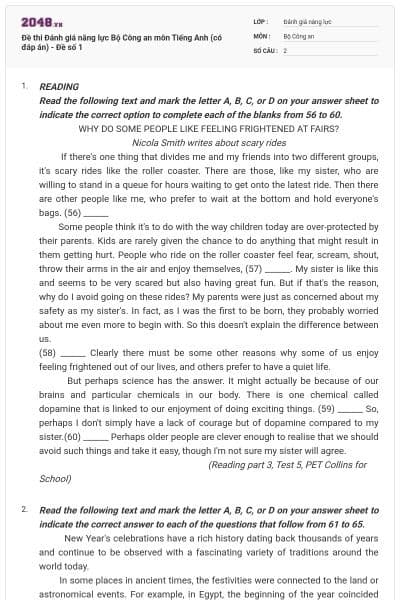
READING
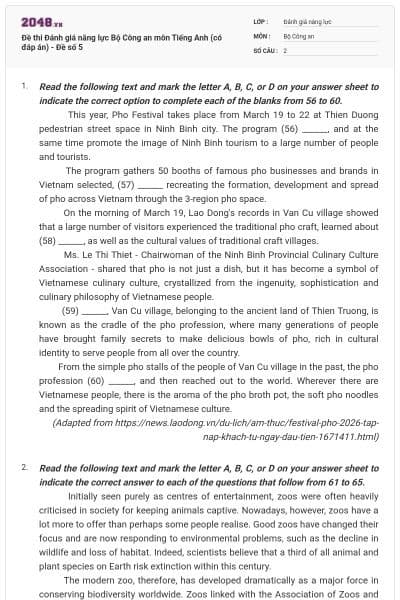
Read the following text and mark the letter A, B, C, or D on your answer sheet to indicate the correct option to complete each of the blanks from 56 to 60.
WHY DO SOME PEOPLE LIKE FEELING FRIGHTENED AT FAIRS?
Nicola Smith writes about scary rides
If there's one thing that divides me and my friends into two different groups, it's scary rides like the roller coaster. There are those, like my sister, who are willing to stand in a queue for hours waiting to get onto the latest ride. Then there are other people like me, who prefer to wait at the bottom and hold everyone's bags. (56) ______
Some people think it's to do with the way children today are over-protected by their parents. Kids are rarely given the chance to do anything that might result in them getting hurt. People who ride on the roller coaster feel fear, scream, shout, throw their arms in the air and enjoy themselves, (57) ______. My sister is like this and seems to be very scared but also having great fun. But if that's the reason, why do I avoid going on these rides? My parents were just as concerned about my safety as my sister's. In fact, as I was the first to be born, they probably worried about me even more to begin with. So this doesn't explain the difference between us.
(58) ______ Clearly there must be some other reasons why some of us enjoy feeling frightened out of our lives, and others prefer to have a quiet life.
But perhaps science has the answer. It might actually be because of our brains and particular chemicals in our body. There is one chemical called dopamine that is linked to our enjoyment of doing exciting things. (59) ______ So, perhaps I don't simply have a lack of courage but of dopamine compared to my sister.(60) ______ Perhaps older people are clever enough to realise that we should avoid such things and take it easy, though I'm not sure my sister will agree.
(Reading part 3, Test 5, PET Collins for School)
Then there are other people like me, who prefer to wait at the bottom and hold everyone's bags. (56) ______
Sometimes, I wonder what it is that makes us so different.
From time to time, I ask myself why we are so alike.
At times, I wonder why some people enjoy these rides so much.
The reasons behind this similarity occasionally make me wonder.
- Xét thông tin If there's one thing that divides me and my friends into two different groups, it's scary rides like the roller coaster. There are those, like my sister, who are willing to stand in a queue for hours waiting to get onto the latest ride. Then there are other people like me, who prefer to wait at the bottom and hold everyone's bags. (56) ______ (Nếu có một điều chia tôi và những người bạn thành hai nhóm khác nhau, đó chính là những trò chơi mạo hiểm như tàu lượn siêu tốc. Có những người, như em gái tôi, sẵn sàng đứng xếp hàng hàng giờ để lên chuyến tàu lượn sớm nhất. Rồi lại có những người như tôi, thích đứng chờ bên dưới và giữ túi cho tất cả mọi người. (56) ______)
" Người viết và chị gái có những thái độ đối lập về các trò chơi mạo hiểm như tàu lượn siêu tốc
A. Sometimes, I wonder what it is that makes us so different. (Thỉnh thoảng, tôi băn khoăn điều gì khiến chúng tôi khác biệt như vậy.)
B. From time to time, I ask myself why we are so alike. (Thỉnh thoảng, tôi tự hỏi chính mình tại sao chúng tôi giống nhau như thế.) " Loại vì mâu thuẫn với thông tin trong bài đọc.
C. At times, I wonder why some people enjoy these rides so much. (Thỉnh thoảng, tôi băn khoăn tại sao một vài người lại thích những trò này nhiều như vậy.)
D. The reasons behind this similarity occasionally make me wonder. (Lí do đằng sau sự giống nhau này thỉnh thoảng khiến tôi băn khoăn.) " Loại vì mâu thuẫn với thông tin trong bài đọc.
" Như vậy, từ thông tin đoạn văn đầu tiên, ta loại được phương án B và D.
- Muốn chọn được phương án đúng (giữa A và C), ta buộc phải đọc thêm thông tin ở đoạn hai.
Ở đoạn hai, ta thấy thông tin: But if that's the reason, why do I avoid going on these rides? My parents were just as concerned about my safety as my sister's. In fact, as I was the first to be born, they probably worried about me even more to begin with. So this doesn't explain the difference between us. (Nếu đó là lí do, thì tại sao tôi tránh chơi những trò mạo hiểm này? Mức độ quan tâm của bố mẹ đối với sự an toàn của tôi và em gái là như nhau. Thực tế, bởi vì tôi được sinh ra trước, họ thậm chí phải lo lắng về tôi trước. Vì vậy lí do này không thể giải thích được sự khác biệt giữa chúng tôi.)
" Như vậy, điều người viết băn khoăn là tại sao mình và em gái mình lại đối lập nhau về trò chơi mạo hiểm như tàu lượn siêu tốc.
" Câu 56 đáp án đúng là A.
Dịch:
If there's one thing that divides me and my friends into two different groups, it's scary rides like the roller coaster. There are those, like my sister, who are willing to stand in a queue for hours waiting to get onto the latest ride. Then there are other people like me, who prefer to wait at the bottom and hold everyone's bags. Sometimes, I wonder what it is that makes us so different.
(Nếu có một điều chia tôi và những người bạn thành hai nhóm khác nhau, đó chính là những trò chơi mạo hiểm như tàu lượn siêu tốc. Có những người, như em gái tôi, sẵn sàng đứng xếp hàng hàng giờ để lên chuyến tàu lượn sớm nhất. Rồi lại có những người như tôi, thích đứng chờ bên dưới và giữ túi cho tất cả mọi người. Thỉnh thoảng, tôi băn khoăn điều gì khiến chúng tôi khác biệt như vậy.)
to know they are not in danger
they know they are safe
knowing that they are safe
known they are protected
People who ride on the roller coaster feel fear, scream, shout, throw their arms in the air and enjoy themselves, (57) ______. (Những người chơi tàu lượn siêu tốc cảm thấy sợ, la thét, gào hét, giang tay lên trời và tận hưởng bản thân ______.)
" Ta thấy thông tin cần điền đứng ngay sau dấu phẩy, và mệnh đề đầu tiên là một mệnh đề độc lập (vì có đầy đủ S và V).
A. to know they are not in danger
" Loại vì to V dùng để diễn tả mục đích hành động, không đứng ngay sau dấu phẩy.
B. they know they are safe
" Sai vì đây là một mệnh đề độc lập, và sẽ không thể nối với một mệnh đề độc lập khác bằng một dấu phẩy được.
C. knowing that they are safe
" Đúng. Đây là một mệnh đề trạng ngữ rút gọn thể chủ động. Mệnh đề trạng ngữ này đồng chủ ngữ với mệnh đề đầu tiên là people who ride on the roller coaster, và giải thích cho thông tin trong mệnh đề đầu tiên.
Lưu ý thêm: Mệnh đề đầy đủ của nó là Because they know that they are safe.
D. known they are protected
" Sai. Đây là một mệnh đề trạng ngữ rút gọn thể bị động. Nếu dùng như vậy, thì chủ ngữ của mệnh đề này là people who ride on the roller coaster. Như vậy, câu sẽ vô lý vì đây là một trạng thái tâm lí, people tự nhận biết được, nên không dùng bị động ở đây.
Dịch:
People who ride on the roller coaster feel fear, scream, shout, throw their arms in the air and enjoy themselves, knowing that they are safe. (Những người chơi tàu lượn siêu tốc cảm thấy sợ, la thét, gào hét, giang tay lên trời và tận hưởng bản thân vì họ biết mình an toàn.)
(58) ______ Clearly there must be some other reasons why some of us enjoy feeling frightened out of our lives, and others prefer to have a quiet life.
Such a conclusion helps clarify our understanding.
On the contrary, individual experiences vary greatly.
This explanation, therefore, seems convincing.
Thus, this theory cannot fully account for the disparity.
Some people think it's to do with the way children today are over-protected by their parents. Kids are rarely given the chance to do anything that might result in them getting hurt. People who ride on the roller coaster feel fear, scream, shout, throw their arms in the air and enjoy themselves, knowing that they are safe. My sister is like this and seems to be very scared but also having great fun. But if that's the reason, why do I avoid going on these rides? My parents were just as concerned about my safety as my sister's. In fact, as I was the first to be born, they probably worried about me even more to begin with. So this doesn't explain the difference between us.
(58) ______ Clearly there must be some other reasons why some of us enjoy feeling frightened out of our lives, and others prefer to have a quiet life.
- Xét nghĩa đoạn thông tin: Một vài người nghĩ rằng điều này liên quan đến việc trẻ nhỏ được bao bọc quá mức bởi bố mẹ. Những đứa trẻ hiếm khi được cho cơ hội làm bất cứ điều gì gây tổn thương cho bản thân. Những người chơi tàu lượn siêu tốc cảm thấy sợ, la thét, gào hét, giang tay lên trời và tận hưởng bản thân vì họ biết mình an toàn. Em gái tôi giống như vậy, dường như rất sợ nhưng cũng thấy rất vui. Nhưng, nếu đó là lí do, thì tại sao tôi tránh chơi những trò mạo hiểm này? Mức độ quan tâm của bố mẹ đối với sự an toàn của tôi và em gái là như nhau. Thực tế, bởi vì tôi được sinh ra trước, họ thậm chí phải lo lắng về tôi trước. Vì vậy lí do này không thể giải thích được sự khác biệt giữa chúng tôi. ______ Rõ ràng phải có những lí do khác cho sự khác biệt này.
A. Such a conclusion helps clarify our understanding. (Sự kết luận như vậy giúp làm sáng tỏ sự hiểu của chúng tôi.) " Sai vì không thích hợp về nghĩa.
B. On the contrary, individual experiences vary greatly. (Ngược lại, trải nghiệm của các nhân khác nhau rất nhiều.) " Sai vì không thích hợp về nghĩa.
C. This explanation, therefore, seems convincing. (Do đó, giải thích này có vẻ thuyết phục.)
" Sai vì mâu thuẫn với nội dung trong bài.
D. Thus, this theory cannot fully account for the disparity. (Do đó, giả thuyết này không thể lí giải hoàn toàn cho sự khác biệt.)
" Đúng, đây là câu kết luận cho lí do đầu tiên mà người viết nêu ra.
Dịch:
Some people think it's to do with the way children today are over-protected by their parents. Kids are rarely given the chance to do anything that might result in them getting hurt. People who ride on the roller coaster feel fear, scream, shout, throw their arms in the air and enjoy themselves, knowing that they are safe. My sister is like this and seems to be very scared but also having great fun. But if that's the reason, why do I avoid going on these rides? My parents were just as concerned about my safety as my sister's. In fact, as I was the first to be born, they probably worried about me even more to begin with. So this doesn't explain the difference between us.
Thus, this theory cannot fully account for the disparity. Clearly there must be some other reasons why some of us enjoy feeling frightened out of our lives, and others prefer to have a quiet life. (Một vài người nghĩ rằng điều này liên quan đến việc trẻ nhỏ được bao bọc quá mức bởi bố mẹ. Những đứa trẻ hiếm khi được cho cơ hội làm bất cứ điều gì gây tổn thương cho bản thân. Những người chơi tàu lượn siêu tốc cảm thấy sợ, la thét, gào hét, giang tay lên trời và tận hưởng bản thân vì họ biết mình an toàn. Em gái tôi giống như vậy, dường như rất sợ nhưng cũng thấy rất vui. Nhưng, nếu đó là lí do, thì tại sao tôi tránh chơi những trò mạo hiểm này? Mức độ quan tâm của bố mẹ đối với sự an toàn của tôi và em gái là như nhau. Thực tế, bởi vì tôi được sinh ra trước, họ thậm chí phải lo lắng về tôi trước. Vì vậy lí do này không thể giải thích được sự khác biệt giữa chúng tôi. Do đó, giả thuyết này không thể lí giải hoàn toàn cho sự khác biệt. Rõ ràng phải có những lí do khác cho sự khác biệt này.)
Exciting experiences often discourage those with high dopamine levels.
High levels of dopamine are closely associated with the interest in thrilling rides.
The less dopamine is released, the more a person is fascinated by thrilling rides.
This chemical can influence people’s reaction to exciting situations.
But perhaps science has the answer. It might actually be because of our brains and particular chemicals in our body. There is one chemical called dopamine that is linked to our enjoyment of doing exciting things. (59) ______ So, perhaps I don't simply have a lack of courage but of dopamine compared to my sister.
- Xét nghĩa đoạn thông tin: Nhưng có lẽ khoa học có lời giải đáp. Thực ra có thể là do não bộ và các chất hóa học cụ thể trong cơ thể. Có một chất hóa học, gọi là dopamine, có liên quan đến việc chúng ta thích thú khi làm những điều gây hứng thú. ______. Vì vậy, có lẽ, không phải đơn giản là tôi thiếu lòng can đảm, mà là tôi đang thiếu hụt dopamine so với em gái mình.
" Như vậy, một trong những lí do khác biệt là ở việc: người viết có ít dopamine hơn em gái.
" Ta suy ra: người có dopamine càng cao thì sẽ càng hứng thú với các trò mạo hiểm.
A. Exciting experiences often discourage those with high dopamine levels. (Những trải nghiệm gây hứng thú khiến những người có mức dopamine cao nản lòng.)
" Sai vì mâu thuẫn với thông tin trong bài đọc.
B. High levels of dopamine are closely associated with the interest in thrilling rides. (Mức dopamine cao liên quan chặt chẽ với sự hứng thú với các trò chơi mạo hiểm.)
" Phù hợp về nghĩa + đúng ngữ pháp.
C. The less dopamine is released, the more a person is fascinated by thrilling rides. (Dopamine càng tiết ra ít, thì người đó càng hứng thú với các trò mạo hiểm.)
" Sai vì mâu thuẫn với thông tin trong bài đọc.
D. This chemical can influence people’s reaction to exciting situations. (Chất hóa học này có thể ảnh hưởng tới phản ứng của con người đối với những tình huống gây hứng thú.)
" Sai vì chưa nêu cụ thể ảnh hưởng như thế nào, và ở mức độ nào thì sẽ gây ảnh hưởng.
Dịch:
But perhaps science has the answer. It might actually be because of our brains and particular chemicals in our body. There is one chemical called dopamine that is linked to our enjoyment of doing exciting things. High levels of dopamine are closely associated with the interest in thrilling rides. So, perhaps I don't simply have a lack of courage but of dopamine compared to my sister. (Nhưng có lẽ khoa học có lời giải đáp. Thực ra có thể là do não bộ và các chất hóa học cụ thể trong cơ thể. Có một chất hóa học, gọi là dopamine, có liên quan đến việc chúng ta thích thú khi làm những điều gây hứng thú. Mức dopamine cao liên quan chặt chẽ với sự hứng thú với các trò chơi mạo hiểm. Vì vậy, có lẽ, không phải đơn giản là tôi thiếu lòng can đảm, mà là tôi đang thiếu hụt dopamine so với em gái mình.)
(60) ______ Perhaps older people are clever enough to realise that we should avoid such things and take it easy, though I'm not sure my sister will agree.
Unfortunately, the thrill of these experiences remains constant throughout life.
Getting older and older, scary rides like the roller coaster are not likely to be chosen.
Unfortunately, people will be more thrilled by frightening rides over the time.
Luckily, aging may prevent our eagerness to take part in scary rides like the roller coaster.
So, perhaps I don't simply have a lack of courage but of dopamine compared to my sister. (60) ______ Perhaps older people are clever enough to realise that we should avoid such things and take it easy, though I'm not sure my sister will agree.
- Xét nghĩa đoạn thông tin: Vì vậy, có lẽ, không phải đơn giản là tôi thiếu lòng can đảm, mà là tôi đang thiếu hụt dopamine so với em gái mình. ______ Có lẽ người lớn tuổi hơn đủ thông minh để nhận ra rằng chúng ta nên tránh những trò như vậy và chọn cách tận hưởng nhẹ nhàng, nhưng tôi không chắc là em gái tôi sẽ đồng ý.
A. Unfortunately, the thrill of these experiences remains constant throughout life.
(Thật không may mắn, sự phấn khích từ những trải nghiệm này không thay đổi trong suốt cuộc đời.) " Sai vì không phù hợp về nghĩa.
B. Getting older and older, scary rides like the roller coaster are not likely to be chosen. (Ngày càng lớn tuổi, những trò đáng sợ như tàu lượn siêu tốc càng ít có khả năng được chọn.)
" Sai ngữ pháp. Hai mệnh đề trong câu sẽ đồng chủ ngữ là scary rides; tuy nhiên, scary rides không thể getting older and older được.
C. Unfortunately, people will be more thrilled by frightening rides over the time. (Thật không may, con người sẽ cảm thấy hứng thú với những trò chơi đáng sợ theo thời gian.)
" Sai vì mâu thuẫn với thông tin trong bài đọc.
D. Luckily, aging may prevent our eagerness to take part in scary rides like the roller coaster. (May mắn thay, sự già đi có lẽ ngăn cản sự hăng hái của chúng ta trong việc tham gia các trò chơi đáng sợ như tàu lượn siêu tốc.)
" Phù hợp về nghĩa + đúng ngữ pháp.
Dịch:
So, perhaps I don't simply have a lack of courage but of dopamine compared to my sister. Luckily, aging may prevent our eagerness to take part in scary rides like the roller coaster. Perhaps older people are clever enough to realise that we should avoid such things and take it easy, though I'm not sure my sister will agree. (Vì vậy, có lẽ, không phải đơn giản là tôi thiếu lòng can đảm, mà là tôi đang thiếu hụt dopamine so với em gái mình. May mắn thay, sự già đi có lẽ ngăn cản sự hăng hái của chúng ta trong việc tham gia các trò chơi đáng sợ như tàu lượn siêu tốc. Có lẽ người lớn tuổi hơn đủ thông minh để nhận ra rằng chúng ta nên tránh những trò như vậy và chọn cách tận hưởng nhẹ nhàng, nhưng tôi không chắc là em gái tôi sẽ đồng ý.)
Bài đọc | Dịch bài đọc |
WHY DO SOME PEOPLE LIKE FEELING FRIGHTENED AT FAIRS?
Nicola Smith writes about scary rides If there's one thing that divides me and my friends into two different groups, it's scary rides like the roller coaster. There are those, like my sister, who are willing to stand in a queue for hours waiting to get onto the latest ride. Then there are other people like me, who prefer to wait at the bottom and hold everyone's bags. Sometimes, I wonder what it is that makes us so different. Some people think it's to do with the way children today are over-protected by their parents. Kids are rarely given the chance to do anything that might result in them getting hurt. People who ride on the roller coaster feel fear, scream, shout, throw their arms in the air and enjoy themselves, knowing that they are safe. My sister is like this and seems to be very scared but also having great fun. But if that's the reason, why do I avoid going on these rides? My parents were just as concerned about my safety as my sister's. In fact, as I was the first to be born, they probably worried about me even more to begin with. So this doesn't explain the difference between us. Thus, this theory cannot fully account for the disparity. Clearly there must be some other reasons why some of us enjoy feeling frightened out of our lives, and others prefer to have a quiet life. But perhaps science has the answer. It might actually be because of our brains and particular chemicals in our body. There is one chemical called dopamine that is linked to our enjoyment of doing exciting things. High levels of dopamine are closely associated with the interest in thrilling rides. So, perhaps I don't simply have a lack of courage but of dopamine compared to my sister. Luckily, aging may prevent our eagerness to take part in scary rides like the roller coaster. Perhaps older people are clever enough to realise that we should avoid such things and take it easy, though I'm not sure my sister will agree.
| TẠI SAO MỘT VÀI NGƯỜI LẠI THÍCH CẢM GIÁC SỢ HÃI Ở KHU VUI CHƠI GIẢI TRÍ? Nicola Smith viết về những trò chơi mạo hiểm Nếu có một điều chia tôi và những người bạn thành hai nhóm khác nhau, đó chính là những trò chơi mạo hiểm như tàu lượn siêu tốc. Có những người, như em gái tôi, sẵn sàng đứng xếp hàng hàng giờ để lên chuyến tàu lượn sớm nhất. Rồi lại có những người như tôi, thích đứng chờ bên dưới và giữ túi cho tất cả mọi người. Thỉnh thoảng, tôi băn khoăn điều gì khiến chúng tôi khác biệt như vậy. Một vài người nghĩ rằng điều này liên quan đến việc trẻ nhỏ được bao bọc quá mức bởi bố mẹ. Những đứa trẻ hiếm khi được cho cơ hội làm bất cứ điều gì gây tổn thương cho bản thân. Những người chơi tàu lượn siêu tốc cảm thấy sợ, la thét, gào hét, giang tay lên trời và tận hưởng bản thân vì họ biết mình an toàn. Em gái tôi giống như vậy, dường như rất sợ nhưng cũng thấy rất vui. Nhưng, nếu đó là lí do, thì tại sao tôi tránh chơi những trò mạo hiểm này? Mức độ quan tâm của bố mẹ đối với sự an toàn của tôi và em gái là như nhau. Thực tế, bởi vì tôi được sinh ra trước, họ thậm chí phải lo lắng về tôi trước. Vì vậy lí do này không thể giải thích được sự khác biệt giữa chúng tôi. Do đó, giả thuyết này không thể lí giải hoàn toàn cho sự khác biệt. Rõ ràng phải có những lí do khác cho sự khác biệt này.
Nhưng có lẽ khoa học có lời giải đáp. Thực ra có thể là do não bộ và các chất hóa học cụ thể trong cơ thể. Có một chất hóa học, gọi là dopamine, có liên quan đến việc chúng ta thích thú khi làm những điều gây hứng thú. Mức dopamine cao liên quan chặt chẽ với sự hứng thú với các trò chơi mạo hiểm. Vì vậy, có lẽ, không phải đơn giản là tôi thiếu lòng can đảm, mà là tôi đang thiếu hụt dopamine so với em gái mình. May mắn thay, sự già đi có lẽ ngăn cản sự hăng hái của chúng ta trong việc tham gia các trò chơi đáng sợ như tàu lượn siêu tốc. Có lẽ người lớn tuổi hơn đủ thông minh để nhận ra rằng chúng ta nên tránh những trò như vậy và chọn cách tận hưởng nhẹ nhàng, nhưng tôi không chắc là em gái tôi sẽ đồng ý. |
Read the following text and mark the letter A, B, C, or D on your answer sheet to indicate the correct answer to each of the questions that follow from 61 to 65.
New Year's celebrations have a rich history dating back thousands of years and continue to be observed with a fascinating variety of traditions around the world today.
In some places in ancient times, the festivities were connected to the land or astronomical events. For example, in Egypt, the beginning of the year coincided with when the River Nile flooded, and this normally happened when the star Sirius rose. The flood left rich soil on the fields and marked the beginning of a new agricultural season for farmers.
The city of Babylon in ancient Mesopotamia was where the first New Year's celebrations were recorded about 4,000 years ago. The Babylonians held their celebrations on the first new moon after the spring equinox and called this festival Akitu (which comes from the word the Sumerians used for barley).As barley in Mesopotamia was harvested in the spring, shortly after the festival, Akitu marked the beginning of this important agricultural period. During Akitu, there was a different ritual on each of the 11 days that the celebration lasted. Statues of the gods were carried through the streets of the city, and in this way, the Babylonians believed that their world had been cleaned to prepare for the new year and a new spring.
In many cities all over the world today, spectacular fireworks displays take place as soon as the clock passes midnight on 31 December. In recent years, Sydney in Australia has hosted one of the first major New Year events as the new year arrives there before most other major international cities. Fireworks light up the skies in hundreds of cities as midnight strikes around the globe.
There are strange and interesting New Year's traditions around the world. In Scotland, New Year's Eve is called Hogmanay, and 'first footing' remains a popular custom with people visiting friends' and neighbours' houses just after midnight. The first person who visits your house should bring a gift as this will mean good luck. In Spain, people eat 12 grapes as the bells sound for midnight on 31 December. One grape is eaten at each sound of the bell, and each grape is supposed to bring good luck for each month of the year ahead.
New Year traditions across the globe all share a common purpose: to welcome a fresh start with hope and joy, whether rooted in ancient rituals or celebrated with modern spectacles.
(Adapted fromhttps://learnenglish.britishcouncil.org/general-english/magazine-zone/new-year-celebrations)
What is the best title of the text?
The origins of New Year’s celebrations throughout history
The importance of New Year’s celebrations throughout history
Ancient and modern New Year traditions throughout history
The differences in ancient and modern New Year’s traditions
What is the best title of the text? (Đâu là tiêu đề tốt nhất cho bài đọc?)
A. The origins of New Year’s celebrations throughout history (Nguồn gốc của lễ mừng Năm mới xuyên suốt lịch sử)
" Sai vì phương án này chỉ đúng cho hai đoạn đầu bài đọc (nói về lễ ăn mừng của Ai Cập và Babylon).
B. The importance of New Year’s celebrations throughout history (Tầm quan trọng của lễ mừng Năm mới xuyên suốt lịch sử)
" Sai vì bài không phân tích sâu vai trò của lễ ăn mừng Năm mới.
C. Ancient and modern New Year traditions throughout history (Những truyền thống Năm mới cổ đại và hiện đại xuyên suốt lịch sử)
" Đúng. Yếu tố ancient traditions được thể hiện ở đoạn hai và đoạn 3, và modern traditions được thể hiện ở hai đoạn văn tiếp theo.
D. The differences in ancient and modern New Year’s traditions (Sự khác biệt giữa truyền thống Năm mới cổ đại và hiện đại)
" Sai vì bài liệt kê những hoạt động chúc mừng Năm mới ở những thời điểm và địa điểm khác nhau, nhằm làm nổi bật sự đa dạng, chứ không mang tính chất so sánh.
What is the purpose of the writer?
To provide an overview of how New Year’s traditions have varied
To point out the correlation between the astronomical factors and the New Year celebration
To persuade readers to travel to different countries to experience New Year customs
To argue that modern New Year’s celebrations are better than ancient ones
What is the purpose of the writer? (Mục đích của người viết là gì?)
A. To provide an overview of how New Year’s traditions have varied (Nhằm cung cấp sự tổng quan về việc truyền thống ăn mừng Năm mới đa dạng như thế nào.)
" Đúng. Bài cung cấp thông tin về sự ăn mừng Năm mới ở các thời điểm khác nhau, ở các địa điểm khác nhau và một số truyền thống của các địa điểm.
B. To point out the correlation between the astronomical factors and the New Year celebration
(Để chỉ ra sự tương quan giữa các yếu tố thiên văn và sự ăn mừng Năm mới)
" Sai vì quá hẹp. Phương án này chỉ đúng với hai đoạn thông tin về Ai Cập và Babylon, không phải mục đích khi viết toàn bài.
C. To persuade readers to travel to different countries to experience New Year customs (Để thuyết phục người đọc đi tới nhiều quốc gia để trải nghiệm các phong tục Năm mới)
" Sai. Bài không có yếu tố thuyết phục người đọc đi du lịch.
D. To argue that modern New Year’s celebrations are better than ancient ones (Để chứng minh rằng các hoạt động ăn mừng Năm mới hiện đại tốt hơn với các hoạt động ăn mừng Năm mới cổ đại)
" Sai. Bài viết không có yếu tố so sánh sự ăn mừng Năm mới.
What can be inferred about the relationship between agricultural cycles and ancient New Year's celebrations?
Ancient New Year’s festivities were primarily intended to signal the ideal time for harvesting and planting seasons.
Only societies that depended mainly on agriculture celebrated the New Year based on natural cycles.
The timing of New Year's often correlated with crucial agricultural events like harvesting or planting seasons.
Ancient civilizations believed that performing rituals could control the timing of seasonal changes.
Thông tin:
- For example, in Egypt, the beginning of the year coincided with when the River Nile flooded, and this normally happened when the star Sirius rose. The flood left rich soil on the fields and marked the beginning of a new agricultural season for farmers. (Ví dụ, ở Ai Cập, bắt đầu năm mới trùng với lúc sông Nile dâng nước lũ, và điều này thường xảy ra khi sao Thiên Lang mọc. Trận lũ để lại lớp phù sa màu mỡ trên các cánh đồng và đánh dấu sự khởi đầu của một mùa vụ nông nghiệp mới cho nông dân.)
Ta có thể tóm tắt thứ tự diễn ra như sau: Sao Thiên Lang mọc " sông Nile dâng nước lũ + năm mới " Mùa vụ mới.
- The Babylonians held their celebrations on the first new moon after the spring equinox and called this festival Akitu (which comes from the word the Sumerians used for barley). As barley in Mesopotamia was harvested in the spring, after the festival, Akitu marked the beginning of this important agricultural period. (Người Babylon tổ chức ăn mừng lễ hội vào trăng non đầu tiên sau điểm Xuân phân và gọi lễ hội này là Akitu (từ này bắt nguồn từ tên gọi cây lúa mạch của người Sumer). Bởi vì lúa mạch được thu hoạch vào mùa xuân, sớm sau lễ hội, Akitu đánh dấu sự bắt đầu của mùa vụ nông nghiệp quan trọng này.)
Ta có thứ tự xảy ra như sau: Điểm Xuân phân " Trăng non đầu tiên " Lễ Năm mới (Akitu) " Mùa thu hoạch.
" Như vậy, năm mới xảy ra gần với thời điểm của các mùa vụ nông nghiệp. Hai sự kiện này có mối liên hệ chặt chẽ về mặt thời gian.
What can be inferred about the relationship between agricultural cycles and ancient New Year's celebrations? (Điều gì có thể suy luận từ mối quan hệ giữa chu kì nông nghiệp và lễ ăn mừng Năm mới thời cổ đại?)
A. Ancient New Year’s festivities were primarily intended to signal the ideal time for harvesting and planting seasons. (Các hoạt động ăn mừng Năm mới thời cổ đại được tổ chức chủ yếu nhằm báo hiệu thời gian lý tưởng cho mùa thu hoạch và mùa gieo trồng)
" Sai. Bài chỉ nói các sự kiện có mối liên hệ về thời gian (xảy ra gần nhau), chứ không phải mục đích con người tổ chức lễ Năm mới là để báo hiệu cho mùa vụ.
B. Only societies that depended mainly on agriculture celebrated the New Year based on natural cycles. (Chỉ những xã hội phụ thuộc chủ yếu vào nền nông nghiệp mới ăn mừng Năm mới dựa trên chu kì tự nhiên.)
" Sai. Bài đưa ví dụ về hai quốc gia nông nghiệp Ai Cập và Lưỡng Hà nhưng không nêu “chỉ có các quốc gia nông nghiệp”.
C. The timing of New Year's often correlated with crucial agricultural events like harvesting or planting seasons. (Thời điểm ăn mừng năm mới tương quan với các sự kiện nông nghiệp như mùa thu hoạch và gieo trồng.)
" Đúng. Ở Ai Cập và Lưỡng Hà, mùa vụ nông nghiệp có liên hệ về mặt thời gian với lễ ăn mừng Năm mới.
D. Ancient civilizations believed that performing rituals could control the timing of seasonal changes. (Các nền văn minh cổ đại tin rằng thực hiện các nghi lễ có thể điều khiển thời điểm thay đổi của các mùa.)
" Sai. Bài viết có thông tin the Babylonians believed that their world had been cleaned to prepare for the new year and a new spring. Thông tin này cho thấy mục đích của nghi lễ là clean their world, chứ không phải control season changes.
Sydney's time zone allows it to be one of the first cities to welcome the New Year.
All New Year's celebrations today are based on ancient astronomical events.
In Scotland, the host gives a gift to the first visitor for good luck.
The Akitu festival was the very first recorded celebration of any kind.
Which fact is true about the New Year celebrations mentioned in the text? (Thông tin nào sau đây đúng về các lễ ăn mừng Năm mới được đề cập trong bài?)
A. Sydney's time zone allows it to be one of the first cities to welcome the New Year. (Đới thời gian của Sydney cho phép nó là một trong những thành phố đầu tiên chào đón năm mới.)
" Đúng, dựa trên thông tin: In recent years, Sydney in Australia has hosted one of the first major New Year events as the new year arrives there before most other major international cities(Vào những năm gần đây, Sydney ở Úc là nơi tổ chức một trong những sự kiện Năm mới lớn đầu tiên vì năm mới đến đó sớm hơn hết các thành phố quốc tế lớn khác).
B. All New Year's celebrations today are based on ancient astronomical events. (Tất cả lễ Năm mới ngày nay đều dựa trên các sự kiện thiên văn học cổ đại.)
" Sai, thông tin này không được nhắc đến trong bài.
C. In Scotland, the host gives a gift to the first visitor for good luck. (Ở Scotland, chủ nhà tặng một món quà cho vị khách đầu tiên để cầu may.)
" Sai vì mâu thuẫn với thông tin trong bài: The first person who visits your house should bring a gift as this will mean good luck (Người đầu tiên đến thăm nhà bạn nên mang theo một món quà bởi vì điều này sẽ mang lại may mắn).
D. The Akitu festival was the very first recorded celebration of any kind. (Lễ hội Akitu là lễ ăn mừng đầu tiên từng được ghi nhận, dưới bất kì hình thức nào.)
" Sai. Dựa trên thông tin: The city of Babylon in ancient Mesopotamia was where the first New Year's celebrations were recorded about 4,000 years ago (Thành phố Babylon ở vùng Lưỡng Hà cổ đại là nơi những lễ ăn mừng Năm mới đầu tiên được ghi nhận, vào khoảng 4000 năm trước), lễ Akitu chỉ là lễ hội Năm mới đầu tiên được ghi nhận, không phải lễ hội đầu tiên thuộc mọi loại lễ hội.
ancient Egyptian festivities
the River Nile flooding
the beginning of the year
the star Sirius rising
What does the word “this” in paragraph 2 refer to? (Từ “this” trong đoạn 2 đều cập tới gì?)
A. ancient Egyptian festivities (các hoạt động lễ hội của người Ai Cập cổ đại)
B. the River Nile flooding (sự dâng nước lũ của sông Nile)
C. the beginning of the year (sự bắt đầu của năm mới)
D. the star Sirius rising (sao Thiên Lang mọc)
Dựa trên thông tin For example, in Egypt, the beginning of the year coincided with when the River Nile flooded, and this normally happened when the star Sirius rose. The flood left rich soil on the fields and marked the beginning of a new agricultural season for farmers (Ví dụ, ở Ai Cập, bắt đầu năm mới trùng với lúc sông Nile dâng nước lũ, và điều này thường xảy ra khi sao Thiên Lang mọc. Trận lũ để lại lớp phù sa màu mỡ trên các cánh đồng và đánh dấu sự khởi đầu của một mùa vụ nông nghiệp mới cho nông dân.)
- Ở đây, có hai khả năng xảy ra:
+ this thay thế cho the beginning of the year.
+ this thay thế cho the River Nile flooding.
Như vậy:
+ Nếu thay this bằng the beginning of the year, ta được câu: the beginning of the year normally happened when the star Sirius rose (sự khởi đầu năm mới thông thường xảy ra khi sao Thiên Lang mọc).
+ Nếu thay this bằng the River Nile flooding, ta được câu: the River Nile flooding happened when the star Sirius rose (sự dâng nước lũ của sông Nile xảy ra khi sao Thiên Lang mọc).
+ Ta có thông tin the beginning of the year coincided with when the River Nile flooded" năm mới phụ thuộc vào lũ sông Nile.
" “this” thay thế cho the River Nile flooding sẽ hợp lí hơn.
Khi đó, câu sẽ chỉ rõ được mối quan hệ: năm mới phụ thuộc vào lũ sông Nile, và lũ sông Nile phụ thuộc vào thời điểm sao Thiên Lang mọc.
Dịch bài đọc:
Lễ đón Năm mới có bề dày lịch sử hàng ngàn năm và cho đến ngày nay vẫn tiếp tục được tổ chức với sự đa dạng đầy mê hoặc của các truyền thống trên khắp thế giới.
Ở một vài nơi thời cổ đại, các hoạt động lễ hội gắn liền với các sự kiện đất đai hoặc thiên văn. Ví dụ, ở Ai Cập, bắt đầu năm mới trùng với lúc sông Nile dâng nước lũ, và điều này thường xảy ra khi sao Thiên Lang mọc. Trận lũ để lại lớp phù sa màu mỡ trên các cánh đồng và đánh dấu sự khởi đầu của một mùa vụ nông nghiệp mới cho nông dân.
Thành phố Babylon ở vùng Lưỡng Hà cổ đại là nơi những lễ ăn mừng Năm mới đầu tiên được ghi nhận, vào khoảng 4000 năm trước. Người Babylon tổ chức ăn mừng lễ hội vào trăng non đầu tiên sau điểm Xuân phân và gọi lễ hội này là Akitu (từ này bắt nguồn từ tên gọi cây lúa mạch của người Sumer). Bởi vì lúa mạch được thu hoạch vào mùa xuân, sớm sau lễ hội, Akitu đánh dấu sự bắt đầu của mùa vụ nông nghiệp quan trọng này. Trong suốt lễ Akitu, mỗi ngày trong số 11 ngày lễ đều có một nghi lễ khác nhau. Tượng của các vị thần được rước qua các con phố trong thành phố, và bằng cách này, người Babylon tin rằng thế giới của họ đã được thanh tẩy để chuẩn bị cho năm mới và mùa xuân mới.
Ở nhiều thành phố trên toàn thế giới ngày nay, những màn trình diễn pháo hoa ngoạn mục diễn ra ngay khi đồng hồ bước qua nửa đêm ngày 31 tháng 12. Vào những năm gần đây, Sydney ở Úc là nơi tổ chức một trong những sự kiện Năm mới lớn đầu tiên vì năm mới đến đó sớm hơn hết các thành phố quốc tế lớn khác. Pháo hoa thắp sáng bầu trời ở hàng trăm thành phố khi thời khắc giao thừa điểm trên toàn cầu.
Có những truyền thống đón Năm mới vừa lạ lùng vừa thú vị trên toàn thế giới. Ở Scotland, đêm giao thừa được gọi là Hogmanay, và tục “xông đất” vẫn là một phong tục phổ biến với với việc mọi người đến thăm nhà bạn bè và hàng xóm ngay sau giao thừa. Người đầu tiên đến thăm nhà bạn nên mang theo một món quà bởi vì điều này sẽ mang lại may mắn. Ở Tây Ban Nha, mọi người ăn 12 quả táo khi tiếng chuông giao thừa vang lên vào ngày 31 tháng 12. Mỗi quả nho được cho rằng sẽ mang lại may mắn cho mỗi tháng của năm mới sắp đến.
Các truyền thống Năm mới trên toàn cầu đều có một mục đích chung: đón chào một năm mới với niềm hi vọng và niềm vui, dù có bắt nguồn từ các nghi lễ cổ đại hay được ăn mừng bằng các màn trình diễn hiện đại.