ĐGNL ĐHQG Hà Nội - Tư duy định lượng - Ứng dụng tích phân để tính diện tích
27 câu hỏi
\[S = \mathop \smallint \limits_a^b f\left( x \right)dx\]
\[S = \mathop \smallint \limits_0^b f\left( x \right)dx\]
\[S = \mathop \smallint \limits_b^a \left| {f\left( x \right)} \right|dx\]
\[S = \mathop \smallint \limits_a^b \left| {f\left( x \right)} \right|dx\]
Công thức tính diện tích hình phẳng giới hạn bởi đồ thị hàm số\[y = f\left( x \right)\] đường thẳng y=0 và hai đường thẳng\[x = a,x = b\] là\[S = \mathop \smallint \limits_a^b \left| {f\left( x \right)} \right|dx\]
Đáp án cần chọn là: D
\[S = \mathop \smallint \limits_{ - 3}^{ - 1} \left| {{x^2} - 1} \right|dx\]
\[S = \mathop \smallint \limits_{ - 1}^{ - 3} \left| {{x^2} - 1} \right|dx\]
\[S = \mathop \smallint \limits_{ - 3}^0 \left| {{x^2} - 1} \right|dx\]
\[S = \mathop \smallint \limits_{ - 3}^{ - 1} \left( {1 - {x^2}} \right)dx\]
Đáp án cần chọn là: A
\[S = \mathop \smallint \limits_a^b \left( {f\left( x \right) - g\left( x \right)} \right)dx\]
\[S = \mathop \smallint \limits_a^b \left( {g\left( x \right) - f\left( x \right)} \right)dx\]
\[S = \mathop \smallint \limits_a^b \left| {f\left( x \right) - g\left( x \right)} \right|dx\]
\[S = \mathop \smallint \limits_a^b \left| {f\left( x \right)} \right|dx - \mathop \smallint \limits_a^b \left| {g\left( x \right)} \right|dx\]
Đáp án cần chọn là: C
\[S = \mathop \smallint \limits_0^e \left| {{e^x} + x} \right|dx\]
\[S = \mathop \smallint \limits_0^e \left| {{e^x} - x} \right|dx\]
\[S = \mathop \smallint \limits_e^0 \left| {{e^x} - x} \right|dx\]
\[S = \mathop \smallint \limits_e^0 \left| {{e^x} + x} \right|dx\]
Diện tích hình phẳng giới hạn bởi hai đồ thị hàm số\[y = f\left( x \right),y = g\left( x \right)\] và hai đường thẳng \[x = 0,x = e\] là:
\[S = \mathop \smallint \limits_0^e \left| {{e^x} - \left( { - x} \right)} \right|dx = \mathop \smallint \limits_0^e \left| {{e^x} + x} \right|dx\]
Đáp án cần chọn là: A
\[S = \left| {\mathop \smallint \nolimits_{ - 1}^1 \left( {3x - {x^3}} \right)dx} \right|\]
\[S = \mathop \smallint \nolimits_{ - 1}^0 \left( {3x - {x^3}} \right)dx + \mathop \smallint \nolimits_0^1 \left( {{x^3} - 3x} \right)dx\]
\[S = \mathop \smallint \nolimits_{ - 1}^1 \left( {3x - {x^3}} \right)dx\]
\[S = \mathop \smallint \nolimits_{ - 1}^0 \left( {{x^3} - 3x} \right)dx + \mathop \smallint \nolimits_0^1 \left( {3x - {x^3}} \right)dx\]
Xét phương trình hoành độ giao điểm của 2 đồ thị:
\[{x^3} - x = 2x \Leftrightarrow {x^3} - 3x = 0 \Leftrightarrow x = 0\] (chỉ xét trên\[\left( { - 1;1} \right)\]
Với\[x \in \left( { - 1;0} \right)\] thì\[{x^3} - 3x > 0\] với \[x \in \left( {0;1} \right)\] thì \[{x^3} - 3x < 0\]
Diện tích cần tìm là \[S = \mathop \smallint \limits_{ - 1}^1 \left| {{x^3} - 3x} \right|dx = \mathop \smallint \limits_{ - 1}^0 \left( {{x^3} - 3x} \right)dx + \mathop \smallint \limits_0^1 \left( {3x - {x^3}} \right)dx\]
Đáp án cần chọn là: D
\[S = 2 + e\]
\[S = 2 - e\]
\[S = e - 2\]
\[S = e - 1\]
Diện tích cần tính là\[S = \mathop \smallint \limits_0^1 \left| {\left( {x - 1} \right){e^x}} \right|dx = \mathop \smallint \limits_0^1 \left( {1 - x} \right){e^x}dx = 0,718... = e - 2\]
(sử dụng máy, tính trực tiếp và so sánh với các đáp án)
Đáp án cần chọn là: C
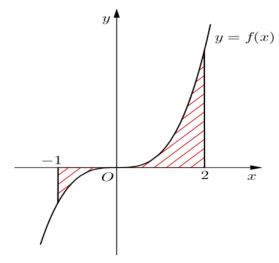
Gọi SS là diện tích hình phẳng (H) giới hạn bởi các đường y=f(x), trục hoành và hai đường thẳng x=−1,x=2 (như hình vẽ). Đặt \[a = \mathop \smallint \limits_{ - 1}^0 f(x)dx,b = \mathop \smallint \limits_0^2 f(x)dx\]. Mệnh đề nào sau đây đúng?
\[S = b - a.\]
\[S = b + a.\]
\[S = - b + a.\]
\[S = - b - a.\]
Diện tích hình phẳng là \[\mathop \smallint \limits_{ - 1}^2 \left| {f(x)} \right|dx\]
Dựa vào hình vẽ ta có được:
\[S = \mathop \smallint \limits_{ - 1}^0 (0 - f(x))dx + \mathop \smallint \limits_0^2 f(x)dx = - \mathop \smallint \limits_{ - 1}^0 f(x)dx + \mathop \smallint \limits_0^2 f(x)dx = b - a\]
Đáp án cần chọn là: A
\[S = \frac{{16}}{3}\]
\[S = \frac{{161}}{6}\]
\[S = \frac{1}{6}\]
\[S = \frac{5}{6}\]
Xét phương trình :\[{x^2} - 4 = x - 4 \Leftrightarrow \left[ {\begin{array}{*{20}{c}}{x = 0}\\{x = 1}\end{array}} \right.\]
Trong khoảng (0;1) thì \[{x^2} - x < 0\]
Diện tích cần tìm là :
\[S = \mathop \smallint \limits_0^1 \left| {{x^2} - 4 - x + 4} \right|dx = \mathop \smallint \limits_0^1 \left| {{x^2} - x} \right|dx = - \mathop \smallint \limits_0^1 \left( {{x^2} - x} \right)dx = \frac{1}{6}\]
Đáp án cần chọn là: C
\[\pi + \frac{4}{3}\]
\[\frac{\pi }{2} - 1\]
\[\frac{\pi }{2}\]
\[\frac{\pi }{2} + \frac{1}{3}\]
\[{x^2} + {y^2} = 2(y > 0) \Leftrightarrow y = \sqrt {2 - {x^2}} \]
+ Hoành độ giao điểm của 2 đường là nghiệm của phương trình:
\(\sqrt {2 - {x^2}} = {x^2} \Leftrightarrow {x^4} + {x^2} - 2 = 0 \Leftrightarrow \left[ {\begin{array}{*{20}{c}}{{x^2} = 1}\\{{x^2} = - 2\left( L \right)}\end{array}} \right.\)
\[ \Leftrightarrow x = \pm 1\]
+ Với \[ - 1 \le x \le 1\] thì
\[\begin{array}{*{20}{l}}{{x^2} \le 1 \Rightarrow {x^4} \le 1}\\{ \Rightarrow {x^4} + {x^2} - 2 = \left( {{x^4} - 1} \right) + \left( {{x^2} - 1} \right) \le 0}\end{array}\]
\[\begin{array}{*{20}{l}}{ \Rightarrow 0 \le {x^4} \le 2 - {x^2}}\\{ \Rightarrow {x^2} \le \sqrt {2 - {x^2}} }\end{array}\]
\[ \Rightarrow {x^2} - \sqrt {2 - {x^2}} \le 0 \Rightarrow \left| {\sqrt {2 - {x^2}} - {x^2}} \right| = \sqrt {2 - {x^2}} - {x^2}\]
+ Diện tích hình phẳng là:
\[S = \mathop \smallint \limits_{ - 1}^1 \left| {\sqrt {2 - {x^2}} - {x^2}} \right|dx = \mathop \smallint \limits_{ - 1}^1 \left( {\sqrt {2 - {x^2}} - {x^2}} \right)dx = \mathop \smallint \limits_{ - 1}^1 \sqrt {2 - {x^2}} dx - \mathop \smallint \limits_{ - 1}^1 {x^2}dx\]
+ Với\[{I_1} = \mathop \smallint \limits_{ - 1}^1 \sqrt {2 - {x^2}} dx\]
Đặt\[x = \sqrt 2 \sin u \Rightarrow dx = \sqrt 2 \cos udu\]
Khi\[x = - 1 \Rightarrow u = - \frac{\pi }{4}\]
\[x = 1 \Rightarrow u = \frac{\pi }{4}\]
Do đó \[{I_1} = \mathop \smallint \limits_{ - \frac{\pi }{4}}^{\frac{\pi }{4}} \sqrt {2 - 2{{\sin }^2}u} .\sqrt 2 \cos udu = \mathop \smallint \limits_{ - \frac{\pi }{4}}^{\frac{\pi }{4}} 2{\cos ^2}udu = \mathop \smallint \limits_{ - \frac{\pi }{4}}^{\frac{\pi }{4}} (1 + \cos 2u)du\]
\( = u\left| {_{ - \frac{\pi }{4}}^{\frac{\pi }{4}}} \right. + \frac{1}{2}sin2u\left| {_{ - \frac{\pi }{4}}^{\frac{\pi }{4}}} \right. = \frac{\pi }{4} + \frac{\pi }{4} + \frac{1}{2}sin\frac{\pi }{2} - \frac{1}{2}\sin \left( { - \frac{\pi }{2}} \right) = \frac{\pi }{2} + 1\)
+ Với\({I_2} = \int\limits_{ - 1}^1 {{x^2}dx = } \frac{1}{3}{x^3}\left| {_{ - 1}^1} \right. = \frac{1}{3} + \frac{1}{3} = \frac{2}{3}\)
\[ \Rightarrow S = {I_1} - {I_2} = \frac{\pi }{2} + 1 - \frac{2}{3} = \frac{\pi }{2} + \frac{1}{3}\]
Đáp án cần chọn là: D

Học thông minh hơn mỗi ngày
Xem toàn bộ 27 câu hỏi và nhiều hơn nữa với tài khoản miễn phí
\[S = \left| {\mathop \smallint \limits_0^2 \left( {{x^3} + x - 2} \right)d{\rm{x}}} \right|\]
\[S = \frac{1}{2} + \mathop \smallint \limits_0^1 {x^3}d{\rm{x}}\]
\[S = \mathop \smallint \limits_0^1 \left| {{x^3} + x - 2} \right|d{\rm{x}}\]
A.\[S = \mathop \smallint \limits_0^1 {x^3}d{\rm{x}} + \mathop \smallint \limits_1^2 \left( {x - 2} \right)d{\rm{x}}\]
Phương trình hoành độ giao điểm của các đồ thị là:\(\left\{ {\begin{array}{*{20}{c}}{2 - x = 0}\\{{x^3} = 0}\\{{x^3} = 2 - x}\end{array}} \right. \Leftrightarrow \left\{ {\begin{array}{*{20}{c}}{x = 2}\\{x = 0}\\{x = 1}\end{array}} \right.\)
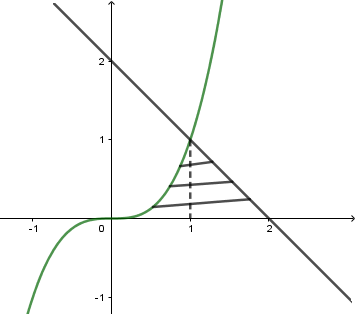
Nên diện tích hình phẳng cần tính là\[S = \mathop \smallint \limits_0^1 {x^3}dx + \mathop \smallint \limits_1^2 (2 - x)dx = \frac{1}{2} + \mathop \smallint \limits_0^1 {x^3}dx\]
Đáp án cần chọn là: C
\[S = \mathop \smallint \limits_{ - 1}^0 f(x)dx + \mathop \smallint \limits_0^1 |f(x)|dx\]
\[\mathop \smallint \limits_{ - 1}^1 \left| {f\left( x \right)} \right|dx\]
\[S = \mathop \smallint \limits_{ - 1}^1 f(x)dx\]
\[S = \left| {\mathop \smallint \limits_{ - 1}^1 f(x)dx} \right|\]
Đáp án cần chọn là: B
Trong Công viên Toán học có những mảnh đất hình dáng khác nhau. Mỗi mảnh được trồng một loài hoa và nó được tạo thành bởi một trong những đường cong đẹp nhất trong toán học. Ở đó có mảnh đất mang tên Bernoulli, nó được tạo thành từ đường Lemniscate có phương trình trong hệ tọa độ Oxy là \[16{y^2} = {x^2}(25 - {x^2})\;\]như hình vẽ bên. Tính diện tích S của mảnh đất Bernoulli biết rằng mỗi đơn vị trong hệ trục tọa độ Oxy tương ứng với chiều dài 1 mét
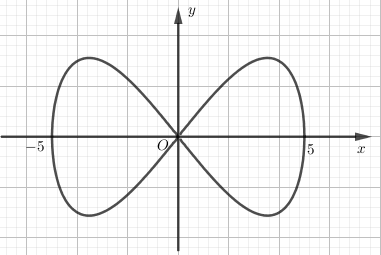
Hoành độ giao điểm của đồ thị với trục hoành là\[x = 0;x = 5;x = - 5\]
Ta thấy diện tích mảnh đất Bernoulli bao gồm diện tích 44 mảnh đất nhỏ bằng nhau.
Xét diện tích S mảnh đất nhỏ trong góc phần tư thứ nhất ta có
\[\begin{array}{*{20}{l}}{4y = x\sqrt {25 - {x^2}} ;x \in \left[ {0;5} \right]}\\{ \Rightarrow S = \frac{1}{4}\mathop \smallint \limits_0^5 x\sqrt {25 - {x^2}} d{\rm{x}} = \frac{{125}}{{12}}}\\{ \Rightarrow S = 4.\frac{{125}}{{12}} = \frac{{125}}{3}\left( {{m^2}} \right)}\end{array}\]
\[S = \frac{{125}}{6}({m^2})\]
\[S = \frac{{125}}{4}\left( {{m^2}} \right)\]
\[S = \frac{{250}}{3}\left( {{m^2}} \right)\]
\[S = \frac{{125}}{3}\left( {{m^2}} \right)\]Trả lời:
D
\[\frac{{107}}{6}\]
\[\frac{{109}}{6}\]
\[\frac{{109}}{7}\]
\[\frac{{109}}{8}\]
Ta có\[\mid {x^2} - 4x + 3\mid = 0 \Leftrightarrow \left[ {\begin{array}{*{20}{c}}{x = 1}\\{x = 3}\end{array}} \right.\]
Ta có:
\[\left| {{x^2} - 4{\rm{x}} + 3} \right| = x + 3 \Leftrightarrow {{\rm{x}}^4} - 8{{\rm{x}}^3} + 22{{\rm{x}}^2} - 24{\rm{x}} + 9 = {x^2} + 6{\rm{x}} + 9\]
\[ \Leftrightarrow {x^4} - 8{x^3} + 21{x^2} - 30x = 0 \Leftrightarrow \left[ {\begin{array}{*{20}{c}}{x = 0}\\{x = 5}\end{array}} \right.\]
Với\[0 \le x \le 5\]thì\[\left| {{x^2} - 4{\rm{x}} + 3} \right| \le x + 3\]
Có
\[\begin{array}{l}S = \int\limits_0^5 {\mid \mid x2 - 4x + 3\mid - x - 3\mid dx} \\ = \int\limits_0^1 {\left[ {x + 3 - (x2 - 4x + 3)} \right]} dx + \int\limits_1^3 {\left[ {x + 3 - ( - x2 + 4x - 3)} \right]} dx + \int\limits_3^5 {\left[ {x + 3 - (x2 - 4x + 3)} \right]} dx\end{array}\]
\( = \int\limits_0^1 {[ - x2 + 5x]dx + \int\limits_1^3 {[x2 - 3x + 6]dx + \int\limits_3^5 {[ - x2 + 5x]dx} } } \)
\( = \left( { - \frac{{{x^3}}}{3} + 5.\frac{{{x^2}}}{2}} \right)\left| {_0^1} \right. + \left( {\frac{{{x^3}}}{2} - 3.\frac{{{x^2}}}{2} + 6x} \right)\left| {_1^3} \right. + \left( { - \frac{{{x^3}}}{3} + 5.\frac{{{x^2}}}{2}} \right)\left| {_3^5} \right.\)
\( = - \frac{1}{3} + \frac{5}{4} + \frac{{27}}{2} - 3.\frac{9}{2} + 18 - \frac{1}{2} + \frac{3}{2} - 6 - \frac{{125}}{3} + \frac{{125}}{2} + \frac{{27}}{3} - \frac{{5.9}}{2} = \frac{{109}}{6}\)
Đáp án cần chọn là: B
0 .
16
4 .
8
Có\[4 - |x| = 0 \Leftrightarrow \left[ {\begin{array}{*{20}{c}}{x = 4}\\{x = - 4}\end{array}} \right.\]
Với\[ - 4 \le x \le 4\]thì\[4 - \left| x \right| \ge 0\]
Diện tích hình cần tìm là:
\(S = \int\limits_{ - 4}^4 {|4 - |x||dx = } \int\limits_{ - 4}^4 {(4 - |x|)dx = \int\limits_{ - 4}^0 {(4 + x)dx + \int\limits_0^4 {(4 - x)dx} } } \)
\( = 4x + \frac{{{x^2}}}{2}\left| {_{ - 4}^0} \right. + 4x - \frac{{{x^2}}}{2}\left| {_0^4} \right. = 0 + 16 - 8 + 16 - 8 = 16\)
Đáp án cần chọn là: B
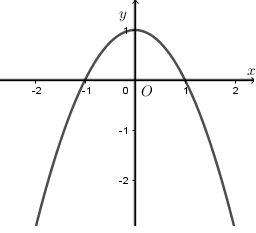
Gọi S là diện tích của Ban Công của một ngôi nhà có dạng như hình vẽ (S được giới hạn bởi parabol (P) và trục Ox). Giá trị của S là:
\[S = \frac{8}{3}\]
\[S = 1\]
\[S = \frac{4}{3}\]
\[S = 2\]
Gọi phương trình parabol:\[y = a{x^2} + bx + c(a \ne 0)\]
Parabol có đỉnh (0;1) nên\[c = 1\]và\[ - \frac{b}{{2a}} = 0\]hay b=0
Do đó\[y = a{x^2} + 1\]
Lại có các điểm (−1;0),(1;0) thuộc đồ thị hàm số nên\[a{.1^2} + 1 = 0 \Leftrightarrow a = - 1\]
Ta thấy, phương trình đường cong parabol trong hình là:\[y = - {x^2} + 1\]
\( \Rightarrow S = \int\limits_{ - 1}^1 {\mid 1 - x2\mid \mid dx = \left( {x - \frac{1}{3}{x^3}} \right)\left| {_{ - 1}^1} \right.} = \frac{4}{3}\)
Đáp án cần chọn là: C
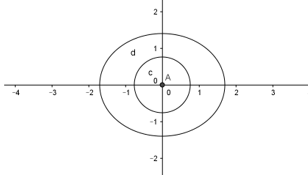
Người ta cần trồng hoa tại phần đắt nằm phía ngoài đường tròn tâm gốc tọa độ O , bán kính bằng \(\frac{1}{{\sqrt 2 }}\)và phía trong của Elip có độ dài trục lớn bằng \(2\sqrt 2 \)và độ dài trục nhỏ bằng 2 (như hình vẽ bên). Trong mỗi một đơn vị diện tích cần bón \(\frac{{100}}{{\left( {2\sqrt 2 - 1} \right)\pi }}kg\) phân hữu cơ. Hỏi cần sử dụng bao nhiêu kg phân hữu cơ để bón cho hoa?
30kg
40kg
50kg
45kg
Phương trình elip:\[\frac{{{x^2}}}{{{{(\sqrt 2 )}^2}}} + \frac{{{y^2}}}{1} = 1\]
Ta có :\[y = \sqrt {1 - \frac{{{x^2}}}{2}} \] (nửa trên của elip)
Diện tích của elip là: \[S = 4\mathop \smallint \nolimits_0^{\sqrt 2 } \sqrt {1 - \frac{{{x^2}}}{2}} dx\]
Đặt\[x = \sqrt 2 \cos a \Rightarrow 1 - \frac{{{x^2}}}{2} = {\sin ^2}a\]
Suy ra:\[dx = - \sqrt 2 \sin ada\]
Đổi cận\[x = \sqrt 2 \Rightarrow a = 0,x = 0\]thì\[a = \frac{\pi }{2}\]
\({S_1} = \int\limits_{\frac{\pi }{2}}^0 { - \sqrt 2 si{n^2}ada = } \frac{{\sqrt 2 }}{2}\int\limits_{\frac{\pi }{2}}^0 {(cos2a - 1)da} \)
\( = \frac{{\sqrt 2 }}{2}\left( {\frac{1}{2}sin2a - a} \right)\left| {_0^{\frac{\pi }{2}}} \right. = \frac{{\sqrt 2 \pi }}{4}\)
\[ \Rightarrow S = 4{S_1} = \sqrt 2 \pi \]
Diện tích hình tròn là :\[S' = \pi {R^2} = \pi .\frac{1}{2} = \frac{1}{2}\pi \]
Diện tích trồng hoa: \[{S_b} = \pi \left( {\sqrt 2 - \frac{1}{2}} \right)\]
Số kg phân bón là :\[\frac{{100}}{{\left( {2\sqrt 2 - 1} \right)\pi }}.\left( {\sqrt 2 - \frac{1}{2}} \right)\pi = 50kg\]
Đáp án cần chọn là: C
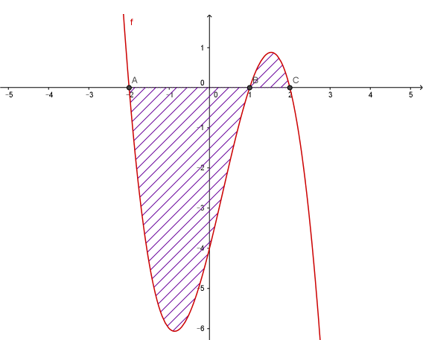
Cho đồ thị hàm số y=f(x) như hình vẽ dưới đây. Diện tích S của hình phẳng (phần gạch chéo) được xác định bởi
\[S = \mathop \smallint \nolimits_{ - 2}^2 f(x)dx\]
\[S = \mathop \smallint \nolimits_1^{ - 2} f(x)dx + \mathop \smallint \nolimits_1^2 f(x)dx\]
\[S = \mathop \smallint \nolimits_{ - 2}^1 f(x)dx + \mathop \smallint \nolimits_1^2 f(x)dx\]
\[S = \mathop \smallint \nolimits_{ - 2}^1 f(x)dx - \mathop \smallint \nolimits_1^2 f(x)dx\]
Nhận thấy phần đồ thị chia làm 2 phần, chú ý đến cận của từng phần.
Phần 1 có cận từ −2 đến 1 nhưng trong (−1;2), đồ thị hàm số nằm phía dưới trục hoành.
Phần 2 có cận từ 1 đến 2 và đồ thị hàm số nằm phía trên trục hoành.
Vậy\[S = \mathop \smallint \nolimits_{ - 2}^1 ( - f(x))dx + \mathop \smallint \nolimits_1^2 f(x)dx = \mathop \smallint \nolimits_1^{ - 2} f(x)dx + \mathop \smallint \nolimits_1^2 f(x)dx\]
Đáp án cần chọn là: B
\[\frac{{128}}{3}{m^2}\]
\[\frac{{131}}{3}{m^2}\]
\[\frac{{28}}{3}{m^2}\]
\[\frac{{26}}{3}m\]
+ Gọi phương trình parabol là: \[y = a{x^2} + bx + c\]
Nhận thấy với x=0 thì y=8 suy ra c=8.
Mặt khác (0;8) là đỉnh nên\[ - \frac{b}{{2a}} = 0 \Leftrightarrow b = 0\]
Điểm (−4;0) thuộc đồ thị hàm số nên phương trình y=0 có nghiệm
\[x = - 4 \Rightarrow a = - \frac{1}{2}\]
Vậy phương trình parabol:\[y = - \frac{{{x^2}}}{2} + 8\]
Bài toán quy về tính diện tích được tạo bởi parabol với trục Ox
Ta có:
\(S = \int\limits_{ - 4}^4 {\left| { - \frac{{{x^2}}}{2} + 8} \right|} dx = 2\int\limits_0^4 {\left( { - \frac{{{x^2}}}{2} + 8} \right)} dx\)
\( = 2.\left( { - \frac{{{x^3}}}{6} + 8x} \right)\left| {_0^4} \right. = \frac{{128}}{3}{m^2}\)
Đáp án cần chọn là: A
\[S = \frac{8}{3}\]
\[S = \frac{4}{3}\]
\[S = 4\]
\[S = \frac{{16}}{9}\]
Phương trình hoành độ giao điểm dd và (P)
Có:\[{x^2} + 1 = mx + 2 \Leftrightarrow {x^2} - mx - 1 = 0(1) \Rightarrow {\rm{\Delta }} = {m^2} + 4 > 0\]
Phương trình trên luôn có 2 nghiệm phân biệt.
Vậy dd luôn cắt (P) tại hai điểm phân biệt A,B với mọi m.
Giả sử A,B lần lượt có hoành độ là a,b nên\[A\left( {a;ma + 2} \right)\]và\[B\left( {b;mb + 2} \right)(a < b)\]
Với x thuộc\[x \in \left( {a;b} \right)\]thì \[mx + 2 \ge {x^2} + 1\]
Do đó, diện tích hình phẳng giới hạn bởi d và (P)
\(\begin{array}{l}S = \int\limits_a^b {(mx + 2 - x2 - 1)dx} \\ = \int\limits_a^b {(mx - {x^2} + 1)dx = \left( {\frac{{m{x^2}}}{2} - \frac{{{x^3}}}{3} + x} \right)} \left| {_a^b} \right.\end{array}\)
\[ = \left( {b - a} \right)\left[ {\frac{m}{2}(a + b) + 1 - \frac{1}{3}({a^2} + {b^2} + ab)} \right]\]
\[ = (b - a)\left[ {\frac{m}{2}\left( {b + a} \right) + 1 - \frac{1}{3}{{\left( {a + b} \right)}^2} + \frac{1}{3}ab} \right]\]
\[ \Rightarrow {S^2} = {(b - a)^2}{\left[ {\frac{m}{2}(b + a) + 1 - \frac{1}{3}{{(a + b)}^2} + \frac{1}{3}ab} \right]^2}\]
\[ = \left[ {{{\left( {a + b} \right)}^2} - 4ab} \right]{\left[ {\frac{m}{2}\left( {b + a} \right) + 1 - \frac{1}{3}{{\left( {a + b} \right)}^2} + \frac{1}{3}ab} \right]^2}\]
Vì a,b là nghiệm của pt (1) nên a+b=m và ab=−1
Suy ra
\[{S^2} = \left( {{m^2} + 4} \right){\left( {\frac{{{m^2}}}{6} + \frac{2}{3}} \right)^2} \ge 4.\frac{4}{9} = \frac{{16}}{9} \Rightarrow S \ge \sqrt {\frac{{16}}{9}} = \frac{4}{3}\,khi\,m = 0\]
Đáp án cần chọn là: B
Cho hàm số y=f(x) liên tục trên \(\mathbb{R}\) và có đồ thị như hình vẽ.
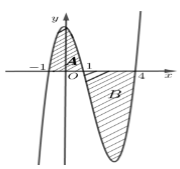
Diện tích hai phần A và B lần lượt là \(\frac{{16}}{3}\) và \(\frac{{63}}{4}\). Tính \[\mathop \smallint \limits_{ - 1}^{\frac{3}{2}} f\left( {2x + 1} \right)dx\]
\[\frac{{253}}{{12}}\]
\[\frac{{253}}{{24}}\]
\[ - \frac{{125}}{{24}}\]
\[ - \frac{{125}}{{12}}\]
Xét \[\mathop \smallint \limits_{ - 1}^{\frac{3}{2}} f\left( {2x + 1} \right)dx\] Đặt\[2x + 1 = t \Leftrightarrow 2dx = dt \Leftrightarrow dx = \frac{{dt}}{2}\]
Đổi cận:\(\left\{ {\begin{array}{*{20}{c}}{x = - 1 \Rightarrow t = - 1}\\{x = \frac{3}{2} \Rightarrow t = 4}\end{array}} \right.\)
Khi đó ta có\[\mathop \smallint \limits_{ - 1}^{\frac{3}{2}} f\left( {2x + 1} \right)dx = \frac{1}{2}\mathop \smallint \limits_{ - 1}^4 f\left( t \right)dt = \frac{1}{2}\mathop \smallint \limits_{ - 1}^4 f\left( x \right)dx\]
\[ = \frac{1}{2}\left( {\mathop \smallint \limits_{ - 1}^1 f\left( x \right)dx + \mathop \smallint \limits_1^4 f\left( x \right)dx} \right)\]
Từ hình vẽ ta có\[\mathop \smallint \limits_{ - 1}^1 f\left( x \right)dx = \frac{{16}}{3};\,\mathop \smallint \limits_1^4 f\left( x \right)dx = - \frac{{63}}{4}\]
Nên\[\mathop \smallint \limits_{ - 1}^{\frac{3}{2}} f\left( {2x + 1} \right)dx = \frac{1}{2}\left( {\mathop \smallint \limits_{ - 1}^1 f\left( x \right)dx + \mathop \smallint \limits_1^4 f\left( x \right)dx} \right) = \frac{1}{2}\left( {\frac{{16}}{3} - \frac{{63}}{4}} \right) = - \frac{{125}}{{24}}\]
Đáp án cần chọn là: C
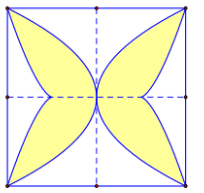
Sàn của một viện bảo tàng mỹ thuật được lát bằng những viên gạch hình vuông cạnh 40(cm) như hình bên. Biết rằng người thiết kế đã sử dụng các đường cong có phương trình \[4{x^2} = {y^4}\;\] và \[4{(|x| - 1)^3} = {y^2}\;\] để tạo hoa văn cho viên gạch. Diện tích phần được tô đậm gần nhất với giá trị nào dưới đây?
\[506\,\,\left( {c{m^2}} \right)\]
\[747\,\,\left( {c{m^2}} \right)\]
\[507\,\,\left( {c{m^2}} \right)\]
\[746\,\,\left( {c{m^2}} \right)\]
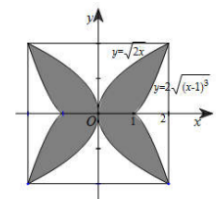
Gắn hệ trục tọa độ như hình vẽ.
Diện tích phần tô đậm là
\[S = 4\left[ {\mathop \smallint \limits_0^1 \left( {\sqrt {2x} - 0} \right)dx + \mathop \smallint \limits_1^2 \left( {\sqrt {2x} - 2\sqrt {{{\left( {x - 1} \right)}^3}} } \right)dx} \right] = \frac{{112}}{{15}}\,\,\left( {d{m^2}} \right) \approx 747\,\,\left( {c{m^2}} \right)\]
Đáp án cần chọn là: B
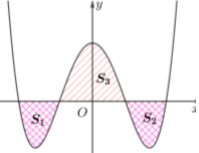
Cho hàm số \[y = {x^4} - 3{x^2} + m\] có đồ thị là (Cm) (m là tham số thực). Giả sử (Cm) cắt trục Ox tại 4 điểm phân biệt. Gọi \[{S_1},{S_2}\;\] là diện tích của hai hình phẳng nằm dưới trục Ox và S3 là diện tích của hình phẳng nằm trên trục Ox được tạo bởi (Cm) với trục Ox. Biết rằng tồn tại duy nhất giá trị \[m = \frac{a}{b}\] (với \[a,b \in {\mathbb{N}^*}\;\] và tối giản) để \[{S_1} + {S_2} = {S_3}\]. Giá trị của 2a−b bằng:
3
−4
6
−2
Xét phương trình hoành độ giao điểm:\[{x^4} - 3{x^2} + m = 0\,\,\,\left( 1 \right)\]
Đặt\[t = {x^2}\,\,\left( {t \ge 0} \right)\] khi đó phương trình (1) trở thành\[{t^2} - 3t + m = 0\,\,\,\left( 2 \right)\]
Vì đồ thị hàm số\[y = {x^4} - 3{x^2} + m\] cắt trục hoành tại 4 điểm phân biệt nên phương trình (1) có 4 nghiệm phân biệt, do đó phương trình (2) phải có 2 nghiệm dương phân biệt.
\( \Rightarrow \left\{ {\begin{array}{*{20}{c}}{\Delta > 0}\\{S > 0}\\{P > 0}\end{array}} \right. \Leftrightarrow \left\{ {\begin{array}{*{20}{c}}{9 - 4m > 0}\\{3 > 0(luon\,dung)}\\{m > 0}\end{array}} \right. \Leftrightarrow 0 < m < \frac{9}{4}\left( * \right)\)
Giả sử phương trình (2) có 2 nghiệm dương phân biệt\[0 < {t_1} < {t_2}\] áp dụng định lí Vi-ét ta có\(\left\{ {\begin{array}{*{20}{c}}{{t_1} + {t_2} = 3}\\{{t_1}{t_2} = m}\end{array}} \right.\) Khi đó phương trình (1) có 4 nghiệm phân biệt
\[ - \sqrt {{t_2}} < - \sqrt {{t_1}} < \sqrt {{t_1}} < \sqrt {{t_2}} \]
Do tính đối xứng qua trục tung của hàm đa thức bậc bốn trùng phương nên\[{S_1} = {S_2}\] do đó theo bài ra ta có \[{S_1} + {S_2} = {S_3} \Leftrightarrow 2{S_1} = {S_3}\]
Ta có:
\[{S_2} = \mathop \smallint \limits_{\sqrt {{t_1}} }^{\sqrt {{t_2}} } \left| {f\left( x \right)} \right|dx = - \mathop \smallint \limits_{\sqrt {{t_1}} }^{\sqrt {{t_2}} } f\left( x \right)dx\]
\[{S_3} = \mathop \smallint \limits_{ - \sqrt {{t_1}} }^{\sqrt {{t_1}} } \left| {f\left( x \right)} \right|dx = \mathop \smallint \limits_{ - \sqrt {{t_1}} }^{\sqrt {{t_1}} } f\left( x \right)dx = 2\mathop \smallint \limits_0^{\sqrt {{t_1}} } f\left( x \right)dx\] (do f(x) là hàm chẵn).
Ta có:
\(\begin{array}{l}2{S_2} = {S_3}\\ \Leftrightarrow - 2\int\limits_{\sqrt {{t_1}} }^{\sqrt {{t_2}} } {f(x)dx = 2\int\limits_0^{\sqrt {{t_1}} } {f(x)dx} } \\ \Leftrightarrow 2\left( {\int\limits_0^{\sqrt {{t_1}} } {f(x)dx} + \int\limits_{\sqrt {{t_1}} }^{\sqrt {{t_2}} } {f(x)dx} } \right) = 0\\ \Leftrightarrow 2\int\limits_0^{\sqrt {{t_2}} } {f(x)dx} = 0 \Leftrightarrow \int\limits_0^{\sqrt {{t_2}} } {f(x)dx = 0} \\ \Leftrightarrow \int\limits_0^{\sqrt {{t_2}} } {({x^4} - 3{x^2} + m)dx = 0} \\ \Leftrightarrow \left( {\frac{{{x^5}}}{5} - {x^3} + mx} \right)\left| {_0^{\sqrt {{t_2}} }} \right. = 0\\ \Leftrightarrow \frac{{{{\left( {\sqrt {{t_2}} } \right)}^5}}}{5} - {\left( {\sqrt {{t_2}} } \right)^3} + m\sqrt {{t_2}} = 0\\ \Leftrightarrow \sqrt {{t_2}} \left( {\frac{{{t^2}}}{5} - t + m} \right) = 0\\ \Leftrightarrow \frac{{{t_2}^2}}{5} - {t_2} + m = 0\,\,(Do\,\,{t_2} > 0)\,\\ \Leftrightarrow t_2^2 - 5{t_2} + 5m = 0( * )\end{array}\)
Mà \[{t_2}\] là nghiệm của phương trình\[{t^2} - 3t + m = 0\] nên\[t_2^2 - 3{t_2} + m = 0\] và\[{t_2} = \frac{{3 + \sqrt {9 - 4m} }}{2}\]
Do đó
\[\begin{array}{*{20}{l}}{\left( * \right) \Leftrightarrow t_2^2 - 3{t_2} + m - 2{t_2} + 4m = 0}\\{ \Leftrightarrow - 2{t_2} + 4m = 0 \Leftrightarrow {t_2} = 2m}\end{array}\]
\(\begin{array}{l} \Rightarrow \frac{{3 + \sqrt {9 - 4m} }}{2} = 2m\\ \Leftrightarrow 3 + \sqrt {9 - 4m} = 4m\\ \Leftrightarrow \sqrt {9 - 4m} = 4m - 3\\ \Leftrightarrow \left\{ {\begin{array}{*{20}{c}}{4m - 3 > 0}\\{9 - 4m = 16{m^2} - 24m + 9}\end{array}} \right.\\ \Leftrightarrow \left\{ {\begin{array}{*{20}{c}}{m > \frac{3}{4}}\\{16{m^2} - 20m = 0}\end{array}} \right.\\ \Leftrightarrow \left\{ {\begin{array}{*{20}{c}}{m > \frac{3}{4}}\\{\left[ {\begin{array}{*{20}{c}}{m = 0}\\{m = \frac{5}{4}}\end{array}} \right.}\end{array}} \right. \Leftrightarrow m = \frac{5}{4}\left( {tm*} \right)\end{array}\)
Vậy \[a = 5,\,\,b = 4 \Rightarrow 2a - b = 10 - 4 = 6.\]
Đáp án cần chọn là: C
Cho hình vuông ABCD tâm O, độ dài cạnh là 4cm. Đường cong BOC là một phần của parabol đỉnh O chia hình vuông thành hai hình phẳng có diện tích lần lượt là S1 và S2 (tham khảo hình vẽ).
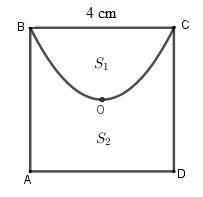
Tỉ số \(\frac{{{S_1}}}{{{S_2}}}\) bằng:
\(\frac{1}{2}\)
\[\frac{3}{5}\]
\[\frac{2}{5}\]
\[\frac{1}{3}\]
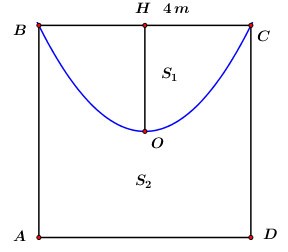
Gọi H là trung điểm của BC.
\[\begin{array}{*{20}{l}}{{S_1} = \frac{4}{3}Rh = \frac{4}{3}.HC.OH = \frac{4}{3}.2.2 = \frac{{16}}{3}\,{m^2}.}\\{{S_{ABCD}} = {4^2} = 16}\\{ \Rightarrow {S_2} = {S_{ABCD}} - {S_1} = 16 - \frac{{16}}{3} = \frac{{32}}{3}\,\,{m^2}.}\\{ \Rightarrow \frac{{{S_1}}}{{{S_2}}} = \frac{{16}}{3}:\frac{{32}}{3} = \frac{1}{2}.}\end{array}\]
Đáp án cần chọn là: A
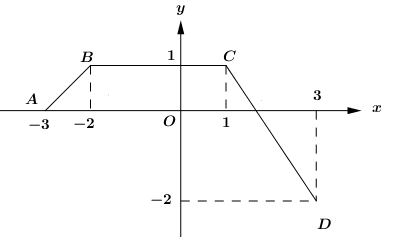
Cho hàm số f(x) có đồ thị trên đoạn \[\left[ { - 3;3} \right]\;\]là đường gấp khúc ABCD như hình vẽ.
Tính \[\mathop \smallint \limits_{ - 3}^3 f\left( x \right)dx\]
\[\frac{5}{2}\]
\[\frac{{35}}{6}\]
\[\frac{{ - 5}}{2}\]
\[\frac{{ - 35}}{6}\]
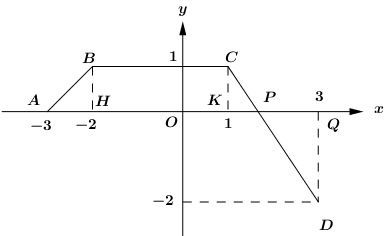
Ta có:
\[\begin{array}{*{20}{l}}{\mathop \smallint \limits_{ - 3}^3 f\left( x \right)dx = {S_{ABH}} + {S_{BCKH}} + {S_{CPK}} - {S_{DPQ}}}\\{\,\,\,\,\,\,\,\,\,\,\,\,\,\,\,\,\,\,\,\,\,\, = \frac{1}{2}.1.1 + 3.1 + \frac{1}{2}.1.\frac{2}{3} - \frac{1}{2}.\frac{4}{3}.2 = \frac{5}{2}}\end{array}\]
Đáp án cần chọn là: A
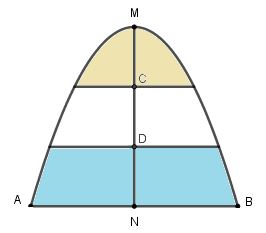
Một khung cửa kính hình parabol với đỉnh M và cạnh đáy AB như minh họa ở hình bên. Biết chi phí để lắp phần kính màu (phần tô đậm trong hình) là 200.000 đồng /m2 và phần kính trắng còn lại là 150.000 đồng /m2/m2.Cho MN=AB=4m và MC=CD=DN. Hỏi số tiền để lắp kính cho khung cửa như trên gần nhất với số tiền nào dưới đây?
1.954.000 đồng
2.123.000 đồng
1.946.000 đồng
2.145.000 đồng
Coi N là gốc tọa độ thì ta có\[M\left( {0;4} \right);A\left( { - 2;0} \right);B\left( {2;0} \right)\]
Parabol có dạng\[y = - {x^2} + 4\]
Diện tích hình phẳng giới hạn bởi parobol và trục hoành là \[S = \mathop \smallint \limits_{ - 2}^2 \left| { - {x^2} + 4} \right|dx = \frac{{32}}{3}\]
Diện tích hình phẳng giới hạn bởi parobol là đường thẳng\[y = \frac{8}{3}\]là\[{S_1} = \mathop \smallint \limits_{ - \frac{{2\sqrt 3 }}{3}}^{\frac{{2\sqrt 3 }}{3}} \left| { - {x^2} + 4 - \frac{8}{3}} \right|dx\]
Diện tích hình phẳng giới hạn bởi parobol là đường thẳng\[y = \frac{4}{3}\]là\[{S_2} = \mathop \smallint \limits_{ - \frac{{2\sqrt 6 }}{3}}^{\frac{{2\sqrt 6 }}{3}} \left| { - {x^2} + 4 - \frac{4}{3}} \right|dx\]
Khi đó số tiền để lắp kính là\[T = 200.{S_1} + 150\left( {{S_2} - {S_1}} \right) + 200\left( {\frac{{32}}{3} - {S_2}} \right) = 1.946\]
Đáp án cần chọn là: C
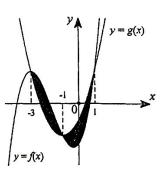
Cho hai hàm số \[f\left( x \right) = m{x^3} + n{x^2} + px - \frac{5}{2}\left( {m,n,p \in \mathbb{R}} \right)\]và\(g\left( x \right) = {x^2} + 3x - 1\) có đồ thị cắt nhau tại ba điểm có hoành độ lần lượt là −3;−1;1( tham khảo hình vẽ bên). Diện tích hình phẳng giới hạn bởi hai đồ thị hàm số f(x)và g(x) bằng
\[\frac{9}{2}\]
\[\frac{{18}}{5}\]
4
5
Đồ thị hàm số\[f\left( x \right) = m{x^3} + n{x^2} + px - \frac{5}{2}\]đi qua các điểm có tọa độ\[\left( {1;2} \right);\left( { - 1; - 2} \right);\left( { - 3;2} \right)\]nên ta có hệ phương trình:
\(\left\{ {\begin{array}{*{20}{c}}{m + n + p - \frac{5}{2} = 2}\\{ - m + n - p - \frac{5}{2} = - 2}\\{ - 27m + 9n - 3p - \frac{5}{2} = 2}\end{array}} \right. \Leftrightarrow \left\{ {\begin{array}{*{20}{c}}{m = \frac{1}{2}}\\{n = \frac{5}{2}}\\{p = \frac{3}{2}}\end{array}} \right.\)
\[ \Rightarrow f\left( x \right) = \frac{1}{2}{x^3} + \frac{5}{2}{x^2} + \frac{3}{2}x - \frac{5}{2}.\]
Xét phương trình haonfh độ giao điểm\[f\left( x \right) = g\left( x \right) \Leftrightarrow f\left( x \right) - g\left( x \right) = 0\]
Dựa vào đồ thị ta thấy phương trình\[f\left( x \right) - g\left( x \right) = 0\]có 3 nghiệm là\(\left[ {\begin{array}{*{20}{c}}{{x_1} = - 3}\\{{x_2} = - 1}\\{{x_3} = 1}\end{array}} \right.\)
Do đó diện tích hình phẳng giới hạn bởi hai đồ thị hàm số\[f\left( x \right);g\left( x \right)\]bằng
\[S = \int\limits_{ - 3}^{ - 1} {[f(x) - g(x)]dx + \int\limits_{ - 1}^1 {[g(x) - f(x)]dx} } \]
\( = \int\limits_{ - 3}^{ - 1} {\left( {\frac{1}{2}{x^3} + \frac{5}{2}{x^2} + \frac{3}{2}x - \frac{5}{2} - {x^2} - 2x + 1} \right)dx + \int\limits_{ - 1}^1 {\left( {{x^2} + 2x - 1 - \frac{1}{2}{x^3} - \frac{5}{2}{x^2} - \frac{3}{2}x + \frac{5}{2}} \right)} } dx\)
\( = \int\limits_{ - 3}^{ - 1} {\left( {\frac{1}{2}{x^3} + \frac{3}{2}{x^2} - \frac{1}{2}x - \frac{3}{2}} \right)} dx + \int\limits_{ - 1}^1 {\left( { - \frac{1}{2}{x^3} - \frac{3}{2}{x^2} + \frac{1}{2}x + \frac{3}{2}} \right)} dx\)
\( = 2 + 2 = 4\)
Đáp án cần chọn là: C
2ln3.
ln3.
ln18.
2ln2.
* Xét phương trình hoành độ giao điểm:
\[\frac{{f\left( x \right)}}{{g\left( x \right) + 6}} = 1 \Leftrightarrow f\left( x \right) = g\left( x \right) + 6 \Leftrightarrow f\left( x \right) - g\left( x \right) - 6 = 0\]
(Chúng ta không cần lo điều kiện\[g\left( x \right) + 6 \ne 0\] bởi lẽ đồ thị hàm số \[y = \frac{{f\left( x \right)}}{{g\left( x \right) + 6}}\] khi tương giao với đường thẳng\[y = 1\] phải tạo nên một miền kín, và khi số nghiệm của phương trình\[f\left( x \right) = g\left( x \right) + 6\] nhiều hơn 2 thì ta mới phải chú ý xem xét lấy cận từ đâu đến đâu, và liệu rằng có phải từ\[{x_{\min }} \to {x_{\max }}\] chẳng may đồ thị tương giao bị gián đoạn trên đoạn\[\left[ {{x_{\min }};{x_{\max }}} \right]\] mà vẫn tạo miền kín. Trên thực tế, bài toán này phương trình\[f\left( x \right) = g\left( x \right) + 6\] chỉ có 2 nghiệm (vì là phương trình bậc hai), nên người giải toán không cần quan tâm đến việc gián đoạn hay không, vì việc tồn tại nghiệm hình và hàm số là thuộc phạm trù người ra đề).
Mà\[g\left( x \right) = f\left( x \right) + f'\left( x \right) + f''\left( x \right) \Rightarrow f\left( x \right) - g\left( x \right) = - f'\left( x \right) - f''\left( x \right)\]
⇒⇒ Phương trình hoành độ giao điểm trở thành:
\[ - f'\left( x \right) - f''\left( x \right) - 6 = 0 \Leftrightarrow f'\left( x \right) + f''\left( x \right) + 6 = 0\](1)
Mặt khác:\[g'\left( x \right) = f'\left( x \right) + f''\left( x \right) + f'''\left( x \right)\] và\[f'''\left( x \right) = 6\]
\[ \Rightarrow g'\left( x \right) = f'\left( x \right) + f''\left( x \right) + 6\]
Từ phương trình (1)\[ \Leftrightarrow g'\left( x \right) = 0\]
Theo giả thiết g(x) có 2 điểm cực trị\[{x_1},\,\,{x_2}\] sao cho\(\left\{ {\begin{array}{*{20}{c}}{g({x_1}) = - 3}\\{g({x_2}) = 6}\end{array}} \right. \Rightarrow g'\left( x \right) = 0\) có 2 nghiệm\[{x_1},\,\,{x_2}\]
Vậy phương trình hoành độ giao điểm có 2 nghiệm\[{x_1},\,\,{x_2}\]
\[ \Rightarrow {S_{\left( H \right)}} = \left| {\int\limits_{{x_1}}^{{x_2}} {\left( {\frac{{f(x)}}{{g(x) + 6}} - 1} \right)dx} } \right|\]
\[\begin{array}{l} = \left| {\int\limits_{{x_1}}^{{x_2}} {\frac{{f(x) - g(x) - 6}}{{g(x) + 6}}dx} } \right|\\ = \left| {\int\limits_{{x_1}}^{{x_2}} {\frac{{ - f\prime (x) - f\prime \prime (x) - 6}}{{g(x) + 6}}dx} } \right|\\ = \left| {\int\limits_{{x_1}}^{{x_2}} {\frac{{ - g\prime (x)}}{{g(x) + 6}}dx} } \right|\end{array}\]
\[ = \left| {\int\limits_{{x_1}}^{{x_2}} {\frac{{g\prime (x)}}{{g(x) + 6}}dx} } \right|\]
\[ = \left| {\int\limits_{{x_1}}^{{x_2}} {\frac{{d(g(x) + 6)}}{{g(x) + 6}}dx} } \right|\]
\[\begin{array}{l} = \mid ln|g(x) + 6||_{{x_1}}^{{x_2}}\mid \\ = |ln|g({x_2}) + 6| - ln|g({x_1}) + 6||\\ = |ln|6 + 6| - ln| - 3 + 6|| = ln12 - ln3 = 2ln2\end{array}\]
Đáp án cần chọn là: D
Bạn có thích hoạt động này không?
Hãy lưu hoặc chia sẻ nội dung này đến mọi người.
Gợi ý cho bạn

Ý tưởng của bạn, bài học của bạn
Tự thiết kế đề thi, bài giảng hoặc flashcard theo cách riêng.





Học liệu phổ biến Đánh giá năng lực
Đánh giá năng lực
Bài tập vừa sức, đúng lớp
Chọn nội dung phù hợp và tạo hoạt động cho lớp của bạn.






Học liệu phổ biến ĐHQG Hà Nội
ĐHQG Hà Nội
Thêm cảm hứng cho môn học
Biến kiến thức quen thuộc thành hoạt động học tập thú vị.