Trắc nghiệm Tiếng Anh 8 Global Success Unit 5 Kĩ năng đọc đục lỗ (có đáp án)
20 câu hỏi
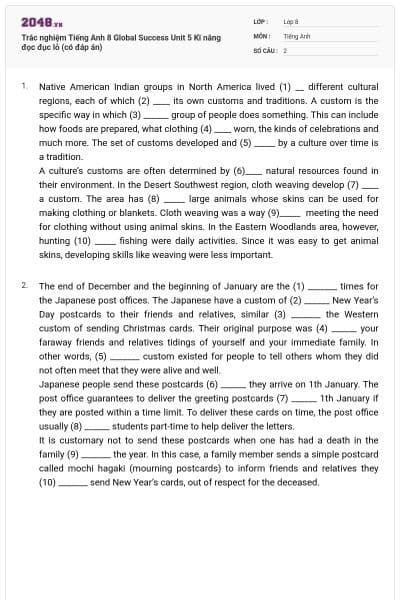
Native American Indian groups in North America lived (1) __ different cultural regions, each of which (2) ____ its own customs and traditions. A custom is the specific way in which (3) ______ group of people does something. This can include how foods are prepared, what clothing (4) ____ worn, the kinds of celebrations and much more. The set of customs developed and (5) _____ by a culture over time is a tradition.
A culture’s customs are often determined by (6)____ natural resources found in their environment. In the Desert Southwest region, cloth weaving develop (7) ____ a custom. The area has (8) _____ large animals whose skins can be used for making clothing or blankets. Cloth weaving was a way (9)_____ meeting the need for clothing without using animal skins. In the Eastern Woodlands area, however, hunting (10) _____ fishing were daily activities. Since it was easy to get animal skins, developing skills like weaving were less important.
Fill in each numbered blank with one suitable word or phrase.
Native American Indian groups in North America lived (1) __ different cultural regions,
in
at
on
of
In: Trong
At: Tại
On: Trên
Of: Của
- in + địa điểm (VD: in the area: trong khu vực, in New York: ở New York.)
=> Native American Indian groups in North America lived in different cultural regions
Tạm dịch: Các nhóm thổ dân da đỏ ở Bắc Mỹ sống ở các vùng văn hóa khác nhau
Đáp án cần chọn là: a
Fill in each numbered blank with one suitable word or phrase.
Native American Indian groups in North America lived in different cultural regions, each of which (2) ____ its own customs and traditions.
develops
decreased
developed
decreases
Develop: Phát triển, xây dựng
Theo sự tương ứng về thì, ta nhận thấy vế trước động từ chia ở thì quá khứ => vế sau cũng chia ở quá khứ => loại A và D (động từ chia ở hiện tại)
Develop: Phát triển, xây dựng
Decrease: Giảm bớt
Dựa vào ngữ nghĩa của câu, ta chọn C
=> Native American Indian groups in North America lived in different cultural regions, each of which developed its own customs and traditions.
Tạm dịch: Các nhóm thổ dân da đỏ bản địa ở Bắc Mỹ sống ở các vùng văn hóa khác nhau, mỗi nhóm phát triển các phong tục và truyền thống riêng.
Đáp án cần chọn là: c
Fill in each numbered blank with one suitable word or phrase.
A custom is the specific way in which (3) ______ group of people does something.
the
an
a
all
Danh từ group (nhóm) chưa xác định => không dùng “the” (loại A)
Danh từ group bắt đầu bằng “g” là một phụ âm => không đi cùng mạo từ “an” => loại B
Sau all (tất cả) là danh từ số nhiều, group là danh từ số ít => loại D
=> A custom is the specific way in which a group of people does something.
Tạm dịch: Một phong tục là cách cụ thể trong đó một nhóm người làm một cái gì đó.
Đáp án cần chọn là: c
Fill in each numbered blank with one suitable word or phrase.
This can include how foods are prepared, what clothing (4) ____ worn, the kinds of celebrations and much more.
are
is
was
were
Dựa theo sự tương ứng về thì, ta nhận thấy vế câu đầu được chia ở thì hiện tại đơn => vế sau cũng chia ở hiện tại => loại C và D (động từ tobe trong quá khứ)
Clothing (trang phục) là danh từ không đếm được => đi với động từ tobe “is” trong hiện tại đơn
=> This can include how foods are prepared, what clothing is worn, the kinds of celebrations and much more.
Tạm dịch: Điều này có thể bao gồm cách thức ăn được chuẩn bị, quần áo được mặc, các loại lễ kỷ niệm và nhiều hơn nữa.
Đáp án cần chọn là: b
Fill in each numbered blank with one suitable word or phrase.
The set of customs developed and (5) _____ by a culture over time is a tradition.
to share
sharing
share
shared
2 động từ nối với nhau bằng and nên phải đồng dạng với nhau.
Cấu trúc mệnh đề quan hệ rút gọn: N which be Vp2 => rút gọn thành: N+ Vp2
=> động từ share phải chia ở dạng Vp2 giống động từ "developed" phía trước
=> The set of customs developed and shared by a culture over time is a tradition.
Tạm dịch: Tập hợp các phong tục được phát triển và chia sẻ bởi một nền văn hóa theo thời gian là một truyền thống.
Đáp án cần chọn là: d
Fill in each numbered blank with one suitable word or phrase.
A culture’s customs are often determined by (6)____ natural resources found in their environment.
x
an
a
the
Ta thấy natural resources (tài nguyên thiên nhiên) ở dạng số nhiều => loại B và C (mạo từ an và a dùng với danh từ số ít)
Dựa vào ngữ nghĩa của câu, những tài nguyên này đều xác định => dùng mạo từ “the”)
=> A culture’s customs are often determined by the natural resources found in their environment.
Tạm dịch: Một phong tục tập quán văn hóa thường được xác định bởi các tài nguyên thiên nhiên được tìm thấy trong môi trường của họ.
Đáp án cần chọn là: d
Fill in each numbered blank with one suitable word or phrase.
In the Desert Southwest region, cloth weaving develop (7) ____ a custom.
as
for
by
in
As: Như
For: Cho
By: Bởi
In: Trong
=> In the Desert Southwest region, cloth weaving develop as a custom.
Tạm dịch: Ở vùng sa mạc Tây Nam, dệt vải phát triển như một phong tục.
Đáp án cần chọn là: a
Fill in each numbered blank with one suitable word or phrase.
The area has (8) _____ large animals whose skins can be used for making clothing or blankets.
fewer
less
most
least
Ta thấy không có từ “the” đứng trước hình thức so sánh => không phải so sánh nhất => loại C (most, nhiều nhất) và D (least, ít nhất)
Animals (động vật) là danh từ đếm được => trong so sánh hơn ta dùng fewer (ít hơn)
=> The area has fewer large animals whose skins can be used for making clothing or blankets.
Tạm dịch: Khu vực này có ít động vật lớn mà da của chúng có thể được sử dụng để làm quần áo hoặc chăn.
Đáp án cần chọn là: a
Fill in each numbered blank with one suitable word or phrase.
Cloth weaving was a way (9)_____ meeting the need for clothing without using animal skins.
by
of
to
as
Cụm từ: a way of st (một cách để làm gì)
=> Cloth weaving was a way of meeting the need for clothing without using animal skins.
Tạm dịch: Dệt vải là một cách đáp ứng nhu cầu về quần áo mà không cần sử dụng da động vật.
Đáp án cần chọn là: b
Fill in each numbered blank with one suitable word or phrase.
In the Eastern Woodlands area, however, hunting (10) _____ fishing were daily activities. Since it was easy to get animal skins, developing skills like weaving were less important.
but
either
and
so
But: nhưng
Either: cũng không
And: và
So: vì vậy
Chỗ cần điền là một từ nối dùng để thêm một danh từ trong chuỗi liệt kê => ta cần phải thêm “and” (và)
=> In the Eastern Woodlands area, however, hunting and fishing were daily activities. Since it was easy to get animal skins, developing skills like weaving were less important.
Tạm dịch: Tuy nhiên, tại khu vực rừng phía Đông , săn bắn và câu cá là hoạt động hàng ngày. Vì việc có được da động vật khá dễ dàng, việc phát triển các kỹ năng như dệt trở nên ít quan trọng hơn.
Tạm dịch bài:
Các nhóm thổ dân da đỏ bản địa ở Bắc Mỹ sống ở các vùng văn hóa khác nhau, mỗi nhóm phát triển các phong tục và truyền thống riêng. Một phong tục là cách cụ thể trong đó một nhóm người làm một cái gì đó. Điều này có thể bao gồm cách chuẩn bị thức ăn, cách ăn mặc, những lễ kỷ niệm và những vấn đề khác. Những phong tục được phát triển và chia sẻ bởi một nền văn hóa theo thời gian được coi là một truyền thống.
Mỗi phong tục tập quán văn hóa thường được xác định bởi các tài nguyên thiên nhiên được tìm thấy trong môi trường của họ. Ở vùng sa mạc Tây Nam, việc dệt vải phát triển như một phong tục. Khu vực này có ít động vật lớn mà da của chúng có thể được sử dụng để làm quần áo hoặc chăn. Dệt vải là một cách đáp ứng nhu cầu về quần áo mà không cần sử dụng da động vật. Tuy nhiên, tại những khu vực rừng ở phía Đông, săn bắn và câu cá là hoạt động hàng ngày. Ở đây có thể dễ dàng có được da động vật, do đó việc phát triển các kỹ năng như dệt ít quan trọng hơn.
Đáp án cần chọn là: c
The end of December and the beginning of January are the (1) _______ times for the Japanese post offices. The Japanese have a custom of (2) ______ New Year’s Day postcards to their friends and relatives, similar (3) _______ the Western custom of sending Christmas cards. Their original purpose was (4) ______ your faraway friends and relatives tidings of yourself and your immediate family. In other words, (5) _______ custom existed for people to tell others whom they did not often meet that they were alive and well.
Japanese people send these postcards (6) ______ they arrive on 1th January. The post office guarantees to deliver the greeting postcards (7) ______ 1th January if they are posted within a time limit. To deliver these cards on time, the post office usually (8) ______ students part-time to help deliver the letters.
It is customary not to send these postcards when one has had a death in the family (9) _______ the year. In this case, a family member sends a simple postcard called mochi hagaki (mourning postcards) to inform friends and relatives they (10) _______ send New Year’s cards, out of respect for the deceased.
Fill in each numbered blank with one suitable word or phrase.
The end of December and the beginning of January are the (1) _______ times for the Japanese post offices.
busiest
busier
most busy
more busy
Xuất hiện “the” => Cấu trúc so sánh hơn nhất: the+adj+N
“busy” (bận) là tính từ có 2 âm tiết kết thúc là “y” => hình thức so sánh hơn nhất: busiest
=> The end of December and the beginning of January are the busiest times for the Japanese post offices.
Tạm dịch: Cuối tháng 12 và đầu tháng 1 là thời điểm bận rộn nhất đối với các bưu điện Nhật Bản.
Đáp án cần chọn là: a
Fill in each numbered blank with one suitable word or phrase.
The Japanese have a custom of (2) ______ New Year’s Day postcards to their friends and relatives,
send
sending
to send
sent
Sau giới từ, động từ dạng V_ing, cụm từ: a custom of+V_ing (phong tục làm gì)
=> The Japanese have a custom of sending New Year’s Day postcards to their friends and relatives,
Tạm dịch: Người Nhật có phong tục gửi bưu thiếp ngày tết cho bạn bè và người thân của họ,
Đáp án cần chọn là: b
Fill in each numbered blank with one suitable word or phrase.
The Japanese have a custom of sending New Year’s Day postcards to their friends and relatives, similar (3) _______ the Western custom of sending Christmas cards.
as
with
for
to
Cụm từ: similar to (tương tự với)
=> The Japanese have a custom of sending New Year’s Day postcards to their friends and relatives, similar (3) to the Western custom of sending Christmas cards.
Tạm dịch: Người Nhật có phong tục gửi bưu thiếp ngày tết cho bạn bè và người thân của họ, tương tự với phong tục gửi thiệp Giáng sinh của phương Tây.
Đáp án cần chọn là: d
Fill in each numbered blank with one suitable word or phrase.
Their original purpose was (4) ______ your faraway friends and relatives tidings of yourself and your immediate family.
of giving
gives
to give
for giving
Cấu trúc: The puspose be + To + V_infi (mục đích để làm gì)
=> Their original purpose was to give your faraway friends and relatives tidings of yourself and your immediate family.
Tạm dịch: Mục đích ban đầu của họ là để mang bạn bè và người thân ở xa của bạn và gia đình trực tiếp của bạn.
Đáp án cần chọn là: c
Fill in each numbered blank with one suitable word or phrase.
In other words, (5) _______ custom existed for people to tell others whom they did not often meet that they were alive and well.
these
a
its
this
- this + N số ít
- these + N số nhiều
Phong tục này đã được nêu đến từ trước, cả người viết và người đọc đều đã biết => dùng this
=> In other words, this custom existed for people to tell others whom they did not often meet that they were alive and well.
Tạm dịch: Nói cách khác, phong tục này tồn tại để mọi người nói với những người khác mà họ không thường gặp rằng họ còn sống và khỏe mạnh.
Đáp án cần chọn là: d
Fill in each numbered blank with one suitable word or phrase.
Japanese people send these postcards (6) ______ they arrive on 1th January.
for
so
so that
to
Loại “to” vì to không dùng để nối các mệnh đề
Loại “for” và “so” vì đây không phải câu ghép (không có dấu phẩy ngăn cách đằng trước)
=> Japanese people send these postcards so that they arrive on 1th January.
Tạm dịch: Người Nhật gửi những tấm bưu thiếp này để chúng đến vào ngày đầu tiên của tháng 1.
Đáp án cần chọn là: c
Fill in each numbered blank with one suitable word or phrase.
The post office guarantees to deliver the greeting postcards (7) ______ 1th January if they are posted within a time limit.
in
on
at
for
In+tháng/năm/các buổi trong ngày
On+ ngày/tháng đi với ngày
At+giờ
For+khoảng thời gian
=> The post office guarantees to deliver the greeting postcards on 1th January if they are posted within a time limit.
Tạm dịch: Bưu điện đảm bảo gửi bưu thiếp chúc mừng vào ngày 1 tháng 1 nếu chúng được đăng trong một thời gian giới hạn.
Đáp án cần chọn là: b
Fill in each numbered blank with one suitable word or phrase.
To deliver these cards on time, the post office usually (8) ______ students part-time to help deliver the letters.
hires
hire
to hire
hiring
“usually” là dấu hiệu nhận biết thì hiện tại đơn => bỏ C và D
Chủ ngữ là danh từ số ít (the post office, bưu điện) => động từ phải thêm –s/es => chọn A
=> To deliver these cards on time, the post office usually hires students part-time to help deliver the letters.
Tạm dịch: Để giao những thẻ này đúng hạn, bưu điện thường thuê sinh viên bán thời gian để giúp chuyển thư.
Đáp án cần chọn là: a
Fill in each numbered blank with one suitable word or phrase.
It is customary not to send these postcards when one has had a death in the family (9) _______ the year.
during
since
for
from
During: Trong suốt khoảng thời gian ...
Since: Từ khi (dùng trong thì hiện tại hoàn thành)
For: Cho (thường dùng trong thì hiện tại hoàn thành)
From: Từ
=> It is customary not to send these postcards when one has had a death in the family during the year.
Tạm dịch: Theo thông lệ, không gửi những tấm bưu thiếp này khi một người đã chết trong gia đình trong năm.
Đáp án cần chọn là: a
Fill in each numbered blank with one suitable word or phrase.
In this case, a family member sends a simple postcard called mochi hagaki (mourning postcards) to inform friends and relatives they (10) _______ send New Year’s cards, out of respect for the deceased.
have to
should
should not
must
Have to: phải làm gì (tác động bên ngoài)
Should: nên
Should not: không nên
Must: phải làm gì (tự mình thấy vậy)
Ở đây chúng ta điền “Should not” vì ở câu trên tác giả đã nói không nên gửi thiệp cho gia đình có người mất trong năm
=> In this case, a family member sends a simple postcard called mochi hagaki (mourning postcards) to inform friends and relatives they should not send New Year’s cards, out of respect for the deceased.
Tạm dịch: Trong trường hợp này, một thành viên trong gia đình gửi một tấm bưu thiếp đơn giản gọi là mochi hagaki (bưu thiếp để tang) để thông báo cho bạn bè và người thân rằng họ không nên gửi thiệp mừng năm mới, để tôn trọng người quá cố.
Xem Bài Dịch
Cuối tháng 12 và đầu tháng 1 là thời điểm bận rộn nhất đối với các bưu điện Nhật Bản. Người Nhật có phong tục gửi bưu thiếp ngày tết cho bạn bè và người thân của họ, tương tự như phong tục gửi thiệp Giáng sinh của phương Tây. Mục đích ban đầu của họ là để liên lạc cho bạn bè và người thân ở xa của bạn và gia đình. Nói cách khác, phong tục này tồn tại để mọi người nói với những người khác mà họ không thường gặp rằng họ còn sống và khỏe mạnh.
Người Nhật gửi những tấm bưu thiếp này để chúng đến vào ngày 1 tháng 1. Bưu điện đảm bảo gửi bưu thiếp chúc mừng vào ngày 1 tháng 1 nếu chúng được đăng trong một thời gian giới hạn. Để giao những thẻ này đúng hạn, bưu điện thường thuê sinh viên bán thời gian để giúp chuyển thư.
Theo thông lệ, không gửi những tấm bưu thiếp này khi một người đã chết trong gia đình trong năm. Trong trường hợp này, một thành viên trong gia đình gửi một tấm bưu thiếp đơn giản gọi là mochi hagaki (bưu thiếp để tang) để thông báo cho bạn bè và người thân rằng họ nên gửi thiệp mừng năm mới, để tôn trọng người quá cố.
Đáp án cần chọn là: c