Trắc nghiệm Tiếng Anh 8 Global Success Unit 4 Writing (có đáp án)
20 câu hỏi
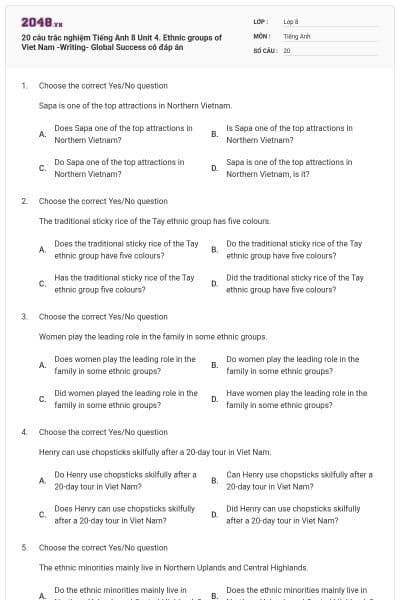
Choose the correct Yes/No question
Sapa is one of the top attractions in Northern Vietnam.
Does Sapa one of the top attractions in Northern Vietnam?
Is Sapa one of the top attractions in Northern Vietnam?
Do Sapa one of the top attractions in Northern Vietnam?
Sapa is one of the top attractions in Northern Vietnam, is it?
Đáp án đúng: B
Giải thích:
Đây là câu khẳng định với động từ “is”, nên đảo “is” lên đầu để tạo câu hỏi Yes/No.
Dịch nghĩa: Sapa có phải là một trong những điểm thu hút hàng đầu ở miền Bắc Việt Nam không?
Choose the correct Yes/No question
The traditional sticky rice of the Tay ethnic group has five colours.
Does the traditional sticky rice of the Tay ethnic group have five colours?
Do the traditional sticky rice of the Tay ethnic group have five colours?
Has the traditional sticky rice of the Tay ethnic group five colours?
Did the traditional sticky rice of the Tay ethnic group have five colours?
Đáp án đúng: A
Giải thích:
Chủ ngữ là danh từ số ít "rice" → dùng “Does” + V1 để đặt câu hỏi.
"Has" → động từ thường, phải dùng trợ động từ "Does".
Dịch nghĩa: Xôi truyền thống của người Tày có năm màu phải không?
Choose the correct Yes/No question
Women play the leading role in the family in some ethnic groups.
Does women play the leading role in the family in some ethnic groups?
Do women play the leading role in the family in some ethnic groups?
Did women played the leading role in the family in some ethnic groups?
Have women play the leading role in the family in some ethnic groups?
Đáp án đúng: B
Giải thích:
Chủ ngữ là “women” (số nhiều) → dùng “Do”.
Động từ “play” là nguyên thể sau “do”.
Dịch nghĩa: Phụ nữ có đóng vai trò chính trong gia đình ở một số dân tộc không?
Choose the correct Yes/No question
Henry can use chopsticks skilfully after a 20-day tour in Viet Nam.
Do Henry use chopsticks skilfully after a 20-day tour in Viet Nam?
Can Henry use chopsticks skilfully after a 20-day tour in Viet Nam?
Does Henry can use chopsticks skilfully after a 20-day tour in Viet Nam?
Did Henry can use chopsticks skilfully after a 20-day tour in Viet Nam?
Đáp án đúng: B
Giải thích:
Động từ khuyết thiếu “can” → chỉ cần đảo “can” lên đầu câu là đủ, không cần dùng “does” hay “did”.
Dịch nghĩa: Henry có thể sử dụng đũa thành thạo sau chuyến đi 20 ngày ở Việt Nam phải không?
Choose the correct Yes/No question
The ethnic minorities mainly live in Northern Uplands and Central Highlands.
Do the ethnic minorities mainly live in Northern Uplands and Central Highlands?
Does the ethnic minorities mainly live in Northern Uplands and Central Highlands?
Did the ethnic minorities mainly live in Northern Uplands and Central Highlands?
Are the ethnic minorities mainly live in Northern Uplands and Central Highlands?
Đáp án đúng: A
Giải thích:
Chủ ngữ là số nhiều → dùng “Do” + V1.
Dịch nghĩa: Các dân tộc thiểu số chủ yếu sống ở miền núi phía Bắc và Tây Nguyên đúng không?
Choose the correct Yes/No question
I didn’t attend the Ban Flower Festival in Dien Bien when I travelled there.
Did I attend the Ban Flower Festival in Dien Bien when I travelled there?
Didn’t you attend the Ban Flower Festival in Dien Bien when you travelled there?
Do I attend the Ban Flower Festival in Dien Bien when I travelled there?
Was I attend the Ban Flower Festival in Dien Bien when I travelled there?
Đáp án đúng: B
Giải thích:
Câu gốc ở thì quá khứ đơn, phủ định → ta có thể đảo lại thành câu nghi vấn dạng rút gọn phủ định: Didn’t + S + V?
“Did I attend” cũng đúng về ngữ pháp nhưng sai ngôi – câu hỏi cần đổi thành “you” nếu hỏi người khác.
Dịch nghĩa: Bạn đã không tham dự Lễ hội hoa Ban ở Điện Biên khi bạn đến đó à?
Choose the correct Yes/No question
The local people will teach tourists to play gong and bamboo flute.
Did the local people teach tourists to play gong and bamboo flute?
Do the local people teach tourists to play gong and bamboo flute?
Will the local people teach tourists to play gong and bamboo flute?
Have the local people teach tourists to play gong and bamboo flute?
Đáp án đúng: C
Giải thích:
Câu gốc ở thì tương lai đơn → đặt câu hỏi bằng cách đảo will lên đầu câu.
Dịch nghĩa: Người dân địa phương sẽ dạy du khách chơi cồng chiêng và sáo trúc phải không?
Choose the correct Yes/No question
They bought lots of handmade items when they visited the local market.
Do they buy lots of handmade items when they visit the local market?
Did they buy lots of handmade items when they visited the local market?
Were they bought lots of handmade items when they visited the local market?
Have they buy lots of handmade items when they visited the local market?
Đáp án đúng: B
Giải thích:
Câu gốc là thì quá khứ đơn → đặt câu hỏi bằng Did + S + V1.
Dịch nghĩa: Họ đã mua nhiều đồ thủ công khi họ đến chợ địa phương phải không?
Choose the correct Yes/No question
We’re going to harvest the rice on the paddy fields with other villagers.
Are we go to harvest the rice on the paddy fields with other villagers?
Are we going to harvest the rice on the paddy fields with other villagers?
Do we going to harvest the rice on the paddy fields with other villagers?
Were we going to harvest the rice on the paddy fields with other villagers?
Đáp án đúng: B
Giải thích:
“Be going to + V” → khi đặt câu hỏi, ta đảo “be” (are) lên đầu.
Dịch nghĩa: Chúng ta sẽ đi gặt lúa trên ruộng cùng với các dân làng khác phải không?
Choose the correct Yes/No question
There were a lot of stilt houses in ethnic minority villages in the past.
Was there a lot of stilt houses in ethnic minority villages in the past?
Did there are a lot of stilt houses in ethnic minority villages in the past?
Were there a lot of stilt houses in ethnic minority villages in the past?
Are there a lot of stilt houses in ethnic minority villages in the past?
Đáp án đúng: C
Giải thích:
Câu bắt đầu bằng “There were” → đặt câu hỏi đảo “were” lên đầu.
Các câu còn lại sai trợ động từ / tobe hoặc sai thì.
Dịch nghĩa: Ngày xưa có nhiều nhà sàn trong các làng dân tộc thiểu số phải không?
Choose the correct Wh-question
The Khmer have three main festivals in a year. (how many)
How many festivals do the Khmer have in a year?
How many main festivals do the Khmer have in a year?
How many festivals does the Khmer have in a year?
How many festivals are the Khmer have in a year?
Đáp án đúng: B
Giải thích:
“How many + danh từ số nhiều + do/does + S + V?” là cấu trúc đúng.
Đáp án C sai chủ ngữ "the Khmer" (danh từ số nhiều → dùng do, không dùng does).
D sai ngữ pháp vì kết hợp “are” và “have”.
Dịch nghĩa: Người Khmer có bao nhiêu lễ hội chính trong một năm?
Choose the correct Yes/No question
The boys played Tinh instrument.
Are the boys playing Tinh instrument?
Were the boys play Tinh instrument?
Do the boys played Tinh instrument?
Did the boys play Tinh instrument?
Đáp án đúng: D
Giải thích:
Câu ở thì quá khứ đơn (played) → câu hỏi dùng Did + S + V.
Dịch nghĩa: Các cậu bé có chơi nhạc cụ Tính không?
Choose the correct Yes/No question
We watched the Ban Flower Festival in Dien Bien 2 years ago.
Did we watch the Ban Flower Festival in Dien Bien 2 years ago?
Have we watched the Ban Flower Festival in Dien Bien 2 years ago?
Did you watch the Ban Flower Festival in Dien Bien 2 years ago?
Were we watch the Ban Flower Festival in Dien Bien 2 years ago?
Đáp án đúng: C
Giải thích:
Cần đổi ngôi “we” → “you” để đặt câu hỏi cho người đối thoại.
Thì quá khứ đơn → dùng "Did + S + V".
Dịch nghĩa: Bạn có xem lễ hội hoa ban ở Điện Biên 2 năm trước không?
Choose the correct Yes/No question
They will practice a folk dance of the Thai people.
Do they practice a folk dance of the Thai people?
Will they practice a folk dance of the Thai people?
Did they practice a folk dance of the Thai people?
Are they practice a folk dance of the Thai people?
Đáp án đúng: B
Giải thích:
Câu ở thì tương lai đơn → dùng "Will + S + V" khi đặt câu hỏi.
Dịch nghĩa: Họ có sẽ tập một điệu múa dân gian của người Thái không?
Choose the correct Yes/No question
English plays an important part in our society nowadays.
Is English play an important part in our society nowadays?
Does English played an important part nowadays?
Does English play an important part in our society nowadays?
Do English play an important part in our society nowadays?
Đáp án đúng: C
Giải thích:
Câu ở hiện tại đơn, chủ ngữ là "English" (số ít) → dùng "Does + S + V".
Dịch nghĩa: Tiếng Anh có đóng vai trò quan trọng trong xã hội ngày nay không?
Choose the correct Yes/No question
They are doing the homework at the moment.
Are they doing the homework at the moment?
Are they doing the homework at the moment?
Do they doing the homework at the moment?
They are doing the homework at the moment?
Đáp án đúng: C
Giải thích:
Câu ở hiện tại tiếp diễn → dùng Are + S + V-ing.
Dịch nghĩa: Họ có đang làm bài tập vào lúc này không?
Choose the correct Yes/No question
He eats five-colour sticky rice.
Is he eat five-colour sticky rice?
Did he eat five-colour sticky rice?
Does he eat five-colour sticky rice?
Do he eat five-colour sticky rice?
Đáp án đúng: C
Giải thích:
Câu ở thì hiện tại đơn, chủ ngữ là he → dùng "Does + S + V".
Dịch nghĩa: Anh ấy có ăn xôi ngũ sắc không?
Choose the correct Yes/No question
She often goes to boarding school.
Do she often go to boarding school?
Does she often go to boarding school?
Did she often goes to boarding school?
Is she often goes to boarding school?
Đáp án đúng: B
Giải thích:
"She" là ngôi thứ ba số ít → dùng "Does + S + V" trong thì hiện tại đơn.
Dịch nghĩa: Cô ấy có thường học nội trú không?
Choose the correct Yes/No question
They had the meeting in the communal house.
Do they have the meeting in the communal house?
Have they the meeting in the communal house?
Did they have the meeting in the communal house?
Are they have the meeting in the communal house?
Đáp án đúng: C
Giải thích:
Câu ở thì quá khứ đơn (had) → dùng "Did + S + V".
Dịch nghĩa: Họ có tổ chức cuộc họp trong nhà cộng đồng không?
Choose the correct Yes/No question
The ethnic minorities in Vietnam often live in mountainous areas.
Are the ethnic minorities in Vietnam often live in mountainous areas?
Do the ethnic minorities in Vietnam often lives in mountainous areas?
Do the ethnic minorities in Vietnam often live in mountainous areas?
Does the ethnic minorities in Vietnam often live in mountainous areas?
Đáp án đúng: C
Giải thích:
Câu gốc ở thì hiện tại đơn với chủ ngữ số nhiều ("the ethnic minorities") → dùng "Do + S + V".
Động từ phải ở dạng nguyên mẫu "live" vì đã có trợ động từ "do".
Dịch nghĩa: Các dân tộc thiểu số ở Việt Nam có thường sống ở vùng núi không?