Trắc nghiệm Tiếng Anh 8 Global Success Unit 4 Reading (có đáp án)
20 câu hỏi
Read the text carefully then answer the following questions.
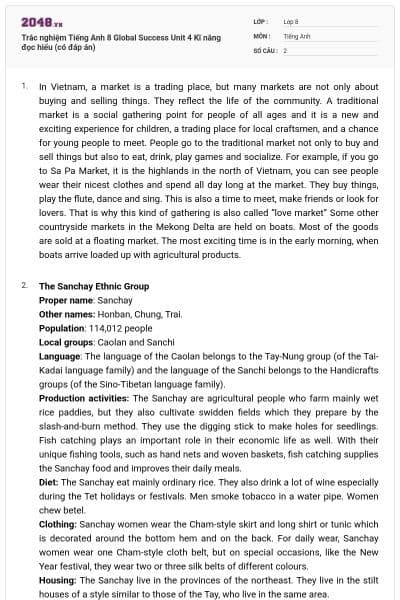
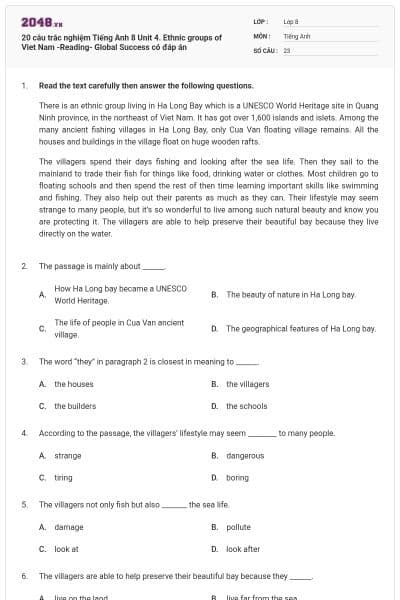
There is an ethnic group living in Ha Long Bay which is a UNESCO World Heritage site in Quang Ninh province, in the northeast of Viet Nam. It has got over 1,600 islands and islets. Among the many ancient fishing villages in Ha Long Bay, only Cua Van floating village remains. All the houses and buildings in the village float on huge wooden rafts.
The villagers spend their days fishing and looking after the sea life. Then they sail to the mainland to trade their fish for things like food, drinking water or clothes. Most children go to floating schools and then spend the rest of then time learning important skills like swimming and fishing. They also help out their parents as much as they can. Their lifestyle may seem strange to many people, but it’s so wonderful to live among such natural beauty and know you are protecting it. The villagers are able to help preserve their beautiful bay because they live directly on the water.
The passage is mainly about ______.
How Ha Long bay became a UNESCO World Heritage.
The beauty of nature in Ha Long bay.
The life of people in Cua Van ancient village.
The geographical features of Ha Long bay.
Đáp án đúng: C
Giải thích:
Đoạn văn tập trung miêu tả cuộc sống của người dân làng Cửa Vạn, cách họ sinh sống, học tập và bảo vệ môi trường – nên đáp án đúng là C.
The word “they” in paragraph 2 is closest in meaning to ______.
the houses
the villagers
the builders
the schools
Đáp án đúng: B
Giải thích:
Dựa vào câu: “Then they sail to the mainland to trade…”, từ “they” thay thế cho the villagers – tức người dân làng chài.
According to the passage, the villagers’ lifestyle may seem ________ to many people.
strange
dangerous
tiring
boring
Đáp án đúng: A
Giải thích:
Dựa vào câu: Their lifestyle may seem strange to many people, but it’s so wonderful to live among such natural beauty and know you are protecting it. (Lối sống của họ có thể có vẻ kỳ lạ với nhiều người, nhưng thật tuyệt vời khi được sống giữa vẻ đẹp thiên nhiên như vậy và biết rằng bạn đang bảo vệ nó.)
The villagers not only fish but also _______ the sea life.
damage
pollute
look at
look after
Đáp án đúng: D
Giải thích:
Dựa vào câu: The villagers spend their days fishing and looking after the sea life. (Dân làng dành cả ngày để đánh cá và chăm sóc sinh vật biển)
The villagers are able to help preserve their beautiful bay because they ______.
live on the land
live far from the sea
don’t live on the water
live directly on the water
Đáp án đúng: D
Giải thích:
Dựa vào câu: The villagers are able to help preserve their beautiful bay because they live directly on the water. (Người dân làng có thể giúp bảo tồn vịnh xinh đẹp của họ vì họ sống trực tiếp trên mặt nước.)
According to the passage, which statement is NOT true?
Ha Long bay has above 1,600 islands and islets.
Because of floating life, children in Cua Van floating village don’t go to school.
The children try to help their parents.
The villagers have preserved their beautiful bay.
Đáp án đúng: B
Giải thích:
Dựa vào câu: Most children go to floating schools and then spend the rest of then time learning important skills like swimming and fishing. (Hầu hết trẻ em đến trường nổi và dành phần thời gian còn lại để học các kỹ năng quan trọng như bơi lội và câu cá.)
Dịch bài đọc:
Có một dân tộc sinh sống ở Vịnh Hạ Long, một di sản thế giới được UNESCO công nhận, thuộc tỉnh Quảng Ninh, phía đông bắc Việt Nam. Vịnh Hạ Long có hơn 1.600 hòn đảo lớn nhỏ. Trong số rất nhiều làng chài cổ xưa ở Vịnh Hạ Long, chỉ còn lại làng chài Cửa Vạn. Tất cả nhà cửa và công trình kiến trúc trong làng đều nổi trên những chiếc bè gỗ khổng lồ. Dân làng dành cả ngày để đánh bắt cá và chăm sóc sinh vật biển. Sau đó, họ đi thuyền vào đất liền để đổi cá lấy những thứ như thức ăn, nước uống hoặc quần áo. Hầu hết trẻ em đều đến trường học nổi và sau đó dành thời gian còn lại để học các kỹ năng quan trọng như bơi lội và câu cá. Các em cũng giúp đỡ cha mẹ hết sức có thể. Lối sống của họ có thể có vẻ kỳ lạ với nhiều người, nhưng thật tuyệt vời khi được sống giữa vẻ đẹp thiên nhiên như vậy và biết rằng mình đang bảo vệ nó. Người dân làng có thể góp phần bảo tồn vịnh biển xinh đẹp của họ vì họ sống trực tiếp trên mặt nước.
Read the text carefully then answer the following questions.
Mount Everest is the highest mountain in the world. It is also the highest trash pile in the world. About 400 people try to reach the top every year. This many climbers means a lot of trash. It is very dangerous to climb Mt. Everest. The air is very thin and cold. Most people carry oxygen bottles; they could die without it. When the oxygen bottles are empty, people throw them on the ground. When strong winds rip their tents, people leave them behind. They don’t have enough energy to go down the mountain safely. Trash is a terrible problem. Since people first began to climb Mt. Everest, they have left 50,000kilos of trash on the mountain. Several groups have climbed the mountain just to pick up the trash. When people plan to climb the mountain, they have to plan to take away their trash.
What is the main topic of the passage?
Wind on the mountain
A problem with trash
A dangerous mountain
Climbing safely
Đáp án đúng: B
Giải thích:
Đoạn văn nói về vấn đề rác thải trên núi Everest – lượng rác rất lớn và khó xử lý.
Where do climbers put their empty oxygen bottles?
On the ground
In trash can
On their back
In their tent
Đáp án đúng: A
Giải thích:
Dựa vào câu: When the oxygen bottles are empty, people throw them on the ground. (Khi bình oxy hết, mọi người ném chúng xuống đất.)
The climbers didn’t leave anything on the mountain, but one is NOT TRUE.
Special groups will pick the rubbish up.
They will recycle the rubbish there.
They don’t have the energy to take the rubbish away.
Other climbers will use the rubbish later.
Đáp án đúng: B
Giải thích:
Không có câu nào trong bài nói rằng rác sẽ được tái chế trên núi → B sai. Các ý khác đều đúng hoặc được nhắc tới trong bài.
Why do climbers on Mt. Everest carry bottles of oxygen?
The weather is cold.
Climbing makes them tired.
The air is very thin.
They are thirsty.
Đáp án đúng: C
Giải thích:
Dựa vào câu: The air is very thin and cold. Most people carry oxygen bottles; they could die without it. (Không khí rất loãng và lạnh. Hầu hết mọi người đều mang theo bình oxy; họ có thể chết nếu không có nó.)
In line 5, “people leave them behind,” what does the word “them” refer to?
Tents
Oxygen bottles
Strong winds
Other climbers
Đáp án đúng: C
Giải thích:
Dựa vào câu: When strong winds rip their tents, people leave them behind. (Khi gió mạnh xé toạc lều trại, mọi người bỏ lại chúng phía sau)
How much trash have climbers left on Mount Everest so far?
5,000 kilos
500 kilos
50,000 kilos
15,000 kilos
Đáp án đúng: C
Giải thích:
Dựa vào câu: Since people first began to climb Mt. Everest, they have left 50,000 kilos of trash on the mountain. (Kể từ khi con người bắt đầu leo núi Everest, họ đã để lại 50.000 kg rác trên ngọn núi này.)
Dịch bài đọc:
Núi Everest là ngọn núi cao nhất thế giới. Nó cũng là đống rác cao nhất thế giới. Khoảng 400 người cố gắng lên đến đỉnh mỗi năm. Nhiều người leo núi như vậy đồng nghĩa với việc có rất nhiều rác thải. Leo núi Everest rất nguy hiểm. Không khí rất loãng và lạnh. Hầu hết mọi người đều mang theo bình oxy; họ có thể chết nếu không có nó. Khi bình oxy hết, mọi người ném chúng xuống đất. Khi gió mạnh xé toạc lều, mọi người bỏ lại chúng. Họ không có đủ năng lượng để xuống núi an toàn. Rác thải là một vấn đề khủng khiếp. Kể từ khi mọi người bắt đầu leo núi Everest, họ đã để lại 50.000kg rác trên núi. Một số nhóm đã leo lên núi chỉ để nhặt rác. Khi mọi người có kế hoạch leo núi, họ phải có kế hoạch mang rác đi.
Read the text carefully then decide whether the following statements are true (T) or false (F).
The Muong are among the ethnic minority groups that have big populations in Vietnam. The Muong share an estimate of 1.3 million people from their six sub-groups, such as Mol, Mual, Moi, Moi Bi, Au Ta and Ao Ta. They are largely concentrated in the provinces of Hoa Binh and Thanh Hoa particularly in mountainous districts. Their language belongs to the Viet-Muong group and they hold many ceremonies year round.
The Muong have practiced farming for a long time and wet rice is their main food staple. Most of their family’s other income is generated through the exploitation of forest products including mushrooms, dried fungus, ammonium, and sticklac. The men are known for basketry as women are skilled in silk spinning and loom weaving.
The Muong have diverse folk arts including folk songs and poems, sorcerer’s worshiping songs, tales, proverbs, lullabies, and riddle songs. The gong is the most popular musical instrument along with the flute, the two-string violin, the drum, and the panpipe.
The Muong is one of the largest ethnic minorities in Vietnam.
True
False
Đáp án đúng: A
Giải thích:
Dựa vào câu: The Muong are among the ethnic minority groups that have big populations in Vietnam (Người Mường là một trong những nhóm dân tộc thiểu số có dân số đông ở Việt Nam)
The Muong are also called Mol, Mual, Moi, Moi Bi, Au Ta and Ao Ta.
True
False
Đáp án đúng: B
Giải thích:
Mol, Mual, Moi, Moi Bi, Au Ta và Ao Ta là các nhóm nhỏ (sub-groups) của người Mường, không phải là tên gọi khác của người Mường.
The Muong don’t have their own language, so they speak Vietnamese.
True
False
Đáp án đúng: B
Giải thích:
Dựa vào câu: Their language belongs to the Viet-Muong group (Ngôn ngữ của họ thuộc nhóm Việt-Mường)
The Muong live mainly on forest products, such as mushrooms and dried fungus.
True
False
Đáp án đúng: B
Giải thích:
Dựa vào câu: Wet rice is their main food staple. (Lúa nước là lương thực chính của họ.)
Muong women are very good at making baskets and loom weaving.
True
False
Đáp án đúng: B
Giải thích:
Dựa vào câu: The men are known for basketry as women are skilled in silk spinning and loom weaving (Đàn ông nổi tiếng với nghề đan lát còn phụ nữ thì khéo léo trong việc kéo sợi tơ tằm và dệt khung cửi)
The Muong have a rich treasure of folk arts.
True
False
Đáp án đúng: A
Giải thích:
Dựa vào câu: The Muong have diverse folk arts including folk songs and poems, sorcerer’s worshiping songs, tales, proverbs, lullabies, and riddle songs. (Người Mường có nhiều loại hình nghệ thuật dân gian đa dạng, bao gồm các bài hát, bài thơ dân gian, bài hát cúng phù thủy, truyện cổ tích, tục ngữ, hát ru và hát đố.)
The Muong use several musical instruments, but the gong is the most popular.
True
False
Đáp án đúng: A
Giải thích:
Dựa vào câu: The gong is the most popular musical instrument along with the flute, the two-string violin, the drum, and the panpipe. (Cồng là nhạc cụ phổ biến nhất cùng với sáo, đàn vĩ cầm hai dây, trống và sáo panpipe.)
The Muong men are good at silk spinning and weaving.
True
False
Đáp án đúng: B
Giải thích:
Dựa vào câu: The men are known for basketry as women are skilled in silk spinning and loom weaving (Đàn ông nổi tiếng với nghề đan lát còn phụ nữ thì khéo léo trong việc kéo sợi tơ tằm và dệt khung cửi)
Dịch bài đọc:
Người Mường là một trong những dân tộc thiểu số có dân số đông ở Việt Nam. Ước tính có khoảng 1,3 triệu người Mường thuộc sáu nhóm dân tộc thiểu số, bao gồm Mol, Mual, Moi, Moi Bi, Au Ta và Ao Ta. Họ tập trung chủ yếu ở các tỉnh Hòa Bình và Thanh Hóa, đặc biệt là ở các huyện miền núi. Ngôn ngữ của họ thuộc nhóm Việt-Mường và họ tổ chức nhiều lễ hội quanh năm.
Người Mường đã làm nghề nông từ lâu đời và lúa nước là lương thực chính của họ. Phần lớn thu nhập khác của gia đình họ đến từ việc khai thác các sản phẩm rừng bao gồm nấm, mộc nhĩ khô, amoni và sticklac. Đàn ông nổi tiếng với nghề đan lát, còn phụ nữ thì khéo léo kéo sợi tơ tằm và dệt khung cửi.
Người Mường có nhiều loại hình nghệ thuật dân gian đa dạng, bao gồm dân ca và thơ ca, các bài hát thờ cúng thầy mo, truyện cổ tích, tục ngữ, hát ru và hát đố. Cồng chiêng là nhạc cụ phổ biến nhất cùng với sáo, đàn violin hai dây, trống và khèn.