III. Reading
Đề thi
III. Reading
A
Admin
Tiếng AnhLớp 841 lượt thi
15 câu hỏi
1.Trắc nghiệm
• 1 điểm

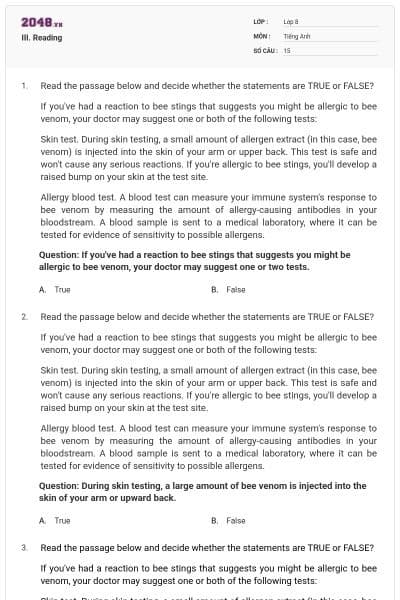
Read the passage below and decide whether the statements are TRUE or FALSE?

If you've had a reaction to bee stings that suggests you might be allergic to bee venom, your doctor may suggest one or both of the following tests:

Skin test. During skin testing, a small amount of allergen extract (in this case, bee venom) is injected into the skin of your arm or upper back. This test is safe and won't cause any serious reactions. If you're allergic to bee stings, you'll develop a raised bump on your skin at the test site.

Allergy blood test. A blood test can measure your immune system's response to bee venom by measuring the amount of allergy-causing antibodies in your bloodstream. A blood sample is sent to a medical laboratory, where it can be tested for evidence of sensitivity to possible allergens.

Question: If you've had a reaction to bee stings that suggests you might be allergic to bee venom, your doctor may suggest one or two tests.

True

False

Xem đáp án

Đáp án: A

Giải thích: Dựa vào câu: “If you've had a reaction to bee stings that suggests you might be allergic to bee venom, your doctor may suggest one or both of the following tests”.

Dịch: Nếu bạn có phản ứng với vết ong đốt mà có dấu hiệu bị kích ứng, bác sĩ có thể sẽ khuyên bạn làm 1 hoặc cả 2 xét nghiệm sau.

2.Trắc nghiệm
• 1 điểm

Read the passage below and decide whether the statements are TRUE or FALSE?

If you've had a reaction to bee stings that suggests you might be allergic to bee venom, your doctor may suggest one or both of the following tests:

Skin test. During skin testing, a small amount of allergen extract (in this case, bee venom) is injected into the skin of your arm or upper back. This test is safe and won't cause any serious reactions. If you're allergic to bee stings, you'll develop a raised bump on your skin at the test site.

Allergy blood test. A blood test can measure your immune system's response to bee venom by measuring the amount of allergy-causing antibodies in your bloodstream. A blood sample is sent to a medical laboratory, where it can be tested for evidence of sensitivity to possible allergens.

Question: During skin testing, a large amount of bee venom is injected into the skin of your arm or upward back.

True

False

Xem đáp án

Đáp án: B

Giải thích: Dựa vào câu: “During skin testing, a small amount of allergen extract (in this case, bee venom) is injected into the skin of your arm or upper back.”.

Dịch: Trong xét nghiệm da, một lượng nhỏ phần dị ứng (ở đây là nọc ong) được trích vào da tay hoặc lưng trên.

3.Trắc nghiệm
• 1 điểm

Read the passage below and decide whether the statements are TRUE or FALSE?

If you've had a reaction to bee stings that suggests you might be allergic to bee venom, your doctor may suggest one or both of the following tests:

Skin test. During skin testing, a small amount of allergen extract (in this case, bee venom) is injected into the skin of your arm or upper back. This test is safe and won't cause any serious reactions. If you're allergic to bee stings, you'll develop a raised bump on your skin at the test site.

Allergy blood test. A blood test can measure your immune system's response to bee venom by measuring the amount of allergy-causing antibodies in your bloodstream. A blood sample is sent to a medical laboratory, where it can be tested for evidence of sensitivity to possible allergens.

Question: Skin test is safe and won't cause any serious reactions.

True

False

Xem đáp án

Đáp án: A

Giải thích: Dựa vào câu: “This test is safe and won't cause any serious reactions”.

Dịch: Xét nghiệm này an toàn và sẽ không gây phản ứng gì nghiêm trọng.

4.Trắc nghiệm
• 1 điểm

Read the passage below and decide whether the statements are TRUE or FALSE?

If you've had a reaction to bee stings that suggests you might be allergic to bee venom, your doctor may suggest one or both of the following tests:

Skin test. During skin testing, a small amount of allergen extract (in this case, bee venom) is injected into the skin of your arm or upper back. This test is safe and won't cause any serious reactions. If you're allergic to bee stings, you'll develop a raised bump on your skin at the test site.

Allergy blood test. A blood test can measure your immune system's response to bee venom by measuring the amount of allergy-causing antibodies in your bloodstream. A blood sample is sent to a medical laboratory, where it can be tested for evidence of sensitivity to possible allergens.

Question: If you're allergic to bee stings, you'll develop a raised bump on your skin at the test site

True

False

Xem đáp án

Đáp án: A

Giải thích: Dựa vào câu: “If you're allergic to bee stings, you'll develop a raised bump on your skin at the test site.”.

Dịch: Nếu bạn dị ứng với vết ong đốt, bạn sẽ mọc mụn ở chỗ kiểm tra.

5.Trắc nghiệm
• 1 điểm

Read the passage below and decide whether the statements are TRUE or FALSE?

If you've had a reaction to bee stings that suggests you might be allergic to bee venom, your doctor may suggest one or both of the following tests:

Skin test. During skin testing, a small amount of allergen extract (in this case, bee venom) is injected into the skin of your arm or upper back. This test is safe and won't cause any serious reactions. If you're allergic to bee stings, you'll develop a raised bump on your skin at the test site.

Allergy blood test. A blood test can measure your immune system's response to bee venom by measuring the amount of allergy-causing antibodies in your bloodstream. A blood sample is sent to a medical laboratory, where it can be tested for evidence of sensitivity to possible allergens.

Question: A blood sample is sent to a physical laboratory.

True

False

Xem đáp án

Đáp án: B

Giải thích: Dựa vào câu: “A blood sample is sent to a medical laboratory, where it can be tested for evidence of sensitivity to possible allergens.”.

Dịch: Một mẫu máu sẽ được gửi đến phòng thí nghiệm y khoa, nơi nó được kiểm định nếu có kích ứng với các tác nhân gây dị ứng.

6.Trắc nghiệm
• 1 điểm

Choose the letter A, B, C or D to complete the passage below

The first step in ___________ (6) a major burn is to call 115 or seek emergency medical care. Steps to take until emergency arrives include:

1. ___________ (7) sure you and the person who’s burned are safe and out of harm’s way. Move them away from the source of the burn. If it’s an electrical burn, turn off the power source before touching them.

2. Check to see if they’re breathing. If needed, start rescue breathing if you’ve been trained.

3. Remove restrictive items ___________ (8) their body, such as belts and jewelry in or near the burned areas. Burned areas typically swell quickly.

4. Cover the burned area. Use a clean cloth or bandage that’s moistened with cool, clean water.

5. Separate fingers and toes. If hands and feet are burned, separate the fingers and toes with dry and sterile, non-adhesive bandages.

6. Remove clothing from burned areas, but don’t try to remove clothing that’s stuck to the skin.

7. Avoid immersing the person or burned body parts in water. Hypothermia (severe loss of body heat) can occur ___________ (9) you immerse large, severe burns in water.

8. Raise the burned area. If possible, elevate the burned area above their heart.

9. Watch for shock. Signs and symptoms of shock include shallow breathing, pale complexion, ___________ (10) fainting.

Question 6:

treat

treating

treatment

treated

Xem đáp án

Đáp án: B

Giải thích: giới từ in + Ving

Dịch: Bước đầu trong việc chữa bỏng là gọi 115 hoặc tìm trung tâm cấp cứu khẩn cấp.

7.Trắc nghiệm
• 1 điểm

Choose the letter A, B, C or D to complete the passage below

The first step in ___________ (6) a major burn is to call 115 or seek emergency medical care. Steps to take until emergency arrives include:

1. ___________ (7) sure you and the person who’s burned are safe and out of harm’s way. Move them away from the source of the burn. If it’s an electrical burn, turn off the power source before touching them.

2. Check to see if they’re breathing. If needed, start rescue breathing if you’ve been trained.

3. Remove restrictive items ___________ (8) their body, such as belts and jewelry in or near the burned areas. Burned areas typically swell quickly.

4. Cover the burned area. Use a clean cloth or bandage that’s moistened with cool, clean water.

5. Separate fingers and toes. If hands and feet are burned, separate the fingers and toes with dry and sterile, non-adhesive bandages.

6. Remove clothing from burned areas, but don’t try to remove clothing that’s stuck to the skin.

7. Avoid immersing the person or burned body parts in water. Hypothermia (severe loss of body heat) can occur ___________ (9) you immerse large, severe burns in water.

8. Raise the burned area. If possible, elevate the burned area above their heart.

9. Watch for shock. Signs and symptoms of shock include shallow breathing, pale complexion, ___________ (10) fainting.

Question 7:

Make

Do

Have

Get

Xem đáp án

Đáp án: A

Giải thích: cụm từ make sure: đảm bảo

Dịch: Đảm bảo là bạn và người bị bỏng an toàn, tránh khỏi noiw nguy hiểm.

2048.vn

Học thông minh hơn mỗi ngày

Xem toàn bộ 15 câu hỏi và nhiều hơn nữa với tài khoản miễn phí

Tạo đề thi
Tổ chức kiểm tra
Báo cáo chấm điểm tự động
Bạn đã có tài khoản?
8.Trắc nghiệm
• 1 điểm

Choose the letter A, B, C or D to complete the passage below

The first step in ___________ (6) a major burn is to call 115 or seek emergency medical care. Steps to take until emergency arrives include:

1. ___________ (7) sure you and the person who’s burned are safe and out of harm’s way. Move them away from the source of the burn. If it’s an electrical burn, turn off the power source before touching them.

2. Check to see if they’re breathing. If needed, start rescue breathing if you’ve been trained.

3. Remove restrictive items ___________ (8) their body, such as belts and jewelry in or near the burned areas. Burned areas typically swell quickly.

4. Cover the burned area. Use a clean cloth or bandage that’s moistened with cool, clean water.

5. Separate fingers and toes. If hands and feet are burned, separate the fingers and toes with dry and sterile, non-adhesive bandages.

6. Remove clothing from burned areas, but don’t try to remove clothing that’s stuck to the skin.

7. Avoid immersing the person or burned body parts in water. Hypothermia (severe loss of body heat) can occur ___________ (9) you immerse large, severe burns in water.

8. Raise the burned area. If possible, elevate the burned area above their heart.

9. Watch for shock. Signs and symptoms of shock include shallow breathing, pale complexion, ___________ (10) fainting.

Question 8:

to

in

of

from

Xem đáp án

Đáp án: D

Giải thích: cụm từ remove … from…: loại bỏ cái gì khỏi…

Dịch: Loại bỏ các vật thể cản trở khỏi cơ thể người bị bỏng như dây thắc lưng, trang sức, ở hoặc gần nơi bị bỏng.

9.Trắc nghiệm
• 1 điểm

Choose the letter A, B, C or D to complete the passage below

The first step in ___________ (6) a major burn is to call 115 or seek emergency medical care. Steps to take until emergency arrives include:

1. ___________ (7) sure you and the person who’s burned are safe and out of harm’s way. Move them away from the source of the burn. If it’s an electrical burn, turn off the power source before touching them.

2. Check to see if they’re breathing. If needed, start rescue breathing if you’ve been trained.

3. Remove restrictive items ___________ (8) their body, such as belts and jewelry in or near the burned areas. Burned areas typically swell quickly.

4. Cover the burned area. Use a clean cloth or bandage that’s moistened with cool, clean water.

5. Separate fingers and toes. If hands and feet are burned, separate the fingers and toes with dry and sterile, non-adhesive bandages.

6. Remove clothing from burned areas, but don’t try to remove clothing that’s stuck to the skin.

7. Avoid immersing the person or burned body parts in water. Hypothermia (severe loss of body heat) can occur ___________ (9) you immerse large, severe burns in water.

8. Raise the burned area. If possible, elevate the burned area above their heart.

9. Watch for shock. Signs and symptoms of shock include shallow breathing, pale complexion, ___________ (10) fainting.

Question 9:

if

unless

in case

as soon as

Xem đáp án

Đáp án: A

Giải thích: if: nếu

Dịch: Mất thân nhiệt có thể xảy ra nếu bạn để vết bỏng lớn và sâu vào nước.

10.Trắc nghiệm
• 1 điểm

Choose the letter A, B, C or D to complete the passage below

The first step in ___________ (6) a major burn is to call 115 or seek emergency medical care. Steps to take until emergency arrives include:

1. ___________ (7) sure you and the person who’s burned are safe and out of harm’s way. Move them away from the source of the burn. If it’s an electrical burn, turn off the power source before touching them.

2. Check to see if they’re breathing. If needed, start rescue breathing if you’ve been trained.

3. Remove restrictive items ___________ (8) their body, such as belts and jewelry in or near the burned areas. Burned areas typically swell quickly.

4. Cover the burned area. Use a clean cloth or bandage that’s moistened with cool, clean water.

5. Separate fingers and toes. If hands and feet are burned, separate the fingers and toes with dry and sterile, non-adhesive bandages.

6. Remove clothing from burned areas, but don’t try to remove clothing that’s stuck to the skin.

7. Avoid immersing the person or burned body parts in water. Hypothermia (severe loss of body heat) can occur ___________ (9) you immerse large, severe burns in water.

8. Raise the burned area. If possible, elevate the burned area above their heart.

9. Watch for shock. Signs and symptoms of shock include shallow breathing, pale complexion, ___________ (10) fainting.

Question 10:

but

so

and

for

Xem đáp án

Đáp án: C

Giải thích: and: và

Dịch: Dấu hiệu và triệu chứng của sốc bao gồm thở gấp, xa xanh xao, và ngất.

11.Trắc nghiệm
• 1 điểm

Choose the letter A, B, C or D to answer these following questions

Miss. Lam is a teacher. She is tall and thin. Her face is oval. Her hair is long and black. She has big and brown eyes. Her nose is small. Her lips are red and full. She is beautiful. And she is a good teacher, too. Every day, she often leaves home for school at 6:30. She enjoys her lunch at the school canteen. In the afternoon, she sometimes goes to the theater with some close friends of hers. After school, she comes back home at 5:00 pm

Question: What does Miss Lam do?

Pupil

Teacher

Engineer

Nurse

Xem đáp án

Đáp án: B

Giải thích: Dựa vào câu: “Miss Lam is a teacher”.

Dịch: Cô Lâm là một cô giáo.

12.Trắc nghiệm
• 1 điểm

Choose the letter A, B, C or D to answer these following questions

Miss. Lam is a teacher. She is tall and thin. Her face is oval. Her hair is long and black. She has big and brown eyes. Her nose is small. Her lips are red and full. She is beautiful. And she is a good teacher, too. Every day, she often leaves home for school at 6:30. She enjoys her lunch at the school canteen. In the afternoon, she sometimes goes to the theater with some close friends of hers. After school, she comes back home at 5:00 pm

Question: What does her face look like?

Her face is small.

Her face is oval.

Her face is oval.

Her face is big

Xem đáp án

Đáp án: C

Giải thích: Dựa vào câu: “Her face is oval”.

Dịch: Cô ấy có khuôn mặt trái xoan.

13.Trắc nghiệm
• 1 điểm

Choose the letter A, B, C or D to answer these following questions

Miss. Lam is a teacher. She is tall and thin. Her face is oval. Her hair is long and black. She has big and brown eyes. Her nose is small. Her lips are red and full. She is beautiful. And she is a good teacher, too. Every day, she often leaves home for school at 6:30. She enjoys her lunch at the school canteen. In the afternoon, she sometimes goes to the theater with some close friends of hers. After school, she comes back home at 5:00 pm

Question: What time does she often go to school?

At six fifteen

At half past six

At a quarter to six

At six forty

Xem đáp án

Đáp án: B

Giải thích: Dựa vào câu: “Every day, she often leaves home for school at 6:30”.

Dịch: Hằng ngày, cô ấy thường rời nhà tới trường vào lúc 6:30

14.Trắc nghiệm
• 1 điểm

Choose the letter A, B, C or D to answer these following questions

Miss. Lam is a teacher. She is tall and thin. Her face is oval. Her hair is long and black. She has big and brown eyes. Her nose is small. Her lips are red and full. She is beautiful. And she is a good teacher, too. Every day, she often leaves home for school at 6:30. She enjoys her lunch at the school canteen. In the afternoon, she sometimes goes to the theater with some close friends of hers. After school, she comes back home at 5:00 pm

Question: Who does she go to the theater with?

Her parents

Her parents

Her boyfriend

Her close friends

Xem đáp án

Đáp án: D

Giải thích: Dựa vào câu: “In the afternoon, she sometimes goes to the theater with some close friends of hers”.

Dịch: Vào buổi chiều, cô ấy đôi khi đi xem phim cùng với một vài người bạn thân.

15.Trắc nghiệm
• 1 điểm

Choose the letter A, B, C or D to answer these following questions

Miss. Lam is a teacher. She is tall and thin. Her face is oval. Her hair is long and black. She has big and brown eyes. Her nose is small. Her lips are red and full. She is beautiful. And she is a good teacher, too. Every day, she often leaves home for school at 6:30. She enjoys her lunch at the school canteen. In the afternoon, she sometimes goes to the theater with some close friends of hers. After school, she comes back home at 5:00 pm

Question: What does she do after school?

She joins some yoga classes.

She visits her parents.

She comes back home.

She prepares for next lessons at school.

Xem đáp án

Đáp án: C

Giải thích: Dựa vào câu: “She comes back home at 5:00 pm”.

Dịch: Cô ấy quay về nhà lúc 5:00.

Bạn có thích hoạt động này không?

Ý kiến của bạn sẽ giúp chúng tôi đề xuất nội dung phù hợp hơn.
Bắt đầu ngay
Khám phá các nguồn tài nguyên miễn phí, phù hợp với tiêu chuẩn trong vài giây

Gợi ý cho bạn

Xem tất cả

Học liệu phổ biến Lớp 8

Xem tất cả

Học liệu phổ biến Tiếng Anh

Xem tất cả