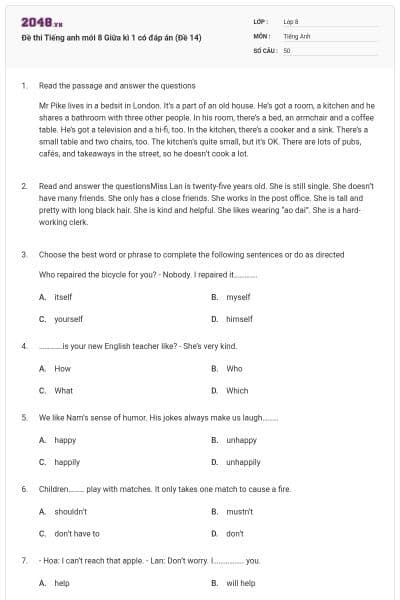
48 câu hỏi
itself
myself
yourself
himself
Đáp án B
Giải thích: đại từ phản thân của “I” là “myself”
Dịch: Ai đã sửa xe đạp cho bạn? - Không ai. Tôi đã tự sửa chữa nó.
How
Who
What
Which
Đáp án C
Giải thích: Cấu trúc hỏi tính cách: What + do/ does + S + like?
Dịch: Giáo viên tiếng Anh mới của bạn như thế nào? - Cô ấy rất tốt bụng.
happy
unhappy
happily
unhappily
Đáp án C
Giải thích: ô trống cần trạng từ chỉ cách thức bổ nghĩa cho động từ phía trước (laugh)
Dịch: Chúng tôi thích khiếu hài hước của Nam. Những câu chuyện cười của anh ấy luôn khiến chúng tôi cười vui vẻ.
shouldn’t
mustn’t
don’t have to
don’t
Đáp án B
Giải thích: mustn’t + Vinf = không được phép làm gì
Dịch: Trẻ em không được chơi với diêm. Chỉ cần một que diêm là có thể gây ra hỏa hoạn.
help
will help
am going to help
helped
Đáp án B
Giải thích: dự định được nảy ra tại thời điểm nói thì dùng tương lai đơn
Dịch: - Hoa: Tôi không thể với được quả táo đó. - Lan: Đừng lo lắng. Tôi sẽ giúp bạn.
Why don’t we
Shall we
Let’s
Can we
Đáp án C
Giải thích: cả 4 phương án đều dùng cấu trúc gợi ý, nhưng A, B, D ở dạng nghi vấn nên loại
Dịch: Tôi nghĩ rằng tiếng Anh của chúng tôi là tốt. Hãy tham gia Câu lạc bộ nói tiếng Anh của chúng tôi.
to
into
at
in
Đáp án B
Dịch: Đưa dao vào ổ điện rất nguy hiểm.

Học thông minh hơn mỗi ngày
Xem toàn bộ 48 câu hỏi và nhiều hơn nữa với tài khoản miễn phí
What
Who
What
Why
Đáp án D
Giải thích: Dựa vào thông tin câu trả lời suy ra câu hỏi cần hỏi về lý do, bắt đầu với Why
Dịch: Tại sao cô Hoa lại muốn làm cô giáo? - Vì cô ấy yêu trẻ con.
years
young
to drive
a car
Đáp án B
Giải thích: Dựa vào nghĩa của câu, ta cần sửa ‘young’ thành ‘old’
Dịch: Nam 15 tuổi. Anh ta chưa đủ tuổi để lái xe ô tô.
Hello, thank you.
Nice to meet you, too.
It’s great.
How do you do, Thu?
Đáp án D
Dịch: “Xin chào, Nam. Đây là em họ của tôi, Thu. ” - "Em khỏe không, Thu?"
chemical
scissors
medicine
precaution
Đáp án D
Giải thích: precaution /prɪˈkɔː.ʃən/ (n) sự đề phòng
missed
washed
raised
watched
Đáp án C
Giải thích: Đáp án C phát âm là /d/, các đáp án còn lại phát âm là /t/
Đáp án: careful
Giải thích: ô trống cần tính từ với nghĩa ‘cẩn thận’
Dịch: Hãy cẩn thận trong công việc của bạn!
Đáp án: strong
Giải thích: ô trống cần tính từ với nghĩa ‘khoẻ’
Dịch: Anh ta không đủ sức để tự mình nhấc chiếc bình lên.
Đáp án: dangerous
Giải thích: ô trống cần tính từ với nghĩa ‘nguy hiểm’
Dịch: Nhà bếp là một nơi nguy hiểm.
Đáp án: interesting
Giải thích: ô trống cần tính từ với nghĩa ‘thú vị’
Dịch: Có một bộ phim rất thú vị trên TV tối nay.
Đáp án: is playing
Giải thích: cần dùng thì hiện tại tiếp diễn để diễn tả hành động đang xảy ra
Dịch: Thu ở đâu? - Cô ấy đang chơi trong sân trường.
Đáp án: to keep
Giải thích: It + be + adj + to V (Thật … khi làm gì.)
Dịch: An toàn để giữ thuốc và hóa chất trong tủ có khóa.
Đáp án: writes
Giải thích: cần dùng thì hiện tại đơn vì có ‘every week’
Dịch: Cô ấy viết thư cho tôi mỗi tuần.
Đáp án: painted
Giải thích: cần dùng thì quá khứ đơn vì có ‘yesterday’
Dịch: Bạn có thích bức tranh này không? - Hôm qua anh tôi đã vẽ nó.
Đáp án: Mr Pike lives in a bedsit in London.
Giải thích: Dựa vào câu: Mr Pike lives in a bedsit in London.
Dịch: Ông Pike sống trong một giường ngủ ở London.
Đáp án: Yes, he does.
Giải thích: Dựa vào câu: He’s got a room, a kitchen and he shares a bathroom with three other people.
Dịch: Ông ấy có một căn phòng, một nhà bếp và ông ấy dùng chung phòng tắm với ba người khác.
Đáp án: The kitchen’s quite small, but it’s OK.
Giải thích: Dựa vào câu: The kitchen’s quite small, but it’s OK.
Dịch: Nhà bếp khá nhỏ, nhưng không sao.
Đáp án: Because there are lots of pubs, cafés, and takeaways in the street.
Giải thích: Dựa vào câu: There are lots of pubs, cafés, and takeaways in the street, so he doesn’t cook a lot.
Dịch: Có rất nhiều quán rượu, quán cà phê và cửa hàng bán đồ ăn vặt trên đường phố, vì vậy ông ấy không nấu ăn nhiều.
(1) Đáp án: on
Giải thích: on + ngày tháng năm
Dịch: Alexander Graham Bell sinh ngày 3 tháng 3 năm 1845 tại Scotland.
(2) Đáp án: in
Giải thích: in + tên nước
Dịch: Alexander Graham Bell sinh ngày 3 tháng 3 năm 1845 tại Scotland.
(3) Đáp án: with
Giải thích: work with sb = làm việc với ai
Dịch: Ông ấy đã làm việc với những người câm.
(4) Đáp án: at
Giải thích: at + trường đại học
Dịch: Ông ấy đã làm việc với những người câm tại Đại học Boston.
Đáp án: It is very dangerous to play with matches.
Giải thích: It + be + adj + to V (Thật … khi làm gì.)
Dịch: Chơi với diêm là rất nguy hiểm.
= Rất nguy hiểm khi chơi với diêm.
Đáp án: Nam is intelligent enough to answer that question.
Giải thích: Cấu trúc: be + adj + enough + to V
Dịch: Nam có thể trả lời câu hỏi đó vì anh ấy rất thông minh.
= Nam đủ thông minh để trả lời câu hỏi đó.
Đáp án: They are going to invite their close friends for dinner tonight.
Giải thích: Cấu trúc: S + be going to + Vinf.
Dịch: Họ dự định sẽ mời những người bạn thân của mình ăn tối vào tối nay.
= Họ sẽ mời những người bạn thân của họ ăn tối vào tối nay.
Đáp án: Why does Mai get bad marks?
Dịch: Tại sao Mai bị điểm kém? - Mai bị điểm kém vì không làm bài tập.
Đáp án: reserved
Giải thích: Câu hỏi về tính cách, 2 đáp án còn lại miêu tả ngoại hình nên loại
Dịch: Tính cách cô ấy là gì? - Cô ấy kiệm lời.
Đáp án: ought to
Giải thích: ought to V = nên làm gì
Dịch: Tôi buồn ngủ. Tôi phải đi ngủ sớm.
Đáp án: on
Giải thích: on the wall = trên tường
Dịch: Bức tranh ở trên tường.
Đáp án: good enough
Giải thích: be + adj + enough + to V = đủ … để làm gì
Dịch: Anh ấy đủ giỏi để làm bài kiểm tra này.
Đáp án: itself
Giải thích: đại từ phản thân của chủ ngữ ‘The computer’ (It) là ‘itself’
Dịch: Máy tính có thể tự tắt nếu chúng ta không sử dụng.
Đáp án: deaf-mute
Dịch: Người câm điếc là người không thể nói cũng như không nghe.
Đáp án: reach
Giải thích: out of reach = ngoài tầm với
Dịch: Nên đặt tất cả những đồ vật nguy hiểm ngoài tầm với của trẻ em.
Đáp án: happy
Giải thích: seem + adj = có vẻ …
Dịch: Hôm nay Tom có vẻ vui.
Đáp án: lived
Giải thích: cần dùng thì quá khứ đơn vì có ‘last year’
Dịch: Năm ngoái Hoa ở Huế.
Đáp án: is going to go
Giải thích: cần dùng thì tương lai gần vì diễn tả dự định tương lai
Dịch: Nam sẽ đi câu cá vào cuối tuần này.
Đáp án: She will be twenty-six years old.
Giải thích: Dựa vào câu: Miss Lan is twenty-five years old.
Dịch: Cô Lan hai mươi lăm tuổi.
Đáp án: She works in the post office.
Giải thích: Dựa vào câu: She works in the post office.
Dịch: Cô ấy làm việc trong bưu điện.
Đáp án: She is tall and pretty with long black hair.
Giải thích: Dựa vào câu: She is tall and pretty with long black hair.
Dịch: Cô ấy cao và xinh xắn với mái tóc đen dài.
Đáp án: No, she doesn’t.
Giải thích: Dựa vào câu: She doesn’t have many friends.
Dịch: Cô ấy không có nhiều bạn bè.
Đáp án: He isn’t tall enough to stick the picture above the window.
Giải thích: Cấu trúc: be + adj + enough + to V (đủ … để làm gì)
Dịch: Anh ấy lùn. Anh ấy không thể dán bức tranh lên phía trên cửa sổ.
= Anh ấy không đủ cao để dán bức tranh phía trên cửa sổ.
Đáp án: There is a table in the middle of the kitchen.
Dịch: Cái bàn ở giữa bếp. = Có một cái bàn ở giữa bếp.
Đáp án: He has short black hair.
Dịch: Tóc anh ấy ngắn và đen.
= Anh ấy có mái tóc ngắn màu đen.
Đáp án: There is a wardrobe to the left of the room.
Dịch: Có một tủ quần áo bên trái của căn phòng.
Đáp án: Next to the wardrobe, there is a bed and opposite the bed, there is a table.
Dịch: Cạnh tủ quần áo có giường ngủ và đối diện giường ngủ có một cái bàn.
Bạn có thích hoạt động này không?
Ý kiến của bạn sẽ giúp chúng tôi đề xuất nội dung phù hợp hơn.
![[Năm 2022] Đề thi thử môn Vật lí THPT Quốc gia có lời giải - Đề số 21](/_next/image?url=https%3A%2F%2Fvideo.vietjack.com%2Fupload%2Fimages%2Fvj-image%2Fimage-3izficdefgfoel0s9j8s-1786772791.jpg&w=3840&q=75)
![[Năm 2022] Đề thi thử môn Vật lí THPT Quốc gia có lời giải - Đề số 20](/_next/image?url=https%3A%2F%2Fvideo.vietjack.com%2Fupload%2Fimages%2Fvj-image%2Fimage-emy0gtcksawvorajezvv-1786772460.jpg&w=3840&q=75)