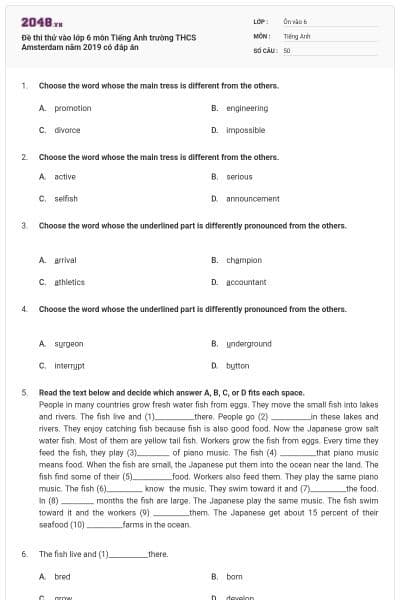
Đề thi thử vào lớp 6 môn Tiếng Anh trường THCS Amsterdam năm 2019 có đáp án
49 câu hỏi
Part I. Phonetics
Choose the word whose main stress is different from the others
promotion
engineering
divorce
impossible
promotion /prəˈməʊ.ʃən/
engineering /ˌen.dʒɪˈnɪə.rɪŋ/
divorce /dɪˈvɔːs/
impossible /ɪmˈpɒs.ə.bəl/
→ Chọn B vì có trọng âm rơi vào âm tiết thứ 3, các từ còn lại đều có trọng âm rơi vào âm tiết thứ 2.
Choose the word whose main stress is different from the others
active
serious
selfish
announcement
active /ˈæk.tɪv/
serious /ˈsɪə.ri.əs/
selfish /ˈsel.fɪʃ/
announcement /əˈnaʊns.mənt/
→ Chọn D vì có trọng âm rơi vào âm tiết thứ 2, các từ còn lại đều có trọng âm rơi vào âm tiết đầu.
Choose the word whose underlined part is differently pronounced from the others
arrival
champion
assistant
accountant
Đáp án đúng là B
arrival /əˈraɪ.vəl/ (n): sự đến nơi, đến địa điểm nào đó
champion /ˈtʃæm.pi.ən/ (n): nhà vô địch, quán quân
assistant /əˈsɪstənt/ (n): trợ lí
accountant /əˈkaʊn.tənt/ (n): kế toán
Choose the word whose underlined part is differently pronounced from the others
surgeon
underground
interrupt
button
Đáp án đúng là A
surgeon /ˈsɜːdʒən/ (n): bác sĩ phẫu thuật
underground /ˌʌndəˈɡraʊnd/ (adj): dưới lòng đất
interrupt /ˌɪntəˈrʌpt/ (v): ngắt lời
button /ˈbʌtn/ (n): nút, công tắc
→ Chọn A vì phần gạch chân của từ này được phát âm là /ɜː/, khác với những từ còn lại có phần gạch chân được phát âm là /ʌ/.
II. READING COMPREHENSION
Read the text below and decide which answer A, B, C, or D fits each space.
People in many countries grow fresh water fish from eggs. They move the small fish into lakes and rivers. The fish live and (1)___________there. People go (2) ___________in these lakes and rivers. They enjoy catching fish because fish is also good food. Now the Japanese grow salt water fish. Most of them are yellow tail fish. Workers grow the fish from eggs. Every time they feed the fish, they play (3)_________ of piano music. The fish (4) __________that piano music means food. When the fish are small, the Japanese put them into the ocean near the land. The fish find some of their (5)___________food. Workers also feed them. They play the same piano music. The fish (6)__________ knowthe music. They swim toward it and (7)__________the food. In (8) _________ months the fish are large. The Japanese play the same music. The fish swim toward it and the workers (9) __________them. The Japanese get about 15 percent of their seafood (10) __________farms in the ocean.
bred
born
grow
develop
Đáp án đúng là C
bred (dạng quá khứ của breed) (v): (động vật) sinh sản
born (v): được sinh ra (chỉ có thể dùng ở thể bị động nếu không có by theo sau)
grow (+ up) (v phr.): lớn lên, phát triển
develop (v): phát triển
Ta có:
- Cụm tự nhiên: live and grow (sống và lớn lên)
- bred = quá khứ của breed → sai thì
- born → chỉ dùng trong bị động be born
- develop cũng có thể đúng nghĩa, nhưng grow tự nhiên hơn với động vật
enjoying
fishing
shopping
catching
Đáp án đúng là B
Go fishing (v phr.): đi câu cá
songs
films
tapes
lots
tapes of piano music: những đoạn băng nhạc dương cầm
think
recognize
realize
learn
think (v): suy nghĩ
recognize (v): nhận ra (vì đã biết trước đó)
realize (v): nhận ra (một cách vô thức)
learn (v): học
learn that… means food: cá học được rằng âm nhạc báo hiệu thức ăn.
own
private
self
individual
their own food: thức ăn của riêng chúng (cụm cố định).
recently
mostly
nearly
already
The fish already know the music. (Những con cá đã biết loại nhạc này trước đó.)
see
find
bite
hold
They swim toward it and find the food. (Chúng bơi về phía đó và tìm thấy đồ ăn.)
few
a few
couple
many
In a few months the fish are large. (Chỉ trong vài tháng những con cá đã lớn.)
grasp
catch
seize
hold
grasp (v): chộp lấy
catch (v): bắt lấy
seize (v): nắm, giữ lấy (cơ hội)
hold (v): giữ lấy
The Japanese get about 15 percent of their seafood (10) ______ farms in the ocean.
on
of
from
in
Get something from something: nhận được gì từ cái gì
Đoạn văn hoàn chỉnh:
People in many countries grow fresh water fish from eggs. They move the small fish into lakes and rivers. The fish live and grow there. People go fishing in these lakes and rivers. They enjoy catching fish because fish is also good food. Now the Japanese grow salt water fish. Most of them are yellow tail fish. Workers grow the fish from eggs. Every time they feed the fish, they play tapes of piano music. The fish learn that piano music means food. When the fish are small, the Japanese put them into the ocean near the land. The fish find some of their own food. Workers also feed them. They play the same piano music. The fish already know the music. They swim toward it and find the food. In a few months the fish are large. The Japanese play the same music. The fish swim toward it and the workers (9) catch them. The Japanese get about 15 percent of their seafood from farms in the ocean.
Tạm dịch:
Ở nhiều quốc gia, người dân nuôi cá nước ngọt từ trứng. Họ thả những con cá nhỏ vào hồ và sông. Cá sống và lớn lên ở đó. Người dân đi câu cá ở những hồ và sông này. Họ thích bắt cá vì cá cũng là một món ăn ngon. Giờ đây, người Nhật nuôi cá nước mặn. Hầu hết chúng là cá đuôi vàng. Công nhân nuôi cá từ trứng. Mỗi lần cho cá ăn, họ bật băng nhạc piano. Cá học được rằng nhạc piano có nghĩa là thức ăn. Khi cá còn nhỏ, người Nhật thả chúng ra biển gần bờ. Cá tự tìm thức ăn. Công nhân cũng cho chúng ăn. Họ bật cùng một bản nhạc piano. Cá đã quen với âm nhạc. Chúng bơi về phía đó và tìm thức ăn. Sau vài tháng, cá lớn lên. Người Nhật bật cùng một bản nhạc. Cá bơi về phía đó và công nhân (9) bắt chúng. Người Nhật lấy khoảng 15% hải sản của họ từ các trang trại trên biển.
Read the following passage and mark the letter A, B, C, or D to indicate the correct answer to each of the questions
Past explorers have made vast contributions to our knowledge of the world today. They braved the oceans to discover the world and to bring their goods to other countries to trade.
Many explorers had to overcome their fear of the unknown to travel around the world on their sailing ships. Submitting themselves to unpredictable weather conditions, each explorer either traveled further than his predecessor or tried to find a different route to already discovered countries. For example, Vasco Da Gama, a Portuguese explorer, established a sea route from Europe to India. He had extended the sea route that Bartolomeu Dias had already done when he latter sailed around the Cape of Good Hope in southern Africa.
More importantly, explorers first closed the gap between the east and the west by trading their local goods with foreign ones. India was known for its spices such as nutmeg and cinnamon while China was known for its silk. A part of the east was brought to the west when western gourmets developed a taste for eastern spices in their food. People in the east dressed in clothes that were previously only worn in the west. Without the explorers, many of us would still be living in our own enclave with little knowledge of the vast world and what other foreign countries have to offer us.
making new good
selling their goods at high prices
traveling to other countries
spending time reading about foreign countries
Đáp án đúng là C
Thông tin:
They braved the oceans to discover the world… (Họ đã vượt đại dương để khám phá thế giới…)
Many explorers had to overcome their fear of the unknown to travel around the world on their sailing ships. (Nhiều nhà thám hiểm đã phải vượt qua nỗi sợ hãi về những điều bí ẩn để đi vòng quanh thế giới trên những chiếc thuyền buồm của họ.)
→ Past explorers contributed to our knowledge of the world by travelling to other countries.(Những nhà thám hiểm trong quá khứ đã đóng góp cho kho tàng tri thức của nhân loại bằng cách đi đến những quốc gia khác.)
swimming in the ocean
the dangers that lurked in unexplored places
being in their sailing ships for a long time
trying to predict the weather conditions
Đáp án đúng là B
Thông tin: Many explorers had to overcome their fear of the unknown to travel around the world on their sailing ships. (Nhiều nhà thám hiểm đã phải vượt qua nỗi sợ hãi về những điều bí ẩn để đi vòng quanh thế giới trên những chiếc thuyền buồm của họ.)
→ Past explorers were probably fearful of the dangers that lurked in unexplored places.(Những nhà thám hiểm trong quá khứ sợ những mối nguy hiểm tiềm ẩn ở những vùng đất chưa được khám phá.)
sold new goods to those countries
bought new goods from those countries
explored new areas in the countries
found another way of going to those countries
Thông tin: …each explorer either traveled further than his predecessor or tried to find a different route to already discovered countries. (…mỗi nhà thám hiểm hoặc đi xa hơn người tiền nhiệm hoặc cố gắng tìm một con đường khác đến các quốc gia đã được khám phá trước đó.)
→ Explorers who traveled to countries that others had already been to would make sure that they found another way of going to those countries.(Những nhà thám hiểm đi đến những quốc gia mà những nhà thám hiểm khác đã từng đến sẽ chắc chắn rằng họ sẽ tìm ra một lộ trình mới để đến những nơi đó.)
earn more money
think about visiting other countries as well
grow different types of spices
find out more about that country
Thông tin: … explorers first closed the gap between the east and the west by trading their local goods with foreign ones. (… các nhà thám hiểm đầu tiên đã thu hẹp khoảng cách giữa phương Đông và phương Tây bằng cách trao đổi hàng hóa ở địa phương của họ với hàng hóa nước ngoài.)
→ The act of selling their local goods to a foreign country allowed the explorers to find out more about that country. (Hành động bán những hàng hóa địa phương cho một quốc gia khác cho phép các nhà thám hiểm tìm hiểu thêm về quốc gia đó.)
clothing and lifestyle
speech and lifestyle
clothing and jobs
family structure and clothing
Thông tin: A part of the east was brought to the west when western gourmets developed a taste for eastern spices in their food. People in the east dressed in clothes that were previously only worn in the west. (Một phần của phương Đông đã được đưa đến phương Tây khi những người sành ăn phương Tây bắt đầu thích các loại gia vị của phương Đông trong thức ăn của họ. Người phương Đông cũng đã mặc trang phục mà trước đây chỉ người phương Tây mới mặc.)
→ Based on the third paragraph, the clothing and lifestyle of people changed when they came into contact with foreigners. (Dựa vào đoạn văn thứ ba, trang phục và lối sống của mọi người thay đổi khi họ tiếp xúc với người nước ngoài.)
Dịch bài đọc:
Những nhà thám hiểm trong quá khứ đã có những đóng góp to lớn cho kho tàng tri thức của nhân loại ngày nay. Họ đã vượt đại dương để khám phá thế giới và mang hàng hóa của họ đến các quốc gia khác để buôn bán.
Nhiều nhà thám hiểm đã phải vượt qua nỗi sợ hãi về những điều bí ẩn để đi vòng quanh thế giới trên những chiếc thuyền buồm của họ. Dấn thân vào những điều kiện thời tiết không thể đoán trước, mỗi nhà thám hiểm hoặc đi xa hơn người tiền nhiệm hoặc cố gắng tìm một con đường khác đến các quốc gia đã được khám phá trước đó. Ví dụ, Vasco Da Gama, một nhà thám hiểm người Bồ Đào Nha, đã thiết lập một con đường biển từ Châu Âu đến Ấn Độ. Ông đã mở rộng tuyến đường biển mà Bartolomeu Dias đã tìm ra khi mà sau đó anh ấy đi thuyền quanh Mũi Hảo Vọng ở miền nam Châu Phi.
Quan trọng hơn, các nhà thám hiểm đầu tiên đã thu hẹp khoảng cách giữa phương Đông và phương Tây bằng cách trao đổi hàng hóa địa phương của họ với hàng hóa nước ngoài. Ấn Độ được biết đến với các loại gia vị như nhục đậu khấu và quế trong khi Trung Quốc được biết đến với tơ lụa. Một phần của phương Đông đã được đưa đến phương Tây khi những người sành ăn phương Tây bắt đầu thích các loại gia vị của phương Đông trong thức ăn của họ. Người phương Đông cũng đã mặc trang phục mà trước đây chỉ người phương Tây mới mặc. Nếu không có những nhà thám hiểm, nhiều người trong chúng ta vẫn sẽ chỉ sống trong vùng đất của chính mình với nguồn kiến thức ít ỏi về thế giới rộng lớn ngoài kia và những gì mà các quốc gia khác mang lại cho chúng ta.
Part III. Grammar & Vocabulary
Choose the best option to complete the sentences
order
broken
vacant
work
Out of order: hỏng, không hoạt động
The ticket machine in the station was out of order so I couldn't buy a ticket for my train.
(Máy bán vé ở trạm xe lửa bị hỏng nên tôi đã không thể mua vé cho chuyến tàu của mình.)
There
That
It
This
That và this đều là những đại từ chỉ định dùng cho người, vật hiện hữu. Cấu trúc There is được dùng để nói có cái gì, đều không phù hợp trong câu này.
It is a complete mystery how they ever got there in that car.
(Đó hoàn toàn là một bí ẩn rằng làm cách nào mà họ vào trong chiếc xe hơi đó được.)
at the end
in the end
by the end
to the end
At the end: thời điểm kết thúc của cái gì
In the end: kết quả cuối cùng của tình huống
By the end (+ of): vào cuối cùng của…
To the end (+ of): cho đến tận cùng của…
We had so many problems with the car that in the end sold it and bought a new one.
(Chúng tôi đã gặp rất nhiều vấn đề với chiếc xe hơi và cuối cùng thì đã bán nó và mua cái mới.)
competitor
supporter
champion
referee
competitor (n): đối thủ
supporter (n): người ủng hộ
champion (n): quán quân
referee (n): trọng tài
I did not agree with the decisions the referee made last night. We lost the game because of him. (Tôi không đồng ý với quyết định trọng tài đưa ra tối qua. Chúng tôi đã thua cuộc bởi do ông ấy.)
will get
gets
got
would get
It is time + S + động từ ở thì quá khứ: cần làm việc gì ngay
His parents think it is time he got married.
(Bố mẹ anh ta nghĩ đây là thời điểm để anh ta kết hôn.)
reach
unpack
set off
arrived
reach (v): chạm vào, đến địa điểm nào đó
unpack (v): mở ra
set off: khởi hành
arrive (v): đến đâu đó
I had to set off early last morning because I was going to board a ferry but I had to wait to check out. (Tôi đã phải khởi hành sớm vào sáng hôm qua vì tôi phải lên phà nhưng tôi còn phải đợi để trả phòng nữa.)
carry on
take off
take in
set off
carry on: tiếp tục làm gì
take off: cởi ra
take in: bao gồm
set off; khởi hành
Before entering the room you'd better take off your shoes.
(Trước khi vào phòng thì bạn nên cởi giày ra.)
flood
freeze
hurricane
arrived
flood (n): lũ
freeze (v): đông lạnh
hurricane (n): bão
flashes of lightning: những tia chớp
They saw bright flashes of lightning in the sky during the storm.
(Họ nhìn thấy những tia chớp sáng lóe lên trên bầu trời trong cơn bão.)
CV
career
application
celebration
CV (viết tắt của curriculum vitae): lý lịch
career (n): sự nghiệp
application (n): sự ứng tuyển
celebration (n): sự tán dương
I regret to inform you that your application for this post has not been successful.
(Tôi rất tiếc khi phải thông báo rằng bạn đã không thành công trong việc ứng tuyển cho vị trí này.)
to continue
continued
continue
continuing
Prevent somebody from doing something: ngăn cản ai đó làm gì
Lack of funds prevented him from continuing with his study.
(Thiếu ngân sách đã ngăn cản anh ấy tiếp tục việc học tập.)
Put the correct form of words
I would be grateful if you could tell me something about the pay and the possibilities of __________. (PROMOTE)
I would be grateful if you could tell me something about the pay and the possibilities of promotion. (PROMOTE)
(Tôi sẽ rất biết ơn nếu bạn có thể cho tôi biết điều gì đó về mức lương và khả năng thăng tiến.)
Giải thích: Vị trí của chỗ trống nằm trong cụm danh từ possibilities of + N nên từ cần điền phải là một danh từ.
promotion (n): sự thăng tiến
Sheila is very __________ (PROFESSION). She turn up on time, works hard and does a good job.
Sheila is very professional (PROFESSION). She turns up on time, works hard and does a good job.
(Sheila rất chuyên nghiệp. Cô ấy đến đúng giờ, làm việc chăm chỉ và hoàn thành tốt công việc.)
Giải thích: Vị trí của từ cần điền là đứng sau động từ to be, trong câu miêu tả về đặc điểm của người nên nó phải là một tính từ.
professional (adj): chuyên nghiệp
People are _________ (CONFUSE) about all the different labels on food these days.
People are confused (CONFUSE) about all the different labels on food these days.
(Mọi người đều bối rối về tất cả những nhãn hiệu khác nhau trên đồ ăn dạo gần đây.)
Giải thích: Vị trí của từ cần điền là đứng sau động từ to be, miêu tả cảm xúc của chủ thể nên nó phải là một tính từ mang đuôi –ed.
confused (adj): bị bối rối
Mark the letter A, B, C or D on your answer sheet to indicate the word(s) CLOSEST in meaning to the underlined word(s) in each of the following questions
risks
annoyances
fears
irritations
Đáp án đúng là A
Many scientists agree that global warming poses great threats to all species on Earth.
(Nhiều nhà khoa học đồng ý rằng nóng lên toàn cầu gây ra những mối đe dọa to lớn tới các loài sinh sống trên Trái Đất.)
risks (n): những rủi ro ~ threats (n): những mối đe dọa
annoyances (n): sự quấy rầy
fears (n): những nỗi sợ hãi
irritations (n): sự chọc tức
light
huge
tiring
difficult
Đáp án đúng là B
When their rent increased from 200 to 400 a month, they protested against such a tremendous increase.
(Khi giá thuê tăng từ 200 lên 400 mỗi tháng, họ đã phản đối mức tăng quá lớn này.)
Light (adj): nhẹ
Huge (adj): lớn ~ tremendous (adj): to lớn
Tiring (adj): mệt mỏi
Difficult (adj): khó khăn
Mark the letter A, B, C or D on your answer sheet to indicate the word(s) OPPOSITE in meaning to the underlined word(s) in each of the following questions
Being late
Being cheerful
Being courteous
Being efficient
Đáp án đúng là A
Punctuality is imperative in your new job.
(Đúng giờ là bắt buộc trong công việc mới của bạn.)
Being late: muộn >< punctuality (n): sự đúng giờ
Being cheerful: vui vẻ
Being courteous: lịch sự
Being efficient: hiệu quả
slow down
put down
turn down
lie down
We’d better speed up if we want to get there in time.
(Chúng ta nên tăng tốc nếu muốn đến đó đúng giờ.)
slow down: chậm lại >< speed up: tăng tốc
put down: đặt xuống
turn down: từ chối
lie down: nằm xuống
Conversation
Jim: “What about collecting used paper, bottles and plastic bags everyday?”
– Ha and Mai: “ _________”
Because they can pollute the environment.
How come? Who can do that?
That’s a very good idea. Let’s do that.
What about this weekend?
Đáp án đúng là C
Jim: "What about collecting used paper, bottles and plastic bags everyday?"
(Các cậu nghĩ sao về việc thu gom giấy, chai và túi nhựa đã qua sử dụng hằng ngày?)
Ha and Mai: “That's a very good idea. Let's do that.”
(Ý hay đấy. Hãy cùng thực hiện nào.)
Phuong: “I’m taking my TOEFL test tomorrow”
– Daisy: “ _________”
Good fortune.
Good luck.
Good outcome.
Good success.
Phuong: "I'm taking my TOEFL test tomorrow" (Mình sẽ thi TOEFL ngày mai.)
Daisy: Good luck (Chúc may mắn nhé.)
Part IV. Writing
Rewrite the sentences without changing their meaning using the given words
She started working as a secretary five years ago.
→She has ________________________________________________________________.
She has worked as a secretary for five years.
(Cô ấy đã làm thư kí được 5 năm.)
“Don’t forget to phone the office,” she told him.
→She reminded ___________________________________________________________.
She reminded him to phone the office.
(Cô ấy nhắc anh ta gọi cho văn phòng.)
The furniture was so expensive that I didn’t buy it.
→The furniture was too _____________________________________________________.
The furniture was too expensive for me to buy.
(Đồ nội thất quá đắt để tôi mua.)
You may get hungry on the train, so take some sandwiches. (CASE)
→_______________________________________________________________________.
In case you get hungry on the train, take some sandwiches.
(Phòng trường hợp bạn bị đói ở trên tàu, hãy mang đi mấy cái bánh kẹp.)
I would like you to help me to put the chairs away.
→Do you mind ____________________________________________________________.
Do you mind helping me to put the chairs away?
(Bạn có phiền nếu giúp tôi rời những cái ghế đi không?)
Write a meaningful sentence using given words
We / should / stop / destroy / forests / because / they / important / environment /
→_______________________________________________________________________.
We should stop destroying forests because they are important to our/the environment.
(Chúng ta nên ngừng phá rừng vì chúng rất quan trọng đối với môi trường của chúng ta.)
She / suggest / go / for / walk.
→_______________________________________________________________________.
She suggested going out for a walk. (Cô ấy đề nghị ra ngoài tản bộ.)
Hoặc: She suggested that we should go out for a walk. (Cô ấy đề nghị rằng chúng ta nên ra ngoài tản bộ.)
I / be / write / tell / you / my holiday / here / Ha Long
→_______________________________________________________________________.
I am writing to tell you about my holiday here in Ha Long.
(Mình viết để kể cho cậu về kì nghỉ của mình tại Hạ Long.)
She / looking forward / see / boyfriend / again.
→_______________________________________________________________________.
She is looking forward to seeing her boyfriend again.
(Cô ấy đang mong ngóng được gặp lại bạn trai của mình.)
Life expectancy/ craft village residents/ be/ lower/ rest of Vietnam.
→_______________________________________________________________________.
Life expectancy of craft village residents is lower than that of the rest of Vietnam.
(Tuổi thọ của cư dân làng nghề thấp hơn so với các vùng còn lại ở Việt Nam.)
Write a paragraph (about 120 – 150 words) about the topic: (12 pts)
Tell a memorable success you have achieved in your life.
Suggested ideas:
What is the success?
How did you do to get success?
What lessons did you have from the success?
What target do you plan to get next time?
Dàn ý gợi ý:
1. Mở bài (Introduction)
- Giới thiệu thành công đáng nhớ.
- Nói ngắn gọn đó là thành công gì và khi nào xảy ra.
Gợi ý
- One of my most memorable successes was…
- It happened when I was…
2. Thân bài (Body)
Ý 1: Khó khăn ban đầu
- Cảm xúc trước khi đạt được thành công.
- Điều khiến bạn lo lắng hoặc thiếu tự tin.
Gợi ý
- At first, I felt…
- I was nervous because…
- I was not confident about…
Ý 2: Quá trình cố gắng
- Bạn đã làm gì để đạt được thành công.
- Việc luyện tập hoặc học tập.
Gợi ý
- I practiced every day…
- I tried my best…
- My teacher/friends helped me…
- I did not give up…
Ý 3: Kết quả đạt được
- Bạn đã thành công như thế nào.
- Cảm xúc khi đạt được thành công.
Gợi ý
- In the end, I…
- I won…
- I felt happy and proud…
3. Kết bài (Conclusion)
- Bài học rút ra từ thành công.
- Ảnh hưởng của thành công đến tương lai.
Gợi ý
- This success taught me that…
- It gave me more confidence…
- I will try harder in the future…
Sample writing:
One of the most memorable successes in my life was winning first prize in an English speaking contest at my school. At first, I felt very nervous because I was not confident about speaking English in front of many people. I practiced every day after school and asked my teacher to help me correct my pronunciation. Sometimes I made mistakes, but I did not give up. On the day of the contest, I tried my best to speak clearly and confidently. When the teacher announced that I was the winner, I felt very happy and proud of myself. This success taught me that hard work and practice are very important. It also gave me more confidence to learn English better in the future.