Đề thi thử Tốt nghiệp THPT Tiếng Anh 2025-2026 THPT Vũng Tàu (Hồ Chí Minh) lần 1 có đáp án
40 câu hỏi
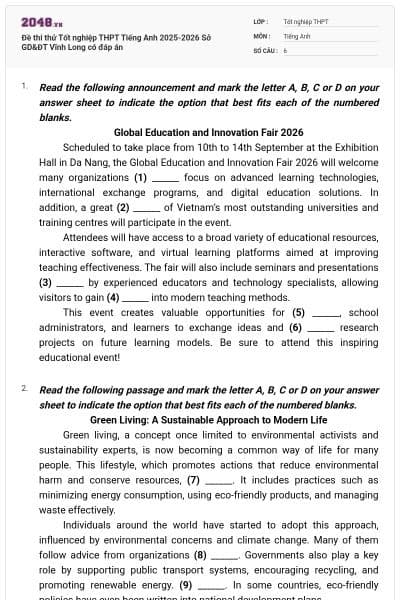
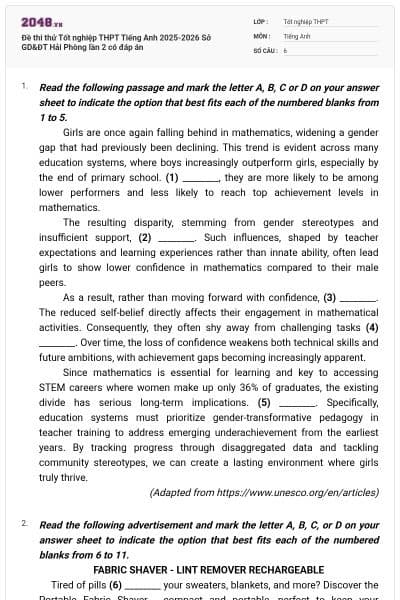
Read the following advertisement and mark the letter A, B, C or D on your answer sheet to indicate the correct option that best fits each of the numbered blanks from 1 to 6.
PROTECT OUR PLANET'S WILD HEART
On World Wildlife Day, we pause to celebrate the stunning variety of life (1) ____________ our planet unique and vibrant. From the smallest insects to the largest whales, every single species plays a crucial role in the health and function of our shared global ecosystems.
Sadly, this (2) ____________ beauty is under severe threat. Habitat loss, climate change, and illegal trade continue to push countless animals and plants closer to the brink of extinction every single day.
We cannot afford to lose these magnificent creatures. (3) ____________ wildlife is not just about saving endangered species; it's fundamentally about protecting the (4) ____________ that provides humanity with clean air, fresh water, and vital food security. Every one of us has the power to make a significant difference.
If we act together today to support sustainable initiatives and stricter protection laws, we can truly reverse these dangerous trends and ensure a brighter future (5) ____________ global biodiversity. Donate to a trusted conservation organization, volunteer your time, or simply commit (6) ____________ your carbon footprint.
Let's stand up for nature. Our future depends on it.
to make
making
maked
that make
A. to make: động từ nguyên thể có "to" (thường chỉ mục đích).
B. making (v-ing): hiện tại phân từ (mang nghĩa chủ động).
C. maked: sai chính tả (động từ quá khứ/phân từ hai của make là made).
D. that make: đại từ quan hệ + động từ (sai sự hòa hợp chủ vị, vì "variety" là danh từ số ít, nếu dùng phải là "that makes").
Đây là dạng rút gọn mệnh đề quan hệ mang nghĩa chủ động bổ nghĩa cho cụm danh từ "the stunning variety of life" (sự đa dạng tuyệt đẹp của sự sống). Mệnh đề đầy đủ là: which/that makes our planet unique.... Khi rút gọn, ta bỏ đại từ quan hệ và chuyển động từ chính thành dạng V-ing.
Chọn B. making
→ ...celebrate the stunning variety of life making our planet unique and vibrant.
Dịch nghĩa: ...tôn vinh sự đa dạng tuyệt đẹp của sự sống đã làm cho hành tinh của chúng ta trở nên độc đáo và tràn đầy sức sống.
incredibly
incredibility
incredibleness
incredible
A. incredibly (adv): một cách khó tin, vô cùng.
B. incredibility (n): sự không thể tin được.
C. incredibleness (n): sự khó tin.
D. incredible (adj): khó tin, tuyệt vời, đáng kinh ngạc.
Phía sau khoảng trống là danh từ "beauty" (vẻ đẹp).
Ta cần một tính từ đứng trước để bổ nghĩa cho danh từ đó.
Chọn D. incredible
→ Sadly, this incredible beauty is under severe threat.
Dịch nghĩa: Đáng buồn thay, vẻ đẹp đáng kinh ngạc này đang bị đe dọa nghiêm trọng.
Remaining
Reserving
Maintaining
Preserving
A. Remaining (v-ing): còn lại, ở lại.
B. Reserving (v-ing): đặt trước, dự trữ.
C. Maintaining (v-ing): duy trì.
D. Preserving (v-ing): bảo tồn, giữ gìn.
Ta có cụm từ kết hợp cố định (collocation) thường dùng trong chủ đề môi trường: preserve wildlife (bảo tồn động vật hoang dã).
Chọn D. Preserving
→ Preserving wildlife is not just about saving endangered species...
Dịch nghĩa: Việc bảo tồn động vật hoang dã không chỉ là cứu lấy các loài có nguy cơ tuyệt chủng...
ecological balance delicate
delicate ecological balance
ecological delicate balance
balance ecological delicate
Phân tích trật tự từ: Cụm danh từ này có danh từ chính là "balance" (sự cân bằng) nên bắt buộc phải đứng cuối cùng. Phía trước có hai tính từ bổ nghĩa:
Tính từ chỉ tính chất/quan điểm: "delicate" (mỏng manh, tinh tế).
Tính từ phân loại: "ecological" (thuộc về sinh thái).
Theo quy tắc trật tự tính từ, tính từ chỉ quan điểm/tính chất phải đứng trước tính từ phân loại. Trật tự đúng là: Tính từ chỉ tính chất + Tính từ phân loại + Danh từ chính.
Chọn B. delicate ecological balance
→ ...fundamentally about protecting the delicate ecological balance that provides humanity with...
Dịch nghĩa: ...về cơ bản là bảo vệ sự cân bằng sinh thái mỏng manh thứ cung cấp cho nhân loại...
with
for
along
under
A. with (prep): với.
B. for (prep): cho, dành cho.
C. along (prep): dọc theo.
D. under (prep): dưới.
Cấu trúc thông dụng: a future for somebody/something (một tương lai cho ai đó/điều gì đó).
Chọn B. for
→ ...we can truly reverse these dangerous trends and ensure a brighter future for global biodiversity.
Dịch nghĩa: ...chúng ta thực sự có thể đảo ngược những xu hướng nguy hiểm này và đảm bảo một tương lai tươi sáng hơn cho sự đa dạng sinh học toàn cầu.
Donate to a trusted conservation organization, volunteer your time, or simply commit (6) ____________ your carbon footprint.
to reduce
reduce
to reducing
reducing
A. to reduce: nguyên thể có "to".
B. reduce: nguyên mẫu.
C. to reducing: giới từ "to" + V-ing.
D. reducing: V-ing.
Ta có cấu trúc cố định: commit to doing something (cam kết làm việc gì đó). Từ "to" ở đây là một giới từ, do đó động từ theo sau bắt buộc phải thêm "-ing".
Chọn C. to reducing
→ ...volunteer your time, or simply commit to reducing your carbon footprint.
Dịch nghĩa: ...dành thời gian tình nguyện, hoặc đơn giản là cam kết giảm bớt lượng khí thải carbon của bạn.
Bài đọc hoàn chỉnh | Dịch bài đọc |
PROTECT OUR PLANET'S WILD HEART On World Wildlife Day, we pause to celebrate the stunning variety of life (1) making our planet unique and vibrant. From the smallest insects to the largest whales, every single species plays a crucial role in the health and function of our shared global ecosystems. Sadly, this (2) incredible beauty is under severe threat. Habitat loss, climate change, and illegal trade continue to push countless animals and plants closer to the brink of extinction every single day. We cannot afford to lose these magnificent creatures. (3) Preserving wildlife is not just about saving endangered species; it's fundamentally about protecting the (4) delicate ecological balance that provides humanity with clean air, fresh water, and vital food security. Every one of us has the power to make a significant difference. If we act together today to support sustainable initiatives and stricter protection laws, we can truly reverse these dangerous trends and ensure a brighter future (5) for global biodiversity. Donate to a trusted conservation organization, volunteer your time, or simply commit (6) to reducing your carbon footprint. Let's stand up for nature. Our future depends on it. | BẢO VỆ TRÁI TIM HOANG DÃ CỦA HÀNH TINH CHÚNG TA Vào Ngày Động vật Hoang dã Thế giới, chúng ta cùng dừng lại để tôn vinh sự đa dạng tuyệt đẹp của sự sống (1) đã làm cho hành tinh của chúng ta trở nên độc đáo và tràn đầy sức sống. Từ những loài côn trùng nhỏ bé nhất cho đến những chú cá voi khổng lồ nhất, mỗi một loài đều đóng một vai trò quan trọng đối với sức khỏe và sự vận hành của các hệ sinh thái toàn cầu chung của chúng ta. Đáng buồn thay, vẻ đẹp (2) đáng kinh ngạc này đang bị đe dọa nghiêm trọng. Việc mất môi trường sống, biến đổi khí hậu và nạn buôn bán bất hợp pháp vẫn tiếp tục đẩy vô số các loài động thực vật đến gần hơn với bờ vực tuyệt chủng mỗi ngày. Chúng ta không thể đánh mất những sinh vật tuyệt mỹ này. Việc (3) bảo tồn động vật hoang dã không chỉ là cứu lấy các loài có nguy cơ tuyệt chủng; mà về cơ bản đó là bảo vệ (4) sự cân bằng sinh thái mỏng manh thứ cung cấp cho nhân loại không khí trong lành, nguồn nước ngọt và an ninh lương thực thiết yếu. Mỗi người trong chúng ta đều có sức mạnh để tạo ra một sự khác biệt lớn lao. Nếu hôm nay chúng ta cùng nhau hành động để ủng hộ các sáng kiến bền vững và các đạo luật bảo vệ nghiêm ngặt hơn, chúng ta thực sự có thể đảo ngược những xu hướng nguy hiểm này và đảm bảo một tương lai tươi sáng hơn (5) cho sự đa dạng sinh học toàn cầu. Hãy quyên góp cho một tổ chức bảo tồn đáng tin cậy, dành thời gian tình nguyện của bạn, hoặc đơn giản là cam kết (6) giảm bớt lượng khí thải carbon của bạn. Hãy cùng đứng lên bảo vệ thiên nhiên. Tương lai của chúng ta phụ thuộc vào điều đó. |
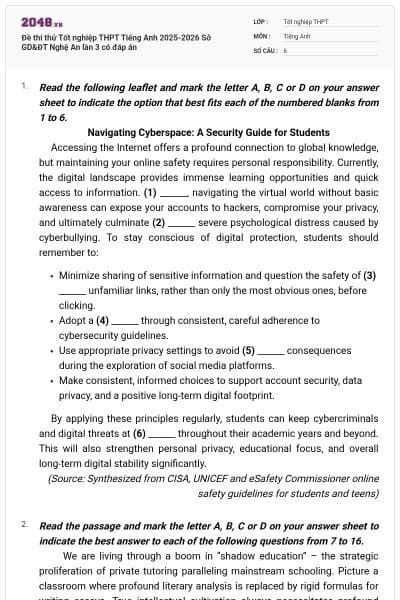
Read the following leaflet and mark the letter A, B, C or D on your answer sheet to indicate the correct option that best fits each of the numbered blanks from 7 to 12.
Conserving Our Planet: An Urgent Call
The Growing Threat
Every day, we hear about the decline of wildlife. Habitat loss and deforestation caused by forest clearance are pushing many species to the (7) ____________ of extinction. Primate species like the gibbon or marine life on coral reefs are all under severe pressure. We cannot (8) ____________ from taking action.
Immediate Action
We need to take effective measures to protect the geographic range of animals. Poaching and illegal hunting mean that poachers must be strictly punished. Some countries are introducing stricter laws to address this issue. Several veterinarians and wildlife rescuers work hard (9) ____________ release rehabilitated animals back into the wild.
Global Scope
The natural world is home to a great deal of life. Many species, such as the sturgeon or the banana frog, are now listed as critically endangered. Even a small (10) ____________ of marine debris can cause severe harm. Efforts to rescue injured creatures are vital, but (11) ____________ major problem is preventing extinction.
Conservation Partnership
The (12) ____________ of biodiversity is a collective responsibility. We must raise funds for ecosystem restoration projects in areas that have been degraded. Successful conservation campaigns happen when many people participate. By contributing to these efforts, we ensure the survival of future generations.
brink
edge
foot
range
A. brink (n): bờ vực (nghĩa bóng).
B. edge (n): rìa, mép, bờ.
C. foot (n): chân (đồi, núi).
D. range (n): phạm vi, dãy.
Ta có cụm từ cố định (collocation): on/to the brink of extinction (bên bờ vực tuyệt chủng).
Chọn A. brink
→ Habitat loss and deforestation caused by forest clearance are pushing many species to the brink of extinction.
Dịch nghĩa: Mất môi trường sống và nạn phá rừng do việc chặt phá rừng gây ra đang đẩy nhiều loài đến bờ vực tuyệt chủng.
We cannot (8) ____________ from taking action.
hold up
hold back
hold out
hold on
A. hold up (phr.v): làm trì hoãn, cản trở.
B. hold back (phr.v): kiềm chế, chần chừ, ngần ngại (từ việc làm gì đó).
C. hold out (phr.v): cầm cự, duy trì (hy vọng).
D. hold on (phr.v): giữ máy (điện thoại), chờ đợi, bám chặt.
Ta có cấu trúc: hold back from doing something (ngần ngại, chần chừ hoặc tự ngăn cản bản thân làm việc gì). Trong ngữ cảnh này, "không thể chần chừ/không thể trì hoãn việc hành động" là nghĩa phù hợp nhất.
Chọn B. hold back
→ We cannot hold back from taking action.
Dịch nghĩa: Chúng ta không thể chần chừ trong việc hành động.
Several veterinarians and wildlife rescuers work hard (9) ____________ release rehabilitated animals back into the wild.
consequent to
in order to
because of
on account of
A. consequent to (prep): là hậu quả của (+ Noun/V-ing).
B. in order to: để, nhằm mục đích (+ V-nguyên thể).
C. because of (prep): bởi vì (+ Noun/V-ing).
D. on account of (prep): do, bởi vì (+ Noun/V-ing).
Phía sau khoảng trống là động từ nguyên mẫu "release" (thả tự do). Do đó, chỉ có "in order to" (chỉ mục đích) là đúng cấu trúc ngữ pháp. Các phương án A, C, D đều là giới từ/cụm giới từ, yêu cầu phải đi với danh từ hoặc V-ing.
Chọn B. in order to
→ Several veterinarians and wildlife rescuers work hard in order to release rehabilitated animals back into the wild.
Dịch nghĩa: Một số bác sĩ thú y và nhân viên cứu hộ động vật hoang dã làm việc chăm chỉ để thả những động vật đã được phục hồi trở lại tự nhiên.
volume
load
number
amount
A. volume (n): thể tích, khối lượng.
B. load (n): gánh nặng, vật nặng.
C. number (n): số lượng (+ danh từ đếm được số nhiều).
D. amount (n): số lượng (+ danh từ không đếm được).
Phía sau khoảng trống là giới từ "of" và danh từ không đếm được "marine debris" (rác thải/mảnh vỡ trên biển). Do đó, ta dùng cấu trúc a small amount of + N (không đếm được) (một lượng nhỏ...).
Chọn D. amount
→ Even a small amount of marine debris can cause severe harm.
Dịch nghĩa: Ngay cả một lượng nhỏ rác thải trên biển cũng có thể gây ra tác hại nghiêm trọng.
Efforts to rescue injured creatures are vital, but (11) ____________ major problem is preventing extinction.
another
the other
other
others
A. another: một (người/vật/vấn đề) khác (tính từ, đi kèm danh từ đếm được số ít).
B. the other: (người/vật/vấn đề) còn lại (đã xác định cụ thể trong một nhóm 2 đối tượng).
C. other: những (người/vật/vấn đề) khác (tính từ, đi kèm danh từ số nhiều / không đếm được).
D. others: những (người/vật/vấn đề) khác (đại từ, đứng độc lập không đi kèm danh từ).
Phía sau khoảng trống là cụm danh từ đếm được ở dạng số ít "major problem" (vấn đề lớn). Do đó, tính từ "another" là lựa chọn duy nhất đúng ngữ pháp.
Chọn A. another
→ Efforts to rescue injured creatures are vital, but another major problem is preventing extinction.
Dịch nghĩa: Những nỗ lực giải cứu các sinh vật bị thương là rất quan trọng, nhưng một vấn đề lớn khác là ngăn chặn sự tuyệt chủng.
preservation
exploitation
maintenance
recovery
A. preservation (n): sự bảo tồn, sự giữ gìn.
B. exploitation (n): sự khai thác, sự bóc lột.
C. maintenance (n): sự bảo trì, sự duy trì.
D. recovery (n): sự phục hồi.
Ta có cụm từ/thuật ngữ phổ biến trong sinh học và môi trường: the preservation of biodiversity (sự bảo tồn đa dạng sinh học).
Chọn A. preservation
→ The preservation of biodiversity is a collective responsibility.
Dịch nghĩa: Việc bảo tồn đa dạng sinh học là một trách nhiệm chung.
Bài đọc hoàn chỉnh | Dịch bài đọc |
Conserving Our Planet: An Urgent Call The Growing Threat Every day, we hear about the decline of wildlife. Habitat loss and deforestation caused by forest clearance are pushing many species to the (7) brink of extinction. Primate species like the gibbon or marine life on coral reefs are all under severe pressure. We cannot (8) hold back from taking action. Immediate Action We need to take effective measures to protect the geographic range of animals. Poaching and illegal hunting mean that poachers must be strictly punished. Some countries are introducing stricter laws to address this issue. Several veterinarians and wildlife rescuers work hard (9) in order to release rehabilitated animals back into the wild. Global Scope The natural world is home to a great deal of life. Many species, such as the sturgeon or the banana frog, are now listed as critically endangered. Even a small (10) amount of marine debris can cause severe harm. Efforts to rescue injured creatures are vital, but (11) another major problem is preventing extinction. Conservation Partnership The (12) preservation of biodiversity is a collective responsibility. We must raise funds for ecosystem restoration projects in areas that have been degraded. Successful conservation campaigns happen when many people participate. By contributing to these efforts, we ensure the survival of future generations. | Bảo Tồn Hành Tinh Của Chúng Ta: Một Lời Kêu Gọi Khẩn Cấp Mối Đe Dọa Đang Gia Tăng Mỗi ngày, chúng ta đều nghe về sự suy giảm của động vật hoang dã. Mất môi trường sống và nạn phá rừng do việc chặt phá rừng gây ra đang đẩy nhiều loài đến (7) bờ vực tuyệt chủng. Các loài linh trưởng như vượn hay sinh vật biển trên các rạn san hô đều đang chịu áp lực nghiêm trọng. Chúng ta không thể (8) chần chừ trong việc hành động. Hành Động Ngay Lập Tức Chúng ta cần thực hiện các biện pháp hiệu quả để bảo vệ phạm vi địa lý của các loài động vật. Nạn săn bắt trộm và săn bắn bất hợp pháp đồng nghĩa với việc những kẻ săn trộm phải bị trừng phạt nghiêm khắc. Một số quốc gia đang ban hành các luật lệ nghiêm ngặt hơn để giải quyết vấn đề này. Một số bác sĩ thú y và nhân viên cứu hộ động vật hoang dã làm việc chăm chỉ (9) để thả những động vật đã được phục hồi trở lại tự nhiên. Phạm Vi Toàn Cầu Thế giới tự nhiên là ngôi nhà của rất nhiều sự sống. Nhiều loài, chẳng hạn như cá tầm hoặc ếch chuối, hiện đang được xếp vào danh sách cực kỳ nguy cấp. Ngay cả một (10) lượng nhỏ rác thải trên biển cũng có thể gây ra tác hại nghiêm trọng. Những nỗ lực giải cứu các sinh vật bị thương là rất quan trọng, nhưng (11) một vấn đề lớn khác là ngăn chặn sự tuyệt chủng. Quan Hệ Đối Tác Bảo Tồn Sự (12) bảo tồn đa dạng sinh học là một trách nhiệm chung. Chúng ta phải gây quỹ cho các dự án phục hồi hệ sinh thái ở những khu vực đã bị suy thoái. Các chiến dịch bảo tồn thành công diễn ra khi có nhiều người cùng tham gia. Bằng cách đóng góp vào những nỗ lực này, chúng ta đảm bảo sự sống còn cho các thế hệ tương lai. |
Mark the letter A, B, C, or D on your answer sheet to indicate the correct arrangement of the sentence to make a meaningful paragraph/letter in each of the following questions from 13 to 17.
a. Lan: What a wonderful initiative! As a volunteer, you could help by giving directions, handing out water, and offering encouragement to students who need it most.
b. Hải: That's right! It's truly fulfilling to interact with these students – we not only help build their confidence but gain valuable experience ourselves.
c. Hải: I'm thinking of joining the "Tiếp sức mùa thi" program to support students during this exam season.
c – b – a
b – c – a
a – c – b
c – a – b
Thứ tự sắp xếp đúng: D. c – a – b
c. Hải: I'm thinking of joining the "Tiếp sức mùa thi" program to support students during this exam season.
a. Lan: What a wonderful initiative! As a volunteer, you could help by giving directions, handing out water, and offering encouragement to students who need it most.
b. Hải: That's right! It's truly fulfilling to interact with these students – we not only help build their confidence but gain valuable experience ourselves.
Dịch nghĩa:
c. Hải: Mình đang nghĩ đến việc tham gia chương trình "Tiếp sức mùa thi" để hỗ trợ các sĩ tử trong mùa thi này.
a. Lan: Thật là một sáng kiến tuyệt vời! Với tư cách là một tình nguyện viên, cậu có thể giúp đỡ bằng cách chỉ đường, phát nước và động viên những học sinh cần nó nhất.
b. Hải: Đúng vậy! Việc được tương tác với các bạn học sinh này thực sự rất ý nghĩa – chúng ta không chỉ giúp xây dựng sự tự tin cho họ mà còn tự tích lũy được những kinh nghiệm quý giá cho bản thân.
Chọn D.
a. Linh: That’s right. They organize courses to help teachers improve their teaching skills and use digital technology in classrooms.
b. Linh: Exactly! Plus, they offer training on life – saving skills for both teachers and students, and help children and households who are in need.
c. Minh: They also create more opportunities for children in remote areas by giving them books and school materials so they can have access to learning.
d. Linh: Have you heard about Save the Children? It’s an international NGO that helps improve children’s lives around the world.
e. Minh: Yes, I know! They started their work in Vietnam in 1990 and provide practical support in areas like education and training.
d – c – a – e – b
b – e – a – c – d
b – c – a – e – d
d – e – a – c – b
Thứ tự sắp xếp đúng: D. d – e – a – c – b
d. Linh: Have you heard about Save the Children? It’s an international NGO that helps improve children’s lives around the world.
e. Minh: Yes, I know! They started their work in Vietnam in 1990 and provide practical support in areas like education and training.
a. Linh: That’s right. They organize courses to help teachers improve their teaching skills and use digital technology in classrooms.
c. Minh: They also create more opportunities for children in remote areas by giving them books and school materials so they can have access to learning.
b. Linh: Exactly! Plus, they offer training on life-saving skills for both teachers and students, and help children and households who are in need.
Dịch nghĩa:
d. Linh: Cậu đã nghe nói về Tổ chức Cứu trợ Trẻ em (Save the Children) chưa? Đó là một tổ chức phi chính phủ quốc tế giúp cải thiện cuộc sống của trẻ em trên toàn thế giới.
e. Minh: Có, tớ biết chứ! Họ bắt đầu hoạt động tại Việt Nam vào năm 1990 và cung cấp sự hỗ trợ thiết thực trong các lĩnh vực như giáo dục và đào tạo.
a. Linh: Đúng vậy. Họ tổ chức các khóa học để giúp giáo viên cải thiện kỹ năng giảng dạy và sử dụng công nghệ kỹ thuật số trong lớp học.
c. Minh: Họ cũng tạo ra nhiều cơ hội hơn cho trẻ em ở các vùng sâu vùng xa bằng cách cung cấp sách vở và đồ dùng học tập để các em có thể tiếp cận với việc học.
b. Linh: Chính xác! Thêm vào đó, họ còn cung cấp các khóa đào tạo về kỹ năng cứu sinh cho cả giáo viên và học sinh, đồng thời giúp đỡ những trẻ em và hộ gia đình đang gặp khó khăn.
Chọn D.
Dear Alex,
a. This integration of technology seems to be transforming traditional teaching methods and enhancing educational outcomes.
b. I recently came across an article discussing the increasing use of artificial intelligence in classrooms, which I found quite fascinating.
c. I hope you’re doing well and had a chance to relax over the weekend.
d. I’d love to hear your thoughts on this development and how you think it might impact our education system.
e. The piece highlighted how AI tools are now assisting teachers by grading assignments and providing personalized learning experiences for students.
Best regards,
Taylor
c – b – e – a – d
c – d – e – a –b
a – e – b – c – d
a – b – e – c – d
Thứ tự sắp xếp đúng: A. c – b – e – a – d
c. I hope you’re doing well and had a chance to relax over the weekend.
b. I recently came across an article discussing the increasing use of artificial intelligence in classrooms, which I found quite fascinating.
e. The piece highlighted how AI tools are now assisting teachers by grading assignments and providing personalized learning experiences for students.
a. This integration of technology seems to be transforming traditional teaching methods and enhancing educational outcomes.
d. I’d love to hear your thoughts on this development and how you think it might impact our education system.
Dịch nghĩa:
Gửi Alex,
c. Mình hy vọng cậu vẫn khỏe và đã có cơ hội để thư giãn vào cuối tuần.
b. Gần đây mình tình cờ đọc được một bài báo thảo luận về việc ngày càng gia tăng sử dụng trí tuệ nhân tạo trong các lớp học, điều mà mình thấy khá thú vị.
e. Bài viết nhấn mạnh cách các công cụ AI hiện đang hỗ trợ giáo viên bằng cách chấm điểm bài tập và mang lại những trải nghiệm học tập được cá nhân hóa cho học sinh.
a. Sự tích hợp công nghệ này dường như đang biến đổi các phương pháp giảng dạy truyền thống và nâng cao kết quả giáo dục.
d. Mình rất muốn nghe suy nghĩ của cậu về sự phát triển này và cậu nghĩ nó có thể tác động đến hệ thống giáo dục của chúng ta như thế nào.
Thân mến,
Taylor
Chọn A.
a. This wave of immigration not only puts pressure on urban services but also raises concerns about the long-term sustainability of cities.
b. One major reason for immigration to big cities is the limited access to health services in remote areas, which drives people to move in search of better healthcare and living standards.
c. For example, many rural residents migrate to urban areas because local hospitals often lack trained medical professionals and proper equipment, as seen with hospitals like Bach Mai and K Hospital, which struggle to meet the demands of patients from small provinces.
d. As a result, the chances of securing a position have decreased significantly, from 33% to as low as 7%.
e. In addition to healthcare, another factor is the search for better job opportunities; with more people moving to the cities, competition for jobs has become fierce.
b-d-c-e-a
b-c-e-d-a
e-c-b-d-a
b-e-c-d-a
Thứ tự sắp xếp đúng: B. b – c – e – d – a
b. One major reason for immigration to big cities is the limited access to health services in remote areas, which drives people to move in search of better healthcare and living standards.
c. For example, many rural residents migrate to urban areas because local hospitals often lack trained medical professionals and proper equipment, as seen with hospitals like Bach Mai and K Hospital, which struggle to meet the demands of patients from small provinces.
e. In addition to healthcare, another factor is the search for better job opportunities; with more people moving to the cities, competition for jobs has become fierce.
d. As a result, the chances of securing a position have decreased significantly, from 33% to as low as 7%.
a. This wave of immigration not only puts pressure on urban services but also raises concerns about the long-term sustainability of cities.
Dịch nghĩa:
b. Một lý do chính của việc di cư đến các thành phố lớn là sự hạn chế trong việc tiếp cận các dịch vụ y tế ở các vùng sâu vùng xa, điều này thúc đẩy người dân di chuyển để tìm kiếm dịch vụ chăm sóc sức khỏe và mức sống tốt hơn.
c. Ví dụ, nhiều cư dân nông thôn di cư ra thành thị vì các bệnh viện địa phương thường thiếu các chuyên gia y tế được đào tạo và trang thiết bị phù hợp, như có thể thấy ở các bệnh viện như Bệnh viện Bạch Mai và Bệnh viện K, nơi đang phải chật vật để đáp ứng nhu cầu của bệnh nhân từ các tỉnh nhỏ.
e. Bên cạnh chăm sóc sức khỏe, một yếu tố khác là việc tìm kiếm cơ hội việc làm tốt hơn; với việc ngày càng có nhiều người chuyển đến các thành phố, sự cạnh tranh về việc làm đã trở nên khốc liệt.
d. Kết quả là, cơ hội đảm bảo được một vị trí việc làm đã giảm đi đáng kể, từ 33% xuống chỉ còn 7%.
a. Làn sóng di cư này không chỉ gây áp lực lên các dịch vụ đô thị mà còn làm dấy lên những lo ngại về tính bền vững lâu dài của các thành phố.
Chọn B.
a.For teachers, technology offers tools to design more flexible lessons, track progress efficiently, and provide timely feedback that supports individual growth.
b.At the same time, meaningful learning still depends on how these tools are used, as passive consumption can limit critical thinking and deep understanding.
c.Technology plays an increasingly central role in education by expanding access to information and learning opportunities beyond the traditional classroom.
d.When integrated thoughtfully, technology enhances education not by replacing teachers, but by strengthening the connection between instruction, practice, and real-world application.
e.Digital platforms allow students to learn at their own pace, revisit complex ideas, and engage with content through interactive formats that suit different learning styles.
c – d – b – a – e
e – b – d – a – c
e – a – c – d – b
c – e – a – b – d
Thứ tự sắp xếp đúng: D. c – e – a – b – d
c. Technology plays an increasingly central role in education by expanding access to information and learning opportunities beyond the traditional classroom.
e. Digital platforms allow students to learn at their own pace, revisit complex ideas, and engage with content through interactive formats that suit different learning styles.
a. For teachers, technology offers tools to design more flexible lessons, track progress efficiently, and provide timely feedback that supports individual growth.
b. At the same time, meaningful learning still depends on how these tools are used, as passive consumption can limit critical thinking and deep understanding.
d. When integrated thoughtfully, technology enhances education not by replacing teachers, but by strengthening the connection between instruction, practice, and real-world application.
Dịch nghĩa:
c. Công nghệ đóng vai trò trung tâm ngày càng lớn trong giáo dục bằng cách mở rộng khả năng tiếp cận thông tin và các cơ hội học tập vượt ra ngoài lớp học truyền thống.
e. Các nền tảng kỹ thuật số cho phép học sinh học theo nhịp độ của riêng mình, ôn lại các ý tưởng phức tạp và tương tác với nội dung thông qua các định dạng tương tác phù hợp với những phong cách học tập khác nhau.
a. Đối với giáo viên, công nghệ cung cấp các công cụ để thiết kế những bài học linh hoạt hơn, theo dõi tiến độ một cách hiệu quả và đưa ra phản hồi kịp thời để hỗ trợ sự phát triển của từng cá nhân.
b. Đồng thời, việc học tập có ý nghĩa vẫn phụ thuộc vào cách sử dụng những công cụ này, vì sự tiếp nhận thụ động có thể làm hạn chế tư duy phản biện và sự hiểu biết sâu sắc.
d. Khi được tích hợp một cách thấu đáo, công nghệ nâng cao giáo dục không phải bằng cách thay thế giáo viên, mà bằng cách củng cố sự kết nối giữa việc giảng dạy, thực hành và ứng dụng vào thế giới thực.
Chọn D.
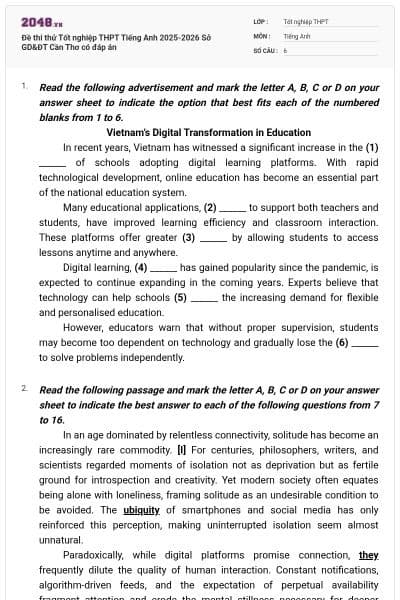
Read the following passage and mark the letter A, B, C, or D to indicate the correct option that best fits each of the numbered blanks from 18 to 22.
Studying abroad can be an enriching experience, but it also involves a number of uncertainties that prospective students must carefully consider. These may include concerns about academic standards, cultural differences, financial pressures, or (18) ____________. Before making a final decision, students often weigh the likelihood of such challenges occurring, assess whether they can be managed effectively, and consider the long-term impact they may have on their personal and professional development.
For some individuals, uncertainty is part of the appeal, as it encourages independence and personal growth, (19) ____________. Others, however, prefer stability and predictability, and therefore seek to minimize uncertainty as much as possible. Naturally, the perceived seriousness of potential difficulties plays a crucial role in this process. (20) ____________. As a result, more cautious students tend to favour institutions with established reputations, well-defined support systems, and clearly structured programmes, as these features help reduce uncertainty and perceived risk.
(21) ____________. Research suggests that many students still hesitate to rely solely on online platforms when selecting overseas universities. This hesitation can be explained partly by the absence of direct interaction with experienced advisors and partly by (22) ____________.
(Adapted from Higher Education and Global Mobility)
the education system is directly experienced upon arrival
to directly experience the education system after arrival
lacking direct experience of the education system until arrival
having experienced the education system directly
Đây là cấu trúc liệt kê (Parallel Structure). Các yếu tố đứng trước từ nối "or" đều là các cụm danh từ (Noun phrases): "academic standards" (tiêu chuẩn học thuật), "cultural differences" (khác biệt văn hóa), "financial pressures" (áp lực tài chính). Do đó, vị trí (18) cũng bắt buộc phải là một cụm danh từ hoặc cụm danh động từ (Gerund phrase) để giữ sự cân bằng ngữ pháp.
Dịch nghĩa/Ngữ pháp:
A. hệ thống giáo dục được trải nghiệm trực tiếp khi đến nơi (Mệnh đề - Sai cấu trúc).
B. để trực tiếp trải nghiệm hệ thống giáo dục sau khi đến (Động từ nguyên thể có "to" - Sai cấu trúc).
C. việc thiếu kinh nghiệm trực tiếp về hệ thống giáo dục cho đến khi đến nơi (Cụm danh động từ - Đúng cấu trúc).
D. việc đã trải nghiệm hệ thống giáo dục một cách trực tiếp (Cụm danh động từ, nhưng sai logic: việc "đã trải nghiệm" không tạo ra sự lo lắng/vô định).
Đáp án C đáp ứng cả yêu cầu về ngữ pháp (cấu trúc song song) lẫn logic ý nghĩa (liệt kê thêm một nỗi lo lắng/sự vô định nữa của du học sinh).
Chọn C.
→ These may include concerns about academic standards, cultural differences, financial pressures, or lacking direct experience of the education system until arrival.
Dịch nghĩa: Những điều này có thể bao gồm những lo ngại về tiêu chuẩn học thuật, sự khác biệt văn hóa, áp lực tài chính, hoặc việc thiếu kinh nghiệm trực tiếp về hệ thống giáo dục cho đến khi thực sự đến nơi.
although it does not necessarily deter them from pursuing such opportunities
if independence is prevented by uncertainty
because it creates barriers that cannot be overcome
so uncertainty itself always discourages international study
Vế trước khẳng định: "For some individuals, uncertainty is part of the appeal..." (Đối với một số cá nhân, sự vô định là một phần của sức hấp dẫn...). Chỗ trống (19) cần một mệnh đề bổ sung làm rõ thái độ tích cực này.
Dịch nghĩa:
A. mặc dù điều đó không nhất thiết cản trở họ theo đuổi các cơ hội như vậy
B. nếu sự tự lập bị ngăn cản bởi sự vô định (Nghĩa tiêu cực, sai logic).
C. bởi vì nó tạo ra những rào cản không thể vượt qua (Nghĩa tiêu cực, sai logic).
D. vì vậy sự vô định luôn cản trở việc du học quốc tế (Nghĩa tiêu cực, sai logic).
Vì sự vô định được coi là "sức hấp dẫn" (appeal), nó chắc chắn không làm những cá nhân này chùn bước. Các đáp án B, C, D đều mang nghĩa tiêu cực cản trở. Chỉ có A giữ được mạch logic phù hợp: sự vô định không làm nản lòng những người ưa thử thách.
Chọn A.
→ For some individuals, uncertainty is part of the appeal, as it encourages independence and personal growth, although it does not necessarily deter them from pursuing such opportunities.
Dịch nghĩa: Đối với một số cá nhân, sự vô định là một phần của sức hấp dẫn, vì nó khuyến khích sự tự lập và phát triển cá nhân, mặc dù điều đó không nhất thiết cản trở họ theo đuổi các cơ hội như vậy.
All potential difficulties are generally considered manageable
Challenges perceived as severe are more likely to discourage risk-taking
Students tend to underestimate the impact of potential difficulties
Serious challenges are often viewed as opportunities for personal development
Câu trước đó nhấn mạnh tầm quan trọng của "perceived seriousness" (mức độ nghiêm trọng được nhận thức). Câu phía sau bắt đầu bằng "As a result" (Kết quả là) để chỉ ra hành động của những "cautious students" (sinh viên thận trọng) là chọn các trường danh tiếng để giảm rủi ro. Vị trí (20) đóng vai trò là nguyên nhân trực tiếp dẫn đến hành vi né tránh rủi ro này.
Dịch nghĩa:
A. Tất cả những khó khăn tiềm ẩn nhìn chung được coi là có thể kiểm soát được (Nếu kiểm soát được thì không cần phải quá thận trọng → Sai logic).
B. Những thách thức được coi là nghiêm trọng có nhiều khả năng làm nản lòng việc chấp nhận rủi ro (Hợp lý: Thấy rủi ro cao thì không dám mạo hiểm).
C. Sinh viên có xu hướng đánh giá thấp tác động của những khó khăn tiềm ẩn (Đánh giá thấp thì sẽ không thận trọng → Sai logic).
D. Những thách thức nghiêm trọng thường được xem như cơ hội để phát triển cá nhân (Đi ngược với hành vi của nhóm "sinh viên thận trọng").
Đáp án B kết nối chuỗi logic: Nhận thức mức độ nghiêm trọng → Thách thức càng cao càng làm giảm ý định mạo hiểm → Do đó (As a result), sinh viên chọn trường an toàn để giảm rủi ro.
Chọn B.
→ Naturally, the perceived seriousness of potential difficulties plays a crucial role in this process. Challenges perceived as severe are more likely to discourage risk-taking.
Dịch nghĩa: Đương nhiên, mức độ nghiêm trọng được nhận thức của những khó khăn tiềm ẩn đóng một vai trò quan trọng trong quá trình này. Những thách thức được coi là nghiêm trọng có nhiều khả năng làm nản lòng việc chấp nhận rủi ro.
The methods students use to gather information are also influenced by risk perception
Information is gathered by students through methods that are risky
Students gather information after risks and methods are chosen carefully
Risky methods are chosen when students gather information
Đây là câu chủ đề (Topic sentence) mở đầu đoạn văn cuối. Đoạn cuối đang thảo luận về việc sinh viên dùng "online platforms" (nền tảng trực tuyến) để "selecting overseas universities" (chọn trường) và sự e ngại/do dự (hesitation) của họ khi dùng cách này. Vị trí (21) cần một câu khái quát bao trùm ý tưởng đó và nối tiếp được ý "nhận thức rủi ro" từ đoạn trước.
Dịch nghĩa:
A. Các phương pháp sinh viên sử dụng để thu thập thông tin cũng bị ảnh hưởng bởi nhận thức về rủi ro.
B. Thông tin được thu thập bởi sinh viên thông qua các phương pháp đầy rủi ro. (Sai trọng tâm).
C. Sinh viên thu thập thông tin sau khi rủi ro và phương pháp được lựa chọn cẩn thận. (Lủng củng, sai logic).
D. Các phương pháp rủi ro được chọn khi sinh viên thu thập thông tin. (Sai trọng tâm).
Đáp án A đóng vai trò là một câu chuyển ý (transition sentence) xuất sắc. Nó liên kết "risk perception" (nhận thức rủi ro - ý của đoạn 2) với "methods to gather information" (phương pháp thu thập thông tin - ý của đoạn 3).
Chọn A.
→ The methods students use to gather information are also influenced by risk perception. Research suggests that many students still hesitate to rely solely on online platforms...
Dịch nghĩa: Các phương pháp sinh viên sử dụng để thu thập thông tin cũng bị ảnh hưởng bởi nhận thức về rủi ro. Nghiên cứu chỉ ra rằng nhiều sinh viên vẫn do dự khi chỉ dựa hoàn toàn vào các nền tảng trực tuyến...
This hesitation can be explained partly by the absence of direct interaction with experienced advisors and partly by (22) ____________.
reliable and objective information is doubted by online platforms
objectivity is ensured through online information reliability
doubts regarding the reliability and objectivity of online information
the online information is reliable despite doubts about objectivity
Cấu trúc song song: "partly by + Danh từ/Cụm danh từ + and partly by + Danh từ/Cụm danh từ".
Phía trước ta có: "...partly by the absence of direct interaction..." (một cụm danh từ). Do đó, sau "and partly by" bắt buộc phải là một cụm danh từ tương đương.
Dịch nghĩa/Ngữ pháp:
A. thông tin đáng tin cậy và khách quan bị nghi ngờ bởi các nền tảng trực tuyến (Mệnh đề - Sai ngữ pháp, sai nghĩa).
B. tính khách quan được đảm bảo thông qua độ tin cậy của thông tin trực tuyến (Mệnh đề - Sai ngữ pháp).
C. những nghi ngờ về độ tin cậy và tính khách quan của thông tin trực tuyến (Cụm danh từ có danh từ chính là "doubts" - Đúng ngữ pháp và logic).
D. thông tin trực tuyến là đáng tin cậy bất chấp những nghi ngờ về tính khách quan (Mệnh đề - Sai ngữ pháp).
Đáp án C là cụm danh từ duy nhất, hoàn thiện đúng cấu trúc ngữ pháp song song của câu và chỉ ra lý do hợp lý cho sự "e ngại" của sinh viên.
Chọn C.
→ This hesitation can be explained partly by the absence of direct interaction with experienced advisors and partly by doubts regarding the reliability and objectivity of online information.
Dịch nghĩa: Sự do dự này có thể được giải thích một phần là do thiếu sự tương tác trực tiếp với các cố vấn giàu kinh nghiệm và một phần do những nghi ngờ về độ tin cậy và tính khách quan của thông tin trực tuyến.
Bài đọc hoàn chỉnh | Dịch bài đọc |
Studying abroad can be an enriching experience, but it also involves a number of uncertainties that prospective students must carefully consider. These may include concerns about academic standards, cultural differences, financial pressures, or lacking direct experience of the education system until arrival. Before making a final decision, students often weigh the likelihood of such challenges occurring, assess whether they can be managed effectively, and consider the long-term impact they may have on their personal and professional development. For some individuals, uncertainty is part of the appeal, as it encourages independence and personal growth, although it does not necessarily deter them from pursuing such opportunities. Others, however, prefer stability and predictability, and therefore seek to minimize uncertainty as much as possible. Naturally, the perceived seriousness of potential difficulties plays a crucial role in this process. Challenges perceived as severe are more likely to discourage risk-taking. As a result, more cautious students tend to favour institutions with established reputations, well-defined support systems, and clearly structured programmes, as these features help reduce uncertainty and perceived risk. The methods students use to gather information are also influenced by risk perception. Research suggests that many students still hesitate to rely solely on online platforms when selecting overseas universities. This hesitation can be explained partly by the absence of direct interaction with experienced advisors and partly by doubts regarding the reliability and objectivity of online information. | Du học có thể là một trải nghiệm làm phong phú thêm vốn sống, nhưng nó cũng đi kèm với một số điểm vô định mà các sinh viên tương lai phải cân nhắc cẩn thận. Những điều này có thể bao gồm những lo ngại về tiêu chuẩn học thuật, sự khác biệt văn hóa, áp lực tài chính, hoặc việc thiếu kinh nghiệm trực tiếp về hệ thống giáo dục cho đến khi thực sự đến nơi. Trước khi đưa ra quyết định cuối cùng, sinh viên thường cân nhắc khả năng xảy ra của những thách thức đó, đánh giá xem liệu chúng có thể được kiểm soát hiệu quả hay không, và xem xét tác động lâu dài mà chúng có thể gây ra đối với sự phát triển cá nhân và nghề nghiệp của họ. Đối với một số cá nhân, sự vô định là một phần của sức hấp dẫn, vì nó khuyến khích sự tự lập và phát triển cá nhân, mặc dù điều đó không nhất thiết cản trở họ theo đuổi các cơ hội như vậy. Tuy nhiên, những người khác lại thích sự ổn định và khả năng dự đoán, và do đó tìm cách giảm thiểu rủi ro càng nhiều càng tốt. Đương nhiên, mức độ nghiêm trọng được nhận thức của những khó khăn tiềm ẩn đóng một vai trò quan trọng trong quá trình này. Những thách thức được coi là nghiêm trọng có nhiều khả năng làm nản lòng việc chấp nhận rủi ro. Kết quả là, những sinh viên thận trọng hơn có xu hướng ưu ái các tổ chức có uy tín lâu năm, hệ thống hỗ trợ được xác định rõ ràng và các chương trình có cấu trúc rõ rệt, vì những đặc điểm này giúp giảm bớt sự vô định và rủi ro được nhận thức. Các phương pháp sinh viên sử dụng để thu thập thông tin cũng bị ảnh hưởng bởi nhận thức về rủi ro. Nghiên cứu chỉ ra rằng nhiều sinh viên vẫn do dự khi chỉ dựa hoàn toàn vào các nền tảng trực tuyến khi lựa chọn các trường đại học ở nước ngoài. Sự do dự này có thể được giải thích một phần là do thiếu sự tương tác trực tiếp với các cố vấn giàu kinh nghiệm và một phần do những nghi ngờ về độ tin cậy và tính khách quan của thông tin trực tuyến. |
Read the following passage and mark the letter A, B, C, or D on your answer sheet to indicate the correct answer to each of the following questions from 23 to 30.
CAREER CHOICES
In the past, the path from high school to a career was often linear and predictable. A student would graduate, perhaps attend university, join a company, and steadily climb the corporate ladder until retirement. However, for today’s high school students, the landscape of work is shifting beneath their feet. The "job for life" concept is rapidly becoming a relic of the past, replaced by the "gig economy," remote work, and a dynamic market where adaptability is the new currency.
One of the most significant sources of anxiety for teenagers is the pressure to choose a "perfect" career at the age of 18. This anxiety is fueled by the misconception that a choice made now is irreversible. Career counselors today emphasize that students should not focus solely on job titles, which may become obsolete in a decade due to automation. Instead, the focus should shift toward acquiring transferable skills—such as critical thinking, digital literacy, and emotional intelligence. These are the tools that will allow young people to pivot across different industries as the market evolves.
Furthermore, the debate between following one's passion and seeking financial stability remains contentious. While the adage "do what you love, and you'll never work a day in your life" sounds appealing, it can be misleading. Not every hobby translates into a viable career. Experts suggest a "career prototype" approach: trying out small versions of a job through internships, volunteering, or shadowing professionals. This allows students to test their assumptions about a career before committing years of education to it.
Another crucial factor is the rise of interdisciplinary fields. The most exciting opportunities often lie at the intersection of different domains, such as bioinformatics (biology and computer science) or green architecture (environmental science and design). Students are encouraged to maintain a broad curiosity rather than narrowing their focus too early.
Ultimately, the most successful individuals in the future will be "lifelong learners." The diploma received at university graduation is no longer the finish line but merely a checkpoint. The willingness to unlearn old habits and relearn new technologies will be the defining characteristic of the modern workforce.
The misleading adage about doing what you love.
The debate between passion and stability.
The approach of trying out small versions of a job.
The commitment to years of education.
Từ "This" ở đoạn 3 chỉ ____________.
A. Câu ngạn ngữ gây hiểu lầm về việc làm những gì bạn yêu thích.
B. Cuộc tranh luận giữa đam mê và sự ổn định.
C. Phương pháp thử nghiệm các phiên bản nhỏ của một công việc.
D. Sự cam kết với nhiều năm giáo dục.
Thông tin: Experts suggest a "career prototype" approach: trying out small versions of a job through internships, volunteering, or shadowing professionals. This allows students to test their assumptions...
(Các chuyên gia đề xuất phương pháp "nguyên mẫu nghề nghiệp": thử nghiệm các phiên bản nhỏ của một công việc thông qua thực tập, tình nguyện hoặc theo dõi các chuyên gia. Điều này cho phép học sinh kiểm tra các giả định của mình...)
→ This = The approach of trying out small versions of a job.
Chọn C.
Paragraph 5
Paragraph 3
Paragraph 2
Paragraph 1
Tác giả thảo luận về tầm quan trọng của các kỹ năng có thể được sử dụng trong nhiều ngành công nghiệp khác nhau ở đoạn nào?
A. Đoạn 5
B. Đoạn 3
C. Đoạn 2
D. Đoạn 1
Thông tin (Đoạn 2): Instead, the focus should shift toward acquiring transferable skills—such as critical thinking, digital literacy, and emotional intelligence. These are the tools that will allow young people to pivot across different industries as the market evolves.
(Thay vào đó, trọng tâm nên chuyển sang việc trang bị các kỹ năng có thể chuyển đổi (áp dụng được ở nhiều nơi)—chẳng hạn như tư duy phản biện, trình độ kỹ thuật số và trí tuệ cảm xúc. Đây là những công cụ sẽ cho phép những người trẻ tuổi chuyển hướng qua các ngành công nghiệp khác nhau khi thị trường phát triển.)
Chọn C.
According to the passage, why do many teenagers feel anxious about choosing a career?
They are forced to choose careers that their parents prefer.
They believe that their current choice cannot be changed later.
They are afraid of the "gig economy" and remote work.
They lack the necessary digital literacy skills for modern jobs.
Theo bài đọc, tại sao nhiều thanh thiếu niên cảm thấy lo lắng về việc chọn nghề nghiệp?
A. Họ bị buộc phải chọn những nghề nghiệp mà cha mẹ họ thích.
B. Họ tin rằng lựa chọn hiện tại của họ không thể thay đổi sau này.
C. Họ sợ "nền kinh tế gig" và làm việc từ xa.
D. Họ thiếu các kỹ năng kỹ thuật số cần thiết cho các công việc hiện đại.
Thông tin (Đoạn 2): One of the most significant sources of anxiety for teenagers is the pressure to choose a "perfect" career at the age of 18. This anxiety is fueled by the misconception that a choice made now is irreversible.
(Một trong những nguồn gây lo lắng đáng kể nhất đối với thanh thiếu niên là áp lực phải chọn một sự nghiệp "hoàn hảo" ở tuổi 18. Sự lo lắng này được thúc đẩy bởi quan niệm sai lầm rằng một sự lựa chọn được đưa ra lúc này là không thể đảo ngược/không thể thay đổi.)
Chọn B.
insignificant
universal
controversial
agreeable
Từ "contentious" ở đoạn 3 GẦN nghĩa nhất với ____________.
contentious (adj): hay tranh cãi, gây tranh cãi.
A. insignificant (adj): không quan trọng
B. universal (adj): phổ quát, chung
C. controversial (adj): gây tranh cãi (đồng nghĩa)
D. agreeable (adj): dễ chịu, có thể đồng tình
→ contentious = controversial
Thông tin: Furthermore, the debate between following one's passion and seeking financial stability remains contentious.
(Hơn nữa, cuộc tranh luận giữa việc theo đuổi đam mê và tìm kiếm sự ổn định tài chính vẫn còn gây tranh cãi.)
Chọn C.
Paragraph 4
Paragraph 1
Paragraph 3
Paragraph 2
Đoạn nào đề cập đến chiến lược thử nghiệm một công việc trước khi hoàn toàn cam kết với nó?
A. Đoạn 4
B. Đoạn 1
C. Đoạn 3
D. Đoạn 2
Thông tin (Đoạn 3): Experts suggest a "career prototype" approach: trying out small versions of a job... This allows students to test their assumptions about a career before committing years of education to it.
(Các chuyên gia đề xuất phương pháp "nguyên mẫu nghề nghiệp": thử nghiệm các phiên bản nhỏ của một công việc... Điều này cho phép học sinh kiểm tra các giả định của mình về một nghề nghiệp trước khi cam kết dành nhiều năm giáo dục cho nó.)
Chọn C.
expensive
outdated
useless
modern
Từ "obsolete" ở đoạn 2 TRÁI NGHĨA với ____________.
obsolete (adj): lỗi thời, không còn được sử dụng.
A. expensive (adj): đắt đỏ
B. outdated (adj): lỗi thời (đồng nghĩa)
C. useless (adj): vô dụng
D. modern (adj): hiện đại (trái nghĩa)
→ obsolete >< modern
Thông tin: ...students should not focus solely on job titles, which may become obsolete in a decade due to automation.
(...học sinh không nên chỉ tập trung vào các chức danh công việc, thứ có thể trở nên lỗi thời trong một thập kỷ nữa do tự động hóa.)
Chọn D.
The concept of staying in one job for a lifetime is becoming outdated.
Career counselors advise students to focus primarily on specific job titles.
Interdisciplinary fields combine knowledge from different domains.
A university diploma is considered just a checkpoint in a lifelong learning journey.
Điều nào sau đây KHÔNG đúng theo bài đọc?
A. Khái niệm gắn bó với một công việc suốt đời đang trở nên lỗi thời.
(Đúng, đoạn 1 nói "job for life" concept is rapidly becoming a relic of the past).
B. Các cố vấn nghề nghiệp khuyên học sinh chủ yếu tập trung vào các chức danh công việc cụ thể.
(Sai, đoạn 2 nói học sinh "không nên chỉ tập trung" vào chức danh - should not focus solely on job titles).
C. Các lĩnh vực liên ngành kết hợp kiến thức từ các miền khác nhau.
(Đúng, đoạn 4 nói "sự giao thoa của các miền khác nhau").
D. Bằng cấp đại học chỉ được coi là một trạm kiểm soát trong hành trình học tập suốt đời.
(Đúng, đoạn 5 nói "merely a checkpoint").
Chọn B.
Which of the following best paraphrases the underlined sentence in the last paragraph?
Modern workers are defined by their ability to refuse old habits and reject new technologies.
To succeed in the modern workforce, one must be ready to discard outdated practices and acquire new technical skills.
Workers today are willing to learn new technologies only if they can keep their old habits.
The defining characteristic of the workforce is the stability of old habits combined with new technologies.
Câu nào sau đây diễn giải tốt nhất câu được gạch chân ở đoạn cuối?
The willingness to unlearn old habits and relearn new technologies will be the defining characteristic of the modern workforce.
(Sự sẵn sàng từ bỏ những thói quen cũ và học lại các công nghệ mới sẽ là đặc điểm xác định của lực lượng lao động hiện đại.)
Dịch nghĩa:
A. Công nhân hiện đại được xác định bởi khả năng từ chối thói quen cũ và từ chối các công nghệ mới. (Sai vì nói "từ chối công nghệ mới").
B. Để thành công trong lực lượng lao động hiện đại, người ta phải sẵn sàng loại bỏ những thực tiễn lỗi thời và học hỏi các kỹ năng kỹ thuật mới. (Đúng và sát nghĩa nhất: unlearn old habits = discard outdated practices; relearn new technologies = acquire new technical skills).
C. Người lao động ngày nay chỉ sẵn sàng học công nghệ mới nếu họ có thể giữ lại những thói quen cũ. (Sai ý nghĩa).
D. Đặc điểm xác định của lực lượng lao động là sự ổn định của các thói quen cũ kết hợp với các công nghệ mới. (Sai vì nói "sự ổn định của thói quen cũ").
Chọn B.
Dịch bài đọc:
Trong quá khứ, con đường từ trường trung học đến một sự nghiệp thường mang tính tuyến tính và dễ đoán. Một học sinh sẽ tốt nghiệp, có thể theo học đại học, gia nhập một công ty và thăng tiến đều đặn trên nấc thang danh vọng cho đến khi nghỉ hưu. Tuy nhiên, đối với học sinh trung học ngày nay, bối cảnh công việc đang dịch chuyển ngay dưới chân họ. Khái niệm "công việc trọn đời" đang nhanh chóng trở thành một tàn tích của quá khứ, được thay thế bởi "nền kinh tế gig", làm việc từ xa và một thị trường năng động nơi sự thích ứng chính là loại tiền tệ mới.
Một trong những nguồn gây lo lắng đáng kể nhất đối với thanh thiếu niên là áp lực phải chọn một sự nghiệp "hoàn hảo" ở tuổi 18. Sự lo lắng này được thúc đẩy bởi quan niệm sai lầm rằng một sự lựa chọn được đưa ra lúc này là không thể thay đổi. Các cố vấn nghề nghiệp ngày nay nhấn mạnh rằng học sinh không nên chỉ tập trung vào các chức danh công việc, thứ có thể trở nên lỗi thời trong một thập kỷ nữa do tự động hóa. Thay vào đó, trọng tâm nên chuyển sang việc trang bị các kỹ năng có thể chuyển đổi—chẳng hạn như tư duy phản biện, trình độ kỹ thuật số và trí tuệ cảm xúc. Đây là những công cụ sẽ cho phép những người trẻ tuổi chuyển hướng qua các ngành công nghiệp khác nhau khi thị trường phát triển.
Hơn nữa, cuộc tranh luận giữa việc theo đuổi đam mê và tìm kiếm sự ổn định tài chính vẫn còn gây tranh cãi. Mặc dù câu ngạn ngữ "hãy làm những gì bạn yêu thích, và bạn sẽ không bao giờ phải làm việc một ngày nào trong đời" nghe có vẻ hấp dẫn, nhưng nó có thể gây hiểu lầm. Không phải sở thích nào cũng có thể chuyển hóa thành một nghề nghiệp khả thi. Các chuyên gia đề xuất phương pháp "nguyên mẫu nghề nghiệp": thử nghiệm các phiên bản nhỏ của một công việc thông qua thực tập, tình nguyện hoặc theo dõi các chuyên gia. Điều này cho phép học sinh kiểm tra các giả định của mình về một nghề nghiệp trước khi cam kết dành nhiều năm giáo dục cho nó.
Một yếu tố quan trọng khác là sự gia tăng của các lĩnh vực liên ngành. Những cơ hội thú vị nhất thường nằm ở sự giao thoa của các miền khác nhau, chẳng hạn như tin sinh học (sinh học và khoa học máy tính) hoặc kiến trúc xanh (khoa học môi trường và thiết kế). Học sinh được khuyến khích duy trì một sự tò mò rộng rãi thay vì thu hẹp sự tập trung của mình quá sớm.
Cuối cùng, những cá nhân thành công nhất trong tương lai sẽ là những "người học tập suốt đời." Tấm bằng nhận được khi tốt nghiệp đại học không còn là vạch đích mà chỉ là một trạm kiểm soát. Sự sẵn sàng từ bỏ những thói quen cũ và học lại các công nghệ mới sẽ là đặc điểm xác định của lực lượng lao động hiện đại.
Read the following passage and mark the letter A, B, C, or D on your answer sheet to indicate the correct answer to each of the following questions from 31 to 40.
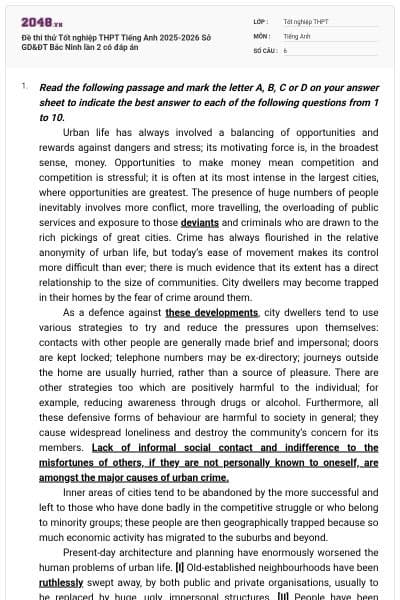
AI IN LANGUAGE LEARNING
The integration of Artificial Intelligence (AI) into language learning has revolutionized the way individuals acquire new tongues, moving the process from dusty textbooks to dynamic, interactive screens. [I] No longer confined to the rigid schedules of traditional classrooms, learners now have access to personalized tutors in their pockets, available twenty-four seven. [II] This transformation arises from advances in Natural Language Processing (NLP) and machine learning, which analyze large datasets and adapt lessons to each learner’s progress. [III] However, as with any disruptive technology, the ubiquity of AI in education brings both transformative benefits and significant challenges that merit close scrutiny. [IV]
One of the most touted advantages of AI is its ability to provide instant, non-judgmental feedback. In a traditional setting, a student might hesitate to speak for fear of making mistakes in front of peers. AI-powered apps, conversely, offer a safe space where learners can practice pronunciation and grammar repeatedly without embarrassment. Furthermore, these systems employ adaptive learning techniques; if a user struggles with the subjunctive mood in Spanish, the program notices and adds more exercises on that topic later. This level of personalization could not be achieved in a classroom with thirty students before.
Even so, people worry about losing the “human element” in language learning. Language is more than rules; it carries culture, emotion, and nuance. Too much dependence on AI could lead to shallow fluency: knowing the rules but not being able to use language well in real life.
Moreover, the role of the teacher is being reconfigured rather than replaced. The fear that AI will make educators obsolete is largely unfounded. Instead, the teacher's role is shifting from a deliverer of knowledge to a facilitator and mentor. Teachers can leverage AI tools to handle repetitive tasks like grading and vocabulary drilling, freeing up valuable class time for complex interactive activities, debates, and cultural immersion that machines cannot replicate.
Data privacy is another important issue. These apps collect lots of data to improve their programs. This raises questions about how this data is stored, who owns it, and whether it could be sold in ways that harm privacy.
In conclusion, while AI serves as a powerful supplementary tool that makes language learning more accessible and efficient, it should not replace human interaction. The future of learning will likely mix technology with human guidance. Machines handle the mechanics, while people help with connection and culture.
The End of Traditional Language Classrooms.
How AI Algorithms Work in Education.
Why Human Teachers are Better than Machines.
AI in Language Learning: A Double-Edged Sword.
Câu nào sau đây phù hợp nhất làm tiêu đề cho bài đọc?
A. Sự kết thúc của các lớp học ngôn ngữ truyền thống. (Sai, giáo viên không bị thay thế mà chỉ chuyển đổi vai trò).
B. Cách các thuật toán AI hoạt động trong giáo dục. (Chỉ là một ý nhỏ ở đoạn đầu).
C. Tại sao giáo viên con người lại tốt hơn máy móc. (Chỉ đề cập ở đoạn 3 và 4, không bao quát toàn bài).
D. AI trong việc học ngôn ngữ: Con dao hai lưỡi.
Bài đọc phân tích cả những lợi ích to lớn (tính cá nhân hóa, phản hồi tức thì ở đoạn 2) và những thách thức/nguy cơ đáng kể (thiếu yếu tố con người, sự nông cạn ở đoạn 3, vấn đề bảo mật dữ liệu ở đoạn 5). Cụm từ "a double-edged sword" (con dao hai lưỡi) phản ánh chính xác nhất tính chất hai mặt này.
Chọn D.
Which of the following best summarizes the reading passage?
AI has transformed language learning by providing 24/7 personalized, data-driven tutoring, and raises little concerns about human connection.
AI focuses solely on grammar and ignores cultural context but it is likely to replace teachers in language learning.
AI makes language learning more personalized and accessible, but human guidance remains essential for culture, nuance, and privacy.
AI's only benefit is faster feedback, with no significant drawbacks or considerations for culture and privacy.
Câu nào sau đây tóm tắt đúng nhất bài đọc?
A. AI đã thay đổi việc học ngôn ngữ bằng cách cung cấp dịch vụ dạy kèm dựa trên dữ liệu, được cá nhân hóa 24/7 và gây ra rất ít (little) mối lo ngại về kết nối con người. (Sai, bài đọc nói rất lo ngại về sự thiếu hụt kết nối con người).
B. AI chỉ tập trung vào ngữ pháp và bỏ qua bối cảnh văn hóa nhưng nó có khả năng (likely) thay thế giáo viên trong việc học ngôn ngữ. (Sai, giáo viên không bị thay thế).
C. AI làm cho việc học ngôn ngữ mang tính cá nhân hóa và dễ tiếp cận hơn, nhưng sự hướng dẫn của con người vẫn rất cần thiết cho văn hóa, sắc thái và vấn đề quyền riêng tư. (Đúng, thâu tóm hoàn hảo các ý chính của toàn bài).
D. Lợi ích duy nhất (only benefit) của AI là phản hồi nhanh hơn, không có nhược điểm hay cân nhắc đáng kể nào về văn hóa và quyền riêng tư. (Sai hoàn toàn).
Chọn C.
According to paragraph 2, why is AI considered a "safe space" for learners?
It connects them with other learners who are at the same level.
It protects their personal data securely.
It prevents them from making any grammatical errors.
It allows them to practice without fear of judgment from others.
Theo đoạn 2, tại sao AI được coi là một "không gian an toàn" đối với người học?
A. Nó kết nối họ với những người học khác ở cùng trình độ. (Sai).
B. Nó bảo vệ dữ liệu cá nhân của họ một cách an toàn.
(Sai, đoạn 5 nói bảo mật là một vấn đề đáng lo ngại).
C. Nó ngăn họ mắc bất kỳ lỗi ngữ pháp nào. (Sai).
D. Nó cho phép họ luyện tập mà không sợ bị người khác phán xét.
Bài đọc chỉ ra rằng khác với lớp học truyền thống nơi học sinh sợ mắc lỗi trước mặt bạn bè, AI cung cấp những phản hồi "không phán xét" (non-judgmental feedback), giúp người học luyện tập nhiều lần mà không sợ bị xấu hổ.
Thông tin: "In a traditional setting, a student might hesitate to speak for fear of making mistakes in front of peers. AI-powered apps, conversely, offer a safe space where learners can practice... without embarrassment." (Trong môi trường truyền thống, học sinh có thể ngần ngại phát biểu vì sợ mắc lỗi trước mặt bạn bè. Ngược lại, các ứng dụng hỗ trợ bởi trí tuệ nhân tạo cung cấp một không gian an toàn để người học có thể thực hành... mà không cảm thấy xấu hổ.)
Chọn D.
Which of the following is TRUE according to the passage?
AI tools can help save time for teachers by handling repetitive tasks.
The author believes AI will eventually replace human interaction entirely.
Teachers should stop teaching grammar and focus only on culture.
AI is currently capable of perfectly understanding sarcasm and cultural nuance.
Điều nào sau đây là ĐÚNG theo bài đọc?
A. Các công cụ AI có thể giúp tiết kiệm thời gian cho giáo viên bằng cách xử lý các nhiệm vụ lặp đi lặp lại. (Đúng).
B. Tác giả tin rằng AI cuối cùng sẽ thay thế hoàn toàn sự tương tác của con người.
(Sai, tác giả khẳng định không nên thay thế tương tác con người).
C. Giáo viên nên ngừng dạy ngữ pháp và chỉ tập trung vào văn hóa.
(Sai, bài không khuyên ngừng dạy ngữ pháp).
D. AI hiện có khả năng hiểu hoàn hảo sự mỉa mai và sắc thái văn hóa.
(Sai, máy móc không thể sao chép được văn hóa, cảm xúc và sắc thái).
Thông tin: "Teachers can leverage AI tools to handle repetitive tasks like grading and vocabulary drilling, freeing up valuable class time..." (Giáo viên có thể tận dụng các công cụ AI để xử lý các nhiệm vụ lặp đi lặp lại như chấm điểm và rèn luyện từ vựng, giải phóng thời gian quý báu trên lớp...)
Chọn A.
auxiliary
supporting
main
unnecessary
Từ "supplementary" trong đoạn cuối TRÁI NGHĨA với ____________.
supplementary (adj): bổ sung, phụ thêm
A. auxiliary (adj): phụ trợ, bổ sung
B. supporting (adj): hỗ trợ
C. main (adj): chính, chủ yếu
D. unnecessary (adj): không cần thiết
→ supplementary >< main
Thông tin: "...while AI serves as a powerful supplementary tool... it should not replace human interaction." (...mặc dù AI đóng vai trò là một công cụ bổ sung mạnh mẽ... nó không nên thay thế sự tương tác của con người.)
Chọn C.
The ethical privacy of AI.
The compromise of user privacy.
The collecting of immense amounts of user data.
The using of collected data.
Từ "This" ở đoạn 5 chỉ ____________.
A. Đạo đức về quyền riêng tư của AI.
B. Sự thỏa hiệp về quyền riêng tư của người dùng.
C. Việc thu thập lượng lớn dữ liệu của người dùng.
D. Việc sử dụng dữ liệu đã thu thập.
Đại từ "This" (Điều này) dùng để chỉ sự việc vừa được nhắc đến ở câu ngay trước đó: "Những ứng dụng này thu thập rất nhiều dữ liệu để cải thiện chương trình của chúng". Chính việc thu thập lượng lớn dữ liệu này (This) đã làm nảy sinh các câu hỏi về việc dữ liệu được lưu trữ như thế nào.
Thông tin: "These apps collect lots of data to improve their programs. This raises questions about how this data is stored..." (Những ứng dụng này thu thập rất nhiều dữ liệu để cải thiện chương trình của chúng. Điều này đặt ra những câu hỏi về cách dữ liệu này được lưu trữ...)
Chọn C.
Which of the following best paraphrases the underlined sentence in paragraph 4?
Teachers should take care of more engaging activities while repetitive tasks are for AI tools.
AI tools can do both the repetitive tasks and complex interactive activities without the help of teachers.
Teachers should upgrade AI tools so that they can devote to harder, more engaging activities.
Teachers can use AI tools to do repetitive, mechanical tasks so that they can devote to harder, more engaging activities.
Câu nào sau đây diễn giải đúng nhất câu được gạch chân ở đoạn 4?
Teachers can leverage AI tools to handle repetitive tasks like grading and vocabulary drilling, freeing up valuable class time for complex interactive activities, debates, and cultural immersion that machines cannot replicate. (Giáo viên có thể tận dụng các công cụ AI để xử lý các nhiệm vụ lặp đi lặp lại như chấm điểm và rèn luyện từ vựng, giải phóng thời gian quý báu trên lớp cho các hoạt động tương tác phức tạp, tranh luận và đắm chìm văn hóa mà máy móc không thể sao chép.)
A. Giáo viên nên đảm nhận các hoạt động hấp dẫn hơn trong khi các nhiệm vụ lặp đi lặp lại dành cho AI. (Đúng về nghĩa nhưng diễn đạt lỏng lẻo, thiếu sự liên kết nguyên nhân - hệ quả của việc giải phóng thời gian).
B. Các công cụ AI có thể làm CẢ nhiệm vụ lặp đi lặp lại và hoạt động tương tác phức tạp mà không cần sự trợ giúp của giáo viên. (Sai, AI không làm được hoạt động phức tạp/văn hóa).
C. Giáo viên nên nâng cấp các công cụ AI để có thể dành thời gian cho các hoạt động khó hơn, hấp dẫn hơn. (Sai).
D. Giáo viên có thể sử dụng các công cụ AI để làm các nhiệm vụ lặp đi lặp lại, mang tính cơ học để họ có thể cống hiến cho các hoạt động hấp dẫn, khó hơn. (Đúng, diễn đạt trọn vẹn ý: dùng AI làm việc chân tay → có thời gian làm việc đầu óc/con người).
Chọn D.
Where in paragraph 1 does the following sentence best fit?
"For instance, apps like Duolingo or chatbots powered by generative AI can simulate conversations that adapt in real-time to the user's responses."
[IV]
[III]
[I]
[II]
Câu sau đây phù hợp nhất với vị trí nào trong đoạn 1?
"For instance, apps like Duolingo or chatbots powered by generative AI can simulate conversations that adapt in real-time to the user's responses." (Ví dụ, các ứng dụng như Duolingo hoặc các chatbot được cung cấp năng lượng bởi AI tạo sinh có thể mô phỏng các cuộc hội thoại thích ứng theo thời gian thực với phản hồi của người dùng.)
Cụm từ "For instance" (Ví dụ) đòi hỏi câu trước đó phải nhắc đến một tính năng chung chung. Trước vị trí [II], tác giả viết: "...người học hiện có quyền truy cập vào các gia sư được cá nhân hóa trong túi của họ..." (access to personalized tutors in their pockets). Câu gạch chân lấy ví dụ cụ thể về ứng dụng (Duolingo/chatbots) chính là các "gia sư trong túi" này, và chức năng "thích ứng theo thời gian thực" là ví dụ cho sự "cá nhân hóa". Do đó, đặt ở vị trí [II] là liền mạch nhất.
Chọn D.
What can be inferred about the future of language learning from the passage?
It will be completely automated with no need for human teachers.
It will focus solely on translation rather than communication.
It will likely involve a blend of AI technology and human guidance.
It will return to traditional methods as people reject technology.
Có thể suy luận gì về tương lai của việc học ngôn ngữ từ bài đọc?
A. Nó sẽ được tự động hóa hoàn toàn mà không cần giáo viên con người. (Sai).
B. Nó sẽ chỉ tập trung vào việc dịch thuật thay vì giao tiếp. (Sai).
C. Nó có thể sẽ liên quan đến sự kết hợp giữa công nghệ AI và sự hướng dẫn của con người. (Đúng).
D. Nó sẽ quay trở lại các phương pháp truyền thống vì mọi người từ chối công nghệ. (Sai).
Tác giả khẳng định rõ ràng ở đoạn cuối rằng tương lai sẽ là sự kết hợp: Máy móc lo phần cơ học, con người lo phần kết nối và văn hóa.
Thông tin: "The future of learning will likely mix technology with human guidance. Machines handle the mechanics, while people help with connection and culture." (Tương lai của việc học có thể sẽ là sự pha trộn giữa công nghệ với sự hướng dẫn của con người. Máy móc xử lý phần cơ học, trong khi con người giúp đỡ về sự kết nối và văn hóa.)
Chọn C.
ignored
preserved
reshaped
eliminated
Từ "reconfigured" ở đoạn 4 gần nghĩa nhất với ____________.
reconfigure (v): tái cấu trúc, thiết lập lại, định hình lại
A. ignored (v): phớt lờ
B. preserved (v): bảo tồn
C. reshaped (v): định hình lại
D. eliminated (v): loại bỏ
→ reconfigured = reshaped
Thông tin: "...the role of the teacher is being reconfigured rather than replaced." (...vai trò của người giáo viên đang được định hình lại/thiết lập lại chứ không phải bị thay thế.)
Chọn C.
Dịch bài đọc:
AI TRONG VIỆC HỌC NGÔN NGỮ
Việc tích hợp Trí tuệ Nhân tạo (AI) vào việc học ngôn ngữ đã cách mạng hóa cách các cá nhân tiếp thu những ngôn ngữ mới, chuyển quá trình này từ những cuốn sách giáo khoa bụi bặm sang các màn hình tương tác, năng động. [I] Không còn bị giới hạn bởi các lịch trình cứng nhắc của các lớp học truyền thống, người học hiện có quyền truy cập vào các gia sư được cá nhân hóa ngay trong túi của họ, sẵn sàng phục vụ hai mươi bốn trên bảy. [II] (Ví dụ, các ứng dụng như Duolingo hoặc các chatbot được cung cấp năng lượng bởi AI tạo sinh có thể mô phỏng các cuộc hội thoại thích ứng theo thời gian thực với phản hồi của người dùng.) [III] Sự chuyển đổi này bắt nguồn từ những tiến bộ trong Xử lý Ngôn ngữ Tự nhiên (NLP) và học máy, những thứ phân tích các tập dữ liệu lớn và điều chỉnh các bài học cho phù hợp với tiến độ của từng người học. [IV] Tuy nhiên, cũng giống như bất kỳ công nghệ mang tính đột phá nào, sự hiện diện ở khắp mọi nơi của AI trong giáo dục mang lại cả những lợi ích mang tính biến đổi lẫn những thách thức đáng kể cần được xem xét kỹ lưỡng.
Một trong những lợi thế được ca ngợi nhiều nhất của AI là khả năng cung cấp phản hồi tức thì và không phán xét. Trong một môi trường truyền thống, một học sinh có thể ngần ngại lên tiếng vì sợ mắc lỗi trước mặt bạn bè. Ngược lại, các ứng dụng do AI hỗ trợ cung cấp một không gian an toàn, nơi người học có thể luyện tập phát âm và ngữ pháp nhiều lần mà không hề cảm thấy xấu hổ. Hơn nữa, các hệ thống này sử dụng các kỹ thuật học tập thích ứng; nếu một người dùng gặp khó khăn với thức giả định trong tiếng Tây Ban Nha, chương trình sẽ nhận ra và thêm nhiều bài tập hơn về chủ đề đó vào lúc sau. Mức độ cá nhân hóa này là điều không thể đạt được trong một lớp học có ba mươi học sinh trước đây.
Dù vậy, mọi người vẫn lo lắng về việc đánh mất "yếu tố con người" trong việc học ngôn ngữ. Ngôn ngữ không chỉ là các quy tắc; nó mang theo văn hóa, cảm xúc và các sắc thái. Việc phụ thuộc quá nhiều vào AI có thể dẫn đến một sự trôi chảy nông cạn: biết các quy tắc nhưng không thể sử dụng ngôn ngữ tốt trong cuộc sống thực.
Hơn nữa, vai trò của người giáo viên đang được định hình lại chứ không phải bị thay thế. Nỗi sợ hãi rằng AI sẽ làm cho các nhà giáo dục trở nên lỗi thời phần lớn là không có cơ sở. Thay vào đó, vai trò của giáo viên đang chuyển từ một người truyền đạt kiến thức sang một người tạo điều kiện và cố vấn. Giáo viên có thể tận dụng các công cụ AI để xử lý các nhiệm vụ lặp đi lặp lại như chấm điểm và rèn luyện từ vựng, giải phóng thời gian quý báu trên lớp cho các hoạt động tương tác phức tạp, tranh luận và đắm chìm vào văn hóa mà máy móc không thể sao chép.
Quyền riêng tư dữ liệu là một vấn đề quan trọng khác. Những ứng dụng này thu thập rất nhiều dữ liệu để cải thiện chương trình của chúng. Điều này đặt ra những câu hỏi về việc dữ liệu này được lưu trữ như thế nào, ai sở hữu nó và liệu nó có thể bị bán theo những cách gây tổn hại đến quyền riêng tư hay không.
Tóm lại, mặc dù AI đóng vai trò là một công cụ bổ sung mạnh mẽ giúp việc học ngôn ngữ trở nên dễ tiếp cận và hiệu quả hơn, nó không nên thay thế sự tương tác của con người. Tương lai của việc học có thể sẽ là sự pha trộn giữa công nghệ với sự hướng dẫn của con người. Máy móc xử lý phần cơ học, trong khi con người giúp đỡ về sự kết nối và văn hóa.