Đề thi thử Tốt nghiệp THPT Tiếng Anh 2025-2026 THPT Thăng Long (Hà Nội) có đáp án
40 câu hỏi
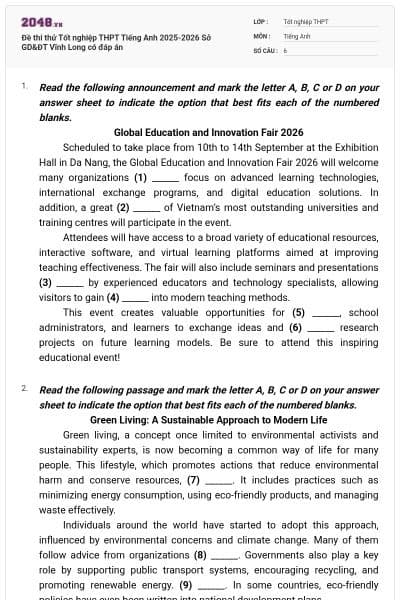
Read the following advertisement and mark the letter A, B, C or D on your answer sheet to indicate the option that best fits each of the numbered blanks from 1 to 6.
Revolutionize Your Air – Breathe Purity Like Never Before!
In an era where air pollution has insidiously permeated every corner of urban life, AeroPure X emerges as the ultimate game-changer, redefining the very essence of clean air. Equipped (1) ____________ cutting-edge nanofiltration technology, this state-of-the-art air purifier eradicates a large (2) ____________ of airborne pollutants - an achievement unrivaled in modern purification systems. Designed with an AI-powered (3) ____________ filtration system, AeroPure X automatically adjusts to fluctuating pollution levels, ensuring an unparalleled indoor atmosphere. The device, engineered to neutralize even the most pernicious toxins, operates in whisper-quiet mode, seamlessly (4) ____________ your lifestyle. With a sleek, minimalist (5) ____________, it transforms your living space into a sanctuary where clean air is no longer a luxury but a given. For those grappling with respiratory ailments, this revolutionary purifier acts as a lifeline, (6) ____________ your health from the relentless onslaught of pollution.
(Adapted from The World Economic Forum)
into
for
with
at
A. into (prep): vào trong.
B. for (prep): cho, vì.
C. with (prep): với.
D. at (prep): tại, ở.
Ta có cấu trúc cố định mang nghĩa bị động: be equipped with something (được trang bị cái gì).
Chọn C. with
→ Equipped with cutting-edge nanofiltration technology, this state-of-the-art air purifier eradicates...
Dịch nghĩa: Được trang bị công nghệ lọc nano tiên tiến, chiếc máy lọc không khí hiện đại này loại bỏ...
amount
number
abundance
wealth
A. amount (n): số lượng, khối lượng (dùng trước danh từ không đếm được).
B. number (n): số lượng (dùng trước danh từ đếm được số nhiều).
C. abundance (n): sự phong phú, dồi dào.
D. wealth (n): sự giàu có, số lượng lớn (thường dùng: a wealth of experience/information).
Phía sau khoảng trống là danh từ đếm được số nhiều "pollutants" (các chất ô nhiễm).
Cấu trúc đúng là a large number of + N (đếm được số nhiều): một số lượng lớn những...
Chọn B. number
→ ...this state-of-the-art air purifier eradicates a large number of airborne pollutants...
Dịch nghĩa: ...chiếc máy lọc không khí hiện đại này loại bỏ một số lượng lớn các chất ô nhiễm trong không khí...
attractive
consecutive
negative
adaptive
A. attractive (adj): hấp dẫn, lôi cuốn.
B. consecutive (adj): liên tục, liên tiếp.
C. negative (adj): tiêu cực.
D. adaptive (adj): có khả năng thích ứng, thích nghi.
Ngữ cảnh: Hệ thống lọc này được hỗ trợ bởi AI và có khả năng "tự động điều chỉnh" (automatically adjusts) theo sự biến động của mức độ ô nhiễm. Do đó, tính từ "thích ứng" là phù hợp nhất về mặt ngữ nghĩa.
Chọn D. adaptive
→ Designed with an AI-powered adaptive filtration system, AeroPure X automatically adjusts to fluctuating pollution levels...
Dịch nghĩa: Được thiết kế với hệ thống lọc thích ứng được hỗ trợ bởi AI, AeroPure X tự động điều chỉnh theo mức độ ô nhiễm biến động...
fitting in with
watching out for
speaking down to
getting along with
A. fitting in with (phr.v): hòa hợp với, phù hợp với.
B. watching out for (phr.v): coi chừng, cẩn thận với.
C. speaking down to (phr.v): nói giọng kẻ cả, trịch thượng với ai.
D. getting along with (phr.v): hòa thuận với (ai đó).
Ngữ cảnh: Chiếc máy hoạt động cực kỳ êm ái và "hòa hợp / phù hợp" một cách hoàn hảo với lối sống của bạn.
Chọn A. fitting in with
→ The device... operates in whisper-quiet mode, seamlessly fitting in with your lifestyle.
Dịch nghĩa: Thiết bị... hoạt động ở chế độ yên tĩnh như tiếng thì thầm, hòa hợp một cách liền mạch với lối sống của bạn.
aesthete
aesthetically
aesthetic
aesthetician
A. aesthete (n): người sành điệu, người yêu cái đẹp/nghệ thuật.
B. aesthetically (adv): về mặt thẩm mỹ.
C. aesthetic (n/adj): tính thẩm mỹ, phong cách thẩm mỹ / thuộc về thẩm mỹ.
D. aesthetician (n): chuyên viên thẩm mỹ (chăm sóc sắc đẹp).
Phân tích từ loại: Phía trước khoảng trống là mạo từ "a" và các tính từ "sleek" (kiểu dáng đẹp), "minimalist" (tối giản). Vị trí này cần một danh từ để tạo thành cụm danh từ. Từ "aesthetic" ngoài chức năng tính từ còn được dùng như một danh từ (phong cách thẩm mỹ), rất thường gặp trong thiết kế.
Chọn C. aesthetic
→ With a sleek, minimalist aesthetic, it transforms your living space into a sanctuary...
Dịch nghĩa: Với một phong cách thẩm mỹ tối giản, kiểu dáng đẹp, nó biến không gian sống của bạn thành một nơi tôn nghiêm...
For those grappling with respiratory ailments, this revolutionary purifier acts as a lifeline, (6) ____________ your health from the relentless onslaught of pollution.
shielded
shielding
is shielded
to shield
A. shielded (v-ed/v3): phân từ hai (mang nghĩa bị động).
B. shielding (v-ing): hiện tại phân từ (mang nghĩa chủ động).
C. is shielded (v): động từ chia bị động thì hiện tại đơn.
D. to shield (to-v): động từ nguyên thể có "to".
Phân tích ngữ pháp: Rút gọn mệnh đề trạng ngữ / mệnh đề quan hệ mang nghĩa chủ động. Chiếc máy lọc này hoạt động như một cứu cánh, (nó) "bảo vệ" sức khỏe của bạn. Hành động bảo vệ là chủ động do thiết bị thực hiện, nên ta dùng V-ing.
Chọn B. shielding
→ ...this revolutionary purifier acts as a lifeline, shielding your health from the relentless onslaught of pollution.
Dịch nghĩa: ...chiếc máy lọc mang tính cách mạng này hoạt động như một cứu cánh, bảo vệ sức khỏe của bạn khỏi sự tấn công không ngừng của ô nhiễm.
Bài đọc hoàn chỉnh | Dịch bài đọc |
Revolutionize Your Air – Breathe Purity Like Never Before! In an era where air pollution has insidiously permeated every corner of urban life, AeroPure X emerges as the ultimate game-changer, redefining the very essence of clean air. Equipped (1) with cutting-edge nanofiltration technology, this state-of-the-art air purifier eradicates a large (2) number of airborne pollutants - an achievement unrivaled in modern purification systems. Designed with an AI-powered (3) adaptive filtration system, AeroPure X automatically adjusts to fluctuating pollution levels, ensuring an unparalleled indoor atmosphere. The device, engineered to neutralize even the most pernicious toxins, operates in whisper-quiet mode, seamlessly (4) fitting in with your lifestyle. With a sleek, minimalist (5) aesthetic, it transforms your living space into a sanctuary where clean air is no longer a luxury but a given. For those grappling with respiratory ailments, this revolutionary purifier acts as a lifeline, (6) shielding your health from the relentless onslaught of pollution. | Cách Mạng Hóa Bầu Không Khí Của Bạn – Hít Thở Sự Trong Lành Chưa Từng Có! Trong thời đại mà ô nhiễm không khí đã âm thầm len lỏi vào mọi ngóc ngách của cuộc sống đô thị, AeroPure X nổi lên như một yếu tố thay đổi cuộc chơi tối thượng, định nghĩa lại bản chất thực sự của không khí sạch. Được trang bị (1) với công nghệ lọc nano tiên tiến, chiếc máy lọc không khí hiện đại này loại bỏ một (2) số lượng lớn các chất ô nhiễm trong không khí - một thành tựu không đối thủ trong các hệ thống lọc hiện đại. Được thiết kế với hệ thống lọc (3) thích ứng được hỗ trợ bởi AI, AeroPure X tự động điều chỉnh theo mức độ ô nhiễm biến động, đảm bảo một bầu không khí trong nhà vô song. Thiết bị này, được chế tạo để vô hiệu hóa cả những độc tố nguy hiểm nhất, hoạt động ở chế độ êm ái như tiếng thì thầm, (4) hòa hợp một cách liền mạch với lối sống của bạn. Với (5) phong cách thẩm mỹ tối giản, kiểu dáng đẹp, nó biến không gian sống của bạn thành một nơi tôn nghiêm, nơi không khí sạch không còn là một thứ xa xỉ mà là một điều hiển nhiên. Đối với những người đang phải vật lộn với các căn bệnh về đường hô hấp, chiếc máy lọc mang tính cách mạng này đóng vai trò như một chiếc phao cứu sinh, (6) bảo vệ sức khỏe của bạn khỏi sự tấn công không khoan nhượng của sự ô nhiễm. |
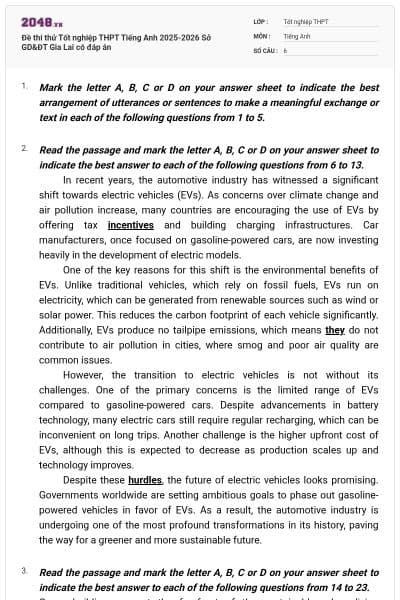
Read the following passage and mark the letter A, B, C or D on your answer sheet to indicate the option that best fits each of the numbered blanks from 7 to 12.
Evolving Competency Frameworks in the Era of Lifelong Learning
The architecture of corporate knowledge ecosystems has been fundamentally reimagined as organizations actively (7) ____________ the necessity of cultivating adaptive expertise to navigate volatile market landscapes. This strategic realignment diverges sharply from antiquated paradigms in which professional growth was perceived as episodic rather than continuous. Global think tanks note a dramatic escalation in demand for executive education programs and specialized industry certifications.
Forward-looking employees now allocate a substantial (8) ____________ of their annual budgets to acquiring advanced analytical proficiencies and sector-specific innovations. When individuals are (9) ____________ transformative skill sets, they often uncover synergies between technological fluency and creative problem-solving, amplifying their strategic value. This synthesis of disciplines demands sustained mental dexterity and resilience under pressure.
A spectrum of instructional formats caters to heterogeneous learner profiles. While some professionals thrive in collaborative workshops, others prefer asynchronous self-directed study. Digital immersion tools enable participants to (10) ____________ constructs at an accelerated pace, especially through gamified simulations and augmented reality environments. The didactic methodologies, however, differ considerably across delivery channels. Recruiters now place exceptional emphasis on applicants who manifest a demonstrable trajectory of skill evolution. (11) ____________ practitioners remain skeptical of perpetual learning models, the prevailing consensus within competitive industries is that adaptability constitutes a non-negotiable criterion for advancement. Enterprises embedding lifelong learning into their operational ethos consistently secure leadership positions in innovation indices and global market share rankings, leaving (12) ____________ room for complacency in a rapidly evolvingeconomy.
assimilate
estimate
internalize
embrace
A. assimilate (v): đồng hóa, tiêu hóa (kiến thức).
B. estimate (v): ước tính, ước lượng.
C. internalize (v): tiếp thu, nội tâm hóa.
D. embrace (v): đón nhận, nhiệt tình chấp nhận (một ý tưởng, sự thay đổi).
Ngữ cảnh: Trong kỷ nguyên mới, các tổ chức chủ động "đón nhận/chấp nhận" sự cần thiết của việc trau dồi chuyên môn để thích ứng. Ta có sự kết hợp từ phổ biến: embrace the necessity (đón nhận sự cần thiết).
Chọn D. embrace
→ ...organizations actively embrace the necessity of cultivating adaptive expertise to navigate volatile market landscapes.
Dịch nghĩa: ...các tổ chức chủ động đón nhận sự cần thiết của việc trau dồi chuyên môn thích ứng để điều hướng các bối cảnh thị trường đầy biến động.
proportion
allotment
segment
fraction
A. proportion (n): tỷ lệ, phần (thường dùng để chỉ một phần lớn của tổng thể).
B. allotment (n): phần được giao, sự phân công.
C. segment (n): phân khúc, đoạn.
D. fraction (n): phân số, một phần nhỏ.
Ta có cụm từ a substantial proportion of something (một phần đáng kể / một tỷ lệ lớn của cái gì). Trong ngữ cảnh này là một phần đáng kể của ngân sách hàng năm.
Chọn A. proportion
→ Forward-looking employees now allocate a substantial proportion of their annual budgets to acquiring advanced analytical proficiencies...
Dịch nghĩa: Những nhân viên có tầm nhìn xa hiện phân bổ một phần đáng kể ngân sách hàng năm của họ để đạt được các năng lực phân tích nâng cao...
to cultivate
cultivating
cultivated
cultivate
A. to cultivate: động từ nguyên thể có "to".
B. cultivating: hiện tại phân từ (V-ing).
C. cultivated: quá khứ phân từ (V-ed/V3).
D. cultivate: động từ nguyên mẫu.
Phân tích ngữ pháp: Cấu trúc thì hiện tại tiếp diễn thể chủ động: be + V-ing (đang làm gì). Chủ ngữ "individuals" (các cá nhân) thực hiện hành động "cultivate" (trau dồi) bộ kỹ năng, nên động từ mang nghĩa chủ động.
Chọn B. cultivating
→ When individuals are cultivating transformative skill sets, they often uncover synergies...
Dịch nghĩa: Khi các cá nhân đang trau dồi những bộ kỹ năng mang tính chuyển đổi, họ thường khám phá ra sự hiệp đồng...
deconstruct intricate theoretical
intricate theoretical deconstruct
theoretical intricate deconstruct
intricate deconstruct theoretical
Phân tích trật tự từ: Vị trí sau "to" cần một động từ nguyên thể: "deconstruct" (phá vỡ, mổ xẻ). Phía sau nó là danh từ "constructs" (các khái niệm). Đứng trước danh từ này cần các tính từ bổ nghĩa theo trật tự: Tính từ chỉ quan điểm/tính chất "intricate" (phức tạp) + Tính từ chỉ loại hình "theoretical" (thuộc về lý thuyết). Trật tự đúng là: Động từ + Tính từ 1 + Tính từ 2.
Chọn A. deconstruct intricate theoretical
→ Digital immersion tools enable participants to deconstruct intricate theoretical constructs at an accelerated pace...
Dịch nghĩa: Các công cụ nhập vai kỹ thuật số cho phép người tham gia mổ xẻ các khái niệm lý thuyết phức tạp với tốc độ nhanh chóng...
Although
However
In addition
With regard to
A. Although (conj): Mặc dù (+ mệnh đề).
B. However (adv): Tuy nhiên (thường đứng sau dấu chấm hoặc chấm phẩy).
C. In addition (adv): Ngoài ra.
D. With regard to (prep): Liên quan đến (+ danh từ/V-ing).
Câu có hai mệnh đề mang ý nghĩa tương phản. Mệnh đề 1: Một số người hành nghề vẫn hoài nghi (remain skeptical). Mệnh đề 2: Sự đồng thuận chung cho rằng khả năng thích ứng là tiêu chí không thể thương lượng. Từ nối chỉ sự nhượng bộ "mặc dù" đứng đầu câu là chính xác nhất.
Chọn A. Although
→ Although practitioners remain skeptical of perpetual learning models, the prevailing consensus...
Dịch nghĩa: Mặc dù những người hành nghề vẫn hoài nghi về các mô hình học tập vĩnh viễn, sự đồng thuận phổ biến...
few
little
a few
a little
A. few: rất ít, hầu như không (mang nghĩa phủ định, + danh từ đếm được số nhiều).
B. little: rất ít, hầu như không (mang nghĩa phủ định, + danh từ không đếm được).
C. a few: một vài (mang nghĩa khẳng định, + danh từ đếm được số nhiều).
D. a little: một chút (mang nghĩa khẳng định, + danh từ không đếm được).
Phân tích: Danh từ "room" (không gian, chỗ trống - ở đây mang nghĩa trừu tượng) là danh từ không đếm được. Cụm từ leave little room for something nghĩa là "hầu như không chừa lại chỗ cho cái gì" (thể hiện sự khắt khe, không dung túng). Ở đây là không chừa chỗ cho sự "complacency" (sự tự mãn).
Chọn B. little
→ ...leaving little room for complacency in a rapidly evolving economy.
Dịch nghĩa: ...hầu như không chừa lại chỗ cho sự tự mãn trong một nền kinh tế đang phát triển nhanh chóng.
Bài đọc hoàn chỉnh | Dịch bài đọc |
Evolving Competency Frameworks in the Era of Lifelong Learning The architecture of corporate knowledge ecosystems has been fundamentally reimagined as organizations actively (7) embrace the necessity of cultivating adaptive expertise to navigate volatile market landscapes. This strategic realignment diverges sharply from antiquated paradigms in which professional growth was perceived as episodic rather than continuous. Global think tanks note a dramatic escalation in demand for executive education programs and specialized industry certifications. Forward-looking employees now allocate a substantial (8) proportion of their annual budgets to acquiring advanced analytical proficiencies and sector-specific innovations. When individuals are (9) cultivating transformative skill sets, they often uncover synergies between technological fluency and creative problem-solving, amplifying their strategic value. This synthesis of disciplines demands sustained mental dexterity and resilience under pressure. A spectrum of instructional formats caters to heterogeneous learner profiles. While some professionals thrive in collaborative workshops, others prefer asynchronous self-directed study. Digital immersion tools enable participants to (10) deconstruct intricate theoretical constructs at an accelerated pace, especially through gamified simulations and augmented reality environments. The didactic methodologies, however, differ considerably across delivery channels. Recruiters now place exceptional emphasis on applicants who manifest a demonstrable trajectory of skill evolution. (11) Although practitioners remain skeptical of perpetual learning models, the prevailing consensus within competitive industries is that adaptability constitutes a non-negotiable criterion for advancement. Enterprises embedding lifelong learning into their operational ethos consistently secure leadership positions in innovation indices and global market share rankings, leaving (12) little room for complacency in a rapidly evolving economy. | Các Khung Năng Lực Đang Phát Triển Trong Kỷ Nguyên Học Tập Suốt Đời Kiến trúc của các hệ sinh thái kiến thức doanh nghiệp đã được tái định hình một cách cơ bản khi các tổ chức chủ động (7) đón nhận sự cần thiết của việc trau dồi chuyên môn thích ứng để điều hướng các bối cảnh thị trường đầy biến động. Sự tái cơ cấu chiến lược này khác biệt rõ rệt so với các mô hình lỗi thời, trong đó sự phát triển nghề nghiệp được coi là từng đợt rải rác thay vì liên tục. Các tổ chức tư vấn toàn cầu ghi nhận sự leo thang đột ngột trong nhu cầu đối với các chương trình giáo dục quản lý và các chứng chỉ chuyên ngành đặc thù. Những nhân viên có tầm nhìn xa hiện phân bổ một (8) phần đáng kể ngân sách hàng năm của họ để đạt được các năng lực phân tích nâng cao và những đổi mới đặc thù của lĩnh vực. Khi các cá nhân đang (9) trau dồi những bộ kỹ năng mang tính chuyển đổi, họ thường khám phá ra sự hiệp đồng giữa sự lưu loát về công nghệ và khả năng giải quyết vấn đề sáng tạo, qua đó khuếch đại giá trị chiến lược của mình. Sự tổng hợp các kỷ luật này đòi hỏi sự nhạy bén trí tuệ và khả năng phục hồi bền bỉ dưới áp lực. Một dải rộng các hình thức giảng dạy phục vụ cho những hồ sơ người học đa dạng. Trong khi một số chuyên gia phát triển mạnh mẽ trong các hội thảo hợp tác, những người khác lại ưa chuộng việc tự học không đồng bộ. Các công cụ nhập vai kỹ thuật số cho phép người tham gia (10) mổ xẻ các khái niệm lý thuyết phức tạp với tốc độ nhanh chóng, đặc biệt là thông qua các mô phỏng được trò chơi hóa và môi trường thực tế tăng cường. Tuy nhiên, các phương pháp giảng dạy khác biệt đáng kể giữa các kênh phân phối. Các nhà tuyển dụng hiện nay đặc biệt nhấn mạnh vào những ứng viên thể hiện được một quỹ đạo tiến hóa kỹ năng rõ ràng. (11) Mặc dù những người hành nghề vẫn hoài nghi về các mô hình học tập vĩnh viễn, sự đồng thuận phổ biến trong các ngành công nghiệp cạnh tranh là khả năng thích ứng tạo thành một tiêu chí không thể thương lượng để thăng tiến. Các doanh nghiệp đưa việc học tập suốt đời vào đặc tính hoạt động của họ luôn giành được vị trí lãnh đạo trong các chỉ số đổi mới và bảng xếp hạng thị phần toàn cầu, (12) hầu như không chừa lại chỗ cho sự tự mãn trong một nền kinh tế đang phát triển nhanh chóng. |
Mark the letter A, B, C or D on your answer sheet to indicate the best arrangement of utterances or sentences to make a meaningful exchange or text in each of the following questions from 13 to 17.
a.William: Precisely. Without foundational digital literacy, technological interventions remain superficial and ineffective.
b.William: Educational prerequisites constitute the most formidable obstacle to bridging the digital divide in developing nations.
c.Sophia: The infrastructure disparity between urban centers and rural peripheries exacerbates these educational inequalities significantly.
a-c-b
c-a-b
b-c-a
c-b-a
Thứ tự sắp xếp đúng: C. b – c – a
b. William: Educational prerequisites constitute the most formidable obstacle to bridging the digital divide in developing nations.
c. Sophia: The infrastructure disparity between urban centers and rural peripheries exacerbates these educational inequalities significantly.
a. William: Precisely. Without foundational digital literacy, technological interventions remain superficial and ineffective.
Dịch nghĩa:
b. William: Các điều kiện tiên quyết về giáo dục tạo thành trở ngại đáng gờm nhất đối với việc thu hẹp khoảng cách kỹ thuật số ở các quốc gia đang phát triển.
c. Sophia: Sự chênh lệch về cơ sở hạ tầng giữa các trung tâm đô thị và vùng ngoại vi nông thôn làm trầm trọng thêm những bất bình đẳng về giáo dục này một cách đáng kể.
a. William: Chính xác. Nếu không có kiến thức kỹ thuật số nền tảng, các can thiệp công nghệ vẫn chỉ mang tính bề ngoài và kém hiệu quả.
Chọn C.
a.Sean: I agree. Sometimes people don’t realize how much unresolved issues affect their daily mood and relationships.
b.Sean: My cousin’s constant arguments at home are taking a toll on her mental health, and she’s finding it hard to break old patterns and communicate openly.
c.Serena: That’s true. Family conflicts often influence not just our personal life but also our work and social life.
d.Serena: That sounds really tough for your cousin. Getting stuck in the same family patterns is hard, and openly communicating requires courage and patience.
e.Serena: Dealing with family problems can be really stressful, especially when emotions run high and communication breaks down.
e-a-c-b-d
a-e-d-c-b
a-e-b-c-d
b-e-c-a-d
Thứ tự sắp xếp đúng: A. e – a – c – b – d
e. Serena: Dealing with family problems can be really stressful, especially when emotions run high and communication breaks down.
a. Sean: I agree. Sometimes people don’t realize how much unresolved issues affect their daily mood and relationships.
c. Serena: That’s true. Family conflicts often influence not just our personal life but also our work and social life.
b. Sean: My cousin’s constant arguments at home are taking a toll on her mental health, and she’s finding it hard to break old patterns and communicate openly.
d. Serena: That sounds really tough for your cousin. Getting stuck in the same family patterns is hard, and openly communicating requires courage and patience.
Dịch nghĩa:
e. Serena: Giải quyết các vấn đề gia đình có thể thực sự căng thẳng, đặc biệt là khi cảm xúc dâng cao và giao tiếp bị phá vỡ.
a. Sean: Tớ đồng ý. Đôi khi mọi người không nhận ra những vấn đề chưa được giải quyết ảnh hưởng lớn thế nào đến tâm trạng hàng ngày và các mối quan hệ của họ.
c. Serena: Đúng vậy. Xung đột gia đình thường không chỉ ảnh hưởng đến cuộc sống cá nhân mà còn cả công việc và đời sống xã hội của chúng ta.
b. Sean: Những cuộc cãi vã liên miên ở nhà của chị họ tớ đang ảnh hưởng nặng nề đến sức khỏe tinh thần của chị ấy, và chị ấy thấy khó khăn để phá bỏ những nếp cũ và giao tiếp cởi mở.
d. Serena: Nghe có vẻ thực sự khó khăn cho chị họ của cậu. Mắc kẹt trong cùng một khuôn mẫu gia đình là điều rất khó khăn, và việc giao tiếp cởi mở đòi hỏi sự can đảm và kiên nhẫn.
Chọn A.
Dear Dr. John,
a.The psychological mechanisms underlying human resilience during catastrophic events have captured my research interest intensely.
b.I am writing to request your guidance regarding my doctoral dissertation proposal on crisis psychology.
c.Your seminal work on post-traumatic growth has provided invaluable theoretical frameworks for my investigation.
d.Specifically, I am intrigued by the neuroplasticity adaptations that facilitate emotional recovery following severe trauma.
e.Would you consider serving as my dissertation advisor for this complex interdisciplinary project?
Respectfully, Andrew
e-a-d-c-b
a-d-c-b-e
b-c-a-d-e
c-a-e-d-b
Thứ tự sắp xếp đúng: C. b – c – a – d – e
b. I am writing to request your guidance regarding my doctoral dissertation proposal on crisis psychology.
c. Your seminal work on post-traumatic growth has provided invaluable theoretical frameworks for my investigation.
a. The psychological mechanisms underlying human resilience during catastrophic events have captured my research interest intensely.
d. Specifically, I am intrigued by the neuroplasticity adaptations that facilitate emotional recovery following severe trauma.
e. Would you consider serving as my dissertation advisor for this complex interdisciplinary project?
Dịch nghĩa:
Kính gửi Tiến sĩ John,
b. Tôi viết thư này để mong nhận được sự hướng dẫn của ngài về đề xuất luận án tiến sĩ của tôi về tâm lý học khủng hoảng.
c. Công trình nghiên cứu có tính ảnh hưởng lớn của ngài về sự phát triển sau sang chấn đã cung cấp những khuôn khổ lý thuyết vô giá cho nghiên cứu của tôi.
a. Các cơ chế tâm lý làm nền tảng cho khả năng phục hồi của con người trong các sự kiện thảm khốc đã thu hút mạnh mẽ sự quan tâm nghiên cứu của tôi.
d. Cụ thể, tôi bị hấp dẫn bởi những sự thích nghi về tính dẻo dai của hệ thần kinh giúp tạo điều kiện thuận lợi cho sự phục hồi cảm xúc sau những chấn thương tâm lý nghiêm trọng.
e. Ngài có cân nhắc việc đóng vai trò là cố vấn luận án của tôi cho dự án liên ngành phức tạp này không?
Trân trọng,
Andrew
Chọn C.
a.However, working professionals often burn the candle at both ends, juggling demanding schedules with personal obligations.
b.With the rise of the hustle culture, people are increasingly equating long hours with success.
c.Yet, research suggests that chronic overwork is counterproductive, leading to burnout and diminished productivity.
d.In the long run, prioritizing work-life balance is not just a luxury-it's the name of the game for sustainable success.
e.Employers must therefore rethink workplace policies to ensure employees can strike a balance without feeling guilty.
d-a-c-e-b
c-b-a-d-e
a-b-c-e-d
b-a-c-d-e
Thứ tự sắp xếp đúng: D. b – a – c – d – e
b. With the rise of the hustle culture, people are increasingly equating long hours with success.
a. However, working professionals often burn the candle at both ends, juggling demanding schedules with personal obligations.
c. Yet, research suggests that chronic overwork is counterproductive, leading to burnout and diminished productivity.
d. In the long run, prioritizing work-life balance is not just a luxury-it's the name of the game for sustainable success.
e. Employers must therefore rethink workplace policies to ensure employees can strike a balance without feeling guilty.
Dịch nghĩa:
b. Với sự trỗi dậy của văn hóa hối hả, mọi người ngày càng đánh đồng việc làm việc nhiều giờ với sự thành công.
a. Tuy nhiên, các chuyên gia đi làm thường xuyên vắt kiệt sức lực của mình, phải xoay xở giữa lịch trình khắt khe và các nghĩa vụ cá nhân.
c. Vậy mà, nghiên cứu chỉ ra rằng làm việc quá sức mãn tính lại phản tác dụng, dẫn đến kiệt quệ và suy giảm năng suất.
d. Về lâu dài, ưu tiên sự cân bằng giữa công việc và cuộc sống không chỉ là một điều xa xỉ - đó là yếu tố quyết định cho sự thành công bền vững.
e. Do đó, các nhà tuyển dụng phải suy nghĩ lại về các chính sách tại nơi làm việc để đảm bảo nhân viên có thể đạt được sự cân bằng mà không cảm thấy tội lỗi.
Chọn D.
a.With the rapid evolution of technology, many traditional jobs are on the verge of becoming obsolete.
b.Workers who fail to keep up with the times may find themselves struggling to stay relevant in their industries.
c.Governments and companies must invest in reskilling programs to help employees get up to speed with emerging trends.
d.Ignoring this issue could result in a widening gap between those who adapt and those who are left in the dust.
e.The key to long-term career success is adaptability and a willingness to roll with the punches.
a-b-c-d-e
a-d-b-e-c
a-e-d-c-b
a-c-b-d-e
Thứ tự sắp xếp đúng: A. a – b – c – d – e
a. With the rapid evolution of technology, many traditional jobs are on the verge of becoming obsolete.
b. Workers who fail to keep up with the times may find themselves struggling to stay relevant in their industries.
c. Governments and companies must invest in reskilling programs to help employees get up to speed with emerging trends.
d. Ignoring this issue could result in a widening gap between those who adapt and those who are left in the dust.
e. The key to long-term career success is adaptability and a willingness to roll with the punches.
Dịch nghĩa:
a. Với sự phát triển nhanh chóng của công nghệ, nhiều công việc truyền thống đang trên bờ vực trở nên lỗi thời.
b. Những người lao động không theo kịp thời đại có thể thấy mình đang phải vật lộn để duy trì sự phù hợp trong ngành nghề của họ.
c. Các chính phủ và công ty phải đầu tư vào các chương trình đào tạo lại kỹ năng để giúp nhân viên bắt kịp các xu hướng mới nổi.
d. Bỏ qua vấn đề này có thể dẫn đến khoảng cách ngày càng nới rộng giữa những người thích nghi và những người bị bỏ lại phía sau.
e. Chìa khóa cho sự thành công nghề nghiệp lâu dài là khả năng thích nghi và sự sẵn sàng linh hoạt ứng phó với khó khăn.
Chọn A.
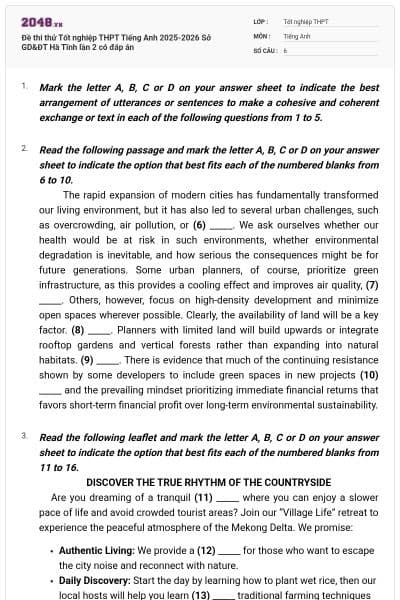
Read the following passage and mark the letter A, B, C or D on your answer sheet to indicate the option that best fits each of the numbered blanks from 18 to 22.
Digital surveillance systems have fundamentally transformed contemporary society's relationship with privacy, creating unprecedented opportunities for governmental oversight and corporate data harvesting. (18) ____________. Privacy advocates argue that ubiquitous monitoring threatens democratic foundations while security proponents emphasize public safety benefits.
Facial recognition algorithms, deployed extensively in urban environments, demonstrate remarkable accuracy in identifying individuals within crowded spaces. (19) ____________. However, civil liberties organizations raise concerns about potential misuse and discriminatory enforcement targeting marginalized populations.
(20) ____________. These regulations attempt to balance technological innovation with fundamental human rights preservation. Some democracies embrace strict data protection measures, while authoritarian regimes exploit surveillance capabilities.
Environmental activists express particular concern regarding the fact that (21) ____________. Sustainable technology solutions are being developed to address these ecological implications.
Despite mounting opposition, surveillance technology adoption continues accelerating globally. Law enforcement agencies increasingly rely on predictive policing algorithms, and corporations utilize behavioral analytics for targeted marketing. (22) ____________.
(Adapted from Advanced Materials for National High School Exam)
Utilizing sophisticated machine learning algorithms, surveillance networks are capable of monitoring citizen activities with a precision and scope rarely witnessed in prior decades
Surveillance networks, which utilize sophisticated machine learning algorithms, is capable of monitoring citizen activities with a precision and scope unprecedented in history
Were sophisticated machine learning algorithms not employed, surveillance networks would hardly monitor citizen activities with such unprecedented precision and scope
Having utilized sophisticated machine learning algorithms, surveillance networks can monitors citizen activities with a precision and scope that remain historically unparalleled
Câu trước giới thiệu về hệ thống giám sát kỹ thuật số tạo ra "unprecedented opportunities" (những cơ hội chưa từng có). Câu (18) cần tiếp nối ý này để làm rõ sự ưu việt của hệ thống giám sát, đồng thời tạo tiền đề cho câu sau trình bày sự tranh cãi giữa phe ủng hộ và phe phản đối.
Dịch nghĩa/Ngữ pháp:
A. Sử dụng các thuật toán học máy tinh vi, các mạng lưới giám sát có khả năng theo dõi các hoạt động của công dân với độ chính xác và phạm vi hiếm thấy trong những thập kỷ trước (Đúng ngữ pháp, dùng phân từ hiện tại "Utilizing" rút gọn mệnh đề cùng chủ ngữ).
B. Các mạng lưới giám sát, cái mà... is capable... (Sai ngữ pháp: Chủ ngữ "networks" số nhiều phải đi với động từ to-be "are").
C. Nếu các thuật toán học máy tinh vi không được sử dụng, các mạng lưới giám sát sẽ khó có thể theo dõi... (Câu điều kiện loại 2 giả định trái hiện tại, về mặt ngữ pháp thì đúng nhưng làm đứt gãy mạch kể chuyện trực tiếp của đoạn văn).
D. ...surveillance networks can monitors... (Sai ngữ pháp cơ bản: sau động từ khuyết thiếu "can" động từ phải ở dạng nguyên thể, không thêm "s").
Đáp án A là sự lựa chọn hoàn hảo nhất cả về ngữ pháp lẫn sự trôi chảy của văn bản.
Chọn A.
→ Digital surveillance systems have fundamentally transformed contemporary society's relationship with privacy, creating unprecedented opportunities for governmental oversight and corporate data harvesting. Utilizing sophisticated machine learning algorithms, surveillance networks are capable of monitoring citizen activities with a precision and scope rarely witnessed in prior decades.
Dịch nghĩa: Hệ thống giám sát kỹ thuật số đã làm thay đổi một cách căn bản mối quan hệ của xã hội đương đại với quyền riêng tư, tạo ra những cơ hội chưa từng có cho sự giám sát của chính phủ và việc thu thập dữ liệu của doanh nghiệp. Sử dụng các thuật toán học máy tinh vi, các mạng lưới giám sát có khả năng theo dõi các hoạt động của công dân với độ chính xác và phạm vi hiếm thấy trong những thập kỷ trước.
Law enforcement agencies that implement these systems have consistently reported significant crime reduction rates across diverse jurisdictions
These systems, when implemented by law enforcement agencies, has enabled significant crime reduction rates to be reported on a nationwide scale
Significant crime reduction rates have been achieved by law enforcement agencies implementing these systems, though methodological concerns remain
The law enforcement agency implementing these systems achieve consistently significant crime reduction rates, regardless of regional disparities
Câu tiếp theo bắt đầu bằng "However..." (Tuy nhiên, các tổ chức dân quyền đưa ra những lo ngại...). Để có sự tương phản logic với "However", câu (19) bắt buộc phải đưa ra một hệ quả tích cực, lợi ích thực tế của hệ thống nhận diện khuôn mặt.
Dịch nghĩa/Ngữ pháp:
A. Các cơ quan thực thi pháp luật áp dụng các hệ thống này đã liên tục báo cáo tỷ lệ giảm tội phạm đáng kể trên nhiều khu vực pháp lý khác nhau. (Hoàn toàn đúng ngữ pháp và mang ý nghĩa tích cực).
B. These systems... has enabled... (Sai ngữ pháp: "systems" số nhiều đi với "has" số ít).
C. Tỷ lệ giảm tội phạm đáng kể đã đạt được..., mặc dù vẫn còn những lo ngại về phương pháp luận (Cụm "though methodological concerns remain" làm giảm đi sự tích cực, khiến liên từ "However" ở câu sau trở nên kém sắc bén/thừa thãi).
D. The law enforcement agency... achieve... (Sai ngữ pháp: Chủ ngữ "agency" số ít đi với động từ "achieve" không chia "s").
Phân tích: Chỉ có A đúng ngữ pháp và tạo ra độ tương phản mạnh mẽ nhất với câu chứa "However" ngay phía sau.
Chọn A.
→ Law enforcement agencies that implement these systems have consistently reported significant crime reduction rates across diverse jurisdictions. However, civil liberties organizations raise concerns about potential misuse and discriminatory enforcement targeting marginalized populations.
Dịch nghĩa: Các cơ quan thực thi pháp luật áp dụng các hệ thống này đã liên tục báo cáo tỷ lệ giảm tội phạm đáng kể trên nhiều khu vực pháp lý khác nhau. Tuy nhiên, các tổ chức tự do dân sự đưa ra những lo ngại về khả năng lạm dụng và thực thi pháp luật mang tính phân biệt đối xử nhắm vào các nhóm dân cư yếu thế.
These legitimate concerns about privacy erosion having acknowledged, legislators worldwide are initiating an unprecedented wave of regulatory debates
Provided that these legitimate concerns about privacy erosion are acknowledged, legislators worldwide will continue initiating an unprecedented wave of regulatory debates
Acknowledging these legitimate concerns about privacy erosion, legislators worldwide have initiated an unprecedented wave of regulatory debates
Having acknowledged these legitimate concerns about privacy erosion, legislators worldwide was initiating an unprecedented wave of regulatory debates
Phía sau chỗ trống là câu "These regulations attempt to balance..." (Những quy định này cố gắng cân bằng...). Để xuất hiện đại từ chỉ định "These regulations", câu (20) bắt buộc phải nhắc đến việc ban hành các quy định hoặc luật lệ.
Dịch nghĩa/Ngữ pháp:
A. These legitimate concerns... having acknowledged... (Sai ngữ pháp: Cấu trúc bị động rút gọn phải là "having been acknowledged").
B. Provided that... legislators worldwide will continue initiating... (Sai thì: Dùng thì tương lai không ăn khớp với động từ "attempt" hiện tại ở câu sau).
C. Nhận thức được những lo ngại chính đáng này về việc xói mòn quyền riêng tư, các nhà lập pháp trên toàn thế giới đã khởi xướng một làn sóng tranh luận chưa từng có về quy định. (Đúng cấu trúc V-ing rút gọn mệnh đề cùng chủ ngữ "legislators").
D. Having acknowledged... legislators worldwide was initiating... (Sai ngữ pháp: "legislators" số nhiều phải đi với "were").
Đáp án C là lựa chọn đúng duy nhất về mặt ngữ pháp, đồng thời cung cấp danh từ "regulatory debates" để câu sau có thể dùng "These regulations" thay thế.
Chọn C.
→ Acknowledging these legitimate concerns about privacy erosion, legislators worldwide have initiated an unprecedented wave of regulatory debates. These regulations attempt to balance technological innovation with fundamental human rights preservation.
Dịch nghĩa: Nhận thức được những lo ngại chính đáng này về việc xói mòn quyền riêng tư, các nhà lập pháp trên toàn thế giới đã khởi xướng một làn sóng tranh luận chưa từng có về quy định. Những quy định này cố gắng cân bằng giữa đổi mới công nghệ và việc bảo tồn các nhân quyền cơ bản.
the consumption of enormous quantities of electricity occurs while processing surveillance data continuously, which raise unprecedented ecological concerns
it were consuming enormous quantities of electricity while processing surveillance data continuously, creating unsustainable energy demands
it will have been consuming enormous quantities of electricity while processing surveillance data continuously, leading to environmental degradation
massive server farms consume enormous quantities of electricity while processing surveillance data continuously, thereby exacerbating ecological burdens
Cụm từ "the fact that" (thực tế là) yêu cầu theo sau nó phải là một mệnh đề hoàn chỉnh (S + V) giải thích rõ ràng nguyên nhân khiến các nhà hoạt động môi trường lo ngại.
Dịch nghĩa/Ngữ pháp:
A. the consumption... occurs..., which raise... (Sai ngữ pháp: đại từ quan hệ "which" thay thế cho cả mệnh đề trước nó thì động từ theo sau phải chia số ít là "raises").
B. it were consuming... (Sai ngữ pháp: "it" đi với "were").
C. it will have been consuming... (Sai thì: Đây là một sự thật đang diễn ra, dùng thì tương lai hoàn thành tiếp diễn là hoàn toàn không hợp lý).
D. các trang trại máy chủ khổng lồ tiêu thụ một lượng điện năng khổng lồ trong khi xử lý dữ liệu giám sát liên tục, do đó làm trầm trọng thêm gánh nặng sinh thái.
Đáp án D cung cấp một mệnh đề hoàn chỉnh, đúng ngữ pháp và sát nhất với bối cảnh "Environmental activists" (các nhà hoạt động môi trường).
Chọn D.
→ Environmental activists express particular concern regarding the fact that massive server farms consume enormous quantities of electricity while processing surveillance data continuously, thereby exacerbating ecological burdens.
Dịch nghĩa: Các nhà hoạt động môi trường bày tỏ sự lo ngại đặc biệt về thực tế là các trang trại máy chủ khổng lồ tiêu thụ một lượng điện năng khổng lồ trong khi xử lý dữ liệu giám sát liên tục, do đó làm trầm trọng thêm gánh nặng sinh thái.
It is likely that the future of privacy will determine by ongoing tensions between technological capabilities and civil liberties protections
Ongoing tensions between technological capabilities and civil liberties protections will hardly determine the future of privacy
The future of privacy will likely be determined by ongoing tensions between technological capabilities and civil liberties protections
Determining the future of privacy, ongoing tensions between technological capabilities and civil liberties protections are hardly
Đây là câu cuối cùng của đoạn văn, mang tính chất tổng kết lại vấn đề: sự mâu thuẫn giữa công nghệ giám sát và quyền tự do của con người.
Dịch nghĩa/Ngữ pháp:
A. It is likely that the future of privacy will determine by... (Sai ngữ pháp: thiếu động từ to-be "be" tạo thành dạng bị động "will be determined").
B. Những căng thẳng đang diễn ra... sẽ hầu như không (hardly) quyết định... (Sai logic: Cụm "hardly determine" đi ngược lại nội dung của toàn bài).
C. Tương lai của quyền riêng tư có thể sẽ được quyết định bởi những căng thẳng đang diễn ra giữa khả năng công nghệ và việc bảo vệ các quyền tự do dân sự. (Đúng ngữ pháp bị động và logic tổng kết).
D. Determining the future of privacy, ongoing tensions... are hardly... (Sai ngữ pháp: câu bị bỏ lửng, không hoàn chỉnh).
Đáp án C cung cấp một câu chốt hạ, tóm gọn được tinh thần của bài đọc.
Chọn C.
→ Despite mounting opposition, surveillance technology adoption continues accelerating globally. Law enforcement agencies increasingly rely on predictive policing algorithms, and corporations utilize behavioral analytics for targeted marketing. The future of privacy will likely be determined by ongoing tensions between technological capabilities and civil liberties protections.
Dịch nghĩa: Bất chấp sự phản đối ngày càng tăng, việc áp dụng công nghệ giám sát vẫn tiếp tục tăng tốc trên toàn cầu. Các cơ quan thực thi pháp luật ngày càng dựa vào các thuật toán dự đoán hoạt động trị an, và các tập đoàn sử dụng phân tích hành vi cho các chiến lược tiếp thị có mục tiêu. Tương lai của quyền riêng tư có thể sẽ được quyết định bởi những căng thẳng đang diễn ra giữa khả năng công nghệ và việc bảo vệ các quyền tự do dân sự.
Bài đọc hoàn chỉnh | Dịch bài đọc |
Digital surveillance systems have fundamentally transformed contemporary society's relationship with privacy, creating unprecedented opportunities for governmental oversight and corporate data harvesting. Utilizing sophisticated machine learning algorithms, surveillance networks are capable of monitoring citizen activities with a precision and scope rarely witnessed in prior decades. Privacy advocates argue that ubiquitous monitoring threatens democratic foundations while security proponents emphasize public safety benefits. Facial recognition algorithms, deployed extensively in urban environments, demonstrate remarkable accuracy in identifying individuals within crowded spaces. Law enforcement agencies that implement these systems have consistently reported significant crime reduction rates across diverse jurisdictions. However, civil liberties organizations raise concerns about potential misuse and discriminatory enforcement targeting marginalized populations. Acknowledging these legitimate concerns about privacy erosion, legislators worldwide have initiated an unprecedented wave of regulatory debates. These regulations attempt to balance technological innovation with fundamental human rights preservation. Some democracies embrace strict data protection measures, while authoritarian regimes exploit surveillance capabilities. Environmental activists express particular concern regarding the fact that massive server farms consume enormous quantities of electricity while processing surveillance data continuously, thereby exacerbating ecological burdens. Sustainable technology solutions are being developed to address these ecological implications. Despite mounting opposition, surveillance technology adoption continues accelerating globally. Law enforcement agencies increasingly rely on predictive policing algorithms, and corporations utilize behavioral analytics for targeted marketing. The future of privacy will likely be determined by ongoing tensions between technological capabilities and civil liberties protections. | Hệ thống giám sát kỹ thuật số đã làm thay đổi một cách căn bản mối quan hệ của xã hội đương đại với quyền riêng tư, tạo ra những cơ hội chưa từng có cho sự giám sát của chính phủ và việc thu thập dữ liệu của doanh nghiệp. Sử dụng các thuật toán học máy tinh vi, các mạng lưới giám sát có khả năng theo dõi các hoạt động của công dân với độ chính xác và phạm vi hiếm thấy trong những thập kỷ trước. Các nhà vận động quyền riêng tư lập luận rằng sự giám sát ở khắp mọi nơi đe dọa các nền tảng dân chủ trong khi những người ủng hộ an ninh lại nhấn mạnh các lợi ích về an toàn công cộng. Các thuật toán nhận diện khuôn mặt, được triển khai rộng rãi trong môi trường đô thị, thể hiện độ chính xác đáng kinh ngạc trong việc xác định các cá nhân trong những không gian đông đúc. Các cơ quan thực thi pháp luật áp dụng các hệ thống này đã liên tục báo cáo tỷ lệ giảm tội phạm đáng kể trên nhiều khu vực pháp lý khác nhau. Tuy nhiên, các tổ chức tự do dân sự đưa ra những lo ngại về khả năng lạm dụng và thực thi pháp luật mang tính phân biệt đối xử nhắm vào các nhóm dân cư yếu thế. Nhận thức được những lo ngại chính đáng này về việc xói mòn quyền riêng tư, các nhà lập pháp trên toàn thế giới đã khởi xướng một làn sóng tranh luận chưa từng có về quy định. Những quy định này cố gắng cân bằng giữa đổi mới công nghệ và việc bảo tồn các nhân quyền cơ bản. Một số nền dân chủ áp dụng các biện pháp bảo vệ dữ liệu nghiêm ngặt, trong khi các chế độ độc tài lại lợi dụng các khả năng giám sát này. Các nhà hoạt động môi trường bày tỏ sự lo ngại đặc biệt về thực tế là các trang trại máy chủ khổng lồ tiêu thụ một lượng điện năng khổng lồ trong khi xử lý dữ liệu giám sát liên tục, do đó làm trầm trọng thêm gánh nặng sinh thái. Các giải pháp công nghệ bền vững đang được phát triển để giải quyết những tác động sinh thái này. Bất chấp sự phản đối ngày càng tăng, việc áp dụng công nghệ giám sát vẫn tiếp tục tăng tốc trên toàn cầu. Các cơ quan thực thi pháp luật ngày càng dựa vào các thuật toán dự đoán hoạt động trị an, và các tập đoàn sử dụng phân tích hành vi cho các chiến lược tiếp thị có mục tiêu. Tương lai của quyền riêng tư có thể sẽ được quyết định bởi những căng thẳng đang diễn ra giữa khả năng công nghệ và việc bảo vệ các quyền tự do dân sự. |
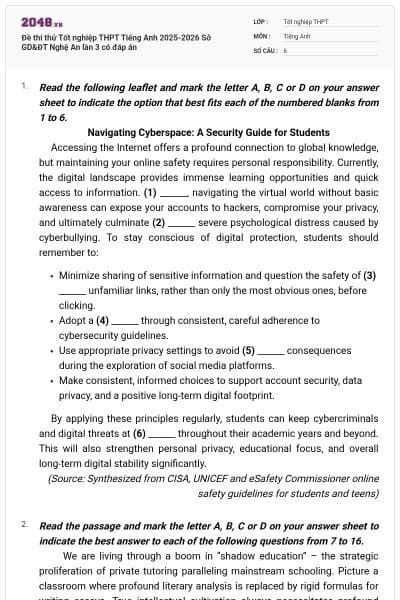
Read the following passage about the magazine's power and mark the letter A, B, C or D on your answer sheet to indicate the option that best fits each of the numbered blanks from 23 to 30.
In an era dominated by digital media, many people question whether print still holds its value. But who claims print magazine is fading away? Step into Joseph's Magazine Stand in downtown Chicago, where eye-catching glossy covers still spark conversations. "People come here seeking stories, not just information," muses Joseph Chen, who has run magazine stands since 1985. Between towering racks of publications, readers forge their unexpected connections.
Print magazines shape cultural narratives in ways digital platforms struggle to replicate. Market research from Columbia Journalism Review unveils that readers retain 65% more information from print articles than digital ones. Readers' emotional engagement amplifies through their physical interaction with pages. Magazine subscribers demonstrate remarkable loyalty, with specialty publications maintaining subscription rates even as many digital alternatives proliferate. Independent magazines flourish in particular niches, where devoted readers savor carefully curated content and tangible experiences.
Print publications cultivate distinct reading rituals. Morning commuters fold newspaper corners on trains, while coffee shop regulars annotate magazine margins. The tactile nature of print media engenders contemplative reading patterns. Scientific studies reveal that paper-based reading stimulates neural pathways associated with deeper comprehension. Paper activates spatial memory, allowing readers to map information physically across pages.
Magazines build bridges between creators and audiences through innovative formats. Art directors experiment with paper types and printing techniques to enhance storytelling. Photography gains depth through carefully chosen paper finishes. Editorial teams orchestrate visual narratives across spreads, guiding readers through carefully crafted journeys. Readers’ letters transform into community forums, where subscribers debate ideas across monthly issues. This collaborative spirit permeates throughout production, fostering meaningful dialogue between writers, designers, and devoted readers who anticipate each carefully crafted edition.
(Adapted from The New Yorker)
enhanced memory retention rates
specialized content curation
advertising effectiveness rates
tactile reading experience
Điều nào sau đây KHÔNG được đề cập như một lợi thế của tạp chí in?
A. enhanced memory retention rates: tỷ lệ ghi nhớ thông tin được nâng cao (Có nhắc đến ở đoạn 2: "retain 65% more information")
B. specialized content curation: việc tuyển chọn nội dung chuyên biệt (Có nhắc đến ở đoạn 2: "carefully curated content")
C. advertising effectiveness rates: tỷ lệ hiệu quả quảng cáo (Không được nhắc đến)
D. tactile reading experience: trải nghiệm đọc mang tính xúc giác (Có nhắc đến ở đoạn 3: "tactile nature of print media")
Chọn C.
unfiltered
censored
crafted
authorized
Từ "curated" ở đoạn 2 TRÁI NGHĨA với ____________.
curated (adj): được tuyển chọn, chắt lọc, tổ chức kỹ lưỡng.
A. unfiltered (adj): không được lọc, không được chọn lọc (trái nghĩa)
B. censored (adj): bị kiểm duyệt
C. crafted (adj): được chế tác, làm thủ công
D. authorized (adj): được ủy quyền
→ curated >< unfiltered
Thông tin: ...where devoted readers savor carefully curated content and tangible experiences.
(...nơi những độc giả trung thành thưởng thức các nội dung được tuyển chọn kỹ lưỡng và những trải nghiệm hữu hình.)
Chọn A.
platforms
readers
magazines
narratives
Từ "their" ở đoạn 2 chỉ ____________.
A. platforms: các nền tảng
B. readers: những người đọc (độc giả)
C. magazines: các cuốn tạp chí
D. narratives: các câu chuyện/lời kể
Thông tin: Readers' emotional engagement amplifies through their physical interaction with pages.
(Sự gắn kết cảm xúc của người đọc được khuếch đại thông qua sự tương tác vật lý của họ với các trang giấy.)
→ their = readers.
Chọn B.
reminisce
revitalize
improvise
reproduce
Từ "replicate" ở đoạn 2 có thể được thay thế tốt nhất bởi ____________.
replicate (v): tái tạo, sao chép, làm lại y hệt.
A. reminisce (v): hồi tưởng
B. revitalize (v): đem lại sức sống mới, phục hồi
C. improvise (v): ứng biến
D. reproduce (v): tái tạo, sản xuất lại (đồng nghĩa)
→ replicate = reproduce
Thông tin: Print magazines shape cultural narratives in ways digital platforms struggle to replicate.
(Tạp chí in định hình các câu chuyện văn hóa theo những cách mà các nền tảng kỹ thuật số chật vật mới có thể tái tạo được.)
Chọn D.
Which of the following best paraphrases the underlined sentence?
Design specialists position visual elements throughout publications to shape reader engagement patterns.
Editorial departments design visual stories across pages, leading audiences through carefully structured experiences.
Magazine teams develop interconnected layouts across multiple pages to direct information consumption rates.
Publication staff members coordinate the arrangement of imagery to control audience reading progression.
Câu nào sau đây diễn giải tốt nhất câu được gạch chân?
Editorial teams orchestrate visual narratives across spreads, guiding readers through carefully crafted journeys.
(Các nhóm biên tập tổ chức/dàn dựng các câu chuyện bằng hình ảnh trên các trang báo mở, dẫn dắt người đọc qua những hành trình được dàn dựng cẩn thận.)
Dịch nghĩa:
A. Các chuyên gia thiết kế định vị các yếu tố hình ảnh xuyên suốt các ấn phẩm để định hình các kiểu gắn kết của người đọc. (Sai sắc thái "guiding" và "journeys").
B. Các bộ phận biên tập thiết kế các câu chuyện hình ảnh trên các trang báo, dẫn dắt khán giả qua những trải nghiệm được cấu trúc cẩn thận. (Đúng và sát nghĩa nhất: Editorial teams = Editorial departments, orchestrate = design, guiding readers = leading audiences, carefully crafted journeys = carefully structured experiences).
C. Các đội ngũ làm tạp chí phát triển các bố cục liên kết với nhau qua nhiều trang để định hướng tỷ lệ tiêu thụ thông tin. (Sai nghĩa "tỷ lệ tiêu thụ").
D. Các nhân viên ấn phẩm điều phối việc sắp xếp hình ảnh để kiểm soát tiến trình đọc của khán giả. (Từ "kiểm soát" - control - làm sai lệch ý nghĩa nhẹ nhàng của từ "dẫn dắt" - guiding).
Chọn B.
Which of the following is TRUE according to the passage?
Print media provides readers with more useful information than digital ones.
Some print magazines maintain subscription numbers despite multiple digital reading options.
Paper-based reading activates some specific pathways in neural comprehension.
Magazine stands to create spaces where readers discover their unexpected insights.
Theo bài đọc, câu nào sau đây là ĐÚNG?
A. Truyền thông in ấn cung cấp cho người đọc nhiều thông tin hữu ích hơn so với truyền thông kỹ thuật số.
(Sai, bài đọc chỉ nói người đọc "ghi nhớ thông tin nhiều hơn 65%", chứ không khẳng định lượng thông tin cung cấp là "hữu ích hơn").
B. Một số tạp chí in vẫn duy trì được lượng người đăng ký bất chấp có nhiều lựa chọn đọc kỹ thuật số.
(Đúng).
C. Việc đọc trên giấy kích hoạt một số đường dẫn cụ thể trong nhận thức thần kinh.
(Sai chi tiết, đoạn 3 viết: "stimulates neural pathways associated with deeper comprehension" - kích thích đường dẫn thần kinh liên quan đến việc hiểu sâu hơn, chứ không phải "trong" nhận thức thần kinh).
D. Các sạp tạp chí tạo ra những không gian nơi người đọc khám phá ra những hiểu biết bất ngờ của họ.
(Sai, đoạn 1 nói họ tạo ra "unexpected connections" - những sự kết nối bất ngờ, chứ không phải "insights").
Thông tin (Đoạn 2): ...with specialty publications maintaining subscription rates even as many digital alternatives proliferate.
(...với các ấn phẩm chuyên đề vẫn duy trì tỷ lệ đăng ký ngay cả khi nhiều lựa chọn kỹ thuật số thay thế đang nảy nở.)
Chọn B.
Paragraph 2
Paragraph 3
Paragraphs 2 & 3
Paragraphs 1 & 4
Tác giả xem xét mối quan hệ giữa việc đọc và trí nhớ ở đoạn nào?
A. Đoạn 2
B. Đoạn 3
C. Cả đoạn 2 và 3
D. Cả đoạn 1 và 4
Thông tin:
Đoạn 2: "...readers retain 65% more information from print articles..." (...người đọc ghi nhớ thông tin từ các bài báo in nhiều hơn 65%...)
Đoạn 3: "Paper activates spatial memory, allowing readers to map information physically..." (Giấy kích hoạt trí nhớ không gian, cho phép người đọc lập bản đồ thông tin một cách vật lý...)
Chọn C.
Paragraph 1
Paragraph 2
Paragraph 3
Paragraph 4
Tác giả khám phá các yếu tố sản xuất sáng tạo ở đoạn nào?
A. Đoạn 1
B. Đoạn 2
C. Đoạn 3
D. Đoạn 4
Thông tin (Đoạn 4): Art directors experiment with paper types and printing techniques... Photography gains depth through carefully chosen paper finishes. Editorial teams orchestrate visual narratives...
(Các giám đốc nghệ thuật thử nghiệm các loại giấy và kỹ thuật in... Nhiếp ảnh có thêm chiều sâu thông qua các lớp phủ giấy được lựa chọn cẩn thận. Các nhóm biên tập dàn dựng các câu chuyện bằng hình ảnh...)
Chọn D.
Dịch bài đọc:
Trong một kỷ nguyên bị thống trị bởi truyền thông kỹ thuật số, nhiều người đặt câu hỏi liệu báo in có còn giữ được giá trị của nó hay không. Nhưng ai nói rằng tạp chí in đang phai nhạt dần? Hãy bước vào Sạp báo Joseph ở trung tâm thành phố Chicago, nơi những trang bìa bóng bẩy bắt mắt vẫn khơi mào cho những cuộc trò chuyện. "Mọi người đến đây tìm kiếm những câu chuyện, chứ không chỉ là thông tin," Joseph Chen, người đã điều hành các sạp báo từ năm 1985, trầm ngâm nói. Giữa những giá để ấn phẩm cao ngất ngưởng, độc giả tạo nên những sự kết nối bất ngờ của họ.
Tạp chí in định hình các câu chuyện văn hóa theo những cách mà các nền tảng kỹ thuật số chật vật mới có thể tái tạo được. Nghiên cứu thị trường từ Tạp chí Báo chí Columbia tiết lộ rằng người đọc ghi nhớ thông tin từ các bài báo in nhiều hơn 65% so với báo kỹ thuật số. Sự gắn kết cảm xúc của người đọc được khuếch đại thông qua sự tương tác vật lý của họ với các trang giấy. Những người đăng ký tạp chí thể hiện lòng trung thành đáng chú ý, với các ấn phẩm chuyên đề vẫn duy trì tỷ lệ đăng ký ngay cả khi nhiều lựa chọn kỹ thuật số thay thế đang nảy nở. Các tạp chí độc lập đặc biệt phát triển mạnh trong các thị trường ngách, nơi những độc giả trung thành thưởng thức các nội dung được tuyển chọn kỹ lưỡng và những trải nghiệm hữu hình.
Các ấn phẩm in nuôi dưỡng những nghi thức đọc riêng biệt. Những người đi lại vào buổi sáng gấp các góc tờ báo trên tàu hỏa, trong khi những khách quen của quán cà phê ghi chú bên lề tạp chí. Bản chất xúc giác của phương tiện truyền thông in ấn sinh ra những kiểu đọc trầm ngâm. Các nghiên cứu khoa học tiết lộ rằng việc đọc trên giấy kích thích các đường dẫn thần kinh liên quan đến việc đọc hiểu sâu hơn. Giấy kích hoạt trí nhớ không gian, cho phép người đọc lập bản đồ thông tin một cách vật lý qua các trang giấy.
Các tạp chí xây dựng cầu nối giữa người sáng tạo và khán giả thông qua các định dạng đổi mới. Các giám đốc nghệ thuật thử nghiệm các loại giấy và kỹ thuật in để nâng cao việc kể chuyện. Nhiếp ảnh có thêm chiều sâu thông qua các lớp phủ giấy được lựa chọn cẩn thận. Các nhóm biên tập dàn dựng các câu chuyện bằng hình ảnh trên các trang báo mở, dẫn dắt người đọc qua những hành trình được dàn dựng cẩn thận. Thư của độc giả biến thành các diễn đàn cộng đồng, nơi những người đăng ký tranh luận về các ý tưởng qua các số báo hàng tháng. Tinh thần hợp tác này len lỏi qua suốt quá trình sản xuất, thúc đẩy cuộc đối thoại có ý nghĩa giữa các nhà văn, nhà thiết kế và những độc giả trung thành, những người mong đợi từng ấn bản được chế tác cẩn thận.
Read the following passage about life in the future and mark the letter A, B, C, or D on your answer sheet to indicate the best answer to each of the following questions from 31 to 40.
Standing on the brink of a technological revolution, humanity is poised to redefine the limits of possibility. Future life will undoubtedly be a realm where the boundaries of possibility are consistently expanded, as humanity strives to push the envelope of technological and intellectual achievement. Artificial intelligence, deeply embedded into every facet of life, will redefine not only how we work but also how we think and interact with the world. Automation will seamlessly integrate into our daily routines, relieving humans of mundane tasks and allowing for a reorientation of societal priorities towards more complex, creative endeavors. However, this rapid evolution will demand a fundamental reevaluation of what constitutes meaningful work and human contribution in an increasingly mechanized environment.
[I]These technologies will not only redefine entertainment and leisure but also revolutionize education by creating interactive learning environments tailored to individual cognitive styles and preferences.[II]As a result, traditional educational institutions may face obsolescence, replaced by decentralized, AI-driven ecosystems. [III] However, this transformation will challenge our understanding of knowledge, expertise, and intellectual rigor, as machines take on a central role in shaping the learning process.
[IV] In healthcare, the future promises unprecedented strides in biotechnology and genetic engineering, potentially offering cures for diseases previously deemed incurable and even altering the trajectory of human evolution. Precision medicine, powered by advanced data analytics, will tailor treatments to the individual on a molecular level, while AI-assisted diagnostics will vastly improve accuracy and speed. Yet, these advancements will not come without moral dilemmas, as the boundaries between therapy and enhancement become increasingly blurred. Questions of equity, access, and the ethical ramifications of altering human biology will occupy a central place in the discourse surrounding medical innovation.
Sustainability will no longer be an aspirational objective but a necessity, as the environmental challenges of the present demand urgent action. With the advent of next-generation renewable energy sources such as nuclear fusion and highly efficient solar technologies, the global energy landscape will shift dramatically, reducing reliance on fossil fuels. In parallel, smart cities equipped with self-regulating infrastructures will reduce their waste and optimize resource use, creating urban spaces that operate at peak efficiency. Nonetheless, the challenge will remain to ensure that these technological solutions do not exacerbate existing inequalities or cause new ecological imbalances.
(Adapted from https://futuristspeaker.com)
Where does the following sentence best fit?
“Moreover, the convergence of virtual and augmented realities is set to transform the essence of human experience, offering immersive and highly personalized learning that challenges traditional education models.”
[I]
[II]
[III]
[IV]
Câu sau đây phù hợp nhất với vị trí nào trong bài đọc?
Moreover, the convergence of virtual and augmented realities is set to transform the essence of human experience, offering immersive and highly personalized learning that challenges traditional education models. (Hơn nữa, sự hội tụ của thực tế ảo và thực tế tăng cường được thiết lập để biến đổi bản chất của trải nghiệm con người, mang đến việc học tập nhập vai và cá nhân hóa cao độ, thách thức các mô hình giáo dục truyền thống.)
Giải thích: Câu gạch chân bổ sung thêm thông tin về công nghệ thực tế ảo (VR) và thực tế tăng cường (AR) giúp mang lại trải nghiệm học tập cá nhân hóa, đồng thời "thách thức các mô hình giáo dục truyền thống" (challenges traditional education models). Điều này dẫn dắt trực tiếp và logic đến câu ngay sau vị trí [II]: "As a result, traditional educational institutions may face obsolescence..." (Kết quả là, các cơ sở giáo dục truyền thống có thể phải đối mặt với sự lỗi thời...).
Chọn B.
According to paragraph 3, which of the following is NOT an expected benefit of future advancements in healthcare?
The potential to cure previously incurable diseases
Tailored treatments designed at a molecular level
Improved accuracy and speed in diagnostics through AI
A reduction in moral and ethical debates about medicine
Theo đoạn 3, điều nào sau đây KHÔNG phải là một lợi ích được kỳ vọng từ những tiến bộ trong tương lai về chăm sóc sức khỏe?
A. Tiềm năng chữa khỏi những căn bệnh trước đây không thể chữa được
(Có: "offering cures for diseases previously deemed incurable")
B. Các phương pháp điều trị được thiết kế riêng ở cấp độ phân tử
(Có: "tailor treatments to the individual on a molecular level")
C. Cải thiện độ chính xác và tốc độ trong chẩn đoán thông qua AI
(Có: "AI-assisted diagnostics will vastly improve accuracy and speed")
D. Sự sụt giảm các cuộc tranh luận về đạo đức và luân lý liên quan đến y học
\Giải thích: Đoạn văn nói rằng những tiến bộ này "sẽ không đến mà không có những tình huống khó xử về đạo đức" (will not come without moral dilemmas) và các câu hỏi về đạo đức "sẽ chiếm một vị trí trung tâm" (will occupy a central place) trong các cuộc thảo luận. Do đó, sự sụt giảm tranh luận là KHÔNG đúng.
Chọn D.
resentments
retaliations
repercussions
disruptions
Từ “ramifications” ở đoạn 3 có thể được thay thế tốt nhất bởi ____________.
ramification (n): hậu quả, hệ lụy
A. resentments (n): sự oán giận
B. retaliations (n): sự trả đũa
C. repercussions (n): hậu quả, hệ lụy (tác động dội lại)
D. disruptions (n): sự gián đoạn
→ ramifications = repercussions
Thông tin: "Questions of equity, access, and the ethical ramifications of altering human biology..." (Các câu hỏi về sự công bằng, quyền tiếp cận và hệ lụy đạo đức của việc thay đổi sinh học con người...)
Chọn C.
Which of the following best summarizes paragraph 3?
Innovations in biotechnology and genetic engineering, precision medicine and AI-assisted diagnostics willrevolutionize healthcare, but they will also raise ethical and equity-related challenges.
AI-assisted diagnostics will dominate the future of healthcare, ensuring faster and more accurate results, but traditional medical methods will remain relevant.
Future healthcare advancements will eliminate all diseases and improve diagnostics, leaving no room for ethical concerns.
The integration of AI and data analytics in healthcare will focus solely on improving individual treatments without ethical implications.
Câu nào sau đây tóm tắt đúng nhất đoạn 3?
A. Những đổi mới trong công nghệ sinh học và kỹ thuật di truyền, y học chính xác và chẩn đoán được hỗ trợ bởi AI sẽ cách mạng hóa việc chăm sóc sức khỏe, nhưng chúng cũng sẽ đặt ra những thách thức liên quan đến đạo đức và sự công bằng. (Đúng và bao quát toàn bộ đoạn).
B. Chẩn đoán hỗ trợ bởi trí tuệ nhân tạo sẽ thống trị tương lai của ngành chăm sóc sức khỏe, đảm bảo kết quả nhanh hơn và chính xác hơn, nhưng các phương pháp y tế truyền thống vẫn sẽ có vai trò quan trọng. (Sai, bài không nói phương pháp truyền thống sẽ vẫn phù hợp).
C. Những tiến bộ trong chăm sóc sức khỏe trong tương lai sẽ loại bỏ tất cả các bệnh tật và cải thiện chẩn đoán, không còn chỗ cho những lo ngại về đạo đức. (Sai, bài nói đạo đức chiếm vị trí trung tâm).
D. Việc tích hợp trí tuệ nhân tạo và phân tích dữ liệu trong chăm sóc sức khỏe sẽ chỉ tập trung vào việc cải thiện các phương pháp điều trị riêng lẻ mà không gây ra những hệ lụy về đạo đức. (Sai, có nhắc đến hệ lụy đạo đức).
Chọn A.
hit it big
cross the line
play it safe
overstep the mark
Cụm từ “push the envelope” ở đoạn 1 TRÁI NGHĨA với ____________.
push the envelope (idiom): vượt qua giới hạn, đổi mới, thử thách những ranh giới thông thường
A. hit it big (idiom): trúng quả đậm, rất thành công
B. cross the line (idiom): đi quá giới hạn (theo hướng tiêu cực)
C. play it safe (idiom): chơi an toàn, không mạo hiểm
D. overstep the mark (idiom): hành động quá trớn
→ push the envelope >< play it safe
Thông tin: "...as humanity strives to push the envelope of technological and intellectual achievement." (...khi nhân loại phấn đấu để vượt qua những giới hạn của thành tựu công nghệ và trí tuệ.)
Chọn C.
Which of the following best paraphrases the underlined sentence in paragraph 1?
Never before will automation disrupt daily routines, burdening humans with chores and hindering progress toward innovative, intellectual endeavors.
The introduction of automation will eliminate all human involvement in daily tasks, leaving society to manage its priorities.
Automation will become smoothly embedded in everyday life, freeing people from repetitive tasks and enabling society to focus on sophisticated and creative pursuits.
Instead of easing our lives, automation will complicate daily tasks and prevent society from moving toward complex, inventive endeavors.
Câu nào sau đây diễn giải đúng nhất câu được gạch chân ở đoạn 1?
Automation will seamlessly integrate into our daily routines, relieving humans of mundane tasks and allowing for a reorientation of societal priorities towards more complex, creative endeavors. (Tự động hóa sẽ tích hợp liền mạch vào thói quen hàng ngày của chúng ta, giải phóng con người khỏi những công việc nhàm chán và cho phép định hướng lại các ưu tiên của xã hội hướng tới những nỗ lực sáng tạo, phức tạp hơn.)
A. Chưa bao giờ tự động hóa sẽ phá vỡ các thói quen hàng ngày, tạo gánh nặng (burdening) cho con người và cản trở sự tiến bộ hướng tới những nỗ lực sáng tạo, trí tuệ như hiện nay. (Sai ý).
B. Sự ra đời của tự động hóa sẽ loại bỏ mọi sự tham gia của con người (eliminate all human involvement) vào các công việc hàng ngày, để xã hội tự quản lý các ưu tiên của mình. (Quá tuyệt đối, sai ý).
C. Tự động hóa sẽ trở nên được gắn kết một cách mượt mà vào cuộc sống hàng ngày, giải phóng con người khỏi những công việc lặp đi lặp lại và cho phép xã hội tập trung vào các hoạt động tinh vi và sáng tạo. (Đúng, "seamlessly integrate" = "smoothly embedded", "mundane" = "repetitive", "creative endeavors" = "creative pursuits").
D. Thay vì làm cho cuộc sống dễ dàng hơn, tự động hóa sẽ làm phức tạp thêm các công việc hàng ngày và ngăn cản xã hội tiến tới những nỗ lực sáng tạo, phức tạp. (Sai hoàn toàn).
Chọn C.
smart cities
infrastructures
fossil fuels
urban spaces
Từ “their” ở đoạn 4 chỉ ____________.
A. smart cities (các thành phố thông minh)
B. infrastructures (các cơ sở hạ tầng)
C. fossil fuels (nhiên liệu hóa thạch)
D. urban spaces (không gian đô thị)
Trong câu, "smart cities" (các thành phố thông minh) được trang bị cơ sở hạ tầng tự điều chỉnh sẽ giảm thiểu chất thải của CHÚNG ("their waste"). Do đó, "their" thay thế cho các thành phố thông minh.
Thông tin: "...smart cities equipped with self-regulating infrastructures will reduce their waste..." (...các thành phố thông minh được trang bị cơ sở hạ tầng tự điều chỉnh sẽ giảm thiểu chất thải của chúng...)
Chọn A.
Which of the following is TRUE according to the passage?
AI will solely impact the workplace, leaving human thought and interactions unchanged.
Advancements in healthcare will eliminate all ethical concerns regarding genetic engineering.
Future educational systems will adapt to individual learning styles using AI-driven technologies.
Sustainability will remain an optional goal as fossil fuels continue to dominate energy production.
Điều nào sau đây là ĐÚNG theo bài đọc?
A. AI sẽ chỉ tác động đến nơi làm việc, để lại suy nghĩ và tương tác của con người không thay đổi.
(Sai, bài đọc nói AI định nghĩa lại cả cách chúng ta suy nghĩ và tương tác).
B. Những tiến bộ trong chăm sóc sức khỏe sẽ loại bỏ mọi lo ngại về đạo đức liên quan đến kỹ thuật di truyền. (Sai).
C. Các hệ thống giáo dục trong tương lai sẽ thích ứng với phong cách học tập của cá nhân bằng cách sử dụng các công nghệ được điều khiển bởi AI. (Đúng).
D. Phát triển bền vững sẽ vẫn là mục tiêu tùy chọn khi nhiên liệu hóa thạch tiếp tục thống trị sản xuất năng lượng. (Sai, bài viết khẳng định nó là một "necessity" - sự thiết yếu).
Thông tin: "...revolutionize education by creating interactive learning environments tailored to individual cognitive styles... replaced by decentralized, AI-driven ecosystems." (...cách mạng hóa giáo dục bằng cách tạo ra các môi trường học tập tương tác được điều chỉnh theo phong cách nhận thức cá nhân... được thay thế bởi các hệ sinh thái do AI điều khiển.)
Chọn C.
Which of the following can be inferred from the passage?
The rapid adoption of AI in education will render traditional methods of learning effective and widely accepted.
The integration of automation in daily life may require society to rethink the value of human creativity and work.
Future advancements in renewable energy will completely eliminate environmental challenges.
Sustainability in the future will be achieved through technological solutions without the need for social or political efforts.
Điều nào sau đây có thể được suy luận từ bài đọc?
A. Việc áp dụng nhanh chóng AI trong giáo dục sẽ làm cho các phương pháp học tập truyền thống trở nên hiệu quả và được chấp nhận rộng rãi.
(Sai, truyền thống có thể sẽ bị lỗi thời - obsolescence).
B. Sự tích hợp của tự động hóa trong cuộc sống hàng ngày có thể đòi hỏi xã hội phải suy nghĩ lại về giá trị của sự sáng tạo và công việc của con người. (Đúng).
C. Những tiến bộ trong tương lai về năng lượng tái tạo sẽ loại bỏ hoàn toàn (completely eliminate) các thách thức môi trường.
(Sai, đoạn cuối cảnh báo rủi ro về mất cân bằng sinh thái mới).
D. Tính bền vững trong tương lai sẽ đạt được thông qua các giải pháp công nghệ mà không cần đến những nỗ lực chính trị hay xã hội.
(Sai, đoạn 4 nhấn mạnh hành động khẩn cấp).
Giải thích: Bài đọc chỉ ra rằng sự thay đổi nhanh chóng do tự động hóa sẽ đòi hỏi chúng ta phải đánh giá lại đâu mới là đóng góp thực sự có ý nghĩa của con người trong một thế giới được cơ giới hóa.
Thông tin: "However, this rapid evolution will demand a fundamental reevaluation of what constitutes meaningful work and human contribution in an increasingly mechanized environment." (Tuy nhiên, sự tiến hóa nhanh chóng này sẽ đòi hỏi một sự đánh giá lại cơ bản về những gì cấu thành nên công việc có ý nghĩa và đóng góp của con người...)
Chọn B.
Advances in AI and healthcare will improve productivity, but education and sustainability will not experience significant changes.
In the future, the growth of AI will lead to the automation of all human tasks, making human labor and creativity obsolete, while technology will entirely replace traditional education systems and healthcare methods.
Automation and AI will eliminate the need for human contribution, creating a fully mechanized society focused solely on efficiency and convenience.
The future will be defined by unprecedented technological advancements in AI, education, healthcare, and sustainability, but these innovations will also pose ethical and societal challenges.
Câu nào sau đây tóm tắt đúng nhất bài đọc?
A. Những tiến bộ trong trí tuệ nhân tạo và chăm sóc sức khỏe sẽ cải thiện năng suất, nhưng giáo dục và phát triển bền vững sẽ không có những thay đổi đáng kể. (Sai).
B. Trong tương lai, sự phát triển của trí tuệ nhân tạo sẽ dẫn đến việc tự động hóa tất cả các công việc của con người, khiến lao động và sự sáng tạo của con người trở nên lỗi thời, trong khi công nghệ sẽ hoàn toàn thay thế các hệ thống giáo dục truyền thống và các phương pháp chăm sóc sức khỏe.
(Sai, sự sáng tạo được chú trọng hơn chứ không lỗi thời).
C. Tự động hóa và trí tuệ nhân tạo sẽ loại bỏ nhu cầu đóng góp của con người, tạo ra một xã hội hoàn toàn cơ giới hóa, chỉ tập trung vào hiệu quả và sự tiện lợi.
(Sai, con người vẫn đóng góp qua những nỗ lực sáng tạo phức tạp).
D. Tương lai sẽ được định hình bởi những tiến bộ công nghệ chưa từng có trong AI, giáo dục, chăm sóc sức khỏe và tính bền vững, nhưng những đổi mới này cũng sẽ đặt ra các thách thức về mặt xã hội và đạo đức. (Đúng, bao quát trọn vẹn 4 đoạn văn của bài đọc).
Chọn D.
Dịch bài đọc:
Đứng trên bờ vực của một cuộc cách mạng công nghệ, nhân loại đã sẵn sàng để định nghĩa lại các giới hạn của những điều khả thi. Cuộc sống tương lai chắc chắn sẽ là một thế giới nơi các ranh giới của sự khả thi liên tục được mở rộng, khi nhân loại nỗ lực bứt phá những giới hạn của thành tựu công nghệ và trí tuệ. Trí tuệ nhân tạo, được gắn kết sâu sắc vào mọi khía cạnh của cuộc sống, sẽ không chỉ định nghĩa lại cách chúng ta làm việc mà còn cả cách chúng ta suy nghĩ và tương tác với thế giới. Tự động hóa sẽ tích hợp liền mạch vào thói quen hàng ngày của chúng ta, giải phóng con người khỏi những công việc nhàm chán và cho phép định hướng lại các ưu tiên của xã hội hướng tới những nỗ lực sáng tạo, phức tạp hơn. Tuy nhiên, sự tiến hóa nhanh chóng này sẽ đòi hỏi một sự đánh giá lại cơ bản về những gì cấu thành nên công việc có ý nghĩa và đóng góp của con người trong một môi trường ngày càng được cơ giới hóa.
[I] Những công nghệ này sẽ không chỉ định nghĩa lại các hoạt động giải trí và thư giãn mà còn cách mạng hóa nền giáo dục bằng cách tạo ra các môi trường học tập tương tác được điều chỉnh theo phong cách nhận thức và sở thích của từng cá nhân. [II] (Hơn nữa, sự hội tụ của thực tế ảo và thực tế tăng cường được thiết lập để biến đổi bản chất của trải nghiệm con người, mang đến việc học tập nhập vai và cá nhân hóa cao độ, thách thức các mô hình giáo dục truyền thống.) Kết quả là, các cơ sở giáo dục truyền thống có thể phải đối mặt với sự lỗi thời, bị thay thế bởi các hệ sinh thái phi tập trung do AI điều khiển. [III] Tuy nhiên, sự biến đổi này sẽ thách thức sự hiểu biết của chúng ta về tri thức, chuyên môn và sự khắt khe về mặt học thuật, khi máy móc đảm nhận vai trò trung tâm trong việc định hình quá trình học tập.
[IV] Trong chăm sóc sức khỏe, tương lai hứa hẹn những bước tiến chưa từng có trong công nghệ sinh học và kỹ thuật di truyền, có khả năng mang lại phương pháp chữa trị cho những căn bệnh trước đây được coi là vô phương cứu chữa và thậm chí làm thay đổi quỹ đạo tiến hóa của con người. Y học chính xác, được hỗ trợ bởi các phân tích dữ liệu tiên tiến, sẽ thiết kế riêng các phương pháp điều trị cho từng cá nhân ở cấp độ phân tử, trong khi chẩn đoán do AI hỗ trợ sẽ cải thiện đáng kể độ chính xác và tốc độ. Tuy nhiên, những tiến bộ này sẽ không đến mà không có những tình huống khó xử về đạo đức, khi ranh giới giữa trị liệu và sự nâng cấp sức mạnh con người ngày càng trở nên mờ nhạt. Các câu hỏi về sự công bằng, quyền tiếp cận và hệ lụy đạo đức của việc thay đổi sinh học con người sẽ chiếm một vị trí trung tâm trong các cuộc thảo luận xoay quanh đổi mới y tế.
Tính bền vững sẽ không còn là một mục tiêu đầy khát vọng mà là một sự thiết yếu, khi những thách thức môi trường của hiện tại đòi hỏi hành động khẩn cấp. Với sự ra đời của các nguồn năng lượng tái tạo thế hệ tiếp theo như phản ứng tổng hợp hạt nhân và các công nghệ năng lượng mặt trời hiệu suất cao, bối cảnh năng lượng toàn cầu sẽ thay đổi ngoạn mục, giảm sự phụ thuộc vào nhiên liệu hóa thạch. Song song đó, các thành phố thông minh được trang bị cơ sở hạ tầng tự điều chỉnh sẽ giảm thiểu chất thải của chúng và tối ưu hóa việc sử dụng tài nguyên, tạo ra những không gian đô thị hoạt động ở hiệu suất cao nhất. Dù vậy, thách thức vẫn sẽ là đảm bảo rằng những giải pháp công nghệ này không làm trầm trọng thêm những bất bình đẳng hiện có hoặc gây ra những sự mất cân bằng sinh thái mới.