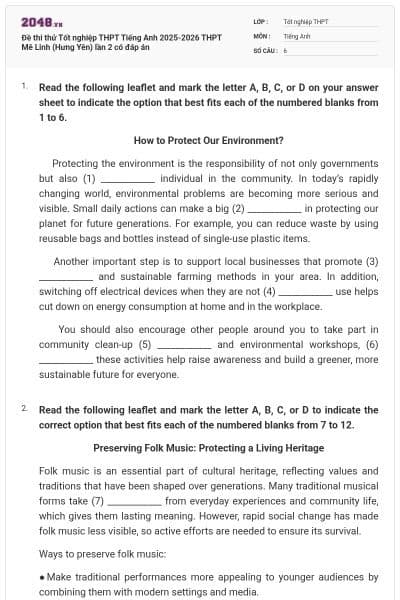
Đề thi thử Tốt nghiệp THPT Tiếng Anh 2025-2026 THPT Mê Linh (Hưng Yên) lần 2 có đáp án
40 câu hỏi
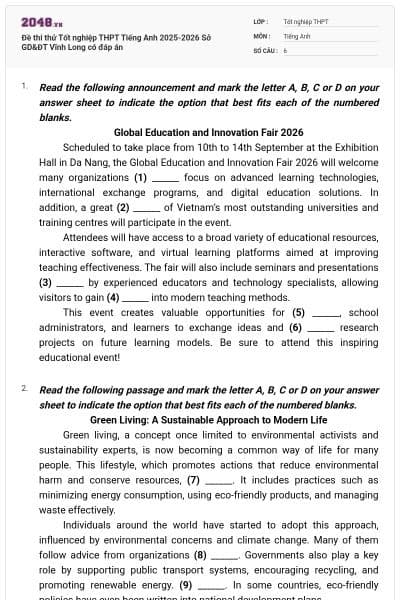
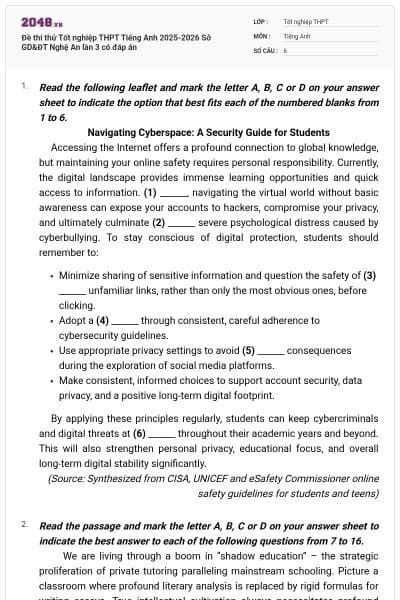
Read the following leaflet and mark the letter A, B, C, or D on your answer sheet to indicate the option that best fits each of the numbered blanks from 1 to 6.
How to Protect Our Environment?
Protecting the environment is the responsibility of not only governments but also (1) ____________ individual in the community. In today’s rapidly changing world, environmental problems are becoming more serious and visible. Small daily actions can make a big (2) ____________ in protecting our planet for future generations. For example, you can reduce waste by using reusable bags and bottles instead of single-use plastic items.
Another important step is to support local businesses that promote (3) ____________ and sustainable farming methods in your area. In addition, switching off electrical devices when they are not (4) ____________ use helps cut down on energy consumption at home and in the workplace.
You should also encourage other people around you to take part in community clean-up (5) ____________ and environmental workshops, (6) ____________ these activities help raise awareness and build a greener, more sustainable future for everyone.
another
many
every
all
A. another: một (người/vật) khác (+ danh từ đếm được số ít).
B. many: nhiều (+ danh từ đếm được số nhiều).
C. every: mỗi, mọi (+ danh từ đếm được số ít).
D. all: tất cả (+ danh từ số nhiều / không đếm được).
Phía sau khoảng trống là danh từ đếm được ở dạng số ít “individual” (cá nhân). Về mặt ngữ nghĩa, bảo vệ môi trường là trách nhiệm của “mỗi” cá nhân, do đó “every” là đáp án chính xác nhất.
Chọn C. every
→ Protecting the environment is the responsibility of not only governments but also every individual in the community.
Dịch nghĩa: Bảo vệ môi trường không chỉ là trách nhiệm của các chính phủ mà còn là của mỗi cá nhân trong cộng đồng.
effort
arrangement
choice
difference
A. effort (n): nỗ lực.
B. arrangement (n): sự sắp xếp.
C. choice (n): sự lựa chọn.
D. difference (n): sự khác biệt.
Ta có cụm kết hợp từ (collocation) cố định: make a difference (tạo ra sự khác biệt, mang lại sự thay đổi lớn/có ý nghĩa).
Chọn D. difference
→ Small daily actions can make a big difference in protecting our planet...
Dịch nghĩa: Những hành động nhỏ hàng ngày có thể tạo ra một sự khác biệt lớn trong việc bảo vệ hành tinh của chúng ta...
products environmentally friendly
friendly environmentally products
environmentally products friendly
environmentally friendly products
Phân tích trật tự từ: Cụm danh từ này có danh từ chính là “products” (các sản phẩm) nên bắt buộc phải đứng cuối cùng. Phía trước nó là tính từ “friendly” (thân thiện) đóng vai trò bổ nghĩa cho danh từ. Đứng trước tính từ là trạng từ “environmentally” (về mặt môi trường) bổ nghĩa cho tính từ đó. Trật tự đúng là: Trạng từ + Tính từ + Danh từ chính.
Chọn D. environmentally friendly products
→ Another important step is to support local businesses that promote environmentally friendly products...
Dịch nghĩa: Một bước quan trọng khác là ủng hộ các doanh nghiệp địa phương đang thúc đẩy các sản phẩm thân thiện với môi trường...
on
in
of
at
A. on (prep): trên.
B. in (prep): trong.
C. of (prep): của.
D. at (prep): tại.
Ta có cụm giới từ cố định: in use (đang được sử dụng). Khi thêm “not” thành not in use mang nghĩa là không (được) sử dụng.
Chọn B. in
→ In addition, switching off electrical devices when they are not in use helps cut down on energy consumption...
Dịch nghĩa: Ngoài ra, việc tắt các thiết bị điện khi chúng không được sử dụng giúp cắt giảm lượng điện năng tiêu thụ...
missions
campaigns
operations
drives
A. missions (n): nhiệm vụ, sứ mệnh.
B. campaigns (n): chiến dịch.
C. operations (n): sự hoạt động, ca phẫu thuật, chiến dịch (quân sự).
D. drives (n): nỗ lực tập thể, cuộc vận động (quyên góp).
Ta có cụm danh từ ghép (collocation) thường gặp trong chủ đề môi trường: clean-up campaigns (các chiến dịch dọn dẹp / chiến dịch vệ sinh môi trường).
Chọn B. campaigns
→ You should also encourage other people around you to take part in community clean-up campaigns...
Dịch nghĩa: Bạn cũng nên khuyến khích những người xung quanh tham gia vào các chiến dịch dọn dẹp cộng đồng...
.............., (6) ____________ these activities help raise awareness and build a greener, more sustainable future for everyone.
therefore
however
because
although
A. therefore (adv): vì vậy, do đó.
B. however (adv): tuy nhiên.
C. because (conj): bởi vì.
D. although (conj): mặc dù.
Khoảng trống cần một từ nối hai mệnh đề. Câu thể hiện mối quan hệ nguyên nhân - kết quả: Bạn nên tham gia các hoạt động này (kết quả/lời khuyên) bởi vì chúng giúp nâng cao nhận thức (nguyên nhân). Hơn nữa, “therefore” và “however” thường đứng sau dấu chấm hoặc chấm phẩy, không đứng ngay sau dấu phẩy (,) nối liền hai mệnh đề như liên từ “because”.
Chọn C. because
→ ...environmental workshops, because these activities help raise awareness...
Dịch nghĩa: ...các buổi hội thảo về môi trường, bởi vì những hoạt động này giúp nâng cao nhận thức...
Bài đọc hoàn chỉnh | Dịch bài đọc |
How to Protect Our Environment? Protecting the environment is the responsibility of not only governments but also (1) every individual in the community. In today’s rapidly changing world, environmental problems are becoming more serious and visible. Small daily actions can make a big (2) difference in protecting our planet for future generations. For example, you can reduce waste by using reusable bags and bottles instead of single-use plastic items. Another important step is to support local businesses that promote (3) environmentally friendly products and sustainable farming methods in your area. In addition, switching off electrical devices when they are not (4) in use helps cut down on energy consumption at home and in the workplace. You should also encourage other people around you to take part in community clean-up (5) campaigns and environmental workshops, (6) because these activities help raise awareness and build a greener, more sustainable future for everyone. | Làm Thế Nào Để Bảo Vệ Môi Trường Của Chúng Ta? Bảo vệ môi trường không chỉ là trách nhiệm của các chính phủ mà còn là của (1) mỗi cá nhân trong cộng đồng. Trong thế giới đang thay đổi nhanh chóng ngày nay, các vấn đề môi trường đang trở nên nghiêm trọng và rõ ràng hơn. Những hành động nhỏ hàng ngày có thể tạo ra một (2) sự khác biệt lớn trong việc bảo vệ hành tinh của chúng ta cho các thế hệ tương lai. Ví dụ, bạn có thể giảm thiểu rác thải bằng cách sử dụng túi và bình nước có thể tái sử dụng thay vì các món đồ nhựa dùng một lần. Một bước quan trọng khác là ủng hộ các doanh nghiệp địa phương đang thúc đẩy (3) các sản phẩm thân thiện với môi trường và các phương pháp canh tác bền vững trong khu vực của bạn. Ngoài ra, việc tắt các thiết bị điện khi chúng không (4) được sử dụng giúp cắt giảm lượng điện năng tiêu thụ ở nhà và tại nơi làm việc. Bạn cũng nên khuyến khích những người xung quanh tham gia vào (5) các chiến dịch dọn dẹp cộng đồng và các buổi hội thảo về môi trường, (6) bởi vì những hoạt động này giúp nâng cao nhận thức và xây dựng một tương lai xanh hơn, bền vững hơn cho tất cả mọi người. |
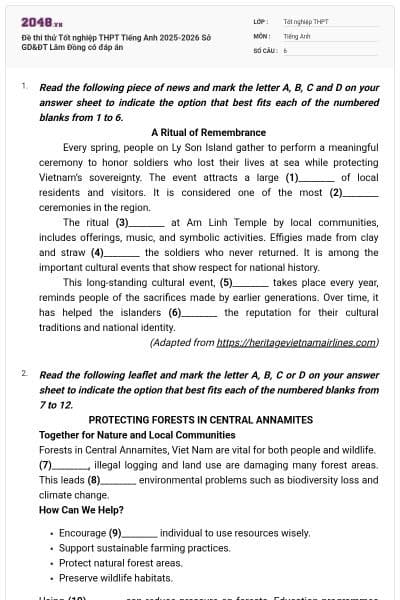
Read the following leaflet and mark the letter A, B, C, or D to indicate the correct option that best fits each of the numbered blanks from 7 to 12.
Preserving Folk Music: Protecting a Living Heritage
Folk music is an essential part of cultural heritage, reflecting values and traditions that have been shaped over generations. Many traditional musical forms take (7) ____________ from everyday experiences and community life, which gives them lasting meaning. However, rapid social change has made folk music less visible, so active efforts are needed to ensure its survival.
Ways to preserve folk music:
●Make traditional performances more appealing to younger audiences by combining them with modern settings and media.
●Encourage participation by a large (8) ____________ of young people through school programmes and local festivals.
●Support folk music, (9) ____________ down orally for centuries, by recording performances and documenting lyrics. Promote collaboration between experienced artists and (10) ____________ who are learning traditional styles.
●Create cultural spaces (11) ____________ allow musicians to perform regularly and interact with audiences.
By valuing folk music as a living art form rather than a museum piece, societies can help it remain relevant and (12) ____________ in modern life.
roots
steps
hold
shape
A. roots (n): rễ cây (cụm từ chuẩn là take root - cắm rễ, bám rễ, thường dùng ở số ít).
B. steps (n): bước đi (take steps - tiến hành các bước/biện pháp).
C. hold (n): sự cầm nắm (take hold - trở nên mạnh mẽ, kiểm soát).
D. shape (n): hình dáng.
Ta có cụm từ take shape (hình thành, thành hình). Âm nhạc truyền thống “được hình thành” từ những trải nghiệm hàng ngày của người dân.
Chọn D. shape
→ Many traditional musical forms take shape from everyday experiences and community life...
Dịch nghĩa: Nhiều hình thức âm nhạc truyền thống được hình thành từ những trải nghiệm hàng ngày và cuộc sống cộng đồng...
●Encourage participation by a large (8) ____________ of young people through school programmes and local festivals.
number
amount
majority
handful
A. number (n): số lượng (+ danh từ đếm được số nhiều).
B. amount (n): khối lượng, lượng (+ danh từ không đếm được).
C. majority (n): phần lớn, đa số (thường dùng the majority of hoặc a large majority of, nhưng trong cấu trúc a large... of đi liền phía trước thì number phổ biến và chuẩn xác hơn với young people).
D. handful (n): một nhúm, một số ít (trái nghĩa với từ large - lớn).
Phía sau khoảng trống là danh từ đếm được số nhiều “young people” (những người trẻ tuổi). Do đó, ta dùng cấu trúc a large number of + N (số nhiều).
Chọn A. number
→ Encourage participation by a large number of young people...
Dịch nghĩa: Khuyến khích sự tham gia của một số lượng lớn những người trẻ tuổi...
having passed
to be passed
passing
passed
A. having passed: phân từ hoàn thành mang nghĩa chủ động.
B. to be passed: động từ nguyên thể mang nghĩa bị động.
C. passing (v-ing): hiện tại phân từ mang nghĩa chủ động.
D. passed (v-ed/v3): quá khứ phân từ mang nghĩa bị động.
Đây là dạng rút gọn mệnh đề quan hệ mang nghĩa bị động, bổ nghĩa cho “folk music” (âm nhạc dân gian). Âm nhạc dân gian không tự lưu truyền mà “được lưu truyền” (bằng miệng) qua nhiều thế kỷ. Mệnh đề đầy đủ là: , which has been passed down orally... Khi rút gọn, ta bỏ đại từ quan hệ và trợ động từ, chỉ giữ lại động từ ở dạng V3/V-ed.
Chọn D. passed
→ Support folk music, passed down orally for centuries...
Dịch nghĩa: Hỗ trợ âm nhạc dân gian, thứ được lưu truyền bằng miệng qua nhiều thế kỷ...
other
the others
the other
others
A. other: (những người/vật) khác (tính từ, bắt buộc phải đi kèm danh từ đếm được số nhiều / không đếm được).
B. the others: những (người/vật) còn lại (đã xác định cụ thể trong một nhóm).
C. the other: (người/vật) còn lại (đã xác định cụ thể trong một nhóm 2 đối tượng).
D. others: những (người/vật) khác (đại từ, đứng độc lập không đi kèm danh từ, mang ý nghĩa chung chung).
Khoảng trống đóng vai trò làm đại từ thay thế cho “other artists/people” (những nghệ sĩ/người học khác nói chung), phía sau không có danh từ nào nên ta phải dùng đại từ “others”.
Chọn D. others
→ Promote collaboration between experienced artists and others who are learning traditional styles.
Dịch nghĩa: Thúc đẩy sự hợp tác giữa các nghệ sĩ giàu kinh nghiệm và những người khác, những người đang học hỏi các phong cách truyền thống.
●Create cultural spaces (11) ____________ allow musicians to perform regularly and interact with audiences.
what
where
when
which
A. what: cái mà (không đóng vai trò đại từ quan hệ thay thế cho danh từ đứng trước).
B. where: trạng từ quan hệ chỉ nơi chốn (thay thế cho in/at/on which, theo sau phải là một mệnh đề S + V).
C. when: trạng từ quan hệ chỉ thời gian.
D. which: đại từ quan hệ chỉ vật/sự việc.
Danh từ đứng trước là “cultural spaces” (không gian văn hóa). Khoảng trống cần điền phải đóng vai trò làm chủ ngữ cho động từ “allow” (cho phép) ngay phía sau. Mặc dù “spaces” là nơi chốn, nhưng “where” là trạng từ nên KHÔNG thể làm chủ ngữ. Ta bắt buộc phải dùng đại từ quan hệ “which” (hoặc that).
Chọn D. which
→ Create cultural spaces which allow musicians to perform regularly...
Dịch nghĩa: Tạo ra các không gian văn hóa nơi mà (những không gian mà) cho phép các nhạc sĩ biểu diễn thường xuyên...
By valuing folk music as a living art form rather than a museum piece, societies can help it remain relevant and (12) ____________ in modern life.
meaningful
meaning
meaningfully
mean
A. meaningful (adj): có ý nghĩa.
B. meaning (n): ý nghĩa.
C. meaningfully (adv): một cách có ý nghĩa.
D. mean (v/adj): có nghĩa là / keo kiệt, xấu tính.
Động từ “remain” (duy trì, vẫn) là một động từ nối (linking verb), theo sau nó phải là tính từ. Hơn nữa, từ cần điền đứng sau liên từ “and” nên phải có cấu trúc song song cùng từ loại với tính từ “relevant” (thích hợp, có liên quan) nằm phía trước. Do đó, ta cần một tính từ.
Chọn A. meaningful
→ ...societies can help it remain relevant and meaningful in modern life.
Dịch nghĩa: ...các xã hội có thể giúp nó luôn thích hợp và có ý nghĩa trong cuộc sống hiện đại.
Bài đọc hoàn chỉnh | Dịch bài đọc |
Preserving Folk Music: Protecting a Living Heritage Folk music is an essential part of cultural heritage, reflecting values and traditions that have been shaped over generations. Many traditional musical forms take (7) shape from everyday experiences and community life, which gives them lasting meaning. However, rapid social change has made folk music less visible, so active efforts are needed to ensure its survival. Ways to preserve folk music: ● Make traditional performances more appealing to younger audiences by combining them with modern settings and media. ● Encourage participation by a large (8) number of young people through school programmes and local festivals. ● Support folk music, (9) passed down orally for centuries, by recording performances and documenting lyrics. Promote collaboration between experienced artists and (10) others who are learning traditional styles. ● Create cultural spaces (11) which allow musicians to perform regularly and interact with audiences. By valuing folk music as a living art form rather than a museum piece, societies can help it remain relevant and (12) meaningful in modern life. | Bảo Tồn Âm Nhạc Dân Gian: Bảo Vệ Một Di Sản Sống Âm nhạc dân gian là một phần thiết yếu của di sản văn hóa, phản ánh những giá trị và truyền thống đã được định hình qua nhiều thế hệ. Nhiều hình thức âm nhạc truyền thống được (7) hình thành từ những trải nghiệm hàng ngày và cuộc sống cộng đồng, điều này mang lại cho chúng những ý nghĩa trường tồn. Tuy nhiên, sự thay đổi xã hội nhanh chóng đã làm cho âm nhạc dân gian trở nên ít hiện diện hơn, do đó những nỗ lực tích cực là cần thiết để đảm bảo sự sống còn của nó. Các cách để bảo tồn âm nhạc dân gian: ● Làm cho các màn trình diễn truyền thống trở nên hấp dẫn hơn đối với khán giả trẻ bằng cách kết hợp chúng với các bối cảnh và phương tiện truyền thông hiện đại. ● Khuyến khích sự tham gia của một (8) số lượng lớn những người trẻ tuổi thông qua các chương trình học đường và các lễ hội địa phương. ● Hỗ trợ âm nhạc dân gian, thứ (9) được lưu truyền bằng miệng qua nhiều thế kỷ, bằng cách ghi âm các màn biểu diễn và ghi chép lại lời bài hát. Thúc đẩy sự hợp tác giữa các nghệ sĩ giàu kinh nghiệm và (10) những người khác, những người đang học hỏi các phong cách truyền thống. ● Tạo ra các không gian văn hóa (11) những không gian mà cho phép các nhạc sĩ biểu diễn thường xuyên và tương tác với khán giả. Bằng cách trân trọng âm nhạc dân gian như một hình thức nghệ thuật sống động thay vì một món đồ trưng bày trong bảo tàng, các xã hội có thể giúp nó luôn thích hợp và (12) có ý nghĩa trong cuộc sống hiện đại. |
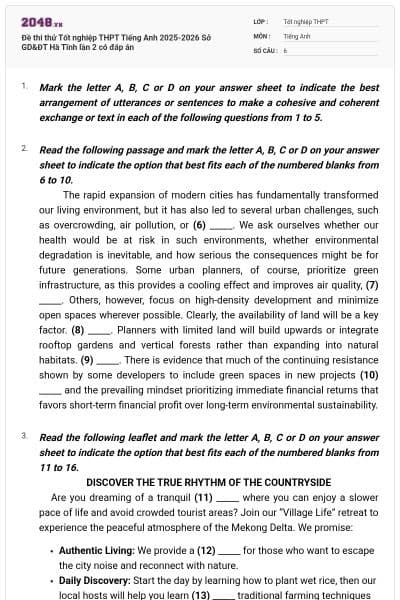
Mark the letter A, B, C or D on your answer sheet to indicate the best arrangement of utterances or sentences to make a cohesive and coherent exchange or text in each of the following questions from 13 to 17.
a.Mai: I agree. Those who embrace lifelong learning are more likely to adapt to changes and succeed.
b.Tung: It also keeps life exciting, don’t you think? Exploring new areas constantly is so rewarding.
c.Tung: I think it’s essential in today’s world. Skills and knowledge become outdated so quickly.
d.Mai: What’s your opinion on lifelong learning?
e.Mai: Lifelong learning is like investing in yourself, and that’s always worth it.
d – c – a – b – e
d – b – a – c – e
e – b – a – c – d
e – c – a – b – d
Thứ tự sắp xếp đúng: A. d – c – a – b – e
d. Mai: What’s your opinion on lifelong learning?
c. Tung: I think it’s essential in today’s world. Skills and knowledge become outdated so quickly.
a. Mai: I agree. Those who embrace lifelong learning are more likely to adapt to changes and succeed.
b. Tung: It also keeps life exciting, don’t you think? Exploring new areas constantly is so rewarding.
e. Mai: Lifelong learning is like investing in yourself, and that’s always worth it.
Dịch nghĩa:
d. Mai: Quan điểm của cậu về việc học tập suốt đời là gì?
c. Tùng: Tớ nghĩ điều đó là thiết yếu trong thế giới ngày nay. Các kỹ năng và kiến thức trở nên lỗi thời quá nhanh.
a. Mai: Tớ đồng ý. Những người đón nhận việc học tập suốt đời sẽ có nhiều khả năng thích ứng với những thay đổi và thành công hơn.
b. Tùng: Nó cũng giúp cuộc sống luôn thú vị, cậu có nghĩ vậy không? Việc liên tục khám phá những lĩnh vực mới thực sự rất xứng đáng.
e. Mai: Học tập suốt đời giống như việc đầu tư vào bản thân, và điều đó luôn mang lại giá trị.
Chọn A.
a.The change brings more jobs and better buses, yet it also raises rents and makes long-time families feel invisible in their own area.
b.As new apartments and shopping streets appear, older parks and small markets are often moved or reduced to make room.
c.If planners protect green corners, add safe walking routes, and support affordable housing, growth can feel like real progress instead of a loss.
d. In my neighbourhood, a quiet field became a high-rise complex, and the new residents now queue for coffee where kidsonce played football.
e.Urbanisation has made my city busier every year, and it has even changed the way we share public space after school.
e – b – d – a – c
b – e – d – a – c
e – d – b – a – c
e – b – a – d – c
Thứ tự sắp xếp đúng: A. e – b – d – a – c
e. Urbanisation has made my city busier every year, and it has even changed the way we share public space after school.
b. As new apartments and shopping streets appear, older parks and small markets are often moved or reduced to make room.
d. In my neighbourhood, a quiet field became a high-rise complex, and the new residents now queue for coffee where kids once played football.
a. The change brings more jobs and better buses, yet it also raises rents and makes long-time families feel invisible in their own area.
c. If planners protect green corners, add safe walking routes, and support affordable housing, growth can feel like real progress instead of a loss.
Dịch nghĩa:
e. Quá trình đô thị hóa đã khiến thành phố của tôi ngày càng bận rộn hơn mỗi năm, và nó thậm chí còn thay đổi cả cách chúng ta chia sẻ không gian công cộng sau giờ học.
b. Khi những khu căn hộ và phố mua sắm mới xuất hiện, những công viên cũ và các khu chợ nhỏ thường bị di dời hoặc thu hẹp lại để nhường chỗ.
d. Trong khu phố của tôi, một bãi đất trống yên tĩnh đã trở thành một khu phức hợp cao tầng, và những cư dân mới giờ đây xếp hàng mua cà phê ở nơi mà lũ trẻ từng chơi bóng đá.
a. Sự thay đổi này mang lại nhiều việc làm hơn và xe buýt tốt hơn, nhưng nó cũng làm tăng giá thuê nhà và khiến những gia đình sống lâu năm cảm thấy như trở nên vô hình trong chính khu vực của họ.
c. Nếu các nhà quy hoạch bảo vệ những mảng xanh, bổ sung các lối đi bộ an toàn và hỗ trợ nhà ở giá cả phải chăng, thì sự tăng trưởng có thể mang lại cảm giác như một sự tiến bộ thực sự thay vì một sự mất mát.
Chọn A.
a.Academic study provides a platform for acquiring knowledge, critical thinking skills, and intellectual growth.
b.Students should pursue academic study for a variety of compelling reasons.
c.Additionally, academic study equips individuals with qualifications necessary to pursue their desired careers.
d.It offers the opportunity to delve into diverse subjects, fostering a broad understanding of the world and its complexities.
e.This opens doors to a wide range of professional opportunities.
b – d – e – c – a
e – b – a – d – c
b – a – d – c – e
a – b – e – d – c
Thứ tự sắp xếp đúng: C. b – a – d – c – e
b. Students should pursue academic study for a variety of compelling reasons.
a. Academic study provides a platform for acquiring knowledge, critical thinking skills, and intellectual growth.
d. It offers the opportunity to delve into diverse subjects, fostering a broad understanding of the world and its complexities.
c. Additionally, academic study equips individuals with qualifications necessary to pursue their desired careers.
e. This opens doors to a wide range of professional opportunities.
Dịch nghĩa:
b. Học sinh, sinh viên nên theo đuổi con đường học thuật vì nhiều lý do thuyết phục.
a. Học thuật cung cấp một nền tảng để tiếp thu kiến thức, các kỹ năng tư duy phản biện và sự phát triển trí tuệ.
d. Nó mang lại cơ hội đào sâu vào các chủ đề đa dạng, bồi dưỡng sự hiểu biết rộng rãi về thế giới và những sự phức tạp của nó.
c. Thêm vào đó, việc học tập trang bị cho các cá nhân những bằng cấp cần thiết để theo đuổi sự nghiệp mà họ mong muốn.
e. Điều này mở ra những cánh cửa dẫn đến hàng loạt các cơ hội nghề nghiệp.
Chọn C.
Dear Sir or Madam,
a.I am writing to apply for the post of a volunteer at your charity centre.
b.Actually, last summer, I spent a month there helping to take care of young kids. I am also patient and caring.
c.I look forward to hearing from you.
d.I can spend hours listening to and talking with other people. I am available for an interview on any day after 4:30 p.m. If my application is successful, I can start work immediately.
e.I saw the advertisement on my school notice board last week. I have experience in volunteering in my local orphanage. Yours faithfully,
b-d-e-c-a
a-c-e-b-d
a-e-b-d-c
a-e-c-b-d
Thứ tự sắp xếp đúng: C. a – e – b – d – c
a. I am writing to apply for the post of a volunteer at your charity centre.
e. I saw the advertisement on my school notice board last week. I have experience in volunteering in my local orphanage.
b. Actually, last summer, I spent a month there helping to take care of young kids. I am also patient and caring.
d. I can spend hours listening to and talking with other people. I am available for an interview on any day after 4:30 p.m. If my application is successful, I can start work immediately.
c. I look forward to hearing from you.
Dịch nghĩa:
Kính gửi Ông/Bà,
a. Tôi viết thư này để ứng tuyển vào vị trí tình nguyện viên tại trung tâm từ thiện của ông/bà.
e. Tôi đã nhìn thấy thông báo tuyển dụng trên bảng tin của trường vào tuần trước. Tôi đã có kinh nghiệm làm tình nguyện tại trại trẻ mồ côi ở địa phương.
b. Thực tế, mùa hè năm ngoái, tôi đã dành một tháng ở đó để giúp chăm sóc các em nhỏ. Tôi cũng là một người kiên nhẫn và biết quan tâm.
d. Tôi có thể dành hàng giờ để lắng nghe và trò chuyện với người khác. Tôi có thể tham gia phỏng vấn vào bất kỳ ngày nào sau 4:30 chiều. Nếu đơn ứng tuyển của tôi thành công, tôi có thể bắt đầu làm việc ngay lập tức.
c. Tôi rất mong nhận được phản hồi từ ông/bà.
Trân trọng,
Chọn C.
a. Patient: Thank you, doctor. I’ll follow your instructions.
b. Doctor: You have a mild flu. Take these tablets twice a day and drink plenty of water.
c. Patient: Good morning doctor, I’ve been having a headache and fever since yesterday.
c – a – b
b – c – a
a – b – c
c – b – a
Thứ tự sắp xếp đúng: D. c – b – a
c. Patient: Good morning doctor, I’ve been having a headache and fever since yesterday.
b. Doctor: You have a mild flu. Take these tablets twice a day and drink plenty of water.
a. Patient: Thank you, doctor. I’ll follow your instructions.
Dịch nghĩa:
c. Bệnh nhân: Chào buổi sáng bác sĩ, tôi bị đau đầu và sốt từ hôm qua.
b. Bác sĩ: Anh bị cảm cúm nhẹ. Hãy uống những viên thuốc này hai lần một ngày và uống nhiều nước nhé.
a. Bệnh nhân: Cảm ơn bác sĩ. Tôi sẽ làm theo sự chỉ dẫn của bác sĩ.
Chọn D.
Read the passage about The Growing Tension Between Cruise Tourism and Local Communities and mark the letter A, B, C or D on your answer sheet to indicate the option that best fits each of the numbered blanks from 18 to 22.
The cruise industry faces serious challenges as tourist destinations worldwide deal with too many visitors.
If cruise lines were to ignore these growing problems, they would risk losing access to popular ports completely.Barcelona and Venice have already taken strong action against mass tourism, creating strict rules to protect their historical centers from too many visitors. Amsterdam shows this problem clearly: (18) ____________, locals believe they cause especially big disruptions to daily life. Local communities, tired of constant tourist crowds, have organized protests asking for better tourism policies. Santorini and Dubrovnik now limit daily visitor numbers, forcing cruise companies to change their schedules. Whether economic benefits are worth environmental damage (19) ____________, who once happily welcomed tourist money. Infrastructure problems have become very obvious during busy season when several ships arrive together.
These restrictions try to protect destinations for future generations, (20) ____________. Tourist taxes have become one solution, creating money for infrastructure improvements while possibly reducing visitor numbers. Port authorities understand the need for balance; (21) ____________. Environmental concerns add another problem to these discussions. In the future, cruise companies will need to adapt how they operate to respect these new rules. They might consider using smaller vessels, (22) ____________, and working closely with local shops and restaurants to prove they care about sustainable tourism. The success of these efforts depends on everyone working together—cruise lines, local governments, and community members must find solutions that benefit all parties equally.
although cruise passengers make up only one percent of yearly tourists
whenever beach travelers bring over five million with annual profits
because hotel visitors create just two thirds from total revenue gains
despite train commuters form nearly ten times than monthly arrivals
Phía trước chỗ trống giới thiệu thành phố Amsterdam là một ví dụ rõ ràng cho vấn đề (shows this problem clearly). Phía sau chỗ trống là mệnh đề: “locals believe they cause especially big disruptions to daily life” (người dân địa phương tin rằng họ gây ra những sự gián đoạn đặc biệt lớn cho cuộc sống hàng ngày). Đại từ “they” ở đây thay thế cho nhóm đối tượng tạo ra sự gián đoạn này. Vị trí (18) cần một mệnh đề chỉ sự tương phản/nhượng bộ để tạo sự bất ngờ: dù số lượng ít nhưng hậu quả lại lớn.
Dịch nghĩa/Ngữ pháp:
A. mặc dù hành khách đi tàu du lịch chỉ chiếm 1 phần trăm lượng khách du lịch hàng năm (Mệnh đề nhượng bộ bắt đầu bằng “although”, “cruise passengers” khớp với “they” ở vế sau, nhấn mạnh sự tương phản: số lượng ít nhưng bị coi là gây gián đoạn lớn).
B. bất cứ khi nào du khách đi biển mang lại hơn năm triệu lợi nhuận hàng năm (Sai chủ đề).
C. bởi vì khách ở khách sạn chỉ tạo ra hai phần ba tổng doanh thu (Sai chủ đề, không tạo sự tương phản).
D. mặc dù người đi tàu hỏa chiếm gần mười lần lượng khách đến hàng tháng (Sai chủ đề).
Đáp án A đưa ra một sự thật bất ngờ (hành khách tàu du lịch chỉ chiếm 1%) để làm nổi bật định kiến của người dân địa phương ở vế sau.
Chọn A.
→ Amsterdam shows this problem clearly: although cruise passengers make up only one percent of yearly tourists, locals believe they cause especially big disruptions to daily life.
Dịch nghĩa: Amsterdam cho thấy vấn đề này một cách rõ ràng: mặc dù hành khách đi tàu du lịch chỉ chiếm 1 phần trăm lượng khách du lịch hàng năm, nhưng người dân địa phương tin rằng họ gây ra những sự gián đoạn đặc biệt lớn cho cuộc sống hàng ngày.
where nobody can gather without paying all new permit
having gone through months of waiting for new permits
has come to be questioned by residents in these places
that never gets approved for public use after reviews
Chủ ngữ của câu là một Mệnh đề danh từ (Noun clause): “Whether economic benefits are worth environmental damage” (Liệu những lợi ích kinh tế có xứng đáng với thiệt hại môi trường hay không). Câu này hiện đang thiếu động từ chính (Main verb).
Dịch nghĩa/Ngữ pháp:
A. where nobody can gather... (Mệnh đề quan hệ → Thiếu động từ chính cho mệnh đề danh từ).
B. having gone through... (Cụm phân từ → Thiếu động từ chính).
C. đã bắt đầu bị nghi ngờ bởi những cư dân ở các nơi này (Cung cấp động từ chính “has come” chia số ít khớp với Mệnh đề danh từ làm chủ ngữ. Đồng thời, “residents” ở đây khớp nối hoàn hảo với cụm “who once happily welcomed tourist money” ở ngay phía sau).
D. that never gets approved... (Mệnh đề quan hệ → Thiếu động từ chính).
Đáp án C là lựa chọn duy nhất cung cấp động từ chính, biến mệnh đề danh từ trở thành một câu hoàn chỉnh và cung cấp danh từ “residents” để đại từ quan hệ “who” phía sau bổ nghĩa.
Chọn C.
→ Whether economic benefits are worth environmental damage has come to be questioned by residents in these places, who once happily welcomed tourist money.
Dịch nghĩa: Liệu những lợi ích kinh tế có xứng đáng với thiệt hại về môi trường hay không đã bắt đầu bị đặt câu hỏi bởi chính những người dân ở những nơi này, những người từng vui vẻ chào đón tiền bạc từ du lịch.
how few tourists, surprisingly, rarely ever fully understand during current trips
whether all visitors, regrettably, truly will appreciate during their short stays
why most tourists, predictably, always will remember after going back home
which is what many travelers, unfortunately, often don't realize these days
Mệnh đề chính: “These restrictions try to protect destinations for future generations” (Những hạn chế này cố gắng bảo vệ các điểm đến cho các thế hệ tương lai). Chỗ trống (20) nằm sau dấu phẩy, dùng để đưa ra lời bình luận hoặc bổ sung thông tin cho mệnh đề phía trước.
Dịch nghĩa/Ngữ pháp:
A. làm thế nào mà có rất ít khách du lịch, đáng ngạc nhiên thay, hiếm khi hiểu được... (Sai ngữ pháp).
B. liệu tất cả du khách, thật đáng tiếc, sẽ thực sự trân trọng... (Sai ngữ pháp do không kết nối được với mệnh đề chính).
C. tại sao hầu hết khách du lịch, như dự đoán, sẽ luôn nhớ... (Sai ngữ pháp và logic).
D. đó là điều mà nhiều du khách, thật không may, thường không nhận ra ngày nay (Dùng đại từ “which” thay thế cho toàn bộ sự việc ở mệnh đề trước. “which is what...” là cấu trúc bổ sung lời bình luận hoàn toàn chuẩn xác).
Đáp án D đóng vai trò là một mệnh đề quan hệ không xác định, bình luận về thực trạng đáng buồn là du khách không hiểu được mục đích tốt đẹp của các biện pháp hạn chế.
Chọn D.
→ These restrictions try to protect destinations for future generations, which is what many travelers, unfortunately, often don't realize these days.
Dịch nghĩa: Những hạn chế này cố gắng bảo vệ các điểm đến cho các thế hệ tương lai, đó là điều mà nhiều du khách, thật không may, thường không nhận ra ngày nay.
however, finding agreement among different groups still remains very difficult
therefore, making decisions within smaller teams often becomes quite manageable
likewise, seeking unity through diverse opinions often becomes truly impossible
meanwhile, building trust between opposing sides always stays extremely complex
Câu phía trước khẳng định: “Port authorities understand the need for balance” (Các nhà chức trách cảng hiểu nhu cầu cần phải có sự cân bằng). Tuy nhiên, “cân bằng” luôn là một bài toán khó khi có nhiều bên liên quan. Vị trí (21) đứng sau dấu chấm phẩy (;), cần một mệnh đề độc lập tạo sự liên kết (thường là sự tương phản) với ý “hiểu được nhu cầu” ở phía trước.
Dịch nghĩa:
A. tuy nhiên, việc tìm kiếm sự đồng thuận giữa các nhóm khác nhau vẫn còn rất khó khăn (Liên từ “however” tạo sự tương phản cực kỳ hợp lý: Hiểu là cần cân bằng, NHƯNG đạt được thỏa thuận thì lại khó).
B. do đó, việc đưa ra quyết định trong các đội nhóm nhỏ hơn thường trở nên khá dễ quản lý (Lạc đề).
C. tương tự như vậy, việc tìm kiếm sự thống nhất thông qua các ý kiến đa dạng thường trở nên thực sự bất khả thi (“likewise” không dùng để chỉ sự tương phản).
D. trong khi đó, việc xây dựng lòng tin giữa các bên đối lập luôn cực kỳ phức tạp (Hơi khiên cưỡng so với ý “tìm kiếm sự đồng thuận” của A).
Đáp án A tạo ra sự đối lập thực tế (lý thuyết thì hiểu nhưng thực hành thì khó), dẫn dắt tốt vào các vấn đề rắc rối tiếp theo (Environmental concerns add another problem...).
Chọn A.
→ Port authorities understand the need for balance; however, finding agreement among different groups still remains very difficult.
Dịch nghĩa: Các nhà chức trách cảng hiểu nhu cầu cần phải có sự cân bằng; tuy nhiên, việc tìm kiếm sự đồng thuận giữa các nhóm khác nhau vẫn còn rất khó khăn.
which are more eco-friendly, staying longer at each port
will become less harmful, keeping ships by new docks
have grown quite green, parking vessels in all bays
where they cause less damage, holding boats on calm sites
Câu chứa chỗ trống: “They might consider using smaller vessels, (22) ____________, and working closely with local shops...” (Họ có thể cân nhắc việc sử dụng các tàu nhỏ hơn, (22) ____________, và làm việc chặt chẽ với các cửa hàng địa phương...).
Đây là cấu trúc liệt kê các hành động mà công ty du lịch (“They”) có thể làm (consider V-ing..., V-ing..., and V-ing...). Phía trước có “using”, phía sau có “working”, vậy vị trí (22) cần chứa một động từ đuôi V-ing để đảm bảo cấu trúc song song, HOẶC là một mệnh đề quan hệ bổ nghĩa cho “smaller vessels” kèm theo một hành động V-ing.
Dịch nghĩa/Ngữ pháp:
A. những thứ thân thiện với môi trường hơn, ở lại lâu hơn ở mỗi cảng (“which are more eco-friendly” bổ sung cho “smaller vessels”, và cụm V-ing “staying longer” đóng vai trò là hành động thứ hai trong chuỗi liệt kê: using → staying → and working. Rất chuẩn xác).
B. will become less harmful, keeping ships... (Mất tính song song vì “will become”).
C. have grown quite green, parking vessels... (Mất tính song song).
D. nơi chúng gây ra ít thiệt hại hơn, giữ tàu... (Dùng “where” không hợp lý để bổ nghĩa cho “smaller vessels”).
Đáp án A giải quyết xuất sắc cấu trúc liệt kê song song các giải pháp (using smaller vessels, staying longer, and working closely).
Chọn A.
→ They might consider using smaller vessels, which are more eco-friendly, staying longer at each port, and working closely with local shops and restaurants to prove they care about sustainable tourism.
Dịch nghĩa: Họ có thể cân nhắc việc sử dụng các tàu nhỏ hơn, những chiếc tàu thân thiện với môi trường hơn, ở lại lâu hơn ở mỗi cảng, và làm việc chặt chẽ với các cửa hàng và nhà hàng địa phương để chứng minh rằng họ quan tâm đến du lịch bền vững.
Bài đọc hoàn chỉnh | Dịch bài đọc |
The cruise industry faces serious challenges as tourist destinations worldwide deal with too many visitors. If cruise lines were to ignore these growing problems, they would risk losing access to popular ports completely. Barcelona and Venice have already taken strong action against mass tourism, creating strict rules to protect their historical centers from too many visitors. Amsterdam shows this problem clearly: although cruise passengers make up only one percent of yearly tourists, locals believe they cause especially big disruptions to daily life. Local communities, tired of constant tourist crowds, have organized protests asking for better tourism policies. Santorini and Dubrovnik now limit daily visitor numbers, forcing cruise companies to change their schedules. Whether economic benefits are worth environmental damage has come to be questioned by residents in these places, who once happily welcomed tourist money. Infrastructure problems have become very obvious during busy season when several ships arrive together. These restrictions try to protect destinations for future generations, which is what many travelers, unfortunately, often don't realize these days. Tourist taxes have become one solution, creating money for infrastructure improvements while possibly reducing visitor numbers. Port authorities understand the need for balance; however, finding agreement among different groups still remains very difficult. Environmental concerns add another problem to these discussions. In the future, cruise companies will need to adapt how they operate to respect these new rules. They might consider using smaller vessels, which are more eco-friendly, staying longer at each port, and working closely with local shops and restaurants to prove they care about sustainable tourism. The success of these efforts depends on everyone working together—cruise lines, local governments, and community members must find solutions that benefit all parties equally. | Ngành công nghiệp tàu du lịch đang phải đối mặt với những thách thức nghiêm trọng khi các điểm đến du lịch trên toàn thế giới phải đối phó với tình trạng quá đông du khách. Nếu các hãng tàu du lịch phớt lờ những vấn đề đang ngày càng gia tăng này, họ sẽ có nguy cơ mất hoàn toàn quyền tiếp cận các cảng biển nổi tiếng. Barcelona và Venice đã có những hành động mạnh mẽ chống lại du lịch đại trà, tạo ra các quy định nghiêm ngặt để bảo vệ các trung tâm lịch sử của họ khỏi lượng khách du lịch quá đông. Amsterdam cho thấy vấn đề này một cách rõ ràng: mặc dù hành khách đi tàu du lịch chỉ chiếm một phần trăm lượng khách du lịch hàng năm, nhưng người dân địa phương tin rằng họ gây ra những sự gián đoạn đặc biệt lớn cho cuộc sống hàng ngày. Các cộng đồng địa phương, mệt mỏi với những đám đông khách du lịch liên tục, đã tổ chức các cuộc biểu tình yêu cầu các chính sách du lịch tốt hơn. Santorini và Dubrovnik hiện đang giới hạn số lượng du khách hàng ngày, buộc các công ty tàu du lịch phải thay đổi lịch trình của họ. Liệu những lợi ích kinh tế có xứng đáng với thiệt hại về môi trường hay không đã bắt đầu bị đặt câu hỏi bởi chính những người dân ở những nơi này, những người từng vui vẻ chào đón tiền bạc từ du lịch. Các vấn đề về cơ sở hạ tầng đã trở nên rất rõ ràng trong mùa cao điểm khi có nhiều tàu đến cùng lúc. Những hạn chế này cố gắng bảo vệ các điểm đến cho các thế hệ tương lai, đó là điều mà nhiều du khách, thật không may, thường không nhận ra ngày nay. Thuế du lịch đã trở thành một giải pháp, tạo ra nguồn tiền cho việc cải thiện cơ sở hạ tầng trong khi có khả năng làm giảm số lượng du khách. Các nhà chức trách cảng hiểu nhu cầu cần phải có sự cân bằng; tuy nhiên, việc tìm kiếm sự đồng thuận giữa các nhóm khác nhau vẫn còn rất khó khăn. Những lo ngại về môi trường lại thêm một vấn đề nữa vào các cuộc thảo luận này. Trong tương lai, các công ty tàu du lịch sẽ cần phải thích nghi với cách thức hoạt động của họ để tôn trọng những quy định mới này. Họ có thể cân nhắc việc sử dụng các tàu nhỏ hơn, những chiếc tàu thân thiện với môi trường hơn, ở lại lâu hơn ở mỗi cảng, và làm việc chặt chẽ với các cửa hàng và nhà hàng địa phương để chứng minh rằng họ quan tâm đến du lịch bền vững. Sự thành công của những nỗ lực này phụ thuộc vào việc mọi người làm việc cùng nhau—các hãng tàu, chính quyền địa phương và các thành viên cộng đồng phải tìm ra những giải pháp mang lại lợi ích công bằng cho tất cả các bên. |
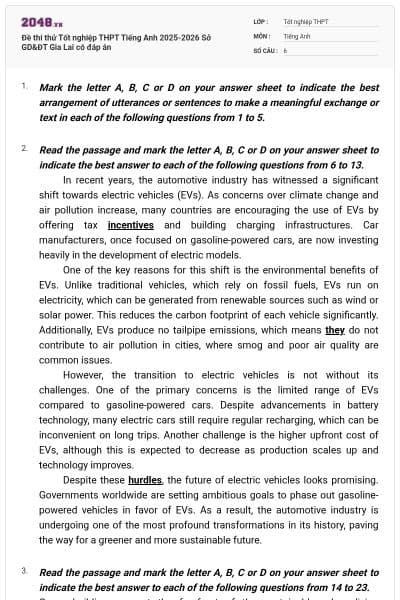
Read the following passage and mark the letter A, B, C or D on your answer sheet to indicate the best answer to each of the following questions from 23 to 30.
In the digital age, the role of newspapers has evolved significantly. Traditionally, newspapers were the primary source of information, providing news, opinion pieces, and advertisements to a wide audience. However, with the rise of the internet and social media, the newspaper industry has had to adapt to new technologies and changing consumer habits. Many peoplenow turn to online platforms for instant access to news, which has led to a decline in print subscriptions.
Despite the challenges posed by digital media, newspapers continue to play a crucial role in society. They provide in-depth analysis, investigative journalism, and local coverage that is often not available through digital-only platforms. Print newspapers still hold significant credibility among many readers, especially older generations who value the physical format. They are also important in reaching audiences in areas with limited internet access, ensuring that all communities stay informed.
Moreover, newspapers have adapted by embracing digital platforms to reach a broader audience. Many major newspapers now have online versions, offering news articles, multimedia content, and interactive features. This shift has allowed newspapers to maintain their relevance and remain competitive in the digital landscape. The move to digital has also led to the rise of subscription-based models, where readers pay for premium content, creating new revenue streams for traditional media outlets.
However, the digital transformation has not been without its challenges. Newspapers face increasing competition from social media platforms, blogs, and online news outlets, which often provide quicker updates and attract younger audiences. Additionally, the rise of fake news and misinformation on digital platforms has made it more difficult for traditional newspapers to maintain their position as trusted sources of information. Despite these challenges, newspapers continue to play a vital role in providing accurate and reliable news in an ever-changing media landscape.
Which of the following is NOT mentioned as a traditional role of newspapers?
Providing advertisements
Providing opinion pieces
Providing real-time news updates
Providing news
Điều nào sau đây KHÔNG được đề cập như một vai trò truyền thống của báo chí?
A. Providing advertisements: Cung cấp quảng cáo (Có nhắc đến: “providing... advertisements”)
B. Providing opinion pieces: Cung cấp các bài xã luận/bài nêu ý kiến (Có nhắc đến: “providing... opinion pieces”)
C. Providing real-time news updates: Cung cấp cập nhật tin tức theo thời gian thực (Không được nhắc đến như một vai trò “truyền thống”, đây là đặc điểm của nền tảng trực tuyến/mạng xã hội ngày nay).
D. Providing news: Cung cấp tin tức (Có nhắc đến: “providing news”)
Thông tin (Đoạn 1): Traditionally, newspapers were the primary source of information, providing news, opinion pieces, and advertisements to a wide audience.
(Theo truyền thống, báo chí là nguồn thông tin chính, cung cấp tin tức, các bài xã luận và quảng cáo cho đông đảo độc giả.)
Chọn C.
The word “instant” in paragraph 1 is OPPOSITE in meaning to ____________.
constant
immediate
gradual
sudden
Từ “instant” ở đoạn 1 TRÁI NGHĨA với ____________.
instant (adj): ngay lập tức, tức thời.
A. constant (adj): liên tục, không đổi
B. immediate (adj): ngay lập tức (đồng nghĩa)
C. gradual (adj): dần dần, từ từ (trái nghĩa)
D. sudden (adj): đột ngột
→ instant >< gradual
Thông tin: Many people now turn to online platforms for instant access to news...
(Nhiều người hiện nay chuyển sang các nền tảng trực tuyến để tiếp cận tin tức ngay lập tức...)
Chọn C.
The word “They” in paragraph 2 refers to ____________.
Print newspapers
Audiences
Readers
Older generations
Từ “They” ở đoạn 2 chỉ ____________.
A. Print newspapers: Báo in
B. Audiences: Khán giả/Độc giả
C. Readers: Độc giả
D. Older generations: Những thế hệ lớn tuổi
Thông tin: Print newspapers still hold significant credibility among many readers... They are also important in reaching audiences in areas with limited internet access...
(Báo in vẫn giữ được sự tín nhiệm đáng kể đối với nhiều độc giả... Chúng cũng rất quan trọng trong việc tiếp cận khán giả ở những khu vực có quyền truy cập internet hạn chế...)
→ They = Print newspapers.
Chọn A.
The word “trusted” in paragraph 4 could be best replaced by ____________.
dependent
incredible
reliable
suspicious
Từ “trusted” ở đoạn 4 có thể được thay thế tốt nhất bởi ____________.
trusted (adj): được tin tưởng, đáng tin cậy.
A. dependent (adj): phụ thuộc
B. incredible (adj): không thể tin được, phi thường
C. reliable (adj): đáng tin cậy (đồng nghĩa)
D. suspicious (adj): đáng ngờ
→ trusted = reliable
Thông tin: ...made it more difficult for traditional newspapers to maintain their position as trusted sources of information.
(...khiến cho các tờ báo truyền thống khó duy trì vị thế là những nguồn thông tin đáng tin cậy hơn.)
Chọn C.
Which of the following best paraphrases the underlined sentence in paragraph 3?
This adjustment has helped newspapers assert their dominance and compete in the digital era.
This transformation has helped newspapers stay outdated and struggle in the digital age.
The shift has allowed newspapers to become less relevant and less competitive in the digital world.
This change has enabled newspapers to stay relevant and stay competitive in the digital age.
Câu nào sau đây diễn giải tốt nhất câu được gạch chân ở đoạn 3?
This shift has allowed newspapers to maintain their relevance and remain competitive in the digital landscape.
(Sự chuyển dịch này đã cho phép các tờ báo duy trì sự phù hợp/giá trị thực tiễn của chúng và duy trì tính cạnh tranh trong bối cảnh kỹ thuật số.)
Dịch nghĩa:
A. Sự điều chỉnh này đã giúp báo chí khẳng định sự thống trị của chúng và cạnh tranh trong kỷ nguyên kỹ thuật số. (Sai từ “khẳng định sự thống trị”).
B. Sự chuyển đổi này đã giúp báo chí luôn lỗi thời và chật vật trong thời đại kỹ thuật số. (Sai nghĩa).
C. Sự chuyển dịch này đã khiến báo chí trở nên kém phù hợp hơn và kém cạnh tranh hơn trong thế giới kỹ thuật số. (Sai nghĩa).
D. Sự thay đổi này đã cho phép các tờ báo luôn phù hợp và duy trì tính cạnh tranh trong thời đại kỹ thuật số. (Đúng và sát nghĩa nhất: shift = change; allowed = enabled; maintain = stay).
Chọn D.
Which of the following is TRUE according to the passage?
Print newspapers are only used by older generations now.
The shift to digital platforms has created new revenue opportunities for newspapers.
The rise of digital media has completely replaced the role of print newspapers.
Fake news and misinformation are not issues for traditional newspapers.
Theo bài đọc, câu nào sau đây là ĐÚNG?
A. Hiện nay báo in chỉ được sử dụng bởi các thế hệ lớn tuổi. (Sai vì có từ “chỉ” - only; đoạn 2 nói “đặc biệt là thế hệ lớn tuổi” chứ không phải chỉ mình họ).
B. Việc chuyển sang các nền tảng kỹ thuật số đã tạo ra những cơ hội doanh thu mới cho báo chí. (Đúng).
C. Sự trỗi dậy của truyền thông kỹ thuật số đã thay thế hoàn toàn vai trò của báo in. (Sai, đoạn 2 nói báo in “vẫn đóng vai trò quan trọng” - continue to play a crucial role).
D. Tin giả và thông tin sai lệch không phải là vấn đề đối với các tờ báo truyền thống. (Sai, đoạn 4 nói nó làm cho báo truyền thống khó duy trì vị thế đáng tin cậy hơn).
Thông tin (Đoạn 3): The move to digital has also led to the rise of subscription-based models, where readers pay for premium content, creating new revenue streams for traditional media outlets.
(Việc chuyển sang kỹ thuật số cũng đã dẫn đến sự gia tăng của các mô hình dựa trên đăng ký, nơi độc giả trả tiền cho nội dung cao cấp, tạo ra các luồng doanh thu mới cho các cơ quan truyền thông truyền thống.)
Chọn B.
In which paragraph does the writer mention a causal relationship in which one factor has led to a decrease in another?
Paragraph 4
Paragraph 3
Paragraph 2
Paragraph 1
Tác giả đề cập đến mối quan hệ nhân quả trong đó một yếu tố đã dẫn đến sự sụt giảm của yếu tố kia ở đoạn nào?
A. Đoạn 4
B. Đoạn 3
C. Đoạn 2
D. Đoạn 1
Thông tin (Đoạn 1): Many people now turn to online platforms for instant access to news, which has led to a decline in print subscriptions.
(Nhiều người hiện nay chuyển sang các nền tảng trực tuyến để tiếp cận tin tức ngay lập tức, điều này đã dẫn đến sự sụt giảm số lượng đăng ký báo in.)
Chọn D.
In which paragraph does the writer discuss the challenges newspapers face in maintaining their credibility in a changing media environment?
Paragraph 3
Paragraph 2
Paragraph 1
Paragraph 4
Tác giả thảo luận về những thách thức mà báo chí phải đối mặt trong việc duy trì sự tín nhiệm của họ trong một môi trường truyền thông đang thay đổi ở đoạn nào?
A. Đoạn 3
B. Đoạn 2
C. Đoạn 1
D. Đoạn 4
Thông tin (Đoạn 4): Additionally, the rise of fake news and misinformation on digital platforms has made it more difficult for traditional newspapers to maintain their position as trusted sources of information.
(Ngoài ra, sự gia tăng của tin giả và thông tin sai lệch trên các nền tảng kỹ thuật số đã khiến các tờ báo truyền thống gặp nhiều khó khăn hơn trong việc duy trì vị trí là các nguồn thông tin đáng tin cậy.)
Chọn D.
Dịch bài đọc:
Trong kỷ nguyên kỹ thuật số, vai trò của báo chí đã tiến hóa một cách đáng kể. Theo truyền thống, báo chí là nguồn thông tin chính, cung cấp tin tức, các bài xã luận và quảng cáo cho đông đảo độc giả. Tuy nhiên, với sự trỗi dậy của internet và mạng xã hội, ngành công nghiệp báo chí đã phải thích ứng với các công nghệ mới và thói quen thay đổi của người tiêu dùng. Nhiều người hiện nay chuyển sang các nền tảng trực tuyến để tiếp cận tin tức ngay lập tức, điều này đã dẫn đến sự sụt giảm số lượng đăng ký báo in.
Bất chấp những thách thức do truyền thông kỹ thuật số đặt ra, báo chí vẫn tiếp tục đóng một vai trò quan trọng trong xã hội. Chúng cung cấp các phân tích chuyên sâu, báo chí điều tra và mức độ bao phủ địa phương mà thường không có sẵn thông qua các nền tảng chỉ sử dụng kỹ thuật số. Báo in vẫn giữ được sự tín nhiệm đáng kể đối với nhiều độc giả, đặc biệt là những thế hệ lớn tuổi đánh giá cao định dạng vật lý. Chúng cũng rất quan trọng trong việc tiếp cận khán giả ở những khu vực có quyền truy cập internet hạn chế, đảm bảo rằng tất cả các cộng đồng đều được cập nhật thông tin.
Hơn nữa, báo chí đã thích ứng bằng cách nắm bắt các nền tảng kỹ thuật số để tiếp cận lượng độc giả rộng lớn hơn. Nhiều tờ báo lớn hiện nay có các phiên bản trực tuyến, cung cấp các bài báo tin tức, nội dung đa phương tiện và các tính năng tương tác. Sự chuyển dịch này đã cho phép các tờ báo duy trì sự phù hợp và duy trì tính cạnh tranh trong bối cảnh kỹ thuật số. Việc chuyển sang kỹ thuật số cũng đã dẫn đến sự gia tăng của các mô hình dựa trên đăng ký, nơi độc giả trả tiền cho nội dung cao cấp, tạo ra các luồng doanh thu mới cho các cơ quan truyền thông truyền thống.
Tuy nhiên, quá trình chuyển đổi kỹ thuật số cũng không phải là không có những thách thức. Báo chí phải đối mặt với sự cạnh tranh ngày càng tăng từ các nền tảng mạng xã hội, blog và các cơ quan tin tức trực tuyến, những nơi thường cung cấp các bản cập nhật nhanh hơn và thu hút khán giả trẻ tuổi hơn. Ngoài ra, sự gia tăng của tin giả và thông tin sai lệch trên các nền tảng kỹ thuật số đã khiến các tờ báo truyền thống gặp nhiều khó khăn hơn trong việc duy trì vị trí là các nguồn thông tin đáng tin cậy. Bất chấp những thách thức này, báo chí vẫn tiếp tục đóng một vai trò thiết yếu trong việc cung cấp các tin tức chính xác và đáng tin cậy trong một bối cảnh truyền thông không ngừng thay đổi.
Read the following passage and mark the letter A, B, C, or D on your answer sheet to indicate the best answer to each of the following questions from 31 to 40.
The Hidden Economy of Browser Cookies: Tracking the Trackers
Every time you browse the internet, a quiet trade takes place. Bits of your behaviour are recorded, analysed, and often sold without you noticing. Browser cookies, small files that websites place on your device, started out as simple tools for convenience. Today, they can also support wide-scale tracking that fuels a huge data market. First-party cookies, set by the sites you actually visit, usually do harmless jobs like keeping you logged in or saving what is in your shopping cart. Third-party cookies are more intrusive. They can follow you from site to site and help build detailed profiles of your interests, routines, and even weak points. Over time, this system turns ordinary users into products, with browsing habits collected and traded to advertisers who want sharper targeting.
[I] It raises hard questions about consent and control, and about how much power sits with large tech firms compared with everyday users. Cookie tracking can enable prediction: systems may guess political views or health worries from a trail of clicks. [II] Many people find that unsettling. And while “cookie consent” banners claim to offer choice, they often push users in one direction. Some rely on dark patterns, design tricks that make “accept all” easy and “reject” slow, hidden, or confusing. [III] Add the fact that data practices are rarely clear, and most people never see the full picture. [IV] In some cases, data collected for ads can be combined and resold by brokers, and it may affect decisions in areas like credit, insurance, or hiring.
Rules and browser changes suggest the system is starting to shift. In Europe, strict privacy laws have pressured companies to limit third-party tracking, and major browsers have moved toward reducing support for third-party cookies. Consumer groups also argue for clearer disclosure so people can understand who is collecting what, and why. Still, the incentives to track users remain strong. Advertising businesses depend on it, and new tools may simply repeat the same behaviour under a different name. For users, the lesson is practical: “free” services often come with hidden costs. Protectingprivacy takes some personal action and, just as importantly, public pressure for better standards.
Where in the passage does the following sentence best fit: “The impact goes beyond advertising.”?
[II]
[III]
[IV]
[I]
Câu sau đây phù hợp nhất với vị trí nào trong bài đọc: “The impact goes beyond advertising.” (Tác động của nó vượt ra ngoài phạm vi quảng cáo.)
Trước vị trí [IV], tác giả đề cập đến việc người dùng không thấy được bức tranh toàn cảnh về cách dữ liệu được sử dụng. Việc đặt câu gạch chân vào vị trí [IV] sẽ tạo ra một bước chuyển ý hoàn hảo: “Tác động của nó vượt ra ngoài phạm vi quảng cáo. Trong một số trường hợp, dữ liệu được thu thập cho mục đích quảng cáo (ads) có thể bị kết hợp và bán lại... và ảnh hưởng đến các quyết định trong những lĩnh vực như tín dụng, bảo hiểm, hoặc tuyển dụng (đây chính là những hệ lụy vượt ra ngoài quảng cáo).”
Chọn C.
The phrase “a quiet trade takes place” in paragraph 1 is CLOSEST in meaning to ____________.
a silent exchange happens in the background
an official audit is announced to users
a legal dispute is settled through courts
a public debate becomes widely visible
Cụm từ “a quiet trade takes place” trong đoạn 1 GẦN NGHĨA nhất với ____________.
a quiet trade takes place: một cuộc giao dịch/mua bán âm thầm diễn ra
A. a silent exchange happens in the background (một sự trao đổi im lặng xảy ra trong nền/ngầm)
B. an official audit is announced to users (một cuộc kiểm toán chính thức được thông báo cho người dùng)
C. a legal dispute is settled through courts (một tranh chấp pháp lý được giải quyết qua tòa án)
D. a public debate becomes widely visible (một cuộc tranh luận công khai trở nên hiển hiện rộng rãi)
Thông tin: Every time you browse the internet, a quiet trade takes place. (Mỗi lần bạn lướt internet, một giao dịch thầm lặng đang diễn ra.)
→ Cụm từ gốc chỉ việc dữ liệu người dùng bị âm thầm ghi lại, phân tích và mua bán mà họ không hề hay biết (“without you noticing”). Đáp án A phản ánh chính xác nhất tính chất “âm thầm” (quiet/silent) và sự “mua bán” (trade/exchange) ngầm này.
→ a quiet trade takes place = a silent exchange happens in the background
Chọn A.
The word “it” in paragraph 3 refers to ____________.
advertising business.
clearer disclosure
consumer group
user tracking
Từ “it” trong đoạn 3 chỉ ____________.
A. advertising business (ngành kinh doanh quảng cáo)
B. clearer disclosure (sự tiết lộ rõ ràng hơn)
C. consumer group (nhóm người tiêu dùng)
D. user tracking (việc theo dõi người dùng)
→ Câu trước đó viết: “Still, the incentives to track users remain strong.” (Dù vậy, động lực để theo dõi người dùng vẫn còn rất mạnh mẽ). Câu tiếp theo: “Advertising businesses depend on it...” (Các doanh nghiệp quảng cáo phụ thuộc vào nó...). “Nó” ở đây chính là hành động “theo dõi người dùng” (user tracking/to track users) vừa được nhắc đến.
Chọn D.
According to paragraph 1, which of the following is NOT true about first-party cookies?
They help websites remember the specific items stored in a shopping cart.
They are primarily designed to enhance user convenience while browsing.
They are the main tools used by advertisers to build cross-site profiles.
They are responsible for maintaining a user's login status on a specific site.
Theo đoạn 1, điều nào sau đây KHÔNG đúng về “first-party cookies” (cookie của bên thứ nhất)?
A. Chúng giúp các trang web ghi nhớ các mặt hàng cụ thể được lưu trong giỏ hàng.
(Đúng - “saving what is in your shopping cart”).
B. Chúng chủ yếu được thiết kế để tăng cường sự tiện lợi cho người dùng khi duyệt web.
(Đúng - “harmless jobs”, “simple tools for convenience”).
C. Chúng là các công cụ chính được các nhà quảng cáo sử dụng để xây dựng hồ sơ theo dõi chéo các trang web. (Sai, đây là chức năng của “third-party cookies”).
D. Chúng chịu trách nhiệm duy trì trạng thái đăng nhập của người dùng trên một trang web cụ thể.
(Đúng - “keeping you logged in”).
Chọn C.
Which of the following best summarises the main content of paragraph 2?
Beyond marketing, cookie tracking creates significant privacy risks and ethical concerns by manipulating user choice and influencing life-altering decisions.
Dark patterns in cookie banners are being eliminated because they make the “reject” option too confusing for the average internet user.
Data brokers are now legally required to combine and resell information to ensure that insurance and hiring decisions are based on data.
Tech firms are using prediction systems to help users manage their health worries and political views more effectively through clicks.
Câu nào sau đây tóm tắt đúng nhất nội dung chính của đoạn 2?
A. Vượt ra ngoài tiếp thị, việc theo dõi bằng cookie tạo ra những rủi ro đáng kể về quyền riêng tư và lo ngại đạo đức bằng cách thao túng sự lựa chọn của người dùng và ảnh hưởng đến những quyết định thay đổi cuộc đời. (Đúng, bao quát các ý: đoán quan điểm chính trị/sức khỏe, “dark patterns” lừa người dùng đồng ý, và ảnh hưởng tới tín dụng/bảo hiểm).
B. Các thủ đoạn đánh lừa người dùng (dark patterns) trong banner quảng cáo cookie đang bị loại bỏ vì chúng khiến tùy chọn “từ chối” trở nên quá khó hiểu đối với người dùng internet thông thường. (Sai, bài đọc nói chúng vẫn đang được sử dụng).
C. Các nhà môi giới dữ liệu hiện nay được yêu cầu pháp lý phải kết hợp và bán lại thông tin để đảm bảo rằng các quyết định về bảo hiểm và tuyển dụng được dựa trên dữ liệu. (Sai, không có luật nào bắt buộc họ làm vậy).
D. Các công ty công nghệ đang sử dụng hệ thống dự đoán để giúp người dùng quản lý những lo lắng về sức khỏe và quan điểm chính trị của họ hiệu quả hơn thông qua các cú nhấp chuột. (Sai, họ dự đoán để thu thập dữ liệu, không phải để “giúp” người dùng).
Chọn A.
The word “intrusive” in paragraph 1 is OPPOSITE in meaning to ____________.
respectful
complex
annoying
invasive
Từ “intrusive” trong đoạn 1 TRÁI NGHĨA với ____________.
intrusive (adj): xâm phạm, chọc ngoáy, làm phiền (vào quyền riêng tư)
A. respectful (adj): tôn trọng (quyền riêng tư/ranh giới)
B. complex (adj): phức tạp
C. annoying (adj): gây bực mình
D. invasive (adj): xâm lấn, xâm phạm
→ intrusive >< respectful
Chọn A.
According to the passage, why do “cookie consent” banners often fail to provide genuine choice to users?
Because websites employ deceptive design elements that prioritize the acceptance of tracking over the ability to decline it.
Because strict privacy laws in Europe have made it impossible for websites to display clear and simple “reject” buttons.
Because third-party cookies are now required by all major browsers to ensure that “free” services remain operational for everyone.
Because most everyday users prefer to have their political views and health concerns predicted by advanced digital systems.
Theo bài đọc, tại sao các biểu ngữ “chấp thuận cookie” thường thất bại trong việc cung cấp sự lựa chọn thực sự cho người dùng?
A. Bởi vì các trang web sử dụng các yếu tố thiết kế lừa dối ưu tiên việc chấp nhận theo dõi hơn là khả năng từ chối nó. (Đúng).
B. Bởi vì luật bảo mật nghiêm ngặt ở châu Âu đã khiến các trang web không thể hiển thị các nút “từ chối” rõ ràng. (Sai, luật bảo vệ người dùng chứ không cấm nút từ chối).
C. Bởi vì tất cả các trình duyệt chính hiện nay đều yêu cầu cookie của bên thứ ba để đảm bảo các dịch vụ “miễn phí” vẫn hoạt động cho mọi người. (Sai).
D. Bởi vì hầu hết người dùng thông thường thích để các hệ thống kỹ thuật số tiên tiến dự đoán quan điểm chính trị và mối quan tâm về sức khỏe của họ. (Sai).
→ Đoạn 2 giải thích rõ các trang web sử dụng “dark patterns” (mô hình thiết kế tối/chiêu trò thiết kế) làm cho nút “chấp nhận tất cả” (accept all) dễ dàng trong khi nút “từ chối” (reject) lại chậm chạp, bị ẩn đi hoặc gây bối rối.
Thông tin: “Some rely on dark patterns, design tricks that make “accept all” easy and “reject” slow, hidden, or confusing.” (Một số dựa vào các thủ thuật thiết kế tinh vi, những mánh khóe khiến việc “chấp nhận tất cả” trở nên dễ dàng và việc “từ chối” thì chậm, khó phát hiện hoặc gây nhầm lẫn.)
Chọn A.
Which of the following best paraphrases the underlined sentence in paragraph 3: “Protecting privacy takes some personal action and, just as importantly, public pressure for better standards.”?
Public pressure for better standards is more important than personal action when users want to protect their privacy from tech firms.
Securing personal data requires a combination of individual vigilance and collective social demands for more rigorous regulatory frameworks.
Individual efforts to protect privacy are completely useless unless there is significant public pressure to change the current standards.
Unless users take personal action to pressure the public, the standards for protecting privacy will remain unchanged by large companies.
Câu nào sau đây diễn giải đúng nhất câu được gạch chân ở đoạn 3?
Protecting privacy takes some personal action and, just as importantly, public pressure for better standards. (Bảo vệ quyền riêng tư đòi hỏi một số hành động cá nhân và, quan trọng không kém, là áp lực từ công chúng vì những tiêu chuẩn tốt hơn.)
A. Áp lực dư luận đòi hỏi các tiêu chuẩn tốt hơn quan trọng hơn hành động cá nhân khi người dùng muốn bảo vệ quyền riêng tư của mình khỏi các công ty công nghệ. (Sai, câu gốc nói “just as importantly” - quan trọng không kém).
B. Việc bảo đảm an toàn dữ liệu cá nhân đòi hỏi sự kết hợp giữa sự cảnh giác của cá nhân (hành động cá nhân) và những yêu cầu xã hội tập thể (áp lực công chúng) về các khuôn khổ quy định nghiêm ngặt hơn (tiêu chuẩn tốt hơn). (Đúng, cấu trúc kết hợp hoàn hảo cả hai yếu tố có tầm quan trọng tương đương).
C. Những nỗ lực cá nhân để bảo vệ quyền riêng tư hoàn toàn vô ích trừ khi có áp lực dư luận đáng kể để thay đổi các tiêu chuẩn hiện hành. (Sai ý).
D. Trừ khi người dùng có hành động cá nhân gây áp lực lên dư luận, các tiêu chuẩn bảo vệ quyền riêng tư sẽ vẫn không thay đổi bởi các công ty lớn. (Sai nghĩa hoàn toàn).
Chọn B.
Which of the following can be most likely inferred from the passage?
The transition toward stricter privacy laws in Europe will lead to the complete disappearance of the global online advertising market.
Major browsers are reducing support for third-party cookies primarily because they want to eliminate the “hidden costs” of free services.
The decline of third-party cookies may lead to the development of alternative tracking technologies that bypass current privacy regulations.
Users who avoid clicking on “cookie consent” banners are immune to having their data resold by brokers for insurance or credit decisions.
Điều nào sau đây CÓ KHẢ NĂNG NHẤT được suy luận từ bài đọc?
A. Việc chuyển hướng tới các luật về quyền riêng tư nghiêm ngặt hơn ở châu Âu sẽ dẫn đến sự biến mất hoàn toàn của thị trường quảng cáo trực tuyến toàn cầu. (Sai, “sự biến mất hoàn toàn” là quá cực đoan).
B. Các trình duyệt chính đang giảm hỗ trợ cho cookie của bên thứ ba chủ yếu vì họ muốn loại bỏ “chi phí ẩn” của các dịch vụ miễn phí. (Sai, họ giảm vì áp lực luật pháp và người tiêu dùng).
C. Sự sụt giảm của cookie của bên thứ ba có thể dẫn đến việc phát triển các công nghệ theo dõi thay thế lách qua các quy định quyền riêng tư hiện tại. (Đúng).
D. Người dùng không nhấp vào biểu ngữ “đồng ý sử dụng cookie” sẽ không bị các nhà môi giới bán lại dữ liệu của họ cho các quyết định bảo hiểm hoặc tín dụng. (Sai).
→ Đoạn cuối nhận định rằng các doanh nghiệp quảng cáo vẫn rất phụ thuộc vào việc theo dõi, và do đó, “các công cụ mới có thể sẽ lặp lại cùng một hành vi dưới một cái tên khác”. Điều này cho phép chúng ta suy luận rằng khi cookie bị siết chặt, họ sẽ tìm ra (phát triển) các công nghệ theo dõi thay thế mới để lách luật.
Thông tin: “Advertising businesses depend on it, and new tools may simply repeat the same behaviour under a different name.” (Các doanh nghiệp quảng cáo phụ thuộc vào nó, và các công cụ mới có thể chỉ đơn giản là lặp lại hành vi tương tự dưới một tên gọi khác.)
Chọn C.
Which of the following best summarises the passage?
Privacy laws and browser updates are successfully ending the hidden economy of data trading, making user tracking a thing of the past.
Browser cookies have evolved from tools of convenience into essential components for tech firms to provide free services to the global public.
The pervasive tracking economy, fueled by intrusive cookies, poses complex privacy threats that require both regulatory shifts and proactive user awareness.
First-party and third-party cookies are equally responsible for the erosion of user control and the rise of dark patterns in modern web design.
Câu nào sau đây tóm tắt đúng nhất bài đọc?
A. Luật bảo mật và các bản cập nhật trình duyệt đang thành công trong việc chấm dứt nền kinh tế ngầm của việc mua bán dữ liệu, khiến việc theo dõi người dùng trở thành dĩ vãng. (Sai, bài đọc nói nó chưa kết thúc và vẫn còn nhiều động lực để tiếp tục).
B. Cookie trình duyệt đã phát triển từ công cụ tiện lợi thành các thành phần thiết yếu để các công ty công nghệ cung cấp dịch vụ miễn phí cho công chúng toàn cầu. (Thiếu hoàn toàn khía cạnh cảnh báo về mối đe dọa quyền riêng tư).
C. Nền kinh tế theo dõi tràn lan, được thúc đẩy bởi các cookie xâm phạm, đặt ra những mối đe dọa phức tạp về quyền riêng tư, đòi hỏi cả sự thay đổi về quy định pháp luật và nhận thức chủ động của người dùng. (Tóm tắt hoàn hảo và trọn vẹn mạch bài: Nêu hiện trạng kinh tế theo dõi ở đoạn 1, các rủi ro phức tạp ở đoạn 2, và sự cần thiết của luật pháp cũng như hành động từ người dùng ở đoạn 3).
D. Cookie của bên thứ nhất và bên thứ ba đều chịu trách nhiệm như nhau đối với sự xói mòn quyền kiểm soát của người dùng và sự gia tăng các thủ thuật thiết kế web đen tối trong thiết kế web hiện đại. (Sai, cookie bên thứ nhất thường vô hại).
Chọn C.
Dịch bài đọc:
Nền Kinh Tế Ngầm Của Cookie Trình Duyệt: Theo Dõi Những Kẻ Theo Dõi
Mỗi khi bạn lướt internet, một cuộc giao dịch âm thầm lại diễn ra. Những mẩu hành vi của bạn được ghi lại, phân tích và thường bị bán đi mà bạn không hề hay biết. Cookie trình duyệt, những tệp tin nhỏ mà các trang web đặt vào thiết bị của bạn, bắt đầu như những công cụ đơn giản mang lại sự tiện lợi. Ngày nay, chúng cũng có thể hỗ trợ việc theo dõi trên quy mô rộng, tiếp nhiên liệu cho một thị trường dữ liệu khổng lồ. Cookie của bên thứ nhất (first-party cookies), được thiết lập bởi chính các trang web mà bạn thực sự truy cập, thường làm những công việc vô hại như giữ cho bạn luôn đăng nhập hoặc lưu trữ những gì có trong giỏ hàng của bạn. Nhưng cookie của bên thứ ba (third-party cookies) lại mang tính xâm phạm cao hơn nhiều. Chúng có thể theo dõi bạn từ trang web này sang trang web khác và giúp xây dựng các hồ sơ chi tiết về sở thích, thói quen, và thậm chí cả những điểm yếu của bạn. Theo thời gian, hệ thống này biến những người dùng bình thường thành các sản phẩm, với những thói quen lướt web được thu thập và bán lại cho những nhà quảng cáo muốn nhắm mục tiêu chuẩn xác hơn.
Nó đặt ra những câu hỏi hóc búa về sự đồng thuận và quyền kiểm soát, cũng như việc các công ty công nghệ lớn đang nắm giữ bao nhiêu quyền lực so với những người dùng bình thường. Việc theo dõi bằng cookie có thể kích hoạt khả năng dự đoán: các hệ thống có thể đoán được quan điểm chính trị hay những nỗi lo lắng về sức khỏe từ một chuỗi các cú nhấp chuột. Nhiều người cảm thấy điều đó thật đáng lo ngại. Và trong khi các biểu ngữ “chấp thuận cookie” tuyên bố là mang đến sự lựa chọn, chúng lại thường thúc đẩy người dùng đi theo một hướng duy nhất. Một số trang web dựa vào “dark patterns” (những mô hình thiết kế tối) – những mánh khóe thiết kế làm cho nút “chấp nhận tất cả” trở nên dễ dàng trong khi việc “từ chối” lại chậm chạp, bị ẩn đi hoặc gây bối rối. Thêm vào đó là sự thật rằng các hoạt động xử lý dữ liệu hiếm khi minh bạch, và hầu hết mọi người không bao giờ nhìn thấy được bức tranh toàn cảnh. [IV] (Tác động của nó vượt ra ngoài phạm vi quảng cáo.) Trong một số trường hợp, dữ liệu được thu thập cho mục đích quảng cáo có thể bị kết hợp và bán lại bởi các nhà môi giới, và nó có thể ảnh hưởng đến các quyết định trong những lĩnh vực như tín dụng, bảo hiểm, hoặc tuyển dụng.
Các quy định và sự thay đổi của trình duyệt cho thấy hệ thống này đang bắt đầu chuyển dịch. Tại châu Âu, các đạo luật bảo mật nghiêm ngặt đã gây áp lực buộc các công ty phải hạn chế việc theo dõi của bên thứ ba, và các trình duyệt lớn đã tiến tới việc giảm hỗ trợ đối với cookie của bên thứ ba. Các nhóm bảo vệ người tiêu dùng cũng đấu tranh đòi hỏi sự công khai rõ ràng hơn để mọi người có thể hiểu ai đang thu thập cái gì, và tại sao. Dù vậy, động lực để theo dõi người dùng vẫn còn rất mạnh mẽ. Các doanh nghiệp quảng cáo phụ thuộc vào nó, và các công cụ mới có thể chỉ đơn giản là lặp lại cùng một hành vi dưới một cái tên khác. Đối với người dùng, bài học rút ra rất thực tế: các dịch vụ “miễn phí” thường đi kèm với những chi phí ẩn. Bảo vệ quyền riêng tư đòi hỏi một số hành động cá nhân và, quan trọng không kém, là áp lực từ công chúng vì những tiêu chuẩn tốt hơn.