Đề thi thử Tốt nghiệp THPT Tiếng Anh 2025-2026 THPT Lê Viết Thuật (Nghệ An) lần 2 có đáp án
40 câu hỏi
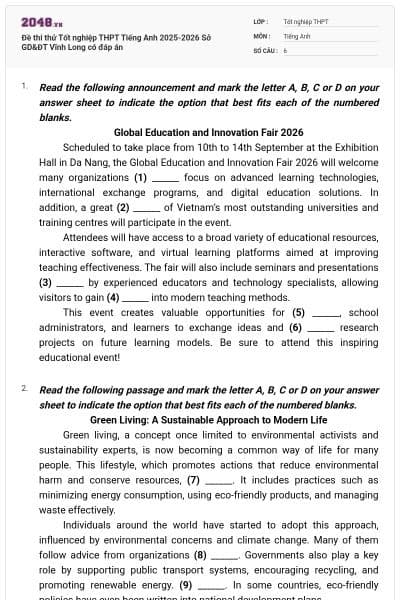
Read the following announcement and mark the letter A, B, C or D on your answer sheet to indicate the option that best fits each of the numbered blanks from 1 to 6.
Youth Leadership Camp 2025 – Empowering Tomorrow’s Visionaries
Are you a student (1) ______ aspires to create meaningful change in your school or community? The Youth Leadership Camp 2025 provides an immersive week of collaboration, innovation, and self- discovery in the tranquil highlands of Da Lat.
The camp (2) ______ under the supervision of the Ministry of Education and Youth Development unites aspiring young leaders from various provinces to cultivate essential life competencies. Participants will engage in a diverse (3) ______ of activities, including strategic problem-solving workshops, intercultural dialogues, and outdoor leadership challenges.
Throughout the program, students can (4) ______ their confidence, communication, and teamwork through real-world simulations. Exceptional participants will be recognized for their (5) ______ leadership and visionary thinking during the closing ceremony.
If you’re ready to embrace growth, inspire others, and redefine your potential, register today and (6) ______ the leader within you!
which
who
whom
whose
Đây là câu hỏi có sử dụng mệnh đề quan hệ để bổ nghĩa cho danh từ “a student” (một học sinh), sau chỗ trống là động từ “aspires” → Ta cần một đại từ quan hệ làm chủ ngữ, chỉ người, để thay thế cho “student” và đứng trước động từ trong mệnh đề quan hệ.
A. “which” là đại từ quan hệ chỉ vật, không dùng để chỉ người → Sai
B. “who” là đại từ quan hệ chỉ người, có thể làm chủ ngữ cho động từ “aspires” → Đúng
C. “whom” thường được dùng để làm tân ngữ, không làm chủ ngữ → Sai
D. “whose” là đại từ quan hệ chỉ sở hữu, phải đi trước một danh từ → Sai
→ Are you a student who aspires to create meaningful change in your school or community? (Bạn có phải là một học sinh có mong muốn tạo ra những thay đổi ý nghĩa trong trường học hoặc cộng đồng của mình không?)
Chọn B.
which organizes
being organized
organizing
organized
Trong câu, động từ chính là “unites”, nên phần đứng trước nó là cụm bổ nghĩa cho danh từ “The camp”. Cụm “under the supervision of …” cho thấy trại hè được giám sát bởi một đơn vị → Cần dùng mệnh đề quan hệ ở thể bị động, có dạng “which is + V past participle”, được rút gọn còn V past participle.
A. “which organizes” là mệnh đề chủ động, không phù hợp vì “the camp” không phải chủ thể giám sát → Sai
B. “being organized” ở dạng tiếp diễn, không phù hợp với văn phong giới thiệu chương trình → Sai
C. “organizing” ở dạng chủ động, trong khi “the camp” không thể tự giám sát → Sai
D. “organized” được rút gọn từ mệnh đề quan hệ ở dạng bị động “which is organized” → Đúng
→ The camp organized under the supervision of the Ministry of Education and Youth Development unites aspiring young leaders from various provinces to cultivate essential life competencies. (Trại được tổ chức dưới sự giám sát của Bộ Giáo dục và Phát triển Thanh niên, quy tụ những nhà lãnh đạo trẻ đầy khát vọng đến từ nhiều tỉnh thành khác nhau nhằm bồi dưỡng các năng lực sống thiết yếu.)
Chọn D.
Participants will engage in a diverse (3) ______ of activities, including strategic problem-solving workshops, intercultural dialogues, and outdoor leadership challenges.
amount
range
deal
number
Sau tính từ “diverse” là cấu trúc “____ of + danh từ số nhiều (activities)”, dùng để diễn tả sự đa dạng về loại hình hoạt động → Ta cần một cụm danh từ chỉ số lượng phù hợp với danh từ đếm được số nhiều.
Cụm từ cố định: a range of + danh từ số nhiều: dùng để chỉ một loạt cái gì đó, nhấn mạnh số lượng (đếm được) và sự đa dạng của chúng.
→ Participants will engage in a diverse range of activities, including strategic problem-solving workshops, intercultural dialogues, and outdoor leadership challenges. (Người tham gia sẽ được trải nghiệm một loạt hoạt động đa dạng, bao gồm các buổi hội thảo rèn luyện kỹ năng giải quyết vấn đề mang tính chiến lược, các cuộc đối thoại liên văn hóa và những thử thách lãnh đạo ngoài trời.)
Chọn B.
take up
put out
build up
bring in
Sau động từ khuyết thiếu “can” cần một động từ nguyên thể, các tân ngữ phía sau (“confidence, communication, teamwork”) đều là kỹ năng/phẩm chất → Ta cần điền cụm động từ mang nghĩa xây dựng, phát triển.
A. take up (phr. v): bắt đầu một hoạt động nào đó
B. put out (phr. v): dập tắt; phát hành, sản xuất
C. build up (phr. v): xây dựng, phát triển dần dần
D. bring in (phr. v): giới thiệu; mang lại doanh thu
→ Throughout the program, students can build up their confidence, communication, and teamwork through real-world simulations. (Trong suốt chương trình, học sinh có thể xây dựng sự tự tin, kỹ năng giao tiếp và khả năng làm việc nhóm thông qua các tình huống mô phỏng thực tế.)
Chọn C.
Exceptional participants will be recognized for their (5) ______ leadership and visionary thinking during the closing ceremony.
inspiration
inspired
inspire
inspiring
Nhìn vào câu ta thấy, trước danh từ “leadership” cần một tính từ để bổ nghĩa.
A. inspiration (n): cảm hứng → Sai, vì là danh từ
B. inspired (adj): được truyền cảm hứng, thường mang nghĩa bị động và mô tả cảm xúc → Sai, vì không phù hợp về ngữ nghĩa
C. inspire (v): truyền cảm hứng → Sai, vì là động từ
D. inspiring (adj): truyền cảm hứng, dùng để mô tả tính chất của sự vật, sự việc → Đúng, phù hợp về cả loại từ và ngữ nghĩa
→ Exceptional participants will be recognized for their inspiring leadership and visionary thinking during the closing ceremony. (Những học viên xuất sắc sẽ được vinh danh vì khả năng lãnh đạo truyền cảm hứng và tư duy tầm nhìn trong lễ bế mạc.)
Chọn D.
unlock
open
widen
extend
Nhìn vào câu, ta cần điền một động từ để đi với cụm “the leader within you”, mang nghĩa năng lực/tiềm năng lãnh đạo tiềm ẩn bên trong mỗi người.
A. unlock (v): khai mở, đánh thức, thường dùng trong các cụm từ cố định như “unlock + potential/talent/ability”, mang nghĩa khai phá những khả năng sẵn có bên trong → Đúng, vì phù hợp với cụm “the leader within you” và thông điệp của bài
B. open (v): mở, thường dùng cho vật thể cụ thể (open a door/a box) hoặc khái niệm chung (open a discussion) → Sai, vì không phù hợp với cụm “the leader within you”
C. widen (v): mở rộng, thường đi với phạm vi, khoảng cách, tầm nhìn (widen knowledge/horizons), không dùng để nói đến việc đánh thức hay khai phá năng lực tiềm ẩn → Sai về nghĩa
D. extend (v): kéo dài, mở rộng, thường dùng với thời gian, phạm vi, quyền hạn (extend a deadline,…), không phù hợp với danh từ trừu tượng “the leader within you” → Sai về nghĩa
→ If you’re ready to embrace growth, inspire others, and redefine your potential, register today and unlock the leader within you! (Nếu bạn sẵn sàng đón nhận sự phát triển, truyền cảm hứng cho người khác và tái định nghĩa tiềm năng của bản thân, hãy đăng ký ngay hôm nay và khơi mở nhà lãnh đạo bên trong bạn!)
Chọn A.
Bài hoàn chỉnh | Dịch bài đọc |
Youth Leadership Camp 2025 – Empowering Tomorrow’s Visionaries Are you a student (1) who aspires to create meaningful change in your school or community? The Youth Leadership Camp 2025 provides an immersive week of collaboration, innovation, and self-discovery in the tranquil highlands of Da Lat. The camp (2) organized under the supervision of the Ministry of Education and Youth Development unites aspiring young leaders from various provinces to cultivate essential life competencies. Participants will engage in a diverse (3) range of activities, including strategic problem-solving workshops, intercultural dialogues, and outdoor leadership challenges. Throughout the program, students can (4) build up their confidence, communication, and teamwork through real-world simulations. Exceptional participants will be recognized for their (5) inspiring leadership and visionary thinking during the closing ceremony. If you’re ready to embrace growth, inspire others, and redefine your potential, register today and (6) unlock the leader within you! | Trại Lãnh đạo Trẻ 2025 – Trao quyền cho những nhà kiến tạo tương lai Bạn có phải là một học sinh có mong muốn tạo ra những thay đổi ý nghĩa trong trường học hoặc cộng đồng của mình không? Trại Lãnh đạo Trẻ 2025 mang đến một tuần trải nghiệm chuyên sâu về hợp tác, đổi mới và tự khám phá, diễn ra tại vùng cao nguyên yên bình của Đà Lạt. Trại được tổ chức dưới sự giám sát của Bộ Giáo dục và Phát triển Thanh niên, quy tụ những nhà lãnh đạo trẻ đầy khát vọng đến từ nhiều tỉnh thành khác nhau nhằm bồi dưỡng các năng lực sống thiết yếu. Người tham gia sẽ được trải nghiệm một loạt hoạt động đa dạng, bao gồm các buổi hội thảo rèn luyện kỹ năng giải quyết vấn đề mang tính chiến lược, các cuộc đối thoại liên văn hóa và những thử thách lãnh đạo ngoài trời. Trong suốt chương trình, học sinh có thể xây dựng sự tự tin, kỹ năng giao tiếp và khả năng làm việc nhóm thông qua các tình huống mô phỏng thực tế. Những học viên xuất sắc sẽ được vinh danh vì khả năng lãnh đạo truyền cảm hứng và tư duy tầm nhìn trong lễ bế mạc. Nếu bạn sẵn sàng đón nhận sự phát triển, truyền cảm hứng cho người khác và tái định nghĩa tiềm năng của bản thân, hãy đăng ký ngay hôm nay và khơi mở nhà lãnh đạo bên trong bạn! |
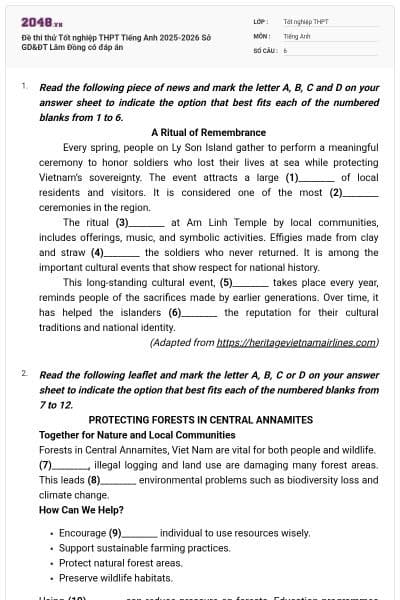
Read the following leaflet and mark the letter A, B, C or D on your answer sheet to indicate the option that best fits each of the numbered blanks from 7 to 12.
How to Fight Fatigue Effectively
Feeling constantly tired can reduce your productivity and lower your overall well-being. To manage fatigue better, try building a healthy routine (7) ______ boosting your daily energy levels.
· Keep a consistent sleep schedule and avoid screen time before bed, (8) ______ this habit can interfere with your natural sleep rhythm.
· Fuel your body with balanced meals rich in protein and whole grains instead of (9) ______ that cause sudden energy crashes.
· Incorporate short bursts of movement into your day. Even a few minutes of (10) ______ physical activity, such as stretching or walking, can refresh your mind.
· Share your goals with friends or family and encourage (11) ______ to participate so you can stay motivated together.
· When you feel tired, try calming techniques like breathing exercises or listening to music to help you get back (12) ______ and feel more refreshed.
of
in
for
on
Nhìn vào câu, ta thấy trước chỗ trống là danh từ “routine”, sau chỗ trống là V-ing “boosting” → Ta cần điền một giới từ chỉ mục đích
→ Cấu trúc “noun + for + V-ing” để chỉ mục đích.
→ To manage fatigue better, try building a healthy routine for boosting your daily energy levels. (Để kiểm soát tình trạng mệt mỏi tốt hơn, hãy thử xây dựng một thói quen lành mạnh nhằm nâng cao mức năng lượng hằng ngày của bạn.)
Chọn C.
as
but
yet
so
Trong câu có 2 mệnh đề, mệnh đề thứ nhất “Keep a consistent sleep schedule and avoid screen time before bed,…” (Hãy duy trì lịch ngủ đều đặn và tránh sử dụng thiết bị điện tử trước khi đi ngủ,…) nói về lời khuyên, mệnh đề thứ hai “…this habit can interfere with your natural sleep rhythm.” (…thói quen này có thể làm rối loạn nhịp sinh học tự nhiên của bạn.) chỉ nguyên nhân giải thích cho lời khuyên → Ta cần một liên từ chỉ nguyên nhân.
A. as: vì/bởi vì, chỉ nguyên nhân
B. but: chỉ sự đối lập
C. yet: diễn tả sự trái ngược
D. so: diễn tả kết quả, không phải nguyên nhân
→ Keep a consistent sleep schedule and avoid screen time before bed, as this habit can interfere with your natural sleep rhythm. (Duy trì lịch ngủ đều đặn và tránh sử dụng thiết bị điện tử trước khi đi ngủ, vì thói quen này có thể gây cản trở nhịp sinh học tự nhiên của bạn.)
Chọn A.
ultra processed foods
foods processed ultra
processed ultra foods
foods ultra processed
Cụm từ cố định: ultra processed foods: thực phẩm siêu chế biến
→ Fuel your body with balanced meals rich in protein and whole grains instead of ultra processed foods that cause sudden energy crashes. (Cung cấp năng lượng cho cơ thể bằng những bữa ăn cân đối, giàu protein và ngũ cốc nguyên hạt, thay vì các thực phẩm siêu chế biến, vốn gây ra tình trạng sụt giảm năng lượng đột ngột.)
Chọn A.
soft
light
slight
mild
Phần ví dụ theo sau là “stretching or walking” (giãn cơ hoặc đi bộ) cho thấy đây đều là những hoạt động vận động có cường độ thấp và được xếp vào nhóm vận động nhẹ → Cần điền một tính từ mô tả tính chất nhẹ của hoạt động thể chất.
A. soft (adj): mềm, dùng cho vật liệu, kết cấu (soft fabric, soft pillow)
B. light (adj): nhẹ, dùng để chỉ cường độ thấp (light exercise, light activity)
C. slight (adj): nhỏ, không đáng kể, dùng cho mức độ trừu tượng (slight change, slight difference)
D. mild (adj): nhẹ, ôn hòa, dùng cho bệnh, thời tiết (mild illness, mild weather)
→ Incorporate short bursts of movement into your day. Even a few minutes of lightphysical activity, such as stretching or walking, can refresh your mind. (Xen kẽ những khoảng vận động ngắn vào sinh hoạt hằng ngày. Chỉ cần vài phút vận động nhẹ, chẳng hạn như giãn cơ hoặc đi bộ, cũng có thể giúp tinh thần bạn tỉnh táo hơn.)
Chọn B.
another
the others
other
others
Nhìn vào câu, ta thấy chỗ trống cần một đại từ chỉ “những người khác” được khuyến khích tham gia, ngoài những chủ thể đã nêu trước đó “friends or family” (bạn bè hoặc gia đình).
A. “another” chỉ một người khác → Không phù hợp, vì chỉ số ít
B. “the others” chỉ những người còn lại trong một nhóm đã được xác định từ trước → Không phù hợp, vì câu không xác định sẵn một nhóm người cụ thể
C. “other” → Không phù hợp, vì “other” không đứng một mình, sau nó phải đi với một danh từ (other people,…)
D. “others” chỉ những người khác, nhưng không xác định rõ họ là ai → Phù hợp
→ Share your goals with friends or family and encourage others to participate so you can stay motivated together. (Chia sẻ mục tiêu của bạn với bạn bè hoặc gia đình và khuyến khích những người khác cùng tham gia để cả nhóm có thể duy trì động lực cùng nhau.)
Chọn D.
· When you feel tired, try calming techniques like breathing exercises or listening to music to help you get back (12) ______ and feel more refreshed.
at ease
in charge
on track
off balance
Ta cần điền vào chỗ trống một cụm từ cố định sau cụm “get back”, mang nghĩa trở lại trạng thái cân bằng, đúng hướng.
A. at ease: trong trạng thái thoải mái, thư giãn, dễ chịu → Không phù hợp về nghĩa
B. in charge: chịu trách nhiệm, có quyền quản lý một việc gì đó → Không phù hợp về nghĩa
C. on track: đúng hướng, đúng tiến độ → Phù hợp về nghĩa
D. off balance: trong trạng thái mất cân bằng, không ổn định → Không phù hợp về nghĩa
→ When you feel tired, try calming techniques like breathing exercises or listening to music to help you get back on track and feel more refreshed. (Khi cảm thấy mệt mỏi, hãy thử các biện pháp thư giãn như bài tập hít thở hoặc nghe nhạc để giúp bạn quay lại đúng hướng và cảm thấy sảng khoái hơn.)
Chọn C.
Bài hoàn chỉnh | Dịch bài đọc |
How to Fight Fatigue Effectively Feeling constantly tired can reduce your productivity and lower your overall well-being. To manage fatigue better, try building a healthy routine (7) for boosting your daily energy levels. · Keep a consistent sleep schedule and avoid screen time before bed, (8) as this habit can interfere with your natural sleep rhythm. · Fuel your body with balanced meals rich in protein and whole grains instead of (9) ultra processed foods that cause sudden energy crashes. · Incorporate short bursts of movement into your day. Even a few minutes of (10) light physical activity, such as stretching or walking, can refresh your mind. · Share your goals with friends or family and encourage (11) others to participate so you can stay motivated together. · When you feel tired, try calming techniques like breathing exercises or listening to music to help you get back (12) on track and feel more refreshed. | Cách chống lại sự mệt mỏi một cách hiệu quả Việc luôn cảm thấy mệt mỏi có thể làm giảm năng suất làm việc và ảnh hưởng tiêu cực đến sức khỏe của bạn. Để kiểm soát tình trạng mệt mỏi tốt hơn, hãy thử xây dựng một thói quen lành mạnh nhằm nâng cao mức năng lượng hằng ngày của bạn. · Duy trì lịch ngủ đều đặn và tránh sử dụng thiết bị điện tử trước khi đi ngủ, vì thói quen này có thể gây cản trở nhịp sinh học tự nhiên của bạn. · Cung cấp năng lượng cho cơ thể bằng những bữa ăn cân đối, giàu protein và ngũ cốc nguyên hạt, thay vì các thực phẩm siêu chế biến, vốn gây ra tình trạng sụt giảm năng lượng đột ngột. · Xen kẽ những khoảng vận động ngắn vào sinh hoạt hằng ngày. Chỉ cần vài phút vận động nhẹ, chẳng hạn như giãn cơ hoặc đi bộ, cũng có thể giúp tinh thần bạn tỉnh táo hơn. · Chia sẻ mục tiêu của bạn với bạn bè hoặc gia đình và khuyến khích những người khác cùng tham gia để cả nhóm có thể duy trì động lực cùng nhau. · Khi cảm thấy mệt mỏi, hãy thử các biện pháp thư giãn như bài tập hít thở hoặc nghe nhạc để giúp bạn quay lại đúng hướng và cảm thấy sảng khoái hơn. |
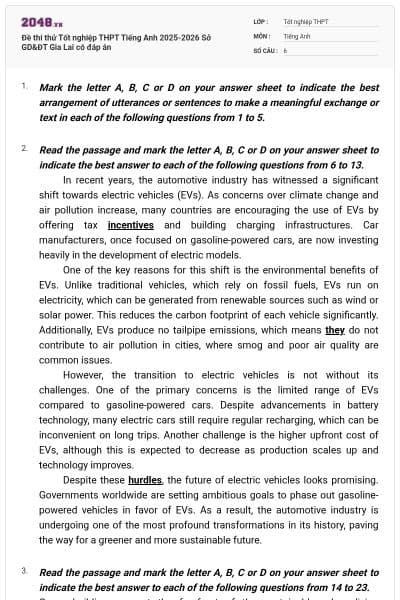
Mark the letter A, B, C or D on your answer sheet to indicate the best arrangement of utterances or sentences to make a meaningful exchange or text in each of the following questions from 13 to 17.
a. Alice: Sure! Just go straight down this road and take a right at the first intersection. It will be on your left.
b. Bella: Excuse me, can you tell me where the nearest bakery is? I’m really in the mood for some pastries!
c. Bella: Thank you so much! I really appreciate your help.
c-a-b
b-a-c
c-b-a
a-c-b
Thứ tự sắp xếp đúng: B. b-a-c
b. Bella: Excuse me, can you tell me where the nearest bakery is? I’m really in the mood for some pastries!
a. Alice: Sure! Just go straight down this road and take a right at the first intersection. It will be on your left.
c. Bella: Thank you so much! I really appreciate your help.
Dịch nghĩa:
b. Bella: Xin lỗi bạn, bạn có thể cho mình biết tiệm bánh gần nhất ở đâu không? Mình đang rất thèm ăn bánh ngọt.
a. Alice: Được chứ! Bạn cứ đi thẳng theo con đường này, rồi rẽ phải ở ngã tư đầu tiên. Tiệm bánh sẽ nằm bên tay trái của bạn.
c. Bella: Cảm ơn bạn nhiều lắm! Mình thật sự rất cảm kích vì sự giúp đỡ của bạn.
Chọn B.
a. Emma: It talked about the immense pressure we face to excel in so many areas of life.
b. Olivia: No, I haven’t seen it. What did it cover?
c. Emma: Hey, did you catch that new documentary about the challenges facing teens today?
d. Olivia: I know what you mean. It feels like we have to be perfect at everything.
e. Emma: Exactly! And then there's the constant social media scrutiny. It's exhausting.
c-a-b-d-e
b-d-e-a-c
c-b-a-d-e
b-c-a-e-d
Thứ tự sắp xếp đúng: C. c-b-a-d-e
c. Emma: Hey, did you catch that new documentary about the challenges facing teens today?
b. Olivia: No, I haven’t seen it. What did it cover?
a. Emma: It talked about the immense pressure we face to excel in so many areas of life.
d. Olivia: I know what you mean. It feels like we have to be perfect at everything.
e. Emma: Exactly! And then there's the constant social media scrutiny. It's exhausting.
Dịch nghĩa:
c. Emma: Này, cậu có xem bộ phim tài liệu mới nói về những khó khăn mà thanh thiếu niên ngày nay đang phải đối mặt không?
b. Olivia: Chưa, mình chưa xem. Phim nói về những vấn đề gì vậy?
a. Emma: Phim đề cập đến áp lực rất lớn mà tụi mình phải chịu để giỏi giang trong nhiều lĩnh vực của cuộc sống.
d. Olivia: Mình hiểu cảm giác đó. Cứ như thể chúng ta phải hoàn hảo trong mọi thứ vậy.
e. Emma: Đúng vậy! Chưa kể đến việc lúc nào cũng bị soi xét trên mạng xã hội nữa. Mệt mỏi thật sự.
Chọn C.
Hi Micky,
a. Your tips made a noticeable difference in my cooking.
b. Thanks again for recommending those useful tips, I really appreciate them.
c. Let's catch up soon to exchange more tips and ideas for improving our cooking skills.
d. Since then, I've already started researching more about the topic and trying out some recipes.
e. I've been thinking a lot about what we discussed last time, especially about mastering new techniques in cooking.
Write back soon, Rose
b-c-a-d-e
b-d-e-a-c
e-a-d-b-c
e-b-c-a-d
Thứ tự sắp xếp đúng: C. e-a-d-b-c
Hi Micky,
e. I've been thinking a lot about what we discussed last time, especially about mastering new techniques in cooking.
a. Your tips made a noticeable difference in my cooking.
d. Since then, I've already started researching more about the topic and trying out some recipes.
b. Thanks again for recommending those useful tips, I really appreciate them.
c. Let's catch up soon to exchange more tips and ideas for improving our cooking skills.
Write back soon, Rose
Dịch nghĩa:
Chào Micky,
e. Mình đã suy nghĩ khá nhiều về những điều tụi mình trao đổi lần trước, đặc biệt là về việc làm chủ các kỹ thuật nấu ăn mới.
a. Những lời khuyên của bạn thực sự đã tạo ra sự khác biệt rõ rệt trong việc nấu nướng của mình.
d. Từ đó đến nay, mình đã bắt đầu tìm hiểu sâu hơn về chủ đề này và thử nghiệm thêm nhiều công thức mới.
b. Một lần nữa cảm ơn bạn vì đã chia sẻ những mẹo rất hữu ích, mình thật sự rất trân trọng.
c. Hy vọng sớm có dịp gặp lại để cùng trao đổi thêm nhiều mẹo và ý tưởng giúp cải thiện kỹ năng nấu ăn nhé.
Viết thư lại sớm nha, Rose
Chọn C.
a. Companies often promote their products in a way that plays on people's desires, making them feel that purchasing these goods is a must.
b. These fraudulent campaigns are designed in a manner that convinces people they are supporting a noble cause, even though their money is being misused.
c. Advertising through mass media is one of the most powerful ways to influence consumer behavior today.
d. When advertisements present products as if they are the solution to all of life's problems, consumers are more likely to believe they need them.
e. However, this power can also be misused, as some scammers use media platforms to deceive people into donating to fake charitable causes.
c-b-e-d-a
c-a-d-e-b
c-e-b-a-d
d-e-a-c-b
Thứ tự sắp xếp đúng: B. c-a-d-e-b
c. Advertising through mass media is one of the most powerful ways to influence consumer behavior today.
a. Companies often promote their products in a way that plays on people's desires, making them feel that purchasing these goods is a must.
d. When advertisements present products as if they are the solution to all of life's problems, consumers are more likely to believe they need them.
e. However, this power can also be misused, as some scammers use media platforms to deceive people into donating to fake charitable causes.
b. These fraudulent campaigns are designed in a manner that convinces people they are supporting a noble cause, even though their money is being misused.
Dịch nghĩa:
c. Quảng cáo thông qua các phương tiện truyền thông đại chúng hiện nay là một trong những cách mạnh mẽ nhất để tác động đến hành vi tiêu dùng.
a. Các công ty thường quảng bá sản phẩm bằng cách đánh vào mong muốn của con người, khiến họ cảm thấy việc mua những món hàng đó là điều cần thiết.
d. Khi quảng cáo mô tả sản phẩm như thể chúng là lời giải cho mọi vấn đề trong cuộc sống, người tiêu dùng càng dễ tin rằng mình thực sự cần chúng.
e. Tuy nhiên, sức ảnh hưởng này cũng có thể bị lạm dụng, khi một số kẻ lừa đảo sử dụng các nền tảng truyền thông để đánh lừa mọi người quyên góp cho những tổ chức từ thiện giả mạo.
b. Những chiến dịch gian lận này được thiết kế rất tinh vi, khiến người ta tin rằng mình đang ủng hộ một mục đích cao đẹp, trong khi thực tế số tiền lại bị sử dụng sai mục đích.
Chọn B.
a. These individual efforts, when combined with broader policy changes and community involvement, can lead to a significant positive impact on global environmental health.
b. Green living has become a crucial part of tackling the environmental crises we face today, as it not only helps preserve natural resources but also ensures the well-being of future generations.
c. By making small changes such as reducing plastic consumption, using energy-efficient appliances, and opting for eco-friendly transportation methods like cycling or using electric cars, we can dramatically reduce our carbon footprint.
d. Shifting towards a plant-based diet further contributes to sustainability, as the agricultural industry, particularly livestock farming, is one of the leading contributors to deforestation and greenhouse gas emissions.
e. In addition, many people are adopting renewable energy solutions, like solar panels or wind turbines, which, in the long run, not only decrease our reliance on non-renewable resources but also lower electricity bills.
b-e-c-a-d
d-e-c-b-a
d-a-e-c-b
b-c-e-d-a
Thứ tự sắp xếp đúng: D. b-c-e-d-a
b. Green living has become a crucial part of tackling the environmental crises we face today, as it not only helps preserve natural resources but also ensures the well-being of future generations.
c. By making small changes such as reducing plastic consumption, using energy-efficient appliances, and opting for eco-friendly transportation methods like cycling or using electric cars, we can dramatically reduce our carbon footprint.
e. In addition, many people are adopting renewable energy solutions, like solar panels or wind turbines, which, in the long run, not only decrease our reliance on non-renewable resources but also lower electricity bills.
d. Shifting towards a plant-based diet further contributes to sustainability, as the agricultural industry, particularly livestock farming, is one of the leading contributors to deforestation and greenhouse gas emissions.
a. These individual efforts, when combined with broader policy changes and community involvement, can lead to a significant positive impact on global environmental health.
Dịch nghĩa:
b. Sống xanh đã trở thành một yếu tố then chốt trong việc ứng phó với các cuộc khủng hoảng môi trường hiện nay, bởi lối sống này không chỉ giúp bảo vệ tài nguyên thiên nhiên mà còn đảm bảo chất lượng cuộc sống cho các thế hệ tương lai.
c. Bằng những thay đổi nhỏ như giảm sử dụng nhựa, dùng các thiết bị tiết kiệm năng lượng và lựa chọn phương tiện thân thiện với môi trường như đi xe đạp hay xe điện, chúng ta có thể giảm đáng kể lượng khí thải carbon.
e. Bên cạnh đó, ngày càng nhiều người chuyển sang sử dụng các nguồn năng lượng tái tạo như điện mặt trời hoặc tua-bin gió, điều này về lâu dài không chỉ giúp giảm sự phụ thuộc vào tài nguyên không tái tạo mà còn tiết kiệm chi phí điện.
d. Việc chuyển sang chế độ ăn giàu thực vật cũng góp phần thúc đẩy phát triển bền vững, bởi ngành nông nghiệp, đặc biệt là chăn nuôi, là một trong những nguyên nhân hàng đầu gây phá rừng và phát thải khí nhà kính.
a. Khi những nỗ lực cá nhân này được kết hợp với các thay đổi chính sách rộng hơn và sự tham gia của cộng đồng, chúng có thể tạo ra tác động tích cực đáng kể đối với sức khỏe môi trường toàn cầu.
Chọn D.
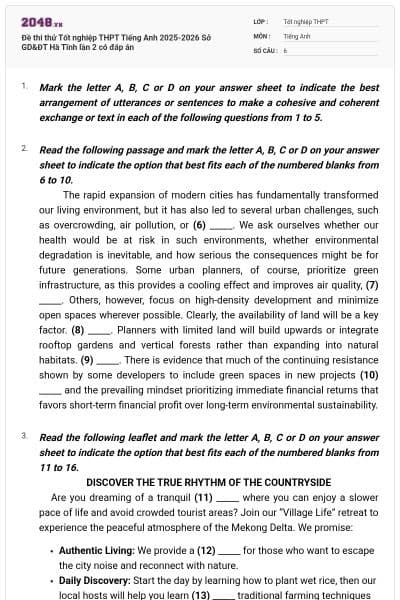
Read the following passage and mark the letter A, B, C or D on your answer sheet to indicate the option that best fits each of the numbered blanks from 18 to 22.
Although smell is often considered the least valued of the five senses, scientists now understand that it forms one of the most immediate links between the brain and the outside world. A scent can reach the area of the brain connected with emotions and memories in just two seconds, which partly explains why certain aromas can instantly trigger vivid recollections. Yet the precise mechanism behind this influence remains unclear, (18) ______.
Nevertheless, smell also (19) ______. Apparently, people respond more strongly to subtle chemical cues than they realise, and even first impressions can be shaped by scent. Many individuals tend to be attracted to those (20) ______. Interestingly, people also smell of what they eat, which may further affect how they are perceived.
In consumer behaviour, the impact of scent has become a topic of substantial interest. In one well-known study, a majority of participants reported being more willing to buy a pair of trainers when the shop environment smelled pleasantly floral. (21) ______. The use of fragrance has gradually become a marketing tool across different industries. Today, many companies deliberately integrate scent into their branding strategies to create welcoming environments and encourage customers to stay longer. However, experts warn that scent-based persuasion has its limits. (22) ______.
Yet the precise mechanism behind this influence remains unclear, (18) ______.
even though scientists have already found some clues about how it works
because many people still do not pay attention to their sense of smell
so researchers have stopped all experiments related to the topic
but most experts agree that smell affects emotions very strongly
Dịch nghĩa:
A. mặc dù các nhà khoa học đã tìm ra một số manh mối về cách khứu giác hoạt động
B. vì nhiều người vẫn chưa thật sự chú ý đến giác quan khứu giác của mình
C. nên các nhà nghiên cứu đã ngừng toàn bộ những thí nghiệm liên quan đến chủ đề này
D. nhưng đa số các chuyên gia đều đồng ý rằng mùi hương có ảnh hưởng rất mạnh đến cảm xúc
Yet the precise mechanism behind this influence remains unclear, (18) ______.
(Tuy vậy, cơ chế chính xác đằng sau sự ảnh hưởng này vẫn chưa được hiểu rõ, (18) ______.)
→ Câu chứa chỗ trống mở đầu bằng “Yet”, thể hiện sự đối lập giữa việc chưa hiểu rõ cơ chế chính xác, và kết luận chung của các chuyên gia về ảnh hưởng của mùi hương. Vì vậy, chỗ trống cần một mệnh đề vừa đối lập về nghĩa, vừa tiếp tục làm rõ nội dung phía trước nó.
Đáp án D sử dụng liên từ “but”, giúp hoàn chỉnh mối quan hệ tương phản giữa việc chưa rõ cơ chế tác động nhưng đa số chuyên gia đồng ý rằng mùi hương ảnh hưởng rất mạnh đến cảm xúc.
→ Yet the precise mechanism behind this influence remains unclear, but most experts agree that smell affects emotions very strongly. (Tuy vậy, cơ chế chính xác đằng sau tác động này vẫn chưa được làm rõ, nhưng đa số các chuyên gia đều đồng ý rằng khứu giác có ảnh hưởng rất mạnh đến cảm xúc.)
Chọn D.
plays a surprisingly important role in social interaction
help people understand certain feelings during simple daily conversations
affecting the way we react to others when we first meet them
works as a main tool for solving difficult mathematical problem
Dịch nghĩa:
A. đóng vai trò quan trọng một cách đáng ngạc nhiên trong các mối tương tác xã hội
B. giúp con người hiểu được một số cảm xúc nhất định trong những cuộc trò chuyện hằng ngày đơn giản
C. ảnh hưởng đến cách chúng ta phản ứng với người khác ngay trong lần đầu gặp gỡ
D. hoạt động như một công cụ chính để giải quyết các bài toán phức tạp về mặt toán học
Nevertheless, smell also (19) ______. (Tuy nhiên, khứu giác cũng ______.)
→ Trong câu có cụm “Nevertheless” (Tuy nhiên) dùng để bổ sung thêm một vai trò khác của khứu giác. Vì vậy, câu sau cần một ý mang tính khái quát, phù hợp với vai trò của khứu giác.
→ Đáp án A phù hợp vì nó khẳng định rằng khứu giác có vai trò quan trọng trong tương tác xã hội, điều này hoàn toàn logic khi mùi hương có thể ảnh hưởng đến ấn tượng, cảm xúc và hành vi giữa người với người.
Loại đáp án B vì quá hẹp, chỉ giới hạn trong “cuộc trò chuyện hàng ngày đơn giản”, không đủ khái quát ý của toàn bộ đoạn văn.
Loại đáp án C vì chỉ đề cập đến “lần đầu gặp gỡ”, trong khi đoạn văn nói về vai trò rộng hơn của khứu giác.
Loại đáp án D vì sai hoàn toàn về nội dung, vì khứu giác không liên quan đến việc giải toán.
→ Nevertheless, smell also plays a surprisingly important role in social interaction.(Tuy nhiên, khứu giác cũng đóng vai trò quan trọng một cách đáng ngạc nhiên trong các mối tương tác xã hội.)
Chọn A.
whose scent appears incompatible with their own body chemistry
who appear to have no noticeable scent in the daily life at all
whose natural smell seems to align with their own body chemistry
who constantly try to mask their natural smell with strong perfumes
Dịch nghĩa:
A. những người có mùi hương không tương thích với “hóa học cơ thể” của chính mình
B. những người dường như không có mùi hương đáng chú ý nào trong đời sống hằng ngày
C. những người có mùi hương tự nhiên hòa hợp với “hóa học cơ thể” của chính mình
D. những người luôn cố che giấu mùi tự nhiên bằng nước hoa nồng
Many individuals tend to be attracted to those (20) ______.
(Nhiều người có xu hướng bị thu hút bởi những người ______.)
→ Cụm “tend to be attracted to” (có xu hướng bị thu hút bởi) chỉ sự thu hút một cách tự nhiên, vô thức.
→ Đáp án C phù hợp nhất vì nó diễn đạt đúng ý: con người bị thu hút bởi những người có mùi hương tự nhiên hòa hợp với “hóa học cơ thể” của họ, phù hợp với mạch lập luận của đoạn văn.
Loại đáp án A vì chứa từ “incompatible” (không tương thích) đi ngược lại ý “attracted to” (bị thu hút bởi).
Loại đáp án B vì nói đến việc không có mùi hương đáng chú ý, mâu thuẫn với ý của đoạn văn về việc con người có phản ứng với mùi hương.
Loại đáp án D vì đoạn văn đang nói đến mùi hương tự nhiên, không phải được che giấu bằng nước hoa.
→ Many individuals tend to be attracted to those whose natural smell seems to align with their own body chemistry.(Nhiều người có xu hướng bị thu hút bởi những người có mùi hương tự nhiên hòa hợp với hóa học cơ thể của chính mình.)
Chọn C.
This demonstrates how carefully people assess the objective quality of a product
Such findings suggest that environmental cues can subtly shape purchasing decisions
The study concluded that floral shops are the most effective retail spaces
Customers primarily buy products based on visual design rather than scent
Dịch nghĩa:
A. Điều này cho thấy con người đánh giá rất kỹ chất lượng khách quan của một sản phẩm
B. Những phát hiện như vậy cho thấy các tín hiệu từ môi trường có thể âm thầm định hình quyết định mua sắm
C. Nghiên cứu kết luận rằng các cửa hàng bán hoa là không gian bán lẻ hiệu quả nhất
D. Khách hàng chủ yếu mua sản phẩm dựa trên thiết kế hình ảnh hơn là mùi hương
In one well-known study, a majority of participants reported being more willing to buy a pair of trainers when the shop environment smelled pleasantly floral. (21) ______.
(Trong một nghiên cứu nổi tiếng, phần lớn người tham gia cho biết họ sẵn sàng mua một đôi giày thể thao hơn khi không gian cửa hàng có mùi hoa dễ chịu. (21) ______.)
→ Câu trước đó nêu ra một ví dụ nghiên cứu cụ thể, cho thấy hành vi mua sắm của người tiêu dùng bị ảnh hưởng bởi mùi hương của môi trường xung quanh. Do đó, câu tiếp theo cần có chức năng khái quát và rút ra kết luận từ ví dụ này.
→ Đáp án B đáp ứng đúng yêu cầu đó vì nó đóng vai trò rút ra ý nghĩa của nghiên cứu, khẳng định rằng các tín hiệu môi trường như mùi hương có thể tác động đến quyết định mua hàng. Điều này hoàn toàn phù hợp với chủ đề của đoạn văn.
Loại đáp án A vì mâu thuẫn với ví dụ đã nêu, vì người mua không dựa vào đánh giá khách quan mà bị tác động bởi mùi hương.
Loại đáp án C vì suy diễn sai nội dung nghiên cứu, vì nghiên cứu không so sánh hiệu quả giữa các loại cửa hàng.
Loại đáp án D vì phủ nhận vai trò của mùi hương, trái ngược với kết quả nghiên cứu.
→ In one well-known study, a majority of participants reported being more willing to buy a pair of trainers when the shop environment smelled pleasantly floral. Such findings suggest that environmental cues can subtly shape purchasing decisions.(Trong một nghiên cứu nổi tiếng, phần lớn người tham gia cho biết họ sẵn sàng mua một đôi giày thể thao hơn khi không gian cửa hàng có mùi hoa dễ chịu. Những phát hiện như vậy cho thấy các tín hiệu từ môi trường có thể âm thầm định hình quyết định mua sắm.)
Chọn B.
Most customers cannot detect any attempt to influence them through scent
People always respond positively to pleasant smells regardless of context
Scent-based strategies work only when combined with loud music and bright lighting
Consumers may resist such tactics if they feel the intention behind them is too obvious
Dịch nghĩa:
A. Hầu hết khách hàng không thể nhận ra bất kỳ nỗ lực nào nhằm tác động đến họ thông qua mùi hương
B. Con người luôn phản ứng tích cực với mùi hương dễ chịu bất kể bối cảnh
C. Các chiến lược dựa trên mùi hương chỉ hiệu quả khi kết hợp với âm nhạc lớn và ánh sáng rực rỡ
D. Người tiêu dùng có thể phản kháng những chiến thuật này nếu họ cảm thấy ý đồ phía sau quá lộ liễu
Today, many companies deliberately integrate scent into their branding strategies to create welcoming environments and encourage customers to stay longer. However, experts warn that scent-based persuasion has its limits. (22) ______.
(Ngày nay, nhiều công ty cố ý đưa mùi hương vào chiến lược xây dựng thương hiệu nhằm tạo ra không gian dễ chịu và khuyến khích khách hàng ở lại lâu hơn. Tuy nhiên, các chuyên gia cảnh báo rằng việc thuyết phục bằng mùi hương cũng có những giới hạn nhất định. (22) ______.)
→ Câu trước đó nêu lên thực tế rằng doanh nghiệp chủ động sử dụng mùi hương như một công cụ marketing, trong khi câu sau bắt đầu bằng “However” nhằm báo hiệu hạn chế của chiến lược này. Vì vậy, chỗ trống cần bổ sung ý cho thấy mùi hương không phải lúc nào cũng mang lại hiệu quả như mong muốn.
→ Đáp án D phù hợp nhất vì nó chỉ ra rằng người tiêu dùng có thể phản ứng tiêu cực hoặc chống lại việc bị thao túng, đặc biệt khi họ nhận ra rõ ràng ý đồ thuyết phục phía sau mùi hương. Điều này giải thích trực tiếp cho “limits” (giới hạn) được nhắc đến trong câu trước.
Loại đáp án A vì mâu thuẫn với ý “has its limits” (có giới hạn), vì nếu khách hàng không nhận ra thì chiến lược sẽ hiệu quả.
Loại đáp án B vì tuyệt đối hóa phản ứng của con người qua từ “always” (luôn luôn), trái với cảnh báo của chuyên gia.
Loại đáp án C vì đưa thông tin không liên quan và không được đề cập trong đoạn văn.
→ Today, many companies deliberately integrate scent into their branding strategies to create welcoming environments and encourage customers to stay longer. However, experts warn that scent-based persuasion has its limits. Consumers may resist such tactics if they feel the intention behind them is too obvious.(Ngày nay, nhiều công ty cố ý đưa mùi hương vào chiến lược xây dựng thương hiệu nhằm tạo ra không gian dễ chịu và khuyến khích khách hàng ở lại lâu hơn. Tuy nhiên, các chuyên gia cảnh báo rằng việc thuyết phục bằng mùi hương cũng có những giới hạn nhất định. Người tiêu dùng có thể phản kháng những chiến thuật này nếu họ cảm thấy ý đồ phía sau quá lộ liễu.)
Chọn D.
Bài hoàn chỉnh | Dịch bài đọc |
Although smell is often considered the least valued of the five senses, scientists now understand that it forms one of the most immediate links between the brain and the outside world. A scent can reach the area of the brain connected with emotions and memories in just two seconds, which partly explains why certain aromas can instantly trigger vivid recollections. Yet the precise mechanism behind this influence remains unclear, (18)but most experts agree that smell affects emotions very strongly. Nevertheless, smell also (19) plays a surprisingly important role in social interaction. Apparently, people respond more strongly to subtle chemical cues than they realise, and even first impressions can be shaped by scent. Many individuals tend to be attracted to those (20) whose natural smell seems to align with their own body chemistry. Interestingly, people also smell of what they eat, which may further affect how they are perceived. In consumer behaviour, the impact of scent has become a topic of substantial interest. In one well-known study, a majority of participants reported being more willing to buy a pair of trainers when the shop environment smelled pleasantly floral. (21) Such findings suggest that environmental cues can subtly shape purchasing decisions. Today, many companies deliberately integrate scent into their branding strategies to create welcoming environments and encourage customers to stay longer. However, experts warn that scent-based persuasion has its limits. (22) Consumers may resist such tactics if they feel the intention behind them is too obvious. | Mặc dù khứu giác thường được xem là giác quan ít được coi trọng nhất trong năm giác quan, các nhà khoa học hiện nay hiểu rằng nó tạo ra một trong những mối liên kết nhanh nhất giữa não bộ và thế giới bên ngoài. Một mùi hương có thể tác động đến vùng não liên quan đến cảm xúc và ký ức chỉ trong vòng hai giây, điều này phần nào giải thích vì sao một số mùi hương có thể ngay lập tức khơi gợi những ký ức sống động. Tuy vậy, cơ chế chính xác đằng sau sự ảnh hưởng này vẫn chưa được làm rõ, nhưng đa số các chuyên gia đều đồng ý rằng khứu giác có ảnh hưởng rất mạnh đến cảm xúc. Tuy nhiên, khứu giác cũng đóng vai trò quan trọng một cách đáng ngạc nhiên trong các mối tương tác xã hội. Rõ ràng, con người phản ứng mạnh mẽ với những tín hiệu hóa học tinh tế hơn so với những gì họ nhận ra, và thậm chí ấn tượng ban đầu cũng có thể bị chi phối bởi mùi hương. Nhiều người có xu hướng bị thu hút bởi những người có mùi hương tự nhiên hòa hợp với “hóa học cơ thể” của chính mình. Điều thú vị là, con người cũng mang mùi của những gì họ ăn, điều này có thể tiếp tục ảnh hưởng đến cách họ được người khác nhìn nhận. Trong hành vi tiêu dùng, tác động của mùi hương đã trở thành một chủ đề được quan tâm đáng kể. Trong một nghiên cứu nổi tiếng, phần lớn người tham gia cho biết họ sẵn sàng mua một đôi giày thể thao hơn khi không gian cửa hàng có mùi hoa dễ chịu. Những phát hiện như vậy cho thấy các tín hiệu từ môi trường có thể âm thầm định hình quyết định mua sắm. Ngày nay, nhiều công ty cố ý đưa mùi hương vào chiến lược xây dựng thương hiệu nhằm tạo ra không gian dễ chịu và khuyến khích khách hàng ở lại lâu hơn. Tuy nhiên, các chuyên gia cảnh báo rằng việc thuyết phục bằng mùi hương cũng có những giới hạn nhất định. Người tiêu dùng có thể phản kháng những chiến thuật này nếu họ cảm thấy ý đồ phía sau quá lộ liễu. |
Read the following passage and mark the letter A, B, C or D on your answer sheet to indicate the best answer to each of the following questions from 23 to 30.
Urbanisation, a process once associated primarily with industrial expansion, has evolved into a multidimensional transformation reshaping societies worldwide. As cities expand, policymakers face mounting pressure to balance economic development with social equity, environmental sustainability, and cultural preservation. Although urbanisation has historically been viewed as a sign of national progress, contemporary debates highlight its uneven consequences, particularly for vulnerable populations whose livelihoods are increasingly threatened.
Modern urban growth is driven not only by rural-to-urban migration but also by demographic change and the expansion of large infrastructure projects. These forces accelerate the conversion of agricultural land into residential and commercial zones. However, this rapid expansion often outpaces the capacity of municipal governments to provide adequate housing, transportation, and waste-management systems. As a result, informal settlements grow on the edges of cities, revealing systemic failures that governments struggle to confront.
Despite its challenges, urbanisation also presents opportunities for innovation. Cities that adopt data-driven planning, integrated public transit, and green infrastructure can mitigate congestion and enhance residents’ quality of life. Furthermore, urban hubs attract diverse talent pools, making them engines of creativity and technological advancement. Yet critics argue that such innovation disproportionately benefits affluent districts, reinforcing spatial inequalities that limit social mobility for lower-income communities.
Increasingly, researchers are calling for a “resilient urbanism” approach - one that emphasises citizen participation, long-term ecological stability, and inclusive policy frameworks. This model encourages city leaders to anticipate climate-related disruptions, redesign public spaces to withstand extreme weather, and ensure that marginalised groups have meaningful influence in urban decision-making. Whether governments can adopt these principles consistently remains uncertain, but many experts contend that the future of urbanisation will depend on how effectively cities address these intertwined social and environmental challenges.
Which of the following is NOT mentioned in paragraph 1 as a concern related to urbanisation?
cultural preservation
environmental sustainability
agricultural productivity
social equity
Nội dung nào sau đây trong đoạn 1 KHÔNG phải là một mối lo ngại liên quan đến quá trình đô thị hóa?
A. cultural preservation: bảo tồn văn hóa
B. environmental sustainability: tính bền vững của môi trường
C. agricultural productivity: năng suất nông nghiệp
D. social equity: công bằng xã hội
Thông tin: As cities expand, policymakers face mounting pressure to balance economic development with social equity, environmental sustainability, and cultural preservation.
(Khi các thành phố không ngừng mở rộng, các nhà hoạch định chính sách phải đối mặt với áp lực ngày càng gia tăng trong việc cân bằng giữa phát triển kinh tế với công bằng xã hội, tính bền vững của môi trường và bảo tồn văn hóa.)
Chọn C.
informal settlements and systemic failures
demographic change and large infrastructure projects
municipal governments and private developers
social equity and cultural preservation
Từ “These forces”trong đoạn 2 đề cập đến ______.
A. informal settlements and systemic failures: các khu dân cư tự phát và những thất bại mang tính hệ thống
B. demographic change and large infrastructure project: biến động nhân khẩu học và các dự án hạ tầng quy mô lớn
C. municipal governments and private developers: chính quyền đô thị và các nhà phát triển tư nhân
D. social equity and cultural preservation: công bằng xã hội và bảo tồn văn hóa
Thông tin: Modern urban growth is driven not only by rural-to-urban migration but also by demographic change and the expansion of large infrastructure projects. These forces accelerate the conversion of agricultural land into residential and commercial zones. (Sự tăng trưởng đô thị hiện đại không chỉ được thúc đẩy bởi làn sóng di cư từ nông thôn ra thành thị mà còn bởi biến động nhân khẩu học và sự mở rộng của các dự án hạ tầng quy mô lớn. Những động lực này đẩy nhanh quá trình chuyển đổi đất nông nghiệp thành các khu dân cư và thương mại.)
→ “These forces” đề cập đến biến động nhân khẩu học và sự mở rộng của các dự án hạ tầng quy mô lớn được nhắc đến ở câu trước.
Chọn B.
Which of the following best paraphrases the underlined sentence in paragraph 2?
City authorities expand urban areas by creating new districts that can be easily managed by officials.
Informal housing on city outskirts increases, exposing governance gaps that authorities find difficult to fix.
Local governments allow settlement growth on the outskirts as a means to address housing demands.
Informal settlements decline when city planners successfully manage infrastructure and services.
Nội dung nào sau đây diễn đạt lại chính xác nhất câu được gạch chân trong đoạn 2?
As a result, informal settlements grow on the edges of cities, revealing systemic failures that governments struggle to confront.(Hệ quả là các khu dân cư tự phát mọc lên ở vùng ven đô, phơi bày những bất cập mang tính hệ thống trong công tác quản lý mà các chính phủ gặp nhiều khó khăn khi xử lý.)
A. City authorities expand urban areas by creating new districts that can be easily managed by officials. (Chính quyền thành phố mở rộng khu vực đô thị bằng cách tạo ra các quận mới có thể dễ dàng được các quan chức quản lý.) → Sai nghĩa
B. Informal housing on city outskirts increases, exposing governance gaps that authorities find difficult to fix. (Nhà ở tự phát tại vùng ven đô gia tăng, làm lộ ra những khoảng trống trong công tác quản lý mà chính quyền khó có thể khắc phục.) → Phù hợp
C. Local governments allow settlement growth on the outskirts as a means to address housing demands. (Chính quyền địa phương cho phép sự mở rộng các khu dân cư ở vùng ven như một cách để giải quyết nhu cầu nhà ở.) → Sai nghĩa
D. Informal settlements decline when city planners successfully manage infrastructure and services. (Các khu định cư tự phát suy giảm khi các nhà quy hoạch đô thị quản lý thành công cơ sở hạ tầng và dịch vụ.) → Sai nghĩa
Chọn B.
drivers
machines
vehicles
tools
Từ “engines” trong đoạn 3 có thể được thay thế phù hợp nhất bằng từ ______.
Trong ngữ cảnh “engines of creativity” (động lực cho sáng tạo), “engines” mang nghĩa ẩn dụ là “động lực, nhân tố thúc đẩy”
A. drivers (n): Bên cạnh nghĩa đen là “người lái”, từ này còn có nghĩa ẩn dụ là “động lực”
B. machines (n): máy móc
C. vehicles (n): phương tiên, xe cộ
D. tools (n): công cụ
→ engines = drivers
Thông tin: Furthermore, urban hubs attract diverse talent pools, making them engines of creativity and technological advancement. (Hơn nữa, các trung tâm đô thị thu hút nguồn nhân lực đa dạng, trở thành động lực cho sáng tạo và tiến bộ công nghệ.)
Chọn A.
Innovation in cities usually benefits all neighbourhoods equally.
Urban hubs often foster creativity and technological growth.
Critics believe that innovation slows down economic productivity.
Green infrastructure worsens congestion in large cities.
Điều nào sau đây là ĐÚNG theo đoạn 3?
A. Innovation in cities usually benefits all neighbourhoods equally. (Đổi mới ở các thành phố thường mang lại lợi ích ngang bằng cho mọi khu dân cư.) →Sai, vì trái ngược với đoạn 3 “…such innovation disproportionately benefits affluent districts…” (những đổi mới này thường mang lại lợi ích không tương xứng cho các khu vực giàu có)
B. Urban hubs often foster creativity and technological growth. (Các trung tâm đô thị thường thúc đẩy sáng tạo và phát triển công nghệ.) →Đúng, vì tương đương với ý “…urban hubs attract diverse talent pools, making them engines of creativity and technological advancement.” (các trung tâm đô thị thu hút nguồn nhân lực đa dạng, trở thành động lực cho sáng tạo và tiến bộ công nghệ.)
C. Critics believe that innovation slows down economic productivity. (Các ý kiến phê phán cho rằng đổi mới làm chậm năng suất kinh tế.) →Sai, vì các ý kiến phê phán cho rằng đổi mới gây bất bình đẳng, không nói đến việc làm chậm năng suất kinh tế “…critics argue that such innovation disproportionately benefits affluent districts, reinforcing spatial inequalities…” (các ý kiến phê phán cho rằng những đổi mới này thường mang lại lợi ích không tương xứng cho các khu vực giàu có, qua đó củng cố bất bình đẳng)
D. Green infrastructure worsens congestion in large cities. (Hạ tầng xanh làm trầm trọng thêm tình trạng ùn tắc ở các thành phố lớn.) →Sai, vì đoạn văn nói hạ tầng xanh giúp giảm tắc nghẽn, không phải làm trầm trọng thêm “…green infrastructure can mitigate congestion…” (hạ tầng xanh có thể giảm thiểu ùn tắc)
Thông tin: Despite its challenges, urbanisation also presents opportunities for innovation. Cities that adopt data-driven planning, integrated public transit, and green infrastructure can mitigate congestion and enhance residents’ quality of life. Furthermore, urban hubs attract diverse talent pools, making them engines of creativity and technological advancement. Yet critics argue that such innovation disproportionately benefits affluent districts, reinforcing spatial inequalities that limit social mobility for lower-income communities. (Bất chấp những thách thức, đô thị hóa cũng mở ra nhiều cơ hội đổi mới. Những thành phố áp dụng quy hoạch dựa trên dữ liệu, hệ thống giao thông công cộng tích hợp và hạ tầng xanh có thể giảm thiểu ùn tắc và nâng cao chất lượng sống của cư dân. Hơn nữa, các trung tâm đô thị thu hút nguồn nhân lực đa dạng, trở thành động lực cho sáng tạo và tiến bộ công nghệ. Tuy vậy, các ý kiến phê phán cho rằng những đổi mới này thường mang lại lợi ích không tương xứng cho các khu vực giàu có, qua đó củng cố bất bình đẳng không gian và hạn chế khả năng dịch chuyển xã hội của các cộng đồng thu nhập thấp.)
Chọn B.
damage
disturbances
interruptions
stability
Từ “disruptions” trong đoạn 4 có nghĩa TRÁI NGƯỢC với ______.
disruptions (n): sự gián đoạn/xáo trộn
A. damage (n): thiệt hại
B. disturbances (n): sự xáo trộn
C. interruptions (n): sự gián đoạn
D. stability (n): sự ổn định
→ disruptions >< stability
Thông tin: This model encourages city leaders to anticipate climate-related disruptions, redesign public spaces to withstand extreme weather, and ensure that marginalised groups have meaningful influence in urban decision-making. (Mô hình này khuyến khích các nhà lãnh đạo đô thị chủ động dự báo những gián đoạn liên quan đến khí hậu, tái thiết không gian công cộng để chống chịu với thời tiết cực đoan, đồng thời bảo đảm rằng các nhóm yếu thể có tiếng nói thực chất trong quá trình ra quyết định đô thị.)
Chọn D.
Paragraph 1
Paragraph 2
Paragraph 3
Paragraph 4
In which paragraph does the writer mention spatial inequalities? (Tác giả đề cập đến sự bất bình đẳng không gian ở đoạn văn nào?)
A. Đoạn 1 B. Đoạn 2 C. Đoạn 3 D. Đoạn 4
Thông tin: Yet critics argue that such innovation disproportionately benefits affluent districts, reinforcing spatial inequalities that limit social mobility for lower-income communities. (Tuy vậy, các ý kiến phê phán cho rằng những đổi mới này thường mang lại lợi ích không tương xứng cho các khu vực giàu có, qua đó củng cố bất bình đẳng không gian và hạn chế khả năng dịch chuyển xã hội của các cộng đồng thu nhập thấp.) (Đoạn 3)
→ Đoạn 3 đề cập đến “spatial inequalities” (bất bình đẳng không gian).
Chọn C.
Paragraph 1
Paragraph 2
Paragraph 3
Paragraph 4
In which paragraph does the writer mention a model for future urban development? (Tác giả đề cập đến một mô hình cho phát triển đô thị trong tương lai ở đoạn văn nào?)
A. Đoạn 1 B. Đoạn 2 C. Đoạn 3 D. Đoạn 4
Thông tin: Increasingly, researchers are calling for a “resilient urbanism” approach - one that emphasises citizen participation, long-term ecological stability, and inclusive policy frameworks. (Ngày càng nhiều nhà nghiên cứu kêu gọi một cách tiếp cận “đô thị hóa có khả năng chống chịu”, nhấn mạnh sự tham gia của người dân, tính ổn định sinh thái dài hạn và các khuôn khổ chính sách bao trùm.) (Đoạn 4)
→ Đoạn 4 đề cập đến một mô hình phát triển đô thị trong tương lai, là mô hình “resilient urbanism” (đô thị hóa có khả năng chống chịu).
Chọn D.
Dịch bài đọc:
Đô thị hóa, một quá trình từng chủ yếu gắn liền với sự mở rộng công nghiệp, nay đã phát triển thành một sự chuyển biến đa chiều, tái định hình các xã hội trên toàn cầu. Khi các thành phố không ngừng mở rộng, các nhà hoạch định chính sách phải đối mặt với áp lực ngày càng gia tăng trong việc cân bằng giữa phát triển kinh tế với công bằng xã hội, bền vững môi trường và bảo tồn giá trị văn hóa. Mặc dù trong lịch sử, đô thị hóa thường được xem là dấu hiệu của tiến bộ quốc gia, những tranh luận đương đại lại nhấn mạnh các hệ quả không đồng đều của quá trình này, đặc biệt đối với những nhóm dân cư dễ bị tổn thương, những người mà sinh kể đang ngày càng bị đe dọa.
Sự tăng trưởng đô thị hiện đại không chỉ được thúc đẩy bởi làn sóng di cư từ nông thôn ra thành thị mà còn bởi biến động nhân khẩu học và sự mở rộng của các dự án hạ tầng quy mô lớn. Những động lực này đẩy nhanh quá trình chuyển đổi đất nông nghiệp thành các khu dân cư và thương mại. Tuy nhiên, tốc độ mở rộng nhanh chóng ấy thường vượt quá năng lực của chính quyền đô thị trong việc cung cấp đầy đủ nhà ở, hệ thống giao thông và quản lý chất thải. Hệ quả là các khu dân cư tự phát mọc lên ở vùng ven đô, phơi bày những bất cập mang tính hệ thống trong công tác quản lý mà các chính phủ gặp nhiều khó khăn khi xử lý.
Bất chấp những thách thức, đô thị hóa cũng mở ra nhiều cơ hội đổi mới. Những thành phố áp dụng quy hoạch dựa trên dữ liệu, hệ thống giao thông công cộng tích hợp và hạ tầng xanh có thể giảm thiểu ùn tắc và nâng cao chất lượng sống của cư dân. Hơn nữa, các trung tâm đô thị thu hút nguồn nhân lực đa dạng, trở thành động lực cho sáng tạo và tiến bộ công nghệ. Tuy vậy, các ý kiến phê phán cho rằng những đổi mới này thường mang lại lợi ích không tương xứng cho các khu vực giàu có, qua đó củng cố bất bình đẳng không gian và hạn chế khả năng dịch chuyển xã hội của các cộng đồng thu nhập thấp.
Ngày càng nhiều nhà nghiên cứu kêu gọi một cách tiếp cận “đô thị hóa có khả năng chống chịu", nhấn mạnh sự tham gia của người dân, tính ổn định sinh thái dài hạn và các khuôn khổ chính sách bao trùm. Mô hình này khuyến khích các nhà lãnh đạo đô thị chủ động dự báo những gián đoạn liên quan đến khí hậu, tái thiết không gian công cộng để chống chịu với thời tiết cực đoan, đồng thời bảo đảm rằng các nhóm yếu thể có tiếng nói thực chất trong quá trình ra quyết định đô thị. Việc các chính phủ có thể áp dụng nhất quán những nguyên tắc này hay không vẫn còn là điều chưa chắc chắn, song nhiều chuyên gia cho rằng tương lai của đô thị hóa sẽ phụ thuộc vào mức độ hiệu quả mà các thành phố giải quyết được những thách thức xã hội và môi trường đan xen này.
Read the following passage and mark the letter A, B, C or D on your answer sheet to indicate the best answer to each of the following questions from 31 to 40.
The idea of green living has become increasingly prominent as the world confronts worsening environmental challenges. Many people now view eco-friendly habits - such as reducing waste, saving energy, or choosing sustainable products - as essential markers of responsible citizenship. These behaviours are widely promoted in schools, workplaces, and media campaigns, suggesting that meaningful environmental progress begins with individual action. Yet researchers argue that while such choices contribute to public awareness, they often create an impression of effectiveness that far exceeds their actual impact. Real progress, they claim, depends less on personal lifestyle changes and more on coordinated reforms across industries and governments.
Companies have quickly recognised the commercial value of green living. [I] A growing number of brands advertise their products using terms like “eco-safe,” “green-approved,” or “low-carbon,” even when such claims remain only loosely supported by scientific evidence. Although these labels appeal to consumers who wish to make environmentally responsible decisions, they frequently provide little clarity about the product’s true footprint. This marketing trend - sometimes described as consumer-driven sustainability - has accelerated faster than any formal mechanism for checking its accuracy. [II] This creates an environment in which environmental responsibility appears widespread, even when actual production practices remain largely unchanged.
Another challenge arises from the narrative that environmental protection is primarily a matter of personal discipline. Advocates of green living often highlight the cumulative value of small actions, arguing that millions of responsible choices can help reshape environmental outcomes. While such actions play a role in creating a culture of sustainability, they can also distract attention from the sectors that generate the majority of emissions. [III] In this way, green living may unintentionally shift responsibility onto individuals while allowing major polluters to avoid public scrutiny. Environmental experts warn that unless structural reforms are placed at the centre of sustainability agendas, lifestyle changes alone will fall short of the scale needed to address the crisis. [IV] Green-living, therefore, should be understood as a useful starting point - one that encourages civic participation and awareness - but not as a replacement for decisive policy and industrial change.
are promoted as the most effective solution to climate change
give a sense of contribution that may not match their real impact
have been proven to deliver large-scale environmental improvements
are rarely encouraged by schools and public institutions
Theo đoạn 1, các thói quen sống xanh của cá nhân ______.
A. are promoted as the most effective solution to climate change (được quảng bá như giải pháp hiệu quả tốt nhất đối với biến đổi khí hậu) →Sai, vì đoạn văn không nói các thói quen sống xanh là giải pháp hiệu quả nhất, mà bác bỏ ý kiến đó
Thông tin: Real progress, they claim, depends less on personal lifestyle changes and more on coordinated reforms across industries and governments. (Theo họ, tiến bộ thực sự ít phụ thuộc vào thay đổi lối sống cá nhân mà phụ thuộc nhiều hơn vào các cải cách có phối hợp ở cấp độ ngành và chính phủ.)
B. give a sense of contribution that may not match their real impact (tạo cảm giác đóng góp nhưng có thể không tương xứng với tác động thực tế) →Đúng, vì diễn đạt lại đúng ý được nói trong đoạn văn
Thông tin: Yet researchers argue that while such choices contribute to public awareness, they often create an impression of effectiveness that far exceeds their actual impact. (Tuy nhiên, các nhà nghiên cứu cho rằng dù những lựa chọn ấy góp phần nâng cao nhận thức cộng đồng, chúng thường tạo ra cảm giác về hiệu quả vượt xa tác động thực tế.)
C. have been proven to deliver large-scale environmental improvements (đã được chứng minh là mang lại những cải thiện môi trường trên quy mô lớn) →Sai, vì đoạn văn không nói các thói quen cá nhân mang lại cải thiện môi trường quy mô lớn; ngược lại còn hạ thấp vai trò của chúng.
Thông tin: Real progress, they claim, depends less on personal lifestyle changes and more on coordinated reforms across industries and governments. (Theo họ, tiến bộ thực sự ít phụ thuộc vào thay đổi lối sống cá nhân mà phụ thuộc nhiều hơn vào các cải cách có phối hợp ở cấp độ ngành và chính phủ.)
D. are rarely encouraged by schools and public institutions (hiếm khi được khuyến khích trong trường học và các tổ chức công) →Sai, vì đoạn văn nói rằng những hành vi được quảng bá rộng rãi, không phải hiếm khi được khuyến khích
Thông tin: These behaviours are widely promoted in schools, workplaces, and media campaigns, suggesting that meaningful environmental progress begins with individual action. (Những hành vi này được quảng bá rộng rãi trong trường học, nơi làm việc và các chiến dịch truyền thông, qua đó gợi ý rằng tiến bộ môi trường thực chất bắt đầu từ hành động của mỗi người.)
Chọn B.
researchers
campaigns
choices
challenges
Từ “they”trong đoạn 1 đề cập đến _________.
A. researchers: các nhà nghiên cứu
B. campaigns: các chiến dịch
C. choices: những lựa chọn
D. challenges: những thách thức
Thông tin: Yet researchers argue that while such choices contribute to public awareness, they often create an impression of effectiveness that far exceeds their actual impact. (Tuy nhiên, các nhà nghiên cứu cho rằng dù những lựa chọn ấy góp phần nâng cao nhận thức cộng đồng, chúng thường tạo ra cảm giác về hiệu quả vượt xa tác động thực tế.)
→ Từ “they” dùng để thay thế cho “such choices” (những lựa chọn ấy) được nói đến trong mệnh đề trước.
Chọn C.
accuracy
confidence
certainty
transparency
Từ “clarity” trong đoạn 2 có thể được thay thế phù hợp nhất bằng từ ______.
clarity (n): sự rõ ràng, minh bạch; trong ngữ cảnh “provide little clarity about the product’s true footprint”, “clarity” chỉ sự rõ ràng về thông tin (cung cấp rất ít thông tin rõ ràng về dấu chân sinh thái thực sự của sản phẩm)
A. accuracy (n): độ chính xác
B. confidence (n): sự tự tin
C. certainty (n): sự chắc chắn
D. transparency (n): sự minh bạch, rõ ràng
→ clarity = transparency
Thông tin: Although these labels appeal to consumers who wish to make environmentally responsible decisions, they frequently provide little clarity about the product’s true footprint. (Dù các nhãn mác ấy hấp dẫn những người tiêu dùng mong muốn đưa ra lựa chọn có trách nhiệm với môi trường, chúng thường cung cấp rất ít thông tin rõ ràng về dấu chân sinh thái thực sự của sản phẩm.)
Chọn D.
Companies use green-themed labels to meet strict environmental standards.
Corporate green claims often lack verification, leaving consumers misinformed.
Consumer-driven sustainability has reduced the need for government regulation.
Marketing transparency has improved as brands adopt eco-friendly practices.
Câu nào sau đây tóm tắt đúng nhất nội dung đoạn 2?
A. Doanh nghiệp sử dụng nhãn xanh để đáp ứng các tiêu chuẩn môi trường nghiêm ngặt.
B. Các tuyên bố xanh của doanh nghiệp thường thiếu kiểm chứng, khiến người tiêu dùng bị hiểu sai.
C. Tính bền vững do người tiêu dùng dẫn dắt đã làm giảm nhu cầu quản lý của chính phủ.
D. Tính minh bạch trong tiếp thị đã được cải thiện khi các thương hiệu áp dụng các hoạt động thân thiện môi trường.
Đoạn 2 nói về việc các doanh nghiệp khai thác lối sống xanh như một chiến lược tiếp thị thương mại, sử dụng các nhãn mác và thuật ngữ “xanh” thiếu cơ sở khoa học rõ ràng, khiến trách nhiệm môi trường chỉ mang tính hình thức trong khi thực tiễn hầu như không thay đổi.
Chọn B.
labels such as “eco-safe”
limited scientific support
rapid expansion of eco-advertising
strict verification by authorities
Điều nào sau đây KHÔNG phải là đặc điểm của các tuyên bố tiếp thị xanh?
A. labels such as “eco-safe”: các nhãn như “an toàn sinh thái”
B. limited scientific support: sự hậu thuẫn khoa học hạn chế
C. rapid expansion of eco-advertising: sự mở rộng nhanh chóng của quảng cáo sinh thái
D. strict verification by authorities: sự kiểm chứng nghiêm ngặt của cơ quan chức năng
Thông tin: A growing number of brands advertise their products using terms like “eco-safe”, “green-approved,” or “low-carbon,” even when such claims remain only loosely supported by scientific evidence. Although these labels appeal to consumers who wish to make environmentally responsible decisions, they frequently provide little clarity about the product’s true footprint. This marketing trend - sometimes described as consumer-driven sustainability - has accelerated faster than any formal mechanism for checking its accuracy.
(Ngày càng nhiều thương hiệu quảng bá sản phẩm bằng những thuật ngữ như “an toàn sinh thái”, “được chứng nhận xanh” hay “phát thải carbon thấp”, ngay cả khi những tuyên bố này chỉ được hậu thuẫn rất lỏng lẻo bởi bằng chứng khoa học. Dù các nhãn mác ấy hấp dẫn những người tiêu dùng mong muốn đưa ra lựa chọn có trách nhiệm với môi trường, chúng thường cung cấp rất ít thông tin rõ ràng về dấu chân sinh thái thực sự của sản phẩm. Xu hướng tiếp thị này, đôi khi được gọi là tính bền vững do người tiêu dùng dẫn dắt, đã phát triển nhanh hơn nhiều so với bất kỳ cơ chế chính thức nào nhằm kiểm chứng độ chính xác của nó.)
Như vậy, đáp án D không được đề cập.
Chọn D.
Which of the following best paraphrases the underlined sentence in paragraph 3?
Green living can accidentally place most of the environmental burden on the general public instead of holding major polluters accountable.
Green living ensures that individuals correct their habits before expecting major polluters to change theirs.
Green living suggests that environmental outcomes rely mainly on personal choices rather than demanding action from major polluters.
Green living limits how much attention the public pays to environmental issues caused by major polluters.
Nội dung nào sau đây diễn đạt lại chính xác nhất câu được gạch chân trong đoạn 3?
In this way,green living may unintentionally shift responsibility onto individuals while allowing major polluters to avoid public scrutiny.(Theo cách đó, lối sống xanh có thể vô tình đẩy gánh nặng trách nhiệm sang cá nhân, trong khi cho phép các nguồn gây ô nhiễm lớn tránh né sự giám sát của công chúng.)
A. Green living can accidentally place most of the environmental burden on the general public instead of holding major polluters accountable. (Lối sống xanh có thể vô tình đặt phần lớn gánh nặng môi trường lên công chúng thay vì buộc các nguồn gây ô nhiễm lớn chịu trách nhiệm.) → Phù hợp
B. Green living ensures that individuals correct their habits before expecting major polluters to change theirs. (Lối sống xanh bảo đảm rằng cá nhân phải sửa đổi thói quen của mình trước khi mong đợi các nguồn gây ô nhiễm lớn thay đổi.) → Sai nghĩa
C. Green living suggests that environmental outcomes rely mainly on personal choices rather than demanding action from major polluters. (Lối sống xanh cho rằng kết quả môi trường chủ yếu phụ thuộc vào lựa chọn cá nhân hơn là yêu cầu hành động từ các nguồn gây ô nhiễm lớn.) → Sai nghĩa
D. Green living limits how much attention the public pays to environmental issues caused by major polluters. (Lối sống xanh làm hạn chế mức độ quan tâm của công chúng đối với các vấn đề môi trường do các nguồn gây ô nhiễm lớn gây ra.) → Sai nghĩa
Chọn A.
large-scale change depends mainly on government action
industries are responsible for the majority of emissions
small everyday actions can collectively make a difference
consumers should avoid buying green-certified products
Theo bài đọc, những người ủng hộ lối sống xanh thường cho rằng ______.
A. thay đổi trên quy mô lớn chủ yếu phụ thuộc vào hành động của chính phủ
Thông tin: Real progress, they claim, depends less on personal lifestyle changes and more on coordinated reforms across industries and governments. (Theo họ, tiến bộ thực sự ít phụ thuộc vào thay đổi lối sống cá nhân mà phụ thuộc nhiều hơn vào các cải cách có phối hợp ở cấp độ ngành và chính phủ.) → Thông tin này xuất hiện ở đoạn 1 khi nói về ý kiến của các nhà nghiên cứu (researchers), không phải của những người ủng hộ lối sống xanh.
B. các ngành công nghiệp chịu trách nhiệm cho phần lớn lượng phát thải
Thông tin: Advocates of green living often highlight the cumulative value of small actions, arguing that millions of responsible choices can help reshape environmental outcomes. (Những người ủng hộ lối sống xanh thường nhấn mạnh giá trị tích lũy của các hành động nhỏ, lập luận rằng hàng triệu lựa chọn có trách nhiệm có thể góp phần định hình lại các kết quả môi trường.) → Thông tin này cho thấy những người ủng hộ lối sống xanh nhấn mạnh tầm quan trọng của trách nhiệm cá nhân hơn là các ngành công nghiệp đối với việc bảo vệ môi trường.
C. những hành động nhỏ hằng ngày có thể cộng hưởng để tạo ra khác biệt
Thông tin: Advocates of green living often highlight the cumulative value of small actions, arguing that millions of responsible choices can help reshape environmental outcomes. (Những người ủng hộ lối sống xanh thường nhấn mạnh giá trị tích lũy của các hành động nhỏ, lập luận rằng hàng triệu lựa chọn có trách nhiệm có thể góp phần định hình lại các kết quả môi trường.) → Thông tin này xuất hiện ở đoạn thứ 3, nói về ý kiến của những người ủng hộ lối sống xanh về việc tích lũy những hành động nhỏ hằng ngày để tạo ra sự khác biệt
→ Đúng
D. người tiêu dùng nên tránh mua các sản phẩm được chứng nhận xanh → Không có thông tin này trong bài đọc
Chọn C.
The absence of rigorous oversight has allowed environmentally themed claims to flourish largely unchecked.
Consumers are generally equipped to scrutinise green labels with the same precision as scientific evaluators.
Corporations seldom rely on ecological rhetoric because it offers little strategic advantage in competitive markets.
System-wide policy reforms are portrayed as secondary measures that merely complement individual behavioural shifts.
Điều nào sau đây có thể được suy ra từ bài đọc?
A. Việc thiếu cơ chế giám sát nghiêm ngặt đã cho phép các tuyên bố mang màu sắc môi trường lan rộng gần như không bị kiểm soát.
Thông tin: This marketing trend - sometimes described as consumer-driven sustainability - has accelerated faster than any formal mechanism for checking its accuracy. (Xu hướng tiếp thị này, đôi khi được gọi là tính bền vững do người tiêu dùng dẫn dắt, đã phát triển nhanh hơn nhiều so với bất kỳ cơ chế chính thức nào nhằm kiểm chứng độ chính xác của nó.)
→ Có thể suy ra rằng việc thiếu giám sát chặt chẽ đã tạo điều kiện cho các tuyên bố mang màu sắc môi trường lan rộng mà không được kiểm soát nghiêm ngặt.
→ Đúng
B. Người tiêu dùng nhìn chung có đủ năng lực để đánh giá nhãn xanh với độ chính xác như các chuyên gia khoa học.
Thông tin: A growing number of brands advertise their products using terms like “eco-safe,” “green-approved,” or “low-carbon,” even when such claims remain only loosely supported by scientific evidence. Although these labels appeal to consumers who wish to make environmentally responsible decisions, they frequently provide little clarity about the product’s true footprint. (Ngày càng nhiều thương hiệu quảng bá sản phẩm bằng những thuật ngữ như “an toàn sinh thái”, “được chứng nhận xanh” hay “phát thải carbon thấp”, ngay cả khi những tuyên bố này chỉ được hậu thuẫn rất lỏng lẻo bởi bằng chứng khoa học. Dù các nhãn mác ấy hấp dẫn những người tiêu dùng mong muốn đưa ra lựa chọn có trách nhiệm với môi trường, chúng thường cung cấp rất ít thông tin rõ ràng về dấu chân sinh thái thực sự của sản phẩm.)
→ Từ đó có thể suy ra rằng người tiêu dùng không thể đánh giá nhãn xanh một cách chính xác.
→ Sai
C. Doanh nghiệp hiếm khi dựa vào diễn ngôn sinh thái vì nó mang lại ít lợi thế chiến lược trong thị trường cạnh tranh.
Thông tin: A growing number of brands advertise their products using terms like “eco-safe,” “green-approved,” or “low-carbon,” even when such claims remain only loosely supported by scientific evidence. (Ngày càng nhiều thương hiệu quảng bá sản phẩm bằng những thuật ngữ như “an toàn sinh thái”, “được chứng nhận xanh” hay “phát thải carbon thấp”, ngay cả khi những tuyên bố này chỉ được hậu thuẫn rất lỏng lẻo bởi bằng chứng khoa học.).
→ Từ đó có thể suy ra rằng các doanh nghiệp ngày càng dựa vào các diễn ngôn môi trường, thuật ngữ sinh thái, chứ không phải hiếm khi.
→ Sai
D. Các cải cách chính sách mang tính hệ thống được mô tả là biện pháp thứ yếu, chỉ bổ trợ cho thay đổi hành vi cá nhân.
Thông tin: Environmental experts warn that unless structural reforms are placed at the centre of sustainability agendas, lifestyle changes alone will fall short of the scale needed to address the crisis.” (Các chuyên gia môi trường cảnh báo rằng nếu các cải cách mang tính cấu trúc không được đặt ở vị trí trung tâm của chương trình nghị sự về bền vững, thì riêng những thay đổi trong lối sống sẽ không đủ tầm để giải quyết cuộc khủng hoảng hiện nay.)
→ Có thể suy ra rằng cải cách mang tính hệ thống phải được đặt ở vị trí trung tâm, không phải biện pháp thứ yếu.
→ Sai
Chọn A.
Where in the passage does the following sentence best fit?
“As a result, customers are often left to rely on vague slogans rather than verified information.”
[I]
[II]
[III]
[IV]
Câu sau nên được đặt ở vị trí nào trong bài?
“As a result, customers are often left to rely on vague slogans rather than verified information.”
(Vì vậy, khách hàng thường buộc phải dựa vào những khẩu hiệu mơ hồ thay vì những thông tin đã được kiểm chứng.)
A. [I] | B. [II] | C. [III] | D. [IV] |
Dịch đoạn:
Companies have quickly recognised the commercial value of green living. [I] A growing number of brands advertise their products using terms like “eco-safe,” “green-approved,” or “low-carbon,” even when such claims remain only loosely supported by scientific evidence. Although these labels appeal to consumers who wish to make environmentally responsible decisions, they frequently provide little clarity about the product’s true footprint. This marketing trend - sometimes described as consumer-driven sustainability - has accelerated faster than any formal mechanism for checking its accuracy. [II] This creates an environment in which environmental responsibility appears widespread, even when actual production practices remain largely unchanged.
Another challenge arises from the narrative that environmental protection is primarily a matter of personal discipline. Advocates of green living often highlight the cumulative value of small actions, arguing that millions of responsible choices can help reshape environmental outcomes. While such actions play a role in creating a culture of sustainability, they can also distract attention from the sectors that generate the majority of emissions. [III] In this way, green living may unintentionally shift responsibility onto individuals while allowing major polluters to avoid public scrutiny. Environmental experts warn that unless structural reforms are placed at the centre of sustainability agendas, lifestyle changes alone will fall short of the scale needed to address the crisis. [IV] Green-living, therefore, should be understood as a useful starting point - one that encourages civic participation and awareness - but not as a replacement for decisive policy and industrial change.
(Các doanh nghiệp nhanh chóng nhận ra giá trị thương mại của lối sống xanh. [I] Ngày càng nhiều thương hiệu quảng bá sản phẩm bằng những thuật ngữ như “an toàn sinh thái”, “được chứng nhận xanh” hay “phát thải carbon thấp”, ngay cả khi những tuyên bố này chỉ được hậu thuẫn rất lỏng lẻo bởi bằng chứng khoa học. Dù các nhãn mác ấy hấp dẫn những người tiêu dùng mong muốn đưa ra lựa chọn có trách nhiệm với môi trường, chúng thường cung cấp rất ít thông tin rõ ràng về dấu chân sinh thái thực sự của sản phẩm. Xu hướng tiếp thị này, đôi khi được gọi là tính bền vững do người tiêu dùng dẫn dắt, đã phát triển nhanh hơn nhiều so với bất kỳ cơ chế chính thức nào nhằm kiểm chứng độ chính xác của nó. [II] Điều này tạo ra một bối cảnh trong đó trách nhiệm môi trường dường như trở nên phổ biến, ngay cả khi các phương thức sản xuất thực tế vẫn hầu như không thay đổi.
Một thách thức khác xuất phát từ quan niệm cho rằng bảo vệ môi trường chủ yếu là vấn đề kỷ luật cá nhân. Những người ủng hộ lối sống xanh thường nhấn mạnh giá trị tích lũy của các hành động nhỏ, lập luận rằng hàng triệu lựa chọn có trách nhiệm có thể góp phần định hình lại các kết quả môi trường. Dù những hành động này đóng vai trò nhất định trong việc hình thành một văn hóa bền vững, chúng cũng có thể khiến sự chú ý bị chuyển hướng khỏi những lĩnh vực tạo ra phần lớn lượng phát thải. [III] Theo cách đó, lối sống xanh có thể vô tình đẩy gánh nặng trách nhiệm sang cá nhân, trong khi cho phép các nguồn gây ô nhiễm lớn tránh né sự giám sát của công chúng. Các chuyên gia môi trường cảnh báo rằng nếu các cải cách mang tính cấu trúc không được đặt ở vị trí trung tâm của chương trình nghị sự về bền vững, thì riêng những thay đổi trong lối sống sẽ không đủ tầm để giải quyết cuộc khủng hoảng hiện nay. [IV] Vì vậy, lối sống xanh nên được hiểu như một điểm khởi đầu hữu ích, giúp khuyến khích sự tham gia của công dân và nâng cao nhận thức, chứ không phải là sự thay thế cho các chính sách quyết đoán và những thay đổi mang tính hệ thống trong công nghiệp.
→ Câu chèn bắt đầu bằng cụm “As a result” (Vì vậy) và nhắc đến “vague slogans” (những khẩu hiệu mơ hồ), cho thấy đây là hệ quả trực tiếp của một tình trạng đã được mô tả ngay trước đó. Vị trí [II] nằm ngay sau 2 câu phân tích việc các doanh nghiệp sử dụng những nhãn mác “xanh” mơ hồ, thiếu bằng chứng khoa học, và nhấn mạnh rằng xu hướng tiếp thị này phát triển nhanh hơn các cơ chế kiểm chứng độ chính xác. Chính trong bối cảnh đó, khách hàng buộc phải dựa vào những khẩu hiệu mơ hồ thay vì thông tin đã được xác minh, đúng như nội dung câu chèn. Khi đặt câu này ở vị trí [II] ta sẽ có mạch nguyên nhân – hệ quả.
Chọn B.
Which of the following best summarises the whole passage?
The rising enthusiasm for green living shows that personal discipline is widely viewed as the foundation of environmental responsibility, regardless of broader political or industrial action.
Recent shifts in consumer behaviour demonstrate that lifestyle adjustments are now widely seen as the primary solution to environmental degradation, rendering larger policy reforms increasingly unnecessary.
Although individual environmental habits help cultivate public awareness, they remain insufficient unless matched by structural reforms that address the systemic forces driving ecological damage.
While green marketing reflects consumers’ growing desire for sustainable choices, its reliance on unverified claims exposes significant gaps in corporate accountability.
Phương án nào sau đây tóm tắt đúng nhất toàn bộ bài đọc?
A. Sự gia tăng nhiệt tình với lối sống xanh cho thấy kỷ luật cá nhân được xem rộng rãi là nền tảng của trách nhiệm môi trường, bất chấp các hành động chính trị hay công nghiệp quy mô lớn hơn.
B. Những thay đổi gần đây trong hành vi tiêu dùng cho thấy việc điều chỉnh lối sống hiện được coi là giải pháp chủ yếu cho suy thoái môi trường, khiến các cải cách chính sách lớn ngày càng không cần thiết.
C. Mặc dù các thói quen môi trường của cá nhân giúp nuôi dưỡng nhận thức cộng đồng, chúng vẫn không đủ nếu không đi kèm các cải cách mang tính cấu trúc nhằm xử lý những lực đẩy hệ thống gây tổn hại sinh thái.
D. Dù tiếp thị xanh phản ánh mong muốn ngày càng tăng của người tiêu dùng đối với lựa chọn bền vững, việc dựa vào các tuyên bố thiếu kiểm chứng đã phơi bày những khoảng trống lớn trong trách nhiệm giải trình của doanh nghiệp.
Bài đọc khẳng định vai trò tích cực của hành vi cá nhân trong việc nâng cao nhận thức cộng đồng (đoạn 1, đoạn 4); nhấn mạnh giới hạn của các hành động cá nhân nếu không có cải cách mang tính cấu trúc (đoạn 1, đoạn 3); khẳng định lối sống xanh chỉ là điểm khởi đầu, không phải giải pháp thay thế cho thay đổi hệ thống.
Chọn C.
Dịch bài đọc:
Lối sống xanh ngày càng trở nên nổi bật khi thế giới phải đối mặt với những thách thức môi trường ngày một nghiêm trọng. Nhiều người hiện nay xem các thói quen thân thiện với môi trường, như giảm thiểu rác thải, tiết kiệm năng lượng hay lựa chọn sản phẩm bền vững, là những dấu hiệu thiết yếu của một công dân có trách nhiệm. Những hành vi này được quảng bá rộng rãi trong trường học, nơi làm việc và các chiến dịch truyền thông, qua đó gợi ý rằng tiến bộ môi trường thực chất bắt đầu từ hành động của mỗi cá nhân. Tuy nhiên, các nhà nghiên cứu cho rằng dù những lựa chọn ấy góp phần nâng cao nhận thức cộng đồng, chúng thường tạo ra cảm giác về hiệu quả vượt xa tác động thực tế. Theo họ, tiến bộ thực sự ít phụ thuộc vào thay đổi lối sống cá nhân mà phụ thuộc nhiều hơn vào các cải cách có phối hợp ở cấp độ ngành và chính phủ.
Các doanh nghiệp nhanh chóng nhận ra giá trị thương mại của lối sống xanh. Ngày càng nhiều thương hiệu quảng bá sản phẩm bằng những thuật ngữ như “an toàn sinh thái”, “được chứng nhận xanh” hay “phát thải carbon thấp”, ngay cả khi những tuyên bố này chỉ được hậu thuẫn rất lỏng lẻo bởi bằng chứng khoa học. Dù các nhãn mác ấy hấp dẫn những người tiêu dùng mong muốn đưa ra lựa chọn có trách nhiệm với môi trường, chúng thường cung cấp rất ít thông tin rõ ràng về dấu chân sinh thái thực sự của sản phẩm. Xu hướng tiếp thị này, đôi khi được gọi là tính bền vững do người tiêu dùng dẫn dắt, đã phát triển nhanh hơn nhiều so với bất kỳ cơ chế chính thức nào nhằm kiểm chứng độ chính xác của nó. Vì vậy, khách hàng thường buộc phải dựa vào những khẩu hiệu mơ hồ thay vì những thông tin đã được kiểm chứng. Điều này tạo ra một bối cảnh trong đó trách nhiệm môi trường dường như trở nên phổ biến, ngay cả khi các phương thức sản xuất thực tế vẫn hầu như không thay đổi.
Một thách thức khác xuất phát từ quan niệm cho rằng bảo vệ môi trường chủ yếu là vấn đề kỷ luật cá nhân. Những người ủng hộ lối sống xanh thường nhấn mạnh giá trị tích lũy của các hành động nhỏ, lập luận rằng hàng triệu lựa chọn có trách nhiệm có thể góp phần định hình lại các kết quả môi trường. Dù những hành động này đóng vai trò nhất định trong việc hình thành một văn hóa bền vững, chúng cũng có thể khiến sự chú ý bị chuyển hướng khỏi những lĩnh vực tạo ra phần lớn lượng phát thải. Theo cách đó, lối sống xanh có thể vô tình đẩy gánh nặng trách nhiệm sang cá nhân, trong khi cho phép các nguồn gây ô nhiễm lớn tránh né sự giám sát của công chúng. Các chuyên gia môi trường cảnh báo rằng nếu các cải cách mang tính cấu trúc không được đặt ở vị trí trung tâm của chương trình nghị sự về bền vững, thì riêng những thay đổi trong lối sống sẽ không đủ tầm để giải quyết cuộc khủng hoảng hiện nay. Vì vậy, lối sống xanh nên được hiểu như một điểm khởi đầu hữu ích, giúp khuyến khích sự tham gia của công dân và nâng cao nhận thức, chứ không phải là sự thay thế cho các chính sách quyết đoán và những thay đổi mang tính hệ thống trong công nghiệp.