Đề thi thử Tốt nghiệp THPT Tiếng Anh 2025-2026 THPT Lê Lợi (Thanh Hóa) lần 1 có đáp án
40 câu hỏi
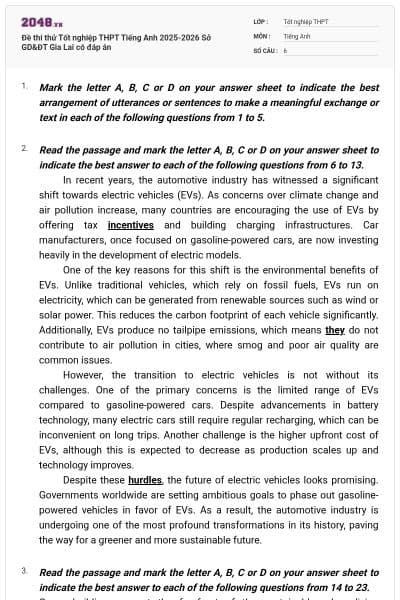
Read the passage and mark the letter A, B, C or D on your answer sheet to indicate the best answer to each of the following questions.
The concept of integrated ecotourism, where local communities, conservationists, and travel agencies collaborate to protect biodiversity while hosting visitors, has gained significant traction. Modern technology keeps this delicate balance on track. Advanced tools such as satellite monitoring, mobile applications, and AI-driven management systems are used to optimize sustainable travel practices. Additionally, real-time data on wildlife movements and trail conditions enables managers to accelerate the decision-making process that maximizes visitor experience while minimizing environmental impact.
GIS and remote sensing allow park rangers and tour operators to precisely map out sensitive ecological zones and create customized trekking routes. This ensures that human foot traffic is directed away from vulnerable habitats based on seasonal breeding patterns and soil erosion data. By avoiding “over-tourism” in fragile areas, communities can maintain their natural capital for the long term. Smart sensors and acoustic monitoring provide advance warnings of illegal activities like poaching or logging, allowing authorities to intercede without disturbing the entire forest. This, therefore, helps curb habitat destruction and save costs for every stakeholder involved in the project.
Technology also plays a vital role in optimizing resource consumption for sustainable lodging. Specialized IoT (Internet of Things) devices report energy and water usage hour by hour, while smart grids manage renewable energy from solar or wind sources. Automated waste management systems track the footprint of each eco-lodge and suggest reductions in single-use materials. This cuts operational costs and protects local watersheds while keeping the ecosystem healthy. In remote, pristine environments, such efficiency keeps ecotourism projects economically viable without compromising the landscape.
The digital trail continues throughout the entire traveler’s journey. Cloud platforms let eco-guides, transport providers, and local artisans input visitor numbers, carbon offset credits, and feedback the moment they are generated, while blockchain records ensure the transparency of “green” certifications so travelers can trust them. Analytic tools combine years of data to forecast seasonal trends, spot conservation opportunities, and mark weak points in the tourist workflow. This allows ecotourism planners to anticipate market demand, exploit resource allocation, and plan for potential climate challenges.
Adapted from: https://ecotourism.org/what-is-ecotourism/
Which of the following is NOT mentioned in paragraph 1 as a factor contributing to the optimization of sustainable travel?
The immediate accessibility of data regarding wildlife and trail conditions.
The implementation of carbon tax policies to discourage frequent traveling.
The collaboration between local communities and conservationists.
The use of satellite monitoring and AI-driven management.
Điều nào sau đây KHÔNG được đề cập trong đoạn 1 như một yếu tố góp phần vào việc tối ưu hóa du lịch bền vững?
A. The immediate accessibility of data regarding wildlife and trail conditions: Sự tiếp cận ngay lập tức với dữ liệu về động vật hoang dã và điều kiện đường mòn. (Có nhắc đến: “real-time data on wildlife movements and trail conditions” - dữ liệu theo thời gian thực...)
B. The implementation of carbon tax policies to discourage frequent traveling: Việc thực thi các chính sách thuế carbon để hạn chế việc đi lại thường xuyên. (Không được nhắc đến)
C. The collaboration between local communities and conservationists: Sự hợp tác giữa cộng đồng địa phương và các nhà bảo tồn. (Có nhắc đến: “local communities, conservationists, and travel agencies collaborate”)
D. The use of satellite monitoring and AI-driven management: Việc sử dụng giám sát vệ tinh và quản lý bằng AI. (Có nhắc đến: “satellite monitoring... and AI-driven management systems”)
Chọn B.
The word “delicate” in paragraph 1 can be best replaced by ____________.
subtle
flimsy
precarious
intricate
Từ “delicate” ở đoạn 1 có thể được thay thế tốt nhất bởi ____________.
delicate (adj): mỏng manh, dễ bị phá vỡ, tinh tế.
A. subtle (adj): phảng phất, tinh tế
B. flimsy (adj): mỏng manh, lỏng lẻo (thường dùng cho vật thể vật lý như vải, cấu trúc)
C. precarious (adj): bấp bênh, chông chênh, mong manh (đồng nghĩa, thường đi với “balance” - sự cân bằng)
D. intricate (adj): phức tạp, rắc rối
→ delicate = precarious
Thông tin: Modern technology keeps this delicate balance on track.
(Công nghệ hiện đại giúp giữ cho sự cân bằng mong manh này đi đúng hướng.)
Chọn C.
The word “intercede” in paragraph 2 is OPPOSITE in meaning to ____________.
arbitrate
mediate
acquiesce
intervene
Từ “intercede” ở đoạn 2 TRÁI NGHĨA với ____________.
intercede (v): can thiệp (để hòa giải hoặc giải quyết).
A. arbitrate (v): phân xử, làm trọng tài
B. mediate (v): hòa giải
C. acquiesce (v): bằng lòng ngầm, cam chịu, mặc kệ, không can thiệp (trái nghĩa)
D. intervene (v): can thiệp (đồng nghĩa)
→ intercede >< acquiesce
Thông tin: ...allowing authorities to intercede without disturbing the entire forest.
(...cho phép các cơ quan chức năng can thiệp mà không làm xáo trộn toàn bộ khu rừng.)
Chọn C.
The word “This” in paragraph 3 refers to ____________.
reporting energy and water usage
managing automated waste systems
tracking footprints and suggesting reductions in single-use materials
managing renewable energy
Từ “This” ở đoạn 3 chỉ ____________.
A. reporting energy and water usage: báo cáo việc sử dụng năng lượng và nước
B. managing automated waste systems: quản lý các hệ thống rác thải tự động
C. tracking footprints and suggesting reductions in single-use materials: theo dõi dấu chân (tác động) và đề xuất giảm thiểu các vật liệu dùng một lần
D. managing renewable energy: quản lý năng lượng tái tạo
Thông tin: Automated waste management systems track the footprint of each eco-lodge and suggest reductions in single-use materials. This cuts operational costs...
(Các hệ thống quản lý rác thải tự động theo dõi tác động của từng nhà nghỉ sinh thái và đề xuất cắt giảm các vật liệu dùng một lần. Điều này làm giảm chi phí hoạt động...)
→ “This” (Điều này) thay thế cho toàn bộ hành động ở câu trước đó.
Chọn C.
Which of the following best paraphrases the underlined sentence in paragraph 3?
“In remote, pristine environments, such efficiency keeps ecotourism projects economically viable without compromising the landscape.”
Ecotourism projects in isolated areas are cheap to run but they often damage the local scenery.
High efficiency allows tourism in untouched areas to be profitable while still protecting nature.
To save the environment, remote tourism projects must accept that they will not make any profit.
Pristine landscapes are the only places where ecotourism projects can save money effectively.
Câu nào sau đây diễn giải tốt nhất câu được gạch chân ở đoạn 3?
“In remote, pristine environments, such efficiency keeps ecotourism projects economically viable without compromising the landscape.”
(Trong những môi trường hoang sơ, hẻo lánh, sự hiệu quả như vậy giúp các dự án du lịch sinh thái có thể duy trì hiệu quả kinh tế (có lãi) mà không làm tổn hại đến cảnh quan.)
Dịch nghĩa:
A. Các dự án du lịch sinh thái ở những khu vực biệt lập có chi phí vận hành rẻ nhưng chúng thường làm hỏng cảnh quan địa phương. (Sai nghĩa - damage).
B. Hiệu suất cao cho phép du lịch ở những khu vực nguyên sơ sinh lời trong khi vẫn bảo vệ được thiên nhiên. (Đúng và sát nghĩa nhất: untouched = pristine; profitable = economically viable; without compromising = protecting).
C. Để cứu lấy môi trường, các dự án du lịch vùng hẻo lánh phải chấp nhận rằng họ sẽ không tạo ra bất kỳ lợi nhuận nào. (Sai nghĩa).
D. Những cảnh quan hoang sơ là những nơi duy nhất mà các dự án du lịch sinh thái có thể tiết kiệm tiền một cách hiệu quả. (Sai vì có từ “duy nhất”).
Chọn B.
Which of the following is TRUE according to paragraph 4?
Blockchain technology is primarily used to track the physical location of travelers during their entire journey.
Digital platforms only allow local artisans to sell their unique products to many international tourists worldwide.
Historical data analysis helps planners prepare for future market needs and potential environmental shifts or challenges.
Climate challenges are the only factors that analytic tools fail to forecast accurately in ecotourism planning.
Theo đoạn 4, điều nào sau đây là ĐÚNG?
A. Công nghệ chuỗi khối (blockchain) chủ yếu được sử dụng để theo dõi vị trí thực tế của khách du lịch trong toàn bộ hành trình của họ. (Sai, nó dùng để đảm bảo tính minh bạch của các chứng nhận “xanh”).
B. Các nền tảng kỹ thuật số chỉ cho phép các nghệ nhân địa phương bán các sản phẩm độc đáo của họ cho nhiều khách du lịch quốc tế trên toàn thế giới. (Sai chi tiết).
C. Việc phân tích dữ liệu lịch sử giúp các nhà lập kế hoạch chuẩn bị cho các nhu cầu thị trường trong tương lai và những sự thay đổi hoặc thách thức tiềm ẩn về môi trường. (Đúng).
D. Các thách thức về khí hậu là những yếu tố duy nhất mà các công cụ phân tích không dự báo được chính xác trong việc lập kế hoạch du lịch sinh thái. (Sai).
Thông tin (Đoạn 4): Analytic tools combine years of data to forecast seasonal trends... anticipate market demand... and plan for potential climate challenges.
(Các công cụ phân tích kết hợp dữ liệu của nhiều năm để dự báo các xu hướng theo mùa... đón đầu nhu cầu thị trường và lên kế hoạch cho những thách thức khí hậu tiềm ẩn.)
Chọn C.
Which paragraph discusses the strategic redirection of tourist flows to protect sensitive reproductive cycles of wildlife?
Paragraph 3
Paragraph 1
Paragraph 2
Paragraph 4
Đoạn nào thảo luận về việc chuyển hướng có chiến lược các luồng khách du lịch để bảo vệ chu kỳ sinh sản nhạy cảm của động vật hoang dã?
A. Đoạn 3
B. Đoạn 1
C. Đoạn 2
D. Đoạn 4
Thông tin (Đoạn 2): This ensures that human foot traffic is directed away from vulnerable habitats based on seasonal breeding patterns...
(Điều này đảm bảo rằng bước chân của con người được chuyển hướng ra xa khỏi các môi trường sống dễ bị tổn thương dựa trên các mô hình sinh sản theo mùa...)
Chọn C.
Which paragraph mentions the integration of decentralized ledger technology to verify environmental claims?
Paragraph 1
Paragraph 2
Paragraph 4
Paragraph 3
Đoạn nào đề cập đến việc tích hợp công nghệ sổ cái phi tập trung (decentralized ledger technology - blockchain) để xác minh các tuyên bố về môi trường?
A. Đoạn 1
B. Đoạn 2
C. Đoạn 4
D. Đoạn 3
Thông tin (Đoạn 4): ...while blockchain records ensure the transparency of “green” certifications so travelers can trust them.
(...trong khi các hồ sơ chuỗi khối (blockchain) đảm bảo tính minh bạch của các chứng nhận “xanh” để du khách có thể tin tưởng chúng.)
Chọn C.
Dịch bài đọc:
Khái niệm về du lịch sinh thái tích hợp, nơi các cộng đồng địa phương, các nhà bảo tồn và các công ty du lịch hợp tác để bảo vệ đa dạng sinh học trong khi đón tiếp du khách, đã thu hút được sự chú ý đáng kể. Công nghệ hiện đại giúp giữ cho sự cân bằng mong manh này đi đúng hướng. Các công cụ tiên tiến như giám sát vệ tinh, ứng dụng di động và hệ thống quản lý điều khiển bằng AI được sử dụng để tối ưu hóa các thực tiễn du lịch bền vững. Ngoài ra, dữ liệu theo thời gian thực về sự di chuyển của động vật hoang dã và điều kiện đường mòn cho phép các nhà quản lý đẩy nhanh quá trình ra quyết định nhằm tối đa hóa trải nghiệm của du khách trong khi giảm thiểu tác động đến môi trường.
GIS và viễn thám cho phép các kiểm lâm viên và nhà điều hành tour lập bản đồ chính xác các khu vực sinh thái nhạy cảm và tạo ra các tuyến đường đi bộ trekking tùy chỉnh. Điều này đảm bảo rằng bước chân của con người được chuyển hướng ra xa khỏi các môi trường sống dễ bị tổn thương dựa trên các mô hình sinh sản theo mùa và dữ liệu xói mòn đất. Bằng cách tránh tình trạng “quá tải du lịch” ở những khu vực mỏng manh, các cộng đồng có thể duy trì nguồn vốn tự nhiên của họ về lâu dài. Các cảm biến thông minh và giám sát âm thanh cung cấp những cảnh báo trước về các hoạt động bất hợp pháp như săn trộm hoặc khai thác gỗ, cho phép các cơ quan chức năng can thiệp mà không làm xáo trộn toàn bộ khu rừng. Do đó, điều này giúp kiềm chế sự phá hủy môi trường sống và tiết kiệm chi phí cho mọi bên liên quan tham gia vào dự án.
Công nghệ cũng đóng một vai trò quan trọng trong việc tối ưu hóa mức tiêu thụ tài nguyên cho các cơ sở lưu trú bền vững. Các thiết bị IoT (Internet Vạn vật) chuyên dụng báo cáo mức sử dụng năng lượng và nước theo từng giờ, trong khi lưới điện thông minh quản lý năng lượng tái tạo từ các nguồn năng lượng mặt trời hoặc gió. Các hệ thống quản lý rác thải tự động theo dõi tác động của từng nhà nghỉ sinh thái và đề xuất cắt giảm các vật liệu dùng một lần. Điều này làm giảm chi phí hoạt động và bảo vệ các lưu vực sông địa phương trong khi vẫn giữ cho hệ sinh thái khỏe mạnh. Trong những môi trường hoang sơ, hẻo lánh, sự hiệu quả như vậy giúp các dự án du lịch sinh thái có thể duy trì hiệu quả kinh tế mà không làm tổn hại đến cảnh quan.
Dấu ấn kỹ thuật số tiếp tục xuất hiện trong toàn bộ hành trình của du khách. Các nền tảng đám mây cho phép các hướng dẫn viên sinh thái, các nhà cung cấp dịch vụ vận tải và các nghệ nhân địa phương nhập số lượng du khách, tín chỉ bù đắp carbon và phản hồi ngay khoảnh khắc chúng được tạo ra, trong khi các hồ sơ chuỗi khối đảm bảo tính minh bạch của các chứng nhận “xanh” để du khách có thể tin tưởng chúng. Các công cụ phân tích kết hợp dữ liệu của nhiều năm để dự báo các xu hướng theo mùa, phát hiện các cơ hội bảo tồn và đánh dấu những điểm yếu trong quy trình du lịch. Điều này cho phép các nhà lập kế hoạch du lịch sinh thái đón đầu nhu cầu thị trường, khai thác việc phân bổ tài nguyên và lên kế hoạch cho những thách thức khí hậu tiềm ẩn.
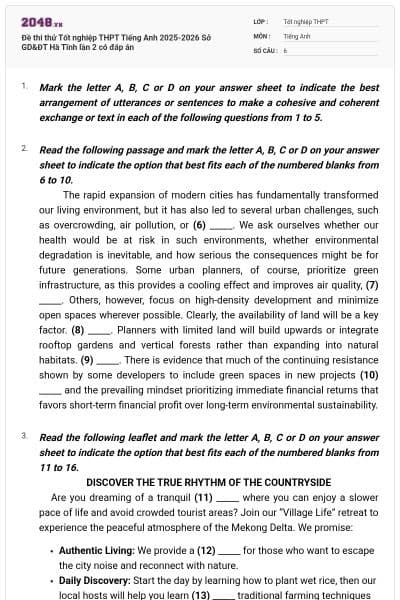
Read the following passage and mark the letter A, B, C or D on your answer sheet to indicate the option that best fits each of the numbered blanks.
Choosing a university major has become one of the most challenging decisions for Vietnamese students today. Apart from personal interests and academic strengths, students must also consider parental expectations, social trends, and future employment prospects, (9) ____________. Many students find themselves torn between pursuing their passion and selecting a field that promises financial stability.
In addition, the rapid development of technology and the labour market makes career planning even more complicated. (10) ____________. As a result, students often feel anxious about whether their chosen major will remain relevant in the long term.
Another significant difficulty lies in the lack of proper career guidance at schools. (11) ____________, they are not always sufficient or up to date, leaving students uncertain about appropriate career choices. Without reliable information, students may rely heavily on advice from friends or follow popular trends without careful consideration.
(12) ____________. In many Vietnamese families, parents tend to influence or even decide their children’s academic paths, believing that they know what is best for them. This pressure can lead to internal conflicts and dissatisfaction later in life.
Therefore, it is essential for students to carefully evaluate their abilities, interests, and long-term goals before making a final decision, (13) ____________. Only by doing so can they choose a suitable major and build a fulfilling career in the future.
which makes the decision-making process even more overwhelming
made the decision-making process even more overwhelming
to make the decision-making process even more overwhelming
making the decision-making process even more overwhelming
Mệnh đề phía trước: “...students must also consider parental expectations, social trends, and future employment prospects” (...học sinh cũng phải cân nhắc những kỳ vọng của cha mẹ, xu hướng xã hội và triển vọng việc làm trong tương lai) là một mệnh đề hoàn chỉnh. Khoảng trống (9) nằm sau dấu phẩy, mang chức năng chỉ ra hệ quả của toàn bộ sự việc vừa được nhắc đến. Trong tiếng Anh, ta có thể dùng đại từ quan hệ “which” thay thế cho cả mệnh đề phía trước (khi đó động từ theo sau chia ở số ít).
Dịch nghĩa/Ngữ pháp:
A. điều này làm cho quá trình ra quyết định trở nên áp lực hơn (Sử dụng mệnh đề quan hệ không xác định “which makes...” thay thế cho toàn bộ sự việc ở vế trước, hoàn toàn chính xác về mặt ngữ pháp và logic).
B. made... (Động từ chia ở quá khứ đơn “made” là sai thì, vì toàn bộ đoạn văn đang ở hiện tại).
C. to make... (Động từ nguyên thể có “to” chỉ mục đích - Sai logic vì sự áp lực là “hậu quả” chứ không phải “mục đích”).
D. making... (Mặc dù V-ing chỉ kết quả cũng đúng ngữ pháp, nhưng trong các bài thi dạng này, cấu trúc “which + V(s/es)” thường được ưu tiên làm đáp án chuẩn mẫu khi có mặt cả hai, vì nó làm rõ đại từ thay thế cho cả mệnh đề). Lưu ý: A là đáp án tối ưu và rõ nghĩa nhất.
Đáp án A tạo ra một mệnh đề quan hệ kết quả xuất sắc, giải thích lý do tại sao học sinh lại thấy “torn” (giằng xé) ở câu tiếp theo.
Chọn A.
→ ...students must also consider parental expectations, social trends, and future employment prospects, which makes the decision-making process even more overwhelming.
Dịch nghĩa: ...học sinh cũng phải cân nhắc những kỳ vọng của cha mẹ, xu hướng xã hội và triển vọng việc làm trong tương lai, điều này làm cho quá trình ra quyết định trở nên áp lực hơn rất nhiều.
The labour market changes at a slow pace, so students rarely worry about their future prospects.
Technological innovation creates various job opportunities, and it guarantees stable employment for most graduates.
New professions are constantly emerging, while others are gradually becoming obsolete, making it difficult for students to foresee long-term career prospects.
Many traditional occupations continue to remain stable, and students can easily make long-term career plans.
Câu phía trước nêu vấn đề: sự phát triển nhanh chóng của công nghệ và thị trường lao động làm cho việc lập kế hoạch nghề nghiệp trở nên phức tạp. Câu phía sau nêu hậu quả: “As a result, students often feel anxious about whether their chosen major will remain relevant...” (Kết quả là, học sinh thường cảm thấy lo lắng về việc liệu chuyên ngành họ chọn có còn phù hợp...). Vị trí (10) cần một câu giải thích rõ sự “phát triển nhanh chóng” đó diễn ra như thế nào để dẫn tới sự lo lắng ở câu sau.
Dịch nghĩa:
A. Thị trường lao động thay đổi với tốc độ chậm, vì vậy sinh viên hiếm khi lo lắng... (Sai logic hoàn toàn: đi ngược lại với “rapid development” và “feel anxious”).
B. Đổi mới công nghệ tạo ra nhiều cơ hội việc làm và nó đảm bảo việc làm ổn định... (Sai logic: nếu đảm bảo ổn định thì sinh viên đã không “lo lắng”).
C. Các nghề nghiệp mới liên tục xuất hiện, trong khi những nghề khác dần trở nên lỗi thời, khiến sinh viên khó dự đoán triển vọng nghề nghiệp dài hạn. (Giải thích hoàn hảo cho sự phức tạp của thị trường lao động và lý do gây ra sự lo lắng).
D. Nhiều nghề nghiệp truyền thống tiếp tục duy trì sự ổn định, và sinh viên có thể dễ dàng lập kế hoạch... (Sai logic).
Đáp án C cung cấp nguyên nhân trực tiếp (nghề mới xuất hiện, nghề cũ biến mất) dẫn đến hệ quả “lo lắng về sự phù hợp trong dài hạn” ở câu liền sau.
Chọn C.
→ In addition, the rapid development of technology and the labour market makes career planning even more complicated. New professions are constantly emerging, while others are gradually becoming obsolete, making it difficult for students to foresee long-term career prospects.
Dịch nghĩa: Thêm vào đó, sự phát triển nhanh chóng của công nghệ và thị trường lao động làm cho việc lập kế hoạch nghề nghiệp trở nên phức tạp hơn bao giờ hết. Các nghề nghiệp mới liên tục xuất hiện, trong khi những nghề khác dần trở nên lỗi thời, khiến sinh viên khó dự đoán được triển vọng nghề nghiệp dài hạn.
Notwithstanding the provision of counselling services by certain institutions
Given that counselling services are widely available in institutions
In view of the provision of counselling services by certain institutions
On the grounds that institutions provide counselling services
Câu phía trước nhận định có một sự khó khăn lớn là “the lack of proper career guidance at schools” (thiếu sự hướng nghiệp đúng đắn tại trường học). Vế sau khoảng trống là “...they are not always sufficient or up to date” (...chúng không phải lúc nào cũng đầy đủ hoặc cập nhật). Đại từ “they” ở đây thay thế cho các dịch vụ tư vấn. Vị trí (11) cần một cấu trúc nhượng bộ (mặc dù) để thể hiện sự tương phản: Dù có dịch vụ tư vấn, nhưng chúng lại không đủ tốt.
Dịch nghĩa/Ngữ pháp:
A. Mặc dù có sự cung cấp các dịch vụ tư vấn bởi một số tổ chức (Cấu trúc “Notwithstanding + Noun phrase” mang nghĩa “Mặc dù / Bất chấp”, tạo ra sự nhượng bộ tuyệt đối hợp lý).
B. Xét thấy các dịch vụ tư vấn có sẵn rộng rãi... (Cụm “Given that” chỉ nguyên nhân/căn cứ → Sai logic).
C. Xét đến sự cung cấp các dịch vụ... (Cụm “In view of” chỉ nguyên nhân → Sai logic).
D. Với lý do là các tổ chức cung cấp dịch vụ... (“On the grounds that” = Because → Sai logic).
Chỉ có đáp án A (Notwithstanding = Despite) tạo ra mối quan hệ nhượng bộ logic giữa việc “có cung cấp dịch vụ” và thực tế là “dịch vụ đó không đủ/không cập nhật”.
Chọn A.
→ Notwithstanding the provision of counselling services by certain institutions, they are not always sufficient or up to date, leaving students uncertain about appropriate career choices.
Dịch nghĩa: Mặc dù có sự cung cấp các dịch vụ tư vấn bởi một số tổ chức giáo dục, chúng không phải lúc nào cũng đầy đủ hoặc được cập nhật, khiến sinh viên không chắc chắn về các lựa chọn nghề nghiệp phù hợp.
Students are always confident in making independent decisions
Parental pressure is another factor that cannot be ignored
Financial constraints are rarely taken into consideration by students
Social media plays no role in shaping career choices
Đây là câu chủ đề (Topic sentence) mở đầu cho đoạn văn áp chót. Các câu ngay phía sau trong đoạn này tập trung thảo luận về việc cha mẹ ở Việt Nam có xu hướng ảnh hưởng hoặc quyết định thay con cái (“parents tend to influence or even decide...”). Do đó, vị trí (12) bắt buộc phải là một câu giới thiệu về yếu tố áp lực từ phía phụ huynh.
Dịch nghĩa:
A. Sinh viên luôn tự tin trong việc đưa ra những quyết định độc lập (Sai logic so với nội dung đoạn).
B. Áp lực từ cha mẹ là một yếu tố khác không thể bị bỏ qua (Giới thiệu trực tiếp, hoàn hảo vào chủ đề “parents” ở câu sau).
C. Những hạn chế về tài chính hiếm khi được sinh viên cân nhắc (Sai chủ đề, đoạn này không nói về tài chính).
D. Mạng xã hội không đóng vai trò gì trong việc định hình các lựa chọn nghề nghiệp (Sai chủ đề).
Đáp án B là câu mở đoạn tốt, dẫn dắt trực tiếp vào việc phân tích sự can thiệp của các bậc phụ huynh Việt Nam đối với con cái.
Chọn B.
→ Parental pressure is another factor that cannot be ignored. In many Vietnamese families, parents tend to influence or even decide their children’s academic paths...
Dịch nghĩa: Áp lực từ cha mẹ là một yếu tố khác không thể bị bỏ qua. Ở nhiều gia đình Việt Nam, các bậc phụ huynh có xu hướng gây ảnh hưởng hoặc thậm chí quyết định con đường học vấn của con cái mình...
because they are influenced by external expectations blindly
without influenced by external expectations blindly
instead of being influenced by external expectations blindly
despite being influenced by external expectations blindly
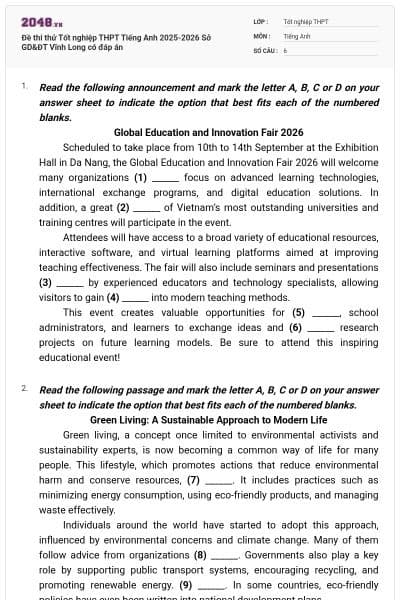
Mệnh đề chính: “...it is essential for students to carefully evaluate their abilities... before making a final decision” (...học sinh cần phải đánh giá cẩn thận khả năng... trước khi đưa ra quyết định cuối cùng). Đây là một lời khuyên tích cực. Vị trí (13) cần một cụm từ chỉ sự đối lập để nhấn mạnh rằng học sinh NÊN làm điều tốt này, THAY VÌ làm một điều tiêu cực (bị ảnh hưởng mù quáng).
Dịch nghĩa/Ngữ pháp:
A. bởi vì chúng bị ảnh hưởng mù quáng bởi những kỳ vọng bên ngoài (Sai logic: không thể khuyên “hãy tự đánh giá BỞI VÌ bạn bị ảnh hưởng mù quáng”).
B. without influenced... (Sai ngữ pháp: sau giới từ “without” cần V-ing, câu bị động phải là “without being influenced”).
C. thay vì bị ảnh hưởng một cách mù quáng bởi những kỳ vọng từ bên ngoài (Cấu trúc “instead of + V-ing”, ở đây là bị động “being influenced”, hoàn toàn chuẩn xác về mặt ngữ pháp và tạo ra lời khuyên đối lập cực kỳ logic).
D. mặc dù bị ảnh hưởng... (“despite being...” không tạo ra thông điệp khuyên nhủ mạnh mẽ và phù hợp bằng “thay vì”).
Đáp án C tuân thủ đúng ngữ pháp (instead of + V-ing) và làm nổi bật thông điệp của bài viết: hãy tự đánh giá bản thân thay vì chạy theo số đông hay kỳ vọng của người khác.
Chọn C.
→ Therefore, it is essential for students to carefully evaluate their abilities, interests, and long-term goals before making a final decision, instead of being influenced by external expectations blindly.
Dịch nghĩa: Do đó, điều cần thiết là học sinh phải đánh giá cẩn thận khả năng, sở thích và mục tiêu dài hạn của mình trước khi đưa ra quyết định cuối cùng, thay vì bị ảnh hưởng một cách mù quáng bởi những kỳ vọng từ bên ngoài.
Bài đọc hoàn chỉnh | Dịch bài đọc |
Choosing a university major has become one of the most challenging decisions for Vietnamese students today. Apart from personal interests and academic strengths, students must also consider parental expectations, social trends, and future employment prospects, which makes the decision-making process even more overwhelming. Many students find themselves torn between pursuing their passion and selecting a field that promises financial stability. In addition, the rapid development of technology and the labour market makes career planning even more complicated. New professions are constantly emerging, while others are gradually becoming obsolete, making it difficult for students to foresee long-term career prospects. As a result, students often feel anxious about whether their chosen major will remain relevant in the long term. Another significant difficulty lies in the lack of proper career guidance at schools. Notwithstanding the provision of counselling services by certain institutions, they are not always sufficient or up to date, leaving students uncertain about appropriate career choices. Without reliable information, students may rely heavily on advice from friends or follow popular trends without careful consideration. Parental pressure is another factor that cannot be ignored. In many Vietnamese families, parents tend to influence or even decide their children’s academic paths, believing that they know what is best for them. This pressure can lead to internal conflicts and dissatisfaction later in life. Therefore, it is essential for students to carefully evaluate their abilities, interests, and long-term goals before making a final decision, instead of being influenced by external expectations blindly. Only by doing so can they choose a suitable major and build a fulfilling career in the future. | Việc chọn chuyên ngành đại học đã trở thành một trong những quyết định đầy thách thức nhất đối với học sinh Việt Nam hiện nay. Ngoài sở thích cá nhân và thế mạnh học thuật, học sinh cũng phải cân nhắc những kỳ vọng của cha mẹ, xu hướng xã hội và triển vọng việc làm trong tương lai, điều này làm cho quá trình ra quyết định trở nên áp lực hơn rất nhiều. Nhiều học sinh nhận thấy bản thân bị giằng xé giữa việc theo đuổi đam mê và việc lựa chọn một lĩnh vực hứa hẹn sự ổn định tài chính. Thêm vào đó, sự phát triển nhanh chóng của công nghệ và thị trường lao động làm cho việc lập kế hoạch nghề nghiệp trở nên phức tạp hơn bao giờ hết. Các nghề nghiệp mới liên tục xuất hiện, trong khi những nghề khác dần trở nên lỗi thời, khiến sinh viên khó dự đoán được triển vọng nghề nghiệp dài hạn. Kết quả là, học sinh thường cảm thấy lo lắng về việc liệu chuyên ngành họ chọn có còn phù hợp trong dài hạn hay không. Một khó khăn đáng kể khác nằm ở sự thiếu hụt hướng nghiệp đúng đắn tại các trường học. Mặc dù có sự cung cấp các dịch vụ tư vấn bởi một số tổ chức giáo dục, chúng không phải lúc nào cũng đầy đủ hoặc được cập nhật, khiến sinh viên không chắc chắn về các lựa chọn nghề nghiệp phù hợp. Nếu không có thông tin đáng tin cậy, học sinh có thể phụ thuộc nhiều vào lời khuyên từ bạn bè hoặc chạy theo các xu hướng phổ biến mà không có sự cân nhắc kỹ lưỡng. Áp lực từ cha mẹ là một yếu tố khác không thể bị bỏ qua. Ở nhiều gia đình Việt Nam, các bậc phụ huynh có xu hướng gây ảnh hưởng hoặc thậm chí quyết định con đường học vấn của con cái mình, với niềm tin rằng họ biết điều gì là tốt nhất cho chúng. Áp lực này có thể dẫn đến những xung đột nội tâm và sự bất mãn trong cuộc sống sau này. Do đó, điều cần thiết là học sinh phải đánh giá cẩn thận khả năng, sở thích và mục tiêu dài hạn của mình trước khi đưa ra quyết định cuối cùng, thay vì bị ảnh hưởng một cách mù quáng bởi những kỳ vọng từ bên ngoài. Chỉ bằng cách làm như vậy, các em mới có thể chọn được một chuyên ngành phù hợp và xây dựng một sự nghiệp viên mãn trong tương lai. |
Read the following leaflet and mark the letter A, B, C or D on your answer sheet to indicate the option that best fits each of the numbered blanks.
Why Choose Vocational Education?
If you are unsure about your future after high school, vocational education may be a smart option for you. Here are several suggestions to help you make the most (14) ____________ your learning journey:
• Choose a course that matches your interests (15) ____________ your natural abilities.
• Develop practical job skills and build a strong career foundation through hands-on training.
• Learn to operate modern machines and use advanced technical equipment in real workplace settings.
• Some students prefer academic studies, while others feel more confident in (16) ____________.
• Work closely with instructors and (17) ____________ industry experts who can guide you toward employment opportunities.
• Vocational education often works (18) ____________ in helping learners secure stable jobs without spending many years at university.
Vocational education equips you with essential experience and prepares you for immediate (19) ____________ into the workforce.
of
in
at
to
A. of (prep): của.
B. in (prep): trong.
C. at (prep): tại.
D. to (prep): đến, tới.
Ta có cụm từ cố định (collocation): make the most of something (tận dụng tối đa cái gì / khai thác triệt để lợi ích của việc gì).
Chọn A. of
→ Here are several suggestions to help you make the most of your learning journey...
Dịch nghĩa: Dưới đây là một vài gợi ý giúp bạn tận dụng tối đa hành trình học tập của mình...
so
or
but
nor
A. so (conj): vì vậy, cho nên (chỉ kết quả).
B. or (conj): hoặc, hay là (đưa ra sự lựa chọn hoặc bổ sung ý tương đương).
C. but (conj): nhưng (chỉ sự đối lập).
D. nor (conj): cũng không (thường dùng trong cấu trúc neither... nor...).
Câu này khuyên người học nên chọn một khóa học phù hợp với “sở thích” (interests) HOẶC “khả năng thiên bẩm” (natural abilities) của mình. Liên từ “or” được dùng để kết nối hai danh từ mang ý nghĩa lựa chọn tương đương nhau.
Chọn B. or
→ Choose a course that matches your interests or your natural abilities.
Dịch nghĩa: Hãy chọn một khóa học phù hợp với sở thích hoặc khả năng thiên bẩm của bạn.
skill-based programs training
training skill-based programs
skill-based training programs
programs skill-based training
Phân tích trật tự từ: Cụm danh từ này có danh từ chính là “programs” (các chương trình) nên bắt buộc phải đứng cuối cùng. Phía trước nó là danh từ phụ “training” (việc đào tạo) đóng vai trò phân loại, tạo thành cụm “training programs” (chương trình đào tạo). Tính từ ghép “skill-based” (dựa trên kỹ năng) bổ nghĩa cho toàn bộ cụm danh từ phía sau nên phải đứng ở vị trí đầu tiên. Trật tự đúng là: Tính từ + Danh từ phụ + Danh từ chính.
Chọn C. skill-based training programs
→ Some students prefer academic studies, while others feel more confident in skill-based training programs.
Dịch nghĩa: Một số học sinh thích các nghiên cứu học thuật, trong khi những người khác lại cảm thấy tự tin hơn trong các chương trình đào tạo dựa trên kỹ năng.
others
another
the other
other
A. others: những (người/vật) khác (đại từ, đứng độc lập không đi kèm danh từ).
B. another: một (người/vật) khác (tính từ/đại từ, đi kèm danh từ đếm được số ít).
C. the other: (người/vật) còn lại (đã xác định cụ thể trong một nhóm).
D. other: những (người/vật) khác (tính từ, đi kèm danh từ đếm được số nhiều / không đếm được).
Phía sau khoảng trống là cụm danh từ đếm được ở dạng số nhiều “industry experts” (các chuyên gia trong ngành). Do đó, ta phải dùng tính từ “other” để bổ nghĩa.
Chọn D. other
→ Work closely with instructors and other industry experts...
Dịch nghĩa: Làm việc chặt chẽ với các giảng viên và những chuyên gia trong ngành khác...
wonders
legends
values
miracles
A. wonders (n): những điều kỳ diệu (thường dùng trong idiom).
B. legends (n): huyền thoại.
C. values (n): giá trị.
D. miracles (n): phép màu.
Ta có thành ngữ (idiom) cố định: work wonders (mang lại hiệu quả tuyệt vời / có tác dụng kỳ diệu đối với ai/cái gì).
Chọn A. wonders
→ Vocational education often works wonders in helping learners secure stable jobs...
Dịch nghĩa: Giáo dục nghề nghiệp thường mang lại hiệu quả tuyệt vời trong việc giúp người học đảm bảo có được những công việc ổn định...
integration
entry
assimilation
induction
A. integration (n): sự hội nhập (thường đi với into society: hòa nhập xã hội).
B. entry (n): sự gia nhập, bước vào.
C. assimilation (n): sự đồng hóa.
D. induction (n): sự kết nạp, lễ nhậm chức.
Ta có cụm từ kết hợp cố định (collocation) chuyên dùng trong chủ đề việc làm: entry into the workforce / the job market (sự gia nhập vào lực lượng lao động / thị trường lao động).
Chọn B. entry
→ Vocational education equips you with essential experience and prepares you for immediate entry into the workforce.
Dịch nghĩa: Giáo dục nghề nghiệp trang bị cho bạn những kinh nghiệm thiết yếu và chuẩn bị cho bạn để gia nhập ngay lập tức vào lực lượng lao động.
Bài đọc hoàn chỉnh | Dịch bài đọc |
Why Choose Vocational Education? If you are unsure about your future after high school, vocational education may be a smart option for you. Here are several suggestions to help you make the most (14) of your learning journey: • Choose a course that matches your interests (15) or your natural abilities. • Develop practical job skills and build a strong career foundation through hands-on training. • Learn to operate modern machines and use advanced technical equipment in real workplace settings. • Some students prefer academic studies, while others feel more confident in (16) skill-based training programs. • Work closely with instructors and (17) other industry experts who can guide you toward employment opportunities. • Vocational education often works (18) wonders in helping learners secure stable jobs without spending many years at university. Vocational education equips you with essential experience and prepares you for immediate (19) entry into the workforce. | Tại Sao Nên Chọn Giáo Dục Nghề Nghiệp? Nếu bạn không chắc chắn về tương lai của mình sau khi tốt nghiệp trung học, giáo dục nghề nghiệp có thể là một lựa chọn thông minh dành cho bạn. Dưới đây là một vài gợi ý giúp bạn tận dụng tối đa (14) được hành trình học tập của mình: • Hãy chọn một khóa học phù hợp với sở thích (15) hoặc khả năng thiên bẩm của bạn. • Phát triển các kỹ năng công việc thực tế và xây dựng một nền tảng sự nghiệp vững chắc thông qua việc đào tạo thực hành. • Học cách vận hành các loại máy móc hiện đại và sử dụng thiết bị kỹ thuật tiên tiến trong các môi trường làm việc thực tế. • Một số học sinh thích các nghiên cứu học thuật, trong khi những người khác lại cảm thấy tự tin hơn trong (16) các chương trình đào tạo dựa trên kỹ năng. • Làm việc chặt chẽ với các giảng viên và (17) những chuyên gia trong ngành khác, những người có thể hướng dẫn bạn đến với các cơ hội việc làm. • Giáo dục nghề nghiệp thường (18) mang lại hiệu quả tuyệt vời trong việc giúp người học đảm bảo có được những công việc ổn định mà không cần phải dành ra nhiều năm tại trường đại học. Giáo dục nghề nghiệp trang bị cho bạn những kinh nghiệm thiết yếu và chuẩn bị cho bạn để (19) gia nhập ngay lập tức vào lực lượng lao động. |
Mark the letter A, B, C or D on your answer sheet to indicate the best arrangement of utterances or sentences to make a cohesive and coherent exchange or text in each of the following items from the following questions.
a. Since then, I have become more cautious and always check safety instructions carefully before using electrical appliances.
b. I had never imagined that a simple mistake could lead to such a terrifying experience.
c. Last year, I experienced one of the most horrifying moments of my life when a short circuit suddenly caused a fire in my kitchen.
d. The flames spread quickly, and thick smoke filled the room, making it hard for me to breathe or even see clearly.
e. Fortunately, I managed to turn off the power and call the fire department before the situation got completely out of control.
c – b – d – a – e
c – d – b – e – a
d – c – e – b – a
b – c – d – e – a
Thứ tự sắp xếp đúng: D. b – c – d – e – a
b. I had never imagined that a simple mistake could lead to such a terrifying experience.
c. Last year, I experienced one of the most horrifying moments of my life when a short circuit suddenly caused a fire in my kitchen.
d. The flames spread quickly, and thick smoke filled the room, making it hard for me to breathe or even see clearly.
e. Fortunately, I managed to turn off the power and call the fire department before the situation got completely out of control.
a. Since then, I have become more cautious and always check safety instructions carefully before using electrical appliances.
Dịch nghĩa:
b. Tôi chưa bao giờ tưởng tượng rằng một sai lầm đơn giản lại có thể dẫn đến một trải nghiệm kinh hoàng như vậy.
c. Năm ngoái, tôi đã trải qua một trong những khoảnh khắc đáng sợ nhất đời mình khi một sự cố chập điện bất ngờ gây ra một vụ hỏa hoạn trong nhà bếp của tôi.
d. Ngọn lửa lan nhanh, và khói dày đặc bao trùm căn phòng, khiến tôi khó thở hoặc thậm chí là không thể nhìn rõ.
e. May mắn thay, tôi đã xoay xở tắt được nguồn điện và gọi cho sở cứu hỏa trước khi tình hình vượt hoàn toàn khỏi tầm kiểm soát.
a. Kể từ đó, tôi trở nên cẩn trọng hơn và luôn kiểm tra kỹ lưỡng các hướng dẫn an toàn trước khi sử dụng các thiết bị điện.
Chọn D.
a. The success of the August Revolution demonstrated the strength of national unity and the determination of the Vietnamese people to gain self-rule.
b. As a result, the Democratic Republic of Vietnam was established, marking a historic turning point in the nation’s long struggle for independence.
c. In August 1945, following Japan’s surrender in World War II, a power vacuum emerged across Vietnam.
d. Seizing this opportunity, revolutionary forces and the Vietnamese people rose up in both urban and rural areas to take control of government offices.
e. Within a short period of time, the revolutionary movement spread rapidly, leading to the collapse of the old colonial and feudal administrations.
c – d – e – b – a
c – e – d – a – b
a – b – c – d – e
d – c – e – b – a
Thứ tự sắp xếp đúng: A. c – d – e – b – a
c. In August 1945, following Japan’s surrender in World War II, a power vacuum emerged across Vietnam.
d. Seizing this opportunity, revolutionary forces and the Vietnamese people rose up in both urban and rural areas to take control of government offices.
e. Within a short period of time, the revolutionary movement spread rapidly, leading to the collapse of the old colonial and feudal administrations.
b. As a result, the Democratic Republic of Vietnam was established, marking a historic turning point in the nation’s long struggle for independence.
a. The success of the August Revolution demonstrated the strength of national unity and the determination of the Vietnamese people to gain self-rule.
Dịch nghĩa:
c. Vào tháng 8 năm 1945, sau khi Nhật Bản đầu hàng trong Thế chiến II, một khoảng trống quyền lực đã xuất hiện trên khắp Việt Nam.
d. Nắm bắt cơ hội này, các lực lượng cách mạng và nhân dân Việt Nam đã nổi dậy ở cả khu vực thành thị và nông thôn để giành quyền kiểm soát các cơ quan chính quyền.
e. Trong một thời gian ngắn, phong trào cách mạng lan rộng nhanh chóng, dẫn đến sự sụp đổ của các chính quyền thực dân và phong kiến cũ.
b. Kết quả là, nước Việt Nam Dân chủ Cộng hòa được thành lập, đánh dấu một bước ngoặt lịch sử trong cuộc đấu tranh giành độc lập lâu dài của dân tộc.
a. Thắng lợi của Cách mạng tháng Tám đã chứng minh sức mạnh của khối đại đoàn kết toàn dân tộc và quyết tâm giành quyền tự chủ của nhân dân Việt Nam.
Chọn A.
a. David: That makes sense. Strong cooperation can help maintain peace and economic stability.
b. David: Why do countries participate in international organizations like the United Nations?
c. Anna: They join to promote cooperation, resolve conflicts peacefully, and address global issues together.
a – b – c
b – a – c
b – c – a
c – a – b
Thứ tự sắp xếp đúng: C. b – c – a
b. David: Why do countries participate in international organizations like the United Nations?
c. Anna: They join to promote cooperation, resolve conflicts peacefully, and address global issues together.
a. David: That makes sense. Strong cooperation can help maintain peace and economic stability.
Dịch nghĩa:
b. David: Tại sao các quốc gia lại tham gia vào các tổ chức quốc tế như Liên Hợp Quốc vậy?
c. Anna: Họ tham gia để thúc đẩy sự hợp tác, giải quyết các cuộc xung đột một cách hòa bình và cùng nhau giải quyết các vấn đề toàn cầu.
a. David: Điều đó thật hợp lý. Sự hợp tác mạnh mẽ có thể giúp duy trì hòa bình và ổn định kinh tế.
Chọn C.
Dear Ms Johnson,
a. Once you have completed the form, you will receive a confirmation email with further instructions to access the course materials.
b. We are pleased to inform you that our company is offering a free online course on Artificial Intelligence for beginners.
c. Should you encounter any difficulties during the registration process, please contact our support team at support@aitech.com.
d. To register for the course, please visit our official website and click on the “Free AI Course” section.
e. After that, fill in your personal information and submit the registration form before the deadline on March 30th.
Yours sincerely,
AI Technology Center
d – b – a – e – c
d – e – b – a – c
b – d – e – a – c
b – e – d – a – c
Thứ tự sắp xếp đúng: C. b – d – e – a – c
b. We are pleased to inform you that our company is offering a free online course on Artificial Intelligence for beginners.
d. To register for the course, please visit our official website and click on the “Free AI Course” section.
e. After that, fill in your personal information and submit the registration form before the deadline on March 30th.
a. Once you have completed the form, you will receive a confirmation email with further instructions to access the course materials.
c. Should you encounter any difficulties during the registration process, please contact our support team at support@aitech.com.
Dịch nghĩa:
Kính gửi cô Johnson,
b. Chúng tôi rất vui mừng thông báo với cô rằng công ty của chúng tôi đang cung cấp một khóa học trực tuyến miễn phí về Trí tuệ Nhân tạo dành cho người mới bắt đầu.
d. Để đăng ký khóa học, vui lòng truy cập trang web chính thức của chúng tôi và nhấp vào mục “Khóa học AI miễn phí”.
e. Sau đó, hãy điền thông tin cá nhân của cô và nộp biểu mẫu đăng ký trước hạn chót là ngày 30 tháng 3.
a. Sau khi cô hoàn thành biểu mẫu, cô sẽ nhận được một email xác nhận với các hướng dẫn tiếp theo để truy cập vào tài liệu khóa học.
c. Nếu cô gặp bất kỳ khó khăn nào trong quá trình đăng ký, vui lòng liên hệ với đội ngũ hỗ trợ của chúng tôi theo địa chỉ support@aitech.com.
Trân trọng,
Trung tâm Công nghệ AI
Chọn C.
a. Emma: That’s true. Peacekeeping forces also help rebuild communities and support humanitarian efforts.
b. Liam: I’ve been reading about international peacekeeping missions lately. Do you know what their main purpose is?
c. Liam: They monitor ceasefires, protect civilians, and assist in maintaining stability in conflict areas.
d. Emma: Yes, their primary goal is to maintain peace and prevent further violence after conflicts end.
b – d – c – a
b – c – d – a
d – b – a – c
c – a – b – d
Thứ tự sắp xếp đúng: A. b – d – c – a
b. Liam: I’ve been reading about international peacekeeping missions lately. Do you know what their main purpose is?
d. Emma: Yes, their primary goal is to maintain peace and prevent further violence after conflicts end.
c. Liam: They monitor ceasefires, protect civilians, and assist in maintaining stability in conflict areas.
a. Emma: That’s true. Peacekeeping forces also help rebuild communities and support humanitarian efforts.
Dịch nghĩa:
b. Liam: Gần đây tớ đang đọc về các sứ mệnh gìn giữ hòa bình quốc tế. Cậu có biết mục đích chính của họ là gì không?
d. Emma: Có chứ, mục tiêu hàng đầu của họ là duy trì hòa bình và ngăn chặn bạo lực tiếp diễn sau khi các cuộc xung đột kết thúc.
c. Liam: Họ giám sát các lệnh ngừng bắn, bảo vệ dân thường và hỗ trợ duy trì sự ổn định ở các khu vực xung đột.
a. Emma: Đúng vậy. Các lực lượng gìn giữ hòa bình cũng giúp tái thiết các cộng đồng và hỗ trợ cho các nỗ lực nhân đạo.
Chọn A.
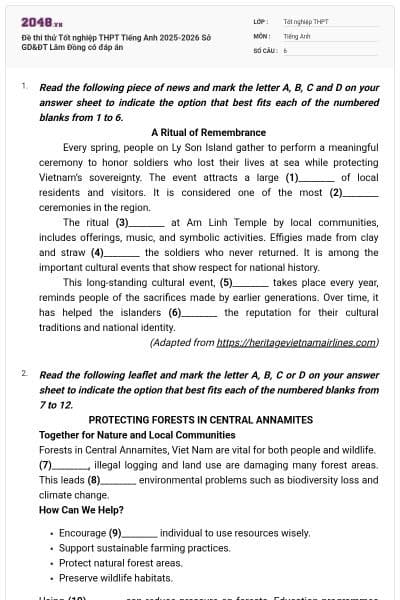
Read the following announcement and mark the letter A, B, C or D on your answer sheet to indicate the option that best fits each of the numbered blanks.
Global Student Summit 2026 – Empowering Future Leaders
Taking place from August 10th to 14th at the International Convention Centre in Singapore, the Global Student Summit 2026 will gather outstanding students (25) ____________ come from more than 50 countries around the world. The program aims to connect young leaders with (26) ____________ educational institutions and international organizations.
Participants will engage in a wide (27) ____________ of workshops, leadership training sessions, and cultural exchange activities designed to enhance critical thinking and global awareness. The summit will also feature keynote speeches (28) ____________ by distinguished speakers and successful entrepreneurs, inspiring students to pursue their ambitions confidently.
This event is an excellent opportunity for students to build global networks, develop essential skills, and (29) ____________ valuable experience in an international environment. Don’t miss the chance (30) ____________ part in shaping a better future together!
For more information, visit https://globalstudentsummit.org/.
whom
who
which
whose
A. whom: đại từ quan hệ thay thế cho danh từ chỉ người (làm tân ngữ).
B. who: đại từ quan hệ thay thế cho danh từ chỉ người (làm chủ ngữ).
C. which: đại từ quan hệ thay thế cho danh từ chỉ vật/sự việc.
D. whose: đại từ quan hệ chỉ sự sở hữu.
Danh từ đứng ngay trước khoảng trống là “outstanding students” (những học sinh xuất sắc) - danh từ chỉ người. Phía sau khoảng trống là động từ “come” (đến), do đó ta cần một đại từ quan hệ đóng vai trò làm chủ ngữ thay thế cho người.
Chọn B. who
→ ...will gather outstanding students who come from more than 50 countries around the world.
Dịch nghĩa: ...sẽ quy tụ những học sinh xuất sắc, những người đến từ hơn 50 quốc gia trên toàn thế giới.
The program aims to connect young leaders with (26) ____________ educational institutions and international organizations.
driving
rising
growing
leading
A. driving (adj/v-ing): có tính thúc đẩy, lái (xe).
B. rising (adj/v-ing): đang lên, tăng lên.
C. growing (adj/v-ing): đang phát triển, gia tăng.
D. leading (adj): hàng đầu, xuất sắc nhất.
Ta có cụm kết hợp từ (collocation) phổ biến: leading educational institutions (các cơ sở giáo dục hàng đầu). Chương trình nhằm kết nối những nhà lãnh đạo trẻ với các tổ chức và cơ sở giáo dục xuất sắc nhất.
Chọn D. leading
→ The program aims to connect young leaders with leading educational institutions and international organizations.
Dịch nghĩa: Chương trình nhằm mục đích kết nối các nhà lãnh đạo trẻ với các cơ sở giáo dục và tổ chức quốc tế hàng đầu.
range
deal
number
plenty
A. range (n): phạm vi, một loạt (thường dùng trong cụm a wide range of + danh từ số nhiều).
B. deal (n): lượng (thường dùng trong cụm a great deal of + danh từ không đếm được).
C. number (n): số lượng (thường dùng a large/great number of, không dùng a wide number of).
D. plenty (pronoun): nhiều (thường dùng plenty of).
Phía trước có từ “wide” và phía sau có giới từ “of” đi kèm danh từ đếm được số nhiều “workshops”. Cấu trúc a wide range of mang ý nghĩa là “một loạt các / sự đa dạng các”.
Chọn A. range
→ Participants will engage in a wide range of workshops...
Dịch nghĩa: Người tham gia sẽ tham gia vào một loạt/sự đa dạng các buổi hội thảo...
The summit will also feature keynote speeches (28) ____________ by distinguished speakers and successful entrepreneurs, inspiring students to pursue their ambitions confidently.
delivering
delivered
deliver
to deliver
A. delivering (v-ing): hiện tại phân từ (mang nghĩa chủ động).
B. delivered (v-ed/v3): quá khứ phân từ (mang nghĩa bị động).
C. deliver (v): động từ nguyên mẫu.
D. to deliver: động từ nguyên thể có “to”.
Đây là dạng rút gọn mệnh đề quan hệ mang nghĩa bị động, bổ nghĩa cho cụm danh từ “keynote speeches” (các bài phát biểu chính). Các bài phát biểu này không tự trình bày mà “được trình bày/phát biểu” bởi các diễn giả (có giới từ “by” phía sau). Mệnh đề đầy đủ là: which are delivered by... Khi rút gọn, ta bỏ đại từ quan hệ và động từ to be, chỉ giữ lại quá khứ phân từ.
Chọn B. delivered
→ The summit will also feature keynote speeches delivered by distinguished speakers...
Dịch nghĩa: Hội nghị thượng đỉnh cũng sẽ có các bài phát biểu chính được trình bày bởi các diễn giả nổi bật...
make
take
gain
do
A. make (v): làm, tạo ra.
B. take (v): lấy, cầm.
C. gain (v): đạt được, thu được, tích lũy.
D. do (v): làm, thực hiện.
Ta có cụm từ kết hợp cố định (collocation): gain experience (thu được/tích lũy được kinh nghiệm).
Chọn C. gain
→ ...develop essential skills, and gain valuable experience in an international environment.
Dịch nghĩa: ...phát triển các kỹ năng thiết yếu và tích lũy được những kinh nghiệm quý báu trong một môi trường quốc tế.
Don’t miss the chance (30) ____________ part in shaping a better future together!
taking
take
takes
to take
A. taking (v-ing): danh động từ / hiện tại phân từ.
B. take (v): động từ nguyên mẫu.
C. takes (v): động từ chia thì hiện tại đơn.
D. to take: động từ nguyên thể có “to”.
Ta có cấu trúc: chance to do something (cơ hội để làm việc gì). Đồng thời, take part in có nghĩa là tham gia vào. Do đó, ta cần điền “to take”.
Chọn D. to take
→ Don’t miss the chance to take part in shaping a better future together!
Dịch nghĩa: Đừng bỏ lỡ cơ hội để tham gia vào việc cùng nhau định hình một tương lai tốt đẹp hơn!
Bài đọc hoàn chỉnh | Dịch bài đọc |
Global Student Summit 2026 – Empowering Future Leaders Taking place from August 10th to 14th at the International Convention Centre in Singapore, the Global Student Summit 2026 will gather outstanding students (25) who come from more than 50 countries around the world. The program aims to connect young leaders with (26) leading educational institutions and international organizations. Participants will engage in a wide (27) range of workshops, leadership training sessions, and cultural exchange activities designed to enhance critical thinking and global awareness. The summit will also feature keynote speeches (28) delivered by distinguished speakers and successful entrepreneurs, inspiring students to pursue their ambitions confidently. This event is an excellent opportunity for students to build global networks, develop essential skills, and (29) gain valuable experience in an international environment. Don’t miss the chance (30) to take part in shaping a better future together! For more information, visithttps://globalstudentsummit.org/. | Hội Nghị Thượng Đỉnh Sinh Viên Toàn Cầu 2026 – Trao Quyền Cho Các Nhà Lãnh Đạo Tương Lai Diễn ra từ ngày 10 đến ngày 14 tháng 8 tại Trung tâm Hội nghị Quốc tế ở Singapore, Hội nghị Thượng đỉnh Sinh viên Toàn cầu 2026 sẽ quy tụ những học sinh xuất sắc, (25) những người đến từ hơn 50 quốc gia trên toàn thế giới. Chương trình nhằm mục đích kết nối các nhà lãnh đạo trẻ với các cơ sở giáo dục và tổ chức quốc tế (26) hàng đầu. Người tham gia sẽ tham gia vào (27) một loạt các buổi hội thảo, các phiên đào tạo khả năng lãnh đạo và các hoạt động giao lưu văn hóa được thiết kế nhằm nâng cao tư duy phản biện và nhận thức toàn cầu. Hội nghị thượng đỉnh cũng sẽ có các bài phát biểu chính (28) được trình bày bởi các diễn giả nổi bật và các doanh nhân thành đạt, truyền cảm hứng cho học sinh tự tin theo đuổi hoài bão của mình. Sự kiện này là một cơ hội tuyệt vời để học sinh xây dựng các mạng lưới quan hệ toàn cầu, phát triển các kỹ năng thiết yếu và (29) tích lũy được những kinh nghiệm quý báu trong một môi trường quốc tế. Đừng bỏ lỡ cơ hội (30) để tham gia vào việc cùng nhau định hình một tương lai tốt đẹp hơn! Để biết thêm thông tin, hãy truy cậphttps://globalstudentsummit.org/. |
Read the passage and mark the letter A, B, C or D on your answer sheet to indicate the best answer to each of the following questions.
We are witnessing a high-stakes transition in the global power sector – a shift that is frequently obscured by the strategic use of “green” rhetoric to bypass the inconvenient realities of industrial expansion. [I] Picture a utility giant that claims to be “powering the future” with wind and solar. Genuine decarbonization would require a painful dismantling of coal-fired assets, massive investment in long-duration storage, and a fundamental reconfiguration of the national grid. Far more convenient is to procure “Renewable Energy Certificates” (RECs) – financial instruments that allow firms to claim green credentials on paper while their physical turbines continue to draw power from a gas-heavy mix. This tactic meets the public at every light switch: tech corporations boast of 100% renewable data centers, yet these facilities often remain tethered to fossil-fuel grids, offset only by accounting maneuvers.
The narrative of “clean” energy has flourished as climate anxiety reaches a fever pitch, yet the real explosion of green-labeling has often ignored the material intensity of the transition. Faced with mounting pressure to abandon hydrocarbons, many energy boards prefer glossy PR highlighting a single hydrogen pilot project over addressing the ecological footprint of their supply chains. [II] Such corporate sleight of hand is particularly evident in the mining sector; the extraction of lithium, cobalt, and rare earth minerals for “green” tech often involves significant biodiversity loss and human rights concerns. [III]
Why does this matter? The obsession with “bridge fuels” (like natural gas) and the over-reliance on future carbon-capture technologies share a core objective: to postpone the radical systemic shifts required to stay within planetary boundaries. [IV] Whereas traditional denial was easy to identify, the new “green” consensus lulls the public into believing the climate crisis is a solved engineering problem. Under this collective illusion, the scrutiny on energy-intensive lifestyles evaporates and the structural reforms needed to reduce total energy demand are delayed indefinitely. Green energy rhetoric thus acts as a comforting narrative, promising a seamless transition without sacrifice. Exposing these half-truths is essential if we are to move beyond carbon accounting tricks toward a truly regenerative energy landscape.
Adapted from: https://energytheory.com/what-is-green-energy-definition-importance-and-examples/
According to paragraph 1, what is the primary function of Renewable Energy Certificates (RECs) for many utility giants?
To facilitate the massive investment needed for long-duration energy storage.
To serve as a paper-based validation for green claims while maintaining fossil-fuel usage.
To provide a practical roadmap for dismantling existing coal-fired power plants.
To bridge the technological gap between national grids and solar energy facilities.
Theo đoạn 1, chức năng chính của Chứng chỉ Năng lượng Tái tạo (RECs) đối với nhiều gã khổng lồ điện lực là gì?
A. Để tạo điều kiện thuận lợi cho khoản đầu tư khổng lồ cần thiết cho việc lưu trữ năng lượng trong thời gian dài. (Sai, đây là yêu cầu của giải trừ carbon thực sự, không phải chức năng của RECs).
B. Đóng vai trò như một sự xác thực trên giấy tờ cho các tuyên bố xanh trong khi vẫn duy trì việc sử dụng nhiên liệu hóa thạch. (Đúng).
C. Để cung cấp một lộ trình thực tế cho việc tháo dỡ các nhà máy điện than hiện có. (Sai).
D. Để thu hẹp khoảng cách công nghệ giữa lưới điện quốc gia và các cơ sở năng lượng mặt trời. (Sai).
Thông tin: “...to procure “Renewable Energy Certificates” (RECs) – financial instruments that allow firms to claim green credentials on paper while their physical turbines continue to draw power from a gas-heavy mix.” (…để mua “Chứng chỉ Năng lượng Tái tạo” (RECs) – các công cụ tài chính cho phép các công ty tuyên bố có chứng nhận xanh trên giấy tờ trong khi các tuabin thực tế của họ vẫn tiếp tục lấy điện từ hỗn hợp nhiên liệu chủ yếu là khí đốt.)
→ Đoạn 1 nêu rõ RECs là các công cụ tài chính cho phép các công ty tuyên bố (trên giấy tờ) rằng họ “xanh”, trong khi thực tế các tuabin vật lý của họ vẫn tiếp tục lấy điện từ nguồn hỗn hợp nhiều khí đốt (nhiên liệu hóa thạch).
Chọn B.
Which of the following best summarises paragraph 1?
Technology corporations are leading the world in making data centers 100% renewable.
Many energy companies use accounting tricks to hide their continued use of fossil fuels.
The transition to green energy is happening faster than we previously expected.
Utility companies are spending a lot of money to improve their national grids.
Câu nào sau đây tóm tắt đúng nhất đoạn 1?
A. Các tập đoàn công nghệ đang dẫn đầu thế giới trong việc làm cho các trung tâm dữ liệu 100% tái tạo. (Sai, bài đọc chỉ trích các tuyên bố này là chiêu trò).
B. Nhiều công ty năng lượng sử dụng các thủ thuật kế toán để che giấu việc họ tiếp tục sử dụng nhiên liệu hóa thạch. (Đúng, bao quát trọn vẹn việc dùng RECs và “thủ thuật kế toán” để đánh lừa công chúng).
C. Việc chuyển đổi sang năng lượng xanh đang diễn ra nhanh hơn dự kiến. (Sai).
D. Các công ty điện lực đang chi rất nhiều tiền để cải thiện lưới điện quốc gia. (Sai, bài nói họ trốn tránh việc này).
Chọn B.
Which of the following is NOT stated as an example of the material intensity mentioned in paragraph 2?
The direct conversion of hydrogen pilot projects into national power sources.
The ecological footprint left by supply chains of energy boards.
The loss of biodiversity resulting from mining rare minerals.
The extraction of cobalt and lithium for green technologies.
Điều nào sau đây KHÔNG ĐƯỢC NÊU như một ví dụ về “sự thâm dụng vật chất” (material intensity) được đề cập trong đoạn 2?
A. Sự chuyển đổi trực tiếp của các dự án thí điểm hydro thành các nguồn điện quốc gia. (Đúng, bài đọc chỉ nhắc đến các dự án hydro như một chiêu trò PR làm màu, không hề nói chúng được chuyển đổi thành nguồn điện quốc gia).
B. Dấu chân sinh thái do chuỗi cung ứng của các hội đồng năng lượng để lại. (Có nhắc đến: “addressing the ecological footprint of their supply chains”).
C. Sự mất mát đa dạng sinh học do khai thác các khoáng sản hiếm. (Có nhắc đến: “extraction... involves significant biodiversity loss”).
D. Việc khai thác coban và liti cho các công nghệ xanh. (Có nhắc đến: “the extraction of lithium, cobalt...”).
Chọn A.
accumulating
surpassing
protruding
escalating
Từ “mounting” ở đoạn 2 có nghĩa gần nhất với ____________.
mounting (adj): đang tăng lên, ngày càng tăng
A. accumulating (adj): tích lũy
B. surpassing (adj): vượt qua
C. protruding (adj): nhô ra
D. escalating (adj): leo thang, ngày càng tăng mạnh
Thông tin: “Faced with mounting/escalating pressure to abandon hydrocarbons...” (Đối mặt với áp lực ngày càng tăng/leo thang trong việc từ bỏ hydrocarbon...)
→ Trong cụm từ “mounting pressure” (áp lực ngày càng tăng), từ đồng nghĩa sát nghĩa và phổ biến nhất là “escalating” (leo thang).
Chọn D.
The word “their” in paragraph 1refers to ____________.
data centers
renewable light switches
accounting maneuvers
firms
Từ “their” trong đoạn 1 chỉ ____________.
A. data centers (các trung tâm dữ liệu)
B. renewable light switches (các công tắc đèn tái tạo)
C. accounting maneuvers (các thủ thuật kế toán)
D. firms: (các công ty)
Thông tin: Far more convenient is to procure “Renewable Energy Certificates” (RECs) – financial instruments that allow firms to claim green credentials on paper while their physical turbines continue to draw power from a gas-heavy mix. (Phương án thuận tiện hơn nhiều là mua “Chứng chỉ Năng lượng Tái tạo” (RECs) – các công cụ tài chính cho phép các công ty tuyên bố có chứng nhận xanh trên giấy tờ trong khi các tuabin thực tế của họ vẫn tiếp tục lấy điện từ hỗn hợp khí đốt.)
→ their = firms
Chọn D.
Which of the following best paraphrases the underlined sentence in paragraph 3?
“Green energy rhetoric thus acts as a comforting narrative, promising a seamless transition without sacrifice.”
The story of green energy is very easy to understand for all normal people.
Talking about green energy makes people feel safe and expect no future difficulties.
People are happy because the transition to green energy will not cost any money.
Using green energy is the only way to protect our world without changing anything.
Câu nào sau đây diễn giải đúng nhất câu được gạch chân ở đoạn 3?
“Green energy rhetoric thus acts as a comforting narrative, promising a seamless transition without sacrifice.” (Ngôn từ hào nhoáng về năng lượng xanh do đó đóng vai trò như một câu chuyện đầy an ủi, hứa hẹn một sự chuyển đổi liền mạch mà không cần phải hy sinh.)
A. Câu chuyện về năng lượng xanh rất dễ hiểu đối với tất cả mọi người bình thường. (Sai nghĩa).
B. Nói về năng lượng xanh làm cho mọi người cảm thấy an toàn và không mong đợi những khó khăn trong tương lai. (Đúng, “comforting narrative” = “makes people feel safe”, “promising a seamless transition without sacrifice” = “expect no future difficulties”).
C. Mọi người vui mừng vì việc chuyển đổi sang năng lượng xanh sẽ không tốn tiền. (Sai, câu gốc nói “hy sinh” chung chung chứ không chỉ nhắc đến tiền bạc).
D. Sử dụng năng lượng xanh là cách duy nhất để bảo vệ thế giới của chúng ta mà không cần thay đổi bất cứ điều gì. (Sai ý).
Chọn B.
According to the passage, natural gas is mentioned as ____________.
a “bridge fuel” used to delay systemic changes
a proven solution to the current climate crisis
a process that is never hidden by rhetoric
a process that has no impact on human rights
Theo đoạn văn, khí tự nhiên được nhắc đến như là ____________.
A. một “nhiên liệu cầu nối” được sử dụng để trì hoãn những thay đổi mang tính hệ thống (Đúng).
B. một giải pháp đã được chứng minh cho cuộc khủng hoảng khí hậu hiện tại (Sai).
C. một quá trình không bao giờ bị che giấu bởi những lời lẽ hào nhoáng (Sai).
D. một quá trình không có tác động đến nhân quyền (Sai).
→ Đoạn 3 chỉ rõ rằng sự ám ảnh về “nhiên liệu cầu nối” như khí tự nhiên được dùng với mục đích trì hoãn (postpone) những sự chuyển dịch căn bản mang tính hệ thống.
Thông tin: “The obsession with “bridge fuels” (like natural gas)... share a core objective: to postpone the radical systemic shifts required to stay within planetary boundaries.” (Nỗi ám ảnh với “nhiên liệu chuyển tiếp” (như khí đốt tự nhiên)... đều có chung một mục tiêu cốt lõi: trì hoãn những thay đổi hệ thống triệt để cần thiết để duy trì trong giới hạn của hành tinh.)
Chọn A.
Which of the following can be inferred from the passage?
Real environmental change is completely impossible without using various types of Renewable Energy Certificates today.
The general public has become much more critical of energy-intensive lifestyles because of green labeling.
Over-reliance on future technology might prevent necessary changes in our current patterns of energy consumption.
The mining sector represents the only industry that truthfully reports its negative environmental impact nowadays.
Có thể suy luận điều gì từ bài đọc?
A. Sự thay đổi môi trường thực sự là hoàn toàn không thể nếu không sử dụng các loại Chứng chỉ Năng lượng Tái tạo (RECs). (Sai, RECs bị bài đọc chỉ trích là công cụ lừa đảo).
B. Công chúng nói chung đã trở nên chỉ trích mạnh mẽ hơn đối với lối sống thâm dụng năng lượng nhờ vào dán nhãn xanh. (Sai, bài đọc nói sự giám sát/chỉ trích của công chúng “bốc hơi/biến mất” vì họ bị ru ngủ bởi dán nhãn xanh).
C. Việc quá phụ thuộc vào công nghệ tương lai có thể ngăn cản những thay đổi cần thiết trong các mô hình tiêu thụ năng lượng hiện tại của chúng ta. (Đúng).
D. Ngành khai thác mỏ là ngành duy nhất hiện nay báo cáo trung thực về tác động tiêu cực đến môi trường. (Sai).
→ Đoạn 3 khẳng định việc ỷ lại vào các công nghệ tương lai (như thu giữ carbon) khiến công chúng ảo tưởng rằng vấn đề đã được giải quyết, từ đó làm trì hoãn vô thời hạn (delayed indefinitely) những cải cách cấu trúc cần thiết để “giảm tổng nhu cầu năng lượng” ở hiện tại.
Chọn C.
Where in the passage does the following sentence best fit?
“While regulators in various jurisdictions are beginning to demand life-cycle assessments, the marketing creativity of “zero-emission” vehicles often outpaces the transparency of their production.”
[II]
[I]
[III]
[IV]
Câu sau đây phù hợp nhất với vị trí nào trong bài đọc?
“While regulators in various jurisdictions are beginning to demand life-cycle assessments, the marketing creativity of “zero-emission” vehicles often outpaces the transparency of their production.” (Mặc dù các cơ quan quản lý ở nhiều khu vực tài phán đang bắt đầu yêu cầu các đánh giá vòng đời, sự sáng tạo trong tiếp thị của các phương tiện “không phát thải” thường vượt xa tính minh bạch trong quá trình sản xuất của chúng.)
→ Trước vị trí [III], tác giả đang phê phán sự lấp liếm của các doanh nghiệp, đặc biệt là trong lĩnh vực khai thác khoáng sản (lithium, cobalt) dùng cho “công nghệ xanh”, vốn gây ra mất đa dạng sinh học và các vấn đề nhân quyền. Lithium và cobalt chính là thành phần cốt lõi để sản xuất “phương tiện không phát thải” (xe điện) được nhắc đến ở câu gạch chân. Việc chèn câu này vào vị trí [III] tạo ra một kết luận hoàn hảo cho đoạn 2: Tóm lại, dù quản lý có khắt khe hơn, nhưng chiêu trò PR tiếp thị về những chiếc xe “không phát thải” vẫn che lấp đi sự thật tàn khốc về quá trình sản xuất (khai khoáng) của chúng.
Chọn C.
The article criticizes the use of green rhetoric and accounting maneuvers by corporations to mask the environmental costs and delay radical systemic energy reforms.
The author argues that carbon-capture technologies and natural gas are essential bridge fuels that will eventually lead to a regenerative and healthy global energy landscape.
The text explores the technological advancements in wind and solar power that allow global corporations to transition away from fossil fuels without any economic sacrifice.
This report highlights how climate anxiety has forced the mining sector to improve its human rights record while producing lithium and cobalt for modern electric vehicles.
Câu nào sau đây tóm tắt đúng nhất bài đọc?
A. Bài viết chỉ trích việc sử dụng ngôn từ xanh và các thủ thuật kế toán của các tập đoàn nhằm che giấu chi phí môi trường và trì hoãn những cải cách năng lượng hệ thống triệt để. (Tóm tắt hoàn hảo và trọn vẹn: “ngôn từ xanh/thủ thuật” ở đoạn 1, “che giấu chi phí môi trường” ở đoạn 2, “trì hoãn cải cách” ở đoạn 3).
B. Tác giả lập luận rằng công nghệ thu giữ carbon và khí đốt tự nhiên là những nhiên liệu chuyển tiếp thiết yếu, cuối cùng sẽ dẫn đến một bức tranh năng lượng toàn cầu tái tạo và lành mạnh. (Sai hoàn toàn, tác giả lên án chúng).
C. Văn bản này khám phá những tiến bộ công nghệ trong năng lượng gió và năng lượng mặt trời cho phép các tập đoàn toàn cầu chuyển đổi khỏi nhiên liệu hóa thạch mà không cần phải hy sinh kinh tế. (Sai trọng tâm).
D. Báo cáo này nêu bật cách mà nỗi lo ngại về khí hậu đã buộc ngành khai thác mỏ phải cải thiện hồ sơ nhân quyền của mình trong khi sản xuất lithium và coban cho các phương tiện điện hiện đại. (Sai thực tế bài đọc).
Chọn A.
Dịch bài đọc:
Chúng ta đang chứng kiến một quá trình chuyển đổi mang tính rủi ro cao trong lĩnh vực điện lực toàn cầu – một sự dịch chuyển thường xuyên bị che mờ bởi việc sử dụng có chiến lược những ngôn từ hào nhoáng “xanh” nhằm né tránh những sự thật bất tiện về sự mở rộng công nghiệp. [I] Hãy hình dung một gã khổng lồ ngành điện lực tuyên bố đang “cung cấp năng lượng cho tương lai” bằng gió và năng lượng mặt trời. Việc giải trừ carbon thực sự sẽ đòi hỏi một quá trình tháo dỡ đau đớn các tài sản chạy bằng than, khoản đầu tư khổng lồ vào lưu trữ năng lượng dài hạn, và một sự tái cấu trúc căn bản đối với lưới điện quốc gia. Nhưng thuận tiện hơn rất nhiều là việc thu mua “Chứng chỉ Năng lượng Tái tạo” (RECs) – những công cụ tài chính cho phép các công ty ghi danh uy tín xanh trên giấy tờ trong khi các tuabin vật lý của họ vẫn tiếp tục lấy điện từ một nguồn hỗn hợp nặng về khí đốt. Chiến thuật này gặp gỡ công chúng ở mọi công tắc đèn: các tập đoàn công nghệ khoe khoang về các trung tâm dữ liệu 100% tái tạo, nhưng những cơ sở này thường vẫn bị ràng buộc vào các lưới điện sử dụng nhiên liệu hóa thạch, và chỉ được bù đắp thông qua các thủ thuật kế toán.
Câu chuyện về năng lượng “sạch” đã bùng nổ khi sự lo âu về khí hậu đạt đến đỉnh điểm, nhưng sự bùng nổ thực sự của việc dán nhãn xanh lại thường phớt lờ đi sự thâm dụng vật chất của quá trình chuyển đổi. Đối mặt với áp lực ngày càng tăng trong việc từ bỏ hydrocarbon, nhiều hội đồng năng lượng lại thích những chiến dịch PR bóng bẩy làm nổi bật một dự án hydro thí điểm đơn lẻ hơn là giải quyết dấu chân sinh thái của toàn bộ chuỗi cung ứng của họ. [II] Trò ảo thuật đánh lừa thị giác này của các tập đoàn đặc biệt hiển hiện trong lĩnh vực khai khoáng; việc khai thác liti, coban và các khoáng sản đất hiếm cho công nghệ “xanh” thường kéo theo sự mất mát đa dạng sinh học đáng kể và các mối lo ngại về nhân quyền. [III] (Mặc dù các cơ quan quản lý ở nhiều khu vực tài phán đang bắt đầu yêu cầu các đánh giá vòng đời, sự sáng tạo trong tiếp thị của các phương tiện “không phát thải” thường vượt xa tính minh bạch trong quá trình sản xuất của chúng.)
Tại sao điều này lại quan trọng? Sự ám ảnh về các “nhiên liệu cầu nối” (như khí tự nhiên) và việc quá ỷ lại vào các công nghệ thu giữ carbon trong tương lai đều chia sẻ một mục tiêu cốt lõi: trì hoãn những sự dịch chuyển hệ thống triệt để cần thiết để giữ cho Trái đất nằm trong giới hạn an toàn. [IV] Trong khi sự phủ nhận truyền thống rất dễ nhận biết, thì sự đồng thuận “xanh” mới này lại ru ngủ công chúng vào niềm tin rằng cuộc khủng hoảng khí hậu là một bài toán kỹ thuật đã có lời giải. Dưới ảo giác tập thể này, sự soi xét kỹ lưỡng đối với những lối sống tiêu tốn nhiều năng lượng sẽ bốc hơi, và những cải cách cấu trúc cần thiết để giảm tổng nhu cầu năng lượng bị trì hoãn vô thời hạn. Do đó, ngôn từ hào nhoáng về năng lượng xanh đóng vai trò như một câu chuyện đầy an ủi, hứa hẹn một sự chuyển đổi liền mạch mà không cần phải hy sinh. Vạch trần những nửa sự thật này là điều thiết yếu nếu chúng ta muốn vượt ra khỏi những chiêu trò kế toán carbon để hướng tới một bức tranh năng lượng thực sự mang tính tái tạo.