Đề thi thử Tốt nghiệp THPT Tiếng Anh 2025-2026 THPT Lam Kinh (Thanh Hóa) lần 1 có đáp án
40 câu hỏi
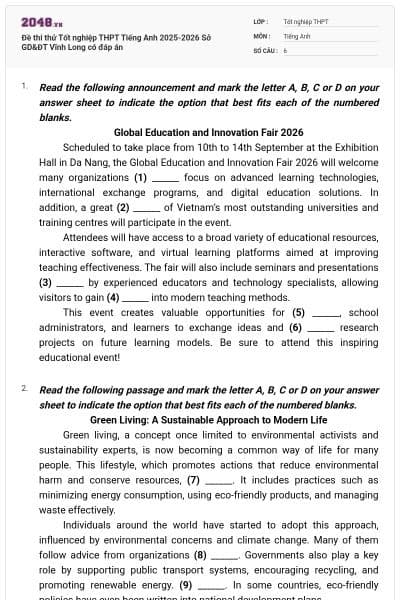
Read the following advertisements and mark the letter A, B, C or D on your answer sheet to indicate the option that best fits each of the numbered blanks.
LANGUAGE EXCHANGE PROGRAM
Join the International Language Exchange Program and practice a new language with native speakers from across the globe! This program is excellent (1) ____________ linguists who aim to enhance their language proficiency through authentic conversations. With both online and in-person meetings, it’s an ideal (2) ____________ to develop skills and forge new friendships.
Participants will be matched with native speakers (3) ____________ by our experienced team to ensure compatibility in language learning. Whether you wish (4) ____________ Spanish, French, Japanese, or another language, we have a partner for you. All sessions are available at flexible hours, allowing you to easily incorporate them into your schedule.
Expand your global network and (5) ____________ confidence in speaking a foreign language. Register now and get ready to embark on an (6) ____________ language journey with us!
(Adapted from Global Success)
at
for
with
on
A. at (prep): ở, tại (dùng trong excellent at + N/V-ing: xuất sắc/giỏi về việc gì).
B. for (prep): cho, dành cho (dùng trong excellent for + somebody: rất tốt/tuyệt vời cho ai đó).
C. with (prep): với.
D. on (prep): trên.
Ở đây khoảng trống đứng trước danh từ chỉ người "linguists" (nhà ngôn ngữ học/người học ngôn ngữ). Chương trình này không phải "giỏi về" người học, mà là "tuyệt vời/rất tốt dành cho" người học.
Chọn B. for
→ This program is excellent for linguists who aim to enhance their language proficiency...
Dịch nghĩa: Chương trình này cực kỳ tuyệt vời dành cho những người học ngôn ngữ có mục tiêu nâng cao sự thành thạo ngôn ngữ của mình...
language environment learning
environment learning language
environment language learning
language learning environment
Phân tích trật tự từ: Cụm danh từ này có danh từ chính là "environment" (môi trường) nên bắt buộc phải đứng cuối cùng. Phía trước nó là cụm danh từ phụ "language learning" (việc học ngôn ngữ) đóng vai trò bổ nghĩa. Trật tự đúng là: Danh từ phụ bổ nghĩa + Danh từ chính.
Chọn D. language learning environment
→ ...it’s an ideal language learning environment to develop skills and forge new friendships.
Dịch nghĩa: ...đây là một môi trường học ngôn ngữ lý tưởng để phát triển các kỹ năng và tạo dựng những tình bạn mới.
are chosen
chosen
choosing
who chosen
A. are chosen: động từ chia bị động (sai vì trong câu đã có động từ chính là "will be matched").
B. chosen (v-ed/v3): quá khứ phân từ (mang nghĩa bị động).
C. choosing (v-ing): hiện tại phân từ (mang nghĩa chủ động).
D. who chosen: sai ngữ pháp (nếu dùng mệnh đề quan hệ đầy đủ phải là who are chosen).
Đây là dạng rút gọn mệnh đề quan hệ mang nghĩa bị động, bổ nghĩa cho cụm danh từ "native speakers". Những người bản xứ này "được chọn lựa" bởi đội ngũ giàu kinh nghiệm (có giới từ "by" phía sau). Mệnh đề đầy đủ là: who are chosen by.... Khi rút gọn, ta lược bỏ đại từ quan hệ và động từ to be, chỉ giữ lại quá khứ phân từ.
Chọn B. chosen
→ Participants will be matched with native speakers chosen by our experienced team...
Dịch nghĩa: Người tham gia sẽ được ghép nối với những người bản xứ được chọn lựa bởi đội ngũ giàu kinh nghiệm của chúng tôi...
practicing
practice
to practicing
to practice
A. practicing (v-ing): danh động từ.
B. practice (v): động từ nguyên mẫu.
C. to practicing: giới từ "to" + V-ing.
D. to practice: động từ nguyên thể có "to".
Ta có cấu trúc cơ bản: wish to do something (mong muốn/muốn làm việc gì).
Chọn D. to practice
→ Whether you wish to practice Spanish, French, Japanese, or another language, we have a partner for you.
Dịch nghĩa: Cho dù bạn mong muốn thực hành tiếng Tây Ban Nha, tiếng Pháp, tiếng Nhật hay một ngôn ngữ nào khác, chúng tôi đều có đối tác dành cho bạn.
make
do
get
gain
A. make (v): làm, chế tạo.
B. do (v): làm, thực hiện.
C. get (v): lấy, có được (thường dùng trong văn nói).
D. gain (v): đạt được, thu được.
Ta có cụm từ kết hợp cố định (collocation): gain confidence (đạt được sự tự tin, trở nên tự tin hơn).
Chọn D. gain
→ Expand your global network and gain confidence in speaking a foreign language.
Dịch nghĩa: Mở rộng mạng lưới quan hệ toàn cầu của bạn và đạt được sự tự tin khi nói một ngoại ngữ.
Register now and get ready to embark on an (6) ____________ language journey with us!
excitement
exciting
excitingly
excite
A. excitement (n): sự hào hứng, sự phấn khích.
B. exciting (adj): thú vị, hào hứng (dùng để miêu tả tính chất của sự vật/sự việc).
C. excitingly (adv): một cách thú vị.
D. excite (v): làm cho hào hứng.
Khoảng trống nằm giữa mạo từ "an" và cụm danh từ "language journey" (hành trình ngôn ngữ). Do đó, ta cần một tính từ đứng trước để miêu tả tính chất cho chuyến hành trình đó.
Chọn B. exciting
→ ...get ready to embark on an exciting language journey with us!
Dịch nghĩa: ...hãy sẵn sàng dấn thân vào một hành trình ngôn ngữ đầy thú vị cùng chúng tôi!
Bài đọc hoàn chỉnh | Dịch bài đọc |
LANGUAGE EXCHANGE PROGRAM Join the International Language Exchange Program and practice a new language with native speakers from across the globe! This program is excellent (1) for linguists who aim to enhance their language proficiency through authentic conversations. With both online and in-person meetings, it’s an ideal (2) language learning environment to develop skills and forge new friendships. Participants will be matched with native speakers (3) chosen by our experienced team to ensure compatibility in language learning. Whether you wish (4) to practice Spanish, French, Japanese, or another language, we have a partner for you. All sessions are available at flexible hours, allowing you to easily incorporate them into your schedule. Expand your global network and (5) gain confidence in speaking a foreign language. Register now and get ready to embark on an (6) exciting language journey with us! | CHƯƠNG TRÌNH TRAO ĐỔI NGÔN NGỮ Hãy tham gia Chương trình Trao đổi Ngôn ngữ Quốc tế và thực hành một ngôn ngữ mới với những người bản xứ đến từ khắp nơi trên toàn cầu! Chương trình này cực kỳ tuyệt vời (1) dành cho những người học ngôn ngữ có mục tiêu nâng cao sự thành thạo ngôn ngữ của mình thông qua các cuộc trò chuyện thực tế. Với cả các hình thức gặp mặt trực tuyến và trực tiếp, đây là một (2) môi trường học ngôn ngữ lý tưởng để phát triển các kỹ năng và tạo dựng những tình bạn mới. Người tham gia sẽ được ghép nối với những người bản xứ (3) được chọn lựa bởi đội ngũ giàu kinh nghiệm của chúng tôi nhằm đảm bảo sự tương thích trong việc học ngôn ngữ. Cho dù bạn mong muốn (4) thực hành tiếng Tây Ban Nha, tiếng Pháp, tiếng Nhật hay một ngôn ngữ nào khác, chúng tôi đều có đối tác dành cho bạn. Tất cả các buổi học đều có khung giờ linh hoạt, cho phép bạn dễ dàng kết hợp chúng vào lịch trình của mình. Mở rộng mạng lưới quan hệ toàn cầu của bạn và (5) đạt được sự tự tin khi nói một ngoại ngữ. Hãy đăng ký ngay bây giờ và sẵn sàng dấn thân vào một hành trình ngôn ngữ (6) đầy thú vị cùng chúng tôi! |
Read the following leaflet and mark the letter A, B, C or D on your answer sheet to indicate the option that best fits each of the numbered blanks.
GREEN LIVING STARTS WITH YOU!
Let’s see how small changes at home can help protect our planet.
♻ The facts:
Excessive deforestation has destroyed habitats and harmed (7) ____________ species. At the same time, we (8) ____________ 60 million plastic bags and 30,000 tonnes of waste yearly, choking rivers and oceans.
♻ Steps to help!
*Shop for seasonal, local products like fruits and vegetables. This cuts down on energy used for food (9) ____________.
*Skip single-use plastics when possible. (10) ____________ grabbing a bottled drink, fill your own reusable bottle!
*This reduces the (11) ____________ of waste you generate.
*Repurpose old containers. Sort glass, paper, and aluminum (12) ____________ and recycle them properly.
others
another
other
the other
A. others: những (người/vật) khác (đại từ, đứng độc lập không đi kèm danh từ).
B. another: một (người/vật) khác (tính từ/đại từ, đi kèm danh từ đếm được số ít).
C. other: những (người/vật) khác (tính từ, đi kèm danh từ số nhiều / không đếm được).
D. the other: (người/vật) còn lại (đã xác định cụ thể trong một nhóm).
Phía sau khoảng trống là danh từ "species" (các loài). Mặc dù từ này có hình thức giống nhau ở cả số ít và số nhiều, nhưng trong ngữ cảnh phá rừng làm ảnh hưởng đến "nhiều loài động thực vật nói chung", nó đang được dùng ở dạng số nhiều. Do đó, ta cần tính từ "other" để bổ nghĩa.
Chọn C. other
→ Excessive deforestation has destroyed habitats and harmed other species.
Dịch nghĩa: Nạn phá rừng quá mức đã phá hủy môi trường sống và gây hại cho các loài khác.
turn down
throw out
give up
run out
A. turn down (phr.v): từ chối, vặn nhỏ (âm lượng).
B. throw out (phr.v): vứt bỏ, vứt đi.
C. give up (phr.v): từ bỏ.
D. run out (phr.v): cạn kiệt, hết.
Ngữ cảnh đang nói về vấn đề rác thải (túi nilon và chất thải). Hành động mà con người thực hiện hàng năm gây tắc nghẽn sông ngòi và đại dương chính là "vứt bỏ" rác.
Chọn B. throw out
→ At the same time, we throw out 60 million plastic bags and 30,000 tonnes of waste yearly...
Dịch nghĩa: Đồng thời, chúng ta vứt bỏ 60 triệu túi nilon và 30.000 tấn rác thải mỗi năm...
cultivation
processing
packaging
delivery
A. cultivation (n): sự canh tác, trồng trọt.
B. processing (n): sự chế biến.
C. packaging (n): sự đóng gói.
D. delivery (n): sự vận chuyển, giao hàng.
Lời khuyên ở đây là mua các sản phẩm "địa phương" (local products). Hàng hóa địa phương không phải trải qua quãng đường dài để đến tay người tiêu dùng, do đó nó giúp tiết kiệm năng lượng cho khâu "vận chuyển".
Chọn D. delivery
→ This cuts down on energy used for food delivery.
Dịch nghĩa: Điều này giúp cắt giảm năng lượng được sử dụng cho việc vận chuyển thực phẩm.
(10) ____________ grabbing a bottled drink, fill your own reusable bottle!
Instead of
In spite of
Because of
Along with
A. Instead of (prep): Thay vì.
B. In spite of (prep): Mặc dù.
C. Because of (prep): Bởi vì.
D. Along with (prep): Cùng với.
Ngữ cảnh đang đưa ra một hành động thay thế thân thiện với môi trường: "Thay vì" lấy một chai nước dùng một lần, hãy dùng bình nước cá nhân. Sau "Instead of" là V-ing (grabbing).
Chọn A. Instead of
→ Instead of grabbing a bottled drink, fill your own reusable bottle!
Dịch nghĩa: Thay vì lấy một chai nước uống đóng chai sẵn, hãy tự đổ đầy bình nước có thể tái sử dụng của bạn!
total
amount
rate
volume
A. total (n/adj): tổng số.
B. amount (n): lượng (+ danh từ không đếm được).
C. rate (n): tỷ lệ, tốc độ.
D. volume (n): thể tích, khối lượng.
Phía sau khoảng trống là giới từ "of" và danh từ không đếm được "waste" (rác thải). Do đó, ta dùng cấu trúc phổ biến the amount of + N (không đếm được).
Chọn B. amount
→ This reduces the amount of waste you generate.
Dịch nghĩa: Điều này làm giảm lượng rác thải mà bạn tạo ra.
pieces
materials
types
objects
A. pieces (n): mảnh, mẩu.
B. materials (n): vật liệu, chất liệu.
C. types (n): loại.
D. objects (n): đồ vật.
Thủy tinh (glass), giấy (paper), và nhôm (aluminum) đều được phân loại chung là các "vật liệu" có thể tái chế.
Chọn B. materials
→ Sort glass, paper, and aluminum materials and recycle them properly.
Dịch nghĩa: Hãy phân loại các vật liệu thủy tinh, giấy, và nhôm rồi tái chế chúng đúng cách.
Bài đọc hoàn chỉnh | Dịch bài đọc |
GREEN LIVING STARTS WITH YOU! Let’s see how small changes at home can help protect our planet. ♻The facts: Excessive deforestation has destroyed habitats and harmed (7) other species. At the same time, we (8) throw out 60 million plastic bags and 30,000 tonnes of waste yearly, choking rivers and oceans. ♻Steps to help! *Shop for seasonal, local products like fruits and vegetables. This cuts down on energy used for food (9) delivery. *Skip single-use plastics when possible. (10) Instead of grabbing a bottled drink, fill your own reusable bottle! *This reduces the (11) amount of waste you generate. *Repurpose old containers. Sort glass, paper, and aluminum (12) materials and recycle them properly. | LỐI SỐNG XANH BẮT ĐẦU TỪ BẠN! Hãy cùng xem những thay đổi nhỏ tại nhà có thể giúp bảo vệ hành tinh của chúng ta như thế nào. ♻Sự thật: Nạn phá rừng quá mức đã phá hủy môi trường sống và gây hại cho (7) các loài khác. Đồng thời, chúng ta (8) vứt bỏ 60 triệu túi nilon và 30.000 tấn rác thải mỗi năm, làm bóp nghẹt các dòng sông và đại dương. ♻Các bước để giúp đỡ! *Mua sắm các sản phẩm địa phương, đúng mùa vụ như trái cây và rau củ. Điều này giúp cắt giảm năng lượng được sử dụng cho việc (9) vận chuyển thực phẩm. *Bỏ qua các loại nhựa dùng một lần khi có thể. (10) Thay vì lấy một chai nước uống đóng chai sẵn, hãy tự đổ đầy bình nước có thể tái sử dụng của bạn! *Điều này làm giảm (11) lượng rác thải mà bạn tạo ra. *Tái sử dụng các hộp chứa cũ. Hãy phân loại các (12) vật liệu thủy tinh, giấy, và nhôm rồi tái chế chúng đúng cách. |
Read the following passage and mark the letter A, B, C or D on your answer sheet to indicate the option that best fits each of the numbered blanks.
Many school-leavers face the difficult decision of whether to continue their education or start working right after graduation. There are various educational options available, and each path has its own benefits and challenges. One of the most popular choices is to attend university, where students can earn a degree in a specialized field. However, some students may prefer to take a different route by enrolling in vocational training programs (13) ____________. These programs are designed to help young people quickly enter the workforce with the skills they need.
(14) ____________. Online education has become a popular option due to its flexibility and convenience. Students can take courses in numerous areas such as business management, technology, and graphic design from the comfort of their homes. (15) ____________. However, some argue that traditional classroom learning provides a more structured environment for students. The structured environment in universities offers a better foundation for learning and social interaction. In many countries, the choice between university and vocational training (16) ____________.
The rise of gap years is also worth mentioning. Students in many countries are taking gap years to gain experience before going to university. Before committing to further education, (17) ____________. A gap year gives students the opportunity to gain valuable life experience, explore their interests and consider different career paths. It’s also a great opportunity for personal growth.
that focus on practical skills for specific careers
offer practical training for targeted career paths
of which concentrate on developing career-specific abilities
specialized in hands-on training for particular professions
Phía trước chỗ trống là một cụm danh từ: "vocational training programs" (các chương trình đào tạo nghề). Vị trí (13) cần một mệnh đề quan hệ để giải thích đặc điểm của các chương trình này, đồng thời tạo tiền đề cho câu phía sau: "These programs are designed to help young people quickly enter the workforce with the skills they need." (Những chương trình này được thiết kế để giúp người trẻ nhanh chóng tham gia lực lượng lao động với các kỹ năng họ cần).
Dịch nghĩa/Ngữ pháp:
A. những chương trình tập trung vào các kỹ năng thực tế cho các nghề nghiệp cụ thể (Mệnh đề quan hệ bắt đầu bằng "that" thay thế cho "programs", động từ "focus" chia số nhiều, hoàn toàn chính xác).
B. cung cấp đào tạo thực tế... (Động từ "offer" làm câu bị dư động từ chính, do chưa có đại từ quan hệ).
C. của cái mà tập trung vào... (Sai ngữ pháp: Cấu trúc "of which" không đi trực tiếp với động từ "concentrate" như vậy).
D. được chuyên môn hóa trong... (Có thể hiểu là phân từ quá khứ rút gọn, nhưng từ "specialized" không diễn đạt tự nhiên bằng cụm "focus on practical skills" khi nói về đào tạo nghề, và không khớp với nét nghĩa "skills" ở câu sau).
Đáp án A cung cấp một mệnh đề quan hệ chuẩn xác và liên kết trực tiếp với từ khóa "skills" (kỹ năng) ở câu tiếp theo.
Chọn A.
→ However, some students may prefer to take a different route by enrolling in vocational training programs that focus on practical skills for specific careers.
Dịch nghĩa: Tuy nhiên, một số học sinh có thể thích đi một con đường khác bằng cách ghi danh vào các chương trình đào tạo nghề tập trung vào các kỹ năng thực tiễn cho các nghề nghiệp cụ thể.
Another option that has gained popularity is online education
Many choices have been considered in recent times.
The gap year experience often leads to better academic performance
Students should return to their studies with a clear direction
Vị trí (14) là câu mở đầu cho đoạn văn thứ hai. Đoạn thứ hai này đang thảo luận về "Online education" (Giáo dục trực tuyến). Do đó, câu (14) phải là câu chủ đề (Topic sentence) giới thiệu trực tiếp vào sự lựa chọn này.
Dịch nghĩa:
A. Một lựa chọn khác đã trở nên phổ biến là giáo dục trực tuyến (Câu mở đoạn hoàn hảo, giới thiệu thẳng vào chủ đề của các câu tiếp theo).
B. Nhiều lựa chọn đã được xem xét trong thời gian gần đây. (Quá chung chung, không giới thiệu được trọng tâm của đoạn).
C. Trải nghiệm gap year thường dẫn đến kết quả học tập tốt hơn (Sai chủ đề: "gap year" nằm ở đoạn 3, không phải đoạn này).
D. Học sinh nên trở lại việc học với một định hướng rõ ràng (Không liên quan đến nội dung của đoạn 2).
Chỉ có đáp án A thực hiện đúng chức năng của một câu chủ đề, giới thiệu rõ ràng từ khóa "online education" để các câu sau tiếp tục triển khai.
Chọn A.
→ Another option that has gained popularity is online education. Online education has become a popular option due to its flexibility and convenience.
Dịch nghĩa: Một lựa chọn khác đã trở nên phổ biến là giáo dục trực tuyến. Giáo dục trực tuyến đã trở thành một lựa chọn phổ biến do tính linh hoạt và sự tiện lợi của nó.
Online education provides more structured environment than traditional learning
It is important for students to explore online education before making a decision
This flexibility allows individuals to balance work and study at the same time
Students should consider online education thoroughly before making a choice.
Đoạn văn đang liệt kê các ưu điểm của giáo dục trực tuyến: "flexibility and convenience" (tính linh hoạt và tiện lợi), "from the comfort of their homes" (từ sự thoải mái tại nhà của họ). Vị trí (15) cần một câu tiếp tục nói về lợi ích tích cực của phương pháp này trước khi chuyển sang mặt trái bằng từ "However" ở câu sau.
Dịch nghĩa:
A. Giáo dục trực tuyến cung cấp môi trường có cấu trúc hơn học tập truyền thống (Sai logic: câu sau đã khẳng định "traditional classroom learning provides a more structured environment").
B. Thật quan trọng đối với học sinh khi khám phá giáo dục trực tuyến trước khi đưa ra quyết định (Câu khuyên nhủ, làm gián đoạn dòng chảy liệt kê lợi ích).
C. Sự linh hoạt này cho phép các cá nhân cân bằng giữa công việc và học tập cùng một lúc (Giải thích rõ ràng lợi ích của từ khóa "flexibility" đã nhắc ở câu trước).
D. Học sinh nên xem xét giáo dục trực tuyến một cách kỹ lưỡng... (Câu khuyên nhủ, không hợp lý về mạch đoạn văn).
Đáp án C tiếp nối cực kỳ logic cụm từ "flexibility" và duy trì mạch liệt kê ưu điểm.
Chọn C.
→ Students can take courses in numerous areas such as business management, technology, and graphic design from the comfort of their homes. This flexibility allows individuals to balance work and study at the same time.
Dịch nghĩa: Học sinh có thể tham gia các khóa học trong nhiều lĩnh vực như quản trị kinh doanh, công nghệ và thiết kế đồ họa từ sự thoải mái ngay tại nhà của mình. Sự linh hoạt này cho phép các cá nhân cân bằng giữa công việc và học tập cùng một lúc.
depends largely on the individual’s career goals and financial situation
whose career goals and financial capacity are of great importance
largely relying on the person’s job goals and financial situation
which is greatly influenced by the individual’s career plans and financial ability
Chủ ngữ của câu là "the choice between university and vocational training" (sự lựa chọn giữa đại học và đào tạo nghề). Câu này hiện đang thiếu động từ chính (Main verb) để hoàn thành cấu trúc ngữ pháp.
Dịch nghĩa/Ngữ pháp:
A. phụ thuộc phần lớn vào mục tiêu nghề nghiệp và tình hình tài chính của mỗi cá nhân (Cung cấp động từ chính "depends" chia số ít khớp với chủ ngữ "the choice", hoàn toàn chính xác).
B. whose career goals... (Mệnh đề quan hệ bắt đầu bằng "whose" → Thiếu động từ chính).
C. largely relying... (Hiện tại phân từ V-ing → Thiếu động từ chính).
D. which is greatly influenced... (Mệnh đề quan hệ bắt đầu bằng "which" → Thiếu động từ chính).
Đáp án A là lựa chọn duy nhất cung cấp động từ chính, đảm bảo ngữ pháp của một câu hoàn chỉnh.
Chọn A.
→ In many countries, the choice between university and vocational training depends largely on the individual’s career goals and financial situation.
Dịch nghĩa: Ở nhiều quốc gia, sự lựa chọn giữa đại học và đào tạo nghề phụ thuộc phần lớn vào mục tiêu nghề nghiệp và tình hình tài chính của mỗi cá nhân.
the option of taking a gap year is widely available in many countries during this year
decisions to explore the world, work, or volunteer are made during this year
selecting to travel, take up a job, or volunteer may become their choices during this year
some students may choose to travel, work, or volunteer during this year
Cụm từ đứng đầu câu "Before committing to further education," (Trước khi cam kết với việc học lên cao,) là một cụm giới từ đóng vai trò như trạng ngữ chỉ thời gian. Theo quy tắc ngữ pháp, Chủ ngữ của mệnh đề chính phía sau dấu phẩy bắt buộc phải là đối tượng có thể thực hiện hành động "committing" (cam kết học lên). Đối tượng này chỉ có thể là con người (cụ thể là "students" - học sinh).
Dịch nghĩa/Ngữ pháp:
A. lựa chọn dành một năm gap year... (Chủ ngữ là "the option" → Lựa chọn không thể thực hiện hành động "cam kết học lên").
B. các quyết định khám phá thế giới... (Chủ ngữ là "decisions" → Quyết định không thể "cam kết học lên").
C. việc lựa chọn đi du lịch... (Chủ ngữ là "selecting..." → Việc lựa chọn không thể "cam kết học lên").
D. một số học sinh có thể chọn đi du lịch, làm việc hoặc làm tình nguyện viên trong năm nay (Chủ ngữ là "some students" - con người, hoàn toàn khớp với cụm trạng ngữ phía trước).
Chỉ có đáp án D tuân thủ đúng quy tắc ngữ pháp về sự hòa hợp chủ thể thực hiện hành động.
Chọn D.
→ Before committing to further education, some students may choose to travel, work, or volunteer during this year.
Dịch nghĩa: Trước khi cam kết với việc học lên cao, một số học sinh có thể chọn đi du lịch, làm việc hoặc làm tình nguyện viên trong năm nay.
Bài đọc hoàn chỉnh | Dịch bài đọc |
Many school-leavers face the difficult decision of whether to continue their education or start working right after graduation. There are various educational options available, and each path has its own benefits and challenges. One of the most popular choices is to attend university, where students can earn a degree in a specialized field. However, some students may prefer to take a different route by enrolling in vocational training programs that focus on practical skills for specific careers. These programs are designed to help young people quickly enter the workforce with the skills they need. Another option that has gained popularity is online education. Online education has become a popular option due to its flexibility and convenience. Students can take courses in numerous areas such as business management, technology, and graphic design from the comfort of their homes. This flexibility allows individuals to balance work and study at the same time. However, some argue that traditional classroom learning provides a more structured environment for students. The structured environment in universities offers a better foundation for learning and social interaction. In many countries, the choice between university and vocational training depends largely on the individual’s career goals and financial situation. The rise of gap years is also worth mentioning. Students in many countries are taking gap years to gain experience before going to university. Before committing to further education, some students may choose to travel, work, or volunteer during this year. A gap year gives students the opportunity to gain valuable life experience, explore their interests and consider different career paths. It’s also a great opportunity for personal growth. | Nhiều học sinh vừa rời ghế nhà trường phải đối mặt với quyết định khó khăn là nên tiếp tục con đường học vấn hay bắt đầu làm việc ngay sau khi tốt nghiệp. Có rất nhiều lựa chọn giáo dục có sẵn, và mỗi con đường đều có những lợi ích và thách thức riêng. Một trong những sự lựa chọn phổ biến nhất là học đại học, nơi sinh viên có thể lấy bằng trong một lĩnh vực chuyên môn. Tuy nhiên, một số học sinh có thể thích đi một con đường khác bằng cách ghi danh vào các chương trình đào tạo nghề tập trung vào các kỹ năng thực tiễn cho các nghề nghiệp cụ thể. Những chương trình này được thiết kế để giúp người trẻ nhanh chóng tham gia lực lượng lao động với các kỹ năng họ cần. Một lựa chọn khác đã trở nên phổ biến là giáo dục trực tuyến. Giáo dục trực tuyến đã trở thành một lựa chọn phổ biến do tính linh hoạt và sự tiện lợi của nó. Học sinh có thể tham gia các khóa học trong nhiều lĩnh vực như quản trị kinh doanh, công nghệ và thiết kế đồ họa từ sự thoải mái ngay tại nhà của mình. Sự linh hoạt này cho phép các cá nhân cân bằng giữa công việc và học tập cùng một lúc. Tuy nhiên, một số người lập luận rằng việc học tập trên lớp học truyền thống cung cấp một môi trường có cấu trúc hơn cho học sinh. Môi trường có cấu trúc tại các trường đại học mang lại một nền tảng tốt hơn cho việc học tập và tương tác xã hội. Ở nhiều quốc gia, sự lựa chọn giữa đại học và đào tạo nghề phụ thuộc phần lớn vào mục tiêu nghề nghiệp và tình hình tài chính của mỗi cá nhân. Sự gia tăng của những năm nghỉ ngơi (gap years) cũng đáng được nhắc đến. Học sinh ở nhiều quốc gia đang dành những năm gap year để tích lũy kinh nghiệm trước khi vào đại học. Trước khi cam kết với việc học lên cao, một số học sinh có thể chọn đi du lịch, làm việc hoặc làm tình nguyện viên trong năm nay. Một năm gap year mang đến cho học sinh cơ hội thu thập những trải nghiệm sống quý giá, khám phá sở thích của mình và cân nhắc các con đường sự nghiệp khác nhau. Đó cũng là một cơ hội tuyệt vời để phát triển bản thân. |
Read the following passage and mark the letter A, B, C, or D on your answer sheet to indicate the correct answer to each of the questions.
Wildlife conservation has become a critical global priority in recent years, as human activity increasingly encroaches upon the natural habitats of various species. Conservation efforts are focused on preserving biodiversity, protecting endangered species, and maintaining ecosystems that support both wildlife and human populations. [I]
One of the primary strategies for wildlife conservation is the establishment of protected areas, such as national parks, wildlife reserves, and marine sanctuaries. These zones are designed to offer a safe haven for wildlife, shielding them from poaching, habitat destruction, and other threats. For example, Yellowstone National Park in the United States and the Serengeti in Tanzania are well-known protected areas that host a wide variety of species. [II]
Another important aspect of conservation is the restoration of damaged habitats. Deforestation, pollution, and urbanization have led to the destruction of vital ecosystems. Conservationists are working to replant forests, clean up polluted rivers, and restore wetlands to create environments where wildlife can thrive. In Costa Rica, for instance, reforestation projects have not only helped to increase forest cover but have also provided new habitats for species such as jaguars, monkeys, and tropical birds. [III]
In addition to habitat protection and restoration, the fight against illegal wildlife trade is essential as well. Poaching and the illegal sale of wildlife products, such as ivory and rhino horn, have driven some species to the brink of extinction. International agreements, like the Convention on International Trade in Endangered Species of Wild Fauna and Flora (CITES), aim to curb this practice by regulating the global trade of wildlife and their products. Additionally, many countries have established strict laws and penalties to deter poaching and trafficking. [IV]
One of the more recent approaches to conservation is the use of technology. Drones, camera traps, and satellite tracking systems are being deployed to monitor wildlife populations and poaching activity in real time. For instance, drones are being used in African savannas to monitor herds of elephants and spot potential poaching threats. Camera traps allow scientists to observe elusive species in remote areas, providing valuable data on their behavior and population sizes.
Ultimately, successful wildlife conservation requires global cooperation, long-term planning, and a balance between protecting wildlife and supporting human development. Governments, non-governmental organizations (NGOs), and local communities must work together to create sustainable solutions that ensure the survival of wildlife for future generations.
(Adapted from https://therealielts.vn/ielts-reading-8-wildlife-conservation-efforts/)
Where in the passage does the following sentence best fit?
"Similarly, marine sanctuaries like the Great Barrier Reef Marine Park in Australia aim to preserve marine biodiversity."
[IV]
[III]
[I]
[II]
Câu sau đây phù hợp nhất với vị trí nào trong bài đọc?
"Similarly, marine sanctuaries like the Great Barrier Reef Marine Park in Australia aim to preserve marine biodiversity." (Tương tự như vậy, các khu bảo tồn biển như Công viên Hải dương Rạn san hô Great Barrier ở Úc nhằm mục đích bảo tồn đa dạng sinh học biển.)
Đoạn 2 giới thiệu về việc thành lập các khu bảo vệ, bao gồm "công viên quốc gia, khu bảo tồn động vật hoang dã, và khu bảo tồn biển". Sau đó, tác giả đưa ra ví dụ về các khu vực trên cạn: "Ví dụ, Công viên Quốc gia Yellowstone ở Hoa Kỳ và Serengeti ở Tanzania...". Việc đặt câu gạch chân (bắt đầu bằng "Tương tự như vậy..." và lấy ví dụ về một khu bảo tồn biển) vào vị trí [II] ngay sau đó sẽ tạo ra sự liên kết song song, bổ sung ví dụ hoàn hảo cho cả môi trường trên cạn lẫn dưới nước.
Chọn D.
Which of the following is NOT mentioned as a focus of wildlife conservation?
Protecting endangered species
Preserving biodiversity
Promoting urbanization
Maintaining ecosystems
Điều nào sau đây KHÔNG được đề cập như một trọng tâm của bảo tồn động vật hoang dã?
A. Protecting endangered species (Bảo vệ các loài có nguy cơ tuyệt chủng - Có nhắc đến).
B. Preserving biodiversity (Bảo tồn đa dạng sinh học - Có nhắc đến).
C. Promoting urbanization (Thúc đẩy đô thị hóa).
D. Maintaining ecosystems (Duy trì các hệ sinh thái - Có nhắc đến).
Ở đoạn 1, bảo tồn động vật hoang dã tập trung vào bảo tồn đa dạng sinh học, bảo vệ các loài có nguy cơ tuyệt chủng và duy trì hệ sinh thái. Đô thị hóa (urbanization) được nhắc đến ở đoạn 3 như một nguyên nhân gây phá hủy môi trường sống, chứ không phải là mục tiêu thúc đẩy của công tác bảo tồn.
Thông tin: "Conservation efforts are focused on preserving biodiversity, protecting endangered species, and maintaining ecosystems..."
Chọn C.
The phrase "safe haven" in paragraph 2 is OPPOSITE in meaning to ____________?
protected habitat
open territory
wildlife sanctuary
threatened space
Cụm từ "safe haven" ở đoạn 2 TRÁI NGHĨA với ____________?
safe haven (n): nơi trú ẩn an toàn
A. protected habitat (n): môi trường sống được bảo vệ
B. open territory (n): lãnh thổ mở
C. wildlife sanctuary (n): khu bảo tồn động vật hoang dã
D. threatened space (n): không gian bị đe dọa
→ safe haven >< threatened space
Thông tin: "These zones are designed to offer a safe haven for wildlife, shielding them from poaching, habitat destruction, and other threats." (Những khu vực này được thiết kế để cung cấp một nơi trú ẩn an toàn cho động vật hoang dã, che chở chúng khỏi nạn săn trộm, phá hủy môi trường sống và các mối đe dọa khác.)
Chọn D.
Which of the following best summarizes paragraph 3?
Costa Rica's urbanization efforts have helped to increase forest cover and support endangered species.
Deforestation and pollution are less harmful than urbanization in the context of habitat restoration.
Reforestation, river cleanup, and wetland restoration are essential efforts to protect wildlife habitats.
Conservationists are focusing on urbanization and pollution as the main causes of habitat destruction.
Câu nào sau đây tóm tắt đúng nhất đoạn 3?
A. Nỗ lực đô thị hóa của Costa Rica đã giúp tăng diện tích rừng và hỗ trợ các loài động vật có nguy cơ tuyệt chủng. (Sai, Costa Rica thực hiện nỗ lực tái trồng rừng - reforestation, không phải đô thị hóa).
B. Phá rừng và ô nhiễm ít gây hại hơn đô thị hóa trong bối cảnh phục hồi môi trường sống. (Sai, bài đọc không so sánh mức độ gây hại giữa chúng).
C. Tái trồng rừng, làm sạch sông ngòi và phục hồi vùng đất ngập nước là những nỗ lực thiết yếu để bảo vệ môi trường sống của động vật hoang dã. (Đúng, thâu tóm được các hành động phục hồi môi trường sống được nêu trong đoạn).
D. Các nhà bảo tồn đang tập trung vào đô thị hóa và ô nhiễm như những nguyên nhân chính gây ra sự phá hủy môi trường sống. (Chưa đủ bao quát, đoạn văn tập trung vào các giải pháp phục hồi chứ không chỉ nêu nguyên nhân).
Chọn C.
Which of the following best paraphrases the underlined sentence in paragraph 4: "In addition to habitat protection and restoration, the fight against illegal wildlife trade is essential as well."?
Habitat protection and restoration is the only focus of conservation efforts.
Stopping illegal wildlife trade is considered more crucial than ever before.
Efforts to reduce illegal wildlife trade are ranked second to habitat restoration.
Combating illegal wildlife trade is as important as protecting and restoring habitats.
Câu nào sau đây diễn giải đúng nhất câu được gạch chân ở đoạn 4?
In addition to habitat protection and restoration, the fight against illegal wildlife trade is essential as well. (Bên cạnh việc bảo vệ và phục hồi môi trường sống, cuộc chiến chống lại nạn buôn bán động vật hoang dã bất hợp pháp cũng rất thiết yếu.)
A. Bảo vệ và phục hồi môi trường sống là trọng tâm duy nhất của các nỗ lực bảo tồn. (Sai, còn có chống buôn bán bất hợp pháp).
B. Ngăn chặn buôn bán động vật hoang dã bất hợp pháp được coi là quan trọng hơn bao giờ hết. (Sai, không có ý so sánh "hơn bao giờ hết").
C. Nỗ lực giảm buôn bán động vật hoang dã bất hợp pháp được xếp thứ hai sau việc phục hồi môi trường sống. (Sai, bài không xếp hạng ưu tiên).
D. Chống lại nạn buôn bán động vật hoang dã bất hợp pháp cũng quan trọng như việc bảo vệ và phục hồi các môi trường sống. (Đúng, cấu trúc "In addition to X, Y is essential as well" mang ý nghĩa cả X và Y đều có tầm quan trọng tương đương).
Chọn D.
The word "curb" in paragraph 4 is closest in meaning to ____________.
deliver
invade
control
foster
Từ "curb" ở đoạn 4 gần nghĩa nhất với ____________.
curb (v): kiềm chế, hạn chế, kiểm soát
A. deliver (v): phân phát, giao hàng
B. invade (v): xâm lược
C. control (v): kiểm soát, hạn chế
D. foster (v): thúc đẩy, bồi dưỡng
→ curb = control
Thông tin: "International agreements... aim to curb this practice by regulating the global trade..." (Các hiệp định quốc tế... nhằm mục đích kiểm soát/kiềm chế hành vi này bằng cách quy định việc buôn bán toàn cầu...)
Chọn C.
The word "their" in paragraph 5 refers to ____________.
species’
scientists’
camera traps’
remote areas’
Từ "their" ở đoạn 5 chỉ ____________.
A. species’ (của các loài)
B. scientists’ (của các nhà khoa học)
C. camera traps’ (của các bẫy ảnh)
D. remote areas’ (của các khu vực hẻo lánh)
Thông tin: "Camera traps allow scientists to observe elusive species in remote areas, providing valuable data on their behavior and population sizes." (Máy ảnh bẫy cho phép các nhà khoa học quan sát các loài khó bắt gặp ở những khu vực hẻo lánh, cung cấp dữ liệu quý giá về hành vi và quy mô quần thể của chúng.)
→ Đại từ sở hữu "their" (của chúng) dùng để chỉ sự sở hữu đối với các danh từ được nhắc đến trước đó. Ở đây, các nhà khoa học quan sát "những loài động vật khó nắm bắt" (elusive species) để cung cấp dữ liệu về hành vi và quy mô quần thể của "chúng". "Chúng" chính là các loài động vật này.
Chọn A.
Which of the following is TRUE according to the passage?
The Great Barrier Reef is a marine sanctuary in Africa.
Conservation efforts include protecting marine and terrestrial species
The Serengeti is the only protected area mentioned in the passage.
Illegal wildlife trade has been entirely stopped by CITES agreements.
Điều nào sau đây là ĐÚNG theo bài đọc?
A. Rạn san hô Great Barrier là một khu bảo tồn biển ở Châu Phi. (Sai, ở Úc - Australia).
B. Các nỗ lực bảo tồn bao gồm việc bảo vệ các loài sinh vật biển và trên cạn. (Đúng, đoạn 2 nhắc đến cả "marine sanctuaries" - khu bảo tồn biển và "national parks" với các loài trên cạn).
C. Serengeti là khu vực được bảo vệ duy nhất được đề cập trong bài. (Sai, còn có Yellowstone, Great Barrier Reef).
D. Nạn buôn bán động vật hoang dã bất hợp pháp đã bị dừng lại hoàn toàn... (Sai, các hiệp định chỉ "nhằm mục đích kiềm chế" - aim to curb).
Chọn B.
Which of the following can be inferred from the passage?
Poaching and the illegal trade of wildlife products are not major threats to endangered species.
The primary goal of wildlife conservation is to increase human populations in protected areas.
Technology has become a crucial element in contemporary wildlife conservation initiatives.
Reforestation projects in Costa Rica have been successful in stopping potential poaching threats.
Có thể suy luận điều gì từ bài đọc?
A. Săn trộm và buôn bán trái phép các sản phẩm từ động vật hoang dã không phải là mối đe dọa lớn đối với các loài có nguy cơ tuyệt chủng. (Sai, đoạn 4 nói chúng đẩy nhiều loài đến bờ vực tuyệt chủng).
B. Mục tiêu chính của bảo tồn động vật hoang dã là tăng dân số trong các khu vực được bảo vệ. (Sai hoàn toàn).
C. Công nghệ đã trở thành một yếu tố quan trọng trong các sáng kiến bảo tồn động vật hoang dã đương đại. (Đúng, đây là nội dung trọng tâm của đoạn 5 khi nói về flycam, bẫy ảnh và hệ thống vệ tinh).
D. Các dự án tái trồng rừng ở Costa Rica đã thành công trong việc ngăn chặn các mối đe dọa săn trộm tiềm tàng. (Sai, tái trồng rừng giúp tăng diện tích rừng và tạo môi trường sống, việc ngăn chặn săn trộm bằng công nghệ được nhắc ở ví dụ châu Phi).
Chọn C.
Wildlife conservation is often seen as being solely focused on the protection of endangered species, but in reality, it encompasses a much broader range of efforts.
While technology in wildlife conservation is often associated with monitoring animal behavior, it plays a vital part in tackling a range of critical threats to wildlife, including poaching and habitat destruction
The main approach to wildlife conservation often revolves around the creation of protected areas, which are designated spaces where human activities are restricted to safeguard ecosystems and biodiversity.
Successful wildlife conservation involves protecting habitats, fighting illegal wildlife trade, using technology for monitoring, and fostering global cooperation to balance wildlife protection and human development.
Câu nào sau đây tóm tắt đúng nhất bài đọc?
A. Bảo tồn động vật hoang dã thường được xem là chỉ tập trung vào việc bảo vệ các loài có nguy cơ tuyệt chủng, nhưng trên thực tế, nó bao gồm một phạm vi nỗ lực rộng lớn hơn nhiều. (Sai ý).
B. Mặc dù công nghệ trong bảo tồn động vật hoang dã thường được liên kết với việc theo dõi hành vi của động vật, nhưng nó đóng một vai trò quan trọng trong việc giải quyết một loạt các mối đe dọa nghiêm trọng đối với động vật hoang dã, bao gồm săn trộm và phá hủy môi trường sống. (Thiếu tính bao quát, chỉ tập trung vào công nghệ).
C. Phương pháp chính để bảo tồn động vật hoang dã thường xoay quanh việc tạo ra các khu bảo tồn, là những không gian được chỉ định nơi các hoạt động của con người bị hạn chế để bảo vệ hệ sinh thái và đa dạng sinh học. (Thiếu tính bao quát, chỉ tập trung vào đoạn 2).
D. Việc bảo tồn động vật hoang dã thành công liên quan đến việc bảo vệ môi trường sống, chống lại nạn buôn bán động vật hoang dã bất hợp pháp, sử dụng công nghệ để giám sát và thúc đẩy sự hợp tác toàn cầu để cân bằng giữa bảo vệ động vật hoang dã và phát triển con người. (Tóm tắt hoàn hảo và đầy đủ các ý chính của toàn bộ các đoạn trong bài).
Chọn D.
Dịch bài đọc:
Bảo tồn động vật hoang dã đã trở thành một ưu tiên toàn cầu quan trọng trong những năm gần đây, khi hoạt động của con người ngày càng xâm lấn vào môi trường sống tự nhiên của nhiều loài khác nhau. Các nỗ lực bảo tồn tập trung vào việc duy trì đa dạng sinh học, bảo vệ các loài có nguy cơ tuyệt chủng và duy trì các hệ sinh thái hỗ trợ cả quần thể động vật hoang dã và con người. [I]
Một trong những chiến lược chính để bảo tồn động vật hoang dã là việc thiết lập các khu vực được bảo vệ, chẳng hạn như công viên quốc gia, khu bảo tồn động vật hoang dã và khu bảo tồn biển. Những khu vực này được thiết kế để cung cấp một nơi trú ẩn an toàn cho động vật hoang dã, che chở chúng khỏi nạn săn trộm, phá hủy môi trường sống và các mối đe dọa khác. Ví dụ, Công viên Quốc gia Yellowstone ở Hoa Kỳ và Serengeti ở Tanzania là những khu bảo tồn nổi tiếng là nơi sinh sống của nhiều loài sinh vật đa dạng. [II] (Tương tự như vậy, các khu bảo tồn biển như Công viên Hải dương Rạn san hô Great Barrier ở Úc nhằm mục đích bảo tồn đa dạng sinh học biển.)
Một khía cạnh quan trọng khác của việc bảo tồn là sự phục hồi các môi trường sống bị hư hại. Nạn phá rừng, ô nhiễm và đô thị hóa đã dẫn đến sự phá hủy các hệ sinh thái thiết yếu. Các nhà bảo tồn đang nỗ lực trồng lại rừng, làm sạch các dòng sông bị ô nhiễm và phục hồi các vùng đất ngập nước để tạo ra những môi trường nơi động vật hoang dã có thể phát triển mạnh mẽ. Chẳng hạn, tại Costa Rica, các dự án tái trồng rừng không chỉ giúp tăng độ che phủ của rừng mà còn cung cấp môi trường sống mới cho các loài như báo đốm, khỉ và các loài chim nhiệt đới. [III]
Bên cạnh việc bảo vệ và phục hồi môi trường sống, cuộc chiến chống lại nạn buôn bán động vật hoang dã bất hợp pháp cũng rất thiết yếu. Nạn săn trộm và buôn bán trái phép các sản phẩm từ động vật hoang dã, chẳng hạn như ngà voi và sừng tê giác, đã đẩy một số loài đến bờ vực tuyệt chủng. Các hiệp định quốc tế, như Công ước về Buôn bán Quốc tế các loài Động, Thực vật Hoang dã Nguy cấp (CITES), nhằm mục đích kiềm chế hành vi này bằng cách quy định việc buôn bán toàn cầu đối với động vật hoang dã và các sản phẩm của chúng. Thêm vào đó, nhiều quốc gia đã thiết lập các luật lệ và hình phạt nghiêm ngặt để răn đe nạn săn trộm và buôn lậu. [IV]
Một trong những phương pháp tiếp cận mới hơn đối với công tác bảo tồn là việc sử dụng công nghệ. Máy bay không người lái (drone), bẫy ảnh và hệ thống theo dõi vệ tinh đang được triển khai để giám sát các quần thể động vật hoang dã và hoạt động săn trộm theo thời gian thực. Ví dụ, máy bay không người lái đang được sử dụng ở các thảo nguyên châu Phi để giám sát các đàn voi và phát hiện các mối đe dọa săn trộm tiềm tàng. Bẫy ảnh cho phép các nhà khoa học quan sát các loài động vật khó nắm bắt ở những khu vực hẻo lánh, cung cấp dữ liệu quý giá về hành vi và quy mô quần thể của chúng.
Cuối cùng, việc bảo tồn động vật hoang dã thành công đòi hỏi sự hợp tác toàn cầu, lập kế hoạch dài hạn và sự cân bằng giữa việc bảo vệ động vật hoang dã và hỗ trợ sự phát triển của con người. Các chính phủ, các tổ chức phi chính phủ (NGO) và các cộng đồng địa phương phải làm việc cùng nhau để tạo ra những giải pháp bền vững nhằm đảm bảo sự sinh tồn của động vật hoang dã cho các thế hệ tương lai.
Read the following passage and mark the letter A, B, C, or D on your answer sheet to indicate the correct answer to each of the questions.
From Cave Walls to Social Media Walls
In today's world, we have different kinds of media available to us at all times, but did you know that the history of media actually goes back millennia?
The word ‘media’ refers to the different ways in which people transmit information. By this definition, we can say with confidence that human beings created the first type of media around 64,000 years ago when we first began painting simplistic symbols on the walls of caves. Since then, the more we have evolved, the more advanced our media have become.
According to experts, it was sometime around 3,400 BC when human beings first began utilising written language as a means of communication. For generations, apart from verbal communication, people had to write everything manually until the mid-1440s. It was Johannes Gutenberg who revolutionised media when he created an invention called the printing press. This marked the beginning of what we now call “mass media”. Gutenberg's innovative invention made print media like books, newspapers and magazines at a large scale and share information with a wider audience than ever before.
Several hundred years after the invention of the printing press, during the 19th century, we created cameras and later, the radio. The invention of the radio began the age of broadcast media, and the development of television swiftly followed it. This allowed many people to watch fascinating movies, programmes and documentaries, all of which remain popular today.
In the 2000s, we saw the rise of digital media. Now, we visit web pages, listen to podcasts, stream music and communicate on social media using our smartphones. We even use QR codes to share information instantly. We have come a long way, and so have the ways we communicate!
(Adapted from Unit 3- Bright 12)
Which of the following is NOT mentioned as a type of media in the passage?
Radio
Cave paintings
Television
Digital billboards
Điều nào sau đây KHÔNG được đề cập trong bài đọc như một loại hình truyền thông?
A. Radio: Đài phát thanh (Có nhắc đến ở đoạn 4)
B. Cave paintings: Tranh vẽ trên hang động (Có nhắc đến ở đoạn 2)
C. Television: Truyền hình (Có nhắc đến ở đoạn 4)
D. Digital billboards: Biển quảng cáo kỹ thuật số (Không được nhắc đến)
Chọn D.
The phrase "simplistic" in paragraph 2 could best be replaced by:
complicated
meaningful
elementary
inspiring
Cụm từ "simplistic" ở đoạn 2 có thể được thay thế tốt nhất bởi ____________.
simplistic (adj): đơn giản, cơ bản.
A. complicated (adj): phức tạp
B. meaningful (adj): có ý nghĩa
C. elementary (adj): cơ bản, sơ đẳng (đồng nghĩa)
D. inspiring (adj): truyền cảm hứng
→ simplistic = elementary
Thông tin: ...when we first began painting simplistic symbols on the walls of caves.
(...khi chúng ta lần đầu tiên bắt đầu vẽ những biểu tượng đơn giản/cơ bản trên các bức tường hang động.)
Chọn C.
The word "revolutionised" in paragraph 3 is OPPOSITE in meaning to ____________.
degraded
improved
simplified
neglected
Từ "revolutionised" ở đoạn 3 TRÁI NGHĨA với ____________.
revolutionised (v-ed): cách mạng hóa, thay đổi mạnh mẽ theo hướng tốt lên.
A. degraded (v-ed): làm suy giảm, làm xuống cấp (trái nghĩa)
B. improved (v-ed): cải thiện, làm cho tốt hơn (đồng nghĩa)
C. simplified (v-ed): đơn giản hóa
D. neglected (v-ed): bỏ bê, phớt lờ
→ revolutionised >< degraded
Thông tin: It was Johannes Gutenberg who revolutionised media when he created an invention called the printing press.
(Chính Johannes Gutenberg là người đã cách mạng hóa ngành truyền thông khi ông tạo ra một phát minh gọi là máy in.)
Chọn A.
The word "it" in paragraph 4 refers to ____________.
the invention of the printing press
the age of cameras
the invention of the radio
the development of television
Từ "it" ở đoạn 4 chỉ ____________.
A. the invention of the printing press: sự phát minh ra máy in
B. the age of cameras: kỷ nguyên của máy ảnh
C. the invention of the radio: sự phát minh ra đài phát thanh
D. the development of television: sự phát triển của truyền hình
Thông tin:The invention of the radio began the age of broadcast media, and the development of television swiftly followed it.
(Sự phát minh ra đài phát thanh đã mở đầu cho kỷ nguyên của truyền thông phát sóng, và sự phát triển của truyền hình đã nhanh chóng nối tiếp nó.)
→ it = the invention of the radio.
Chọn C.
Which of the following best paraphrases the italicized sentence in paragraph 4: "This allowed many people to watch fascinating movies, programmes and documentaries, all of which remain popular today"?
People found it difficult to watch movies, programs, and documentaries, which are still loved today.
This enabled many people to enjoy movies, programs, and documentaries that are still popular.
People had access to popular movies, programs and documentaries that are disappearing.
This made it impossible for people to watch popular movies, shows, and documentaries.
Câu nào sau đây diễn giải tốt nhất câu được in nghiêng ở đoạn 4?
"This allowed many people to watch fascinating movies, programmes and documentaries, all of which remain popular today"
(Điều này cho phép nhiều người xem các bộ phim, chương trình và phim tài liệu hấp dẫn, tất cả đều vẫn còn phổ biến cho đến ngày nay.)
Dịch nghĩa:
A. Mọi người cảm thấy khó khăn khi xem các bộ phim, chương trình và phim tài liệu, những thứ vẫn còn được yêu thích cho đến ngày nay. (Sai nghĩa).
B. Điều này đã tạo điều kiện cho nhiều người thưởng thức các bộ phim, chương trình và phim tài liệu mà vẫn còn phổ biến cho đến nay. (Đúng và sát nghĩa nhất: allowed = enabled; watch = enjoy; remain popular = are still popular).
C. Mọi người đã có quyền truy cập vào các bộ phim, chương trình và phim tài liệu phổ biến đang dần biến mất. (Sai nghĩa từ "biến mất").
D. Điều này khiến mọi người không thể xem các bộ phim, chương trình và phim tài liệu phổ biến. (Sai nghĩa hoàn toàn).
Chọn B.
Which of the following is TRUE according to the passage?
The invention of the printing press took place in the 19th century.
Digital media was first introduced in the 1900s.
The cave paintings were the first form of digital communication.
The radio marked the beginning of the broadcast media era.
Theo bài đọc, câu nào sau đây là ĐÚNG?
A. Sự phát minh ra máy in diễn ra vào thế kỷ 19. (Sai, đoạn 3 nói nó diễn ra vào giữa những năm 1440 - mid-1440s).
B. Truyền thông kỹ thuật số lần đầu tiên được giới thiệu vào những năm 1900. (Sai, đoạn 5 nói nó trỗi dậy vào những năm 2000 - In the 2000s).
C. Tranh vẽ trên hang động là hình thức truyền thông kỹ thuật số đầu tiên. (Sai, nó là hình thức truyền thông đầu tiên, nhưng không phải là "kỹ thuật số" - digital).
D. Đài phát thanh đánh dấu sự khởi đầu của kỷ nguyên truyền thông phát sóng. (Đúng).
Thông tin (Đoạn 4): The invention of the radio began the age of broadcast media...
(Sự phát minh ra đài phát thanh đã mở đầu cho kỷ nguyên của truyền thông phát sóng...)
Chọn D.
In which paragraph does the writer mention the role of the printing press in the development of mass media?
Paragraph 2
Paragraph 4
Paragraph 1
Paragraph 3
Tác giả đề cập đến vai trò của máy in trong sự phát triển của phương tiện truyền thông đại chúng ở đoạn nào?
A. Đoạn 2
B. Đoạn 4
C. Đoạn 1
D. Đoạn 3
Thông tin (Đoạn 3): It was Johannes Gutenberg who revolutionised media when he created an invention called the printing press. This marked the beginning of what we now call “mass media”.
(Chính Johannes Gutenberg là người đã cách mạng hóa ngành truyền thông khi ông tạo ra một phát minh gọi là máy in. Điều này đã đánh dấu sự khởi đầu của thứ mà ngày nay chúng ta gọi là "phương tiện truyền thông đại chúng".)
Chọn D.
In which paragraph does the writer mention the invention of new communication technologies?
Paragraph 3
Paragraph 4
Paragraph 5
Paragraph 2
Tác giả đề cập đến sự phát minh ra các công nghệ giao tiếp/truyền thông mới ở đoạn nào?
A. Đoạn 3
B. Đoạn 4
C. Đoạn 5
D. Đoạn 2
Thông tin (Đoạn 4): ...we created cameras and later, the radio. The invention of the radio began the age of broadcast media, and the development of television swiftly followed it.
(...chúng ta đã tạo ra máy ảnh và sau đó là đài phát thanh. Sự phát minh ra đài phát thanh đã mở đầu cho kỷ nguyên của truyền thông phát sóng, và sự phát triển của truyền hình đã nhanh chóng nối tiếp nó.)
Chọn B.
Dịch bài đọc:
Từ Những Bức Tường Hang Động Đến Những Bức Tường Mạng Xã Hội
Trong thế giới ngày nay, chúng ta luôn có sẵn nhiều loại hình truyền thông khác nhau vào mọi lúc, nhưng bạn có biết rằng lịch sử của ngành truyền thông thực chất đã bắt nguồn từ hàng thiên niên kỷ trước?
Từ 'truyền thông' (media) đề cập đến những cách thức khác nhau mà con người truyền tải thông tin. Theo định nghĩa này, chúng ta có thể tự tin nói rằng con người đã tạo ra loại hình truyền thông đầu tiên vào khoảng 64.000 năm trước khi chúng ta lần đầu tiên bắt đầu vẽ những biểu tượng đơn giản trên các bức tường hang động. Kể từ đó, chúng ta càng tiến hóa, các phương tiện truyền thông của chúng ta càng trở nên tiên tiến hơn.
Theo các chuyên gia, vào khoảng năm 3.400 trước Công nguyên, con người lần đầu tiên bắt đầu sử dụng ngôn ngữ viết như một phương tiện giao tiếp. Trong nhiều thế hệ, ngoại trừ giao tiếp bằng lời nói, con người phải viết mọi thứ bằng tay cho đến giữa những năm 1440. Chính Johannes Gutenberg là người đã cách mạng hóa ngành truyền thông khi ông tạo ra một phát minh gọi là máy in. Điều này đã đánh dấu sự khởi đầu của thứ mà ngày nay chúng ta gọi là "phương tiện truyền thông đại chúng". Phát minh mang tính đổi mới của Gutenberg đã giúp tạo ra các phương tiện in ấn như sách, báo và tạp chí ở quy mô lớn và chia sẻ thông tin với lượng độc giả rộng lớn hơn bao giờ hết.
Vài trăm năm sau khi phát minh ra máy in, vào thế kỷ 19, chúng ta đã tạo ra máy ảnh và sau đó là đài phát thanh. Sự phát minh ra đài phát thanh đã mở đầu cho kỷ nguyên của truyền thông phát sóng, và sự phát triển của truyền hình đã nhanh chóng nối tiếp nó. Điều này cho phép nhiều người xem các bộ phim, chương trình và phim tài liệu hấp dẫn, tất cả đều vẫn còn phổ biến cho đến ngày nay.
Vào những năm 2000, chúng ta đã chứng kiến sự trỗi dậy của truyền thông kỹ thuật số. Giờ đây, chúng ta truy cập các trang web, nghe podcast, phát nhạc trực tuyến và giao tiếp trên mạng xã hội bằng điện thoại thông minh của mình. Chúng ta thậm chí còn sử dụng mã QR để chia sẻ thông tin ngay lập tức. Chúng ta đã đi một chặng đường dài, và cách chúng ta giao tiếp cũng vậy!
Mark the letter A, B, C, or D on your answer sheet to indicate the best arrangement of utterances or sentences to make a meaningful exchange or text in each of the following questions.
a. Nam: That’s nice! Learning new apps is fun.
b. Linh: Thanks, Nam! I’ve been learning how to use a new app on my phone.
c. Nam: Hi, Linh! Long time no see. Your phone looks new!
(Adapted from Global Success)
a – c – b
c – a – b
a – b – c
c – b – a
Thứ tự sắp xếp đúng: D. c – b – a
c. Nam: Hi, Linh! Long time no see. Your phone looks new!
b. Linh: Thanks, Nam! I’ve been learning how to use a new app on my phone.
a. Nam: That’s nice! Learning new apps is fun.
Dịch nghĩa:
c. Nam: Chào Linh! Lâu rồi không gặp. Điện thoại của cậu trông mới thế!
b. Linh: Cảm ơn Nam! Tớ đang học cách sử dụng một ứng dụng mới trên điện thoại của mình.
a. Nam: Tuyệt đấy! Học cách sử dụng các ứng dụng mới rất thú vị.
Chọn D.
a. Lisa: I enjoy helping others and sharing knowledge.
b. John: You’ll be great at it. Have you started any training yet?
c. Lisa: I’m thinking of becoming a teacher. What do you think?
d. Lisa: Not yet, but I’m planning to join a course next month.
e. John: That’s an amazing career choice. What made you decide that?
(Adapted from Flagship 3)
c – a – e – d – b
c – e – a – b – d
a – b – c – e – d
a – e – c – b – d
Thứ tự sắp xếp đúng: B. c – e – a – b – d
c. Lisa: I’m thinking of becoming a teacher. What do you think?
e. John: That’s an amazing career choice. What made you decide that?
a. Lisa: I enjoy helping others and sharing knowledge.
b. John: You’ll be great at it. Have you started any training yet?
d. Lisa: Not yet, but I’m planning to join a course next month.
Dịch nghĩa:
c. Lisa: Tớ đang nghĩ đến việc trở thành một giáo viên. Cậu nghĩ sao?
e. John: Đó là một lựa chọn nghề nghiệp tuyệt vời. Điều gì đã khiến cậu quyết định như vậy?
a. Lisa: Tớ thích giúp đỡ người khác và chia sẻ kiến thức.
b. John: Cậu sẽ làm rất tốt đấy. Cậu đã bắt đầu khóa đào tạo nào chưa?
d. Lisa: Chưa, nhưng tớ dự định sẽ tham gia một khóa học vào tháng tới.
Chọn B.
Hi Mark,
a. The characters were so interesting, especially the main character.
b. I wanted to say thank you for recommending that film. I loved it!
c. Let’s chat soon about more movie recommendations!
d. I’m thinking of watching it again with my friends.
e. The soundtrack was also incredible. It added so much emotion to each scene.
Your friend,
Emily
(Adapted from Bright)
b – a – e – d – c
a – e – c – d – b
a – d – c – e – b
b – e – a – c – d
Thứ tự sắp xếp đúng: A. b – a – e – d – c
b. I wanted to say thank you for recommending that film. I loved it!
a. The characters were so interesting, especially the main character.
e. The soundtrack was also incredible. It added so much emotion to each scene.
d. I’m thinking of watching it again with my friends.
c. Let’s chat soon about more movie recommendations!
Dịch nghĩa:
Chào Mark,
b. Tớ muốn gửi lời cảm ơn cậu vì đã giới thiệu bộ phim đó. Tớ rất thích nó!
a. Các nhân vật rất thú vị, đặc biệt là nhân vật chính.
e. Nhạc phim cũng thật đáng kinh ngạc. Nó đã thêm rất nhiều cảm xúc vào từng cảnh quay.
d. Tớ đang nghĩ đến việc sẽ xem lại nó cùng với bạn bè của mình.
c. Chúng ta hãy sớm trò chuyện thêm về các đề xuất phim khác nhé!
Bạn của cậu,
Emily
Chọn A.
a. Lifelong learning, however, is not merely about acquiring qualifications but also about nurturing curiosity and adaptability.
b. It is an ongoing process that allows individuals to develop professionally and personally throughout their lives.
c. As technology continues to evolve rapidly, the ability to learn and relearn has become a critical skill in the modern world.
d. From formal education to self-directed learning, it provides countless opportunities for growth and improvement.
e. In conclusion, embracing lifelong learning enables us to remain relevant, adaptable, and open to new challenges in an ever-changing world.
(Adapted from Wider World)
b-a-c-d-e
a-b-d-c-e
c-a-d-b-e
b-d-a-c-e
Thứ tự sắp xếp đúng: C. c – a – d – b – e
c. As technology continues to evolve rapidly, the ability to learn and relearn has become a critical skill in the modern world.
a. Lifelong learning, however, is not merely about acquiring qualifications but also about nurturing curiosity and adaptability.
d. From formal education to self-directed learning, it provides countless opportunities for growth and improvement.
b. It is an ongoing process that allows individuals to develop professionally and personally throughout their lives.
e. In conclusion, embracing lifelong learning enables us to remain relevant, adaptable, and open to new challenges in an ever-changing world.
Dịch nghĩa:
c. Khi công nghệ tiếp tục phát triển nhanh chóng, khả năng học và học lại đã trở thành một kỹ năng quan trọng trong thế giới hiện đại.
a. Tuy nhiên, học tập suốt đời không chỉ đơn thuần là việc đạt được các bằng cấp mà còn là nuôi dưỡng sự tò mò và khả năng thích ứng.
d. Từ giáo dục chính quy đến tự học, nó cung cấp vô số cơ hội để phát triển và cải thiện.
b. Đây là một quá trình liên tục cho phép các cá nhân phát triển về mặt chuyên môn và cá nhân trong suốt cuộc đời của họ.
e. Tóm lại, việc nắm bắt học tập suốt đời cho phép chúng ta duy trì sự phù hợp, khả năng thích ứng và cởi mở với những thách thức mới trong một thế giới không ngừng thay đổi.
Chọn C.
a. In the future, education is likely to be even more interactive and tailored to the individual learner’s needs.
b. The education system in many countries is undergoing a transformation, as schools adapt to the needs of a rapidly changing world.
c. This shift is being driven by advances in technology, which allow for more personalized and flexible learning experiences.
d. To address these challenges, educators are increasingly focusing on developing students’ critical thinking and problem-solving skills.
e. However, there are concerns that these changes may leave some students behind, especially those without access to the necessary resources.
(Adapted from English Material Trang Anh)
e-d-c-b-a
b-c-e-d-a
a-b-d-c-e
d-e-b-c-a
Thứ tự sắp xếp đúng: B. b – c – e – d – a
b. The education system in many countries is undergoing a transformation, as schools adapt to the needs of a rapidly changing world.
c. This shift is being driven by advances in technology, which allow for more personalized and flexible learning experiences.
e. However, there are concerns that these changes may leave some students behind, especially those without access to the necessary resources.
d. To address these challenges, educators are increasingly focusing on developing students’ critical thinking and problem-solving skills.
a. In the future, education is likely to be even more interactive and tailored to the individual learner’s needs.
Dịch nghĩa:
b. Hệ thống giáo dục ở nhiều quốc gia đang trải qua một sự chuyển đổi, khi các trường học thích ứng với nhu cầu của một thế giới đang thay đổi nhanh chóng.
c. Sự chuyển dịch này đang được thúc đẩy bởi những tiến bộ trong công nghệ, cho phép mang lại những trải nghiệm học tập linh hoạt và được cá nhân hóa hơn.
e. Tuy nhiên, có những lo ngại rằng những thay đổi này có thể khiến một số học sinh bị bỏ lại phía sau, đặc biệt là những em không có cơ hội tiếp cận với các nguồn tài nguyên cần thiết.
d. Để giải quyết những thách thức này, các nhà giáo dục đang ngày càng tập trung vào việc phát triển các kỹ năng tư duy phản biện và giải quyết vấn đề của học sinh.
a. Trong tương lai, giáo dục có khả năng sẽ mang tính tương tác cao hơn và được điều chỉnh cho phù hợp với nhu cầu của từng cá nhân người học.
Chọn B.