Đề thi thử Tốt nghiệp THPT Tiếng Anh 2025-2026 THPT Kim Bôi (Phú Thọ) có đáp án
40 câu hỏi
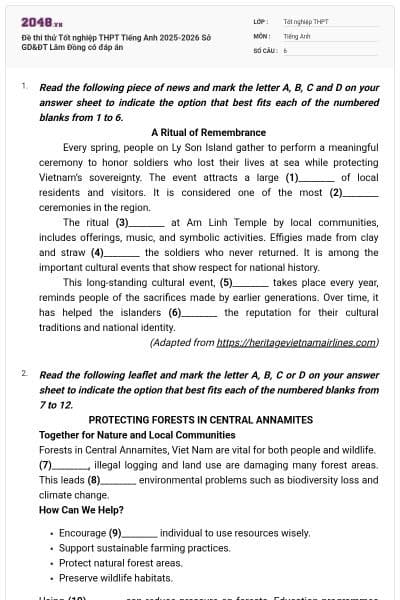
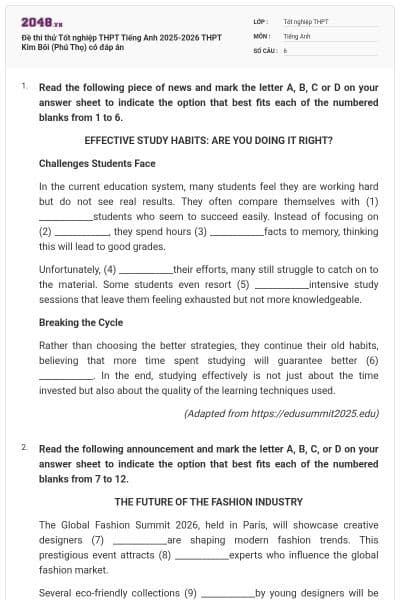
Read the following piece of news and mark the letter A, B, C or D on your answer sheet to indicate the option that best fits each of the numbered blanks from 1 to 6.
EFFECTIVE STUDY HABITS: ARE YOU DOING IT RIGHT?
Challenges Students Face
In the current education system, many students feel they are working hard but do not see real results. They often compare themselves with (1) ____________students who seem to succeed easily. Instead of focusing on (2) ____________, they spend hours (3) ____________facts to memory, thinking this will lead to good grades.
Unfortunately, (4) ____________their efforts, many still struggle to catch on to the material. Some students even resort (5) ____________intensive study sessions that leave them feeling exhausted but not more knowledgeable.
Breaking the Cycle
Rather than choosing the better strategies, they continue their old habits, believing that more time spent studying will guarantee better (6) ____________. In the end, studying effectively is not just about the time invested but also about the quality of the learning techniques used.
(Adapted from https://edusummit2025.edu)
other
others
the other
another
A. other: (những người/vật) khác (tính từ, đi kèm danh từ đếm được số nhiều / không đếm được).
B. others: những (người/vật) khác (đại từ, đứng độc lập không đi kèm danh từ).
C. the other: (người/vật) còn lại (đã xác định cụ thể trong một nhóm 2 đối tượng).
D. another: một (người/vật) khác (tính từ, đi kèm danh từ đếm được số ít).
Phía sau khoảng trống là danh từ đếm được ở dạng số nhiều “students” (các học sinh). Do đó, ta phải dùng tính từ “other” để bổ nghĩa.
Chọn A. other
→ They often compare themselves with other students who seem to succeed easily.
Dịch nghĩa: Họ thường so sánh bản thân với những học sinh khác, những người dường như thành công một cách dễ dàng.
methods effective study
study effective methods
effective study methods
effective methods study
Phân tích trật tự từ: Cụm danh từ này có danh từ chính là “methods” (các phương pháp) nên bắt buộc phải đứng cuối cùng. Phía trước nó là danh từ phụ “study” (học tập) đóng vai trò bổ nghĩa, tạo thành cụm “study methods” (các phương pháp học tập). Tính từ “effective” (hiệu quả) bổ nghĩa cho toàn bộ cụm danh từ phía sau nên phải đứng ở vị trí đầu tiên.
Trật tự đúng là: Tính từ + Danh từ phụ + Danh từ chính.
Chọn C. effective study methods
→ Instead of focusing on effective study methods, they spend hours...
Dịch nghĩa: Thay vì tập trung vào các phương pháp học tập hiệu quả, họ dành hàng giờ...
compiling
composing
combining
committing
A. compiling (v-ing): biên soạn, tổng hợp.
B. composing (v-ing): sáng tác (nhạc, thơ), soạn (thư).
C. combining (v-ing): kết hợp.
D. committing (v-ing): cam kết, phạm (tội).
Ta có cụm từ cố định (collocation): commit something to memory (ghi nhớ, học thuộc lòng điều gì đó).
Chọn D. committing
→ ...they spend hours committing facts to memory, thinking this will lead to good grades.
Dịch nghĩa: ...họ dành hàng giờ để học thuộc lòng/ghi nhớ các dữ kiện, nghĩ rằng điều này sẽ dẫn đến điểm số tốt.
despite
in spite
though
although
A. despite (prep): mặc dù, bất chấp (+ Noun / V-ing).
B. in spite (prep): sai cấu trúc (phải là in spite of).
C. though (conj): mặc dù (+ Mệnh đề S + V).
D. although (conj): mặc dù (+ Mệnh đề S + V).
Phía sau khoảng trống là một cụm danh từ “their efforts” (những nỗ lực của họ). Do đó, ta phải dùng giới từ “despite”.
Chọn A. despite
→ Unfortunately, despite their efforts, many still struggle to catch on to the material.
Dịch nghĩa: Thật không may, bất chấp những nỗ lực của mình, nhiều người vẫn chật vật để nắm bắt tài liệu.
Some students even resort (5) ____________intensive study sessions that leave them feeling exhausted but not more knowledgeable.
to
of
at
in
A. to (prep): đến, tới.
B. of (prep): của.
C. at (prep): tại.
D. in (prep): trong.
Ta có cấu trúc động từ đi kèm giới từ cố định: resort to something/doing something (phải dùng đến, nhờ đến biện pháp gì - thường là biện pháp không mong muốn hoặc là giải pháp cuối cùng).
Chọn A. to
→ Some students even resort to intensive study sessions that leave them feeling exhausted...
Dịch nghĩa: Một số học sinh thậm chí phải dùng đến những phiên học tập cường độ cao khiến họ cảm thấy kiệt sức...
outbreak
outlook
outcomes
outputs
A. outbreak (n): sự bùng phát (dịch bệnh, chiến tranh).
B. outlook (n): cách nhìn, quan điểm, viễn cảnh.
C. outcomes (n): kết quả, đầu ra (thường dùng trong giáo dục, y tế).
D. outputs (n): sản lượng, đầu ra (của máy móc, hệ thống, thông tin).
Câu đang nói về kết quả học tập của học sinh. Từ “outcomes” (kết quả đạt được/đầu ra học tập) là thuật ngữ chính xác nhất trong ngữ cảnh giáo dục này.
Chọn C. outcomes
→ ...believing that more time spent studying will guarantee better outcomes.
Dịch nghĩa: ...tin rằng dành nhiều thời gian học hơn sẽ đảm bảo những kết quả tốt hơn.
Bài đọc hoàn chỉnh | Dịch bài đọc |
EFFECTIVE STUDY HABITS: ARE YOU DOING IT RIGHT? Challenges Students Face In the current education system, many students feel they are working hard but do not see real results. They often compare themselves with (1) other students who seem to succeed easily. Instead of focusing on (2) effective study methods, they spend hours (3) committing facts to memory, thinking this will lead to good grades. Unfortunately, (4) despite their efforts, many still struggle to catch on to the material. Some students even resort (5) to intensive study sessions that leave them feeling exhausted but not more knowledgeable. Breaking the Cycle Rather than choosing the better strategies, they continue their old habits, believing that more time spent studying will guarantee better (6) outcomes. In the end, studying effectively is not just about the time invested but also about the quality of the learning techniques used. | THÓI QUEN HỌC TẬP HIỆU QUẢ: BẠN CÓ ĐANG LÀM ĐÚNG CÁCH? Những Thách Thức Học Sinh Phải Đối Mặt Trong hệ thống giáo dục hiện tại, nhiều học sinh cảm thấy họ đang học tập chăm chỉ nhưng không thấy kết quả thực sự. Họ thường so sánh bản thân với (1) những học sinh khác, những người dường như thành công một cách dễ dàng. Thay vì tập trung vào (2) các phương pháp học tập hiệu quả, họ dành hàng giờ để (3) học thuộc lòng các dữ kiện, nghĩ rằng điều này sẽ dẫn đến điểm số tốt. Thật không may, (4) bất chấp những nỗ lực của họ, nhiều người vẫn chật vật để theo kịp tài liệu. Một số học sinh thậm chí phải (5) dùng đến những phiên học tập cường độ cao khiến họ cảm thấy kiệt sức nhưng không hề có thêm kiến thức. Phá Vỡ Vòng Lặp Thay vì chọn những chiến lược tốt hơn, họ tiếp tục những thói quen cũ của mình, tin rằng dành nhiều thời gian học hơn sẽ đảm bảo (6) những kết quả tốt hơn. Tóm lại, học tập hiệu quả không chỉ phụ thuộc vào thời gian đầu tư mà còn phụ thuộc vào chất lượng của các phương pháp học tập được sử dụng. |
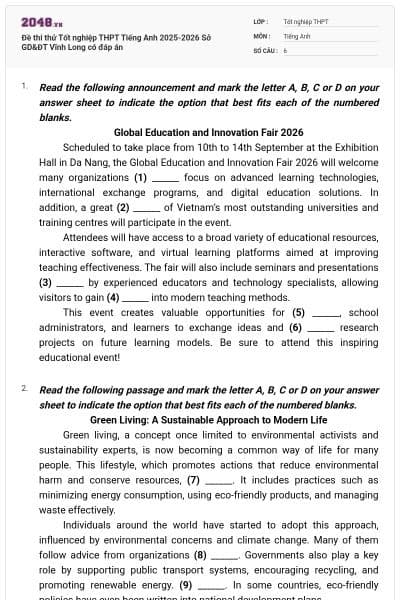
Read the following announcement and mark the letter A, B, C, or D on your answer sheet to indicate the option that best fits each of the numbered blanks from 7 to 12.
THE FUTURE OF THE FASHION INDUSTRY
The Global Fashion Summit 2026, held in Paris, will showcase creative designers (7) ____________are shaping modern fashion trends. This prestigious event attracts (8) ____________experts who influence the global fashion market.
Several eco-friendly collections (9) ____________by young designers will be presented to promote sustainable fashion. These designs aim to reduce environmental impact while maintaining style and quality.
Visitors will discover a large (10) ____________of fashion products, including recycled clothing, smart fabrics, and digital fashion items. The opening ceremony will be (11) ____________by a famous fashion icon, inspiring young talents to pursue their creative goals.
The summit also provides opportunities for collaboration and encourages further (12) ____________approaches in sustainable fashion. Participants are encouraged to join workshops and networking sessions to expand their professional connections.
whose
which
who
whom
A. whose: đại từ quan hệ chỉ sự sở hữu.
B. which: đại từ quan hệ thay thế cho danh từ chỉ vật/sự việc.
C. who: đại từ quan hệ thay thế cho danh từ chỉ người (làm chủ ngữ).
D. whom: đại từ quan hệ thay thế cho danh từ chỉ người (làm tân ngữ).
Danh từ đứng ngay trước khoảng trống là “creative designers” (những nhà thiết kế sáng tạo) - danh từ chỉ người. Phía sau khoảng trống là động từ “are shaping” (đang định hình), do đó ta cần một đại từ quan hệ đóng vai trò làm chủ ngữ thay thế cho người.
Chọn C. who
→ ...will showcase creative designers who are shaping modern fashion trends.
Dịch nghĩa: ...sẽ giới thiệu những nhà thiết kế sáng tạo, những người đang định hình các xu hướng thời trang hiện đại.
simple
basic
ordinary
leading
A. simple (adj): đơn giản.
B. basic (adj): cơ bản.
C. ordinary (adj): bình thường, thông thường.
D. leading (adj): hàng đầu, xuất sắc nhất.
Câu đang nói về một sự kiện uy tín (prestigious event) có tầm ảnh hưởng đến thị trường thời trang toàn cầu. Do đó, sự kiện này phải thu hút những chuyên gia “hàng đầu” (leading experts) chứ không thể là những chuyên gia bình thường hay cơ bản.
Chọn D. leading
→ This prestigious event attracts leading experts who influence the global fashion market.
Dịch nghĩa: Sự kiện uy tín này thu hút các chuyên gia hàng đầu, những người có sức ảnh hưởng đến thị trường thời trang toàn cầu.
designing
designed
designs
design
A. designing (v-ing): hiện tại phân từ (mang nghĩa chủ động).
B. designed (v-ed/v3): quá khứ phân từ (mang nghĩa bị động).
C. designs (v): động từ chia thì hiện tại đơn, ngôi thứ 3 số ít.
D. design (v): động từ nguyên mẫu.
Đây là dạng rút gọn mệnh đề quan hệ mang nghĩa bị động bổ nghĩa cho danh từ “eco-friendly collections” (các bộ sưu tập thân thiện với môi trường). Các bộ sưu tập này không tự thiết kế mà “được thiết kế” bởi các nhà thiết kế trẻ (có giới từ “by” phía sau). Mệnh đề đầy đủ là: which are designed by... Khi rút gọn, ta bỏ đại từ quan hệ và động từ to be, chỉ giữ lại quá khứ phân từ.
Chọn B. designed
→ Several eco-friendly collections designed by young designers will be presented...
Dịch nghĩa: Một số bộ sưu tập thân thiện với môi trường được thiết kế bởi các nhà thiết kế trẻ sẽ được trình diễn...
number
much
deal
amount
A. number (n): số lượng (+ danh từ đếm được số nhiều).
B. much (pronoun): nhiều (+ danh từ không đếm được).
C. deal (n): lượng (thường dùng trong cụm a great deal of + danh từ không đếm được).
D. amount (n): lượng (+ danh từ không đếm được).
Phía sau khoảng trống là giới từ “of” và cụm danh từ đếm được ở dạng số nhiều “fashion products” (các sản phẩm thời trang). Do đó, ta bắt buộc phải dùng cấu trúc a large number of + N (số nhiều).
Chọn A. number
→ Visitors will discover a large number of fashion products...
Dịch nghĩa: Du khách sẽ khám phá một số lượng lớn các sản phẩm thời trang...
The opening ceremony will be (11) ____________by a famous fashion icon, inspiring young talents to pursue their creative goals.
carried on
looked after
made up
taken over
A. carried on (phr.v): tiếp tục.
B. looked after (phr.v): chăm sóc, trông coi.
C. made up (phr.v): bịa đặt, trang điểm, chiếm (tỉ lệ).
D. taken over (phr.v): tiếp quản, đảm nhận, gánh vác trách nhiệm (điều hành/dẫn dắt).
Trong ngữ cảnh của một buổi lễ khai mạc (opening ceremony), việc một biểu tượng thời trang nổi tiếng “đảm nhận / tiếp quản việc dẫn dắt” chương trình là nghĩa phù hợp và logic nhất.
Chọn D. taken over
→ The opening ceremony will be taken over by a famous fashion icon...
Dịch nghĩa: Buổi lễ khai mạc sẽ được đảm nhận (dẫn dắt) bởi một biểu tượng thời trang nổi tiếng...
creation
creative
create
creatively
A. creation (n): sự sáng tạo, tác phẩm.
B. creative (adj): mang tính sáng tạo.
C. create (v): tạo ra.
D. creatively (adv): một cách sáng tạo.
Phân tích từ loại: Khoảng trống nằm ngay trước danh từ “approaches” (các phương pháp tiếp cận). Theo quy tắc, ta cần một tính từ đứng trước để bổ nghĩa cho danh từ đó.
Chọn B. creative
→ ...and encourages further creative approaches in sustainable fashion.
Dịch nghĩa: ...và khuyến khích thêm các phương pháp tiếp cận sáng tạo trong thời trang bền vững.
Bài đọc hoàn chỉnh | Dịch bài đọc |
THE FUTURE OF THE FASHION INDUSTRY The Global Fashion Summit 2026, held in Paris, will showcase creative designers (7) who are shaping modern fashion trends. This prestigious event attracts (8) leading experts who influence the global fashion market. Several eco-friendly collections (9) designed by young designers will be presented to promote sustainable fashion. These designs aim to reduce environmental impact while maintaining style and quality. Visitors will discover a large (10) number of fashion products, including recycled clothing, smart fabrics, and digital fashion items. The opening ceremony will be (11) taken over by a famous fashion icon, inspiring young talents to pursue their creative goals. The summit also provides opportunities for collaboration and encourages further (12) creative approaches in sustainable fashion. Participants are encouraged to join workshops and networking sessions to expand their professional connections. | TƯƠNG LAI CỦA NGÀNH CÔNG NGHIỆP THỜI TRANG Hội nghị Thượng đỉnh Thời trang Toàn cầu 2026, được tổ chức tại Paris, sẽ giới thiệu những nhà thiết kế sáng tạo, (7) những người đang định hình các xu hướng thời trang hiện đại. Sự kiện uy tín này thu hút các chuyên gia (8) hàng đầu, những người có sức ảnh hưởng đến thị trường thời trang toàn cầu. Một số bộ sưu tập thân thiện với môi trường (9) được thiết kế bởi các nhà thiết kế trẻ sẽ được trình diễn nhằm thúc đẩy thời trang bền vững. Những thiết kế này hướng tới mục tiêu giảm thiểu tác động đến môi trường trong khi vẫn duy trì được phong cách và chất lượng. Du khách sẽ khám phá (10) một số lượng lớn các sản phẩm thời trang, bao gồm quần áo tái chế, vải thông minh và các mặt hàng thời trang kỹ thuật số. Lễ khai mạc sẽ được (11) đảm nhận bởi một biểu tượng thời trang nổi tiếng, truyền cảm hứng cho các tài năng trẻ theo đuổi những mục tiêu sáng tạo của họ. Hội nghị thượng đỉnh cũng cung cấp các cơ hội hợp tác và khuyến khích thêm các phương pháp tiếp cận (12) sáng tạo trong thời trang bền vững. Những người tham gia được khuyến khích tham gia vào các buổi hội thảo và các phiên giao lưu kết nối để mở rộng các mối quan hệ chuyên môn của mình. |
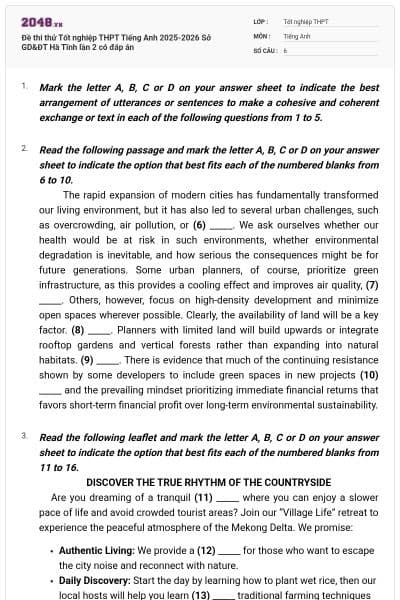
Mark the letter A, B, C, or D on your answer sheet to indicate the best arrangement of utterances or sentences to make a meaningful exchange or text in each of the following items from questions 13 to 17.
a. Traditional industries have long relied on human expertise and manual processes to maintain quality and productivity.
b. However, the rapid advancement of artificial intelligence has significantly transformed the way businesses operate and make decisions.
c. In recent decades, technological innovation has accelerated dramatically as AI systems have become increasingly sophisticated and accessible worldwide.
d. This transformation has prompted researchers to examine whether AI-driven automation may eventually replace certain human roles in the workforce.
e. Consequently, many policymakers now emphasize the importance of reskilling programs to help workers adapt to the evolving job market.
c – a – d – b – e
c – a – b – d – e
a – c – b – e – d
c – b – a – d – e
Thứ tự sắp xếp đúng: B. c – a – b – d – e
c. In recent decades, technological innovation has accelerated dramatically as AI systems have become increasingly sophisticated and accessible worldwide.
a. Traditional industries have long relied on human expertise and manual processes to maintain quality and productivity.
b. However, the rapid advancement of artificial intelligence has significantly transformed the way businesses operate and make decisions.
d. This transformation has prompted researchers to examine whether AI-driven automation may eventually replace certain human roles in the workforce.
e. Consequently, many policymakers now emphasize the importance of reskilling programs to help workers adapt to the evolving job market.
Dịch nghĩa:
c. Trong những thập kỷ gần đây, đổi mới công nghệ đã tăng tốc một cách đáng kể khi các hệ thống AI trở nên ngày càng tinh vi và dễ tiếp cận trên toàn thế giới.
a. Các ngành công nghiệp truyền thống từ lâu đã dựa vào chuyên môn của con người và các quy trình thủ công để duy trì chất lượng và năng suất.
b. Tuy nhiên, sự phát triển nhanh chóng của trí tuệ nhân tạo đã thay đổi đáng kể cách thức các doanh nghiệp vận hành và đưa ra quyết định.
d. Sự chuyển đổi này đã thúc đẩy các nhà nghiên cứu xem xét liệu quá trình tự động hóa do AI điều khiển cuối cùng có thể thay thế một số vai trò nhất định của con người trong lực lượng lao động hay không.
e. Hậu quả là, nhiều nhà hoạch định chính sách hiện nay nhấn mạnh tầm quan trọng của các chương trình đào tạo lại kỹ năng nhằm giúp người lao động thích nghi với thị trường việc làm đang không ngừng phát triển.
Chọn B.
a. David: It helps him feel independent, and he’s more likely to open up when he’s ready.
b. David: I try to give him space but also make time for casual conversations.
c. Emma: I think I’ll try being more patient with my daughter.
d. Emma: Why is giving space important?
e. Emma: How do you get along with your teenage son?
c – a – b – d – e
c – b – d – a – e
e – a – c – b – d
e – b – d – a – c
Thứ tự sắp xếp đúng: D. e – b – d – a – c
e. Emma: How do you get along with your teenage son?
b. David: I try to give him space but also make time for casual conversations.
d. Emma: Why is giving space important?
a. David: It helps him feel independent, and he’s more likely to open up when he’s ready.
c. Emma: I think I’ll try being more patient with my daughter.
Dịch nghĩa:
e. Emma: Làm thế nào mà anh có thể hòa hợp với cậu con trai đang tuổi vị thành niên của mình vậy?
b. David: Tôi cố gắng cho thằng bé không gian riêng nhưng cũng dành thời gian cho những cuộc trò chuyện thông thường.
d. Emma: Tại sao việc cho không gian riêng lại quan trọng?
a. David: Điều đó giúp thằng bé cảm thấy tự lập, và thằng bé sẽ có nhiều khả năng mở lòng hơn khi đã sẵn sàng.
c. Emma: Tôi nghĩ tôi sẽ thử kiên nhẫn hơn với con gái mình.
Chọn D.
a. Ms Hoa: Good morning, class. I'd like you to meet Mr Paul Smith. He's a culture specialist. Today, he'll talk about cultural diversity in the UK.
b. Class: Good morning, Mr Smith. It's nice to meet you too!
c. Mr Smith: Hello, everyone. It's nice to meet you all.
a – b – c
c – b – a
b – a – c
a – c – b
Thứ tự sắp xếp đúng: D. a – c – b
a. Ms Hoa: Good morning, class. I'd like you to meet Mr Paul Smith. He's a culture specialist. Today, he'll talk about cultural diversity in the UK.
c. Mr Smith: Hello, everyone. It's nice to meet you all.
b. Class: Good morning, Mr Smith. It's nice to meet you too!
Dịch nghĩa:
a. Cô Hoa: Chào buổi sáng cả lớp. Cô muốn giới thiệu với các em ông Paul Smith. Ông ấy là một chuyên gia văn hóa. Hôm nay, ông ấy sẽ nói về sự đa dạng văn hóa ở Vương quốc Anh.
c. Ông Smith: Chào mọi người. Rất vui được gặp tất cả các em.
b. Cả lớp: Chào buổi sáng ông Smith. Chúng em cũng rất vui được gặp ông!
Chọn D.
a. Furthermore, eco-tourism encourages environmental awareness among travelers, promoting responsible behavior and meaningful conservation efforts in vulnerable natural areas.
b. In conclusion, although eco-tourism offers economic and environmental benefits for many regions, careful and sustainable management is essential to prevent long-term negative impacts.
c. However, the rapid increase in tourist numbers can put serious pressure on fragile natural habitats and small local communities.
d. Eco-tourism has become increasingly popular worldwide in recent years, attracting visitors who seek authentic cultural experiences and sustainable travel options.
e. Consequently, many destinations must implement strict and effective regulations to balance tourism development with environmental protection.
d – a – c – e – b
d – c – a – e – b
c – d – e – a – b
d – c – e – a – b
Thứ tự sắp xếp đúng: A. d – a – c – e – b
d. Eco-tourism has become increasingly popular worldwide in recent years, attracting visitors who seek authentic cultural experiences and sustainable travel options.
a. Furthermore, eco-tourism encourages environmental awareness among travelers, promoting responsible behavior and meaningful conservation efforts in vulnerable natural areas.
c. However, the rapid increase in tourist numbers can put serious pressure on fragile natural habitats and small local communities.
e. Consequently, many destinations must implement strict and effective regulations to balance tourism development with environmental protection.
b. In conclusion, although eco-tourism offers economic and environmental benefits for many regions, careful and sustainable management is essential to prevent long-term negative impacts.
Dịch nghĩa:
d. Trong những năm gần đây, du lịch sinh thái đã trở nên ngày càng phổ biến trên toàn thế giới, thu hút những du khách đang tìm kiếm những trải nghiệm văn hóa đích thực và các lựa chọn du lịch bền vững.
a. Hơn nữa, du lịch sinh thái còn khuyến khích nhận thức về môi trường ở các du khách, thúc đẩy các hành vi có trách nhiệm và những nỗ lực bảo tồn có ý nghĩa tại các khu vực tự nhiên dễ bị tổn thương.
c. Tuy nhiên, sự gia tăng nhanh chóng về lượng khách du lịch có thể đặt áp lực nghiêm trọng lên các môi trường sống tự nhiên mỏng manh và các cộng đồng nhỏ ở địa phương.
e. Hậu quả là, nhiều điểm đến phải thực thi các quy định nghiêm ngặt và hiệu quả để cân bằng giữa phát triển du lịch và bảo vệ môi trường.
b. Tóm lại, mặc dù du lịch sinh thái mang lại những lợi ích về kinh tế và môi trường cho nhiều khu vực, nhưng việc quản lý cẩn thận và bền vững là điều thiết yếu để ngăn chặn những tác động tiêu cực lâu dài.
Chọn A.
Dear Jamie,
a. First, organizing local clean-up events can significantly impact our surroundings and engage more residents.
b. This approach can lead to a greater awareness of environmental issues among the community members.
c. I hope you’re doing well. I’ve been reflecting on ways we can contribute to environmental conservation in our community.
d. Moreover, educating children about the importance of recycling and sustainability in schools can foster a sense of responsibility from a young age.
e. Ultimately, preserving our natural spaces is essential for future generations.
Best wishes,
John
b – e – a – d – c
c – a – d – b – e
a – d – b – c – e
d – b – a – e – c
Thứ tự sắp xếp đúng: B. c – a – d – b – e
c. I hope you’re doing well. I’ve been reflecting on ways we can contribute to environmental conservation in our community.
a. First, organizing local clean-up events can significantly impact our surroundings and engage more residents.
d. Moreover, educating children about the importance of recycling and sustainability in schools can foster a sense of responsibility from a young age.
b. This approach can lead to a greater awareness of environmental issues among the community members.
e. Ultimately, preserving our natural spaces is essential for future generations.
Dịch nghĩa:
Gửi Jamie,
c. Mình hy vọng bạn vẫn khỏe. Mình đang suy nghĩ về những cách mà chúng ta có thể đóng góp vào việc bảo tồn môi trường trong cộng đồng của mình.
a. Đầu tiên, việc tổ chức các sự kiện dọn dẹp tại địa phương có thể tác động đáng kể đến môi trường xung quanh chúng ta và thu hút thêm nhiều cư dân tham gia.
d. Hơn nữa, việc giáo dục trẻ em về tầm quan trọng của tái chế và tính bền vững trong trường học có thể nuôi dưỡng ý thức trách nhiệm ngay từ khi còn nhỏ.
b. Cách tiếp cận này có thể dẫn đến nhận thức cao hơn về các vấn đề môi trường trong số các thành viên cộng đồng.
e. Cuối cùng, việc bảo tồn các không gian tự nhiên của chúng ta là điều thiết yếu đối với các thế hệ tương lai.
Chúc bạn những điều tốt đẹp nhất,
John
Chọn B.
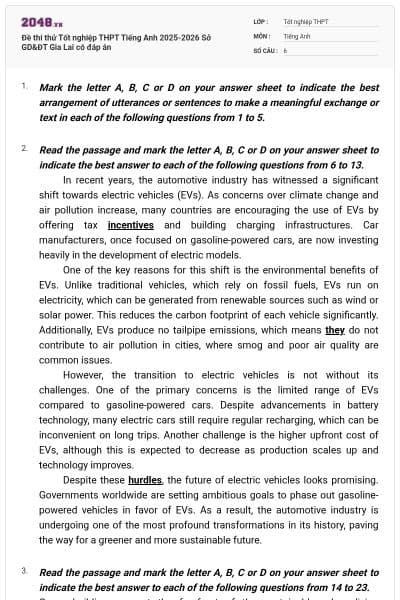
Read the following passage and mark the letter A, B, C or D on your answer sheet to indicate the option that best fits each of the numbered blanks from 18 to 22.
CRISTIANO RONALDO: A LEGACY OF EXCELLENCE
Cristiano Ronaldo, one of the greatest football players of all time, (18) ____________. Born on February 5, 1985, in Madeira, Portugal, he showed exceptional talent from a young age. His journey began at Sporting Lisbon, (19) ____________. During his time at Manchester United, Ronaldo developed into a world-class player, winning three Premier League titles and the UEFA Champions League. In 2009, he transferred to Real Madrid, where he broke numerous records, including becoming the club's all-time leading scorer. (20) ____________.
Possessing remarkable athleticism and a sense of strategy, (21) ____________. His training regimen ensures that he remains at peak performance. This dedication has allowed him to adapt his playing style, maintaining his relevance in an ever-evolving sport. Additionally, Ronaldo's ability to lead has earned him respect both on and off the field.
Beyond his football career, Ronaldo is a philanthropist who uses his platform to give back to the community. (22) ____________. His influence extends far beyond the pitch, making him a global icon. Ultimately, Cristiano Ronaldo's legacy is defined not only by his records but also by his commitment to making a positive impact in the world.
impacting significantly on the sport
that has his significant impact on the sport recognized
has made a significant impact on the sport
of whom significant impact on the sport
Chủ ngữ chính của câu là “Cristiano Ronaldo”. Cụm từ nằm giữa hai dấu phẩy “, one of the greatest football players of all time,” chỉ là thành phần phụ chú (đồng vị ngữ) giải thích thêm cho chủ ngữ. Do đó, vị trí (18) đang thiếu một động từ chính (Main verb) để hoàn thành cấu trúc Chủ ngữ + Vị ngữ.
Dịch nghĩa/Ngữ pháp:
A. tác động đáng kể đến môn thể thao này (Dạng V-ing “impacting” không thể làm động từ chính → Sai ngữ pháp).
B. cái mà có tác động đáng kể của anh ấy đối với môn thể thao được công nhận (Mệnh đề quan hệ bắt đầu bằng “that” → Thiếu động từ chính cho toàn câu).
C. đã tạo ra một tác động đáng kể đối với môn thể thao này (Cung cấp động từ chính “has made” chia ở thì hiện tại hoàn thành, hoàn toàn chuẩn xác).
D. của người mà tác động đáng kể lên môn thể thao... (Mệnh đề quan hệ → Thiếu động từ chính).
Đáp án C là lựa chọn duy nhất cung cấp động từ chính để tạo thành một câu hoàn chỉnh về mặt ngữ pháp.
Chọn C.
→ Cristiano Ronaldo, one of the greatest football players of all time, has made a significant impact on the sport.
Dịch nghĩa: Cristiano Ronaldo, một trong những cầu thủ bóng đá vĩ đại nhất mọi thời đại, đã tạo ra một tác động đáng kể đối với môn thể thao này.
of which his skills were honed before signing with Manchester United in 2003
where he honed his skills before moving to Manchester United in 2003
refining his skills there before making the move to Manchester United in 2003
aided him in polishing his skills before transferring to Manchester United in 2003
Phía trước chỗ trống là “Sporting Lisbon” (một câu lạc bộ bóng đá / địa điểm). Vị trí (19) cần một mệnh đề quan hệ chỉ nơi chốn để bổ sung thông tin giải thích những gì anh ấy đã làm tại câu lạc bộ này trước khi chuyển đi.
Dịch nghĩa/Ngữ pháp:
A. của cái mà kỹ năng của anh ấy đã được mài giũa trước khi ký hợp đồng... (Dùng “of which” thay cho địa điểm là sai ngữ pháp).
B. nơi anh ấy mài giũa các kỹ năng của mình trước khi chuyển đến Manchester United vào năm 2003 (Sử dụng đại từ quan hệ chỉ nơi chốn “where” hoàn toàn chính xác, và thông tin “moving to Manchester United” khớp nối hoàn hảo với câu tiếp theo).
C. mài giũa các kỹ năng của anh ấy ở đó trước khi thực hiện việc chuyển đến... (Nếu dùng V-ing rút gọn thì chủ ngữ của nó phải là “His journey” ở đầu câu, nhưng “hành trình” không thể thực hiện hành động “mài giũa kỹ năng” → Lỗi Dangling modifier).
D. đã hỗ trợ anh ấy trong việc trau chuốt các kỹ năng... (Thiếu đại từ quan hệ “which” làm chủ ngữ).
Chỉ có đáp án B đúng chuẩn ngữ pháp mệnh đề quan hệ và tạo ra sự liên kết logic về mốc thời gian/sự kiện với câu phía sau.
Chọn B.
→ His journey began at Sporting Lisbon, where he honed his skills before moving to Manchester United in 2003.
Dịch nghĩa: Hành trình của anh bắt đầu tại Sporting Lisbon, nơi anh mài giũa các kỹ năng của mình trước khi chuyển đến Manchester United vào năm 2003.
The relentless drive of Ronaldo has forced many fans to become footballers.
Aimed to encourage athletes, Ronaldo shared his experiences with them.
Young athletes have inspired Ronaldo to strengthen his work ethic.
Ronaldo’s relentless drive and work ethic have inspired many young athletes.
Vị trí (20) nằm ở cuối đoạn 1, mang chức năng kết lại toàn bộ chặng đường vươn lên và phá vỡ kỷ lục của Ronaldo tại các câu lạc bộ (Sporting Lisbon, Manchester United, Real Madrid). Nó cần là một lời khẳng định về sức ảnh hưởng hoặc giá trị cốt lõi đằng sau những thành tựu đó.
Dịch nghĩa:
A. Sự nỗ lực không ngừng nghỉ của Ronaldo đã ép buộc nhiều người hâm mộ phải trở thành cầu thủ bóng đá. (Dùng từ “forced” - ép buộc - là sai logic).
B. Với mục đích khuyến khích các vận động viên, Ronaldo đã chia sẻ kinh nghiệm của mình với họ. (Không phù hợp làm câu chốt tổng kết thành tựu).
C. Các vận động viên trẻ đã truyền cảm hứng cho Ronaldo củng cố đạo đức làm việc của anh ấy. (Sai logic hoàn toàn: Ronaldo mới là người truyền cảm hứng cho họ).
D. Sự nỗ lực không ngừng nghỉ và đạo đức làm việc của Ronaldo đã truyền cảm hứng cho nhiều vận động viên trẻ. (Tổng kết hoàn hảo di sản của anh đối với thế hệ sau).
Đáp án D mang sắc thái tôn vinh, chốt lại đoạn văn nói về những kỷ lục vĩ đại của anh một cách rất mượt mà và logic.
Chọn D.
→ In 2009, he transferred to Real Madrid, where he broke numerous records, including becoming the club's all-time leading scorer. Ronaldo’s relentless drive and work ethic have inspired many young athletes.
Dịch nghĩa: Năm 2009, anh chuyển đến Real Madrid, nơi anh phá vỡ vô số kỷ lục, bao gồm cả việc trở thành cầu thủ ghi nhiều bàn thắng nhất mọi thời đại của câu lạc bộ. Sự nỗ lực không ngừng nghỉ và đạo đức làm việc của Ronaldo đã truyền cảm hứng cho nhiều vận động viên trẻ.
Achieving the marvelous title of the best player of all time is a simple feat for Ronaldo
Ronaldo consistently demonstrates why he is considered one of the best players of all time
The label of one of the all-time best players is officially attributed to Ronaldo
Experts consistently regard Ronaldo as one of the greatest players of all time worldwide
Cụm từ đứng đầu câu “Possessing remarkable athleticism and a sense of strategy,” (Sở hữu nền tảng thể lực đáng kinh ngạc và tư duy chiến thuật,) là một phân từ hiện tại (V-ing) đóng vai trò bổ ngữ. Theo quy tắc ngữ pháp (Dangling modifier - Lỗi bổ ngữ lơ lửng), Chủ ngữ của mệnh đề chính bắt buộc phải là người thực hiện hành động “Sở hữu” (Possessing). Đối tượng này chỉ có thể là Ronaldo.
Dịch nghĩa/Ngữ pháp:
A. Việc đạt được danh hiệu tuyệt vời... (Chủ ngữ là “Việc đạt được” → Sai vì danh hiệu không thể “sở hữu thể lực”).
B. Ronaldo liên tục chứng minh tại sao anh được coi là một trong những cầu thủ xuất sắc nhất mọi thời đại (Chủ ngữ là “Ronaldo” → Hoàn toàn khớp với cụm V-ing phía trước).
C. Danh xưng là một trong những cầu thủ... (Chủ ngữ là “Danh xưng” → Sai ngữ pháp).
D. Các chuyên gia liên tục đánh giá... (Chủ ngữ là “Các chuyên gia” → Sai vì chuyên gia không phải là người sở hữu thể lực của Ronaldo).
Đáp án B là lựa chọn duy nhất tuân thủ đúng quy tắc ngữ pháp về sự hòa hợp giữa cụm phân từ và chủ ngữ của mệnh đề chính.
Chọn B.
→ Possessing remarkable athleticism and a sense of strategy, Ronaldo consistently demonstrates why he is considered one of the best players of all time.
Dịch nghĩa: Sở hữu nền tảng thể lực đáng kinh ngạc và tư duy chiến thuật, Ronaldo liên tục chứng minh tại sao anh được coi là một trong những cầu thủ xuất sắc nhất mọi thời đại.
He has donated millions of dollars to charities, supporting children’s hospitals and disaster relief.
Spending millions, various charities can support noble causes on behalf of Ronaldo.
Many charities would struggle to support children’s hospitals without Ronaldo’s contributions.
His millions are reserved for personal projects rather than for supporting charitable causes.
Câu trước đó khẳng định: “...Ronaldo is a philanthropist who uses his platform to give back to the community.” (...Ronaldo là một nhà từ thiện, người sử dụng nền tảng của mình để cống hiến cho cộng đồng). Vị trí (22) cần một hành động hoặc ví dụ cụ thể để chứng minh cho sự “từ thiện” và “cống hiến” này.
Dịch nghĩa/Ngữ pháp:
A. Anh đã quyên góp hàng triệu đô la cho các tổ chức từ thiện, hỗ trợ các bệnh viện nhi đồng và cứu trợ thiên tai. (Đưa ra ví dụ cụ thể, tuyệt đối khớp với ý “từ thiện” ở câu trước).
B. Tiêu tốn hàng triệu đô la, các tổ chức từ thiện khác nhau có thể hỗ trợ... (Lỗi ngữ pháp Dangling modifier: “các tổ chức” không phải là người “tiêu tốn hàng triệu đô la” của Ronaldo).
C. Nhiều tổ chức từ thiện sẽ phải vật lộn để hỗ trợ... (Câu này tập trung vào các tổ chức từ thiện thay vì làm nổi bật hành động chủ động của Ronaldo).
D. Hàng triệu đô la của anh ấy được dành riêng cho các dự án cá nhân thay vì hỗ trợ các mục đích từ thiện. (Đi ngược lại hoàn toàn với hình ảnh “nhà từ thiện” - philanthropist).
Đáp án A đưa ra minh chứng rõ ràng và thuyết phục nhất cho việc Ronaldo làm từ thiện, tạo bước đệm hoàn hảo để câu sau kết luận “Sức ảnh hưởng của anh vượt ra ngoài sân cỏ”.
Chọn A.
→ Beyond his football career, Ronaldo is a philanthropist who uses his platform to give back to the community. He has donated millions of dollars to charities, supporting children’s hospitals and disaster relief.
Dịch nghĩa: Vượt ra ngoài sự nghiệp bóng đá của mình, Ronaldo là một nhà từ thiện, người sử dụng nền tảng của mình để cống hiến cho cộng đồng. Anh đã quyên góp hàng triệu đô la cho các tổ chức từ thiện, hỗ trợ các bệnh viện nhi đồng và cứu trợ thiên tai.
Bài đọc hoàn chỉnh | Dịch bài đọc |
CRISTIANO RONALDO: A LEGACY OF EXCELLENCE Cristiano Ronaldo, one of the greatest football players of all time, has made a significant impact on the sport. Born on February 5, 1985, in Madeira, Portugal, he showed exceptional talent from a young age. His journey began at Sporting Lisbon, where he honed his skills before moving to Manchester United in 2003. During his time at Manchester United, Ronaldo developed into a world-class player, winning three Premier League titles and the UEFA Champions League. In 2009, he transferred to Real Madrid, where he broke numerous records, including becoming the club's all-time leading scorer. Ronaldo’s relentless drive and work ethic have inspired many young athletes. Possessing remarkable athleticism and a sense of strategy, Ronaldo consistently demonstrates why he is considered one of the best players of all time. His training regimen ensures that he remains at peak performance. This dedication has allowed him to adapt his playing style, maintaining his relevance in an ever-evolving sport. Additionally, Ronaldo's ability to lead has earned him respect both on and off the field. Beyond his football career, Ronaldo is a philanthropist who uses his platform to give back to the community. He has donated millions of dollars to charities, supporting children’s hospitals and disaster relief. His influence extends far beyond the pitch, making him a global icon. Ultimately, Cristiano Ronaldo's legacy is defined not only by his records but also by his commitment to making a positive impact in the world. | CRISTIANO RONALDO: MỘT DI SẢN CỦA SỰ XUẤT CHÚNG Cristiano Ronaldo, một trong những cầu thủ bóng đá vĩ đại nhất mọi thời đại, đã tạo ra một tác động đáng kể đối với môn thể thao này. Sinh ngày 5 tháng 2 năm 1985 tại Madeira, Bồ Đào Nha, anh đã bộc lộ tài năng xuất chúng từ khi còn trẻ. Hành trình của anh bắt đầu tại Sporting Lisbon, nơi anh mài giũa các kỹ năng của mình trước khi chuyển đến Manchester United vào năm 2003. Trong suốt thời gian ở Manchester United, Ronaldo đã phát triển thành một cầu thủ đẳng cấp thế giới, giành ba chức vô địch Premier League và UEFA Champions League. Năm 2009, anh chuyển đến Real Madrid, nơi anh phá vỡ vô số kỷ lục, bao gồm cả việc trở thành cầu thủ ghi nhiều bàn thắng nhất mọi thời đại của câu lạc bộ. Sự nỗ lực không ngừng nghỉ và đạo đức làm việc của Ronaldo đã truyền cảm hứng cho nhiều vận động viên trẻ. Sở hữu nền tảng thể lực đáng kinh ngạc và tư duy chiến thuật, Ronaldo liên tục chứng minh tại sao anh được coi là một trong những cầu thủ xuất sắc nhất mọi thời đại. Chế độ tập luyện của anh đảm bảo rằng anh luôn duy trì ở đỉnh cao phong độ. Sự cống hiến này đã cho phép anh điều chỉnh phong cách chơi bóng của mình, duy trì vị thế trong một môn thể thao không ngừng tiến hóa. Thêm vào đó, khả năng lãnh đạo của Ronaldo đã mang lại cho anh sự tôn trọng cả trên sân cỏ lẫn ngoài đời. Vượt ra ngoài sự nghiệp bóng đá của mình, Ronaldo là một nhà từ thiện, người sử dụng nền tảng của mình để cống hiến cho cộng đồng. Anh đã quyên góp hàng triệu đô la cho các tổ chức từ thiện, hỗ trợ các bệnh viện nhi đồng và cứu trợ thiên tai. Sức ảnh hưởng của anh lan rộng vượt xa khỏi phạm vi sân cỏ, đưa anh trở thành một biểu tượng toàn cầu. Rốt cuộc, di sản của Cristiano Ronaldo được định hình không chỉ bởi những kỷ lục của anh mà còn bởi những cam kết của anh trong việc tạo ra một tác động tích cực trên thế giới. |
Read the passage and mark the letter A, B, C or D on your answer sheet to indicate the best answer to each of the following questions from 23 to 30.
In an era marked by climate change and environmental degradation, adopting green living habits has become increasingly vital. Green living refers to a lifestyle that seeks to minimize one's ecological footprint through conscious choices in daily activities. This can include everything from reducing waste to conserving energy and using sustainable products. As more individuals recognize the importance of preserving our planet, the movement toward greener practices continues to gain momentum.
One of the most significant aspects of green living is its focus on sustainability. By choosing products that are eco-friendly, consumers can support businesses that prioritize environmental responsibility. For instance, using reusable bags, bottles, and containers reduces plastic waste and promotes a circular economy. Furthermore, opting for locally sourced foods not only supports local farmers but also decreases the carbon emissions associated with transportation.
When green living habits are adopted, they can lead to profound changes in our environment. By reducing their energy consumption through the use of energy-efficient appliances, individuals help lower greenhouse gas emissions. Consequently, this contributes to cleaner air and mitigates the effects of climate change. Moreover, by practicing water conservation methods, such as fixing leaks and using low-flow fixtures, households can significantly decrease water waste, promoting the sustainable use of this precious resource.
In conclusion, educating individuals about green living habits is crucial for promoting a more sustainable future. Schools and community organizations can offer workshops and resources that highlight the benefits of eco-friendly practices. Additionally, social media campaigns can raise awareness and encourage people to share their experiences with sustainable living. By empowering individuals to make informed choices, we can collectively work toward a healthier planet for generations to come.
Which of the following is TRUE according to the passage?
Teaching people about green living practices is not essential for promoting a sustainable future.
Green living exclusively focuses on reducing energy consumption and does not address waste management.
The movement toward greener practices has lost momentum as fewer individuals recognize the importance of preserving the planet.
Using reusable products can contribute to a decrease in plastic waste and promote sustainability.
Theo bài đọc, câu nào sau đây là ĐÚNG?
A. Việc dạy mọi người về các thực tiễn lối sống xanh là không cần thiết cho việc thúc đẩy một tương lai bền vững. (Sai, đoạn 4 nói việc này là “crucial” - vô cùng quan trọng).
B. Lối sống xanh chỉ tập trung độc quyền vào việc giảm tiêu thụ năng lượng và không giải quyết vấn đề quản lý rác thải. (Sai, bài đọc có nhắc đến việc giảm rác thải ở đoạn 1 và 2).
C. Phong trào hướng tới các thực tiễn xanh hơn đã mất đà vì ngày càng ít cá nhân nhận ra tầm quan trọng của việc bảo vệ hành tinh. (Sai, đoạn 1 nói phong trào “continues to gain momentum” - tiếp tục đạt được đà phát triển).
D. Việc sử dụng các sản phẩm có thể tái sử dụng có thể góp phần làm giảm rác thải nhựa và thúc đẩy sự bền vững. (Đúng).
Thông tin (Đoạn 2): For instance, using reusable bags, bottles, and containers reduces plastic waste and promotes a circular economy.
(Ví dụ, việc sử dụng túi, chai và hộp đựng có thể tái sử dụng giúp giảm rác thải nhựa và thúc đẩy nền kinh tế tuần hoàn.)
Chọn D.
The word “vital” in paragraph 1 is OPPOSITE in meaning to ____________.
imperfect
crucial
important
inessential
Từ “vital” ở đoạn 1 TRÁI NGHĨA với ____________.
vital (adj): thiết yếu, vô cùng quan trọng.
A. imperfect (adj): không hoàn hảo
B. crucial (adj): then chốt, quan trọng (đồng nghĩa)
C. important (adj): quan trọng (đồng nghĩa)
D. inessential (adj): không cần thiết, không thiết yếu (trái nghĩa)
→ vital >< inessential
Thông tin: ...adopting green living habits has become increasingly vital.
(...việc áp dụng các thói quen sống xanh đã trở nên ngày càng thiết yếu.)
Chọn D.
In which paragraph does the writer discuss methods for teaching people about eco-friendly living practices?
Paragraph 2
Paragraph 1
Paragraph 4
Paragraph 3
Tác giả thảo luận về các phương pháp để dạy mọi người về những thực tiễn sống thân thiện với môi trường ở đoạn nào?
A. Đoạn 2
B. Đoạn 1
C. Đoạn 4
D. Đoạn 3
Thông tin (Đoạn 4): ...educating individuals about green living habits is crucial... Schools and community organizations can offer workshops and resources... social media campaigns can raise awareness...
(...việc giáo dục các cá nhân về các thói quen sống xanh là vô cùng quan trọng... Trường học và các tổ chức cộng đồng có thể tổ chức các buổi hội thảo và cung cấp tài nguyên... các chiến dịch truyền thông xã hội có thể nâng cao nhận thức...)
Chọn C.
In which paragraph does the writer mention a present causal relationship?
Paragraph 4
Paragraph 3
Paragraph 1
Paragraph 2
Tác giả đề cập đến một mối quan hệ nhân - quả ở hiện tại trong đoạn nào?
A. Đoạn 4
B. Đoạn 3
C. Đoạn 1
D. Đoạn 2
Thông tin (Đoạn 3): When green living habits are adopted, they can lead to profound changes in our environment... Consequently, this contributes to cleaner air and mitigates the effects of climate change.
(Khi các thói quen sống xanh được áp dụng, chúng có thể dẫn đến những thay đổi sâu sắc trong môi trường của chúng ta... Hậu quả là/Kết quả là, điều này góp phần mang lại không khí sạch hơn và làm giảm nhẹ tác động của biến đổi khí hậu.)
Chọn B.
Which of the following best paraphrases the underlined sentence in paragraph 2?
Opting for eco-friendly products may distract consumers from recognizing businesses that neglect environmental responsibility.
By purchasing items that are harmful to the planet, consumers can inadvertently encourage businesses that do not care about environmental issues.
Choosing eco-friendly products allows consumers to back businesses that emphasize environmental stewardship.
When consumers select non-eco-friendly products, they undermine companies committed to environmental responsibility.
Câu nào sau đây diễn giải tốt nhất câu được gạch chân ở đoạn 2?
By choosing products that are eco-friendly, consumers can support businesses that prioritize environmental responsibility.
(Bằng cách chọn những sản phẩm thân thiện với môi trường, người tiêu dùng có thể ủng hộ các doanh nghiệp ưu tiên trách nhiệm với môi trường.)
Dịch nghĩa:
A. Lựa chọn các sản phẩm thân thiện với môi trường có thể làm người tiêu dùng xao nhãng khỏi việc nhận ra các doanh nghiệp bỏ bê trách nhiệm môi trường. (Sai nghĩa).
B. Bằng cách mua những mặt hàng gây hại cho hành tinh, người tiêu dùng có thể vô tình khuyến khích các doanh nghiệp không quan tâm đến các vấn đề môi trường. (Sai nghĩa).
C. Lựa chọn các sản phẩm thân thiện với môi trường cho phép người tiêu dùng hậu thuẫn cho các doanh nghiệp nhấn mạnh đến việc quản lý môi trường. (Đúng và sát nghĩa nhất: choosing = opting for; support = back; prioritize environmental responsibility = emphasize environmental stewardship).
D. Khi người tiêu dùng chọn những sản phẩm không thân thiện với môi trường, họ làm suy yếu các công ty cam kết với trách nhiệm môi trường. (Sai nghĩa).
Chọn C.
Which of the following is NOT mentioned as one of the green living practices?
Reducing waste
Using sustainable products
Composting organic waste
Conserving energy
Điều nào sau đây KHÔNG được đề cập như một trong những thực tiễn của lối sống xanh?
A. Reducing waste: Giảm thiểu rác thải (Có nhắc đến ở đoạn 1)
B. Using sustainable products: Sử dụng các sản phẩm bền vững (Có nhắc đến ở đoạn 1)
C. Composting organic waste: Ủ phân hữu cơ từ rác thải (Không được nhắc đến)
D. Conserving energy: Tiết kiệm năng lượng (Có nhắc đến ở đoạn 1)
Thông tin (Đoạn 1): This can include everything from reducing waste to conserving energy and using sustainable products.
(Điều này có thể bao gồm mọi thứ từ việc giảm thiểu rác thải đến tiết kiệm năng lượng và sử dụng các sản phẩm bền vững.)
Chọn C.
The word “empowering” in paragraph 4 could be best replaced by ____________.
forbidding
prohibiting
enabling
abandoning
Từ “empowering” ở đoạn 4 có thể được thay thế tốt nhất bởi ____________.
empowering (v-ing): trao quyền, tạo điều kiện, cho phép.
A. forbidding (v-ing): cấm đoán
B. prohibiting (v-ing): cấm
C. enabling (v-ing): cho phép, tạo điều kiện (đồng nghĩa)
D. abandoning (v-ing): từ bỏ
→ empowering = enabling
Thông tin: By empowering individuals to make informed choices, we can collectively work toward a healthier planet...
(Bằng cách tạo điều kiện/trao quyền cho các cá nhân đưa ra những lựa chọn sáng suốt, chúng ta có thể cùng nhau nỗ lực hướng tới một hành tinh khỏe mạnh hơn...)
Chọn C.
The word “their” in paragraph 3 refers to ____________.
energy-efficient appliances
green living habits
profound changes
individuals
Từ “their” ở đoạn 3 chỉ ____________.
A. energy-efficient appliances: các thiết bị tiết kiệm năng lượng
B. green living habits: các thói quen sống xanh
C. profound changes: những thay đổi sâu sắc
D. individuals: các cá nhân
Thông tin: By reducing their energy consumption through the use of energy-efficient appliances, individuals help lower greenhouse gas emissions.
(Bằng cách giảm lượng tiêu thụ năng lượng của họ thông qua việc sử dụng các thiết bị tiết kiệm năng lượng, các cá nhân giúp làm giảm lượng khí thải nhà kính.)
→ their = individuals'.
Chọn D.
Dịch bài đọc:
Trong một kỷ nguyên được đánh dấu bởi biến đổi khí hậu và suy thoái môi trường, việc áp dụng các thói quen sống xanh đã trở nên ngày càng thiết yếu. Lối sống xanh đề cập đến một lối sống tìm cách giảm thiểu dấu chân sinh thái của một người thông qua những lựa chọn có ý thức trong các hoạt động hàng ngày. Điều này có thể bao gồm mọi thứ từ việc giảm thiểu rác thải đến tiết kiệm năng lượng và sử dụng các sản phẩm bền vững. Khi ngày càng có nhiều cá nhân nhận ra tầm quan trọng của việc bảo vệ hành tinh của chúng ta, phong trào hướng tới các thực tiễn xanh hơn tiếp tục đạt được đà phát triển.
Một trong những khía cạnh quan trọng nhất của lối sống xanh là sự tập trung vào tính bền vững. Bằng cách chọn những sản phẩm thân thiện với môi trường, người tiêu dùng có thể ủng hộ các doanh nghiệp ưu tiên trách nhiệm với môi trường. Ví dụ, việc sử dụng túi, chai và hộp đựng có thể tái sử dụng giúp giảm rác thải nhựa và thúc đẩy nền kinh tế tuần hoàn. Hơn nữa, việc lựa chọn các loại thực phẩm có nguồn gốc địa phương không chỉ ủng hộ nông dân địa phương mà còn làm giảm lượng khí thải carbon liên quan đến việc vận chuyển.
Khi các thói quen sống xanh được áp dụng, chúng có thể dẫn đến những thay đổi sâu sắc trong môi trường của chúng ta. Bằng cách giảm lượng tiêu thụ năng lượng của họ thông qua việc sử dụng các thiết bị tiết kiệm năng lượng, các cá nhân giúp làm giảm lượng khí thải nhà kính. Kết quả là, điều này góp phần mang lại không khí sạch hơn và làm giảm nhẹ tác động của biến đổi khí hậu. Hơn nữa, bằng cách thực hành các phương pháp tiết kiệm nước, chẳng hạn như sửa chữa các chỗ rò rỉ và sử dụng các thiết bị có lưu lượng thấp, các hộ gia đình có thể làm giảm đáng kể sự lãng phí nước, thúc đẩy việc sử dụng bền vững nguồn tài nguyên quý giá này.
Tóm lại, việc giáo dục các cá nhân về các thói quen sống xanh là vô cùng quan trọng để thúc đẩy một tương lai bền vững hơn. Trường học và các tổ chức cộng đồng có thể tổ chức các buổi hội thảo và cung cấp tài nguyên làm nổi bật những lợi ích của các thực tiễn thân thiện với môi trường. Ngoài ra, các chiến dịch truyền thông xã hội có thể nâng cao nhận thức và khuyến khích mọi người chia sẻ những trải nghiệm của họ về lối sống bền vững. Bằng cách tạo điều kiện cho các cá nhân đưa ra những lựa chọn sáng suốt, chúng ta có thể cùng nhau nỗ lực hướng tới một hành tinh khỏe mạnh hơn cho các thế hệ mai sau.
Read the passage and mark the letter A, B, C or D on your answer sheet to indicate the best answer to each of the following questions from 31 to 40.
On the morning of October 19, 2025, a meticulously orchestrated heist unfolded at the Louvre Museum in Paris, shocking the global art community. In under seven minutes, four masked individuals infiltrated the Galerie d’Apollon and absconded with eight priceless artifacts. The speed and audacity of the operation exposed alarming vulnerabilities in the security infrastructure of one of the world's most celebrated museums.
The robbery points unmistakably to a professional operation. The perpetrators employed a crane mounted on a vehicle to gain access to a window on the museum’s upper level—an entry point made accessible by ongoing construction work. Once inside, they used industrial-grade tools to break open reinforced glass display cases, threatening guards with angle grinders without deploying firearms. Their escape on motorbikes further underscores the premeditated nature of the crime. Perhaps most telling is the fact that the thieves bypassed the Regent Diamond, arguably the gallery’s most valuable piece, suggesting that the robbery was a targeted operation guided by a specific acquisition list. By the time the sun rose over the Seine, some of the world’s most priceless treasures had vanished without a trace.
This incident is emblematic of the commodification of cultural heritage in the shadow economy. In recent years, historical objects have become assets for laundering illicit wealth and fulfilling the desires of unscrupulous private collectors. The Louvre heist demonstrates that even prestigious institutions are not immune to this trend. The loss of royal artifacts, particularly those symbolizing national identity, represents a “cultural erosion” that cannot be measured solely in financial terms. Once sold into the black market, the historical context and national identity associated with the objects are often irretrievably lost.
(I) The heist has reignited debate about systemic neglect in the preservation of cultural institutions. (II) Despite repeated appeals for increased funding, it appears that necessary measures were delayed or deprioritized. (III) The fact that such a breach occurred during visiting hours raises troubling questions about preparedness and oversight. (IV) In an age of evolving threats, relying on outdated infrastructure is indefensible.
While authorities have launched an investigation through a specialized police unit, the path to recovery remains uncertain. If the objects were stolen to order, they may still be intact. If, however, they were taken for their intrinsic material value—gems or precious metals—the likelihood of recovery diminishes drastically. This outcome signals the urgent need for international cooperation in reinforcing preventive frameworks. The Louvre robbery is a litmus test for how nations value their cultural legacy. Museums are guardians of collective memory; when that memory is compromised, it is identity itself that is lost.
Which of the following best summarizes the passage?
An account of a sophisticated heist that highlights broader crises in cultural heritage security and identity.
An in-depth investigative report focusing on the criminal backgrounds of the four masked individuals.
A detailed technical critique of the architectural flaws in the Louvre’s Galerie d’Apollon.
A comprehensive historical review of the most famous robberies at the Louvre Museum since its founding.
Câu nào sau đây tóm tắt đúng nhất đoạn văn?
A. Một bài tường thuật về một vụ trộm tinh vi làm nổi bật những cuộc khủng hoảng rộng lớn hơn về an ninh và bản sắc di sản văn hóa.
B. Một báo cáo điều tra chuyên sâu tập trung vào lý lịch tội phạm của bốn cá nhân đeo mặt nạ. (Sai, bài không đề cập lý lịch của kẻ trộm).
C. Một bài phê bình kỹ thuật chi tiết về những sai sót kiến trúc ở Galerie d'Apollon của Louvre. (Sai, kiến trúc chỉ được nhắc đến rất lướt qua).
D. Một bài đánh giá lịch sử toàn diện về các vụ cướp nổi tiếng nhất tại Bảo tàng Louvre kể từ khi thành lập. (Sai, bài chỉ nói về một vụ duy nhất vào năm 2025).
Đoạn 1 và 2 mô tả chi tiết về vụ trộm tinh vi. Các đoạn 3, 4 và 5 mở rộng vấn đề ra, bàn về sự xói mòn văn hóa (cultural erosion), sự bỏ bê mang tính hệ thống đối với các tổ chức văn hóa, và tầm quan trọng của việc bảo vệ bản sắc di sản. Đáp án A bao quát được toàn bộ cấu trúc này.
Chọn A.
Where in paragraph 4 does the following sentence best fit? “The lack of proactive investment has left a window of opportunity for sophisticated criminal syndicates.”
(II)
(IV)
(III)
(I)
Câu sau đây phù hợp nhất với vị trí nào trong đoạn 4?
“The lack of proactive investment has left a window of opportunity for sophisticated criminal syndicates.” (Sự thiếu hụt đầu tư chủ động đã để lại một lỗ hổng cơ hội cho các tổ chức tội phạm tinh vi.)
Cụm từ “lack of proactive investment” (thiếu đầu tư chủ động) liên kết trực tiếp và logic với câu ngay trước vị trí (III): “...appeals for increased funding, it appears that necessary measures were delayed or deprioritized” (...kêu gọi tăng cường tài trợ, dường như các biện pháp cần thiết đã bị trì hoãn hoặc không được ưu tiên). Hơn nữa, “a window of opportunity” (lỗ hổng cơ hội) dẫn dắt trực tiếp đến hậu quả ở câu ngay sau vị trí (III): “The fact that such a breach occurred...” (Thực tế là một sự xâm nhập như vậy đã xảy ra...). Do đó, đặt ở vị trí (III) là hoàn hảo nhất.
Chọn C.
Which of the following best paraphrases the underlined sentence in paragraph 2:
“By the time the sun rose over the Seine, some of the world’s most priceless treasures had vanished without a trace.”?
The treasures were so heavy that they could only be moved after the sun had risen.
Because the treasures were priceless, the thieves decided to leave them near the Seine river.
Before the morning began, several extremely valuable items had completely disappeared.
The sunlight helped the thieves find the priceless treasures more easily as they escaped.
Câu nào sau đây diễn giải đúng nhất câu được gạch chân ở đoạn 2:
By the time the sun rose over the Seine, some of the world’s most priceless treasures had vanished without a trace.(Vào thời điểm mặt trời mọc trên sông Seine, một số kho báu vô giá nhất thế giới đã biến mất không để lại dấu vết.)
A. Những kho báu này quá nặng nên chúng chỉ có thể được di chuyển sau khi mặt trời đã mọc. (Sai nghĩa).
B. Bởi vì các kho báu là vô giá, bọn trộm quyết định để chúng lại gần sông Seine. (Sai nghĩa).
C. Trước khi buổi sáng bắt đầu, một vài món đồ cực kỳ giá trị đã hoàn toàn biến mất. (Đúng: “sun rose” = morning began; “priceless treasures” = extremely valuable items; “vanished without a trace” = completely disappeared).
D. Ánh sáng mặt trời đã giúp bọn trộm tìm thấy những kho báu vô giá dễ dàng hơn khi chúng tẩu thoát. (Sai nghĩa).
Chọn C.
Which of the following best summarizes paragraph 5?
An analysis of the possible fates of the stolen artifacts and the necessity for global action.
A deeply pessimistic outlook on the uncertain future of international cooperation in art recovery.
A comprehensive list of the specialized police units involved in the investigation.
A comparison between the intrinsic economic value of gems and the historical value of artifacts.
Câu nào sau đây tóm tắt đúng nhất đoạn 5?
A. Một phân tích về những số phận có thể xảy ra của các hiện vật bị đánh cắp và sự cần thiết phải có hành động toàn cầu. (Đúng).
B. Một cái nhìn vô cùng bi quan về tương lai bất định của hợp tác quốc tế trong việc thu hồi các tác phẩm nghệ thuật. (Sai, đoạn văn có cảnh báo nhưng không “vô cùng bi quan” về sự hợp tác).
C. Một danh sách toàn diện về các đơn vị cảnh sát chuyên trách tham gia vào cuộc điều tra. (Sai, chỉ nhắc lướt qua “specialized police unit”).
D. Một sự so sánh giữa giá trị kinh tế nội tại của đá quý và giá trị lịch sử của các hiện vật. (Chỉ là một chi tiết nhỏ trong đoạn).
Đoạn 5 bàn về các khả năng có thể xảy ra với các món đồ (nếu trộm theo đơn đặt hàng thì còn nguyên vẹn, nếu trộm vì vật liệu thì khả năng thu hồi giảm mạnh). Sau đó đoạn văn nhấn mạnh nhu cầu cấp thiết về “hợp tác quốc tế” (international cooperation). Đáp án A thâu tóm chính xác các ý này.
Chọn A.
The phrase “absconded with” in paragraph 1 could be best replaced by ____________.
escaped with
discovered among
investigated for
surrendered to
Cụm từ “absconded with” trong đoạn 1 có thể được thay thế tốt nhất bởi ____________.
abscond with (phrasal verb): bỏ trốn cùng với (những thứ ăn cắp được)
A. escaped with (v): tẩu thoát/bỏ trốn cùng với
B. discovered among (v): được khám phá giữa
C. investigated for (v): bị điều tra vì
D. surrendered to (v): đầu hàng
→ absconded with = escaped with
Thông tin: “...four masked individuals infiltrated the Galerie d’Apollon and absconded with eight priceless artifacts.” (...bốn cá nhân đeo mặt nạ đã xâm nhập Galerie d'Apollon và cuỗm đi/tẩu thoát với tám hiện vật vô giá.)
Chọn A.
The word “those” in paragraph 3 refers to ____________.
royal artifacts
private collectors
prestigious institutions
financial terms
Từ “those” trong đoạn 3 chỉ ____________.
A. royal artifacts (các hiện vật hoàng gia)
B. private collectors (những nhà sưu tập tư nhân)
C. prestigious institutions (các tổ chức danh tiếng)
D. financial terms (các điều khoản/thuật ngữ tài chính)
Đại từ “those” được sử dụng để thay thế cho danh từ số nhiều đứng ngay trước nó nhằm tránh lặp từ. Trong trường hợp này, nó thay thế cho “royal artifacts”.
Thông tin: “The loss of royal artifacts, particularly those symbolizing national identity...” (Sự mất mát của các hiện vật hoàng gia, đặc biệt là những hiện vật tượng trưng cho bản sắc dân tộc...)
Chọn A.
Which of the following can be inferred from the thieves’ decision to bypass the Regent Diamond?
The thieves were amateur criminals who were unaware of the diamond's immense market value.
The heist was likely a targeted operation focused on specific items rather than general wealth.
The security surrounding the Regent Diamond was too formidable to be breached in seven minutes.
The diamond was too large and heavy to be transported quickly on the getaway motorbikes.
Điều nào sau đây có thể được suy luận từ quyết định của bọn trộm bỏ qua viên kim cương Regent?
A. Bọn trộm là những tội phạm nghiệp dư không biết về giá trị thị trường khổng lồ của viên kim cương. (Sai, bài nói chúng làm việc rất chuyên nghiệp - “professional operation”).
B. Vụ trộm rất có thể là một chiến dịch có mục tiêu tập trung vào các món đồ cụ thể thay vì của cải nói chung. (Đúng).
C. An ninh xung quanh viên kim cương Regent quá kiên cố để có thể bị phá vỡ trong bảy phút. (Không có thông tin trong bài).
D. Viên kim cương quá lớn và nặng để có thể vận chuyển nhanh chóng trên những chiếc xe máy tẩu thoát. (Sai thực tế và không có trong bài).
Thông tin: “...the thieves bypassed the Regent Diamond, arguably the gallery’s most valuable piece, suggesting that the robbery was a targeted operation guided by a specific acquisition list.” (...bọn trộm đã bỏ qua viên kim cương Regent, được cho là món đồ giá trị nhất của phòng trưng bày, cho thấy rằng vụ cướp là một hoạt động có mục tiêu được hướng dẫn bởi một danh sách thu thập cụ thể.)
Chọn B.
Which of the following is NOT mentioned as a detail of the heist’s execution?
The exploitation of an entry point created by ongoing construction work.
The use of a crane mounted on a vehicle to reach an upper-level window.
The use of motorbikes as a getaway vehicle after the theft was completed.
The deployment of firearms to incapacitate the museum’s security guards.
Điều nào sau đây KHÔNG ĐƯỢC đề cập như một chi tiết trong quá trình thực hiện vụ trộm?
A. Việc lợi dụng một điểm xâm nhập được tạo ra bởi công việc xây dựng đang diễn ra.
(Có nhắc đến: “entry point made accessible by ongoing construction work”).
B. Việc sử dụng một cần cẩu gắn trên xe để tiếp cận cửa sổ tầng trên.
(Có nhắc đến: “employed a crane mounted on a vehicle to gain access to a window”).
C. Việc sử dụng xe máy làm phương tiện tẩu thoát sau khi vụ trộm hoàn tất.
(Có nhắc đến: “escape on motorbikes”).
D. Việc triển khai súng (firearms) để vô hiệu hóa các nhân viên an ninh của bảo tàng.
→ Bài đọc nêu rõ ràng rằng bọn trộm đã đe dọa các bảo vệ bằng máy mài góc (angle grinders) mà KHÔNG hề sử dụng đến súng.
Thông tin: “...threatening guards with angle grinders without deploying firearms.” (...đe dọa các lính gác bằng máy mài góc mà không sử dụng súng.)
Chọn D.
What can be inferred from the passage?
The ongoing investigation will certainly recover absolutely all the stolen objects intact.
The stolen artifacts were quite likely taken completely randomly due to their high material value.
The robbery reveals weaknesses in both museum security and broader cultural protection systems.
Cultural heritage crimes are now gradually decreasing due to stronger international cooperation.
Có thể suy luận gì từ bài đọc?
A. Cuộc điều tra đang diễn ra chắc chắn sẽ thu hồi được hoàn toàn nguyên vẹn tất cả các đồ vật bị đánh cắp. (Sai, bài nói khả năng phục hồi là không chắc chắn - “remains uncertain”).
B. Các hiện vật bị đánh cắp rất có thể được lấy đi một cách hoàn toàn ngẫu nhiên do giá trị vật liệu cao của chúng. (Sai, chúng được lấy theo danh sách có chủ đích - “specific acquisition list”).
C. Vụ cướp tiết lộ những điểm yếu trong cả an ninh bảo tàng và các hệ thống bảo vệ văn hóa rộng lớn hơn. (Đúng).
D. Các tội phạm di sản văn hóa hiện đang giảm dần nhờ sự hợp tác quốc tế mạnh mẽ hơn. (Sai, bài nói nó đang là xu hướng - “not immune to this trend”).
→ Ở đoạn 1, vụ cướp phơi bày “vulnerabilities in the security infrastructure” (điểm yếu trong cơ sở hạ tầng an ninh). Sang đoạn 4, tác giả mở rộng ra vấn đề “systemic neglect in the preservation of cultural institutions” (sự bỏ bê mang tính hệ thống trong việc bảo tồn các tổ chức văn hóa). Do đó đáp án C bao quát chính xác cả hai khía cạnh này.
Chọn C.
According to the passage, the loss of cultural artifacts represents “cultural erosion” because ____________.
It directly encourages more and more people to visit the museum to see the empty display cases.
The financial loss is simply far too great for the French government to compensate.
the historical context and national identity associated with the objects are often destroyed.
It ultimately leads to the permanent destruction of the physical building of the museum.
Theo bài đọc, sự mất mát của các hiện vật văn hóa đại diện cho sự “xói mòn văn hóa” bởi vì ____________.
A. Nó trực tiếp khuyến khích ngày càng nhiều người đến thăm bảo tàng để xem các tủ trưng bày trống rỗng. (Không có thông tin).
B. Tổn thất tài chính đơn giản là quá lớn để chính phủ Pháp có thể bồi thường. (Sai, bài nói không thể đo lường “chỉ bằng khía cạnh tài chính”).
C. bối cảnh lịch sử và bản sắc dân tộc gắn liền với các đồ vật thường bị phá hủy/mất đi. (Đúng).
D. Cuối cùng nó dẫn đến sự phá hủy vĩnh viễn tòa nhà vật lý của bảo tàng. (Sai).
Thông tin: “The loss of royal artifacts... represents a “cultural erosion”... Once sold into the black market, the historical context and national identity associated with the objects are often irretrievably lost.” (Sự mất mát của các hiện vật hoàng gia... đại diện cho một sự “xói mòn văn hóa”... Một khi bị bán vào chợ đen, bối cảnh lịch sử và bản sắc dân tộc gắn liền với các đồ vật thường bị mất đi không thể lấy lại được.)
Chọn C.
Dịch bài đọc:
Vào sáng ngày 19 tháng 10 năm 2025, một vụ cướp được dàn dựng tỉ mỉ đã diễn ra tại Bảo tàng Louvre ở Paris, gây rúng động cộng đồng nghệ thuật toàn cầu. Trong chưa đầy bảy phút, bốn cá nhân đeo mặt nạ đã xâm nhập Galerie d'Apollon và cuỗm đi tám hiện vật vô giá. Tốc độ và sự táo tợn của chiến dịch này đã phơi bày những lỗ hổng đáng báo động trong cơ sở hạ tầng an ninh của một trong những bảo tàng nổi tiếng nhất thế giới.
Vụ cướp cho thấy rõ ràng đây là một hoạt động chuyên nghiệp. Những kẻ thủ ác đã sử dụng một cần cẩu gắn trên xe để tiếp cận một cửa sổ ở tầng trên của bảo tàng — một điểm xâm nhập có thể tiếp cận được do công trình xây dựng đang diễn ra. Khi đã vào trong, chúng sử dụng các công cụ công nghiệp để phá vỡ các tủ trưng bày bằng kính cường lực, đe dọa các lính gác bằng máy mài góc mà không hề sử dụng súng. Việc chúng tẩu thoát bằng xe máy càng làm nổi bật thêm tính chất có tính toán trước của tội ác. Có lẽ điều minh chứng rõ nhất là việc bọn trộm đã bỏ qua viên kim cương Regent, được cho là món đồ giá trị nhất của phòng trưng bày, cho thấy rằng vụ cướp là một hoạt động có mục tiêu được hướng dẫn bởi một danh sách thu thập cụ thể. Vào thời điểm mặt trời mọc trên sông Seine, một số kho báu vô giá nhất thế giới đã biến mất không để lại dấu vết.
Sự cố này là biểu tượng cho quá trình thương mại hóa di sản văn hóa trong nền kinh tế ngầm. Trong những năm gần đây, các đồ vật lịch sử đã trở thành tài sản để rửa tiền bất hợp pháp và thỏa mãn ham muốn của những nhà sưu tập tư nhân vô đạo đức. Vụ cướp Louvre chứng minh rằng ngay cả những tổ chức danh tiếng cũng không miễn nhiễm với xu hướng này. Sự mất mát của các hiện vật hoàng gia, đặc biệt là những hiện vật tượng trưng cho bản sắc dân tộc, đại diện cho một sự “xói mòn văn hóa” không thể chỉ đo lường bằng khía cạnh tài chính. Một khi bị bán vào chợ đen, bối cảnh lịch sử và bản sắc dân tộc gắn liền với các đồ vật thường bị mất đi không thể lấy lại được.
(I) Vụ cướp đã làm dấy lên cuộc tranh luận về sự bỏ bê mang tính hệ thống trong việc bảo tồn các tổ chức văn hóa. (II) Bất chấp những lời kêu gọi lặp đi lặp lại về việc tăng cường tài trợ, dường như các biện pháp cần thiết đã bị trì hoãn hoặc không được ưu tiên. (III) (Sự thiếu hụt đầu tư chủ động đã để lại một lỗ hổng cơ hội cho các tổ chức tội phạm tinh vi.) Thực tế là một sự xâm nhập như vậy đã xảy ra ngay trong giờ tham quan làm dấy lên những câu hỏi rắc rối về sự chuẩn bị và giám sát. (IV) Trong thời đại của những mối đe dọa không ngừng tiến hóa, việc dựa dẫm vào cơ sở hạ tầng lỗi thời là điều không thể bào chữa được.
Mặc dù các nhà chức trách đã tiến hành một cuộc điều tra thông qua một đơn vị cảnh sát chuyên trách, con đường thu hồi vẫn còn không chắc chắn. Nếu các đồ vật bị đánh cắp theo đơn đặt hàng, chúng có thể vẫn còn nguyên vẹn. Tuy nhiên, nếu chúng bị lấy đi vì giá trị vật liệu nội tại — đá quý hoặc kim loại quý — khả năng thu hồi sẽ giảm mạnh. Kết quả này báo hiệu nhu cầu cấp bách về sự hợp tác quốc tế trong việc củng cố các khuôn khổ phòng ngừa. Vụ cướp Louvre là một phép thử cho cách các quốc gia coi trọng di sản văn hóa của mình. Các bảo tàng là những người bảo vệ ký ức tập thể; khi ký ức đó bị xâm phạm, thì thứ bị mất đi chính là bản thân bản sắc.