Đề thi thử Tốt nghiệp THPT Tiếng Anh 2025-2026 THPT Chuyên Chu Văn An (Lạng Sơn) mã đề chẵn có đáp án
40 câu hỏi
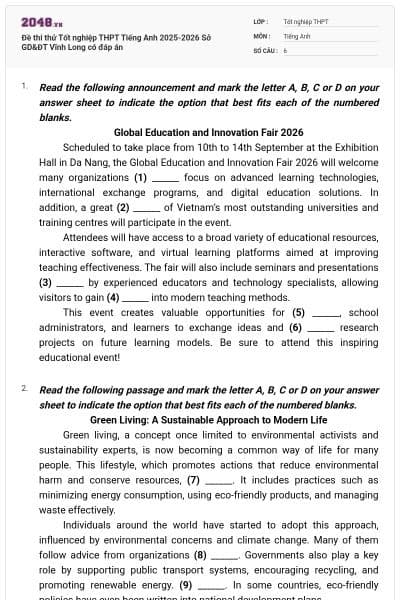
Read the following piece of news and mark the letter A, B, C or D on your answer sheet to indicate the option that fits each of the numbered blanks from 1 to 6.
A80 NATIONAL EXHIBITION
Taking place from August 25th to 30th at the National Exhibition Centre in Hanoi, the A80 National Exhibition 2025 will showcase more than 150 displays, (1) ________ are contributed by leading museums and cultural organisations across Vietnam.
Visitors will explore a wide (2) ________ of documents, photographs, and interactive models reflecting the country's progress over eight decades. The event also includes expert discussions held by historians and researchers, (3) ________ valuable insights into national development.
Guests are encouraged to join interactive activities, which (4) ________ to deepen public understanding of national achievements. This exhibition is a meaningful opportunity for students, researchers, and the public to learn about the country's development and (5) valuable knowledge while supporting deeper (6) ________ appreciation.
whom
whose
who
which
A. whom: thay cho người (đóng vai trò tân ngữ)
B. whose: thay cho sở hữu
C. who: thay cho người (đóng vai trò chủ ngữ)
D. which: thay cho vật (đóng vai trò chủ ngữ/tân ngữ)
“150 displays” (150 hiện vật trưng bày) là danh từ chỉ vật. Đại từ quan hệ “which” dùng để thay thế cho danh từ chỉ vật và làm chủ ngữ cho mệnh đề phía sau.
Chọn D. which
→ The A80 National Exhibition 2025 will showcase more than 150 displays, which are contributed by leading museums and cultural organisations across Vietnam.
Dịch nghĩa: Triển lãm Quốc gia A80 năm 2025 sẽ trưng bày hơn 150 hiện vật, những hiện vật này được đóng góp bởi các bảo tàng và tổ chức văn hóa hàng đầu khắp Việt Nam.
number
deal
amount
range
A. number: số lượng (thường đi với N đếm được)
B. deal: lượng (thường đi với a great deal of + N không đếm được)
C. amount: lượng (thường đi với N không đếm được)
D. range: phạm vi / loại đa dạng
Cụm từ cố định: a wide range of something: sự đa dạng các loại cái gì đó.
Chọn D. range
→ Visitors will explore a wide range of documents, photographs, and interactive models reflecting the country's progress over eight decades.
Dịch nghĩa: Khách tham quan sẽ được khám phá đa dạng các loại tài liệu, hình ảnh và mô hình tương tác phản ánh sự tiến bộ của đất nước qua tám thập kỷ.
The event also includes expert discussions held by historians and researchers, (3) ________ valuable insights into national development.
offering
offered
be offering
offer
A. offering: mang lại/cung cấp (dạng V-ing)
B. offered: đã cung cấp (dạng V-ed)
C. be offering: đang cung cấp (sai vì không thể dùng “be + V-ing” trong mệnh đề quan hệ rút gọn)
D. offer: cung cấp (động từ nguyên mẫu)
Rút gọn mệnh đề quan hệ dạng chủ động (discussions which offer...). Khi lược bỏ đại từ quan hệ, động từ chuyển thành V-ing.
Chọn A. offering
→ The event also includes expert discussions held by historians and researchers, offering valuable insights into national development.
Dịch nghĩa: Sự kiện cũng bao gồm các buổi thảo luận chuyên gia được tổ chức bởi các nhà sử học và nhà nghiên cứu, mang lại những cái nhìn giá trị về sự phát triển của quốc gia.
organise
raise
show
aim
A. organise: tổ chức
B. raise: nâng cao
C. show: trình bày/cho thấy
D. aim: nhắm đến/mục đích
Cấu trúc: aim to do something: nhằm mục đích làm gì đó.
Chọn D. aim
→ Guests are encouraged to join interactive activities, which aim to deepen public understanding of national achievements.
Dịch nghĩa: Khách mời được khuyến khích tham gia các hoạt động tương tác, những hoạt động này nhằm mục đích làm sâu sắc thêm sự hiểu biết của công chúng về các thành tựu quốc gia.
come up
get up
pick up
take up
A. come up: xảy ra/nảy sinh
B. get up: thức dậy
C. pick up: học hỏi được/có được (kỹ năng, kiến thức)
D. take up: bắt đầu một thói quen/chiếm không gian
Ngữ cảnh: Đi với “valuable knowledge” (kiến thức quý giá), ta dùng “pick up” với nghĩa là tiếp thu hoặc học hỏi được kiến thức một cách tự nhiên.
Chọn C. pick up
→ This exhibition is a meaningful opportunity for students, researchers, and the public to learn about the country's development and pick up valuable knowledge while supporting deeper cultural appreciation.
Dịch nghĩa: Triển lãm này là một cơ hội ý nghĩa để sinh viên, các nhà nghiên cứu và công chúng tìm hiểu về sự phát triển của đất nước và tiếp thu những kiến thức quý giá đồng thời ủng hộ sự trân trọng văn hóa sâu sắc hơn.
cultural
culturally
culture
cultivate
A. cultural (adj): thuộc về văn hóa
B. culturally (adv): về mặt văn hóa
C. culture (n): nền văn hóa
D. cultivate (v): trau dồi/trồng trọt
“appreciation” là danh từ, đứng trước nó cần một tính từ (adj) để bổ nghĩa. Cụm từ “cultural appreciation” (sự trân trọng/đánh giá cao về văn hóa) là cụm từ hợp lý.
Chọn A. cultural
→ This exhibition is a meaningful opportunity for students, researchers, and the public to learn about the country's development and pick up valuable knowledge while supporting deeper cultural appreciation.
Dịch nghĩa: Triển lãm này là một cơ hội ý nghĩa để sinh viên, các nhà nghiên cứu và công chúng tìm hiểu về sự phát triển của đất nước và tiếp thu những kiến thức quý giá đồng thời ủng hộ sự trân trọng văn hóa sâu sắc hơn.
Bài đọc hoàn chỉnh | Dịch bài đọc |
A80 NATIONAL EXHIBITION Taking place from August 25th to 30th at the National Exhibition Centre in Hanoi, the A80 National Exhibition 2025 will showcase more than 150 displays, which are contributed by leading museums and cultural organisations across Vietnam. Visitors will explore a wide range of documents, photographs, and interactive models reflecting the country's progress over eight decades. The event also includes expert discussions held by historians and researchers, offering valuable insights into national development. Guests are encouraged to join interactive activities, which aim to deepen public understanding of national achievements. This exhibition is a meaningful opportunity for students, researchers, and the public to learn about the country's development and pick up valuable knowledge while supporting deeper cultural appreciation. | TRIỂN LÃM QUỐC GIA A80 Diễn ra từ ngày 25 đến 30 tháng 8 tại Trung tâm Triển lãm Quốc gia ở Hà Nội, Triển lãm Quốc gia A80 năm 2025 sẽ trưng bày hơn 150 gian trưng bày, được đóng góp bởi các bảo tàng và tổ chức văn hóa hàng đầu trên khắp Việt Nam. Khách tham quan sẽ khám phá nhiều loại tài liệu, hình ảnh và mô hình tương tác phản ánh sự phát triển của đất nước trong suốt tám thập kỷ. Sự kiện cũng bao gồm các buổi thảo luận chuyên môn do các nhà sử học và nhà nghiên cứu tổ chức, mang đến những hiểu biết giá trị về sự phát triển của quốc gia. Khách tham dự được khuyến khích tham gia các hoạt động tương tác nhằm nâng cao sự hiểu biết của công chúng về những thành tựu quốc gia. Triển lãm này là một cơ hội ý nghĩa để học sinh, nhà nghiên cứu và công chúng tìm hiểu về quá trình phát triển của đất nước và tiếp thu những kiến thức giá trị, đồng thời thúc đẩy sự trân trọng văn hóa sâu sắc hơn. |
Mark the letter A, B, C or D on your answer sheet to indicate the best arrangement of utterances or sentences to make a meaningful exchange or text in each of the following questions from 7 to 11.
a. The beach rescue team consists of many members who are always ready to help people in need.
b. For example, lifeguards swim out to save people in the water.
c. These lifesavers can do a lot of useful things, and they have different jobs.
d. The first aiders look after injured people on the beach, and the pilots fly the helicopters to look for those getting lost in the sea.
e. Without the rescue team, people will not feel safe when going to the beach anymore.
a-c-e-b-d
a-c-b-a-e
a-c-e-d-b
a-b-c-e-d
Thứ tự sắp xếp đúng: A. a – c – e – b – d
a. The beach rescue team consists of many members who are always ready to help people in need.
c. These lifesavers can do a lot of useful things, and they have different jobs.
e. Without the rescue team, people will not feel safe when going to the beach anymore.
b. For example, lifeguards swim out to save people in the water.
d. The first aiders look after injured people on the beach, and the pilots fly the helicopters to look for those getting lost in the sea.
Dịch nghĩa:
a. Đội cứu hộ bãi biển gồm nhiều thành viên luôn sẵn sàng giúp đỡ những người gặp nạn.
c. Những người cứu hộ này có thể làm nhiều việc hữu ích và họ có các nhiệm vụ khác nhau.
e. Nếu không có đội cứu hộ, mọi người sẽ không còn cảm thấy an toàn khi đi biển nữa.
b. Ví dụ, các nhân viên cứu hộ bơi ra cứu người dưới nước.
d. Nhân viên sơ cứu chăm sóc người bị thương trên bãi biển và phi công lái trực thăng để tìm những người bị lạc ngoài biển.
Chọn A.
a. They eat a lot of fruit and vegetables, do regular exercise, don't smoke and drink only in moderation.
b. Finally, people who live to 100 often have a close family, too.
c. It is clear that people who live the longest are health-conscious.
d. Therefore, there's no secret - it's just a healthy lifestyle and a positive attitude to life.
e. They also tend to be happy and have a good sense of humour.
c-a-b-e-d
c-a-e-d-b
a-c-e-d-b
c-a-e-b-d
Thứ tự sắp xếp đúng: D. c – a – e – b – d
c. It is clear that people who live the longest are health-conscious.
a. They eat a lot of fruit and vegetables, do regular exercise, don't smoke and drink only in moderation.
e. They also tend to be happy and have a good sense of humour.
b. Finally, people who live to 100 often have a close family, too.
d. Therefore, there's no secret - it's just a healthy lifestyle and a positive attitude to life.
Dịch nghĩa:
c. Rõ ràng những người sống thọ nhất là những người quan tâm đến sức khỏe.
a. Họ ăn nhiều trái cây và rau, tập thể dục thường xuyên, không hút thuốc và chỉ uống rượu ở mức độ vừa phải.
e. Họ cũng thường vui vẻ và có khiếu hài hước.
b. Cuối cùng, những người sống đến 100 tuổi thường có gia đình gắn bó.
d. Vì vậy, không có bí quyết nào cả – chỉ đơn giản là lối sống lành mạnh và thái độ sống tích cực.
Chọn D.
a. On the contrary, most scientists agree that it is real and that we need to do something about it.
b. They say it is just a natural part of the Earth's climate.
c. However, some people think that global warming is not real.
d. Global warming is causing a lot of problems for the world.
e. The temperature of the Earth is slowly getting hotter, and this is causing the ice at the North Pole to melt.
d-e-c-b-a
d-a-e-c-b
d-a-e-b-c
d-a-b-c-e
Thứ tự sắp xếp đúng: A. d – e – c – b – a
d. Global warming is causing a lot of problems for the world.
e. The temperature of the Earth is slowly getting hotter, and this is causing the ice at the North Pole to melt.
c. However, some people think that global warming is not real.
b. They say it is just a natural part of the Earth's climate.
a. On the contrary, most scientists agree that it is real and that we need to do something about it.
Dịch nghĩa:
d. Sự nóng lên toàn cầu đang gây ra nhiều vấn đề cho thế giới.
e. Nhiệt độ Trái Đất đang dần tăng lên, điều này làm băng ở Bắc Cực tan chảy.
c. Tuy nhiên, một số người cho rằng hiện tượng nóng lên toàn cầu không có thật.
b. Họ nói đó chỉ là một phần tự nhiên của khí hậu Trái Đất.
a. Ngược lại, hầu hết các nhà khoa học đều đồng ý rằng nó là có thật và chúng ta cần làm gì đó.
Chọn A.
a. There will be no traffic lights or road signs because cars will talk to each other and work together to find the best options to travel to destinations.
b. Finally, people will not have to park their cars which are able to locate and go to a parking lot on their own.
c. Instead, they can use an app on their smartphone to order a car whenever they need one.
d. Also, people will not need to buy a car at a store.
e. In the future, most cars will be electric and drive themselves.
e-c-d-b-a
e-a-d-c-b
e-a-d-b-c
e-c-a-b-d
Thứ tự sắp xếp đúng: B. e – a – d – c – b
e. In the future, most cars will be electric and drive themselves.
a. There will be no traffic lights or road signs because cars will talk to each other and work together to find the best options to travel to destinations.
d. Also, people will not need to buy a car at a store.
c. Instead, they can use an app on their smartphone to order a car whenever they need one.
b. Finally, people will not have to park their cars which are able to locate and go to a parking lot on their own.
Dịch nghĩa:
e. Trong tương lai, hầu hết ô tô sẽ chạy bằng điện và tự lái.
a. Sẽ không còn đèn giao thông hay biển báo vì các xe sẽ “nói chuyện” với nhau và phối hợp để tìm lộ trình tốt nhất.
d. Ngoài ra, mọi người sẽ không cần mua xe ở cửa hàng.
c. Thay vào đó, họ có thể dùng ứng dụng trên điện thoại thông minh để gọi xe khi cần.
b. Cuối cùng, mọi người sẽ không phải đỗ xe vì xe có thể tự tìm và đi đến bãi đỗ.
Chọn B.
a. They usually have a smartphone and use it to chat with friends, post photos and videos, and play games.
b. Some parents think that using the internet too much like that is bad for teenagers.
c. Teenagers today spend a lot of time online.
d. However, others think it is just a normal part of life in the 21st century.
e. They also use social media sites like Instagram and Snapchat or watch TV shows and movies on streaming services such as Netflix and Hulu.
c-a-b-d-e
c-a-e-b-d
c-a-e-d-b
c-e-d-b-a
Thứ tự sắp xếp đúng: B. c – a – e – b – d
c. Teenagers today spend a lot of time online.
a. They usually have a smartphone and use it to chat with friends, post photos and videos, and play games.
e. They also use social media sites like Instagram and Snapchat or watch TV shows and movies on streaming services such as Netflix and Hulu.
b. Some parents think that using the internet too much like that is bad for teenagers.
d. However, others think it is just a normal part of life in the 21st century.
Dịch nghĩa:
c. Thanh thiếu niên ngày nay dành nhiều thời gian trực tuyến.
a. Họ thường có điện thoại thông minh và dùng nó để trò chuyện, đăng ảnh và video, và chơi game.
e. Họ cũng sử dụng các mạng xã hội như Instagram và Snapchat hoặc xem chương trình truyền hình, phim trên các dịch vụ phát trực tuyến như Netflix và Hulu.
b. Một số phụ huynh cho rằng việc sử dụng Internet quá nhiều như vậy là không tốt cho thanh thiếu niên.
d. Tuy nhiên, những người khác lại nghĩ đó chỉ là một phần bình thường của cuộc sống trong thế kỷ 21.
Chọn B.
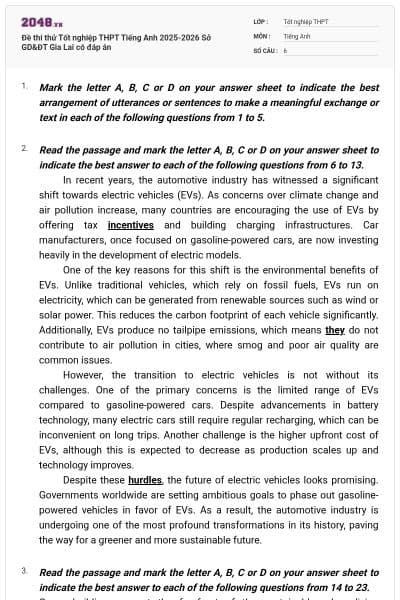
Read the following passage and mark the letter A, B, C or D on your answer sheet to indicate the best answer to each of the following questions from 12 to 19.
Impact of Artificial Intelligence on Education
Artificial Intelligence (AI) has quickly become a defining influence in modern education, altering how learners engage with knowledge and how teachers design instruction. Rather than functioning as simple digital tools, AI systems now process extensive learning data to detect patterns, identify emerging difficulties, and forecast areas where students may require additional support. These insights allow educators to intervene earlier and refine their teaching with greater precision.
Adaptive learning platforms are among the clearest examples of this shift. By monitoring how learners navigate lessons, these systems adjust the complexity of tasks, recommend supplementary materials, and offer instantaneous feedback. As a result, less-proficient learners receive timely guidance, while high-performing learners are challenged at a pace suited to their abilities. Yet the algorithms that drive these decisions are not always transparent, leaving students and teachers uncertain about how particular suggestions are generated.
AI is also reshaping assessment practices. Automated scoring tools can analyse written responses, detect linguistic patterns, and evaluate conceptual understanding far more rapidly than human graders. While such efficiency lightens teachers' workloads, concerns persist about fairness and nuance – especially for assignments that rely on creativity, personal voice, or cultural context. The increased use of AI-generated content by students further complicates questions of academic integrity, prompting educators to reconsider whether traditional assessment models remain adequate.
Beyond the classroom, AI supports broader educational planning. Predictive analytics help school systems identify dropout risks, guide policy interventions, and distribute resources more strategically. However, these tools depend on large volumes of personal data, which may introduce privacy concerns or unintentionally reinforce existing inequalities if the underlying datasets contain bias.
Although AI offers considerable advantages, its role in education must be managed responsibly. Technological efficiency should complement - not replace - the human judgment and ethical considerations that remain essential to meaningful learning.
Which of the following is NOT mentioned in paragraph 1 as one of AI's functions in education?
Processing large sets of learning data
Replacing teachers in delivering lessons
Forecasting areas where students may need help
Detecting learning patterns
Điều nào sau đây KHÔNG được đề cập trong đoạn 1 như là một trong những chức năng của AI trong giáo dục?
A. Xử lý các bộ dữ liệu học tập lớn
B. Thay thế giáo viên trong việc giảng dạy bài học
C. Dự báo các lĩnh vực mà học sinh có thể cần trợ giúp
D. Phát hiện các mô hình học tập
Thông tin: Rather than functioning as simple digital tools, AI systems now process extensive learning data to detect patterns, identify emerging difficulties, and forecast areas where students may require additional support. (Thay vì chỉ đóng vai trò là những công cụ kỹ thuật số đơn giản, các hệ thống AI hiện nay xử lý lượng lớn dữ liệu học tập để phát hiện các mô hình, xác định những khó khăn mới nổi và dự báo những lĩnh vực mà học sinh có thể cần hỗ trợ thêm.)
→ Trong đoạn 1, AI được mô tả là một công cụ hỗ trợ giáo viên đưa ra quyết định chính xác hơn, không phải để thay thế giáo viên.
Chọn B.
limit
adjust
remove
prevent
Từ “refine” ở đoạn 1 có thể được thay thế tốt nhất bởi _______.
refine (v): tinh chỉnh, cải thiện (để làm cho thứ gì đó chính xác hoặc tốt hơn).
A. limit (v): hạn chế
B. adjust (v): điều chỉnh, chỉnh sửa
C. remove (v): loại bỏ
D. prevent (v): ngăn chặn
→ refine ≈ adjust (điều chỉnh cho tốt hơn).
Thông tin: These insights allow educators to intervene earlier and refine their teaching with greater precision.
(Những thông tin chi tiết này cho phép các nhà giáo dục can thiệp sớm hơn và tinh chỉnh việc giảng dạy của họ với độ chính xác cao hơn.)
Chọn B.
obscure
open
fair
clear
Từ “transparent” ở đoạn 2 TRÁI NGHĨA với _______.
transparent (adj): minh bạch, rõ ràng, dễ hiểu.
A. obscure (adj): mơ hồ, khó hiểu, không rõ ràng
B. open (adj): mở
C. fair (adj): công bằng
D. clear (adj): rõ ràng (Đồng nghĩa)
→ transparent (minh bạch) >< obscure (mơ hồ).
Thông tin: Yet the algorithms that drive these decisions are not always transparent...
(Tuy nhiên, các thuật toán thúc đẩy những quyết định này không phải lúc nào cũng minh bạch...)
Chọn A.
high-performing learners
less-proficient learners
adaptive learning platforms
supplementary materials
Từ “their” ở đoạn 2 chỉ _______.
A. high-performing learners: những người học có kết quả cao
B. less-proficient learners: những người học kém thành thạo hơn
C. adaptive learning platforms: các nền tảng học tập thích ứng
D. supplementary materials: các tài liệu bổ sung
Thông tin: As a result, less-proficient learners receive timely guidance, while high-performing learners are challenged at a pace suited to theirabilities.
(Do đó, những học sinh có trình độ thấp hơn sẽ nhận được sự hướng dẫn kịp thời, trong khi những học sinh có trình độ cao hơn sẽ được thử thách với tốc độ phù hợp với khả năng của họ.)
Chọn A.
Which of the following best paraphrases the underlined sentence in paragraph 3? “The increased use of AI-generated content by students further complicates questions of academic integrity, prompting educators to reconsider whether traditional assessment models remain adequate.”
Academic integrity improves because AI enables teachers to track student learning.
Traditional grading is becoming obsolete because AI evaluates assignments more precisely.
Institutions are abandoning conventional assessments as students rely mainly on AI tools.
Schools must revise assessments since AI-generated work complicates judging real student performance.
Câu nào diễn giải đúng nhất câu gạch chân ở đoạn 3?
“The increased use of AI-generated content by students further complicates questions of academic integrity, prompting educators to reconsider whether traditional assessment models remain adequate.”
(Việc sinh viên tăng cường sử dụng nội dung do AI tạo ra làm phức tạp thêm các vấn đề về liêm chính học thuật, thôi thúc các nhà giáo dục xem xét lại liệu các mô hình đánh giá truyền thống có còn đầy đủ/phù hợp hay không.)
A. Liêm chính học thuật được cải thiện vì AI cho phép giáo viên theo dõi việc học của học sinh.
→ sai hoàn toàn (improve ≠ complicates)
B. Chấm điểm truyền thống đang trở nên lỗi thời vì AI đánh giá bài tập chính xác hơn.
→ Sai ý chính
C. Các tổ chức đang từ bỏ các đánh giá thông thường vì sinh viên chủ yếu dựa vào các công cụ AI.
→ Sai: “reconsider” - xem xét lại, không phải “abandoning” - từ bỏ hoàn toàn
D. Các trường học phải sửa đổi các bài đánh giá vì các bài làm do AI tạo ra gây khó khăn cho việc đánh giá năng lực thực sự của học sinh.
→ D phản ánh đúng tinh thần: “complicates questions of academic integrity” = “complicates judging real student performance”; “reconsider” = “revise”.
Chọn D.
Which of the following is TRUE according to paragraph 4?
Resource allocation systems seldom rely on personal data to distribute educational resources.
AI supposedly guarantees equal support distribution across all school communities involved.
Governments mainly employ AI technologies to automate traditional classroom teachingroles.
Predictive analytics may unintentionally reinforce inequalities if based on biased datasets.
Theo đoạn 4, điều nào sau đây là ĐÚNG?
A. Các hệ thống phân bổ nguồn lực hiếm khi dựa vào dữ liệu cá nhân.
→ Sai. Thông tin: these tools depend on large volumes of personal data (các công cụ này phụ thuộc vào một lượng lớn dữ liệu cá nhân.)
B. AI được cho là đảm bảo sự phân bổ hỗ trợ bình đẳng cho tất cả các cộng đồng trường học liên quan.
→ Sai: có thể làm tăng sự bất bình đẳng
C. Các chính phủ chủ yếu sử dụng công nghệ AI để tự động hóa các vai trò giảng dạy trên lớp truyền thống.
→ Không có thông tin
D. Phân tích dự đoán có thể vô tình làm gia tăng sự bất bình đẳng nếu dựa trên các bộ dữ liệu thiên vị.
→ Đúng. Thông tin: However, these tools depend on large volumes of personal data, which may introduce privacy concerns or unintentionally reinforce existing inequalities if the underlying datasets contain bias.(Tuy nhiên, những công cụ này phụ thuộc vào một lượng lớn dữ liệu cá nhân, điều này có thể gây ra những lo ngại về quyền riêng tư hoặc vô tình làm trầm trọng thêm sự bất bình đẳng hiện có nếu các tập dữ liệu cơ bản chứa đựng sự thiên vị.)
Chọn D.
Paragraph 1
Paragraph 3
Paragraph 2
Paragraph 4
Đoạn văn nào đề cập đến khó khăn trong việc hiểu cách các đề xuất do AI tạo ra được tạo ra?
A. Đoạn 1
B. Đoạn 3
C. Đoạn 2
D. Đoạn 4
Thông tin (Đoạn 2): Yet the algorithms that drive these decisions are not always transparent, leaving students and teachers uncertain about how particular suggestions are generated.
(Tuy nhiên, các thuật toán điều khiển những quyết định này không phải lúc nào cũng minh bạch, khiến học sinh và giáo viên không chắc chắn về cách thức tạo ra các đề xuất cụ thể.)
Chọn C.
Paragraph 5
Paragraph 3
Paragraph 1
Paragraph 2
Đoạn văn nào đề cập đến việc đánh giá tự động các câu trả lời viết của học sinh?
A. Đoạn 5
B. Đoạn 3
C. Đoạn 1
D. Đoạn 2
Thông tin (Đoạn 3): Automated scoring tools can analyse written responses, detect linguistic patterns, and evaluate conceptual understanding far more rapidly than human graders. (Các công cụ chấm điểm tự động có thể phân tích câu trả lời bằng văn bản, phát hiện các mẫu ngôn ngữ và đánh giá sự hiểu biết về khái niệm nhanh hơn nhiều so với người chấm điểm thủ công.)
Chọn B.
Dịch bài đọc:
TÁC ĐỘNG CỦA TRÍ TUỆ NHÂN TẠO ĐỐI VỚI GIÁO DỤC
Trí tuệ nhân tạo (AI) đã nhanh chóng trở thành một tầm ảnh hưởng mang tính định hình trong giáo dục hiện đại, thay đổi cách người học tiếp cận kiến thức và cách giáo viên thiết kế bài giảng. Thay vì chỉ đóng vai trò là các công cụ kỹ thuật số đơn giản, các hệ thống AI hiện nay xử lý dữ liệu học tập sâu rộng để phát hiện các mô hình, xác định những khó khăn mới nảy sinh và dự báo những lĩnh vực mà học sinh có thể cần hỗ trợ thêm. Những thông tin chi tiết này cho phép các nhà giáo dục can thiệp sớm hơn và tinh chỉnh việc giảng dạy của mình với độ chính xác cao hơn.
Các nền tảng học tập thích ứng là một trong những ví dụ rõ ràng nhất về sự chuyển dịch này. Bằng cách theo dõi cách người học điều hướng qua các bài học, các hệ thống này sẽ điều chỉnh độ phức tạp của nhiệm vụ, đề xuất các tài liệu bổ sung và đưa ra phản hồi tức thì. Kết quả là, những người học kém thành thạo hơn nhận được sự hướng dẫn kịp thời, trong khi những người học có kết quả cao được thử thách ở tốc độ phù hợp với khả năng của họ. Tuy nhiên, các thuật toán thúc đẩy những quyết định này không phải lúc nào cũng minh bạch, khiến học sinh và giáo viên không chắc chắn về cách các đề xuất cụ thể được tạo ra.
AI cũng đang tái định hình các phương thức đánh giá. Các công cụ chấm điểm tự động có thể phân tích các câu trả lời viết, phát hiện các mô hình ngôn ngữ và đánh giá sự hiểu biết về khái niệm nhanh hơn nhiều so với người chấm là con người. Mặc dù hiệu quả như vậy giúp giảm bớt khối lượng công việc cho giáo viên, nhưng những lo ngại vẫn tồn tại về tính công bằng và sự tinh tế – đặc biệt là đối với các bài tập dựa trên sự sáng tạo, giọng văn cá nhân hoặc bối cảnh văn hóa. Việc sinh viên tăng cường sử dụng nội dung do AI tạo ra càng làm phức tạp thêm các vấn đề về liêm chính học thuật, thôi thúc các nhà giáo dục xem xét lại liệu các mô hình đánh giá truyền thống có còn phù hợp hay không.
Bên ngoài lớp học, AI hỗ trợ lập kế hoạch giáo dục rộng lớn hơn. Phân tích dự đoán giúp các hệ thống trường học xác định rủi ro bỏ học, hướng dẫn các can thiệp chính sách và phân bổ nguồn lực một cách chiến lược hơn. Tuy nhiên, các công cụ này phụ thuộc vào khối lượng lớn dữ liệu cá nhân, điều này có thể dẫn đến các mối lo ngại về quyền riêng tư hoặc vô tình củng cố những bất bình đẳng hiện có nếu các bộ dữ liệu cơ sở chứa đựng sự thiên kiến.
Mặc dù AI mang lại những lợi thế đáng kể, nhưng vai trò của nó trong giáo dục phải được quản lý một cách có trách nhiệm. Hiệu quả công nghệ nên bổ sung – chứ không phải thay thế – sự phán đoán của con người và những cân nhắc về đạo đức vốn vẫn là yếu tố thiết yếu cho việc học tập có ý nghĩa.
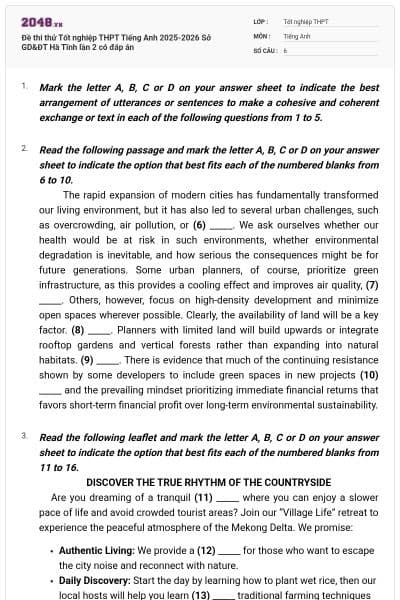
Read the following passage and mark the letter A, B, C or D on your answer sheet to indicate the option that best fits each of the numbered blanks from 20 to 24.
CAMPING HOLIDAYS AND THE RISKS INVOLVED
All camping trips involve some degree of risk whether in the form of bad weather, wild animals, lack of clean water, or (20) ________. We ask ourselves what risks we might face if we camp there, how likely they are to occur, whether they can be avoided, and how serious the consequences could be.
Some campers, of course, enjoy a certain level of risk, as it adds excitement to the experience, (21) ________. Others, however, are risk averse and will avoid unnecessary dangers whenever possible? Clearly, the significance of the risk plays an important role. (22) ________. The risk averse will choose organised campsites, follow familiar routes, or join guided tours rather than explore independently.
(23) ________. There is evidence that many campers remain hesitant to rely solely on online sources when planning a camping trip, partly because of the lack of direct advice from an experienced guide and partly due to (24) ________ about the reliability of online information.
what campsite conditions we will certainly see directly
for the campsite facilities to be seen directly
until we can directly see how the campsite actually is
being uncertain about the campsite until reaching it
Đây là cấu trúc liệt kê (Parallel Structure). Các yếu tố trước đó đều là danh từ hoặc cụm danh từ: bad weather (thời tiết xấu), wild animals (động vật hoang dã), lack of clean water (thiếu nước sạch).
Vị trí (20) cần một danh từ hoặc cụm danh động từ (Gerund phrase) để đóng vai trò như một “rủi ro” tiếp theo trong danh sách.
Dịch nghĩa:
A. chúng ta chắc chắn sẽ thấy trực tiếp điều kiện bãi cắm trại như thế nào
B. để các cơ sở vật chất của bãi cắm trại được nhìn thấy trực tiếp
C. cho đến khi chúng ta có thể trực tiếp thấy bãi cắm trại thực sự như thế nào
D. việc không chắc chắn về bãi cắm trại cho đến khi thực sự đến đó
Phân tích:
A. mệnh đề danh từ dài, ý không hợp logic (“điều chắc chắn thấy trực tiếp” ≠ rủi ro)
B. cấu trúc không tự nhiên, không thể hiện rủi ro
C. mệnh đề thời gian, không song song với danh từ
D. đúng cấu trúc (Gerund phrase) và bổ sung một loại rủi ro mang tính tâm lý/thực tế: sự không chắc chắn.
Chọn D.
→ All camping trips involve some degree of risk whether in the form of bad weather, wild animals, lack of clean water, or being uncertain about the campsite until reaching it.
Dịch nghĩa: Tất cả các chuyến cắm trại đều tiềm ẩn mức độ rủi ro nhất định, dù là dưới hình thức thời tiết xấu, động vật hoang dã, thiếu nước sạch, hay việc không chắc chắn về điều kiện bãi cắm trại cho đến khi thực sự đặt chân tới đó.
so the presence of risk is not in itself a barrier to camping
but risk itself does not necessarily discourage people from camping
if the presence of risk does not serve as a barrier to camping
and camping itself does not present any barriers or risks
Câu cần nối hai ý logic sau dấu phẩy:
Phía trước: “Some campers, of course, enjoy a certain level of risk, as it adds excitement to the experience, ...”
→ “as” ở đây có nghĩa là “vì” (because).
Phía sau cần một ý tương phản nhẹ hoặc kết nối tự nhiên để nói rằng:
“Dù có rủi ro, nhưng rủi ro đó không nhất thiết khiến mọi người bỏ cuộc khi đi cắm trại.”
Dịch nghĩa:
A. vì vậy sự hiện diện của rủi ro tự thân nó không phải là rào cản đối với việc cắm trại
B. nhưng bản thân rủi ro không nhất thiết làm nản lòng mọi người khi cắm trại
C. nếu sự hiện diện của rủi ro không đóng vai trò như một rào cản đối với việc cắm trại
D. và việc cắm trại không đưa ra bất kỳ rào cản hay rủi ro nào
Phân tích:
A. Sai. “so” mang nghĩa “vì vậy” (kết quả), nhưng câu trước đã dùng “as” chỉ nguyên nhân. Dùng “so” sẽ tạo logic ngược và lặp ý không tự nhiên.
B. Đúng nhất, “but” tạo sự tương phản nhẹ nhàng, hợp lý. Đúng cấu trúc và nghĩa.
C. Sai. “if” biến câu sau thành mệnh đề điều kiện, khiến toàn bộ câu thiếu động từ chính, không đứng độc lập được.
D. Sai hoàn toàn về nghĩa. Câu gốc đang nói rõ là có rủi ro, không phải “không có rủi ro”.
Chọn B.
→ Some campers, of course, enjoy a certain level of risk, as it adds excitement to the experience, so the presence of risk is not in itself a barrier to camping.
Dịch nghĩa: Một số người đi cắm trại tất nhiên là thích một mức độ rủi ro nhất định, vì nó làm tăng thêm sự phấn khích cho trải nghiệm, vì vậy sự hiện diện của rủi ro tự thân nó không phải là rào cản đối với việc đi cắm trại.
As a result, there will be far less concern about minor discomfort than about real danger
As earlier mentioned, the danger from wildlife causes greater concern than rain
Similarly, people will be more concerned about rain than about dangerous terrain
People, by contrast, will be far less concerned about wildlife than about the lack of comfort
“Significance of risk” (Tầm quan trọng/mức độ nghiêm trọng của rủi ro) ảnh hưởng đến tâm lý. Câu sau nói về “Risk averse” (người ngại rủi ro) sẽ chọn phương án an toàn.
Cần một câu giải thích rõ việc phân loại mức độ rủi ro (rủi ro nhỏ so với rủi ro thực sự).
Dịch nghĩa:
A. Kết quả là, người ta sẽ ít lo lắng về sự khó chịu nhỏ hơn là về mối nguy hiểm thực sự.
B. Như đã đề cập trước đó, mối nguy hiểm từ động vật hoang dã gây lo ngại lớn hơn mưa.
C. Tương tự, mọi người sẽ lo lắng về mưa hơn là về địa hình nguy hiểm.
D. Ngược lại, mọi người sẽ ít lo lắng về động vật hoang dã hơn là về việc thiếu sự thoải mái.
Phân tích:
A. đúng logic nhất vì nó giải thích cho cụm “significance of the risk” (người ta cân đo giữa khó chịu nhỏ và nguy hiểm thật).
B. “As earlier mentioned” là sai vì trước đó chưa có sự so sánh cụ thể giữa động vật và mưa.
C, D. sai về logic ưu tiên an toàn của con người (nguy hiểm thực sự phải đáng sợ hơn sự khó chịu).
Chọn A.
→ Clearly, the significance of the risk plays an important role. As a result, there will be far less concern about minor discomfort than about real danger.
Dịch nghĩa: Rõ ràng, mức độ nghiêm trọng của rủi ro đóng một vai trò quan trọng. Kết quả là, người ta sẽ ít lo lắng về sự khó chịu nhỏ nhặt hơn là về mối nguy hiểm thực sự.
Risk also influences the way campers choose their planning methods
Campers also choose their planning methods based on risk-free factors
Camping plans are also booked after selecting risk-free methods
Planning a camping trip requires choosing factors that eliminate risk
Cấu trúc: Đây là câu chủ đề (Topic Sentence) của đoạn văn mới.
Đoạn này thảo luận về cách lên kế hoạch (planning), sự do dự khi dùng nguồn online và nhu cầu về người hướng dẫn.
Dịch nghĩa:
A. Rủi ro cũng ảnh hưởng đến cách người đi cắm trại lựa chọn phương pháp lập kế hoạch của họ.
B. Người đi cắm trại cũng chọn các phương pháp lập kế hoạch dựa trên các yếu tố không rủi ro.
C. Các kế hoạch cắm trại cũng được đặt sau khi lựa chọn các phương pháp không rủi ro.
D. Lập kế hoạch cho một chuyến cắm trại đòi hỏi phải chọn các yếu tố loại bỏ rủi ro.
Phân tích:
A. là câu khái quát nhất, dẫn dắt vào nội dung đoạn (rủi ro về thông tin khiến họ thay đổi cách lập kế hoạch).
B, C. cụm “risk-free” không phù hợp vì bài đang nói về sự “do dự” (hesitant) và “thiếu tin tưởng”, tức là vẫn còn rủi ro.
D. mang tính áp đặt, không mang tính mô tả thực trạng như bài đọc.
Chọn A.
→ Risk also influences the way campers choose their planning methods. There is evidence that many campers remain hesitant to rely solely on online sources when planning a camping trip,...
Dịch nghĩa: Rủi ro cũng ảnh hưởng đến cách những người đi cắm trại lựa chọn phương pháp lập kế hoạch cho chuyến đi của mình. Có bằng chứng cho thấy nhiều người đi cắm trại vẫn do dự khi chỉ dựa hoàn toàn vào các nguồn trực tuyến khi lên kế hoạch cho chuyến đi,...
the suspicion that information found online may be biased
thanks to the Internet, where suspicious information is often biased
biased information being suspicious when received through the Internet
the biased information received through the Internet being suspicious
Sau “due to” cần một cụm danh từ.
Dịch nghĩa:
A. sự nghi ngờ rằng thông tin tìm thấy trên mạng có thể bị phiến diện (thiên kiến)
B. nhờ có Internet, nơi mà thông tin nghi ngờ thường bị phiến diện
C. thông tin phiến diện bị nghi ngờ khi nhận được qua Internet
D. thông tin phiến diện nhận được qua Internet bị nghi ngờ
Phân tích:
A. đúng cấu trúc ngữ pháp và phù hợp nhất với từ “reliability” (sự tin cậy) ở phía sau.
B. “thanks to” mang nghĩa tích cực, không hợp với ngữ cảnh “ngại/do dự”, và câu đã có sẵn “due to”
C. biased information being suspicious → cấu trúc không tự nhiên
D. sai cấu trúc câu
Chọn A.
→ ...partly due to the suspicion that information found online may be biasedabout the reliability of online information.
Dịch nghĩa: ...một phần là do sự nghi ngờ rằng thông tin tìm thấy trực tuyến có thể thiên kiến về độ tin cậy của thông tin trên mạng.
Bài đọc hoàn chỉnh | Dịch bài đọc |
CAMPING HOLIDAYS AND THE RISKS INVOLVED All camping trips involve some degree of risk whether in the form of bad weather, wild animals, lack of clean water, or being uncertain about the campsite until reaching it. We ask ourselves what risks we might face if we camp there, how likely they are to occur, whether they can be avoided, and how serious the consequences could be. Some campers, of course, enjoy a certain level of risk, as it adds excitement to the experience, but risk itself does not necessarily discourage people from camping. Others, however, are risk averse and will avoid unnecessary dangers whenever possible. Clearly, the significance of the risk plays an important role. As a result, there will be far less concern about minor discomfort than about real danger. The risk averse will choose organised campsites, follow familiar routes, or join guided tours rather than explore independently. Risk also influences the way campers choose their planning methods. There is evidence that many campers remain hesitant to rely solely on online sources when planning a camping trip, partly because of the lack of direct advice from an experienced guide and partly due to the suspicion that information found online may be biased about the reliability of online information. | KỲ NGHỈ CẮM TRẠI VÀ NHỮNG RỦI RO LIÊN QUAN Tất cả các chuyến đi cắm trại đều tiềm ẩn một mức độ rủi ro nhất định, có thể dưới dạng thời tiết xấu, động vật hoang dã, thiếu nước sạch, hoặc sự không chắc chắn về điều kiện của khu cắm trại cho đến khi thực sự đến nơi. Chúng ta thường tự hỏi mình có thể gặp phải những rủi ro gì nếu cắm trại ở đó, khả năng chúng xảy ra cao đến đâu, liệu có thể tránh được hay không, và hậu quả có thể nghiêm trọng như thế nào. Tất nhiên, một số người cắm trại thích một mức độ rủi ro nhất định vì điều đó làm cho trải nghiệm trở nên thú vị hơn, nhưng bản thân rủi ro không nhất thiết khiến mọi người nản lòng khi đi cắm trại. Tuy nhiên, những người thận trọng (ngại rủi ro) sẽ tránh những nguy hiểm không cần thiết bất cứ khi nào có thể. Rõ ràng, mức độ nghiêm trọng của rủi ro đóng vai trò quan trọng. Vì vậy, mọi người sẽ ít lo lắng về những bất tiện nhỏ hơn so với những nguy hiểm thực sự. Những người ngại rủi ro sẽ chọn các khu cắm trại được tổ chức sẵn, đi theo các tuyến đường quen thuộc, hoặc tham gia các tour có hướng dẫn thay vì tự khám phá. Rủi ro cũng ảnh hưởng đến cách người đi cắm trại lựa chọn phương pháp lập kế hoạch. Có bằng chứng cho thấy nhiều người đi cắm trại vẫn do dự khi chỉ dựa hoàn toàn vào các nguồn trực tuyến khi lên kế hoạch cho chuyến đi, một phần vì thiếu lời khuyên trực tiếp từ người hướng dẫn có kinh nghiệm và một phần do sự nghi ngờ rằng thông tin tìm thấy trên mạng có thể bị thiên lệch, dẫn đến lo ngại về độ tin cậy của thông tin trực tuyến. |
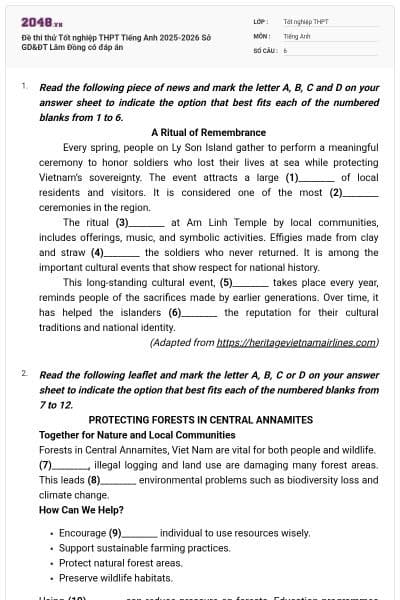
Read the following leaflet and mark the letter A, B, C or D on your answer sheet to indicate the option that best fits each of the numbered blanks from 25 to 30.
HOW TO COPE WITH STRESS AS A TEENAGER
If you often feel overwhelmed by schoolwork, relationships, or daily pressures, here are several simple tips to help you build a routine (25) ________ managing stress effectively.
- Create a realistic study schedule that balances work and rest.
- Track your emotions using a journal (26) ________ a mental-health app.
- Take every chance to do calming activities such as deep breathing or going for a few (27)
________.
- Invite friends and (28) ________ supportive family members to share your thoughts, and try
(29) ________ everyone's positive energy by doing relaxing activities together.
- Reward yourself with a small treat like listening to music if your coping plan works (30) ________ to keep you motivated.
If you often feel overwhelmed by schoolwork, relationships, or daily pressures, here are several simple tips to help you build a routine (25) ________ managing stress effectively.
for
of
at
in
A. for (preposition): dành cho / để làm gì
B. of (preposition): của
C. at (preposition): tại
D. in (preposition): trong
Cấu trúc: build a routine for + V-ing: xây dựng thói quen để làm gì đó.
Chọn A. for
→ If you often feel overwhelmed by schoolwork, relationships, or daily pressures, here are several simple tips to help you build a routine for managing stress effectively.
Dịch nghĩa: Nếu bạn thường xuyên cảm thấy bị quá tải bởi bài vở, các mối quan hệ hay áp lực hàng ngày, dưới đây là một vài mẹo đơn giản giúp bạn xây dựng thói quen để quản lý căng thẳng hiệu quả.
- Track your emotions using a journal (26) ________ a mental-health app.
both
nor
or
so
A. both: cả hai (thường đi với and)
B. nor: cũng không (thường đi với neither)
C. or: hoặc (dùng để đưa ra sự lựa chọn)
D. so: vì vậy
Câu này đưa ra hai phương tiện để theo dõi cảm xúc là “nhật ký” hoặc “ứng dụng sức khỏe tâm thần”. Do đó, ta dùng liên từ “or” để chỉ sự lựa chọn.
Chọn C. or
→ Track your emotions using a journal or a mental-health app.
Dịch nghĩa: Theo dõi cảm xúc của bạn bằng cách sử dụng nhật ký hoặc một ứng dụng sức khỏe tâm thần.
walks outdoor refreshing
outdoor walks refreshing
refreshing walks outdoor
refreshing outdoor walks
Trật tự tính từ trong tiếng Anh thường là: Tính từ chỉ tính chất (refreshing) + Danh từ đóng vai trò tính từ chỉ nơi chốn (outdoor) + Danh từ chính (walks).
→ refreshing outdoor walks: những chuyến đi dạo ngoài trời thư thái.
Chọn D. refreshing outdoor walks
→ Take every chance to do calming activities such as deep breathing or going for a few refreshing outdoor walks.
Dịch nghĩa: Hãy tận dụng mọi cơ hội để thực hiện các hoạt động làm dịu tâm trí như hít thở sâu hoặc đi dạo ngoài trời thư thái.
other
others
another
the others
A. other + N-số nhiều: những ... khác
B. others: những cái/người khác (đóng vai trò đại từ, không đi kèm danh từ phía sau)
C. another + N-số ít: một ... khác
D. the others: những cái/người còn lại cuối cùng trong một nhóm
“supportive family members” là danh từ số nhiều, nên ta dùng “other” đứng trước để bổ nghĩa.
Chọn A. other
→ Invite friends and other supportive family members to share your thoughts.
Dịch nghĩa: Hãy mời bạn bè và những thành viên khác trong gia đình luôn ủng hộ bạn để chia sẻ những suy nghĩ của mình.
comparing
diverting
reducing
boosting
A. comparing: so sánh
B. diverting: làm chệch hướng
C. reducing: giảm bớt
D. boosting: thúc đẩy / làm tăng cường
Ngữ cảnh: Khi làm các hoạt động thư giãn cùng nhau, mục đích là để làm tăng thêm năng lượng tích cực của mọi người.
Chọn D. boosting
→ Invite friends and other supportive family members to share your thoughts, and try boosting everyone's positive energy by doing relaxing activities together.
Dịch nghĩa: Hãy mời bạn bè và những thành viên khác trong gia đình luôn ủng hộ bạn để chia sẻ những suy nghĩ của mình, và cố gắng thúc đẩy năng lượng tích cực của mọi người bằng cách thực hiện các hoạt động thư giãn cùng nhau.
enough
well
completely
greatly
A. enough: đủ (thường đứng sau tính từ/trạng từ)
B. well: tốt / hiệu quả (trạng từ)
C. completely: hoàn toàn
D. greatly: rất nhiều / đáng kể
Động từ “work” (có tác dụng/hiệu quả) cần một trạng từ bổ nghĩa. “Work well” là một cụm từ phổ biến để chỉ việc một kế hoạch hay hệ thống hoạt động có hiệu quả.
Chọn B. well
→ Reward yourself with a small treat like listening to music if your coping plan works well to keep you motivated.
Dịch nghĩa: Hãy tự thưởng cho mình một món quà nhỏ như nghe nhạc nếu kế hoạch đối phó của bạn hoạt động hiệu quả để giữ cho bạn có thêm động lực.
Bài đọc hoàn chỉnh | Dịch bài đọc |
HOW TO COPE WITH STRESS AS A TEENAGER If you often feel overwhelmed by schoolwork, relationships, or daily pressures, here are several simple tips to help you build a routine for managing stress effectively. · Create a realistic study schedule that balances work and rest. · Track your emotions using a journal or a mental-health app. · Take every chance to do calming activities such as deep breathing or going for a few refreshing outdoor walks. · Invite friends and other supportive family members to share your thoughts, and try boosting everyone's positive energy by doing relaxing activities together. · Reward yourself with a small treat like listening to music if your coping plan works well to keep you motivated. | CÁCH ĐỐI PHÓ VỚI CĂNG THẲNG Ở TUỔI THIẾU NIÊN Nếu bạn thường xuyên cảm thấy bị choáng ngợp bởi bài vở ở trường, các mối quan hệ hay những áp lực hàng ngày, dưới đây là một vài mẹo đơn giản giúp bạn xây dựng một thói quen để quản lý căng thẳng hiệu quả. · Hãy lập một thời gian biểu học tập thực tế để cân bằng giữa làm việc và nghỉ ngơi. · Theo dõi cảm xúc của bạn bằng cách sử dụng nhật ký hoặc một ứng dụng sức khỏe tâm thần. · Tận dụng mọi cơ hội để thực hiện các hoạt động thư giãn như hít thở sâu hoặc thực hiện một vài chuyến đi dạo ngoài trời thư thái. · Hãy mời bạn bè và những thành viên khác trong gia đình luôn ủng hộ bạn để chia sẻ những suy nghĩ của mình, và cố gắng thúc đẩy năng lượng tích cực của mọi người bằng cách thực hiện các hoạt động thư giãn cùng nhau. · Hãy tự thưởng cho mình một món quà nhỏ như nghe nhạc nếu kế hoạch đối phó của bạn hoạt động hiệu quả để giúp bạn luôn giữ được động lực. |
Read the following passage and mark the letter A, B, C or D on your answer sheet to indicate the best answer to each of the following questions from 31 to 40.
The Erosion of Data Privacy in the Digital Age
[I] Over the past decade, data privacy has shifted from a technical worry to a central societal concern. Every day, people generate large streams of behavioural data by sending messages, travelling with smartphones, or browsing online platforms. These digital traces, once considered insignificant metadata, have become highly valuable assets. Corporations harvest them to refine advertising systems, while governments rely on expanding surveillance tools capable of tracking citizens with growing precision. As a result, personal information is constantly collected, analysed, and repurposed - often without meaningful or informed consent. [II]
Technology companies claim that data-driven services offer convenience through personalised recommendations, predictive search systems, or location-based assistance. However, these advantages hide a major imbalance of power. Most users lack clear knowledge of how their information is stored, shared, or monetised. Privacy policies are long, technical, and designed to discourage careful reading, turning consent into a mere formality. This opacity has created a digital environment in which large-scale data extraction is routine, invisible, and rarely questioned. [III]
The political implications of weakened data privacy are increasingly alarming. Authoritarian states deploy advanced surveillance infrastructures to monitor citizens movements, communications, and social networks. These systems are expanding so rapidly that they often operate beyond meaningful public oversight. Even in democratic nations, tools such as facial recognition and biometric databases challenge the boundary between public security and intrusion. Once collected, data forms an enduring record that can later be used against journalists, activists, or vulnerable communities. The erosion of anonymity therefore threatens both personal autonomy and the stability of open societies. [IV]
Economic incentives intensify the dilemma. Personal data fuels the rapidly expanding “surveillance economy,” where companies compete to gather the most detailed user profiles. Data brokers - operating with limited regulation - sell information to advertisers or political strategists with little transparency. This business model encourages more aggressive data collection while discouraging accountability, leaving even well-intentioned organisations conflicted about prioritising user privacy.
Despite rising public pressure, regulatory efforts remain uneven. Laws such as the EU's GDPR attempt to curb abusive practices, yet enforcement varies and struggles to keep pace with AI-driven data analytics. Protecting privacy now requires more than gradual policy updates; it demands a fundamental rethinking of how digital systems are built, governed, and held responsible.
negligible
substantial
trivial
minor
Từ “insignificant” ở đoạn 1 TRÁI NGHĨA với _______.
insignificant (adj): không đáng kể, tầm thường, không quan trọng.
A. negligible (adj): có thể bỏ qua, không đáng kể (Đồng nghĩa)
B. substantial (adj): đáng kể, quan trọng, to lớn
C. trivial (adj): tầm thường, không đáng kể (Đồng nghĩa)
D. minor (adj): nhỏ, không quan trọng (Đồng nghĩa)
→ insignificant (nhỏ bé) >< substantial (lớn lao/đáng kể).
Thông tin: These digital traces, once considered insignificant metadata, have become highly valuable assets.
(Những dấu vết kỹ thuật số này, từng bị coi là siêu dữ liệu không đáng kể, đã trở thành những tài sản có giá trị cao.)
Chọn B.
Which of the following is NOT mentioned in paragraph 1 as a way in which people generate behavioural data?
Using smartphones while travelling
Browsing various online platforms
Sending messages on digital platforms
Refining advertising systems
Điều nào sau đây KHÔNG được đề cập trong đoạn 1 như là một cách mà con người tạo ra dữ liệu hành vi?
A. Sử dụng điện thoại thông minh khi đi du lịch.
B. Truy cập các nền tảng trực tuyến khác nhau.
C. Gửi tin nhắn trên các nền tảng kỹ thuật số.
D. Tinh chỉnh các hệ thống quảng cáo.
Thông tin (Đoạn 1): Every day, people generate large streams of behavioural data by sending messages, travelling with smartphones, or browsing online platforms.
(Mỗi ngày, con người tạo ra các dòng dữ liệu hành vi lớn bằng cách gửi tin nhắn, di chuyển với điện thoại thông minh, hoặc duyệt các nền tảng trực tuyến.)
→ Việc tinh chỉnh hệ thống quảng cáo (“refine advertising systems”) là việc của các tập đoàn, không phải cách người dùng tạo ra dữ liệu.
Chọn D.
Where does the following sentence best fit in the passage?
This shift has expanded data collection far beyond what early internet users ever imagined.
[II]
[I]
[IV]
[III]
Câu sau đây phù hợp nhất với vị trí nào trong bài đọc?
“This shift has expanded data collection far beyond what early internet users ever imagined.”
(Sự chuyển dịch này đã mở rộng việc thu thập dữ liệu vượt xa những gì người dùng internet thời kỳ đầu từng tưởng tượng.)
Vị trí [II] nằm cuối đoạn 1, ngay sau khi tác giả giải thích về “sự chuyển dịch” (shift) từ việc coi dữ liệu là vô nghĩa sang tài sản giá trị được thu thập bởi các tập đoàn và chính phủ. Câu này đóng vai trò kết luận cho đoạn 1.
Thông tin:[I] Over the past decade, data privacy has shifted from a technical worry to a central societal concern. Every day, people generate large streams of behavioural data by sending messages, travelling with smartphones, or browsing online platforms. These digital traces, once considered insignificantmetadata, have become highly valuable assets. Corporations harvest them to refine advertising systems, while governments rely on expanding surveillance tools capable of tracking citizens with growing precision. As a result, personal information is constantly collected, analysed, and repurposed - often without meaningful or informed consent. [II] This shift has expanded data collection far beyond what early internet users ever imagined.
(Trong thập kỷ qua, quyền riêng tư dữ liệu đã chuyển từ mối lo ngại về mặt kỹ thuật thành mối quan tâm trọng tâm của xã hội. Mỗi ngày, mọi người tạo ra lượng lớn dữ liệu hành vi bằng cách gửi tin nhắn, di chuyển với điện thoại thông minh hoặc duyệt các nền tảng trực tuyến. Những dấu vết kỹ thuật số này, từng được coi là siêu dữ liệu không đáng kể, đã trở thành tài sản có giá trị cao. Các tập đoàn khai thác chúng để tinh chỉnh hệ thống quảng cáo, trong khi các chính phủ dựa vào việc mở rộng các công cụ giám sát có khả năng theo dõi công dân với độ chính xác ngày càng cao. Kết quả là, thông tin cá nhân liên tục được thu thập, phân tích và sử dụng lại - thường không có sự đồng ý có ý nghĩa hoặc được thông báo. [II] Sự thay đổi này đã mở rộng việc thu thập dữ liệu vượt xa những gì người dùng internet thời kỳ đầu từng tưởng tượng.)
Chọn A.
Paragraph 3
Paragraph 1
Paragraph 5
Paragraph 2
Đoạn văn nào đề cập đến các công cụ giám sát tiên tiến được sử dụng để theo dõi các hoạt động của công dân?
A. Đoạn 3
B. Đoạn 1
C. Đoạn 5
D. Đoạn 2
Thông tin (Đoạn 3): Authoritarian states deploy advanced surveillance infrastructures to monitor citizens movements, communications, and social networks.
(Các quốc gia độc đoán triển khai các cơ sở hạ tầng giám sát tiên tiến để theo dõi các chuyển động, liên lạc và mạng lưới xã hội của công dân.)
Chọn A.
secrecy
observation
freedom
ignorance
Từ “surveillance” ở đoạn 3 gần nghĩa nhất với _______.
surveillance (n): sự giám sát, sự theo dõi cẩn thận.
A. secrecy (n): sự bí mật
B. observation (n): sự quan sát, sự theo dõi
C. freedom (n): sự tự do
D. ignorance (n): sự thiếu hiểu biết/lờ đi
→ surveillance ≈ observation.
Thông tin: Authoritarian states deploy advanced surveillanceinfrastructures to monitor citizens movements, communications, and social networks.
(Các quốc gia độc tài triển khai cơ sở hạ tầng giám sát tiên tiến để theo dõi sự di chuyển, liên lạc và mạng xã hội của công dân.)
Chọn B.
journalists and activists
surveillance systems
biometric databases
democratic nations
Từ “they” ở đoạn 3 chỉ _______.
A. journalists and activists: các nhà báo và nhà hoạt động
B. surveillance systems: các hệ thống giám sát
C. biometric databases: các cơ sở dữ liệu sinh trắc học
D. democratic nations: các quốc gia dân chủ
Thông tin: Authoritarian states deploy advanced surveillance infrastructures... These systems are expanding so rapidly that they often operate beyond meaningful public oversight.
(Các quốc gia độc đoán triển khai các cơ sở hạ tầng giám sát tiên tiến... Các hệ thống này đang mở rộng nhanh chóng đến mức chúng thường hoạt động vượt ngoài sự kiểm soát có ý nghĩa của công chúng.)
→ they = these systems (surveillance infrastructures).
Chọn B.
Which of the following best paraphrases the underlined sentence in paragraph 3? “The erosion of anonymity therefore threatens both personal autonomy and the stability of open societies.”
When anonymity diminishes, both individual freedom and the functioning of democratic societies may be placed at risk.
Open societies remain stable even when anonymity erodes, provided that citizens comply with state regulations.
Personal autonomy is unaffected by reductions in anonymity as long as oversight mechanisms remain in place.
The gradual loss of anonymity strengthens civic participation while encouraging governments to redesign political institutions.
Câu nào diễn giải đúng nhất câu gạch chân ở đoạn 3?
“The erosion of anonymity therefore threatens both personal autonomy and the stability of open societies.”
(Sự xói mòn của tính ẩn danh do đó đe dọa cả quyền tự chủ cá nhân và sự ổn định của các xã hội mở.)
A. Khi tính ẩn danh giảm đi, cả tự do cá nhân và sự vận hành của các xã hội dân chủ có thể gặp rủi ro.
B. Các xã hội mở vẫn ổn định ngay cả khi tính ẩn danh bị xói mòn, miễn là công dân tuân thủ quy định. → Sai nghĩa
C. Quyền tự chủ cá nhân không bị ảnh hưởng bởi việc giảm tính ẩn danh. → Sai nghĩa
D. Sự mất dần tính ẩn danh giúp tăng cường sự tham gia của công dân. → Sai nghĩa
→ Đúng, “erosion of anonymity” = “anonymity diminishes”, “threatens... stability” = “placed at risk”.
Chọn A.
Advertisers are allowed to access user data only when individuals provide direct, informed permission.
The economic value of personal data drives organisations to expand their data-collection practices.
Data brokers typically comply with comprehensive international privacy standards when trading user information.
Companies that limit their data-gathering activities generally improve their long-term competitiveness.
Theo đoạn 4, điều nào sau đây là ĐÚNG?
A. Các nhà quảng cáo chỉ được phép truy cập dữ liệu người dùng khi cá nhân cung cấp sự cho phép trực tiếp và đầy đủ thông tin.
→ Sai, vì sự minh bạch rất thấp)
B. Giá trị kinh tế của dữ liệu cá nhân thúc đẩy các tổ chức mở rộng hoạt động thu thập dữ liệu của họ. → Đúng
C. Các nhà môi giới dữ liệu thường tuân thủ các tiêu chuẩn bảo mật quốc tế toàn diện khi giao dịch thông tin người dùng.
→ Sai, đoạn 4 nói họ hoạt động với “limited regulation”
D. Các công ty hạn chế hoạt động thu thập dữ liệu nhìn chung sẽ cải thiện khả năng cạnh tranh lâu dài.
→ Sai, ngược thông tin: các công ty đang cạnh tranh để thu thập nhiều nhất
Thông tin: Economic incentives intensify the dilemma. Personal data fuels the rapidly expanding “surveillance economy,” where companies compete to gather the most detailed user profiles.
(Các khuyến khích kinh tế làm trầm trọng thêm tình thế tiến thoái lưỡng nan. Dữ liệu cá nhân thúc đẩy “nền kinh tế giám sát” đang mở rộng nhanh chóng, nơi các công ty cạnh tranh để thu thập các hồ sơ người dùng chi tiết nhất.)
Chọn B.
Which of the following can be inferred from the passage?
Privacy protections are effective even without regulation.
Users generally have a strong understanding of how their data is processed.
Current privacy laws are insufficient to restrain the rapidly growing data economy.
Most AI systems reduce privacy risks by limiting data collection.
Điều gì có thể được suy ra từ bài đọc?
A. Các biện pháp bảo vệ quyền riêng tư vẫn hiệu quả ngay cả khi không có quy định.
→ Sai
B. Người dùng nhìn chung hiểu rõ cách dữ liệu của họ được xử lý.
→ Sai. Thông tin: Most users lack clear knowledge (Đa số người dùng thiếu kiến thức rõ ràng.)
C. Các luật về quyền riêng tư hiện nay không đủ để kiềm chế nền kinh tế dữ liệu đang phát triển nhanh chóng.
→ Đúng. Thông tin (Đoạn cuối): Laws such as the EU's GDPR attempt to curb abusive practices, yet enforcement varies and struggles to keep pace with AI-driven data analytics.
(Các đạo luật như GDPR của EU cố gắng ngăn chặn các hành vi lạm dụng, tuy nhiên việc thực thi còn khác biệt và gặp khó khăn để theo kịp các phân tích dữ liệu do AI thúc đẩy.)
D. Hầu hết các hệ thống AI đều giảm thiểu rủi ro quyền riêng tư bằng cách hạn chế thu thập dữ liệu.
→ Sai, AI analytics đang gây khó khăn cho việc thực thi luật
Chọn C.
Data privacy declines due to profit motives, surveillance growth, and weak regulation.
New technologies ensure personal data is consistently handled transparently and ethically.
Data privacy issues are mainly technical and solvable through improved digital systems.
Concerns about data privacy lessen because users freely share information online.
Câu nào tóm tắt tốt nhất bài đọc?
A. Quyền riêng tư dữ liệu suy giảm do động cơ lợi nhuận, sự phát triển của giám sát và các quy định yếu kém.
B. Công nghệ mới đảm bảo dữ liệu cá nhân được xử lý minh bạch và có đạo đức một cách nhất quán.
→ Sai thực tế bài viết
C. Các vấn đề về quyền riêng tư dữ liệu chủ yếu mang tính kỹ thuật và có thể giải quyết được thông qua các hệ thống kỹ thuật số cải tiến.
→ Chưa đủ ý
D. Các mối lo ngại về quyền riêng tư dữ liệu giảm bớt vì người dùng tự nguyện chia sẻ thông tin. → Sai hoàn toàn
Ý chính toàn bài:
Đoạn 1: dữ liệu cá nhân bị thu thập ngày càng nhiều
Đoạn 2: người dùng không kiểm soát được dữ liệu
Đoạn 3: công nghệ giám sát đe doạ tự do cá nhân
Đoạn 4: lợi nhuận thúc đẩy thu thập dữ liệu
Đoạn 5: luật pháp chưa theo kịp công nghệ
→ Câu A bao quát được: “profit motives” (đoạn 4), “surveillance growth” (đoạn 3), và “weak regulation” (đoạn 5).
Chọn A.
Dịch bài đọc:
SỰ XÓI MÒN QUYỀN RIÊNG TƯ DỮ LIỆU TRONG THỜI ĐẠI KỸ THUẬT SỐ
Trong thập kỷ qua, quyền riêng tư dữ liệu đã chuyển dịch từ một nỗi lo kỹ thuật thành một mối quan tâm trung tâm của xã hội. Mỗi ngày, con người tạo ra những dòng dữ liệu hành vi khổng lồ thông qua việc gửi tin nhắn, di chuyển với điện thoại thông minh hoặc lướt các nền tảng trực tuyến. Những dấu vết kỹ thuật số này, từng bị coi là siêu dữ liệu vô nghĩa, nay đã trở thành những tài sản có giá trị cao. Các tập đoàn khai thác chúng để tinh chỉnh hệ thống quảng cáo, trong khi các chính phủ dựa vào các công cụ giám sát đang ngày càng mở rộng, có khả năng theo dõi công dân với độ chính xác ngày càng cao. Kết quả là, thông tin cá nhân liên tục bị thu thập, phân tích và tái sử dụng – thường mà không có sự đồng ý đầy đủ hoặc có hiểu biết từ phía người dùng.
Các công ty công nghệ tuyên bố rằng các dịch vụ dựa trên dữ liệu mang lại sự tiện lợi thông qua các đề xuất cá nhân hóa, hệ thống tìm kiếm dự đoán hoặc hỗ trợ dựa trên vị trí. Tuy nhiên, những lợi thế này che giấu một sự mất cân bằng quyền lực trầm trọng. Hầu hết người dùng thiếu kiến thức rõ ràng về cách thông tin của họ được lưu trữ, chia sẻ hoặc kiếm lời. Các chính sách quyền riêng tư thì dài dòng, mang tính kỹ thuật và được thiết kế để khiến người dùng nản lòng khi đọc kỹ, biến việc “đồng ý” chỉ còn là một thủ tục hình thức. Sự tù mù này đã tạo ra một môi trường kỹ thuật số mà trong đó việc trích xuất dữ liệu quy mô lớn diễn ra thường xuyên, vô hình và hiếm khi bị đặt câu hỏi.
Hệ lụy chính trị của việc suy giảm quyền riêng tư dữ liệu ngày càng đáng báo động. Các quốc gia độc đoán triển khai các cơ sở hạ tầng giám sát tiên tiến để theo dõi các chuyển động, liên lạc và mạng lưới xã hội của công dân. Những hệ thống này đang mở rộng nhanh chóng đến mức chúng thường hoạt động vượt ngoài sự kiểm soát có ý nghĩa của công chúng. Ngay cả ở các quốc gia dân chủ, các công cụ như nhận diện khuôn mặt và cơ sở dữ liệu sinh trắc học đang thách thức ranh giới giữa an ninh công cộng và sự xâm phạm đời tư. Một khi đã được thu thập, dữ liệu tạo thành một hồ sơ vĩnh viễn mà sau này có thể được sử dụng để chống lại các nhà báo, nhà hoạt động hoặc các cộng đồng dễ bị tổn thương. Do đó, sự xói mòn tính ẩn danh đe dọa cả quyền tự chủ cá nhân lẫn sự ổn định của các xã hội mở.
Các động cơ kinh tế càng làm trầm trọng thêm tình thế tiến thoái lưỡng nan này. Dữ liệu cá nhân thúc đẩy “nền kinh tế giám sát” đang mở rộng nhanh chóng, nơi các công ty cạnh tranh để thu thập các hồ sơ người dùng chi tiết nhất. Các nhà môi giới dữ liệu – hoạt động với sự điều tiết hạn chế – bán thông tin cho các nhà quảng cáo hoặc các chiến lược gia chính trị với rất ít sự minh bạch. Mô hình kinh doanh này khuyến khích việc thu thập dữ liệu quyết liệt hơn đồng thời làm nản lòng trách nhiệm giải trình, khiến ngay cả các tổ chức có thiện chí cũng bị mâu thuẫn trong việc ưu tiên quyền riêng tư của người dùng.
Bất chấp áp lực ngày càng tăng từ công chúng, các nỗ lực quản lý vẫn còn thiếu đồng bộ. Các đạo luật như GDPR của Liên minh Châu Âu cố gắng kiềm chế các hành vi lạm dụng, tuy nhiên việc thực thi còn khác biệt và gặp khó khăn để theo kịp các phân tích dữ liệu do AI thúc đẩy. Việc bảo vệ quyền riêng tư giờ đây đòi hỏi nhiều hơn là những bản cập nhật chính sách dần dần; nó đòi hỏi một sự tái tư duy căn bản về cách các hệ thống kỹ thuật số được xây dựng, quản trị và chịu trách nhiệm.