Đề thi thử Tốt nghiệp THPT Tiếng Anh 2025-2026 Sở GD&ĐT Tuyên Quang lần 2 có đáp án
40 câu hỏi
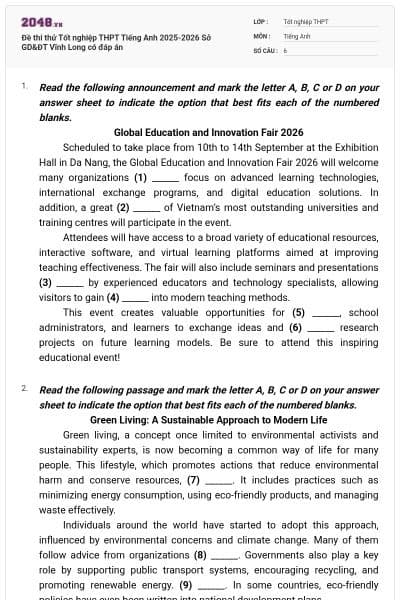
Read the following announcement and mark the letter A, B, C or D on your answer sheet to indicate the option that best fits each of the numbered blanks from 1 to 6.
Songkran Festival – Thailand’s Traditional New Year Celebration
Songkran is set to take place across Thailand as a nationwide cultural celebration next month. Each year, this festival attracts millions of international visitors (1) _____ seek to experience its blend of tradition and festivity. The Tourism Authority of Thailand has confirmed that all planned activities will proceed as scheduled, reflecting a (2) _____ commitment to preserving cultural heritage while promoting tourism development.
Recognized by UNESCO as an Intangible Cultural Heritage, Songkran allows communities to (3) _____ ancient rituals such as water-pouring ceremonies for elders and merit-making at temples, which remain deeply rooted in Thai society. In Bangkok, large-scale events are expected to attract thousands of participants, offering (4) _____ unique chance to experience Thailand’s traditional New Year atmosphere firsthand. Organizers also provide (5) _____ services to ensure smooth coordination and public safety throughout the festival period. Visitors are encouraged to (6) _____ the festive spirit and take part in the nationwide celebration of renewal, unity, and joy.
(Adapted from https://www.tatnews.org/2026/03/songkran-festival/)
who
which
whom
whose
A. who: đại từ quan hệ thay thế cho danh từ chỉ người (đóng vai trò làm chủ ngữ).
B. which: đại từ quan hệ thay thế cho danh từ chỉ vật/sự việc.
C. whom: đại từ quan hệ thay thế cho danh từ chỉ người (đóng vai trò làm tân ngữ).
D. whose: đại từ quan hệ chỉ sự sở hữu.
Phía trước khoảng trống là danh từ chỉ người “international visitors” (những du khách quốc tế). Phía sau khoảng trống là động từ “seek” (tìm kiếm). Do đó, ta cần một đại từ quan hệ chỉ người và đóng vai trò làm chủ ngữ trong mệnh đề.
Chọn A. who
→ ...attracts millions of international visitors who seek to experience its blend of tradition and festivity.
Dịch nghĩa: ...thu hút hàng triệu du khách quốc tế, những người mà tìm kiếm trải nghiệm sự hòa quyện giữa truyền thống và không khí lễ hội của nó.
individual
superficial
shared
separate
A. individual (adj): cá nhân.
B. superficial (adj): hời hợt, bề ngoài.
C. shared (adj): chung, được chia sẻ.
D. separate (adj): riêng biệt.
Ta có cụm từ a shared commitment (một cam kết chung).
Trong bối cảnh này, việc tổ chức lễ hội diễn ra đúng kế hoạch thể hiện một “cam kết chung” của các ban ngành trong việc vừa bảo tồn di sản văn hóa vừa thúc đẩy phát triển du lịch.
Chọn C. shared
→ ...reflecting a shared commitment to preserving cultural heritage while promoting tourism development.
Dịch nghĩa: ...phản ánh một cam kết chung trong việc bảo tồn di sản văn hóa đồng thời thúc đẩy phát triển du lịch.
bring about
carry out
take over
turn into
A. bring about (phr.v): mang lại, gây ra (sự thay đổi).
B. carry out (phr.v): tiến hành, thực hiện.
C. take over (phr.v): tiếp quản.
D. turn into (phr.v): biến thành.
Phía sau khoảng trống là cụm danh từ “ancient rituals” (các nghi lễ cổ xưa). Động từ theo cụm phù hợp nhất đi kèm với các nghi lễ, nhiệm vụ, hoặc dự án là “carry out” (thực hiện/tiến hành).
Chọn B. carry out
→ ...Songkran allows communities to carry out ancient rituals...
Dịch nghĩa: ...Songkran cho phép các cộng đồng thực hiện các nghi lễ cổ xưa...
Ø
an
a
the
A. Ø: không dùng mạo từ.
B. an: mạo từ không xác định (đứng trước danh từ/cụm danh từ bắt đầu bằng nguyên âm).
C. a: mạo từ không xác định (đứng trước danh từ/cụm danh từ bắt đầu bằng phụ âm).
D. the: mạo từ xác định.
“chance” (cơ hội) là một danh từ đếm được số ít và chưa được xác định trước đó nên ta phải dùng “a” hoặc “an”. Từ tiếp theo ngay sau mạo từ là tính từ “unique” (độc đáo). Mặc dù bắt đầu bằng chữ “u”, nhưng “unique” được phiên âm là /juːˈniːk/ (bắt đầu bằng phụ âm /j/). Do đó, ta phải dùng mạo từ “a”.
Chọn C. a
→ ...offering a unique chance to experience Thailand’s traditional New Year atmosphere firsthand.
Dịch nghĩa: ...mang đến một cơ hội độc đáo để trực tiếp trải nghiệm bầu không khí Năm mới truyền thống của Thái Lan.
reliably
reliance
reliable
rely
A. reliably (adv): một cách đáng tin cậy.
B. reliance (n): sự tin cậy, sự phụ thuộc.
C. reliable (adj): đáng tin cậy.
D. rely (v): tin cậy, phụ thuộc.
Phía sau khoảng trống là danh từ “services” (các dịch vụ). Theo quy tắc trật tự từ cơ bản, ta cần điền một tính từ đứng trước để bổ nghĩa cho danh từ đó.
Chọn C. reliable
→ Organizers also provide reliable services to ensure smooth coordination...
Dịch nghĩa: Các nhà tổ chức cũng cung cấp những dịch vụ đáng tin cậy để đảm bảo sự điều phối suôn sẻ...
make
keep
seize
handle
A. make (v): làm, tạo ra.
B. keep (v): giữ, duy trì.
C. seize (v): nắm bắt (cơ hội).
D. handle (v): xử lý.
Ta có cụm từ: keep the festive spirit: duy trì / giữ gìn tinh thần lễ hội
Chọn B. keep
→ Visitors are encouraged to keep the festive spirit and take part in...
Dịch nghĩa: Du khách được khuyến khích duy trì tinh thần lễ hội và tham gia vào...
Bài đọc hoàn chỉnh | Dịch bài đọc |
Songkran Festival – Thailand’s Traditional New Year Celebration Songkran is set to take place across Thailand as a nationwide cultural celebration next month. Each year, this festival attracts millions of international visitors (1) who seek to experience its blend of tradition and festivity. The Tourism Authority of Thailand has confirmed that all planned activities will proceed as scheduled, reflecting a (2) shared commitment to preserving cultural heritage while promoting tourism development. Recognized by UNESCO as an Intangible Cultural Heritage, Songkran allows communities to (3) carry out ancient rituals such as water-pouring ceremonies for elders and merit-making at temples, which remain deeply rooted in Thai society. In Bangkok, large-scale events are expected to attract thousands of participants, offering (4) a unique chance to experience Thailand’s traditional New Year atmosphere firsthand. Organizers also provide (5) reliable services to ensure smooth coordination and public safety throughout the festival period. Visitors are encouraged to (6) keep the festive spirit and take part in the nationwide celebration of renewal, unity, and joy. | Lễ Hội Songkran – Lễ Kỷ Niệm Năm Mới Truyền Thống Của Thái Lan Songkran dự kiến sẽ diễn ra trên khắp Thái Lan như một lễ hội văn hóa toàn quốc vào tháng tới. Mỗi năm, lễ hội này thu hút hàng triệu du khách quốc tế, (1) những người tìm kiếm trải nghiệm sự hòa quyện giữa truyền thống và không khí lễ hội của nó. Tổng cục Du lịch Thái Lan đã xác nhận rằng tất cả các hoạt động theo kế hoạch sẽ diễn ra đúng lịch trình, phản ánh một cam kết (2) chung trong việc bảo tồn di sản văn hóa đồng thời thúc đẩy phát triển du lịch. Được UNESCO công nhận là Di sản Văn hóa Phi vật thể, Songkran cho phép các cộng đồng (3) thực hiện các nghi lễ cổ xưa như lễ rưới nước cho người lớn tuổi và làm công đức tại các ngôi chùa, những điều vẫn luôn bắt rễ sâu sắc trong xã hội Thái Lan. Tại Bangkok, các sự kiện quy mô lớn được kỳ vọng sẽ thu hút hàng ngàn người tham gia, mang đến (4) một cơ hội độc đáo để trực tiếp trải nghiệm bầu không khí Năm mới truyền thống của Thái Lan. Các nhà tổ chức cũng cung cấp các dịch vụ (5) đáng tin cậy để đảm bảo sự điều phối suôn sẻ và an toàn công cộng trong suốt thời gian diễn ra lễ hội. Du khách được khuyến khích (6) duy trì tinh thần lễ hội và tham gia vào lễ kỷ niệm toàn quốc về sự đổi mới, đoàn kết và niềm vui. |
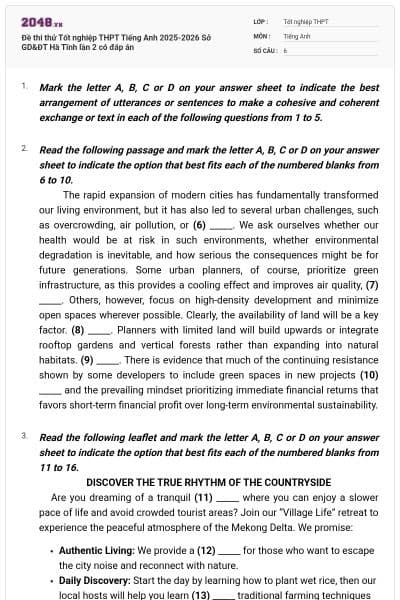
Mark the letter A, B, C or D on your answer sheet to indicate the best arrangement of utterances or sentences to make a cohesive and coherent exchange or text in each of the following questions from 7 to 11.
a. I often had to work late shifts and deal with demanding customers, which occasionally left me feeling quite overwhelmed and stressed.
b. What initially seemed like a manageable job gradually turned out to be far more demanding and challenging than I had expected.
c. Looking back, this experience played a significant role in helping me become more responsible and improving my communication skills.
d. Working in a small café as a part-time employee provided me with valuable insights into the practical realities of working life.
e. Rather than giving up, I learned to manage my time more effectively and handle difficult situations with greater patience and resilience.
b – d – a – e – c
d – b – a – e – c
d – b – e – a – c
b – a – d – c – e
Thứ tự sắp xếp đúng: B. d – b – a – e – c
d. Working in a small café as a part-time employee provided me with valuable insights into the practical realities of working life.
b. What initially seemed like a manageable job gradually turned out to be far more demanding and challenging than I had expected.
a. I often had to work late shifts and deal with demanding customers, which occasionally left me feeling quite overwhelmed and stressed.
e. Rather than giving up, I learned to manage my time more effectively and handle difficult situations with greater patience and resilience.
c. Looking back, this experience played a significant role in helping me become more responsible and improving my communication skills.
Dịch nghĩa:
d. Làm nhân viên bán thời gian tại một quán cà phê nhỏ đã mang lại cho tôi những cái nhìn sâu sắc và giá trị về thực tế thực tiễn của cuộc sống đi làm.
b. Công việc mà ban đầu tưởng chừng như có thể quản lý được dần dần lại trở nên đòi hỏi khắt khe và đầy thử thách hơn nhiều so với những gì tôi đã mong đợi.
a. Tôi thường xuyên phải làm ca muộn và đối phó với những khách hàng khó tính, điều này thỉnh thoảng khiến tôi cảm thấy khá quá sức và căng thẳng.
e. Thay vì bỏ cuộc, tôi đã học cách quản lý thời gian của mình hiệu quả hơn và xử lý những tình huống khó khăn với sự kiên nhẫn và sức chịu đựng lớn hơn.
c. Nhìn lại, trải nghiệm này đóng một vai trò quan trọng trong việc giúp tôi trở nên có trách nhiệm hơn và cải thiện các kỹ năng giao tiếp của mình.
Chọn B.
a. Tom: Thank you so much! I really appreciate your feedback.
b. Anna: I really enjoyed your presentation - it was clear, engaging, and very informative.
c. Anna: You're welcome. I especially liked the way you explained the key points so clearly.
b – c – a
a – b – c
c – a – b
b – a – c
Thứ tự sắp xếp đúng: D. b – a – c
b. Anna: I really enjoyed your presentation - it was clear, engaging, and very informative.
a. Tom: Thank you so much! I really appreciate your feedback.
c. Anna: You're welcome. I especially liked the way you explained the key points so clearly.
Dịch nghĩa:
b. Anna: Tớ thực sự rất thích bài thuyết trình của cậu - nó rõ ràng, lôi cuốn và cung cấp rất nhiều thông tin hữu ích.
a. Tom: Cảm ơn cậu rất nhiều! Tớ thực sự đánh giá cao những lời nhận xét của cậu.
c. Anna: Không có gì đâu. Tớ đặc biệt thích cái cách cậu giải thích những điểm chính một cách thật rõ ràng.
Chọn D.
a. Lan: I usually volunteer at a local shelter at weekends. What about you?
b. Lan: That sounds really meaningful. I believe volunteering is a great way to support others and gain valuable experience.
c. Minh: I'm involved in organizing charity events and raising funds for children in need.
d. Minh: You seem to be very active in community work. What kind of volunteer activities do you usually take part in?
e. Minh: I totally agree. It also helps us develop important life skills.
d – a – c – b – e
a – c – d – b – e
d – c – a – b – e
a – d – c – e – b
Thứ tự sắp xếp đúng: A. d – a – c – b – e
d. Minh: You seem to be very active in community work. What kind of volunteer activities do you usually take part in?
a. Lan: I usually volunteer at a local shelter at weekends. What about you?
c. Minh: I'm involved in organizing charity events and raising funds for children in need.
b. Lan: That sounds really meaningful. I believe volunteering is a great way to support others and gain valuable experience.
e. Minh: I totally agree. It also helps us develop important life skills.
Dịch nghĩa:
d. Minh: Cậu có vẻ rất tích cực trong các công việc cộng đồng. Cậu thường tham gia vào những loại hoạt động tình nguyện nào vậy?
a. Lan: Tớ thường làm tình nguyện tại một mái ấm địa phương vào những ngày cuối tuần. Còn cậu thì sao?
c. Minh: Tớ tham gia vào việc tổ chức các sự kiện từ thiện và gây quỹ cho trẻ em có hoàn cảnh khó khăn.
b. Lan: Nghe thực sự ý nghĩa đấy. Tớ tin rằng làm tình nguyện là một cách tuyệt vời để hỗ trợ người khác và có được những trải nghiệm quý giá.
e. Minh: Tớ hoàn toàn đồng ý. Nó cũng giúp chúng ta phát triển những kỹ năng sống quan trọng.
Chọn A.
a. Taken as a whole, these developments illustrate how mass media has evolved into a highly networked system characterized by immediacy, personalization, and global reach.
b. A key driver of this transformation was the expansion of broadband internet, which enabled the rapid distribution of digital content across multiple platforms.
c. Between 2010 and 2025, the mass media ecosystem underwent a structural shift that redefined how information was produced, distributed, and consumed.
d. As user engagement increased on social platforms, traditional advertising gradually lost effectiveness, prompting firms to adopt data-driven targeting strategies.
e. This digital acceleration also contributed to the decline of traditional print media, as audiences increasingly shifted toward real-time online updates.
c – e – b – a – d
c – d – b – a – e
c – b – e – d – a
c – b – d – e – a
Thứ tự sắp xếp đúng: C. c – b – e – d – a
c. Between 2010 and 2025, the mass media ecosystem underwent a structural shift that redefined how information was produced, distributed, and consumed.
b. A key driver of this transformation was the expansion of broadband internet, which enabled the rapid distribution of digital content across multiple platforms.
e. This digital acceleration also contributed to the decline of traditional print media, as audiences increasingly shifted toward real-time online updates.
d. As user engagement increased on social platforms, traditional advertising gradually lost effectiveness, prompting firms to adopt data-driven targeting strategies.
a. Taken as a whole, these developments illustrate how mass media has evolved into a highly networked system characterized by immediacy, personalization, and global reach.
Dịch nghĩa:
c. Từ năm 2010 đến năm 2025, hệ sinh thái phương tiện thông tin đại chúng đã trải qua một sự chuyển dịch mang tính cấu trúc nhằm tái định nghĩa cách thức thông tin được sản xuất, phân phối và tiêu thụ.
b. Động lực chính của sự chuyển đổi này là sự mở rộng của internet băng thông rộng, cho phép phân phối nhanh chóng nội dung kỹ thuật số trên nhiều nền tảng.
e. Sự tăng tốc kỹ thuật số này cũng góp phần vào sự suy thoái của báo in truyền thống, khi khán giả ngày càng chuyển sang theo dõi các cập nhật trực tuyến theo thời gian thực.
d. Khi mức độ tương tác của người dùng trên các nền tảng xã hội tăng lên, quảng cáo truyền thống dần mất đi tính hiệu quả, thúc đẩy các công ty áp dụng các chiến lược nhắm mục tiêu dựa trên dữ liệu.
a. Nhìn chung, những sự phát triển này minh họa cho việc các phương tiện thông tin đại chúng đã tiến hóa thành một hệ thống được kết nối mạng lưới cao độ với đặc trưng là tính tức thời, tính cá nhân hóa và phạm vi tiếp cận toàn cầu.
Chọn C.
Dear Mr. Hoang,
a. I would greatly appreciate it if you could provide further details regarding any initial responsibilities or expectations associated with this position.
b. I am writing to formally express my sincere appreciation for offering me the position at GHI Group.
c. I am fully committed to leveraging my professional experience and skills to make a meaningful contribution to the organization.
d. I look forward to the prospect of working alongside a team of highly skilled professionals and contributing to common objectives.
e. This opportunity represents a significant milestone in my career, and I am truly honored to have been selected.
Yours sincerely,
Thuy Nguyen
b – e – c – d – a
b – c – d – e – a
c – b – e – d – a
c – e – b – d – a
Thứ tự sắp xếp đúng: A. b – e – c – d – a
b. I am writing to formally express my sincere appreciation for offering me the position at GHI Group.
e. This opportunity represents a significant milestone in my career, and I am truly honored to have been selected.
c. I am fully committed to leveraging my professional experience and skills to make a meaningful contribution to the organization.
d. I look forward to the prospect of working alongside a team of highly skilled professionals and contributing to common objectives.
a. I would greatly appreciate it if you could provide further details regarding any initial responsibilities or expectations associated with this position.
Dịch nghĩa:
Kính gửi anh Hoàng,
b. Tôi viết thư này để chính thức bày tỏ sự biết ơn chân thành của mình vì anh đã đề nghị trao cho tôi vị trí tại Tập đoàn GHI.
e. Cơ hội này đại diện cho một cột mốc quan trọng trong sự nghiệp của tôi, và tôi thực sự rất vinh dự khi được lựa chọn.
c. Tôi cam kết sẽ tận dụng tối đa kinh nghiệm chuyên môn và các kỹ năng của mình để tạo ra một sự đóng góp đầy ý nghĩa cho tổ chức.
d. Tôi rất mong đợi viễn cảnh được làm việc cùng một đội ngũ gồm những chuyên gia tay nghề cao và đóng góp vào các mục tiêu chung.
a. Tôi sẽ rất cảm kích nếu anh có thể cung cấp thêm các chi tiết về bất kỳ trách nhiệm hoặc kỳ vọng ban đầu nào gắn liền với vị trí này.
Trân trọng,
Thủy Nguyễn
Chọn A.
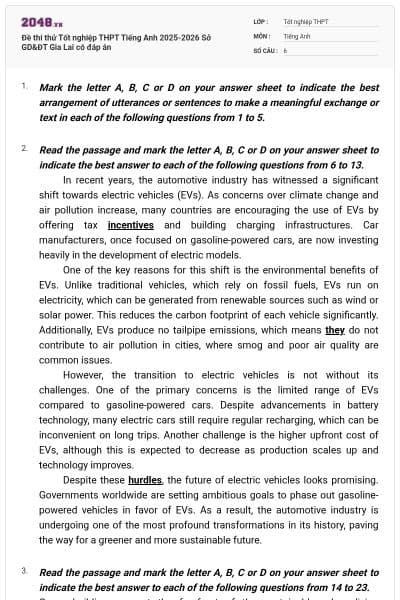
Read the following passage and mark the letter A, B, C or D on your answer sheet to indicate the option that best fits each of the numbered blanks from 12 to 16.
Wildlife tourism involves observing and interacting with animals and plants in their natural habitats, including eco-tourism, safaris, and mountain travel. Much of this activity takes place in protected areas, national parks, and reserves, which serve as key attractions, particularly in Africa. According to UNWTO, wildlife tourism represents about seven percent of global tourism and grows by roughly three percent annually, generating substantial revenue, including millions of dollars in entrance fees for protected areas, (12) _____. Beyond economic benefits, wildlife tourism supports local livelihoods; WWF reports that most natural heritage sites provide recreation, tourism opportunities, and employment, while countries such as Belize depend heavily on reef-related tourism and fisheries. Wildlife also embodies biodiversity, which underpins human health and planetary stability. Species are interconnected within ecological systems, (13) _____.
Tens of thousands of species benefit humanity; and many pharmaceuticals originate from wild plants. However, wildlife faces threats from disease, climate change, poaching, and illegal trade. Strong policies, public awareness, and responsible media coverage are essential to promote conservation. Protecting wildlife sustains biodiversity, supports agriculture, enables scientific research, and maintains ecosystem services such as clean water. (14) _____. To achieve these outcomes, governments must strengthen regulations, encourage community participation, and (15) _____. This balanced approach helps ensure tourism contributes to conservation rather than environmental damage. (16) _____.
(Adapted from https://www.untourism.int/)
highlighted the significant financial value of conserving natural ecosystems
to highlight the significant financial value of conserving natural ecosystems
which highlight the significant financial value of conserving natural ecosystems
highlighting the significant financial value of conserving natural ecosystems
Câu phía trước đang liệt kê các hành động và kết quả của du lịch động vật hoang dã: “...grows by roughly three percent annually, generating substantial revenue, including millions of dollars in entrance fees...” (...tăng trưởng khoảng 3% mỗi năm, tạo ra doanh thu đáng kể, bao gồm hàng triệu đô la phí vào cửa...). Khoảng trống (12) nằm sau dấu phẩy, dùng để bổ sung thông tin chỉ kết quả hoặc tính chất của toàn bộ sự việc vừa được nhắc đến. Ta cần sử dụng một Hiện tại phân từ (V-ing) để tạo thành mệnh đề phân từ (Participle clause).
Dịch nghĩa/Ngữ pháp:
A. highlighted... (Quá khứ phân từ/Động từ quá khứ → Sai ngữ pháp vì không có chủ ngữ hoặc không mang nghĩa bị động trong ngữ cảnh này).
B. to highlight... (Động từ nguyên mẫu có “to” chỉ mục đích → Sai logic vì việc “tạo ra doanh thu” tự nó làm nổi bật giá trị, chứ không phải mục đích của doanh thu là để làm nổi bật).
C. which highlight... (Nếu dùng đại từ quan hệ “which” thay thế cho “entrance fees” hay “dollars” thì động từ chia số nhiều “highlight” có thể đúng ngữ pháp, nhưng về mặt ý nghĩa, CẢ SỰ VIỆC tạo ra doanh thu mới là thứ “làm nổi bật” giá trị. Do đó dùng V-ing rút gọn cho toàn bộ mệnh đề trước là tối ưu nhất).
D. làm nổi bật giá trị tài chính to lớn của việc bảo tồn các hệ sinh thái tự nhiên (Sử dụng V-ing “highlighting” diễn tả kết quả tự nhiên của sự việc ở vế trước, song song với cấu trúc V-ing “generating” ngay phía trước. Rất chuẩn xác).
Đáp án D cung cấp một mệnh đề phân từ V-ing hợp lý, nối tiếp mạch văn diễn tả kết quả trực tiếp của việc ngành du lịch mang lại nhiều tiền.
Chọn D.
→ ...generating substantial revenue, including millions of dollars in entrance fees for protected areas, highlighting the significant financial value of conserving natural ecosystems.
Dịch nghĩa: ...tạo ra doanh thu đáng kể, bao gồm hàng triệu đô la phí vào cửa các khu bảo tồn, làm nổi bật giá trị tài chính to lớn của việc bảo tồn các hệ sinh thái tự nhiên.
so habitat disruption can create cascading effects that threaten life cycles
because ecosystems remain stable despite environmental changes
and species usually adapt immediately to any habitat loss
while ecological systems function independently of one another
Câu chứa chỗ trống bắt đầu bằng nhận định: “Species are interconnected within ecological systems,” (Các loài có sự liên kết chặt chẽ với nhau trong các hệ sinh thái,). Từ khóa ở đây là “interconnected” (liên kết/phụ thuộc lẫn nhau). Vị trí (13) nằm sau dấu phẩy, cần một mệnh đề chỉ ra hệ quả tất yếu của sự liên kết này.
Dịch nghĩa/Ngữ pháp:
A. vì vậy sự phá vỡ môi trường sống có thể tạo ra các hiệu ứng dây chuyền đe dọa các chu kỳ sống (Khớp logic: Vì chúng liên kết với nhau, nên khi một mắt xích bị hỏng (disruption), nó sẽ tạo ra phản ứng dây chuyền (cascading effects) ảnh hưởng đến những loài khác).
B. bởi vì các hệ sinh thái vẫn ổn định bất chấp những thay đổi môi trường
(Sai logic: Trái ngược với thực tế và không liên quan đến từ “interconnected”).
C. và các loài thường thích nghi ngay lập tức với bất kỳ sự mất mát môi trường sống nào
(Sai thực tế sinh học và sai logic).
D. trong khi các hệ sinh thái hoạt động độc lập với nhau
(Từ “independently” - độc lập - đi ngược hoàn toàn với “interconnected” - liên kết).
Đáp án A đưa ra hệ quả trực tiếp và khoa học nhất của sự phụ thuộc lẫn nhau giữa các loài trong tự nhiên.
Chọn A.
→ Species are interconnected within ecological systems, so habitat disruption can create cascading effects that threaten life cycles.
Dịch nghĩa: Các loài có sự liên kết chặt chẽ với nhau trong các hệ sinh thái, vì vậy sự phá vỡ môi trường sống có thể tạo ra các hiệu ứng dây chuyền đe dọa các chu kỳ sống.
This ensures tourism activities rarely influence environmental protection policies
This reduces the importance of biodiversity for long-term development
This demonstrates how conservation efforts benefit both nature and communities
This prevents governments from investing in wildlife protection programs
Câu liền trước liệt kê hàng loạt lợi ích của việc bảo vệ động vật hoang dã: duy trì đa dạng sinh học, hỗ trợ nông nghiệp, tạo điều kiện cho nghiên cứu khoa học và duy trì các dịch vụ hệ sinh thái (như nước sạch). Đây là những lợi ích bao trùm cho cả thiên nhiên và con người. Khoảng trống (14) cần một câu tổng kết lại ý nghĩa của toàn bộ danh sách lợi ích vừa nêu.
Dịch nghĩa/Ngữ pháp:
A. Điều này đảm bảo các hoạt động du lịch hiếm khi ảnh hưởng đến các chính sách bảo vệ môi trường (Sai logic và lạc đề).
B. Điều này làm giảm tầm quan trọng của đa dạng sinh học đối với sự phát triển dài hạn (Sai logic vì câu trước đang ca ngợi lợi ích).
C. Điều này chứng minh các nỗ lực bảo tồn mang lại lợi ích cho cả thiên nhiên và cộng đồng như thế nào (Đại từ “This” tóm gọn toàn bộ câu trước. Cụm “both nature and communities” khái quát cực kỳ chính xác các lợi ích như đa dạng sinh học (nature) và nông nghiệp/nước sạch (communities)).
D. Điều này ngăn cản các chính phủ đầu tư vào các chương trình bảo vệ động vật hoang dã (Sai logic: Lợi ích nhiều thì phải khuyến khích đầu tư chứ không phải ngăn cản).
Đáp án C cung cấp một câu chốt ý mạch lạc, thâu tóm được trọn vẹn thông điệp của câu liệt kê phía trước.
Chọn C.
→ Protecting wildlife sustains biodiversity, supports agriculture, enables scientific research, and maintains ecosystem services such as clean water. This demonstrates how conservation efforts benefit both nature and communities.
Dịch nghĩa: Bảo vệ động vật hoang dã duy trì đa dạng sinh học, hỗ trợ nông nghiệp, tạo điều kiện cho nghiên cứu khoa học và duy trì các dịch vụ hệ sinh thái như nước sạch. Điều này chứng minh các nỗ lực bảo tồn mang lại lợi ích cho cả thiên nhiên và cộng đồng như thế nào.
reduce oversight in order to facilitate rapid tourism expansion across vulnerable regions
delegate environmental responsibility entirely to private sector stakeholders
prioritise short-term economic gains over long-term environmental sustainability
implement measures that align tourism development with ecological preservation goals
Đây là cấu trúc liệt kê song song (Parallelism) với các động từ đứng sau trợ động từ “must” (phải): “governments must strengthen regulations, encourage community participation, and (15) [V-nguyên thể]”. Vị trí (15) cần một cụm động từ mang ý nghĩa tích cực, mang tính giải pháp để đạt được các kết quả tốt đẹp (To achieve these outcomes...). Thêm vào đó, câu ngay sau viết: “This balanced approach helps...” (Cách tiếp cận cân bằng này giúp...). Vậy khoảng trống (15) phải nhắc đến một hành động tạo ra sự “cân bằng”.
Dịch nghĩa/Ngữ pháp:
A. giảm bớt sự giám sát nhằm tạo điều kiện cho việc mở rộng du lịch nhanh chóng...
(Sai logic: Mang ý nghĩa tiêu cực, phá hoại môi trường).
B. giao phó toàn bộ trách nhiệm môi trường cho các bên liên quan thuộc khu vực tư nhân
(Sai logic: Chính phủ không thể đẩy hết trách nhiệm cho tư nhân).
C. ưu tiên lợi ích kinh tế ngắn hạn hơn tính bền vững môi trường dài hạn
(Sai logic: Đi ngược lại tinh thần bảo tồn của bài).
D. thực thi các biện pháp giúp điều chỉnh sự phát triển du lịch phù hợp với các mục tiêu bảo tồn sinh thái (Hoàn toàn chính xác: Sự kết hợp giữa “phát triển du lịch” và “bảo tồn sinh thái” chính là lời giải thích hoàn hảo cho cụm từ “balanced approach” ở câu ngay sau đó).
Đáp án D không chỉ tuân thủ cấu trúc ngữ pháp song song mà còn tạo ra sự liên kết từ vựng tuyệt vời (align/balance) với câu tiếp theo.
Chọn D.
→ To achieve these outcomes, governments must strengthen regulations, encourage community participation, and implement measures that align tourism development with ecological preservation goals.
Dịch nghĩa: Để đạt được những kết quả này, chính phủ các nước phải tăng cường các quy định, khuyến khích sự tham gia của cộng đồng, và thực thi các biện pháp giúp điều chỉnh sự phát triển du lịch phù hợp với các mục tiêu bảo tồn sinh thái.
This balanced approach helps ensure tourism contributes to conservation rather than environmental damage. (16) _____.
Consequently, sustainable wildlife tourism can reinforce ecological integrity while enhancing long-term economic resilience
In parallel, local communities may remain marginalised from conservation initiatives and associated economic opportunities
Accordingly, wildlife conservation maintains limited relevance to broader sustainability goals and policy frameworks
Nevertheless, expanding tourism infrastructure often accelerates environmental degradation and undermines ecological stability
Khoảng trống (16) nằm ở cuối đoạn, đóng vai trò là một câu kết luận (Concluding sentence). Câu phía trước đó nói: “This balanced approach helps ensure tourism contributes to conservation rather than environmental damage.” (Cách tiếp cận cân bằng này giúp đảm bảo du lịch đóng góp vào việc bảo tồn thay vì làm tổn hại môi trường). Câu kết luận cần phải tiếp nối ý tích cực này và khẳng định lại bức tranh toàn cảnh mang tính chiến lược của du lịch sinh thái.
Dịch nghĩa:
A. Hậu quả là/Do đó, du lịch động vật hoang dã bền vững có thể củng cố tính toàn vẹn sinh thái trong khi nâng cao khả năng phục hồi kinh tế dài hạn (Sử dụng liên từ “Consequently”, kết hợp cả 2 khía cạnh “ecological integrity” (bảo vệ thiên nhiên) và “economic resilience” (lợi ích tài chính). Đây là một lời tổng kết xuất sắc và toàn diện cho cả bài đọc).
B. Song song đó, các cộng đồng địa phương có thể vẫn bị gạt ra ngoài lề các sáng kiến bảo tồn và các cơ hội kinh tế liên quan. (Sai logic: Câu kết luận mang tính tiêu cực, đi ngược lại nỗ lực ở các câu trước).
C. Do đó, bảo tồn động vật hoang dã duy trì sự liên quan hạn chế đến các mục tiêu bền vững rộng hơn và các khuôn khổ chính sách. (Sai logic: Mang ý nghĩa tiêu cực).
D. Tuy nhiên, việc mở rộng cơ sở hạ tầng du lịch thường đẩy nhanh quá trình suy thoái môi trường và làm suy yếu sự ổn định sinh thái. (Sai logic: Đây là câu nêu vấn đề, không phù hợp làm câu kết luận ngợi ca “balanced approach”).
Đáp án A là lựa chọn duy nhất mang sắc thái tích cực, đúc kết được lợi ích kép (kinh tế - môi trường) của giải pháp đã nêu.
Chọn A.
→ This balanced approach helps ensure tourism contributes to conservation rather than environmental damage. Consequently, sustainable wildlife tourism can reinforce ecological integrity while enhancing long-term economic resilience.
Dịch nghĩa: Cách tiếp cận cân bằng này giúp đảm bảo du lịch đóng góp vào việc bảo tồn thay vì làm tổn hại môi trường. Do đó, du lịch động vật hoang dã bền vững có thể củng cố tính toàn vẹn sinh thái trong khi nâng cao khả năng phục hồi kinh tế dài hạn.
Bài đọc hoàn chỉnh | Dịch bài đọc |
Wildlife tourism involves observing and interacting with animals and plants in their natural habitats, including eco-tourism, safaris, and mountain travel. Much of this activity takes place in protected areas, national parks, and reserves, which serve as key attractions, particularly in Africa. According to UNWTO, wildlife tourism represents about seven percent of global tourism and grows by roughly three percent annually, generating substantial revenue, including millions of dollars in entrance fees for protected areas, highlighting the significant financial value of conserving natural ecosystems. Beyond economic benefits, wildlife tourism supports local livelihoods; WWF reports that most natural heritage sites provide recreation, tourism opportunities, and employment, while countries such as Belize depend heavily on reef-related tourism and fisheries. Wildlife also embodies biodiversity, which underpins human health and planetary stability. Species are interconnected within ecological systems, so habitat disruption can create cascading effects that threaten life cycles. Tens of thousands of species benefit humanity; and many pharmaceuticals originate from wild plants. However, wildlife faces threats from disease, climate change, poaching, and illegal trade. Strong policies, public awareness, and responsible media coverage are essential to promote conservation. Protecting wildlife sustains biodiversity, supports agriculture, enables scientific research, and maintains ecosystem services such as clean water. This demonstrates how conservation efforts benefit both nature and communities. To achieve these outcomes, governments must strengthen regulations, encourage community participation, and implement measures that align tourism development with ecological preservation goals. This balanced approach helps ensure tourism contributes to conservation rather than environmental damage. Consequently, sustainable wildlife tourism can reinforce ecological integrity while enhancing long-term economic resilience. | Du lịch động vật hoang dã bao gồm việc quan sát và tương tác với các loài động thực vật trong môi trường sống tự nhiên của chúng, bao gồm du lịch sinh thái, các chuyến đi săn (safari) và du lịch leo núi. Phần lớn hoạt động này diễn ra tại các khu bảo tồn, công viên quốc gia và khu dự trữ sinh quyển, những nơi đóng vai trò là điểm thu hút chính, đặc biệt là ở châu Phi. Theo Tổ chức Du lịch Thế giới (UNWTO), du lịch động vật hoang dã chiếm khoảng 7% du lịch toàn cầu và tăng trưởng khoảng 3% mỗi năm, tạo ra doanh thu đáng kể, bao gồm hàng triệu đô la phí vào cửa các khu bảo tồn, làm nổi bật giá trị tài chính to lớn của việc bảo tồn các hệ sinh thái tự nhiên. Vượt ra ngoài những lợi ích kinh tế, du lịch động vật hoang dã hỗ trợ sinh kế của người dân địa phương; Quỹ Quốc tế Bảo vệ Thiên nhiên (WWF) báo cáo rằng hầu hết các di sản thiên nhiên đều cung cấp các cơ hội giải trí, du lịch và việc làm, trong khi các quốc gia như Belize phụ thuộc rất nhiều vào du lịch và nghề cá liên quan đến rạn san hô. Động vật hoang dã cũng hiện thân cho đa dạng sinh học, nền tảng cho sức khỏe con người và sự ổn định của hành tinh. Các loài có sự liên kết chặt chẽ với nhau trong các hệ sinh thái, vì vậy sự phá vỡ môi trường sống có thể tạo ra các hiệu ứng dây chuyền đe dọa các chu kỳ sống. Hàng chục nghìn loài mang lại lợi ích cho nhân loại; và nhiều loại dược phẩm có nguồn gốc từ các loài thực vật hoang dã. Tuy nhiên, động vật hoang dã đang phải đối mặt với các mối đe dọa từ dịch bệnh, biến đổi khí hậu, săn trộm và buôn bán bất hợp pháp. Các chính sách mạnh mẽ, nhận thức của công chúng và việc đưa tin có trách nhiệm của giới truyền thông là rất cần thiết để thúc đẩy công tác bảo tồn. Bảo vệ động vật hoang dã duy trì đa dạng sinh học, hỗ trợ nông nghiệp, tạo điều kiện cho nghiên cứu khoa học và duy trì các dịch vụ hệ sinh thái như nước sạch. Điều này chứng minh các nỗ lực bảo tồn mang lại lợi ích cho cả thiên nhiên và cộng đồng như thế nào. Để đạt được những kết quả này, chính phủ các nước phải tăng cường các quy định, khuyến khích sự tham gia của cộng đồng, và thực thi các biện pháp giúp điều chỉnh sự phát triển du lịch phù hợp với các mục tiêu bảo tồn sinh thái. Cách tiếp cận cân bằng này giúp đảm bảo du lịch đóng góp vào việc bảo tồn thay vì làm tổn hại môi trường. Do đó, du lịch động vật hoang dã bền vững có thể củng cố tính toàn vẹn sinh thái trong khi nâng cao khả năng phục hồi kinh tế dài hạn. |
Read the passage and mark the letter A, B, C or D on your answer sheet to indicate the best answer to each of the following questions from 17 to 26.
Why we crave dessert even when we are full
Even after eating a large meal, most people can still find room for sweets. Now, research in mice shows that the neurons behind feeling full also trigger sugar cravings. In other words, there seems to be a neurological basis for our love of dessert. (I)
Previous studies have shown that naturally occurring opioids in the brain play a crucial role in sugar cravings. The main producers of these opioids are neurons located in a brain region that regulates appetite, metabolism and hormones. Known as pro-opiomelanocortin (POMC) neurons, they also control feelings of satiety after eating.
To understand whether these cells have a role in sugar cravings, Henning Fenselau at the Max Planck Institute for Metabolism Research in Germany and his colleagues traced the opioid signals that POMC cells send in the brain. They did so by bathing brain slices from three mice in a fluorescent solution that binds to receptors of these opioids. (II) The brain region with the highest density of these receptors was the paraventricular nucleus of the thalamus (PVT), known to regulate feeding. That suggested sugar cravings were related to communication between these two brain regions. This observation provided a clearer map of the neural circuitry involved, allowing the researchers to focus on specific pathways rather than general brain activity. It also helped establish a functional link between receptor density and behavioural outcomes related to food intake, thereby strengthening the overall reliability of their experimental approach. (III)
Subsequently, the researchers monitored the activity of neurons in these regions as mice ate their usual food. When the animals seemed to be full, the team gave them a dessert of sugary chow. (IV) On average, neuronal activity between the brain regions roughly quadrupled while mice ate dessert compared with their regular meal. The spike began prior to eating the sweets, suggesting the pathway dictates sugar cravings. When the team inhibited signals from POMC neurons to the PVT, the mice consumed 40 percent less dessert. “The cell types, which are extremely well-known for driving satiety, also release signals that cause the appetite for sugar, and they do so particularly in the state of satiety,” says Fenselau. “This would explain why animals – humans – over-consume sugar when they’re actually full.” The pathway may have evolved because sugar is more easily turned into energy than other sources like fats or proteins.
(Adapted from New Scientist, issue dated March 22, 2025)
Naturally produced compounds in the brain involved in regulating cravings
External dietary sugars that stimulate neural activity
Chemical substances artificially introduced in experimental conditions
Hormonal secretions responsible for digestion and metabolism
Cụm từ “these opioids” trong đoạn 2 chỉ _____.
A. Các hợp chất được sản xuất tự nhiên trong não tham gia vào việc điều chỉnh cảm giác thèm ăn. (Đúng)
B. Các loại đường trong chế độ ăn uống bên ngoài kích thích hoạt động thần kinh. (Sai)
C. Các chất hóa học được đưa vào nhân tạo trong điều kiện thí nghiệm. (Sai)
D. Dịch tiết nội tiết tố chịu trách nhiệm cho quá trình tiêu hóa và trao đổi chất. (Sai)
Thông tin: “Previous studies have shown that naturally occurring opioids in the brain play a crucial role in sugar cravings. The main producers of these opioids are neurons...” (Các nghiên cứu trước đây đã chỉ ra rằng các opioid xuất hiện tự nhiên trong não đóng một vai trò quan trọng trong cảm giác thèm đường. Các tế bào sản xuất chính ra những opioid này là các tế bào thần kinh...).
→ Do đó, “these opioids” thay thế cho các hợp chất sản sinh tự nhiên trong não.
Chọn A.
The wordsatiety in paragraph 2 is CLOSEST in meaning to _____.
desire
digestion
hunger
fullness
Từ “satiety” trong đoạn 2 GẦN NGHĨA NHẤT với _____.
satiety (n): sự no bụng, cảm giác no thỏa mãn
A. desire (n): sự thèm muốn
B. digestion (n): sự tiêu hóa
C. hunger (n): cơn đói
D. fullness (n): sự no bụng, cảm giác đầy bụng (Đúng)
Thông tin: Known as pro-opiomelanocortin (POMC) neurons, they also control feelings of satiety after eating. (Được gọi là tế bào thần kinh pro-opiomelanocortin (POMC), chúng cũng kiểm soát cảm giác no sau khi ăn.)
→ Trong ngữ cảnh ăn uống, “satiety after eating” (sự no nê sau khi ăn) đồng nghĩa với “fullness”.
Chọn D.
The word traced in paragraph 3 is OPPOSITE in meaning to _____.
ignored
eliminated
followed
concealed
Từ “traced” trong đoạn 3 TRÁI NGHĨA với _____.
trace (v): theo dấu, theo dõi, vạch ra
A. ignored (v): phớt lờ, bỏ qua, không chú ý (Trái nghĩa)
B. eliminated (v): loại bỏ
C. followed (v): đi theo, theo dõi (Đồng nghĩa)
D. concealed (v): che giấu
Thông tin: To understand whether these cells have a role in sugar cravings, Henning Fenselau at the Max Planck Institute for Metabolism Research in Germany and his colleagues traced the opioid signals that POMC cells send in the brain. (Để hiểu liệu những tế bào này có vai trò trong chứng thèm đường hay không, Henning Fenselau tại Viện Nghiên cứu Chuyển hóa Max Planck ở Đức và các đồng nghiệp đã theo dõi các tín hiệu opioid mà tế bào POMC gửi đi trong não.)
→ traced (theo dấu) >< ignored (bỏ qua, phớt lờ).
Chọn A.
Which of the following isNOT mentioned as a function of POMC neurons?
Influencing satiety
Regulating appetite
Controlling metabolism
Producing insulin
Điều nào sau đây KHÔNG ĐƯỢC NHẮC ĐẾN như một chức năng của các nơ-ron POMC?
A. Ảnh hưởng đến cảm giác no (Có: “...they also control feelings of satiety...”)
B. Điều chỉnh sự thèm ăn (Có: “...regulates appetite...”)
C. Kiểm soát quá trình trao đổi chất (Có: “...regulates... metabolism...”)
D. Sản xuất insulin. (Không được nhắc đến trong bài).
Chọn D.
Where in the passage would the following sentence best fit?
This may help explain why people often continue to crave sweets even after they feel full.
(III)
(II)
(I)
(IV)
Câu sau đây phù hợp nhất với vị trí nào trong bài đọc?
“This may help explain why people often continue to crave sweets even after they feel full.” (Điều này có thể giúp giải thích tại sao mọi người thường tiếp tục thèm đồ ngọt ngay cả sau khi họ cảm thấy no.)
→ Tại vị trí (I) ở cuối đoạn 1, tác giả viết: “Nói cách khác, dường như có một cơ sở thần kinh học cho niềm đam mê đồ tráng miệng của chúng ta.” Việc chèn câu đã cho ngay sau đó là một sự bổ sung hợp lý, áp dụng cái “cơ sở thần kinh học” vừa kết luận vào thực tế hành vi của con người (giải thích tại sao chúng ta vẫn thèm ngọt dù đã no).
Chọn C.
Which of the following statements isTRUE according to the passage?
Neuronal activity increased significantly when mice consumed sweets.
The PVT region has no role in regulating feeding behavior.
Mice ate less dessert when neuronal signals were enhanced properly.
Sugar cravings disappear completely after a large meal each day.
Phát biểu nào sau đây là ĐÚNG theo bài đọc?
A. Hoạt động của tế bào thần kinh tăng lên đáng kể khi chuột tiêu thụ đồ ngọt. (Đúng)
B. Vùng PVT không có vai trò gì trong việc điều chỉnh hành vi ăn uống.
(Sai, đoạn 3 nói nó “known to regulate feeding”).
C. Chuột ăn ít đồ tráng miệng hơn khi các tín hiệu thần kinh được tăng cường đúng cách.
(Sai, chúng ăn ít đi khi tín hiệu bị ức chế - “inhibited”, không phải tăng cường).
D. Cảm giác thèm đường biến mất hoàn toàn sau một bữa ăn lớn mỗi ngày.
(Sai, bài đọc chứng minh điều ngược lại).
Thông tin (Đoạn 4): “On average, neuronal activity between the brain regions roughly quadrupled while mice ate dessert...” (Trung bình, hoạt động của tế bào thần kinh giữa các vùng não tăng khoảng gấp bốn lần trong khi chuột ăn đồ tráng miệng...).
→ Tăng gấp bốn lần chính là “tăng lên đáng kể”.
Chọn A.
Which of the following best paraphrases the underlined sentence in paragraph 4?
The act of consuming sugary foods leads to lasting structural changes in the brain, which in turn reinforce future eating behavior.
Neuronal activity increases only after sugar has been consumed, indicating that the desire for sweets is purely a consequence of eating rather than a cause of it.
Sugar cravings are mainly triggered by external environmental influences, such as the sight or smell of food, rather than by internal neurological processes.
The neural pathway becomes active before any sweets are eaten, indicating that it plays a causal role in generating the desire for sugar.
Câu nào sau đây diễn giải đúng nhất câu được gạch chân ở đoạn 4?
The spike began prior to eating the sweets, suggesting the pathway dictates sugar cravings. (Sự tăng vọt bắt đầu trước khi [chuột] ăn đồ ngọt, cho thấy con đường [thần kinh] này ra lệnh/tạo ra cảm giác thèm đường.)
A. Hành động tiêu thụ thực phẩm có đường dẫn đến những thay đổi cấu trúc lâu dài trong não, từ đó củng cố hành vi ăn uống trong tương lai. (Sai, không nhắc đến thay đổi cấu trúc lâu dài).
B. Hoạt động thần kinh chỉ tăng lên sau khi đường được tiêu thụ, cho thấy rằng sự thèm muốn đồ ngọt hoàn toàn là hệ quả của việc ăn uống chứ không phải là nguyên nhân của nó. (Sai, câu gốc nói là “bắt đầu trước khi” - prior to).
C. Cảm giác thèm đường chủ yếu được kích hoạt bởi các tác động từ môi trường bên ngoài, chẳng hạn như hình ảnh hoặc mùi vị của thức ăn, chứ không phải bởi các quá trình thần kinh bên trong. (Sai).
D. Con đường thần kinh trở nên hoạt động trước khi bất kỳ đồ ngọt nào được ăn, chỉ ra rằng nó đóng vai trò nguyên nhân trong việc tạo ra sự thèm muốn đường. (Đúng: “began prior to” = “becomes active before”, “dictates sugar cravings” = “plays a causal role in generating the desire”).
Chọn D.
The neural basis of sugar cravings is likely conserved across species, including humans.
Satiety signals completely override all forms of food-related desire across species.
Proteins and fats are processed more efficiently than sugar in all biological systems.
Sugar consumption is driven exclusively by cultural and environmental influences.
Điều nào sau đây có thể được suy luận từ bài đọc?
A. Cơ sở thần kinh của cảm giác thèm đường có khả năng được bảo tồn qua các loài, bao gồm cả con người. (Đúng)
B. Tín hiệu no hoàn toàn lấn át mọi hình thức ham muốn liên quan đến thực phẩm ở tất cả các loài. (Sai, tín hiệu no lại đi kèm với việc kích hoạt thèm đường).
C. Protein và chất béo được xử lý hiệu quả hơn đường trong mọi hệ sinh học. (Sai, đoạn cuối nói đường dễ chuyển hóa thành năng lượng hơn).
D. Việc tiêu thụ đường hoàn toàn do các ảnh hưởng văn hóa và môi trường thúc đẩy. (Sai, do cơ sở thần kinh).
Thông tin: “This would explain why animals – humans – over-consume sugar when they’re actually full.” (Điều này sẽ giải thích tại sao động vật – và cả con người – tiêu thụ quá nhiều đường khi họ thực sự đã no)
→ Việc nghiên cứu trên não chuột nhưng lại dùng để giải thích cho hành vi của con người cho thấy hệ thống thần kinh báo no và thèm ngọt này là tương đồng/được bảo tồn qua các loài.
Chọn A.
Which of the following best captures the central idea of the passage as a whole?
Evolutionary factors have eliminated the biological drive to consume excess sugar in modern organisms.
Neural systems responsible for signaling fullness can simultaneously promote the consumption of sugar.
Sugar cravings are primarily the result of external environmental triggers rather than internal processes.
Scientific research has definitively separated appetite regulation from reward-based eating behaviors.
Câu nào sau đây nắm bắt đúng nhất ý tưởng trung tâm của toàn bộ bài đọc?
A. Các yếu tố tiến hóa đã loại bỏ bản năng sinh học thúc đẩy việc tiêu thụ quá nhiều đường ở các sinh vật hiện đại. (Sai).
B. Các hệ thống thần kinh chịu trách nhiệm báo hiệu sự no bụng đồng thời có thể thúc đẩy việc tiêu thụ đường. (Đúng, bao quát trọn vẹn nghịch lý được phân tích trong toàn bài).
C. Cảm giác thèm đường chủ yếu là do các tác nhân môi trường bên ngoài chứ không phải do các quá trình bên trong cơ thể. (Sai).
D. Nghiên cứu khoa học đã tách biệt dứt khoát việc điều chỉnh cảm giác thèm ăn khỏi các hành vi ăn uống dựa trên phần thưởng. (Sai, nghiên cứu cho thấy chúng gắn kết mật thiết với nhau ở vùng nơ-ron POMC).
Chọn B.
Which of the following best describes the author’s attitude toward the research findings presented in the passage?
Objective and explanatory in presenting scientific evidence
Doubtful about the reliability of the findings on sugar cravings
Supportive of increasing daily sugar consumption
Critical of the experimental design and methodology
Câu nào sau đây mô tả đúng nhất thái độ của tác giả đối với những phát hiện nghiên cứu được trình bày trong bài?
A. Khách quan và mang tính giải thích trong việc trình bày bằng chứng khoa học. (Đúng).
B. Nghi ngờ về độ tin cậy của các phát hiện liên quan đến sự thèm đường (Sai).
C. Ủng hộ việc tăng cường tiêu thụ đường hàng ngày. (Sai).
D. Chỉ trích thiết kế và phương pháp luận của thí nghiệm. (Sai, tác giả viết rằng quan sát của họ “củng cố độ tin cậy tổng thể của phương pháp thí nghiệm”).
→ Bài viết mang giọng điệu báo chí khoa học tiêu chuẩn, tác giả chỉ trình bày lại các thí nghiệm, trích dẫn lời chuyên gia và giải thích cơ chế một cách trung lập, khách quan (objective and explanatory).
Chọn A.
Dịch bài đọc:
Tại sao chúng ta lại thèm đồ tráng miệng ngay cả khi đã no
Ngay cả sau khi ăn một bữa lớn, hầu hết mọi người vẫn có thể chừa bụng cho đồ ngọt. Giờ đây, nghiên cứu trên chuột cho thấy các tế bào thần kinh đằng sau cảm giác no cũng đồng thời kích hoạt cảm giác thèm đường. Nói cách khác, dường như có một cơ sở thần kinh học cho niềm đam mê đồ tráng miệng của chúng ta. [I] (Điều này có thể giúp giải thích tại sao mọi người thường tiếp tục thèm đồ ngọt ngay cả sau khi họ cảm thấy no.)
Các nghiên cứu trước đây đã chỉ ra rằng các opioid xuất hiện tự nhiên trong não đóng một vai trò quan trọng trong cảm giác thèm đường. Các nhà sản xuất chính ra những opioid này là các nơ-ron nằm ở một vùng não điều chỉnh sự thèm ăn, quá trình trao đổi chất và hormone. Được biết đến với tên gọi là nơ-ron pro-opiomelanocortin (POMC), chúng cũng kiểm soát cảm giác no sau khi ăn.
Để hiểu liệu những tế bào này có vai trò gì trong cảm giác thèm đường hay không, Henning Fenselau tại Viện Nghiên cứu Chuyển hóa Max Planck ở Đức và các đồng nghiệp của ông đã theo dấu các tín hiệu opioid mà các tế bào POMC gửi đi trong não. Họ đã làm như vậy bằng cách ngâm các lát cắt não từ ba con chuột vào một dung dịch huỳnh quang có khả năng liên kết với các thụ thể của những opioid này. [II] Vùng não có mật độ các thụ thể này cao nhất là nhân cạnh não thất của vùng đồi thị (PVT), vốn được biết đến là nơi điều chỉnh việc ăn uống. Điều đó chỉ ra rằng cảm giác thèm đường có liên quan đến sự giao tiếp giữa hai vùng não này. Quan sát này cung cấp một bản đồ rõ ràng hơn về hệ thống mạch thần kinh liên quan, cho phép các nhà nghiên cứu tập trung vào các lộ trình cụ thể thay vì hoạt động não bộ nói chung. Nó cũng giúp thiết lập một mối liên kết chức năng giữa mật độ thụ thể và các kết quả hành vi liên quan đến lượng thức ăn nạp vào, qua đó củng cố độ tin cậy tổng thể của phương pháp thí nghiệm mà họ sử dụng. [III]
Sau đó, các nhà nghiên cứu đã theo dõi hoạt động của các nơ-ron ở những vùng này khi những con chuột ăn thức ăn thông thường của chúng. Khi các con vật có vẻ đã no, nhóm nghiên cứu cho chúng một món tráng miệng là thức ăn có đường. [IV] Trung bình, hoạt động của tế bào thần kinh giữa các vùng não tăng khoảng gấp bốn lần trong khi chuột ăn đồ tráng miệng so với bữa ăn thông thường của chúng. Sự tăng vọt bắt đầu trước khi chúng ăn đồ ngọt, cho thấy con đường thần kinh này ra lệnh/tạo ra cảm giác thèm đường. Khi nhóm nghiên cứu ức chế các tín hiệu từ các nơ-ron POMC đến PVT, những con chuột đã tiêu thụ ít đi 40% lượng đồ tráng miệng. Fenselau cho biết: “Các loại tế bào vốn cực kỳ nổi tiếng trong việc điều khiển cảm giác no này cũng đồng thời giải phóng các tín hiệu gây ra sự thèm đường, và chúng làm điều đó đặc biệt ở trong trạng thái no. Điều này sẽ giải thích tại sao động vật – và con người – lại tiêu thụ quá mức lượng đường khi họ thực sự đã no.” Con đường thần kinh này có thể đã tiến hóa bởi vì đường dễ dàng được chuyển hóa thành năng lượng hơn so với các nguồn khác như chất béo hoặc protein.
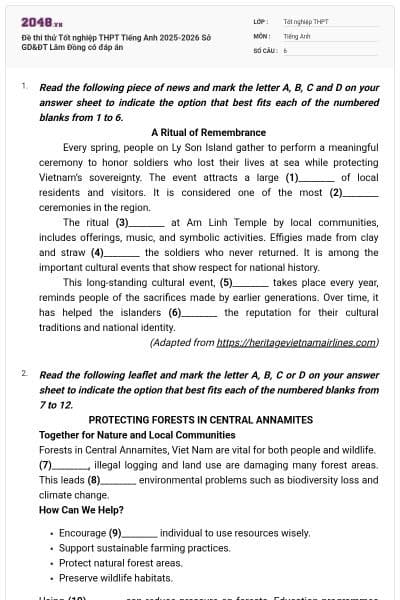
Read the following leaflet and mark the letter A, B, C, or D on your answer sheet to indicate the option that best fits each of the numbered blanks from 27 to 32.
Smart Strategies for Career Success
Plan your approach carefully. Instead of applying to (27) _____ jobs randomly, focus on quality, tailored applications. Prepare your CV and cover letter in advance so you can respond quickly and professionally.
Manage your time effectively, (28) _____ you should set clear periods for job searching, networking, and improving skills. Build a strong online presence (29) _____ visibility with employers. Use networking - many opportunities arise through personal connections rather than public listings.
(30) _____ informed about trends to identify valuable potential opportunities in the market. Be realistic; it is essential to be realistic about expectations and demands.
These strategies can help you make progress in a (31) _____. With discipline and persistence, adopt a more (32) _____ approach to achieving career success. Stay adaptable, learn continuously, and seek feedback to strengthen your profile and long-term prospects.
(Adapted from Navigating the Job Market: Essential Career Advice and Job Search Strategies)
amount of
many
plenty
much
A. amount of: lượng (+ danh từ không đếm được).
B. many: nhiều (+ danh từ đếm được số nhiều).
C. plenty: nhiều (phải đi kèm với giới từ of tạo thành plenty of).
D. much: nhiều (+ danh từ không đếm được).
Phía sau khoảng trống là danh từ đếm được ở dạng số nhiều “jobs” (những công việc). Do đó, “many” là lựa chọn chính xác duy nhất để đi kèm với danh từ này.
Chọn B. many
→ Instead of applying to many jobs randomly, focus on quality, tailored applications.
Dịch nghĩa: Thay vì nộp đơn cho nhiều công việc một cách ngẫu nhiên, hãy tập trung vào các hồ sơ ứng tuyển chất lượng và được tinh chỉnh cho phù hợp.
so
but
because
although
A. so (conj): vì vậy, cho nên (chỉ kết quả/hệ quả).
B. but (conj): nhưng (chỉ sự đối lập).
C. because (conj): bởi vì (chỉ nguyên nhân).
D. although (conj): mặc dù (chỉ sự nhượng bộ).
Mệnh đề phía trước đưa ra một lời khuyên mang tính định hướng (“Quản lý thời gian của bạn một cách hiệu quả”), mệnh đề phía sau đưa ra một hành động cụ thể mang tính hệ quả để thực hiện lời khuyên đó (“bạn nên thiết lập các khoảng thời gian rõ ràng...”). Liên từ “so” là phù hợp nhất về mặt logic.
Chọn A. so
→ Manage your time effectively, so you should set clear periods for job searching...
Dịch nghĩa: Hãy quản lý thời gian của bạn một cách hiệu quả, vì vậy (do đó) bạn nên thiết lập những khoảng thời gian rõ ràng cho việc tìm kiếm việc làm...
to increasing
increasing
increase
to increase
A. to increasing: Sai ngữ pháp (thông thường sau 'to' là V-inf, chỉ một vài cụm cố định mới dùng 'to V-ing' như look forward to).
B. increasing (v-ing): hiện tại phân từ.
C. increase (v): động từ nguyên mẫu.
D. to increase: động từ nguyên thể có “to”.
Câu này sử dụng cấu trúc to + V-inf đóng vai trò làm trạng ngữ chỉ mục đích, mang ý nghĩa là “để làm gì”.
Chọn D. to increase
→ Build a strong online presence to increase visibility with employers.
Dịch nghĩa: Hãy xây dựng một sự hiện diện trực tuyến mạnh mẽ để gia tăng mức độ nhận diện đối với các nhà tuyển dụng.
Stay
Have
Pay
Make
A. Stay (v): duy trì, giữ ở trạng thái nào đó.
B. Have (v): có.
C. Pay (v): trả (tiền), chú ý (pay attention).
D. Make (v): làm, tạo ra.
Ta có cụm kết hợp từ (collocation) cố định: stay informed (about something) (luôn cập nhật thông tin / nắm bắt thông tin về vấn đề gì).
Chọn A. Stay
→ Stay informed about trends to identify valuable potential opportunities in the market.
Dịch nghĩa: Hãy luôn cập nhật thông tin về các xu hướng để xác định những cơ hội tiềm năng có giá trị trên thị trường.
competitive fast-paced environment
fast-paced environment competitive
fast-paced competitive environment
environment fast-paced competitive
Phân tích trật tự từ: Cụm danh từ này có danh từ chính là “environment” (môi trường) nên bắt buộc phải đứng cuối cùng. Phía trước nó là hai tính từ: “fast-paced” (nhịp độ nhanh) và “competitive” (có tính cạnh tranh). Theo thói quen sử dụng (collocation) và trật tự tính từ, từ chỉ nhịp độ/tốc độ mang tính khái quát (fast-paced) thường đứng trước từ chỉ tính chất/đặc điểm cụ thể hơn (competitive). Trật tự đúng là: fast-paced competitive environment.
Chọn C. fast-paced competitive environment
→ These strategies can help you make progress in a fast-paced competitive environment.
Dịch nghĩa: Những chiến lược này có thể giúp bạn tiến bộ trong một môi trường cạnh tranh với nhịp độ nhanh.
temporary
systematic
strategic
efficient
A. temporary (adj): tạm thời.
B. systematic (adj): có hệ thống.
C. strategic (adj): mang tính chiến lược.
D. efficient (adj): hiệu quả, có hiệu suất cao.
Dựa vào tiêu đề của bài viết “Smart Strategies for Career Success” (Những chiến lược thông minh...) và nội dung bài đọc nhấn mạnh việc lên kế hoạch, tập trung vào chất lượng, quản lý thời gian,... ta cần một tính từ tương ứng. Cụm từ a strategic approach (một cách tiếp cận mang tính chiến lược) hoàn toàn phù hợp với tinh thần của toàn bài.
Chọn C. strategic
→ With discipline and persistence, adopt a more strategic approach to achieving career success.
Dịch nghĩa: Với sự kỷ luật và tính kiên trì, hãy áp dụng một cách tiếp cận mang tính chiến lược hơn để đạt được thành công trong sự nghiệp.
Bài đọc hoàn chỉnh | Dịch bài đọc |
Smart Strategies for Career Success Plan your approach carefully. Instead of applying to (27) many jobs randomly, focus on quality, tailored applications. Prepare your CV and cover letter in advance so you can respond quickly and professionally. Manage your time effectively, (28) so you should set clear periods for job searching, networking, and improving skills. Build a strong online presence (29) to increase visibility with employers. Use networking - many opportunities arise through personal connections rather than public listings. (30) Stay informed about trends to identify valuable potential opportunities in the market. Be realistic; it is essential to be realistic about expectations and demands. These strategies can help you make progress in a (31) fast-paced competitive environment. With discipline and persistence, adopt a more (32) strategic approach to achieving career success. Stay adaptable, learn continuously, and seek feedback to strengthen your profile and long-term prospects. | Những Chiến Lược Thông Minh Để Thành Công Trong Sự Nghiệp Hãy lên kế hoạch cho cách tiếp cận của bạn một cách cẩn thận. Thay vì nộp đơn cho (27) nhiều công việc một cách ngẫu nhiên, hãy tập trung vào các hồ sơ ứng tuyển chất lượng và được tinh chỉnh cho phù hợp. Hãy chuẩn bị sẵn CV và thư xin việc từ trước để bạn có thể phản hồi một cách nhanh chóng và chuyên nghiệp. Hãy quản lý thời gian của bạn một cách hiệu quả, (28) do đó bạn nên thiết lập những khoảng thời gian rõ ràng cho việc tìm kiếm việc làm, mở rộng mạng lưới quan hệ và cải thiện các kỹ năng. Hãy xây dựng một sự hiện diện trực tuyến mạnh mẽ (29) để gia tăng mức độ nhận diện đối với các nhà tuyển dụng. Tận dụng mạng lưới quan hệ - nhiều cơ hội nảy sinh thông qua các mối liên hệ cá nhân thay vì các danh sách tuyển dụng công khai. Hãy (30) luôn cập nhật thông tin về các xu hướng để xác định những cơ hội tiềm năng có giá trị trên thị trường. Hãy thực tế; việc thực tế về những kỳ vọng và yêu cầu là điều rất cần thiết. Những chiến lược này có thể giúp bạn tiến bộ trong một (31) môi trường cạnh tranh với nhịp độ nhanh. Với sự kỷ luật và tính kiên trì, hãy áp dụng một cách tiếp cận mang tính (32) chiến lược hơn để đạt được thành công trong sự nghiệp. Hãy giữ sự thích ứng, học hỏi không ngừng và tìm kiếm những phản hồi để củng cố hồ sơ cũng như các triển vọng dài hạn của bạn. |
Read the passage and mark the letter A, B, C or D on your answer sheet to indicate the best answer to each of the following questions from 33 to 40.
Collagen is the most abundant protein in mammals, functioning as the essential structural foundation for skin, bones, and muscles. In recent years, the market for collagen supplements has expanded exponentially, with global consumers spending billions annually. Although promotional campaigns often advertise it as a definitive cure for aging, numerous scientists remain skeptical. They argue that the empirical evidence supporting these ambitious claims is still developing, despite the widespread popularity of these products among high-profile celebrities.
After reaching the age of forty, humans typically lose approximately one percent of their body’s collagen each year. This gradual decline inevitably leads to sagging skin and joint discomfort. Moreover, specific detrimental factors can severely accelerate this process, such as chronic smoking or excessive sugar consumption. Consequently, many people attempt to find a magic pill to counteract this issue. However, preserving existing collagen through healthy lifestyle modifications remains the most effective strategy.
Most contemporary supplements contain “collagen peptides,” which are formulated to be significantly easier for the body to absorb than whole proteins. Interestingly, these commercial products are not strictly regulated by the FDA for safety or therapeutic effectiveness before they are distributed to the market. While some clinical studies demonstrate modest improvements in skin hydration, the overall results are not always consistent. Researchers emphasize that far more rigorous evidence is needed to confirm whether these supplements can truly reverse the visible signs of aging.
Beyond dermatological benefits, collagen may help alleviate joint inflammation, particularly in highly active athletes. One study indicated that active adults experienced a noticeable reduction in pain after taking daily supplements for six consecutive months. For those who prefer avoiding artificial supplements, this protein is naturally found in dietary sources like poultry and bone broth. Furthermore, consuming vitamin C is also vital, as it serves as a necessary component that helps the body produce its own collagen, thereby ensuring long-term vitality.
(Adapted from https://www.nationalgeographic.com/)
The word They in paragraph 1 refers to _____.
promotional campaigns
consumers
scientists
supplements
Từ “They” ở đoạn 1 chỉ _____.
A. promotional campaigns: các chiến dịch quảng cáo
B. consumers: người tiêu dùng
C. scientists: các nhà khoa học
D. supplements: các chất bổ sung
Thông tin (Đoạn 1): Although promotional campaigns often advertise it as a definitive cure for aging, numerous scientists remain skeptical. They argue that the empirical evidence...
(Mặc dù các chiến dịch quảng cáo thường quảng bá nó như một phương pháp chữa trị dứt điểm tình trạng lão hóa, vô số các nhà khoa học vẫn hoài nghi. Họ lập luận rằng bằng chứng thực nghiệm...)
→ They = scientists.
Chọn C.
Which of the following isNOT mentioned in paragraph 2 as a factor contributing to the loss of collagen?
reaching the age of forty
joint discomfort
chronic smoking
excessive sugar consumption
Điều nào sau đây KHÔNG được đề cập trong đoạn 2 như một yếu tố góp phần làm mất collagen?
A. reaching the age of forty: đạt đến độ tuổi bốn mươi
(Có nhắc đến: “After reaching the age of forty...”)
B. joint discomfort: sự khó chịu ở khớp (Đây là hậu quả/kết quả của việc giảm collagen, không phải là yếu tố gây ra sự sụt giảm: “This gradual decline inevitably leads to sagging skin and joint discomfort”)
C. chronic smoking: hút thuốc lá mãn tính (Có nhắc đến: “such as chronic smoking...”)
D. excessive sugar consumption: tiêu thụ quá nhiều đường (Có nhắc đến: “...or excessive sugar consumption.”)
Thông tin:After reaching the age of forty, humans typically lose approximately one percent of their body’s collagen each year. This gradual decline inevitably leads to sagging skin and joint discomfort. Moreover, specific detrimental factors can severely accelerate this process, such as chronic smoking or excessive sugar consumption. (Sau tuổi 40, con người thường mất khoảng 1% lượng collagen trong cơ thể mỗi năm. Sự suy giảm dần dần này chắc chắn dẫn đến da chảy xệ và đau nhức khớp. Hơn nữa, một số yếu tố có hại cụ thể có thể đẩy nhanh quá trình này, chẳng hạn như hút thuốc lá mãn tính hoặc tiêu thụ quá nhiều đường.)
Chọn B.
The word counteract in paragraph 2 is OPPOSITE in meaning to _____.
offset
encounter
exacerbate
overcome
Từ “counteract” ở đoạn 2 TRÁI NGHĨA với _____.
counteract (v): chống lại, làm mất tác dụng, ngăn chặn.
A. offset (v): bù đắp, đền bù
B. encounter (v): chạm trán, gặp phải
C. exacerbate (v): làm trầm trọng thêm (trái nghĩa)
D. overcome (v): vượt qua
→ counteract >< exacerbate
Thông tin: Consequently, many people attempt to find a magic pill to counteract this issue.
(Hậu quả là, nhiều người cố gắng tìm kiếm một viên thuốc thần kỳ để chống lại/ngăn chặn vấn đề này.)
Chọn C.
Which of the following best paraphrases the underlined sentence in paragraph 3?
Scientists believe that reversing the signs of aging is impossible, regardless of how much evidence is provided.
Researchers confirm that there is already enough rigorous evidence showing these supplements can completely reverse the aging process.
It is emphasized by researchers that no amount of evidence will ever be able to prove the anti-aging effects of these supplements.
Scientists stress that additional solid proof is required to determine if these products can actually undo the physical effects of growing older.
Câu nào sau đây diễn giải tốt nhất câu được gạch chân ở đoạn 3?
“Researchers emphasize that far more rigorous evidence is needed to confirm whether these supplements can truly reverse the visible signs of aging.”
(Các nhà nghiên cứu nhấn mạnh rằng cần có thêm bằng chứng chặt chẽ hơn nhiều để xác nhận liệu những chất bổ sung này có thể thực sự đảo ngược các dấu hiệu lão hóa có thể nhìn thấy được hay không.)
Dịch nghĩa:
A. Các nhà khoa học tin rằng việc đảo ngược các dấu hiệu lão hóa là không thể, bất kể có bao nhiêu bằng chứng được cung cấp. (Sai nghĩa).
B. Các nhà nghiên cứu xác nhận rằng đã có đủ bằng chứng chặt chẽ cho thấy những chất bổ sung này có thể đảo ngược hoàn toàn quá trình lão hóa. (Sai nghĩa).
C. Các nhà nghiên cứu nhấn mạnh rằng không có bất kỳ lượng bằng chứng nào có thể chứng minh được tác dụng chống lão hóa của những chất bổ sung này. (Sai nghĩa).
D. Các nhà khoa học nhấn mạnh rằng cần có thêm bằng chứng vững chắc để xác định xem những sản phẩm này có thực sự hoàn tác được những tác động vật lý của việc già đi hay không. (Đúng và sát nghĩa nhất: emphasize = stress; far more rigorous evidence = additional solid proof; confirm whether = determine if; reverse = undo; visible signs of aging = physical effects of growing older).
Chọn D.
The word consecutive in paragraph 4 is CLOSEST in meaning to _____.
intermittent
successive
subsequent
concurrent
Từ “consecutive” ở đoạn 4 GẦN NGHĨA nhất với _____.
consecutive (adj): liên tục, liên tiếp.
A. intermittent (adj): gián đoạn, từng cơn
B. successive (adj): liên tiếp, kế tiếp (đồng nghĩa)
C. subsequent (adj): xảy ra sau, theo sau
D. concurrent (adj): đồng thời
→ consecutive = successive
Thông tin: ...after taking daily supplements for six consecutive months.
(...sau khi dùng các chất bổ sung hàng ngày trong sáu tháng liên tiếp.)
Chọn B.
Which of the following isTRUE according to the passage?
Despite their widespread popularity, collagen supplements must undergo stringent FDA evaluations for therapeutic effectiveness before reaching consumers.
Relying exclusively on synthetic collagen supplements is considered the most effective strategy to counteract the age-related deterioration of the skin.
The human body completely ceases its natural collagen production immediately after an individual reaches the age of forty.
While collagen supplements show potential in easing joint discomfort, their definitive anti-aging effects still require further scientific validation.
Theo bài đọc, nhận định nào sau đây là ĐÚNG?
A. Mặc dù phổ biến rộng rãi, các chất bổ sung collagen phải trải qua các đánh giá nghiêm ngặt của FDA về hiệu quả điều trị trước khi đến tay người tiêu dùng. (Sai, đoạn 3 nói chúng “không được FDA quản lý chặt chẽ” - are not strictly regulated by the FDA).
B. Việc chỉ dựa vào các chất bổ sung collagen tổng hợp được coi là chiến lược hiệu quả nhất để chống lại sự suy thoái da do tuổi tác. (Sai, đoạn 2 nói việc thay đổi lối sống lành mạnh mới là “chiến lược hiệu quả nhất” - remains the most effective strategy).
C. Cơ thể con người ngừng hoàn toàn việc sản xuất collagen tự nhiên ngay sau khi một người đạt đến tuổi bốn mươi. (Sai, đoạn 2 nói cơ thể “mất khoảng 1% mỗi năm” chứ không phải dừng hoàn toàn).
D. Mặc dù các chất bổ sung collagen cho thấy tiềm năng trong việc làm giảm bớt sự khó chịu ở khớp, nhưng tác dụng chống lão hóa rõ ràng của chúng vẫn cần được xác minh thêm về mặt khoa học. (Đúng, theo nội dung đoạn 3 và 4).
Thông tin (Đoạn 3 & 4): Researchers emphasize that far more rigorous evidence is needed to confirm whether these supplements can truly reverse the visible signs of aging. (Đoạn 3) / Beyond dermatological benefits, collagen may help alleviate joint inflammation... (Đoạn 4).
(Các nhà nghiên cứu nhấn mạnh rằng cần có thêm bằng chứng chặt chẽ... để xác nhận khả năng chống lão hóa / Ngoài những lợi ích về da liễu, collagen có thể giúp làm giảm viêm khớp...)
Chọn D.
In which paragraph does the writer mention a causal relationship between lifestyle habits and physical changes?
Paragraph 3
Paragraph 2
Paragraph 1
Paragraph 4
Đoạn nào tác giả đề cập đến mối quan hệ nhân quả giữa thói quen lối sống và những thay đổi về mặt thể chất?
A. Đoạn 3
B. Đoạn 2
C. Đoạn 1
D. Đoạn 4
Thông tin (Đoạn 2): Moreover, specific detrimental factors can severely accelerate this process, such as chronic smoking or excessive sugar consumption.
(Hơn nữa, các yếu tố gây hại cụ thể có thể đẩy nhanh nghiêm trọng quá trình này, chẳng hạn như thói quen hút thuốc mãn tính hoặc tiêu thụ quá nhiều đường.)
Chọn B.
In which paragraph does the writer discuss the lack of official regulatory control over supplement quality?
Paragraph 1
Paragraph 4
Paragraph 2
Paragraph 3
Đoạn nào tác giả thảo luận về việc thiếu sự kiểm soát quy định chính thức đối với chất lượng của các chất bổ sung?
A. Đoạn 1
B. Đoạn 4
C. Đoạn 2
D. Đoạn 3
Thông tin (Đoạn 3): Interestingly, these commercial products are not strictly regulated by the FDA for safety or therapeutic effectiveness before they are distributed to the market.
(Thú vị là, những sản phẩm thương mại này không được FDA quản lý chặt chẽ về độ an toàn hoặc hiệu quả điều trị trước khi chúng được phân phối ra thị trường.)
Chọn D.
Dịch bài đọc:
Collagen là loại protein dồi dào nhất ở động vật có vú, đóng vai trò là nền tảng cấu trúc thiết yếu cho da, xương và cơ bắp. Trong những năm gần đây, thị trường cho các chất bổ sung collagen đã mở rộng theo cấp số nhân, với việc người tiêu dùng toàn cầu chi trả hàng tỷ đô la mỗi năm. Mặc dù các chiến dịch quảng cáo thường quảng bá nó như một phương pháp chữa trị dứt điểm tình trạng lão hóa, vô số các nhà khoa học vẫn hoài nghi. Họ lập luận rằng các bằng chứng thực nghiệm ủng hộ những tuyên bố đầy tham vọng này vẫn đang trong quá trình phát triển, bất chấp sự phổ biến rộng rãi của các sản phẩm này đối với những người nổi tiếng.
Sau khi đạt đến độ tuổi bốn mươi, con người thường mất đi khoảng một phần trăm lượng collagen trong cơ thể mỗi năm. Sự suy giảm dần dần này tất yếu dẫn đến tình trạng da chảy xệ và sự khó chịu ở các khớp. Hơn nữa, các yếu tố gây hại cụ thể có thể đẩy nhanh nghiêm trọng quá trình này, chẳng hạn như thói quen hút thuốc mãn tính hoặc tiêu thụ quá nhiều đường. Hậu quả là, nhiều người cố gắng tìm kiếm một viên thuốc thần kỳ để chống lại vấn đề này. Tuy nhiên, việc duy trì lượng collagen hiện có thông qua những sửa đổi thói quen lối sống lành mạnh vẫn là chiến lược hiệu quả nhất.
Hầu hết các chất bổ sung đương đại đều chứa “collagen peptide”, được bào chế để cơ thể dễ hấp thụ hơn đáng kể so với protein nguyên vẹn. Thú vị là, những sản phẩm thương mại này không được FDA quản lý chặt chẽ về độ an toàn hoặc hiệu quả điều trị trước khi chúng được phân phối ra thị trường. Mặc dù một số nghiên cứu lâm sàng cho thấy những cải thiện khiêm tốn về quá trình hydrat hóa của da, nhưng kết quả tổng thể không phải lúc nào cũng nhất quán. Các nhà nghiên cứu nhấn mạnh rằng cần có thêm bằng chứng chặt chẽ hơn nhiều để xác nhận liệu những chất bổ sung này có thể thực sự đảo ngược các dấu hiệu lão hóa có thể nhìn thấy được hay không.
Ngoài những lợi ích về da liễu, collagen có thể giúp làm giảm viêm khớp, đặc biệt là ở những vận động viên hoạt động với cường độ cao. Một nghiên cứu đã chỉ ra rằng những người trưởng thành năng động đã trải qua sự sụt giảm cơn đau rõ rệt sau khi uống các chất bổ sung hàng ngày trong sáu tháng liên tiếp. Đối với những người muốn tránh các chất bổ sung nhân tạo, loại protein này được tìm thấy tự nhiên trong các nguồn thực phẩm như thịt gia cầm và nước hầm xương. Hơn nữa, việc tiêu thụ vitamin C cũng rất quan trọng, vì nó đóng vai trò là một thành phần cần thiết giúp cơ thể tự sản xuất collagen, qua đó đảm bảo sức sống lâu dài.