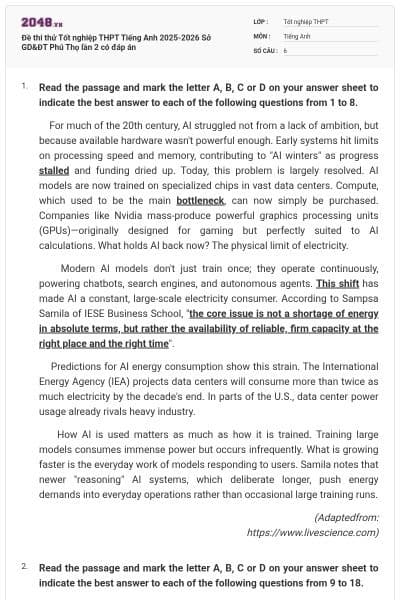
Đề thi thử Tốt nghiệp THPT Tiếng Anh 2025-2026 Sở GD&ĐT Phú Thọ lần 2 có đáp án
40 câu hỏi
Read the passage and mark the letter A, B, C or D on your answer sheet to indicate the best answer to each of the following questions from 1 to 8.
For much of the 20th century, AI struggled not from a lack of ambition, but because available hardware wasn't powerful enough. Early systems hit limits on processing speed and memory, contributing to "AI winters" as progress stalled and funding dried up. Today, this problem is largely resolved. AI models are now trained on specialized chips in vast data centers. Compute, which used to be the main bottleneck, can now simply be purchased. Companies like Nvidia mass-produce powerful graphics processing units (GPUs)—originally designed for gaming but perfectly suited to AI calculations. What holds AI back now? The physical limit of electricity.
Modern AI models don't just train once; they operate continuously, powering chatbots, search engines, and autonomous agents. This shift has made AI a constant, large-scale electricity consumer. According to Sampsa Samila of IESE Business School, "the core issue is not a shortage of energy in absolute terms, but rather the availability of reliable, firm capacity at the right place and the right time".
Predictions for AI energy consumption show this strain. The International Energy Agency (IEA) projects data centers will consume more than twice as much electricity by the decade's end. In parts of the U.S., data center power usage already rivals heavy industry.
How AI is used matters as much as how it is trained. Training large models consumes immense power but occurs infrequently. What is growing faster is the everyday work of models responding to users. Samila notes that newer "reasoning" AI systems, which deliberate longer, push energy demands into everyday operations rather than occasional large training runs.
(Adaptedfrom: https://www.livescience.com)
Which of the following is NOT mentioned in the passage as a factor that contributed to AI's slow progress in the 20th century?
Insufficient processing speed
Limited memory capacity
Lack of research funding after stalled progress
Absence of skilled AI engineers and scientists
Điều nào sau đây KHÔNG được đề cập trong bài đọc như một yếu tố góp phần vào sự tiến triển chậm chạp của AI trong thế kỷ 20?
A. Insufficient processing speed: Tốc độ xử lý không đủ. (Có nhắc đến: "hit limits on processing speed")
B. Limited memory capacity: Dung lượng bộ nhớ hạn chế. (Có nhắc đến: "and memory")
C. Lack of research funding after stalled progress: Thiếu kinh phí nghiên cứu sau khi tiến độ bị đình trệ. (Có nhắc đến: "funding dried up")
D. Absence of skilled AI engineers and scientists: Sự thiếu vắng các kỹ sư và nhà khoa học AI lành nghề. (Không được nhắc đến)
Thông tin (Đoạn 1): Early systems hit limits on processing speed and memory, contributing to "AI winters" as progress stalled and funding dried up.
(Các hệ thống sơ khai đã chạm đến giới hạn về tốc độ xử lý và bộ nhớ, góp phần tạo ra "mùa đông AI" khi tiến độ bị đình trệ và nguồn tài trợ cạn kiệt.)
Chọn D.
The word “stalled” in paragraph 1 is OPPOSITE in meaning to ____________?
prevented
accelerated
paused
frozen
Từ “stalled” ở đoạn 1 TRÁI NGHĨA với ____________.
stalled (v-ed): bị đình trệ, bị chững lại.
A. prevented (v-ed): bị ngăn cản
B. accelerated (v-ed): được tăng tốc, đẩy nhanh (trái nghĩa)
C. paused (v-ed): bị tạm dừng (đồng nghĩa)
D. frozen (v-ed): bị đóng băng
→ stalled >< accelerated
Thông tin: ...contributing to "AI winters" as progress stalled and funding dried up.
(...góp phần tạo ra "mùa đông AI" khi tiến độ bị đình trệ và nguồn tài trợ cạn kiệt.)
Chọn B.
In paragraph 2, the phrase “this shift” refers to ____________.
the development of more powerful GPU chips by companies such as Nvidia and AMD for AI use
the change from AI training occasionally to AI operating continuously across multiple applications
the transition from AI being used for research to being used commercially
the move from running AI computations on local machines to large-scale cloud data centers
Ở đoạn 2, cụm từ “this shift” chỉ ____________.
A. sự phát triển của các chip GPU mạnh mẽ hơn bởi các công ty như Nvidia và AMD dành cho việc sử dụng AI.
B. sự thay đổi từ việc huấn luyện AI thỉnh thoảng mới diễn ra sang việc AI hoạt động liên tục trên nhiều ứng dụng.
C. sự chuyển đổi từ việc AI được sử dụng cho nghiên cứu sang được sử dụng cho mục đích thương mại.
D. sự chuyển dịch từ việc chạy các tính toán AI trên máy cục bộ sang các trung tâm dữ liệu đám mây quy mô lớn.
Thông tin: Modern AI models don't just train once; they operate continuously, powering chatbots, search engines, and autonomous agents. This shift has made AI a constant...
(Các mô hình AI hiện đại không chỉ được huấn luyện một lần; chúng hoạt động liên tục, cung cấp sức mạnh cho các chatbot, công cụ tìm kiếm và các tác nhân tự trị. Sự chuyển dịch này đã khiến AI trở thành một thiết bị tiêu thụ liên tục...)
→ this shift = the change from AI training occasionally to AI operating continuously across multiple applications.
Chọn B.
The word “bottleneck” as used in paragraph 1 is CLOSEST in meaning to ____________.
advantage
resource
barrier
component
Từ “bottleneck” được sử dụng ở đoạn 1 GẦN NGHĨA nhất với ____________.
bottleneck (n): điểm nghẽn, rào cản, sự đình trệ.
A. advantage (n): lợi thế
B. resource (n): tài nguyên
C. barrier (n): rào cản, chướng ngại vật (đồng nghĩa)
D. component (n): thành phần
→ bottleneck = barrier
Thông tin: Compute, which used to be the main bottleneck, can now simply be purchased.
(Năng lực tính toán (Compute), thứ từng là điểm nghẽn/rào cản chính, giờ đây có thể dễ dàng được mua.)
Chọn C.
Which of the following BEST paraphrases the underlined sentence in paragraph 2?
The world currently does not generate sufficient electricity to meet the growing demands of modern AI systems.
The challenge is not the global energy supply, but ensuring stable power is available where and when AI systems require it.
Energy companies have not made sufficient investments in the infrastructure required to adequately support global AI growth.
AI data centers should move to energy-surplus regions to resolve the power shortage crisis.
Câu nào sau đây diễn giải tốt nhất câu được gạch chân ở đoạn 2?
"the core issue is not a shortage of energy in absolute terms, but rather the availability of reliable, firm capacity at the right place and the right time"
("vấn đề cốt lõi không phải là sự thiếu hụt năng lượng về mặt tuyệt đối, mà đúng hơn là sự sẵn có của công suất điện ổn định, đáng tin cậy ở đúng nơi và đúng lúc")
Dịch nghĩa:
A. Thế giới hiện không tạo ra đủ điện năng để đáp ứng nhu cầu ngày càng tăng của các hệ thống AI hiện đại. (Trái ngược với "không phải là sự thiếu hụt năng lượng về mặt tuyệt đối").
B. Thách thức không nằm ở nguồn cung cấp năng lượng toàn cầu, mà là việc đảm bảo nguồn điện ổn định luôn sẵn sàng ở những nơi và thời điểm mà các hệ thống AI yêu cầu. (Đúng và sát nghĩa nhất).
C. Các công ty năng lượng đã không đầu tư đủ vào cơ sở hạ tầng cần thiết để hỗ trợ đầy đủ cho sự tăng trưởng AI toàn cầu. (Sai trọng tâm).
D. Các trung tâm dữ liệu AI nên chuyển đến các khu vực dư thừa năng lượng để giải quyết cuộc khủng hoảng thiếu điện. (Không được đề cập trong câu gốc).
Chọn B.
According to the passage, which of the following statements is NOT TRUE?
GPUs were originally developed for gaming and visualization before being used in AI.
Training large AI models is currently the fastest-growing source of AI energy consumption.
The IEA projects data center electricity use will more than double by the end of the decade.
Reasoning AI systems increase energy use during everyday operations rather than only during training.
Theo bài đọc, nhận định nào sau đây là KHÔNG ĐÚNG?
A. GPU ban đầu được phát triển cho việc chơi game và hình ảnh hóa trước khi được sử dụng trong AI. (Đúng, đoạn 1 nói "originally designed for gaming").
B. Việc huấn luyện các mô hình AI lớn hiện là nguồn tiêu thụ năng lượng tăng nhanh nhất của AI. (Sai, đoạn 4 nói "Thứ đang tăng trưởng nhanh hơn là công việc hàng ngày của các mô hình khi phản hồi người dùng").
C. IEA dự báo lượng điện sử dụng của các trung tâm dữ liệu sẽ tăng hơn gấp đôi vào cuối thập kỷ này. (Đúng, đoạn 3 ghi "consume more than twice as much").
D. Các hệ thống AI "lập luận" làm tăng mức sử dụng năng lượng trong các hoạt động hàng ngày thay vì chỉ trong quá trình huấn luyện. (Đúng, đoạn 4 ghi "push energy demands into everyday operations").
Thông tin (Đoạn 4): Training large models consumes immense power but occurs infrequently. What is growing faster is the everyday work of models responding to users.
(Việc huấn luyện các mô hình lớn tiêu thụ nguồn điện khổng lồ nhưng không thường xuyên diễn ra. Thứ đang tăng trưởng nhanh hơn là công việc hàng ngày của các mô hình khi phản hồi người dùng.)
Chọn B.
In which paragraph does the author explain how GPUs, though originally designed for gaming, became central to AI processing?
Paragraph 1
Paragraph 2
Paragraph 3
Paragraph 4
Đoạn nào tác giả giải thích cách mà GPU, mặc dù ban đầu được thiết kế để chơi game, lại trở thành trung tâm của quá trình xử lý AI?
A. Đoạn 1
B. Đoạn 2
C. Đoạn 3
D. Đoạn 4
Thông tin (Đoạn 1): Companies like Nvidia mass-produce powerful graphics processing units (GPUs)—originally designed for gaming but perfectly suited to AI calculations.
(Các công ty như Nvidia sản xuất hàng loạt các bộ xử lý đồ họa (GPU) mạnh mẽ—ban đầu được thiết kế cho mục đích chơi game nhưng lại hoàn toàn phù hợp với các phép tính AI.)
Chọn A.
Which paragraph mentions the everyday operations of newer "reasoning" systems responding to users?
Paragraph 2
Paragraph 4
Paragraph 1
Paragraph 3
Đoạn nào đề cập đến các hoạt động hàng ngày của các hệ thống "lập luận" mới hơn khi phản hồi người dùng?
A. Đoạn 2
B. Đoạn 4
C. Đoạn 1
D. Đoạn 3
Thông tin (Đoạn 4): Samila notes that newer "reasoning" AI systems, which deliberate longer, push energy demands into everyday operations rather than occasional large training runs.
(Samila lưu ý rằng các hệ thống AI "lập luận" mới hơn, vốn mất nhiều thời gian cân nhắc hơn, đang đẩy nhu cầu năng lượng vào các hoạt động hàng ngày thay vì chỉ tập trung vào các đợt huấn luyện lớn thỉnh thoảng mới diễn ra.)
Chọn B.
Dịch bài đọc:
Trong phần lớn thế kỷ 20, AI gặp khó khăn không phải vì thiếu tham vọng, mà vì phần cứng sẵn có không đủ mạnh. Các hệ thống sơ khai đã chạm đến giới hạn về tốc độ xử lý và bộ nhớ, góp phần tạo ra "mùa đông AI" khi tiến độ bị đình trệ và nguồn tài trợ cạn kiệt. Ngày nay, vấn đề này phần lớn đã được giải quyết. Các mô hình AI hiện được huấn luyện trên các chip chuyên dụng trong các trung tâm dữ liệu khổng lồ. Năng lực tính toán (Compute), thứ từng là điểm nghẽn chính, giờ đây có thể dễ dàng được mua. Các công ty như Nvidia sản xuất hàng loạt các bộ xử lý đồ họa (GPU) mạnh mẽ—ban đầu được thiết kế cho mục đích chơi game nhưng lại hoàn toàn phù hợp với các phép tính AI. Điều gì đang kìm hãm AI hiện nay? Đó là giới hạn vật lý của điện năng.
Các mô hình AI hiện đại không chỉ được huấn luyện một lần; chúng hoạt động liên tục, cung cấp sức mạnh cho các chatbot, công cụ tìm kiếm và các tác nhân tự trị. Sự chuyển dịch này đã khiến AI trở thành một thiết bị tiêu thụ điện liên tục với quy mô lớn. Theo Sampsa Samila từ Trường Kinh doanh IESE, "vấn đề cốt lõi không phải là sự thiếu hụt năng lượng về mặt tuyệt đối, mà đúng hơn là sự sẵn có của công suất điện ổn định, đáng tin cậy ở đúng nơi và đúng lúc".
Các dự báo về mức tiêu thụ năng lượng của AI cho thấy áp lực này. Cơ quan Năng lượng Quốc tế (IEA) dự báo các trung tâm dữ liệu sẽ tiêu thụ lượng điện năng cao hơn gấp đôi vào cuối thập kỷ này. Tại một số khu vực của Mỹ, mức sử dụng điện của trung tâm dữ liệu đã sánh ngang với ngành công nghiệp nặng.
Cách AI được sử dụng cũng quan trọng không kém cách nó được huấn luyện. Việc huấn luyện các mô hình lớn tiêu thụ nguồn điện khổng lồ nhưng không thường xuyên diễn ra. Thứ đang tăng trưởng nhanh hơn là công việc hàng ngày của các mô hình khi phản hồi người dùng. Samila lưu ý rằng các hệ thống AI "lập luận" mới hơn, vốn mất nhiều thời gian cân nhắc hơn, đang đẩy nhu cầu năng lượng vào các hoạt động hàng ngày thay vì chỉ tập trung vào các đợt huấn luyện lớn thỉnh thoảng mới diễn ra.
Read the passage and mark the letter A, B, C or D on your answer sheet to indicate the best answer to each of the following questions from 9 to 18.
The so-called generation gap has arguably never been wider, yet it has never been more misunderstood. [I] Picture a family dinner at which a grandparent laments that young people are glued to screens, while a grandchild concludes the elder is irrelevant. Both retreat into their own certainties, leaving their misalignment of values, priorities, and lived experiences entirely unexamined. Commentators habitually frame this estrangement as a consequence of technological acceleration: older generations struggle to master tools that younger ones absorb instinctively, and each side interprets the other's unfamiliarity as evidence of deeper inadequacy.
Social media has transformed what was once a private tension into an intractable cultural spectacle. Viral videos pit young professionals against exasperated older voices, harvesting engagement through generational grievance. Older adults are mocked as technologically incompetent and emotionally rigid; younger generations are dismissed as entitled and incapable of sustained effort. [II] Media features and corporate reports amplify these caricatures into boardrooms, classrooms, and policy chambers, where consequential decisions about employment, education, and social provision are made.
The term 'generation gap' entered popular discourse in the 1960s, but the practice of treating generational difference as fixed, oppositional, and insurmountable has intensified in recent decades. Employers who dismiss younger workers as entitled simultaneously overlook their own rigidity in the face of change. [III] Researchers have documented how the burden of proof is disproportionately assigned to the young: it is consistently they who must adapt their communication styles, suppress their expectations, and perform gratitude for opportunities previous generations received without question. Performance review culture illustrates this imbalance most vividly, as assessments of 'professionalism' routinely encode the preferences of whoever holds the senior position.
Why does this matter beyond interpersonal friction? Surface-level interventions — reverse-mentoring programmes and generational awareness workshops — are adopted by HR departments eager to signal modernity while leaving underlying power hierarchies untouched. [IV] Expecting harmony between generations without fostering conditions for genuine mutual listening resembles asking two musicians to perform in unison when neither has agreed to hear the other's melody. Collaborative possibilities remain squandered, not because the divide is unbridgeable, but because addressing it seriously would require organisations to redistribute power rather than merely rebrand it.
Bridging the generation gap authentically — through enforceable equity, transparent dialogue, and a genuine willingness to revise inherited assumptions — is indispensable if workplaces and families are to harness the full range of human experience across age.
According to paragraph 1, framing the generation gap purely as a consequence of technological acceleration will ____________.
widen the existing digital competence gap between older and younger generations significantly
inspire both older and younger generations to invest greater effort in mastering unfamiliar tools
prevent any genuine exploration of the deeper value and priority differences separating both sides
prove financially costly for families attempting to close the technological divide at home
Theo đoạn 1, việc nhìn nhận khoảng cách thế hệ hoàn toàn là hệ quả của sự tăng tốc công nghệ sẽ ____________.
A. nới rộng đáng kể khoảng cách năng lực kỹ thuật số hiện tại giữa các thế hệ.
B. truyền cảm hứng cho cả hai thế hệ nỗ lực hơn trong việc nắm vững các công cụ mới.
C. ngăn cản bất kỳ sự khám phá thực sự nào về những khác biệt sâu sắc hơn trong giá trị và ưu tiên đang chia rẽ hai bên.
D. chứng minh là tốn kém về mặt tài chính đối với các gia đình đang cố gắng thu hẹp khoảng cách công nghệ tại nhà.
Đoạn 1 chỉ ra rằng khi mọi người (ông bà và cháu) đổ lỗi cho những vấn đề bề nổi (như dán mắt vào màn hình), họ sẽ rút lui vào những định kiến của riêng mình và để lại sự sai lệch về giá trị, ưu tiên hoàn toàn "không được xem xét/khám phá" (entirely unexamined). Việc các nhà bình luận (commentators) cứ gán ghép sự xa lánh này là do công nghệ khiến cho những khác biệt tâm lý sâu xa không được giải quyết.
Thông tin: "Both retreat into their own certainties, leaving their misalignment of values, priorities, and lived experiences entirely unexamined." (Cả hai đều rút lui vào những xác tín của riêng mình, để lại sự sai lệch về giá trị, ưu tiên và trải nghiệm sống của họ hoàn toàn không được xem xét.)
Chọn C.
outdated
insignificant
constant
evolving
Từ "intractable" trong đoạn 2 gần nghĩa nhất với ____________.
intractable (adj): nan giải, khó giải quyết, cứng đầu, dai dẳng
A. outdated (adj): lỗi thời
B. insignificant (adj): không quan trọng
C. constant (adj): không ngừng, dai dẳng, thường trực
D. evolving (adj): đang tiến hóa
→ intractable = constant
Thông tin: "Social media has transformed what was once a private tension into an intractable cultural spectacle." (Mạng xã hội đã biến những gì từng là sự căng thẳng riêng tư thành một cảnh tượng văn hóa nan giải/dai dẳng.)
Chọn C.
Which of the following best summarises paragraph 2?
Social media platforms have become the primary arena in which generational stereotypes are produced, circulated, and eventually dismantled.
Digital communication has made it easier for members of different generations to identify common ground and bridge inherited cultural divisions.
Corporate diversity reports have successfully reduced generational tension in workplaces by representing the perspectives of both employers and employees fairly.
Generational stereotypes have spread beyond private settings into media and institutions where consequential decisions are made.
Câu nào sau đây tóm tắt đúng nhất đoạn 2?
A. Các nền tảng mạng xã hội đã trở thành đấu trường chính nơi các định kiến thế hệ được tạo ra, lan truyền và cuối cùng là bị xóa bỏ. (Sai, định kiến không bị phá bỏ mà bị khuếch đại).
B. Giao tiếp kỹ thuật số đã giúp các thành viên thuộc các thế hệ khác nhau dễ dàng tìm thấy điểm chung và thu hẹp những khác biệt văn hóa đã có từ lâu. (Sai hoàn toàn so với nội dung bài).
C. Các báo cáo về sự đa dạng trong doanh nghiệp đã giảm thiểu thành công căng thẳng giữa các thế hệ tại nơi làm việc bằng cách thể hiện quan điểm của cả nhà tuyển dụng và người lao động một cách công bằng. (Sai, các báo cáo này đang "khuếch đại" định kiến).
D. Những định kiến thế hệ đã lan rộng khỏi các môi trường riêng tư, tiến vào truyền thông và các thể chế nơi các quyết định quan trọng được đưa ra.
→ Đoạn 2 giải thích việc mạng xã hội biến căng thẳng riêng tư thành cảnh tượng văn hóa, các video lan truyền tạo ra định kiến (caricatures). Sau đó, các định kiến này bị truyền thông và báo cáo doanh nghiệp khuếch đại, xâm nhập vào phòng họp, lớp học, nơi đưa ra các quyết định quan trọng (consequential decisions).
Chọn D.
What does the passage suggest about employers who dismiss younger workers as entitled?
They are largely correct in their assessments, as younger workers consistently fail to demonstrate adequate commitment to organisational goals.
They are equally susceptible to generational bias, failing to recognise their own resistance to change.
They are products of a formal education system that never adequately prepared them for managing a multi-generational workforce.
They are typically overruled by HR departments that enforce strict equity policies across all generational cohorts.
Bài đọc ngụ ý điều gì về những nhà tuyển dụng gạt bỏ những lao động trẻ vì cho rằng họ "đòi hỏi/ảo tưởng quyền lợi" (entitled)?
A. Họ phần lớn đúng trong các đánh giá của mình, vì người lao động trẻ tuổi thường xuyên không thể hiện đủ sự cam kết đối với các mục tiêu của tổ chức. (Sai).
B. Họ cũng dễ mắc phải những thành kiến thế hệ, thất bại trong việc nhận ra sự bảo thủ/kháng cự sự thay đổi của chính mình. (Đúng).
C. Họ là sản phẩm của một hệ thống giáo dục chính quy chưa bao giờ chuẩn bị đầy đủ cho họ về việc quản lý lực lượng lao động đa thế hệ. (Không có thông tin).
D. Họ thường bị các bộ phận nhân sự bác bỏ vì các bộ phận này thực thi các chính sách bình đẳng nghiêm ngặt đối với tất cả các thế hệ. (Sai).
→ Đoạn 3 nói rõ rằng những nhà tuyển dụng hay chê bai người trẻ là "đòi hỏi" lại thường không nhìn thấy sự bảo thủ, cứng nhắc của chính bản thân họ trước sự thay đổi.
Thông tin: "Employers who dismiss younger workers as entitled simultaneously overlook their own rigidity in the face of change." (Những nhà tuyển dụng gạt bỏ những lao động trẻ vì cho rằng họ đòi hỏi đồng thời lại bỏ qua sự cứng nhắc của chính họ khi đối mặt với sự thay đổi.)
Chọn B.
What challenge do younger workers face in professional environments, according to paragraph 3?
An unequal expectation that they must be the ones to adjust their behaviour to fit existing norms
A systematic exclusion from senior promotional pathways regardless of demonstrated performance
A legal framework that actively prevents them from challenging outdated professional standards
A widespread tendency among peers of the same generation to undermine one another's efforts
Theo đoạn 3, những lao động trẻ phải đối mặt với thách thức gì trong môi trường chuyên nghiệp?
A. Một kỳ vọng không công bằng rằng họ phải là những người điều chỉnh hành vi của mình để phù hợp với các tiêu chuẩn hiện có. (Đúng).
B. Việc loại trừ có hệ thống khỏi các lộ trình thăng tiến cấp cao bất kể thành tích đã được chứng minh (Không được nhắc đến).
C. Một khuôn khổ pháp lý chủ động ngăn cản họ thách thức các tiêu chuẩn nghề nghiệp lỗi thời (Không được nhắc đến).
D. Một xu hướng phổ biến giữa những người đồng trang lứa cùng thế hệ nhằm phá hoại nỗ lực của nhau... (Không được nhắc đến).
→ Tác giả chỉ ra rằng "gánh nặng chứng minh" luôn đổ dồn lên vai người trẻ; họ luôn phải là người thay đổi phong cách giao tiếp, kìm nén mong muốn và tỏ ra biết ơn.
Thông tin: "...the burden of proof is disproportionately assigned to the young: it is consistently they who must adapt their communication styles, suppress their expectations, and perform gratitude..." (...gánh nặng chứng minh bị gán một cách không cân xứng cho người trẻ: nhất quán luôn là họ, những người phải điều chỉnh phong cách giao tiếp của mình...)
Chọn A.
The word “their” in paragraph 3 refers to ____________.
researchers
generations
opportunities
the young
Từ "their" trong đoạn 3 chỉ ____________.
A. researchers (các nhà nghiên cứu)
B. generations (các thế hệ)
C. opportunities (các cơ hội)
D. the young (những người trẻ)
Thông tin: Researchers have documented how the burden of proof is disproportionately assigned to the young: it is consistently they who must adapt their communication styles, suppress their expectations, and perform gratitude for opportunities previous generations received without question. (Các nhà nghiên cứu đã ghi nhận cách gánh nặng chứng minh được đặt lên vai người trẻ một cách không cân xứng: chính họ luôn phải điều chỉnh phong cách giao tiếp, kìm nén kỳ vọng và thể hiện lòng biết ơn đối với những cơ hội mà các thế hệ trước nhận được mà không cần phải thắc mắc.)
→ Trong cụm "...it is consistently they who must adapt their communication styles", đại từ "they" và tính từ sở hữu "their" đều đang quy chiếu về đối tượng được nhắc đến ở vế trước là "the young" (những người trẻ).
Chọn D.
Which of the following best paraphrases the underlined sentence in paragraph 4?
Generational harmony is impossible unless both sides adopt the same communication technology as a shared platform for dialogue.
Cohesion across generations cannot be achieved unless both sides are genuinely willing to understand and acknowledge each other's perspective.
Since both generations already share common goals, the only remaining barrier to harmony is the absence of a structured programme to coordinate their efforts.
The differences between generations are so fundamental that no institutional intervention, however well-designed, can realistically overcome them.
Câu nào sau đây diễn giải đúng nhất câu được gạch chân ở đoạn 4?
Expecting harmony between generations without fostering conditions for genuine mutual listening resembles asking two musicians to perform in unison when neither has agreed to hear the other's melody. (Kỳ vọng sự hòa hợp giữa các thế hệ mà không nuôi dưỡng các điều kiện để thực sự lắng nghe lẫn nhau giống như việc yêu cầu hai nhạc sĩ biểu diễn đồng thanh khi không ai đồng ý nghe giai điệu của người kia.)
A. Sự hòa hợp giữa các thế hệ là điều không thể trừ khi cả hai bên cùng áp dụng một công nghệ truyền thông làm nền tảng chung cho đối thoại. (Sai ý).
B. Sự gắn kết giữa các thế hệ không thể đạt được trừ khi cả hai bên thực sự sẵn sàng thấu hiểu và công nhận quan điểm của nhau. (Đúng, "harmony" = "cohesion", "genuine mutual listening" = "genuinely willing to understand and acknowledge each other's perspective").
C. Vì cả hai thế hệ đã có những mục tiêu chung, rào cản duy nhất còn lại đối với sự hòa hợp là thiếu một chương trình có cấu trúc để phối hợp nỗ lực của họ. (Sai).
D. Sự khác biệt giữa các thế hệ quá cơ bản đến mức không có sự can thiệp nào của thể chế, dù được thiết kế tốt đến đâu, có thể thực sự khắc phục được chúng. (Sai ý).
Chọn B.
Which of the following can be inferred from the passage?
HR departments are effectively dismantling intergenerational hierarchies through the consistent and rigorous application of reverse-mentoring programmes.
Younger and older workers, having recognised their mutual biases, are increasingly collaborating to reform the professional review systems that disadvantage both groups.
The primary responsibility for resolving generational conflict rests with older workers, who hold the institutional power needed to initiate meaningful structural change.
Organisations play an active role in preserving the conditions that sustain intergenerational division, as redistributing power would threaten existing institutional structures.
Có thể suy luận gì từ bài đọc?
A. Các bộ phận nhân sự đang phá bỏ hiệu quả các hệ thống phân cấp giữa các thế hệ thông qua việc áp dụng nhất quán và nghiêm ngặt các chương trình cố vấn ngược.
(Sai, họ "để nguyên các hệ thống phân cấp quyền lực" - leaving underlying power hierarchies untouched).
B. Người lao động trẻ và người lao động lớn tuổi, sau khi nhận ra những định kiến lẫn nhau, đang ngày càng hợp tác để cải cách hệ thống đánh giá chuyên môn vốn gây bất lợi cho cả hai nhóm. (Sai).
C. Trách nhiệm chính trong việc giải quyết xung đột thế hệ thuộc về người lao động lớn tuổi, những người nắm giữ quyền lực thể chế cần thiết để khởi xướng những thay đổi cấu trúc có ý nghĩa.
(Bài đọc kêu gọi sự công bằng và thấu hiểu chung, không đổ dồn trách nhiệm cho bên nào).
D. Các tổ chức đóng vai trò chủ động trong việc duy trì các điều kiện nuôi dưỡng sự chia rẽ thế hệ, bởi vì việc phân bổ lại quyền lực sẽ đe dọa các cấu trúc thể chế hiện có. (Đúng).
→ Đoạn 4 chỉ ra rằng các bộ phận HR chỉ áp dụng các biện pháp bề nổi (surface-level interventions) để ra vẻ hiện đại nhưng lại giữ nguyên quyền lực (leaving underlying power hierarchies untouched). Những khả năng hợp tác bị lãng phí vì nếu muốn giải quyết vấn đề một cách nghiêm túc, các tổ chức sẽ phải "phân bổ lại quyền lực" (redistribute power) thay vì chỉ thay đổi tên gọi. Điều này ngụ ý các tổ chức cố tình duy trì sự chia rẽ bề ngầm để bảo vệ quyền lực của họ.
Chọn D.
Where in the passage does the following sentence best fit?
Yet the more consequential divide is not technological but psychological.
[IV]
[III]
[II]
[I]
Câu sau đây phù hợp nhất với vị trí nào trong bài đọc?
"Yet the more consequential divide is not technological but psychological." (Tuy nhiên, sự chia rẽ mang tính hệ quả/quan trọng hơn không phải là về công nghệ mà là về tâm lý.)
Tại đoạn 1, tác giả cho rằng khoảng cách thế hệ đang bị "hiểu lầm". Việc chèn câu gạch chân vào vị trí [I] đóng vai trò như một câu luận điểm (topic sentence) giải thích cho sự hiểu lầm đó: Mọi người nghĩ đó là khoảng cách công nghệ, nhưng thực chất là khoảng cách tâm lý.
Ngay sau vị trí [I], tác giả đưa ra ví dụ kinh điển để chứng minh luận điểm này: Ông bà phàn nàn cháu "dán mắt vào màn hình" (khoảng cách công nghệ/technological), trong khi cháu lại kết luận ông bà "không còn liên quan/lỗi thời" (khoảng cách tâm lý/psychological). Cả hai bỏ qua "sự sai lệch về giá trị, ưu tiên" (yếu tố tâm lý) và các nhà bình luận lại cứ đổ lỗi cho "sự tăng tốc công nghệ" (yếu tố công nghệ). Đặt tại vị trí [I] tạo ra tư duy diễn dịch cực kỳ hoàn hảo cho cả đoạn.
Chọn D.
Which of the following best summarises the passage?
The generation gap is a culturally amplified, institutionally reinforced divide that demands genuine structural reform, not superficial fixes.
Intergenerational conflict is predominantly a workplace issue, and its resolution depends entirely on employers introducing enforceable equity policies in performance review systems.
The rise of social media has made the generation gap irreversible, as digital platforms continuously produce new stereotypes faster than institutions can address the old ones.
Bridging the generation gap requires younger generations to take the initiative in revising their professional expectations and communication habits to align with established norms.
Câu nào sau đây tóm tắt đúng nhất bài đọc?
A. Khoảng cách thế hệ là một sự chia rẽ được khuếch đại bởi văn hóa, được củng cố bởi thể chế, đòi hỏi cải cách cấu trúc thực sự chứ không phải là những biện pháp sửa chữa hời hợt. (Bao quát cực tốt: "khuếch đại bởi văn hóa" ở đoạn 2, "củng cố bởi thể chế/nơi làm việc" ở đoạn 3 và 4, "cải cách cấu trúc/không hời hợt" ở đoạn 4 và 5).
B. Xung đột giữa các thế hệ chủ yếu là vấn đề nơi làm việc, và việc giải quyết nó hoàn toàn phụ thuộc vào việc các nhà tuyển dụng đưa ra các chính sách công bằng có thể thực thi trong hệ thống đánh giá hiệu suất. (Sai, nó diễn ra cả ở gia đình và văn hóa xã hội nói chung).
C. Sự trỗi dậy của mạng xã hội đã khiến khoảng cách thế hệ trở nên không thể đảo ngược, vì các nền tảng kỹ thuật số liên tục tạo ra những định kiến mới nhanh hơn so với khả năng giải quyết những định kiến cũ của các thể chế. (Sai, bài đọc đưa ra hướng giải quyết ở cuối bài).
D. Thu hẹp khoảng cách thế hệ đòi hỏi các thế hệ trẻ phải chủ động điều chỉnh kỳ vọng nghề nghiệp và thói quen giao tiếp của họ để phù hợp với các chuẩn mực đã được thiết lập. (Sai hoàn toàn, bài đọc lên án việc ép người trẻ phải nhượng bộ).
Chọn A.
Dịch bài đọc:
Cái gọi là khoảng cách thế hệ được cho là chưa bao giờ rộng hơn, nhưng nó cũng chưa bao giờ bị hiểu lầm nhiều hơn thế. [I] (Tuy nhiên, sự chia rẽ mang tính hệ quả hơn không phải là về công nghệ mà là về tâm lý.) Hãy tưởng tượng một bữa tối gia đình, nơi một người ông/bà than phiền rằng những người trẻ tuổi luôn dán mắt vào màn hình, trong khi người cháu lại kết luận rằng người lớn tuổi đã không còn theo kịp thời đại. Cả hai đều rút lui vào những xác tín của riêng mình, để lại sự sai lệch về giá trị, ưu tiên và trải nghiệm sống của họ hoàn toàn không được xem xét. Các nhà bình luận thường có thói quen gán ghép sự xa lánh này như là hệ quả của sự tăng tốc công nghệ: các thế hệ lớn tuổi chật vật để nắm vững các công cụ mà những người trẻ tuổi tiếp thu theo bản năng, và mỗi bên lại diễn giải sự thiếu quen thuộc của bên kia như là bằng chứng của một sự kém cỏi sâu sắc hơn.
Mạng xã hội đã biến những gì từng là sự căng thẳng riêng tư thành một cảnh tượng văn hóa nan giải. Các video lan truyền (viral) đặt những chuyên gia trẻ tuổi đối đầu với những tiếng nói bực tức của người lớn tuổi, thu hoạch lượt tương tác thông qua sự bất bình giữa các thế hệ. Người lớn tuổi bị chế giễu là kém cỏi về công nghệ và cứng nhắc về mặt cảm xúc; trong khi các thế hệ trẻ bị gạt bỏ vì bị coi là luôn ảo tưởng quyền lợi và không có khả năng nỗ lực bền bỉ. [II] Các chuyên mục truyền thông và báo cáo của doanh nghiệp khuếch đại những bức tranh biếm họa này, đưa chúng vào các phòng họp, lớp học và các phòng chính sách, nơi những quyết định quan trọng về việc làm, giáo dục và phúc lợi xã hội được đưa ra.
Thuật ngữ 'khoảng cách thế hệ' đi vào diễn ngôn đại chúng vào những năm 1960, nhưng thói quen coi sự khác biệt giữa các thế hệ là cố định, đối lập và không thể vượt qua đã gia tăng mạnh mẽ trong những thập kỷ gần đây. Những nhà tuyển dụng gạt bỏ những lao động trẻ vì cho rằng họ đòi hỏi đồng thời lại bỏ qua sự cứng nhắc của chính họ khi đối mặt với sự thay đổi. [III] Các nhà nghiên cứu đã ghi nhận cách mà gánh nặng chứng minh bị gán một cách không cân xứng cho người trẻ: nhất quán luôn là họ, những người phải điều chỉnh phong cách giao tiếp của mình, kìm nén những kỳ vọng của bản thân và thể hiện lòng biết ơn đối với những cơ hội mà các thế hệ trước nhận được một cách hiển nhiên. Văn hóa đánh giá hiệu suất minh họa cho sự mất cân bằng này một cách sống động nhất, khi mà các đánh giá về 'tính chuyên nghiệp' thường xuyên mã hóa các sở thích của bất kỳ ai nắm giữ vị trí cấp cao.
Tại sao điều này lại quan trọng vượt ra ngoài xích mích giữa các cá nhân? Các can thiệp bề nổi — như các chương trình cố vấn đảo ngược và các hội thảo nâng cao nhận thức thế hệ — được các bộ phận nhân sự áp dụng vì háo hức muốn phô diễn sự hiện đại, trong khi lại để nguyên các hệ thống phân cấp quyền lực cơ bản. [IV] Kỳ vọng sự hòa hợp giữa các thế hệ mà không nuôi dưỡng các điều kiện để thực sự lắng nghe lẫn nhau giống như việc yêu cầu hai nhạc sĩ biểu diễn đồng thanh khi không ai đồng ý nghe giai điệu của người kia. Những khả năng hợp tác vẫn tiếp tục bị lãng phí, không phải vì khoảng cách này là không thể thu hẹp, mà bởi vì việc giải quyết nó một cách nghiêm túc sẽ đòi hỏi các tổ chức phải phân bổ lại quyền lực chứ không chỉ đơn thuần là làm mới thương hiệu cho nó.
Thu hẹp khoảng cách thế hệ một cách đích thực — thông qua sự công bằng có thể thực thi, đối thoại minh bạch và một sự sẵn lòng thực sự để sửa đổi những giả định được kế thừa — là điều không thể thiếu nếu các nơi làm việc và các gia đình muốn khai thác trọn vẹn dải kinh nghiệm của con người ở mọi lứa tuổi.
Read the following passage and mark the letter A, B, C, or D on your answer sheet to indicate the correct word or phrase that best fits each of the numbered blanks from 19 to 24.
Urban gardening has become a powerful movement for city dwellers seeking a deeper connection (19) ____________ nature. Growing food in small spaces — whether on rooftops, balconies, or community plots — brings both environmental and mental health benefits. (20) ____________ it empowers residents to take meaningful control over what they consume, reducing dependence on long supply chains.
Our neighborhood initiative has recently launched a series of (21) ____________ to help beginners get started. Volunteers provide tools, seeds, and hands-on training every Saturday morning. (22) ____________ participant who completes the four-week programme will receive a certificate of achievement.
Consistent effort is essential if you wish to (23) ____________ a thriving garden over the long term. While the initial setup can feel overwhelming, many growers report that the (24) ____________ obstacles of the first season quickly give way to confidence and creativity.
for
to
on
from
A. for (prep): cho, vì.
B. to (prep): với, tới.
C. on (prep): trên.
D. from (prep): từ.
Ta có danh từ đi kèm giới từ cố định: connection to/with something (sự kết nối với cái gì đó).
Chọn B. to
→ Urban gardening has become a powerful movement for city dwellers seeking a deeper connection to nature.
Dịch nghĩa: Làm vườn ở đô thị đã trở thành một phong trào mạnh mẽ đối với những cư dân thành phố đang tìm kiếm một sự kết nối sâu sắc hơn với thiên nhiên.
However
Therefore
In addition
Although
A. However (adv): Tuy nhiên.
B. Therefore (adv): Vì vậy, do đó.
C. In addition (adv): Ngoài ra, thêm vào đó.
D. Although (conj): Mặc dù (+ Mệnh đề).
Câu trước đề cập đến những lợi ích về môi trường và sức khỏe tinh thần của việc làm vườn. Câu sau bổ sung thêm một lợi ích nữa là "trao quyền cho cư dân kiểm soát những gì họ tiêu thụ". Do tính chất liệt kê, bổ sung thông tin nên ta dùng "In addition".
Chọn C. In addition
→ In addition, it empowers residents to take meaningful control over what they consume...
Dịch nghĩa: Ngoài ra, nó trao quyền cho cư dân kiểm soát một cách có ý nghĩa những gì họ tiêu thụ...
workshops practical gardening
gardening practical workshops
gardening workshops practical
practical gardening workshops
Phân tích trật tự từ: Cụm danh từ này có danh từ chính là "workshops" (các hội thảo) nên bắt buộc phải đứng cuối cùng. Phía trước nó là danh từ phụ "gardening" (việc làm vườn) đóng vai trò phân loại, tạo thành cụm "gardening workshops" (các hội thảo làm vườn). Tính từ "practical" (thực tế, mang tính thực hành) bổ nghĩa cho toàn bộ cụm danh từ phía sau nên phải đứng đầu. Trật tự đúng là: Tính từ + Danh từ phụ + Danh từ chính.
Chọn D. practical gardening workshops
→ Our neighborhood initiative has recently launched a series of practical gardening workshops to help beginners get started.
Dịch nghĩa: Sáng kiến của khu phố chúng tôi gần đây đã khởi động một chuỗi các buổi hội thảo làm vườn thực tế để giúp những người mới bắt đầu làm quen.
(22) ____________ participant who completes the four-week programme will receive a certificate of achievement.
Many
Several
Every
All
A. Many: Nhiều (+ danh từ đếm được số nhiều).
B. Several: Một vài (+ danh từ đếm được số nhiều).
C. Every: Mỗi, mọi (+ danh từ đếm được số ít).
D. All: Tất cả (+ danh từ số nhiều / không đếm được).
Phía sau khoảng trống là danh từ đếm được ở dạng số ít "participant" (người tham gia), và động từ của mệnh đề quan hệ theo sau cũng chia ở số ít ("completes"). Do đó, "Every" là từ duy nhất đúng ngữ pháp.
Chọn C. Every
→ Every participant who completes the four-week programme will receive a certificate of achievement.
Dịch nghĩa: Mỗi người tham gia hoàn thành chương trình kéo dài bốn tuần sẽ nhận được một giấy chứng nhận thành tích.
sustain
diminish
abandon
establish
A. sustain (v): duy trì, gìn giữ.
B. diminish (v): làm giảm bớt, thu nhỏ.
C. abandon (v): từ bỏ, bỏ rơi.
D. establish (v): thành lập, thiết lập.
Phía trước có cụm "consistent effort" (nỗ lực bền bỉ) và phía sau có "over the long term" (trong dài hạn). Để giữ cho một khu vườn phát triển tươi tốt trong thời gian dài, bạn cần phải "duy trì" nó.
Chọn A. sustain
→ Consistent effort is essential if you wish to sustain a thriving garden over the long term.
Dịch nghĩa: Nỗ lực bền bỉ là điều thiết yếu nếu bạn muốn duy trì một khu vườn tươi tốt trong dài hạn.
trivial
predictable
daunting
permanent
A. trivial (adj): nhỏ nhặt, không đáng kể.
B. predictable (adj): có thể đoán trước được.
C. daunting (adj): làm nản chí, đáng sợ, khó khăn.
D. permanent (adj): dài hạn, vĩnh cửu.
Vế trước của câu đề cập đến việc "thiết lập ban đầu có thể mang lại cảm giác quá sức" (initial setup can feel overwhelming). Do đó, những trở ngại (obstacles) của mùa đầu tiên phải mang tính chất khó khăn, làm "nản chí". Từ "daunting" liên kết chặt chẽ với ý nghĩa của từ "overwhelming".
Chọn C. daunting
→ ...many growers report that the daunting obstacles of the first season quickly give way to confidence and creativity.
Dịch nghĩa: ...nhiều người trồng báo cáo rằng những trở ngại làm nản lòng của mùa đầu tiên nhanh chóng nhường chỗ cho sự tự tin và sáng tạo.
Bài đọc hoàn chỉnh | Dịch bài đọc |
URBAN GARDENING Urban gardening has become a powerful movement for city dwellers seeking a deeper connection (19) to nature. Growing food in small spaces — whether on rooftops, balconies, or community plots — brings both environmental and mental health benefits. (20) In addition, it empowers residents to take meaningful control over what they consume, reducing dependence on long supply chains. Our neighborhood initiative has recently launched a series of (21) practical gardening workshops to help beginners get started. Volunteers provide tools, seeds, and hands-on training every Saturday morning. (22) Every participant who completes the four-week programme will receive a certificate of achievement. Consistent effort is essential if you wish to (23) sustain a thriving garden over the long term. While the initial setup can feel overwhelming, many growers report that the (24) daunting obstacles of the first season quickly give way to confidence and creativity. | LÀM VƯỜN Ở ĐÔ THỊ Làm vườn ở đô thị đã trở thành một phong trào mạnh mẽ đối với những cư dân thành phố đang tìm kiếm một sự kết nối sâu sắc hơn (19) với thiên nhiên. Trồng thực phẩm trong những không gian nhỏ — cho dù là trên sân thượng, ban công hay những khu đất của cộng đồng — đều mang lại những lợi ích về cả môi trường lẫn sức khỏe tinh thần. (20) Ngoài ra, nó trao quyền cho cư dân kiểm soát một cách có ý nghĩa những gì họ tiêu thụ, giảm bớt sự phụ thuộc vào các chuỗi cung ứng dài. Sáng kiến của khu phố chúng tôi gần đây đã khởi động một chuỗi (21) các buổi hội thảo làm vườn thực tế để giúp những người mới bắt đầu làm quen. Các tình nguyện viên cung cấp dụng cụ, hạt giống và hướng dẫn thực hành vào mỗi sáng thứ Bảy. (22) Mỗi người tham gia hoàn thành chương trình kéo dài bốn tuần sẽ nhận được một giấy chứng nhận thành tích. Nỗ lực bền bỉ là điều thiết yếu nếu bạn muốn (23) duy trì một khu vườn tươi tốt trong dài hạn. Mặc dù việc thiết lập ban đầu có thể mang lại cảm giác quá sức, nhiều người trồng báo cáo rằng những trở ngại (24) làm nản lòng của mùa đầu tiên nhanh chóng nhường chỗ cho sự tự tin và sự sáng tạo. |
Read the following passage and mark the letter A, B, C, or D on your answer sheet to indicate the correct word or phrase that best fits each of the numbered blanks from 25 to 30.
Vietnam's Cultural Diversity Week 2025
Vietnam's Cultural Diversity Week 2025 has attracted a record (25) ____________ of participating communities, making it the grandest edition in the event's history. Organizers expect it to be the most remarkable cultural (26) ____________ the nation has ever seen.
The event's organizing committee, (27) ____________ by the Ministry of Culture, Sports and Tourism, has prepared an exciting lineup of activities, including folk music concerts, traditional craft exhibitions, and culinary showcases. Indigenous artisans are among the (28) ____________ contributors to this year's programme, offering visitors a rare glimpse into centuries-old traditions.
Spanning from October 15th to October 22nd, the festival features over two hundred performances, (29) ____________ are expected to attract both domestic and international audiences.
Over the past decade, Vietnam's Cultural Diversity Week has helped the country (30) ____________ its role as a guardian of Southeast Asia's rich multicultural heritage.
(Adapted from https://www.vietnamculture.vn)
amount
volume
number
sum
A. amount (n): khối lượng, số lượng (+ danh từ không đếm được).
B. volume (n): thể tích, dung tích, âm lượng.
C. number (n): số lượng (+ danh từ đếm được số nhiều).
D. sum (n): tổng số (thường dùng cho tiền bạc hoặc toán học).
Phía sau khoảng trống là giới từ "of" và danh từ đếm được ở dạng số nhiều "participating communities" (các cộng đồng tham gia). Do đó, ta phải dùng cấu trúc a (record) number of + N (số nhiều) (một số lượng kỷ lục các...).
Chọn C. number
→ Vietnam's Cultural Diversity Week 2025 has attracted a record number of participating communities...
Dịch nghĩa: Tuần lễ Đa dạng Văn hóa Việt Nam 2025 đã thu hút một số lượng kỷ lục các cộng đồng tham gia...
celebration
celebrate
celebrated
celebratory
A. celebration (n): sự kỷ niệm, lễ kỷ niệm.
B. celebrate (v): ăn mừng, kỷ niệm.
C. celebrated (adj/v-ed): nổi tiếng / đã được ăn mừng.
D. celebratory (adj): mang tính chất kỷ niệm, tán dương.
Phân tích từ loại: Khoảng trống nằm sau tính từ "cultural" (thuộc về văn hóa). Theo quy tắc, ta cần một danh từ đứng sau để tạo thành một cụm danh từ hoàn chỉnh (cultural celebration - lễ kỷ niệm văn hóa).
Chọn A. celebration
→ Organizers expect it to be the most remarkable cultural celebration the nation has ever seen.
Dịch nghĩa: Các nhà tổ chức kỳ vọng đây sẽ là lễ kỷ niệm văn hóa đáng chú ý nhất mà quốc gia này từng chứng kiến.
establishing
established
has established
is establishing
A. establishing (v-ing): hiện tại phân từ (mang nghĩa chủ động).
B. established (v-ed/v3): quá khứ phân từ (mang nghĩa bị động).
C. has established: động từ chia thì hiện tại hoàn thành.
D. is establishing: động từ chia thì hiện tại tiếp diễn.
Đây là hiện tượng rút gọn mệnh đề quan hệ mang nghĩa bị động, bổ nghĩa cho cụm danh từ "The event's organizing committee" (Ban tổ chức của sự kiện). Ban tổ chức này không tự thành lập mà "được thành lập" bởi Bộ Văn hóa, Thể thao và Du lịch (có giới từ "by" phía sau). Mệnh đề đầy đủ là: which was established by... Khi rút gọn, ta bỏ đại từ quan hệ và động từ to be, chỉ giữ lại quá khứ phân từ.
Chọn B. established
→ The event's organizing committee, established by the Ministry of Culture, Sports and Tourism...
Dịch nghĩa: Ban tổ chức của sự kiện, được thành lập bởi Bộ Văn hóa, Thể thao và Du lịch...
heading
advancing
rising
leading
A. heading (v-ing/n): hướng tới, tiêu đề.
B. advancing (v-ing): thăng tiến, tiến lên.
C. rising (v-ing/adj): đang lên, tăng lên.
D. leading (adj): hàng đầu, xuất sắc nhất.
Ta có cụm kết hợp từ (collocation): leading contributors (những người đóng góp hàng đầu / những nhân tố đóng vai trò chủ chốt).
Chọn D. leading
→ Indigenous artisans are among the leading contributors to this year's programme...
Dịch nghĩa: Các nghệ nhân bản địa nằm trong số những người đóng góp hàng đầu cho chương trình năm nay...
who
when
which
where
A. who: đại từ quan hệ thay thế cho danh từ chỉ người (làm chủ ngữ).
B. when: trạng từ quan hệ chỉ thời gian.
C. which: đại từ quan hệ thay thế cho danh từ chỉ vật/sự việc (có thể đứng sau dấu phẩy).
D. where: trạng từ quan hệ chỉ nơi chốn.
Danh từ đứng ngay trước khoảng trống là "performances" (các màn trình diễn) - danh từ chỉ vật. Phía trước có dấu phẩy (,) tạo thành mệnh đề quan hệ không xác định, nên ta dùng "which" đóng vai trò làm chủ ngữ cho động từ "are expected" phía sau.
Chọn C. which
→ ...the festival features over two hundred performances, which are expected to attract both domestic and international audiences.
Dịch nghĩa: ...lễ hội có hơn hai trăm màn trình diễn, những tiết mục mà được kỳ vọng sẽ thu hút cả khán giả trong nước và quốc tế.
take on
take up
take in
take off
A. take on (phr.v): đảm nhận, gánh vác (trách nhiệm, vai trò).
B. take up (phr.v): bắt đầu (một sở thích/thói quen), chiếm (không gian, thời gian).
C. take in (phr.v): hiểu được, hấp thụ, cho ai đó ở nhờ.
D. take off (phr.v): cất cánh, cởi ra, thành công nhanh chóng.
Ta có cụm động từ đi liền với danh từ: take on a role (đảm nhận một vai trò).
Chọn A. take on
→ ...Vietnam's Cultural Diversity Week has helped the country take on its role as a guardian of Southeast Asia's rich multicultural heritage.
Dịch nghĩa: ...Tuần lễ Đa dạng Văn hóa Việt Nam đã giúp đất nước đảm nhận vai trò của mình như một người bảo vệ di sản đa văn hóa phong phú của Đông Nam Á.
Bài đọc hoàn chỉnh | Dịch bài đọc |
Vietnam's Cultural Diversity Week 2025 Vietnam's Cultural Diversity Week 2025 has attracted a record (25) number of participating communities, making it the grandest edition in the event's history. Organizers expect it to be the most remarkable cultural (26) celebration the nation has ever seen. The event's organizing committee, (27) established by the Ministry of Culture, Sports and Tourism, has prepared an exciting lineup of activities, including folk music concerts, traditional craft exhibitions, and culinary showcases. Indigenous artisans are among the (28) leading contributors to this year's programme, offering visitors a rare glimpse into centuries-old traditions. Spanning from October 15th to October 22nd, the festival features over two hundred performances, (29) which are expected to attract both domestic and international audiences. Over the past decade, Vietnam's Cultural Diversity Week has helped the country (30) take on its role as a guardian of Southeast Asia's rich multicultural heritage. | Tuần Lễ Đa Dạng Văn Hóa Việt Nam 2025 Tuần lễ Đa dạng Văn hóa Việt Nam 2025 đã thu hút một (25) số lượng kỷ lục các cộng đồng tham gia, biến đây trở thành phiên bản hoành tráng nhất trong lịch sử của sự kiện này. Các nhà tổ chức kỳ vọng đây sẽ là (26) lễ kỷ niệm văn hóa đáng chú ý nhất mà quốc gia này từng chứng kiến. Ban tổ chức của sự kiện, (27) được thành lập bởi Bộ Văn hóa, Thể thao và Du lịch, đã chuẩn bị một chuỗi các hoạt động thú vị, bao gồm các buổi hòa nhạc dân gian, các cuộc triển lãm hàng thủ công truyền thống và các màn trình diễn ẩm thực. Các nghệ nhân bản địa nằm trong số những người đóng góp (28) hàng đầu cho chương trình năm nay, mang đến cho du khách một cái nhìn hiếm hoi về những truyền thống đã có từ hàng thế kỷ trước. Kéo dài từ ngày 15 tháng 10 đến ngày 22 tháng 10, lễ hội có hơn hai trăm màn trình diễn, (29) những tiết mục mà được kỳ vọng sẽ thu hút cả khán giả trong nước lẫn quốc tế. Trong thập kỷ qua, Tuần lễ Đa dạng Văn hóa Việt Nam đã giúp đất nước (30) đảm nhận vai trò của mình như một người bảo vệ di sản đa văn hóa phong phú của Đông Nam Á. |
Read the following passage and mark the letter A, B, C, or D on your answer sheet to indicate the correct word or phrase that best fits each of the numbered blanks from 31 to 35.
(31) ____________. Across both wealthy and developing nations, the growing gap between those who possess digital skills and those who do not, (32) ____________, is reshaping access to employment, education, and civic participation in profound ways. This unequal distribution of technological competence has led policymakers to question whether existing education systems are adequately equipping all members of society to thrive in an increasingly automated world.
The consequences of this divide, however, extend well beyond individual career prospects. Large segments of the population, particularly low-income households and communities in remote areas, (33) ____________ rather than being empowered to participate meaningfully in the digital economy. Such structural and financial barriers often prevent these individuals from developing even the most basic digital competencies needed for everyday life. (34) ____________. This growing disadvantage not only widens pre-existing socioeconomic gaps but also threatens the cohesion of communities that risk being left permanently behind. Bridging this divide demands sustained public investment in digital infrastructure, affordable access to devices and connectivity, and (35) ____________. Without a coordinated effort across government, industry, and civil society, the digital revolution risks deepening inequality rather than alleviating it.
Many governments have long struggled to bridge the digital divide and address persistent regional inequalities
Tech corporations face growing global scrutiny over the digital divide and access inequalities
Leading tech experts argue that the digital divide stems from significant hardware inequalities in schools
The digital divide remains a defining and widespread inequality across contemporary societies
Vị trí (31) là câu mở đầu (Topic sentence) cho toàn bộ đoạn văn. Các câu phía sau thảo luận về "the growing gap between those who possess digital skills and those who do not" (khoảng cách ngày càng tăng giữa những người có và không có kỹ năng kỹ thuật số), và khẳng định nó đang "reshaping access" (định hình lại khả năng tiếp cận) giáo dục, việc làm... Do đó, câu (31) phải là một lời khẳng định khái quát về sự bất bình đẳng kỹ thuật số (digital divide) như một vấn đề cốt lõi của xã hội hiện đại.
Dịch nghĩa:
A. Nhiều chính phủ từ lâu đã chật vật để thu hẹp khoảng cách kỹ thuật số và giải quyết những bất bình đẳng khu vực dai dẳng (Chưa phù hợp vì đoạn 1 nói về sự hiện diện của "digital divide" chứ chưa bàn đến hành động của chính phủ).
B. Các tập đoàn công nghệ đang phải đối mặt với sự giám sát toàn cầu ngày càng tăng về khoảng cách kỹ thuật số và bất bình đẳng trong việc tiếp cận công nghệ. (Không có thông tin về tập đoàn công nghệ trong đoạn).
C. Các chuyên gia công nghệ hàng đầu cho rằng khoảng cách kỹ thuật số bắt nguồn từ sự bất bình đẳng đáng kể về phần cứng trong các trường học. (Lạc đề).
D. Khoảng cách kỹ thuật số vẫn là một sự bất bình đẳng mang tính định hình và phổ biến trên khắp các xã hội đương đại (Bao quát cực kỳ hoàn hảo ý chính của đoạn: sự bất bình đẳng phổ biến ở cả nước giàu và đang phát triển - "Across both wealthy and developing nations").
Đáp án D cung cấp câu chủ đề lý tưởng, định nghĩa "digital divide" là một sự bất bình đẳng mang tính định hình (defining inequality) của xã hội đương đại.
Chọn D.
→ The digital divide remains a defining and widespread inequality across contemporary societies. Across both wealthy and developing nations, the growing gap between those who possess digital skills and those who do not...
Dịch nghĩa: Khoảng cách kỹ thuật số vẫn là một sự bất bình đẳng mang tính định hình và phổ biến trên khắp các xã hội đương đại. Ở cả các quốc gia giàu có và đang phát triển, khoảng cách ngày càng tăng giữa những người sở hữu kỹ năng kỹ thuật số và những người không sở hữu...
all of which place a disproportionate burden on rural schools and young learners
which continues to widen despite government pledges to expand broadband coverage
where high-tech hubs concentrate the best opportunities in wealthy urban districts
this gap is expected to narrow as mobile devices become more widely adopted
Khoảng trống (32) nằm giữa hai dấu phẩy, đứng ngay sau cụm danh từ "the growing gap between those who possess digital skills and those who do not" (khoảng cách ngày càng tăng...). Vị trí này cần một mệnh đề quan hệ không xác định để bổ sung thông tin cho "the growing gap" (khoảng cách này).
Dịch nghĩa/Ngữ pháp:
A. tất cả những điều đó đặt một gánh nặng không cân xứng... (Đại từ "all of which" ám chỉ số nhiều, nhưng chủ ngữ chính là "the growing gap" - số ít).
B. cái mà tiếp tục mở rộng bất chấp những cam kết của chính phủ về việc mở rộng phủ sóng băng thông rộng (Dùng đại từ "which" thay thế cho "the growing gap", động từ "continues" số ít, hoàn toàn hợp lý về mặt ngữ pháp và logic).
C. nơi mà các trung tâm công nghệ cao tập trung những cơ hội tốt nhất... ("where" dùng cho nơi chốn, không thay thế cho "gap").
D. khoảng cách này dự kiến sẽ thu hẹp... (Đây là một mệnh đề độc lập, nếu đặt vào giữa hai dấu phẩy sẽ gây lỗi "comma splice" - sai ngữ pháp trầm trọng, đồng thời sai logic với từ "growing gap").
Đáp án B là một mệnh đề quan hệ chuẩn mực, cung cấp thêm thông tin về tình trạng tồi tệ của "khoảng cách kỹ thuật số" (vẫn tiếp tục nới rộng dù có nỗ lực của chính phủ).
Chọn B.
→ ...the growing gap between those who possess digital skills and those who do not, which continues to widen despite government pledges to expand broadband coverage, is reshaping access to employment...
Dịch nghĩa: ...khoảng cách ngày càng tăng giữa những người sở hữu kỹ năng kỹ thuật số và những người không sở hữu, thứ vẫn tiếp tục mở rộng bất chấp những cam kết của chính phủ về việc mở rộng phủ sóng băng thông rộng, đang định hình lại khả năng tiếp cận việc làm...
being systematically excluded from the opportunities that digital literacy unlocks
local authorities have failed to provide them with adequate internet facilities nearby
are systematically excluded from the opportunities that digital literacy unlocks
having been excluded from the opportunities that technology often provides
Chủ ngữ của câu là "Large segments of the population, particularly low-income households and communities in remote areas," (Những bộ phận lớn của dân số, đặc biệt là các hộ gia đình thu nhập thấp và các cộng đồng ở vùng sâu vùng xa,). Câu này hiện đang thiếu động từ chính (Main verb) để hoàn thành cấu trúc Chủ ngữ + Vị ngữ. Hơn nữa, phía sau có cấu trúc song song "...rather than being empowered..." (...thay vì được trao quyền...).
Dịch nghĩa/Ngữ pháp:
A. đang bị loại trừ một cách có hệ thống khỏi các cơ hội... (Dạng V-ing "being" → Thiếu động từ chính).
B. chính quyền địa phương đã thất bại trong việc cung cấp... (Xuất hiện một chủ ngữ mới "local authorities" → Làm câu sai cấu trúc).
C. bị loại trừ một cách có hệ thống khỏi các cơ hội mà hiểu biết kỹ thuật số mở ra (Cung cấp động từ chính "are excluded" ở thể bị động, hoàn chỉnh cấu trúc ngữ pháp).
D. having been excluded... (Phân từ hoàn thành → Thiếu động từ chính).
Đáp án C là lựa chọn duy nhất cung cấp động từ chính, đảm bảo ngữ pháp của một câu hoàn chỉnh, và đối lập rất chuẩn với vế sau: "are systematically excluded... rather than being empowered".
Chọn C.
→ Large segments of the population, particularly low-income households and communities in remote areas, are systematically excluded from the opportunities that digital literacy unlocks rather than being empowered to participate meaningfully in the digital economy.
Dịch nghĩa: Những bộ phận lớn của dân số, đặc biệt là các hộ gia đình có thu nhập thấp và cộng đồng ở các vùng sâu vùng xa, bị loại trừ một cách có hệ thống khỏi những cơ hội mà sự hiểu biết kỹ thuật số mở ra thay vì được trao quyền để tham gia một cách có ý nghĩa vào nền kinh tế kỹ thuật số.
Recent figures reveal rural students are likely to lack a lot of digital skills due to cost and distance
Some volunteer organisations run mobile programmes to bring basic digital training to remote communities
Several municipal governments have introduced subsidies to improve digital access in underserved areas
Deteriorating connectivity in rural zones continues to raise serious concerns among non-government organisations
Câu trước đó phân tích nguyên nhân: "Such structural and financial barriers often prevent these individuals from developing even the most basic digital competencies..." (Những rào cản về cấu trúc và tài chính như vậy thường ngăn cản những cá nhân này phát triển ngay cả những năng lực kỹ thuật số cơ bản nhất...). Câu phía sau nói về hậu quả: "This growing disadvantage not only widens..." (Sự bất lợi ngày càng tăng này không chỉ nới rộng...). Vị trí (34) đóng vai trò là một câu đưa ra bằng chứng thực tế (evidence) minh họa cho sự ngăn cản ở câu trước.
Dịch nghĩa:
A. Những số liệu gần đây tiết lộ rằng học sinh nông thôn có khả năng thiếu hụt nhiều kỹ năng kỹ thuật số do chi phí và khoảng cách (Câu này cung cấp ví dụ cụ thể về "financial barriers" - cost, và "structural barriers" - distance, dẫn đến việc thiếu "basic digital competencies").
B. Một số tổ chức tình nguyện triển khai các chương trình lưu động để mang đào tạo kỹ năng số cơ bản đến các cộng đồng vùng sâu vùng xa. (Câu nói về giải pháp, sai logic vì đoạn này đang phân tích thực trạng tiêu cực).
C. Một số chính quyền địa phương đã đưa ra các khoản trợ cấp để cải thiện khả năng tiếp cận kỹ thuật số ở các khu vực chưa được phục vụ đầy đủ. (Giống B, đang nói về giải pháp).
D. Tình trạng kết nối mạng ngày càng xấu đi ở các vùng nông thôn tiếp tục gây ra những lo ngại nghiêm trọng trong các tổ chức phi chính phủ. (Không nhắc đến yếu tố "kỹ năng/năng lực" như câu trước).
Chỉ có đáp án A đưa ra số liệu/bằng chứng trực tiếp chứng minh cho hệ quả của những rào cản đã nêu ở câu liền trước.
Chọn A.
→ Such structural and financial barriers often prevent these individuals from developing even the most basic digital competencies needed for everyday life. Recent figures reveal rural students are likely to lack a lot of digital skills due to cost and distance.
Dịch nghĩa: Những rào cản về cấu trúc và tài chính như vậy thường ngăn cản những cá nhân này phát triển ngay cả những năng lực kỹ thuật số cơ bản nhất cần thiết cho cuộc sống hàng ngày. Những số liệu gần đây tiết lộ rằng học sinh nông thôn có khả năng thiếu hụt nhiều kỹ năng kỹ thuật số do chi phí và khoảng cách.
to deliver digital literacy training and the removal of technical barriers to online services
because delivering digital literacy training helps remove technical barriers facing rural users
the provision of inclusive digital literacy training and the elimination of barriers to online participation
the provision of inclusive digital literacy training and to systematically eliminate barriers to online participation
Cấu trúc song song trong việc liệt kê (Parallelism): "demands [1] sustained public investment in digital infrastructure, [2] affordable access to devices and connectivity, and [3]...".
Hai thành phần trước [1] và [2] đều là các cụm danh từ (Noun phrases). Do đó, thành phần thứ ba [3] bắt buộc cũng phải là một cụm danh từ để giữ cấu trúc cân bằng.
Dịch nghĩa/Ngữ pháp:
A. để cung cấp đào tạo kỹ năng kỹ thuật số và việc loại bỏ... (Bắt đầu bằng to-V "to deliver" làm phá vỡ cấu trúc cụm danh từ).
B. bởi vì việc cung cấp... (Mệnh đề bắt đầu bằng liên từ "because" → Sai cấu trúc).
C. việc cung cấp đào tạo kỹ năng kỹ thuật số bao trùm và việc xóa bỏ các rào cản đối với sự tham gia trực tuyến (Đây là một Cụm danh từ "the provision of... and the elimination of...", tuân thủ tuyệt đối cấu trúc song song).
D. việc cung cấp... và để xóa bỏ một cách có hệ thống... (Sử dụng cấu trúc "to systematically eliminate" làm mất tính song song với "the provision of...").
Phân tích:
Đáp án C là lựa chọn duy nhất giữ được tính nhất quán về mặt từ loại (Cụm danh từ) trong một chuỗi liệt kê.
Chọn C.
→ Bridging this divide demands sustained public investment in digital infrastructure, affordable access to devices and connectivity, and the provision of inclusive digital literacy training and the elimination of barriers to online participation.
Dịch nghĩa: Việc thu hẹp khoảng cách này đòi hỏi sự đầu tư công liên tục vào cơ sở hạ tầng kỹ thuật số, khả năng tiếp cận các thiết bị và kết nối với giá cả phải chăng, cũng như việc cung cấp chương trình đào tạo kỹ năng kỹ thuật số mang tính bao trùm và việc xóa bỏ các rào cản đối với sự tham gia trực tuyến.
Bài đọc hoàn chỉnh | Dịch bài đọc |
The digital divide remains a defining and widespread inequality across contemporary societies. Across both wealthy and developing nations, the growing gap between those who possess digital skills and those who do not, which continues to widen despite government pledges to expand broadband coverage, is reshaping access to employment, education, and civic participation in profound ways. This unequal distribution of technological competence has led policymakers to question whether existing education systems are adequately equipping all members of society to thrive in an increasingly automated world. The consequences of this divide, however, extend well beyond individual career prospects. Large segments of the population, particularly low-income households and communities in remote areas, are systematically excluded from the opportunities that digital literacy unlocks rather than being empowered to participate meaningfully in the digital economy. Such structural and financial barriers often prevent these individuals from developing even the most basic digital competencies needed for everyday life. Recent figures reveal rural students are likely to lack a lot of digital skills due to cost and distance. This growing disadvantage not only widens pre-existing socioeconomic gaps but also threatens the cohesion of communities that risk being left permanently behind. Bridging this divide demands sustained public investment in digital infrastructure, affordable access to devices and connectivity, and the provision of inclusive digital literacy training and the elimination of barriers to online participation. Without a coordinated effort across government, industry, and civil society, the digital revolution risks deepening inequality rather than alleviating it. | Khoảng cách kỹ thuật số vẫn là một sự bất bình đẳng mang tính định hình và phổ biến trên khắp các xã hội đương đại. Ở cả các quốc gia giàu có và đang phát triển, khoảng cách ngày càng tăng giữa những người sở hữu kỹ năng kỹ thuật số và những người không sở hữu, thứ vẫn tiếp tục mở rộng bất chấp những cam kết của chính phủ về việc mở rộng phủ sóng băng thông rộng, đang định hình lại khả năng tiếp cận việc làm, giáo dục và sự tham gia của công dân theo những cách sâu sắc. Sự phân bổ năng lực công nghệ không đồng đều này đã khiến các nhà hoạch định chính sách phải đặt câu hỏi liệu các hệ thống giáo dục hiện tại có đang trang bị đầy đủ cho mọi thành viên trong xã hội để vươn lên trong một thế giới ngày càng tự động hóa hay không. Tuy nhiên, hậu quả của khoảng cách này vượt ra xa khỏi triển vọng nghề nghiệp của từng cá nhân. Những bộ phận lớn của dân số, đặc biệt là các hộ gia đình có thu nhập thấp và cộng đồng ở các vùng sâu vùng xa, bị loại trừ một cách có hệ thống khỏi những cơ hội mà sự hiểu biết kỹ thuật số mở ra thay vì được trao quyền để tham gia một cách có ý nghĩa vào nền kinh tế kỹ thuật số. Những rào cản về cấu trúc và tài chính như vậy thường ngăn cản những cá nhân này phát triển ngay cả những năng lực kỹ thuật số cơ bản nhất cần thiết cho cuộc sống hàng ngày. Những số liệu gần đây tiết lộ rằng học sinh nông thôn có khả năng thiếu hụt nhiều kỹ năng kỹ thuật số do chi phí và khoảng cách. Sự bất lợi ngày càng tăng này không chỉ nới rộng những khoảng cách kinh tế xã hội đã tồn tại từ trước mà còn đe dọa sự gắn kết của các cộng đồng có nguy cơ bị bỏ lại phía sau vĩnh viễn. Việc thu hẹp khoảng cách này đòi hỏi sự đầu tư công liên tục vào cơ sở hạ tầng kỹ thuật số, khả năng tiếp cận các thiết bị và kết nối với giá cả phải chăng, cũng như việc cung cấp chương trình đào tạo kỹ năng kỹ thuật số mang tính bao trùm và việc xóa bỏ các rào cản đối với sự tham gia trực tuyến. Nếu không có nỗ lực phối hợp nhịp nhàng giữa chính phủ, ngành công nghiệp và xã hội dân sự, cuộc cách mạng kỹ thuật số có nguy cơ làm sâu sắc thêm tình trạng bất bình đẳng thay vì làm giảm nhẹ nó. |
Mark the letter A, B, C or D on your answer sheet to indicate the best arrangement of utterances or sentences to make a cohesive and coherent exchange or text in each of the following questions from 36 to 40.
a. Mary: That's fine! Enjoy your walk and your workout then.
b. Mary: It's starting to rain. Do you want me to drive you to the train station?
c. Tom: Thanks for the offer, but I have an umbrella and I'd prefer to walk to the gym first.
a – b – c
b – a – c
b – c – a
a – c – b
Thứ tự sắp xếp đúng: C. b – c – a
b. Mary: It's starting to rain. Do you want me to drive you to the train station?
c. Tom: Thanks for the offer, but I have an umbrella and I'd prefer to walk to the gym first.
a. Mary: That's fine! Enjoy your walk and your workout then.
Dịch nghĩa:
b. Mary: Trời bắt đầu mưa rồi. Cậu có muốn tớ lái xe chở cậu đến ga tàu không?
c. Tom: Cảm ơn lời đề nghị nhé, nhưng tớ có ô rồi và tớ muốn đi bộ đến phòng tập gym trước.
a. Mary: Ổn thôi! Vậy thì chúc cậu có một chuyến đi bộ và buổi tập luyện vui vẻ nhé.
Chọn C.
a. Jack: Uh, once you get used to making plans, you can balance everything without stress.
b. Jose: You handle schoolwork well even with all your clubs; what's your secret to being organized?
c. Jack: I plan my week every Sunday and write down my assignments.
d. Jose: That's smart! I often forget what to do because I have many tasks.
e. Jose: I should start doing that! It sounds like a great way to avoid stress.
c – b – d – a – e
b – d – c – a – e
b – c – d – a – e
b – c – a – d – e
Thứ tự sắp xếp đúng: C. b – c – d – a – e
b. Jose: You handle schoolwork well even with all your clubs; what's your secret to being organized?
c. Jack: I plan my week every Sunday and write down my assignments.
d. Jose: That's smart! I often forget what to do because I have many tasks.
a. Jack: Uh, once you get used to making plans, you can balance everything without stress.
e. Jose: I should start doing that! It sounds like a great way to avoid stress.
Dịch nghĩa:
b. Jose: Cậu xử lý bài vở ở trường rất tốt mặc dù tham gia nhiều câu lạc bộ; bí quyết để sống có tổ chức của cậu là gì vậy?
c. Jack: Tớ lên kế hoạch cho cả tuần vào mỗi Chủ Nhật và ghi chú lại các bài tập của mình.
d. Jose: Thật thông minh! Tớ thường quên mất những việc phải làm vì tớ có quá nhiều nhiệm vụ.
a. Jack: Ừm, một khi cậu đã quen với việc lập kế hoạch, cậu có thể cân bằng mọi thứ mà không bị căng thẳng.
e. Jose: Tớ nên bắt đầu làm điều đó! Nghe có vẻ là một cách tuyệt vời để tránh bị căng thẳng.
Chọn C.
a. I dedicated a lot of time to organizing my presentation materials, hoping to make a strong impression on the committee.
b. The situation, however, turned out to be quite different when I met with unexpected technical difficulties during my speech.
c. This challenging experience was truly a great lesson that helped me build more resilience in my professional life.
d. Accepting a position as a project coordinator at a leading firm motivated me to develop my leadership skills further.
e. Rather than losing my confidence, I remained calm and adapted my approach to complete the task successfully.
c – b – e – a – d
c – a – e – d – b
d – a – b – e – c
d – b – e – c – a
Thứ tự sắp xếp đúng: C. d – a – b – e – c
d. Accepting a position as a project coordinator at a leading firm motivated me to develop my leadership skills further.
a. I dedicated a lot of time to organizing my presentation materials, hoping to make a strong impression on the committee.
b. The situation, however, turned out to be quite different when I met with unexpected technical difficulties during my speech.
e. Rather than losing my confidence, I remained calm and adapted my approach to complete the task successfully.
c. This challenging experience was truly a great lesson that helped me build more resilience in my professional life.
Dịch nghĩa:
d. Việc nhận vị trí điều phối viên dự án tại một công ty hàng đầu đã thúc đẩy tôi phát triển thêm các kỹ năng lãnh đạo của mình.
a. Tôi đã dành rất nhiều thời gian để sắp xếp các tài liệu thuyết trình, hy vọng tạo được ấn tượng mạnh với hội đồng.
b. Tuy nhiên, tình hình lại hoàn toàn khác khi tôi gặp phải những khó khăn kỹ thuật ngoài dự kiến trong lúc phát biểu.
e. Thay vì đánh mất sự tự tin, tôi vẫn giữ bình tĩnh và điều chỉnh cách tiếp cận của mình để hoàn thành nhiệm vụ một cách thành công.
c. Trải nghiệm đầy thử thách này thực sự là một bài học tuyệt vời giúp tôi xây dựng khả năng phục hồi (sự kiên cường) tốt hơn trong cuộc sống nghề nghiệp của mình.
Chọn C.
Dear Valued Customer,
a. If you do not update your information, it may lead to temporary limits on using your online banking services.
b. To keep your access working, please update your contact information, especially your mobile number, in the 'Profile' section before October 15th.
c. We are writing to tell you about an important security improvement to our online banking system, starting next month.
d. We thank you for your help in keeping the highest level of security for your money transactions.
e. This new part will add two-factor authentication for all logins, greatly increasing the protection of your accounts.
Yours sincerely,
The Customer Security Team
e – c – b – a – d
a – c – b – e – d
c – e – b – a – d
c – b – e – a – d
Thứ tự sắp xếp đúng: C. c – e – b – a – d
c. We are writing to tell you about an important security improvement to our online banking system, starting next month.
e. This new part will add two-factor authentication for all logins, greatly increasing the protection of your accounts.
b. To keep your access working, please update your contact information, especially your mobile number, in the 'Profile' section before October 15th.
a. If you do not update your information, it may lead to temporary limits on using your online banking services.
d. We thank you for your help in keeping the highest level of security for your money transactions.
Dịch nghĩa:
Kính gửi Quý khách hàng thân thiết,
c. Chúng tôi viết thư này để thông báo cho quý vị về một sự cải tiến bảo mật quan trọng đối với hệ thống ngân hàng trực tuyến của chúng tôi, bắt đầu từ tháng tới.
e. Phần mới này sẽ bổ sung tính năng xác thực hai yếu tố cho tất cả các lần đăng nhập, giúp tăng cường đáng kể khả năng bảo vệ cho các tài khoản của quý vị.
b. Để duy trì quyền truy cập hoạt động bình thường, vui lòng cập nhật thông tin liên hệ của quý vị, đặc biệt là số điện thoại di động, trong phần 'Hồ sơ' trước ngày 15 tháng 10.
a. Nếu quý vị không cập nhật thông tin của mình, điều đó có thể dẫn đến việc tạm thời bị giới hạn sử dụng các dịch vụ ngân hàng trực tuyến.
d. Chúng tôi cảm ơn sự trợ giúp của quý vị trong việc duy trì mức độ bảo mật cao nhất cho các giao dịch tiền tệ của mình.
Trân trọng,
Đội ngũ Bảo mật Khách hàng
Chọn C.
a. These wide-ranging developments illustrate a profound transformation of the district, turning it from a declining industrial zone into a prestigious and socially integrated urban core.
b. This transition was further supported by the ecological restoration of the nearby waterfront, marked by the introduction of long-lasting green corridors and recreational facilities.
c. Historically forgotten sectors were greatly renovated, involving the large-scale demolition of old buildings for luxury high-rise apartments.
d. Concurrently, a significant expansion of the service sector emerged, most notably through the development of high-tech innovation hubs and large retail complexes on former industrial sites.
e. Throughout the early 21st century, the outskirts of Aethelgard underwent a major transformation, signaling a shift toward thorough modernization and renewed economic expansion.
e – d – b – a – c
e – a – b – d – c
e – c – d – b – a
e – c – b – a – d
Thứ tự sắp xếp đúng: C. e – c – d – b – a
e. Throughout the early 21st century, the outskirts of Aethelgard underwent a major transformation, signaling a shift toward thorough modernization and renewed economic expansion.
c. Historically forgotten sectors were greatly renovated, involving the large-scale demolition of old buildings for luxury high-rise apartments.
d. Concurrently, a significant expansion of the service sector emerged, most notably through the development of high-tech innovation hubs and large retail complexes on former industrial sites.
b. This transition was further supported by the ecological restoration of the nearby waterfront, marked by the introduction of long-lasting green corridors and recreational facilities.
a. These wide-ranging developments illustrate a profound transformation of the district, turning it from a declining industrial zone into a prestigious and socially integrated urban core.
Dịch nghĩa:
e. Xuyên suốt đầu thế kỷ 21, vùng ngoại ô Aethelgard đã trải qua một cuộc lột xác lớn, báo hiệu sự chuyển hướng sang hiện đại hóa toàn diện và sự mở rộng kinh tế được đổi mới.
c. Các khu vực từng bị lãng quên trong lịch sử đã được cải tạo đáng kể, bao gồm việc phá dỡ quy mô lớn các tòa nhà cũ để nhường chỗ cho các căn hộ cao cấp sang trọng.
d. Đồng thời, một sự mở rộng đáng kể của khu vực dịch vụ đã nổi lên, đáng chú ý nhất là thông qua việc phát triển các trung tâm đổi mới công nghệ cao và các khu phức hợp bán lẻ lớn trên những địa điểm từng là khu công nghiệp.
b. Quá trình chuyển đổi này còn được hỗ trợ thêm bởi việc phục hồi sinh thái của khu vực bờ sông gần đó, được đánh dấu bằng sự ra đời của các hành lang xanh bền vững và các cơ sở giải trí.
a. Những sự phát triển trên phạm vi rộng này minh họa cho một sự chuyển mình sâu sắc của quận, biến nơi đây từ một khu công nghiệp đang suy tàn thành một vùng lõi đô thị danh giá và hòa nhập về mặt xã hội.
Chọn C.