Đề thi thử Tốt nghiệp THPT Tiếng Anh 2025-2026 Sở GD&ĐT Lào Cai có đáp án
40 câu hỏi
Read the following passage and mark the letter A, B, C or D on your answer sheet to indicate the best answer to each of the following questions from 1 to 10.
Technology, Deterrence and the Battle Against Waste Crime
Illegal waste dumping is frequently dismissed as a local inconvenience; however, in practice it constitutes a highly organised and financially lucrative form of environmental crime. In England alone, such activity is estimated to cost the economy approximately £1 billion annually, while simultaneously imposing long-term ecological and social damage. Against this backdrop, the government has announced the establishment of a 33-member drone unit intended to enhance the detection and investigation of unlicensed waste sites. Far from being a symbolic gesture, this initiative represents a strategic shift towards a more assertive and technology-driven enforcement model. [I]
The announcement coincided with the conviction of Varun Datta at Birmingham Crown Court. Datta orchestrated the illegal disposal of more than 4,000 tonnes of municipal waste across 16 sites, including protected land and a historic manor property. By falsely declaring that the waste would be transported to a licensed facility near Sheffield, he redirected it to unauthorised locations nationwide. [II] The court ordered him to repay over £1 million, reflecting the financial benefits derived from his activities, in addition to compensation and prosecution costs. [III] Although his custodial sentence was suspended, the substantial financial penalty was intended to undermine the economic incentives that often make waste crime attractive to organised groups.
Central to the revised strategy is the expanded role of the Environment Agency, which now integrates advanced surveillance technologies into its investigative framework. Several drones will be equipped with lidar systems capable of generating highly detailed topographical maps, enabling authorities to identify concealed or rapidly changing dumping sites. Officials argue that such innovation is necessary because organised offenders have become increasingly adept at exploiting regulatory gaps and avoiding conventional inspections. In this sense, technological monitoring is presented not as an optional enhancement but as a proportionate response to evolving criminal methods. [IV]
Nevertheless, questions remain regarding whether surveillance and financial penalties alone can deliver sustained deterrence. Critics contend that suspended prison sentences may dilute the perceived severity of the offence, potentially weakening the overall message of zero tolerance. Moreover, effective enforcement is resource-intensive and depends upon coordination between national regulators, local authorities and private landowners. Without consistent collaboration and long-term funding, even sophisticated technology may struggle to reverse entrenched patterns of illegal disposal.
Ultimately, while drones and harsher penalties are unlikely to eradicate waste crime entirely, they signal an effort to recalibrate the balance of risk and reward that has historically favoured offenders. By combining technological precision with legal accountability, policymakers appear determined to demonstrate that environmental crime will no longer remain a low-risk, high-profit enterprise.
(Adapted from https://www.theguardian.com/am)
According to paragraph 1, the establishment of the drone unit is best understood as an attempt to ____________.
replace conventional inspection methods with fully automated monitoring systems
offset the economic losses caused by environmental offences
address illegal dumping through a more proactive and technology-oriented enforcement approach
increase the number of personnel responsible for environmental compliance
Theo đoạn 1, việc thành lập đơn vị máy bay không người lái được hiểu đúng nhất là một nỗ lực nhằm ____________.
A. thay thế các phương pháp kiểm tra thông thường bằng các hệ thống giám sát tự động hoàn toàn
(Sai, bài không nói thay thế hoàn toàn).
B. bù đắp những tổn thất kinh tế do các hành vi vi phạm môi trường gây ra
(Sai, máy bay không người lái dùng để phát hiện, không phải để bù đắp kinh tế).
C. giải quyết tình trạng đổ rác thải trái phép thông qua một phương pháp thực thi chủ động và định hướng công nghệ hơn.
D. tăng số lượng nhân sự chịu trách nhiệm về việc tuân thủ môi trường (Sai).
Tác giả khẳng định sáng kiến thành lập đơn vị máy bay không người lái (drone) không phải là một hành động mang tính biểu tượng, mà là một sự thay đổi chiến lược hướng tới việc thực thi pháp luật mạnh mẽ và dựa vào công nghệ.
Thông tin: "Far from being a symbolic gesture, this initiative represents a strategic shift towards a more assertive and technology-driven enforcement model." (Được coi là không chỉ mang tính biểu tượng, sáng kiến này đại diện cho một sự thay đổi chiến lược hướng tới một mô hình thực thi pháp luật quyết đoán và dựa trên công nghệ hơn.)
Chọn C.
hesitant and cautious
temporary and flexible
forceful and determined
experimental and innovative
Từ “assertive” ở đoạn 1 gần nghĩa nhất với ____________.
assertive (adj): quyết đoán, quả quyết, mạnh mẽ
A. hesitant and cautious: do dự và thận trọng
B. temporary and flexible: tạm thời và linh hoạt
C. forceful and determined: mạnh mẽ và quyết tâm
D. experimental and innovative: mang tính thử nghiệm và đổi mới
→ assertive = forceful and determined
Thông tin: “Far from being a symbolic gesture, this initiative represents a strategic shift towards a more assertive and technology-driven enforcement model.” (Được coi là không chỉ mang tính biểu tượng, sáng kiến này đại diện cho một sự thay đổi chiến lược hướng tới một mô hình thực thi pháp luật quyết đoán và dựa trên công nghệ hơn.)
Chọn C.
Why are lidar-equipped drones presented as a necessary component of the revised enforcement strategy?
They symbolise a broader governmental commitment to technological modernisation in environmental governance.
They improve the accuracy of detecting concealed dumping sites that traditional inspection procedures may overlook.
They reduce the overall administrative burden associated with prosecuting environmental offences nationwide.
They prevent offenders from exploiting sentencing inconsistencies within the judicial system.
Tại sao các máy bay không người lái được trang bị hệ thống lidar lại được trình bày như một thành phần cần thiết của chiến lược thực thi sửa đổi?
A. Chúng tượng trưng cho cam kết rộng lớn hơn của chính phủ đối với hiện đại hóa công nghệ trong quản trị môi trường.
B. Chúng cải thiện độ chính xác trong việc phát hiện các bãi rác bị che giấu mà các quy trình kiểm tra truyền thống có thể bỏ sót.
C. Chúng làm giảm gánh nặng hành chính tổng thể liên quan đến việc khởi tố các vi phạm môi trường trên toàn quốc.
D. Chúng ngăn chặn người vi phạm lợi dụng những sự không nhất quán trong việc tuyên án của hệ thống tư pháp.
Đoạn 3 giải thích rõ máy bay trang bị lidar có thể tạo ra bản đồ địa hình chi tiết, giúp giới chức phát hiện các bãi rác bị giấu kín mà tội phạm dùng để qua mặt các đợt kiểm tra thông thường.
Thông tin: "Several drones will be equipped with lidar systems capable of generating highly detailed topographical maps, enabling authorities to identify concealed or rapidly changing dumping sites... organised offenders have become increasingly adept at... avoiding conventional inspections." (Một số máy bay không người lái sẽ được trang bị hệ thống lidar... cho phép chính quyền xác định các bãi rác bị che giấu hoặc thay đổi nhanh chóng... những kẻ phạm tội có tổ chức ngày càng trở nên lão luyện trong việc... né tránh các cuộc kiểm tra thông thường.)
Chọn B.
Which of the following best summarises paragraph 3?
Organised offenders have shifted towards less profitable but more discreet disposal methods.
Traditional inspection systems remain adequate despite the emergence of new technological tools.
Regulatory authorities are restructuring investigative practices to address increasingly adaptive criminal strategies.
Waste crime has expanded primarily because enforcement agencies underestimated its economic impact.
Câu nào sau đây tóm tắt đúng nhất đoạn 3?
A. Những kẻ phạm tội có tổ chức đã chuyển sang các phương pháp vứt bỏ rác ít lợi nhuận hơn nhưng kín đáo hơn.
(Sai, bài đọc nói tội phạm rác thải rất "financially lucrative" - sinh lợi cao).
B. Các hệ thống kiểm tra truyền thống vẫn đầy đủ bất chấp sự xuất hiện của các công cụ công nghệ mới. (Sai, kiểm tra truyền thống đang bị qua mặt).
C. Các cơ quan quản lý đang tái cấu trúc các hoạt động điều tra để đối phó với các chiến lược tội phạm ngày càng mang tính thích ứng cao.
D. Tội phạm rác thải đã mở rộng chủ yếu vì các cơ quan thực thi đánh giá thấp tác động kinh tế của nó.
(Sai ý).
Đoạn 3 tập trung nói về việc Cơ quan Môi trường mở rộng vai trò, tích hợp công nghệ tiên tiến (drone có lidar) vào quá trình điều tra (tái cấu trúc hoạt động điều tra) bởi vì tội phạm ngày càng khôn ngoan và biết lách luật (chiến lược tội phạm thích ứng cao).
Chọn C.
According to the passage, the financial penalty imposed on Datta was intended to ____________.
compensate local authorities for technological investment
highlight the symbolic importance of environmental protection
remove the financial motivation behind organised waste crime
replace imprisonment as the primary form of punishment
Theo bài đọc, hình phạt tài chính áp dụng cho Datta nhằm mục đích ____________.
A. bồi thường cho chính quyền địa phương về đầu tư công nghệ
B. làm nổi bật tầm quan trọng mang tính biểu tượng của việc bảo vệ môi trường
C. loại bỏ động cơ tài chính đằng sau tội phạm rác thải có tổ chức
D. thay thế việc bỏ tù như một hình thức trừng phạt chính
Bài đọc chỉ ra rõ ràng rằng mục tiêu của hình phạt tài chính khổng lồ là để phá hoại sức hấp dẫn kinh tế của loại tội phạm này.
Thông tin: "...the substantial financial penalty was intended to undermine the economic incentives that often make waste crime attractive to organised groups." (...hình phạt tài chính đáng kể nhằm mục đích phá hoại các động cơ kinh tế thường làm cho tội phạm rác thải trở nên hấp dẫn đối với các nhóm có tổ chức.)
Chọn C.
According to paragraph 4, which of the following factors is identified as essential for achieving sustained effectiveness in combating illegal waste crime?
Sustained inter-agency cooperation supported by consistent financial and institutional resources.
Exclusive reliance on advanced aerial surveillance technologies across affected regions.
Comprehensive public awareness initiatives designed to discourage community-level participation.
The immediate introduction of mandatory prison sentences for all environmental offences.
Theo đoạn 4, yếu tố nào sau đây được xác định là thiết yếu để đạt được hiệu quả bền vững trong việc chống lại tội phạm rác thải bất hợp pháp?
A. Sự hợp tác liên ngành bền vững được hỗ trợ bởi các nguồn lực tài chính và thể chế nhất quán.
B. Chỉ dựa hoàn toàn vào các công nghệ giám sát trên không tiên tiến trên các khu vực bị ảnh hưởng.
C. Các sáng kiến nâng cao nhận thức cộng đồng toàn diện nhằm ngăn chặn sự tham gia ở cấp độ cộng đồng.
D. Việc áp dụng ngay lập tức các án tù bắt buộc đối với mọi hành vi vi phạm môi trường.
Đoạn 4 nhấn mạnh rằng chỉ có công nghệ thì chưa đủ, mà còn cần sự phối hợp giữa các cơ quan ban ngành và nguồn tài trợ lâu dài.
Thông tin: "...effective enforcement is resource-intensive and depends upon coordination between national regulators, local authorities and private landowners. Without consistent collaboration and long-term funding..." (...việc thực thi hiệu quả đòi hỏi nhiều nguồn lực và phụ thuộc vào sự phối hợp giữa các cơ quan quản lý quốc gia, chính quyền địa phương và chủ đất tư nhân. Nếu không có sự hợp tác nhất quán và nguồn tài trợ dài hạn...)
Chọn A.
Where in the passage would the following sentence best fit?
“This case therefore served as a practical illustration of the economic logic underpinning organised waste crime.”
[II]
[I]
[IV]
[III]
Câu sau đây phù hợp nhất với vị trí nào trong bài đọc?
"This case therefore served as a practical illustration of the economic logic underpinning organised waste crime." (Do đó, vụ án này đóng vai trò như một minh họa thực tế cho tính logic về mặt kinh tế làm nền tảng cho tội phạm rác thải có tổ chức.)
Đầu đoạn 2 đang kể về trường hợp của Varun Datta kiếm lợi từ việc đổ rác trái phép. Câu ngay trước vị trí [III] nói về việc tòa án buộc hắn phải trả lại hơn 1 triệu bảng, phản ánh "những lợi ích tài chính thu được từ các hoạt động của hắn". Đặt câu gạch chân vào vị trí [III] để kết luận rằng vụ án của hắn chính là "một minh họa thực tế về logic kinh tế" của loại tội phạm này. Ngay sau đó là câu chốt về việc dùng hình phạt tài chính để phá bỏ động cơ kinh tế đó. Từ đó ta có chuỗi lập luận hợp lý.
Chọn D.
policymakers and regulators
patterns of illegal disposal
drones and harsher penalties
organised criminal groups
Từ “they” ở đoạn 5 chỉ ____________.
A. policymakers and regulators (các nhà hoạch định chính sách và cơ quan quản lý)
B. patterns of illegal disposal (các kiểu xả rác bất hợp pháp)
C. drones and harsher penalties (máy bay không người lái và các hình phạt khắc nghiệt hơn)
D. organised criminal groups (các nhóm tội phạm có tổ chức)
Đại từ "they" ở vế sau thay thế cho chủ ngữ số nhiều "drones and harsher penalties" ở vế trước trong cùng một câu để tránh lặp từ.
Thông tin: "Ultimately, while drones and harsher penalties are unlikely to eradicate waste crime entirely, they signal an effort to recalibrate the balance..." (Cuối cùng, mặc dù máy bay không người lái và các hình phạt khắc nghiệt hơn khó có thể diệt trừ hoàn toàn tội phạm rác thải, chúng báo hiệu một nỗ lực nhằm điều chỉnh lại sự cân bằng...)
Chọn C.
Which of the following can be inferred from the passage?
The expansion of drone surveillance reflects widespread public dissatisfaction with current environmental policies.
Regulatory agencies previously lacked both legal authority and technological capacity to address illegal dumping effectively.
Most individuals involved in illegal disposal activities are unaware of the long-term ecological consequences.
Organised waste crime has persisted partly because the anticipated financial returns have historically exceeded the perceived risks of enforcement.
Điều nào sau đây có thể được suy luận từ bài đọc?
A. Việc mở rộng hoạt động giám sát bằng máy bay không người lái phản ánh sự bất mãn rộng rãi của công chúng đối với các chính sách môi trường hiện hành. (Không có thông tin).
B. Các cơ quan quản lý trước đây thiếu cả thẩm quyền pháp lý và năng lực công nghệ để giải quyết hiệu quả vấn nạn đổ rác thải bất hợp pháp.
(Họ chỉ được bổ sung công nghệ, không phải trước đây không có luật).
C. Hầu hết các cá nhân liên quan đến xả rác bất hợp pháp đều không nhận thức được hậu quả sinh thái lâu dài. (Sai, đây là tội phạm có tổ chức và vì tiền).
D. Tội phạm rác thải có tổ chức vẫn tồn tại một phần là do lợi nhuận tài chính dự kiến trong lịch sử đã vượt quá những rủi ro bị bắt giữ.
Câu cuối cùng của bài đọc nhấn mạnh mục tiêu của chính quyền là thay đổi cán cân rủi ro - phần thưởng, và chứng minh rằng tội phạm môi trường sẽ không còn là một mô hình "rủi ro thấp, lợi nhuận cao" nữa. Từ đó suy ra, trong quá khứ, loại tội phạm này vẫn tồn tại dai dẳng chính là vì lợi nhuận kiếm được quá cao trong khi rủi ro bị bắt phạt lại quá thấp.
Thông tin: "...signal an effort to recalibrate the balance of risk and reward that has historically favoured offenders... demonstrate that environmental crime will no longer remain a low-risk, high-profit enterprise." (...báo hiệu một nỗ lực nhằm điều chỉnh lại sự cân bằng giữa rủi ro và phần thưởng vốn trong lịch sử luôn có lợi cho người vi phạm... chứng minh rằng tội phạm môi trường sẽ không còn là một mô hình kinh doanh rủi ro thấp, lợi nhuận cao nữa.)
Chọn D.
Which of the following best summarises the passage?
The government is adopting a multifaceted strategy combining technology with financial and legal deterrents torebalance criminal incentives.
Drone surveillance will gradually replace conventional inspections and permanently eliminate organised waste crime.
Illegal dumping primarily results from limited public awareness rather than coordinated criminalactivity.
Financial sanctions represent the single most effective mechanism for addressing environmental offences nationwide.
Câu nào sau đây tóm tắt đúng nhất bài đọc?
A. Chính phủ đang áp dụng một chiến lược đa diện kết hợp công nghệ với các biện pháp răn đe tài chính và pháp lý nhằm tái cân bằng các động cơ tội phạm.
(Bao quát toàn bộ: Đoạn 1, 3 nói về công nghệ; Đoạn 2 nói về án phạt tài chính và pháp lý; Đoạn cuối nói về mục tiêu tái cân bằng).
B. Giám sát bằng máy bay không người lái sẽ dần dần thay thế các cuộc kiểm tra thông thường và loại bỏ vĩnh viễn tội phạm rác thải.
(Sai, đoạn cuối nói không thể diệt trừ hoàn toàn).
C. Việc đổ rác thải trái phép chủ yếu là do nhận thức hạn chế của công chúng chứ không phải do hoạt động tội phạm có tổ chức.
(Sai hoàn toàn, do tội phạm có tổ chức).
D. Các biện pháp trừng phạt tài chính là cơ chế hiệu quả nhất để giải quyết các hành vi vi phạm môi trường trên toàn quốc.
(Sai, bỏ qua yếu tố công nghệ giám sát).
Chọn A.
Dịch bài đọc:
Công Nghệ, Sự Răn Đe Và Cuộc Chiến Chống Lại Tội Phạm Rác Thải
Việc đổ rác thải trái phép thường bị gạt đi như một sự bất tiện ở địa phương; tuy nhiên, trên thực tế, nó cấu thành một hình thức tội phạm môi trường có tổ chức cao và mang lại lợi nhuận tài chính béo bở. Chỉ riêng ở Anh, hoạt động này ước tính gây thiệt hại cho nền kinh tế khoảng 1 tỷ bảng mỗi năm, đồng thời gây ra những thiệt hại lâu dài về sinh thái và xã hội. Trong bối cảnh này, chính phủ đã công bố việc thành lập một đơn vị máy bay không người lái gồm 33 thành viên nhằm tăng cường việc phát hiện và điều tra các bãi rác không có giấy phép. Được coi là không chỉ mang tính biểu tượng, sáng kiến này đại diện cho một sự thay đổi chiến lược hướng tới một mô hình thực thi pháp luật quyết đoán và dựa trên công nghệ hơn. [I]
Thông báo này trùng hợp với việc kết án Varun Datta tại Tòa án Hoàng gia Birmingham. Datta đã tổ chức vứt bỏ trái phép hơn 4.000 tấn rác thải đô thị trên 16 địa điểm, bao gồm cả đất được bảo vệ và một khu điền trang lịch sử. Bằng cách khai báo gian dối rằng rác thải sẽ được vận chuyển đến một cơ sở được cấp phép gần Sheffield, hắn đã chuyển hướng chúng đến các địa điểm không được phép trên toàn quốc. [II] Tòa án đã ra lệnh cho hắn phải bồi hoàn hơn 1 triệu bảng, phản ánh những lợi ích tài chính thu được từ các hoạt động của hắn, ngoài các chi phí bồi thường và chi phí khởi tố. [III] (Do đó, vụ án này đóng vai trò như một minh họa thực tế cho tính logic về mặt kinh tế làm nền tảng cho tội phạm rác thải có tổ chức.) Mặc dù án tù của hắn đã được cho hưởng án treo, nhưng khoản tiền phạt tài chính khổng lồ này nhằm mục đích phá hoại các động cơ kinh tế thường làm cho tội phạm rác thải trở nên hấp dẫn đối với các nhóm tội phạm có tổ chức.
Trọng tâm của chiến lược sửa đổi là vai trò mở rộng của Cơ quan Môi trường, hiện đang tích hợp các công nghệ giám sát tiên tiến vào khuôn khổ điều tra của mình. Một số máy bay không người lái sẽ được trang bị hệ thống lidar có khả năng tạo ra các bản đồ địa hình cực kỳ chi tiết, cho phép chính quyền xác định các bãi rác bị che giấu hoặc thay đổi nhanh chóng. Các quan chức lập luận rằng sự đổi mới như vậy là cần thiết vì những kẻ phạm tội có tổ chức ngày càng trở nên lão luyện trong việc lợi dụng các lỗ hổng quy định và né tránh các cuộc kiểm tra thông thường. Theo ý nghĩa này, giám sát công nghệ được trình bày không phải là một nâng cấp tùy chọn mà là một sự đáp trả tương xứng đối với các phương thức tội phạm đang tiến hóa. [IV]
Tuy nhiên, vẫn còn đó những câu hỏi về việc liệu chỉ riêng các biện pháp giám sát và hình phạt tài chính có thể mang lại sự răn đe lâu dài hay không. Các nhà phê bình cho rằng các bản án tù treo có thể làm giảm mức độ nghiêm trọng mà người ta cảm nhận về tội ác này, có nguy cơ làm suy yếu thông điệp tổng thể về sự "không khoan nhượng". Hơn nữa, việc thực thi hiệu quả đòi hỏi nhiều nguồn lực và phụ thuộc vào sự phối hợp giữa các cơ quan quản lý quốc gia, chính quyền địa phương và các chủ đất tư nhân. Nếu không có sự hợp tác nhất quán và nguồn tài trợ dài hạn, ngay cả công nghệ tinh vi cũng có thể chật vật trong việc đảo ngược các mô hình xả rác trái phép đã ăn sâu bén rễ.
Cuối cùng, mặc dù máy bay không người lái và các hình phạt khắc nghiệt hơn khó có thể diệt trừ hoàn toàn tội phạm rác thải, nhưng chúng báo hiệu một nỗ lực nhằm điều chỉnh lại sự cân bằng giữa rủi ro và phần thưởng vốn trong lịch sử luôn có lợi cho người vi phạm. Bằng cách kết hợp sự chính xác của công nghệ với trách nhiệm giải trình trước pháp luật, các nhà hoạch định chính sách dường như quyết tâm chứng minh rằng tội phạm môi trường sẽ không còn là một mô hình kinh doanh rủi ro thấp, lợi nhuận cao nữa.
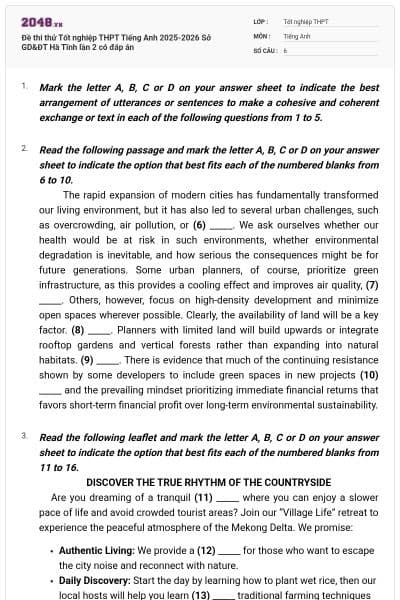
Mark the letter A, B, C or D on your answer sheet to indicate the best arrangement of utterances or sentences to make a meaningful exchange or text in each of the following questions from 11 to 15.
a. However, the reality was far more demanding than I had anticipated, as cultural differences and tight deadlines quickly tested my adaptability.
b. Instead of feeling discouraged, I gradually adjusted my communication style and learned how to collaborateeffectively with colleagues from diverse backgrounds.
c. Participating in an international exchange programme motivated me to pursue broader career opportunitiesbeyond my home country.
d. This challenging yet transformative experience ultimately strengthened my resilience and brought me closer to achieving global success.
e. At first, I was excited about working on multinational projects and expanding my professional network.
c – e – b – a – d
c – e – a – b – d
c – a – e – b – d
e – c – a – b – d
Thứ tự sắp xếp đúng: B. c – e – a – b – d
c. Participating in an international exchange programme motivated me to pursue broader career opportunities beyond my home country.
e. At first, I was excited about working on multinational projects and expanding my professional network.
a. However, the reality was far more demanding than I had anticipated, as cultural differences and tight deadlines quickly tested my adaptability.
b. Instead of feeling discouraged, I gradually adjusted my communication style and learned how to collaborate effectively with colleagues from diverse backgrounds.
d. This challenging yet transformative experience ultimately strengthened my resilience and brought me closer to achieving global success.
Dịch nghĩa:
c. Việc tham gia vào một chương trình giao lưu quốc tế đã thúc đẩy tôi theo đuổi những cơ hội nghề nghiệp rộng mở hơn bên ngoài quê hương mình.
e. Lúc đầu, tôi rất hào hứng với việc làm việc trong các dự án đa quốc gia và mở rộng mạng lưới quan hệ chuyên môn của mình.
a. Tuy nhiên, thực tế lại đòi hỏi khắt khe hơn nhiều so với những gì tôi dự đoán, vì những khác biệt về văn hóa và thời hạn làm việc gắt gao đã nhanh chóng thử thách khả năng thích nghi của tôi.
b. Thay vì cảm thấy nản lòng, tôi đã dần điều chỉnh phong cách giao tiếp của mình và học cách hợp tác hiệu quả với các đồng nghiệp đến từ nhiều nền tảng đa dạng.
d. Trải nghiệm đầy thách thức nhưng mang tính bước ngoặt này cuối cùng đã củng cố sự kiên cường của tôi và đưa tôi đến gần hơn với việc đạt được thành công toàn cầu.
Chọn B.
a. Mia: Honestly, chances like that don’t come up very often. It could help your career in the long run.
b. Leo: I’ve just been offered a short-term contract abroad, but I’m not sure if I should take it.
c. Leo: Yeah, I guess it might give me an edge later on.
b – a – c
b – c – a
a – b – c
c – b – a
Thứ tự sắp xếp đúng: A. b – a – c
b. Leo: I’ve just been offered a short-term contract abroad, but I’m not sure if I should take it.
a. Mia: Honestly, chances like that don’t come up very often. It could help your career in the long run.
c. Leo: Yeah, I guess it might give me an edge later on.
Dịch nghĩa:
b. Leo: Tớ vừa được đề nghị một hợp đồng ngắn hạn ở nước ngoài, nhưng tớ không chắc mình có nên nhận nó hay không.
a. Mia: Thành thật mà nói, những cơ hội như vậy không thường xuyên xuất hiện đâu. Về lâu dài, nó có thể giúp ích cho sự nghiệp của cậu đấy.
c. Leo: Ừ, tớ đoán nó có thể mang lại cho tớ một lợi thế sau này.
Chọn A.
a. Liam: I agree. Protecting wildlife isn’t just a local issue anymore; it’s a global responsibility.
b. Sophie: I read that several countries are working together to save endangered species.
c. Liam: Yes, and some conservation projects have even created jobs for local communities.
d. Sophie: That’s great! It shows that wildlife conservation benefits both the environment and the economy.
e.Liam: Exactly. When people see real benefits, they’re more willing to support long-term conservation efforts.
b – d – c – a – e
a – b – c – e – d
b – a – c – d – e
b – c – d – e – a
Thứ tự sắp xếp đúng: C. b – a – c – d – e
b. Sophie: I read that several countries are working together to save endangered species.
a. Liam: I agree. Protecting wildlife isn’t just a local issue anymore; it’s a global responsibility.
c. Liam: Yes, and some conservation projects have even created jobs for local communities.
d. Sophie: That’s great! It shows that wildlife conservation benefits both the environment and the economy.
e. Liam: Exactly. When people see real benefits, they’re more willing to support long-term conservation efforts.
Dịch nghĩa:
b. Sophie: Tớ đọc được rằng một số quốc gia đang hợp tác với nhau để cứu các loài có nguy cơ tuyệt chủng.
a. Liam: Tớ đồng ý. Việc bảo vệ động vật hoang dã không chỉ còn là vấn đề của địa phương nữa; đó là trách nhiệm toàn cầu.
c. Liam: Đúng vậy, và một số dự án bảo tồn thậm chí đã tạo ra việc làm cho các cộng đồng địa phương.
d. Sophie: Tuyệt quá! Điều đó cho thấy việc bảo tồn động vật hoang dã mang lại lợi ích cho cả môi trường và nền kinh tế.
e. Liam: Chính xác. Khi mọi người nhìn thấy những lợi ích thực sự, họ sẽ sẵn sàng hơn trong việc ủng hộ các nỗ lực bảo tồn dài hạn.
Chọn C.
a. I am writing to express my interest in the part-time sales assistant position advertised on your website.
b. I believe my customer service experience and strong communication skills make me a suitable candidate for this role.
c. I am currently a second-year university student seeking practical work experience to develop my professional skills.
d. I would welcome the opportunity to attend an interview at your convenience.
e. I have attached my CV for your consideration and look forward to hearing from you soon.
c – a – b – d – e
a – c – b – e – d
a – c – b – d – e
a – b – c – e – d
Thứ tự sắp xếp đúng: C. a – c – b – d – e
a. I am writing to express my interest in the part-time sales assistant position advertised on your website.
c. I am currently a second-year university student seeking practical work experience to develop my professional skills.
b. I believe my customer service experience and strong communication skills make me a suitable candidate for this role.
d. I would welcome the opportunity to attend an interview at your convenience.
e. I have attached my CV for your consideration and look forward to hearing from you soon.
Dịch nghĩa:
a. Tôi viết thư này để bày tỏ sự quan tâm của mình đối với vị trí trợ lý bán hàng bán thời gian được quảng cáo trên trang web của công ty.
c. Tôi hiện là sinh viên đại học năm thứ hai đang tìm kiếm kinh nghiệm làm việc thực tế để phát triển các kỹ năng chuyên môn của mình.
b. Tôi tin rằng kinh nghiệm chăm sóc khách hàng và kỹ năng giao tiếp tốt khiến tôi trở thành một ứng cử viên phù hợp cho vai trò này.
d. Tôi rất mong có cơ hội được tham dự một buổi phỏng vấn vào thời gian thuận tiện cho ông/bà.
e. Tôi đã đính kèm sơ yếu lý lịch của mình để ông/bà xem xét và mong sớm nhận được phản hồi từ ông/bà.
Chọn C.
a. Overall, these developments suggest a clear transition from a predominantly agricultural village to a more urbanised and functionally diverse area.
b. Significant developments occurred in Greenfield village between 1990 and 2015, during which the village underwent considerable changes.
c. By 2015, several new housing estates had been constructed on former farmland, and the main road had been extended to the east.
d. In 1990, Greenfield was largely rural in character, consisting mainly of open fields, a small number of houses, and a primary school located near the river.
e. Furthermore, a community centre and a small retail area were added in the southern part of the village, replacing what had once been open land.
b – c – d – e – a
b – d – c – e – a
d – b – c – e – a
d – c – b – e – a
Thứ tự sắp xếp đúng: B. b – d – c – e – a
b. Significant developments occurred in Greenfield village between 1990 and 2015, during which the village underwent considerable changes.
d. In 1990, Greenfield was largely rural in character, consisting mainly of open fields, a small number of houses, and a primary school located near the river.
c. By 2015, several new housing estates had been constructed on former farmland, and the main road had been extended to the east.
e. Furthermore, a community centre and a small retail area were added in the southern part of the village, replacing what had once been open land.
a. Overall, these developments suggest a clear transition from a predominantly agricultural village to a more urbanised and functionally diverse area.
Dịch nghĩa:
b. Những sự phát triển đáng kể đã diễn ra ở làng Greenfield từ năm 1990 đến năm 2015, trong khoảng thời gian đó, ngôi làng đã trải qua những thay đổi lớn.
d. Vào năm 1990, Greenfield mang đậm nét nông thôn, chủ yếu bao gồm những cánh đồng mở, một số ít nhà ở và một trường tiểu học nằm gần con sông.
c. Đến năm 2015, một số khu nhà ở mới đã được xây dựng trên những vùng đất canh tác trước đây, và con đường chính đã được kéo dài về phía đông.
e. Hơn nữa, một trung tâm cộng đồng và một khu bán lẻ nhỏ đã được thêm vào ở khu vực phía nam của ngôi làng, thay thế cho nơi từng là những bãi đất trống.
a. Nhìn chung, những sự phát triển này cho thấy một sự chuyển tiếp rõ rệt từ một ngôi làng chủ yếu là nông nghiệp sang một khu vực đô thị hóa và đa dạng chức năng hơn.
Chọn B.
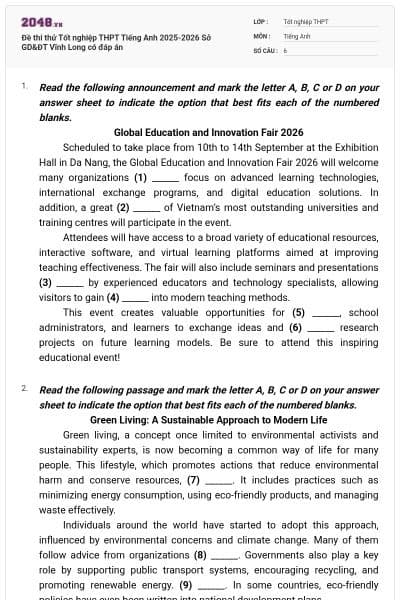
Read the following passage and mark the letter A, B, C or D on your answer sheet to indicate the option that best fits each of the numbered blanks from 16 to 20.
An ethnography is a valuable research design for studying groups in education, focusing on their behaviors, beliefs, language, and the ways they develop shared patterns of interaction over time. Ethnographic research is a qualitative approach used to describe, analyze, and interpret the patterns of a culture-sharing group. (16) ____________, including language, rituals, social structures, life stages, interactions, and communication.
Ethnographers conduct research by entering the “field,” (17) ____________. They aim to produce a detailed cultural portrait of a group within its natural setting. Typically, ethnographic studies focus on a group of individuals at a single site, examining shared patterns of behavior, belief, and language that have evolved over time. Fieldwork often involves observing and interviewing participants in the contexts where they live and work. Data analysis begins with describing and analyzing the culture-sharing group and interpreting its patterns within the broader context of culture in action. (18) ____________. The roots of ethnographic research lie in anthropology, sociology, education, and postmodern concerns about interpretation and representation.
Historically, three main types of ethnographic designs have emerged: realist, case study, and critical ethnographies. A realist ethnography presents an objective account of a culture-sharing group. (19) ____________. Case studies focus on a specific program, event, or activity and offer an in-depth description and analysis based on extensive data collection. Critical ethnography emphasizes advocacy, giving voice to marginalized groups and addressing issues of power and authority. Together, these three ethnographic designs illustrate the methodological diversity of ethnographic research, (20) ____________.
(Adapted from Educational Research)
People behave and believe in a system of cultural concepts and encompass them broadly
Culturally, encompassing belief systems in human behavior is a broad concept
The concept of culture is broad and encompasses human behavior and belief systems
Human behavior and their belief systems are broadly encompassed the concept of culture
Phía sau chỗ trống là một cụm từ bổ sung thông tin bắt đầu bằng giới từ: "..., including language, rituals, social structures..." (..., bao gồm ngôn ngữ, nghi lễ, cấu trúc xã hội...). Vị trí (16) cần một mệnh đề chính giới thiệu khái niệm bao trùm chứa các yếu tố này.
Dịch nghĩa/Ngữ pháp:
A. Mọi người cư xử và tin vào một hệ thống các khái niệm văn hóa và bao trùm chúng một cách rộng rãi (Sai logic và diễn đạt lủng củng).
B. Về mặt văn hóa, việc bao trùm các hệ thống niềm tin vào hành vi con người là một khái niệm rộng (Không ăn nhập với cụm liệt kê phía sau).
C. Khái niệm về văn hóa rất rộng và bao trùm hành vi cũng như hệ thống niềm tin của con người (Hoàn toàn hợp lý về mặt định nghĩa, cụm "bao gồm ngôn ngữ..." ở phía sau chính là để làm rõ cho "hành vi và hệ thống niềm tin").
D. Hành vi con người và hệ thống niềm tin của họ bị bao trùm một cách rộng rãi khái niệm văn hóa
(Sai cấu trúc bị động "are encompassed the concept").
Đáp án C cung cấp một định nghĩa khái quát, đóng vai trò là mệnh đề chính, tạo đà cho cụm liệt kê chi tiết ngay phía sau dấu phẩy.
Chọn C.
→ The concept of culture is broad and encompasses human behavior and belief systems, including language, rituals, social structures, life stages, interactions, and communication.
Dịch nghĩa: Khái niệm về văn hóa rất rộng và bao trùm hành vi cũng như hệ thống niềm tin của con người, bao gồm ngôn ngữ, các nghi lễ, cấu trúc xã hội, các giai đoạn cuộc đời, sự tương tác và giao tiếp.
observing and interviewing are means of collecting extensive data
through interviewing and observation, data are collected extensively
that extensive data are collected through interviewing and observation
where they collect extensive data through observation and interviewing
Phía trước là danh từ chỉ nơi chốn "the field" (thực địa/hiện trường). Vị trí (17) cần một mệnh đề quan hệ để bổ nghĩa cho nơi chốn này.
Dịch nghĩa/Ngữ pháp:
A. quan sát và phỏng vấn là các phương tiện để thu thập dữ liệu sâu rộng
(Tạo thành 2 mệnh đề độc lập nối bằng dấu phẩy - lỗi comma splice).
B. thông qua phỏng vấn và quan sát, dữ liệu được thu thập một cách sâu rộng (Giống lỗi A).
C. rằng dữ liệu sâu rộng được thu thập thông qua phỏng vấn và quan sát
(Đại từ "that" không thể đứng sau dấu phẩy trong mệnh đề quan hệ).
D. nơi mà họ thu thập dữ liệu sâu rộng thông qua việc quan sát và phỏng vấn (Dùng đại từ quan hệ "where" thay thế cho "the field", hoàn toàn chính xác).
Chỉ có đáp án D sử dụng đúng đại từ quan hệ chỉ nơi chốn và ghép nối chuẩn xác với danh từ đứng trước nó.
Chọn D.
→ Ethnographers conduct research by entering the “field,” where they collect extensive data through observation and interviewing.
Dịch nghĩa: Các nhà dân tộc học tiến hành nghiên cứu bằng cách bước vào "thực địa", nơi mà họ thu thập dữ liệu sâu rộng thông qua việc quan sát và phỏng vấn.
Ethnographers, therefore, adopt a reflexive inquiry style, remaining self-aware in research while maintaining respect for participants.
On the contrary, ethnographers maintain a reflexive inquiry style and adopt self-aware in research to remain respect for participants.
Participants, on the contrary, respect for ethnographers while remaining self-aware in a reflexive inquiry in research.
Therefore, participants remain a reflexive inquiry style in research while maintaining their respect for ethnographers.
Đoạn văn đang mô tả quá trình thu thập và phân tích dữ liệu vô cùng sâu sát của các nhà dân tộc học ("observing", "interviewing", "interpreting... within the broader context"). Câu (18) cần nêu kết quả hoặc thái độ của người nghiên cứu khi thực hiện các công việc phức tạp này.
Dịch nghĩa:
A. Do đó, các nhà dân tộc học áp dụng một phong cách đặt câu hỏi mang tính phản tư, duy trì sự tự nhận thức trong nghiên cứu trong khi vẫn giữ sự tôn trọng đối với những người tham gia.
(Từ nối "therefore" chỉ kết quả hợp lý).
B. Trái lại, các nhà dân tộc học duy trì...
(Dùng "On the contrary" sai logic vì không có sự đối lập nào với câu trước).
C. Trái lại, những người tham gia tôn trọng các nhà dân tộc học...
(Sai chủ thể hành động: đoạn văn đang nói về thái độ/cách làm việc của "Ethnographers", không phải của "Participants").
D. Do đó, những người tham gia duy trì một phong cách đặt câu hỏi...
(Sai chủ thể hành động: "Participants" không phải là người đặt câu hỏi nghiên cứu).
Đáp án A là lựa chọn duy nhất đúng cả về mặt logic kết nối văn bản (therefore) lẫn chủ thể của hành động nghiên cứu (Ethnographers).
Chọn A.
→ Data analysis begins with describing and analyzing the culture-sharing group and interpreting its patterns within the broader context of culture in action. Ethnographers, therefore, adopt a reflexive inquiry style, remaining self-aware in research while maintaining respect for participants. The roots of ethnographic research lie in anthropology, sociology, education, and postmodern concerns about interpretation and representation.
Dịch nghĩa: Việc phân tích dữ liệu bắt đầu bằng việc mô tả và phân tích nhóm chia sẻ văn hóa và diễn giải các khuôn mẫu của nó trong bối cảnh rộng lớn hơn của văn hóa trong hành động. Do đó, các nhà dân tộc học áp dụng một phong cách đặt câu hỏi mang tính phản tư, duy trì sự tự nhận thức trong nghiên cứu trong khi vẫn giữ sự tôn trọng đối với những người tham gia. Nguồn gốc của nghiên cứu dân tộc học nằm ở nhân chủng học, xã hội học, giáo dục và những mối quan tâm mang tính hậu hiện đại về sự diễn giải và tính đại diện.
This type of ethnography is typically written from a third-person perspective, with the researcher providing the final interpretation.
Regardless of a third-person perspective, it is typically written basing on the researcher’s sole perspective and interpretation.
Typically, it is written from a researcher’s perspective basing on the final interpretation which is provided by the third person.
The researcher writes this type of ethnographyfrom their own perspectives without any interpretation from a third person.
Câu trước vừa giới thiệu: "A realist ethnography presents an objective account..." (Một nghiên cứu dân tộc học thực tế trình bày một bản báo cáo khách quan...). Câu (19) cần giải thích thêm về cách thức tạo ra sự "khách quan" (objective) đó.
Dịch nghĩa:
A. Loại hình dân tộc học này thường được viết từ góc nhìn thứ ba, với việc nhà nghiên cứu đưa ra sự diễn giải cuối cùng.
(Ngôi thứ 3 chính là cách tạo ra sự "khách quan").
B. Bất chấp góc nhìn thứ ba, nó thường được viết dựa trên góc nhìn và sự diễn giải duy nhất của nhà nghiên cứu. (Cụm "Regardless of" làm sai lệch logic hoàn toàn).
C. Thông thường, nó được viết từ góc nhìn của nhà nghiên cứu dựa trên sự diễn giải cuối cùng được cung cấp bởi người thứ ba.
(Sai logic: nhà nghiên cứu mới là người viết báo cáo khoa học, không phải "người thứ ba").
D. Nhà nghiên cứu viết loại hình dân tộc học này từ góc nhìn của chính họ mà không có bất kỳ sự diễn giải nào từ người thứ ba.
(Viết từ "own perspectives" thì sẽ mang tính chủ quan - subjective, mâu thuẫn với từ "objective" ở câu trước).
Đáp án A giải thích chính xác đặc điểm của "realist ethnography" - viết dưới góc nhìn thứ 3 để đảm bảo tính khách quan như đã nêu ở câu trước.
Chọn A.
→ A realist ethnography presents an objective account of a culture-sharing group. This type of ethnography is typically written from a third-person perspective, with the researcher providing the final interpretation.
Dịch nghĩa: Một nghiên cứu dân tộc học thực tế trình bày một bản báo cáo khách quan về một nhóm có chung văn hóa. Loại hình dân tộc học này thường được viết từ góc nhìn thứ ba, với việc nhà nghiên cứu đưa ra sự diễn giải cuối cùng.
Together, these three ethnographic designs illustrate the methodological diversity of ethnographic research, (20) ____________.
because social and cultural phenomena can be understood from a distinct lens offered
to understand social and cultural phenomena through a distinct lens offered by them
each of them offersa distinct lens in order to understand social and cultural phenomena
each offering a distinct lens through which social and cultural phenomena can be understood
Câu chứa chỗ trống có mệnh đề chính hoàn chỉnh: "Together, these three ethnographic designs illustrate the methodological diversity of ethnographic research" (Cùng nhau, ba thiết kế dân tộc học này minh họa cho sự đa dạng về phương pháp luận của nghiên cứu dân tộc học). Vị trí (20) cần một cụm từ đóng vai trò bổ ngữ hoặc mệnh đề rút gọn giải thích sự đa dạng đó.
Dịch nghĩa/Ngữ pháp:
A. bởi vì các hiện tượng văn hóa và xã hội có thể được hiểu từ một lăng kính rõ rệt được cung cấp
(Bị thiếu chủ ngữ/tân ngữ gây tối nghĩa).
B. để hiểu các hiện tượng văn hóa và xã hội thông qua một lăng kính rõ rệt được cung cấp bởi chúng (Cấu trúc "to V" không mang tính chất tổng kết mà mang tính mục đích, không phù hợp).
C. mỗi cái trong số chúng đưa ra một lăng kính riêng biệt để hiểu các hiện tượng văn hóa và xã hội
(Tạo thành 2 mệnh đề độc lập nối bằng dấu phẩy - lỗi comma splice).
D. mỗi loại cung cấp một lăng kính riêng biệt, qua đó các hiện tượng văn hóa và xã hội có thể được thấu hiểu (Sử dụng cấu trúc V-ing "offering" rút gọn mệnh đề mang tính độc lập tương đối - Absolute phrase, chuẩn xác về ngữ pháp nâng cao).
Đáp án D không những đúng ngữ pháp (không tạo lỗi comma splice như C) mà còn tạo ra câu chốt hạ tốt.
Chọn D.
→ Together, these three ethnographic designs illustrate the methodological diversity of ethnographic research, each offering a distinct lens through which social and cultural phenomena can be understood.
Dịch nghĩa: Cùng nhau, ba thiết kế dân tộc học này minh họa cho sự đa dạng về phương pháp luận của nghiên cứu dân tộc học, mỗi loại cung cấp một lăng kính riêng biệt, qua đó các hiện tượng văn hóa và xã hội có thể được thấu hiểu.
Bài đọc hoàn chỉnh | Dịch bài đọc |
An ethnography is a valuable research design for studying groups in education, focusing on their behaviors, beliefs, language, and the ways they develop shared patterns of interaction over time. Ethnographic research is a qualitative approach used to describe, analyze, and interpret the patterns of a culture-sharing group. The concept of culture is broad and encompasses human behavior and belief systems, including language, rituals, social structures, life stages, interactions, and communication. Ethnographers conduct research by entering the “field,” where they collect extensive data through observation and interviewing. They aim to produce a detailed cultural portrait of a group within its natural setting. Typically, ethnographic studies focus on a group of individuals at a single site, examining shared patterns of behavior, belief, and language that have evolved over time. Fieldwork often involves observing and interviewing participants in the contexts where they live and work. Data analysis begins with describing and analyzing the culture-sharing group and interpreting its patterns within the broader context of culture in action. Ethnographers, therefore, adopt a reflexive inquiry style, remaining self-aware in research while maintaining respect for participants. The roots of ethnographic research lie in anthropology, sociology, education, and postmodern concerns about interpretation and representation. Historically, three main types of ethnographic designs have emerged: realist, case study, and critical ethnographies. A realist ethnography presents an objective account of a culture-sharing group. This type of ethnography is typically written from a third-person perspective, with the researcher providing the final interpretation. Case studies focus on a specific program, event, or activity and offer an in-depth description and analysis based on extensive data collection. Critical ethnography emphasizes advocacy, giving voice to marginalized groups and addressing issues of power and authority. Together, these three ethnographic designs illustrate the methodological diversity of ethnographic research, each offering a distinct lens through which social and cultural phenomena can be understood. | Nghiên cứu dân tộc học là một thiết kế nghiên cứu có giá trị để nghiên cứu các nhóm trong giáo dục, tập trung vào các hành vi, niềm tin, ngôn ngữ của họ và những cách mà họ phát triển các khuôn mẫu tương tác chung theo thời gian. Nghiên cứu dân tộc học là một cách tiếp cận định tính được sử dụng để mô tả, phân tích và diễn giải các khuôn mẫu của một nhóm có chung nền văn hóa. Khái niệm về văn hóa rất rộng và bao trùm hành vi cũng như hệ thống niềm tin của con người, bao gồm ngôn ngữ, các nghi lễ, cấu trúc xã hội, các giai đoạn cuộc đời, sự tương tác và giao tiếp. Các nhà dân tộc học tiến hành nghiên cứu bằng cách bước vào "thực địa", nơi mà họ thu thập dữ liệu sâu rộng thông qua việc quan sát và phỏng vấn. Mục tiêu của họ là tạo ra một bức chân dung văn hóa chi tiết về một nhóm trong môi trường tự nhiên của nó. Thông thường, các nghiên cứu dân tộc học tập trung vào một nhóm các cá nhân tại một địa điểm duy nhất, xem xét các khuôn mẫu chung về hành vi, niềm tin và ngôn ngữ đã tiến hóa theo thời gian. Việc thực địa thường bao gồm việc quan sát và phỏng vấn những người tham gia trong bối cảnh nơi họ sống và làm việc. Việc phân tích dữ liệu bắt đầu bằng việc mô tả và phân tích nhóm chia sẻ văn hóa và diễn giải các khuôn mẫu của nó trong bối cảnh rộng lớn hơn của văn hóa trong hành động. Do đó, các nhà dân tộc học áp dụng một phong cách đặt câu hỏi mang tính phản tư, duy trì sự tự nhận thức trong nghiên cứu trong khi vẫn giữ sự tôn trọng đối với những người tham gia. Nguồn gốc của nghiên cứu dân tộc học nằm ở nhân chủng học, xã hội học, giáo dục và những mối quan tâm mang tính hậu hiện đại về sự diễn giải và tính đại diện. Về mặt lịch sử, ba loại hình thiết kế dân tộc học chính đã xuất hiện: dân tộc học thực tế, nghiên cứu tình huống và dân tộc học phê phán. Một nghiên cứu dân tộc học thực tế trình bày một bản báo cáo khách quan về một nhóm có chung văn hóa. Loại hình dân tộc học này thường được viết từ góc nhìn thứ ba, với việc nhà nghiên cứu đưa ra sự diễn giải cuối cùng. Các nghiên cứu tình huống tập trung vào một chương trình, sự kiện hoặc hoạt động cụ thể và đưa ra một sự mô tả cũng như phân tích chuyên sâu dựa trên việc thu thập dữ liệu sâu rộng. Dân tộc học phê phán nhấn mạnh vào sự biện hộ, mang lại tiếng nói cho các nhóm người yếu thế và giải quyết các vấn đề về quyền lực và thẩm quyền. Cùng nhau, ba thiết kế dân tộc học này minh họa cho sự đa dạng về phương pháp luận của nghiên cứu dân tộc học, mỗi loại cung cấp một lăng kính riêng biệt, qua đó các hiện tượng văn hóa và xã hội có thể được thấu hiểu. |
Read the following advertisement and mark the letter A, B, C or D on your answer sheet to indicate the option that best fits each of the numbered blanks from 21 to 26.
Francophonie Day 2026
With a nod to both language and the environment, Francophonie Day will bring an eco-minded energy to Thong Nhat Park on March 22, 2026. The event is an annual (21) ____________ for the Francophone and Francophile community in Viet Nam and this year it also aims to guide people towards a greener future through sport, culture, education, and (22) ____________ professional opportunities.
As part of the event, the fourth season of the Course de la Francophonie (Race of the Francophonie) continues its commitment (23) ____________ the values of the Francophone community. It offers an opportunity to (24) ____________ personal goals and spread a positive spirit. The Francophone Career and Job Fair will be held (25) ____________ the race, offering young people the chance to meet directly with embassies and organisations of the Francophone community, schools and universities, as well as business representatives. There will also be numerous booths and stands (26) ____________ by Francophone embassies and institutions teaching French and in French.
(Adapted from https://vietnamnews.vn)
gathering
congress
conference
ceremony
A. gathering (n): cuộc tụ họp, buổi giao lưu, sự kiện tụ tập.
B. congress (n): đại hội (thường mang tính chính trị, lập pháp).
C. conference (n): hội nghị.
D. ceremony (n): buổi lễ, nghi lễ.
Sự kiện được tổ chức tại Công viên Thống Nhất là một dịp để cộng đồng gặp gỡ, giao lưu. Do đó, từ "gathering" (buổi giao lưu/tụ họp) là phù hợp nhất, mang tính chất cộng đồng và gần gũi hơn so với các từ chỉ hội nghị hay đại hội.
Chọn A. gathering
→ The event is an annual gathering for the Francophone and Francophile community in Viet Nam...
Dịch nghĩa: Sự kiện này là một buổi giao lưu thường niên dành cho cộng đồng Pháp ngữ và những người yêu mến văn hóa Pháp tại Việt Nam...
other
the others
another
others
A. other: khác (tính từ, bắt buộc phải có danh từ số nhiều hoặc không đếm được theo sau).
B. the others: những người/vật còn lại (đại từ, không đi kèm danh từ).
C. another: một ... khác (tính từ/đại từ, đi kèm danh từ đếm được số ít).
D. others: những người/vật khác (đại từ, không đi kèm danh từ).
Phía sau khoảng trống là cụm danh từ số nhiều "professional opportunities" (các cơ hội nghề nghiệp). Do đó, ta cần một tính từ bổ nghĩa cho danh từ số nhiều này.
Chọn A. other
→ ...and this year it also aims to guide people towards a greener future through sport, culture, education, and other professional opportunities.
Dịch nghĩa: ...và năm nay sự kiện cũng nhằm mục đích hướng mọi người tới một tương lai xanh hơn thông qua thể thao, văn hóa, giáo dục và các cơ hội nghề nghiệp khác.
to promote
promote
promoting
to promoting
A. to promote: động từ nguyên thể có "to".
B. promote: động từ nguyên mẫu.
C. promoting: hiện tại phân từ (V-ing).
D. to promoting: giới từ "to" + V-ing.
Ta có cấu trúc cố định: commitment to doing something (cam kết thực hiện việc gì). Chữ "to" ở đây đóng vai trò là một giới từ, do đó động từ theo sau phải thêm "-ing".
Chọn D. to promoting
→ ...the fourth season of the Course de la Francophonie (Race of the Francophonie) continues its commitment to promoting the values of the Francophone community.
Dịch nghĩa: ...mùa thứ tư của Giải chạy Pháp ngữ (Course de la Francophonie) tiếp tục cam kết của mình trong việc thúc đẩy các giá trị của cộng đồng Pháp ngữ.
play
set
do
go
A. play (v): chơi.
B. set (v): đặt ra, thiết lập.
C. do (v): làm.
D. go (v): đi.
Ta có cụm kết hợp từ cố định (collocation): set a goal / set personal goals (đặt ra mục tiêu cá nhân).
Chọn B. set
→ It offers an opportunity to set personal goals and spread a positive spirit.
Dịch nghĩa: Nó mang đến một cơ hội để thiết lập các mục tiêu cá nhân và lan tỏa một tinh thần tích cực.
by virtue of
by dint of
in line with
in parallel with
A. by virtue of (prep): bởi vì, nhờ có.
B. by dint of (prep): nhờ vào, bởi vì (thường chỉ sự nỗ lực).
C. in line with (prep): phù hợp với, nhất trí với.
D. in parallel with (prep): song song với, diễn ra cùng lúc với.
Hội chợ Việc làm và Nghề nghiệp Pháp ngữ sẽ được tổ chức "song song với / cùng lúc với" giải chạy, để mang đến cho những người trẻ cơ hội gặp gỡ trực tiếp các đại sứ quán.
Chọn D. in parallel with
→ The Francophone Career and Job Fair will be held in parallel with the race...
Dịch nghĩa: Hội chợ Việc làm và Nghề nghiệp Pháp ngữ sẽ được tổ chức song song với giải chạy...
running
run
were run
which run
A. running: hiện tại phân từ (V-ing, mang nghĩa chủ động).
B. run: quá khứ phân từ (V-ed/V3, mang nghĩa bị động).
C. were run: động từ chia bị động thì quá khứ đơn (sai ngữ pháp vì câu đã có động từ chính "will be").
D. which run: mệnh đề quan hệ mang nghĩa chủ động.
Động từ "run" ngoài nghĩa là chạy, còn mang nghĩa là "quản lý, điều hành" (quản lý một gian hàng/doanh nghiệp). Ở đây ta cần rút gọn mệnh đề quan hệ mang nghĩa bị động: "các gian hàng được điều hành bởi các đại sứ quán". Mệnh đề đầy đủ: which are run by... → Rút gọn còn quá khứ phân từ run. (3 cột của động từ này là: run - ran - run).
Chọn B. run
→ There will also be numerous booths and stands run by Francophone embassies and institutions...
Dịch nghĩa: Cũng sẽ có rất nhiều gian hàng và quầy trưng bày được điều hành bởi các đại sứ quán và các tổ chức Pháp ngữ...
Bài đọc hoàn chỉnh | Dịch bài đọc |
Francophonie Day 2026 With a nod to both language and the environment, Francophonie Day will bring an eco-minded energy to Thong Nhat Park on March 22, 2026. The event is an annual (21) gathering for the Francophone and Francophile community in Viet Nam and this year it also aims to guide people towards a greener future through sport, culture, education, and (22) other professional opportunities. As part of the event, the fourth season of the Course de la Francophonie (Race of the Francophonie) continues its commitment (23) to promoting the values of the Francophone community. It offers an opportunity to (24) set personal goals and spread a positive spirit. The Francophone Career and Job Fair will be held (25) in parallel with the race, offering young people the chance to meet directly with embassies and organisations of the Francophone community, schools and universities, as well as business representatives. There will also be numerous booths and stands (26) run by Francophone embassies and institutions teaching French and in French. | Ngày Quốc tế Pháp ngữ 2026 Với sự tôn vinh dành cho cả ngôn ngữ lẫn môi trường, Ngày Quốc tế Pháp ngữ sẽ mang một nguồn năng lượng hướng tới sinh thái đến Công viên Thống Nhất vào ngày 22 tháng 3 năm 2026. Sự kiện này là một (21) buổi giao lưu thường niên dành cho cộng đồng Pháp ngữ và những người yêu mến văn hóa Pháp tại Việt Nam, và năm nay nó cũng nhằm mục đích hướng mọi người tới một tương lai xanh hơn thông qua thể thao, văn hóa, giáo dục và (22) các cơ hội nghề nghiệp khác. Như một phần của sự kiện, mùa thứ tư của Giải chạy Pháp ngữ (Course de la Francophonie) tiếp tục cam kết của mình trong việc (23) thúc đẩy các giá trị của cộng đồng Pháp ngữ. Nó mang đến một cơ hội để (24) đặt ra các mục tiêu cá nhân và lan tỏa một tinh thần tích cực. Hội chợ Việc làm và Nghề nghiệp Pháp ngữ sẽ được tổ chức (25) song song với giải chạy, mang đến cho những người trẻ cơ hội gặp gỡ trực tiếp với các đại sứ quán và các tổ chức của cộng đồng Pháp ngữ, các trường học và trường đại học, cũng như đại diện các doanh nghiệp. Cũng sẽ có rất nhiều gian hàng và quầy trưng bày (26) được điều hành bởi các đại sứ quán và các tổ chức Pháp ngữ giảng dạy tiếng Pháp và bằng tiếng Pháp. |
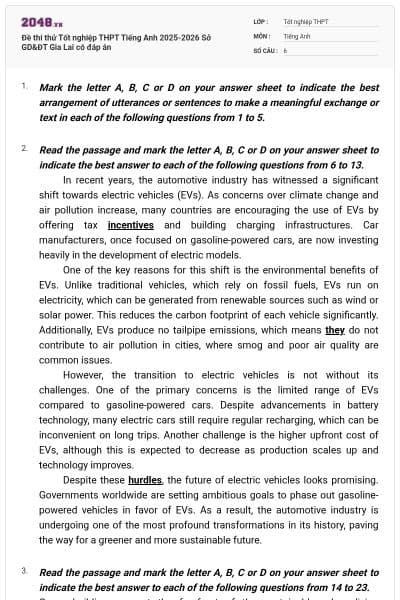
Read the passage and mark the letter A, B, C or D on your answer sheet to indicate the best answer to each of the following questions from 27 to 34.
3D printers have been widely used in educational settings from K–12 schools to universities as tools that support experiential learning and innovation. They are placed in various locations and environmental settings on campus, such as classrooms, maker centers, laboratories, and offices, alongside other office equipment such as photocopy machines, and are used for teaching, research, design, and prototyping in engineering, architecture, and other fields. In particular, university maker centers often house diverse types and multiple 3D printers within a single space, where these devices may operate continuously for extended periods. This intensive and frequent use increases the likelihood of prolonged exposure to emissions for students and staff working nearby.
Chemical Insights Research Institute (CIRI) has conducted a multi-year research initiative on 3D printer emissions and has found that 3D printing produces ultrafine particles (UFPs, smaller than 100 nm) as well as volatile organic compounds (VOCs). Due to their extremely small size, UFPs can remain suspended in the air for long durations and are easily inhaled. Once inhaled, these particles may penetrate deep into the lungs and even enter the bloodstream, which has been linked to respiratory and cardiovascular diseases.
In addition, some VOCs released during 3D printing processes have been associated with both acute and chronic adverse health effects, including eye and throat irritation, respiratory illness, and, in some cases, cancer, depending on exposure duration and concentration levels. The use of 3D printers on campuses can therefore contribute to elevated levels of indoor air pollutants, raising particular concerns for vulnerable populations such as individuals with asthma or other pre-existing respiratory conditions.
As a result, the growing prevalence of 3D printers in educational environments has increased attention to indoor air quality management. In enclosed or poorly ventilated spaces, continuous printer operation may lead to the accumulation of airborne pollutants, thereby heightening potential health risks. Consequently, systematic monitoring of particle and VOC levels, together with effective ventilation and exposure mitigation strategies, is essential to ensure a safe learning and working environment.
(Adapted from https://chemicalinsights.ul.org)
laboratories
photocopy machines
universities
3D printers
Cụm từ “these devices” ở đoạn 1 chỉ trực tiếp nhất đến ____________.
A. laboratories: các phòng thí nghiệm
B. photocopy machines: các máy photocopy
C. universities: các trường đại học
D. 3D printers: các máy in 3D
Thông tin: ...often house diverse types and multiple 3D printers within a single space, where these devices may operate continuously...
(...thường chứa các loại hình đa dạng và nhiều máy in 3D trong một không gian duy nhất, nơi những thiết bị này có thể hoạt động liên tục...)
→ these devices = 3D printers.
Chọn D.
Which of the following best paraphrases the underlined sentence in paragraph 1?
The heavy and repeated use makes it more likely that students and staff in close proximity will experience long-term exposure to emissions.
Intensive and frequently repeated use reduces the chances that emissions will affect students and staff working close to the source.
Because students and staff work nearby, they are exposed to emissions for a long time, although the use is not frequent and intensive.
The frequent exposure of students and staff results in more intensive use of emission-producing equipment nearby.
Câu nào sau đây diễn giải tốt nhất câu được gạch chân trong đoạn 1?
This intensive and frequent use increases the likelihood of prolonged exposure to emissions for students and staff working nearby.
(Việc sử dụng cường độ cao và thường xuyên này làm tăng khả năng phơi nhiễm kéo dài với khí thải đối với sinh viên và nhân viên làm việc gần đó.)
Dịch nghĩa:
A. Việc sử dụng nhiều và lặp đi lặp lại làm cho sinh viên và nhân viên ở khoảng cách gần có nhiều khả năng bị phơi nhiễm lâu dài với khí thải hơn. (Đúng và sát nghĩa nhất).
B. Việc sử dụng với cường độ cao và thường xuyên lặp lại làm giảm cơ hội khí thải sẽ ảnh hưởng đến sinh viên và nhân viên làm việc gần nguồn phát. (Sai nghĩa từ "làm giảm" - reduces).
C. Bởi vì sinh viên và nhân viên làm việc gần đó, họ bị phơi nhiễm với khí thải trong một thời gian dài, mặc dù việc sử dụng không thường xuyên và cường độ không cao. (Sai nghĩa vế sau).
D. Việc phơi nhiễm thường xuyên của sinh viên và nhân viên dẫn đến việc sử dụng các thiết bị tạo ra khí thải gần đó với cường độ cao hơn. (Sai, đảo ngược mối quan hệ nguyên nhân - kết quả).
Chọn A.
remain
enter
embark
remove
Từ “penetrate” ở đoạn 2 có nghĩa gần nhất với ____________.
penetrate (v): thâm nhập, lọt vào, đi sâu vào.
A. remain (v): duy trì, ở lại
B. enter (v): đi vào, xâm nhập (đồng nghĩa)
C. embark (v): bắt đầu, lên tàu
D. remove (v): loại bỏ
→ penetrate = enter
Thông tin: Once inhaled, these particles may penetrate deep into the lungs and even enter the bloodstream...
(Một khi được hít vào, những hạt này có thể thâm nhập/đi sâu vào phổi và thậm chí xâm nhập vào máu...)
Chọn B.
Which of the following is NOT implied in the passage regarding 3D printers in educational environments?
They are commonly used for innovation-oriented learning activities.
Prolonged printer operation may increase exposure to airborne emissions.
Educational institutions are legally required to limit printer usage time.
Indoor air pollution levels may rise as a result of printer use.
Điều nào sau đây KHÔNG được ngụ ý trong bài đọc về máy in 3D trong môi trường giáo dục?
A. Chúng thường được sử dụng cho các hoạt động học tập định hướng đổi mới sáng tạo.
(Có ngụ ý ở đoạn 1: "support experiential learning and innovation").
B. Việc vận hành máy in kéo dài có thể làm tăng sự phơi nhiễm với khí thải trong không khí.
(Có ngụ ý xuyên suốt bài).
C. Các cơ sở giáo dục bị yêu cầu về mặt pháp lý phải giới hạn thời gian sử dụng máy in.
(Không được nhắc đến hay ngụ ý trong bài).
D. Mức độ ô nhiễm không khí trong nhà có thể tăng lên do việc sử dụng máy in.
(Có ngụ ý ở đoạn 3: "contribute to elevated levels of indoor air pollutants").
Chọn C.
retention
reduction
intensity
increase
Từ “accumulation” ở đoạn 4 TRÁI NGHĨA với ____________.
accumulation (n): sự tích tụ, sự chồng chất.
A. retention (n): sự giữ lại
B. reduction (n): sự giảm bớt (trái nghĩa)
C. intensity (n): cường độ
D. increase (n): sự gia tăng (đồng nghĩa)
→ accumulation >< reduction
Thông tin: In enclosed or poorly ventilated spaces, continuous printer operation may lead to the accumulation of airborne pollutants...
(Trong không gian kín hoặc thông gió kém, việc vận hành máy in liên tục có thể dẫn đến sự tích tụ các chất ô nhiễm trong không khí...)
Chọn B.
Which of the following can be reasonably inferred from the passage?
Extended exposure increases potential health risks in enclosed spaces.
3D printer emissions pose no risk in well-ventilated classrooms.
UFPs are more dangerous than VOCs in all exposure conditions.
Maker centers are safer than laboratories for operating 3D printers.
Điều nào sau đây có thể được suy luận hợp lý từ bài đọc?
A. Phơi nhiễm kéo dài làm tăng các nguy cơ tiềm ẩn về sức khỏe trong những không gian kín.
(Đúng, có thể suy luận từ đoạn 4: Việc máy in hoạt động liên tục trong không gian kín dẫn đến tích tụ chất ô nhiễm, qua đó làm tăng nguy cơ sức khỏe).
B. Khí thải từ máy in 3D không gây ra rủi ro nào trong các lớp học được thông gió tốt.
(Sai, từ "không gây ra rủi ro nào - no risk" mang tính quá tuyệt đối).
C. UFPs nguy hiểm hơn VOCs trong mọi điều kiện phơi nhiễm.
(Sai, bài đọc không so sánh mức độ nguy hiểm giữa hai chất này).
D. Trung tâm chế tạo (Maker centers) an toàn hơn phòng thí nghiệm khi vận hành máy in 3D.
(Sai, bài đọc không so sánh mức độ an toàn giữa hai khu vực này).
Chọn A.
Paragraphs 1 and 4
Paragraphs 2 and 3
Paragraph 1 only
Paragraph 4 only
(Các) đoạn nào tập trung chủ yếu vào những tác động tới sức khỏe của việc phơi nhiễm với khí thải máy in 3D?
A. Đoạn 1 và 4
B. Đoạn 2 và 3
C. Chỉ đoạn 1
D. Chỉ đoạn 4
Thông tin:
Đoạn 2 phân tích ảnh hưởng sức khỏe của hạt siêu nhỏ (UFPs): "respiratory and cardiovascular diseases" (các bệnh về hô hấp và tim mạch).
Đoạn 3 phân tích ảnh hưởng sức khỏe của hợp chất hữu cơ dễ bay hơi (VOCs): "eye and throat irritation, respiratory illness, and... cancer" (kích ứng mắt và cổ họng, bệnh hô hấp, và ung thư).
Chọn B.
Paragraph 1
Paragraph 2
Paragraph 3
Paragraph 4
Đoạn nào nhấn mạnh sự cần thiết phải cân bằng giữa lợi ích giáo dục với các biện pháp bảo vệ sức khỏe?
A. Đoạn 1
B. Đoạn 2
C. Đoạn 3
D. Đoạn 4
Thông tin (Đoạn 4): Consequently, systematic monitoring of particle and VOC levels, together with effective ventilation and exposure mitigation strategies, is essential to ensure a safe learning and working environment.
(Do đó, việc giám sát có hệ thống các mức độ hạt và VOC, cùng với các chiến lược thông gió và giảm thiểu phơi nhiễm hiệu quả, là điều cần thiết để đảm bảo một môi trường học tập và làm việc an toàn.)
Chọn D.
Dịch bài đọc:
Máy in 3D đã được sử dụng rộng rãi trong các môi trường giáo dục từ trường phổ thông liên cấp (K-12) đến các trường đại học như một công cụ hỗ trợ học tập trải nghiệm và đổi mới sáng tạo. Chúng được đặt ở nhiều vị trí và không gian môi trường khác nhau trong khuôn viên trường, chẳng hạn như lớp học, trung tâm chế tạo (maker centers), phòng thí nghiệm và văn phòng, bên cạnh các thiết bị văn phòng khác như máy photocopy, và được sử dụng để giảng dạy, nghiên cứu, thiết kế và tạo mẫu trong kỹ thuật, kiến trúc cùng các lĩnh vực khác. Đặc biệt, các trung tâm chế tạo của trường đại học thường chứa các loại hình đa dạng và nhiều máy in 3D trong một không gian duy nhất, nơi những thiết bị này có thể hoạt động liên tục trong thời gian dài. Việc sử dụng cường độ cao và thường xuyên này làm tăng khả năng phơi nhiễm kéo dài với khí thải đối với sinh viên và nhân viên làm việc gần đó.
Viện Nghiên cứu Thông tin Hóa học (CIRI) đã tiến hành một sáng kiến nghiên cứu kéo dài nhiều năm về khí thải của máy in 3D và phát hiện ra rằng việc in 3D tạo ra các hạt siêu nhỏ (UFPs, nhỏ hơn 100 nm) cũng như các hợp chất hữu cơ dễ bay hơi (VOCs). Do kích thước cực kỳ nhỏ, UFPs có thể lơ lửng trong không khí trong thời gian dài và rất dễ bị hít vào. Một khi được hít vào, những hạt này có thể đi sâu vào phổi và thậm chí xâm nhập vào máu, điều đã được chứng minh là có liên quan đến các bệnh về hô hấp và tim mạch.
Ngoài ra, một số VOCs thải ra trong quá trình in 3D có liên quan đến các tác động bất lợi cho sức khỏe cả cấp tính và mãn tính, bao gồm kích ứng mắt và cổ họng, bệnh hô hấp, và trong một số trường hợp là ung thư, tùy thuộc vào thời gian phơi nhiễm và mức độ nồng độ. Do đó, việc sử dụng máy in 3D trong khuôn viên trường có thể góp phần làm tăng mức độ các chất ô nhiễm không khí trong nhà, làm dấy lên những lo ngại đặc biệt đối với các nhóm đối tượng dễ bị tổn thương như những cá nhân mắc bệnh hen suyễn hoặc các tình trạng hô hấp có từ trước khác.
Kết quả là, sự phổ biến ngày càng tăng của máy in 3D trong môi trường giáo dục đã làm gia tăng sự chú ý đến việc quản lý chất lượng không khí trong nhà. Trong không gian kín hoặc thông gió kém, việc vận hành máy in liên tục có thể dẫn đến sự tích tụ các chất ô nhiễm trong không khí, qua đó làm tăng các nguy cơ tiềm ẩn về sức khỏe. Do đó, việc giám sát có hệ thống các mức độ hạt và VOC, cùng với các chiến lược thông gió và giảm thiểu phơi nhiễm hiệu quả, là điều cần thiết để đảm bảo một môi trường học tập và làm việc an toàn.
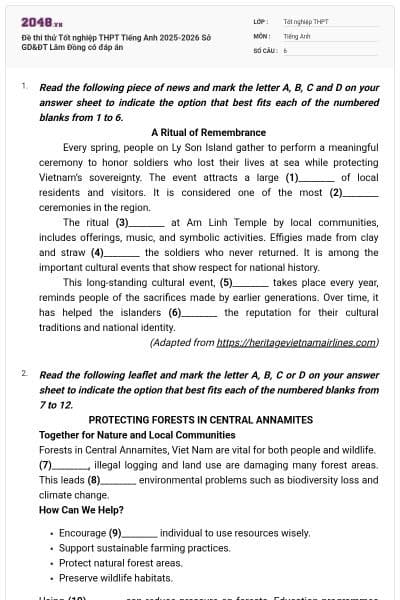
Read the following leaflet and mark the letter A, B, C or D on your answer sheet to indicate the option that best fits each of the numbered blanks from 35 to 40.
Eat Real Food Policy – Updated U.S. Dietary Guidelines (2025–2030)
The Eat Real Food Policy refers to the updated United States Dietary Guidelines for Americans (2025–2030), marking a significant shift in federal nutrition guidance. (35) ____________, the policy delivers a clear message: prioritise real, minimally processed foods to curb diet-related diseases and improve public health.The guidelines emphasise real, whole foods (36) ____________ are recognisable in their natural form. Protein is highlighted as a key nutrient and encouraged at every meal. Fruit and vegetables are prioritised with (37) ____________, while whole grains are promoted over refined grains.
The policy addresses rising (38) ____________ of obesity, prediabetes, and chronic diseases linked to poor diets by encouraging a shift towards nutrient-dense. In doing so, it seeks to foster long-term (39) ____________ habits that support sustainable public health outcomes. These science-based guidelines apply (40) ____________ all life stages and influence national programmes such as school meals, public health campaigns, and nutrition education.
(Adapted from https://www.hhs.govpolicy.com)
However
Otherwise
Nevertheless
Accordingly
A. However (adv): Tuy nhiên.
B. Otherwise (adv): Nếu không thì, mặt khác.
C. Nevertheless (adv): Tuy nhiên, dẫu vậy.
D. Accordingly (adv): Do đó, theo đó, vì vậy.
Câu trước đề cập đến việc cập nhật hướng dẫn đánh dấu một sự thay đổi đáng kể. Câu sau giải thích nội dung của sự thay đổi đó (truyền tải một thông điệp rõ ràng...). Hai câu này mang ý nghĩa tiếp nối, hệ quả logic chứ không hề tương phản. Do đó, "Accordingly" (Theo đó / Do đó) là đáp án chính xác nhất.
Chọn D. Accordingly
→ Accordingly, the policy delivers a clear message: prioritise real, minimally processed foods...
Dịch nghĩa: Theo đó, chính sách truyền tải một thông điệp rõ ràng: ưu tiên thực phẩm thật, ít qua chế biến...
what
which
whose
who
A. what: những gì (không làm đại từ quan hệ bổ nghĩa cho danh từ đứng trước).
B. which: đại từ quan hệ thay thế cho danh từ chỉ vật (làm chủ ngữ/tân ngữ).
C. whose: đại từ quan hệ chỉ sự sở hữu.
D. who: đại từ quan hệ thay thế cho danh từ chỉ người.
Danh từ đứng ngay trước khoảng trống là "real, whole foods" (thực phẩm thật, nguyên hạt/nguyên bản) - danh từ chỉ sự vật. Khoảng trống cần một đại từ quan hệ đóng vai trò làm chủ ngữ cho động từ "are" phía sau.
Chọn B. which
→ The guidelines emphasise real, whole foods which are recognisable in their natural form.
Dịch nghĩa: Các hướng dẫn nhấn mạnh vào thực phẩm thật, nguyên bản cái mà có thể nhận biết được ở dạng tự nhiên của chúng.
intake specific targets
specific targets intake
targets specific intake
specific intake targets
Cụm danh từ này có danh từ chính là "targets" (các mục tiêu) nên nó phải đứng ở vị trí cuối cùng. Danh từ phụ "intake" (lượng hấp thụ/tiêu thụ) đứng ngay trước danh từ chính để bổ nghĩa, tạo thành danh từ ghép "intake targets" (các mục tiêu về lượng tiêu thụ). Tính từ "specific" (cụ thể) đứng đầu để bổ nghĩa cho toàn bộ cụm. Trật tự đúng là: Tính từ + Danh từ phụ + Danh từ chính.
Chọn D. specific intake targets
→ Fruit and vegetables are prioritised with specific intake targets...
Dịch nghĩa: Trái cây và rau quả được ưu tiên với các mục tiêu lượng tiêu thụ cụ thể...
rates
amounts
degrees
numbers
A. rates (n): tỷ lệ.
B. amounts (n): số lượng.
C. degrees (n): mức độ, nhiệt độ, bằng cấp.
D. numbers (n): con số.
Khi nói về mức độ phổ biến hoặc sự gia tăng của bệnh tật (béo phì, tiền tiểu đường...), ta dùng cụm kết hợp từ cố định (collocation): rising rates of + bệnh tật (tỷ lệ mắc bệnh đang gia tăng).
Chọn A. rates
→ The policy addresses rising rates of obesity, prediabetes, and chronic diseases...
Dịch nghĩa: Chính sách giải quyết tỷ lệ gia tăng của bệnh béo phì, tiền tiểu đường và các bệnh mãn tính...
dietetics
dietary
dietitian
diet
A. dietetics (n): khoa dinh dưỡng học.
B. dietary (adj): thuộc về chế độ ăn uống.
C. dietitian (n): chuyên gia dinh dưỡng.
D. diet (n): chế độ ăn uống.
Phía trước khoảng trống là tính từ "long-term" (dài hạn), phía sau là danh từ "habits" (thói quen). Ở đây ta cần một tính từ để bổ nghĩa cho danh từ "habits".
Ta có cụm cố định: dietary habits (thói quen ăn uống).
Chọn B. dietary
→ In doing so, it seeks to foster long-term dietary habits that support sustainable public health outcomes.
Dịch nghĩa: Làm như vậy, nó tìm cách nuôi dưỡng các thói quen ăn uống lâu dài giúp hỗ trợ các kết quả y tế cộng đồng bền vững.
These science-based guidelines apply (40) ____________ all life stages and influence national programmes such as school meals, public health campaigns, and nutrition education.
to
with
of
for
A. to (prep): cho, tới.
B. with (prep): với.
C. of (prep): của.
D. for (prep): cho, vì.
Ta có cấu trúc: apply to somebody/something (áp dụng cho ai / đối với cái gì).
Chọn A. to
→ These science-based guidelines apply to all life stages...
Dịch nghĩa: Những hướng dẫn dựa trên cơ sở khoa học này áp dụng cho mọi giai đoạn của cuộc đời...
Bài đọc hoàn chỉnh | Dịch bài đọc |
Eat Real Food Policy – Updated U.S. Dietary Guidelines (2025–2030) The Eat Real Food Policy refers to the updated United States Dietary Guidelines for Americans (2025–2030), marking a significant shift in federal nutrition guidance. (35) Accordingly, the policy delivers a clear message: prioritise real, minimally processed foods to curb diet-related diseases and improve public health. The guidelines emphasise real, whole foods (36) which are recognisable in their natural form. Protein is highlighted as a key nutrient and encouraged at every meal. Fruit and vegetables are prioritised with (37) specific intake targets, while whole grains are promoted over refined grains. The policy addresses rising (38) rates of obesity, prediabetes, and chronic diseases linked to poor diets by encouraging a shift towards nutrient-dense. In doing so, it seeks to foster long-term (39) dietary habits that support sustainable public health outcomes. These science-based guidelines apply (40) to all life stages and influence national programmes such as school meals, public health campaigns, and nutrition education. | Chính sách Ăn Thực phẩm Thật – Hướng dẫn Chế độ ăn uống Cập nhật của Hoa Kỳ (2025–2030) Chính sách Ăn Thực phẩm Thật đề cập đến Hướng dẫn Chế độ ăn uống cập nhật dành cho người Mỹ (2025–2030) của Hoa Kỳ, đánh dấu một sự thay đổi đáng kể trong hướng dẫn dinh dưỡng liên bang. (35) Theo đó, chính sách truyền tải một thông điệp rõ ràng: ưu tiên thực phẩm thật, ít qua chế biến để kiềm chế các căn bệnh liên quan đến chế độ ăn uống và cải thiện sức khỏe cộng đồng. Các hướng dẫn nhấn mạnh vào thực phẩm thật, nguyên bản (36) cái mà có thể nhận biết được ở dạng tự nhiên của chúng. Protein được làm nổi bật như một chất dinh dưỡng chủ chốt và được khuyến khích trong mỗi bữa ăn. Trái cây và rau quả được ưu tiên với (37) các mục tiêu lượng tiêu thụ cụ thể, trong khi ngũ cốc nguyên hạt được thúc đẩy thay vì ngũ cốc tinh chế. Chính sách này giải quyết (38) tỷ lệ gia tăng của bệnh béo phì, tiền tiểu đường và các bệnh mãn tính liên quan đến chế độ ăn uống kém bằng cách khuyến khích chuyển hướng sang các thực phẩm giàu dinh dưỡng. Bằng cách làm như vậy, nó tìm cách nuôi dưỡng các thói quen (39) ăn uống lâu dài giúp hỗ trợ các kết quả y tế cộng đồng bền vững. Những hướng dẫn dựa trên cơ sở khoa học này áp dụng (40) cho mọi giai đoạn của cuộc đời và ảnh hưởng đến các chương trình quốc gia như bữa ăn học đường, các chiến dịch y tế cộng đồng và giáo dục dinh dưỡng. |