Đề thi thử Tốt nghiệp THPT Tiếng Anh 2025-2026 Sở GD&ĐT Lâm Đồng có đáp án
40 câu hỏi
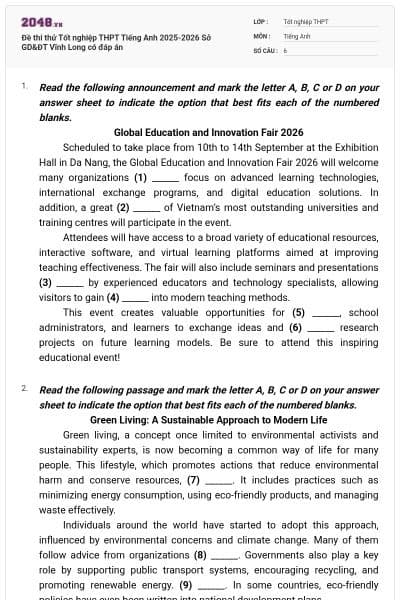
Read the following piece of news and mark the letter A, B, C and D on your answer sheet to indicate the option that best fits each of the numbered blanks from 1 to 6.
A Ritual of Remembrance
Every spring, people on Ly Son Island gather to perform a meaningful ceremony to honor soldiers who lost their lives at sea while protecting Vietnam’s sovereignty. The event attracts a large (1)________ of local residents and visitors. It is considered one of the most (2)________ ceremonies in the region.
The ritual (3)________ at Am Linh Temple by local communities, includes offerings, music, and symbolic activities. Effigies made from clay and straw (4)________ the soldiers who never returned. It is among the important cultural events that show respect for national history.
This long-standing cultural event, (5)________ takes place every year, reminds people of the sacrifices made by earlier generations. Over time, it has helped the islanders (6)________ the reputation for their cultural traditions and national identity.
(Adapted from https://heritagevietnamairlines.com)
number
amount
volume
level
A. number (n): số lượng (+ danh từ đếm được số nhiều).
B. amount (n): lượng (+ danh từ không đếm được).
C. volume (n): khối lượng, thể tích, âm lượng.
D. level (n): mức độ, cấp độ.
Phía sau khoảng trống là giới từ “of” và cụm danh từ đếm được ở dạng số nhiều “local residents and visitors” (cư dân địa phương và du khách). Do đó, ta áp dụng cấu trúc a large number of + N (số nhiều) mang ý nghĩa là “một số lượng lớn...”.
Chọn A. number
→ The event attracts a large number of local residents and visitors.
Dịch nghĩa: Sự kiện này thu hút một số lượng lớn cư dân địa phương và du khách.
emotion
emotional
emotionally
emotionless
A. emotion (n): cảm xúc.
B. emotional (adj): cảm động, giàu cảm xúc.
C. emotionally (adv): về mặt cảm xúc.
D. emotionless (adj): vô cảm, không có cảm xúc.
Khoảng trống nằm giữa cấu trúc so sánh nhất “the most” và danh từ “ceremonies”, do đó ta cần một tính từ để bổ nghĩa cho danh từ đó. Dựa vào bối cảnh trang nghiêm và ý nghĩa của buổi lễ tưởng niệm, tính từ “emotional” (cảm động/giàu cảm xúc) là đáp án phù hợp nhất, trái ngược với “emotionless” (vô cảm).
Chọn B. emotional
→ It is considered one of the most emotional ceremonies in the region.
Dịch nghĩa: Nó được coi là một trong những buổi lễ cảm động nhất trong khu vực.
holding
held
has held
is holding
A. holding (v-ing): hiện tại phân từ (mang nghĩa chủ động).
B. held (v-ed/v3): quá khứ phân từ (mang nghĩa bị động).
C. has held: thì hiện tại hoàn thành.
D. is holding: thì hiện tại tiếp diễn.
Câu đã có động từ chính là “includes” (bao gồm). Phần nằm giữa hai dấu phẩy là một mệnh đề quan hệ rút gọn mang nghĩa bị động, bổ nghĩa cho danh từ “The ritual” (Nghi lễ). Nghi lễ này không tự tổ chức mà “được tổ chức” (có giới từ “by” phía sau). Mệnh đề đầy đủ là: ..., which is held at Am Linh Temple... Khi rút gọn, ta lược bỏ đại từ quan hệ và động từ to be, chỉ giữ lại quá khứ phân từ.
Chọn B. held
→ The ritual, held at Am Linh Temple by local communities, includes offerings...
Dịch nghĩa: Nghi lễ, được tổ chức tại Âm Linh Tự bởi cộng đồng địa phương, bao gồm các đồ tế lễ...
advertise
organise
represent
decorate
A. advertise (v): quảng cáo.
B. organise (v): tổ chức.
C. represent (v): đại diện cho, tượng trưng cho.
D. decorate (v): trang trí.
Phía trước là “Effigies made from clay and straw” (Những hình nhân làm từ đất sét và rơm rạ), phía sau là “the soldiers who never returned” (những người lính không bao giờ trở về). Động từ phù hợp nhất để diễn tả mục đích của việc làm hình nhân thay thế là “đại diện/tượng trưng cho”.
Chọn C. represent
→ Effigies made from clay and straw represent the soldiers who never returned.
Dịch nghĩa: Những hình nhân được làm từ đất sét và rơm rạ tượng trưng cho những người lính không bao giờ trở về.
who
which
that
where
A. who: đại từ quan hệ thay thế cho người.
B. which: đại từ quan hệ thay thế cho vật/sự việc.
C. that: đại từ quan hệ thay thế cho người/vật (không dùng trong mệnh đề quan hệ có dấu phẩy).
D. where: trạng từ quan hệ chỉ nơi chốn.
Phía trước khoảng trống là cụm danh từ chỉ sự việc “This long-standing cultural event” (Sự kiện văn hóa lâu đời này). Hơn nữa, phía trước có dấu phẩy (,) báo hiệu đây là mệnh đề quan hệ không xác định, nên ta không thể dùng “that”. Đại từ quan hệ thay thế cho sự việc đóng vai trò làm chủ ngữ trong trường hợp này bắt buộc phải là “which”.
Chọn B. which
→ This long-standing cultural event, which takes place every year, reminds people...
Dịch nghĩa: Sự kiện văn hóa lâu đời này, sự kiện mà diễn ra hàng năm, nhắc nhở mọi người...
bring up
build up
take up
turn up
A. bring up (phr.v): nuôi dưỡng, đề cập đến (một chủ đề).
B. build up (phr.v): xây dựng, tích lũy, củng cố dần dần.
C. take up (phr.v): bắt đầu (một sở thích/thói quen), chiếm (thời gian/không gian).
D. turn up (phr.v): xuất hiện, vặn lớn (âm lượng).
Ta có cụm từ kết hợp (collocation) quen thuộc: build up the reputation (xây dựng / củng cố danh tiếng).
Chọn B. build up
→ Over time, it has helped the islanders build up the reputation for their cultural traditions...
Dịch nghĩa: Theo thời gian, nó đã giúp những người dân đảo xây dựng danh tiếng cho những truyền thống văn hóa...
Bài đọc hoàn chỉnh | Dịch bài đọc |
A Ritual of Remembrance Every spring, people on Ly Son Island gather to perform a meaningful ceremony to honor soldiers who lost their lives at sea while protecting Vietnam’s sovereignty. The event attracts a large (1) number of local residents and visitors. It is considered one of the most (2) emotional ceremonies in the region. The ritual, (3) held at Am Linh Temple by local communities, includes offerings, music, and symbolic activities. Effigies made from clay and straw (4) represent the soldiers who never returned. It is among the important cultural events that show respect for national history. This long-standing cultural event, (5) which takes place every year, reminds people of the sacrifices made by earlier generations. Over time, it has helped the islanders (6) build up the reputation for their cultural traditions and national identity. | Nghi Lễ Tưởng Niệm Mỗi độ xuân về, người dân trên đảo Lý Sơn lại tụ họp để thực hiện một nghi lễ đầy ý nghĩa nhằm tôn vinh những người lính đã mất mạng trên biển trong khi bảo vệ chủ quyền của Việt Nam. Sự kiện này thu hút một (1) số lượng lớn cư dân địa phương và du khách. Nó được coi là một trong những buổi lễ (2) cảm động nhất trong khu vực. Nghi lễ, (3) được tổ chức tại Âm Linh Tự bởi các cộng đồng địa phương, bao gồm các đồ tế lễ, âm nhạc và các hoạt động mang tính biểu tượng. Những hình nhân được làm từ đất sét và rơm rạ (4) tượng trưng cho những người lính không bao giờ trở về. Đây là một trong những sự kiện văn hóa quan trọng thể hiện sự tôn kính đối với lịch sử dân tộc. Sự kiện văn hóa lâu đời này, (5) sự kiện mà diễn ra hàng năm, nhắc nhở mọi người về những hy sinh của các thế hệ đi trước. Theo thời gian, nó đã giúp những người dân đảo (6) xây dựng danh tiếng cho những truyền thống văn hóa và bản sắc dân tộc của họ. |
Read the following leaflet and mark the letter A, B, C or D on your answer sheet to indicate the option that best fits each of the numbered blanks from 7 to 12.
PROTECTING FORESTS IN CENTRAL ANNAMITES
Together for Nature and Local Communities
Forests in Central Annamites, Viet Nam are vital for both people and wildlife.
(7)________, illegal logging and land use are damaging many forest areas. This leads (8)________ environmental problems such as biodiversity loss and climate change.
How Can We Help?
- Encourage (9)________ individual to use resources wisely.
- Support sustainable farming practices.
- Protect natural forest areas.
- Preserve wildlife habitats.
Using (10)________ can reduce pressure on forests. Education programmes also help raise awareness about conservation. Avoiding excessive (11)________ of forest resources is necessary for long-term protection. Developing (12)________ solutions will benefit both nature and local communities.
Protect Forests Today for a Greener Tomorrow!
(Adapted from https://www.worldwildlife.org)
However
Otherwise
Though
Therefore
A. However (adv): Tuy nhiên (chỉ sự đối lập, thường đứng đầu câu và có dấu phẩy theo sau).
B. Otherwise (adv): Nếu không thì.
C. Though (conj): Mặc dù (thường dùng để nối 2 mệnh đề hoặc đứng cuối câu).
D. Therefore (adv): Vì vậy, do đó.
Câu phía trước nêu lên một thực trạng tích cực (Rừng ở Trung Trường Sơn rất quan trọng đối với cả con người và động vật hoang dã). Câu phía sau nêu lên một thực trạng tiêu cực (Việc khai thác gỗ và sử dụng đất trái phép đang tàn phá nhiều diện tích rừng). Sự đối lập này yêu cầu trạng từ liên kết “However”.
Chọn A. However
→ However, illegal logging and land use are damaging many forest areas.
Dịch nghĩa: Tuy nhiên, việc khai thác gỗ và sử dụng đất trái phép đang tàn phá nhiều diện tích rừng.
on
at
in
to
A. on (prep): trên.
B. at (prep): tại, ở.
C. in (prep): trong.
D. to (prep): đến, tới.
Ta có cấu trúc / cụm động từ cố định: lead to something (dẫn đến điều gì / gây ra hậu quả gì).
Chọn D. to
→ This leads to environmental problems such as biodiversity loss and climate change.
Dịch nghĩa: Điều này dẫn đến các vấn đề về môi trường như mất đa dạng sinh học và biến đổi khí hậu.
- Encourage (9)________ individual to use resources wisely.
few
each
much
many
A. few: ít (+ danh từ đếm được số nhiều).
B. each: mỗi (+ danh từ đếm được số ít).
C. much: nhiều (+ danh từ không đếm được).
D. many: nhiều (+ danh từ đếm được số nhiều).
Phía sau khoảng trống là danh từ “individual” (cá nhân) đang ở dạng đếm được số ít. Do đó, “each” là lượng từ duy nhất phù hợp về mặt ngữ pháp.
Chọn B. each
→ Encourage each individual to use resources wisely.
Dịch nghĩa: Khuyến khích mỗi cá nhân sử dụng các nguồn tài nguyên một cách khôn ngoan.
products sustainable wood
wood sustainable products
wood products sustainable
sustainable wood products
Phân tích trật tự từ: Cụm danh từ này có khái niệm chính là “những sản phẩm gỗ”: “wood products” (trong đó “products” là danh từ chính bắt buộc đứng cuối, “wood” là danh từ phụ đóng vai trò phân loại). Tính từ “sustainable” (mang tính bền vững) bổ nghĩa cho toàn bộ khái niệm đó nên phải đứng ở vị trí đầu tiên. Trật tự đúng là: Tính từ + Danh từ phụ + Danh từ chính.
Chọn D. sustainable wood products
→ Using sustainable wood products can reduce pressure on forests.
Dịch nghĩa: Việc sử dụng các sản phẩm gỗ bền vững có thể làm giảm áp lực lên các khu rừng.
declaration
exploitation
restoration
development
A. declaration (n): sự tuyên bố.
B. exploitation (n): sự khai thác (thường mang nghĩa tiêu cực nếu đi với excessive).
C. restoration (n): sự phục hồi, tôn tạo.
D. development (n): sự phát triển.
Ta có cụm từ kết hợp (collocation) quen thuộc: exploitation of natural resources (sự khai thác tài nguyên thiên nhiên). Trong câu này, việc tránh sự khai thác “quá mức” (excessive) là điều cần thiết để bảo vệ lâu dài.
Chọn B. exploitation
→ Avoiding excessive exploitation of forest resources is necessary for long-term protection.
Dịch nghĩa: Việc tránh sự khai thác quá mức các nguồn tài nguyên rừng là điều cần thiết để bảo vệ lâu dài.
impulsive
aggressive
feasible
mutual
A. impulsive (adj): bốc đồng, hấp tấp.
B. aggressive (adj): hung hăng, công kích, xông xáo.
C. feasible (adj): khả thi (có thể thực hiện được).
D. mutual (adj): lẫn nhau, chung.
Phía sau khoảng trống là danh từ “solutions” (các giải pháp). Tính từ đi kèm phù hợp nhất về mặt logic và ngữ nghĩa trong bối cảnh giải quyết vấn đề là “feasible” (khả thi). Ta có cụm feasible solutions (những giải pháp khả thi).
Chọn C. feasible
→ Developing feasible solutions will benefit both nature and local communities.
Dịch nghĩa: Việc phát triển các giải pháp khả thi sẽ mang lại lợi ích cho cả thiên nhiên và các cộng đồng địa phương.
Bài đọc hoàn chỉnh | Dịch bài đọc |
PROTECTING FORESTS IN CENTRAL ANNAMITES Together for Nature and Local Communities Forests in Central Annamites, Viet Nam are vital for both people and wildlife. (7) However, illegal logging and land use are damaging many forest areas. This leads (8) to environmental problems such as biodiversity loss and climate change. How Can We Help?
Using (10) sustainable wood products can reduce pressure on forests. Education programmes also help raise awareness about conservation. Avoiding excessive (11) exploitation of forest resources is necessary for long-term protection. Developing (12) feasible solutions will benefit both nature and local communities. Protect Forests Today for a Greener Tomorrow! | BẢO VỆ NHỮNG KHU RỪNG Ở TRUNG TRƯỜNG SƠN Cùng Nhau Vì Thiên Nhiên Và Cộng Đồng Địa Phương Những khu rừng ở Trung Trường Sơn, Việt Nam có ý nghĩa sống còn đối với cả con người và động vật hoang dã. (7) Tuy nhiên, việc khai thác gỗ và sử dụng đất trái phép đang tàn phá nhiều diện tích rừng. Điều này dẫn (8) đến các vấn đề về môi trường như mất đa dạng sinh học và biến đổi khí hậu. Chúng Ta Có Thể Giúp Đỡ Bằng Cách Nào?
Việc sử dụng (10) các sản phẩm gỗ bền vững có thể làm giảm áp lực lên các khu rừng. Các chương trình giáo dục cũng giúp nâng cao nhận thức về bảo tồn. Việc tránh (11) sự khai thác quá mức các nguồn tài nguyên rừng là điều cần thiết để bảo vệ lâu dài. Việc phát triển các giải pháp (12) khả thi sẽ mang lại lợi ích cho cả thiên nhiên và các cộng đồng địa phương. Hãy Bảo Vệ Rừng Hôm Nay Vì Một Ngày Mai Xanh Hơn! |
Mark the letter A, B, C or D on your answer sheet to indicate the best arrangement of utterances or sentences to make a cohesive and coherent exchange or text in each of the following questions from 13 to 17.
a. Lisa: Okay, let me know if you need any help.
b. Lisa: Are you ready for the Math test tomorrow?
c. Jack: Not really, I still need to review a few chapters tonight.
a-b-c
b-c-a
b-a-c
a-c-b
Thứ tự sắp xếp đúng: B. b - c - a
b. Lisa: Are you ready for the Math test tomorrow?
c. Jack: Not really, I still need to review a few chapters tonight.
a. Lisa: Okay, let me know if you need any help.
Dịch nghĩa:
b. Lisa: Cậu đã sẵn sàng cho bài kiểm tra Toán ngày mai chưa?
c. Jack: Chưa hẳn, tớ vẫn cần ôn lại vài chương tối nay.
a. Lisa: Được rồi, hãy cho tớ biết nếu cậu cần bất kỳ sự giúp đỡ nào nhé.
Chọn B.
a. Tom: I used to study from books, but now I learn a lot through online platforms and mobile apps.
b. Anna: Same here! It’s more flexible, but I think traditional classroom learning still has its own benefits.
c. Anna: Do you use any new ways to learn English these days?
d. Anna: I believe each method has its own strengths that we can take full advantage of.
e. Tom: You’re right. Face-to-face interaction gives us real communication that’s hard to replace.
d-a-c-e-b
c-a-b-e-d
d-e-b-a-c
c-a-d-e-b
Thứ tự sắp xếp đúng: B. c - a - b - e - d
c. Anna: Do you use any new ways to learn English these days?
a. Tom: I used to study from books, but now I learn a lot through online platforms and mobile apps.
b. Anna: Same here! It’s more flexible, but I think traditional classroom learning still has its own benefits.
e. Tom: You’re right. Face-to-face interaction gives us real communication that’s hard to replace.
d. Anna: I believe each method has its own strengths that we can take full advantage of.
Dịch nghĩa:
c. Anna: Dạo này cậu có sử dụng cách nào mới để học tiếng Anh không?
a. Tom: Trước đây tớ thường học từ sách, nhưng bây giờ tớ học rất nhiều thông qua các nền tảng trực tuyến và ứng dụng di động.
b. Anna: Tớ cũng vậy! Nó linh hoạt hơn, nhưng tớ nghĩ việc học trên lớp truyền thống vẫn có những lợi ích riêng của nó.
e. Tom: Cậu nói đúng. Sự tương tác trực tiếp mang lại cho chúng ta sự giao tiếp thực tế rất khó để thay thế.
d. Anna: Tớ tin rằng mỗi phương pháp đều có những thế mạnh riêng mà chúng ta có thể tận dụng tối đa.
Chọn B.
a. Moreover, educating residents about responsible waste disposal practices helps cultivate environmental awareness and encourages active civic participation in the city’s sustainability initiatives.
b. Effective waste sorting plays a pivotal role in sustainable urban management in Ho Chi Minh City, as it directly contributes to improved recycling efficiency and a significant reduction in landfill dependency.
c. For example, materials such as plastic, paper, and glass should be separated from food waste, as they can be recycled and reintegrated into production cycles when properly collected.
d. In conclusion, by promoting systematic waste sorting across Ho Chi Minh City, local authorities and communities can work together to create a cleaner urban environment while maximizing resource reuse and minimizing ecological strain.
e. A crucial component of this process involves raising public awareness of waste classification, including recyclable materials, organic waste, and residual household refuse, each of which requires distinct handling methods.
b-e-c-a-d
c-d-b-a-e
b-c-e-a-d
e-a-d-b-c
Thứ tự sắp xếp đúng: A. b - e - c - a - d
b. Effective waste sorting plays a pivotal role in sustainable urban management in Ho Chi Minh City, as it directly contributes to improved recycling efficiency and a significant reduction in landfill dependency.
e. A crucial component of this process involves raising public awareness of waste classification, including recyclable materials, organic waste, and residual household refuse, each of which requires distinct handling methods.
c. For example, materials such as plastic, paper, and glass should be separated from food waste, as they can be recycled and reintegrated into production cycles when properly collected.
a. Moreover, educating residents about responsible waste disposal practices helps cultivate environmental awareness and encourages active civic participation in the city’s sustainability initiatives.
d. In conclusion, by promoting systematic waste sorting across Ho Chi Minh City, local authorities and communities can work together to create a cleaner urban environment while maximizing resource reuse and minimizing ecological strain.
Dịch nghĩa:
b. Việc phân loại rác thải hiệu quả đóng một vai trò then chốt trong quản lý đô thị bền vững ở Thành phố Hồ Chí Minh, vì nó trực tiếp góp phần nâng cao hiệu quả tái chế và giảm thiểu đáng kể sự phụ thuộc vào bãi chôn lấp.
e. Một thành phần quan trọng của quá trình này liên quan đến việc nâng cao nhận thức của cộng đồng về phân loại rác thải, bao gồm các vật liệu có thể tái chế, rác thải hữu cơ và rác thải sinh hoạt còn lại, mỗi loại đòi hỏi các phương pháp xử lý riêng biệt.
c. Ví dụ, các vật liệu như nhựa, giấy và thủy tinh nên được tách khỏi rác thải thực phẩm, vì chúng có thể được tái chế và tái hòa nhập vào các chu trình sản xuất khi được thu gom đúng cách.
a. Hơn nữa, việc giáo dục người dân về các thực hành xử lý rác thải có trách nhiệm giúp trau dồi nhận thức về môi trường và khuyến khích sự tham gia tích cực của công dân vào các sáng kiến bền vững của thành phố.
d. Tóm lại, bằng cách thúc đẩy phân loại rác thải có hệ thống trên toàn Thành phố Hồ Chí Minh, chính quyền địa phương và cộng đồng có thể làm việc cùng nhau để tạo ra một môi trường đô thị sạch hơn đồng thời tối đa hóa việc tái sử dụng tài nguyên và giảm thiểu áp lực sinh thái.
Chọn A.
Hi Gemma,
a. I would greatly appreciate it if you could provide further details regarding the programme structure and assessment criteria.
b. I am writing to express my interest in enrolling in your advanced AI-integrated language course.
c. In particular, I am keen to understand how the course accommodates learners seeking both flexibility and academic rigour.
d. I look forward to your response and hope to proceed with the application in due course.
e. Having reviewed the information available on your website, I am particularly impressed by the emphasis on personalised learning pathways.
Write back soon,
Billy
e-b-d-c-a
b-a-d-c-e
a-e-c-b-d
b-e-c-a-d
Thứ tự sắp xếp đúng: D. b - e - c - a - d
b. I am writing to express my interest in enrolling in your advanced AI-integrated language course.
e. Having reviewed the information available on your website, I am particularly impressed by the emphasis on personalised learning pathways.
c. In particular, I am keen to understand how the course accommodates learners seeking both flexibility and academic rigour.
a. I would greatly appreciate it if you could provide further details regarding the programme structure and assessment criteria.
d. I look forward to your response and hope to proceed with the application in due course.
Dịch nghĩa:
Chào Gemma,
b. Tôi viết thư này để bày tỏ sự quan tâm của mình đến việc ghi danh vào khóa học ngôn ngữ tích hợp AI nâng cao của bạn.
e. Sau khi xem xét thông tin có sẵn trên trang web của bạn, tôi đặc biệt ấn tượng bởi sự nhấn mạnh vào các lộ trình học tập được cá nhân hóa.
c. Nói riêng, tôi rất muốn hiểu cách khóa học đáp ứng những người học đang tìm kiếm cả sự linh hoạt và tính nghiêm ngặt trong học thuật.
a. Tôi sẽ rất biết ơn nếu bạn có thể cung cấp thêm thông tin chi tiết về cấu trúc chương trình và tiêu chí đánh giá.
d. Tôi mong nhận được phản hồi của bạn và hy vọng sẽ tiến hành thủ tục nộp đơn vào thời gian thích hợp.
Hồi âm sớm nhé,
Billy
Chọn D.
a. This transformation also included the development of new industrial areas, as farmland nearby was converted into factories and small production sites.
b. Overall, these changes highlight the modernisation of Lakeview, turning it from a peaceful residential district into a more dynamic and commercially active area.
c. Between 2010 and 2022, the outer areas of Lakeview city experienced significant changes, reflecting a shift towards urban growth and economic development.
d. Housing areas were greatly affected, with many old houses being replaced by modern buildings, and a local park being relocated.
e. At the same time, commercial facilities expanded rapidly, especially with the construction of a large mall and a parking lot on former residential land.
c-d-e-a-b
c-e-d-a-b
c-a-d-e-b
c-d-a-b-e
Thứ tự sắp xếp đúng: A. c - d - e - a - b
c. Between 2010 and 2022, the outer areas of Lakeview city experienced significant changes, reflecting a shift towards urban growth and economic development.
d. Housing areas were greatly affected, with many old houses being replaced by modern buildings, and a local park being relocated.
e. At the same time, commercial facilities expanded rapidly, especially with the construction of a large mall and a parking lot on former residential land.
a. This transformation also included the development of new industrial areas, as farmland nearby was converted into factories and small production sites.
b. Overall, these changes highlight the modernisation of Lakeview, turning it from a peaceful residential district into a more dynamic and commercially active area.
Dịch nghĩa:
c. Từ năm 2010 đến 2022, các khu vực ngoại ô của thành phố Lakeview đã trải qua những thay đổi đáng kể, phản ánh sự chuyển dịch hướng tới tăng trưởng đô thị và phát triển kinh tế.
d. Các khu nhà ở đã bị ảnh hưởng lớn, với nhiều ngôi nhà cũ được thay thế bằng các tòa nhà hiện đại, và một công viên địa phương bị di dời.
e. Cùng lúc đó, các cơ sở thương mại mở rộng nhanh chóng, đặc biệt là với việc xây dựng một trung tâm thương mại lớn và một bãi đậu xe trên vùng đất trước đây là đất ở.
a. Sự biến đổi này cũng bao gồm việc phát triển các khu công nghiệp mới, khi đất nông nghiệp gần đó được chuyển đổi thành các nhà máy và cơ sở sản xuất nhỏ.
b. Nhìn chung, những thay đổi này làm nổi bật quá trình hiện đại hóa của Lakeview, biến nó từ một khu dân cư yên bình thành một khu vực năng động và hoạt động thương mại tích cực hơn.
Chọn A.
Read the following passage and mark the letter A, B, C or D on your answer sheet to indicate the option that best fits each of the numbered blanks from 18 to 22.
Academic pressure from well-meaning parents has become a growing concern affecting students’ emotions and development. Many parents strongly incentivise their children to pursue rigorous academic schedules encompassing an extensive range of subjects. This pressure (18)________. They might feel overwhelmed by the number of assignments and exams they have to prepare for each week. Parents also want their children to succeed, which can result in more stress and anxiety. Moreover, (19)________.
Some students (20)________ find it difficult to balance their studies with other activities. Such children frequently find themselves deprived of opportunities for leisure pursuits or meaningful social interaction, a sustained imbalance that can undermine mental well-being and precipitate academic burnout. Parents may not realize the impact of their expectations on their children’s well-being. (21)________.
To help reduce this pressure, students should be given time to relax and explore their interests. Given the chance to take breaks, (22)________. Constructive parental communication and well-balanced daily routines contribute significantly to healthier learning habits, stronger resilience, and sustained long-term success. Maintaining a healthy balance between academic responsibilities and personal well-being enables students to develop positively and thrive successfully in the long term.
(Adapted from OECD, Students’ Well-Being and Academic Pressure)
having frequently been experienced by students who struggle to keep pace with escalating academic demands
is frequently experienced by students who find it increasingly difficult to meet academic expectations
that is frequently experienced by students who encounter persistent difficulty in managing academic workloads
of which it is frequently experienced by students who face mounting pressure to keep up academically
Chủ ngữ của câu là “This pressure” (Áp lực này). Vị trí (18) đang thiếu một động từ chính (Main verb) để tạo thành một câu hoàn chỉnh.
Dịch nghĩa/Ngữ pháp:
A. having frequently been experienced... (Hiện tại phân từ / Danh động từ → Thiếu động từ chính cho câu).
B. thường được trải nghiệm bởi những học sinh thấy ngày càng khó khăn trong việc đáp ứng các kỳ vọng học thuật (Cung cấp động từ chính “is frequently experienced” ở thể bị động, hoàn chỉnh cấu trúc Chủ - Vị và rất hợp logic).
C. that is frequently experienced... (Đại từ quan hệ “that” biến vế phía sau thành một mệnh đề quan hệ bổ nghĩa, làm cho toàn bộ câu bị khuyết động từ chính).
D. of which it is frequently... (Sai cấu trúc ngữ pháp).
Đáp án B là lựa chọn duy nhất cung cấp động từ chính, đảm bảo câu đúng chuẩn ngữ pháp tiếng Anh.
Chọn B.
→ This pressure is frequently experienced by students who find it increasingly difficult to meet academic expectations.
Dịch nghĩa: Áp lực này thường được trải nghiệm bởi những học sinh thấy ngày càng khó khăn trong việc đáp ứng các kỳ vọng học thuật.
because academic rigor is not inherently paramount, making it imperative that children affording sufficient opportunities for leisure and enjoyment.
while learning should remain intrinsically rewarding, an excessive preoccupation with grades can enhance students’ genuine engagement with education
students frequently achieve higher levels of performance when intrinsically motivated, and measured pressure may enhance confidence and creative capacity
when learning becomes excessively grade-focused, students’ genuine engagement with education is gradually eroded
Đoạn văn đang liệt kê các tác động tiêu cực của áp lực học tập đối với học sinh: “feel overwhelmed” (cảm thấy choáng ngợp), “more stress and anxiety” (nhiều căng thẳng và lo âu hơn). Liên từ “Moreover,” (Hơn nữa,) ở đầu câu (19) báo hiệu rằng câu này phải tiếp tục nêu lên một hậu quả tiêu cực khác để nhất quán với mạch logic.
Dịch nghĩa:
A. bởi vì sự khắt khe trong học thuật vốn không phải là điều quan trọng nhất, khiến cho việc trẻ em có đủ cơ hội... (Sai ngữ pháp ở cụm “children affording”).
B. trong khi việc học nên duy trì phần thưởng nội tại, một sự bận tâm quá mức đến điểm số có thể nâng cao sự gắn kết thực sự của học sinh... (Sai logic: Việc bận tâm điểm số quá mức không thể “nâng cao” - enhance - sự gắn kết tích cực được).
C. học sinh thường đạt hiệu suất cao hơn khi có động lực nội tại, và áp lực vừa phải có thể nâng cao... (Mang ý nghĩa tích cực, đi ngược lại mạch “stress and anxiety” ở câu trước).
D. khi việc học trở nên quá tập trung vào điểm số, sự gắn kết thực sự của học sinh với giáo dục dần bị xói mòn (Đưa ra một hậu quả tiêu cực hợp lý: sự xói mòn/giảm sút niềm đam mê học tập. Rất chuẩn xác).
Đáp án D là sự lựa chọn duy nhất duy trì được luồng ý kiến tiêu cực, phê phán áp lực điểm số mà đoạn văn đang xây dựng.
Chọn D.
→ Moreover, when learning becomes excessively grade-focused, students’ genuine engagement with education is gradually eroded.
Dịch nghĩa: Hơn nữa, khi việc học trở nên quá tập trung vào điểm số, sự gắn kết thực sự của học sinh với giáo dục dần bị xói mòn.
those have come to organise virtually every aspect of their lives around academic obligations
maintain a well-balanced lifestyle supported by family encouragement and guidance
that daily routines have overwhelmingly dictated by institutional academic expectations
whose lives are predominantly oriented around scholastic responsibilities
Cấu trúc câu: “Some students (20) ________ find it difficult to balance their studies with other activities.” Chủ ngữ là “Some students” (Một số học sinh) và động từ chính là “find” (nhận thấy). Do đó, khoảng trống (20) cần một mệnh đề quan hệ bổ nghĩa cho danh từ “students”.
Dịch nghĩa/Ngữ pháp:
A. those have come to... (Đại từ “those” không dùng làm đại từ quan hệ thay thế cho danh từ đứng ngay trước nó, phải dùng “who”).
B. maintain a well-balanced lifestyle... (Cung cấp thêm một động từ chính “maintain” làm câu có hai động từ chính chồng chéo mà không có liên từ nối → Lỗi sai ngữ pháp cơ bản).
C. that daily routines have overwhelmingly dictated... (Sai ngữ pháp và làm cấu trúc câu trở nên vô nghĩa).
D. những người mà cuộc sống chủ yếu xoay quanh các trách nhiệm học thuật (Sử dụng đại từ quan hệ sở hữu “whose” hoàn toàn chính xác để bổ nghĩa cho “students”. Ngữ nghĩa cũng khớp với nguyên nhân khiến họ không thể cân bằng các hoạt động khác).
Đáp án D cung cấp một mệnh đề quan hệ chuẩn mực, giải thích rõ đặc điểm của “một số học sinh” đang được nhắc đến.
Chọn D.
→ Some students whose lives are predominantly oriented around scholastic responsibilities find it difficult to balance their studies with other activities.
Dịch nghĩa: Một số học sinh, những người mà cuộc sống chủ yếu xoay quanh các trách nhiệm học thuật, nhận thấy rất khó để cân bằng việc học với các hoạt động khác.
Instead of encouraging a love for learning, they might unintentionally create a fear of failure
Students believe that studying hard will always guarantee success in all subjects without any stress
Some children enjoy school so much that they find studying easy and rarely need to seek help
Many students struggle to manage their time, leading to poor grades and missed deadlines in school
Câu liền trước nêu vấn đề: “Parents may not realize the impact of their expectations on their children’s well-being.” (Cha mẹ có thể không nhận ra tác động của những kỳ vọng của họ đối với hạnh phúc của con cái). Câu (21) cần tiếp nối mạch ý tưởng này bằng cách đưa ra ví dụ hoặc giải thích rõ hơn về tác động tiêu cực không lường trước (không nhận ra) từ phía cha mẹ.
Dịch nghĩa:
A. Thay vì khuyến khích tình yêu học tập, họ có thể vô tình tạo ra nỗi sợ thất bại (Đại từ “they” ám chỉ “Parents”. Từ “unintentionally” (vô tình) khớp với cụm “may not realize” (không nhận ra) ở câu trước. Ý nghĩa cực kỳ logic).
B. Học sinh tin rằng việc học hành chăm chỉ... (Lạc đề sang góc nhìn của học sinh, làm đứt mạch bàn về “cha mẹ”).
C. Một số trẻ em rất thích trường học... (Đi ngược hoàn toàn với bối cảnh áp lực, mệt mỏi của đoạn văn).
D. Nhiều học sinh gặp khó khăn trong việc quản lý thời gian... (Không liên quan trực tiếp đến “sự kỳ vọng của cha mẹ”).
Đáp án A là một cầu nối tuyệt vời, làm rõ hậu quả trái với mong muốn ban đầu của các bậc phụ huynh.
Chọn A.
→ Parents may not realize the impact of their expectations on their children’s well-being. Instead of encouraging a love for learning, they might unintentionally create a fear of failure.
Dịch nghĩa: Cha mẹ có thể không nhận ra tác động của những kỳ vọng của họ đối với hạnh phúc của con cái. Thay vì khuyến khích tình yêu học tập, họ có thể vô tình tạo ra nỗi sợ thất bại.
their efforts will yield measurable improvements in academic performance
demonstrable improvements are observed in their academic performance
students tend to exhibit significantly higher levels of academic attainment
substantial improvements can be achieved across academic domains
Câu bắt đầu bằng cụm phân từ: “Given the chance to take breaks,” (Nếu được cho cơ hội nghỉ ngơi,). Theo quy tắc ngữ pháp về sự hòa hợp chủ ngữ (Dangling modifier - Lỗi bổ ngữ lơ lửng), Chủ ngữ của mệnh đề chính phía sau bắt buộc phải là đối tượng thực hiện/tiếp nhận hành động ở mệnh đề phân từ. Trong trường hợp này, đối tượng “được cho cơ hội nghỉ ngơi” phải là con người (cụ thể là học sinh).
Dịch nghĩa/Ngữ pháp:
A. những nỗ lực của họ sẽ mang lại... (Chủ ngữ “their efforts” không thể “được cho cơ hội nghỉ ngơi” → Sai cấu trúc).
B. những sự cải thiện có thể chứng minh được... (Chủ ngữ “demonstrable improvements” không thể “được cho cơ hội nghỉ ngơi” → Sai cấu trúc).
C. học sinh có xu hướng thể hiện mức độ thành tích học tập cao hơn đáng kể (Chủ ngữ “students” là con người, hoàn toàn khớp với cụm phân từ đầu câu. Ý nghĩa tích cực hợp logic).
D. những sự cải thiện đáng kể... (Sai cấu trúc tương tự A và B).
Chỉ có đáp án C tuân thủ quy tắc ngữ pháp khắt khe về mệnh đề phân từ rút gọn ở đầu câu.
Chọn C.
→ Given the chance to take breaks, students tend to exhibit significantly higher levels of academic attainment.
Dịch nghĩa: Nếu được cho cơ hội nghỉ ngơi, học sinh có xu hướng thể hiện mức độ thành tích học tập cao hơn đáng kể.
Bài đọc hoàn chỉnh | Dịch bài đọc |
Academic pressure from well-meaning parents has become a growing concern affecting students’ emotions and development. Many parents strongly incentivise their children to pursue rigorous academic schedules encompassing an extensive range of subjects. This pressure is frequently experienced by students who find it increasingly difficult to meet academic expectations. They might feel overwhelmed by the number of assignments and exams they have to prepare for each week. Parents also want their children to succeed, which can result in more stress and anxiety. Moreover, when learning becomes excessively grade-focused, students’ genuine engagement with education is gradually eroded. Some students whose lives are predominantly oriented around scholastic responsibilities find it difficult to balance their studies with other activities. Such children frequently find themselves deprived of opportunities for leisure pursuits or meaningful social interaction, a sustained imbalance that can undermine mental well-being and precipitate academic burnout. Parents may not realize the impact of their expectations on their children’s well-being. Instead of encouraging a love for learning, they might unintentionally create a fear of failure. To help reduce this pressure, students should be given time to relax and explore their interests. Given the chance to take breaks, students tend to exhibit significantly higher levels of academic attainment. Constructive parental communication and well-balanced daily routines contribute significantly to healthier learning habits, stronger resilience, and sustained long-term success. Maintaining a healthy balance between academic responsibilities and personal well-being enables students to develop positively and thrive successfully in the long term. | Áp lực học tập từ những bậc cha mẹ có ý tốt đã trở thành một mối quan tâm ngày càng lớn ảnh hưởng đến sự phát triển và cảm xúc của học sinh. Nhiều bậc cha mẹ khuyến khích mạnh mẽ con cái họ theo đuổi lịch trình học tập khắt khe bao gồm nhiều môn học. Áp lực này thường được trải nghiệm bởi những học sinh thấy ngày càng khó khăn trong việc đáp ứng các kỳ vọng học thuật. Họ có thể cảm thấy choáng ngợp trước số lượng bài tập và kỳ thi mà họ phải chuẩn bị mỗi tuần. Cha mẹ cũng muốn con cái thành công, điều này có thể dẫn đến nhiều căng thẳng và lo âu hơn. Hơn nữa, khi việc học trở nên quá tập trung vào điểm số, sự gắn kết thực sự của học sinh với giáo dục dần bị xói mòn. Một số học sinh, những người mà cuộc sống chủ yếu xoay quanh các trách nhiệm học thuật, nhận thấy rất khó để cân bằng việc học với các hoạt động khác. Những đứa trẻ như vậy thường thấy mình bị tước đoạt các cơ hội cho những hoạt động giải trí hoặc những tương tác xã hội có ý nghĩa, một sự mất cân bằng kéo dài có thể làm suy yếu sức khỏe tinh thần và thúc đẩy sự kiệt sức trong học tập. Cha mẹ có thể không nhận ra tác động của những kỳ vọng của họ đối với hạnh phúc của con cái. Thay vì khuyến khích tình yêu học tập, họ có thể vô tình tạo ra nỗi sợ thất bại. Để giúp giảm bớt áp lực này, học sinh nên được cho thời gian để thư giãn và khám phá sở thích của mình. Nếu được cho cơ hội nghỉ ngơi, học sinh có xu hướng thể hiện mức độ thành tích học tập cao hơn đáng kể. Sự giao tiếp mang tính xây dựng của cha mẹ và thói quen hàng ngày được cân bằng tốt đóng góp đáng kể vào những thói quen học tập lành mạnh hơn, sự kiên cường mạnh mẽ hơn và thành công lâu dài bền vững. Việc duy trì sự cân bằng lành mạnh giữa trách nhiệm học tập và hạnh phúc cá nhân cho phép học sinh phát triển tích cực và phát triển thành công trong dài hạn. |
Read the following passage and mark the letter A, B, C or D on your answer sheet to indicate the best answer to each of the following questions from 23 to 30.
There are countless technological innovations shaping the modern world today. However, the majority of global users rely on a relatively small number of dominant digital platforms, including search engines, social media networks, cloud-based services, and mobile applications. According to recent reports by the World Economic Forum, this concentration of technological power has accelerated innovation while simultaneously raising concerns about digital inequality, data privacy, and market monopolisation.
When technology evolves rapidly, it inevitably transforms how societies function. Digital tools influence communication patterns, reshape labour markets, and redefine access to information. For example, artificial intelligence systems are increasingly used in healthcare, finance, and education. Their efficiency stems from the ability to process vast quantities of data, enabling faster decision-making than traditional human-led systems. As a result, productivity has improved across multiple sectors.
In response to these developments, governments and institutions are attempting to regulate technological growth responsibly. Several countries have introduced digital literacy programmes to help citizens navigate online environments safely. Others have implemented data-protection laws to ensure that personal information is not exploited. These measures illustrate how policy intervention can mitigate technological risks while preserving innovation.
Technology also offers new solutions for addressing large-scale challenges. Open-source platforms, online learning systems, and remote collaboration tools have expanded access to knowledge worldwide. Because such technologies are widely accessible via the Internet, individuals from diverse backgrounds can acquire skills, participate in global discourse, and contribute to digital economies. Nevertheless, experts emphasise that technological progress must be guided by ethical frameworks to ensure long-term social benefit rather than unchecked automation.
(Adapted from World Economic Forum & OECD reports on digital transformation)
Which of the following is NOT mentioned in paragraph 1 as a dominant digital platform?
search engines
social media networks
cloud-based services
offline applications
Điều nào sau đây KHÔNG được đề cập trong đoạn 1 như một nền tảng kỹ thuật số thống trị?
A. search engines: các công cụ tìm kiếm (Có nhắc đến)
B. social media networks: các mạng xã hội (Có nhắc đến)
C. cloud-based services: các dịch vụ dựa trên đám mây (Có nhắc đến)
D. offline applications: các ứng dụng ngoại tuyến (Không được nhắc đến, bài đọc nhắc đến “mobile applications” - ứng dụng di động).
Thông tin (Đoạn 1): ...including search engines, social media networks, cloud-based services, and mobile applications.
(...bao gồm các công cụ tìm kiếm, mạng xã hội, dịch vụ dựa trên đám mây và ứng dụng di động.)
Chọn D.
The word accelerated in paragraph 1 could be best replaced by ______.
expedited
inhibited
facilitated
transferred
Từ “accelerated” ở đoạn 1 có thể được thay thế tốt nhất bởi ______.
accelerated (v-ed/P2): được đẩy nhanh, tăng tốc.
A. expedited (v-ed/P2): xúc tiến, đẩy nhanh
B. inhibited (v-ed/P2): ngăn chặn, cản trở
C. facilitated (v-ed/P2): tạo điều kiện dễ dàng
D. transferred (v-ed/P2): chuyển giao
→ accelerated = expedited
Thông tin: ...this concentration of technological power has accelerated innovation...
(...sự tập trung quyền lực công nghệ này đã đẩy nhanh sự đổi mới...)
Chọn A.
Which of the following best paraphrases the underlined sentence in paragraph 2?
Their effectiveness comes from their capacity to handle small amounts of data, allowing quicker decisions than systems controlled by humans.
Because they can analyse enormous volumes of information, these systems make decisions more gradually than traditional human-operated methods.
Their high level of efficiency is due to the ability to process massive data sets and support faster decision-making in multiple sectors.
By processing huge quantities of data, these systems can reach decisions more quickly than conventional systems managed by humans.
Câu nào sau đây diễn giải tốt nhất câu được gạch chân ở đoạn 2?
Their efficiency stems from the ability to process vast quantities of data, enabling faster decision-making than traditional human-led systems.
(Hiệu quả của chúng bắt nguồn từ khả năng xử lý lượng lớn dữ liệu, cho phép ra quyết định nhanh hơn so với các hệ thống truyền thống do con người lãnh đạo.)
Dịch nghĩa:
A. Tính hiệu quả của chúng đến từ khả năng xử lý lượng nhỏ dữ liệu, cho phép ra quyết định nhanh hơn so với các hệ thống do con người kiểm soát. (Sai ở “small amounts of data”).
B. Bởi vì chúng có thể phân tích khối lượng thông tin khổng lồ, những hệ thống này đưa ra quyết định dần dần/chậm hơn so với các phương pháp do con người vận hành truyền thống. (Sai ở “more gradually”).
C. Mức độ hiệu quả cao của chúng là do khả năng xử lý các tập dữ liệu khổng lồ và hỗ trợ việc ra quyết định nhanh hơn trong nhiều lĩnh vực. (Thiếu yếu tố so sánh với hệ thống do con người lãnh đạo “human-led systems”).
D. Bằng cách xử lý lượng dữ liệu khổng lồ, các hệ thống này có thể đưa ra quyết định nhanh hơn so với các hệ thống thông thường do con người quản lý. (Đúng và sát nghĩa nhất: process vast quantities of data = processing huge quantities of data; enabling faster decision-making = reach decisions more quickly; traditional human-led systems = conventional systems managed by humans).
Chọn D.
The word Others in paragraph 3 refers to ______.
These developments
Some countries
Digital literacy programmes
Online environments
Từ “Others” ở đoạn 3 chỉ ______.
A. These developments: Những sự phát triển này
B. Some countries: Một vài quốc gia
C. Digital literacy programmes: Các chương trình hiểu biết kỹ thuật số
D. Online environments: Các môi trường trực tuyến
Thông tin:Several countries have introduced digital literacy programmes... Others have implemented data-protection laws...
(Một số quốc gia đã giới thiệu các chương trình hiểu biết kỹ thuật số... Những quốc gia khác đã thực thi các luật bảo vệ dữ liệu...)
→ Others = Other countries (Các quốc gia khác).
Chọn B.
The word mitigate in paragraph 3 is OPPOSITE in meaning to ______.
distribute
accumulate
diminish
alleviate
Từ “mitigate” ở đoạn 3 TRÁI NGHĨA với ______.
mitigate (v): làm giảm nhẹ, làm dịu bớt.
A. distribute (v): phân phối
B. accumulate (v): tích tụ, tích lũy, làm tăng thêm (trái nghĩa trong bối cảnh làm cho các rủi ro tăng lên/chồng chất thay vì giảm đi)
C. diminish (v): làm giảm bớt (đồng nghĩa)
D. alleviate (v): làm giảm nhẹ, xoa dịu (đồng nghĩa)
→ mitigate >< accumulate
Thông tin: These measures illustrate how policy intervention can mitigate technological risks...
(Những biện pháp này minh họa cách can thiệp chính sách có thể làm giảm bớt rủi ro công nghệ...)
Chọn B.
Which of the following is TRUE according to the passage?
Technological dominance boosts innovation but increases concerns about inequality, misinformation, and economic monopolies.
Governments focus primarily on promoting innovation rather than addressing risks related to technology.
Ethical considerations are regarded as essential in guiding technological development for long-term societal benefits.
Governments and organisations are trying to carefully find out technological development in a responsible and sustainable manner.
Theo bài đọc, nhận định nào sau đây là ĐÚNG?
A. Sự thống trị công nghệ thúc đẩy đổi mới nhưng làm tăng lo ngại về bất bình đẳng, thông tin sai lệch và độc quyền kinh tế. (Sai, bài đọc không đề cập đến “misinformation” - thông tin sai lệch).
B. Các chính phủ chủ yếu tập trung vào việc thúc đẩy đổi mới thay vì giải quyết các rủi ro liên quan đến công nghệ. (Sai, đoạn 3 nói họ đang cố gắng điều chỉnh để “giảm bớt rủi ro công nghệ trong khi vẫn bảo vệ sự đổi mới”).
C. Các khía cạnh đạo đức được coi là thiết yếu trong việc dẫn dắt sự phát triển công nghệ vì các lợi ích xã hội lâu dài. (Đúng).
D. Các chính phủ và các tổ chức đang cố gắng tìm hiểu cẩn thận về sự phát triển công nghệ một cách có trách nhiệm và bền vững. (Sai nghĩa).
Thông tin (Đoạn 4): Nevertheless, experts emphasise that technological progress must be guided by ethical frameworks to ensure long-term social benefit...
(Tuy nhiên, các chuyên gia nhấn mạnh rằng tiến bộ công nghệ phải được dẫn dắt bởi các khuôn khổ đạo đức để đảm bảo lợi ích xã hội lâu dài...)
Chọn C.
In which paragraph does the writer mention a present causal relationship?
Paragraph 1
Paragraph 2
Paragraph 3
Paragraph 4
Tác giả đề cập đến một mối quan hệ nhân quả ở hiện tại (present causal relationship) trong đoạn nào?
A. Đoạn 1
B. Đoạn 2
C. Đoạn 3
D. Đoạn 4
Thông tin (Đoạn 4):Because such technologies are widely accessible via the Internet, individuals from diverse backgrounds can acquire skills...
(Bởi vì những công nghệ như vậy có thể truy cập rộng rãi qua Internet, các cá nhân từ nhiều nền tảng khác nhau có thể tiếp thu các kỹ năng...)
→ Sử dụng liên từ chỉ nguyên nhân “Because” và thì hiện tại đơn mô tả một quan hệ nhân quả hiện tại.
Chọn D.
In which paragraph does the writer discuss the technology’s contribution to the global dissemination of knowledge?
Paragraph 1
Paragraph 2
Paragraph 3
Paragraph 4
Tác giả thảo luận về đóng góp của công nghệ đối với việc phổ biến kiến thức toàn cầu ở đoạn nào?
A. Đoạn 1
B. Đoạn 2
C. Đoạn 3
D. Đoạn 4
Thông tin (Đoạn 4): Open-source platforms, online learning systems, and remote collaboration tools have expanded access to knowledge worldwide.
(Các nền tảng mã nguồn mở, hệ thống học trực tuyến và các công cụ cộng tác từ xa đã mở rộng việc tiếp cận kiến thức trên toàn thế giới.)
Chọn D.
Dịch bài đọc:
Có vô số đổi mới công nghệ đang định hình thế giới hiện đại ngày nay. Tuy nhiên, phần lớn người dùng toàn cầu dựa vào một số lượng tương đối nhỏ các nền tảng kỹ thuật số thống trị, bao gồm các công cụ tìm kiếm, mạng xã hội, dịch vụ dựa trên đám mây và ứng dụng di động. Theo các báo cáo gần đây của Diễn đàn Kinh tế Thế giới, sự tập trung quyền lực công nghệ này đã đẩy nhanh sự đổi mới đồng thời làm dấy lên những lo ngại về bất bình đẳng kỹ thuật số, quyền riêng tư dữ liệu và độc quyền thị trường.
Khi công nghệ phát triển nhanh chóng, nó tất yếu làm thay đổi cách thức hoạt động của xã hội. Các công cụ kỹ thuật số ảnh hưởng đến các mô hình giao tiếp, định hình lại thị trường lao động và tái định nghĩa việc tiếp cận thông tin. Ví dụ, các hệ thống trí tuệ nhân tạo ngày càng được sử dụng nhiều trong chăm sóc sức khỏe, tài chính và giáo dục. Hiệu quả của chúng bắt nguồn từ khả năng xử lý lượng lớn dữ liệu, cho phép ra quyết định nhanh hơn so với các hệ thống truyền thống do con người lãnh đạo. Hậu quả là, năng suất đã được cải thiện trên nhiều lĩnh vực.
Để đối phó với những diễn biến này, các chính phủ và các tổ chức đang cố gắng điều chỉnh sự phát triển công nghệ một cách có trách nhiệm. Một số quốc gia đã giới thiệu các chương trình hiểu biết kỹ thuật số để giúp công dân điều hướng các môi trường trực tuyến một cách an toàn. Những quốc gia khác đã thực thi các luật bảo vệ dữ liệu để đảm bảo rằng thông tin cá nhân không bị khai thác. Những biện pháp này minh họa cách can thiệp chính sách có thể làm giảm bớt rủi ro công nghệ trong khi vẫn bảo vệ sự đổi mới.
Công nghệ cũng cung cấp các giải pháp mới để giải quyết các thách thức quy mô lớn. Các nền tảng mã nguồn mở, hệ thống học trực tuyến và các công cụ cộng tác từ xa đã mở rộng việc tiếp cận kiến thức trên toàn thế giới. Bởi vì những công nghệ như vậy có thể truy cập rộng rãi qua Internet, các cá nhân từ nhiều nền tảng khác nhau có thể tiếp thu các kỹ năng, tham gia vào diễn ngôn toàn cầu và đóng góp vào các nền kinh tế kỹ thuật số. Tuy nhiên, các chuyên gia nhấn mạnh rằng tiến bộ công nghệ phải được dẫn dắt bởi các khuôn khổ đạo đức để đảm bảo lợi ích xã hội lâu dài thay vì tự động hóa không được kiểm soát.
Read the following passage and mark the letter A, B, C or D on your answer sheet to indicate the best answer to each of the following questions from 31 to 40.
In the era of globalization, mass media has emerged as both a conduit of cultural exchange and a catalyst of cultural homogenization. Through film, television, and music, dominant cultures circulate their narratives across borders, shaping consumer tastes and social norms worldwide. Yet the same process jeopardizes local traditions, which struggle to remain visible. The ubiquity of Western pop culture, obliterating many regions once saturated with indigenous practices, illustrates the asymmetry of influence. [I]
Scholars debate whether globalization enriches cultural hybridity or erodes distinctiveness. On one hand, exposure to foreign traditions can foster cosmopolitanism; on the other, unchecked dissemination often mirrors cultural imperialism. Media theorist John Tomlinson has argued that global flows of content tend to privilege dominant powers, marginalizing local voices. This tension becomes especially evident in emerging economies, where imported media frequently eclipses domestic production. [II]
Importantly, the media does not simply transmit culture passively; it reframes it. Content is adapted, or resisted, producing hybrid identities. “To consume global media is never to abandon one’s identity entirely; rather, it is to negotiate between worlds”, notes cultural critic Ines Tasya Jadidah. Nonetheless, corporations seeking profit standardize cultural products to reach wider audiences, thereby reducing diversity. [III]
Strategies to safeguard pluralism include promoting local content, supporting minority creators, and investing in media literacy. Nations such as France and Canada impose quotas requiring broadcasters to feature domestic productions. Meanwhile, grassroots initiatives empower marginalized communities to produce their own narratives, counteracting dominant scripts. Still, critics warn that without structural reforms in global media markets, such efforts may remain insufficient. [IV] The challenge, therefore, is not merely technical but ethical: how to balance cultural exchange with cultural survival. Policymakers must craft environments where diversity thrives, while corporations must embrace responsibility beyond profit. In this light, global media can function as both a bridge and a barrier.
(Adapted from Journal of East-West Thought)
According to paragraph 1, local traditions are increasingly threatened because they ______.
are overshadowed by the widespread influence of dominant global cultures
receive substantial support from international entertainment industries
struggle to compete with globally circulated cultural products that shape public preferences
are gradually transformed to align with internationally accepted cultural standards
Theo đoạn 1, các truyền thống địa phương ngày càng bị đe dọa bởi vì chúng ______.
A. bị lu mờ bởi ảnh hưởng lan rộng của các nền văn hóa toàn cầu thống trị (Đúng và sát nghĩa nhất).
B. nhận được sự hỗ trợ đáng kể từ các ngành công nghiệp giải trí quốc tế (Sai nghĩa).
C. đấu tranh để cạnh tranh với các sản phẩm văn hóa được lưu hành toàn cầu định hình sở thích của công chúng (Không sát bằng A vì bài đọc nhấn mạnh vào việc “đấu tranh để duy trì sự hiện diện/hiển hiện” chứ không nhấn mạnh vào sự cạnh tranh thương mại).
D. dần dần bị biến đổi để phù hợp với các tiêu chuẩn văn hóa được quốc tế chấp nhận (Không được nhắc đến).
Thông tin (Đoạn 1): Yet the same process jeopardizes local traditions, which struggle to remain visible. The ubiquity of Western pop culture, obliterating many regions once saturated with indigenous practices...
(Tuy nhiên, chính quá trình này lại gây nguy hiểm cho các truyền thống địa phương, những truyền thống đang phải chật vật để duy trì sự hiện diện. Sự phổ biến/có mặt khắp nơi của văn hóa đại chúng phương Tây, xóa sổ nhiều khu vực từng tràn ngập các tập tục bản địa...)
→ “struggle to remain visible” và “obliterating” mang ý nghĩa bị lu mờ (overshadowed); “ubiquity” tương đương với ảnh hưởng lan rộng (widespread influence).
Chọn A.
The word circulate in paragraph 1 mostly means ______.
contaminate
disseminate
accommodate
exaggerate
Từ “circulate” ở đoạn 1 có nghĩa gần nhất với ______.
circulate (v): lưu hành, lan truyền, phổ biến.
A. contaminate (v): làm ô nhiễm
B. disseminate (v): lan truyền, gieo rắc, phổ biến (đồng nghĩa)
C. accommodate (v): cung cấp chỗ ở, đáp ứng
D. exaggerate (v): phóng đại
→ circulate = disseminate
Thông tin: ...dominant cultures circulate their narratives across borders...
(...các nền văn hóa thống trị lan truyền/phổ biến những câu chuyện của họ qua biên giới...)
Chọn B.
Which of the following best paraphrases the underlined sentence in paragraph 2?
While contact with foreign customs can promote cosmopolitan values, the uncontrolled spread of external cultures frequently reflects cultural imperialism.
Because interaction with foreign customs can cultivate a cosmopolitan outlook, unregulated cultural dissemination often resembles a form of cultural imperialism.
Engagement with overseas traditions can promote global-mindedness; therefore, excessive cultural diffusion may reduce cultural imperialism.
Whereas foreign cultural exposure has the potential to nurture cosmopolitanism, restricted dissemination commonly perpetuates cultural imperialism.
Câu nào sau đây diễn giải tốt nhất câu được gạch chân ở đoạn 2?
“On one hand, exposure to foreign traditions can foster cosmopolitanism; on the other, unchecked dissemination often mirrors cultural imperialism.”
(Một mặt, việc tiếp xúc với các truyền thống nước ngoài có thể nuôi dưỡng chủ nghĩa thế giới; mặt khác, sự lan truyền không được kiểm soát thường phản chiếu chủ nghĩa đế quốc văn hóa.)
Dịch nghĩa:
A. Mặc dù việc tiếp xúc với các phong tục nước ngoài có thể thúc đẩy các giá trị của chủ nghĩa thế giới, nhưng sự lan truyền không kiểm soát của các nền văn hóa bên ngoài thường phản ánh chủ nghĩa đế quốc văn hóa. (Đúng và sát nghĩa nhất: exposure = contact; unchecked dissemination = uncontrolled spread; mirrors = reflects).
B. Bởi vì tương tác với các phong tục nước ngoài có thể trau dồi quan điểm của chủ nghĩa thế giới, sự lan truyền văn hóa không được kiểm soát thường giống như một hình thức của chủ nghĩa đế quốc văn hóa. (Sai mối quan hệ nguyên nhân - kết quả “Bởi vì”).
C. Việc gắn kết với các truyền thống hải ngoại có thể thúc đẩy tư duy toàn cầu; do đó, sự khuếch tán văn hóa quá mức có thể làm giảm chủ nghĩa đế quốc văn hóa. (Sai nghĩa từ “làm giảm”).
D. Trong khi việc tiếp xúc văn hóa nước ngoài có tiềm năng nuôi dưỡng chủ nghĩa thế giới, sự lan truyền bị hạn chế thường duy trì chủ nghĩa đế quốc văn hóa. (Sai ở từ “bị hạn chế” - restricted, ngược nghĩa với unchecked).
Chọn A.
The word This in paragraph 2 refers to ______.
The privileging of dominant powers in media flows
The enrichment of cultural hybridity through globalization
The rejection of imported media by emerging economies
The equal coexistence of cosmopolitan traditions
Từ “This” ở đoạn 2 chỉ ______.
A. The privileging of dominant powers in media flows: Sự ưu tiên các thế lực thống trị trong các luồng phương tiện truyền thông
B. The enrichment of cultural hybridity through globalization: Sự làm phong phú thêm tính lai tạp văn hóa thông qua toàn cầu hóa
C. The rejection of imported media by emerging economies: Sự chối bỏ phương tiện truyền thông nhập khẩu bởi các nền kinh tế mới nổi
D. The equal coexistence of cosmopolitan traditions: Sự cùng tồn tại bình đẳng của các truyền thống thuộc chủ nghĩa thế giới
Thông tin (Đoạn 2): Media theorist John Tomlinson has argued that global flows of content tend to privilege dominant powers, marginalizing local voices. This tension becomes especially evident in emerging economies...
(Nhà lý luận truyền thông John Tomlinson đã lập luận rằng các luồng nội dung toàn cầu có xu hướng ưu tiên các thế lực thống trị, gạt bỏ các tiếng nói địa phương ra ngoài lề. Căng thẳng này (This tension) trở nên đặc biệt rõ ràng ở các nền kinh tế mới nổi...)
→ Căng thẳng này chính là sự chênh lệch do việc ưu tiên thế lực thống trị và gạt bỏ tiếng nói địa phương.
Chọn A.
Which of the following best summarises paragraph 3?
Through processes of resistance, adaptation, and negotiation, media redefines culture and produces hybrid identities, even as corporations standardize cultural products and foster diversity.
Rather than merely transmitting culture passively, the media continuously reshapes cultural values through adaptation and resistance, producing hybrid identities globally.
Media reshapes culture through negotiation, adaptation and resistance, forming hybrid identities while corporations standardize content, reducing diversity.
Media influences cultural evolution through adaptation and resistance, weakening hybrid identities while corporate standardization contributes to the decline of cultural diversity.
Câu nào sau đây tóm tắt tốt nhất đoạn 3?
A. Thông qua các quá trình phản kháng, thích nghi và đàm phán, truyền thông định nghĩa lại văn hóa và tạo ra các bản sắc lai tạp, ngay cả khi các tập đoàn tiêu chuẩn hóa các sản phẩm văn hóa và thúc đẩy sự đa dạng. (Sai ở “thúc đẩy sự đa dạng” - foster diversity).
B. Thay vì chỉ truyền tải văn hóa một cách thụ động, phương tiện truyền thông liên tục định hình lại các giá trị văn hóa thông qua sự thích nghi và phản kháng, tạo ra các bản sắc lai tạp trên toàn cầu. (Thiếu vế nói về các tập đoàn).
C. Truyền thông định hình lại văn hóa thông qua đàm phán, thích ứng và phản kháng, hình thành các bản sắc lai tạp trong khi các tập đoàn tiêu chuẩn hóa nội dung, làm giảm sự đa dạng. (Đúng và bao quát nhất nội dung của đoạn 3).
D. Truyền thông ảnh hưởng đến sự tiến hóa văn hóa thông qua sự thích ứng và phản kháng, làm suy yếu các bản sắc lai tạp trong khi sự tiêu chuẩn hóa của doanh nghiệp góp phần làm suy giảm đa dạng văn hóa. (Sai ở “làm suy yếu” - weakening).
Chọn C.
According to paragraph 3, why do corporations standardize cultural products?
to preserve cultural uniqueness across regions
to make products suitable for broader commercial goals
to encourage resistance to dominant cultural forms
to strengthen local cultural identities
Theo đoạn 3, tại sao các tập đoàn lại tiêu chuẩn hóa các sản phẩm văn hóa?
A. để bảo tồn sự độc đáo của văn hóa giữa các khu vực
B. để làm cho sản phẩm phù hợp với các mục tiêu thương mại rộng lớn hơn (Đúng).
C. để khuyến khích sự phản kháng lại các hình thức văn hóa thống trị
D. để củng cố các bản sắc văn hóa địa phương
Thông tin (Đoạn 3): Nonetheless, corporations seeking profit standardize cultural products to reach wider audiences...
(Tuy nhiên, các tập đoàn tìm kiếm lợi nhuận tiêu chuẩn hóa các sản phẩm văn hóa để tiếp cận lượng khán giả rộng lớn hơn...)
→ Việc tìm kiếm lợi nhuận và tiếp cận khán giả rộng lớn chính là “mục tiêu thương mại rộng lớn hơn”.
Chọn B.
What is the primary purpose of grassroots initiatives mentioned in the passage?
to increase commercial competitiveness in global media industries
to reinforce national control over international broadcasting flows
to enable local communities to produce and share their own narratives
to replace existing cultural policies with market-driven strategies
Mục đích chính của các sáng kiến cấp cơ sở (grassroots initiatives) được đề cập trong bài đọc là gì?
A. để tăng khả năng cạnh tranh thương mại trong các ngành truyền thông toàn cầu
B. để củng cố sự kiểm soát của quốc gia đối với các luồng phát sóng quốc tế
C. để cho phép các cộng đồng địa phương sản xuất và chia sẻ những câu chuyện của riêng họ (Đúng).
D. để thay thế các chính sách văn hóa hiện có bằng các chiến lược do thị trường định hướng
Thông tin (Đoạn 4): Meanwhile, grassroots initiatives empower marginalized communities to produce their own narratives, counteracting dominant scripts.
(Trong khi đó, các sáng kiến cấp cơ sở trao quyền cho các cộng đồng bị gạt ra ngoài lề xã hội để họ sản xuất những câu chuyện của riêng mình, chống lại các kịch bản thống trị.)
Chọn C.
Where in the passage does the following sentence best fit?
Without comprehensive regulation, market forces will likely continue to privilege dominant media powers at the expense of diversity.
[I]
[II]
[III]
[IV]
Câu sau đây phù hợp nhất ở vị trí nào trong bài đọc?
“Without comprehensive regulation, market forces will likely continue to privilege dominant media powers at the expense of diversity.”
(Nếu không có quy định toàn diện, các thế lực thị trường có khả năng sẽ tiếp tục ưu tiên các thế lực truyền thông thống trị mà phải trả giá bằng sự đa dạng.)
Phân tích:
- Câu liền trước vị trí [IV]: “Still, critics warn that without structural reforms in global media markets, such efforts may remain insufficient.” (Tuy nhiên, các nhà phê bình cảnh báo rằng nếu không có những cải cách cơ cấu trong thị trường truyền thông toàn cầu, những nỗ lực như vậy có thể vẫn không đủ.)
- Chèn câu vào vị trí [IV]: Cụm từ “Without comprehensive regulation” (Nếu không có quy định toàn diện) liên kết trực tiếp và giải thích thêm cho cụm “without structural reforms” (nếu không có cải cách cơ cấu). Nó giải thích rõ hậu quả sẽ là gì nếu không có những cải cách đó.
- Câu liền sau đó: “The challenge, therefore, is not merely technical but ethical: how to balance cultural exchange with cultural survival.” (Do đó, thách thức không chỉ đơn thuần là kỹ thuật mà còn là đạo đức: làm thế nào để cân bằng...). Sự liên kết ý tưởng hợp lý.
Chọn D.
The expansion of global media networks primarily depends on technological innovation rather than cultural considerations.
Ethical concerns arise because decisions about media dissemination inevitably influence which cultures are preserved or marginalized.
The ethical dimension of globalization can only be addressed through stricter censorship of foreign media content.
Advances in communication technology have effectively eliminated conflicts between cultural exchange and cultural preservation.
Điều nào sau đây có thể được suy luận từ bài đọc?
A. Sự mở rộng của các mạng lưới truyền thông toàn cầu chủ yếu phụ thuộc vào đổi mới công nghệ chứ không phải các yếu tố văn hóa. (Sai, không được đề cập).
B. Những lo ngại về đạo đức nảy sinh bởi vì các quyết định về việc phổ biến phương tiện truyền thông tất yếu ảnh hưởng đến việc những nền văn hóa nào được bảo tồn hoặc bị gạt ra ngoài lề. (Đúng).
C. Chiều hướng đạo đức của toàn cầu hóa chỉ có thể được giải quyết thông qua việc kiểm duyệt chặt chẽ hơn đối với nội dung truyền thông nước ngoài. (Sai).
D. Những tiến bộ trong công nghệ giao tiếp đã loại bỏ hiệu quả những xung đột giữa trao đổi văn hóa và bảo tồn văn hóa. (Sai, bài đọc khẳng định đó vẫn là một thách thức lớn).
Suy luận cho B: Nằm ở đoạn 4: “The challenge, therefore, is not merely technical but ethical: how to balance cultural exchange with cultural survival.” (Do đó, thách thức không chỉ là kỹ thuật mà còn là đạo đức: làm thế nào để cân bằng giữa trao đổi văn hóa với sự sinh tồn của văn hóa). Điều này ngụ ý rằng các quyết định về truyền thông (trao đổi/phổ biến) liên quan trực tiếp đến sự sinh tồn (được bảo tồn hay gạt ra ngoài lề) của các nền văn hóa, từ đó gây ra các vấn
Which of the following best summarises the entire passage?
The passage argues that globalization, by diffusing dominant cultural forms through mass media, invariably secures pluralism and guarantees that indigenous practices will prosper alongside imported traditions.
The text explores how global media simultaneously promotes cultural exchange and threatens diversity, underscores the risks of homogenization, and considers policy and grassroots strategies to sustain pluralism in the face of corporate power.
The article maintains that grassroots media activism has effectively neutralized the dangers of cultural imperialism, leaving only minor technical challenges for policymakers to address in the global marketplace.
The author concludes that cultural homogenization is an inevitable outcome of globalization, contending that no political or community interventions are capable of mitigating its destructive effects on local traditions.
Câu nào sau đây tóm tắt toàn bộ bài đọc tốt nhất?
A. Bài đọc lập luận rằng toàn cầu hóa, bằng cách phổ biến các hình thức văn hóa thống trị thông qua các phương tiện thông tin đại chúng, luôn đảm bảo chủ nghĩa đa nguyên và bảo đảm rằng các tập tục bản địa sẽ thịnh vượng cùng với các truyền thống nhập khẩu. (Sai hoàn toàn so với nội dung bài).
B. Văn bản khám phá cách truyền thông toàn cầu đồng thời thúc đẩy trao đổi văn hóa và đe dọa sự đa dạng, nhấn mạnh rủi ro của sự đồng nhất hóa, và xem xét các chính sách cũng như các chiến lược cấp cơ sở để duy trì chủ nghĩa đa nguyên khi đối mặt với quyền lực của các tập đoàn. (Đúng và bao quát nhất toàn bộ bài đọc từ đoạn 1 đến đoạn 4).
C. Bài báo khẳng định rằng hoạt động truyền thông cấp cơ sở đã vô hiệu hóa hiệu quả những nguy hiểm của chủ nghĩa đế quốc văn hóa, chỉ còn lại những thách thức kỹ thuật nhỏ mà các nhà hoạch định chính sách cần giải quyết trên thị trường toàn cầu. (Sai vì bài nói những nỗ lực này có thể “vẫn không đủ”).
D. Tác giả kết luận rằng sự đồng nhất hóa văn hóa là một kết quả tất yếu của toàn cầu hóa, cho rằng không có sự can thiệp chính trị hay cộng đồng nào có khả năng làm giảm nhẹ những tác động hủy diệt của nó. (Sai vì tác giả vẫn đưa ra và hy vọng vào các giải pháp cũng như trách nhiệm đạo đức ở đoạn cuối).
Chọn B.
Dịch bài đọc:
Trong kỷ nguyên toàn cầu hóa, các phương tiện thông tin đại chúng đã nổi lên như vừa là một ống dẫn cho sự trao đổi văn hóa vừa là một chất xúc tác cho sự đồng nhất hóa văn hóa. Thông qua phim ảnh, truyền hình và âm nhạc, các nền văn hóa thống trị lan truyền những câu chuyện của họ qua biên giới, định hình thị hiếu người tiêu dùng và các chuẩn mực xã hội trên toàn thế giới. Tuy nhiên, chính quá trình này lại gây nguy hiểm cho các truyền thống địa phương, những truyền thống đang phải chật vật để duy trì sự hiện diện. Sự phổ biến của văn hóa đại chúng phương Tây, xóa sổ nhiều khu vực từng tràn ngập các tập tục bản địa, minh họa cho sự bất đối xứng của tầm ảnh hưởng. [I]
Các học giả tranh luận về việc liệu toàn cầu hóa làm phong phú thêm tính lai tạp văn hóa hay làm xói mòn sự khác biệt. Một mặt, việc tiếp xúc với các truyền thống nước ngoài có thể nuôi dưỡng chủ nghĩa thế giới; mặt khác, sự lan truyền không được kiểm soát thường phản chiếu chủ nghĩa đế quốc văn hóa. Nhà lý luận truyền thông John Tomlinson đã lập luận rằng các luồng nội dung toàn cầu có xu hướng ưu tiên các thế lực thống trị, gạt bỏ các tiếng nói địa phương ra ngoài lề. Căng thẳng này trở nên đặc biệt rõ ràng ở các nền kinh tế mới nổi, nơi phương tiện truyền thông nhập khẩu thường xuyên làm lu mờ hoạt động sản xuất trong nước. [II]
Quan trọng là, truyền thông không chỉ đơn thuần truyền tải văn hóa một cách thụ động; nó định hình lại văn hóa. Nội dung được điều chỉnh, hoặc bị kháng cự, tạo ra các bản sắc lai tạp. “Tiêu thụ truyền thông toàn cầu không bao giờ là từ bỏ hoàn toàn bản sắc của một người; đúng hơn, đó là đàm phán giữa các thế giới”, nhà phê bình văn hóa Ines Tasya Jadidah lưu ý. Tuy nhiên, các tập đoàn tìm kiếm lợi nhuận tiêu chuẩn hóa các sản phẩm văn hóa để tiếp cận lượng khán giả rộng lớn hơn, do đó làm giảm sự đa dạng. [III]
Các chiến lược để bảo vệ chủ nghĩa đa nguyên bao gồm thúc đẩy nội dung địa phương, hỗ trợ các nhà sáng tạo thuộc nhóm thiểu số và đầu tư vào hiểu biết truyền thông. Các quốc gia như Pháp và Canada áp đặt hạn ngạch yêu cầu các đài truyền hình phải phát sóng các sản phẩm trong nước. Trong khi đó, các sáng kiến cấp cơ sở trao quyền cho các cộng đồng bị gạt ra ngoài lề xã hội để họ sản xuất những câu chuyện của riêng mình, chống lại các kịch bản thống trị. Tuy nhiên, các nhà phê bình cảnh báo rằng nếu không có những cải cách cơ cấu trong thị trường truyền thông toàn cầu, những nỗ lực như vậy có thể vẫn không đủ. [IV] Do đó, thách thức không chỉ đơn thuần là kỹ thuật mà còn là đạo đức: làm thế nào để cân bằng giữa trao đổi văn hóa với sự sinh tồn của văn hóa. Các nhà hoạch định chính sách phải tạo ra những môi trường nơi sự đa dạng phát triển mạnh mẽ, trong khi các tập đoàn phải gánh vác trách nhiệm vượt ra ngoài vấn đề lợi nhuận. Dưới góc độ này, truyền thông toàn cầu có thể hoạt động vừa như một cây cầu vừa như một rào cản.