Đề thi thử Tốt nghiệp THPT Tiếng Anh 2025-2026 Sở GD&ĐT Hưng Yên lần 2 có đáp án
40 câu hỏi
Read the passage and mark the letter A, B, C or D on your answer sheet to indicate the best answer to each of the following questions from 1 to 10.
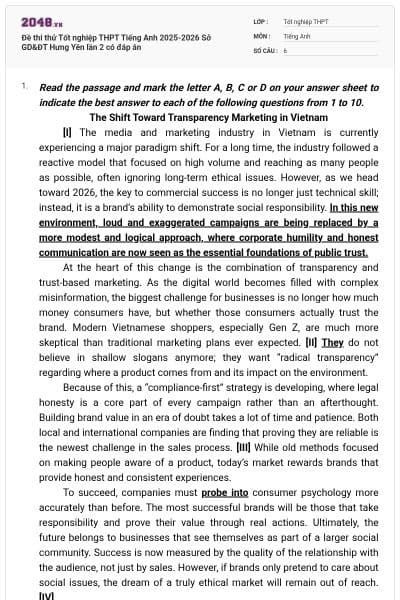
The Shift Toward Transparency Marketing in Vietnam
[I] The media and marketing industry in Vietnam is currently experiencing a major paradigm shift. For a long time, the industry followed a reactive model that focused on high volume and reaching as many people as possible, often ignoring long-term ethical issues. However, as we head toward 2026, the key to commercial success is no longer just technical skill; instead, it is a brand’s ability to demonstrate social responsibility. In this new environment, loud and exaggerated campaigns are being replaced by a more modest and logical approach, where corporate humility and honest communication are now seen as the essential foundations of public trust.
At the heart of this change is the combination of transparency and trust-based marketing. As the digital world becomes filled with complex misinformation, the biggest challenge for businesses is no longer how much money consumers have, but whether those consumers actually trust the brand. Modern Vietnamese shoppers, especially Gen Z, are much more skeptical than traditional marketing plans ever expected. [II] They do not believe in shallow slogans anymore; they want “radical transparency” regarding where a product comes from and its impact on the environment.
Because of this, a “compliance-first” strategy is developing, where legal honesty is a core part of every campaign rather than an afterthought. Building brand value in an era of doubt takes a lot of time and patience. Both local and international companies are finding that proving they are reliable is the newest challenge in the sales process. [III] While old methods focused on making people aware of a product, today’s market rewards brands that provide honest and consistent experiences.
To succeed, companies must probe into consumer psychology more accurately than before. The most successful brands will be those that take responsibility and prove their value through real actions. Ultimately, the future belongs to businesses that see themselves as part of a larger social community. Success is now measured by the quality of the relationship with the audience, not just by sales. However, if brands only pretend to care about social issues, the dream of a truly ethical market will remain out of reach. [IV]
(Adapted from https://www.brandsvietnam.com)
According to paragraph 2, what is the main reason why consumer confidence has become the fundamental hurdle for market demand?
The digital world is full of complex and false information.
Gen Z consumers have less money to spend than before.
High-quality transparency has made products more expensive for consumers.
Brands have successfully integrated ethical standards into their slogans.
Theo đoạn 2, đâu là lý do chính khiến niềm tin của người tiêu dùng trở thành rào cản/thách thức cơ bản đối với nhu cầu thị trường?
A. Thế giới kỹ thuật số chứa đầy thông tin phức tạp và sai lệch. (Đúng)
B. Người tiêu dùng Gen Z có ít tiền để chi tiêu hơn trước.
(Sai, bài đọc nói tiền không còn là thách thức lớn nhất).
C. Tính minh bạch chất lượng cao đã làm cho các sản phẩm trở nên đắt đỏ hơn đối với người tiêu dùng. (Không có thông tin).
D. Các thương hiệu đã tích hợp thành công các tiêu chuẩn đạo đức vào khẩu hiệu của họ. (Sai, người tiêu dùng không còn tin vào các khẩu hiệu sáo rỗng).
→ Đoạn 2 chỉ ra rõ ràng rằng do thế giới số tràn ngập thông tin sai lệch, thách thức lớn nhất đối với doanh nghiệp chuyển từ túi tiền của khách hàng sang việc họ có tin tưởng thương hiệu hay không.
Thông tin: “As the digital world becomes filled with complex misinformation, the biggest challenge for businesses is no longer how much money consumers have, but whether those consumers actually trust the brand.” (Trong thế giới kỹ thuật số ngày càng tràn ngập thông tin sai lệch phức tạp, thách thức lớn nhất đối với các doanh nghiệp không còn là người tiêu dùng có bao nhiêu tiền, mà là liệu người tiêu dùng có thực sự tin tưởng vào thương hiệu đó hay không.)
Chọn A.
The word They in paragraph 2 refers to ______.
environmental footprints
modern Vietnamese consumers
superficial slogans
brand strategies
Từ “They” trong đoạn 2 chỉ ______.
A. environmental footprints (dấu chân môi trường)
B. modern Vietnamese consumers (người tiêu dùng Việt Nam hiện đại)
C. superficial slogans (những khẩu hiệu sáo rỗng/nông cạn)
D. brand strategies (các chiến lược thương hiệu)
Thông tin: “Modern Vietnamese shoppers, especially Gen Z, are much more skeptical... They do not believe in shallow slogans anymore...” (Những người mua sắm Việt Nam hiện đại... Họ không còn tin vào...).
→ Đại từ “They” thay thế cho “modern Vietnamese consumers”
Chọn B.
Which of the following assertions is NOT TRUE according to the passage?
A “compliance-first” framework treats legal integrity as a secondary or minor issue.
Modern market rewards are increasingly directed toward brands providing authentic experiences.
Establishing brand equity currently requires firms to overcome the challenge of reassurance.
The marketing industry is moving away from a reactive and volume-based model.
Khẳng định nào sau đây là KHÔNG ĐÚNG theo đoạn văn?
A. Một khuôn khổ “tuân thủ là trên hết” coi tính toàn vẹn pháp lý là một vấn đề thứ yếu hoặc nhỏ nhặt. (Sai, bài đọc nói nó là phần “cốt lõi” - core part).
B. Phần thưởng của thị trường hiện đại ngày càng hướng tới các thương hiệu mang lại trải nghiệm chân thực. (Đúng, theo đoạn 3).
C. Việc thiết lập giá trị thương hiệu hiện nay đòi hỏi các công ty phải vượt qua thách thức trong việc chứng minh sự đáng tin cậy. (Đúng, theo đoạn 3).
D. Ngành tiếp thị đang dần rời xa mô hình phản ứng dựa trên số lượng lớn. (Đúng, theo đoạn 1).
→ Theo đoạn 3, tính toàn vẹn pháp lý (sự trung thực về pháp luật) là một “phần cốt lõi” (core part), chứ không phải là điều “được nghĩ đến sau/thứ yếu” (afterthought). Do đó, phát biểu ở đáp án A đi ngược lại với bài đọc.
Thông tin: “...a “compliance-first” strategy is developing, where legal honesty is a core part of every campaign rather than an afterthought.” (...một chiến lược "tuân thủ pháp luật là ưu tiên hàng đầu" đang được hình thành, trong đó tính trung thực về mặt pháp luật là cốt lõi của mọi chiến dịch chứ không phải là điều được xem xét sau cùng.)
Chọn A.
Which of the following best summarises paragraph 2?
The problems of managing internet traffic in big cities.
How Trust Marketing helps brands deal with consumer doubt.
The history of using slogans in traditional advertising.
The role of Gen Z in protecting the environment.
Câu nào sau đây tóm tắt đúng nhất đoạn 2?
A. Những vấn đề quản lý lưu lượng truy cập internet ở các thành phố lớn. (Sai)
B. Cách Tiếp thị dựa trên Niềm tin (Trust Marketing) giúp các thương hiệu đối phó với sự hoài nghi của người tiêu dùng. (Đúng, bao quát ý: thách thức từ thông tin sai lệch, sự hoài nghi của Gen Z, và nhu cầu minh bạch triệt để).
C. Lịch sử của việc sử dụng các khẩu hiệu trong quảng cáo truyền thống. (Sai)
D. Vai trò của Gen Z trong việc bảo vệ môi trường. (Sai, quá hẹp).
Chọn B.
Which of the following best paraphrases the underlined sentence in paragraph 1?
The dominance of noisy campaigns remains unchallenged despite the rise of reasoned corporate discourse.
Corporate humility is hindering the evolution of public trust within the new marketing discipline.
Future success in marketing necessitates that companies amplify their loud campaigns to reach public trust.
Exaggerated marketing is being replaced by a serious and modest approach, which is vital for securing trust.
Câu nào sau đây diễn giải đúng nhất câu được gạch chân ở đoạn 1?
In this new environment, loud and exaggerated campaigns are being replaced by a more modest and logical approach, where corporate humility and honest communication are now seen as the essential foundations of public trust. (Trong môi trường mới này, các chiến dịch ồn ào và phóng đại đang được thay thế bằng một cách tiếp cận khiêm tốn và hợp lý hơn, nơi sự khiêm tốn của doanh nghiệp và giao tiếp trung thực hiện được xem là nền tảng thiết yếu của niềm tin công chúng.)
A. Sự thống trị của các chiến dịch ồn ào vẫn không bị thách thức bất chấp sự trỗi dậy của ngôn từ doanh nghiệp có lý lẽ. (Sai nghĩa).
B. Sự khiêm tốn của doanh nghiệp đang cản trở sự phát triển của lòng tin công chúng trong lĩnh vực tiếp thị mới. (Sai nghĩa, nó là nền tảng chứ không cản trở).
C. Thành công trong tương lai của tiếp thị đòi hỏi các công ty phải khuếch đại các chiến dịch ồn ào của mình để đạt được lòng tin của công chúng. (Sai nghĩa, ngược ý hoàn toàn).
D. Tiếp thị phóng đại đang được thay thế bằng một cách tiếp cận nghiêm túc và khiêm tốn, điều có ý nghĩa sống còn để bảo đảm niềm tin. (Đúng nghĩa và sát nhất với câu gốc).
Chọn D.
In paragraph 4, what do companies need to do more accurately to succeed in today’s complex market?
Study and understand consumer psychology more deeply.
Increase their budgets for digital advertisements.
Focus primarily on increasing their total market share.
Change their global offices into standard methodologies.
Trong đoạn 4, các công ty cần làm gì chính xác hơn để thành công trong thị trường phức tạp ngày nay?
A. Nghiên cứu và hiểu sâu hơn về tâm lý người tiêu dùng. (Đúng)
B. Tăng ngân sách cho quảng cáo kỹ thuật số. (Không có thông tin)
C. Tập trung chủ yếu vào việc tăng tổng thị phần của họ. (Sai)
D. Thay đổi các văn phòng toàn cầu của họ thành các phương pháp luận tiêu chuẩn. (Sai)
Thông tin: “To succeed, companies must probe into consumer psychology more accurately than before.” (Để thành công, các công ty phải nghiên cứu tâm lý người tiêu dùng chính xác hơn trước đây.)
Chọn A.
What can be inferred from the passage concerning the long-term consequences for a brand that engages in “performative activism”?
It will become the most influential brand by prioritizing awareness over accountability.
It will likely fail to facilitate the creation of a truly sustainable and ethical market.
It will successfully restore institutional legitimacy through tangible social actions.
It will eventually be perceived as an integral component of the broader social ecosystem.
Có thể suy luận gì từ bài đọc về những hậu quả lâu dài đối với một thương hiệu tham gia vào việc “biểu diễn hành động” (chỉ giả vờ quan tâm đến xã hội)?
A. Nó sẽ trở thành thương hiệu có sức ảnh hưởng nhất bằng cách ưu tiên nhận thức hơn là trách nhiệm giải trình. (Sai).
B. Nó có khả năng sẽ thất bại trong việc tạo điều kiện thiết lập một thị trường thực sự bền vững và đạo đức. (Đúng).
C. Nó sẽ khôi phục thành công tính hợp pháp của thể chế thông qua các hành động xã hội cụ thể. (Sai).
D. Cuối cùng, nó sẽ được coi là một thành phần không thể thiếu của hệ sinh thái xã hội. (Sai).
→ Câu kết của bài đọc cảnh báo rằng nếu các thương hiệu chỉ “giả vờ quan tâm” (pretend to care = performative activism), thì giấc mơ về một thị trường thực sự có đạo đức sẽ “nằm ngoài tầm với” (remain out of reach). Suy ra, những thương hiệu này sẽ làm thất bại việc tạo ra một thị trường đạo đức.
Chọn B.
Where in the passage does the following sentence best fit?
Standard methodologies that once yielded rapid results are no longer sufficient to secure long-term loyalty.
[III]
[I]
[II]
[IV]
Câu sau đây phù hợp nhất với vị trí nào trong bài đọc?
“Standard methodologies that once yielded rapid results are no longer sufficient to secure long-term loyalty.” (Các phương pháp luận tiêu chuẩn từng mang lại kết quả nhanh chóng nay không còn đủ sức để đảm bảo lòng trung thành lâu dài nữa.)
→ Tại vị trí [III] trong đoạn 3, việc chèn câu đã cho đóng vai trò là cầu nối hợp lý. Nó nhắc đến “các phương pháp tiêu chuẩn từng mang lại kết quả nhanh”, khớp nối chặt chẽ với câu ngay phía sau: “Trong khi những phương pháp cũ (old methods) tập trung vào việc làm cho mọi người nhận biết về sản phẩm, thị trường ngày nay ban thưởng cho những thương hiệu mang lại trải nghiệm trung thực...”. Sự tương phản giữa phương pháp cũ (không còn đủ sức) và xu hướng thị trường mới được thể hiện rất liền mạch. Không thể đặt ở [II] vì nó sẽ làm đứt gãy sự liên kết của đại từ “They” với “Modern Vietnamese shoppers”.
Chọn A.
The phrasal verb probe into in the last paragraph most closely aligns with the meaning of:
promote
disregard
investigate
overlook
Cụm động từ “probe into” trong đoạn cuối gần nghĩa nhất với:
probe into (phr.v): thăm dò, điều tra, nghiên cứu kỹ lưỡng
A. promote (v): thúc đẩy, thăng tiến
B. disregard (v): ngó lơ, coi thường
C. investigate (v): điều tra, nghiên cứu sâu.
D. overlook (v): bỏ qua, không chú ý
Thông tin: To succeed, companies must probe into consumer psychology more accurately than before.
(Để thành công, các công ty phải nghiên cứu tâm lý người tiêu dùng một cách chính xác hơn trước đây.)
→ probe into = investigate
Chọn C.
The preeminence of technological expertise in the marketing strategies of 2026.
The competitive struggle between domestic and global enterprises for digital market share.
The detrimental impact of consumer skepticism on the growth of Vietnamese mass media.
The ongoing transformation of the Vietnamese market toward transparency and ethical responsibility.
Câu nào sau đây tóm tắt đúng nhất bài đọc?
A. Sự ưu việt của chuyên môn công nghệ trong chiến lược tiếp thị năm 2026. (Sai, bài đọc nói thành công không chỉ còn nằm ở kỹ năng công nghệ).
B. Cuộc cạnh tranh khốc liệt giữa các doanh nghiệp trong nước và quốc tế để giành thị phần kỹ thuật số. (Sai trọng tâm).
C. Tác động tiêu cực của sự hoài nghi từ phía người tiêu dùng đối với sự phát triển của truyền thông đại chúng Việt Nam. (Sai, sự hoài nghi là động lực để chuyển đổi chứ không phải chỉ gây tác động tiêu cực).
D. Sự chuyển đổi đang diễn ra của thị trường Việt Nam hướng tới tính minh bạch và trách nhiệm đạo đức. (Tóm tắt hợp lý và trọn vẹn: Sự chuyển đổi ở đoạn 1, tính minh bạch/niềm tin ở đoạn 2, tuân thủ đạo đức ở đoạn 3, 4).
Chọn D.
Dịch bài đọc:
Sự Dịch Chuyển Hướng Tới Tiếp Thị Minh Bạch Tại Việt Nam
[I] Ngành truyền thông và tiếp thị tại Việt Nam hiện đang trải qua một sự thay đổi mô hình to lớn. Trong một thời gian dài, ngành này đã tuân theo một mô hình phản ứng tập trung vào số lượng lớn và tiếp cận càng nhiều người càng tốt, thường bỏ qua các vấn đề đạo đức dài hạn. Tuy nhiên, khi chúng ta tiến tới năm 2026, chìa khóa thành công thương mại không chỉ còn là kỹ năng kỹ thuật nữa; thay vào đó, nó là khả năng thể hiện trách nhiệm xã hội của một thương hiệu. Trong môi trường mới này, các chiến dịch ồn ào và phóng đại đang được thay thế bằng một cách tiếp cận khiêm tốn và hợp lý hơn, nơi sự khiêm tốn của doanh nghiệp và giao tiếp trung thực hiện được xem là nền tảng thiết yếu của niềm tin công chúng.
Cốt lõi của sự thay đổi này là sự kết hợp giữa tính minh bạch và tiếp thị dựa trên niềm tin. Khi thế giới kỹ thuật số ngày càng ngập tràn những thông tin sai lệch và phức tạp, thách thức lớn nhất đối với doanh nghiệp không còn là việc người tiêu dùng có bao nhiêu tiền, mà là liệu những người tiêu dùng đó có thực sự tin tưởng thương hiệu hay không. Những người mua sắm Việt Nam hiện đại, đặc biệt là Gen Z, hoài nghi hơn nhiều so với những gì các kế hoạch tiếp thị truyền thống từng mong đợi. [II] Họ không còn tin vào các khẩu hiệu nông cạn nữa; họ muốn một sự “minh bạch triệt để” về nguồn gốc của một sản phẩm và tác động của nó đối với môi trường.
Chính vì điều này, một chiến lược “tuân thủ là trên hết” đang được phát triển, nơi sự trung thực về mặt pháp lý là một phần cốt lõi của mọi chiến dịch chứ không phải là điều được nghĩ đến sau cùng. Việc xây dựng giá trị thương hiệu trong kỷ nguyên của sự hoài nghi đòi hỏi rất nhiều thời gian và sự kiên nhẫn. Cả các công ty trong nước và quốc tế đều đang nhận ra rằng việc chứng minh họ đáng tin cậy chính là thử thách mới nhất trong quy trình bán hàng. [III] (Các phương pháp luận tiêu chuẩn từng mang lại kết quả nhanh chóng nay không còn đủ sức để đảm bảo lòng trung thành lâu dài nữa.) Trong khi những phương pháp cũ tập trung vào việc làm cho mọi người nhận biết về một sản phẩm, thị trường ngày nay lại ban thưởng cho những thương hiệu cung cấp những trải nghiệm trung thực và nhất quán.
Để thành công, các công ty phải đi sâu nghiên cứu tâm lý người tiêu dùng một cách chính xác hơn trước đây. Những thương hiệu thành công nhất sẽ là những thương hiệu dám nhận trách nhiệm và chứng minh giá trị của mình thông qua các hành động thực tế. Suy cho cùng, tương lai thuộc về những doanh nghiệp coi bản thân họ là một phần của một cộng đồng xã hội rộng lớn hơn. Thành công nay được đo đếm bằng chất lượng của mối quan hệ với khán giả, chứ không chỉ đơn thuần bằng doanh số. Tuy nhiên, nếu các thương hiệu chỉ giả vờ quan tâm đến các vấn đề xã hội, thì giấc mơ về một thị trường thực sự có đạo đức sẽ mãi mãi nằm ngoài tầm với. [IV]
Read the following passage and mark the letter A, B, C or D on your answer sheet to indicate the option that best fits each of the numbered blanks from 11 to 15.
One of the most promising recent applications of artificial intelligence in medicine is rare-disease diagnosis. This field has long challenged clinicians because symptoms are often diverse, inconsistent, multisystem, and easily mistaken for more common disorders. In addition, the relevant knowledge base changes quickly as new genetic conditions continue to be identified. (11) ______. In 2026, Nature reported DeepRare, an agentic system that combines clinical descriptions, genetic evidence, specialised tools, and literature retrieval to generate ranked differential diagnoses with traceable reasoning. Rather than producing a single obscure answer, the system links each hypothesis to verifiable medical evidence, (12) ______.
This feature matters in practice because clinicians are unlikely to trust recommendations they cannot inspect, challenge, or justify. (13) ______. Used carefully within specialist workflows, such tools may help hospitals shorten diagnostic delay and support patients who currently face long, uncertain journeys. Even so, recent reviews of AI agents in healthcare stress that progress will depend on more than technical accuracy alone. (14) ______, these systems must be evaluated for safety, governance, and real-world reliability before they are widely deployed. In the long term, the aim is not to replace clinical judgment, (15) ______.
(Adapted from https://www.nature.com)
As a result, all genetic disorders can now be identified with complete accuracy
On the other hand, laboratory medicine is no longer considered an important part of the diagnostic process
More broadly, this has created demand for systems to retrieve knowledge, and justify their suggestions transparently
In contrast, most hospitals have now stopped relying on clinical databases when dealing with more complex medical cases
Các câu phía trước nêu lên khó khăn trong việc chẩn đoán các căn bệnh hiếm gặp (triệu chứng đa dạng, kiến thức y khoa thay đổi nhanh chóng...). Câu phía sau giới thiệu hệ thống AI DeepRare có khả năng kết hợp mô tả lâm sàng, bằng chứng di truyền và tài liệu để đưa ra chẩn đoán “với lập luận có thể truy xuất nguồn gốc” (traceable reasoning). Do đó, vị trí (11) cần một câu đóng vai trò cầu nối (transition), tóm tắt lại nhu cầu phát sinh từ những khó khăn trên để dẫn dắt vào giải pháp DeepRare.
Dịch nghĩa/Ngữ pháp:
A. Kết quả là, tất cả các rối loạn di truyền hiện có thể được xác định với độ chính xác tuyệt đối (Sai logic: quá cường điệu với từ “tất cả” và “tuyệt đối”).
B. Mặt khác, y học xét nghiệm không còn được coi là một phần quan trọng của quá trình chẩn đoán. (Lạc đề, sai sự thật).
C. Rộng hơn, điều này đã tạo ra nhu cầu về các hệ thống có khả năng truy xuất kiến thức và biện minh cho các đề xuất của chúng một cách minh bạch (Khớp hoàn hảo về logic: khó khăn tạo ra “nhu cầu”, và “biện minh minh bạch” chính là tiền đề để giới thiệu tính năng “traceable reasoning” của hệ thống DeepRare ở câu sau).
D. Ngược lại, hầu hết các bệnh viện hiện nay đã ngừng dựa vào cơ sở dữ liệu lâm sàng khi xử lý các trường hợp y tế phức tạp hơn. (Sai logic).
Đáp án C cung cấp một câu chuyển ý xuất sắc, kết nối nguyên nhân (khó khăn thực tế) với kết quả (nhu cầu về hệ thống AI minh bạch).
Chọn C.
→ In addition, the relevant knowledge base changes quickly as new genetic conditions continue to be identified. More broadly, this has created demand for systems to retrieve knowledge, and justify their suggestions transparently.
Dịch nghĩa: Ngoài ra, nền tảng kiến thức liên quan thay đổi nhanh chóng khi các tình trạng di truyền mới tiếp tục được xác định. Rộng hơn, điều này đã tạo ra nhu cầu về các hệ thống có khả năng truy xuất kiến thức và biện minh cho các đề xuất của chúng một cách minh bạch.
while some patients are still not familiar with using digital tools
unless the software is used only for administrative purposes
although many hospitals are now cutting down on the amount of money they spend on laboratory services
because interpretability is increasingly treated as a clinical requirement rather than a technical luxury
Mệnh đề trước đó mô tả cách hệ thống hoạt động: “...the system links each hypothesis to verifiable medical evidence,” (...hệ thống liên kết mỗi giả thuyết với bằng chứng y khoa có thể xác minh được). Câu tiếp theo ngay sau chỗ trống khẳng định: “This feature matters in practice because clinicians are unlikely to trust recommendations they cannot inspect...” (Tính năng này quan trọng trong thực tế vì các bác sĩ lâm sàng khó có thể tin tưởng các khuyến nghị mà họ không thể kiểm tra...). Vị trí (12) cần một mệnh đề chỉ nguyên nhân/lý do tại sao hệ thống lại phải cung cấp bằng chứng y khoa xác minh được.
Dịch nghĩa:
A. trong khi một số bệnh nhân vẫn chưa quen với việc sử dụng các công cụ kỹ thuật số (Lạc đề).
B. trừ khi phần mềm chỉ được sử dụng cho mục đích quản trị (Sai logic).
C. mặc dù nhiều bệnh viện hiện đang cắt giảm chi phí cho dịch vụ xét nghiệm (Lạc đề).
D. bởi vì khả năng diễn giải ngày càng được coi là một yêu cầu lâm sàng chứ không phải là một sự xa xỉ về mặt kỹ thuật (Sử dụng liên từ “because”, từ khóa “interpretability” - khả năng diễn giải - khớp hoàn hảo với “verifiable medical evidence” ở câu trước và giải quyết được vấn đề “trust” (niềm tin) ở câu sau).
Đáp án D giải thích trọn vẹn lý do hệ thống AI phải kết nối với bằng chứng: đó là yêu cầu bắt buộc của ngành y.
Chọn D.
→ Rather than producing a single obscure answer, the system links each hypothesis to verifiable medical evidence, because interpretability is increasingly treated as a clinical requirement rather than a technical luxury.
Dịch nghĩa: Thay vì đưa ra một câu trả lời mơ hồ duy nhất, hệ thống liên kết mỗi giả thuyết với bằng chứng y khoa có thể xác minh được, bởi vì khả năng diễn giải ngày càng được coi là một yêu cầu lâm sàng chứ không phải là một sự xa xỉ về mặt kỹ thuật.
For that reason, patients with rare diseases should stay away from genetic testing whenever it can be avoided
For that reason, automated results should take the place of all consultation with medical specialists
For that reason, some researchers argue that explainable AI could widen access to specialist-level reasoning in hospitals with limited expertise
For that reason, diagnostic interviews are gradually becoming less necessary in today’s hospitals
Câu phía trước khẳng định tầm quan trọng của việc có thể kiểm tra và biện minh (bác sĩ không tin những gì họ không thể kiểm tra). Khoảng trống (13) cần một câu rút ra hệ quả tích cực từ việc giải quyết được vấn đề niềm tin này, trước khi câu sau kết luận: “Used carefully... such tools may help hospitals shorten diagnostic delay...” (Nếu được sử dụng cẩn thận... các công cụ như vậy có thể giúp bệnh viện rút ngắn thời gian chẩn đoán...).
Dịch nghĩa/Ngữ pháp:
A. Vì lý do đó, bệnh nhân mắc các bệnh hiếm gặp nên tránh xét nghiệm gen bất cứ khi nào có thể. (Đi ngược lại logic y khoa).
B. Vì lý do đó, kết quả tự động nên thay thế mọi cuộc hội chẩn với bác sĩ chuyên khoa (Sai logic: bài viết nhấn mạnh AI chỉ hỗ trợ chứ không thay thế bác sĩ).
C. Vì lý do đó, một số nhà nghiên cứu lập luận rằng AI có thể giải thích được có thể mở rộng khả năng tiếp cận với lập luận cấp độ chuyên gia tại các bệnh viện có chuyên môn hạn chế (Cụm “explainable AI” - AI có thể giải thích - là giải pháp hoàn hảo cho việc bác sĩ cần “kiểm tra và biện minh”. Mở rộng khả năng tiếp cận chuyên môn cũng tạo tiền đề cho việc “rút ngắn thời gian chẩn đoán” ở câu sau).
D. Vì lý do đó, các cuộc phỏng vấn chẩn đoán đang dần trở nên ít cần thiết hơn trong các bệnh viện hiện nay. (Sai logic).
Đáp án C cung cấp một hệ quả vô cùng hợp lý và tích cực: khi AI có thể giải thích được lý do chẩn đoán, nó sẽ trở thành trợ thủ đắc lực ở những nơi thiếu chuyên gia.
Chọn C.
→ This feature matters in practice because clinicians are unlikely to trust recommendations they cannot inspect, challenge, or justify. For that reason, some researchers argue that explainable AI could widen access to specialist-level reasoning in hospitals with limited expertise.
Dịch nghĩa: Tính năng này quan trọng trong thực tế vì các bác sĩ lâm sàng khó có thể tin tưởng các khuyến nghị mà họ không thể kiểm tra, thách thức hoặc biện minh. Vì lý do đó, một số nhà nghiên cứu lập luận rằng AI có thể giải thích được có thể mở rộng khả năng tiếp cận với lập luận cấp độ chuyên gia tại các bệnh viện có chuyên môn hạn chế.
Being genuinely useful in clinical settings
To be genuinely useful in clinical settings
Because they are genuinely useful in clinical settings
Due to the genuine usefulness in clinical settings
Khoảng trống (14) đứng đầu câu, trước dấu phẩy. Mệnh đề chính phía sau là: “...these systems must be evaluated for safety, governance, and real-world reliability before they are widely deployed.” (...các hệ thống này phải được đánh giá về độ an toàn, quản trị và độ tin cậy trong thế giới thực trước khi được triển khai rộng rãi). Vị trí này cần một cụm từ chỉ mục đích của việc đánh giá.
Dịch nghĩa/Ngữ pháp:
A. Being genuinely useful... (V-ing đứng đầu câu có thể hiểu là mệnh đề nguyên nhân “Because they are...” → Sai logic: Chúng chưa thực sự hữu ích ngay, mà PHẢI được đánh giá ĐỂ trở nên hữu ích).
B. Để thực sự hữu ích trong môi trường lâm sàng, (Cấu trúc động từ nguyên mẫu có “to” (To-Infinitive) chỉ mục đích. Khớp với mệnh đề chính “phải được đánh giá”).
C. Because they are genuinely useful... (Sai logic nhân quả tương tự A).
D. Due to the genuine usefulness... (Sai logic nguyên nhân).
Chỉ có đáp án B (chỉ mục đích) tạo ra mối quan hệ logic chính xác: “Để đạt được X, hệ thống phải làm Y”.
Chọn B.
→ To be genuinely useful in clinical settings, these systems must be evaluated for safety, governance, and real-world reliability before they are widely deployed.
Dịch nghĩa: Để thực sự hữu ích trong môi trường lâm sàng, các hệ thống này phải được đánh giá về độ an toàn, quản trị và độ tin cậy trong thế giới thực trước khi chúng được triển khai rộng rãi.
that hospitals ought to spend more money on additional digital equipment
because medical evidence is often limited or not fully complete
eliminating the need for doctors completely in the process
but to strengthen expert judgment while leaving final responsibility with human clinicians
Câu kết luận có cấu trúc phủ định ở vế đầu: “In the long term, the aim is not to replace clinical judgment,” (Về dài hạn, mục tiêu không phải là để thay thế phán đoán lâm sàng,). Trong tiếng Anh, cấu trúc song song rất phổ biến để thể hiện sự tương phản là: “not to V1, but to V2” (không phải để làm V1, mà là để làm V2).
Dịch nghĩa/Ngữ pháp:
A. that hospitals ought to spend... (Sai cấu trúc ngữ pháp).
B. because medical evidence... (Làm hỏng mạch tương phản của câu kết).
C. eliminating the need... (V-ing “eliminating” làm mất tính song song với “to replace”, đồng thời sai logic vì nó phủ định lại vế “not to replace”).
D. mà là để củng cố phán đoán của chuyên gia trong khi vẫn để lại trách nhiệm cuối cùng cho các bác sĩ lâm sàng con người (Sử dụng cấu trúc “but to strengthen...”, tuyệt đối song song với “not to replace”, đồng thời chốt lại thông điệp cốt lõi của bài: AI là công cụ hỗ trợ, không phải để thay thế con người).
Đáp án D tuân thủ nghiêm ngặt cấu trúc song song (Parallelism) và mang lại một câu chốt ý xuất sắc, bao quát thông điệp của toàn văn bản.
Chọn D.
→ In the long term, the aim is not to replace clinical judgment, but to strengthen expert judgment while leaving final responsibility with human clinicians.
Dịch nghĩa: Về dài hạn, mục tiêu không phải là để thay thế phán đoán lâm sàng, mà là để củng cố phán đoán của chuyên gia trong khi vẫn để lại trách nhiệm cuối cùng cho các bác sĩ lâm sàng con người.
Bài đọc hoàn chỉnh | Dịch bài đọc |
One of the most promising recent applications of artificial intelligence in medicine is rare-disease diagnosis. This field has long challenged clinicians because symptoms are often diverse, inconsistent, multisystem, and easily mistaken for more common disorders. In addition, the relevant knowledge base changes quickly as new genetic conditions continue to be identified. More broadly, this has created demand for systems to retrieve knowledge, and justify their suggestions transparently. In 2026, Nature reported DeepRare, an agentic system that combines clinical descriptions, genetic evidence, specialised tools, and literature retrieval to generate ranked differential diagnoses with traceable reasoning. Rather than producing a single obscure answer, the system links each hypothesis to verifiable medical evidence, because interpretability is increasingly treated as a clinical requirement rather than a technical luxury. This feature matters in practice because clinicians are unlikely to trust recommendations they cannot inspect, challenge, or justify. For that reason, some researchers argue that explainable AI could widen access to specialist-level reasoning in hospitals with limited expertise. Used carefully within specialist workflows, such tools may help hospitals shorten diagnostic delay and support patients who currently face long, uncertain journeys. Even so, recent reviews of AI agents in healthcare stress that progress will depend on more than technical accuracy alone. To be genuinely useful in clinical settings, these systems must be evaluated for safety, governance, and real-world reliability before they are widely deployed. In the long term, the aim is not to replace clinical judgment, but to strengthen expert judgment while leaving final responsibility with human clinicians. | Một trong những ứng dụng gần đây đầy hứa hẹn nhất của trí tuệ nhân tạo trong y học là chẩn đoán bệnh hiếm gặp. Lĩnh vực này từ lâu đã thách thức các bác sĩ lâm sàng vì các triệu chứng thường đa dạng, không nhất quán, ảnh hưởng đến nhiều hệ cơ quan và dễ bị nhầm lẫn với các rối loạn phổ biến hơn. Ngoài ra, nền tảng kiến thức liên quan thay đổi nhanh chóng khi các tình trạng di truyền mới tiếp tục được xác định. Rộng hơn, điều này đã tạo ra nhu cầu về các hệ thống có khả năng truy xuất kiến thức và biện minh cho các đề xuất của chúng một cách minh bạch. Năm 2026, tạp chí Nature đã báo cáo về DeepRare, một hệ thống tác nhân kết hợp các mô tả lâm sàng, bằng chứng di truyền, các công cụ chuyên dụng và truy xuất tài liệu để tạo ra các chẩn đoán phân biệt được xếp hạng với lập luận có thể truy xuất nguồn gốc. Thay vì đưa ra một câu trả lời mơ hồ duy nhất, hệ thống liên kết mỗi giả thuyết với bằng chứng y khoa có thể xác minh được, bởi vì khả năng diễn giải ngày càng được coi là một yêu cầu lâm sàng chứ không phải là một sự xa xỉ về mặt kỹ thuật. Tính năng này quan trọng trong thực tế vì các bác sĩ lâm sàng khó có thể tin tưởng các khuyến nghị mà họ không thể kiểm tra, thách thức hoặc biện minh. Vì lý do đó, một số nhà nghiên cứu lập luận rằng AI có thể giải thích được có thể mở rộng khả năng tiếp cận với lập luận cấp độ chuyên gia tại các bệnh viện có chuyên môn hạn chế. Nếu được sử dụng cẩn thận trong quy trình làm việc của chuyên gia, các công cụ như vậy có thể giúp bệnh viện rút ngắn sự chậm trễ trong chẩn đoán và hỗ trợ những bệnh nhân hiện đang phải đối mặt với những hành trình dài và không chắc chắn. Mặc dù vậy, các đánh giá gần đây về các tác nhân AI trong chăm sóc sức khỏe nhấn mạnh rằng sự tiến bộ sẽ phụ thuộc vào nhiều yếu tố chứ không chỉ riêng độ chính xác kỹ thuật. Để thực sự hữu ích trong môi trường lâm sàng, các hệ thống này phải được đánh giá về độ an toàn, quản trị và độ tin cậy trong thế giới thực trước khi chúng được triển khai rộng rãi. Về dài hạn, mục tiêu không phải là để thay thế phán đoán lâm sàng, mà là để củng cố phán đoán của chuyên gia trong khi vẫn để lại trách nhiệm cuối cùng cho các bác sĩ lâm sàng con người. |
Read the following announcement and mark the letter A, B, C or D to indicate the option that best fits each blank from 16 to 21.
Announcement: UNDP Highlights Vietnam’s Inclusive Path to Green and Digital Growth
UNDP Resident Representative Ramla Khalidi has affirmed Vietnam’s strong commitment to an inclusive path for green and digital growth. She emphasized that the country’s transition (16) ______ must place people at its center leaves no one marginalized.
Green policies are expected to create a wide (17) ______ of job opportunities by 2030, especially in renewable energy. Furthermore, the Just Energy Transition Partnership (JETP) is mobilizing $15.5 billion to support the shift away from coal, with a focus on protecting affected communities.
Reforms also aim to expand access to skills, finance, and digital tools, particularly for vulnerable groups, (18) ______ greater participation in the digital economy. UNDP also calls on stakeholders to (19) ______ their efforts in supporting inclusive growth.
UNDP reaffirms its commitment to helping Vietnam in building a just transition, (20) ______ opportunity and strengthening governance. This demonstrates Vietnam’s potential to lead globally in sustainable development, provided policies are effectively translated into real, inclusive outcomes, developing a truly (21) ______ society.
(Adapted from https://vietnamnews.vn)
who
whose
which
where
A. who: đại từ quan hệ thay thế cho người (làm chủ ngữ).
B. whose: đại từ quan hệ chỉ sự sở hữu.
C. which: đại từ quan hệ thay thế cho vật/sự việc.
D. where: trạng từ quan hệ chỉ nơi chốn.
Phía trước khoảng trống là danh từ chỉ sự việc “transition” (sự chuyển đổi). Phía sau là động từ “must place”, nên ta cần một đại từ quan hệ đóng vai trò làm chủ ngữ bổ nghĩa cho “transition”. Mệnh đề quan hệ which must place people at its center (điều mà phải đặt con người làm trung tâm) được chèn vào giữa để bổ nghĩa cho chủ ngữ chính trước khi đến động từ chính “leaves”.
Chọn C. which
→ ...that the country’s transition which must place people at its center leaves no one marginalized.
Dịch nghĩa: ...rằng sự chuyển đổi của quốc gia, sự chuyển đổi mà phải đặt con người làm trung tâm, không bỏ lại bất kỳ ai bên lề.
number
deal
amount
range
A. number (n): số lượng (đi với a large/great number of + N đếm được số nhiều).
B. deal (n): lượng (đi với a great deal of + N không đếm được).
C. amount (n): khối lượng, lượng (đi với a large amount of + N không đếm được).
D. range (n): phạm vi, sự đa dạng (đi với a wide range of + N đếm được số nhiều).
Phía sau khoảng trống là danh từ số nhiều “job opportunities” (các cơ hội việc làm). Ta có cụm từ cố định: a wide range of + N (số nhiều) mang ý nghĩa là “một loạt / sự đa dạng các...”.
Chọn D. range
→ Green policies are expected to create a wide range of job opportunities...
Dịch nghĩa: Các chính sách xanh được kỳ vọng sẽ tạo ra một loạt (sự đa dạng) các cơ hội việc làm.facilitate
facilitating
to facilitate
facilitated
A. facilitate (v): tạo điều kiện, làm cho thuận tiện (động từ nguyên thể).
B. facilitating (v-ing): hiện tại phân từ (mang nghĩa chủ động).
C. to facilitate: động từ nguyên thể có “to” (chỉ mục đích).
D. facilitated (v-ed/v3): quá khứ phân từ.
Phía trước khoảng trống có dấu phẩy (,). Đây là cấu trúc sử dụng hiện tại phân từ (V-ing) đứng sau dấu phẩy để rút gọn mệnh đề quan hệ mang ý nghĩa chỉ kết quả của toàn bộ hành động phía trước (tương đương với which facilitates).
Chọn B. facilitating
→ ...particularly for vulnerable groups, facilitating greater participation in the digital economy.
Dịch nghĩa: ...đặc biệt là đối với các nhóm dễ bị tổn thương, (từ đó) tạo điều kiện cho sự tham gia lớn hơn vào nền kinh tế kỹ thuật số.
step up
build up
gear up
follow up
A. step up (phr.v): tăng cường, đẩy mạnh.
B. build up (phr.v): tích lũy, xây dựng lên dần dần.
C. gear up (phr.v): chuẩn bị sẵn sàng (cho một sự kiện/hoạt động).
D. follow up (phr.v): bám sát, tiếp tục (hành động tiếp theo).
Ta có cụm kết hợp từ (collocation): step up one's efforts (tăng cường/đẩy mạnh nỗ lực của ai đó).
Chọn A. step up
→ UNDP also calls on stakeholders to step up their efforts in supporting inclusive growth.
Dịch nghĩa: UNDP cũng kêu gọi các bên liên quan đẩy mạnh nỗ lực của họ trong việc hỗ trợ tăng trưởng bao trùm.
ensuring
providing
progressing
proposing
A. ensuring (v-ing): đảm bảo.
B. providing (v-ing): cung cấp.
C. progressing (v-ing): tiến bộ, tiến triển.
D. proposing (v-ing): đề xuất.
Cấu trúc liệt kê song song (parallelism) với các V-ing: building... , ensuring... and strengthening.... Hơn nữa, trong ngôn ngữ chính sách vĩ mô, cụm từ ensuring opportunity (đảm bảo cơ hội) rất hay được sử dụng đi kèm với strengthening governance (tăng cường quản trị).
Chọn A. ensuring
→ ...building a just transition, ensuring opportunity and strengthening governance.
Dịch nghĩa: ...xây dựng một sự chuyển đổi công bằng, đảm bảo cơ hội và tăng cường quản trị.
equity
equitable
equivocal
equitably
A. equity (n): sự công bằng, tính vô tư.
B. equitable (adj): công bằng, bình đẳng.
C. equivocal (adj): mập mờ, đa nghĩa.
D. equitably (adv): một cách công bằng.
Khoảng trống nằm giữa trạng từ “truly” (thực sự) và danh từ “society” (xã hội). Do đó, ta cần một tính từ để tạo thành cụm danh từ. “Equitable” (công bằng) là tính từ phù hợp nhất về mặt ngữ nghĩa.
Chọn B. equitable
→ ...developing a truly equitable society.
Dịch nghĩa: ...phát triển một xã hội công bằng thực sự.
Bài đọc hoàn chỉnh | Dịch bài đọc |
Announcement: UNDP Highlights Vietnam’s Inclusive Path to Green and Digital Growth UNDP Resident Representative Ramla Khalidi has affirmed Vietnam’s strong commitment to an inclusive path for green and digital growth. She emphasized that the country’s transition (16) which must place people at its center leaves no one marginalized. Green policies are expected to create a wide (17) range of job opportunities by 2030, especially in renewable energy. Furthermore, the Just Energy Transition Partnership (JETP) is mobilizing $15.5 billion to support the shift away from coal, with a focus on protecting affected communities. Reforms also aim to expand access to skills, finance, and digital tools, particularly for vulnerable groups, (18) facilitating greater participation in the digital economy. UNDP also calls on stakeholders to (19) step up their efforts in supporting inclusive growth. UNDP reaffirms its commitment to helping Vietnam in building a just transition, (20) ensuring opportunity and strengthening governance. This demonstrates Vietnam’s potential to lead globally in sustainable development, provided policies are effectively translated into real, inclusive outcomes, developing a truly (21) equitable society. | Thông báo: UNDP Làm Nổi Bật Con Đường Tăng Trưởng Xanh Và Kỹ Thuật Số Bao Trùm Của Việt Nam Trưởng đại diện thường trú của UNDP, Ramla Khalidi, đã khẳng định cam kết mạnh mẽ của Việt Nam đối với con đường tăng trưởng xanh và kỹ thuật số mang tính bao trùm. Bà nhấn mạnh rằng sự chuyển đổi của quốc gia, (16) sự chuyển đổi mà phải đặt con người làm trung tâm, không để ai bị gạt ra ngoài lề xã hội. Các chính sách xanh được kỳ vọng sẽ tạo ra một (17) loạt các cơ hội việc làm vào năm 2030, đặc biệt là trong lĩnh vực năng lượng tái tạo. Hơn nữa, Đối tác Chuyển đổi Năng lượng Công bằng (JETP) đang huy động 15,5 tỷ USD để hỗ trợ quá trình chuyển đổi khỏi than đá, với trọng tâm là bảo vệ các cộng đồng bị ảnh hưởng. Các cuộc cải cách cũng nhằm mục đích mở rộng khả năng tiếp cận các kỹ năng, tài chính và các công cụ kỹ thuật số, đặc biệt là đối với các nhóm dễ bị tổn thương, (18) (từ đó) tạo điều kiện cho sự tham gia lớn hơn vào nền kinh tế kỹ thuật số. UNDP cũng kêu gọi các bên liên quan (19) đẩy mạnh những nỗ lực của họ trong việc hỗ trợ tăng trưởng bao trùm. UNDP tái khẳng định cam kết của mình trong việc giúp đỡ Việt Nam xây dựng một quá trình chuyển đổi công bằng, (20) đảm bảo cơ hội và tăng cường quản trị. Điều này chứng minh tiềm năng của Việt Nam trong việc dẫn đầu toàn cầu về phát triển bền vững, với điều kiện là các chính sách phải được chuyển hóa một cách hiệu quả thành những kết quả thực tế mang tính bao trùm, nhằm phát triển một xã hội (21) công bằng thực sự. |
Mark the letter A, B, C, or D on your answer sheet to indicate the correct arrangement of utterances or sentences to make a meaningful exchange or text in each of the following questions from 22 to 26.
a. However, with modern fishing techniques, the demand for traditional fish traps as practical tools has naturally declined over the years.
b. Thu Sy Village, nestled in Hung Yen Province, stands as a testament to Vietnam’s enduring traditional craftsmanship, particularly its unique fish trap weaving.
c. Recognizing this, the villagers have diligently worked to transform the craft into a cultural art form, attracting tourists and promoting heritage.
d. Historically, these bamboo traps were vital tools for local farmers in the Red River Delta, essential for their water-based livelihoods.
e. Consequently, Thu Sy not only preserves a centuries-old tradition but also thrives as a vibrant cultural destination, ensuring its legacy for future generations.
b-a-c-d-e
b-d-a-e-c
b-d-c-a-e
b-d-a-c-e
Thứ tự sắp xếp đúng: D. b – d – a – c – e
b. Thu Sy Village, nestled in Hung Yen Province, stands as a testament to Vietnam’s enduring traditional craftsmanship, particularly its unique fish trap weaving.
d. Historically, these bamboo traps were vital tools for local farmers in the Red River Delta, essential for their water-based livelihoods.
a. However, with modern fishing techniques, the demand for traditional fish traps as practical tools has naturally declined over the years.
c. Recognizing this, the villagers have diligently worked to transform the craft into a cultural art form, attracting tourists and promoting heritage.
e. Consequently, Thu Sy not only preserves a centuries-old tradition but also thrives as a vibrant cultural destination, ensuring its legacy for future generations.
Dịch nghĩa:
b. Làng Thủ Sỹ, nép mình ở tỉnh Hưng Yên, đứng như một minh chứng cho nghề thủ công truyền thống lâu đời của Việt Nam, đặc biệt là nghề đan đó (dụng cụ bắt cá) độc đáo.
d. Về mặt lịch sử, những chiếc đó tre này là công cụ quan trọng đối với nông dân địa phương ở Đồng bằng sông Hồng, thiết yếu cho sinh kế dựa vào vùng nước của họ.
a. Tuy nhiên, với các kỹ thuật đánh bắt hiện đại, nhu cầu về đó truyền thống như những công cụ thiết thực đã giảm dần theo thời gian một cách tự nhiên.
c. Nhận thức được điều này, người dân trong làng đã nỗ lực làm việc để biến nghề thủ công thành một loại hình nghệ thuật văn hóa, thu hút khách du lịch và quảng bá di sản.
e. Do đó, Thủ Sỹ không chỉ bảo tồn truyền thống hàng thế kỷ mà còn phát triển rực rỡ như một điểm đến văn hóa sôi động, đảm bảo di sản của mình cho các thế hệ tương lai.
Chọn D.
a. Mark: Oh, really? I hadn’t caught up with the news. I loved “Maverick” a couple of years ago.
b. Mark: Yeah, the flying sequences in both films are just breathtaking. They really make you appreciate the skill involved.
c. Sarah: Me too! I’ve always been a fan of action films, especially those with incredible aerial stunts.
d. Sarah: Did you hear about the announcement for “Top Gun 3”? I’m so excited.
e. Sarah: Absolutely. It makes me want to try something adventurous, like a flight simulator, though maybe not actual fighter training!
c-b-e-a-d
e-a-d-b-c
d-a-c-b-e
c-a-d-b-e
Thứ tự sắp xếp đúng: C. d – a – c – b – e
d. Sarah: Did you hear about the announcement for “Top Gun 3”? I’m so excited.
a. Mark: Oh, really? I hadn’t caught up with the news. I loved “Maverick” a couple of years ago.
c. Sarah: Me too! I’ve always been a fan of action films, especially those with incredible aerial stunts.
b. Mark: Yeah, the flying sequences in both films are just breathtaking. They really make you appreciate the skill involved.
e. Sarah: Absolutely. It makes me want to try something adventurous, like a flight simulator, though maybe not actual fighter training!
Dịch nghĩa:
d. Sarah: Cậu đã nghe thông báo về “Top Gun 3” chưa? Tớ háo hức quá.
a. Mark: Ồ, vậy sao? Tớ chưa cập nhật tin tức. Tớ rất thích “Maverick” vài năm trước.
c. Sarah: Tớ cũng vậy! Tớ luôn là một người hâm mộ các bộ phim hành động, đặc biệt là những phim có các pha nhào lộn trên không tuyệt đỉnh.
b. Mark: Đúng vậy, các cảnh bay lượn trong cả hai phần phim đều đẹp đến nghẹt thở. Chúng thực sự làm cho cậu đánh giá cao kỹ năng của những người tham gia vào đó.
e. Sarah: Chắc chắn rồi. Nó khiến tớ muốn thử một thứ gì đó mạo hiểm, như máy mô phỏng chuyến bay, mặc dù có thể không phải là huấn luyện phi công chiến đấu thực sự!
Chọn C.
a. Moreover, mastering this skill helps students reduce academic stress and avoid the habit of last-minute procrastination.
b. Therefore, developing a structured daily routine is essential for any student aiming for long-term success.
c. Effective time management is a fundamental skill that enables students to balance their studies with personal interests.
d. However, many students struggle to stay organized due to the constant distractions from social media and entertainment.
e. To begin with, it involves prioritizing urgent tasks and setting realistic goals for each study session.
d-c-a-b-e
c-e-a-d-b
c-b-a-e-d
c-e-d-a-b
Thứ tự sắp xếp đúng: B. c – e – a – d – b
c. Effective time management is a fundamental skill that enables students to balance their studies with personal interests.
e. To begin with, it involves prioritizing urgent tasks and setting realistic goals for each study session.
a. Moreover, mastering this skill helps students reduce academic stress and avoid the habit of last-minute procrastination.
d. However, many students struggle to stay organized due to the constant distractions from social media and entertainment.
b. Therefore, developing a structured daily routine is essential for any student aiming for long-term success.
Dịch nghĩa:
c. Quản lý thời gian hiệu quả là một kỹ năng nền tảng cho phép học sinh cân bằng giữa việc học và sở thích cá nhân.
e. Để bắt đầu, nó bao gồm việc ưu tiên các nhiệm vụ khẩn cấp và đặt ra các mục tiêu thực tế cho mỗi buổi học.
a. Hơn nữa, việc nắm vững kỹ năng này giúp học sinh giảm bớt căng thẳng trong học tập và tránh được thói quen trì hoãn đến phút chót.
d. Tuy nhiên, nhiều học sinh phải vật lộn để giữ được sự tổ chức do sự phân tâm liên tục từ mạng xã hội và giải trí.
b. Do đó, việc xây dựng một thói quen hàng ngày có cấu trúc là điều cần thiết đối với bất kỳ học sinh nào hướng tới thành công lâu dài.
Chọn B.
Hi Lan,
a. But once we started talking openly about our views on career and lifestyle, we both realized that we have more in common than we thought.
b. Thanks for asking about my weekend visit to my grandparents’ house; it was much better than I expected.
c. Why don’t you join us for dinner next time we visit them? I’m sure you’d love their stories.
d. Thanks also for the advice on how to bridge the generation gap — listening patiently really helped me understand my grandfather’s perspective.
e. Managing family differences can be tricky sometimes, but I’m glad we’ve found a way to connect.
Write back soon, Minh
b-e-a-d-c
a-d-b-c-e
d-b-a-c-e
b-d-a-e-c
Thứ tự sắp xếp đúng: D. b – d – a – e – c
b. Thanks for asking about my weekend visit to my grandparents’ house; it was much better than I expected.
d. Thanks also for the advice on how to bridge the generation gap — listening patiently really helped me understand my grandfather’s perspective.
a. But once we started talking openly about our views on career and lifestyle, we both realized that we have more in common than we thought.
e. Managing family differences can be tricky sometimes, but I’m glad we’ve found a way to connect.
c. Why don’t you join us for dinner next time we visit them? I’m sure you’d love their stories.
Dịch nghĩa:
Chào Lan,
b. Cảm ơn cậu đã hỏi thăm về chuyến thăm nhà ông bà của tớ vào cuối tuần; nó tốt hơn nhiều so với những gì tớ mong đợi.
d. Cũng cảm ơn cậu vì lời khuyên về cách thu hẹp khoảng cách thế hệ — việc kiên nhẫn lắng nghe thực sự đã giúp tớ hiểu được quan điểm của ông tớ.
a. Nhưng một khi chúng tớ bắt đầu cởi mở trò chuyện về quan điểm của mình đối với sự nghiệp và lối sống, cả hai chúng tớ nhận ra rằng mình có nhiều điểm chung hơn mình tưởng.
e. Đôi khi việc quản lý những sự khác biệt trong gia đình có thể khá khó khăn, nhưng tớ rất vui vì chúng tớ đã tìm ra cách để kết nối.
c. Sao cậu không tham gia cùng chúng tớ trong bữa tối vào lần tới khi chúng tớ đến thăm họ nhỉ? Tớ chắc chắn cậu sẽ thích những câu chuyện của họ.
Hồi âm sớm cho tớ nhé,
Minh
Chọn D.
a. Thu: You’re right. I’ll start by taking short walks every evening and eating more vegetables.
b. Thu: I’ve been feeling quite tired and sluggish lately. Do you have any advice for me, Nam?
c. Nam: I think you should try to balance your diet and get some regular exercise to boost your energy.
a-c-b
c-b-a
b-c-a
b-a-c
Thứ tự sắp xếp đúng: C. b – c – a
b. Thu: I’ve been feeling quite tired and sluggish lately. Do you have any advice for me, Nam?
c. Nam: I think you should try to balance your diet and get some regular exercise to boost your energy.
a. Thu: You’re right. I’ll start by taking short walks every evening and eating more vegetables.
Dịch nghĩa:
b. Thu: Dạo này tớ cảm thấy khá mệt mỏi và uể oải. Cậu có lời khuyên nào cho tớ không, Nam?
c. Nam: Tớ nghĩ cậu nên cố gắng cân bằng lại chế độ ăn uống và tập thể dục thường xuyên để tăng cường năng lượng.
a. Thu: Cậu nói đúng. Tớ sẽ bắt đầu bằng việc đi dạo vài vòng ngắn vào mỗi buổi tối và ăn nhiều rau hơn.
Chọn C.
Read the passage and mark the letter A, B, C or D on your answer sheet to indicate the best answer to each of the following questions from 27 to 34.
Modern urban planning is undergoing a seismic shift as the “Smart City” concept transitions from futuristic theory to lived reality. Integrating the Internet of Things (IoT) and artificial intelligence (AI), these metropolises leverage data-driven insights to optimize everything from traffic flow to waste management. Proponents argue that the primary merit lies in environmental preservation. For instance, intelligent lighting systems that dim when streets are empty can reduce municipal energy consumption by up to 40%. Furthermore, real-time monitoring of water pipelines allows for the immediate detection of leaks, preventing the loss of billions of gallons of treated water.
However, the rapid digital transformation of urban spaces is not without its detractors. Skeptics point toward the “digital divide,” a phenomenon where marginalized communities lack the hardware or literacy to benefit from these advancements. There are also profound concerns regarding data privacy. In a fully integrated smart city, a citizen’s every movement, from their morning commute to their grocery preferences, is recorded and analyzed. This constant surveillance raises ethical questions about who owns this data and how it might be exploited by private corporations or overzealous governments.
Despite these hurdles, the momentum toward smart urbanization seems irrevocable. Many European capitals are already pioneering “Circular Smart Cities,” where technology is used specifically to ensure that resources are recycled and reused indefinitely. The success of these projects suggests that the smart city is not merely a collection of gadgets, but a necessary evolution in how humanity inhabits the planet.
Furthermore, these urban centers prioritize environmental preservation alongside digital efficiency. If managed with transparent governance and inclusive policies, they could represent our best hope for a sustainable future in an increasingly crowded world. Ultimately, this transformation will redefine urban living by fostering a resilient ecosystem where both people and nature can thrive together harmoniously.
(Adapted from The Guardian and BBC News)
Which of the following is NOT mentioned in paragraph 1 as a benefit of smart cities?
Immediate detection of water leaks
Reduction in municipal energy consumption
Lowering the cost of high-speed internet
Optimization of traffic flow
Điều nào sau đây KHÔNG được đề cập trong đoạn 1 như một lợi ích của các thành phố thông minh?
A. Immediate detection of water leaks: Phát hiện ngay lập tức các vụ rò rỉ nước
(Có nhắc đến: “immediate detection of leaks”)
B. Reduction in municipal energy consumption: Giảm mức tiêu thụ năng lượng của thành phố
(Có nhắc đến: “reduce municipal energy consumption by up to 40%”)
C. Lowering the cost of high-speed internet: Làm giảm chi phí internet tốc độ cao
(Không được nhắc đến)
D. Optimization of traffic flow: Tối ưu hóa luồng giao thông
(Có nhắc đến: “optimize everything from traffic flow...”)
Chọn C.
The word leverage in paragraph 1 is CLOSEST in meaning to ______.
ignore
create
finance
utilize
Từ “leverage” ở đoạn 1 GẦN NGHĨA nhất với ______.
leverage (v): tận dụng, sử dụng tối đa.
A. ignore (v): phớt lờ
B. create (v): tạo ra
C. finance (v): tài trợ
D. utilize (v): sử dụng, tận dụng (đồng nghĩa)
→ leverage = utilize
Thông tin: ...these metropolises leverage data-driven insights to optimize everything...
(...những siêu đô thị này tận dụng các thông tin chuyên sâu dựa trên dữ liệu để tối ưu hóa mọi thứ...)
Chọn D.
The word they in the final paragraph refers to ______.
gadgets
European capitals
inclusive policies
smart cities
Từ “they” trong đoạn cuối chỉ ______.
A. gadgets: các thiết bị
B. European capitals: các thủ đô ở châu Âu
C. inclusive policies: các chính sách hòa nhập
D. smart cities: các thành phố thông minh
Thông tin (Đoạn 4): Furthermore, these urban centers prioritize environmental preservation alongside digital efficiency. If managed with transparent governance and inclusive policies, they could represent our best hope...
(Hơn nữa, những trung tâm đô thị này (các thành phố thông minh) ưu tiên việc bảo tồn môi trường song song với hiệu quả kỹ thuật số. Nếu được quản lý với sự điều hành minh bạch và các chính sách hòa nhập, chúng có thể đại diện cho niềm hy vọng lớn nhất của chúng ta...)
→ they = these urban centers (tương đương với smart cities).
Chọn D.
The word irrevocable in the third paragraph is OPPOSITE in meaning to ______.
inevitable
irreversible
changeable
permanent
Từ “irrevocable” ở đoạn 3 TRÁI NGHĨA với ______.
irrevocable (adj): không thể thay đổi, không thể đảo ngược, chắc chắn.
A. inevitable (adj): không thể tránh khỏi
B. irreversible (adj): không thể đảo ngược (đồng nghĩa)
C. changeable (adj): có thể thay đổi (trái nghĩa)
D. permanent (adj): vĩnh viễn
→ irrevocable >< changeable
Thông tin: Despite these hurdles, the momentum toward smart urbanization seems irrevocable.
(Bất chấp những rào cản này, đà tiến tới đô thị hóa thông minh dường như là không thể đảo ngược/không thể thay đổi.)
Chọn C.
Which of the following best paraphrases the underlined sentence in paragraph 2?
Ethical questions are raised only when citizens refuse to share their grocery preferences with corporations.
Analyzing a citizen’s movements is the only way to ensure that governments do not become overzealous.
Privacy is lost in smart cities because private companies are allowed to sell citizen data to the government.
Smart cities gather personal data, raising concerns over ownership and misuse.
Câu nào sau đây diễn giải tốt nhất câu được gạch chân ở đoạn 2?
This constant surveillance raises ethical questions about who owns this data and how it might be exploited by private corporations or overzealous governments.
(Sự giám sát liên tục này làm dấy lên những câu hỏi về đạo đức xoay quanh việc ai sở hữu dữ liệu này và nó có thể bị khai thác như thế nào bởi các tập đoàn tư nhân hoặc các chính phủ quá mức sốt sắng.)
Dịch nghĩa:
A. Các câu hỏi về đạo đức chỉ được đặt ra khi người dân từ chối chia sẻ sở thích mua sắm của họ với các tập đoàn. (Sai nghĩa).
B. Việc phân tích sự di chuyển của một công dân là cách duy nhất để đảm bảo rằng các chính phủ không trở nên quá đà. (Sai nghĩa).
C. Quyền riêng tư bị mất trong các thành phố thông minh vì các công ty tư nhân được phép bán dữ liệu công dân cho chính phủ. (Sai nghĩa so với câu gốc).
D. Các thành phố thông minh thu thập dữ liệu cá nhân, làm dấy lên những lo ngại về quyền sở hữu và sự lạm dụng. (Đúng và sát nghĩa nhất: constant surveillance = gather personal data; raises ethical questions = raising concerns; who owns this data = ownership; how it might be exploited = misuse).
Chọn D.
Which of the following is TRUE according to the passage?
The smart city concept is still largely a futuristic theory with no real-world application.
Intelligent lighting systems only work when streets are completely empty.
Smart cities have already eliminated the digital divide in most European capitals.
Circular Smart Cities focus on the perpetual recycling and reuse of resources.
Theo bài đọc, nhận định nào sau đây là ĐÚNG?
A. Khái niệm thành phố thông minh phần lớn vẫn là một lý thuyết tương lai chưa có ứng dụng thực tế. (Sai, đoạn 1 nói nó “đang chuyển đổi từ lý thuyết tương lai sang thực tế hiện hữu”).
B. Hệ thống chiếu sáng thông minh chỉ hoạt động khi đường phố hoàn toàn vắng vẻ. (Sai, đoạn 1 nói chúng “mờ đi” (dim) khi đường phố vắng, chứ không phải “chỉ hoạt động” lúc đó).
C. Các thành phố thông minh đã loại bỏ hoàn toàn khoảng cách kỹ thuật số ở hầu hết các thủ đô châu Âu. (Sai, khoảng cách kỹ thuật số vẫn đang là một rào cản/mối lo ngại ở đoạn 2).
D. Các “Thành phố Thông minh Tuần hoàn” tập trung vào việc tái chế và tái sử dụng tài nguyên vô thời hạn. (Đúng).
Thông tin (Đoạn 3): ... “Circular Smart Cities,” where technology is used specifically to ensure that resources are recycled and reused indefinitely.
(...các “Thành phố Thông minh Tuần hoàn”, nơi công nghệ được sử dụng đặc biệt để đảm bảo rằng các nguồn tài nguyên được tái chế và tái sử dụng vô thời hạn.)
Chọn D.
Which paragraph mentions the potential downsides of smart city technology regarding social equality and privacy?
Paragraph 3
Paragraph 1
Paragraph 2
Paragraph 4
Đoạn nào đề cập đến những mặt trái tiềm ẩn của công nghệ thành phố thông minh liên quan đến bình đẳng xã hội và quyền riêng tư?
A. Đoạn 3
B. Đoạn 1
C. Đoạn 2
D. Đoạn 4
Thông tin (Đoạn 2): Skeptics point toward the “digital divide,” a phenomenon where marginalized communities lack the hardware or literacy... (Bất bình đẳng xã hội). There are also profound concerns regarding data privacy... (Quyền riêng tư).
(Những người hoài nghi chỉ ra “khoảng cách kỹ thuật số”, một hiện tượng mà các cộng đồng yếu thế thiếu phần cứng hoặc kiến thức... Cũng có những lo ngại sâu sắc liên quan đến quyền riêng tư dữ liệu...)
Chọn C.
Which paragraph says that smart urbanization is an essential progression for the future of the planet?
Paragraph 3
Paragraph 1
Paragraph 2
Paragraph 4
Đoạn nào nói rằng đô thị hóa thông minh là một sự tiến hóa/bước tiến thiết yếu cho tương lai của hành tinh?
A. Đoạn 3
B. Đoạn 1
C. Đoạn 2
D. Đoạn 4
Thông tin (Đoạn 3): The success of these projects suggests that the smart city is not merely a collection of gadgets, but a necessary evolution in how humanity inhabits the planet.
(Sự thành công của các dự án này cho thấy rằng thành phố thông minh không chỉ đơn thuần là một tập hợp các thiết bị công nghệ, mà là một sự tiến hóa tất yếu trong cách nhân loại cư trú trên hành tinh này.)
Chọn A.
Dịch bài đọc:
Quy hoạch đô thị hiện đại đang trải qua một bước ngoặt lớn khi khái niệm “Thành phố thông minh” chuyển đổi từ lý thuyết tương lai sang thực tế hiện hữu. Tích hợp Internet Vạn vật (IoT) và trí tuệ nhân tạo (AI), những siêu đô thị này tận dụng các thông tin chuyên sâu dựa trên dữ liệu để tối ưu hóa mọi thứ, từ luồng giao thông đến quản lý rác thải. Những người ủng hộ lập luận rằng ưu điểm chính của nó nằm ở việc bảo tồn môi trường. Ví dụ, hệ thống chiếu sáng thông minh mờ đi khi đường phố vắng vẻ có thể giúp giảm tới 40% mức tiêu thụ năng lượng của thành phố. Hơn nữa, việc giám sát đường ống nước theo thời gian thực cho phép phát hiện ngay lập tức các chỗ rò rỉ, ngăn chặn việc thất thoát hàng tỷ gallon nước đã qua xử lý.
Tuy nhiên, sự chuyển đổi kỹ thuật số nhanh chóng của các không gian đô thị không phải là không có những người chỉ trích. Những người hoài nghi chỉ ra “khoảng cách kỹ thuật số”, một hiện tượng mà các cộng đồng yếu thế thiếu phần cứng hoặc kiến thức để hưởng lợi từ những tiến bộ này. Cũng có những lo ngại sâu sắc liên quan đến quyền riêng tư dữ liệu. Trong một thành phố thông minh được tích hợp toàn diện, mọi di chuyển của một công dân, từ việc đi lại vào buổi sáng đến sở thích mua đồ tạp hóa của họ, đều được ghi lại và phân tích. Sự giám sát liên tục này làm dấy lên những câu hỏi về đạo đức xoay quanh việc ai sở hữu dữ liệu này và nó có thể bị khai thác như thế nào bởi các tập đoàn tư nhân hoặc các chính phủ kiểm soát quá mức.
Bất chấp những rào cản này, đà tiến tới đô thị hóa thông minh dường như là không thể đảo ngược. Nhiều thủ đô ở châu Âu đã và đang tiên phong trong các “Thành phố Thông minh Tuần hoàn”, nơi công nghệ được sử dụng đặc biệt để đảm bảo rằng các nguồn tài nguyên được tái chế và tái sử dụng vô thời hạn. Sự thành công của các dự án này cho thấy rằng thành phố thông minh không chỉ đơn thuần là một tập hợp các thiết bị công nghệ, mà là một sự tiến hóa tất yếu trong cách nhân loại cư trú trên hành tinh này.
Hơn nữa, những trung tâm đô thị này ưu tiên việc bảo tồn môi trường song song với hiệu quả kỹ thuật số. Nếu được quản lý với sự điều hành minh bạch và các chính sách hòa nhập, chúng có thể đại diện cho niềm hy vọng lớn nhất của chúng ta về một tương lai bền vững trong một thế giới ngày càng đông đúc. Cuối cùng, sự chuyển đổi này sẽ định hình lại cuộc sống đô thị bằng cách nuôi dưỡng một hệ sinh thái có khả năng chống chịu, nơi cả con người và thiên nhiên đều có thể cùng nhau phát triển hài hòa.
Read the following leaflet and mark the letter A, B, C or D on your answer sheet to indicate the option that best fits each of the numbered blanks from 35 to 40.
Explore Britain by Train
Travelling by train is an eco-friendly, scenic and relaxing way to explore Britain, with a rail network covering extensive areas and highly convenient (35) ______ tourists seeking a stress-free travel experience.
To help you plan and save money, you can:
- use the National Rail Journey Planner
- buy tickets from travel agents, online providers, or at railway stations
- book in advance to save money
- check carefully, as two single tickets are sometimes cheaper than a return ticket
For tourists, the BritRail Pass offers unlimited journeys and discounts, giving you the freedom to travel around Britain at your own pace. Some travellers prefer this option, while (36) ______ choose single tickets depending on their needs. Travellers (37) ______ it as a practical option for long-distance travel, especially when seeking flexibility. Overall, train travel in Britain is both efficient and (38) ______, making it a popular choice among tourists.
Passengers can combine flexible booking options, online platforms, and station services, all of which provide (39) ______. The rail network has been meticulously developed into a highly integrated system of accessibility spanning major cities and rural regions, (40) ______ travellers are able to navigate the country with remarkable ease and efficiency.
(Adapted from https://www.visitbritain.com)
in
within
for
with
A. in (prep): trong.
B. within (prep): trong vòng, trong phạm vi.
C. for (prep): cho, đối với.
D. with (prep): với.
Ta có cấu trúc tính từ đi kèm giới từ cố định: convenient for somebody/something (thuận tiện cho ai / cái gì).
Chọn C. for
→ ...with a rail network covering extensive areas and highly convenient for tourists...
Dịch nghĩa: ...với một mạng lưới đường sắt bao phủ các khu vực rộng lớn và cực kỳ thuận tiện cho những du khách...
others
other
another
the other
A. others: những người/vật khác (đại từ, đóng vai trò làm chủ ngữ/tân ngữ, đứng độc lập không đi kèm danh từ).
B. other: những (người/vật) khác (tính từ, phải đi kèm danh từ đếm được số nhiều hoặc không đếm được).
C. another: một (người/vật) khác (đại từ/tính từ đi kèm danh từ số ít).
D. the other: (người/vật) còn lại (đã xác định cụ thể trong một nhóm).
Phân tích ngữ pháp: Trong câu đang có cấu trúc đối lập thường gặp: Some... while others... (Một số người... trong khi những người khác...). Khoảng trống cần một đại từ đóng vai trò làm chủ ngữ cho động từ “choose” (số nhiều).
Chọn A. others
→ Some travellers prefer this option, while others choose single tickets...
Dịch nghĩa: Một số du khách thích lựa chọn này, trong khi những người khác lại chọn mua vé lẻ...
reject
avoid
ignore
regard
A. reject (v): từ chối, bác bỏ.
B. avoid (v): tránh.
C. ignore (v): phớt lờ, bỏ qua.
D. regard (v): coi như, xem như.
Phân tích ngữ pháp & Ngữ cảnh: Ta có cấu trúc cố định: regard something as something (coi/đánh giá cái gì như là cái gì). Các động từ còn lại không đi với giới từ “as” trong ngữ cảnh mang nghĩa tích cực như thế này.
Chọn D. regard
→ Travellers regard it as a practical option for long-distance travel...
Dịch nghĩa: Du khách coi nó như là một lựa chọn thiết thực cho việc đi lại đường dài...
appealing
restrictive
bewildering
cumbersome
A. appealing (adj): hấp dẫn, thu hút.
B. restrictive (adj): mang tính hạn chế, gò bó.
C. bewildering (adj): gây hoang mang, bối rối.
D. cumbersome (adj): cồng kềnh, vướng víu.
Từ cần điền nằm trong cấu trúc song song liên kết bởi từ “and”: both efficient and ______ (vừa hiệu quả vừa...). Vì “efficient” là một từ mang nghĩa tích cực và kết quả phía sau là “making it a popular choice” (khiến nó trở thành một lựa chọn phổ biến), ta cần một tính từ mang nghĩa tích cực. “Appealing” là đáp án hợp lý duy nhất.
Chọn A. appealing
→ Overall, train travel in Britain is both efficient and appealing...
Dịch nghĩa: Nhìn chung, việc di chuyển bằng tàu hỏa ở Anh vừa hiệu quả vừa hấp dẫn...
seamless booking ticket
ticket seamless booking
booking ticket seamless
seamless ticket booking
Phân tích trật tự từ: Cụm danh từ này có khái niệm chính là việc đặt vé: “ticket booking” (trong đó “ticket” là danh từ phụ bổ nghĩa cho danh từ chính “booking”). Tính từ “seamless” (liền mạch, trơn tru, không bị gián đoạn) bổ nghĩa cho toàn bộ khái niệm đặt vé đó nên phải đứng ở vị trí đầu tiên. Trật tự đúng là: Tính từ + Danh từ phụ + Danh từ chính.
Chọn D. seamless ticket booking
→ ...all of which provide seamless ticket booking.
Dịch nghĩa: ...tất cả những điều này cung cấp việc đặt vé liền mạch (trơn tru).
so
but
and
yet
A. so (conj): vì vậy, do đó (chỉ kết quả).
B. but (conj): nhưng (chỉ sự đối lập).
C. and (conj): và (chỉ sự bổ sung).
D. yet (conj): tuy nhiên (chỉ sự đối lập).
Mệnh đề phía trước nêu ra một nguyên nhân/thực trạng (mạng lưới đường sắt đã được phát triển tỉ mỉ thành một hệ thống tích hợp cao), mệnh đề phía sau nêu ra kết quả của điều đó (du khách có thể điều hướng, di chuyển trong nước với sự dễ dàng và hiệu quả). Do đó, liên từ chỉ kết quả “so” là phù hợp nhất.
Chọn A. so
→ ...system of accessibility spanning major cities and rural regions, so travellers are able to navigate the country with remarkable ease...
Dịch nghĩa: ...hệ thống tiếp cận được tích hợp cao trải dài khắp các thành phố lớn và các vùng nông thôn, do đó du khách có thể di chuyển trong nước với sự dễ dàng và hiệu quả đáng kinh ngạc.
Bài đọc hoàn chỉnh | Dịch bài đọc |
Explore Britain by Train Travelling by train is an eco-friendly, scenic and relaxing way to explore Britain, with a rail network covering extensive areas and highly convenient (35) for tourists seeking a stress-free travel experience. To help you plan and save money, you can:
For tourists, the BritRail Pass offers unlimited journeys and discounts, giving you the freedom to travel around Britain at your own pace. Some travellers prefer this option, while (36) others choose single tickets depending on their needs. Travellers (37) regard it as a practical option for long-distance travel, especially when seeking flexibility. Overall, train travel in Britain is both efficient and (38) appealing, making it a popular choice among tourists. Passengers can combine flexible booking options, online platforms, and station services, all of which provide (39) seamless ticket booking. The rail network has been meticulously developed into a highly integrated system of accessibility spanning major cities and rural regions, (40) so travellers are able to navigate the country with remarkable ease and efficiency. | Khám Phá Nước Anh Bằng Tàu Hỏa Di chuyển bằng tàu hỏa là một cách thân thiện với môi trường, có cảnh quan tuyệt đẹp và thư giãn để khám phá nước Anh, với một mạng lưới đường sắt bao phủ các khu vực rộng lớn và cực kỳ thuận tiện (35) cho những du khách đang tìm kiếm một trải nghiệm du lịch không căng thẳng. Để giúp bạn lên kế hoạch và tiết kiệm tiền, bạn có thể:
Đối với du khách, Thẻ BritRail cung cấp các hành trình không giới hạn và các khoản giảm giá, mang đến cho bạn sự tự do đi lại vòng quanh nước Anh theo nhịp độ của riêng mình. Một số du khách thích lựa chọn này, trong khi (36) những người khác lại chọn mua vé lẻ tùy thuộc vào nhu cầu của họ. Du khách (37) coi đây là một lựa chọn thiết thực cho việc đi lại đường dài, đặc biệt là khi tìm kiếm sự linh hoạt. Nhìn chung, việc di chuyển bằng tàu hỏa ở Anh vừa hiệu quả vừa (38) hấp dẫn, khiến nó trở thành một sự lựa chọn phổ biến đối với các du khách. Hành khách có thể kết hợp các tùy chọn đặt vé linh hoạt, các nền tảng trực tuyến và các dịch vụ tại nhà ga, tất cả những điều này cung cấp (39) việc đặt vé liền mạch. Mạng lưới đường sắt đã được phát triển một cách tỉ mỉ thành một hệ thống tiếp cận được tích hợp cao trải dài khắp các thành phố lớn và các vùng nông thôn, (40) do đó du khách có thể điều hướng (di chuyển) trong nước với sự dễ dàng và hiệu quả đáng kinh ngạc. |