Đề thi thử Tốt nghiệp THPT Tiếng Anh 2025-2026 Sở GD&ĐT Hải Phòng có đáp án
40 câu hỏi
Mark the letter A, B, C or D on your answer sheet to indicate the best arrangement of utterances to make a meaningful exchange, a meaningful letter or text in each of the following questions.
a. While many readers once relied on the daily paper for reliable updates, today’s audiences turn instead to digital platforms with convenient access.
b. In such a climate, the survival of any newspaper depends on its ability to adapt with modern models that preserve credibility while meeting digital demands.
c. This shift has led to shrinking circulation numbers and the closure of many local presses.
d. The decline of newspapers has become a defining feature of modern media.
e. Advertisers have also redirected their budgets towards online outlets, further eroding the financial stability of traditional journalism.
b-c-d-e-a
d-a-c-e-b
d-b-e-a-c
d-c-e-b-a
Thứ tự sắp xếp đúng: B. d – a – c – e – b
d. The decline of newspapers has become a defining feature of modern media.
a. While many readers once relied on the daily paper for reliable updates, today’s audiences turn instead to digital platforms with convenient access.
c. This shift has led to shrinking circulation numbers and the closure of many local presses.
e. Advertisers have also redirected their budgets towards online outlets, further eroding the financial stability of traditional journalism.
b. In such a climate, the survival of any newspaper depends on its ability to adapt with modern models that preserve credibility while meeting digital demands.
Dịch nghĩa:
d. Sự suy tàn của báo in đã trở thành một đặc điểm nổi bật của phương tiện truyền thông hiện đại.
a. Mặc dù nhiều độc giả từng dựa vào tờ báo hàng ngày để có những cập nhật đáng tin cậy, nhưng khán giả ngày nay lại chuyển sang các nền tảng kỹ thuật số với khả năng truy cập thuận tiện.
c. Sự chuyển dịch này đã dẫn đến số lượng phát hành bị thu hẹp và sự đóng cửa của nhiều cơ quan báo chí địa phương.
e. Các nhà quảng cáo cũng đã chuyển hướng ngân sách của họ sang các kênh trực tuyến, tiếp tục làm xói mòn sự ổn định tài chính của ngành báo chí truyền thống.
b. Trong một bối cảnh như vậy, sự sống còn của bất kỳ tờ báo nào cũng phụ thuộc vào khả năng thích ứng với các mô hình hiện đại nhằm duy trì độ tin cậy trong khi vẫn đáp ứng các nhu cầu kỹ thuật số.
Chọn B.
a. It was such an eye-opening experience. Here, I met people from all walks of life and heard stories that inspired me deeply.
b. Giving back to the community has always been a value I hold, so I decided to volunteer at a local soup kitchen.
c. Since then, I’ve continued to seek ways to help more people and encourage others to join in the mission of giving.
d. Besides providing meals to those in need, the kitchen served as a place of hope, offering support and companionship to them.
e. Volunteering taught me the power of empathy and the importance of small actions in creating meaningful change.
b-e-a-c-d
b-a-d-e-c
b-d-e-c-a
b-c-d-e-a
Thứ tự sắp xếp đúng: B. b – a – d – e – c
b. Giving back to the community has always been a value I hold, so I decided to volunteer at a local soup kitchen.
a. It was such an eye-opening experience. Here, I met people from all walks of life and heard stories that inspired me deeply.
d. Besides providing meals to those in need, the kitchen served as a place of hope, offering support and companionship to them.
e. Volunteering taught me the power of empathy and the importance of small actions in creating meaningful change.
c. Since then, I’ve continued to seek ways to help more people and encourage others to join in the mission of giving.
Dịch nghĩa:
b. Cống hiến cho cộng đồng luôn là một giá trị mà tôi gìn giữ, vì vậy tôi đã quyết định làm tình nguyện viên tại một bếp ăn tình thương ở địa phương.
a. Đó là một trải nghiệm mở mang tầm mắt. Tại đây, tôi đã gặp gỡ những người đến từ mọi tầng lớp xã hội và nghe những câu chuyện truyền cảm hứng sâu sắc cho tôi.
d. Bên cạnh việc cung cấp những bữa ăn cho những người gặp khó khăn, nhà bếp còn đóng vai trò như một nơi của niềm hy vọng, mang đến sự hỗ trợ và tình bạn cho họ.
e. Công việc tình nguyện đã dạy tôi sức mạnh của sự đồng cảm và tầm quan trọng của những hành động nhỏ bé trong việc tạo ra sự thay đổi có ý nghĩa.
c. Kể từ đó, tôi tiếp tục tìm kiếm những cách thức để giúp đỡ được nhiều người hơn và khuyến khích những người khác cùng tham gia vào sứ mệnh cho đi này.
Chọn B.
a. Alex: How was your morning?
b. Alex: I have. I’m sure it’ll be more exciting than the art class this morning.
c. Jane: Not bad, thanks. We did an interesting experiment in science with Mrs. Ellwood. You’ve got her class after lunch, haven’t you?
a-b-c
c-a-b
b-c-a
a-c-b
Thứ tự sắp xếp đúng: D. a – c – b
a. Alex: How was your morning?
c. Jane: Not bad, thanks. We did an interesting experiment in science with Mrs. Ellwood. You’ve got her class after lunch, haven’t you?
b. Alex: I have. I’m sure it’ll be more exciting than the art class this morning.
Dịch nghĩa:
a. Alex: Buổi sáng của cậu thế nào?
c. Jane: Không tệ lắm, cảm ơn nhé. Bọn tớ đã làm một thí nghiệm khoa học thú vị với cô Ellwood. Cậu có lớp của cô ấy sau bữa trưa, đúng không?
b. Alex: Tớ có. Tớ chắc chắn nó sẽ thú vị hơn là lớp mỹ thuật sáng nay.
Chọn D.
a. Anna: Exactly. Even small actions like littering can disrupt ecosystems and harm wildlife.
b. David: Right, so being responsible means limiting our impact, not just following rules.
c. David: Hi. I’m visiting a protected area, but I’m not sure how to behave.
d. David: So I should take out everything I bring in and avoid interfering with nature, shouldn’t I?
e. Anna: Well, I’ve read that visitors to such places are expected to stay on marked paths and avoid disturbing plants or animals.
c-d-e-a-b
c-e-a-d-b
c-e-d-a-b
e-c-d-a-b
Thứ tự sắp xếp đúng: C. c – e – d – a – b
c. David: Hi. I’m visiting a protected area, but I’m not sure how to behave.
e. Anna: Well, I’ve read that visitors to such places are expected to stay on marked paths and avoid disturbing plants or animals.
d. David: So I should take out everything I bring in and avoid interfering with nature, shouldn’t I?
a. Anna: Exactly. Even small actions like littering can disrupt ecosystems and harm wildlife.
b. David: Right, so being responsible means limiting our impact, not just following rules.
Dịch nghĩa:
c. David: Chào cậu. Tớ đang đến thăm một khu bảo tồn, nhưng tớ không chắc mình nên cư xử thế nào cho đúng.
e. Anna: À, tớ có đọc được rằng du khách đến những nơi như vậy được kỳ vọng là sẽ đi trên những con đường đã được đánh dấu và tránh làm phiền thực vật hay động vật.
d. David: Vậy tớ nên mang ra ngoài mọi thứ mà tớ đã mang vào và tránh can thiệp vào tự nhiên, đúng không?
a. Anna: Chính xác. Ngay cả những hành động nhỏ như xả rác cũng có thể làm gián đoạn hệ sinh thái và gây hại cho động vật hoang dã.
b. David: Đúng vậy, thế nên việc có trách nhiệm có nghĩa là hạn chế tác động của chúng ta, chứ không chỉ đơn thuần là tuân theo các quy tắc.
Chọn C.
Dear Ms. Anderson,
a. In light of this, I would be grateful if you could consider my application.
b. I am writing to follow up on my application for the Research Assistant position.
c. Although I understand that candidates with hands-on experience will be preferred, I remain highly interested in contributing to your team.
d. Since submitting my application, I have completed additional training relevant to the role.
e. I look forward to your reply and would like to discuss any future opportunity that may arise.
Yours sincerely,
Michael Thompson
b-d-c-a-e
b-a-d-c-e
b-e-d-c-a
b-c-e-a-d
Thứ tự sắp xếp đúng: A. b – d – c – a – e
b. I am writing to follow up on my application for the Research Assistant position.
d. Since submitting my application, I have completed additional training relevant to the role.
c. Although I understand that candidates with hands-on experience will be preferred, I remain highly interested in contributing to your team.
a. In light of this, I would be grateful if you could consider my application.
e. I look forward to your reply and would like to discuss any future opportunity that may arise.
Dịch nghĩa:
Kính gửi bà Anderson,
b. Tôi viết thư này để theo dõi tiến độ hồ sơ ứng tuyển của tôi cho vị trí Trợ lý Nghiên cứu.
d. Kể từ khi nộp đơn, tôi đã hoàn thành thêm khóa đào tạo bổ sung liên quan đến vai trò này.
c. Mặc dù tôi hiểu rằng các ứng viên có kinh nghiệm thực tế sẽ được ưu tiên, nhưng tôi vẫn rất quan tâm đến việc đóng góp cho đội ngũ của bà.
a. Xét đến điều này, tôi sẽ rất biết ơn nếu bà có thể xem xét đơn ứng tuyển của tôi.
e. Tôi mong nhận được phản hồi của bà và rất muốn thảo luận về bất kỳ cơ hội nào trong tương lai có thể xuất hiện.
Trân trọng,
Michael Thompson
Chọn A.
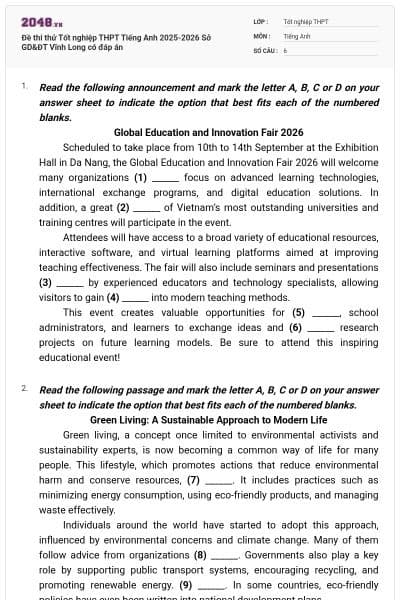
Read the following passage and mark the letter A, B, C or D on your answer sheet to indicate the option that best fits each of the numbered blanks from 6 to 10.
SNACK-SIZED WORKOUTS: SMALL EFFORTS, BIG GAINS?
For many people, finding time to exercise has become an ongoing challenge. Busy schedules, long working hours, and constant digital distractions mean that traditional hour-long gym sessions often feel unrealistic. In response, a growing number of fitness experts are promoting what they call “snack-sized workouts”- short bursts of activity spread throughout the day. This shift (6) ____________. Consequently, even those with demanding routines may find it easier to remain physically active.
Instead of following fixed workout plans, individuals are stimulated to take advantage of small opportunities to move. Climbing a few flights of stairs, stretching between tasks, or completing brief cardio exercises can all contribute to daily activity levels. (7) ____________. Over time, these small actions can accumulate into meaningful behavioural change.
Researchers have found that even short periods of physical activity can improve heart health, support metabolism, and help regulate blood sugar levels. (8) ____________. In other words, modest efforts, when repeated consistently, may still produce noticeable benefits. Equally important are the psychological effects. Many people feel discouraged by the idea of committing to long workouts, but shorter sessions tend to feel more manageable. This simplicity can lower the barrier to getting started, (9) ____________.
Of course, not everyone is convinced. Some critics argue that brief, scattered workouts may not be sufficient for achieving higher levels of fitness. Still, most experts agree that doing something is better than remaining inactive. Ultimately, the real question is (10) ____________.
(Adapted from https://health-insights.org/micro-workouts)
works on the assumption that extended exercise sessions are only worthwhile
redefines what only counts worthwhile extended exercise sessions
questions the idea that only extended exercise sessions are worthwhile
suggests that exercise only need to take the form of extended sessions to be worthwhile
Đoạn văn mở đầu bằng việc nêu ra khó khăn khi duy trì “traditional hour-long gym sessions” (các buổi tập gym kéo dài cả giờ đồng hồ truyền thống) và giới thiệu giải pháp mới là “snack-sized workouts” (các bài tập ngắn rải rác). Sự thay đổi (This shift) này nhắm thẳng vào quan niệm cũ kỹ về việc tập luyện.
Dịch nghĩa/Ngữ pháp:
A. hoạt động dựa trên giả định rằng các buổi tập thể dục kéo dài là điều duy nhất đáng giá (Sai logic: bài viết đang ủng hộ bài tập ngắn).
B. định nghĩa lại những gì chỉ được tính là các buổi tập thể dục kéo dài đáng giá (Sai ngữ pháp và diễn đạt lủng củng).
C. đặt câu hỏi/nghi ngờ ý tưởng rằng chỉ có các buổi tập thể dục kéo dài mới đáng giá (Động từ “questions” mang nghĩa chất vấn quan điểm cũ, hoàn toàn khớp với việc giới thiệu một phương pháp mới).
D. gợi ý rằng tập thể dục chỉ cần mang hình thức các buổi tập kéo dài để đáng giá (Sai logic: đi ngược lại nội dung ủng hộ bài tập ngắn).
Đáp án C thể hiện chính xác sự “phá vỡ” quan niệm truyền thống để mở đường cho phương pháp tập luyện ngắn hạn.
Chọn C.
→ In response, a growing number of fitness experts are promoting what they call “snack-sized workouts”- short bursts of activity spread throughout the day. This shift questions the idea that only extended exercise sessions are worthwhile.
Dịch nghĩa: Đáp lại, ngày càng có nhiều chuyên gia thể hình đang quảng bá cái mà họ gọi là “bài tập kích cỡ bữa ăn nhẹ” - những đợt hoạt động ngắn rải rác suốt cả ngày. Sự thay đổi này đặt câu hỏi về ý tưởng rằng chỉ có các buổi tập thể dục kéo dài mới đáng giá.
With such flexibility, otherwise inactive routines are incorporated into movement
Such flexibility allows movement to be incorporated into otherwise inactive routines
Such flexibility makes it possible to incorporate inactive routines into otherwise movement
Movement is incorporated into such flexibility despite otherwise inactive routines
Phía trước chỗ trống tác giả đưa ra các ví dụ về việc tận dụng cơ hội nhỏ để vận động: leo vài bậc cầu thang, giãn cơ, tập cardio ngắn. Đây chính là sự “linh hoạt” (flexibility) trong tập luyện. Vị trí (7) cần một câu tổng kết lợi ích của sự linh hoạt này.
Dịch nghĩa:
A. Với sự linh hoạt như vậy, những thói quen thụ động được kết hợp vào sự vận động (Diễn đạt lủng củng, sai logic: thói quen thụ động không kết hợp vào vận động).
B. Sự linh hoạt như vậy cho phép sự vận động được kết hợp vào những thói quen vốn dĩ thụ động (Đúng nghĩa: biến những lúc ngồi im thành lúc vận động).
C. Sự linh hoạt như vậy làm cho việc kết hợp những thói quen thụ động vào sự vận động trở nên khả thi (Lủng củng và ngược logic như A).
D. Sự vận động được kết hợp vào sự linh hoạt như vậy bất chấp những thói quen thụ động (Tối nghĩa).
Đáp án B mô tả chính xác mục đích của “snack-sized workouts”: xen kẽ sự vận động vào những lúc chúng ta đang rảnh rỗi hoặc thụ động (inactive routines).
Chọn B.
→ Climbing a few flights of stairs, stretching between tasks, or completing brief cardio exercises can all contribute to daily activity levels. Such flexibility allows movement to be incorporated into otherwise inactive routines.
Dịch nghĩa: Việc leo vài bậc cầu thang, giãn cơ giữa các công việc, hoặc hoàn thành các bài tập cardio ngắn đều có thể đóng góp vào mức độ hoạt động hàng ngày. Sự linh hoạt như vậy cho phép sự vận động được kết hợp vào những thói quen vốn dĩ thụ động.
In fact, minimal activity, although convenient, rarely leads to clear physical improvement
Therefore, even small amounts of activity can serve as a useful starting point for less active people
However, minimal activity is not enough unless people also take part in more intense exercise
As a result, minimal activity is considered helpful mainly because it replaces more demanding exercise
Phía trước là những lợi ích y khoa của các bài tập ngắn (“improve heart health...”, “regulate blood sugar...”). Ngay phía sau là câu chốt: “In other words, modest efforts, when repeated consistently, may still produce noticeable benefits.” (Nói cách khác, những nỗ lực khiêm tốn... vẫn có thể tạo ra lợi ích rõ rệt). Vị trí (8) cần một câu mang tính kết luận tích cực để câu “In other words” phía sau có thể tóm lược lại.
Dịch nghĩa:
A. Trên thực tế, hoạt động tối thiểu, mặc dù tiện lợi, hiếm khi dẫn đến sự cải thiện thể chất rõ ràng (Sai logic, đi ngược lại lợi ích ở câu trước).
B. Do đó, ngay cả một lượng nhỏ hoạt động cũng có thể đóng vai trò là điểm khởi đầu hữu ích cho những người ít hoạt động (Chính xác, tiếp nối lợi ích và mở đường cho kết luận “nỗ lực khiêm tốn tạo ra lợi ích”).
C. Tuy nhiên, hoạt động tối thiểu là không đủ trừ khi mọi người cũng tham gia vào các bài tập cường độ cao hơn (Sai logic, mang tính phản bác phương pháp bài viết đang đề cao).
D. Kết quả là, hoạt động tối thiểu được coi là hữu ích chủ yếu vì nó thay thế bài tập đòi hỏi khắt khe hơn (Sai logic: nó hữu ích vì tác dụng của nó, không phải chỉ vì nó “thay thế”).
Đáp án B duy trì mạch khen ngợi phương pháp tập luyện ngắn (small amounts of activity) và kết nối mượt mà với câu diễn giải phía sau.
Chọn B.
→ Researchers have found that even short periods of physical activity can improve heart health, support metabolism, and help regulate blood sugar levels. Therefore, even small amounts of activity can serve as a useful starting point for less active people.
Dịch nghĩa: Các nhà nghiên cứu đã phát hiện ra rằng ngay cả những khoảng thời gian hoạt động thể chất ngắn cũng có thể cải thiện sức khỏe tim mạch, hỗ trợ quá trình trao đổi chất và giúp điều chỉnh lượng đường trong máu. Do đó, ngay cả một lượng nhỏ hoạt động cũng có thể đóng vai trò là điểm khởi đầu hữu ích cho những người ít hoạt động.
making it more likely that individuals will develop sustainable habits
yet it is more likely that sustainable habits will be developed by individuals
thereby making it more sustainable for individuals to develop easier habits
which increases the likelihood for individuals to develop sustainable habits
Mệnh đề chính là: “This simplicity can lower the barrier to getting started” (Sự đơn giản này có thể hạ thấp rào cản để bắt đầu). Vị trí (9) đi sau dấu phẩy, đòi hỏi một cấu trúc V-ing (hiện tại phân từ) chỉ kết quả hoặc một mệnh đề quan hệ để bổ nghĩa cho toàn bộ sự việc.
Dịch nghĩa/Ngữ pháp:
A. làm cho các cá nhân có nhiều khả năng phát triển các thói quen bền vững hơn (Cấu trúc V-ing “making it...” chỉ hệ quả trực tiếp cực kỳ hợp lý).
B. nhưng có nhiều khả năng là các thói quen bền vững sẽ được phát triển... (Dùng liên từ “yet” - nhưng - sai logic vì đây là kết quả thuận chiều, không phải tương phản).
C. do đó làm cho các cá nhân phát triển các thói quen dễ dàng hơn trở nên bền vững hơn (Sai ngữ pháp và lủng củng: “sustainable” không bổ nghĩa cho “habits”).
D. điều này làm tăng khả năng... (Đại từ quan hệ “which” có thể dùng được, nhưng theo sau “likelihood” thường là “of + V-ing” hoặc “that clause”, cấu trúc “likelihood for sb to V” ít tự nhiên hơn A).
Đáp án A sử dụng phân từ hiện tại chỉ kết quả (making it + adj + that clause) vô cùng chuẩn mực.
Chọn A.
→ This simplicity can lower the barrier to getting started, making it more likely that individuals will develop sustainable habits.
Dịch nghĩa: Sự đơn giản này có thể hạ thấp rào cản để bắt đầu, làm cho các cá nhân có nhiều khả năng phát triển các thói quen bền vững hơn.
why we should integrate structured exercise without completely replacing more brief activity
how brief activity can be integrated without replacing more structured exercise entirely
whether brief activity can be included in a way that entirely replaces more structured exercise
how individuals can use brief activity to make up for the complete absence of exercise in daily life
Đoạn cuối đề cập đến một số ý kiến phản đối (“scattered workouts may not be sufficient”) nhưng chốt lại rằng “có làm còn hơn không”. Câu cuối cùng “Ultimately, the real question is...” (Rốt cuộc, câu hỏi thực sự là...) cần một mệnh đề danh từ để đưa ra giải pháp trung hòa giữa bài tập ngắn và bài tập truyền thống.
Dịch nghĩa:
A. tại sao chúng ta nên tích hợp bài tập có cấu trúc mà không thay thế hoàn toàn hoạt động ngắn gọn hơn (Sai logic: mục tiêu của bài viết là làm sao để thêm “bài tập ngắn” vào cuộc sống).
B. làm thế nào hoạt động ngắn gọn có thể được tích hợp mà không thay thế hoàn toàn các bài tập có cấu trúc hơn (Chính xác: Tìm cách kết hợp cả hai, dùng bài tập ngắn như sự bổ sung chứ không phải là thứ thay thế hoàn toàn bài tập bài bản).
C. liệu hoạt động ngắn gọn có thể được đưa vào theo cách thay thế hoàn toàn các bài tập có cấu trúc hơn không (Sai logic: bài viết vừa thừa nhận nó có thể “không đủ” - not sufficient, nên không thể thay thế hoàn toàn).
D. làm thế nào các cá nhân có thể sử dụng hoạt động ngắn gọn để bù đắp cho sự thiếu vắng hoàn toàn việc tập thể dục trong cuộc sống hàng ngày (Quá hẹp và không nhắc đến các bài tập có cấu trúc truyền thống).
Đáp án B đưa ra một hướng đi hợp lý và ôn hòa: tích hợp phương pháp mới (brief activity) mà không loại bỏ phương pháp cũ (structured exercise).
Chọn B.
→ Ultimately, the real question is how brief activity can be integrated without replacing more structured exercise entirely.
Dịch nghĩa: Rốt cuộc, câu hỏi thực sự là làm thế nào hoạt động ngắn gọn có thể được tích hợp mà không thay thế hoàn toàn các bài tập có cấu trúc hơn.
Bài đọc hoàn chỉnh | Dịch bài đọc |
SNACK-SIZED WORKOUTS: SMALL EFFORTS, BIG GAINS? For many people, finding time to exercise has become an ongoing challenge. Busy schedules, long working hours, and constant digital distractions mean that traditional hour-long gym sessions often feel unrealistic. In response, a growing number of fitness experts are promoting what they call “snack-sized workouts”- short bursts of activity spread throughout the day. This shift questions the idea that only extended exercise sessions are worthwhile. Consequently, even those with demanding routines may find it easier to remain physically active. Instead of following fixed workout plans, individuals are stimulated to take advantage of small opportunities to move. Climbing a few flights of stairs, stretching between tasks, or completing brief cardio exercises can all contribute to daily activity levels. Such flexibility allows movement to be incorporated into otherwise inactive routines. Over time, these small actions can accumulate into meaningful behavioural change. Researchers have found that even short periods of physical activity can improve heart health, support metabolism, and help regulate blood sugar levels. Therefore, even small amounts of activity can serve as a useful starting point for less active people. In other words, modest efforts, when repeated consistently, may still produce noticeable benefits. Equally important are the psychological effects. Many people feel discouraged by the idea of committing to long workouts, but shorter sessions tend to feel more manageable. This simplicity can lower the barrier to getting started, making it more likely that individuals will develop sustainable habits. Of course, not everyone is convinced. Some critics argue that brief, scattered workouts may not be sufficient for achieving higher levels of fitness. Still, most experts agree that doing something is better than remaining inactive. Ultimately, the real question is how brief activity can be integrated without replacing more structured exercise entirely. | NHỮNG BÀI TẬP CỠ BỮA ĂN NHẸ: NỖ LỰC NHỎ, LỢI ÍCH LỚN? Đối với nhiều người, việc tìm kiếm thời gian để tập thể dục đã trở thành một thách thức dai dẳng. Lịch trình bận rộn, thời gian làm việc kéo dài và sự phân tâm liên tục bởi kỹ thuật số khiến cho các buổi tập gym kéo dài cả giờ đồng hồ truyền thống thường có vẻ phi thực tế. Đáp lại, ngày càng có nhiều chuyên gia thể hình đang quảng bá cái mà họ gọi là “bài tập kích cỡ bữa ăn nhẹ” - những đợt hoạt động ngắn rải rác suốt cả ngày. Sự thay đổi này đặt câu hỏi về ý tưởng rằng chỉ có các buổi tập thể dục kéo dài mới đáng giá. Hậu quả là, ngay cả những người có thói quen sinh hoạt đòi hỏi khắt khe cũng có thể thấy việc duy trì hoạt động thể chất trở nên dễ dàng hơn. Thay vì tuân theo các kế hoạch tập luyện cố định, các cá nhân được khuyến khích tận dụng những cơ hội nhỏ để vận động. Việc leo vài bậc cầu thang, giãn cơ giữa các công việc, hoặc hoàn thành các bài tập cardio ngắn đều có thể đóng góp vào mức độ hoạt động hàng ngày. Sự linh hoạt như vậy cho phép sự vận động được kết hợp vào những thói quen vốn dĩ thụ động. Theo thời gian, những hành động nhỏ này có thể tích lũy thành sự thay đổi hành vi đầy ý nghĩa. Các nhà nghiên cứu đã phát hiện ra rằng ngay cả những khoảng thời gian hoạt động thể chất ngắn cũng có thể cải thiện sức khỏe tim mạch, hỗ trợ quá trình trao đổi chất và giúp điều chỉnh lượng đường trong máu. Do đó, ngay cả một lượng nhỏ hoạt động cũng có thể đóng vai trò là điểm khởi đầu hữu ích cho những người ít hoạt động. Nói cách khác, những nỗ lực khiêm tốn, khi được lặp đi lặp lại một cách nhất quán, vẫn có thể tạo ra những lợi ích rõ rệt. Quan trọng không kém là các tác động tâm lý. Nhiều người cảm thấy chán nản với ý tưởng phải cam kết thực hiện các buổi tập luyện dài, nhưng các phiên tập ngắn hơn có xu hướng tạo cảm giác dễ kiểm soát hơn. Sự đơn giản này có thể hạ thấp rào cản để bắt đầu, làm cho các cá nhân có nhiều khả năng phát triển các thói quen bền vững hơn. Tất nhiên, không phải ai cũng bị thuyết phục. Một số nhà phê bình cho rằng các bài tập ngắn, rải rác có thể không đủ để đạt được mức độ thể lực cao hơn. Dẫu vậy, hầu hết các chuyên gia đều đồng ý rằng làm một điều gì đó vẫn tốt hơn là cứ thụ động. Rốt cuộc, câu hỏi thực sự là làm thế nào hoạt động ngắn gọn có thể được tích hợp mà không thay thế hoàn toàn các bài tập có cấu trúc hơn. |
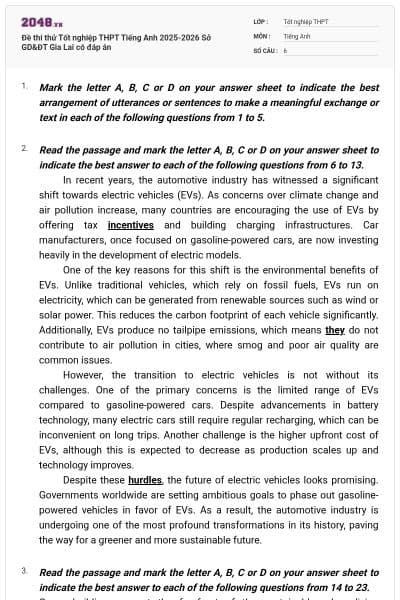
Read the following announcement and mark the letter A, B, C or D on your answer sheet to indicate the option that best fits each of the numbered blanks from 11 to 16.
THE OFFBEAT SARI EXHIBITION
We are pleased to announce the opening of “The Offbeat Sari”. This exhibition (11) ____________ a long-held assumption of the traditional and uncomfortable sari because it offers a new perspective on one of South Asia’s oldest garments. (12) ____________ proposed by Priya Khanchandani, the exhibition explores how the 5,000-year-old sari has been reinvented as a powerful symbol of cultural pride and social change.
The sari’s flexible form, (13) ____________ is traditionally an unstitched drape, has enabled it to change and reflect different cultural influences over time. Today, designers are experimenting with (14) ____________ materials such as steel and recycled fabrics, giving the garment a more modern character.
(15) ____________ 54 saris by India’s most renowned designers, the exhibition is organized into three sections: Transformations, Identity and Resistance, and New Materialities. These works reveal how the sari is not just clothing, but a way to express ideas about society. Far from passive or uncomfortable, the sari has emerged as dynamic, modern, and central to (16) ____________.
? Bunjil Place, Narre Warren
? Now showing until August 30
(Adapted from https://www.abc.net.au/news/2026-03-29/)
objects
supports
challenges
maintains
A. objects (v): phản đối (yêu cầu phải có giới từ to đi kèm: object to something).
B. supports (v): ủng hộ, hỗ trợ.
C. challenges (v): thách thức, phản bác.
D. maintains (v): duy trì.
Ta có cụm kết hợp từ (collocation): challenge an assumption (thách thức/phản bác một quan niệm/giả định). Do triển lãm mang đến “một góc nhìn mới” (offers a new perspective), nó đi ngược lại và thách thức những quan niệm cũ kỹ về trang phục sari.
Chọn C. challenges
→ This exhibition challenges a long-held assumption of the traditional and uncomfortable sari...
Dịch nghĩa: Triển lãm này thách thức một quan niệm đã có từ lâu về bộ trang phục sari truyền thống và không thoải mái...
Originality
Original
Originally
Origin
A. Originality (n): tính nguyên bản, sự độc đáo.
B. Original (adj): nguyên bản, ban đầu.
C. Originally (adv): ban đầu, khởi đầu.
D. Origin (n): nguồn gốc.
Khoảng trống đứng trước dạng phân từ/động từ “proposed” (được đề xuất). Ta cần một trạng từ để bổ nghĩa cho động từ này, chỉ thời gian/cách thức hành động diễn ra (ban đầu được đề xuất bởi...).
Chọn C. Originally
→ Originally proposed by Priya Khanchandani...
Dịch nghĩa: Ban đầu được đề xuất bởi Priya Khanchandani...
who
where
which
that
A. who: đại từ quan hệ thay thế cho người.
B. where: trạng từ quan hệ chỉ nơi chốn.
C. which: đại từ quan hệ thay thế cho vật/sự việc (có thể đứng sau dấu phẩy trong mệnh đề quan hệ không xác định).
D. that: đại từ quan hệ thay thế cho người/vật (tuyệt đối không dùng sau dấu phẩy).
Phía trước khoảng trống là danh từ chỉ vật “flexible form” (hình dáng linh hoạt). Dấu phẩy (,) phía trước chỉ ra đây là mệnh đề quan hệ không xác định, nên ta phải dùng “which” làm chủ ngữ.
Chọn C. which
→ The sari’s flexible form, which is traditionally an unstitched drape...
Dịch nghĩa: Hình dáng linh hoạt của sari, thứ mà theo truyền thống là một tấm vải rủ không cần khâu...
conventional
innovative
delicate
casual
A. conventional (adj): theo truyền thống, thông thường.
B. innovative (adj): mang tính đổi mới, sáng tạo.
C. delicate (adj): mỏng manh, tinh tế.
D. casual (adj): bình thường, không trang trọng.
Câu này đang nói về việc các nhà thiết kế thử nghiệm sử dụng các chất liệu như “thép và vải tái chế” (steel and recycled fabrics) cho quần áo. Đây là những chất liệu hoàn toàn mới lạ, khác biệt và có tính đột phá.
Chọn B. innovative
→ Today, designers are experimenting with innovative materials such as steel and recycled fabrics...
Dịch nghĩa: Ngày nay, các nhà thiết kế đang thử nghiệm với những chất liệu đổi mới/sáng tạo chẳng hạn như thép và vải tái chế...
Featured
Featuring
Being featured
Having featured
A. Featured (v-ed/v3): quá khứ phân từ (mang nghĩa bị động).
B. Featuring (v-ing): hiện tại phân từ (mang nghĩa chủ động).
C. Being featured (v-ing): phân từ mang nghĩa bị động tiếp diễn.
D. Having featured: phân từ hoàn thành.
Đây là dạng rút gọn mệnh đề trạng ngữ (hoặc mệnh đề phân từ) mang tính chủ động có cùng chủ ngữ với mệnh đề chính là “the exhibition”. Cuộc triển lãm chủ động “trưng bày/giới thiệu” (feature) 54 bộ sari.
Chọn B. Featuring
→ Featuring 54 saris by India’s most renowned designers, the exhibition is organized into three sections...
Dịch nghĩa: Trưng bày (Bao gồm) 54 bộ sari của những nhà thiết kế nổi tiếng nhất Ấn Độ, cuộc triển lãm được chia thành ba phần...
artistic conversation global
artistic global conversation
global conversation artistic
global artistic conversation
Phân tích trật tự từ: Cụm danh từ này có danh từ chính là “conversation” (cuộc đối thoại/cuộc đàm luận) bắt buộc phải đứng cuối. Phía trước có hai tính từ bổ nghĩa:
Tính từ chỉ phạm vi/quy mô: “global” (toàn cầu).
Tính từ phân loại: “artistic” (thuộc về nghệ thuật).
Theo quy tắc, tính từ chỉ phạm vi chung (global) sẽ đứng trước tính từ phân loại cụ thể (artistic). Trật tự đúng là: Tính từ phạm vi + Tính từ phân loại + Danh từ chính.
Chọn D. global artistic conversation
→ ...the sari has emerged as dynamic, modern, and central to global artistic conversation.
Dịch nghĩa: ...sari đã vươn mình trở nên năng động, hiện đại và là trung tâm của cuộc đàm luận nghệ thuật toàn cầu.
Bài đọc hoàn chỉnh | Dịch bài đọc |
THE OFFBEAT SARI EXHIBITION We are pleased to announce the opening of “The Offbeat Sari”. This exhibition (11) challenges a long-held assumption of the traditional and uncomfortable sari because it offers a new perspective on one of South Asia’s oldest garments. (12) Originally proposed by Priya Khanchandani, the exhibition explores how the 5,000-year-old sari has been reinvented as a powerful symbol of cultural pride and social change. The sari’s flexible form, (13) which is traditionally an unstitched drape, has enabled it to change and reflect different cultural influences over time. Today, designers are experimenting with (14) innovative materials such as steel and recycled fabrics, giving the garment a more modern character. (15) Featuring 54 saris by India’s most renowned designers, the exhibition is organized into three sections: Transformations, Identity and Resistance, and New Materialities. These works reveal how the sari is not just clothing, but a way to express ideas about society. Far from passive or uncomfortable, the sari has emerged as dynamic, modern, and central to (16) global artistic conversation. ? Bunjil Place, Narre Warren ? Now showing until August 30 | TRIỂN LÃM SARI PHÁ CÁCH Chúng tôi vui mừng thông báo về việc khai mạc “Triển lãm Sari Phá cách” (The Offbeat Sari). Triển lãm này (11) thách thức một quan niệm đã có từ lâu về bộ trang phục sari truyền thống và thiếu thoải mái bởi vì nó mang đến một góc nhìn mới về một trong những loại trang phục lâu đời nhất của Nam Á. (12) Ban đầu được đề xuất bởi Priya Khanchandani, cuộc triển lãm khám phá cách bộ trang phục sari 5.000 năm tuổi này đã được tái hiện như một biểu tượng mạnh mẽ của niềm tự hào văn hóa và sự thay đổi xã hội. Hình dáng linh hoạt của sari, (13) thứ mà theo truyền thống là một tấm vải rủ không cần khâu, đã giúp nó có khả năng thay đổi và phản ánh những ảnh hưởng văn hóa khác nhau qua thời gian. Ngày nay, các nhà thiết kế đang thử nghiệm với những chất liệu (14) mang tính đổi mới chẳng hạn như thép và vải tái chế, mang lại cho loại trang phục này một nét đặc trưng hiện đại hơn. (15) Trưng bày 54 bộ sari của những nhà thiết kế nổi tiếng nhất Ấn Độ, cuộc triển lãm được chia thành ba phần: Sự Biến đổi, Bản sắc và Sự Kháng cự, và Những Chất liệu mới. Những tác phẩm này tiết lộ cách sari không chỉ đơn thuần là quần áo, mà còn là một cách để bày tỏ những tư tưởng về xã hội. Không hề thụ động hay khó chịu, sari đã vươn mình trở nên năng động, hiện đại và là trung tâm của (16) cuộc đàm luận nghệ thuật toàn cầu. ? Bunjil Place, Narre Warren ? Đang diễn ra cho đến ngày 30 tháng 8 |
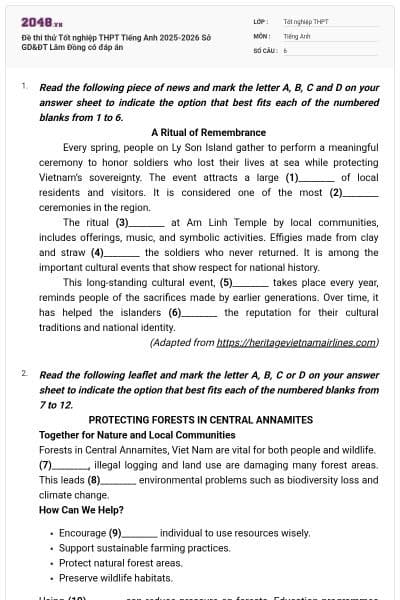
Read the following leaflet and mark the letter A, B, C or D on your answer sheet to indicate the option that best fits each of the numbered blanks from 17 to 22.
CAT BA NATIONAL PARK – THE GREEN LUNG OF HAI PHONG
Discover Nature - Experience Adventure!
Nestled on Cat Ba Island, Cat Ba National Park is a UNESCO-recognized biosphere reserve and one of Vietnam’s largest special-use forests. Covering over 17,000 hectares, it offers (17) ____________ unique ecosystems - from lush forests and mangroves to vibrant marine habitats - making it a true haven for nature lovers. The park is (18) ____________ to hundreds of plant and animal species, including the rare Cat Ba langur. Visitors can immerse themselves (19) ____________ a rich natural environment, where towering ancient trees, hidden caves, and crystal-clear waters bring nature to life. Whether you choose to venture into primary forests, paddle through mangroves, or dive into coral-rich waters, each experience offers a chance to (20) ____________ the beauty of nature.
(21) ____________ its beauty, the park is also a living laboratory of biodiversity and a place where conservation takes centre stage. Visitors (22) ____________ to travel responsibly and help preserve this unique ecosystem.
? Plan your trip today and be part of nature!
(Adapted from https://visitvietnam.org.vn/en/experiences)
a great deal of
a wide variety of
a huge number of
a large amount of
A. a great deal of: rất nhiều (+ danh từ không đếm được).
B. a wide variety of: sự đa dạng, vô số các loại... khác nhau (+ danh từ đếm được số nhiều).
C. a huge number of: một số lượng lớn (+ danh từ đếm được số nhiều).
D. a large amount of: một lượng lớn (+ danh từ không đếm được).
Phía sau khoảng trống là danh từ đếm được số nhiều “ecosystems” (các hệ sinh thái) đang được liệt kê bằng các kiểu môi trường khác nhau (từ rừng rậm, rừng ngập mặn đến môi trường biển). Cụm “a wide variety of” là sự kết hợp từ (collocation) hoàn hảo nhất để nhấn mạnh sự phong phú và đa dạng về chủng loại của các hệ sinh thái này, thay vì chỉ nói về “số lượng” (number).
Chọn B. a wide variety of
→ ...it offers a wide variety of unique ecosystems...
Dịch nghĩa: ...nơi đây mang đến một sự đa dạng các hệ sinh thái độc đáo...
home
location
house
habitat
A. home (n): ngôi nhà, quê hương, nơi cư trú.
B. location (n): địa điểm, vị trí.
C. house (n): ngôi nhà (công trình xây dựng).
D. habitat (n): môi trường sống, không gian sống (thường dùng làm chủ ngữ hoặc tân ngữ trực tiếp, không đi với giới từ to theo cách này).
Ta có cấu trúc cố định (collocation) rất quen thuộc trong sinh học và địa lý: be home to somebody/something (là ngôi nhà/nơi cư trú/sinh sống của ai/loài nào).
Chọn A. home
→ The park is home to hundreds of plant and animal species...
Dịch nghĩa: Công viên là nơi cư trú của hàng trăm loài động thực vật...
in
with
on
off
A. in (prep): trong.
B. with (prep): với.
C. on (prep): trên.
D. off (prep): khỏi, tắt.
Ta có cấu trúc động từ đi kèm giới từ cố định: immerse oneself in something (đắm mình vào, hòa mình vào điều gì đó).
Chọn A. in
→ Visitors can immerse themselves in a rich natural environment...
Dịch nghĩa: Du khách có thể đắm mình vào một môi trường tự nhiên phong phú...
put down
catch up
take in
look into
A. put down (phr.v): đặt xuống, ghi chép lại.
B. catch up (phr.v): theo kịp, bắt kịp.
C. take in (phr.v): hấp thụ, hiểu, ngắm nhìn/thưởng thức (phong cảnh).
D. look into (phr.v): điều tra, xem xét kỹ lưỡng.
Cụm từ “take in the beauty of nature” mang ý nghĩa là ngắm nhìn, thưởng thức và thẩm thấu trọn vẹn vẻ đẹp của thiên nhiên bằng các giác quan.
Chọn C. take in
→ ...each experience offers a chance to take in the beauty of nature.
Dịch nghĩa: ...mỗi trải nghiệm đều mang đến cơ hội để thưởng thức vẻ đẹp của thiên nhiên.
Instead of
In addition to
Due to
In spite of
A. Instead of (prep): Thay vì.
B. In addition to (prep): Bên cạnh, ngoài... ra.
C. Due to (prep): Bởi vì, do.
D. In spite of (prep): Mặc dù.
Ở đoạn trước, bài viết đã tập trung miêu tả vẻ đẹp (beauty) của công viên. Sang đoạn này, bài viết bổ sung thêm một vai trò khác của nơi đây (từ nối “also” - cũng là một phòng thí nghiệm sống). Sự kết nối mang tính liệt kê/bổ sung này hoàn toàn phù hợp với “In addition to”.
Chọn B. In addition to
→ In addition to its beauty, the park is also a living laboratory of biodiversity...
Dịch nghĩa: Bên cạnh vẻ đẹp của mình, công viên cũng là một phòng thí nghiệm sống về đa dạng sinh học...
are encouraged
encourage
have encouraged
encouraged
A. are encouraged: bị động thì hiện tại đơn.
B. encourage: chủ động thì hiện tại đơn.
C. have encouraged: chủ động thì hiện tại hoàn thành.
D. encouraged: quá khứ đơn / quá khứ phân từ.
Chủ ngữ trong câu là “Visitors” (khách du lịch). Du khách không tự mình đi “khuyến khích” ai khác trong ngữ cảnh này, mà họ “được khuyến khích” (bởi ban quản lý) để đi du lịch có trách nhiệm. Do đó, động từ phải được chia ở thể bị động.
Chọn A. are encouraged
→ Visitors are encouraged to travel responsibly and help preserve this unique ecosystem.
Dịch nghĩa: Du khách được khuyến khích đi du lịch có trách nhiệm và giúp bảo tồn hệ sinh thái độc đáo này.
Bài đọc hoàn chỉnh | Dịch bài đọc |
CAT BA NATIONAL PARK – THE GREEN LUNG OF HAI PHONG Discover Nature - Experience Adventure! Nestled on Cat Ba Island, Cat Ba National Park is a UNESCO-recognized biosphere reserve and one of Vietnam’s largest special-use forests. Covering over 17,000 hectares, it offers (17) a wide variety of unique ecosystems - from lush forests and mangroves to vibrant marine habitats - making it a true haven for nature lovers. The park is (18) home to hundreds of plant and animal species, including the rare Cat Ba langur. Visitors can immerse themselves (19) in a rich natural environment, where towering ancient trees, hidden caves, and crystal-clear waters bring nature to life. Whether you choose to venture into primary forests, paddle through mangroves, or dive into coral-rich waters, each experience offers a chance to (20) take in the beauty of nature. (21) In addition to its beauty, the park is also a living laboratory of biodiversity and a place where conservation takes centre stage. Visitors (22) are encouraged to travel responsibly and help preserve this unique ecosystem. ? Plan your trip today and be part of nature! | VƯỜN QUỐC GIA CÁT BÀ – LÁ PHỔI XANH CỦA HẢI PHÒNG Khám Phá Thiên Nhiên - Trải Nghiệm Phiêu Lưu! Nép mình trên Đảo Cát Bà, Vườn Quốc gia Cát Bà là một khu dự trữ sinh quyển được UNESCO công nhận và là một trong những khu rừng đặc dụng lớn nhất Việt Nam. Bao phủ hơn 17.000 héc-ta, nơi đây mang đến (17) một sự đa dạng các hệ sinh thái độc đáo - từ những khu rừng rậm rạp, rừng ngập mặn cho đến môi trường sống trên biển đầy sức sống - biến nơi này thành một thiên đường đích thực cho những người yêu thiên nhiên. Công viên là (18) nơi cư trú của hàng trăm loài động thực vật, bao gồm cả loài voọc Cát Bà quý hiếm. Du khách có thể đắm mình (19) vào một môi trường tự nhiên phong phú, nơi những cây cổ thụ cao chót vót, những hang động ẩn giấu và làn nước trong vắt như pha lê mang thiên nhiên vào cuộc sống. Cho dù bạn chọn dấn thân vào những khu rừng nguyên sinh, chèo thuyền qua rừng ngập mặn hay lặn xuống làn nước giàu san hô, mỗi trải nghiệm đều mang đến cơ hội để (20) thưởng thức vẻ đẹp của thiên nhiên. (21) Bên cạnh vẻ đẹp của mình, công viên cũng là một phòng thí nghiệm sống về đa dạng sinh học và là nơi công tác bảo tồn chiếm vị trí trung tâm. Du khách (22) được khuyến khích đi du lịch có trách nhiệm và giúp bảo tồn hệ sinh thái độc đáo này. ? Hãy lên kế hoạch cho chuyến đi của bạn ngay hôm nay và trở thành một phần của thiên nhiên! |
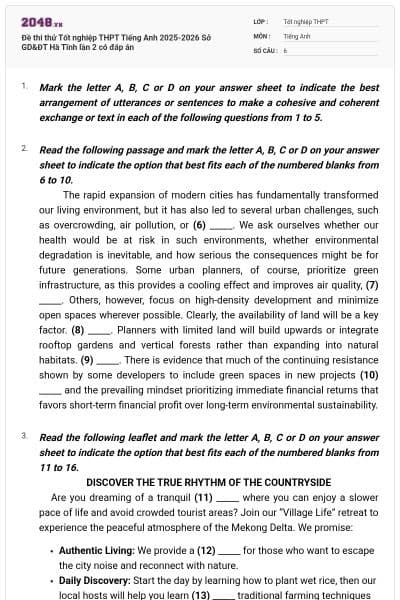
Read the following passage about a new payment technology and mark the letter A, B, C or D on your answer sheet to indicate the best answer to each of the following questions from 23 to 30.
THE RISE OF PALM PAYMENT TECHNOLOGY
Amazon One is an advanced payment method using palm recognition to identify customers. This biometric system scans both surface lines and vein patterns beneath the skin, creating a unique identification for each person. Users can register through their smartphones, connecting palm data to their accounts. Once enrolled, they can make purchases by simply holding their hands above scanners, eliminating the need for wallets or phones. The technology promises to transform how people shop in busy environments.
Currently operating in over four hundred stores nationwide, including Whole Foods Markets, this solution extends beyond Amazon's own establishments. Various venues like sports arenas, airports, and dining establishments have begun implementing these scanners. The corporation emphasizes speed and efficiency as primary benefits, particularly in crowded locations where traditional checkout methods create bottlenecks. Additionally, potential applications include building entry systems, membership verification, and medical facilities, suggesting broader uses beyond retail transactions.
Nevertheless, serious concerns surround this advancement. Security experts highlight fundamental risks with biometric information storage since compromised biological data remains permanent, unlike changeable passwords. Cloud-based storage amplifies vulnerability to cyberattacks, while questions about corporate surveillance persist. Many consumers lack a complete understanding of future data usage, creating transparency issues that regulatory frameworks have not adequately addressed yet.
This palm-scanning innovation reflects movement toward touchless interactions and automated services. Success depends on balancing customer convenience against privacy protection requirements. While adoption continues growing, debates about ethical implications intensify. The outcome will likely influence how businesses handle personal identification going forward, potentially establishing precedents for biometric authentication standards across industries worldwide.
(Adapted from https://retail-innovation.com/al)
Each palm scan takes a specific amount of time to process.
The system has been used in sports arenas and airports.
The technology scans both surface lines and vein patterns.
Users can register using their smartphones.
Thông tin nào sau đây KHÔNG ĐƯỢC NHẮC ĐẾN trong bài đọc?
A. Each palm scan takes a specific amount of time to process: Mỗi lần quét lòng bàn tay mất một khoảng thời gian cụ thể để xử lý. (Không được nhắc đến)
B. The system has been used in sports arenas and airports: Hệ thống đã được sử dụng ở các nhà thi đấu thể thao và sân bay. (Có nhắc đến ở đoạn 2: “Various venues like sports arenas, airports...”)
C. The technology scans both surface lines and vein patterns: Công nghệ quét cả các đường nét trên bề mặt và mạng lưới tĩnh mạch. (Có nhắc đến ở đoạn 1: “scans both surface lines and vein patterns”)
D. Users can register using their smartphones: Người dùng có thể đăng ký bằng điện thoại thông minh của họ. (Có nhắc đến ở đoạn 1: “Users can register through their smartphones”)
Chọn A.
The word “their” in paragraph 1 refers to ____________.
enrolled users
users’ accounts
vein patterns
surface lines
Từ “their” ở đoạn 1 chỉ ____________.
A. enrolled users: những người dùng đã đăng ký
B. users’ accounts: tài khoản của người dùng
C. vein patterns: mạng lưới tĩnh mạch
D. surface lines: các đường nét trên bề mặt
Thông tin:Users can register through their smartphones, connecting palm data to their accounts. Once enrolled, they can make purchases by simply holding their hands above scanners...
(Người dùng có thể đăng ký thông qua điện thoại thông minh, liên kết dữ liệu lòng bàn tay với tài khoản của họ. Sau khi đăng ký, họ có thể mua hàng chỉ bằng cách giữ bàn tay của họ phía trên máy quét...)
→ their = enrolled users'.
Chọn A.
The word “bottlenecks” in paragraph 2 is OPPOSITE in meaning to ____________.
unsteady streams
lengthy delays
smooth flows
operational barriers
Từ “bottlenecks” ở đoạn 2 TRÁI NGHĨA với ____________.
bottlenecks (n): điểm nghẽn, sự ùn tắc, sự đình trệ.
A. unsteady streams (n): những dòng chảy không ổn định
B. lengthy delays (n): những sự chậm trễ kéo dài (đồng nghĩa)
C. smooth flows (n): những dòng chảy trơn tru, sự lưu thông thuận lợi (trái nghĩa)
D. operational barriers (n): những rào cản hoạt động
→ bottlenecks >< smooth flows
Thông tin: ...particularly in crowded locations where traditional checkout methods create bottlenecks.
(...đặc biệt là ở những địa điểm đông đúc nơi các phương thức thanh toán truyền thống tạo ra sự ùn tắc/điểm nghẽn.)
Chọn C.
The word “compromised” in paragraph 3 could be best replaced by ____________.
enhanced
restricted
sustained
exposed
Từ “compromised” ở đoạn 3 có thể được thay thế tốt nhất bởi ____________.
compromised (adj): bị xâm phạm, bị lộ, bị rò rỉ.
A. enhanced (adj): được tăng cường
B. restricted (adj): bị hạn chế
C. sustained (adj): được duy trì
D. exposed (adj): bị phơi bày, bị lộ, bị xâm phạm (đồng nghĩa)
→ compromised = exposed
Thông tin: Security experts highlight fundamental risks with biometric information storage since compromised biological data remains permanent...
(Các chuyên gia bảo mật nhấn mạnh những rủi ro cơ bản với việc lưu trữ thông tin sinh trắc học vì dữ liệu sinh học bị lộ/bị xâm phạm sẽ tồn tại vĩnh viễn...)
Chọn D.
Which of the following best paraphrases the underlined sentence in paragraph 4?
The success of this technology will largely depend on delivering customer convenience while reducing privacy concerns as much as possible.
The future success of this technology will rest on meeting customers’ expectations for convenience without imposing excessive privacy safeguards.
For this technology to succeed, customer convenience must remain the priority, with privacy protection treated as a secondary consideration.
Whether this technology succeeds will depend on how well it manages the trade-off between user convenience and privacy protection.
Câu nào sau đây diễn giải tốt nhất câu được gạch chân ở đoạn 4?
Success depends on balancing customer convenience against privacy protection requirements.
(Sự thành công phụ thuộc vào việc cân bằng giữa sự tiện lợi của khách hàng và các yêu cầu bảo vệ quyền riêng tư.)
Dịch nghĩa:
A. Sự thành công của công nghệ này sẽ phụ thuộc lớn vào việc mang lại sự tiện lợi cho khách hàng trong khi giảm thiểu các mối quan ngại về quyền riêng tư càng nhiều càng tốt. (Chưa thể hiện rõ ý “đánh đổi/cân bằng”).
B. Thành công trong tương lai của công nghệ này sẽ dựa trên việc đáp ứng những kỳ vọng của khách hàng về sự tiện lợi mà không áp đặt các biện pháp bảo vệ quyền riêng tư quá mức. (Sai nghĩa).
C. Để công nghệ này thành công, sự tiện lợi của khách hàng phải là ưu tiên hàng đầu, với việc bảo vệ quyền riêng tư được coi là vấn đề thứ yếu. (Sai nghĩa).
D. Liệu công nghệ này có thành công hay không sẽ phụ thuộc vào việc nó quản lý sự đánh đổi giữa sự tiện lợi của người dùng và việc bảo vệ quyền riêng tư tốt đến mức nào. (Đúng và sát nghĩa nhất: balancing = manages the trade-off).
Chọn D.
Which of the following is TRUE according to the passage?
Users are generally provided with sufficient information about how their biometric data will be stored and used.
Palm payment technology is rapidly becoming a dominant payment method across most retail sectors.
Palm payment systems significantly reduce concerns related to unauthorized access to personal data.
The potential uses of palm-based biometric identification may extend to various non-commercial domains.
Theo bài đọc, câu nào sau đây là ĐÚNG?
A. Người dùng thường được cung cấp đầy đủ thông tin về cách dữ liệu sinh trắc học của họ sẽ được lưu trữ và sử dụng. (Sai, đoạn 3 nói “Nhiều người tiêu dùng thiếu hiểu biết đầy đủ...” - Many consumers lack a complete understanding).
B. Công nghệ thanh toán bằng lòng bàn tay đang nhanh chóng trở thành phương thức thanh toán thống trị ở hầu hết các lĩnh vực bán lẻ. (Sai, bài chỉ nói sự chấp nhận đang tăng lên chứ chưa phải là “thống trị” - dominant).
C. Các hệ thống thanh toán bằng lòng bàn tay làm giảm đáng kể những lo ngại liên quan đến việc truy cập trái phép vào dữ liệu cá nhân. (Sai, đoạn 3 nói nó “khuếch đại lỗ hổng” - amplifies vulnerability).
D. Các mục đích sử dụng tiềm năng của nhận dạng sinh trắc học dựa trên lòng bàn tay có thể mở rộng sang nhiều lĩnh vực phi thương mại khác nhau. (Đúng).
Thông tin (Đoạn 2): Additionally, potential applications include building entry systems, membership verification, and medical facilities, suggesting broader uses beyond retail transactions.
(Ngoài ra, các ứng dụng tiềm năng bao gồm hệ thống ra vào tòa nhà, xác minh tư cách thành viên và các cơ sở y tế, cho thấy những mục đích sử dụng rộng rãi hơn bên ngoài các giao dịch bán lẻ.)
Chọn D.
In which paragraph does the writer mention the broader impact this technology may have on future business practices?
Paragraph 4
Paragraph 3
Paragraph 2
Paragraph 1
Tác giả đề cập đến tác động rộng lớn hơn mà công nghệ này có thể gây ra đối với các hoạt động kinh doanh trong tương lai ở đoạn nào?
A. Đoạn 4
B. Đoạn 3
C. Đoạn 2
D. Đoạn 1
Thông tin (Đoạn 4): The outcome will likely influence how businesses handle personal identification going forward, potentially establishing precedents for biometric authentication standards across industries worldwide.
(Kết quả này có khả năng sẽ ảnh hưởng đến cách các doanh nghiệp xử lý việc nhận dạng cá nhân trong tương lai, có tiềm năng thiết lập các tiền lệ cho các tiêu chuẩn xác thực sinh trắc học trên toàn thế giới.)
Chọn A.
In which paragraph does the writer mention the vulnerability of biometric data to cyberattacks?
Paragraph 1
Paragraph 3
Paragraph 4
Paragraph 2
Tác giả đề cập đến lỗ hổng của dữ liệu sinh trắc học trước các cuộc tấn công mạng ở đoạn nào?
A. Đoạn 1
B. Đoạn 3
C. Đoạn 4
D. Đoạn 2
Thông tin (Đoạn 3): Cloud-based storage amplifies vulnerability to cyberattacks...
(Lưu trữ trên nền tảng đám mây khuếch đại lỗ hổng bảo mật trước các cuộc tấn công mạng...)
Chọn B.
Dịch bài đọc:
SỰ TRỖI DẬY CỦA CÔNG NGHỆ THANH TOÁN BẰNG LÒNG BÀN TAY
Amazon One là một phương thức thanh toán tiên tiến sử dụng nhận dạng lòng bàn tay để xác định khách hàng. Hệ thống sinh trắc học này quét cả các đường nét trên bề mặt và mạng lưới tĩnh mạch dưới da, tạo ra một nhận dạng duy nhất cho mỗi người. Người dùng có thể đăng ký thông qua điện thoại thông minh của họ, kết nối dữ liệu lòng bàn tay với tài khoản của mình. Sau khi đăng ký, họ có thể mua hàng chỉ bằng cách giữ bàn tay của mình phía trên máy quét, loại bỏ nhu cầu mang theo ví hoặc điện thoại. Công nghệ này hứa hẹn sẽ thay đổi cách mọi người mua sắm trong những môi trường bận rộn.
Hiện đang hoạt động tại hơn bốn trăm cửa hàng trên toàn quốc, bao gồm cả chuỗi siêu thị Whole Foods Markets, giải pháp này mở rộng vượt ra ngoài các cơ sở của chính Amazon. Nhiều địa điểm khác nhau như các nhà thi đấu thể thao, sân bay và cơ sở ăn uống đã bắt đầu triển khai các máy quét này. Tập đoàn nhấn mạnh tốc độ và tính hiệu quả là những lợi ích cốt lõi, đặc biệt là ở những địa điểm đông đúc nơi các phương thức thanh toán truyền thống tạo ra sự ùn tắc. Ngoài ra, các ứng dụng tiềm năng bao gồm hệ thống ra vào tòa nhà, xác minh tư cách thành viên và các cơ sở y tế, cho thấy những mục đích sử dụng rộng rãi hơn bên ngoài các giao dịch bán lẻ.
Tuy nhiên, có những mối quan ngại nghiêm trọng xoay quanh tiến bộ này. Các chuyên gia bảo mật nhấn mạnh những rủi ro cơ bản với việc lưu trữ thông tin sinh trắc học vì dữ liệu sinh học bị lộ sẽ tồn tại vĩnh viễn, không giống như mật khẩu có thể thay đổi được. Việc lưu trữ trên nền tảng đám mây khuếch đại lỗ hổng bảo mật trước các cuộc tấn công mạng, trong khi những câu hỏi về sự giám sát của các tập đoàn vẫn còn dai dẳng. Nhiều người tiêu dùng thiếu hiểu biết đầy đủ về việc sử dụng dữ liệu trong tương lai, tạo ra những vấn đề về tính minh bạch mà các khuôn khổ pháp lý vẫn chưa giải quyết thỏa đáng.
Sự đổi mới về quét lòng bàn tay này phản ánh xu hướng hướng tới các tương tác không chạm và các dịch vụ tự động. Sự thành công phụ thuộc vào việc cân bằng giữa sự tiện lợi của khách hàng và các yêu cầu bảo vệ quyền riêng tư. Trong khi sự chấp nhận tiếp tục gia tăng, các cuộc tranh luận về những hệ lụy đạo đức cũng ngày càng gay gắt. Kết quả này có khả năng sẽ ảnh hưởng đến cách các doanh nghiệp xử lý việc nhận dạng cá nhân trong tương lai, có tiềm năng thiết lập các tiền lệ cho các tiêu chuẩn xác thực sinh trắc học ở các ngành công nghiệp trên toàn thế giới.
Read the following passage about the current energy crisis and mark the letter A, B, C or D on your answer sheet to indicate the best answer to each of the following questions from 31 to 40.
ENERGY SHOCK FALLOUT: WHICH ECONOMIES ARE MOST AT RISK?
In many developing countries, the latest Gulf war has set off a scramble for energy. In Nepal, long queues for cooking gas have forced the government to limit supplies. In Sri Lanka, firms have been urged to shut on Wednesdays to conserve fuel. In Pakistan, schools have been closed and universities moved online. Households and governments are preparing for what the head of the IMF, Kristalina Georgieva, has called “the unthinkable”.
When global energy supply is squeezed, poorer countries suffer most. As Europe subsidised energy to shield households, demand held up and prices stayed higher for longer. This, in turn, has shifted the burden onto importers with fewer reserves and less budget flexibility. The result is a crisis. With the Strait of Hormuz all but closed, the latest hit could be worse. (I)
Pakistan and Egypt are among the most affected countries. (II) Pakistan spends some 4% of GDP on oil and gas imports, sourcing nearly 90% from the Middle East. Egypt spends about 3% of GDP and gets nearly half its supplies from the region. Both countries also rely heavily on remittances from the Gulf, which are worth around 5–6% of GDP. These inflows could fall if the war disrupts labour markets or forces migrant workers to return home. (III) A higher fuel bill can eventually tip into a financial crisis.
Bangladesh and Sri Lanka also look vulnerable despite having less direct exposure. Bangladesh’s reserves barely cover three months of imports, and it is already on an IMF programme. Sri Lanka only recently emerged from its debt crisis in 2022, and its financial reserves remain limited. India, by contrast, is better placed to weather the storm. Its reserves cover about seven months’ imports, and it is more flexible in diversifying its energy imports. (IV)
Even if countries avoid a macroeconomic crisis, the human toll could still be severe. Nitrogen fertiliser, made from natural gas, is becoming more expensive, raising the cost of food production across poor countries. The World Food Programme warned this week that the number of people facing hunger could reach record levels in 2026 if the conflict does not end soon. Stabilising currencies and paying for imports may help countries avoid a financial crisis. Keeping food affordable is another matter.
(Adapted from https://www.economist.com)
Which of the following is TRUE according to paragraph 1?
Pakistan has managed to keep its education system running without disruption.
Sri Lanka has increased fuel production to meet domestic demand.
Governments in developing countries are taking measures to deal with energy shortages.
The energy crisis has only affected households, not businesses or education systems.
Điều nào sau đây là ĐÚNG theo đoạn 1?
A. Pakistan đã nỗ lực duy trì hệ thống giáo dục hoạt động mà không bị gián đoạn. (Sai, bài đọc nói trường học bị đóng cửa và đại học phải học trực tuyến).
B. Sri Lanka đã tăng cường sản xuất nhiên liệu để đáp ứng nhu cầu trong nước. (Sai, các công ty bị yêu cầu đóng cửa vào thứ Tư để tiết kiệm nhiên liệu).
C. Chính phủ ở các nước đang phát triển đang thực hiện các biện pháp để đối phó với tình trạng thiếu hụt năng lượng. (Đúng).
D. Cuộc khủng hoảng năng lượng chỉ ảnh hưởng đến các hộ gia đình, không ảnh hưởng đến doanh nghiệp hay hệ thống giáo dục. (Sai, có ảnh hưởng đến doanh nghiệp ở Sri Lanka và trường học ở Pakistan).
Đoạn 1 liệt kê hàng loạt các biện pháp mà chính phủ các nước đang phát triển phải áp dụng để đối phó với cuộc khủng hoảng năng lượng (Nepal giới hạn nguồn cung, Sri Lanka đóng cửa công ty 1 ngày/tuần, Pakistan đóng cửa trường học).
Thông tin: “In Nepal, long queues for cooking gas have forced the government to limit supplies. In Sri Lanka, firms have been urged to shut on Wednesdays to conserve fuel. In Pakistan, schools have been closed...”
Chọn C.
The word “shield” in paragraph 2 is closest in meaning to ____________.
separate
defend
disclose
eliminate
Từ “shield” ở đoạn 2 có nghĩa gần nhất với ____________.
shield (v): bảo vệ, che chở
A. separate (v): tách biệt
B. defend (v): bảo vệ
C. disclose (v): tiết lộ
D. eliminate (v): loại bỏ
→ shield = defend
Thông tin: “As Europe subsidised energy to shield households...” (Khi châu Âu trợ cấp năng lượng để bảo vệ các hộ gia đình...)
Chọn B.
Which of the following best summarises paragraph 2?
Rising energy prices are placing a heavier burden on poorer energy importers.
Europe is now facing the greatest pressure from high energy costs.
Energy subsidies in Europe have kept fuel demand higher for longer.
The energy shock is affecting most economies in largely similar ways.
Câu nào sau đây tóm tắt đúng nhất đoạn 2?
A. Giá năng lượng tăng đang đặt gánh nặng lớn hơn lên các quốc gia nhập khẩu năng lượng nghèo hơn. (Đúng, bao quát ý chính của đoạn).
B. Châu Âu hiện đang đối mặt với áp lực lớn nhất từ chi phí năng lượng cao. (Sai, châu Âu trợ cấp được, nước nghèo mới chịu áp lực lớn nhất).
C. Trợ cấp năng lượng ở châu Âu đã giữ cho nhu cầu nhiên liệu duy trì ở mức cao trong thời gian dài hơn. (Đây chỉ là một chi tiết nguyên nhân, không phải ý chính của cả đoạn).
D. Cú sốc năng lượng đang ảnh hưởng đến hầu hết các nền kinh tế theo những cách phần lớn giống nhau. (Sai, nó ảnh hưởng đến các nước nghèo nặng nề hơn).
Đoạn 2 giải thích cơ chế: Khi nguồn cung bị thắt chặt, châu Âu dùng tiền để giữ nhu cầu, điều này làm giá tăng cao và đẩy toàn bộ gánh nặng sang các nước nhập khẩu nghèo hơn (những nước không có ngân sách để trợ cấp).
Chọn A.
According to paragraph 3, why are Pakistan and Egypt highly susceptible?
They benefit from remittance inflows and diversified energy sources that reduce their exposure to external shocks.
They depend greatly on energy imports and overseas income, both of which may be disrupted by regional instability.
They maintain strong financial reserves but remain vulnerable due to declining energy output.
They have limited access to global markets and depend mainly on domestic energy production.
Theo đoạn 3, tại sao Pakistan và Ai Cập lại rất dễ bị tổn thương (highly susceptible)?
A. Họ được hưởng lợi từ dòng kiều hối và các nguồn năng lượng đa dạng, giúp giảm thiểu rủi ro trước những biến động bên ngoài. (Sai, nguồn năng lượng của họ không đa dạng, chủ yếu từ Trung Đông).
B. Họ phụ thuộc lớn vào nhập khẩu năng lượng và thu nhập từ nước ngoài, cả hai điều này đều có thể bị gián đoạn do bất ổn trong khu vực. (Đúng).
C. Họ duy trì dự trữ tài chính mạnh mẽ nhưng vẫn dễ bị tổn thương do sản lượng năng lượng giảm. (Sai).
D. Họ có quyền tiếp cận hạn chế vào thị trường toàn cầu và chủ yếu phụ thuộc vào sản xuất năng lượng trong nước. (Sai, họ phụ thuộc vào nhập khẩu).
Đoạn 3 chỉ ra 2 lý do khiến hai nước này gặp nguy hiểm: 1) Họ nhập khẩu phần lớn dầu khí từ Trung Đông; 2) Họ phụ thuộc nặng nề vào kiều hối (remittances) từ vùng Vịnh, nguồn tiền này có thể giảm nếu chiến tranh làm gián đoạn thị trường lao động.
Chọn B.
The word “which” in paragraph 3 refers to ____________.
remittances
imports
countries
supplies
Từ “which” ở đoạn 3 chỉ ____________.
A. remittances (kiều hối / tiền gửi về nước)
B. imports (hàng nhập khẩu)
C. countries (các quốc gia)
D. supplies (nguồn cung)
Thông tin: “Both countries also rely heavily on remittances from the Gulf, which are worth around 5–6% of GDP.” (Cả hai quốc gia này cũng phụ thuộc rất nhiều vào kiều hối từ vùng Vịnh, chiếm khoảng 5-6% GDP.)
→ Đại từ quan hệ “which” thay thế cho danh từ đứng ngay trước nó là “remittances” (kiều hối). “Kiều hối từ vùng Vịnh, thứ mà trị giá khoảng 5-6% GDP.”
Chọn A.
Which of the following best paraphrases the underlined sentence in paragraph 3?
Increasing fuel costs generally result in an immediate economic breakdown.
Sustained increases in fuel costs can ultimately lead to a financial crisis.
Financial crises often arise regardless of fluctuations in fuel prices.
Extra fuel expenses are unlikely to pose a serious long-term economic threat.
Câu nào sau đây diễn giải đúng nhất câu được gạch chân ở đoạn 3?
A higher fuel bill can eventually tip into a financial crisis. (Một hóa đơn nhiên liệu cao hơn rốt cuộc có thể dẫn đến một cuộc khủng hoảng tài chính.)
A. Chi phí nhiên liệu tăng thường dẫn đến sự sụp đổ kinh tế ngay lập tức (immediate). (Sai, câu gốc dùng từ “eventually” - rốt cuộc/về lâu dài, không phải ngay lập tức).
B. Sự gia tăng chi phí nhiên liệu kéo dài cuối cùng có thể dẫn đến một cuộc khủng hoảng tài chính. (Đúng, “ultimately lead to” = “eventually tip into”).
C. Khủng hoảng tài chính thường nảy sinh bất chấp sự biến động của giá nhiên liệu. (Sai nghĩa).
D. Chi phí nhiên liệu phát sinh thêm khó có khả năng gây ra mối đe dọa kinh tế dài hạn nghiêm trọng. (Sai hoàn toàn nghĩa).
Chọn B.
Which of the following economic conditions is NOT STATED in the passage?
Greater resilience to energy supply disruptions in affected economies
Limited budget flexibility in some vulnerable energy-importing countries
Steady energy demand in European economies
Escalating food production costs in poor countries
Điều kiện kinh tế nào sau đây KHÔNG ĐƯỢC NÊU trong bài đọc?
A. Khả năng phục hồi lớn hơn trước những gián đoạn nguồn cung năng lượng ở các nền kinh tế bị ảnh hưởng. (Các nền kinh tế bị ảnh hưởng như Pakistan, Sri Lanka đều “dễ bị tổn thương” (vulnerable) chứ không hề có “khả năng phục hồi lớn hơn” (greater resilience). Chỉ có Ấn Độ có khả năng phục hồi, nhưng Ấn Độ không nằm trong nhóm bị ảnh hưởng nặng). → Không có trong bài.
B. Sự linh hoạt ngân sách hạn chế ở một số quốc gia nhập khẩu năng lượng dễ bị tổn thương.
(Có: “less budget flexibility” ở đoạn 2).
C. Nhu cầu năng lượng ổn định ở các nền kinh tế châu Âu. (Có: “demand held up” ở đoạn 2).
D. Chi phí sản xuất lương thực leo thang ở các nước nghèo.
(Có: “raising the cost of food production across poor countries” ở đoạn 5).
Chọn A.
Higher energy costs may increase food insecurity in poorer countries by raising farming costs.
Food shortages in poorer countries are mainly caused by falling agricultural productivity.
Stabilising currencies alone is enough to prevent both economic and humanitarian crises.
Countries with access to fertiliser are unlikely to face higher food production costs.
Có thể suy luận từ bài đọc rằng ____________.
A. Chi phí năng lượng cao hơn có thể làm tăng tình trạng mất an ninh lương thực ở các nước nghèo hơn bằng cách làm tăng chi phí canh tác/sản xuất. (Đúng).
B. Thiếu hụt lương thực ở các nước nghèo chủ yếu là do năng suất nông nghiệp giảm.
(Sai, do chi phí sản xuất tăng vì giá phân bón tăng).
C. Chỉ cần ổn định tiền tệ là đủ để ngăn chặn cả khủng hoảng kinh tế và nhân đạo.
(Sai, bài đọc nói “giữ cho lương thực giá cả phải chăng lại là một vấn đề khác”).
D. Các quốc gia có quyền tiếp cận phân bón khó có khả năng phải đối mặt với chi phí sản xuất lương thực cao hơn. (Sai, vì bản thân giá phân bón đã đắt lên rồi).
Đoạn 5 giải thích chuỗi nguyên nhân - kết quả: Phân đạm (làm từ khí tự nhiên) trở nên đắt đỏ hơn → làm tăng chi phí sản xuất lương thực → dẫn đến nguy cơ đói khát (hunger) đạt mức kỷ lục.
Thông tin: “Nitrogen fertiliser, made from natural gas, is becoming more expensive, raising the cost of food production across poor countries. The World Food Programme warned... the number of people facing hunger could reach record levels...” (Phân bón nitơ, được sản xuất từ khí tự nhiên, đang trở nên đắt đỏ hơn, làm tăng chi phí sản xuất lương thực ở các nước nghèo. Chương trình Lương thực Thế giới cảnh báo... số người đối mặt với nạn đói có thể đạt mức kỷ lục...)
Chọn A.
Where in the passage does the following sentence best fit?
As energy prices rise and remittance inflows decline, countries face greater financial pressure.
(II)
(III)
(IV)
(I)
Câu sau đây phù hợp nhất với vị trí nào trong bài đọc?
“As energy prices rise and remittance inflows decline, countries face greater financial pressure.” (Khi giá năng lượng tăng và dòng kiều hối giảm, các quốc gia phải đối mặt với áp lực tài chính lớn hơn.)
Câu này là một câu tổng hợp nguyên nhân kép: giá năng lượng tăng VÀ kiều hối giảm. Ngay trước vị trí (III), tác giả vừa giải thích việc kiều hối có thể bị giảm (These inflows could fall...). Việc đặt câu gạch chân vào vị trí (III) giúp đúc kết lại hai áp lực (tiền mua nhiên liệu tăng + tiền gửi về giảm) tạo ra “áp lực tài chính”. Cụm “áp lực tài chính” này lại mở đường hoàn hảo cho câu kết đoạn ngay sau đó: “Một hóa đơn nhiên liệu cao hơn rốt cuộc có thể dẫn đến một cuộc khủng hoảng tài chính.”
Chọn B.
Which of the following best summarises the passage?
Stronger economies have become largely immune to global energy shocks through diversified energy strategies.
Middle Eastern countries are facing the most serious consequences because of their central role in global energy supply.
Global energy shocks are worsening instability, leaving poorer countries under financial and humanitarian pressure.
Rising energy prices are causing mainly temporary economic disruptions in developing countries.
Câu nào sau đây tóm tắt đúng nhất bài đọc?
A. Các nền kinh tế mạnh hơn phần lớn đã trở nên miễn nhiễm với các cú sốc năng lượng toàn cầu nhờ các chiến lược năng lượng đa dạng. (Sai trọng tâm, bài viết tập trung vào các nước đang phát triển bị ảnh hưởng).
B. Các quốc gia Trung Đông đang phải đối mặt với những hậu quả nghiêm trọng nhất do vai trò trung tâm của họ trong nguồn cung năng lượng toàn cầu. (Sai, các nước nghèo nhập khẩu mới gánh hậu quả nghiêm trọng nhất).
C. Cú sốc năng lượng toàn cầu đang làm tình trạng bất ổn tồi tệ hơn, đẩy các nước nghèo hơn vào áp lực tài chính và nhân đạo. (Đúng, bao quát trọn vẹn: áp lực tài chính ở đoạn 2,3,4 và áp lực nhân đạo/lương thực ở đoạn 5).
D. Giá năng lượng tăng chủ yếu gây ra sự gián đoạn kinh tế tạm thời ở các nước đang phát triển. (Sai, nó có thể gây ra khủng hoảng tài chính và nạn đói diện rộng, không phải “tạm thời”).
Chọn C.
Dịch bài đọc:
HỆ QUẢ CỦA CÚ SỐC NĂNG LƯỢNG: NHỮNG NỀN KINH TẾ NÀO ĐANG RỦI RO NHẤT?
Ở nhiều quốc gia đang phát triển, cuộc chiến tranh vùng Vịnh mới nhất đã gây ra một cuộc tranh giành năng lượng. Tại Nepal, những hàng dài xếp hàng chờ mua khí đốt nấu ăn đã buộc chính phủ phải giới hạn nguồn cung. Tại Sri Lanka, các công ty đã được đôn đốc đóng cửa vào các ngày thứ Tư để tiết kiệm nhiên liệu. Tại Pakistan, trường học đã bị đóng cửa và các trường đại học phải chuyển sang học trực tuyến. Các hộ gia đình và chính phủ đang chuẩn bị cho điều mà người đứng đầu IMF, bà Kristalina Georgieva, gọi là “điều không tưởng”.
Khi nguồn cung năng lượng toàn cầu bị thắt chặt, các nước nghèo hơn phải chịu đựng nhiều nhất. Khi châu Âu trợ cấp năng lượng để bảo vệ các hộ gia đình, nhu cầu vẫn duy trì và giá cả giữ ở mức cao trong thời gian dài hơn. Điều này, đổi lại, đã chuyển gánh nặng sang các nước nhập khẩu có ít dự trữ hơn và ít sự linh hoạt trong ngân sách hơn. Kết quả là một cuộc khủng hoảng. Với việc Eo biển Hormuz gần như bị đóng cửa, cú đòn mới nhất có thể còn tồi tệ hơn. (I)
Pakistan và Ai Cập nằm trong số những quốc gia bị ảnh hưởng nặng nề nhất. (II) Pakistan dành khoảng 4% GDP cho việc nhập khẩu dầu và khí đốt, với gần 90% nguồn cung từ Trung Đông. Ai Cập dành khoảng 3% GDP và lấy gần một nửa nguồn cung từ khu vực này. Cả hai quốc gia cũng phụ thuộc nặng nề vào lượng kiều hối từ vùng Vịnh, chiếm khoảng 5–6% GDP. Những dòng tiền đổ vào này có thể giảm sút nếu chiến tranh làm gián đoạn thị trường lao động hoặc buộc các công nhân nhập cư phải trở về nhà. (III) (Khi giá năng lượng tăng và dòng kiều hối giảm, các quốc gia phải đối mặt với áp lực tài chính lớn hơn.) Một hóa đơn nhiên liệu cao hơn rốt cuộc có thể dẫn đến một cuộc khủng hoảng tài chính.
Bangladesh và Sri Lanka cũng có vẻ dễ bị tổn thương mặc dù ít bị phơi bày trực tiếp hơn. Lượng dự trữ của Bangladesh chỉ đủ trang trải ba tháng nhập khẩu, và nước này đã nằm trong một chương trình của IMF. Sri Lanka chỉ mới vừa thoát khỏi cuộc khủng hoảng nợ vào năm 2022, và dự trữ tài chính của nước này vẫn còn hạn chế. Ngược lại, Ấn Độ lại có vị thế tốt hơn để vượt qua cơn bão. Dự trữ của nước này đủ trang trải khoảng bảy tháng nhập khẩu, và họ cũng linh hoạt hơn trong việc đa dạng hóa nguồn nhập khẩu năng lượng. (IV)
Ngay cả khi các quốc gia tránh được một cuộc khủng hoảng kinh tế vĩ mô, cái giá phải trả về mặt con người vẫn có thể rất khốc liệt. Phân bón nitơ, được làm từ khí tự nhiên, đang trở nên đắt đỏ hơn, làm tăng chi phí sản xuất lương thực ở khắp các nước nghèo. Chương trình Lương thực Thế giới đã cảnh báo trong tuần này rằng số người phải đối mặt với nạn đói có thể đạt mức kỷ lục vào năm 2026 nếu xung đột không sớm kết thúc. Việc ổn định tiền tệ và thanh toán cho hàng nhập khẩu có thể giúp các quốc gia tránh được khủng hoảng tài chính. Nhưng giữ cho giá lương thực ở mức phải chăng lại là một vấn đề hoàn toàn khác.