Đề thi thử Tốt nghiệp THPT Tiếng Anh 2025-2026 Sở GD&ĐT Hà Tĩnh mã đề lẻ có đáp án
40 câu hỏi
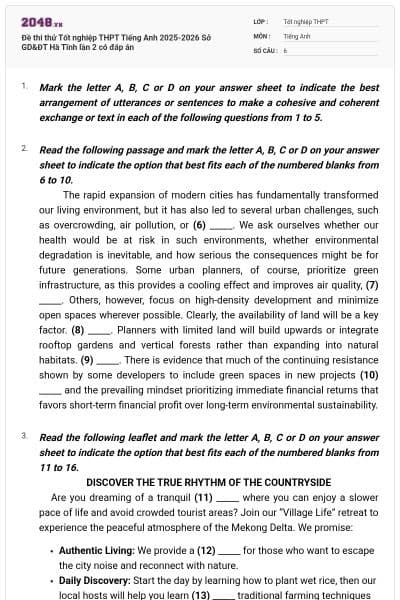
Mark the letter A, B, C, or D on your answer sheet to indicate the best arrangement of utterances or sentences to make a meaningful exchange or text in each of the following questions from 1 to 5.
a. Paul: Don’t worry. I’ll send you the notes after class.
b. Sarah: Thank you! That would be great.
c. Sarah: I’m sorry I missed today’s lesson. Could you help me with the notes?
b – a – c
c – a – b
c – b – a
b – c – a
Thứ tự sắp xếp đúng: B. c – a – b
c. Sarah: I’m sorry I missed today’s lesson. Could you help me with the notes?
a. Paul: Don’t worry. I’ll send you the notes after class.
b. Sarah: Thank you! That would be great.
Dịch nghĩa:
c. Sarah: Mình xin lỗi vì đã bỏ lỡ buổi học hôm nay. Cậu có thể giúp mình phần ghi chép được không?
a. Paul: Đừng lo. Mình sẽ gửi cho cậu bản ghi chép sau giờ học.
b. Sarah: Cảm ơn cậu! Thế thì tuyệt quá.
Chọn B.
a. Lan: That’s a good idea. I’ve been trying to eat more vegetables and cut down on sugar lately.
b. Lan: You seem much more energetic these days. Have you changed your routine?
c.Minh: Exactly. Regular exercise and a balanced diet really make a difference.
d.Minh: Yes, I’ve started going to the gym three times a week and sleeping earlier.
e.Lan: I totally agree. Staying healthy requires both discipline and consistency.
b – a – d – c – e
d – b – a – e – c
e – b – a – d – c
b – d – a – c – e
Thứ tự sắp xếp đúng: D. b – d – a – c – e
b. Lan: You seem much more energetic these days. Have you changed your routine?
d. Minh: Yes, I’ve started going to the gym three times a week and sleeping earlier.
a. Lan: That’s a good idea. I’ve been trying to eat more vegetables and cut down on sugar lately.
c. Minh: Exactly. Regular exercise and a balanced diet really make a difference.
e. Lan: I totally agree. Staying healthy requires both discipline and consistency.
Dịch nghĩa:
b. Lan: Dạo này trông cậu có vẻ tràn đầy năng lượng hơn hẳn. Cậu có thay đổi thói quen sinh hoạt không?
d. Minh: Có chứ, tớ đã bắt đầu đến phòng tập thể dục ba lần một tuần và ngủ sớm hơn.
a. Lan: Đó là một ý kiến hay. Gần đây tớ cũng đang cố gắng ăn nhiều rau hơn và cắt giảm lượng đường.
c. Minh: Chính xác. Việc tập thể dục thường xuyên và một chế độ ăn uống cân bằng thực sự tạo ra sự khác biệt.
e. Lan: Tớ hoàn toàn đồng ý. Việc duy trì sức khỏe đòi hỏi cả tính kỷ luật và sự kiên trì.
Chọn D.
Dear Parents,
a.Should you have any questions regarding the revised fee structure, please contact the school office for further clarification.
b.The updated tuition rates will take effect from the beginning of the next academic term in January.
c.We understand that this adjustment may require careful consideration, and we appreciate your continued support.
d.Due to rising operational costs and improvements in educational facilities, the school will be implementing a revised tuition policy.
e.We are writing to inform you of an important update concerning the school’s tuition fees.
Yours faithfully,
Greenfield International School
d – b – e – a – c
e – d – b – a – c
d – e – b – c – a
e – b – a – d – c
Thứ tự sắp xếp đúng: B. e – d – b – a – c
e. We are writing to inform you of an important update concerning the school’s tuition fees.
d. Due to rising operational costs and improvements in educational facilities, the school will be implementing a revised tuition policy.
b. The updated tuition rates will take effect from the beginning of the next academic term in January.
a. Should you have any questions regarding the revised fee structure, please contact the school office for further clarification.
c. We understand that this adjustment may require careful consideration, and we appreciate your continued support.
Dịch nghĩa:
Kính gửi Quý Phụ huynh,
e. Chúng tôi viết thư này để thông báo cho quý vị về một cập nhật quan trọng liên quan đến học phí của trường.
d. Do chi phí vận hành tăng và những cải thiện về cơ sở vật chất giáo dục, nhà trường sẽ áp dụng chính sách học phí sửa đổi.
b. Mức học phí cập nhật sẽ có hiệu lực từ đầu học kỳ tiếp theo vào tháng Giêng.
a. Nếu quý vị có bất kỳ câu hỏi nào về cấu trúc học phí sửa đổi, vui lòng liên hệ với văn phòng nhà trường để được giải thích thêm.
c. Chúng tôi hiểu rằng sự điều chỉnh này có thể cần sự cân nhắc kỹ lưỡng, và chúng tôi trân trọng sự ủng hộ không ngừng của quý vị.
Trân trọng,
Trường Quốc tế Greenfield
Chọn B.
a. In the end, I came to see that leaving my comfort zone had been the most valuable part of the experience.
b.These challenges became clear when navigating unfamiliar streets, sampling local dishes and dealing with a different dialect proved more demanding than I had anticipated.
c.Having to handle everything alone, without the support of friends or family, left me feeling slightly uneasy.
d.In retrospect, the journey not only strengthened my independence but also made me more confident in unfamiliar situations.
e.During the summer holiday, I chose to travel alone to a small coastal town, expecting nothing more than a peaceful break.
e – b – c – a – d
b – c – e – a – d
b – e – c – d – a
e – c – b – a – d
Thứ tự sắp xếp đúng: D. e – c – b – a – d
e. During the summer holiday, I chose to travel alone to a small coastal town, expecting nothing more than a peaceful break.
c. Having to handle everything alone, without the support of friends or family, left me feeling slightly uneasy.
b. These challenges became clear when navigating unfamiliar streets, sampling local dishes and dealing with a different dialect proved more demanding than I had anticipated.
a. In the end, I came to see that leaving my comfort zone had been the most valuable part of the experience.
d. In retrospect, the journey not only strengthened my independence but also made me more confident in unfamiliar situations.
Dịch nghĩa:
e. Trong kỳ nghỉ hè, tôi đã chọn đi du lịch một mình đến một thị trấn nhỏ ven biển, không mong đợi gì hơn ngoài một kỳ nghỉ yên bình.
c. Việc phải tự mình xử lý mọi thứ, không có sự hỗ trợ của bạn bè hay gia đình, khiến tôi cảm thấy hơi bất an.
b. Những thách thức này trở nên rõ ràng khi việc tìm đường trên những con phố xa lạ, thử các món ăn địa phương và đối phó với một phương ngữ khác tỏ ra khó khăn hơn tôi dự đoán.
a. Cuối cùng, tôi nhận ra rằng việc bước ra khỏi vùng an toàn của mình chính là phần giá trị nhất của trải nghiệm này.
d. Nhìn lại, chuyến đi không chỉ củng cố tính tự lập của tôi mà còn giúp tôi tự tin hơn trong những tình huống xa lạ.
Chọn D.
a. Over the past few years, the organisation has struggled with communication gaps and declining employee morale.
b.To enhance collaboration, the company introduced regular team-building workshops and cross-departmental projects.
c.As a result, overall productivity improved, and employees reported higher levels of job satisfaction.
d.These initiatives encouraged staff members to share ideas more openly and develop stronger professional relationships.
e.Recognising these challenges, senior managers decided to implement a comprehensive strategy to strengthen teamwork across the company.
e – b – a – c – d
a – b – e – d – c
e – a – b – c – d
a – e – b – d – c
Thứ tự sắp xếp đúng: D. a – e – b – d – c
a. Over the past few years, the organisation has struggled with communication gaps and declining employee morale.
e. Recognising these challenges, senior managers decided to implement a comprehensive strategy to strengthen teamwork across the company.
b. To enhance collaboration, the company introduced regular team-building workshops and cross-departmental projects.
d. These initiatives encouraged staff members to share ideas more openly and develop stronger professional relationships.
c. As a result, overall productivity improved, and employees reported higher levels of job satisfaction.
Dịch nghĩa:
a. Trong vài năm qua, tổ chức đã phải vật lộn với những khoảng trống trong giao tiếp và tinh thần làm việc của nhân viên giảm sút.
e. Nhận thấy những thách thức này, các quản lý cấp cao đã quyết định thực hiện một chiến lược toàn diện nhằm củng cố tinh thần làm việc nhóm trên toàn công ty.
b. Để tăng cường sự hợp tác, công ty đã giới thiệu các hội thảo xây dựng đội ngũ thường xuyên và các dự án liên phòng ban.
d. Những sáng kiến này đã khuyến khích các nhân viên chia sẻ ý tưởng cởi mở hơn và phát triển các mối quan hệ chuyên môn bền chặt hơn.
c. Kết quả là, năng suất tổng thể đã được cải thiện, và nhân viên báo cáo mức độ hài lòng với công việc cao hơn.
Chọn D.
Read the following leaflet and mark the letter A, B, C, or D on your answer sheet to indicate the option that best fits each of the numbered blanks from 6 to 11.
Airport Delays and Cancellations: What Travellers Should Know
Flight disruptions are becoming more common in the United States. Weather conditions, staffing shortages and technical problems can (6) ____________ significant delays or cancellations. Passengers are advised to check airline updates regularly and stay informed about any schedule(7) ____________.
Travellers should arrive early at the airport (8) ____________ unexpected security procedures may extend waiting times. Airlines are responsible for offering assistance under a (9) ____________ designed to protect affected passengers.
To reduce inconvenience:
•Keep essential items in a carry-on bag.
•Contact airline staff to (10) ____________ a compensation claim if your flight iscancelled for reasons within the airline’s control.
•Check the (11) ____________ of flights cancelled on your route before making alternative travel plans.
give rise to
give up on
give way to
result from
A. give rise to (phr.v): gây ra, dẫn đến (= cause).
B. give up on (phr.v): từ bỏ (hy vọng, nỗ lực) về ai/cái gì.
C. give way to (phr.v): nhường chỗ cho, bị thay thế bởi.
D. result from (phr.v): bắt nguồn từ, do (cái gì gây ra).
Các yếu tố như điều kiện thời tiết, thiếu hụt nhân sự và sự cố kỹ thuật là nguyên nhân (cause), dẫn đến kết quả là sự chậm trễ hoặc hủy chuyến. Do đó, cụm từ "give rise to" (gây ra/dẫn đến) là chính xác nhất.
Lưu ý: "result from" bị ngược chiều nhân quả.
Chọn A. give rise to
→ Weather conditions, staffing shortages and technical problems can give rise to significant delays or cancellations.
Dịch nghĩa: Điều kiện thời tiết, tình trạng thiếu hụt nhân sự và các sự cố kỹ thuật có thể gây ra những đợt chậm trễ hoặc hủy chuyến đáng kể.
settlements
enclosures
adjustments
possessions
A. settlements (n): sự giải quyết, sự thỏa thuận.
B. enclosures (n): tài liệu đính kèm, sự rào lại.
C. adjustments (n): sự điều chỉnh.
D. possessions (n): tài sản, vật sở hữu.
Ta có cụm danh từ thường gặp trong du lịch và giao thông: schedule adjustments (những sự điều chỉnh lịch trình).
Chọn C. adjustments
→ Passengers are advised to check airline updates regularly and stay informed about any schedule adjustments.
Dịch nghĩa: Hành khách được khuyên nên kiểm tra các cập nhật của hãng hàng không thường xuyên và luôn nắm bắt thông tin về bất kỳ sự điều chỉnh lịch trình nào.
and
but
so
because
A. and (conj): và.
B. but (conj): nhưng.
C. so (conj): vì vậy, cho nên (chỉ kết quả).
D. because (conj): bởi vì (chỉ nguyên nhân).
Hai mệnh đề có mối quan hệ nguyên nhân - kết quả. Mệnh đề sau ("các thủ tục an ninh bất ngờ có thể kéo dài thời gian chờ đợi") là nguyên nhân giải thích cho lời khuyên ở mệnh đề trước ("du khách nên đến sân bay sớm").
Chọn D. because
→ Travellers should arrive early at the airport because unexpected security procedures may extend waiting times.
Dịch nghĩa: Du khách nên đến sân bay sớm bởi vì các thủ tục an ninh bất ngờ có thể kéo dài thời gian chờ đợi.
passenger assistance policy
assistance passenger policy
passenger policy assistance
policy passenger assistance
Phân tích trật tự từ: Cụm danh từ này có danh từ chính là "policy" (chính sách), do đó nó phải đứng ở vị trí cuối cùng. Phía trước là danh từ phụ "assistance" bổ nghĩa tạo thành "assistance policy" (chính sách hỗ trợ). "passenger" đứng đầu bổ nghĩa cho toàn bộ cụm, chỉ rõ đối tượng được hỗ trợ. Trật tự đúng là: passenger assistance policy (chính sách hỗ trợ hành khách).
Chọn A. passenger assistance policy
→ Airlines are responsible for offering assistance under a passenger assistance policy designed to protect affected passengers.
Dịch nghĩa: Các hãng hàng không có trách nhiệm cung cấp sự hỗ trợ theo một chính sách hỗ trợ hành khách được thiết kế để bảo vệ những hành khách bị ảnh hưởng.
•Contact airline staff to (10) ____________ a compensation claim if your flight iscancelled for reasons within the airline’s control.
postpone
replace
file
undergo
A. postpone (v): trì hoãn.
B. replace (v): thay thế.
C. file (v): nộp, đệ trình (đơn từ, khiếu nại).
D. undergo (v): trải qua, chịu đựng.
Ta có cụm kết hợp từ cố định (collocation) trong lĩnh vực pháp lý/dịch vụ: file a claim hoặc file a compensation claim (nộp đơn yêu cầu bồi thường).
Chọn C. file
→ Contact airline staff to file a compensation claim if your flight is cancelled for reasons within the airline’s control.
Dịch nghĩa: Hãy liên hệ với nhân viên hãng hàng không để nộp đơn yêu cầu bồi thường nếu chuyến bay của bạn bị hủy vì những lý do nằm trong tầm kiểm soát của hãng.
•Check the (11) ____________ of flights cancelled on your route before making alternative travel plans.
number
rate
amount
level
A. number (n): số lượng (+ danh từ đếm được số nhiều).
B. rate (n): tỷ lệ.
C. amount (n): số lượng (+ danh từ không đếm được).
D. level (n): mức độ.
Phía sau khoảng trống là giới từ "of" và danh từ đếm được ở dạng số nhiều "flights" (các chuyến bay).
Do đó, ta phải dùng cấu trúc the number of + N (số nhiều).
Chọn A. number
→ Check the number of flights cancelled on your route before making alternative travel plans.
Dịch nghĩa: Hãy kiểm tra số lượng các chuyến bay bị hủy trên tuyến đường của bạn trước khi lập các kế hoạch di chuyển thay thế.
Bài đọc hoàn chỉnh | Dịch bài đọc |
Airport Delays and Cancellations: What Travellers Should Know Flight disruptions are becoming more common in the United States. Weather conditions, staffing shortages and technical problems can (6) give rise to significant delays or cancellations. Passengers are advised to check airline updates regularly and stay informed about any schedule (7) adjustments. Travellers should arrive early at the airport (8) because unexpected security procedures may extend waiting times. Airlines are responsible for offering assistance under a (9) passenger assistance policy designed to protect affected passengers. To reduce inconvenience: • Keep essential items in a carry-on bag. • Contact airline staff to (10) file a compensation claim if your flight is cancelled for reasons within the airline’s control. • Check the (11) number of flights cancelled on your route before making alternative travel plans. | Chậm Trễ Và Hủy Chuyến Bay Tại Sân Bay: Những Điều Du Khách Nên Biết Sự gián đoạn chuyến bay đang trở nên phổ biến hơn ở Hoa Kỳ. Điều kiện thời tiết, tình trạng thiếu hụt nhân sự và các sự cố kỹ thuật có thể (6) gây ra những đợt chậm trễ hoặc hủy chuyến đáng kể. Hành khách được khuyên nên kiểm tra các cập nhật của hãng hàng không thường xuyên và luôn nắm bắt thông tin về bất kỳ (7) sự điều chỉnh lịch trình nào. Du khách nên đến sân bay sớm (8) bởi vì các thủ tục an ninh bất ngờ có thể kéo dài thời gian chờ đợi. Các hãng hàng không có trách nhiệm cung cấp sự hỗ trợ theo một (9) chính sách hỗ trợ hành khách được thiết kế để bảo vệ những hành khách bị ảnh hưởng. Để giảm thiểu sự bất tiện: • Giữ các vật dụng thiết yếu trong túi hành lý xách tay. • Liên hệ với nhân viên hãng hàng không để (10) nộp đơn yêu cầu bồi thường nếu chuyến bay của bạn bị hủy vì những lý do nằm trong tầm kiểm soát của hãng. • Kiểm tra (11) số lượng các chuyến bay bị hủy trên tuyến đường của bạn trước khi lập các kế hoạch di chuyển thay thế. |
Read the following passage and mark the letter A, B, C or D on your answer sheet to indicate the best answer to each of the following questions from 12 to 19.
As smartphones increasingly dominate online activity, improving mobile usability has become a strategic priority for digital designers. Compared with desktop interfaces, mobile environments present constraints due to limited screen space and touch-based interaction. These conditions require layouts that minimise distraction, highlight essential functions and help users complete tasks efficiently without excessive cognitive effort.
A common problem in mobile interface design is visual clutter. When too many buttons, images or text blocks compete for attention, users may struggle to navigate effectively or interpret information accurately. Establishing a clear visual hierarchy, maintaining consistent design patterns and ensuring readable typography allow users to process content more smoothly. Removing redundant elements and simplifying structures can significantly enhance clarity while preserving functional balance and interface consistency.
Effective navigation is essential for maintaining usability across mobile platforms. Since small screens cannot accommodate complex menu systems, designers must adopt simplified and logically organised structures. Features such as compact icons, bottom navigation bars and gesture-based commands are widely used to facilitate quicker interaction. However, these solutions must be carefully designed, as poorly labelled or hidden functions may confuse users and reduce overall satisfaction.
Performance and responsiveness also shape user experience. Mobile users often access information in short sessions and expect immediate results. When a page loads slowly or relies heavily on visual effects, users may abandon it more quickly, weakening long-term engagement. Technical optimisation, including image compression, efficient coding and adaptive design, supports smoother performance across devices and varying network conditions.
Finally, user testing remains crucial in mobile design. By observing real usage patterns, designers can identify obstacles that theoretical assumptions overlook. They can then adjust layouts and refine navigation flows to align better with user expectations. In a competitive digital marketplace, usability functions not merely as an enhancement but as a fundamental requirement for sustained growth.
(Adapted from https://consumersearch.com)
Which of the following is NOT mentioned as a factor affecting mobile usability?
Hardware storage capacity
Touch-based interaction
Performance and responsiveness
Limited screen space
Điều nào sau đây KHÔNG được đề cập như một yếu tố ảnh hưởng đến khả năng sử dụng trên thiết bị di động?
A. Hardware storage capacity: Dung lượng lưu trữ phần cứng (Không được nhắc đến)
B. Touch-based interaction: Tương tác dựa trên cảm ứng (Có nhắc đến ở đoạn 1)
C. Performance and responsiveness: Hiệu suất và khả năng phản hồi (Có nhắc đến ở đoạn 4)
D. Limited screen space: Không gian màn hình bị giới hạn (Có nhắc đến ở đoạn 1)
Các yếu tố B, C, D đều xuất hiện rõ ràng trong bài ("touch-based interaction", "Performance and responsiveness", "limited screen space"). Chỉ có yếu tố A là không xuất hiện.
Chọn A.
innovations
advantages
adjustments
limitations
Từ “constraints” ở đoạn 1 có thể được thay thế tốt nhất bởi ____________.
constraints (n): sự hạn chế, sự ràng buộc.
A. innovations (n): những sự đổi mới
B. advantages (n): những lợi thế
C. adjustments (n): những sự điều chỉnh
D. limitations (n): những sự hạn chế (đồng nghĩa)
→ constraints = limitations
Thông tin: Compared with desktop interfaces, mobile environments present constraints due to limited screen space and touch-based interaction.
(So với giao diện máy tính để bàn, môi trường di động đặt ra những hạn chế do không gian màn hình bị giới hạn và tương tác dựa trên cảm ứng.)
Chọn D.
unnecessary
excessive
innovative
essential
Từ “redundant” ở đoạn 2 TRÁI NGHĨA với ____________.
redundant (adj): dư thừa, thừa thãi.
A. unnecessary (adj): không cần thiết (đồng nghĩa)
B. excessive (adj): quá mức, thừa (đồng nghĩa)
C. innovative (adj): mang tính đổi mới
D. essential (adj): thiết yếu, cần thiết (trái nghĩa)
→ redundant >< essential
Thông tin: Removing redundant elements and simplifying structures can significantly enhance clarity...
(Việc loại bỏ các yếu tố dư thừa và đơn giản hóa các cấu trúc có thể nâng cao đáng kể sự rõ ràng...)
Chọn D.
a page
a technical optimisation
a long-term engagement
a user behaviour
Từ “it” ở đoạn 4 chỉ ____________.
A. a page: một trang web
B. a technical optimisation: một sự tối ưu hóa kỹ thuật
C. a long-term engagement: một sự gắn kết lâu dài
D. a user behaviour: một hành vi người dùng
Thông tin: When a page loads slowly or relies heavily on visual effects, users may abandon it more quickly...
(Khi một trang tải chậm hoặc phụ thuộc quá nhiều vào các hiệu ứng hình ảnh, người dùng có thể từ bỏ nó nhanh hơn...)
→ it = a page.
Chọn A.
Which of the following best paraphrases the underlined sentence in paragraph 5?
In competitive digital markets, usability has become essential rather than simply an additional improvement.
In competitive digital markets, usability can enhance platforms but is not always necessary for growth.
In competitive digital markets, platform success often results from marketing instead of improvements.
In competitive digital markets, sustained growth depends mainly on innovative visual design strategies.
Câu nào diễn giải tốt nhất câu được gạch chân ở đoạn 5?
In a competitive digital marketplace, usability functions not merely as an enhancement but as a fundamental requirement for sustained growth.
(Trong một thị trường kỹ thuật số đầy cạnh tranh, khả năng sử dụng không chỉ đóng vai trò như một sự nâng cấp/cải thiện mà còn là một yêu cầu cơ bản cho sự tăng trưởng bền vững.)
Dịch nghĩa:
A. Trong các thị trường kỹ thuật số cạnh tranh, khả năng sử dụng đã trở nên thiết yếu chứ không chỉ đơn thuần là một sự cải thiện bổ sung. (Đúng và sát nghĩa nhất).
B. Trong các thị trường kỹ thuật số cạnh tranh, khả năng sử dụng có thể nâng cao nền tảng nhưng không phải lúc nào cũng cần thiết cho sự phát triển. (Sai nghĩa).
C. Trong các thị trường kỹ thuật số cạnh tranh, thành công của nền tảng thường là kết quả của tiếp thị thay vì các cải tiến. (Không liên quan đến câu gốc).
D. Trong các thị trường kỹ thuật số cạnh tranh, sự tăng trưởng bền vững chủ yếu phụ thuộc vào các chiến lược thiết kế hình ảnh sáng tạo. (Sai trọng tâm).
Chọn A.
Which of the following is TRUE according to the passage?
User testing guarantees error-free interface design.
Hidden or unclear navigation elements may decrease user satisfaction.
Visual effects always strengthen long-term engagement.
Complex menu systems are suitable for small mobile screens.
Theo bài đọc, điều nào sau đây là ĐÚNG?
A. Việc thử nghiệm người dùng đảm bảo thiết kế giao diện không có lỗi.
(Sai vì từ "đảm bảo... không có lỗi" là quá tuyệt đối, bài đọc chỉ nói giúp "xác định những trở ngại" - identify obstacles).
B. Các yếu tố điều hướng bị ẩn hoặc không rõ ràng có thể làm giảm sự hài lòng của người dùng.
(Đúng).
C. Các hiệu ứng hình ảnh luôn củng cố sự gắn kết lâu dài.
(Sai, đoạn 4 nói phụ thuộc quá nhiều vào hiệu ứng hình ảnh sẽ làm "suy yếu" sự gắn kết lâu dài - weakening long-term engagement).
D. Các hệ thống menu phức tạp phù hợp với màn hình di động nhỏ.
(Sai, đoạn 3 nói màn hình nhỏ "không thể chứa" các hệ thống menu phức tạp - cannot accommodate complex menu systems).
Thông tin (Đoạn 3): ...poorly labelled or hidden functions may confuse users and reduce overall satisfaction.
(...các chức năng bị dán nhãn kém hoặc bị ẩn đi có thể làm người dùng bối rối và làm giảm mức độ hài lòng nói chung.)
Chọn B.
Paragraph 3
Paragraph 4
Paragraph 2
Paragraph 1
Đoạn nào thảo luận về tầm quan trọng của việc giảm bớt các yếu tố thiết kế không cần thiết?
A. Đoạn 3
B. Đoạn 4
C. Đoạn 2
D. Đoạn 1
Thông tin (Đoạn 2): Removing redundant elements and simplifying structures can significantly enhance clarity while preserving functional balance and interface consistency.
(Việc loại bỏ các yếu tố dư thừa và đơn giản hóa các cấu trúc có thể nâng cao đáng kể sự rõ ràng trong khi vẫn duy trì sự cân bằng chức năng và tính nhất quán của giao diện.)
Chọn C.
Paragraph 2
Paragraph 5
Paragraph 4
Paragraph 3
Đoạn nào đề cập đến các chiến lược kỹ thuật để cải thiện hiệu suất hệ thống?
A. Đoạn 2
B. Đoạn 5
C. Đoạn 4
D. Đoạn 3
Thông tin (Đoạn 4): Technical optimisation, including image compression, efficient coding and adaptive design, supports smoother performance across devices and varying network conditions.
(Việc tối ưu hóa kỹ thuật, bao gồm nén hình ảnh, viết mã hiệu quả và thiết kế thích ứng, hỗ trợ hiệu suất mượt mà hơn trên các thiết bị và điều kiện mạng khác nhau.)
Chọn C.
Dịch bài đọc:
Khi điện thoại thông minh ngày càng thống trị các hoạt động trực tuyến, việc cải thiện khả năng sử dụng trên thiết bị di động đã trở thành một ưu tiên chiến lược đối với các nhà thiết kế kỹ thuật số. So với giao diện máy tính để bàn, môi trường di động đặt ra những hạn chế do không gian màn hình bị giới hạn và tương tác dựa trên cảm ứng. Những điều kiện này đòi hỏi các bố cục phải giảm thiểu sự xao nhãng, làm nổi bật các chức năng thiết yếu và giúp người dùng hoàn thành các tác vụ một cách hiệu quả mà không cần tốn quá nhiều nỗ lực nhận thức.
Một vấn đề phổ biến trong thiết kế giao diện di động là sự lộn xộn về mặt thị giác. Khi có quá nhiều nút, hình ảnh hoặc các khối văn bản cạnh tranh sự chú ý, người dùng có thể gặp khó khăn trong việc điều hướng hiệu quả hoặc diễn giải thông tin chính xác. Việc thiết lập một hệ thống phân cấp thị giác rõ ràng, duy trì các mẫu thiết kế nhất quán và đảm bảo kiểu chữ dễ đọc cho phép người dùng xử lý nội dung trôi chảy hơn. Việc loại bỏ các yếu tố dư thừa và đơn giản hóa các cấu trúc có thể nâng cao đáng kể sự rõ ràng trong khi vẫn duy trì sự cân bằng chức năng và tính nhất quán của giao diện.
Điều hướng hiệu quả là yếu tố cần thiết để duy trì khả năng sử dụng trên các nền tảng di động. Vì màn hình nhỏ không thể chứa các hệ thống menu phức tạp, các nhà thiết kế phải áp dụng các cấu trúc được đơn giản hóa và tổ chức hợp lý. Các tính năng như biểu tượng nhỏ gọn, thanh điều hướng dưới cùng và các lệnh dựa trên cử chỉ được sử dụng rộng rãi để tạo điều kiện tương tác nhanh hơn. Tuy nhiên, các giải pháp này phải được thiết kế cẩn thận, vì các chức năng bị dán nhãn kém hoặc bị ẩn đi có thể làm người dùng bối rối và làm giảm mức độ hài lòng nói chung.
Hiệu suất và khả năng phản hồi cũng định hình trải nghiệm người dùng. Người dùng di động thường truy cập thông tin trong các phiên ngắn và mong đợi kết quả ngay lập tức. Khi một trang tải chậm hoặc phụ thuộc quá nhiều vào các hiệu ứng hình ảnh, người dùng có thể từ bỏ nó nhanh hơn, làm suy yếu sự gắn kết lâu dài. Việc tối ưu hóa kỹ thuật, bao gồm nén hình ảnh, viết mã hiệu quả và thiết kế thích ứng, hỗ trợ hiệu suất mượt mà hơn trên các thiết bị và điều kiện mạng khác nhau.
Cuối cùng, việc thử nghiệm người dùng vẫn đóng vai trò quan trọng trong thiết kế di động. Bằng cách quan sát các kiểu sử dụng thực tế, các nhà thiết kế có thể xác định những trở ngại mà các giả định lý thuyết bỏ qua. Sau đó, họ có thể điều chỉnh bố cục và tinh chỉnh các luồng điều hướng để phù hợp hơn với kỳ vọng của người dùng. Trong một thị trường kỹ thuật số đầy cạnh tranh, khả năng sử dụng không chỉ đóng vai trò như một sự nâng cấp mà còn là một yêu cầu cơ bản cho sự tăng trưởng bền vững.
Read the following advertisement and mark the letter A, B, C, or D on your answer sheet to indicate the option that best fits each of the numbered blanks from 20 to 25.
? Edinburgh Science Festival
The Edinburgh Science Festival is an annual event (20) ____________ celebrates scientific discovery and innovation. Held each spring, the festival offers numerous exhibitions, workshops and interactive activities designed to (21) ____________ interest among people of all ages.
Visitors are encouraged to take part in hands-on experiments and discussions (22) ____________ by scientists and researchers. Although participants may have little scientific background, the activities are designed to be accessible and engaging.
The festival also highlights the importance of scientific (23) ____________ in modern society, especially in addressing global challenges.Many events rely on collaboration between universities, schools and research organisations.
(24) ____________ the festival to receive greater support from schools and local communities, it would have an even wider impact. Some schools already organise regular science-related activities for young people, and (25) ____________ schools may follow if more support is available.
(Adapted from https://www.earthday.org)
whose
who
which
whom
A. whose: đại từ quan hệ chỉ sự sở hữu (theo sau bắt buộc phải có danh từ).
B. who: đại từ quan hệ thay thế cho danh từ chỉ người.
C. which: đại từ quan hệ thay thế cho danh từ chỉ sự vật/sự việc.
D. whom: đại từ quan hệ thay thế cho danh từ chỉ người (làm tân ngữ).
Danh từ đứng ngay trước khoảng trống là "an annual event" (một sự kiện thường niên) - danh từ chỉ sự việc. Khoảng trống cần một đại từ quan hệ đóng vai trò làm chủ ngữ cho động từ "celebrates" phía sau. Do đó, "which" là đáp án chính xác.
Chọn C. which
→ The Edinburgh Science Festival is an annual event which celebrates scientific discovery and innovation.
Dịch nghĩa: Lễ hội Khoa học Edinburgh là một sự kiện thường niên nhằm tôn vinh sự khám phá và đổi mới khoa học.
reduce
ignore
create
cancel
A. reduce (v): giảm bớt.
B. ignore (v): phớt lờ, bỏ qua.
C. create (v): tạo ra.
D. cancel (v): hủy bỏ.
Mục đích của các buổi triển lãm và hoạt động tương tác tại lễ hội khoa học là để "tạo ra sự hứng thú" (create interest) cho mọi người ở mọi lứa tuổi, chứ không phải là làm giảm hay hủy bỏ nó.
Chọn C. create
→ ...designed to create interest among people of all ages.
Dịch nghĩa: ...được thiết kế để tạo ra sự hứng thú cho mọi người ở mọi lứa tuổi.
led
lead
are led
leading
A. led: quá khứ phân từ (V-ed/V3, mang nghĩa bị động).
B. lead: động từ nguyên mẫu.
C. are led: động từ chia bị động thì hiện tại đơn.
D. leading: hiện tại phân từ (V-ing, mang nghĩa chủ động).
Đây là hiện tượng rút gọn mệnh đề quan hệ mang nghĩa bị động. Các cuộc thảo luận và thí nghiệm không tự diễn ra mà "được dẫn dắt" bởi các nhà khoa học (có giới từ "by"). Mệnh đề đầy đủ là: which are led by.... Khi rút gọn, ta bỏ đại từ quan hệ và to be, chỉ giữ lại quá khứ phân từ. (3 cột của động từ này là: lead - led - led).
Chọn A. led
→ Visitors are encouraged to take part in hands-on experiments and discussions led by scientists and researchers.
Dịch nghĩa: Du khách được khuyến khích tham gia vào các thí nghiệm thực tế và các cuộc thảo luận được dẫn dắt bởi các nhà khoa học và nhà nghiên cứu.
literate
illiteracy
literately
literacy
A. literate (adj): biết chữ, có hiểu biết.
B. illiteracy (n): nạn mù chữ, sự thất học.
C. literately (adv): một cách có hiểu biết/có học thức.
D. literacy (n): sự biết đọc biết viết, sự am hiểu/kiến thức cơ bản về một lĩnh vực.
Phân tích từ loại: Đứng sau tính từ "scientific" (thuộc về khoa học) cần một danh từ. Lễ hội nhấn mạnh "tầm quan trọng" (importance) nên danh từ này phải mang ý nghĩa tích cực.
Ta có cụm từ: scientific literacy (sự am hiểu khoa học / kiến thức khoa học cơ bản).
Chọn D. literacy
→ The festival also highlights the importance of scientific literacy in modern society...
Dịch nghĩa: Lễ hội cũng nhấn mạnh tầm quan trọng của sự am hiểu khoa học trong xã hội hiện đại...
Unless
Should
Had
Were
A. Unless: Trừ khi (+ mệnh đề bình thường).
B. Should: Đảo ngữ câu điều kiện loại 1 (+ S + V-nguyên thể).
C. Had: Đảo ngữ câu điều kiện loại 3 (+ S + V-ed/V3).
D. Were: Đảo ngữ câu điều kiện loại 2 (+ S + to V / Cụm danh từ/Tính từ).
Nhìn vào mệnh đề chính "it would have an even wider impact", ta biết đây là câu điều kiện loại 2 (trái với thực tế ở hiện tại/tương lai). Cấu trúc đảo ngữ của câu điều kiện loại 2 đối với động từ thường là: Were + S + to V. Phía sau khoảng trống ta thấy có "the festival to receive", do đó chọn "Were" là chính xác tuyệt đối.
Chọn D. Were
→ Were the festival to receive greater support from schools and local communities, it would have an even wider impact.
Dịch nghĩa: Nếu lễ hội nhận được sự hỗ trợ lớn hơn từ các trường học và cộng đồng địa phương, nó sẽ có sức ảnh hưởng thậm chí còn rộng rãi hơn.
another
others
other
the other
A. another: một ... khác (tính từ/đại từ, theo sau là danh từ đếm được số ít).
B. others: những người/vật khác (đại từ, không đi kèm danh từ phía sau).
C. other: khác (tính từ, bắt buộc phải có danh từ số nhiều hoặc không đếm được theo sau).
D. the other: cái/người còn lại (đã xác định cụ thể).
Phân tích ngữ pháp: Ngay sau khoảng trống là danh từ đếm được số nhiều "schools" (các trường học). Do đó, từ phù hợp nhất để bổ nghĩa cho nó là tính từ "other".
Chọn C. other
→ ...and other schools may follow if more support is available.
Dịch nghĩa: ...và các trường học khác có thể sẽ noi theo nếu có nhiều sự hỗ trợ hơn.
Bài đọc hoàn chỉnh | Dịch bài đọc |
Edinburgh Science Festival The Edinburgh Science Festival is an annual event (20) which celebrates scientific discovery and innovation. Held each spring, the festival offers numerous exhibitions, workshops and interactive activities designed to (21) create interest among people of all ages. Visitors are encouraged to take part in hands-on experiments and discussions (22) led by scientists and researchers. Although participants may have little scientific background, the activities are designed to be accessible and engaging. The festival also highlights the importance of scientific (23) literacy in modern society, especially in addressing global challenges. Many events rely on collaboration between universities, schools and research organisations. (24) Were the festival to receive greater support from schools and local communities, it would have an even wider impact. Some schools already organise regular science-related activities for young people, and (25) other schools may follow if more support is available. | Lễ hội Khoa học Edinburgh Lễ hội Khoa học Edinburgh là một sự kiện thường niên (20) nhằm tôn vinh sự khám phá và đổi mới khoa học. Được tổ chức vào mỗi mùa xuân, lễ hội mang đến vô số các buổi triển lãm, hội thảo và các hoạt động tương tác được thiết kế nhằm (21) tạo ra sự hứng thú cho mọi người ở mọi lứa tuổi. Du khách được khuyến khích tham gia vào các thí nghiệm thực tế và các cuộc thảo luận (22) được dẫn dắt bởi các nhà khoa học và nhà nghiên cứu. Mặc dù những người tham gia có thể có rất ít nền tảng về khoa học, nhưng các hoạt động đều được thiết kế để dễ tiếp cận và đầy sức lôi cuốn. Lễ hội cũng nhấn mạnh tầm quan trọng của (23) sự am hiểu khoa học trong xã hội hiện đại, đặc biệt là trong việc giải quyết các thách thức toàn cầu. Nhiều sự kiện dựa trên sự hợp tác giữa các trường đại học, trường học và các tổ chức nghiên cứu. (24) Nếu lễ hội nhận được sự hỗ trợ lớn hơn từ các trường học và cộng đồng địa phương, nó sẽ có sức ảnh hưởng thậm chí còn rộng rãi hơn. Một số trường học đã tổ chức các hoạt động liên quan đến khoa học thường xuyên cho thanh thiếu niên, và (25) các trường học khác có thể sẽ noi theo nếu có thêm nhiều sự hỗ trợ. |
Read the following passage and mark the letter A, B, C or D on your answer sheet to indicate the option that best fits each of the numbered blanks from 26 to 30.
While greenwashing has received significant public attention, brownwashing remains less widely recognised. It occurs when companies intentionally minimise or obscure their genuine environmental progress in public communication. (26) ____________. As a result, firms may appear less environmentally responsible than they actually are.
One reason for this behaviour is the increasing pressure placed on companies to meet ambitious sustainability targets. (27) ____________. In such situations, organisations may prefer to avoid strong claims altogether rather than draw attention to commitments they may struggle to fulfil. This cautious approach can be particularly common in highly competitive industries.
However, brownwashing can also create unintended consequences, (28) ____________. When companies fail to communicate their achievements clearly, stakeholders may struggle to identify which firms are genuinely making progress.
Another concern is that inconsistent communication practices make comparison difficult. (29) ____________, those that communicate more clearly may gain an advantage, regardless of their actual environmental performance.
To address these challenges, experts suggest that improving both transparency and consistency is essential. The key issue is (30) ____________.
(Adapted from https://news.umich.edu)
This may seem counterintuitive, as businesses are generally expected to highlight their achievements
This is often driven by companies’ desire to improve their image through environmental communication
In addition, sustainability reporting has become an important tool for corporate communication
For this reason, many firms attempt to expand their environmental campaigns to reach wider audiences
Câu trước định nghĩa hiện tượng "brownwashing" là khi các công ty "intentionally minimise or obscure their genuine environmental progress" (cố tình giảm thiểu hoặc che giấu sự tiến bộ môi trường thực sự của họ). Hành động này đi ngược lại với lẽ thường trong kinh doanh (thường là thích khoe khoang thành tích). Vị trí (26) cần một câu nhận xét về sự mâu thuẫn này để nối sang kết quả ở câu sau.
Dịch nghĩa:
A. Điều này có vẻ ngược đời, vì các doanh nghiệp thường được kỳ vọng sẽ làm nổi bật thành tựu của họ.
B. Điều này thường được thúc đẩy bởi mong muốn cải thiện hình ảnh của các công ty thông qua truyền thông môi trường (Sai logic, che giấu thì không thể cải thiện hình ảnh theo cách thông thường).
C. Ngoài ra, báo cáo bền vững đã trở thành một công cụ quan trọng cho truyền thông doanh nghiệp (Lạc đề).
D. Vì lý do này, nhiều công ty cố gắng mở rộng các chiến dịch môi trường của họ để tiếp cận lượng khán giả rộng hơn (Sai logic với việc "che giấu" ở câu trước).
Đáp án A chỉ ra sự "ngược đời" (counterintuitive) hoàn toàn chính xác, tạo cầu nối logic tuyệt vời giữa việc che giấu thành tích và hậu quả là họ trông có vẻ kém trách nhiệm hơn ở câu sau.
Chọn A.
→ It occurs when companies intentionally minimise or obscure their genuine environmental progress in public communication. This may seem counterintuitive, as businesses are generally expected to highlight their achievements.
Dịch nghĩa: Nó xảy ra khi các công ty cố tình giảm thiểu hoặc che giấu sự tiến bộ môi trường thực sự của họ trong giao tiếp công chúng. Điều này có vẻ ngược đời, vì các doanh nghiệp thường được kỳ vọng sẽ làm nổi bật thành tựu của họ.
In many cases, companies that fail to live up to these expectations may face criticism and reputational damage
As a result, companies invest more resources in promoting their environmental achievements to attract support
For example, some organisations prioritise internal improvements before sharing their results publicly
In addition, sustainability reporting helps firms communicate their long-term strategies more clearly to investors
Câu trước nêu nguyên nhân của brownwashing là do "increasing pressure... to meet ambitious sustainability targets" (áp lực ngày càng tăng... phải đáp ứng các mục tiêu bền vững đầy tham vọng). Vị trí (27) cần giải thích hệ quả tiêu cực của áp lực này nếu công ty không làm được, từ đó làm nền tảng cho việc họ chọn giải pháp "im lặng/tránh né" ở câu ngay phía sau ("In such situations, organisations may prefer to avoid strong claims...").
Dịch nghĩa:
A. Trong nhiều trường hợp, các công ty không đáp ứng được những kỳ vọng này có thể đối mặt với sự chỉ trích và thiệt hại về danh tiếng.
B. Kết quả là, các công ty đầu tư nhiều nguồn lực hơn vào việc quảng bá thành tựu môi trường của họ để thu hút sự ủng hộ (Sai logic của bài là đang giấu đi).
C. Ví dụ, một số tổ chức ưu tiên cải thiện nội bộ trước khi chia sẻ kết quả công khai
(Không giải thích được sự e ngại ở câu sau).
D. Ngoài ra, báo cáo bền vững giúp các công ty giao tiếp chiến lược dài hạn rõ ràng hơn với các nhà đầu tư (Lạc đề).
Đáp án A đưa ra rủi ro thiết thực (chỉ trích, thiệt hại danh tiếng). Chính vì rủi ro này mà "Trong những tình huống như vậy" (In such situations), các công ty thà không nói gì còn hơn là hứa rồi làm không được.
Chọn A.
→ One reason for this behaviour is the increasing pressure placed on companies to meet ambitious sustainability targets. In many cases, companies that fail to live up to these expectations may face criticism and reputational damage.
Dịch nghĩa: Một lý do cho hành vi này là áp lực ngày càng tăng đặt lên các công ty trong việc đáp ứng các mục tiêu bền vững đầy tham vọng. Trong nhiều trường hợp, các công ty không đáp ứng được những kỳ vọng này có thể đối mặt với sự chỉ trích và thiệt hại về danh tiếng.
leaving responsible firms less recognised for their real environmental efforts
reflecting differences in standards across sectors and reporting systems
reinforcing the role of sustainability reporting in corporate communication
making sustainability reporting less common in competitive industries
Mệnh đề chính là "brownwashing can also create unintended consequences" (brownwashing cũng có thể tạo ra những hậu quả không mong muốn). Vị trí (28) cần một cấu trúc V-ing (hiện tại phân từ) chỉ kết quả của mệnh đề chính, đồng thời phải hợp logic với câu sau ("các bên liên quan gặp khó khăn trong việc xác định công ty nào thực sự đang tiến bộ").
Dịch nghĩa/Ngữ pháp:
A. khiến các công ty có trách nhiệm ít được công nhận hơn cho những nỗ lực môi trường thực sự của họ (Cấu trúc "leave + O + Adj/V-ed").
B. phản ánh sự khác biệt trong tiêu chuẩn giữa các lĩnh vực và hệ thống báo cáo
(Không phải là "hậu quả không mong muốn" trực tiếp của brownwashing).
C. củng cố vai trò của báo cáo bền vững trong truyền thông doanh nghiệp
(Đây là điều tích cực, không phải "unintended consequences").
D. làm cho báo cáo bền vững trở nên ít phổ biến hơn trong các ngành cạnh tranh
(Không khớp với diễn giải ở câu sau).
Đáp án A giải thích hoàn hảo hậu quả tiêu cực của việc "giấu tài": những công ty thực sự làm tốt lại không nhận được sự công nhận xứng đáng.
Chọn A.
→ However, brownwashing can also create unintended consequences, leaving responsible firms less recognised for their real environmental efforts.
Dịch nghĩa: Tuy nhiên, brownwashing cũng có thể tạo ra những hậu quả không mong muốn, khiến các công ty có trách nhiệm ít được công nhận hơn cho những nỗ lực môi trường thực sự của họ.
Since corporate communication strategies play an important role in shaping public perception
When companies adopt different ways of presenting their environmental results in reports
Because environmental reports are often used to support broader corporate messaging
Although many organisations aim to improve transparency in sustainability communication
Câu trước nêu vấn đề: "inconsistent communication practices make comparison difficult" (thực tiễn giao tiếp không nhất quán làm cho việc so sánh trở nên khó khăn). Vị trí (29) cần một mệnh đề phụ thuộc (Adverbial clause) đóng vai trò điều kiện hoặc thời gian, dẫn tới kết quả bất công ở vế sau: "...those that communicate more clearly may gain an advantage..." (...những công ty giao tiếp rõ ràng hơn có thể giành lợi thế...).
Dịch nghĩa:
A. Vì các chiến lược giao tiếp doanh nghiệp đóng vai trò quan trọng trong việc định hình nhận thức công chúng (Quá chung chung, không khớp nối trực tiếp với từ "inconsistent").
B. Khi các công ty áp dụng các cách khác nhau để trình bày kết quả môi trường của họ trong báo cáo (Cụm "adopt different ways" chính là cách diễn đạt lại của "inconsistent communication practices").
C. Bởi vì các báo cáo môi trường thường được sử dụng để hỗ trợ các thông điệp doanh nghiệp rộng lớn hơn (Không giải thích được sự bất công ở vế sau).
D. Mặc dù nhiều tổ chức hướng tới việc cải thiện sự minh bạch trong truyền thông bền vững (Sai logic nhượng bộ).
Đáp án B đóng vai trò là một mệnh đề trạng ngữ chỉ thời gian/điều kiện rất chặt chẽ, tạo nền tảng cho sự cạnh tranh không công bằng được nhắc tới ở mệnh đề chính.
Chọn B.
→ When companies adopt different ways of presenting their environmental results in reports, those that communicate more clearly may gain an advantage, regardless of their actual environmental performance.
Dịch nghĩa: Khi các công ty áp dụng các cách khác nhau để trình bày kết quả môi trường của họ trong báo cáo, những công ty giao tiếp rõ ràng hơn có thể giành được lợi thế, bất kể hiệu suất môi trường thực tế của họ ra sao.
To address these challenges, experts suggest that improving both transparency and consistency is essential. The key issue is (30) ____________.
whether companies are communicating accurately or creating misleading impressions selectively
the extent to which environmental policies influence business decisions in competitive markets
how companies can strengthen their reputation through clearer environmental communication
why sustainability reporting has become increasingly important in modern corporate practices
Đoạn kết luận gợi ý giải pháp: "improving both transparency and consistency is essential" (cải thiện cả sự minh bạch và tính nhất quán là điều cần thiết). Vị trí (30) chốt lại toàn bộ chủ đề của bài đọc (xoay quanh việc nói dối/che giấu thành tích).
Dịch nghĩa:
A. liệu các công ty đang giao tiếp một cách chính xác hay đang tạo ra những ấn tượng gây hiểu lầm một cách có chọn lọc.
B. mức độ mà các chính sách môi trường ảnh hưởng đến các quyết định kinh doanh trong các thị trường cạnh tranh.
C. làm thế nào các công ty có thể củng cố danh tiếng của họ thông qua truyền thông môi trường rõ ràng hơn.
D. tại sao báo cáo bền vững đã trở nên ngày càng quan trọng trong thực tiễn doanh nghiệp hiện đại.
Xuyên suốt bài viết, tác giả nhắc đến greenwashing (thổi phồng) và brownwashing (che giấu). Cả hai đều là việc tạo ra "misleading impressions" (ấn tượng gây hiểu lầm). Đáp án A tóm lược chính xác nhất cốt lõi vấn đề của toàn bài: tính xác thực trong truyền thông.
Chọn A.
→ The key issue is whether companies are communicating accurately or creating misleading impressions selectively.
Dịch nghĩa: Vấn đề cốt lõi là liệu các công ty đang giao tiếp một cách chính xác hay đang tạo ra những ấn tượng gây hiểu lầm một cách có chọn lọc.
Bài đọc hoàn chỉnh | Dịch bài đọc |
While greenwashing has received significant public attention, brownwashing remains less widely recognised. It occurs when companies intentionally minimise or obscure their genuine environmental progress in public communication. This may seem counterintuitive, as businesses are generally expected to highlight their achievements. As a result, firms may appear less environmentally responsible than they actually are. One reason for this behaviour is the increasing pressure placed on companies to meet ambitious sustainability targets. In many cases, companies that fail to live up to these expectations may face criticism and reputational damage. In such situations, organisations may prefer to avoid strong claims altogether rather than draw attention to commitments they may struggle to fulfil. This cautious approach can be particularly common in highly competitive industries. However, brownwashing can also create unintended consequences, leaving responsible firms less recognised for their real environmental efforts. When companies fail to communicate their achievements clearly, stakeholders may struggle to identify which firms are genuinely making progress. Another concern is that inconsistent communication practices make comparison difficult. When companies adopt different ways of presenting their environmental results in reports, those that communicate more clearly may gain an advantage, regardless of their actual environmental performance. To address these challenges, experts suggest that improving both transparency and consistency is essential. The key issue is whether companies are communicating accurately or creating misleading impressions selectively. | Trong khi "tẩy xanh" (greenwashing - quảng bá sai sự thật về tính thân thiện với môi trường) đã nhận được sự chú ý đáng kể từ công chúng, thì "tẩy nâu" (brownwashing) lại ít được biết đến rộng rãi hơn. Nó xảy ra khi các công ty cố tình giảm thiểu hoặc che giấu sự tiến bộ môi trường thực sự của họ trong giao tiếp công chúng. Điều này có vẻ ngược đời, vì các doanh nghiệp thường được kỳ vọng sẽ làm nổi bật thành tựu của họ. Kết quả là, các công ty có thể trông có vẻ ít có trách nhiệm với môi trường hơn so với thực tế. Một lý do cho hành vi này là áp lực ngày càng tăng đặt lên các công ty trong việc đáp ứng các mục tiêu bền vững đầy tham vọng. Trong nhiều trường hợp, các công ty không đáp ứng được những kỳ vọng này có thể đối mặt với sự chỉ trích và thiệt hại về danh tiếng. Trong những tình huống như vậy, các tổ chức có thể thích việc tránh đưa ra các tuyên bố mạnh mẽ hoàn toàn hơn là thu hút sự chú ý vào các cam kết mà họ có thể gặp khó khăn để hoàn thành. Cách tiếp cận thận trọng này có thể đặc biệt phổ biến trong các ngành công nghiệp cạnh tranh cao. Tuy nhiên, brownwashing cũng có thể tạo ra những hậu quả không mong muốn, khiến các công ty có trách nhiệm ít được công nhận hơn cho những nỗ lực môi trường thực sự của họ. Khi các công ty không truyền đạt thành tựu của họ một cách rõ ràng, các bên liên quan có thể gặp khó khăn trong việc xác định công ty nào thực sự đang tạo ra sự tiến bộ. Một mối lo ngại khác là các thực tiễn giao tiếp không nhất quán làm cho việc so sánh trở nên khó khăn. Khi các công ty áp dụng các cách khác nhau để trình bày kết quả môi trường của họ trong báo cáo, những công ty giao tiếp rõ ràng hơn có thể giành được lợi thế, bất kể hiệu suất môi trường thực tế của họ ra sao. Để giải quyết những thách thức này, các chuyên gia đề xuất rằng việc cải thiện cả sự minh bạch và tính nhất quán là điều cần thiết. Vấn đề cốt lõi là liệu các công ty đang giao tiếp một cách chính xác hay đang tạo ra những ấn tượng gây hiểu lầm một cách có chọn lọc. |
Read the following passage and mark the letter A, B, C or D on your answer sheet to indicate the best answer to each of the following questions from 31 to 40.
For more than fifteen years, environmental organisations, scientists and Indigenous communities campaigned for stronger protection of the High Seas – the vast areas of ocean beyond national jurisdiction. These waters, covering nearly half of the planet, had long remained largely unregulated and vulnerable to intensive resource exploitation. In early 2026, their efforts culminated in the entry into force of the Global Ocean Treaty, creating a new legal framework for international marine governance.
Before the Treaty, less than one percent of the High Seas was fully or highly protected. Industrial fishing fleets operated with minimal restrictions, and proposals for deep-sea mining raised concerns about irreversible ecological damage and long-term habitat degradation. [I] By establishing a formal process to designate marine protected areas, the Treaty provides governments with tools to conserve biodiversity on a scale not previously possible in international waters.
Supporters argue that protecting the High Seas is essential not only for marine life but also for climate stability. Oceans absorb vast amounts of carbon dioxide and regulate global temperatures. Moreover, billions of people depend on healthy marine ecosystems for food security and economic livelihoods. In this context, ocean conservation is increasingly viewed as central to sustainable development rather than a purely environmental objective.
Nevertheless, adoption of the Treaty did not occur without resistance. [II] Some governments were initially reluctant to accept binding obligations that might limit industrial expansion. Negotiations required compromise, and implementation will depend oncontinued political will and institutional coordination. Under the agreement, proposals for protected areas must be based on scientific evidence and involve consultation with affected communities, ensuring legitimacy and accountability.
World leaders have committed to protecting 30 percent of the world’s oceans by 2030 – the “30x30” goal. [III] Achieving this target will demand consistent monitoring, transparent reporting and meaningful enforcement. Past environmental agreements demonstrate that ambitious pledges alone do not automatically produce measurable results.
[IV] The Global Ocean Treaty therefore represents both a diplomatic achievement and a test of global commitment. Its ultimate impact will depend on whether governments transform negotiated promises into sustained protection for marine ecosystems.
(Adapted from https://www.greenpeace.org.uk)
According to paragraph 1, the coming into force of the Global Ocean Treaty can best be seen as the result of ____________.
economic incentives generated by expanding marine industries worldwide
a sudden rise in international disputes over ocean resource exploitation
a rapid shift in government policy triggered by recent scientific discoveries
prolonged and coordinated pressure from environmental and scientific advocates
Theo đoạn 1, việc Hiệp ước Đại dương Toàn cầu có hiệu lực có thể được xem là kết quả của ____________.
A. các động lực kinh tế được tạo ra bởi việc mở rộng các ngành công nghiệp hàng hải trên toàn thế giới.
B. sự gia tăng đột ngột của các tranh chấp quốc tế về khai thác tài nguyên đại dương.
C. sự thay đổi nhanh chóng trong chính sách của chính phủ do các khám phá khoa học gần đây gây ra.
D. áp lực phối hợp và kéo dài từ các nhà vận động môi trường và khoa học.
Đoạn văn chỉ ra rằng các tổ chức môi trường, nhà khoa học và cộng đồng bản địa đã vận động (tạo áp lực) trong "hơn 15 năm" (kéo dài). Những nỗ lực này cuối cùng đã dẫn đến sự ra đời của Hiệp ước.
Thông tin: "For more than fifteen years, environmental organisations, scientists and Indigenous communities campaigned for stronger protection of the High Seas... In early 2026, their efforts culminated in the entry into force of the Global Ocean Treaty..." (Trong hơn mười lăm năm, các tổ chức môi trường, các nhà khoa học và các cộng đồng bản địa đã vận động để bảo vệ mạnh mẽ hơn cho Vùng biển Quốc tế... Vào đầu năm 2026, những nỗ lực của họ đã đi đến kết quả là sự có hiệu lực của Hiệp ước Đại dương Toàn cầu...)
Chọn D.
Maintaining planetary climate stability
Supporting coastal economic livelihoods
Preserving global marine biodiversity
Expanding international trade networks
Điều nào sau đây KHÔNG được nhắc đến như một lý do để bảo vệ Vùng biển Quốc tế?
A. Duy trì sự ổn định khí hậu hành tinh (Có: "climate stability" - đoạn 3).
B. Hỗ trợ sinh kế kinh tế ven biển (Có: "economic livelihoods" - đoạn 3).
C. Bảo tồn đa dạng sinh học biển toàn cầu (Có: "conserve biodiversity" - đoạn 2).
D. Mở rộng các mạng lưới thương mại quốc tế (Không được nhắc đến).
Chọn D.
The word “their” in paragraph 1 refers to ____________.
environmental groups, scientists and Indigenous communities
environmental advocacy organisations
national governments in treaty negotiations
scientific research institutions
Từ “their” ở đoạn 1 chỉ ____________.
A. environmental groups, scientists and Indigenous communities: các nhóm môi trường, nhà khoa học và cộng đồng bản địa
B. environmental advocacy organisations: các tổ chức vận động môi trường
C. national governments in treaty negotiations: các chính phủ quốc gia trong các cuộc đàm phán hiệp ước
D. scientific research institutions: các tổ chức nghiên cứu khoa học
Đại từ sở hữu "their" (của họ) được dùng để thay thế cho chủ ngữ số nhiều đứng trước nó nhằm tránh lặp từ. "Những nỗ lực của họ" ở đây là nỗ lực của ba nhóm người vừa được liệt kê ở câu trước.
Thông tin: "...environmental organisations, scientists and Indigenous communities campaigned... In early 2026, their efforts culminated..." (...các tổ chức môi trường, nhà khoa học và cộng đồng bản địa đã vận động... Đầu năm 2026, nỗ lực của họ đã đi đến kết quả...)
Chọn A.
accelerated
initiated
resulted in
complicated
Cụm từ “culminated in” ở đoạn 1 gần nghĩa nhất với ____________.
culminate in (phrasal verb): lên đến đỉnh điểm và kết thúc bằng một kết quả nào đó, dẫn đến kết quả
A. accelerated (v): tăng tốc
B. initiated (v): khởi xướng, bắt đầu
C. resulted in (v): dẫn đến kết quả
D. complicated (v): làm phức tạp
→culminated in = resulted in
Thông tin: In early 2026, their efforts culminated in the entry into force of the Global Ocean Treaty, creating a new legal framework for international marine governance. (Vào đầu năm 2026, những nỗ lực của họ đã đi đến kết quả là sự có hiệu lực của Hiệp ước Đại dương Toàn cầu, tạo ra một khuôn khổ pháp lý mới cho quản trị hàng hải quốc tế.)
Chọn C.
Which of the following best summarises paragraph 2?
Rising concern over deep-sea mining encouraged stronger international regulation of marine activities.
Some protections in international waters existed, but they remained too limited to prevent ecological damage.
Industrial exploitation in the High Seas revealed regulatory failings that the Treaty was designed to address.
Weak protection and growing exploitation in the High Seas highlighted the need for the Treaty framework.
Câu nào sau đây tóm tắt đúng nhất đoạn 2?
A. Mối lo ngại ngày càng tăng về khai thác khoáng sản dưới đáy biển sâu đã khuyến khích các quy định quốc tế mạnh mẽ hơn. (Thiếu ý về đánh bắt cá và sự bảo vệ của Hiệp ước).
B. Một số sự bảo vệ trong vùng biển quốc tế đã tồn tại, nhưng chúng quá hạn chế. (Chưa bao quát được vai trò của Hiệp ước ở cuối đoạn).
C. Sự bóc lột công nghiệp ở Vùng biển Quốc tế đã bộc lộ những thất bại về mặt quản lý. (Thiếu đi giải pháp của Hiệp ước).
D. Sự bảo vệ yếu kém và sự khai thác ngày càng tăng ở Vùng biển Quốc tế đã làm nổi bật sự cần thiết của khuôn khổ Hiệp ước. (Đúng, bao quát được thực trạng yếu kém ở đầu đoạn và giải pháp/công cụ mà Hiệp ước mang lại ở cuối đoạn).
Chọn D.
Which of the following best paraphrases the underlined sentence in paragraph 3?
Efforts to safeguard marine ecosystems are mainly promoted for environmental reasons, while their developmental role remains uncertain.
The protection of marine ecosystems is increasingly discussed within sustainability debates, yet still treated chiefly as an ecological issue.
Beyond environmental considerations, protecting the oceans is increasingly regarded as integral to long-term social and economic progress.
Policies supporting marine protection are increasingly linked to economic development, though environmental priorities are becoming less central.
Câu nào sau đây diễn giải đúng nhất câu được gạch chân ở đoạn 3?
In this context, ocean conservation is increasingly viewed as central to sustainable development rather than a purely environmental objective. (Trong bối cảnh này, việc bảo tồn đại dương ngày càng được xem là trung tâm của sự phát triển bền vững chứ không chỉ đơn thuần là một mục tiêu môi trường.)
A. Những nỗ lực bảo vệ hệ sinh thái biển chủ yếu được thúc đẩy vì lý do môi trường, trong khi vai trò phát triển của chúng vẫn chưa chắc chắn. (Sai nghĩa).
B. Việc bảo vệ hệ sinh thái biển ngày càng được thảo luận nhiều hơn trong các cuộc tranh luận về phát triển bền vững, nhưng vẫn chủ yếu được xem như một vấn đề sinh thái. (Sai, câu gốc nói nó KHÔNG CHỈ ĐƠN THUẦN là vấn đề sinh thái nữa).
C. Vượt ra ngoài những cân nhắc về môi trường, việc bảo vệ đại dương ngày càng được coi là không thể thiếu đối với sự tiến bộ kinh tế và xã hội lâu dài.
(Đúng, "integral" = "central", "long-term social and economic progress" = "sustainable development").
D. Các chính sách hỗ trợ bảo vệ biển ngày càng gắn liền với phát triển kinh tế, mặc dù các ưu tiên về môi trường đang trở nên ít trọng tâm hơn. (Sai, môi trường không bị xem nhẹ đi).
Chọn C.
withdrew from multilateral discussions entirely
rejected community involvement requirements
resisted accepting legally binding obligations
opposed formal scientific consultation processes
Theo đoạn 4, một thách thức trong các cuộc đàm phán là một số chính phủ đã ____________.
A. rút lui hoàn toàn khỏi các cuộc thảo luận đa phương
B. từ chối các yêu cầu về sự tham gia của cộng đồng
C. chống lại việc chấp nhận các nghĩa vụ ràng buộc về mặt pháp lý
D. phản đối các quá trình tham vấn khoa học chính thức
Bài đọc chỉ ra rằng sự phản kháng đến từ việc một số chính phủ ban đầu không muốn ("reluctant" = "resisted") gánh vác các nghĩa vụ có tính ràng buộc vì sợ ảnh hưởng đến kinh tế.
Thông tin: "Some governments were initially reluctant to accept binding obligations that might limit industrial expansion." (Một số chính phủ ban đầu đã miễn cưỡng trong việc chấp nhận các nghĩa vụ mang tính ràng buộc có thể giới hạn sự mở rộng công nghiệp.)
Chọn C.
It can be inferred from the passage that the Treaty’s effectiveness will hinge on ____________.
legal adoption automatically producing ecological recovery
preventing economic expansion in marine industries altogether
the 30x30 pledge guaranteeing universal compliance
national priorities aligning with collective enforcement mechanisms
Có thể suy luận từ bài đọc rằng hiệu quả của Hiệp ước sẽ phụ thuộc vào ____________.
A. việc thông qua luật tự động tạo ra sự phục hồi sinh thái
(Sai, đoạn 5 nói cam kết không tự động tạo ra kết quả).
B. việc ngăn chặn hoàn toàn sự mở rộng kinh tế trong các ngành công nghiệp hàng hải
(Sai, hiệp ước yêu cầu sự thỏa hiệp - "compromise").
C. cam kết 30x30 đảm bảo sự tuân thủ trên toàn cầu (Sai).
D. các ưu tiên quốc gia phù hợp với các cơ chế thực thi tập thể.
Đoạn 4, 5 và 6 liên tục nhấn mạnh rằng việc đàm phán xong chỉ là bước đầu. Hiệu quả thực sự đòi hỏi "ý chí chính trị", "sự phối hợp thể chế", "thực thi có ý nghĩa" và việc các chính phủ phải biến lời hứa thành hành động bảo vệ thực tế. Điều này đồng nghĩa với việc các ưu tiên của quốc gia (ý chí chính trị) phải đi đôi với sự thực thi tập thể.
Thông tin: "...implementation will depend on continued political will and institutional coordination... Its ultimate impact will depend on whether governments transform negotiated promises into sustained protection for marine ecosystems." (...việc thực thi sẽ phụ thuộc vào ý chí chính trị liên tục và sự phối hợp thể chế... Tác động cuối cùng của nó sẽ phụ thuộc vào việc liệu các chính phủ có biến những lời hứa đã được đàm phán thành sự bảo vệ bền vững cho các hệ sinh thái biển hay không.)
Chọn D.
Where in the passage does the following sentence best fit?
“Such hesitation illustrates the tension between environmental ambition and economic calculation.”
[II]
[I]
[III]
[IV]
Câu sau đây phù hợp nhất với vị trí nào trong bài đọc?
"Such hesitation illustrates the tension between environmental ambition and economic calculation." (Sự do dự như vậy minh họa cho sự căng thẳng giữa tham vọng môi trường và sự tính toán kinh tế.)
Cụm từ "Such hesitation" (Sự do dự như vậy) đòi hỏi phải có một sự kháng cự hoặc ngập ngừng được nhắc đến ngay trước đó. Ngay trước vị trí [II] là câu: "adoption of the Treaty did not occur without resistance" (việc thông qua Hiệp ước không diễn ra mà không có sự phản kháng). "Hesitation" ở đây chính là nói đến sự phản kháng này. Ngay sau vị trí [II] là câu giải thích sự do dự/phản kháng đó là gì: "Một số chính phủ miễn cưỡng... vì sợ giới hạn sự mở rộng công nghiệp" (đây chính là sự tính toán kinh tế). Do đó, đặt ở vị trí [II] tạo ra sự liên kết logic phù hợp.
Chọn A.
Which of the following best summarises the passage?
International marine agreements often project ambitious goals but risk remaining symbolic unless backed by rigorous enforcement and political commitment.
Structural challenges in regulating international waters continue to undermine attempts at comprehensive ocean protection, despite diplomatic progress.
The Treaty is a landmark achievement, yet its credibility depends on governments translating negotiated promises into sustained ecological protection.
Efforts to conserve the High Seas reveal persistent tensions between environmental imperatives and economic expansion, complicating global governance.
Câu nào sau đây tóm tắt đúng nhất bài đọc?
A. Các thỏa thuận hàng hải quốc tế thường đề ra những mục tiêu đầy tham vọng nhưng có nguy cơ chỉ mang tính biểu tượng nếu không được hỗ trợ bởi việc thực thi nghiêm ngặt và cam kết chính trị.
(Quá chung chung, không lấy Hiệp ước Đại dương Toàn cầu làm trọng tâm).
B. Những thách thức về cấu trúc trong việc điều tiết vùng biển quốc tế tiếp tục làm suy yếu các nỗ lực bảo vệ đại dương toàn diện, bất chấp những tiến bộ ngoại giao.
(Sai, đoạn văn mang tính tích cực về một "thành tựu" dù còn thách thức).
C. Hiệp ước là một thành tựu mang tính bước ngoặt, nhưng uy tín của nó phụ thuộc vào việc các chính phủ chuyển hóa những lời hứa đã đàm phán thành sự bảo vệ sinh thái bền vững.
(Tóm tắt tốt: Nêu được thành tựu ở 3 đoạn đầu, và điều kiện để thành công ở 3 đoạn cuối. Khớp hoàn toàn với câu chốt của bài).
D. Những nỗ lực bảo tồn vùng biển quốc tế cho thấy những căng thẳng dai dẳng giữa các yêu cầu về môi trường và sự mở rộng kinh tế, làm phức tạp thêm việc quản trị toàn cầu.
(Chỉ tóm tắt được khía cạnh khó khăn ở đoạn 4).
Chọn C.
Dịch bài đọc:
Trong hơn mười lăm năm, các tổ chức môi trường, các nhà khoa học và các cộng đồng bản địa đã vận động để bảo vệ mạnh mẽ hơn cho Vùng biển Quốc tế (High Seas) – những vùng đại dương rộng lớn nằm ngoài quyền tài phán quốc gia. Những vùng nước này, bao phủ gần một nửa hành tinh, từ lâu đã phần lớn không được quản lý và dễ bị tổn thương trước việc khai thác tài nguyên chuyên sâu. Vào đầu năm 2026, những nỗ lực của họ đã đi đến kết quả là sự có hiệu lực của Hiệp ước Đại dương Toàn cầu, tạo ra một khuôn khổ pháp lý mới cho quản trị hàng hải quốc tế.
Trước Hiệp ước, chưa đến một phần trăm Vùng biển Quốc tế được bảo vệ hoàn toàn hoặc ở mức độ cao. Các đội tàu đánh bắt công nghiệp hoạt động với những hạn chế tối thiểu, và các đề xuất khai thác khoáng sản dưới đáy biển sâu đã làm dấy lên những lo ngại về thiệt hại sinh thái không thể đảo ngược và sự suy thoái môi trường sống lâu dài. [I] Bằng cách thiết lập một quy trình chính thức để chỉ định các khu bảo tồn biển, Hiệp ước cung cấp cho các chính phủ những công cụ để bảo tồn đa dạng sinh học trên một quy mô chưa từng có trước đây ở vùng biển quốc tế.
Những người ủng hộ lập luận rằng việc bảo vệ Vùng biển Quốc tế là điều cần thiết không chỉ đối với sinh vật biển mà còn đối với sự ổn định khí hậu. Các đại dương hấp thụ lượng lớn carbon dioxide và điều hòa nhiệt độ toàn cầu. Hơn nữa, hàng tỷ người phụ thuộc vào các hệ sinh thái biển khỏe mạnh để đảm bảo an ninh lương thực và sinh kế kinh tế. Trong bối cảnh này, việc bảo tồn đại dương ngày càng được xem là trung tâm của sự phát triển bền vững chứ không chỉ đơn thuần là một mục tiêu môi trường.
Tuy nhiên, việc thông qua Hiệp ước không diễn ra mà không có sự phản kháng. [II] (Sự do dự như vậy minh họa cho sự căng thẳng giữa tham vọng môi trường và sự tính toán kinh tế.) Một số chính phủ ban đầu đã miễn cưỡng trong việc chấp nhận các nghĩa vụ mang tính ràng buộc có thể giới hạn sự mở rộng công nghiệp. Các cuộc đàm phán đòi hỏi sự thỏa hiệp, và việc thực thi sẽ phụ thuộc vào ý chí chính trị liên tục và sự phối hợp thể chế. Theo thỏa thuận, các đề xuất về các khu bảo tồn phải dựa trên bằng chứng khoa học và bao gồm sự tham vấn với các cộng đồng bị ảnh hưởng, đảm bảo tính hợp pháp và trách nhiệm giải trình.
Các nhà lãnh đạo thế giới đã cam kết bảo vệ 30% đại dương trên thế giới vào năm 2030 – mục tiêu "30x30". [III] Việc đạt được mục tiêu này sẽ đòi hỏi sự giám sát nhất quán, báo cáo minh bạch và sự thực thi có ý nghĩa. Các hiệp định môi trường trong quá khứ đã chứng minh rằng chỉ riêng những lời cam kết đầy tham vọng không tự động tạo ra những kết quả có thể đo lường được.
[IV] Do đó, Hiệp ước Đại dương Toàn cầu đại diện cho cả một thành tựu ngoại giao và một phép thử đối với cam kết toàn cầu. Tác động cuối cùng của nó sẽ phụ thuộc vào việc liệu các chính phủ có biến những lời hứa đã được đàm phán thành sự bảo vệ bền vững cho các hệ sinh thái biển hay không.