Đề thi thử Tốt nghiệp THPT Tiếng Anh 2025-2026 Sở GD&ĐT Hà Tĩnh lần 2 có đáp án
40 câu hỏi
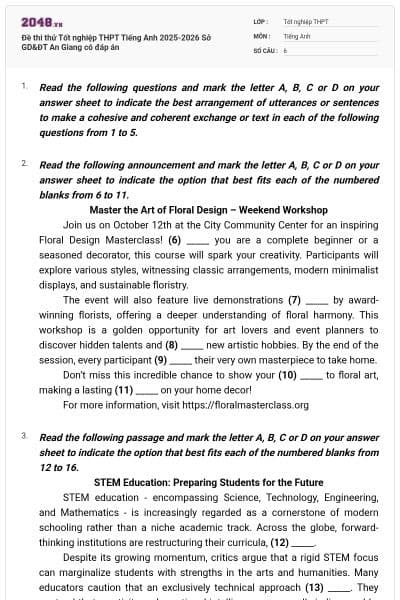
Mark the letter A, B, C or D on your answer sheet to indicate the best arrangement of utterances or sentences to make a cohesive and coherent exchange or text in each of the following questions from 1 to 5.
a. Alex: That’s true. We should be more careful about how much personal information we share online.
b. Mia: Exactly. Protecting our privacy has become more important than ever.
c. Mia: Have you ever thought about how much data we share on social media every day?
d. Alex: Yes, and sometimes we don’t even realize how it can be used by others.
e. Mia: I agree. It’s becoming harder to control who has access to our information.
a – d – c – e – b
a – c – d – e – b
c – e – d – a – b
c – d – e – a – b
Thứ tự sắp xếp đúng: D. c – d – e – a – b
c. Mia: Have you ever thought about how much data we share on social media every day?
d. Alex: Yes, and sometimes we don’t even realize how it can be used by others.
e. Mia: I agree. It’s becoming harder to control who has access to our information.
a. Alex: That’s true. We should be more careful about how much personal information we share online.
b. Mia: Exactly. Protecting our privacy has become more important than ever.
Dịch nghĩa:
c. Mia: Cậu có bao giờ nghĩ về việc chúng ta chia sẻ bao nhiêu dữ liệu trên mạng xã hội mỗi ngày không?
d. Alex: Có chứ, và đôi khi chúng ta thậm chí không nhận ra nó có thể bị người khác sử dụng như thế nào.
e. Mia: Tớ đồng ý. Ngày càng khó kiểm soát ai có quyền truy cập vào thông tin của chúng ta.
a. Alex: Đúng vậy. Chúng ta nên cẩn thận hơn về lượng thông tin cá nhân mà chúng ta chia sẻ trực tuyến.
b. Mia: Chính xác. Việc bảo vệ quyền riêng tư của chúng ta đã trở nên quan trọng hơn bao giờ hết.
Chọn D.
a. Because of this, I often left tasks unfinished and felt frustrated with my progress.
b. Eventually, I realized that I needed to set clear goals and manage my time better.
c. At the beginning of the course, I believed that I could complete assignments easily without much effort.
d. Looking back, I understand that discipline and planning are essential for success.
e. During my first semester, I struggled to keep up with my academic workload.
c – b – a – e – d
e – c – a – b – d
c – a – e – b – d
e – a – c – b – d
Thứ tự sắp xếp đúng: B. e – c – a – b – d
e. During my first semester, I struggled to keep up with my academic workload.
c. At the beginning of the course, I believed that I could complete assignments easily without much effort.
a. Because of this, I often left tasks unfinished and felt frustrated with my progress.
b. Eventually, I realized that I needed to set clear goals and manage my time better.
d. Looking back, I understand that discipline and planning are essential for success.
Dịch nghĩa:
e. Trong học kỳ đầu tiên, tôi đã phải vật lộn để theo kịp khối lượng công việc học tập của mình.
c. Vào đầu khóa học, tôi tin rằng mình có thể hoàn thành các bài tập một cách dễ dàng mà không cần nhiều nỗ lực.
a. Vì điều này, tôi thường bỏ dở các nhiệm vụ và cảm thấy thất vọng với sự tiến bộ của bản thân.
b. Cuối cùng, tôi nhận ra rằng mình cần phải đặt ra những mục tiêu rõ ràng và quản lý thời gian tốt hơn.
d. Nhìn lại, tôi hiểu rằng kỷ luật và việc lập kế hoạch là những điều thiết yếu để thành công.
Chọn B.
a. Huy: Yeah, you’re right but I need to finish my assignment by Friday.
b. Trang: I see, but it’s better to take a short break. It might help you stay focused.
c. Trang: You’ve been sitting at your desk all day. Don’t you feel tired?
a – b – c
c – b – a
c – a – b
b – c – a
Thứ tự sắp xếp đúng: C. c – a – b
c. Trang: You’ve been sitting at your desk all day. Don’t you feel tired?
a. Huy: Yeah, you’re right but I need to finish my assignment by Friday.
b. Trang: I see, but it’s better to take a short break. It might help you stay focused.
Dịch nghĩa:
c. Trang: Cậu đã ngồi ở bàn làm việc cả ngày rồi. Cậu không thấy mệt sao?
a. Huy: Ừ, cậu nói đúng nhưng tớ cần phải hoàn thành bài tập của mình trước thứ Sáu.
b. Trang: Tớ hiểu, nhưng tốt hơn là cậu nên nghỉ ngơi một chút. Nó có thể giúp cậu duy trì sự tập trung.
Chọn C.
a. These developments clearly highlight how human activities are increasingly shaping environmental conditions on a global scale.
b. As a result, more people are becoming aware of the urgent need to adopt sustainable practices in their daily lives.
c. In recent decades, environmental issues such as climate change and resource depletion have attracted growing international attention.
d. For instance, rising global temperatures, melting ice caps, and more frequent extreme weather events are being reported worldwide.
e. This growing awareness has encouraged governments, organizations, and individuals to take more responsibility for protecting the environment.
c – b – d – e – a
c – d – e – b – a
c – d – b – e – a
c – e – d – b – a
Thứ tự sắp xếp đúng: C. c – d – b – e – a
c. In recent decades, environmental issues such as climate change and resource depletion have attracted growing international attention.
d. For instance, rising global temperatures, melting ice caps, and more frequent extreme weather events are being reported worldwide.
b. As a result, more people are becoming aware of the urgent need to adopt sustainable practices in their daily lives.
e. This growing awareness has encouraged governments, organizations, and individuals to take more responsibility for protecting the environment.
a. These developments clearly highlight how human activities are increasingly shaping environmental conditions on a global scale.
Dịch nghĩa:
c. Trong những thập kỷ gần đây, các vấn đề môi trường như biến đổi khí hậu và cạn kiệt tài nguyên đã thu hút sự chú ý ngày càng tăng của quốc tế.
d. Ví dụ, nhiệt độ toàn cầu tăng lên, các chỏm băng tan chảy và các hiện tượng thời tiết cực đoan xảy ra thường xuyên hơn đang được báo cáo trên toàn thế giới.
b. Kết quả là, ngày càng có nhiều người nhận thức được nhu cầu cấp bách phải áp dụng các thực hành bền vững trong cuộc sống hàng ngày của họ.
e. Nhận thức ngày càng tăng này đã khuyến khích các chính phủ, tổ chức và cá nhân chịu trách nhiệm nhiều hơn trong việc bảo vệ môi trường.
a. Những sự phát triển này làm nổi bật rõ ràng cách thức các hoạt động của con người đang ngày càng định hình các điều kiện môi trường trên quy mô toàn cầu.
Chọn C.
Dear Ms Johnson,
a. I would be grateful if you could provide me with further details about the application process.
b. I am writing to express my interest in the internship program offered by your company.
c. I believe this opportunity would allow me to develop my professional skills.
d. I have recently completed my studies in business administration.
e. Thank you for your time and consideration. I look forward to your reply.
d – b – c – a – e
b – c – d – a – e
b – d – c – a – e
d – c – b – a – e
Thứ tự sắp xếp đúng: C. b – d – c – a – e
b. I am writing to express my interest in the internship program offered by your company.
d. I have recently completed my studies in business administration.
c. I believe this opportunity would allow me to develop my professional skills.
a. I would be grateful if you could provide me with further details about the application process.
e. Thank you for your time and consideration. I look forward to your reply.
Dịch nghĩa:
Kính gửi cô Johnson,
b. Tôi viết thư này để bày tỏ sự quan tâm của mình đối với chương trình thực tập do công ty của cô cung cấp.
d. Tôi vừa mới hoàn thành chương trình học về quản trị kinh doanh.
c. Tôi tin rằng cơ hội này sẽ cho phép tôi phát triển các kỹ năng chuyên môn của mình.
a. Tôi sẽ rất biết ơn nếu cô có thể cung cấp cho tôi thêm thông tin chi tiết về quy trình nộp đơn.
e. Cảm ơn cô đã dành thời gian và xem xét. Tôi rất mong nhận được hồi âm từ cô.
Chọn C.
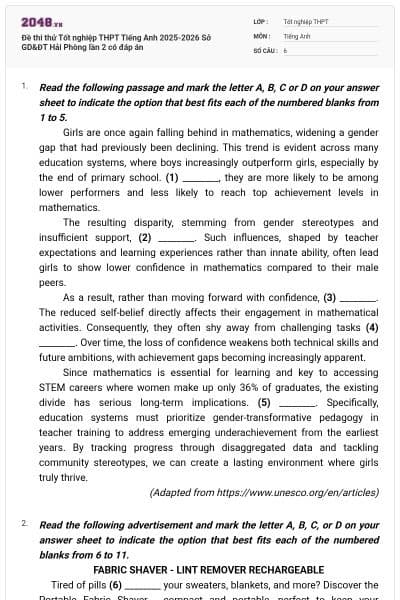
Read the following passage and mark the letter A, B, C or D on your answer sheet to indicate the option that best fits each of the numbered blanks from 6 to 10.
The rapid expansion of modern cities has fundamentally transformed our living environment, but it has also led to several urban challenges, such as overcrowding, air pollution, or (6) _____. We ask ourselves whether our health would be at risk in such environments, whether environmental degradation is inevitable, and how serious the consequences might be for future generations. Some urban planners, of course, prioritize green infrastructure, as this provides a cooling effect and improves air quality, (7) _____. Others, however, focus on high-density development and minimize open spaces wherever possible. Clearly, the availability of land will be a key factor. (8) _____. Planners with limited land will build upwards or integrate rooftop gardens and vertical forests rather than expanding into natural habitats. (9) _____. There is evidence that much of the continuing resistance shown by some developers to include green spaces in new projects (10) _____ and the prevailing mindset prioritizing immediate financial returns that favors short-term financial profit over long-term environmental sustainability.
residents are exposed to environmental risks regularly
because residents face difficulty accessing clean air
the constant exposure to excessive noise pollution
to experience higher and higher levels of daily stress
Câu chứa khoảng trống sử dụng cấu trúc liệt kê với cụm từ “such as” (như là): “...such as overcrowding, air pollution, or (6) _____.” Theo quy tắc cấu trúc song song (Parallelism), các thành phần được liệt kê phải đồng nhất về từ loại. Vì “overcrowding” (tình trạng quá tải) và “air pollution” (ô nhiễm không khí) đều là các cụm danh từ (Noun phrases), khoảng trống (6) cũng bắt buộc phải là một cụm danh từ.
Dịch nghĩa/Ngữ pháp:
A. residents are exposed... (Đây là một mệnh đề hoàn chỉnh S+V → Sai ngữ pháp).
B. because residents face... (Mệnh đề chỉ nguyên nhân → Sai ngữ pháp).
C. việc thường xuyên tiếp xúc với ô nhiễm tiếng ồn quá mức (Đây là một cụm danh từ hoàn chỉnh, bắt đầu bằng danh từ “the constant exposure”, hoàn toàn khớp với cấu trúc liệt kê và phù hợp về mặt ý nghĩa đối với các “thách thức đô thị” (urban challenges)).
D. to experience... (Động từ nguyên mẫu có “to” → Sai ngữ pháp).
Đáp án C là lựa chọn duy nhất tuân thủ quy tắc cấu trúc song song, duy trì tính mạch lạc của câu liệt kê.
Chọn C.
→ ...but it has also led to several urban challenges, such as overcrowding, air pollution, or the constant exposure to excessive noise pollution.
Dịch nghĩa: ...nhưng nó cũng đã dẫn đến một số thách thức đô thị, chẳng hạn như tình trạng quá tải, ô nhiễm không khí, hay việc thường xuyên tiếp xúc với ô nhiễm tiếng ồn quá mức.
making urban environments more livable and comfortable
while some people question its long-term effectiveness
although it may require significant financial investment
but it is not always considered a practical solution to invest in
Mệnh đề đi trước khoảng trống (7) mô tả những tác động tích cực của cơ sở hạ tầng xanh (green infrastructure): “...provides a cooling effect and improves air quality...” (...mang lại hiệu ứng làm mát và cải thiện chất lượng không khí...). Vị trí (7) nằm sau dấu phẩy, dùng để bổ sung thông tin chỉ kết quả tự nhiên của những tác động tích cực vừa được nêu.
Dịch nghĩa/Ngữ pháp:
A. làm cho môi trường đô thị trở nên đáng sống và thoải mái hơn (Sử dụng Hiện tại phân từ “making” rút gọn mệnh đề chỉ kết quả. Việc “làm mát và cải thiện không khí” dẫn đến kết quả môi trường “đáng sống hơn”. Rất hợp logic và nối tiếp mạch văn tích cực).
B. trong khi một số người đặt câu hỏi về hiệu quả lâu dài của nó (Câu tiếp theo bắt đầu bằng “Others, however, focus on...” (Tuy nhiên, những người khác lại tập trung vào...) tạo sự đối lập giữa hai nhóm người. Việc chèn thêm một sự đối lập (while) ở đây sẽ làm gãy cấu trúc so sánh tương phản chính của đoạn).
C. mặc dù nó có thể đòi hỏi đầu tư... (Sai logic tương tự B).
D. nhưng nó không phải lúc nào cũng được coi là... (Sai logic tương tự B).
Đáp án A cung cấp một mệnh đề phân từ V-ing đóng vai trò chỉ hệ quả tất yếu, củng cố thêm luận điểm ủng hộ “cơ sở hạ tầng xanh” trước khi tác giả chuyển sang góc nhìn đối lập ở câu sau.
Chọn A.
→ Some urban planners, of course, prioritize green infrastructure, as this provides a cooling effect and improves air quality, making urban environments more livable and comfortable.
Dịch nghĩa: Tất nhiên, một số nhà quy hoạch đô thị ưu tiên cơ sở hạ tầng xanh, vì điều này mang lại hiệu ứng làm mát và cải thiện chất lượng không khí, làm cho môi trường đô thị trở nên đáng sống và thoải mái hơn.
As a result, different strategies will be adopted accordingly
In contrast, urban populations are increasing rapidly worldwide
For instance, land use regulations are strictly enforced worldwide
Similarly, environmental awareness is growing among citizens
Câu ngay trước đó khẳng định: “Clearly, the availability of land will be a key factor.” (Rõ ràng, sự sẵn có của quỹ đất sẽ là một yếu tố then chốt). Câu liền sau chỗ trống đưa ra một ví dụ về chiến lược đối phó: “Planners with limited land will build upwards or integrate rooftop gardens...” (Các nhà quy hoạch có quỹ đất hạn chế sẽ xây dựng hướng lên cao hoặc tích hợp các khu vườn trên mái...).
Khoảng trống (8) cần một câu cầu nối (transition) suy ra hệ quả từ việc “quỹ đất là yếu tố then chốt”, trước khi đưa ra ví dụ cụ thể.
Dịch nghĩa:
A. Kết quả là, các chiến lược khác nhau sẽ được áp dụng tương ứng (Từ “As a result” tạo quan hệ nhân quả chuẩn xác: vì đất đai là yếu tố then chốt → chiến lược phải đa dạng tùy theo đất. Câu tiếp theo minh họa ngay cho chiến lược khi “đất hạn chế”. Hoàn toàn logic).
B. Ngược lại, dân số đô thị đang tăng nhanh... (Lạc đề, không liên quan đến quỹ đất và thiết kế).
C. Ví dụ, các quy định sử dụng đất được thực thi nghiêm ngặt... (Sai logic, đoạn này đang nói về giải pháp kiến trúc, không phải luật pháp).
D. Tương tự, nhận thức về môi trường đang tăng... (Lạc đề).
Đáp án A đóng vai trò là câu chủ đề phụ, nối kết mượt mà giữa nguyên nhân cốt lõi (quỹ đất) và giải pháp thực tế (xây nhà cao tầng/vườn trên mái).
Chọn A.
→ Clearly, the availability of land will be a key factor. As a result, different strategies will be adopted accordingly. Planners with limited land will build upwards...
Dịch nghĩa: Rõ ràng, sự sẵn có của quỹ đất sẽ là một yếu tố then chốt. Kết quả là, các chiến lược khác nhau sẽ được áp dụng tương ứng. Các nhà quy hoạch có quỹ đất hạn chế sẽ xây dựng hướng lên cao...
Construction speed is also a factor in the successful completion of urban projects.
Economic pressure is also a factor influencing developers’ decisions to limit parks.
Population growth is also a factor affecting the demand for affordable housing units.
Technological innovation is also a factor shaping the style of modern architecture.
Vị trí (9) nằm trước một câu giải thích về động cơ của giới phát triển dự án: “There is evidence that much of the continuing resistance shown by some developers to include green spaces... [is due to] the prevailing mindset prioritizing immediate financial returns that favors short-term financial profit...” (...sự phản đối liên tục của một số nhà phát triển đối với việc đưa không gian xanh vào... [là do] tư duy ưu tiên lợi nhuận tài chính ngắn hạn...).
Từ khóa “financial returns” (lợi nhuận tài chính) và “financial profit” chỉ ra rằng khoảng trống (9) phải đưa ra khía cạnh kinh tế/tài chính.
Dịch nghĩa:
A. Tốc độ xây dựng cũng là một yếu tố... (Không khớp với nội dung về lợi nhuận tài chính ở câu sau).
B. Áp lực kinh tế cũng là một yếu tố ảnh hưởng đến quyết định hạn chế công viên của các nhà phát triển. (Cụm “Economic pressure” bao quát ý “financial returns/profit” ở câu sau. Việc “limit parks” tương đồng với “resistance... to include green spaces”. Cấu trúc câu này cũng song song với ý “yếu tố then chốt” ở đoạn trên).
C. Tăng trưởng dân số cũng là một yếu tố... (Lạc đề).
D. Đổi mới công nghệ cũng là một yếu tố... (Lạc đề).
Đáp án B là câu mở ý lý tưởng để dẫn dắt người đọc vào lý do kinh tế khiến các nhà đầu tư không muốn xây công viên (được giải thích ở câu cuối).
Chọn B.
→ Economic pressure is also a factor influencing developers’ decisions to limit parks. There is evidence that much of the continuing resistance shown by some developers...
Dịch nghĩa: Áp lực kinh tế cũng là một yếu tố ảnh hưởng đến quyết định hạn chế công viên của các nhà phát triển. Có bằng chứng cho thấy phần lớn sự phản đối liên tục của một số nhà phát triển...
being attributed to the high cost of maintenance
which can be attributed to the high cost of maintenance
is greatly attributing to the high cost of maintenance
can be attributed to the high cost of maintenance
Câu văn có cấu trúc khá phức tạp: “There is evidence that [much of the continuing resistance... in new projects] (10) _____ and [the prevailing mindset...]”.
Phía sau từ “that” là một mệnh đề danh từ. Chủ ngữ của mệnh đề này là cụm từ rất dài: “much of the continuing resistance shown by some developers to include green spaces in new projects” (phần lớn sự phản đối liên tục của một số nhà phát triển trong việc đưa không gian xanh vào các dự án mới).
Khoảng trống (10) đang thiếu động từ chính (Main verb) cho chủ ngữ này. Đồng thời, cấu trúc ở đây là được quy cho [Lý do A] and [Lý do B].
Dịch nghĩa/Ngữ pháp:
A. being attributed... (Hiện tại phân từ (V-ing) → Thiếu động từ chính để tạo thành mệnh đề hoàn chỉnh sau “that”).
B. which can be attributed... (Mệnh đề quan hệ bắt đầu bằng “which” → Tiếp tục làm câu bị thiếu động từ chính).
C. is greatly attributing to... (Chia thể chủ động là sai. Sự phản đối không tự đi “quy cho” cái gì, mà nó “được quy cho” (bị động) nguyên nhân nào đó).
D. có thể được quy cho chi phí bảo trì cao (Cung cấp cụm động từ chính “can be attributed to” ở thể bị động. Cấu trúc câu trở nên hoàn chỉnh: Sự phản đối có thể được quy cho [chi phí bảo trì cao] (Lý do A) và [tư duy ưu tiên lợi nhuận...] (Lý do B)).
Đáp án D cung cấp đúng động từ chính mang thể bị động, kết nối hai nguyên nhân (cost of maintenance và prevailing mindset) dẫn đến sự ngần ngại của các nhà phát triển.
Chọn D.
→ There is evidence that much of the continuing resistance shown by some developers to include green spaces in new projects can be attributed to the high cost of maintenance and the prevailing mindset...
Dịch nghĩa: Có bằng chứng cho thấy phần lớn sự phản đối liên tục của một số nhà phát triển trong việc đưa không gian xanh vào các dự án mới có thể được quy cho chi phí bảo trì cao và tư duy phổ biến ưu tiên lợi nhuận tài chính tức thời...
Bài đọc hoàn chỉnh | Dịch bài đọc |
The rapid expansion of modern cities has fundamentally transformed our living environment, but it has also led to several urban challenges, such as overcrowding, air pollution, or the constant exposure to excessive noise pollution. We ask ourselves whether our health would be at risk in such environments, whether environmental degradation is inevitable, and how serious the consequences might be for future generations. Some urban planners, of course, prioritize green infrastructure, as this provides a cooling effect and improves air quality, making urban environments more livable and comfortable. Others, however, focus on high-density development and minimize open spaces wherever possible. Clearly, the availability of land will be a key factor. As a result, different strategies will be adopted accordingly. Planners with limited land will build upwards or integrate rooftop gardens and vertical forests rather than expanding into natural habitats. Economic pressure is also a factor influencing developers’ decisions to limit parks. There is evidence that much of the continuing resistance shown by some developers to include green spaces in new projects can be attributed to the high cost of maintenance and the prevailing mindset prioritizing immediate financial returns that favors short-term financial profit over long-term environmental sustainability. | Sự mở rộng nhanh chóng của các thành phố hiện đại đã làm thay đổi căn bản môi trường sống của chúng ta, nhưng nó cũng dẫn đến một số thách thức đô thị, chẳng hạn như tình trạng quá tải, ô nhiễm không khí, hay việc thường xuyên tiếp xúc với ô nhiễm tiếng ồn quá mức. Chúng ta tự hỏi liệu sức khỏe của mình có gặp rủi ro trong những môi trường như vậy hay không, liệu sự suy thoái môi trường có phải là điều không thể tránh khỏi, và những hậu quả đối với các thế hệ tương lai có thể nghiêm trọng đến mức nào. Tất nhiên, một số nhà quy hoạch đô thị ưu tiên cơ sở hạ tầng xanh, vì điều này mang lại hiệu ứng làm mát và cải thiện chất lượng không khí, làm cho môi trường đô thị trở nên đáng sống và thoải mái hơn. Tuy nhiên, những người khác lại tập trung vào phát triển mật độ cao và thu hẹp không gian mở ở bất cứ nơi nào có thể. Rõ ràng, sự sẵn có của quỹ đất sẽ là một yếu tố then chốt. Kết quả là, các chiến lược khác nhau sẽ được áp dụng tương ứng. Các nhà quy hoạch có quỹ đất hạn chế sẽ xây dựng hướng lên cao hoặc tích hợp các khu vườn trên mái nhà và những khu rừng thẳng đứng thay vì mở rộng vào các môi trường sống tự nhiên. Áp lực kinh tế cũng là một yếu tố ảnh hưởng đến quyết định hạn chế công viên của các nhà phát triển. Có bằng chứng cho thấy phần lớn sự phản đối liên tục của một số nhà phát triển trong việc đưa không gian xanh vào các dự án mới có thể được quy cho chi phí bảo trì cao và tư duy phổ biến ưu tiên lợi nhuận tài chính tức thời, coi trọng lợi nhuận tài chính ngắn hạn hơn sự bền vững môi trường dài hạn. |
Read the following leaflet and mark the letter A, B, C or D on your answer sheet to indicate the option that best fits each of the numbered blanks from 11 to 16.
DISCOVER THE TRUE RHYTHM OF THE COUNTRYSIDE
Are you dreaming of a tranquil (11) _____ where you can enjoy a slower pace of life and avoid crowded tourist areas? Join our “Village Life” retreat to experience the peaceful atmosphere of the Mekong Delta. We promise:
- Authentic Living: We provide a (12) _____ for those who want to escape the city noise and reconnect with nature.
- Daily Discovery: Start the day by learning how to plant wet rice, then our local hosts will help you learn (13) _____ traditional farming techniques in a friendly and educational environment.
- Direct Care: (14) _____ our tour groups are very small, you will receive personalized attention from your guide throughout the journey.
- Boat Safety: However, you must listen to the safety briefing carefully before getting (15) _____ the wooden boats to explore the canals.
- Policy: If you lose the equipment provided during your stay, please inform the staff immediately so we can (16) _____ it for you.
itinerary
getaway
departure
heritage
A. itinerary (n): lịch trình, hành trình.
B. getaway (n): kỳ nghỉ ngắn, nơi nghỉ dưỡng (nơi để trốn khỏi sự ồn ào, bận rộn).
C. departure (n): sự khởi hành.
D. heritage (n): di sản.
Phân tích ngữ cảnh: Phía sau có mệnh đề “where you can enjoy a slower pace of life...” (nơi bạn có thể tận hưởng nhịp sống chậm hơn). Từ “getaway” rất phù hợp để chỉ một địa điểm hoặc một chuyến đi nghỉ ngơi, trốn khỏi sự xô bồ của thành phố.
Chọn B. getaway
→ Are you dreaming of a tranquil getaway where you can enjoy a slower pace of life...
Dịch nghĩa: Bạn có đang mơ về một kỳ nghỉ (nơi trốn) yên tĩnh, nơi bạn có thể tận hưởng nhịp sống chậm hơn...
experience special cultural
special cultural experience
cultural experience special
cultural special experience
Phân tích trật tự từ: Cụm danh từ này có danh từ chính là “experience” (trải nghiệm) nên bắt buộc phải đứng cuối cùng. Phía trước nó là hai tính từ: “special” (đặc biệt) chỉ quan điểm/đánh giá chung, và “cultural” (thuộc về văn hóa) chỉ phân loại/nguồn gốc. Theo quy tắc trật tự tính từ, tính từ chỉ quan điểm phải đứng trước tính từ phân loại. Trật tự đúng là: Tính từ (Opinion) + Tính từ (Type) + Danh từ chính.
Chọn B. special cultural experience
→ We provide a special cultural experience for those who want to escape the city noise...
Dịch nghĩa: Chúng tôi mang đến một trải nghiệm văn hóa đặc biệt cho những ai muốn thoát khỏi sự ồn ào của thành phố...
each
another
other
others
A. each: mỗi (+ danh từ đếm được số ít).
B. another: một (người/vật) khác (+ danh từ đếm được số ít).
C. other: những (người/vật) khác (tính từ, đi kèm danh từ đếm được số nhiều hoặc không đếm được).
D. others: những người/vật khác (đại từ, đứng độc lập không đi kèm danh từ).
Phía sau khoảng trống là cụm danh từ đếm được ở dạng số nhiều “traditional farming techniques” (các kỹ thuật canh tác truyền thống). Do đó, ta bắt buộc phải dùng tính từ “other” để bổ nghĩa.
Chọn C. other
→ ...then our local hosts will help you learn other traditional farming techniques...
Dịch nghĩa: ...sau đó những người chủ nhà địa phương của chúng tôi sẽ giúp bạn học những kỹ thuật canh tác truyền thống khác...
Because
Despite
But
Though
A. Because (conj): Bởi vì (+ mệnh đề).
B. Despite (prep): Mặc dù (+ cụm danh từ / V-ing).
C. But (conj): Nhưng (dùng nối 2 mệnh đề, không đứng đầu câu trong ngữ cảnh này).
D. Though (conj): Mặc dù (+ mệnh đề).
Khoảng trống đứng trước một mệnh đề hoàn chỉnh “our tour groups are very small” (các nhóm tham quan của chúng tôi rất nhỏ). Mệnh đề này đóng vai trò là nguyên nhân dẫn đến kết quả ở vế sau (“bạn sẽ nhận được sự quan tâm mang tính cá nhân hóa”). Mối quan hệ nguyên nhân - kết quả này yêu cầu liên từ “Because”.
Chọn A. Because
→ Because our tour groups are very small, you will receive personalized attention...
Dịch nghĩa: Bởi vì các nhóm tham quan của chúng tôi rất nhỏ, bạn sẽ nhận được sự quan tâm mang tính cá nhân hóa...
at
for
on
with
A. at (prep): tại, ở.
B. for (prep): cho.
C. on (prep): trên.
D. with (prep): với.
Ta có cụm động từ (phrasal verb) cố định: get on (a boat/a train/a bus): lên thuyền, lên tàu, lên xe buýt.
Chọn C. on
→ ...you must listen to the safety briefing carefully before getting on the wooden boats to explore the canals.
Dịch nghĩa: ...bạn phải lắng nghe kỹ phần hướng dẫn an toàn trước khi lên trên những chiếc thuyền gỗ để khám phá các con kênh.
replacing
to replace
replace
replaced
A. replacing (v-ing): hiện tại phân từ / danh động từ.
B. to replace (to-v): động từ nguyên thể có “to”.
C. replace (v): động từ nguyên mẫu.
D. replaced (v-ed): quá khứ phân từ / thì quá khứ đơn.
Phía trước khoảng trống là động từ khuyết thiếu “can” (có thể). Theo quy tắc ngữ pháp cơ bản, sau động từ khuyết thiếu (can, could, will, would, should, may, might...) luôn là một động từ ở dạng nguyên mẫu không “to” (V-inf).
Chọn C. replace
→ ...please inform the staff immediately so we can replace it for you.
Dịch nghĩa: ...vui lòng thông báo cho nhân viên ngay lập tức để chúng tôi có thể thay thế nó cho bạn.
Bài đọc hoàn chỉnh | Dịch bài đọc |
DISCOVER THE TRUE RHYTHM OF THE COUNTRYSIDE Are you dreaming of a tranquil (11) getaway where you can enjoy a slower pace of life and avoid crowded tourist areas? Join our “Village Life” retreat to experience the peaceful atmosphere of the Mekong Delta. We promise:
| KHÁM PHÁ NHỊP SỐNG ĐÍCH THỰC CỦA VÙNG NÔNG THÔN Bạn có đang mơ về một (11) kỳ nghỉ (nơi trốn) yên tĩnh, nơi bạn có thể tận hưởng nhịp sống chậm hơn và tránh xa các khu du lịch đông đúc? Hãy tham gia chuyến nghỉ dưỡng “Đời sống Làng quê” của chúng tôi để trải nghiệm bầu không khí thanh bình của Đồng bằng sông Cửu Long. Chúng tôi cam kết:
|
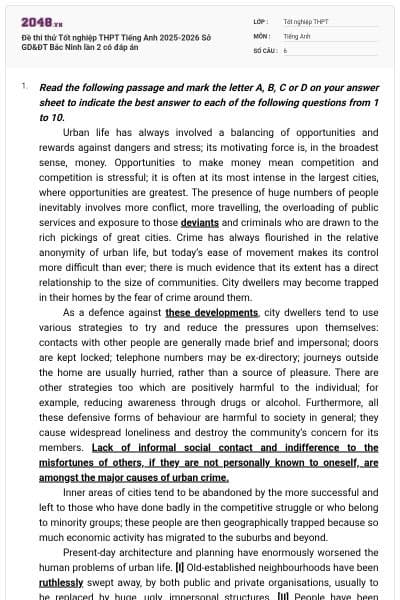
Read the passage and mark the letter A, B, C or D on your answer sheet to indicate the best answer to each of the following questions from 17 to 26.
The digital revolution has brought about a widespread presence of music, changing the essential nature of music from a special artistic object to a common background service. While streaming platforms celebrate the “democratization” of sound, this large amount of music often hides a worrying trend: the change of music into a commercialized product. In the past, listening to an album was often a special ritual; today, it is frequently reduced to a stream of data designed to fill the silence of our daily travel or housework.
As algorithms choose tracks to suit specific moods or activities, the historical and cultural background of a song is often removed [I]. A protest song or a religious hymn may be placed in a “mellow” playlist simply because its speed is slow, ignoring the message and intent of the creator. This leaves behind a short-lived auditory experience that requires almost no thinking from the listener, as the machine decides what is important [II]. The depth of the music is ignored in favor of its basic utility, leading to a superficial connection with art.
[III]. Central to this shift is the rise of the “skip-rate” as the main way to measure musical value. In the digital era, a song must capture the listener’s interest within the first few seconds to survive, and artists often sacrifice creative complexity for it. This pressure to be instantly satisfying means that slow introductions or complex instrumental parts are often taken out. Consequently, the once-vibrant landscape of musical subcultures is being flattened into a single stream of optimized sounds. The “middle ground” of music—experimentally yet easy to listen to—is disappearing, leaving only the very popular or the completely invisible.
Furthermore, the money-making models of large platforms give high rewards to global superstars while leaving independent creators with very small earnings. Under the current system, the money paid by a fan of an independent artist often goes into a large pool that rewards the most-played stars. This financial inequality is made worse by the loss of human control in music discovery: when a machine decides what is relevant, the natural connection between vision and soul is lost. The true cost of this algorithmic convenience may be the loss of our ability to listen deeply [IV]. To protect music as a human expression, we must become active listeners again.
The word “superficial” in paragraph 2 is closest in meaning to _____.
shallow
complex
deep
meaningful
Từ “superficial” ở đoạn 2 có nghĩa gần nhất với _____.
superficial (adj): hời hợt, nông cạn, trên bề mặt.
A. shallow (adj): nông cạn, hời hợt
B. complex (adj): phức tạp
C. deep (adj): sâu sắc
D. meaningful (adj): có ý nghĩa
→ superficial = shallow
Thông tin: The depth of the music is ignored in favor of its basic utility, leading to a superficial connection with art.
(Chiều sâu của âm nhạc bị phớt lờ để nhường chỗ cho tiện ích cơ bản của nó, dẫn đến một sự kết nối hời hợt với nghệ thuật.)
Chọn A.
The word “flattened” in paragraph 3 is OPPOSITE in meaning to _____.
compressed
simplified
diversified
leveled
Từ “flattened” ở đoạn 3 TRÁI NGHĨA với _____.
flattened (v-ed/P2): bị san phẳng, cào bằng (trong ngữ cảnh này là làm mất đi sự phong phú, đa dạng).
A. compressed (v-ed/P2): bị nén lại
B. simplified (v-ed/P2): bị đơn giản hóa
C. diversified (v-ed/P2): được đa dạng hóa (trái nghĩa)
D. leveled (v-ed/P2): được san bằng
→ flattened >< diversified
Thông tin: Consequently, the once-vibrant landscape of musical subcultures is being flattened into a single stream of optimized sounds.
(Hậu quả là, bức tranh từng rất sống động của các tiểu văn hóa âm nhạc đang bị cào bằng/san phẳng thành một luồng duy nhất của những âm thanh được tối ưu hóa.)
Chọn C.
Which of the following best summarises the passage?
While offering unprecedented global accessibility, the transition to digital ubiquity and algorithmic curation risks diminishing the cultural depth and human connection that define music.
Algorithmic curation tends to categorize tracks primarily to suit specific moods or daily activities, inadvertently stripping songs of their original historical and cultural backgrounds.
The digital revolution has turned music into a ubiquitous background service, sparking major concerns about the financial inequality between global superstars and independent artists.
The increasing reliance on the “skip-rate” metric across digital platforms forces modern artists to sacrifice creative complexity in exchange for immediate listener engagement.
Câu nào sau đây tóm tắt tốt nhất bài đọc?
A. Mặc dù mang lại khả năng tiếp cận toàn cầu chưa từng có, nhưng sự chuyển dịch sang tính phổ biến kỹ thuật số và sự tuyển chọn bằng thuật toán có nguy cơ làm suy giảm chiều sâu văn hóa và sự kết nối của con người - những yếu tố định nghĩa âm nhạc. (Đúng và bao quát toàn bộ bài: sự phổ biến kỹ thuật số (đoạn 1), thuật toán làm mất bối cảnh văn hóa (đoạn 2), làm giảm chiều sâu âm nhạc (đoạn 3), làm mất sự kết nối của con người (đoạn 4)).
B. Tuyển chọn bằng thuật toán có xu hướng phân loại các bài hát chủ yếu để phù hợp với tâm trạng hoặc hoạt động hàng ngày cụ thể, vô tình tước bỏ bối cảnh lịch sử và văn hóa ban đầu của các bài hát. (Chỉ tóm tắt đoạn 2).
C. Cuộc cách mạng kỹ thuật số đã biến âm nhạc thành một dịch vụ nền phổ biến, làm dấy lên những lo ngại lớn về sự bất bình đẳng tài chính giữa các siêu sao toàn cầu và các nghệ sĩ độc lập. (Chỉ tập trung vào đoạn 1 và đoạn 4, bỏ sót sự thay đổi về tư duy/cấu trúc nghệ thuật ở đoạn 2, 3).
D. Việc ngày càng phụ thuộc vào chỉ số "tỷ lệ bỏ qua" trên các nền tảng kỹ thuật số buộc các nghệ sĩ hiện đại phải hy sinh sự phức tạp sáng tạo để đổi lấy sự tương tác tức thì của người nghe. (Chỉ tóm tắt đoạn 3).
Chọn A.
The current “skip-rate” metric encourages musicians to prioritize immediate engagement over the structural and intellectual complexity of their compositions.
The revenue models currently employed by dominant digital platforms provide a fair and equitable financial distribution for both superstars and independent creators.
Algorithmic curation often involves removing the historical and cultural background of a song to make it fit into specific functional categories.
Streaming platforms have transitioned the status of music from a significant artistic object to a pervasive service that functions as background noise.
Theo bài đọc, điều nào sau đây KHÔNG đúng?
A. Chỉ số “tỷ lệ bỏ qua” hiện tại khuyến khích các nhạc sĩ ưu tiên sự tương tác tức thì hơn là sự phức tạp về cấu trúc và trí tuệ trong các tác phẩm của họ. (Đúng, theo đoạn 3).
B. Các mô hình doanh thu hiện được các nền tảng kỹ thuật số thống trị áp dụng cung cấp một sự phân phối tài chính công bằng và bình đẳng cho cả siêu sao và những nhà sáng tạo độc lập. (Sai, đoạn 4 nói rằng nó tạo ra “sự bất bình đẳng tài chính” - financial inequality).
C. Việc tuyển chọn bằng thuật toán thường bao gồm việc loại bỏ bối cảnh lịch sử và văn hóa của một bài hát để làm cho nó phù hợp với các danh mục chức năng cụ thể. (Đúng, theo đoạn 2).
D. Các nền tảng phát trực tuyến đã chuyển đổi trạng thái của âm nhạc từ một đối tượng nghệ thuật quan trọng thành một dịch vụ lan tràn hoạt động như tiếng ồn xung quanh. (Đúng, theo đoạn 1).
Thông tin (Đoạn 4): ...give high rewards to global superstars while leaving independent creators with very small earnings.
(...mang lại phần thưởng cao cho các siêu sao toàn cầu trong khi khiến những nhà sáng tạo độc lập chỉ có được thu nhập rất nhỏ.)
Chọn B.
It can be inferred from the passage that _____.
the current financial inequalities suggest that independent creators could regain their artistic soul and financial stability by completely returning to physical record sales
the heavy reliance on algorithmic recommendations may lead to a standardized musical landscape where unique and independent artistic voices struggle to be heard
the pressure created by the “skip-rate” metric indicates that complex instrumental parts are no longer technically compatible with modern digital streaming softwares
the transformation of music into a background service implies that modern composers now intentionally design their works specifically for daily travel and housework
Điều nào sau đây có thể được suy luận từ bài đọc?
A. Sự bất bình đẳng tài chính hiện tại cho thấy những người sáng tạo độc lập có thể lấy lại tâm hồn nghệ thuật và sự ổn định tài chính bằng cách quay hoàn toàn về việc bán đĩa vật lý. (Không được đề cập/suy luận trong bài).
B. Việc phụ thuộc nhiều vào các đề xuất thuật toán có thể dẫn đến một bối cảnh âm nhạc bị tiêu chuẩn hóa (cào bằng), nơi những tiếng nói nghệ thuật độc đáo và độc lập phải chật vật để được lắng nghe. (Đúng, suy ra từ việc âm nhạc bị “cào bằng thành một luồng duy nhất”, sự “biến mất của vùng trung dung”, và “bất bình đẳng tài chính”).
C. Áp lực do số liệu “tỷ lệ bỏ qua” tạo ra cho thấy các phần nhạc cụ phức tạp không còn tương thích về mặt kỹ thuật với các phần mềm phát trực tuyến kỹ thuật số hiện đại. (Sai, chúng bị loại bỏ vì người nghe thiếu kiên nhẫn, không phải vì lỗi kỹ thuật phần mềm).
D. Việc biến âm nhạc thành dịch vụ nền ngụ ý rằng các nhà soạn nhạc hiện đại giờ đây cố ý thiết kế các tác phẩm của họ dành riêng cho việc đi lại hàng ngày và làm việc nhà. (Sai, bài đọc nói rằng các thuật toán và thói quen nghe đã làm giảm giá trị của chúng, chứ không phải các nhà soạn nhạc ban đầu muốn vậy).
Chọn B.
Where in the passage does the following sentence best fit? “As a result, songs requiring deep attention are systematically marginalized.”
[III]
[II]
[IV]
[I]
Câu sau đây phù hợp nhất ở vị trí nào trong bài đọc?
“As a result, songs requiring deep attention are systematically marginalized.”
(Hậu quả là, những bài hát đòi hỏi sự tập trung sâu sắc bị gạt ra ngoài lề một cách có hệ thống.)
Phân tích:
- Câu liền trước vị trí [II]: “This leaves behind a short-lived auditory experience that requires almost no thinking from the listener, as the machine decides what is important [II].” (Điều này để lại một trải nghiệm thính giác ngắn ngủi hầu như không đòi hỏi người nghe phải suy nghĩ, vì máy móc quyết định điều gì là quan trọng.)
- Câu cần điền tiếp nối ý “không đòi hỏi suy nghĩ” bằng một hệ quả: “Hậu quả là, những bài hát đòi hỏi sự tập trung sâu sắc bị gạt ra ngoài lề...”.
- Câu liền sau đó: “The depth of the music is ignored...” (Chiều sâu của âm nhạc bị phớt lờ...). Sự liên kết về mặt ý nghĩa (không suy nghĩ → bài hát cần tập trung bị gạt bỏ → chiều sâu bị phớt lờ) là hợp lý.
Chọn B.
The word “it” in paragraph 1 refers to _____.
the digital revolution
a stream of data
a background service
listening to an album
Từ “it” ở đoạn 1 chỉ _____.
A. the digital revolution: cuộc cách mạng kỹ thuật số
B. a stream of data: một luồng dữ liệu
C. a background service: một dịch vụ nền
D. listening to an album: việc nghe một album
Thông tin: In the past, listening to an album was often a special ritual; today, it is frequently reduced to a stream of data...
(Trong quá khứ, việc nghe một album thường là một nghi thức đặc biệt; ngày nay, nó thường bị rút gọn thành một luồng dữ liệu...)
→ it = listening to an album.
Chọn D.
The positive connection between automated statistical algorithms and human soul.
The specific ways independent creators can easily compete with global superstars.
The financial inequality and the loss of genuine human connection in music discovery.
The technical operation of the “pro-rata” revenue system on digital platforms.
Trọng tâm chính của đoạn 4 là gì?
A. Mối liên hệ tích cực giữa các thuật toán thống kê tự động và tâm hồn con người. (Sai).
B. Những cách cụ thể mà các nhà sáng tạo độc lập có thể dễ dàng cạnh tranh với các siêu sao toàn cầu. (Sai).
C. Sự bất bình đẳng tài chính và sự mất mát kết nối thực sự của con người trong việc khám phá âm nhạc. (Đúng. Đoạn 4 nói về mô hình tiền tệ thưởng cho siêu sao để lại ít tiền cho nghệ sĩ độc lập, và sự mất kết nối giữa “tầm nhìn và tâm hồn” do máy móc kiểm soát).
D. Hoạt động kỹ thuật của hệ thống doanh thu “theo tỷ lệ” trên các nền tảng kỹ thuật số. (Không phải ý chính khái quát).
Chọn C.
Which of the following best paraphrases the underlined sentence in paragraph 4?
Reclaiming the transformative power of music requires a complete rejection of all modern automated services in favor of traditional methods of discovery.
Algorithmic convenience is the only tool we have to ensure that deep listening remains a core component of the modern musical experience.
The ease of using algorithms might cause us to lose our ability to listen to music with focus and understand its deeper meanings.
The financial success of the digital music industry is directly linked to the listener’s capacity for intentional engagement with complex artistic expressions.
Câu nào sau đây diễn giải tốt nhất câu được gạch chân ở đoạn 4?
“The true cost of this algorithmic convenience may be the loss of our ability to listen deeply.”
(Cái giá thực sự của sự tiện lợi bằng thuật toán này có thể là sự đánh mất khả năng nghe sâu của chúng ta.)
Dịch nghĩa:
A. Việc đòi lại sức mạnh biến đổi của âm nhạc đòi hỏi phải từ chối hoàn toàn tất cả các dịch vụ tự động hiện đại để ủng hộ các phương pháp khám phá truyền thống. (Sai nghĩa).
B. Sự tiện lợi của thuật toán là công cụ duy nhất chúng ta có để đảm bảo rằng việc nghe sâu vẫn là một thành phần cốt lõi của trải nghiệm âm nhạc hiện đại. (Sai nghĩa).
C. Sự dễ dàng trong việc sử dụng các thuật toán có thể khiến chúng ta mất đi khả năng nghe nhạc có sự tập trung và hiểu được những ý nghĩa sâu sắc hơn của nó. (Đúng và sát nghĩa nhất: true cost = cause us to lose; algorithmic convenience = ease of using algorithms; listen deeply = listen to music with focus and understand its deeper meanings).
D. Thành công tài chính của ngành công nghiệp âm nhạc kỹ thuật số gắn liền trực tiếp với khả năng tương tác có chủ ý của người nghe đối với các biểu đạt nghệ thuật phức tạp. (Sai nghĩa).
Chọn C.
According to the passage, what happens under the current money-making models of large platforms?
It ensures that every artist receives a fair share of the subscription fees paid specifically by their own dedicated listeners.
It provides independent creators with the financial resources necessary to experiment with longer and more complex musical compositions.
It encourages listeners to spend more time exploring obscure genres by offering financial incentives for discovering new independent artists.
Money paid by fans of niche artists is often pooled together to reward the most-played global superstars on the platform.
Theo bài đọc, điều gì xảy ra dưới các mô hình kiếm tiền hiện tại của các nền tảng lớn?
A. Nó đảm bảo rằng mọi nghệ sĩ đều nhận được một phần công bằng từ các khoản phí đăng ký do những người nghe tận tâm của chính họ trả. (Sai).
B. Nó cung cấp cho các nhà sáng tạo độc lập các nguồn lực tài chính cần thiết để thử nghiệm các tác phẩm âm nhạc dài hơn và phức tạp hơn. (Sai).
C. Nó khuyến khích người nghe dành nhiều thời gian hơn để khám phá các thể loại ít người biết bằng cách cung cấp các ưu đãi tài chính. (Sai).
D. Tiền do những người hâm mộ của các nghệ sĩ ngách (độc lập) trả thường được gộp chung lại để thưởng cho các siêu sao toàn cầu được phát nhiều nhất trên nền tảng. (Đúng).
Thông tin (Đoạn 4): Under the current system, the money paid by a fan of an independent artist often goes into a large pool that rewards the most-played stars.
(Theo hệ thống hiện tại, số tiền mà một người hâm mộ của một nghệ sĩ độc lập chi trả thường đi vào một quỹ chung lớn để thưởng cho những ngôi sao được phát nhiều nhất.)
Chọn D.
Dịch bài đọc:
Cuộc cách mạng kỹ thuật số đã mang lại sự hiện diện lan tràn của âm nhạc, làm thay đổi bản chất cốt lõi của âm nhạc từ một đối tượng nghệ thuật đặc biệt thành một dịch vụ nền phổ biến. Mặc dù các nền tảng phát trực tuyến tôn vinh sự “dân chủ hóa” âm thanh, một lượng lớn âm nhạc này thường che giấu một xu hướng đáng lo ngại: sự biến đổi của âm nhạc thành một sản phẩm thương mại hóa. Trong quá khứ, việc nghe một album thường là một nghi thức đặc biệt; ngày nay, nó thường bị rút gọn thành một luồng dữ liệu được thiết kế để lấp đầy sự im lặng trong những lúc chúng ta đi lại hàng ngày hoặc làm việc nhà.
Khi các thuật toán chọn các bài hát để phù hợp với những tâm trạng hoặc hoạt động cụ thể, bối cảnh lịch sử và văn hóa của một bài hát thường bị loại bỏ [I]. Một bài hát phản đối hoặc một bài thánh ca tôn giáo có thể được đưa vào danh sách phát “êm dịu” chỉ vì tốc độ của nó chậm, phớt lờ đi thông điệp và ý định của người sáng tạo. Điều này để lại một trải nghiệm thính giác ngắn ngủi hầu như không đòi hỏi người nghe phải suy nghĩ, vì máy móc quyết định điều gì là quan trọng [II]. Hậu quả là, những bài hát đòi hỏi sự tập trung sâu sắc bị gạt ra ngoài lề một cách có hệ thống. Chiều sâu của âm nhạc bị phớt lờ để nhường chỗ cho tiện ích cơ bản của nó, dẫn đến một sự kết nối hời hợt với nghệ thuật.
[III] Trung tâm của sự thay đổi này là sự gia tăng của “tỷ lệ bỏ qua” (skip-rate) như một cách chính để đo lường giá trị âm nhạc. Trong kỷ nguyên kỹ thuật số, một bài hát phải thu hút được sự quan tâm của người nghe trong vòng vài giây đầu tiên để tồn tại, và các nghệ sĩ thường hy sinh sự phức tạp trong sáng tạo vì điều đó. Áp lực phải làm hài lòng ngay lập tức này có nghĩa là các phần mở đầu chậm hoặc các phần nhạc cụ phức tạp thường bị lược bỏ. Hậu quả là, bức tranh từng rất sống động của các tiểu văn hóa âm nhạc đang bị cào bằng thành một luồng duy nhất của những âm thanh được tối ưu hóa. Vùng “trung dung” của âm nhạc—mang tính thử nghiệm nhưng vẫn dễ nghe—đang biến mất, chỉ để lại những thứ hoặc rất nổi tiếng hoặc hoàn toàn vô hình.
Hơn nữa, các mô hình kiếm tiền của các nền tảng lớn mang lại phần thưởng cao cho các siêu sao toàn cầu trong khi khiến những nhà sáng tạo độc lập chỉ có được thu nhập rất nhỏ. Theo hệ thống hiện tại, số tiền mà một người hâm mộ của một nghệ sĩ độc lập chi trả thường đi vào một quỹ chung lớn để thưởng cho những ngôi sao được phát nhiều nhất. Sự bất bình đẳng tài chính này càng trở nên tồi tệ hơn do sự mất đi quyền kiểm soát của con người trong việc khám phá âm nhạc: khi máy móc quyết định điều gì là phù hợp, sự kết nối tự nhiên giữa tầm nhìn và tâm hồn sẽ bị mất đi. Cái giá thực sự của sự tiện lợi bằng thuật toán này có thể là sự đánh mất khả năng nghe sâu của chúng ta [IV]. Để bảo vệ âm nhạc như một sự biểu đạt của con người, chúng ta phải trở lại làm những người nghe chủ động.
Read the passage and mark the letter A, B, C or D on your answer sheet to indicate the best answer to each of the following questions from 27 to 34.
For decades, Gross Domestic Product (GDP) has been the paramount metric for gauging a nation’s success. Created in the 1930s to track industrial production, it was never designed to be a definitive measure of human welfare. By focusing strictly on market transactions, GDP ignores the value of unpaid domestic work and, more critically, fails to account for the depletion of natural resources.
In light of modern environmental and social crises, the concept of a “Well-being Economy” has gained significant traction. This framework suggests that the goal of government policy should be to ensure that every person can live a dignified life on a healthy planet. Countries like Iceland, Scotland, and New Zealand have already begun integrating these principles into their national budgets, shifting the focus from purely financial growth to indicators like mental health and housing quality.
One notable alternative is the Happy Planet Index (HPI), which evaluates how efficiently nations use their environmental resources to support long, happy lives for their citizens. Unlike GDP, the HPI penalizes countries with a high ecological footprint, even if their economies are booming. Critics, however, argue that such indices rely too heavily on subjective self-reporting, which can be influenced by cultural biases and may not provide a stable basis for international comparison.
Despite these debates, the transition toward more holistic metrics seems inevitable. As climate change and wealth inequality continue to pose existential threats, the traditional obsession with “growth at any cost” is being replaced by a more balanced approach. Ensuring a sustainable future requires a fundamental redesign of how we define and pursue progress.
(Adapted from World Economic Forum - weforum.org)
The word “it” in paragraph 1 refers to _____.
human welfare
Gross Domestic Product
industrial production
nation’s success
Từ “it” ở đoạn 1 chỉ _____.
A. human welfare: phúc lợi của con người
B. Gross Domestic Product: Tổng sản phẩm quốc nội (GDP)
C. industrial production: sản xuất công nghiệp
D. nation’s success: sự thành công của một quốc gia
Thông tin (Đoạn 1):Gross Domestic Product (GDP) has been the paramount metric for gauging a nation’s success. Created in the 1930s to track industrial production, it was never designed to be a definitive measure of human welfare.
(Tổng sản phẩm quốc nội (GDP) đã từng là thước đo quan trọng nhất để đánh giá sự thành công của một quốc gia. Được tạo ra vào những năm 1930 để theo dõi sản xuất công nghiệp, nó chưa bao giờ được thiết kế để trở thành một thước đo dứt khoát về phúc lợi của con người.)
→ it = Gross Domestic Product.
Chọn B.
Which of the following is NOT mentioned in paragraph 2 as a focus of the “Well-being Economy”?
Industrial production
Housing quality
Mental health
Dignified life
Điều nào sau đây KHÔNG được đề cập trong đoạn 2 như là một trọng tâm của “Nền kinh tế Phúc lợi” (Well-being Economy)?
A. Industrial production: Sản xuất công nghiệp (Được nhắc đến ở đoạn 1 như là mục đích ban đầu của GDP, không phải là trọng tâm của Nền kinh tế Phúc lợi ở đoạn 2).
B. Housing quality: Chất lượng nhà ở (Có nhắc đến: “indicators like mental health and housing quality”)
C. Mental health: Sức khỏe tinh thần (Có nhắc đến)
D. Dignified life: Cuộc sống có phẩm giá (Có nhắc đến: “ensure that every person can live a dignified life”)
Thông tin: This framework suggests that the goal of government policy should be to ensure that every person can live a dignified life on a healthy planet. Countries like Iceland, Scotland, and New Zealand have already begun integrating these principles into their national budgets, shifting the focus from purely financial growth to indicators like mental health and housing quality. (Khung lý thuyết này cho rằng mục tiêu của chính sách chính phủ nên là đảm bảo mỗi người đều có thể sống một cuộc sống xứng đáng trên một hành tinh khỏe mạnh. Các quốc gia như Iceland, Scotland và New Zealand đã bắt đầu tích hợp những nguyên tắc này vào ngân sách quốc gia của họ, chuyển trọng tâm từ tăng trưởng tài chính thuần túy sang các chỉ số như sức khỏe tâm thần và chất lượng nhà ở.)
Chọn A.
The word “penalizes” in paragraph 3 is OPPOSITE in meaning to _____.
monitors
rewards
ignores
punishes
Từ “penalizes” ở đoạn 3 TRÁI NGHĨA với _____.
penalizes (v): trừng phạt, phạt.
A. monitors (v): giám sát
B. rewards (v): thưởng, trao thưởng (trái nghĩa)
C. ignores (v): phớt lờ
D. punishes (v): trừng phạt (đồng nghĩa)
→ penalizes >< rewards
Thông tin: Unlike GDP, the HPI penalizes countries with a high ecological footprint...
(Không giống như GDP, HPI trừng phạt những quốc gia có dấu chân sinh thái cao...)
Chọn B.
Several pioneering nations have recently started moving their national budgetary focus toward well-being indicators instead of relying solely on strict financial growth metrics.
The GDP metric, established in the 1930s, successfully accounts for the depletion of natural resources but ignores the value of unpaid domestic work.
The Happy Planet Index evaluates national progress by directly combining countries’ objective environmental metrics with the continuous financial growth of their booming economies.
Critics argue that the framework of a “Well-being Economy” is fundamentally unreliable due to its heavy dependence on cultural biases and subjective self-reporting.
Theo bài đọc, nhận định nào sau đây là ĐÚNG?
A. Một số quốc gia tiên phong gần đây đã bắt đầu chuyển trọng tâm ngân sách quốc gia của họ sang các chỉ số phúc lợi thay vì chỉ dựa vào các thước đo tăng trưởng tài chính nghiêm ngặt. (Đúng).
B. Thước đo GDP, được thiết lập vào những năm 1930, đã tính toán thành công sự cạn kiệt tài nguyên thiên nhiên nhưng lại bỏ qua giá trị của công việc nội trợ không được trả lương. (Sai, đoạn 1 nói GDP “không tính đến sự cạn kiệt của tài nguyên thiên nhiên” - fails to account for).
C. Chỉ số Hành tinh Hạnh phúc (HPI) đánh giá tiến bộ quốc gia bằng cách kết hợp trực tiếp các thước đo môi trường khách quan của các quốc gia với sự tăng trưởng tài chính liên tục của nền kinh tế đang bùng nổ của họ. (Sai, đoạn 3 nói HPI “trừng phạt các quốc gia có dấu chân sinh thái cao, ngay cả khi nền kinh tế của họ đang bùng nổ”).
D. Các nhà phê bình lập luận rằng khuôn khổ của một “Nền kinh tế Phúc lợi” về cơ bản là không đáng tin cậy do phụ thuộc nhiều vào các thành kiến văn hóa và tự báo cáo chủ quan. (Sai, những lời chỉ trích này nhắm vào các chỉ số như HPI ở đoạn 3, không phải khuôn khổ “Nền kinh tế Phúc lợi” nói chung ở đoạn 2).
Thông tin (Đoạn 2): Countries like Iceland, Scotland, and New Zealand have already begun integrating these principles into their national budgets, shifting the focus from purely financial growth to indicators like mental health and housing quality.
(Các quốc gia như Iceland, Scotland và New Zealand đã bắt đầu tích hợp các nguyên tắc này vào ngân sách quốc gia của họ, chuyển trọng tâm từ tăng trưởng tài chính thuần túy sang các chỉ số như sức khỏe tinh thần và chất lượng nhà ở.)
Chọn A.
The word “inevitable” in paragraph 4 is closest in meaning to _____.
undeniable
unavoidable
impossible
indecisive
Từ “inevitable” ở đoạn 4 có nghĩa gần nhất với _____.
inevitable (adj): không thể tránh khỏi, tất yếu.
A. undeniable (adj): không thể phủ nhận
B. unavoidable (adj): không thể tránh khỏi
C. impossible (adj): không thể thực hiện được
D. indecisive (adj): thiếu quyết đoán
→ inevitable = unavoidable
Thông tin: Despite these debates, the transition toward more holistic metrics seems inevitable.
(Bất chấp những cuộc tranh luận này, quá trình chuyển đổi hướng tới các thước đo toàn diện hơn dường như là không thể tránh khỏi.)
Chọn B.
Which paragraph mentions the original purpose and historical context of GDP?
Paragraph 3
Paragraph 4
Paragraph 1
Paragraph 2
Đoạn nào đề cập đến mục đích ban đầu và bối cảnh lịch sử của GDP?
A. Đoạn 3
B. Đoạn 4
C. Đoạn 1
D. Đoạn 2
Thông tin (Đoạn 1): Created in the 1930s to track industrial production...
(Được tạo ra vào những năm 1930 để theo dõi sản xuất công nghiệp...)
Chọn C.
Which paragraph discusses the criticisms and potential flaws of alternative indices?
Paragraph 1
Paragraph 2
Paragraph 3
Paragraph 4
Đoạn nào thảo luận về những lời chỉ trích và những thiếu sót tiềm ẩn của các chỉ số thay thế?
A. Đoạn 1
B. Đoạn 2
C. Đoạn 3
D. Đoạn 4
Thông tin (Đoạn 3): Critics, however, argue that such indices rely too heavily on subjective self-reporting, which can be influenced by cultural biases...
(Tuy nhiên, các nhà phê bình lập luận rằng các chỉ số như vậy (chỉ số thay thế như HPI) dựa quá nhiều vào việc tự báo cáo mang tính chủ quan, điều có thể bị ảnh hưởng bởi những thành kiến văn hóa...)
Chọn C.
Which of the following best paraphrases the underlined sentence in paragraph 4?
Experts believe that the only way to ensure a sustainable future is to continue the traditional pursuit of high industrial production rates.
Achieving a balanced approach is often considered less important than maintaining the traditional focus on financial gains in most modern nations.
The conventional focus on achieving economic expansion regardless of the consequences is giving way to a more stable and diverse perspective.
Modern governments are increasingly choosing to ignore economic growth entirely in order to focus on protecting the environment from damage.
Câu nào sau đây diễn giải tốt nhất câu được gạch chân ở đoạn 4?
“As climate change and wealth inequality continue to pose existential threats, the traditional obsession with “growth at any cost” is being replaced by a more balanced approach.”
(Khi biến đổi khí hậu và bất bình đẳng giàu nghèo tiếp tục đặt ra những mối đe dọa đến sự tồn vong, nỗi ám ảnh truyền thống về “tăng trưởng bằng mọi giá” đang được thay thế bằng một cách tiếp cận cân bằng hơn.)
Dịch nghĩa:
A. Các chuyên gia tin rằng cách duy nhất để đảm bảo một tương lai bền vững là tiếp tục theo đuổi các tỷ lệ sản xuất công nghiệp cao theo truyền thống. (Sai nghĩa).
B. Đạt được một cách tiếp cận cân bằng thường được coi là ít quan trọng hơn so với việc duy trì trọng tâm truyền thống vào lợi ích tài chính ở hầu hết các quốc gia hiện đại. (Sai nghĩa).
C. Trọng tâm thông thường vào việc đạt được sự mở rộng kinh tế bất chấp hậu quả đang nhường chỗ cho một góc nhìn ổn định và đa dạng hơn. (Đúng và sát nghĩa nhất: traditional obsession = conventional focus; growth at any cost = achieving economic expansion regardless of the consequences; is being replaced by = is giving way to; more balanced approach = more stable and diverse perspective).
D. Các chính phủ hiện đại đang ngày càng chọn cách phớt lờ hoàn toàn tăng trưởng kinh tế để tập trung vào việc bảo vệ môi trường khỏi bị hư hại. (Sai ở chi tiết “phớt lờ hoàn toàn tăng trưởng kinh tế”).
Chọn C.
Dịch bài đọc:
Trong nhiều thập kỷ, Tổng sản phẩm quốc nội (GDP) đã từng là thước đo quan trọng nhất để đánh giá sự thành công của một quốc gia. Được tạo ra vào những năm 1930 để theo dõi sản xuất công nghiệp, nó chưa bao giờ được thiết kế để trở thành một thước đo dứt khoát về phúc lợi của con người. Bằng cách chỉ tập trung nghiêm ngặt vào các giao dịch thị trường, GDP bỏ qua giá trị của các công việc nội trợ không được trả lương và, quan trọng hơn, không tính đến sự cạn kiệt của tài nguyên thiên nhiên.
Trước những cuộc khủng hoảng môi trường và xã hội hiện đại, khái niệm “Nền kinh tế Phúc lợi” đã nhận được sự ủng hộ đáng kể. Khuôn khổ này cho thấy rằng mục tiêu của chính sách chính phủ nên là đảm bảo mọi người đều có thể sống một cuộc sống có phẩm giá trên một hành tinh khỏe mạnh. Các quốc gia như Iceland, Scotland và New Zealand đã bắt đầu tích hợp các nguyên tắc này vào ngân sách quốc gia của họ, chuyển trọng tâm từ tăng trưởng tài chính thuần túy sang các chỉ số như sức khỏe tinh thần và chất lượng nhà ở.
Một sự thay thế đáng chú ý là Chỉ số Hành tinh Hạnh phúc (HPI), đánh giá mức độ hiệu quả mà các quốc gia sử dụng tài nguyên môi trường của họ để hỗ trợ một cuộc sống lâu dài, hạnh phúc cho công dân của mình. Không giống như GDP, HPI trừng phạt những quốc gia có dấu chân sinh thái cao, ngay cả khi nền kinh tế của họ đang bùng nổ. Tuy nhiên, các nhà phê bình lập luận rằng các chỉ số như vậy dựa quá nhiều vào việc tự báo cáo mang tính chủ quan, điều có thể bị ảnh hưởng bởi những thành kiến văn hóa và có thể không cung cấp một nền tảng ổn định cho việc so sánh quốc tế.
Bất chấp những cuộc tranh luận này, quá trình chuyển đổi hướng tới các thước đo toàn diện hơn dường như là không thể tránh khỏi. Khi biến đổi khí hậu và bất bình đẳng giàu nghèo tiếp tục đặt ra những mối đe dọa đến sự tồn vong, nỗi ám ảnh truyền thống về “tăng trưởng bằng mọi giá” đang được thay thế bằng một cách tiếp cận cân bằng hơn. Đảm bảo một tương lai bền vững đòi hỏi một sự thiết kế lại mang tính nền tảng về cách chúng ta định nghĩa và theo đuổi sự tiến bộ.
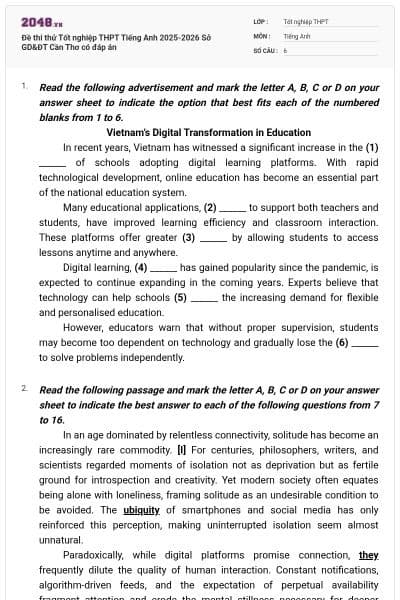
Read the following announcement and mark the letter A, B, C or D on your answer sheet to indicate the option that best fits each of the numbered blanks from 35 to 40.
Embrace Sustainable Tourism
Are you passionate about travel and protecting the planet? Sustainable tourism is a modern approach that encourages visitors to respect the environment while supporting local communities.
This trend has become (35) _____ attractive to travelers who wish to protect natural habitats while exploring new destinations. Instead of choosing luxury cruises, many now prefer trekking in small groups to minimize environmental impact and experience nature more authentically.
However, a significant (36) _____ of attention is still required to ensure that local environmental regulations are followed properly. To become a responsible traveler, you should (37) _____ old habits and learn how to live in harmony with nature. In many parts of (38) _____ world, conserving water is essential for daily survival. In addition, various projects (39) _____ opportunities to plant trees are now welcoming international volunteers.
By participating in these meaningful activities, visitors can develop a more (40) _____ awareness of the delicate balance between humans and the Earth.
Travel responsibly. Protect nature. Make a difference today!
remarkable
remarkably
remarked
remark
A. remarkable (adj): đáng chú ý, xuất chúng.
B. remarkably (adv): một cách đáng chú ý, đặc biệt.
C. remarked (v-ed): đã nhận xét.
D. remark (v/n): nhận xét.
Phía trước khoảng trống là động từ nối “become” (trở nên), phía sau là tính từ “attractive” (hấp dẫn). Theo quy tắc ngữ pháp, ta cần một trạng từ (adv) đứng trước để bổ nghĩa mức độ cho tính từ đó.
Chọn B. remarkably
→ This trend has become remarkably attractive to travelers...
Dịch nghĩa: Xu hướng này đã trở nên hấp dẫn đặc biệt (một cách đáng chú ý) đối với những du khách...
few
number
amount
many
A. few: ít (+ danh từ đếm được số nhiều).
B. number (n): số lượng (+ danh từ đếm được số nhiều).
C. amount (n): khối lượng, lượng (+ danh từ không đếm được).
D. many: nhiều (+ danh từ đếm được số nhiều).
Phía sau khoảng trống là giới từ “of” và danh từ không đếm được “attention” (sự chú ý). Do đó, “amount” là đáp án duy nhất phù hợp về mặt ngữ pháp. Ta có cụm a significant amount of + N (không đếm được) (một lượng lớn...).
Chọn C. amount
→ However, a significant amount of attention is still required...
Dịch nghĩa: Tuy nhiên, một lượng lớn sự chú ý vẫn là điều cần thiết...
give up
take off
get on
look for
A. give up (phr.v): từ bỏ.
B. take off (phr.v): cất cánh (máy bay), cởi (quần áo), thành công nhanh chóng.
C. get on (phr.v): lên (xe buýt, tàu hỏa), hòa thuận.
D. look for (phr.v): tìm kiếm.
Phía sau khoảng trống là cụm danh từ “old habits” (những thói quen cũ). Để trở thành một du khách có trách nhiệm và sống hài hòa với thiên nhiên, bạn cần “từ bỏ” những thói quen cũ (thường là những thói quen xấu, gây hại cho môi trường).
Chọn A. give up
→ To become a responsible traveler, you should give up old habits and learn how to live in harmony with nature.
Dịch nghĩa: Để trở thành một du khách có trách nhiệm, bạn nên từ bỏ những thói quen cũ và học cách sống hài hòa với thiên nhiên.
an
(no article)
the
a
A. an: mạo từ không xác định (đứng trước danh từ số ít bắt đầu bằng nguyên âm).
B. (no article): không dùng mạo từ.
C. the: mạo từ xác định.
D. a: mạo từ không xác định (đứng trước danh từ số ít bắt đầu bằng phụ âm).
“world” (thế giới) là danh từ chỉ một thực thể duy nhất, độc nhất. Theo quy tắc sử dụng mạo từ, ta bắt buộc phải dùng mạo từ xác định “the” trước nó. Ta có cụm cố định: the world.
Chọn C. the
→ In many parts of the world, conserving water is essential for daily survival.
Dịch nghĩa: Ở nhiều nơi trên thế giới, việc bảo tồn nguồn nước là điều thiết yếu cho sự sinh tồn hàng ngày.
to provide
providing
provided
provide
A. to provide (to-v): động từ nguyên thể có “to”.
B. providing (v-ing): hiện tại phân từ (mang nghĩa chủ động).
C. provided (v-ed/v3): quá khứ phân từ (mang nghĩa bị động).
D. provide (v): động từ nguyên mẫu.
Câu đã có động từ chính chia theo thì hiện tại tiếp diễn là “are now welcoming” (hiện đang chào đón). Khoảng trống nằm trong mệnh đề quan hệ rút gọn bổ nghĩa cho danh từ “various projects” (nhiều dự án khác nhau). Các dự án này chủ động “cung cấp” cơ hội. Mệnh đề đầy đủ là: which provide opportunities.... Khi rút gọn, ta bỏ đại từ quan hệ và chuyển động từ sang dạng V-ing.
Chọn B. providing
→ In addition, various projects providing opportunities to plant trees are now welcoming international volunteers.
Dịch nghĩa: Ngoài ra, nhiều dự án khác nhau cung cấp các cơ hội trồng cây hiện đang chào đón các tình nguyện viên quốc tế.
mutual
holistic
tangible
intrinsic
A. mutual (adj): lẫn nhau, qua lại (giữa 2 hay nhiều bên).
B. holistic (adj): toàn diện, tổng thể.
C. tangible (adj): hữu hình, có thể sờ mó/cảm nhận bằng xúc giác.
D. intrinsic (adj): thuộc về bản chất, giá trị bên trong.
Phía sau khoảng trống là danh từ “awareness” (nhận thức). Cụm “the delicate balance between humans and the Earth” (sự cân bằng mong manh giữa con người và Trái đất) là một hệ thống phức tạp, mang tính liên kết. Để hiểu được hệ thống này, du khách cần phát triển một nhận thức mang tính “toàn diện / tổng thể”.
Chọn B. holistic
→ ...visitors can develop a more holistic awareness of the delicate balance between humans and the Earth.
Dịch nghĩa: ...du khách có thể phát triển một nhận thức toàn diện hơn về sự cân bằng mong manh giữa con người và Trái đất.
Bài đọc hoàn chỉnh | Dịch bài đọc |
Embrace Sustainable Tourism Are you passionate about travel and protecting the planet? Sustainable tourism is a modern approach that encourages visitors to respect the environment while supporting local communities. This trend has become (35) remarkably attractive to travelers who wish to protect natural habitats while exploring new destinations. Instead of choosing luxury cruises, many now prefer trekking in small groups to minimize environmental impact and experience nature more authentically. However, a significant (36) amount of attention is still required to ensure that local environmental regulations are followed properly. To become a responsible traveler, you should (37) give up old habits and learn how to live in harmony with nature. In many parts of (38) the world, conserving water is essential for daily survival. In addition, various projects (39) providing opportunities to plant trees are now welcoming international volunteers. By participating in these meaningful activities, visitors can develop a more (40) holistic awareness of the delicate balance between humans and the Earth. Travel responsibly. Protect nature. Make a difference today! | Đón Nhận Du Lịch Bền Vững Bạn có đam mê du lịch và bảo vệ hành tinh không? Du lịch bền vững là một cách tiếp cận hiện đại khuyến khích du khách tôn trọng môi trường đồng thời hỗ trợ các cộng đồng địa phương. Xu hướng này đã trở nên hấp dẫn (35) đặc biệt (một cách đáng chú ý) đối với những du khách mong muốn bảo vệ môi trường sống tự nhiên trong khi khám phá những điểm đến mới. Thay vì chọn các chuyến du thuyền sang trọng, nhiều người hiện nay thích đi bộ leo núi (trekking) theo từng nhóm nhỏ để giảm thiểu tác động đến môi trường và trải nghiệm thiên nhiên một cách chân thực hơn. Tuy nhiên, một (36) lượng lớn sự chú ý vẫn là điều cần thiết để đảm bảo rằng các quy định về môi trường của địa phương được tuân thủ đúng đắn. Để trở thành một du khách có trách nhiệm, bạn nên (37) từ bỏ những thói quen cũ và học cách sống hài hòa với thiên nhiên. Ở nhiều nơi trên thế (38) giới, việc bảo tồn nguồn nước là điều thiết yếu cho sự sinh tồn hàng ngày. Ngoài ra, nhiều dự án khác nhau (39) cung cấp các cơ hội trồng cây hiện đang chào đón các tình nguyện viên quốc tế. Bằng cách tham gia vào những hoạt động đầy ý nghĩa này, du khách có thể phát triển một nhận thức (40) toàn diện hơn về sự cân bằng mong manh giữa con người và Trái đất. Hãy du lịch có trách nhiệm. Bảo vệ thiên nhiên. Tạo ra sự khác biệt ngay hôm nay! |