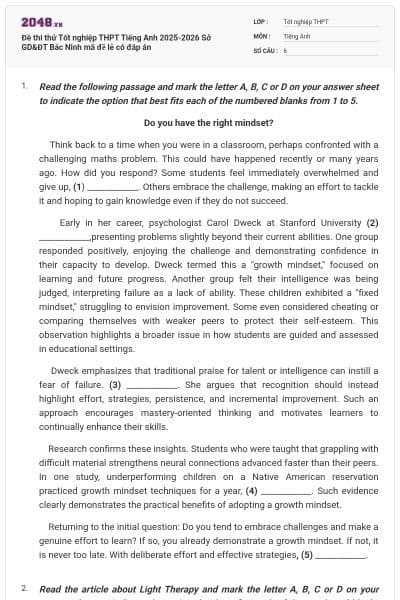
Đề thi thử Tốt nghiệp THPT Tiếng Anh 2025-2026 Sở GD&ĐT Bắc Ninh mã đề lẻ có đáp án
40 câu hỏi
Read the following passage and mark the letter A, B, C or D on your answer sheet to indicate the option that best fits each of the numbered blanks from 1 to 5.
Do you have the right mindset?
Think back to a time when you were in a classroom, perhaps confronted with a challenging maths problem. This could have happened recently or many years ago. How did you respond? Some students feel immediately overwhelmed and give up, (1) ____________. Others embrace the challenge, making an effort to tackle it and hoping to gain knowledge even if they do not succeed.
Early in her career, psychologist Carol Dweck at Stanford University (2) ____________,presenting problems slightly beyond their current abilities. One group responded positively, enjoying the challenge and demonstrating confidence in their capacity to develop. Dweck termed this a "growth mindset," focused on learning and future progress. Another group felt their intelligence was being judged, interpreting failure as a lack of ability. These children exhibited a "fixed mindset," struggling to envision improvement. Some even considered cheating or comparing themselves with weaker peers to protect their self-esteem. This observation highlights a broader issue in how students are guided and assessed in educational settings.
Dweck emphasizes that traditional praise for talent or intelligence can instill a fear of failure. (3) ____________. She argues that recognition should instead highlight effort, strategies, persistence, and incremental improvement. Such an approach encourages mastery-oriented thinking and motivates learners to continually enhance their skills.
Research confirms these insights. Students who were taught that grappling with difficult material strengthens neural connections advanced faster than their peers. In one study, underperforming children on a Native American reservation practiced growth mindset techniques for a year, (4) ____________. Such evidence clearly demonstrates the practical benefits of adopting a growth mindset.
Returning to the initial question: Do you tend to embrace challenges and make a genuine effort to learn? If so, you already demonstrate a growth mindset. If not, it is never too late. With deliberate effort and effective strategies, (5) ____________.
seeing that the question was intentionally designed to confuse
providing the explanation has not yet been made clear
assuming the task is beyond their capacity
supposing the solution requires knowledge they lacked
- Xét mệnh đề trước chỗ trống: “Some students feel immediately overwhelmed and give up,” (Một số học sinh ngay lập tức cảm thấy choáng ngợp và bỏ cuộc,) – Đây là mệnh đề S+V đầy đủ → phía sau là mệnh đề quan hệ hoặc mệnh đề quan hệ rút gọn để bổ sung ý nghĩa cho mệnh đề chính.
- Xét các đáp án:
A. thấy rằng câu hỏi vốn được thiết kế cố ý để gây nhầm lẫn
B. cung cấp lời giải thích vẫn chưa rõ ràng
C. giả định rằng nhiệm vụ đó nằm ngoài khả năng của mình
D. cho rằng lời giải đòi hỏi những kiến thức mà mình còn thiếu
→ Đáp án C là phù hợp nhất về nghĩa
→ Some students feel immediately overwhelmed and give up, assuming the task is beyond their capacity.
Dịch: Một số học sinh ngay lập tức cảm thấy choáng ngợp và bỏ cuộc, giả định rằng nhiệm vụ đó nằm ngoài khả năng của mình.
Chọn C.
where classroom behavior of ten-year-old children was observed
in which achievement data were collected from ten-year-old children
conducted experiments with ten-year-old children
having analyzed test results of ten-year-old children
- Xét câu văn chứa chỗ trống: “Early in her career, psychologist Carol Dweck at Stanford University …,presenting problems slightly beyond their current abilities.” (Ngay từ đầu sự nghiệp, nhà tâm lý học Carol Dweck tại Đại học Stanford …, đưa ra những vấn đề hơi quá khả năng hiện tại của các em.) – Câu văn đã có chủ ngữ “pyschologist Carol Dwech” (nhà tâm lý học Carol Dweck) nhưng còn thiếu động từ chính.
- Xét các đáp án:
A. where classroom behavior of ten-year-old children was observed: sai, đây là mệnh đề quan hệ
B. in which achievement data were collected from ten-year-old children: sai, đây là mệnh đề quan hệ
C. conducted experiments with ten-year-old children: đúng, động từ “conduct” (thực hiện) được chia ở thì quá khứ đơn, phù hợp với ngữ cảnh câu văn
D. having analyzed test results of ten-year-old children: sai, đây là mệnh đề phân từ hoàn thành (having VPII)
→ Early in her career, psychologist Carol Dweck at Stanford University conducted experiments with ten-year-old children,presenting problems slightly beyond their current abilities.
Dịch: Ngay từ đầu sự nghiệp, nhà tâm lý học Carol Dweck tại Đại học Stanford đã thực hiện các thí nghiệm với trẻ em mười tuổi, đưa ra những vấn đề hơi quá khả năng hiện tại của các em.
Chọn C.
As a result, students may become overly dependent on standardized tests
Hence, students tend to associate academic success primarily with financial rewards
Therefore, students frequently feel little pressure to outperform their peers
Consequently, students often concentrate on grades rather than actual learning
- Xét ngữ cảnh: Đoạn văn đang nhấn mạnh việc khen ngợi tài năng thiên bẩm có thể gây ra nỗi sợ thất bại
- Xét các đáp án:
A. Kết quả là, học sinh có thể trở nên quá phụ thuộc vào các bài kiểm tra tiêu chuẩn.
B. Vì thế, học sinh có xu hướng gắn liền thành công học thuật chủ yếu với các phần thưởng tài chính.
C. Do đó, học sinh thường ít cảm thấy áp lực trong việc phải vượt xa bạn bè đồng trang lứa.
D. Hệ quả là, học sinh thường tập trung vào điểm số hơn là việc thực sự học hỏi.
→ Đáp án D là phù hợp nhất về nghĩa
→ Consequently, students often concentrate on grades rather than actual learning.
Dịch: Hệ quả là, học sinh thường tập trung vào điểm số hơn là việc thực sự học hỏi.
Chọn D.
which led to top regional test scores and less privileged peers surpassing
achieving top regional test scores and surpassing more privileged peers
involved surpassing more privileged peers and achieving regional test scores
which resulted in regional test scores and surpassing more privileged peers
- Xét mệnh đề trước chỗ trống: “In one study, underperforming children on a Native American reservation practiced growth mindset techniques for a year,” (Trong một nghiên cứu, những trẻ em có học lực kém tại một khu bảo tồn người Da đỏ đã thực hành các kỹ thuật tư duy phát triển trong một năm,) – Đây là mệnh đề S+V đầy đủ → mệnh đề phía sau là mệnh đề quan hệ hoặc mệnh đề quan hệ rút gọn.
- Xét các đáp án:
A. which led to top regional test scores and less privileged peers surpassing: sai, sau “and” phải là một danh từ tương ứng với “top regional test scores”, cụm “less privileged peers surpassing” không phải là một cụm danh từ
B. achieving top regional test scores and surpassing more privileged peers: đúng, đây là mệnh đề quan hệ rút gọn bổ sung kết quả cho việc luyện tập kỹ thuật phát triển ở vế trước
C. involved surpassing more privileged peers and achieving regional test scores: sai, đây không phải mệnh đề quan hệ
D. which resulted in regional test scores and surpassing more privileged peers: sai, sau “and” phải là một danh từ tương ứng với “regional test scores”, cụm “surpassing more privileged peers” không phải là một cụm danh từ
→ In one study, underperforming children on a Native American reservation practiced growth mindset techniques for a year, achieving top regional test scores and surpassing more privileged peers.
Dịch: Trong một nghiên cứu, những trẻ em có học lực kém tại một khu bảo tồn người Da đỏ đã thực hành các kỹ thuật tư duy phát triển trong một năm, đạt được điểm kiểm tra cao nhất khu vực và vượt qua cả những bạn có điều kiện hơn.
Chọn B.
With deliberate effort and effective strategies, (5) ____________.
your academic ability can adopt a mastery-oriented mindset, leading to intellectual growth
anyone can adopt a mastery-oriented mindset and thrive academically and professionally
your mindset is positioned as the primary driver of sustained learning, though
adopting a mastery-oriented mindset in both academic and professional contexts become evident
- Xét cụm từ trước chỗ trống: “With deliberate effort and effective strategies,” (Với nỗ lực có ý thức và các chiến lược hiệu quả,) – đây là mệnh đề phụ của câu → câu văn còn thiếu một mệnh đề S + V hoàn chỉnh.
- Xét các đáp án:
A. khả năng học thuật của bạn có thể áp dụng tư duy định hướng sự tinh thông, dẫn đến sự phát triển trí tuệ
B. bất kỳ ai cũng có thể áp dụng tư duy định hướng sự tinh thông và phát triển mạnh mẽ trong học tập lẫn sự nghiệp
C. tư duy của bạn được định vị là động lực chính của việc học tập bền vững, mặc dù vậy
D. việc áp dụng tư duy định hướng sự tinh thông trong cả bối cảnh học thuật và chuyên nghiệp trở nên rõ ràng
→ Đáp án B là phù hợp nhất về nghĩa
→ With deliberate effort and effective strategies,anyone can adopt a mastery-oriented mindset and thrive academically and professionally.
Dịch: Với nỗ lực có ý thức và các chiến lược hiệu quả, bất kỳ ai cũng có thể áp dụng tư duy định hướng sự tinh thông và phát triển mạnh mẽ trong học tập lẫn sự nghiệp.
Chọn B.
Bài hoàn chỉnh | Dịch bài đọc |
Do you have the right mindset? Think back to a time when you were in a classroom, perhaps confronted with a challenging maths problem. This could have happened recently or many years ago. How did you respond? Some students feel immediately overwhelmed and give up, assuming the task is beyond their capacity. Others embrace the challenge, making an effort to tackle it and hoping to gain knowledge even if they do not succeed. Early in her career, psychologist Carol Dweck at Stanford University conducted experiments with ten-year-old children,presenting problems slightly beyond their current abilities. One group responded positively, enjoying the challenge and demonstrating confidence in their capacity to develop. Dweck termed this a "growth mindset," focused on learning and future progress. Another group felt their intelligence was being judged, interpreting failure as a lack of ability. These children exhibited a "fixed mindset," struggling to envision improvement. Some even considered cheating or comparing themselves with weaker peers to protect their self-esteem. This observation highlights a broader issue in how students are guided and assessed in educational settings. Dweck emphasizes that traditional praise for talent or intelligence can instill a fear of failure. Consequently, students often concentrate on grades rather than actual learning. She argues that recognition should instead highlight effort, strategies, persistence, and incremental improvement. Such an approach encourages mastery-oriented thinking and motivates learners to continually enhance their skills. Research confirms these insights. Students who were taught that grappling with difficult material strengthens neural connections advanced faster than their peers. In one study, underperforming children on a Native American reservation practiced growth mindset techniques for a year, achieving top regional test scores and surpassing more privileged peers. Such evidence clearly demonstrates the practical benefits of adopting a growth mindset. Returning to the initial question: Do you tend to embrace challenges and make a genuine effort to learn? If so, you already demonstrate a growth mindset. If not, it is never too late. With deliberate effort and effective strategies, anyone can adopt a mastery-oriented mindset and thrive academically and professionally.
| Bạn có đang sở hữu tư duy đúng đắn? Hãy nhớ lại khoảng thời gian khi bạn còn ngồi trên lớp, có lẽ là lúc đối mặt với một bài toán hóc búa. Điều này có thể vừa mới xảy ra gần đây hoặc từ nhiều năm trước. Bạn đã phản ứng thế nào? Một số học sinh ngay lập tức cảm thấy choáng ngợp và bỏ cuộc, giả định rằng nhiệm vụ đó nằm ngoài khả năng của mình. Những người khác lại đón nhận thử thách, nỗ lực giải quyết và hy vọng tiếp thu được kiến thức ngay cả khi họ không thành công. Ngay từ đầu sự nghiệp, nhà tâm lý học Carol Dweck tại Đại học Stanford đã thực hiện các thí nghiệm với trẻ em mười tuổi, đưa ra những vấn đề hơi quá khả năng hiện tại của các em. Một nhóm đã phản ứng tích cực, tận hưởng thử thách và thể hiện sự tự tin vào khả năng phát triển của bản thân. Dweck gọi đây là "tư duy phát triển", tập trung vào việc học hỏi và sự tiến bộ trong tương lai. Một nhóm khác lại cảm thấy trí thông minh của mình đang bị đánh giá, coi thất bại là do thiếu năng lực. Những đứa trẻ này thể hiện một "tư duy cố định", gặp khó khăn trong việc hình dung ra sự cải thiện. Một số thậm chí còn tính đến chuyện gian lận hoặc so sánh bản thân với những bạn kém hơn để bảo vệ lòng tự trọng của mình. Quan sát này làm nổi bật một vấn đề rộng lớn hơn trong cách học sinh được hướng dẫn và đánh giá trong môi trường giáo dục. Dweck nhấn mạnh rằng những lời khen ngợi truyền thống dành cho tài năng hay trí thông minh có thể làm nảy sinh nỗi sợ thất bại. Hệ quả là, học sinh thường tập trung vào điểm số hơn là việc thực sự học hỏi. Bà lập luận rằng sự công nhận thay vào đó nên làm nổi bật sự nỗ lực, chiến lược, sự kiên trì và những cải thiện dần dần. Cách tiếp cận như vậy khuyến khích tư duy định hướng sự tinh thông và thúc đẩy người học không ngừng nâng cao kỹ năng của mình. Các nghiên cứu đã xác nhận những hiểu biết này. Những học sinh được dạy rằng việc vật lộn với các tài liệu khó sẽ làm tăng cường các kết nối thần kinh đã tiến bộ nhanh hơn các bạn cùng trang lứa. Trong một nghiên cứu, những trẻ em có học lực kém tại một khu bảo tồn người Da đỏ đã thực hành các kỹ thuật tư duy phát triển trong một năm, đạt được điểm kiểm tra cao nhất khu vực và vượt qua cả những bạn có điều kiện hơn. Những bằng chứng như vậy chứng minh rõ ràng lợi ích thực tế của việc áp dụng tư duy phát triển. Quay trở lại câu hỏi ban đầu: Bạn có xu hướng đón nhận thử thách và nỗ lực thực sự để học hỏi không? Nếu có, bạn đã thể hiện một tư duy phát triển. Nếu không, không bao giờ là quá muộn. Với nỗ lực có ý thức và các chiến lược hiệu quả, bất kỳ ai cũng có thể áp dụng tư duy định hướng sự tinh thông và phát triển mạnh mẽ trong học tập lẫn sự nghiệp. |
Read the article about Light Therapy and mark the letter A, B, C or D on your answer sheet to indicate the option that best fits each of the numbered blanks from 6 to 11.
According to Dr. Paul Desan of Yale University's Winter Depression Research Clinic, light therapy is the primary treatment for Seasonal Affective Disorder (SAD). This therapy utilizes devices (6) _____emit light approximately 20 times (7) _____standard indoor lighting, measured at about 10,000 lux. Research indicates that most patients experiencing dramatic improvements often (8) _____medication when exposed to this bright light for 30 minutes every morning. This treatment is effective for both clinical SAD and less-severe winter low moods.
How to Use Light Therapy Effectively:
• Select the Right Device: Choose a lamp specifically designed for SAD that produces 10,000 lux.
• Timing: Use the light shortly after waking up in the morning (9) _____this is when the body is most responsive.
• Positioning: Sit at the manufacturer's recommended distance, allowing light (10) _____ your eyes indirectly without staring directly into the lamp.
• Consistency: Maintain a daily routine of 30-minute sessions throughout the winter months.
By following this daily routine, users can effectively (11) _____symptoms of depression and low mood during the darker seasons.
who
where
that
when
A. who: đại từ quan hệ thay thế cho chủ ngữ hoặc tân ngữ chỉ người
B. where: trạng từ quan hệ chỉ nơi chốn
C. that: đại từ quan hệ thay thế cho chủ ngữ hoặc tân ngữ chỉ người/vật
D. when: trạng từ quan hệ chỉ thời gian
- Căn cứ vào danh từ “devices” (các thiết bị) → đáp án C là phù hợp nhất
→ This therapy utilizes devices thatemit light approximately 20 times brighter than standard indoor lighting, measured at about 10,000 lux.
Dịch: Liệu pháp này sử dụng các thiết bị mà phát ra ánh sáng mạnh gấp khoảng 20 lần so với ánh sáng tiêu chuẩn trong nhà, đo được ở mức khoảng 10.000 lux.
Chọn C.
as brighter than
so bright as
brighter than
as brighter as
- Cấu trúc ngữ pháp:
Số lần (once, twice, three times, …) + as + adj/adv + as = gấp bao nhiêu lần so với
Số lần (once, twice, three times, …) + hình thức so sánh hơn + than = gấp bao nhiêu lần so với (thường dùng cho số lần từ 3 trở lên)
→ Đáp án C là phù hợp nhất
→ This therapy utilizes devices that emit light approximately 20 times brighter thanstandard indoor lighting, measured at about 10,000 lux.
Dịch: Liệu pháp này sử dụng các thiết bị mà phát ra ánh sáng mạnh gấp khoảng 20 lần so với ánh sáng tiêu chuẩn trong nhà, đo được ở mức khoảng 10.000 lux.
Chọn C.
get over
work out
do without
take up
A. get over (phr.v): vượt qua (bệnh tật, khó khăn)
B. work out (phr.v): tập thể dục, tìm ra giải pháp
C. do without (phr.v): sống mà không cần đến, xoay sở mà không có thứ gì
D. take up (phr.v): bắt đầu (sở thích, thói quen, công việc mới)
→ Research indicates that most patients experiencing dramatic improvements often do withoutmedication when exposed to this bright light for 30 minutes every morning.
Dịch: Nghiên cứu chỉ ra rằng hầu hết bệnh nhân có những cải thiện rõ rệt thường có thể không cần dùng thuốc khi tiếp xúc với ánh sáng rực rỡ này trong 30 phút mỗi sáng.
Chọn C.
• Timing: Use the light shortly after waking up in the morning (9) _____this is when the body is most responsive.
because
although
due to
despite
A. because: bởi vì → dùng để nối mệnh đề chỉ nguyên nhân với mệnh đề chỉ kết quả
B. although: mặc dù → dùng để nối hai mệnh đề có ý nghĩa trái ngược nhau, thường đứng ở đầu hoặc giữa câu
C. due to: bởi vì → due to + N/Ving (nguyên nhân)
D. despite: mặc dù → despite + N/Ving
- Căn cứ vào mệnh đề phía sau chỗ trống “this is when the body is most responsive.” (đây là lúc cơ thể phản ứng mạnh mẽ nhất.) là mệnh đề S+V đầy đủ → Loại đáp án C, D
- Xét ngữ cảnh: Câu văn đề cập tới việc sử dụng đèn ngay sau khi thức dậy vào buổi sáng và nêu lý do vì đây là thời gian cơ thể phản ứng mạnh mẽ nhất → Đáp án A là phù hợp nhất
→ Use the light shortly after waking up in the morning becausethis is when the body is most responsive.
Dịch: Sử dụng đèn ngay sau khi thức dậy vào buổi sáng vì đây là lúc cơ thể phản ứng mạnh mẽ nhất.
Chọn A.
• Positioning: Sit at the manufacturer's recommended distance, allowing light (10) _____ your eyes indirectly without staring directly into the lamp.
reach
to reach
reached
reaching
- Cấu trúc: allow sb/sth to do sth = cho phép ai/cái gì làm gì
→ Sit at the manufacturer's recommended distance, allowing light to reach your eyes indirectly without staring directly into the lamp.
Dịch: Ngồi ở khoảng cách theo khuyến nghị của nhà sản xuất, cho phép ánh sáng tiếp cận mắt một cách gián tiếp mà không cần nhìn trực diện vào đèn.
Chọn B.
By following this daily routine, users can effectively (11) _____symptoms of depression and low mood during the darker seasons.
manage
increase
endure
neglect
A. manage (v): kiểm soát, quản lý, điều tiết
B. increase (v): tăng
C. endure (v): cam chịu, chịu đựng
D. neglect (v): thờ ơ, xao nhãng
→ By following this daily routine, users can effectively managesymptoms of depression and low mood during the darker seasons.
Dịch: Bằng cách tuân thủ thói quen hàng ngày này, người dùng có thể kiểm soát các triệu chứng trầm cảm và tâm trạng uể oải một cách hiệu quả trong những mùa thiếu ánh sáng.
Chọn A.
Bài hoàn chỉnh | Dịch bài đọc |
According to Dr. Paul Desan of Yale University's Winter Depression Research Clinic, light therapy is the primary treatment for Seasonal Affective Disorder (SAD). This therapy utilizes devices that emit light approximately 20 times brighter than standard indoor lighting, measured at about 10,000 lux. Research indicates that most patients experiencing dramatic improvements often do without medication when exposed to this bright light for 30 minutes every morning. This treatment is effective for both clinical SAD and less-severe winter low moods. How to Use Light Therapy Effectively: • Select the Right Device: Choose a lamp specifically designed for SAD that produces 10,000 lux. • Timing: Use the light shortly after waking up in the morning because this is when the body is most responsive. • Positioning: Sit at the manufacturer's recommended distance, allowing light to reach your eyes indirectly without staring directly into the lamp. •Consistency: Maintain a daily routine of 30-minute sessions throughout the winter months. By following this daily routine, users can effectively manage symptoms of depression and low mood during the darker seasons. | Theo Tiến sĩ Paul Desan thuộc Phòng khám Nghiên cứu Trầm cảm Mùa đông của Đại học Yale, trị liệu bằng ánh sáng là phương pháp điều trị chính cho Hội chứng Rối loạn Cảm xúc theo Mùa (SAD). Liệu pháp này sử dụng các thiết bị mà phát ra ánh sáng mạnh gấp khoảng 20 lần so với ánh sáng tiêu chuẩn trong nhà, đo được ở mức khoảng 10.000 lux. Nghiên cứu chỉ ra rằng hầu hết bệnh nhân có những cải thiện rõ rệt thường có thể không cần dùng thuốc khi tiếp xúc với ánh sáng rực rỡ này trong 30 phút mỗi sáng. Phương pháp điều trị này hiệu quả cho cả SAD lâm sàng và các tình trạng tâm trạng kém vào mùa đông ít nghiêm trọng hơn. Cách Sử Dụng Trị Liệu Ánh Sáng Hiệu Quả: • Chọn thiết bị phù hợp: Chọn loại đèn được thiết kế riêng cho hội chứng SAD có cường độ 10.000 lux. • Thời điểm: Sử dụng đèn ngay sau khi thức dậy vào buổi sáng vì đây là lúc cơ thể phản ứng mạnh mẽ nhất. • Vị trí: Ngồi ở khoảng cách theo khuyến nghị của nhà sản xuất, cho phép ánh sáng tiếp cận mắt một cách gián tiếp mà không cần nhìn trực diện vào đèn. • Sự kiên trì: Duy trì thói quen hàng ngày với các phiên trị liệu 30 phút trong suốt những tháng mùa đông. Bằng cách tuân thủ thói quen hàng ngày này, người dùng có thể kiểm soát các triệu chứng trầm cảm và tâm trạng uể oải một cách hiệu quả trong những mùa thiếu ánh sáng.
|
Read the leaflet about Cruise: Destination of Your Dreams and mark the letter A, B, C or D on your answer sheet to indicate the option that best fits each of the numbered blanks from 12 to 17.
Create Your Own Adventure
Are you ready for a/an (12) _____ trip but find that your friends just don't have the time to join you? Don't wait for others to be ready-make this journey your own and save big with our exclusive "Cruising Solo" program. In the cruise industry, cabins are typically designed for double (13) _____ which often forces solo travelers to pay nearly the full cabin rate alone. We have changed that to ensure your dream destination is more affordable than ever.
Our company offers a truly (14) _____ experience, providing the perfect environment to meet fantastic people from every corner of the world. Once on board, you will enjoy world-class entertainment, a relaxing spa, a fitness center, and even a court to play sports. If you are seeking thrills, you can visit our refreshing pools and (15) _____.
What You Get:
· Access to our full range of luxury pools, spas and gyms.
· Extended shore excursions (16) _____ for more in-depth exploring.
· (17) _____ exciting themed parties every night.
· Access to a selection of specialty restaurants serving up authentic local flavors.
forgettable
forget
forgetful
unforgettable
A. forgettable (adj): có thể quên được
B. forget (v): quên
C. forgetful (adj): hay quên
D. unforgettable (adj): không thể nào quên
→ Are you ready for an unforgettable trip but find that your friends just don't have the time to join you?
Dịch: Bạn đã sẵn sàng cho một chuyến đi không thể nào quên nhưng lại thấy bạn bè của mình đơn giản là không có thời gian để tham gia cùng?
Chọn D.
assistance
occupancy
residency
availability
- Cụm cố định: double occupancy = phòng đôi
→ In the cruise industry, cabins are typically designed for double occupancy which often forces solo travelers to pay nearly the full cabin rate alone.
Dịch: Trong ngành công nghiệp du thuyền, các cabin thường được thiết kế cho hai người ở, điều này thường buộc những hành khách đi một mình phải trả gần như toàn bộ giá phòng một mình.
Chọn B.
ordinary
single
unique
common
A. ordinary (adj): bình thường, thông thường
B. single (adj): độc thân, đơn lẻ, chỉ có một
C. unique (adj): duy nhất, độc nhất, độc đáo
D. common (adj): phổ biến, chung chung
→ Our company offers a truly unique experience, providing the perfect environment to meet fantastic people from every corner of the world.
Dịch: Công ty chúng tôi mang đến một trải nghiệm thực sự độc đáo, tạo ra môi trường hoàn hảo để gặp gỡ những con người tuyệt vời từ khắp nơi trên thế giới.
Chọn C.
If you are seeking thrills, you can visit our refreshing pools and (15) _____.
exciting parks water
water parks exciting
exciting water parks
water exciting parks
- Cụm danh từ: water park = công viên nước
- Ta có trật tự tính từ đứng trước danh từ → tính từ “exciting” đứng trước cụm danh từ “water parks”
→ Trật tự đúng: exciting water parks
→ If you are seeking thrills, you can visit our refreshing pools and exciting water parks.
Dịch: Nếu bạn đang tìm kiếm cảm giác mạnh, bạn có thể ghé thăm các hồ bơi mát lạnh và những công viên nước đầy thú vị.
Chọn C.
· Extended shore excursions (16) _____ for more in-depth exploring.
designing
be designing
designed
which designed
- Xét ngữ cảnh: đoạn văn đang liệt kê những điều mà người tham gia nhận được → cụm chứa chỗ trống là một cụm danh từ → động từ được chia ở dạng mệnh đề quan hệ hoặc mệnh đề quan hệ rút gọn
- Xét cụm danh từ “Extended shore excursions” (Các chuyến tham quan bờ biển kéo dài) và nghĩa của từ “design” (thiết kế) → động từ phải được chia ở dạng bị động
→ Đáp án C là phù hợp nhất
→ Extended shore excursions designed for more in-depth exploring.
Dịch: Các chuyến tham quan bờ biển kéo dài được thiết kế để bạn có thể khám phá sâu hơn.
Chọn C.
· (17) _____ exciting themed parties every night.
A great deal of
A large amount of
A high degree of
A. A wide variety of: rất nhiều loại khác nhau → a wide variety of + N đếm được số nhiều
B. A great deal of: rất nhiều → a great deal of + N không đếm được (trang trọng)
C. A large amount of: một lượng lớn → a large amount of + N không đếm được (vật chất, tiền bạc, thời gian)
D. A high degree of: một mức độ cao → a high degree of + N không đếm được (tính chất, cường độ)
- Căn cứ vào “exciting themed parties” (các loại bữa tiệc theo chủ đề) là danh từ đếm được số nhiều → Đáp án A là phù hợp nhất
→ A wide variety of exciting themed parties every night.
Dịch:Đa dạng các loại bữa tiệc theo chủ đề thú vị mỗi đêm.
Chọn A.
Bài hoàn chỉnh | Dịch bài đọc |
Create Your Own Adventure Are you ready for an unforgettable trip but find that your friends just don't have the time to join you? Don't wait for others to be ready-make this journey your own and save big with our exclusive “Cruising Solo” program. In the cruise industry, cabins are typically designed for double occupancy which often forces solo travelers to pay nearly the full cabin rate alone. We have changed that to ensure your dream destination is more affordable than ever. Our company offers a truly unique experience, providing the perfect environment to meet fantastic people from every corner of the world. Once on board, you will enjoy world-class entertainment, a relaxing spa, a fitness center, and even a court to play sports. If you are seeking thrills, you can visit our refreshing pools and exciting water parks. What You Get: •Access to our full range of luxury pools, spas and gyms. • Extended shore excursions designed for more in-depth exploring. • A wide variety of exciting themed parties every night. •Access to a selection of specialty restaurants serving up authentic local flavors. Contact us at +0 (123) 456 789 or visit our office at 445 W. Mount Eden Road, Anchorage, AK to book the cruise of your dreams.
| Tạo ra chuyến phiêu lưu của riêng bạn Bạn đã sẵn sàng cho một chuyến đi không thể nào quên nhưng lại thấy bạn bè của mình đơn giản là không có thời gian để tham gia cùng? Đừng chờ đợi người khác sẵn sàng - hãy biến hành trình này thành của riêng bạn và tiết kiệm một khoản chi phí lớn với chương trình độc quyền “Đi du thuyền một mình” của chúng tôi. Trong ngành công nghiệp du thuyền, các cabin thường được thiết kế cho hai người ở, điều này thường buộc những hành khách đi một mình phải trả gần như toàn bộ giá phòng một mình. Chúng tôi đã thay đổi điều đó để đảm bảo điểm đến mơ ước của bạn có mức giá phải chăng hơn bao giờ hết. Công ty chúng tôi mang đến một trải nghiệm thực sự độc đáo, tạo ra môi trường hoàn hảo để gặp gỡ những con người tuyệt vời từ khắp nơi trên thế giới. Ngay khi lên tàu, bạn sẽ được tận hưởng các chương trình giải trí đẳng cấp thế giới, spa thư giãn, trung tâm thể hình và thậm chí là sân chơi thể thao. Nếu bạn đang tìm kiếm cảm giác mạnh, bạn có thể ghé thăm các hồ bơi mát lạnh và những công viên nước đầy thú vị. Những gì bạn nhận được: · Quyền sử dụng toàn bộ các hồ bơi, spa và phòng tập gym sang trọng của chúng tôi. · Các chuyến tham quan bờ biển kéo dài được thiết kế để bạn có thể khám phá sâu hơn. · Đa dạng các loại bữa tiệc theo chủ đề thú vị mỗi đêm. · Quyền thưởng thức tại hệ thống các nhà hàng đặc sản phục vụ hương vị địa phương thuần túy. Liên hệ với chúng tôi tại số điện thoại +0 (123) 456 789 hoặc ghé thăm văn phòng của chúng tôi tại số 445 Đường W. Mount Eden, Anchorage, Alaska (AK) để đặt chuyến du thuyền trong mơ của bạn. |
Read the following passage about Global Communication Styles and mark the letter A, B, C or D on your answer sheet to indicate the best answer to each of the following questions from 18 to 25.
Understanding global communication styles in the workplace is essential in today's interconnected world. Whether you are part of a multinational corporation or a small organization with a diverse team, being adeptat navigating these varied communication styles is crucial for lasting success.
The workplace is a melting pot where different cultures, languages, and backgrounds come together. This diversity enriches our work environment, but it also presents unique challenges, particularly in intercultural communication. Global communication styles in the workplace vary significantly - from the direct and straightforward approach often seen in North American and Western European cultures to the more indirect and holistic styles prevalent in many Asian cultures. Cultures that value directness see it as a sign of honesty and efficiency. In contrast, other cultures might view the same directness as rude or disrespectful. Similarly, indirect communicators, who often rely on context and non-verbal cues, might find themselves misunderstood in environments where directness is the norm. The key to success here is to strike a balance and develop an understanding of these nuances.
The concept of high-context and low-context cultures is important in understanding global communication styles in the workplace. High-context cultures heavily rely on implicit communication, where much is conveyed through body language, tone of voice, and even silence. Low-context cultures, on the other hand, prefer clear and detailed verbal communication. Recognizing whether your colleagues come from high or low-context backgrounds can greatly enhance your interactions and collaborations.
Encouraging an environment that respects and adapts to various global communication styles in the workplace is likely to increase productivity. It fosters better collaboration, reduces misunderstandings, and enhances a team's dynamic. It's about being flexible, culturally sensitive, and empathetic. By embracing these diverse communication styles, both organizations and individuals can build stronger, more effective teams. As we navigate through the complexities of global communication, let's remember that it's not just about overcoming barriers; it's about building bridges of understanding that can lead to greater success and innovation.
mature
adjustable
compatible
skilled
Từ “adept” trong đoạn 1 có thể được thay thế tốt nhất bằng từ nào dưới đây?
- adept (adj): tinh thông, lão luyện, giỏi xoay xở
A. mature (adj): trưởng thành
B. adjustable (adj): có thể điều chỉnh được (máy móc, kích cỡ, kế hoạch)
C. compatible (adj): tương thích, hợp nhau
D. skilled (adj): có kỹ năng, khéo léo, lành nghề
→ adept = skilled
Chọn D.
culture
diversity
environment
workplace
Từ “it” trong đoạn 2 đề cập đến điều gì?
A. văn hóa
B. sự đa dạng
C. môi trường
D. nơi làm việc
- Thông tin: This diversity enriches our work environment, but it also presents unique challenges, particularly in intercultural communication.
(Sự đa dạng này làm phong phú thêm môi trường làm việc của chúng ta, nhưng nó cũng đặt ra những thách thức độc đáo, đặc biệt là trong giao tiếp liên văn hóa.)
Chọn B.
verbal communication
tone of voice
body language
silence
Điều nào dưới đây KHÔNG được đề cập trong đoạn 3 như là một cách truyền tải ý nghĩa trong các nền văn hóa bối cảnh cao?
A. giao tiếp bằng lời nói
B. tông giọng
C. ngôn ngữ cơ thể
D. sự im lặng
- Thông tin: High-context cultures heavily rely on implicit communication, where much is conveyed through body language, tone of voice, and even silence.
(Các nền văn hóa bối cảnh cao dựa dẫm nặng nề vào giao tiếp ẩn ý, nơi nhiều thứ được truyền tải thông qua ngôn ngữ cơ thể, tông giọng, và thậm chí là sự im lặng.)
Chọn A.
explicit
implied
unspoken
indirect
Từ “implicit” trong đoạn 3 TRÁI NGƯỢC với từ nào dưới đây?
- implicit (adj): ẩn ý
A. explicit (adj): rõ ràng, trực diện
B. implied (adj): ngụ ý, ẩn ý
C. unspoken (adj): không nói ra bằng lời
D. indirect (adj): gián tiếp
→ implicit >< explicit
Chọn A.
Which of the following best paraphrases the underlined sentence in paragraph 4?
Success and innovation in global workplaces depend on building cultural understanding rather than dealing with communication difficulties.
Greater success and innovation are more likely to be achieved when all communication barriers in the global workplace have been completely removed.
Successfully handling global communication focuses on eliminating barriers in order to promote understanding that results in success and innovation.
The process of global communication is not merely about overcoming obstacles but about fostering mutual understanding that helps drive success and innovation.
Câu nào sau đây diễn giải đúng nhất câu được gạch chân trong đoạn 4?
A. Thành công và đổi mới ở nơi làm việc toàn cầu phụ thuộc vào việc xây dựng sự thấu hiểu văn hóa thay vì giải quyết các khó khăn trong giao tiếp.
B. Thành công và đổi mới lớn hơn có khả năng đạt được khi tất cả các rào cản giao tiếp đã được loại bỏ hoàn toàn.
C. Xử lý thành công giao tiếp toàn cầu tập trung vào việc xóa bỏ rào cản để thúc đẩy sự thấu hiểu dẫn đến thành công.
D. Quá trình giao tiếp toàn cầu không đơn thuần là vượt qua các trở ngại mà là thúc đẩy sự thấu hiểu lẫn nhau giúp thúc đẩy thành công và đổi mới.
- Câu gạch chân: As we navigate through the complexities of global communication, let's remember that it's not just about overcoming barriers; it's about building bridges of understanding that can lead to greater success and innovation.
(Khi chúng ta điều hướng qua những phức tạp của giao tiếp toàn cầu, hãy nhớ rằng đó không chỉ là về việc vượt qua các rào cản; đó là về việc xây dựng những nhịp cầu thấu hiểu có thể dẫn đến thành công và đổi mới lớn hơn.)
Chọn D.
The direct and straightforward approach tends to be preferred across all cultures in global workplaces.
High-context cultures rely more on body language and unspoken signals than on detailed verbal messages.
Understanding global communication styles in the workplace is only essential in multinational corporations.
Embracing diverse communication styles can discourage organizations and individuals from working effectively.
Điều nào dưới đây là ĐÚNG theo nội dung bài đọc?
A. Cách tiếp cận trực tiếp và thẳng thắn có xu hướng được ưa chuộng ở tất cả các nền văn hóa trong môi trường làm việc toàn cầu.
B. Các nền văn hóa bối cảnh cao dựa vào ngôn ngữ cơ thể và các tín hiệu không lời nhiều hơn là các thông điệp bằng lời nói chi tiết.
C. Việc thấu hiểu các phong cách giao tiếp toàn cầu tại nơi làm việc chỉ thiết yếu đối với các tập đoàn đa quốc gia.
D. Việc đón nhận các phong cách giao tiếp đa dạng có thể làm nản lòng các tổ chức và cá nhân trong việc làm việc hiệu quả.
Thông tin: High-context cultures heavily rely on implicit communication, where much is conveyed through body language, tone of voice, and even silence.
(Các nền văn hóa bối cảnh cao dựa dẫm nặng nề vào giao tiếp ẩn ý, nơi nhiều thứ được truyền tải thông qua ngôn ngữ cơ thể, tông giọng, và thậm chí là sự im lặng.)
Chọn B.
Paragraph 1
Paragraph 2
Paragraph 4
Paragraph 3
Người viết đề cập đến một sự tương phản giữa các phong cách giao tiếp khác nhau trong đoạn văn nào?
- Đoạn 2: Cultures that value directness see it as a sign of honesty and efficiency. In contrast, other cultures might view the same directness as rude or disrespectful.
(Các nền văn hóa coi trọng sự trực tiếp xem đó là dấu hiệu của sự trung thực và hiệu quả. Ngược lại, các nền văn hóa khác có thể coi sự trực tiếp đó là thô lỗ hoặc thiếu tôn trọng.)
Chọn B.
Paragraph 4
Paragraph 3
Paragraph 2
Paragraph 1
Người viết đề cập đến việc tạo ra một môi trường hỗ trợ mà ở đó có sự thích nghi với các phong cách giao tiếp toàn cầu khác nhau trong đoạn văn nào?
- Đoạn 4: Encouraging an environment that respects and adapts to various global communication styles in the workplace is likely to increase productivity.
(Khuyến khích một môi trường tôn trọng và thích nghi với các phong cách giao tiếp toàn cầu khác nhau tại nơi làm việc có khả năng làm tăng năng suất.)
Chọn A.
Dịch bài đọc:
Hiểu biết về các phong cách giao tiếp toàn cầu tại nơi làm việc là điều thiết yếu trong thế giới kết nối lẫn nhau ngày nay. Cho dù bạn là một phần của một tập đoàn đa quốc gia hay một tổ chức nhỏ với một đội ngũ đa dạng, việc thành thạo trong việc điều hướng các phong cách giao tiếp đa dạng này là rất quan trọng để có được thành công lâu dài.
Nơi làm việc là một điểm giao thoa nơi các nền văn hóa, ngôn ngữ và nền tảng khác nhau hội tụ lại với nhau. Sự đa dạng này làm phong phú thêm môi trường làm việc của chúng ta, nhưng nó cũng đặt ra những thách thức độc đáo, đặc biệt là trong giao tiếp liên văn hóa. Các phong cách giao tiếp toàn cầu tại nơi làm việc thay đổi đáng kể - từ cách tiếp cận trực tiếp và thẳng thắn thường thấy ở các nền văn hóa Bắc Mỹ và Tây Âu đến các phong cách gián tiếp và toàn diện hơn phổ biến ở nhiều nền văn hóa châu Á. Các nền văn hóa coi trọng sự trực tiếp xem đó là dấu hiệu của sự trung thực và hiệu quả. Ngược lại, các nền văn hóa khác có thể coi sự trực tiếp đó là thô lỗ hoặc thiếu tôn trọng. Tương tự như vậy, những người giao tiếp gián tiếp, những người thường dựa vào ngữ cảnh và các tín hiệu phi ngôn ngữ, có thể thấy mình bị hiểu lầm trong những môi trường mà sự trực tiếp là chuẩn mực. Chìa khóa để thành công ở đây là đạt được sự cân bằng và phát triển sự hiểu biết về những sắc thái này.
Khái niệm về văn hóa bối cảnh cao và bối cảnh thấp là rất quan trọng trong việc thấu hiểu các phong cách giao tiếp toàn cầu tại nơi làm việc. Các nền văn hóa bối cảnh cao dựa dẫm nặng nề vào giao tiếp ẩn ý, nơi nhiều thứ được truyền tải thông qua ngôn ngữ cơ thể, tông giọng, và thậm chí là sự im lặng. Mặt khác, các nền văn hóa bối cảnh thấp ưa chuộng giao tiếp bằng lời nói rõ ràng và chi tiết. Việc nhận ra liệu các đồng nghiệp của bạn đến từ nền tảng bối cảnh cao hay thấp có thể tăng cường đáng kể các tương tác và sự cộng tác của bạn.
Khuyến khích một môi trường tôn trọng và thích nghi với các phong cách giao tiếp toàn cầu khác nhau tại nơi làm việc có khả năng làm tăng năng suất. Nó thúc đẩy sự cộng tác tốt hơn, giảm thiểu hiểu lầm, và tăng cường động lực của nhóm. Đó là về việc trở nên linh hoạt, nhạy cảm về văn hóa và thấu cảm. Bằng cách đón nhận những phong cách giao tiếp đa dạng này, cả tổ chức và cá nhân đều có thể xây dựng những đội ngũ mạnh mẽ hơn, hiệu quả hơn. Khi chúng ta điều hướng qua những phức tạp của giao tiếp toàn cầu, hãy nhớ rằng đó không chỉ là về việc vượt qua các rào cản; đó là về việc xây dựng những nhịp cầu thấu hiểu có thể dẫn đến thành công và đổi mới lớn hơn.
Read the passage about Cancel Culture and mark the letter A, B, C or D on your answer sheet to indicate the best answer to each of the following questions from 26 to 35.
Cancel Culture
Cancel culture has become one of the most debated phenomena in today's digital society. At its core, it refers to the practice of publicly shaming or withdrawing support from individuals or organizations that are perceived to have violated social norms. While public shaming has existed for centuries, the internet has transformed its speed and reach. [I] This immediacy has made cancel culture a powerful tool of accountability, but also a source of controversy regarding fairness, freedom of expression, and the potential for harm.
Historically, social movements such as the abolitionist campaigns or the Civil Rights Movement relied on boycotts and public pressure to demand justice. [II] Cancel culture can be seen as a modern extension of these tactics, amplified by digital technology. Online platforms allow communities to mobilize quickly, using hashtags, petitions, or viral posts to call out perceived misconduct. Influencers and celebrities play a crucial role in shaping these narratives, either intensifying criticism or helping to mitigate its effects. The involvement of high-profile figures often determines whether a cancellation succeeds or fades away, highlighting the complex interplay between public opinion and media influence.
The consequences of cancel culture are wide-ranging. For individuals, the impact can include reputational damage, loss of employment, and even psychological distress. [III] At the same time, public pressure can lead to positive outcomes, such as policy changes or greater awareness of discrimination and injustice. Yet critics warn of negative effects: the chilling of free speech, disproportionate punishment, and the spread of misinformation. Because online judgments are often made quickly and without due process, people may face condemnation for statements taken out of context or exaggerated by viral content. This lack of nuance raises concerns about whether cancel culture truly promotes justice or simply fuels polarization.
Looking ahead, cancel culture is likely to evolve alongside technology and social movements. Artificial intelligence and algorithms may further amplify online criticism, while platforms will continue to struggle with balancing free speech and community safety. The future of cancel culture will depend on how societies adapt whether they foster media literacy, encourage critical thinking, and design fairer systems of accountability. [IV] Ultimately, cancel culture reflects both the power and the risks of digital communities. It can hold individuals accountable for harmful actions, but it must be tempered with fairness, empathy, and respect for human dignity to avoid becoming destructive.
debated phenomena
cancel culture
digital society
shaming practice
Từ “it” trong đoạn 1 đề cập đến điều gì?
A. các hiện tượng gây tranh cãi
B. văn hóa tẩy chay
C. xã hội kỹ thuật số
D. hành vi sỉ nhục
- Thông tin: Cancel culture has become one of the most debated phenomena in today's digital society. At its core, it refers to the practice of publicly shaming or withdrawing support from individuals or organizations that are perceived to have violated social norms.
(Văn hóa tẩy chay đã trở thành một trong những hiện tượng gây tranh cãi nhất trong xã hội kỹ thuật số ngày nay. Về cốt lõi, nó đề cập đến việc công khai sỉ nhục hoặc rút lại sự ủng hộ đối với các cá nhân hoặc tổ chức bị coi là vi phạm các chuẩn mực xã hội.)
Chọn B.
According to paragraph 2, influencers and celebrities mainly _____.
influence whether public criticism is intensified or moderated
contribute to modern activist tactics through their media presence
reduce the ramification of public narratives
play a role in ensuring that online criticism becomes more objective
Theo đoạn 2, những người có ảnh hưởng và người nổi tiếng chủ yếu:
A. ảnh hưởng đến việc liệu sự chỉ trích công khai sẽ bị đẩy mạnh hay được giảm bớt
B. đóng góp vào các chiến thuật hoạt động hiện đại thông qua sự hiện diện trên truyền thông của họ
C. làm giảm hệ quả của các câu chuyện công khai
D. đóng vai trò trong việc đảm bảo rằng sự chỉ trích trực tuyến trở nên khách quan hơn
- Thông tin: Influencers and celebrities play a crucial role in shaping these narratives, either intensifying criticism or helping to mitigate its effects.
(Những người có ảnh hưởng và người nổi tiếng đóng vai trò quan trọng trong việc định hình các câu chuyện này, hoặc là làm gia tăng sự chỉ trích, hoặc giúp giảm bớt các tác động của nó.)
Chọn A.
Which of the following best summarises paragraph 2?
Digital platforms allow rapid collective action, with public figures shaping the impact of cancellations.
Influencers use their popularity to distort traditional media narratives and reshape public discourse.
Cancel culture originates from historical movements but shows limited effectiveness in digital environments.
Online campaigns rely on petitions more than public opinion to pressure individuals involved.
Câu nào dưới đây tóm tắt đúng nhất nội dung đoạn 2?
A. Các nền tảng kỹ thuật số cho phép hành động tập thể nhanh chóng, với các nhân vật công chúng là người định hình tác động của các vụ tẩy chay.
B. Những người có ảnh hưởng sử dụng sự nổi tiếng của họ để bóp méo các câu chuyện truyền thông truyền thống và định hình lại các cuộc thảo luận công khai.
C. Văn hóa tẩy chay bắt nguồn từ các phong trào lịch sử nhưng cho thấy hiệu quả hạn chế trong môi trường kỹ thuật số.
D. Các chiến dịch trực tuyến dựa vào các bản kiến nghị nhiều hơn là dư luận để gây áp lực lên các cá nhân liên quan.
- Thông tin: Online platforms allow communities to mobilize quickly, using hashtags, petitions, or viral posts to call out perceived misconduct. Influencers and celebrities play a crucial role in shaping these narratives, either intensifying criticism or helping to mitigate its effects.
(Các nền tảng trực tuyến cho phép cộng đồng huy động lực lượng nhanh chóng, sử dụng thẻ hashtag, kiến nghị hoặc các bài đăng lan truyền để chỉ trích những hành vi sai trái được nhận định. Những người có ảnh hưởng và người nổi tiếng đóng vai trò quan trọng trong việc định hình các câu chuyện này, hoặc là làm gia tăng sự chỉ trích, hoặc giúp giảm bớt các tác động của nó.)
Chọn A.
disqualified
unauthorized
inequitable
unacknowledged
Từ “disproportionate” trong đoạn 3 chủ yếu có nghĩa là:
- disproportionate (adj): quá mức, không cân xứng
A. disqualified (adj): bị loại, không đủ điều kiện
B. unauthorized (adj): chưa được cấp phép, trái phép
C. inequitable (adj): không công bằng, không tương xứng
D. unacknowledged (adj): không được công nhận, bị phớt lờ
→ disproportionate = inequitable
Chọn C.
According to paragraph 3, one possible positive outcome of cancel culture is _____.
the elimination of misinformation on social media platforms
protection of freedom of expression in society
increased consciousness of social inequality and fairness
guaranteed fairness in public judgment processes
Theo đoạn 3, một kết quả tích cực của văn hóa tẩy chay có thể là:
A. việc loại bỏ thông tin sai lệch trên các nền tảng mạng xã hội.
B. bảo vệ quyền tự do ngôn luận trong xã hội.
C. nâng cao nhận thức về sự bất công xã hội và sự công bằng.
D. đảm bảo sự công bằng trong các quy trình phán xét công cộng.
- Thông tin: At the same time, public pressure can lead to positive outcomes, such as policy changes or greater awareness of discrimination and injustice.
(Đồng thời, áp lực công cộng có thể dẫn đến những kết quả tích cực, chẳng hạn như thay đổi chính sách hoặc nâng cao nhận thức về phân biệt đối xử và bất công.)
Chọn C.
Which of the following best paraphrases the underlined sentence in paragraph 3?
The absence of careful judgment leads people to question whether cancel culture achieves fairness or deepens social divisions.
The complexity of cancel culture proves that polarization is unavoidable within modern online debates and social movements.
A lack of contextual understanding leads some to see cancel culture as either ineffective or socially divisive.
Without clear nuances, cancel culture causes injustice in digital communities and undermines trust in public accountability.
Câu nào sau đây diễn giải đúng nhất câu được gạch chân trong đoạn 3?
A. Sự thiếu vắng những phán xét cẩn trọng khiến mọi người đặt câu hỏi liệu văn hóa tẩy chay đạt được sự công bằng hay làm sâu sắc thêm sự chia rẽ xã hội.
B. Sự phức tạp của văn hóa tẩy chay chứng minh rằng sự phân cực là không thể tránh khỏi trong các cuộc tranh luận trực tuyến và phong trào xã hội hiện đại.
C. Việc thiếu hiểu biết về ngữ cảnh dẫn đến việc một số người coi văn hóa tẩy chay là vô hiệu hoặc gây chia rẽ xã hội.
D. Nếu không có các sắc thái rõ ràng, văn hóa tẩy chay gây ra sự bất công trong cộng đồng số và làm suy giảm niềm tin vào trách nhiệm giải trình công cộng.
- Câu gạch chân: This lack of nuance raises concerns about whether cancel culture truly promotes justice or simply fuels polarization.
(Sự thiếu sắc thái này làm dấy lên lo ngại về việc liệu văn hóa tẩy chay thực sự thúc đẩy công lý hay chỉ đơn thuần thúc đẩy sự phân cực.)
Chọn A.
Which factor is most likely responsible for the increasing destructiveness of cancel culture in digital communities?
Relying on algorithms to accelerate the spread of public criticism.
Deficient critical reasoning and flawed frameworks of fair accountability.
The normalization of slow and carefully considered collective judgment.
The increasing visibility of online controversies across digital platforms.
Yếu tố nào có khả năng gây ra sự gia tăng tính hủy diệt của văn hóa tẩy chay trong các cộng đồng kỹ thuật số nhất?
A. Việc dựa vào các thuật toán để đẩy nhanh sự lan truyền của những lời chỉ trích công khai.
B. Sự thiếu hụt tư duy phản biện và các hệ thống giải trình công bằng bị khiếm khuyết.
C. Sự bình thường hóa các phán quyết tập thể chậm rãi và được xem xét cẩn thận.
D. Sự hiện diện ngày càng tăng của các tranh cãi trực tuyến trên khắp các nền tảng kỹ thuật số.
Thông tin:
- “The future of cancel culture will depend on how societies adapt whether they foster media literacy, encourage critical thinking, and design fairer systems of accountability.” (Tương lai của văn hóa tẩy chay sẽ phụ thuộc vào cách các xã hội thích nghi – liệu họ có bồi dưỡng kiến thức truyền thông, khuyến khích tư duy phản biện và thiết kế các hệ thống giải trình công bằng hơn hay không.)
Chọn B.
Which of the following can be inferred from the passage?
The absence of procedural safeguards in online accountability increases the risk of unjust outcomes.
Public reactions to online controversies are increasingly shaped by individual experiences.
Online criticism has become more effective as digital platforms encourage careful evaluation of misconduct claims.
The influence of digital communities on public judgment tends to diminish once investigations are initiated.
Điều nào sau đây có thể được suy ra từ bài đọc?
A. Sự thiếu vắng các biện pháp bảo vệ về quy trình trong việc giải trình trực tuyến làm tăng nguy cơ dẫn đến các kết quả bất công.
B. Phản ứng của công chúng đối với các tranh cãi trực tuyến ngày càng bị chi phối bởi kinh nghiệm cá nhân.
C. Những lời chỉ trích trực tuyến đã trở nên hiệu quả hơn khi các nền tảng kỹ thuật số khuyến khích việc đánh giá cẩn thận các cáo buộc về hành vi sai trái.
D. Ảnh hưởng của các cộng đồng kỹ thuật số đối với phán quyết công cộng có xu hướng giảm bớt khi các cuộc điều tra được bắt đầu.
- Thông tin: Because online judgments are often made quickly and without due process, people may face condemnation for statements taken out of context or exaggerated by viral content.
(Bởi vì các phán xét trực tuyến thường được đưa ra nhanh chóng và không qua các quy trình xét xử công bằng, mọi người có thể phải đối mặt với sự lên án vì những tuyên bố bị đưa ra khỏi ngữ cảnh hoặc bị phóng đại bởi các nội dung lan truyền.)
Chọn A.
Where in the passage does the following sentence best fit?
What once took weeks or months to spread through newspapers or word of mouth can now escalate within hours on social media platforms.
[IV]
[I]
[III]
[II]
Câu văn dưới đây phù hợp nhất với vị trí nào trong bài đọc?
Những gì trước đây phải mất vài tuần hoặc vài tháng để lan truyền qua báo chí hoặc truyền miệng thì nay có thể leo thang chỉ trong vài giờ trên các nền tảng mạng xã hội.
- Xét vị trí [I]: While public shaming has existed for centuries, the internet has transformed its speed and reach. [I] This immediacy has made cancel culture a powerful tool of accountability, but also a source of controversy regarding fairness, freedom of expression, and thepotential for harm.
(Mặc dù việc sỉ nhục công khai đã tồn tại trong nhiều thế kỷ, nhưng internet đã thay đổi hoàn toàn tốc độ và phạm vi tiếp cận của nó. [I] Tính tức thời này đã biến văn hóa tẩy chay thành một công cụ mạnh mẽ để thực thi trách nhiệm giải trình, nhưng cũng là nguồn cơn gây tranh cãi về sự công bằng, tự do ngôn luận và khả năng gây hại.)
→ Vị trí này nằm ngay sau câu văn nói về việc internet đã thay đổi hoàn toàn tốc độ và phạm vi tiếp cận của việc sỉ nhục công khai. Ngoài ra, cụm “This immediacy” (Tính tức thời) ở câu sau đề cập đến sự leo thang nhanh chóng trong câu cần điền. Đặt câu văn ở đây giúp đoạn văn mạch lạc, rõ ràng hơn.
Chọn B.
Which of the following best summarises the passage?
Cancel culture will evolve with technology, requiring media literacy and fair accountability systems.
Cancel culture is a modern form of online punishment driven by celebrities and algorithms dominating contemporary digital public discourse worldwide today.
Cancel culture shows the power and risks of digital accountability, requiring fairness and adaptation as technology evolves.
Cancel culture enables rapid digital accountability by consistently reshaping social norms through online collective action.
Câu văn nào dưới đây tóm tắt đúng nhất nội dung bài đọc?
A. Văn hóa tẩy chay sẽ phát triển cùng công nghệ, đòi hỏi kiến thức truyền thông và hệ thống giải trình công bằng.
B. Văn hóa tẩy chay là một hình thức trừng phạt trực tuyến hiện đại được thúc đẩy bởi người nổi tiếng và thuật toán đang thống trị các cuộc thảo luận công khai kỹ thuật số trên toàn thế giới
C. Văn hóa tẩy chay cho thấy sức mạnh và rủi ro của trách nhiệm giải trình kỹ thuật số, đòi hỏi sự công bằng và thích nghi khi công nghệ phát triển.
D. Văn hóa tẩy chay cho phép giải trình kỹ thuật số nhanh chóng bằng cách liên tục định hình lại các chuẩn mực xã hội thông qua hành động tập thể trực tuyến.
- Thông tin: The future of cancel culture will depend on how societies adapt whether they foster media literacy, encourage critical thinking, and design fairer systems of accountability. Ultimately, cancel culture reflects both the power and the risks of digital communities. It can hold individuals accountable for harmful actions, but it must be tempered with fairness, empathy, and respect for human dignity to avoid becoming destructive.
(Tương lai của văn hóa tẩy chay sẽ phụ thuộc vào cách các xã hội thích nghi – liệu họ có bồi dưỡng kiến thức truyền thông, khuyến khích tư duy phản biện và thiết kế các hệ thống giải trình công bằng hơn hay không. Cuối cùng, văn hóa tẩy chay phản ánh cả sức mạnh và rủi ro của các cộng đồng kỹ thuật số. Nó có thể buộc các cá nhân phải chịu trách nhiệm về những hành động gây hại, nhưng nó phải được kiềm chế bằng sự công bằng, thấu cảm và tôn trọng nhân phẩm để tránh trở nên hủy diệt.)
→ Đoạn 4 đã tóm tắt nội dung toàn bài đọc. Đoạn văn đề cập đến việc văn hóa tẩy chay phản ánh sức mạnh và rủi ro của các cộng đồng kỹ thuật số, đồng thời đòi hỏi sự công bằng và cách xã hội thích nghi khi công nghệ phát triển.
Chọn C.
Dịch bài đọc:
Văn hóa tẩy chay
Văn hóa tẩy chay đã trở thành một trong những hiện tượng gây tranh cãi nhất trong xã hội kỹ thuật số ngày nay. Về cốt lõi, nó đề cập đến việc công khai sỉ nhục hoặc rút lại sự ủng hộ đối với các cá nhân hoặc tổ chức bị coi là vi phạm các chuẩn mực xã hội. Mặc dù việc sỉ nhục công khai đã tồn tại trong nhiều thế kỷ, nhưng internet đã thay đổi hoàn toàn tốc độ và phạm vi tiếp cận của nó. Những gì trước đây phải mất vài tuần hoặc vài tháng để lan truyền qua báo chí hoặc truyền miệng thì nay có thể leo thang chỉ trong vài giờ trên các nền tảng mạng xã hội.Tính tức thời này đã biến văn hóa tẩy chay thành một công cụ mạnh mẽ để thực thi trách nhiệm giải trình, nhưng cũng là nguồn cơn gây tranh cãi về sự công bằng, tự do ngôn luận và khả năng gây hại.
Về mặt lịch sử, các phong trào xã hội như chiến dịch bãi nô hay Phong trào Quyền dân sự đã dựa vào việc tẩy chay và áp lực công khai để đòi công lý. Văn hóa tẩy chay có thể được coi là một phần mở rộng hiện đại của những chiến thuật này, được khuếch đại bởi công nghệ kỹ thuật số. Các nền tảng trực tuyến cho phép cộng đồng huy động lực lượng nhanh chóng, sử dụng thẻ hashtag, kiến nghị hoặc các bài đăng lan truyền để chỉ trích những hành vi sai trái được nhận định. Những người có ảnh hưởng và người nổi tiếng đóng vai trò quan trọng trong việc định hình các câu chuyện này, hoặc là làm gia tăng sự chỉ trích, hoặc giúp giảm bớt các tác động của nó. Sự tham gia của các nhân vật tầm cỡ thường quyết định liệu một vụ tẩy chay sẽ thành công hay mờ nhạt dần, làm nổi bật mối tương tác phức tạp giữa dư luận và ảnh hưởng của truyền thông.
Hệ quả của văn hóa tẩy chay rất sâu rộng. Đối với các cá nhân, tác động có thể bao gồm tổn hại về danh tiếng, mất việc làm và thậm chí là khủng hoảng tâm lý. Đồng thời, áp lực công cộng có thể dẫn đến những kết quả tích cực, chẳng hạn như thay đổi chính sách hoặc nâng cao nhận thức về phân biệt đối xử và bất công. Tuy nhiên, những người chỉ trích cảnh báo về các tác động tiêu cực: sự kìm hãm tự do ngôn luận, hình phạt không tương xứng và sự lan truyền của thông tin sai lệch. Bởi vì các phán xét trực tuyến thường được đưa ra nhanh chóng và không qua các quy trình xét xử công bằng, mọi người có thể phải đối mặt với sự lên án vì những tuyên bố bị đưa ra khỏi ngữ cảnh hoặc bị phóng đại bởi các nội dung lan truyền. Sự thiếu sắc thái này làm dấy lên lo ngại về việc liệu văn hóa tẩy chay thực sự thúc đẩy công lý hay chỉ đơn thuần thúc đẩy sự phân cực.
Nhìn về tương lai, văn hóa tẩy chay có khả năng phát triển cùng với công nghệ và các phong trào xã hội. Trí tuệ nhân tạo và các thuật toán có thể khuếch đại thêm các chỉ trích trực tuyến, trong khi các nền tảng sẽ tiếp tục gặp khó khăn trong việc cân bằng giữa tự do ngôn luận và an toàn cộng đồng. Tương lai của văn hóa tẩy chay sẽ phụ thuộc vào cách các xã hội thích nghi – liệu họ có bồi dưỡng kiến thức truyền thông, khuyến khích tư duy phản biện và thiết kế các hệ thống giải trình công bằng hơn hay không. Cuối cùng, văn hóa tẩy chay phản ánh cả sức mạnh và rủi ro của các cộng đồng kỹ thuật số. Nó có thể buộc các cá nhân phải chịu trách nhiệm về những hành động gây hại, nhưng nó phải được kiềm chế bằng sự công bằng, thấu cảm và tôn trọng nhân phẩm để tránh trở nên hủy diệt.
Mark the letter A, B, C, or D on your answer sheet to indicate the best arrangement of utterances or sentences to make a meaningful exchange, letter or text in each of the following questions from 36 to 40.
a. Sarah: Yes, there's one near my office that offers flexible hours.
b. Mike: That's a good idea. Staying active is important. Do you have a gym in mind?
c. Sarah: I think I'm going to sign up for a gym membership. I really want to work out more regularly.
d. Sarah: Definitely. That way, I can go either before or after work, depending on my schedule.
e. Mike: Perfect! It's always great to have a gym in a convenient location, especially when you're busy.
a-e-c-b-d
c-b-a-e-d
a-b-d-e-c
c-d-e-a-b
Thứ tự sắp xếp đúng: c-b-a-e-d
c. Sarah: I think I'm going to sign up for a gym membership. I really want to work out more regularly.
b. Mike: That's a good idea. Staying active is important. Do you have a gym in mind?
a. Sarah: Yes, there's one near my office that offers flexible hours.
e. Mike: Perfect! It's always great to have a gym in a convenient location, especially when you're busy.
d. Sarah: Definitely. That way, I can go either before or after work, depending on my schedule.
Dịch:
c. Sarah: Mình nghĩ là mình sẽ đăng ký thẻ tập gym. Mình thực sự muốn đi tập thể dục đều đặn hơn.
b. Mike: Ý hay đó! Duy trì vận động rất quan trọng. Bạn đã nhắm được phòng tập nào chưa?
a. Sarah: Rồi, có một chỗ gần văn phòng mình có giờ giấc khá linh hoạt.
e. Mike: Tuyệt vời! Có một phòng tập ở vị trí thuận tiện thì luôn tốt, nhất là khi bạn bận rộn.
d. Sarah: Chắc chắn rồi. Như vậy mình có thể đi tập trước hoặc sau giờ làm, tùy thuộc vào lịch trình của mình.
Chọn B.
a. As a result, the phrase is no longer limited to casual online humour but has entered mainstream discussions, including journalism and mental-health debates.
b. Originally coined in the nineteenth century by Henry David Thoreau, the term criticised society's preference for simplistic ideas over complex intellectual engagement.
c. In the digital era, however, “brain rot” has been revived to describe both the spread of low-quality online content and its perceived harmful effects on cognition.
d. The growing popularity of short-form videos, memes, and repetitive viral trends has intensified concerns about “brain rot” and the long-term consequences of excessive screen consumption.
e. “Brain rot” refers to the supposed deterioration of mental or intellectual ability caused by prolonged exposure to trivial and unchallenging material.
d-e-b-a-c
e-b-c-d-a
b-e-d-a-c
e-c-b-d-a
Thứ tự sắp xếp đúng: e-b-c-d-a
e. “Brain rot” refers to the supposed deterioration of mental or intellectual ability caused by prolonged exposure to trivial and unchallenging material.
b. Originally coined in the nineteenth century by Henry David Thoreau, the term criticised society's preference for simplistic ideas over complex intellectual engagement.
c. In the digital era, however, “brain rot” has been revived to describe both the spread of low-quality online content and its perceived harmful effects on cognition.
d. The growing popularity of short-form videos, memes, and repetitive viral trends has intensified concerns about “brain rot” and the long-term consequences of excessive screen consumption.
a. As a result, the phrase is no longer limited to casual online humour but has entered mainstream discussions, including journalism and mental-health debates.
Dịch:
e. Thuật ngữ “Brain rot” (thối não) ám chỉ sự suy giảm về khả năng trí tuệ hoặc tinh thần được cho là do tiếp xúc kéo dài với những nội dung tầm thường và thiếu tính thử thách.
b. Nguyên gốc được đặt ra vào thế kỷ XIX bởi Henry David Thoreau, thuật ngữ này từng chỉ trích việc xã hội ưa chuộng những ý tưởng đơn giản thay vì sự dấn thân vào trí tuệ phức tạp.
c. Tuy nhiên, trong kỷ nguyên số, “brain rot” đã được hồi sinh để mô tả cả sự lan truyền của nội dung trực tuyến chất lượng thấp và những tác động có hại của chúng đối với nhận thức.
d. Sự phổ biến ngày càng tăng của các video dạng ngắn, meme và các xu hướng lan truyền lặp đi lặp lại đã làm trầm trọng thêm những lo ngại về “brain rot”và những hậu quả lâu dài của việc tiêu thụ màn hình quá mức.
a. Kết quả là, cụm từ này không còn giới hạn trong những trò đùa thông thường trên mạng mà đã đi vào các cuộc thảo luận chính thống, bao gồm cả báo chí và các cuộc tranh luận về sức khỏe tâm thần.
Chọn B.
a. Moreover, many people argue that taxing fast food is not an effective solution, as consumption is influenced not only by sugar, salt and fat content, but also by other factors such as lack of exercise, poor portion control and individual eating habits.
b. A growing number of people today suffer from health problems linked to the overconsumption of cheap, mass-produced food, leading many to argue that fast food should be heavily taxed in order to encourage healthier choices.
c. However, fast food also plays an important role in people's social lives, as its affordability and convenience make it a popular choice for teenagers to socialise and provide low-income families with small but meaningful pleasures that help maintain their quality of life.
d. Despite these concerns, some believe that taxing fast food could push consumers toward healthier options and encourage producers to improve food quality, although resistance may arise from those who value a wider range of choices.
e. Overall, the impact of raising fast-food taxes remains uncertain, since any potential benefits may be outweighed by the drawbacks, especially if people feel that the tax is unfair or if taxation alone fails to promote a healthier society.
b-a-c-d-e
b-c-d-a-e
b-c-a-d-e
b-d-a-c-e
Thứ tự sắp xếp đúng: b-c-a-d-e
b. A growing number of people today suffer from health problems linked to the overconsumption of cheap, mass-produced food, leading many to argue that fast food should be heavily taxed in order to encourage healthier choices.
c. However, fast food also plays an important role in people's social lives, as its affordability and convenience make it a popular choice for teenagers to socialise and provide low-income families with small but meaningful pleasures that help maintain their quality of life.
a. Moreover, many people argue that taxing fast food is not an effective solution, as consumption is influenced not only by sugar, salt and fat content, but also by other factors such as lack of exercise, poor portion control and individual eating habits.
d. Despite these concerns, some believe that taxing fast food could push consumers toward healthier options and encourage producers to improve food quality, although resistance may arise from those who value a wider range of choices.
e. Overall, theimpact of raising fast-food taxes remains uncertain, since any potential benefits may be outweighed by the drawbacks, especially if people feel that the tax is unfair or if taxation alone fails to promote a healthier society.
Dịch:
b. Ngày càng có nhiều người hiện nay gặp phải các vấn đề sức khỏe liên quan đến việc tiêu thụ quá mức thực phẩm giá rẻ được sản xuất hàng loạt, khiến nhiều người lập luận rằng thức ăn nhanh nên bị đánh thuế nặng để khuyến khích các lựa chọn lành mạnh hơn.
c. Tuy nhiên, thức ăn nhanh cũng đóng một vai trò quan trọng trong đời sống xã hội, vì giá cả phải chăng và sự tiện lợi khiến nó trở thành lựa chọn phổ biến cho thanh thiếu niên gặp gỡ bạn bè và mang lại cho các gia đình thu nhập thấp những niềm vui nhỏ bé nhưng ý nghĩa, giúp duy trì chất lượng cuộc sống của họ.
a. Hơn nữa, nhiều người cho rằng đánh thuế thức ăn nhanh không phải là một giải pháp hiệu quả, vì việc tiêu thụ không chỉ bị ảnh hưởng bởi hàm lượng đường, muối và chất béo, mà còn bởi các yếu tố khác như lười vận động, kiểm soát khẩu phần ăn kém và thói quen ăn uống của từng cá nhân.
d. Bất chấp những lo ngại này, một số người tin rằng việc đánh thuế thức ăn nhanh có thể thúc đẩy người tiêu dùng hướng tới các lựa chọn lành mạnh hơn và khuyến khích các nhà sản xuất cải thiện chất lượng thực phẩm, mặc dù sự phản kháng có thể nảy sinh từ những người coi trọng sự đa dạng trong lựa chọn.
e. Nhìn chung, tác động của việc tăng thuế thức ăn nhanh vẫn chưa chắc chắn, vì bất kỳ lợi ích tiềm năng nào cũng có thể bị lấn át bởi những hạn chế, đặc biệt nếu người dân cảm thấy mức thuế đó là bất công hoặc nếu chỉ riêng việc đánh thuế thôi thì không đủ để thúc đẩy một xã hội lành mạnh hơn.
Chọn C.
Dear Sir or Madam,
a. I also spend time on my uncle's farm during the year helping him take care of the animals, which has strengthened my decision to pursue a career working with animals.
b. I am hard-working, punctual and highly committed, and I believe that a placement at your sanctuary will give me invaluable insight into animal care and help me develop essential skills.
c. I am writing to express my interest in the voluntary work placement at your animal sanctuary which was recently advertised on your website.
d. I have gained practical experience with animals through voluntary work at a local dogs' home, where I took responsibility for feeding, cleaning, and exercising the dogs.
e. I am eighteen years old and currently in my final year at secondary school, and I plan to study veterinary science at university, having already received two conditional offers.
I hope I have shown that I am an ideal candidate for this position and please find attached my CV.
I look forward to hearing from you.
Yours faithfully,
Emily Jones
c-d-e-a-b
c-e-d-a-b
c-d-a-b-e
c-e-a-b-d
Thứ tự sắp xếp đúng: c-e-d-a-b
Dear Sir or Madam,
c. I am writing to express my interest in the voluntary work placement at your animal sanctuary which was recently advertised on your website.
e. I am eighteen years old and currently in my final year at secondary school, and I plan to study veterinary science at university, having already received two conditional offers.
d. I have gained practical experience with animals through voluntary work at a local dogs' home, where I took responsibility for feeding, cleaning, and exercising the dogs.
a. I also spend time on my uncle's farm during the year helping him take care of the animals, which has strengthened my decision to pursue a career working with animals.
b. I am hard-working, punctual and highly committed, and I believe that a placement at your sanctuary will give me invaluable insight into animal care and help me develop essential skills.
I hope I have shown that I am an ideal candidate for this position and please find attached my CV.
I look forward to hearing from you.
Yours faithfully,
Emily Jones
Dịch:
Kính gửi ông/bà,
c. Tôi viết thư này để bày tỏ sự quan tâm đến vị trí thực tập tình nguyện tại khu bảo tồn động vật của ông/bà, vị trí mà gần đây đã được quảng cáo trên trang web của quý cơ quan.
e. Tôi mười tám tuổi và hiện đang là học sinh năm cuối cấp ba. Tôi dự định sẽ theo học ngành khoa học thú y tại trường đại học và đã nhận được hai lời mời nhập học có điều kiện.
d. Tôi đã tích lũy được kinh nghiệm thực tế với động vật thông qua công việc tình nguyện tại một trại cứu trợ chó địa phương, nơi tôi chịu trách nhiệm cho ăn, vệ sinh và dắt chó đi dạo.
a. Tôi cũng dành thời gian tại trang trại của chú mình trong năm để giúp ông chăm sóc các con vật; điều này đã củng cố thêm quyết định theo đuổi sự nghiệp làm việc với động vật của tôi.
b. Tôi là người chăm chỉ, đúng giờ và có tinh thần trách nhiệm cao. Tôi tin rằng một vị trí thực tập tại khu bảo tồn của ông/bà sẽ mang lại cho tôi những hiểu biết vô giá về việc chăm sóc động vật và giúp tôi phát triển các kỹ năng thiết yếu.
Tôi hy vọng mình đã chứng minh được bản thân là một ứng viên lý tưởng cho vị trí này. Vui lòng xem CV của tôi được đính kèm dưới đây.
Tôi rất mong sớm nhận được phản hồi từ ông/bà.
Trân trọng,
Emily Jones
Chọn B.
a. Alex: That's awesome! I think we'll make a real difference together.
b. Alex: I'm so excited about the upcoming community clean-up event! Have you signed up yet?
c. Emma: Yes, I signed up last week! It feels good to contribute to our neighborhood.
c-b-a
c-a-b
b-c-a
a-b-c
Thứ tự sắp xếp đúng: b-c-a
b. Alex: I'm so excited about the upcoming community clean-up event! Have you signed up yet?
c. Emma: Yes, I signed up last week! It feels good to contribute to our neighborhood.
a. Alex: That's awesome! I think we'll make a real difference together.
Dịch:
b. Alex: Mình rất hào hứng với sự kiện dọn dẹp cộng đồng sắp tới! Bạn đã đăng ký tham gia chưa?
c. Emma: Rồi, mình đã đăng ký từ tuần trước! Cảm giác thật tuyệt khi được đóng góp cho khu phố của chúng mình.
a. Alex: Tuyệt quá! Mình tin là khi làm cùng nhau, chúng ta sẽ thực sự tạo nên sự khác biệt.
Chọn C.