Đề thi thử Tốt nghiệp THPT Tiếng Anh 2025-2026 Sở GD&ĐT Bắc Ninh lần 2 có đáp án
40 câu hỏi
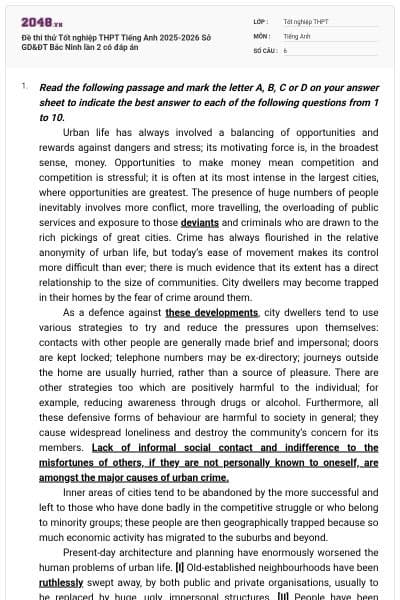
Read the following passage and mark the letter A, B, C or D on your answer sheet to indicate the best answer to each of the following questions from 1 to 10.
Urban life has always involved a balancing of opportunities and rewards against dangers and stress; its motivating force is, in the broadest sense, money. Opportunities to make money mean competition and competition is stressful; it is often at its most intense in the largest cities, where opportunities are greatest. The presence of huge numbers of people inevitably involves more conflict, more travelling, the overloading of public services and exposure to those deviants and criminals who are drawn to the rich pickings of great cities. Crime has always flourished in the relative anonymity of urban life, but today’s ease of movement makes its control more difficult than ever; there is much evidence that its extent has a direct relationship to the size of communities. City dwellers may become trapped in their homes by the fear of crime around them.
As a defence against these developments, city dwellers tend to use various strategies to try and reduce the pressures upon themselves: contacts with other people are generally made brief and impersonal; doors are kept locked; telephone numbers may be ex-directory; journeys outside the home are usually hurried, rather than a source of pleasure. There are other strategies too which are positively harmful to the individual; for example, reducing awareness through drugs or alcohol. Furthermore, all these defensive forms of behaviour are harmful to society in general; they cause widespread loneliness and destroy the community’s concern for its members. Lack of informal social contact and indifference to the misfortunes of others, if they are not personally known to oneself, are amongst the major causes of urban crime.
Inner areas of cities tend to be abandoned by the more successful and left to those who have done badly in the competitive struggle or who belong to minority groups; these people are then geographically trapped because so much economic activity has migrated to the suburbs and beyond.
Present-day architecture and planning have enormously worsened the human problems of urban life. [I] Old-established neighbourhoods have been ruthlessly swept away, by both public and private organisations, usually to be replaced by huge, ugly, impersonal structures. [II] People have been forced to leave their familiar homes, usually to be rehoused in tower blocks which are drab, inconvenient, and fail to provide any setting for human interaction or support. [III] Instead, every effort should be made to conserve the human scale of the environment, and to retain familiar landmarks. [IV]
(Adapted from: Cambridge Proficiency Examination Practice 5)
According to paragraph 1, which of the following is NOT mentioned as an inevitable consequence of the vast population density in cities?
Overburdening of public service systems
Increasing daily travel time
Higher incidence of mental health problems
Increased levels of conflict among people
Theo đoạn 1, điều nào sau đây KHÔNG được đề cập như một hệ quả tất yếu của mật độ dân số đông đúc ở các thành phố?
A. Overburdening of public service systems: Việc hệ thống dịch vụ công bị quá tải.
(Có nhắc đến: “overloading of public services”)
B. Increasing daily travel time: Tăng thời gian đi lại hàng ngày.
(Có nhắc đến: “more travelling”)
C. Higher incidence of mental health problems: Tỷ lệ mắc các vấn đề sức khỏe tâm thần cao hơn. (Không được nhắc đến)
D. Increased levels of conflict among people: Mức độ xung đột gia tăng giữa con người.
(Có nhắc đến: “more conflict”)
Thông tin (Đoạn 1): The presence of huge numbers of people inevitably involves more conflict, more travelling, the overloading of public services...
(Sự hiện diện của số lượng lớn con người tất yếu kéo theo nhiều xung đột hơn, đi lại nhiều hơn, sự quá tải của các dịch vụ công...)
Chọn C.
The word “deviants” in paragraph 1 is closest in meaning to ______.
strangers
outsiders
offenders
activists
Từ “deviants” ở đoạn 1 có nghĩa gần nhất với ______.
deviant (n): người có hành vi lệch lạc, bất thường (thường theo chiều hướng tiêu cực/phạm tội).
A. strangers (n): người lạ
B. outsiders (n): người ngoài
C. offenders (n): người phạm tội, người vi phạm (gần nghĩa nhất trong ngữ cảnh đi đôi với “criminals”)
D. activists (n): nhà hoạt động
→ deviants = offenders
Thông tin: ...exposure to those deviants and criminals who are drawn to the rich pickings of great cities.
(...tiếp xúc với những kẻ có hành vi lệch lạc và tội phạm, những kẻ bị thu hút bởi những món hời béo bở của các thành phố lớn.)
Chọn C.
Which of the following statements best summarizes paragraph 1?
The main difficulty of city life lies in managing crime, which is intensified by the ease of movement and anonymity.
The growth of large cities increases crime and social strain due to today’s ease of movement and overburdened services.
Urban life involves a tension between opportunities and pressures, largely shaped by financial motives and competition.
High population density in cities leads to competition, conflict, and stress among individuals seeking economic success.
Câu nào sau đây tóm tắt tốt nhất đoạn 1?
A. Khó khăn chính của cuộc sống thành phố nằm ở việc quản lý tội phạm, điều bị gia tăng bởi sự dễ dàng di chuyển và tính ẩn danh. (Chỉ là một ý nhỏ của đoạn).
B. Sự phát triển của các thành phố lớn làm tăng tội phạm và căng thẳng xã hội do sự di chuyển dễ dàng ngày nay và các dịch vụ bị quá tải. (Chưa bao quát hết ý về cơ hội và động lực tài chính).
C. Cuộc sống đô thị bao hàm sự căng thẳng giữa các cơ hội và áp lực, phần lớn được định hình bởi động cơ tài chính và sự cạnh tranh. (Đúng và bao quát nhất: đoạn 1 mở đầu bằng việc cân bằng giữa cơ hội/phần thưởng với nguy hiểm/căng thẳng, và nhấn mạnh động lực cốt lõi là tiền bạc và cạnh tranh, kéo theo các vấn đề khác).
D. Mật độ dân số cao ở các thành phố dẫn đến cạnh tranh, xung đột và căng thẳng giữa những cá nhân tìm kiếm thành công kinh tế. (Thiếu yếu tố tội phạm và các áp lực khác).
Chọn C.
In paragraph 2, the phrase “these developments” primarily refers to ______.
urban chances, wealth, and rewards
rising urban stress, crime, and fear
the rich pickings of great cities
city dwellers trapped in their homes
Ở đoạn 2, cụm từ “these developments” chủ yếu chỉ ______.
A. urban chances, wealth, and rewards: cơ hội, sự giàu có và phần thưởng đô thị
B. rising urban stress, crime, and fear: căng thẳng đô thị gia tăng, tội phạm và nỗi sợ hãi
C. the rich pickings of great cities: những món hời béo bở của các thành phố lớn
D. city dwellers trapped in their homes: những cư dân thành phố bị mắc kẹt trong nhà của họ
Thông tin (Đoạn 1 & 2): Cuối đoạn 1 nói về việc tỷ lệ tội phạm tăng, kiểm soát khó khăn, và người dân thành phố sợ hãi bị mắc kẹt trong nhà. Đầu đoạn 2 tiếp nối: “As a defence against these developments...” (Như một sự phòng vệ chống lại những diễn biến này...). Do đó, “these developments” chỉ những tiêu cực vừa được nêu (căng thẳng, tội phạm, nỗi sợ hãi).
Chọn B.
Which of the following best paraphrases the underlined sentence in paragraph 2?
A significant factor in city crime is the absence of casual social interaction and a lack of concern for strangers’ problems.
People who do not have personal acquaintances in the city are more likely to become victims of crime and misfortune.
Urban crime is primarily driven by the fact that city dwellers do not know how to help strangers who are in trouble.
The main cause of crime in urban areas is that residents are too busy to establish formal social contacts with their neighbors.
Câu nào sau đây diễn giải tốt nhất câu được gạch chân ở đoạn 2?
Lack of informal social contact and indifference to the misfortunes of others, if they are not personally known to oneself, are amongst the major causes of urban crime.
(Sự thiếu vắng các tiếp xúc xã hội thân mật và sự thờ ơ đối với những bất hạnh của người khác, nếu bản thân không quen biết họ một cách cá nhân, là một trong những nguyên nhân chính gây ra tội phạm đô thị.)
Dịch nghĩa:
A. Một yếu tố quan trọng gây ra tội phạm thành phố là sự thiếu vắng tương tác xã hội thông thường và sự thiếu quan tâm đến những vấn đề của người lạ. (Đúng và sát nghĩa nhất: lack of informal social contact = absence of casual social interaction; indifference to the misfortunes of others (not personally known) = lack of concern for strangers’ problems).
B. Những người không có người quen cá nhân trong thành phố có nhiều khả năng trở thành nạn nhân của tội phạm và bất hạnh. (Sai nghĩa).
C. Tội phạm đô thị chủ yếu được thúc đẩy bởi thực tế là cư dân thành phố không biết cách giúp đỡ những người lạ đang gặp khó khăn. (Sai nghĩa).
D. Nguyên nhân chính gây ra tội phạm ở các khu vực thành thị là cư dân quá bận rộn để thiết lập các mối liên hệ xã hội chính thức với hàng xóm của họ. (Sai nghĩa từ “formal”).
Chọn A.
The word “ruthlessly” in paragraph 4 is OPPOSITE in meaning to ______.
aggressively
compassionately
indifferently
efficiently
Từ “ruthlessly” ở đoạn 4 TRÁI NGHĨA với ______.
ruthlessly (adv): một cách tàn nhẫn, không thương xót.
A. aggressively (adv): một cách hung hăng
B. compassionately (adv): một cách đầy lòng thương cảm, nhân ái (trái nghĩa)
C. indifferently (adv): một cách thờ ơ
D. efficiently (adv): một cách hiệu quả
→ ruthlessly >< compassionately
Thông tin: Old-established neighbourhoods have been ruthlessly swept away...
(Những khu dân cư lâu đời đã bị quét sạch một cách tàn nhẫn...)
Chọn B.
Which of the following is TRUE according to the passage?
Old neighbourhoods were improved and replaced by large modern buildings that strengthened community interaction and support.
Urban residents often adopt impersonal behaviours that contribute to greater psychological pressure and decreased social isolation.
The more affluent move out of inner-city areas, leaving poorer groups confined to places where economic activity has shifted to the suburbs.
There might be little or no significant correlation between the scale of a community and the scope of criminal activity within it.
Theo bài đọc, nhận định nào sau đây là ĐÚNG?
A. Các khu dân cư cũ đã được cải tạo và thay thế bằng các tòa nhà hiện đại lớn giúp tăng cường sự tương tác và hỗ trợ của cộng đồng. (Sai, đoạn 4 nói chúng “fail to provide any setting for human interaction or support”).
B. Cư dân đô thị thường áp dụng những hành vi thiếu tình người, điều góp phần làm tăng áp lực tâm lý và giảm sự cô lập xã hội. (Sai vì hành vi này làm tăng sự cô lập chứ không phải giảm).
C. Những người khá giả hơn chuyển ra khỏi khu vực nội thành, để lại những nhóm nghèo hơn bị giới hạn ở những nơi mà hoạt động kinh tế đã chuyển ra vùng ngoại ô. (Đúng).
D. Có thể có rất ít hoặc không có mối tương quan đáng kể nào giữa quy mô của một cộng đồng và phạm vi hoạt động tội phạm trong đó. (Sai, đoạn 1 nói “có nhiều bằng chứng cho thấy mức độ của nó có mối quan hệ trực tiếp với quy mô của cộng đồng”).
Thông tin (Đoạn 3): Inner areas of cities tend to be abandoned by the more successful and left to those who have done badly... these people are then geographically trapped because so much economic activity has migrated to the suburbs...
(Các khu vực nội thành có xu hướng bị những người thành công hơn bỏ rơi và nhường lại cho những người thất bại... những người này sau đó bị mắc kẹt về mặt địa lý vì rất nhiều hoạt động kinh tế đã di cư đến các vùng ngoại ô...)
Chọn C.
Where in the paragraph 4 does the following sentence best fit?
This destruction of established social structures is the worst possible approach to the difficulties of living in a town or city.
[I]
[IV]
[III]
[II]
Câu sau đây phù hợp nhất ở vị trí nào trong đoạn 4?
“This destruction of established social structures is the worst possible approach to the difficulties of living in a town or city.”
(Sự phá hủy các cấu trúc xã hội đã được thiết lập này là cách tiếp cận tồi tệ nhất có thể đối với những khó khăn của cuộc sống ở thị trấn hoặc thành phố.)
- [I] Đầu đoạn 4 nêu nhận định chung về kiến trúc.
- Câu tiếp theo mô tả việc phá hủy “old-established neighbourhoods” và thay bằng “huge, ugly, impersonal structures” [II], rồi nhồi nhét người dân vào “tower blocks” không có sự tương tác hay hỗ trợ con người.
- Vị trí [III] là nơi lý tưởng nhất để chèn câu được cho, vì “This destruction of established social structures” sẽ tóm gọn lại toàn bộ hậu quả của những hành động được mô tả trước đó (phá khu dân cư, chuyển vào tháp chung cư).
- Câu tiếp theo bắt đầu bằng “Instead...” (Thay vào đó...) đưa ra giải pháp (bảo tồn, giữ lại các điểm nhấn quen thuộc), rất phù hợp để đi ngay sau câu chỉ trích “cách tiếp cận tồi tệ nhất”.
Chọn C.
Which of the following can be inferred from the passage?
Measures aimed at reducing crime are unlikely to succeed unless individuals alter their defensive behaviours and increase social interaction.
Efforts to strengthen social cohesion in cities may be limited in effectiveness only if underlying structural and environmental issues remain unaddressed.
Preserving aspects of traditional urban environments could play a role in mitigating certain social and psychological problems in cities.
Expanding economic activity beyond city centres would likely reduce inequality and improve social conditions for disadvantaged urban populations.
Điều nào sau đây có thể được suy luận từ bài đọc?
A. Các biện pháp nhằm giảm tội phạm khó có thể thành công trừ khi các cá nhân thay đổi hành vi phòng vệ và tăng cường tương tác xã hội. (Quá khẳng định, bài chỉ nói nó là “một trong những nguyên nhân chính”).
B. Những nỗ lực củng cố sự gắn kết xã hội ở các thành phố có thể bị hạn chế về hiệu quả chỉ khi các vấn đề cơ bản về cấu trúc và môi trường không được giải quyết. (Sai sắc thái “chỉ khi”).
C. Việc bảo tồn các khía cạnh của môi trường đô thị truyền thống có thể đóng vai trò trong việc giảm nhẹ một số vấn đề xã hội và tâm lý ở các thành phố. (Đúng).
D. Việc mở rộng hoạt động kinh tế ra ngoài trung tâm thành phố có khả năng làm giảm bất bình đẳng và cải thiện điều kiện xã hội cho các nhóm dân cư đô thị yếu thế. (Sai, đoạn 3 nói việc kinh tế chuyển ra ngoại ô khiến người yếu thế ở nội thành bị “mắc kẹt”).
→ Suy luận cho C: Đoạn 4 chỉ trích việc kiến trúc hiện đại phá bỏ các “old-established neighbourhoods” quen thuộc và tống người dân vào những khối nhà không có tình người, làm tồi tệ hơn các vấn đề của cuộc sống đô thị. Bài đọc kết luận bằng lời khuyên: “Thay vào đó, nên nỗ lực hết sức để bảo tồn quy mô con người của môi trường và giữ lại những điểm nhấn quen thuộc.” (conserve the human scale... retain familiar landmarks). Điều này ngụ ý rằng việc bảo tồn các yếu tố truyền thống, quen thuộc này sẽ giúp giảm bớt/phòng tránh những vấn đề xã hội và tâm lý đã nêu.
Chọn C.
Which of the following best summarises the passage?
Financial motives in cities lead to social strain, which is exacerbated by flawed architectural design and defensive behaviors that undermine community structures.
Urban life offers financial rewards but creates individual stress and social isolation, which are further worsened by poor architectural planning and rising criminal activities.
The inherent stresses and dangers of urban life, exacerbated by individual coping mechanisms and flawed urban development, lead to societal breakdown and increased crime.
Urban life provides economic wealth but causes social conflict and individual fear, while modern planning fails to support human interaction and prevent widespread community crime.
Câu nào sau đây tóm tắt tốt nhất bài đọc?
A. Các động cơ tài chính ở thành phố dẫn đến căng thẳng xã hội, điều bị làm trầm trọng hơn bởi thiết kế kiến trúc thiếu sót và các hành vi phòng vệ làm suy yếu cấu trúc cộng đồng. (Đúng một phần nhưng thiếu ý quan trọng về bối cảnh nguy hiểm, tội phạm do đông dân cư).
B. Cuộc sống đô thị mang lại phần thưởng tài chính nhưng tạo ra căng thẳng cá nhân và sự cô lập xã hội, những điều này càng trở nên tồi tệ hơn do quy hoạch kiến trúc kém và hoạt động tội phạm gia tăng. (Chưa làm rõ mối liên hệ giữa các hành vi phòng vệ dẫn đến sự thờ ơ và tội phạm).
C. Những căng thẳng và nguy hiểm cố hữu của cuộc sống đô thị, bị làm trầm trọng thêm bởi các cơ chế đối phó cá nhân và sự phát triển đô thị nhiều thiếu sót, dẫn đến sự suy đồi xã hội và gia tăng tội phạm. (Đúng và bao quát nhất: inherent stresses/dangers (đoạn 1); individual coping mechanisms = các hành vi phòng vệ cá nhân (đoạn 2); flawed urban development (đoạn 4); societal breakdown and increased crime (hậu quả xuyên suốt)).
D. Cuộc sống đô thị mang lại sự giàu có về kinh tế nhưng gây ra xung đột xã hội và nỗi sợ hãi cá nhân, trong khi quy hoạch hiện đại không hỗ trợ được tương tác của con người và ngăn chặn tội phạm cộng đồng lan rộng. (Hơi thiếu ý hành vi phòng vệ cá nhân gây ra hậu quả).
Chọn C.
Dịch bài đọc:
Cuộc sống đô thị luôn bao hàm việc cân bằng giữa các cơ hội, phần thưởng với những nguy hiểm và căng thẳng; động lực thúc đẩy nó, theo nghĩa rộng nhất, chính là tiền bạc. Cơ hội kiếm tiền đồng nghĩa với sự cạnh tranh và cạnh tranh thì đầy căng thẳng; nó thường ở mức độ khốc liệt nhất tại các thành phố lớn nhất, nơi các cơ hội là lớn nhất. Sự hiện diện của số lượng lớn con người tất yếu kéo theo nhiều xung đột hơn, đi lại nhiều hơn, sự quá tải của các dịch vụ công và việc tiếp xúc với những kẻ có hành vi lệch lạc và tội phạm, những kẻ bị thu hút bởi những món hời béo bở của các thành phố lớn. Tội phạm luôn sinh sôi nảy nở trong sự ẩn danh tương đối của cuộc sống đô thị, nhưng sự dễ dàng di chuyển ngày nay khiến việc kiểm soát nó trở nên khó khăn hơn bao giờ hết; có nhiều bằng chứng cho thấy mức độ của nó có mối quan hệ trực tiếp với quy mô của cộng đồng. Cư dân thành phố có thể trở nên bị mắc kẹt trong chính ngôi nhà của mình bởi nỗi sợ hãi tội phạm xung quanh họ.
Như một sự phòng vệ chống lại những diễn biến này, cư dân thành phố có xu hướng sử dụng nhiều chiến lược khác nhau để cố gắng giảm bớt áp lực lên bản thân: những liên hệ với người khác thường được thực hiện một cách ngắn gọn và không mang tính cá nhân; cửa ra vào luôn được khóa; số điện thoại có thể không được liệt kê trong danh bạ; những chuyến đi ra khỏi nhà thường diễn ra vội vã, thay vì là một nguồn vui. Cũng có những chiến lược khác gây tổn hại tích cực đến cá nhân; ví dụ, làm giảm nhận thức thông qua ma túy hoặc rượu. Hơn nữa, tất cả những hình thức hành vi phòng vệ này đều gây hại cho xã hội nói chung; chúng gây ra sự cô đơn lan rộng và phá hủy sự quan tâm của cộng đồng dành cho các thành viên của nó. Sự thiếu vắng các tiếp xúc xã hội thân mật và sự thờ ơ đối với những bất hạnh của người khác, nếu bản thân không quen biết họ một cách cá nhân, là một trong những nguyên nhân chính gây ra tội phạm đô thị.
Các khu vực nội thành có xu hướng bị những người thành công hơn bỏ rơi và nhường lại cho những người thất bại trong cuộc đấu tranh cạnh tranh hoặc những người thuộc các nhóm thiểu số; những người này sau đó bị mắc kẹt về mặt địa lý vì rất nhiều hoạt động kinh tế đã di cư đến các vùng ngoại ô và xa hơn nữa.
Kiến trúc và quy hoạch ngày nay đã làm tồi tệ đi rất nhiều những vấn đề về con người trong cuộc sống đô thị. [I] Những khu dân cư lâu đời đã bị quét sạch một cách tàn nhẫn, bởi cả các tổ chức công và tư, thường để bị thay thế bởi những cấu trúc khổng lồ, xấu xí và thiếu tình người. [II] Con người đã bị buộc phải rời bỏ những ngôi nhà quen thuộc của họ, thường là để được tái định cư trong những khối tháp chung cư buồn tẻ, bất tiện, và không cung cấp bất kỳ bối cảnh nào cho sự tương tác hay hỗ trợ của con người. [III] Sự phá hủy các cấu trúc xã hội đã được thiết lập này là cách tiếp cận tồi tệ nhất có thể đối với những khó khăn của cuộc sống ở thị trấn hoặc thành phố. Thay vào đó, nên nỗ lực hết sức để bảo tồn quy mô con người của môi trường và giữ lại những điểm nhấn quen thuộc. [IV]
Mark the letter A, B, C, or D on your answer sheet to indicate the best arrangement of utterances or sentences to make a meaningful exchange or text in each of the following questions from 11 to 15.
a. I was quite surprised that something as ordinary as wrapping a present could involve such careful planning and precision.
b. When people know the exact dimensions of a gift, they can calculate a much more suitable amount of wrapping paper.
c. This often makes the present look more elegant and helps avoid wasting unnecessary materials.
d. I recently came across an article about the maths formula for perfectly wrapped gifts, and it immediately made me think of you.
e. I hope you will try this idea someday, because it can make gift-giving both easier and more meaningful.
Write back soon,
Billy
a – d – b – c – e
b – e – a – d – c
d – e – a – b – c
d – a – b – c – e
Thứ tự sắp xếp đúng: D. d – a – b – c – e
d. I recently came across an article about the maths formula for perfectly wrapped gifts, and it immediately made me think of you.
a. I was quite surprised that something as ordinary as wrapping a present could involve such careful planning and precision.
b. When people know the exact dimensions of a gift, they can calculate a much more suitable amount of wrapping paper.
c. This often makes the present look more elegant and helps avoid wasting unnecessary materials.
e. I hope you will try this idea someday, because it can make gift-giving both easier and more meaningful.
Dịch nghĩa:
Chào Gemma,
d. Tớ vừa mới đọc được một bài báo về công thức toán học để gói quà một cách hoàn hảo, và nó khiến tớ nghĩ ngay đến cậu.
a. Tớ khá ngạc nhiên khi một việc tưởng chừng như bình thường như gói quà lại có thể đòi hỏi sự lập kế hoạch cẩn thận và độ chính xác đến vậy.
b. Khi mọi người biết được kích thước chính xác của một món quà, họ có thể tính toán được lượng giấy gói phù hợp hơn rất nhiều.
c. Điều này thường làm cho món quà trông thanh lịch hơn và giúp tránh lãng phí các vật liệu không cần thiết.
e. Tớ hy vọng một ngày nào đó cậu sẽ thử ý tưởng này, bởi vì nó có thể làm cho việc tặng quà trở nên dễ dàng và ý nghĩa hơn.
Hồi âm sớm cho tớ nhé,
Billy
Chọn D.
a. Nam: Hi, Mark! Long time no see. You look so healthy!
b. Nam: Yes, I have. I’ve been eating more fibre-rich foods because they are good for both digestion and brain health.
c. Mark: Hi, Nam! Thanks. You look great, too. Have you changed your eating habits lately?
b – c – a
c – a – b
c – b – a
a – c – b
Thứ tự sắp xếp đúng: D. a – c – b
a. Nam: Hi, Mark! Long time no see. You look so healthy!
c. Mark: Hi, Nam! Thanks. You look great, too. Have you changed your eating habits lately?
b. Nam: Yes, I have. I’ve been eating more fibre-rich foods because they are good for both digestion and brain health.
Dịch nghĩa:
a. Nam: Chào Mark! Lâu rồi không gặp. Cậu trông khỏe khoắn quá!
c. Mark: Chào Nam! Cảm ơn nhé. Cậu trông cũng rất tuyệt. Dạo này cậu có thay đổi thói quen ăn uống của mình không?
b. Nam: Có chứ. Tớ đang ăn nhiều thực phẩm giàu chất xơ hơn vì chúng tốt cho cả tiêu hóa và sức khỏe não bộ.
Chọn D.
a. Researchers warn that relying too heavily on these tools may gradually weaken memory, creativity, and critical thinking.
b. In one MIT study, students who used ChatGPT to write essays showed much less brain activity and later struggled to remember what they had written.
c. As large language models become more common, many people are using them to complete tasks that once required independent thinking.
d. Some experts fear that this pattern of accepting AI-generated answers with little questioning may eventually contribute to cognitive decline, especially among younger users.
e. Teachers also found that many AI-assisted essays looked similar, lacked originality, and were often described as “soulless.”
c – e – a – b – d
c – a – e – b – d
c – e – b – a – d
c – a – b – e – d
Thứ tự sắp xếp đúng: D. c – a – b – e – d
c. As large language models become more common, many people are using them to complete tasks that once required independent thinking.
a. Researchers warn that relying too heavily on these tools may gradually weaken memory, creativity, and critical thinking.
b. In one MIT study, students who used ChatGPT to write essays showed much less brain activity and later struggled to remember what they had written.
e. Teachers also found that many AI-assisted essays looked similar, lacked originality, and were often described as “soulless.”
d. Some experts fear that this pattern of accepting AI-generated answers with little questioning may eventually contribute to cognitive decline, especially among younger users.
Dịch nghĩa:
c. Khi các mô hình ngôn ngữ lớn trở nên phổ biến hơn, nhiều người đang sử dụng chúng để hoàn thành các nhiệm vụ từng đòi hỏi tư duy độc lập.
a. Các nhà nghiên cứu cảnh báo rằng việc quá phụ thuộc vào những công cụ này có thể dần dần làm suy yếu trí nhớ, tính sáng tạo và tư duy phản biện.
b. Trong một nghiên cứu của MIT, những sinh viên sử dụng ChatGPT để viết luận cho thấy hoạt động não bộ ít hơn hẳn và sau đó gặp khó khăn trong việc nhớ lại những gì họ đã viết.
e. Các giáo viên cũng phát hiện ra rằng nhiều bài luận có sự hỗ trợ của AI trông rất giống nhau, thiếu đi sự độc đáo và thường bị miêu tả là “vô hồn”.
d. Một số chuyên gia lo ngại rằng mô hình chấp nhận các câu trả lời do AI tạo ra với rất ít sự hoài nghi này cuối cùng có thể góp phần vào sự suy giảm nhận thức, đặc biệt là ở những người dùng trẻ tuổi.
Chọn D.
a. Alex: Why do you think knitting is helpful?
b. Sue: I’m going to try knitting to relax after school.
c. Alex: How are you going to calm your mind after stressful days?
d. Alex: I think knitting takes too much patience. I don’t think I’ll try it.
e. Sue: It helps people focus on simple movements, reduces stress, and makes them feel calmer.
c – b – a – e – d
c – e – d – b – a
d – e – a – b – c
d – b – a – e – c
Thứ tự sắp xếp đúng: A. c – b – a – e – d
c. Alex: How are you going to calm your mind after stressful days?
b. Sue: I’m going to try knitting to relax after school.
a. Alex: Why do you think knitting is helpful?
e. Sue: It helps people focus on simple movements, reduces stress, and makes them feel calmer.
d. Alex: I think knitting takes too much patience. I don’t think I’ll try it.
Dịch nghĩa:
c. Alex: Cậu định làm thế nào để xoa dịu tâm trí sau những ngày căng thẳng vậy?
b. Sue: Tớ định thử đan len để thư giãn sau giờ học.
a. Alex: Tại sao cậu lại nghĩ đan len là hữu ích?
e. Sue: Nó giúp mọi người tập trung vào những chuyển động đơn giản, giảm bớt căng thẳng và làm cho họ cảm thấy bình tĩnh hơn.
d. Alex: Tớ nghĩ đan len đòi hỏi quá nhiều sự kiên nhẫn. Tớ không nghĩ là mình sẽ thử đâu.
Chọn A.
a. However, many teenagers argue that these bans are ineffective, as students often find ways around them and may become even more dependent on their devices.
b. Some also point out that school-provided laptops and tablets can be equally distracting, which makes such policies appear inconsistent in practice.
c. For this reason, many students believe that teaching responsible technology use may be more effective than simply banning it.
d. Schools have recently introduced a range of technology bans in an effort to reduce distractions and improve students’ focus in class.
e. Even so, some students admit that when strictly enforced, these measures can improve concentration and encourage more meaningful face-to-face interaction.
a – d – b – e – c
d – b – a – e – c
a – b – d – e – c
d – a – b – e – c
Thứ tự sắp xếp đúng: D. d – a – b – e – c
d. Schools have recently introduced a range of technology bans in an effort to reduce distractions and improve students’ focus in class.
a. However, many teenagers argue that these bans are ineffective, as students often find ways around them and may become even more dependent on their devices.
b. Some also point out that school-provided laptops and tablets can be equally distracting, which makes such policies appear inconsistent in practice.
e. Even so, some students admit that when strictly enforced, these measures can improve concentration and encourage more meaningful face-to-face interaction.
c. For this reason, many students believe that teaching responsible technology use may be more effective than simply banning it.
Dịch nghĩa:
d. Các trường học gần đây đã đưa ra một loạt lệnh cấm công nghệ trong nỗ lực giảm bớt sự phân tâm và cải thiện sự tập trung của học sinh trong lớp.
a. Tuy nhiên, nhiều thanh thiếu niên lập luận rằng những lệnh cấm này không hiệu quả, vì học sinh thường tìm cách lách luật và có thể trở nên phụ thuộc hơn vào các thiết bị của mình.
b. Một số người cũng chỉ ra rằng máy tính xách tay và máy tính bảng do trường cung cấp cũng có thể gây xao nhãng không kém, điều này làm cho các chính sách đó có vẻ thiếu nhất quán trong thực tế.
e. Mặc dù vậy, một số học sinh thừa nhận rằng khi được thực thi nghiêm ngặt, những biện pháp này có thể cải thiện sự tập trung và khuyến khích các tương tác trực tiếp có ý nghĩa hơn.
c. Vì lý do này, nhiều học sinh tin rằng việc dạy cách sử dụng công nghệ có trách nhiệm có thể sẽ hiệu quả hơn là chỉ đơn thuần cấm đoán nó.
Chọn D.
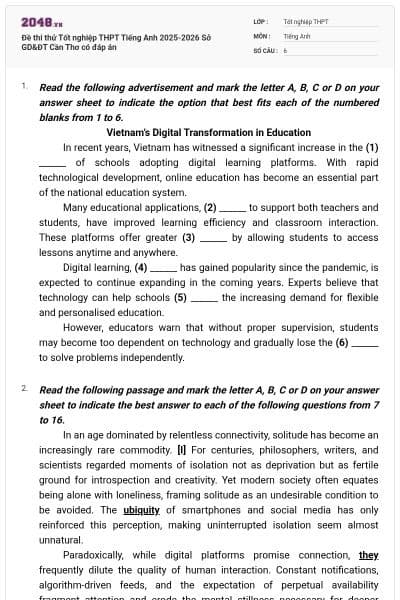
Read the following article and mark the letter A, B, C or D on your answer sheet to indicate the option that best fits each of the numbered blanks from 16 to 21.
Embrace Imperfection and Stop Pleasing Everyone
Many people feel pressure to stay busy, satisfy others, and complete too (16) ______ tasks each day. However, some readers have discovered that doing less can improve both happiness and well-being. By reducing unnecessary (17) ______, they have gained more time, energy, and peace of mind.
One important lesson is to stop trying to please everyone. Accepting short (18) ______ of discomfort and allowing (19) ______ to solve their own problems can protect emotional energy. Another is to accept that things do not need to be perfect. For instance, choosing a suitable travel plan quickly instead of searching endlessly can save time and reduce stress.
People can also (20) ______ phone calls instead of sending constant messages. Planning regular downtime, taking short breaks, and focusing on one important task at a time may also make life easier. Doing less does not mean achieving less. (21) ______, it can help people live more calmly, clearly, and effectively.
(Adapted from: https://www.theguardian.com)
many
few
much
little
A. many: nhiều (+ danh từ đếm được số nhiều).
B. few: ít (+ danh từ đếm được số nhiều).
C. much: nhiều (+ danh từ không đếm được).
D. little: ít (+ danh từ không đếm được).
Phía sau khoảng trống là danh từ đếm được ở dạng số nhiều “tasks” (các nhiệm vụ). Trong ngữ cảnh nói về áp lực, lượng từ đi với “too” (quá) phù hợp nhất mang nghĩa “quá nhiều” là “too many”.
Chọn A. many
→ ...satisfy others, and complete too many tasks each day.
Dịch nghĩa: ...làm hài lòng người khác và hoàn thành quá nhiều nhiệm vụ mỗi ngày.
demands
impulses
appeals
standards
A. demands (n): những yêu cầu, đòi hỏi.
B. impulses (n): sự bốc đồng, cơn bốc đồng.
C. appeals (n): sự hấp dẫn, lời kêu gọi.
D. standards (n): tiêu chuẩn.
Dựa vào câu trước (cảm thấy áp lực phải luôn bận rộn, làm hài lòng người khác), việc giảm bớt những “đòi hỏi/yêu cầu” không cần thiết (từ bản thân hoặc người khác) sẽ giúp họ lấy lại được thời gian và sự bình yên.
Chọn A. demands
→ By reducing unnecessary demands, they have gained more time...
Dịch nghĩa: Bằng cách giảm bớt những đòi hỏi không cần thiết, họ đã có thêm thời gian...
intervals
levels
moments
stages
A. intervals (n): khoảng thời gian (thường có tính chu kỳ, quãng nghỉ).
B. levels (n): mức độ.
C. moments (n): khoảnh khắc, lúc.
D. stages (n): giai đoạn.
Ta có cụm từ ghép: moments of discomfort (những khoảnh khắc khó chịu / không thoải mái về mặt cảm xúc).
Chọn C. moments
→ Accepting short moments of discomfort...
Dịch nghĩa: Chấp nhận những khoảnh khắc không thoải mái ngắn ngủi...
another
others
other
the others
A. another: một (người/vật) khác (+ danh từ đếm được số ít, hoặc đại từ chỉ 1 người).
B. others: những người/vật khác (đại từ, đứng độc lập không đi kèm danh từ).
C. other: những (người/vật) khác (tính từ, phải đi kèm danh từ số nhiều hoặc không đếm được).
D. the others: những người/vật còn lại (đã xác định cụ thể trong một nhóm).
Khoảng trống cần một đại từ đóng vai trò làm tân ngữ cho động từ “allowing”, mang nghĩa chỉ “những người khác” nói chung. Do đó “others” là lựa chọn chính xác.
Chọn B. others
→ ...and allowing others to solve their own problems can protect emotional energy.
Dịch nghĩa: ...và cho phép những người khác tự giải quyết các vấn đề của riêng họ có thể bảo vệ năng lượng cảm xúc.
switch to
check out
catch on
call for
A. switch to (phr.v): chuyển sang.
B. check out (phr.v): làm thủ tục trả phòng, kiểm tra, xem xét.
C. catch on (phr.v): trở nên phổ biến, hiểu ra vấn đề.
D. call for (phr.v): đòi hỏi, yêu cầu.
Cấu trúc “... instead of ...” (thay vì...) cho thấy sự thay đổi, từ bỏ một thói quen cũ (nhắn tin liên tục) để áp dụng một thói quen mới (gọi điện thoại). “Switch to” là cụm động từ hoàn toàn phù hợp.
Chọn A. switch to
→ People can also switch to phone calls instead of sending constant messages.
Dịch nghĩa: Mọi người cũng có thể chuyển sang gọi điện thoại thay vì nhắn tin liên tục.
In addition
As a result
In comparison
Instead
A. In addition (adv): Ngoài ra, thêm vào đó.
B. As a result (adv): Kết quả là.
C. In comparison (adv): Để so sánh.
D. Instead (adv): Thay vào đó.
Câu phía trước mang ý phủ định (“Làm ít đi không có nghĩa là đạt được ít hơn.”). Câu phía sau đưa ra một ý nghĩa thay thế mang tính tích cực hơn (“...nó có thể giúp mọi người sống bình tĩnh hơn...”). Liên từ “Instead” được dùng để nối 2 vế có tính chất phủ định sự việc này và thay thế bằng sự việc khác.
Chọn D. Instead
→ Doing less does not mean achieving less. Instead, it can help people live more calmly...
Dịch nghĩa: Làm ít đi không có nghĩa là đạt được ít hơn. Thay vào đó, nó có thể giúp con người sống bình tĩnh hơn...
Bài đọc hoàn chỉnh | Dịch bài đọc |
Embrace Imperfection and Stop Pleasing Everyone Many people feel pressure to stay busy, satisfy others, and complete too (16) many tasks each day. However, some readers have discovered that doing less can improve both happiness and well-being. By reducing unnecessary (17) demands, they have gained more time, energy, and peace of mind. One important lesson is to stop trying to please everyone. Accepting short (18) moments of discomfort and allowing (19) others to solve their own problems can protect emotional energy. Another is to accept that things do not need to be perfect. For instance, choosing a suitable travel plan quickly instead of searching endlessly can save time and reduce stress. People can also (20) switch to phone calls instead of sending constant messages. Planning regular downtime, taking short breaks, and focusing on one important task at a time may also make life easier. Doing less does not mean achieving less. (21) Instead, it can help people live more calmly, clearly, and effectively. | Chấp Nhận Sự Không Hoàn Hảo Và Ngừng Làm Hài Lòng Tất Cả Mọi Người Nhiều người cảm thấy áp lực phải luôn bận rộn, làm hài lòng người khác và hoàn thành quá (16) nhiều nhiệm vụ mỗi ngày. Tuy nhiên, một số độc giả đã phát hiện ra rằng làm ít đi có thể cải thiện cả hạnh phúc lẫn sức khỏe (thể chất và tinh thần). Bằng cách giảm bớt những (17) đòi hỏi không cần thiết, họ đã có thêm thời gian, năng lượng và sự bình yên trong tâm trí. Một bài học quan trọng là hãy ngừng cố gắng làm hài lòng tất cả mọi người. Việc chấp nhận những (18) khoảnh khắc không thoải mái ngắn ngủi và để cho (19) những người khác tự giải quyết các vấn đề của riêng họ có thể bảo vệ năng lượng cảm xúc. Một bài học khác là chấp nhận rằng mọi thứ không cần phải hoàn hảo. Ví dụ, việc nhanh chóng chọn một kế hoạch du lịch phù hợp thay vì tìm kiếm không ngừng nghỉ có thể tiết kiệm thời gian và giảm bớt căng thẳng. Mọi người cũng có thể (20) chuyển sang gọi điện thoại thay vì nhắn tin liên tục. Việc lên kế hoạch cho thời gian nghỉ ngơi đều đặn, có những khoảng nghỉ ngắn và tập trung vào một nhiệm vụ quan trọng tại một thời điểm cũng có thể làm cho cuộc sống dễ dàng hơn. Làm ít đi không có nghĩa là đạt được ít hơn. (21) Thay vào đó, nó có thể giúp mọi người sống một cách bình tĩnh, sáng suốt và hiệu quả hơn. |
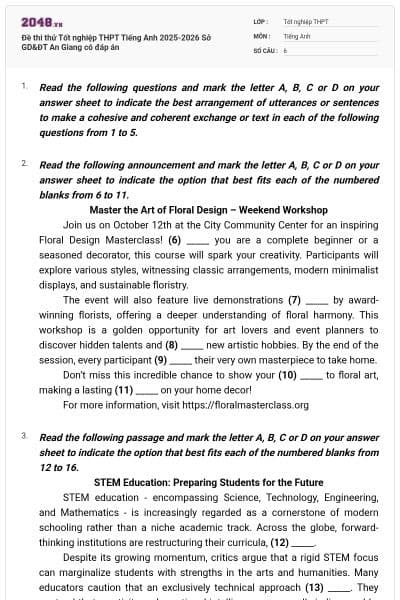
Read the following advertisement and mark the letter A, B, C or D on your answer sheet to indicate the option that best fits each of the numbered blanks from 22 to 27.
JOIN OUR CREATIVE TEAM
“Are you prepared to dedicate yourself to working collaboratively with a team of like-minded professionals? Are you (22) ______ to apply your education, experience, and creativity in a meaningful way? If so, this opportunity may be exactly what you are looking for. Karning Creative Designs is currently undergoing expansion, and with our continued success comes your opportunity.
Karning Creative Designs was established ten years ago as a (23) ______ set up in the home of our current CEO and founder, Shirin Navani. Now situated in a modern loft in downtown Hollinson, our company currently employs 25 full-time staff members. We are presently seeking designers and artists (24) ______ to work effectively in a fast-paced, collaborative setting. The ideal candidate should demonstrate a strong ability to work closely (25) ______ colleagues while maintaining exceptional standards of quality.
At Karning, you will have valuable opportunities to interact with clients and (26) ______ business contacts. If you would prefer (27) ______ independently rather than work in large groups while still contributing to a cohesive team, this position could be an excellent fit for you. If you’re ready to join us, contact Salvador Tomassin at 608-555-0144. Apply by March 31.”
(Adapted from: TOEIC ETS actual tests 2025)
fascinating
willing
stimulating
exciting
A. fascinating (adj): hấp dẫn, lôi cuốn.
B. willing (adj): sẵn lòng, bằng lòng.
C. stimulating (adj): mang tính kích thích, khơi gợi.
D. exciting (adj): thú vị, hào hứng.
Ta có cấu trúc: be willing to do something (sẵn lòng làm việc gì đó).
Chọn B. willing
→ Are you willing to apply your education, experience, and creativity...
Dịch nghĩa: Bạn có sẵn lòng áp dụng trình độ học vấn, kinh nghiệm và sự sáng tạo của mình...
operation two persons
two-person operation
two persons operation
operation two-person
Phân tích ngữ pháp: Để tạo một tính từ ghép chỉ số lượng bổ nghĩa cho danh từ phía sau, ta dùng cấu trúc [Số đếm] - [Danh từ đếm được ở dạng SỐ ÍT]. Ở đây, “two-person” đóng vai trò là tính từ ghép bổ nghĩa cho danh từ chính “operation” (hoạt động/cơ sở kinh doanh).
Chọn B. two-person operation
→ ...established ten years ago as a two-person operation set up in the home...
Dịch nghĩa: ...được thành lập cách đây 10 năm như một cơ sở kinh doanh hai người được thiết lập tại nhà...
who is qualified
qualifying
being qualified
qualified
A. who is qualified: Sai ngữ pháp do động từ to be chia số ít “is”, trong khi danh từ đứng trước “designers and artists” là số nhiều.
B. qualifying: hiện tại phân từ (mang nghĩa chủ động).
C. being qualified: hiện tại phân từ mang nghĩa bị động (đang được).
D. qualified: quá khứ phân từ / tính từ (đủ tiêu chuẩn/điều kiện).
Đây là trường hợp rút gọn mệnh đề quan hệ. Mệnh đề đầy đủ là who are qualified (những người có đủ tiêu chuẩn). Khi rút gọn, ta bỏ đại từ quan hệ “who” và động từ to be “are”, chỉ giữ lại phần tính từ “qualified”.
Chọn D. qualified
→ We are presently seeking designers and artists qualified to work effectively...
Dịch nghĩa: Hiện tại chúng tôi đang tìm kiếm các nhà thiết kế và nghệ sĩ đủ tiêu chuẩn để làm việc hiệu quả...
for
on
with
as
A. for (prep): cho.
B. on (prep): trên.
C. with (prep): với.
D. as (prep): như là.
Ta có cụm động từ cơ bản: work with somebody (làm việc cùng với ai đó). Phía sau khoảng trống là “colleagues” (các đồng nghiệp).
Chọn C. with
→ ...demonstrate a strong ability to work closely with colleagues...
Dịch nghĩa: ...thể hiện khả năng làm việc chặt chẽ với các đồng nghiệp...
hold
take
make
lose
A. hold (v): cầm, nắm, tổ chức.
B. take (v): cầm, lấy.
C. make (v): làm, tạo ra.
D. lose (v): mất.
Ta có cụm từ kết hợp (collocation) cố định: make contacts (thiết lập các mối quan hệ / tạo dựng các mối liên hệ).
Chọn C. make
→ ...interact with clients and make business contacts.
Dịch nghĩa: ...tương tác với khách hàng và tạo dựng các mối quan hệ kinh doanh.
working
to working
to work
work
A. working (v-ing): danh động từ.
B. to working: giới từ to + V-ing.
C. to work: động từ nguyên thể có “to”.
D. work (v): động từ nguyên mẫu.
Ta có cấu trúc diễn tả sự ưu tiên/sự thích hơn: would prefer TO DO something rather than DO something (thích/muốn làm việc này hơn là làm việc kia). Lưu ý vế sau là “rather than work”, nên vế trước bắt buộc phải dùng “to work”.
Chọn C. to work
→ If you would prefer to work independently rather than work in large groups...
Dịch nghĩa: Nếu bạn muốn (thích) làm việc độc lập hơn là làm việc trong các nhóm lớn...
Bài đọc hoàn chỉnh | Dịch bài đọc |
JOIN OUR CREATIVE TEAM “Are you prepared to dedicate yourself to working collaboratively with a team of like-minded professionals? Are you (22) willing to apply your education, experience, and creativity in a meaningful way? If so, this opportunity may be exactly what you are looking for. Karning Creative Designs is currently undergoing expansion, and with our continued success comes your opportunity. Karning Creative Designs was established ten years ago as a (23) two-person operation set up in the home of our current CEO and founder, Shirin Navani. Now situated in a modern loft in downtown Hollinson, our company currently employs 25 full-time staff members. We are presently seeking designers and artists (24) qualified to work effectively in a fast-paced, collaborative setting. The ideal candidate should demonstrate a strong ability to work closely (25) with colleagues while maintaining exceptional standards of quality. At Karning, you will have valuable opportunities to interact with clients and (26) make business contacts. If you would prefer (27) to work independently rather than work in large groups while still contributing to a cohesive team, this position could be an excellent fit for you. If you’re ready to join us, contact Salvador Tomassin at 608-555-0144. Apply by March 31.” | GIA NHẬP ĐỘI NGŨ SÁNG TẠO CỦA CHÚNG TÔI “Bạn đã sẵn sàng cống hiến hết mình để làm việc cộng tác với một đội ngũ gồm những chuyên gia có cùng chí hướng chưa? Bạn có (22) sẵn lòng áp dụng trình độ học vấn, kinh nghiệm và sự sáng tạo của mình một cách có ý nghĩa không? Nếu có, cơ hội này có thể chính xác là những gì bạn đang tìm kiếm. Karning Creative Designs hiện đang trong quá trình mở rộng, và cùng với sự thành công liên tục của chúng tôi chính là cơ hội của bạn. Karning Creative Designs được thành lập cách đây 10 năm như một (23) cơ sở kinh doanh hai người được thiết lập tại nhà của Giám đốc điều hành kiêm người sáng lập hiện tại của chúng tôi, Shirin Navani. Hiện đang tọa lạc tại một căn gác lửng hiện đại ở trung tâm thành phố Hollinson, công ty chúng tôi hiện đang sử dụng 25 nhân viên toàn thời gian. Hiện tại chúng tôi đang tìm kiếm các nhà thiết kế và nghệ sĩ (24) đủ tiêu chuẩn để làm việc hiệu quả trong một môi trường cộng tác, nhịp độ nhanh. Ứng viên lý tưởng cần thể hiện khả năng làm việc chặt chẽ (25) với các đồng nghiệp trong khi vẫn duy trì các tiêu chuẩn đặc biệt về chất lượng. Tại Karning, bạn sẽ có những cơ hội quý giá để tương tác với khách hàng và (26) tạo dựng các mối quan hệ kinh doanh. Nếu bạn thích (27) làm việc độc lập hơn là làm việc trong các nhóm lớn mà vẫn đóng góp cho một đội ngũ gắn kết, thì vị trí này có thể là một sự lựa chọn tuyệt vời dành cho bạn. Nếu bạn đã sẵn sàng tham gia cùng chúng tôi, hãy liên hệ với Salvador Tomassin theo số 608-555-0144. Ứng tuyển trước ngày 31 tháng 3.” |
Read the following passage and mark the letter A, B, C or D on your answer sheet to indicate the best answer to each of the following questions from 28 to 35.
Exam-Obsessed Schools Leave Youth Unprepared for Work
An “exam-obsessed” school system is leaving young people fundamentally unprepared for the workforce, according to Alan Milburn. The former cabinet minister, currently leading a government-commissioned review into young people and work, argues that the current model is “brilliant at sorting young people by academic ability” but “poor at equipping them for adult life.” Milburn’s intervention highlights a growing disconnect between classroom priorities and the demands of a fast-changing labour market, where employers frequently report that school leavers are simply not-work-ready.
New YouGov polling of over 1,000 teachers reinforces this concern, with 74% stating there is too much emphasis on passing exams. Furthermore, 73% of educators believe there is insufficient focus on developing essential “soft skills” or preparing pupils for employment. The data reveals a troubling trend: six in ten teachers say young people’s soft skills have worsened over the past five years, while 66% believe overall readiness for work has declined. This serves as a “gauntlet” to policymakers to bridge the gap between academic standards and employability.
Milburn insists that high educational standards and real-world skills are not competing priorities. Instead, he advocates for a curriculum fostering the attributes young people need to succeed - communication and collaboration skills, agility and creativity — alongside formal qualifications. Teachers largely support this shift, with 98% backing universal careers advice and 92% supporting vocational pathways before age 16. There is a clear consensus that the system must provide alternative routes for those who struggle under the current high-stakes testing regime without lowering overall standards.
The review comes as official statistics show nearly 1 million 16- to 24-year-olds are not in education, employment, or training (Neet). Milburn warns that a system judged more on exam results than student destinations will face increasing scrutiny. To reverse the rise in youth inactivity, he calls for stronger links with employers and expanded access to meaningful work experience, asserting that government ambition must be matched by “action at scale” to ensure long-term economic and social success.
(Adapted from https://www.theguardian.com)
The word “equipping” in paragraph 1 is closest in meaning to ______.
neglecting
providing
challenging
modifying
Từ “equipping” ở đoạn 1 có nghĩa gần nhất với ______.
equipping (v-ing): trang bị (kiến thức, kỹ năng).
A. neglecting (v-ing): phớt lờ, bỏ bê
B. providing (v-ing): cung cấp, trang bị (đồng nghĩa)
C. challenging (v-ing): thử thách
D. modifying (v-ing): sửa đổi
→ equipping = providing
Thông tin: ...the current model is “brilliant at sorting young people by academic ability” but “poor at equipping them for adult life.”
(...mô hình hiện tại “rất xuất sắc trong việc phân loại những người trẻ tuổi theo khả năng học thuật” nhưng lại “kém trong việc trang bị cho họ bước vào cuộc sống trưởng thành.”)
Chọn B.
The word “insufficient” in paragraph 2 is OPPOSITE in meaning to ______.
ample
inadequate
deficient
complete
Từ “insufficient” ở đoạn 2 TRÁI NGHĨA với ______.
insufficient (adj): không đủ, thiếu sót.
A. ample (adj): dư dả, phong phú, đủ nhiều (trái nghĩa)
B. inadequate (adj): không đầy đủ, thiếu (đồng nghĩa)
C. deficient (adj): thiếu hụt (đồng nghĩa)
D. complete (adj): hoàn chỉnh
→ insufficient >< ample
Thông tin: Furthermore, 73% of educators believe there is insufficient focus on developing essential “soft skills”...
(Hơn nữa, 73% các nhà giáo dục tin rằng có sự thiếu tập trung (không tập trung đủ) vào việc phát triển các “kỹ năng mềm” thiết yếu...)
Chọn A.
The word “This” in paragraph 2 refers to ______.
the perceived lack of sufficient focus on developing essential soft skills
the excessive emphasis on passing exams in the current school system
the YouGov polling results involving over 1,000 teachers nationwide
the declining trend in soft skills and overall work readiness among youth
Từ “This” ở đoạn 2 chỉ ______.
A. nhận thức về việc thiếu sự tập trung đầy đủ vào việc phát triển các kỹ năng mềm thiết yếu
B. sự nhấn mạnh quá mức vào việc vượt qua các kỳ thi trong hệ thống trường học hiện tại
C. kết quả cuộc thăm dò của YouGov liên quan đến hơn 1.000 giáo viên trên toàn quốc
D. xu hướng suy giảm về kỹ năng mềm và sự sẵn sàng làm việc nói chung ở giới trẻ
Thông tin (Đoạn 2): The data reveals a troubling trend: six in ten teachers say young people’s soft skills have worsened over the past five years, while 66% believe overall readiness for work has declined. This serves as a “gauntlet” to policymakers...
(Dữ liệu tiết lộ một xu hướng đáng lo ngại: 6/10 giáo viên nói rằng kỹ năng mềm của giới trẻ đã trở nên tồi tệ hơn trong 5 năm qua, trong khi 66% tin rằng sự sẵn sàng làm việc nói chung đã suy giảm. Điều này đóng vai trò như một “lời thách thức” đối với các nhà hoạch định chính sách...)
→ This = the declining trend in soft skills and overall work readiness among youth.
Chọn D.
Which of the following best paraphrases the underlined sentence in paragraph 3?
Milburn suggests that real-world skills should be prioritized over maintaining high educational standards.
Milburn thinks that achieving high educational standards makes it impossible to develop real-world skills.
Milburn argues that high educational standards and real-world skills can and should be pursued together.
Milburn believes that academic excellence and practical abilities should be treated as separate goals.
Câu nào sau đây diễn giải tốt nhất câu được gạch chân ở đoạn 3?
“Milburn insists that high educational standards and real-world skills are not competing priorities.”
(Milburn khẳng định rằng các tiêu chuẩn giáo dục cao và các kỹ năng trong thế giới thực không phải là những ưu tiên cạnh tranh/loại trừ lẫn nhau.)
Dịch nghĩa:
A. Milburn gợi ý rằng các kỹ năng trong thế giới thực nên được ưu tiên hơn việc duy trì các tiêu chuẩn giáo dục cao. (Sai nghĩa).
B. Milburn cho rằng việc đạt được các tiêu chuẩn giáo dục cao khiến việc phát triển các kỹ năng trong thế giới thực trở nên bất khả thi. (Sai nghĩa hoàn toàn).
C. Milburn lập luận rằng các tiêu chuẩn giáo dục cao và các kỹ năng trong thế giới thực có thể và nên được theo đuổi cùng nhau. (Đúng và sát nghĩa nhất: not competing priorities = can and should be pursued together).
D. Milburn tin rằng sự xuất sắc trong học thuật và khả năng thực tế nên được coi là các mục tiêu riêng biệt. (Sai sắc thái nghĩa, ông muốn kết hợp chúng).
Chọn C.
Which of the following qualities is NOT identified in the passage as a key attribute for young people’s success?
teamwork
creativity
leadership
flexibility
Phẩm chất nào sau đây KHÔNG được xác định trong bài đọc như một thuộc tính chính cho sự thành công của giới trẻ?
A. teamwork: làm việc nhóm (Đồng nghĩa với “collaboration” trong bài)
B. creativity: sự sáng tạo (Có nhắc đến: “creativity”)
C. leadership: khả năng lãnh đạo (Không được nhắc đến)
D. flexibility: sự linh hoạt (Đồng nghĩa với “agility” trong bài)
Thông tin (Đoạn 3): ...he advocates for a curriculum fostering the attributes young people need to succeed - communication and collaboration skills, agility and creativity...
(...ông ủng hộ một chương trình giảng dạy bồi dưỡng các thuộc tính mà những người trẻ tuổi cần để thành công - kỹ năng giao tiếp và hợp tác, sự linh hoạt và tính sáng tạo...)
Chọn C.
Which of the following is NOT TRUE according to the passage?
The government’s goals require large-scale action to secure lasting economic and social prosperity.
The number of young people not in education, employment, or training is currently approximately one million.
Wide agreement favors creating alternative paths for struggling students while maintaining rigorous academic standards.
Milburn suggests classroom priorities are already well aligned with labour market expectations and student outcomes.
Theo bài đọc, điều nào sau đây là KHÔNG ĐÚNG?
A. Các mục tiêu của chính phủ đòi hỏi hành động trên quy mô lớn để đảm bảo sự thịnh vượng lâu dài về kinh tế và xã hội. (Đúng, theo đoạn 4: “action at scale to ensure long-term economic and social success”).
B. Số lượng thanh niên không đi học, không có việc làm hoặc không được đào tạo hiện xấp xỉ một triệu người. (Đúng, theo đoạn 4: “nearly 1 million 16- to 24-year-olds are not in education, employment, or training”).
C. Sự đồng thuận rộng rãi ủng hộ việc tạo ra các con đường thay thế cho những học sinh gặp khó khăn trong khi vẫn duy trì các tiêu chuẩn học thuật nghiêm ngặt. (Đúng, theo đoạn 3: “clear consensus... alternative routes... without lowering overall standards”).
D. Milburn cho rằng các ưu tiên của lớp học hiện đã phù hợp với những kỳ vọng của thị trường lao động và kết quả của học sinh. (Sai, đoạn 1 chỉ ra điều ngược lại, rằng có một sự “mất kết nối ngày càng tăng” - growing disconnect).
Thông tin (Đoạn 1): Milburn’s intervention highlights a growing disconnect between classroom priorities and the demands of a fast-changing labour market...
(Sự can thiệp của Milburn làm nổi bật một sự mất kết nối ngày càng tăng giữa các ưu tiên của lớp học và nhu cầu của một thị trường lao động thay đổi nhanh chóng...)
Chọn D.
Which paragraph presents data used to support concerns about exam overemphasis?
Paragraph 2
Paragraph 3
Paragraph 4
Paragraph 1
Đoạn nào trình bày dữ liệu được sử dụng để củng cố cho những lo ngại về việc quá chú trọng vào thi cử?
A. Đoạn 2
B. Đoạn 3
C. Đoạn 4
D. Đoạn 1
Thông tin (Đoạn 2): New YouGov polling of over 1,000 teachers reinforces this concern, with 74% stating there is too much emphasis on passing exams.
(Cuộc thăm dò mới của YouGov đối với hơn 1.000 giáo viên củng cố cho mối lo ngại này, với 74% nói rằng có quá nhiều sự chú trọng vào việc vượt qua các kỳ thi.)
Chọn A.
In which paragraph does the writer mention the measures to counter the upward trend in youth disengagement?
Paragraph 1
Paragraph 3
Paragraph 4
Paragraph 2
Tác giả đề cập đến các biện pháp để chống lại xu hướng gia tăng sự mất gắn kết (không đi học/không đi làm) của thanh niên ở đoạn nào?
A. Đoạn 1
B. Đoạn 3
C. Đoạn 4
D. Đoạn 2
Thông tin (Đoạn 4): To reverse the rise in youth inactivity, he calls for stronger links with employers and expanded access to meaningful work experience...
(Để đảo ngược sự gia tăng tình trạng không hoạt động của thanh niên (sự mất gắn kết), ông kêu gọi tạo mối liên kết chặt chẽ hơn với các nhà tuyển dụng và mở rộng khả năng tiếp cận với kinh nghiệm làm việc có ý nghĩa...)
Chọn C.
Dịch bài đọc:
Các trường học ám ảnh thi cử khiến giới trẻ không sẵn sàng cho công việc
Một hệ thống trường học “ám ảnh thi cử” đang khiến những người trẻ tuổi về cơ bản không được chuẩn bị sẵn sàng cho lực lượng lao động, theo Alan Milburn. Cựu bộ trưởng nội các, hiện đang lãnh đạo một cuộc đánh giá do chính phủ ủy quyền về giới trẻ và công việc, lập luận rằng mô hình hiện tại “rất xuất sắc trong việc phân loại những người trẻ tuổi theo khả năng học thuật” nhưng lại “kém trong việc trang bị cho họ bước vào cuộc sống trưởng thành.” Sự can thiệp của Milburn làm nổi bật một sự mất kết nối ngày càng tăng giữa các ưu tiên của lớp học và nhu cầu của một thị trường lao động thay đổi nhanh chóng, nơi các nhà tuyển dụng thường xuyên báo cáo rằng những học sinh mới ra trường đơn giản là chưa-sẵn-sàng-làm-việc.
Cuộc thăm dò mới của YouGov đối với hơn 1.000 giáo viên củng cố cho mối lo ngại này, với 74% nói rằng có quá nhiều sự chú trọng vào việc vượt qua các kỳ thi. Hơn nữa, 73% các nhà giáo dục tin rằng có sự thiếu tập trung vào việc phát triển các “kỹ năng mềm” thiết yếu hoặc chuẩn bị cho học sinh tham gia vào thị trường việc làm. Dữ liệu tiết lộ một xu hướng đáng lo ngại: cứ 10 giáo viên thì có 6 người nói rằng kỹ năng mềm của giới trẻ đã trở nên tồi tệ hơn trong 5 năm qua, trong khi 66% tin rằng sự sẵn sàng làm việc nói chung đã suy giảm. Điều này đóng vai trò như một “lời thách thức” đối với các nhà hoạch định chính sách nhằm thu hẹp khoảng cách giữa các tiêu chuẩn học thuật và khả năng được tuyển dụng.
Milburn khẳng định rằng các tiêu chuẩn giáo dục cao và các kỹ năng trong thế giới thực không phải là những ưu tiên cạnh tranh (loại trừ lẫn nhau). Thay vào đó, ông ủng hộ một chương trình giảng dạy bồi dưỡng các thuộc tính mà những người trẻ tuổi cần để thành công - kỹ năng giao tiếp và hợp tác, sự linh hoạt và tính sáng tạo — song song với các bằng cấp chính quy. Các giáo viên phần lớn ủng hộ sự chuyển đổi này, với 98% ủng hộ việc tư vấn nghề nghiệp phổ cập và 92% ủng hộ các lộ trình học nghề trước tuổi 16. Có một sự đồng thuận rõ ràng rằng hệ thống phải cung cấp các con đường thay thế cho những học sinh gặp khó khăn dưới chế độ kiểm tra áp lực cao hiện tại mà không làm giảm các tiêu chuẩn chung.
Báo cáo đánh giá được đưa ra trong bối cảnh các số liệu thống kê chính thức cho thấy có gần 1 triệu thanh niên từ 16 đến 24 tuổi không đi học, không có việc làm hoặc không được đào tạo (Neet). Milburn cảnh báo rằng một hệ thống được đánh giá dựa trên kết quả thi cử nhiều hơn là dựa trên đích đến (tương lai) của học sinh sẽ phải đối mặt với sự giám sát ngày càng tăng. Để đảo ngược sự gia tăng tình trạng không hoạt động của thanh niên, ông kêu gọi tạo mối liên kết chặt chẽ hơn với các nhà tuyển dụng và mở rộng khả năng tiếp cận với kinh nghiệm làm việc có ý nghĩa, khẳng định rằng tham vọng của chính phủ phải đi đôi với “hành động ở quy mô lớn” để đảm bảo sự thành công lâu dài về kinh tế và xã hội.
Read the following passage and mark the letter A, B, C or D on your answer sheet to indicate the option that best fits each of the numbered blanks from 36 to 40.
Many students assume that mathematical ability is inherited — that people either possess a natural talent for math or they do not. (36) ______. Over time, students who achieve the most success tend to be those who consistently put in effort, rather than those with the highest intelligence. For these learners, perseverance, rather than innate talent, (37) ______.
In her book Mindset: The New Psychology of Success, (38) ______. Building on this idea, she argues that a student’s mindset strongly influences how they respond to challenges. Those with a “fixed mindset” tend to believe their abilities are limited, so they often give up when faced with difficulty. In contrast, students with a “growth mindset” view challenges as opportunities to develop their skills. They understand that intelligence can be improved through practice and experience, and are therefore more willing to persist.
A similar idea is presented by Geoff Colvin in Talent Is Overrated. He emphasizes the importance of “deliberate practice,” (39) ______. Although natural talent may provide an initial advantage, it is long-term dedication that ultimately leads to success. As one teacher notes, it is uncommon for a hardworking student to fail. Developing the right mindset is therefore essential. When students believe in their ability to improve and are encouraged to work consistently, (40) ______.
(Adapted from: TOEFL Reading Comprehension)
In addition, schools should provide more structured support for students who struggle with mathematics
For example, many educators have long believed that mathematical talent is fixed at birth
As a result, intelligence has always been considered the most decisive factor in academic success
However, recent research suggests that inborn ability may be less important than is often believed
Câu mở đầu đoạn văn nêu lên một quan điểm phổ biến nhưng mang tính phỏng đoán: “Many students assume that mathematical ability is inherited...” (Nhiều học sinh cho rằng khả năng toán học là do bẩm sinh/di truyền...). Tuy nhiên, câu ngay sau chỗ trống lại đưa ra một thực tế trái ngược: “...students who achieve the most success tend to be those who consistently put in effort...” (...những học sinh đạt được nhiều thành công nhất thường là những người liên tục nỗ lực...). Vị trí (36) cần một câu mang tính tương phản để bác bỏ quan điểm ban đầu và làm bước đệm cho câu sau.
Dịch nghĩa/Ngữ pháp:
A. Ngoài ra, các trường học nên cung cấp... (Sai logic vì dùng “In addition” mang tính bổ sung thuận chiều).
B. Ví dụ, nhiều nhà giáo dục từ lâu đã tin rằng... (Sai logic vì đây không phải là ví dụ cho câu sau).
C. Kết quả là, trí thông minh luôn được coi là... (Sai logic nhân quả).
D. Tuy nhiên, nghiên cứu gần đây cho thấy khả năng bẩm sinh có thể ít quan trọng hơn so với những gì thường được tin tưởng (Sử dụng liên từ “However” tạo sự tương phản cực kỳ chuẩn xác, trực tiếp phản bác lại từ “inherited” ở câu trước).
Đáp án D là cầu nối logic tuyệt vời để chuyển từ niềm tin sai lầm (toán học là bẩm sinh) sang thực tế chứng minh (sự nỗ lực mới là quan trọng).
Chọn D.
→ Many students assume that mathematical ability is inherited — that people either possess a natural talent for math or they do not. However, recent research suggests that inborn ability may be less important than is often believed.
Dịch nghĩa: Nhiều học sinh cho rằng khả năng toán học là do di truyền — rằng con người hoặc là sở hữu tài năng thiên bẩm về toán hoặc là không. Tuy nhiên, nghiên cứu gần đây cho thấy khả năng bẩm sinh có thể ít quan trọng hơn so với những gì thường được tin tưởng.
is often regarded as a natural ability that cannot be easily developed
plays a central role in achieving long-term academic success
reflects the level of natural intelligence that students are born with
tends to be far less important than intelligence in achieving success
Chủ ngữ của câu là “perseverance” (sự kiên trì). Cụm từ nằm giữa hai dấu phẩy “, rather than innate talent,” (thay vì tài năng bẩm sinh,) chỉ là thành phần phụ chú. Khoảng trống (37) đang thiếu một cụm Vị ngữ (Main verb phrase). Xét về mặt logic, dựa trên câu trước (“nỗ lực liên tục” mang lại “nhiều thành công nhất”), Vị ngữ này phải mang ý nghĩa tích cực đối với sự thành công.
Dịch nghĩa/Ngữ pháp:
A. thường được coi là một khả năng tự nhiên không thể dễ dàng phát triển (Sai logic vì đi ngược lại cụm “rather than innate talent”).
B. đóng một vai trò trung tâm trong việc đạt được thành công học thuật lâu dài (Cung cấp Vị ngữ “plays a central role...” hoàn toàn đúng ngữ pháp và vô cùng khớp với thông điệp đề cao sự kiên trì của đoạn văn).
C. phản ánh mức độ thông minh tự nhiên... (Sai logic).
D. có xu hướng ít quan trọng hơn nhiều so với trí thông minh... (Đi ngược hoàn toàn với ý nghĩa của đoạn văn).
Đáp án B là sự lựa chọn duy nhất vừa cung cấp động từ chính chuẩn xác (plays), vừa mang lại ý nghĩa đề cao sự nỗ lực nhất quán với toàn bài.
Chọn B.
→ For these learners, perseverance, rather than innate talent, plays a central role in achieving long-term academic success.
Dịch nghĩa: Đối với những người học này, sự kiên trì, thay vì tài năng bẩm sinh, đóng một vai trò trung tâm trong việc đạt được thành công học thuật lâu dài.
Introducing the idea that individuals’ beliefs about ability can shape their learning outcomes is by Carol Dweck
The idea by Carol Dweck that individuals’ beliefs about ability can shape their learning outcomes are introduced
That individuals’ beliefs about ability can shape their learning outcomes are the idea by Carol Dweck
Carol Dweck introduces the idea that individuals’ beliefs about ability can shape their learning outcomes
Câu bắt đầu bằng một cụm giới từ chỉ nơi chốn/nguồn gốc: “In her book Mindset: The New Psychology of Success,” (Trong cuốn sách Tâm lý học Thành công mới của bà,...). Theo cấu trúc ngữ pháp cơ bản, ngay sau dấu phẩy phải là Chủ ngữ chính thực hiện hành động trong sách. Đại từ “her” (của bà ấy) và đại từ “she” (bà ấy) ở câu tiếp theo báo hiệu Chủ ngữ này phải là một người phụ nữ (Carol Dweck).
Dịch nghĩa/Ngữ pháp:
A. Việc giới thiệu ý tưởng rằng... là của Carol Dweck (Diễn đạt vô cùng lủng củng, không tự nhiên).
B. Ý tưởng của Carol Dweck rằng... được giới thiệu (Sai ngữ pháp: Chủ ngữ “The idea” là số ít nhưng động từ “are introduced” lại chia số nhiều).
C. Rằng niềm tin của các cá nhân... là ý tưởng của Carol (Sai ngữ pháp và văn phong không chuẩn).
D. Carol Dweck giới thiệu ý tưởng rằng niềm tin của các cá nhân về khả năng có thể định hình kết quả học tập của họ (Cung cấp Chủ ngữ “Carol Dweck” và Động từ “introduces” cực kỳ chuẩn xác, tự nhiên và logic).
Đáp án D cung cấp một mệnh đề chính hoàn chỉnh (S + V + O) đứng ngay sau trạng ngữ chỉ nơi chốn, đảm bảo sự trôi chảy và đúng chuẩn ngữ pháp tiếng Anh.
Chọn D.
→ In her book Mindset: The New Psychology of Success, Carol Dweck introduces the idea that individuals’ beliefs about ability can shape their learning outcomes.
Dịch nghĩa: Trong cuốn sách Mindset: Tâm lý học Thành công mới của mình, Carol Dweck giới thiệu ý tưởng rằng niềm tin của các cá nhân về khả năng có thể định hình kết quả học tập của họ.
whose focused and sustained effort helps to improve performance over time
which involves focused and sustained effort to improve performance
involved in focused and sustained effort to improve performance effectively
which involves focused and sustained effort, improving performance over time
Khoảng trống (39) nằm sau dấu phẩy, đứng ngay sau cụm danh từ “deliberate practice” (sự thực hành có chủ đích). Đây là vị trí của một mệnh đề quan hệ không xác định để giải thích thuật ngữ “deliberate practice” này là gì.
Dịch nghĩa/Ngữ pháp:
A. whose focused... (Đại từ “whose” chỉ sự sở hữu của người/vật. Sự thực hành không “sở hữu” nỗ lực → Sai cấu trúc).
B. điều bao gồm nỗ lực tập trung và bền bỉ để cải thiện hiệu suất (Đại từ “which” thay thế cho “deliberate practice”, động từ “involves” chia số ít. Cụm “to improve performance” chỉ mục đích của sự nỗ lực. Hoàn toàn chuẩn xác).
C. involved in focused... (Quá khứ phân từ mang nghĩa bị động, dịch ra sẽ bị sai nghĩa: “bị lôi kéo vào nỗ lực...”).
D. which involves focused and sustained effort, improving... (Ngữ pháp cơ bản dùng được, nhưng việc dùng “to improve” ở đáp án B diễn tả mục đích của “sự thực hành có chủ đích” chuẩn xác và tự nhiên hơn trong tâm lý học).
Đáp án B đưa ra một định nghĩa hoàn hảo, chuẩn mực bằng mệnh đề quan hệ bắt đầu với “which” cho thuật ngữ “deliberate practice”.
Chọn B.
→ He emphasizes the importance of “deliberate practice,” which involves focused and sustained effort to improve performance.
Dịch nghĩa: Ông nhấn mạnh tầm quan trọng của “sự thực hành có chủ đích”, điều bao gồm nỗ lực tập trung và bền bỉ để cải thiện hiệu suất.
they are more likely to overcome challenges and achieve their full potential
the likelihood of overcoming challenges and achieving their full potential is greatly diminished
they stand a slim chance of overcoming challenges and achieving their full potential
overcoming challenges and achieving their full potential seems increasingly unlikely
Đây là câu có cấu trúc điều kiện: “When students believe in their ability to improve and are encouraged to work consistently,” (Khi học sinh tin vào khả năng cải thiện của mình và được khuyến khích làm việc liên tục,). Vì mệnh đề chỉ thời gian/điều kiện (When...) nêu lên những hành động mang tính tích cực (tin vào bản thân, nỗ lực), nên mệnh đề chính (40) bắt buộc phải dẫn đến một kết quả tích cực.
Dịch nghĩa/Ngữ pháp:
A. họ có nhiều khả năng vượt qua những thách thức và đạt được toàn bộ tiềm năng của mình
(Chủ ngữ “they” thay thế cho “students”, kết quả hoàn toàn tích cực, đúng ngữ pháp và logic).
B. khả năng vượt qua thử thách... bị suy giảm đáng kể (Kết quả tiêu cực → Sai logic).
C. họ có cơ hội rất mỏng manh để vượt qua... (Kết quả tiêu cực → Sai logic).
D. việc vượt qua những thử thách... có vẻ ngày càng không chắc chắn (Kết quả tiêu cực → Sai logic).
Đáp án A là lựa chọn duy nhất đưa ra hệ quả mang tính tích cực, khép lại bài đọc một cách trọn vẹn đúng với tinh thần “tư duy phát triển” (growth mindset).
Chọn A.
→ When students believe in their ability to improve and are encouraged to work consistently, they are more likely to overcome challenges and achieve their full potential.
Dịch nghĩa: Khi học sinh tin vào khả năng cải thiện của bản thân và được khuyến khích làm việc liên tục, họ có nhiều khả năng vượt qua những thách thức và đạt được toàn bộ tiềm năng của mình.
Bài đọc hoàn chỉnh | Dịch bài đọc |
Many students assume that mathematical ability is inherited — that people either possess a natural talent for math or they do not. However, recent research suggests that inborn ability may be less important than is often believed. Over time, students who achieve the most success tend to be those who consistently put in effort, rather than those with the highest intelligence. For these learners, perseverance, rather than innate talent, plays a central role in achieving long-term academic success. In her book Mindset: The New Psychology of Success, Carol Dweck introduces the idea that individuals’ beliefs about ability can shape their learning outcomes. Building on this idea, she argues that a student’s mindset strongly influences how they respond to challenges. Those with a “fixed mindset” tend to believe their abilities are limited, so they often give up when faced with difficulty. In contrast, students with a “growth mindset” view challenges as opportunities to develop their skills. They understand that intelligence can be improved through practice and experience, and are therefore more willing to persist. A similar idea is presented by Geoff Colvin in Talent Is Overrated. He emphasizes the importance of “deliberate practice,” which involves focused and sustained effort to improve performance. Although natural talent may provide an initial advantage, it is long-term dedication that ultimately leads to success. As one teacher notes, it is uncommon for a hardworking student to fail. Developing the right mindset is therefore essential. When students believe in their ability to improve and are encouraged to work consistently, they are more likely to overcome challenges and achieve their full potential. | Nhiều học sinh cho rằng khả năng toán học là do di truyền — rằng con người hoặc là sở hữu tài năng thiên bẩm về toán hoặc là không. Tuy nhiên, nghiên cứu gần đây cho thấy khả năng bẩm sinh có thể ít quan trọng hơn so với những gì thường được tin tưởng. Theo thời gian, những học sinh đạt được nhiều thành công nhất thường là những người liên tục nỗ lực, thay vì những người có trí thông minh cao nhất. Đối với những người học này, sự kiên trì, thay vì tài năng bẩm sinh, đóng một vai trò trung tâm trong việc đạt được thành công học thuật lâu dài. Trong cuốn sách Mindset: Tâm lý học Thành công mới của mình, Carol Dweck giới thiệu ý tưởng rằng niềm tin của các cá nhân về khả năng có thể định hình kết quả học tập của họ. Xây dựng dựa trên ý tưởng này, bà lập luận rằng tư duy của một học sinh ảnh hưởng mạnh mẽ đến cách họ phản ứng với các thách thức. Những người có “tư duy cố định” có xu hướng tin rằng khả năng của họ là có hạn, vì vậy họ thường bỏ cuộc khi phải đối mặt với khó khăn. Ngược lại, những học sinh có “tư duy phát triển” coi những thách thức là cơ hội để phát triển kỹ năng của mình. Họ hiểu rằng trí thông minh có thể được cải thiện thông qua thực hành và kinh nghiệm, và do đó họ sẵn sàng kiên trì hơn. Một ý tưởng tương tự được trình bày bởi Geoff Colvin trong cuốn Talent Is Overrated (Tài năng được đánh giá quá cao). Ông nhấn mạnh tầm quan trọng của “sự thực hành có chủ đích”, điều bao gồm nỗ lực tập trung và bền bỉ để cải thiện hiệu suất. Mặc dù tài năng thiên bẩm có thể mang lại một lợi thế ban đầu, nhưng sự cống hiến lâu dài mới là điều cuối cùng dẫn đến thành công. Như một giáo viên đã lưu ý, hiếm có học sinh chăm chỉ nào lại thất bại. Do đó, việc phát triển tư duy đúng đắn là điều thiết yếu. Khi học sinh tin vào khả năng cải thiện của bản thân và được khuyến khích làm việc liên tục, họ có nhiều khả năng vượt qua những thách thức và đạt được toàn bộ tiềm năng của mình. |