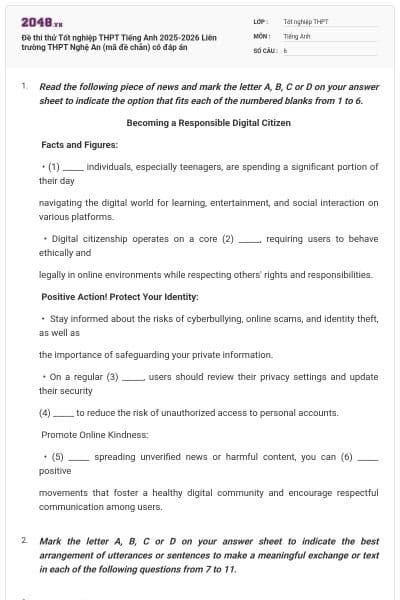
Đề thi thử Tốt nghiệp THPT Tiếng Anh 2025-2026 Liên trường THPT Nghệ An (mã đề chẵn) có đáp án
40 câu hỏi
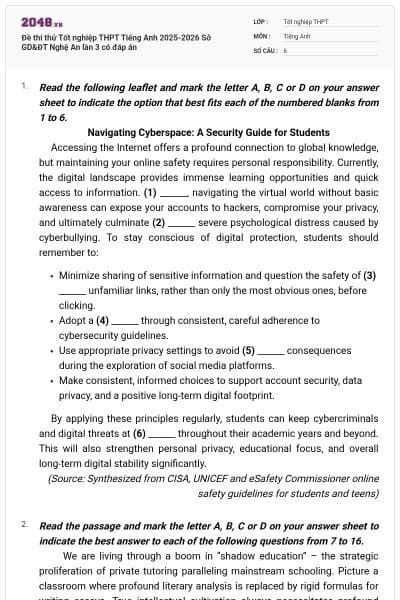
Read the following piece of news and mark the letter A, B, C or D on your answer sheet to indicate the option that fits each of the numbered blanks from 1 to 6.
Becoming a Responsible Digital Citizen
Facts and Figures:
• (1) _____ individuals, especially teenagers, are spending a significant portion of their day
navigating the digital world for learning, entertainment, and social interaction on various platforms.
• Digital citizenship operates on a core (2) _____, requiring users to behave ethically and
legally in online environments while respecting others' rights and responsibilities.
Positive Action! Protect Your Identity:
• Stay informed about the risks of cyberbullying, online scams, and identity theft, as well as
the importance of safeguarding your private information.
• On a regular (3) _____, users should review their privacy settings and update their security
(4) _____ to reduce the risk of unauthorized access to personal accounts.
Promote Online Kindness:
• (5) _____ spreading unverified news or harmful content, you can (6) _____ positive
movements that foster a healthy digital community and encourage respectful communication among users.
Many
Much
Every
Another
A. Many: nhiều (đi với danh từ đếm được số nhiều)
B. Much: nhiều (đi với danh từ không đếm được)
C. Every: mỗi, mọi (đi với danh từ đếm được số ít)
D. Another: một ... khác (đi với danh từ đếm được số ít)
Dựa vào danh từ theo sau “individuals” là danh từ đếm được ở dạng số nhiều, ta chọn đáp án A.
→ Many individuals, especially teenagers, are spending a significant portion of their day navigating the digital world for learning, entertainment, and social interaction on various platforms.
Chọn A.
Dịch nghĩa: Nhiều cá nhân, đặc biệt là thanh thiếu niên, đang dành một phần đáng kể trong ngày của họ để khám phá thế giới kỹ thuật số cho việc học tập, giải trí và tương tác xã hội trên các nền tảng khác nhau.
legally in online environments while respecting others' rights and responsibilities.
routine
procedure
schedule
principle
A. routine (n): thói quen, công việc thường ngày
B. procedure (n): quy trình, thủ tục
C. schedule (n): lịch trình
D. principle (n): nguyên tắc
Dựa vào ngữ cảnh của câu, ta chọn đáp án D.
→ Digital citizenship operates on a core principle, requiring users to behave ethically and legally in online environments while respecting others' rights and responsibilities.
Chọn D.
Dịch nghĩa: Quyền công dân kỹ thuật số hoạt động dựa trên một nguyên tắc cốt lõi, đòi hỏi người dùng phải cư xử có đạo đức và hợp pháp trong môi trường trực tuyến đồng thời tôn trọng quyền và trách nhiệm của người khác.
basis
level
amount
degree
A. basis (n): nền tảng, cơ sở
B. level (n): mức độ
C. amount (n): số lượng
D. degree (n): bằng cấp, mức độ
ta có cụm từ cố định on a regular basis: thường xuyên = regularly
→ On a regular basis, users should review their privacy settings
Chọn A.
Dịch nghĩa: Thường xuyên, người dùng nên kiểm tra lại các cài đặt quyền riêng tư của mình
ingredients
substances
materials
credentials
A. ingredients (n): thành phần (thường dùng trong nấu ăn)
B. substances (n): chất, vật chất
C. materials (n): vật liệu, tài liệu
D. credentials (n): thông tin xác thực (như tên đăng nhập, mật khẩu, mã pin...)
Dựa vào ngữ cảnh câu, ta chọn được đáp án đúng là D.
→ On a regular basis, users should review their privacy settings and update their security credentials to reduce the risk of unauthorized access to personal accounts.
Chọn D.
Dịch nghĩa: Một cách thường xuyên, người dùng nên kiểm tra lại các cài đặt quyền riêng tư của mình và cập nhật các thông tin xác thực bảo mật để giảm nguy cơ truy cập trái phép vào tài khoản cá nhân.
Regardless of
For fear of
In terms of
Instead of
A. Regardless of: Bất kể, không chú ý tới
B. For fear of: Vì sợ (điều gì xảy ra)
C. In terms of: Xét về mặt, liên quan tới
D. Instead of: Thay vì
Dựa vào ngữ cảnh của câu, vế trước và vế sau mang tính chất đối lập, do đó ta chọn D.
→ Instead of spreading unverified news or harmful content, you can (6) ______ positive
movements that foster a healthy digital community and encourage respectful communication among users.
Chọn D.
Dịch nghĩa: Thay vì lan truyền những tin tức chưa được kiểm chứng hoặc nội dung độc hại, bạn (6) ______ các phong trào tích cực nhằm nuôi dưỡng một cộng đồng kỹ thuật số lành mạnh và khuyến khích giao tiếp tôn trọng giữa các người dùng.
movements that foster a healthy digital community and encourage respectful communication among users.
take apart
take part in
catch on
close down
A. take apart (phrasal verb): tháo rời
B. take part in (phrasal verb): tham gia vào
C. catch on (phrasal verb): trở nên phổ biến, hoặc chợt hiểu ra điều gì
D. close down (phrasal verb): đóng cửa, phá sản
Dựa vào ngữ cảnh, ta chọn đáp án B
→ Instead of spreading unverified news or harmful content, you can take part in positive movements that foster a healthy digital community and encourage respectful communication among users.
Chọn B.
Dịch nghĩa: Thay vì lan truyền những tin tức chưa được kiểm chứng hoặc nội dung độc hại, bạn có thể tham gia vào các phong trào tích cực nhằm nuôi dưỡng một cộng đồng kỹ thuật số lành mạnh và khuyến khích giao tiếp tôn trọng giữa các người dùng.
Bài hoàn chỉnh | Dịch bài đọc |
Becoming a Responsible Digital Citizen Facts and Figures • (1) Many individuals, especially teenagers, are spending a significant portion of their day navigating the digital world for learning, entertainment, and social interaction on various platforms. • Digital citizenship operates on a core (2) principle, requiring users to behave ethically and legally in online environments while respecting others' rights and responsibilities. Positive Action! Protect Your Identity: • Stay informed about the risks of cyberbullying, online scams, and identity theft, as well as the importance of safeguarding your private information. • On a regular (3) basis, users should review their privacy settings and update their security (4) credentials to reduce the risk of unauthorized access to personal accounts. Promote Online Kindness: • (5) Instead of spreading unverified news or harmful content, you can (6) take part in positive movements that foster a healthy digital community and encourage respectful communication among users.
| Trở thành một công dân kỹ thuật số có trách nhiệm Thông tin và số liệu: • (1) Nhiều cá nhân, đặc biệt là thanh thiếu niên, đang dành một phần đáng kể trong ngày của họ để khám phá thế giới kỹ thuật số cho việc học tập, giải trí và tương tác xã hội trên các nền tảng khác nhau. • Quyền công dân kỹ thuật số hoạt động dựa trên một (2) nguyên tắc cốt lõi, đòi hỏi người dùng phải cư xử có đạo đức và hợp pháp trong môi trường trực tuyến đồng thời tôn trọng quyền và trách nhiệm của người khác. Hành động tích cực! Bảo vệ danh tính của bạn: • Luôn cập nhật thông tin về các rủi ro của bắt nạt trên mạng, lừa đảo trực tuyến và đánh cắp danh tính, cũng như tầm quan trọng của việc bảo vệ thông tin riêng tư của bạn. • Một cách (3) thường xuyên, người dùng nên xem xét lại các cài đặt quyền riêng tư của mình và cập nhật các (4) thông tin xác thực bảo mật để giảm nguy cơ truy cập trái phép vào các tài khoản cá nhân. Lan tỏa sự tử tế trên mạng: • (5) Thay vì lan truyền tin tức chưa được kiểm chứng hoặc nội dung độc hại, bạn có thể (6) tham gia vào các phong trào tích cực nhằm nuôi dưỡng một cộng đồng kỹ thuật số lành mạnh và khuyến khích giao tiếp tôn trọng giữa các người dùng.
|
Mark the letter A, B, C or D on your answer sheet to indicate the best arrangement of utterances or sentences to make a meaningful exchange or text in each of the following questions from 7 to 11.
a. Jake: Absolutely! The sunshine finally decided to show up.
b. Emma: Want to grab an iced coffee at Joe’s later?
c. Emma: Hey Jake! Beautiful morning, isn’t it?
a-c-b
a-b-c
b-c-a
c-a-b
Thứ tự sắp xếp đúng: D. c - a - b
c. Emma: Hey Jake! Beautiful morning, isn't it?
a. Jake: Absolutely! The sunshine finally decided to show up.
b. Emma: Want to grab an iced coffee at Joe's later?
Dịch nghĩa:
c. Emma: Chào Jake! Buổi sáng đẹp trời nhỉ?
a. Jake: Chắc chắn rồi! Cuối cùng thì ánh nắng cũng quyết định xuất hiện.
b. Emma: Lát nữa bạn có muốn đi uống cà phê đá ở quán Joe's không?
Chọn D.
a. Tom: That’s a wonderful idea! Have you thought about what kind of pet you want?
b. Jane: I’m thinking about adopting a pet.
c. Tom: Dogs are great companions!
d. Jane: Yes, I think they’ll fit perfectly with my lifestyle.
e. Jane: I’m leaning towards adopting a dog.
a-b-d-c-e
d-c-e-a-b
b-a-e-c-d
a-b-c-d-e
Thứ tự sắp xếp đúng: C. b - a - e - c - d
b. Jane: I'm thinking about adopting a pet.
a. Tom: That's a wonderful idea! Have you thought about what kind of pet you want?
e. Jane: I'm leaning towards adopting a dog.
c. Tom: Dogs are great companions!
d. Jane: Yes, I think they'll fit perfectly with my lifestyle.
Dịch nghĩa:
b. Jane: Mình đang nghĩ đến việc nhận nuôi một thú cưng.
a. Tom: Ý kiến tuyệt vời đấy! Bạn đã nghĩ xem mình muốn nuôi con gì chưa?
e. Jane: Mình đang nghiêng về việc nhận nuôi một chú chó.
c. Tom: Chó là những người bạn đồng hành tuyệt vời!
d. Jane: Đúng vậy, mình nghĩ chúng sẽ hoàn toàn phù hợp với lối sống của mình.
Chọn C.
a. As you may have heard, we will be switching to online classes for the next few weeks because of the severe storm.
b. I hope everyone is doing well despite the weather conditions.
c. I appreciate your understanding and flexibility during this time, and I’m confident we can make this work together.
d. I know this might be an adjustment for some of you, but it’s important to prioritize safety.
e. Please ensure you have access to your online resources, and let me know if you have any questions or concerns.
Best wishes,
d-b-a-c-e
c-b-e-a-d
a-e-c-b-d
b-a-d-c-e
Thứ tự sắp xếp đúng: D. b - a - d - c - e
b. I hope everyone is doing well despite the weather conditions.
a. As you may have heard, we will be switching to online classes for the next few weeks because of the severe storm.
d. I know this might be an adjustment for some of you, but it's important to prioritize safety.
c. I appreciate your understanding and flexibility during this time, and I'm confident we can make this work together.
e. Please ensure you have access to your online resources, and let me know if you have any questions or concerns.
Dịch nghĩa:
b. Thầy/Cô hy vọng mọi người đều ổn dù điều kiện thời tiết không tốt.
a. Như các em có thể đã nghe nói, chúng ta sẽ chuyển sang học trực tuyến trong vài tuần tới do cơn bão nghiêm trọng.
d. Thầy/Cô biết điều này có thể là một sự điều chỉnh đối với một số em, nhưng việc ưu tiên sự an toàn là rất quan trọng.
c. Thầy/Cô đánh giá cao sự thấu hiểu và linh hoạt của các em trong thời gian này, và thầy/cô tin tưởng chúng ta có thể cùng nhau vượt qua.
e. Vui lòng đảm bảo các em có quyền truy cập vào các tài nguyên trực tuyến của mình và cho thầy/cô biết nếu các em có bất kỳ câu hỏi hoặc thắc mắc nào.
Chọn D.
a. There’s also a clearly laid-down salary structure in this profession, and that makes it easier to think ahead.
b. Before I started here I’d expected to have to work very long hours, but nowadays there’s a maximum of 48 hours per week for doctors.
c. There is of course shift work, but the days of junior doctors having to live in and be on call all night are, I was happy to find, long gone!
d. After leaving school, I had a gap year working in Africa before I did my medical degree.
e. I’m now a Junior Doctor in training at a local hospital, where the work is demanding but very rewarding with lots of advice and support from senior colleagues.
d-e-b-c-a
c-d-e-a-b
e-a-b-c-d
b-e-c-a-d
Thứ tự sắp xếp đúng: A. d - e - b - c - a
d. After leaving school, I had a gap year working in Africa before I did my medical degree.
e. I'm now a Junior Doctor in training at a local hospital, where the work is demanding but very rewarding with lots of advice and support from senior colleagues.
b. Before I started here I'd expected to have to work very long hours, but nowadays there's a maximum of 48 hours per week for doctors.
c. There is of course shift work, but the days of junior doctors having to live in and be on call all night are, I was happy to find, long gone!
a. There's also a clearly laid-down salary structure in this profession, and that makes it easier to think ahead.
Dịch nghĩa:
d. Sau khi rời ghế nhà trường, tôi đã có một năm nghỉ ngơi (gap year) làm việc ở Châu Phi trước khi lấy bằng y khoa.
e. Hiện tại, tôi là một Bác sĩ nội trú tại một bệnh viện địa phương, nơi công việc tuy vất vả nhưng rất xứng đáng với nhiều lời khuyên và sự hỗ trợ từ các đồng nghiệp đi trước.
b. Trước khi bắt đầu làm việc ở đây, tôi từng nghĩ mình sẽ phải làm việc rất nhiều giờ, nhưng ngày nay các bác sĩ chỉ làm tối đa 48 giờ mỗi tuần.
c. Tất nhiên là có làm việc theo ca, nhưng những ngày tháng mà các bác sĩ trẻ phải sống ở bệnh viện và túc trực cả đêm, tôi rất vui khi thấy, đã qua lâu rồi!
a. Ngoài ra còn có một cơ cấu tiền lương được quy định rõ ràng trong nghề này, và điều đó giúp việc tính toán cho tương lai trở nên dễ dàng hơn.
Chọn A.
a. The quick and easy nature of platforms like TikTok and Instagram often leads to decreased attention spans, as viewers become accustomed to rapid changes and instant gratification.
b. In conclusion, while short-form content can be entertaining and engaging, it is essential to be aware of its potential harms and to practice moderation in consumption to maintain a healthy balance in our lives.
c. This type of media can also contribute to feelings of anxiety and inadequacy, as individuals may find themselves comparing their lives to the highlights showcased by others.
d. In recent years, the rise of short-form content has become a significant trend, but its negative effects on viewers cannot be overlooked
e. Furthermore, the addictive nature of short-form content can lead to excessive screen time, negatively impacting physical health and social interactions.
b-d-c-a-e
b-a-c-d-e
d-a-c-e-b
a-d-c-e-b
Thứ tự sắp xếp đúng: C. d - a - c - e - b
d. In recent years, the rise of short-form content has become a significant trend, but its negative effects on viewers cannot be overlooked.
a. The quick and easy nature of platforms like TikTok and Instagram often leads to decreased attention spans, as viewers become accustomed to rapid changes and instant gratification.
c. This type of media can also contribute to feelings of anxiety and inadequacy, as individuals may find themselves comparing their lives to the highlights showcased by others.
e. Furthermore, the addictive nature of short-form content can lead to excessive screen time, negatively impacting physical health and social interactions.
b. In conclusion, while short-form content can be entertaining and engaging, it is essential to be aware of its potential harms and to practice moderation in consumption to maintain a healthy balance in our lives.
Dịch nghĩa:
d. Trong những năm gần đây, sự gia tăng của nội dung dạng ngắn đã trở thành một xu hướng đáng kể, nhưng không thể bỏ qua những tác động tiêu cực của nó đối với người xem.
a. Bản chất nhanh gọn và dễ tiếp cận của các nền tảng như TikTok và Instagram thường dẫn đến việc giảm khoảng thời gian chú ý, vì người xem trở nên quen với những thay đổi nhanh chóng và sự thỏa mãn tức thời.
c. Loại phương tiện truyền thông này cũng có thể góp phần gây ra cảm giác lo âu và kém cỏi, vì các cá nhân có thể thấy mình đang so sánh cuộc sống của bản thân với những điểm nổi bật được người khác phô diễn.
e. Hơn nữa, tính chất gây nghiện của nội dung dạng ngắn có thể dẫn đến thời gian sử dụng màn hình quá mức, tác động tiêu cực đến sức khỏe thể chất và các tương tác xã hội.
b. Tóm lại, mặc dù nội dung dạng ngắn có thể mang tính giải trí và thu hút, nhưng điều cần thiết là phải nhận thức được những tác hại tiềm ẩn của nó và thực hành sự điều độ trong việc tiêu thụ để duy trì sự cân bằng lành mạnh trong cuộc sống của chúng ta.
Chọn C.
Read the following passage and mark the letter A, B, C or D on your answer sheet to indicate the best answer to each of the following questions from 12 to 19.
The discovery of neuroplasticity - the brain's capacity to reorganize neural pathways throughout life - has revolutionized neuroscience and overturned long-held assumptions about cognitive rigidity. For decades, scientific consensus maintained that adult brains possessed fixed neural architecture, with cognitive decline being inevitable and irreversible. Contemporary research demonstrates that the brain remains remarkably adaptable, continuously restructuring in response to experiences, learning, injuries, and environmental changes.
Neuroplasticity manifests through multiple mechanisms operating across different timescales. Synaptic plasticity, the most rapid form, involves strengthening or weakening connections between neurons based on activation patterns. This process underlies learning and memory formation, occurring within minutes to hours. Structural plasticity encompasses more dramatic changes, including neurogenesis - the birth of new neurons - and the growth or pruning of dendritic branches. These transformations require weeks to months, fundamentally altering brain circuitry. Such adaptability persists far beyond childhood development, challenging previous assumptions about critical period limitations.
The implications for rehabilitation and cognitive enhancement prove profound. Stroke victims can recover lost functions through intensive therapy that encourages the brain to reroute neural pathways around damaged areas. Musicians demonstrate expanded auditory cortex regions compared to non-musicians, reflecting years of specialized training. Even elderly individuals show improved cognitive performance following sustained engagement with challenging mental activities, suggesting that cognitive reserve can be cultivated throughout the lifespan. These findings validate the "use it or lose it" principle while emphasizing that disease accelerates decline.
However, neuroplasticity possesses a darker dimension. Maladaptive plasticity contributes to chronic pain conditions, phantom limb sensations, and addiction through reinforcing dysfunctional neural patterns. The same mechanisms enabling learning can entrench harmful behaviors when repeatedly activated. Understanding these dual aspects becomes essential for developing therapeutic interventions that harness beneficial plasticity while preventing detrimental reorganization patterns.
stability
fragility
complexity
adaptability
Từ “rigidity” trong đoạn 1 TRÁI NGHĨA với từ nào?
A. stability (n): sự ổn định
B. fragility (n): sự mong manh, yếu ớt
C. complexity (n): sự phức tạp
D. adaptability (n): khả năng thích nghi
→ rigidity (n): sự cứng nhắc, không thay đổi >< adaptability (n): khả năng thích nghi
Thông tin: The discovery of neuroplasticity - the brain's capacity to reorganize neural pathways throughout life - has revolutionized neuroscience and overturned long-held assumptions about cognitive rigidity.
(Việc khám phá ra tính dẻo của hệ thần kinh - khả năng tổ chức lại các con đường thần kinh của não bộ trong suốt cuộc đời - đã tạo ra một cuộc cách mạng trong khoa học thần kinh và bác bỏ những giả định đã tồn tại từ lâu về sự cứng nhắc trong nhận thức.)
Chọn D.
The word “Such” in paragraph 2 refers to _____.
The mechanisms of synaptic and structural plasticity.
The scientific consensus of fixed neural architecture.
The process of learning and memory formation.
The inevitable decline of cognitive functions.
Từ “Such” trong đoạn 2 đề cập đến _____.
A. The mechanisms of synaptic and structural plasticity: Các cơ chế dẻo dai của khớp thần kinh và cấu trúc
B. The scientific consensus of fixed neural architecture: Sự đồng thuận khoa học về cấu trúc thần kinh cố định
C. The process of learning and memory formation: Quá trình học tập và hình thành trí nhớ
D. The inevitable decline of cognitive functions: Sự suy giảm tất yếu của các chức năng nhận thức
Thông tin: These transformations require weeks to months, fundamentally altering brain circuitry. Such adaptability persists far beyond childhood development, challenging previous assumptions about critical period limitations.
(Những biến đổi này cần từ vài tuần đến vài tháng, làm thay đổi căn bản cấu trúc mạch thần kinh của não bộ. Khả năng thích ứng này vẫn tồn tại rất lâu sau giai đoạn phát triển thời thơ ấu, thách thức những giả định trước đây về giới hạn của giai đoạn phát triển quan trọng.)
→ Such adaptability đề cập đến khả năng não bộ thay đổi thông qua các cơ chế đã được liệt kê ngay trước đó là Synaptic plasticity và Structural plasticity.
Chọn A.
limited
temporary
controversial
far-reaching
Từ “profound” trong đoạn 3 GẦN NGHĨA NHẤT với từ nào?
A. limited (adj): hạn chế
B. temporary (adj): tạm thời
C. controversial (adj): gây tranh cãi
D. far-reaching (adj): có ảnh hưởng sâu rộng, to lớn
→ profound (adj): sâu sắc, to lớn, có tác động mạnh mẽ = far-reaching (adj) có ảnh hưởng sâu rộng, to lớn
Thông tin: The implications for rehabilitation and cognitive enhancement prove profound.
(Những ý nghĩa đối với việc phục hồi chức năng và tăng cường nhận thức chứng tỏ là rất to lớn/có ảnh hưởng sâu rộng.)
Chọn D.
Which of the following is TRUE according to the passage?
Neuroplasticity only occurs during critical developmental periods in childhood.
Structural brain changes happen within minutes of a new experience.
Synaptic plasticity is a rapid process involved in learning and memory.
The brain's capacity to reorganize decreases significantly with age.
Điều nào sau đây là ĐÚNG theo đoạn văn?
A. Tính dẻo của hệ thần kinh chỉ xảy ra trong các giai đoạn phát triển quan trọng ở thời thơ ấu.
→ Sai.
Thông tin: Such adaptability persists far beyond childhood development, challenging previous assumptions about critical period limitations.
(Khả năng thích nghi như vậy tồn tại vượt xa giai đoạn phát triển thời thơ ấu, thách thức những giả định trước đây về những giới hạn của giai đoạn phát triển quan trọng.)
B. Những thay đổi về cấu trúc não xảy ra trong vòng vài phút sau một trải nghiệm mới.
→ Sai.
Thông tin: Structural plasticity encompasses more dramatic changes, including neurogenesis - the birth of new neurons - and the growth or pruning of dendritic branches. These transformations require weeks to months, fundamentally altering brain circuitry.
(Tính dẻo cấu trúc bao gồm những thay đổi mạnh mẽ hơn, bao gồm sự hình thành tế bào thần kinh mới (neurogenesis) và sự phát triển hoặc cắt tỉa các nhánh dendrite. Những biến đổi này cần từ vài tuần đến vài tháng, làm thay đổi cơ bản cấu trúc mạch thần kinh của não bộ.)
C. Tính dẻo của khớp thần kinh là một quá trình nhanh chóng tham gia vào việc học tập và trí nhớ. → Đúng.
Thông tin: Synaptic plasticity, the most rapid form, involves strengthening or weakening connections between neurons based on activation patterns. This process underlies learning and memory formation, occurring within minutes to hours.
(Tính dẻo dai của khớp thần kinh, hình thức nhanh nhất, liên quan đến việc củng cố hoặc làm suy yếu các kết nối giữa các tế bào thần kinh dựa trên các mô hình kích hoạt. Quá trình này là nền tảng của việc học tập và hình thành trí nhớ, diễn ra trong vòng vài phút đến vài giờ.)
D. Khả năng tổ chức lại của não bộ giảm đi đáng kể theo tuổi tác.
→ Sai.
Thông tin: - The discovery of neuroplasticity - the brain's capacity to reorganize neural pathways throughout life - has revolutionized neuroscience and overturned long-held assumptions about cognitive rigidity.
(Việc khám phá ra tính dẻo của hệ thần kinh - khả năng tổ chức lại các con đường thần kinh của não bộ trong suốt cuộc đời - đã tạo ra một cuộc cách mạng trong khoa học thần kinh và bác bỏ những giả định đã tồn tại từ lâu về sự cứng nhắc trong nhận thức.)
- Synaptic plasticity, the most rapid form, involves strengthening or weakening connections between neurons based on activation patterns. This process underlies learning and memory formation, occurring within minutes to hours.
(Tính dẻo dai của khớp thần kinh, hình thức nhanh nhất, liên quan đến việc củng cố hoặc làm suy yếu các kết nối giữa các tế bào thần kinh dựa trên các mô hình kích hoạt. Quá trình này là nền tảng của việc học tập và hình thành trí nhớ, diễn ra trong vòng vài phút đến vài giờ.)
Chọn C.
Which of the following best paraphrases the underlined sentence in paragraph 4?
Repeated activation always leads to the entrenchment of harmful behaviors.
Harmful behaviors are learned through different mechanisms than beneficial ones.
Neural processes that support learning can also reinforce negative patterns.
Learning mechanisms become inactive when applied to negative behaviors.
Câu nào sau đây diễn giải đúng nhất câu được gạch chân trong đoạn 4?
The same mechanisms enabling learning can entrench harmful behaviors when repeatedly activated.(Cùng một cơ chế cho phép học tập có thể củng cố những hành vi gây hại khi được kích hoạt lặp đi lặp lại.)
A. Repeated activation always leads to the entrenchment of harmful behaviors.
(Sự kích hoạt lặp đi lặp lại luôn dẫn đến việc củng cố các hành vi gây hại.)
→ Sai nghĩa vì từ always không đồng nghĩa với can
B. Harmful behaviors are learned through different mechanisms than beneficial ones.
(Các hành vi gây hại được học thông qua các cơ chế khác với các hành vi có lợi.)
→ Sai nghĩa, bài đọc nói là the same mechanisms
C. Neural processes that support learning can also reinforce negative patterns.
(Các quá trình thần kinh hỗ trợ việc học tập cũng có thể củng cố các mô hình tiêu cực.)
→ Đúng
D. Learning mechanisms become inactive when applied to negative behaviors.
(Các cơ chế học tập trở nên không hoạt động khi áp dụng cho các hành vi tiêu cực.)
→ Sai nghĩa.
Chọn C.
Which of the following is NOT mentioned in the passage?
A negative consequence of maladaptive brain reorganization.
A specific chemical involved in the process of neurogenesis.
A principle related to cognitive maintenance and decline.
An example of neuroplasticity in a specific professional group.
Điều nào sau đây KHÔNG được đề cập trong đoạn văn?
A. Một hậu quả tiêu cực của việc tổ chức lại não bộ thích nghi kém.
→ Đã được đề cập ở đoạn 4
Thông tin: Maladaptive plasticity contributes to chronic pain conditions, phantom limb sensations, and addiction through reinforcing dysfunctional neural patterns.
(Tính dẻo thích nghi kém góp phần gây ra các tình trạng đau mãn tính, cảm giác chi ma và chứng nghiện thông qua việc củng cố các mô hình thần kinh rối loạn chức năng.)
B. Một hóa chất cụ thể tham gia vào quá trình hình thành tế bào thần kinh mới.
→ Không được đề cập.
C. Một nguyên tắc liên quan đến việc duy trì và suy giảm nhận thức.
→ Đã được đề cập ở đoạn 3
Thông tin: These findings validate the "use it or lose it" principle while emphasizing that disease accelerates decline.
(Những phát hiện này xác nhận nguyên tắc "dùng nó hoặc mất nó" đồng thời nhấn mạnh rằng bệnh tật làm tăng tốc độ suy giảm.)
D. Một ví dụ về tính dẻo của hệ thần kinh ở một nhóm chuyên môn cụ thể.
→ Đã được đề cập ở đoạn 3
Thông tin: Musicians demonstrate expanded auditory cortex regions compared to non-musicians, reflecting years of specialized training.
(Các nhạc sĩ cho thấy các vùng vỏ não thính giác được mở rộng so với những người không phải là nhạc sĩ, phản ánh nhiều năm đào tạo chuyên môn.)
Chọn B.
Paragraph 3
Paragraph 1
Paragraph 2
Paragraph 4
Trong đoạn văn nào tác giả so sánh thời lượng của các quá trình tổ chức lại thần kinh khác nhau?
A. Đoạn 3
B. Đoạn 1
C. Đoạn 2
D. Đoạn 4
Thông tin: Synaptic plasticity, the most rapid form, involves strengthening or weakening connections between neurons based on activation patterns. This process underlies learning and memory formation, occurring within minutes to hours. (Đoạn 2)
(Tính dẻo dai của khớp thần kinh, hình thức nhanh nhất, liên quan đến việc củng cố hoặc làm suy yếu các kết nối giữa các tế bào thần kinh dựa trên các mô hình kích hoạt. Quá trình này là nền tảng của việc học tập và hình thành trí nhớ, diễn ra trong vòng vài phút đến vài giờ.)
Chọn C.
Paragraph 3
Paragraph 4
Paragraph 2
Paragraph 1
Trong đoạn văn nào tác giả trình bày những phát hiện trực tiếp thách thức một giả định đã được đề cập trước đó về sự vĩnh viễn của việc mất nhận thức?
A. Đoạn 3
B. Đoạn 4
C. Đoạn 2
D. Đoạn 1
Thông tin: The implications for rehabilitation and cognitive enhancement prove profound. Stroke victims can recover lost functions through intensive therapy that encourages the brain to reroute neural pathways around damaged areas. Musicians demonstrate expanded auditory cortex regions compared to non-musicians, reflecting years of specialized training. Even elderly individuals show improved cognitive performance following sustained engagement with challenging mental activities, suggesting that cognitive reserve can be cultivated throughout the lifespan. These findings validate the "use it or lose it" principle while emphasizing that disease accelerates decline. (Đoạn 3)
(Những phát hiện này có ý nghĩa sâu sắc đối với phục hồi chức năng và tăng cường nhận thức. Nạn nhân đột quỵ có thể phục hồi các chức năng đã mất thông qua liệu pháp chuyên sâu, khuyến khích não bộ định tuyến lại các đường dẫn thần kinh xung quanh các vùng bị tổn thương. Các nhạc sĩ thể hiện vùng vỏ não thính giác mở rộng hơn so với những người không phải nhạc sĩ, phản ánh nhiều năm đào tạo chuyên sâu. Ngay cả người cao tuổi cũng cho thấy hiệu suất nhận thức được cải thiện sau khi tham gia liên tục vào các hoạt động trí tuệ đòi hỏi cao, cho thấy rằng khả năng dự trữ nhận thức có thể được trau dồi suốt đời. Những phát hiện này chứng minh nguyên tắc "sử dụng thì giữ được, không sử dụng thì mất đi" đồng thời nhấn mạnh rằng bệnh tật làm tăng tốc độ suy giảm.)
Chọn A.
Dịch bài đọc:
Việc khám phá ra tính dẻo của hệ thần kinh (neuroplasticity) - khả năng tổ chức lại các con đường thần kinh của não bộ trong suốt cuộc đời - đã tạo ra một cuộc cách mạng trong khoa học thần kinh và bác bỏ những giả định đã tồn tại từ lâu về sự cứng nhắc trong nhận thức. Trong nhiều thập kỷ, sự đồng thuận khoa học cho rằng não bộ của người trưởng thành sở hữu cấu trúc thần kinh cố định, với sự suy giảm nhận thức là điều không thể tránh khỏi và không thể đảo ngược. Các nghiên cứu đương đại chứng minh rằng não bộ vẫn duy trì khả năng thích nghi đáng kinh ngạc, liên tục tái cấu trúc để phản ứng với những trải nghiệm, việc học tập, các chấn thương và những thay đổi của môi trường.
Tính dẻo của hệ thần kinh biểu hiện thông qua nhiều cơ chế hoạt động trên các khoảng thời gian khác nhau. Tính dẻo của khớp thần kinh (synaptic plasticity), hình thức nhanh nhất, liên quan đến việc tăng cường hoặc làm yếu đi các kết nối giữa các tế bào thần kinh dựa trên các mô hình kích hoạt. Quá trình này là nền tảng cho việc học tập và hình thành trí nhớ, xảy ra trong vòng vài phút đến vài giờ. Tính dẻo về mặt cấu trúc bao gồm những thay đổi mạnh mẽ hơn, bao gồm sự phát sinh tế bào thần kinh (neurogenesis) - sự ra đời của các tế bào thần kinh mới - và sự phát triển hoặc cắt tỉa các nhánh đuôi gai. Những biến đổi này đòi hỏi vài tuần đến vài tháng, làm thay đổi căn bản hệ thống mạch thần kinh của não. Khả năng thích nghi như vậy tồn tại vượt xa giai đoạn phát triển thời thơ ấu, thách thức những giả định trước đây về những giới hạn của giai đoạn phát triển quan trọng.
Những ý nghĩa đối với việc phục hồi chức năng và tăng cường nhận thức chứng tỏ là rất sâu sắc. Nạn nhân đột quỵ có thể phục hồi các chức năng đã mất thông qua liệu pháp chuyên sâu nhằm khuyến khích não bộ định tuyến lại các con đường thần kinh đi vòng qua các vùng bị tổn thương. Các nhạc sĩ cho thấy các vùng vỏ não thính giác được mở rộng so với những người không phải là nhạc sĩ, phản ánh nhiều năm đào tạo chuyên môn. Thậm chí những người cao tuổi cũng cho thấy hiệu suất nhận thức được cải thiện sau khi tham gia liên tục vào các hoạt động trí óc đầy thách thức, cho thấy rằng nguồn dự trữ nhận thức có thể được nuôi dưỡng trong suốt cuộc đời. Những phát hiện này xác nhận nguyên tắc "dùng nó hoặc mất nó" đồng thời nhấn mạnh rằng bệnh tật làm tăng tốc độ suy giảm.
Tuy nhiên, tính dẻo của hệ thần kinh cũng sở hữu một khía cạnh tối tăm hơn. Tính dẻo thích nghi kém góp phần gây ra các tình trạng đau mãn tính, cảm giác chi ma (cảm giác ở một bộ phận cơ thể đã bị cắt cụt) và chứng nghiện thông qua việc củng cố các mô hình thần kinh rối loạn chức năng. Cùng một cơ chế cho phép học tập cũng có thể củng cố những hành vi gây hại khi được kích hoạt lặp đi lặp lại. Việc hiểu được hai khía cạnh này trở nên thiết yếu đối với việc phát triển các can thiệp điều trị nhằm tận dụng tính dẻo có lợi đồng thời ngăn ngừa các mô hình tổ chức lại có hại.
Read the following passage and mark the letter A, B, C or D on your answer sheet to indicate the option that best fits each of the numbered blanks from 20 to 24.
The Influence of Music on Human Behaviour
Music is often described as a universal language, capable of affecting people across cultures and age groups. Research shows that listening to music can activate multiple areas of the brain, including those responsible for emotion and memory. Certain melodies can instantly change a person's mood, although scientists are still exploring exactly how these effects occur, (20) _____.
Beyond emotional responses, music also (21) _____ . Studies indicate that background music can influence how people behave in public spaces, such as shops or restaurants. For example, customers may spend more time in a store when calm music is played. Many people also feel more comfortable in environments (22) _____. As a result, music is often used to create a specific atmosphere.
In the workplace, the use of music has become increasingly popular. Some employers believe that allowing employees to listen to music while working can improve concentration and reduce stress. (23) _____. Consequently, companies often choose playlists carefully to match the type of work being done.
However, specialists caution that music does not benefit everyone in the same way. (24) _____.
Certain melodies can instantly change a person's mood, although scientists are still exploring exactly how these effects occur, (20) _____.
these reactions are widely experienced by most people
music has no real connection to human emotions
its emotional impact is generally accepted by researchers
scientists have completely stopped studying the subject
Dịch nghĩa:
A. những phản ứng này được trải nghiệm rộng rãi bởi hầu hết mọi người
B. âm nhạc không có mối liên hệ thực sự nào với cảm xúc con người
C. tác động cảm xúc của nó nhìn chung được các nhà nghiên cứu chấp nhận
D. các nhà khoa học đã hoàn toàn ngừng nghiên cứu chủ đề này
Certain melodies can instantly change a person's mood, although scientists are still exploring exactly how these effects occur, (20) _____.
(Một số giai điệu nhất định có thể thay đổi tâm trạng của một người ngay lập tức, mặc dù các nhà khoa học vẫn đang khám phá chính xác cách thức những hiệu ứng này xảy ra, (20) _____.)
→ Mệnh đề bắt đầu bằng although thể hiện sự tương phản. Các nhà khoa học chưa hiểu rõ cách thức xảy ra, nhưng họ không phủ nhận hiện tượng đó. Dựa vào ngữ cảnh ta chọn được đáp án đúng nhất là C.
→ Certain melodies can instantly change a person's mood, although scientists are still exploring exactly how these effects occur, its emotional impact is generally accepted by researchers. (Một số giai điệu nhất định có thể thay đổi tâm trạng của một người ngay lập tức, mặc dù các nhà khoa học vẫn đang khám phá chính xác cách thức những hiệu ứng này xảy ra, tác động cảm xúc của nó nhìn chung được các nhà nghiên cứu chấp nhận.)
Chọn C.
affects by the way individuals remember personal events
helps people to solve complex scientific problems quickly
works as a replacement for spoken communication
plays an important role in shaping social behaviour
Dịch nghĩa:
A. bị ảnh hưởng bởi cách các cá nhân nhớ lại các sự kiện cá nhân
→ Sai ngữ pháp câu bị động: affects by
B. giúp mọi người giải quyết các vấn đề khoa học phức tạp một cách nhanh chóng
C. hoạt động như một sự thay thế cho giao tiếp bằng lời nói
D. đóng một vai trò quan trọng trong việc hình thành hành vi xã hội
Beyond emotional responses, music also (21) _____ .
(Bên cạnh những phản ứng cảm xúc, âm nhạc cũng (21) _____ .)
→ Câu tiếp theo ngay sau khoảng trống là: Studies indicate that background music can influence how people behave in public spaces, such as shops or restaurants. (Các nghiên cứu chỉ ra rằng nhạc nền có thể ảnh hưởng đến cách mọi người cư xử trong không gian công cộng, như là cửa hàng hoặc nhà hàng). Do đó, khoảng trống cần một cụm từ khái quát về việc âm nhạc định hình hành vi, nên ta chọn đáp án D.
→ Beyond emotional responses, music also plays an important role in shaping social behaviour.
(Bên cạnh những phản ứng cảm xúc, âm nhạc cũng đóng một vai trò quan trọng trong việc hình thành hành vi xã hội.)
Chọn D.
that are filled with music matching their preferences
whose design focuses only on visual appearance
which contain no form of sound or noise at all
where silence is strictly required at all times
Dịch nghĩa:
A. được lấp đầy bởi âm nhạc phù hợp với sở thích của họ
B. có thiết kế chỉ tập trung vào hình thức bên ngoài
C. hoàn toàn không chứa bất kỳ dạng âm thanh hay tiếng ồn nào
D. nơi mà sự im lặng được yêu cầu nghiêm ngặt vào mọi lúc
Many people also feel more comfortable in environments (22) _____.
(Nhiều người cũng cảm thấy thoải mái hơn trong các môi trường (22) _____.)
→ Cả đoạn văn đang nói về tác động tích cực của âm nhạc đến hành vi con người trong các không gian công cộng (ví dụ như bật nhạc êm dịu trong cửa hàng). Do đó, mọi người sẽ cảm thấy thoải mái ở những nơi có âm nhạc phù hợp với họ.
Loại đáp án B vì chỉ tập trung vào hình ảnh, C và D yêu cầu sự im lặng tuyệt đối, đi ngược lại với chủ đề của đoạn. → Đáp án là A.
→ Many people also feel more comfortable in environments that are filled with music matching their preferences.
(Nhiều người cũng cảm thấy thoải mái hơn trong các môi trường được lấp đầy bởi âm nhạc phù hợp với sở thích của họ.)
Chọn A.
This proves that silence is always the best condition for productivity
The research focused exclusively on professional musicians
Such findings suggest that music can influence work performance
Employees prefer music mainly because it shortens working hours
Dịch nghĩa:
A. Điều này chứng tỏ rằng im lặng luôn là điều kiện tốt nhất cho năng suất
B. Nghiên cứu chỉ tập trung vào các nhạc sĩ chuyên nghiệp
C. Những phát hiện như vậy cho thấy âm nhạc có thể ảnh hưởng đến hiệu suất làm việc
D. Nhân viên thích âm nhạc chủ yếu vì nó rút ngắn thời gian làm việc
(23) _____. Consequently, companies often choose playlists carefully to match the type of work being done.
((23) _____. Do đó, các công ty thường cẩn thận chọn danh sách phát để phù hợp với loại công việc đang được thực hiện.)
→ Câu phía trước đề cập đến niềm tin của người sử dụng lao động rằng âm nhạc giúp cải thiện sự tập trung và giảm căng thẳng. Câu phía sau dùng từ nối “Consequently” để chỉ hành động chọn nhạc cho phù hợp công việc.
→ Dựa vào ngữ cảnh câu, ta chọn được đáp án đúng là C.
→ Such findings suggest that music can influence work performance. Consequently, companies often choose playlists carefully to match the type of work being done.
(Những phát hiện như vậy cho thấy âm nhạc có thể ảnh hưởng đến hiệu suất làm việc. Do đó, các công ty thường cẩn thận chọn danh sách phát để phù hợp với loại công việc đang được thực hiện.)
Chọn C.
However, specialists caution that music does not benefit everyone in the same way. (24) _____.
Everyone responds to music in exactly the same way
Some individuals may find music distracting rather than helpful
Music has no measurable effect on human behaviour
Music always improves concentration regardless of the situation
Dịch nghĩa:
A. Mọi người đều phản ứng với âm nhạc theo cách hoàn toàn giống nhau
B. Một số cá nhân có thể thấy âm nhạc gây xao nhãng thay vì hữu ích
C. Âm nhạc không có tác động nào có thể đo lường được đối với hành vi con người
D. Âm nhạc luôn cải thiện sự tập trung bất kể tình huống nào
However, specialists caution that music does not benefit everyone in the same way. (24) _____.
(Tuy nhiên, các chuyên gia cảnh báo rằng âm nhạc không mang lại lợi ích cho tất cả mọi người theo cùng một cách. (24) _____.)
→ Câu trước chứa cụm does not benefit everyone mang hàm ý cảnh báo về mặt trái.
→ Ta chọn đáp án B vì đáp án này đã đưa ra ví dụ cụ thể cho khía cạnh tiêu cực này
→ However, specialists caution that music does not benefit everyone in the same way. Some individuals may find music distracting rather than helpful.
(Tuy nhiên, các chuyên gia cảnh báo rằng âm nhạc không mang lại lợi ích cho tất cả mọi người theo cùng một cách. Một số cá nhân có thể thấy âm nhạc gây xao nhãng thay vì hữu ích.)
Chọn B.
Bài hoàn chỉnh | Dịch bài đọc |
The Influence of Music on Human Behaviour Music is often described as a universal language, capable of affecting people across cultures and age groups. Research shows that listening to music can activate multiple areas of the brain, including those responsible for emotion and memory. Certain melodies can instantly change a person's mood, although scientists are still exploring exactly how these effects occur, (20) its emotional impact is generally accepted by researchers. Beyond emotional responses, music also (21) plays an important role in shaping social behaviour. Studies indicate that background music can influence how people behave in public spaces, such as shops or restaurants. For example, customers may spend more time in a store when calm music is played. Many people also feel more comfortable in environments (22) that are filled with music matching their preferences. As a result, music is often used to create a specific atmosphere. In the workplace, the use of music has become increasingly popular. Some employers believe that allowing employees to listen to music while working can improve concentration and reduce stress. (23) Such findings suggest that music can influence work performance. Consequently, companies often choose playlists carefully to match the type of work being done. However, specialists caution that music does not benefit everyone in the same way. (24) Some individuals may find music distracting rather than helpful. | Ảnh hưởng của âm nhạc đến hành vi con người Âm nhạc thường được xem như một ngôn ngữ chung của nhân loại, có khả năng tác động đến con người ở nhiều nền văn hóa và độ tuổi khác nhau. Các nghiên cứu cho thấy việc nghe nhạc có thể kích hoạt nhiều vùng khác nhau của não bộ, bao gồm những vùng chịu trách nhiệm về cảm xúc và trí nhớ. Một số giai điệu có thể ngay lập tức thay đổi tâm trạng của một người, mặc dù các nhà khoa học vẫn đang nghiên cứu chính xác cách những tác động này xảy ra, nhưng ảnh hưởng cảm xúc của âm nhạc nhìn chung đã được các nhà nghiên cứu công nhận. Bên cạnh những phản ứng cảm xúc, âm nhạc còn đóng vai trò quan trọng trong việc định hình hành vi xã hội. Các nghiên cứu chỉ ra rằng nhạc nền có thể ảnh hưởng đến cách con người cư xử ở nơi công cộng, chẳng hạn như cửa hàng hoặc nhà hàng. Ví dụ, khách hàng có thể dành nhiều thời gian hơn trong một cửa hàng khi nhạc nhẹ được bật. Nhiều người cũng cảm thấy thoải mái hơn trong những môi trường có âm nhạc phù hợp với sở thích của họ. Vì vậy, âm nhạc thường được sử dụng để tạo ra một bầu không khí cụ thể. Tại nơi làm việc, việc sử dụng âm nhạc ngày càng trở nên phổ biến. Một số nhà tuyển dụng tin rằng cho phép nhân viên nghe nhạc khi làm việc có thể cải thiện khả năng tập trung và giảm căng thẳng. Những phát hiện này cho thấy âm nhạc có thể ảnh hưởng đến hiệu suất làm việc. Do đó, các công ty thường lựa chọn danh sách nhạc một cách cẩn thận để phù hợp với tính chất công việc. Tuy nhiên, các chuyên gia cảnh báo rằng âm nhạc không mang lại lợi ích giống nhau cho tất cả mọi người. Một số người có thể thấy âm nhạc gây xao nhãng thay vì hữu ích. |
Read the following leaflet and mark the letter A, B, C or D on your answer sheet to indicate the option that best fits each of the numbered blanks from 25 to 30.
Master any language with Edu-Vox AI!
Are you (25) _____ with traditional methods of language learning that yield little results? Edu Vox AI, our cutting-edge learning platform, is designed to (26) _____ the potential of every student through personalized AI tutoring. With its (27) _____, the app analyzes your speech and corrects your pronunciation in real-time. Edu-Vox AI prevents learners (28) _____ making common grammatical errors by providing instant feedback and tailored exercises.
Whether you aim (29) _____ fluency for travel or professional purposes, Edu-Vox AI is your ultimate solution. By practicing for just 15 minutes a day, you will see rapid progress, (30)_____you to communicate with confidence in any global environment. Start your journey with Edu-Vox AI today!
disappointed
disappointment
disappointing
disappoint
A. disappointed (adj): cảm thấy thất vọng (dùng chỉ cảm xúc)
B. disappointment (n): sự thất vọng
C. disappointing (adj): gây thất vọng (dùng cho bản chất của sự vật, sự việc)
D. disappoint (v): làm thất vọng
Chỗ trống đứng sau động từ to be nên cần một tính từ. Vì chủ ngữ là you nên ta dùng tính từ đuôi -ed để chỉ cảm xúc. Ta có cấu trúc: be disappointed with sth (thất vọng với cái gì).
→ Are you disappointed with traditional methods of language learning that yield little results?
Chọn A.
Dịch nghĩa: Bạn có đang thất vọng với các phương pháp học ngôn ngữ truyền thống mang lại ít kết quả không?
open
break
loose
unlock
A. open (v): mở
B. break (v): phá vỡ
C. loose (v/adj): nới lỏng, lỏng lẻo
D. unlock (v): mở khóa, khai phá
Ta có cụm unlock the potential: khai phá tiềm năng.
→ Edu Vox AI, our cutting-edge learning platform, is designed to unlock the potential of every student through personalized AI tutoring.
Chọn D.
Dịch nghĩa: Edu Vox AI, nền tảng học tập tiên tiến của chúng tôi, được thiết kế để khai phá tiềm năng của mỗi học sinh thông qua việc gia sư AI được cá nhân hóa.
voice system recognition
system voice-recognition
voice-recognition system
recognition voice system
Trong tiếng Anh, danh từ ghép thường được tạo thành bằng cách đặt từ bổ nghĩa lên trước danh từ chính. Ở đây, voice-recognition đóng vai trò như một tính từ bổ nghĩa cho danh từ system. → Đáp án đúng là C.
→ With its voice-recognition system, the app analyzes your speech and corrects your pronunciation in real-time.
Chọn C.
Dịch nghĩa: Với hệ thống nhận diện giọng nói của mình, ứng dụng phân tích giọng nói của bạn và sửa lỗi phát âm của bạn trong thời gian thực.
of
with
at
from
A. of (giới từ): của
B. with (giới từ): với
C. at (giới từ): tại, ở
D. from (giới từ): từ
Ta có cấu trúc: prevent sb/sth from doing sth (ngăn chặn ai/cái gì làm gì). → Đáp án đúng là D.
→ Edu-Vox AI prevents learners from making common grammatical errors by providing instant feedback and tailored exercises.
Chọn D.
Dịch nghĩa: Edu-Vox AI ngăn người học mắc các lỗi ngữ pháp phổ biến bằng cách cung cấp phản hồi tức thì và các bài tập được điều chỉnh phù hợp.
achieve
to achieve
to achieving
achieving
Ta có cấu trúc: aim to do sth (đặt mục tiêu làm gì / hướng tới việc làm gì).
→ Whether you aim to achieve fluency for travel or professional purposes, Edu-Vox AI is your ultimate solution.
Chọn B.
Dịch nghĩa: Cho dù bạn đặt mục tiêu đạt được sự trôi chảy cho mục đích du lịch hay công việc, Edu-Vox AI là giải pháp tối ưu của bạn.
enabling
which enable
to enable
enabled
Câu đã có đầy đủ chủ ngữ và vị ngữ ở vế trước, nếu ta dùng thêm 1 động từ nữa trong câu thì phải dùng mệnh đề quan hệ. → Loại C.
Loại B vì which thay cho cả mệnh đề trước thì động từ phải thêm "s" → which enables
→ Ở đây ta phải dùng mệnh đề quan hệ rút gọn thay thế cho cả mệnh đề phía trước, và câu mang ý nghĩa chủ động, nên ta dùng V-ing.
→ By practicing for just 15 minutes a day, you will see rapid progress, enabling you to communicate with confidence in any global environment.
Chọn A.
Dịch nghĩa: Bằng cách thực hành chỉ 15 phút mỗi ngày, bạn sẽ thấy sự tiến bộ nhanh chóng, điều này cho phép bạn giao tiếp một cách tự tin trong bất kỳ môi trường toàn cầu nào.
Bài hoàn chỉnh | Dịch bài đọc |
Master any language with Edu-Vox AI! Are you (25) disappointed with traditional methods of language learning that yield little results? Edu Vox AI, our cutting-edge learning platform, is designed to (26) unlock the potential of every student through personalized AI tutoring. With its (27) voice-recognition system, the app analyzes your speech and corrects your pronunciation in real-time. Edu-Vox AI prevents learners (28) from making common grammatical errors by providing instant feedback and tailored exercises. Whether you aim (29) to achieve fluency for travel or professional purposes, Edu-Vox AI is your ultimate solution. By practicing for just 15 minutes a day, you will see rapid progress, (30) enabling you to communicate with confidence in any global environment. Start your journey with Edu-Vox AI today! | Chinh phục mọi ngôn ngữ với Edu-Vox AI! Bạn có đang (25) thất vọng với các phương pháp học ngôn ngữ truyền thống mang lại ít kết quả không? Edu Vox AI, nền tảng học tập tiên tiến của chúng tôi, được thiết kế để (26) khai phá tiềm năng của mỗi học sinh thông qua việc gia sư AI được cá nhân hóa. Với (27) hệ thống nhận diện giọng nói của mình, ứng dụng phân tích giọng nói và sửa lỗi phát âm của bạn trong thời gian thực. Edu-Vox AI ngăn người học (28) khỏi việc mắc các lỗi ngữ pháp phổ biến bằng cách cung cấp phản hồi tức thì và các bài tập được điều chỉnh phù hợp. Cho dù bạn đặt mục tiêu (29) đạt được sự trôi chảy cho mục đích du lịch hay công việc, Edu-Vox AI là giải pháp tối ưu của bạn. Bằng cách thực hành chỉ 15 phút mỗi ngày, bạn sẽ thấy sự tiến bộ nhanh chóng, (30) cho phép bạn giao tiếp một cách tự tin trong bất kỳ môi trường toàn cầu nào. Hãy bắt đầu hành trình của bạn với Edu-Vox AI ngay hôm nay! |
Read the following passage and mark the letter A, B, C or D on your answer sheet to indicate the best answer to each of the following questions from 31 to 40.
[I] In today's competitive job market, businesses often prioritize hard skills, such as proficiency in foreign languages and digital literacy, because these abilities can be easily measured and directly linked to job performance. [II] While hard skills may secure a job, it is often soft skills that contribute to long-term career growth and leadership potential, helping individuals advance beyond entry-level positions. [III] Therefore, soft skills like empathy and adaptability are equally vital, as they support not only personal success but also healthy workplace environments. [IV]
First, empathy enables individuals to build strong relationships with their colleagues and clients, which is essential in team-based professional settings. By understanding and empathizing with others' perspectives and emotions, individuals can foster trust and cooperation in the workplace. For instance, when a team member is feeling overwhelmed or stressed, showing empathy can lead to a more supportive environment where everyone feels valued and respected. Moreover, empathy encourages a collaborative mindset and reduces interpersonal conflicts, allowing teams to work more effectively toward shared goals. As communication improves, misunderstandings are minimized and productivity naturally increases. Empathetic leaders are better equipped to motivate and inspire their teams, leading to increased job satisfaction and retention, which benefits both employees and organizations in the long run.
In an ever-changing workplace, adaptability is a crucial soft skill that helps employees thrive despite constant technological and organizational developments. It allows them to quickly adjust to new tasks, technologies, and work environments without losing efficiency. This flexibility enables individuals to remain effective and resilient when their professional lives present unexpected challenges. For example, when dealing with sudden changes in project deadlines or client requirements, adaptable individuals can swiftly adjust their strategies and approaches to meet the evolving demands of the situation. Furthermore, adaptability builds innovation and creativity by encouraging individuals to embrace new ideas and experiment with more effective methods. As a result, companies that prioritize adaptability are more likely to have competitive advantages.
In conclusion, while hard skills are undeniably important for entering the workforce, soft skills like empathy and adaptability are equally crucial for long-term success. By developing soft skills alongside hard skills, people can achieve what it takes to succeed in both their personal and professional lives and remain competitive in a rapidly changing job market.
Where in paragraph 1 does the following sentence best fit?
These skills are often seen as crucial for success in today's competitive job market.
[III]
[IV]
[I]
[II]
Câu sau đây phù hợp nhất ở vị trí nào trong đoạn 1?
These skills are often seen as crucial for success in today's competitive job market.
(Những kỹ năng này thường được xem là rất quan trọng để thành công trong thị trường việc làm cạnh tranh ngày nay.)
A. [III]
B. [IV]
C. [I]
D. [II]
Thông tin:[I] In today's competitive job market, businesses often prioritize hard skills, such as proficiency in foreign languages and digital literacy, because these abilities can be easily measured and directly linked to job performance.
[II] While hard skills may secure a job, it is often soft skills that contribute to long-term career growth and leadership potential, helping individuals advance beyond entry-level positions.
[III] Therefore, soft skills like empathy and adaptability are equally vital, as they support not only personal success but also healthy workplace environments.
[IV]
([I] Trong thị trường việc làm cạnh tranh ngày nay, các doanh nghiệp thường ưu tiên các kỹ năng cứng, chẳng hạn như thành thạo ngoại ngữ và kỹ năng số, bởi vì những khả năng này có thể dễ dàng đo lường và liên quan trực tiếp đến hiệu suất công việc.
[II] Mặc dù kỹ năng cứng có thể giúp bạn có được một công việc, nhưng thường thì các kỹ năng mềm mới góp phần vào sự phát triển nghề nghiệp lâu dài và tiềm năng lãnh đạo, giúp cá nhân thăng tiến vượt qua các vị trí cấp thấp.
[III] Do đó, các kỹ năng mềm như sự đồng cảm và khả năng thích ứng cũng quan trọng không kém, vì chúng không chỉ hỗ trợ thành công cá nhân mà còn tạo ra môi trường làm việc lành mạnh.
[IV])
→ Câu cần chèn sử dụng cụm “These skills” dùng để thay thế cho các danh từ chỉ kỹ năng ở ngay câu trước đó. Ở cuối đoạn 1, câu văn vừa nhắc đến “soft skills like empathy and adaptabilitys”. Do đó, ta sẽ đặt câu này ở vị trí [IV].
Chọn B.
understood
assisted
denied
appreciated
Từ “valued” trong đoạn 2 có thể được thay thế tốt nhất bởi từ nào?
A. understood (v-ed): được thấu hiểu
B. assisted (v-ed): được hỗ trợ
C. denied (v-ed): bị từ chối
D. appreciated (v-ed): được trân trọng, được đánh giá cao
→ valued (adj/v-ed): có giá trị, được trân trọng = appreciated (v-ed): được trân trọng, được đánh giá cao
Thông tin: For instance, when a team member is feeling overwhelmed or stressed, showing empathy can lead to a more supportive environment where everyone feels valued and respected.
(Ví dụ, khi một thành viên trong nhóm cảm thấy quá tải hoặc căng thẳng, việc thể hiện sự đồng cảm có thể tạo ra một môi trường hỗ trợ tốt hơn, nơi mọi người cảm thấy được trân trọng và tôn trọng.)
Chọn D.
individuals
new workplaces
new technologies
new tasks
Từ “their” trong đoạn 3 ám chỉ điều gì?
A. individuals: những cá nhân
B. new workplaces: những nơi làm việc mới
C. new technologies: những công nghệ mới
D. new tasks: những nhiệm vụ mới
→ their ám chỉ danh từ số nhiều chỉ người ở ngay trước nó là individuals.
Thông tin: For example, when dealing with sudden changes in project deadlines or client requirements, adaptable individuals can swiftly adjust their strategies and approaches to meet the evolving demands of the situation.
(Ví dụ, khi đối mặt với những thay đổi đột ngột về thời hạn dự án hoặc yêu cầu của khách hàng, những cá nhân có khả năng thích ứng cao có thể nhanh chóng điều chỉnh chiến lược và phương pháp của mình để đáp ứng những yêu cầu thay đổi của tình huống.)
Chọn A.
study
welcome
accept
reject
Từ “embrace” trong đoạn 3 TRÁI NGHĨA với từ nào?
A. study (v): học tập, nghiên cứu
B. welcome (v): chào đón
C. accept (v): chấp nhận
D. reject (v): từ chối, bác bỏ
→ embrace (v): đón nhận, chấp nhận nhiệt tình >< reject (v): từ chối, bác bỏ
Thông tin: Furthermore, adaptability builds innovation and creativity by encouraging individuals to embrace new ideas and experiment with more effective methods.
(Hơn nữa, khả năng thích ứng xây dựng sự đổi mới và sáng tạo bằng cách khuyến khích các cá nhân đón nhận những ý tưởng mới và thử nghiệm các phương pháp hiệu quả hơn.)
Chọn D.
collaborative mindset
productive workplace
a supportive environment
different perspectives
Theo đoạn 2, điều nào sau đây KHÔNG PHẢI là tác dụng của sự thấu cảm?
A. Tư duy hợp tác → Đáp án sai
Thông tin: empathy encourages a collaborative mindset and reduces interpersonal conflicts
(sự thấu cảm khuyến khích một tư duy hợp tác và làm giảm các xung đột cá nhân)
B. nơi làm việc năng suất → Đáp án sai
Thông tin: As communication improves, misunderstandings are minimized and productivity naturally increases.
(Khi giao tiếp được cải thiện, những hiểu lầm được giảm thiểu và năng suất làm việc tự nhiên tăng lên.)
C. một môi trường mang tính hỗ trợ → Đáp án sai
Thông tin: showing empathy can lead to a more supportive environment where everyone feels valued and respected.
(việc thể hiện sự thấu cảm có thể dẫn đến một môi trường mang tính hỗ trợ tốt hơn, nơi mọi người đều cảm thấy được trân trọng và tôn trọng.)
D. các góc nhìn khác nhau → Đây không phải là tác dụng do sự thấu cảm tạo ra. Trong bài, góc nhìn là thứ mà con người cần thấu hiểu để từ đó mới tạo ra sự thấu cảm. → Không được đề cập. Do đó, đáp án đúng là D.
Thông tin: By understanding and empathizing with others' perspectives and emotions, individuals can foster trust
(Bằng cách hiểu và đồng cảm với những góc nhìn và cảm xúc của người khác, các cá nhân có thể nuôi dưỡng niềm tin)
Chọn D.
Which of the following best summarizes paragraph 3?
Adaptability helps employees effectively manage unexpected changes and challenges.
Employees who struggle with unexpected challenges are not adaptable.
Only by staying adaptable can employees remain valuable in the competitive workplace.
Companies prioritizing adaptability always remain highly competitive in their fields.
Câu nào sau đây tóm tắt đúng nhất đoạn 3?
→ Đoạn 3 tập trung phân tích việc khả năng thích ứng giúp cá nhân xử lý các thay đổi về công nghệ, nhiệm vụ, deadline và giúp công ty có lợi thế cạnh tranh.
A. Adaptability helps employees effectively manage unexpected changes and challenges.
(Khả năng thích ứng giúp nhân viên quản lý hiệu quả các thay đổi và thách thức bất ngờ.)
B. Employees who struggle with unexpected challenges are not adaptable.
(Những nhân viên chật vật với những thách thức bất ngờ là những người không có khả năng thích ứng.) → Không phản ánh nội dung đoạn văn
C. Only by staying adaptable can employees remain valuable in the competitive workplace.
(Chỉ bằng cách duy trì khả năng thích ứng, nhân viên mới có thể giữ được giá trị trong môi trường làm việc cạnh tranh.) → Sai ở từ Only
D. Companies prioritizing adaptability always remain highly competitive in their fields.
(Các công ty ưu tiên khả năng thích ứng luôn luôn duy trì tính cạnh tranh cao trong lĩnh vực của họ.) → Sai ở từ always
Chọn A.
Which of the following is TRUE according to the passage?
Only empathy can help deal with interpersonal conflicts in the workplace.
Employees who are highly adaptable in the workplace should be promoted quickly.
A productive workplace can help employees become more competitive.
Empathetic leaders can boost job satisfaction, improve retention and inspire their team.
Điều nào sau đây là ĐÚNG theo đoạn văn?
A. Chỉ có sự thấu cảm mới có thể giúp đối phó với các xung đột cá nhân tại nơi làm việc. → Sai. Bài đọc có nhắc đến việc sự thấu cảm giúp giảm xung đột, nhưng không mang tính tuyệt đối
Thông tin: empathy encourages a collaborative mindset and reduces interpersonal conflicts
(sự thấu cảm khuyến khích tư duy hợp tác và làm giảm các xung đột cá nhân) → Không dùng từ only
B. Những nhân viên có khả năng thích ứng cao tại nơi làm việc nên được thăng chức nhanh chóng. → Sai. Bài đọc nói rằng khả năng thích ứng giúp nhân viên phát triển và linh hoạt, không đề cập đến việc được thăng chức nhanh chóng
Thông tin: In an ever-changing workplace, adaptability is a crucial soft skill that helps employees thrive despite constant technological and organizational developments. It allows them to quickly adjust to new tasks, technologies, and work environments without losing efficiency.
(Trong môi trường làm việc luôn thay đổi, khả năng thích ứng là một kỹ năng mềm quan trọng giúp nhân viên phát triển mạnh mẽ bất chấp những tiến bộ không ngừng về công nghệ và tổ chức. Kỹ năng này cho phép họ nhanh chóng thích nghi với các nhiệm vụ, công nghệ và môi trường làm việc mới mà không làm giảm hiệu quả.)
C. Một nơi làm việc năng suất có thể giúp nhân viên trở nên cạnh tranh hơn. → Sai. Bài đọc khẳng định việc tự trang bị kỹ năng cứng và kỹ năng mềm mới là thứ giúp cá nhân duy trì sự cạnh tranh, không phải do nơi làm việc năng suất mang lại.
Thông tin: By developing soft skills alongside hard skills, people can achieve what it takes to succeed in both their personal and professional lives and remain competitive in a rapidly changing job market.
(Bằng cách phát triển các kỹ năng mềm song song với các kỹ năng cứng, mọi người có thể đạt được những điều cần thiết để thành công trong cả cuộc sống cá nhân và nghề nghiệp, đồng thời duy trì khả năng cạnh tranh trong thị trường việc làm thay đổi nhanh chóng.)
D. Những nhà lãnh đạo thấu cảm có thể thúc đẩy sự hài lòng trong công việc, cải thiện tỷ lệ giữ chân nhân sự và truyền cảm hứng cho đội ngũ của họ. → Đúng.
Thông tin: Empathetic leaders are better equipped to motivate and inspire their teams, leading to increased job satisfaction and retention, which benefits both employees and organizations in the long run.
(Những nhà lãnh đạo giàu lòng thấu cảm có khả năng tốt hơn trong việc động viên và truyền cảm hứng cho đội ngũ của mình, dẫn đến sự hài lòng và giữ chân nhân viên cao hơn, mang lại lợi ích cho cả nhân viên và tổ chức về lâu dài.)
Chọn D.
Which of the following best paraphrases the underlined sentence in paragraph 3?
As a result, gaining competitive advantages allows companies to be adaptable.
As a result, companies that emphasize adaptability often gain a strong edge in the market.
As a result, the more adaptable companies, the more competitive advantages they have.
As a result, being adaptable enables many companies to gain competitive advantages.
Câu nào sau đây diễn giải đúng nhất câu được gạch chân trong đoạn 3?
As a result, companies that prioritize adaptability are more likely to have competitive advantages.
(Kết quả là, các công ty ưu tiên khả năng thích ứng có nhiều khả năng có được lợi thế cạnh tranh hơn.)
A. As a result, gaining competitive advantages allows companies to be adaptable.
(Kết quả là, việc đạt được lợi thế cạnh tranh cho phép các công ty có khả năng thích ứng.)
→ Sai nghĩa
B. As a result, companies that emphasize adaptability often gain a strong edge in the market.
(Kết quả là, các công ty chú trọng khả năng thích ứng thường giành được lợi thế lớn trên thị trường.) → Đúng
C. As a result, the more adaptable companies, the more competitive advantages they have.
(Kết quả là, các công ty càng dễ thích ứng, họ càng có nhiều lợi thế cạnh tranh.) → Sai nghĩa
D. As a result, being adaptable enables many companies to gain competitive advantages.
(Kết quả là, việc có khả năng thích ứng cho phép nhiều công ty đạt được lợi thế cạnh tranh.)
→ sai nghĩa
Chọn B.
Which of the following could be inferred from the passage?
Interpersonal conflicts will be reduced if all the employees are adaptable.
Employees can carry out effective strategies thanks to their empathy.
Supportive workplaces could be built on adaptability.
Success can come to those who possess the necessary hard and soft skills.
Điều nào sau đây có thể được suy luận từ đoạn văn?
A. Xung đột cá nhân sẽ giảm nếu tất cả nhân viên đều có khả năng thích ứng.
→ Sai. Bài đọc gán việc giảm xung đột với kỹ năng thấu cảm, không phải khả năng thích ứng
Thông tin: empathy encourages a collaborative mindset and reduces interpersonal conflicts
(sự thấu cảm khuyến khích tư duy hợp tác và làm giảm các xung đột cá nhân)
B. Nhân viên có thể thực hiện các chiến lược hiệu quả nhờ vào sự thấu cảm của họ.
→ Sai. Việc điều chỉnh chiến lược được bài đọc gán cho khả năng thích ứng, không phải sự thấu cảm
Thông tin: adaptable individuals can swiftly adjust their strategies and approaches
(những cá nhân có khả năng thích ứng có thể nhanh chóng điều chỉnh các chiến lược và phương pháp tiếp cận của họ)
C. Những nơi làm việc mang tính hỗ trợ có thể được xây dựng dựa trên khả năng thích ứng.
→ Sai. Bài đọc gán việc tạo ra môi trường hỗ trợ với sự thấu cảm, không phải khả năng thích ứng
Thông tin: showing empathy can lead to a more supportive environment
(việc thể hiện sự thấu cảm có thể dẫn đến một môi trường mang tính hỗ trợ tốt hơn)
D. công có thể đến với những ai sở hữu các kỹ năng cứng và mềm cần thiết. → Đúng.
Thông tin: By developing soft skills alongside hard skills, people can achieve what it takes to succeed in both their personal and professional lives and remain competitive in a rapidly changing job market.
(Bằng cách phát triển các kỹ năng mềm song song với các kỹ năng cứng, mọi người có thể đạt được những điều cần thiết để thành công trong cả cuộc sống cá nhân và nghề nghiệp, đồng thời duy trì khả năng cạnh tranh trong thị trường việc làm thay đổi nhanh chóng.)
Chọn D.
Which of the following best summarizes the passage?
Hard skills can help people find a desired job, but it's the soft skills that guarantee their career advancement in the fast-changing job market.
Although hard skills are valuable, soft skills, like empathy and adaptability, in a few cases play a key role in people's career growth and leadership potential.
When it comes to long-term professional success, hard skills are not as crucial as soft skills like empathy and adaptability.
In today's job market, possessing a combination of hard and soft skills, particularly empathy and adaptability, is vital for professional success.
Câu nào sau đây tóm tắt đúng nhất đoạn văn?
A. Kỹ năng cứng có thể giúp mọi người tìm được công việc mong muốn, nhưng chính kỹ năng mềm mới đảm bảo sự thăng tiến trong sự nghiệp trên thị trường lao động thay đổi nhanh chóng.
B. Mặc dù kỹ năng cứng rất có giá trị, nhưng kỹ năng mềm, như sự đồng cảm và khả năng thích ứng, trong một số trường hợp đóng vai trò quan trọng trong sự phát triển nghề nghiệp và tiềm năng lãnh đạo của con người.
C. Khi nói đến thành công nghề nghiệp lâu dài, kỹ năng cứng không quan trọng bằng kỹ năng mềm như sự đồng cảm và khả năng thích ứng.
D. Trong thị trường lao động hiện nay, việc sở hữu sự kết hợp giữa kỹ năng cứng và kỹ năng mềm, đặc biệt là sự đồng cảm và khả năng thích ứng, là rất quan trọng đối với thành công nghề nghiệp.
→ Đoạn văn này chủ yếu bàn về tầm quan trọng của các kỹ năng mềm, đặc biệt là sự thấu cảm và khả năng thích ứng đối với sự thành công và thăng tiến lâu dài trong công việc. Tác giả đặt chúng trong bối cảnh đối sánh với các kỹ năng cứng.
Chọn D.
Dịch bài đọc:
Trong thị trường việc làm cạnh tranh ngày nay, các doanh nghiệp thường ưu tiên các kỹ năng cứng, chẳng hạn như sự thành thạo ngoại ngữ và trình độ kỹ thuật số, bởi vì những khả năng này có thể dễ dàng đo lường và liên quan trực tiếp đến hiệu suất công việc. Mặc dù các kỹ năng cứng có thể giúp bạn có được một công việc, nhưng thường thì các kỹ năng mềm mới là yếu tố đóng góp vào sự phát triển nghề nghiệp lâu dài và tiềm năng lãnh đạo, giúp các cá nhân thăng tiến vượt ra khỏi các vị trí mới vào nghề. Do đó, các kỹ năng mềm như sự thấu cảm và khả năng thích ứng cũng quan trọng không kém, vì chúng không chỉ hỗ trợ thành công cá nhân mà còn tạo ra một môi trường làm việc lành mạnh. Những kỹ năng này thường được xem là rất quan trọng để thành công trong thị trường việc làm cạnh tranh ngày nay.
Đầu tiên, sự thấu cảm cho phép các cá nhân xây dựng mối quan hệ bền vững với đồng nghiệp và khách hàng, điều này rất cần thiết trong môi trường làm việc chuyên nghiệp đề cao tinh thần làm việc nhóm. Bằng cách thấu hiểu và đồng cảm với góc nhìn và cảm xúc của người khác, các cá nhân có thể nuôi dưỡng niềm tin và sự hợp tác tại nơi làm việc. Ví dụ, khi một thành viên trong nhóm cảm thấy quá tải hoặc căng thẳng, việc thể hiện sự thấu cảm có thể dẫn đến một môi trường mang tính hỗ trợ tốt hơn, nơi mọi người đều cảm thấy được trân trọng và tôn trọng. Hơn nữa, sự thấu cảm khuyến khích tư duy hợp tác và làm giảm các xung đột cá nhân, cho phép các nhóm làm việc hiệu quả hơn để hướng tới các mục tiêu chung. Khi giao tiếp được cải thiện, những hiểu lầm được giảm thiểu và năng suất làm việc tự nhiên tăng lên. Các nhà lãnh đạo thấu cảm được trang bị tốt hơn để tạo động lực và truyền cảm hứng cho đội ngũ của họ, dẫn đến gia tăng sự hài lòng trong công việc và tỷ lệ giữ chân nhân sự, điều này mang lại lợi ích cho cả nhân viên và tổ chức về lâu dài.
Trong một môi trường làm việc không ngừng thay đổi, khả năng thích ứng là một kỹ năng mềm quan trọng giúp nhân viên phát triển mạnh mẽ bất chấp những bước tiến liên tục về công nghệ và tổ chức. Nó cho phép họ nhanh chóng điều chỉnh theo các nhiệm vụ, công nghệ và môi trường làm việc mới mà không làm giảm đi hiệu suất. Sự linh hoạt này cho phép các cá nhân duy trì sự hiệu quả và kiên cường khi công việc của họ xuất hiện những thách thức bất ngờ. Ví dụ, khi đối phó với những thay đổi đột ngột về thời hạn dự án hoặc yêu cầu của khách hàng, những cá nhân có khả năng thích ứng có thể nhanh chóng điều chỉnh chiến lược và phương pháp tiếp cận của mình để đáp ứng những nhu cầu đang thay đổi của tình huống. Hơn nữa, khả năng thích ứng xây dựng sự đổi mới và sáng tạo bằng cách khuyến khích các cá nhân đón nhận những ý tưởng mới và thử nghiệm các phương pháp hiệu quả hơn. Kết quả là, các công ty ưu tiên khả năng thích ứng có nhiều khả năng đạt được lợi thế cạnh tranh hơn.
Tóm lại, trong khi kỹ năng cứng rõ ràng là quan trọng để gia nhập lực lượng lao động, thì các kỹ năng mềm như sự thấu cảm và khả năng thích ứng cũng quan trọng không kém đối với thành công lâu dài. Bằng cách phát triển các kỹ năng mềm song song với kỹ năng cứng, mọi người có thể đạt được những yếu tố cần thiết để thành công trong cả cuộc sống cá nhân lẫn công việc và duy trì sức cạnh tranh trong một thị trường việc làm đang thay đổi nhanh chóng.