Đề thi thử Tốt nghiệp THPT Tiếng Anh 2025-2026 Cụm các trường THPT Hải Phòng lần 2 có đáp án
40 câu hỏi
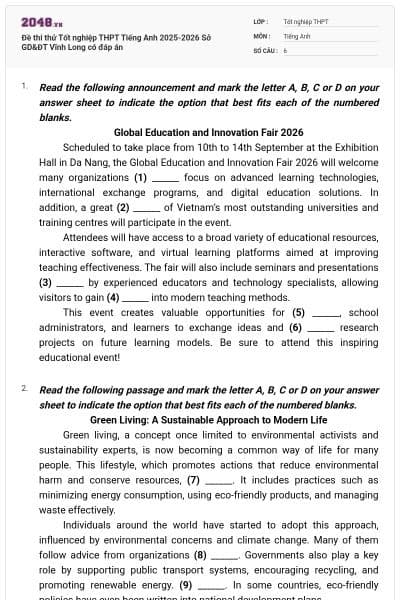
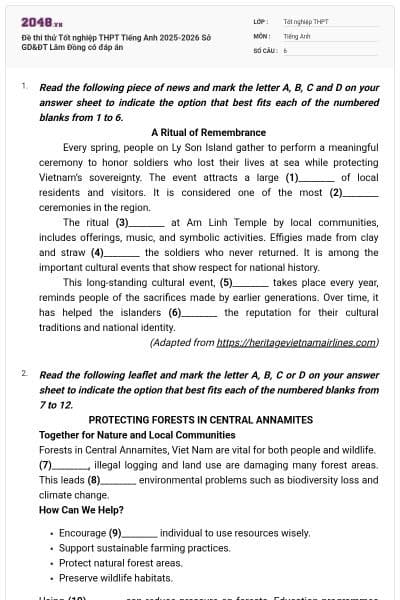
Read the following passage and mark the letter A, B, C or D on your answer sheet to indicate the option that best fits each of the numbered blanks from 1 to 6.
A (1) ____________has swept through northern Vietnam this week, sending temperatures tumbling across many provinces. Mountainous areas were the first to feel the full (2) ____________of the cold air, with readings dropping to around 9°C. In contrast, lowland regions recorded milder conditions, ranging from 14°C to 17°C. The sharp change, intensifying overnight, forced residents to bring out thick blankets and winter clothes.
Schools and offices reported lower attendance as people stayed indoors to avoid the chill. The sudden drop in temperature caused serious (3) ____________to agricultural production in the northern provinces.
The cold air mass, moving southward, is expected (4) ____________to central provinces in the coming days. (5) ____________by the severe cold wave, farmers are now rushing to protect crops from frost, as livestock face higher risks of illness. Meteorologists say this is the strongest cold wave so far this season. It will, (6) ____________, likely disrupt daily activities and continue to affect transportation and agriculture until the weekend.
(Adapted from https://e.vnexpress.net)
snap cold powerful
powerful cold snap
powerful snap cold
cold powerful snap
Phân tích trật tự từ: Ta có danh từ ghép “cold snap” (đợt rét đậm, đợt không khí lạnh). Tính từ “powerful” (mạnh mẽ) phải đứng trước cụm danh từ này để bổ nghĩa cho nó.
Chọn B. powerful cold snap
→ A powerful cold snap has swept through northern Vietnam this week...
Dịch nghĩa: Một đợt không khí lạnh mạnh đã quét qua miền Bắc Việt Nam trong tuần này...
conflict
dispute
bruise
brunt
A. conflict (n): cuộc xung đột.
B. dispute (n): cuộc tranh chấp, bàn cãi.
C. bruise (n): vết bầm tím.
D. brunt (n): gánh nặng, phần tồi tệ nhất.
Ta có cụm từ cố định (collocation): bear/feel the full brunt of something (hứng chịu hậu quả nặng nề nhất/sự tác động mạnh nhất của cái gì).
Chọn D. brunt
→ Mountainous areas were the first to feel the full brunt of the cold air...
Dịch nghĩa: Các khu vực miền núi là những nơi đầu tiên hứng chịu sự tác động mạnh nhất của khối không khí lạnh...
The sudden drop in temperature caused serious (3) ____________to agricultural production in the northern provinces.
damage
damaging
damaged
damages
A. damage (n): sự thiệt hại (không đếm được).
B. damaging (adj): có tính tàn phá, gây hại.
C. damaged (adj): bị hư hỏng.
D. damages (n): tiền bồi thường thiệt hại (danh từ số nhiều mang nghĩa pháp lý).
Đứng sau tính từ “serious” (nghiêm trọng) cần một danh từ.
Ta có cụm “cause damage to something” (gây thiệt hại cho cái gì). Trong ngữ cảnh này, sự thiệt hại là danh từ không đếm được nên không có “s”.
Chọn A. damage
→ The sudden drop in temperature caused serious damage to agricultural production in the northern provinces.
Dịch nghĩa: Sự sụt giảm nhiệt độ đột ngột đã gây ra thiệt hại nghiêm trọng cho sản xuất nông nghiệp ở các tỉnh phía Bắc.
spreading
to spread
being spread
to be spread
A. spreading: hiện tại phân từ (V-ing).
B. to spread: động từ nguyên thể có “to” (chủ động).
C. being spread: V-ing dạng bị động.
D. to be spread: nguyên thể có “to” dạng bị động.
Cấu trúc: be expected to do something (được dự kiến sẽ làm gì).
Chủ ngữ “The cold air mass” (khối không khí lạnh) tự bản thân nó lan rộng (hành động mang tính chủ động), nên ta dùng “to spread”.
Chọn B. to spread
→ The cold air mass, moving southward, is expected to spread to central provinces in the coming days.
Dịch nghĩa: Khối không khí lạnh, di chuyển về phía nam, được dự kiến sẽ lan rộng đến các tỉnh miền Trung trong những ngày tới.
Affected
Affecting
To affect
To be affected
A. Affected: quá khứ phân từ (dạng bị động).
B. Affecting: hiện tại phân từ (dạng chủ động).
C. To affect: nguyên thể có “to” (chỉ mục đích).
D. To be affected: nguyên thể có “to” bị động.
Rút gọn mệnh đề trạng ngữ đồng chủ ngữ. Chủ ngữ của vế chính là “farmers” (những người nông dân). Nông dân “bị ảnh hưởng” bởi đợt rét đậm (bị động), nên khi rút gọn ta dùng quá khứ phân từ (V-ed/V3). Mệnh đề đầy đủ: Because they are affected by...
Chọn A. Affected
→ Affected by the severe cold wave, farmers are now rushing to protect crops from frost...
Dịch nghĩa: Bị ảnh hưởng bởi đợt không khí lạnh khắc nghiệt, người nông dân hiện đang hối hả bảo vệ mùa màng khỏi sương giá...
It will, (6) ____________, likely disrupt daily activities and continue to affect transportation and agriculture until the weekend.
however
moreover
therefore
yet
A. however (adv): tuy nhiên.
B. moreover (adv): hơn nữa, ngoài ra.
C. therefore (adv): vì vậy, do đó.
D. yet (conj): tuy nhiên, nhưng.
Mệnh đề trước là nguyên nhân (“Đây là đợt không khí lạnh mạnh nhất từ đầu mùa đến nay”).
Mệnh đề sau là kết quả (“Nó có khả năng làm gián đoạn các hoạt động thường ngày...”).
Từ nối chỉ nguyên nhân - kết quả phù hợp nhất là “therefore”.
Chọn C. therefore
→ It will, therefore, likely disrupt daily activities and continue to affect transportation and agriculture until the weekend.
Dịch nghĩa: Do đó, nó có khả năng làm gián đoạn các hoạt động thường ngày và tiếp tục ảnh hưởng đến giao thông và nông nghiệp cho đến cuối tuần.
Bài đọc hoàn chỉnh | Dịch bài đọc |
A (1) powerful cold snap has swept through northern Vietnam this week, sending temperatures tumbling across many provinces. Mountainous areas were the first to feel the full (2) brunt of the cold air, with readings dropping to around 9°C. In contrast, lowland regions recorded milder conditions, ranging from 14°C to 17°C. The sharp change, intensifying overnight, forced residents to bring out thick blankets and winter clothes. Schools and offices reported lower attendance as people stayed indoors to avoid the chill. The sudden drop in temperature caused serious (3) damage to agricultural production in the northern provinces. The cold air mass, moving southward, is expected (4) to spread to central provinces in the coming days. (5) Affected by the severe cold wave, farmers are now rushing to protect crops from frost, as livestock face higher risks of illness. Meteorologists say this is the strongest cold wave so far this season. It will, (6) therefore, likely disrupt daily activities and continue to affect transportation and agriculture until the weekend. | Một (1) đợt không khí lạnh mạnh đã quét qua miền Bắc Việt Nam trong tuần này, khiến nhiệt độ sụt giảm trên khắp nhiều tỉnh thành. Các khu vực miền núi là những nơi đầu tiên hứng chịu (2) sự tác động mạnh nhất của khối không khí lạnh, với mức nhiệt độ ghi nhận giảm xuống chỉ còn khoảng 9°C. Ngược lại, các khu vực đồng bằng ghi nhận điều kiện thời tiết ôn hòa hơn, dao động từ 14°C đến 17°C. Sự thay đổi đột ngột này, tăng cường vào ban đêm, đã buộc người dân phải mang chăn dày và quần áo mùa đông ra sử dụng. Các trường học và văn phòng ghi nhận mức độ chuyên cần thấp hơn do mọi người ở trong nhà để tránh rét. Việc nhiệt độ giảm mạnh đã gây ra (3) thiệt hại nghiêm trọng cho sản xuất nông nghiệp ở các tỉnh phía Bắc. Khối không khí lạnh, đang di chuyển về phía Nam, được dự kiến sẽ (4) lan rộng đến các tỉnh miền Trung trong những ngày tới. (5) Bị ảnh hưởng bởi đợt không khí lạnh khắc nghiệt, người nông dân hiện đang hối hả bảo vệ mùa màng khỏi sương giá, trong khi vật nuôi phải đối mặt với nguy cơ mắc bệnh cao hơn. Các nhà khí tượng học cho biết đây là đợt không khí lạnh mạnh nhất tính đến thời điểm này trong mùa. (6) Do đó, nó có khả năng sẽ làm gián đoạn các hoạt động thường ngày và tiếp tục ảnh hưởng đến giao thông cũng như nông nghiệp cho đến cuối tuần. |
Read the following leaflet and mark the letter A, B, C or D on your answer sheet to indicate the option that best fits each of the numbered blanks from 7 to 12.
CITIES OF THE FUTURE: BUILDING TOMORROW’S URBAN LANDSCAPE
Define the Vision
(7) ____________sustainable cities, it is essential to establish clear urban goals. From reducing carbon footprints to increasing connectivity, setting these (8) ____________will steer urban development and ensure that our cities are ready to meet future demands.
Design infrastructure
A (9) ____________city must incorporate advanced infrastructure that promotes both resilience and adaptability. Smart energy grids, green buildings, and sustainable transportation are essential to creating an urban environment that (10) ____________as one of the most charming among global cities.
Connect Communities and Technology
By connecting communities with (11) ____________innovative technologies such as digital platforms, data analytics, and IoT, we can create an inclusive urban ecosystem giving everyone a(n) (12) ____________in accessing services, amenities, and opportunities.
(Adapted from bbc.com)
Regardless of
On account of
For the sake of
In spite of
A. Regardless of (prep): Bất chấp, không kể đến.
B. On account of (prep): Bởi vì (= because of).
C. For the sake of (prep): Vì mục đích, vì lợi ích của.
D. In spite of (prep): Mặc dù.
Vế sau nói về việc “thiết lập các mục tiêu đô thị rõ ràng là điều thiết yếu”.
Vế trước là mục đích của việc làm này. Do đó, “Vì mục đích/lợi ích của những thành phố bền vững” là phù hợp nhất về nghĩa.
Chọn C. For the sake of
→ For the sake of sustainable cities, it is essential to establish clear urban goals.
Dịch nghĩa: Vì mục đích xây dựng những thành phố bền vững, điều thiết yếu là phải thiết lập các mục tiêu đô thị rõ ràng.
From reducing carbon footprints to increasing connectivity, setting these (8) ____________will steer urban development and ensure that our cities are ready to meet future demands.
essentials
basics
commercials
objectives
A. essentials (n): những điều thiết yếu.
B. basics (n): những điều cơ bản.
C. commercials (n): các mẩu quảng cáo trên truyền hình/radio.
D. objectives (n): những mục tiêu.
Ở câu ngay phía trước tác giả đã nhắc đến việc thiết lập “urban goals” (các mục tiêu đô thị).
Phía sau liệt kê “giảm lượng khí thải carbon” hay “tăng cường kết nối” chính là những mục tiêu cụ thể. → objectives = goals
Chọn D. objectives
→ From reducing carbon footprints to increasing connectivity, setting these objectives will steer urban development...
Dịch nghĩa: Từ việc giảm lượng khí thải carbon đến tăng cường tính kết nối, việc thiết lập những mục tiêu này sẽ lèo lái sự phát triển đô thị...
historic
weird
futuristic
local
A. historic (adj): mang tính lịch sử, có ý nghĩa lịch sử.
B. weird (adj): kỳ lạ, khó hiểu.
C. futuristic (adj): thuộc về tương lai, cực kỳ hiện đại.
D. local (adj): thuộc về địa phương.
Tiêu đề của bài đọc là “CITIES OF THE FUTURE” (Những thành phố của tương lai). Hơn nữa, thành phố này kết hợp “advanced infrastructure” (cơ sở hạ tầng tiên tiến), nên tính từ mô tả chính xác nhất là “futuristic”.
Chọn C. futuristic
→ A futuristic city must incorporate advanced infrastructure that promotes both resilience and adaptability.
Dịch nghĩa: Một thành phố hiện đại của tương lai phải tích hợp cơ sở hạ tầng tiên tiến nhằm thúc đẩy cả khả năng phục hồi và tính thích ứng.
Smart energy grids, green buildings, and sustainable transportation are essential to creating an urban environment that (10) ____________as one of the most charming among global cities.
gets off
stands out
breaks out of
brings up
A. gets off (phr.v): xuống (xe buýt, tàu), cởi bỏ, hoặc trốn phạt.
B. stands out (phr.v): nổi bật, vượt trội.
C. breaks out of (phr.v): trốn thoát khỏi (nơi giam giữ).
D. brings up (phr.v): nuôi dưỡng, hoặc đề cập đến (một chủ đề).
Thành phố tạo ra một môi trường đô thị khiến nó “nổi bật lên” như một trong những thành phố quyến rũ nhất trong số các thành phố toàn cầu.
Chọn B. stands out
→ ...creating an urban environment that stands out as one of the most charming among global cities.
Dịch nghĩa: ...tạo ra một môi trường đô thị nổi bật lên như một trong những nơi quyến rũ nhất giữa các thành phố trên toàn cầu.
some
another
little
the others
A. some: một vài, một số (+ danh từ đếm được số nhiều hoặc không đếm được).
B. another: một ... khác (+ danh từ đếm được số ít).
C. little: rất ít (+ danh từ không đếm được).
D. the others: những cái/người khác (đóng vai trò đại từ, không đứng trước danh từ).
Từ điền vào chỗ trống đứng trước cụm danh từ đếm được số nhiều “innovative technologies” (các công nghệ đổi mới). Do đó, “some” là đáp án đúng.
Chọn A. some
→ By connecting communities with some innovative technologies such as digital platforms...
Dịch nghĩa: Bằng cách kết nối các cộng đồng với một số công nghệ đổi mới như các nền tảng kỹ thuật số...
verge
brink
edge
side
A. verge (n): bờ vực (thường dùng: on the verge of).
B. brink (n): bờ vực (thường dùng: on the brink of).
C. edge (n): lợi thế (thường dùng: have/give someone an edge in/over...).
D. side (n): khía cạnh, phía, mặt.
Ta có cụm kết hợp từ cố định (collocation): give someone an edge in something (mang lại cho ai đó một lợi thế trong việc gì).
Chọn C. edge
→ ...we can create an inclusive urban ecosystem giving everyone an edge in accessing services, amenities, and opportunities.
Dịch nghĩa: ...chúng ta có thể tạo ra một hệ sinh thái đô thị bao trùm, mang lại cho mọi người lợi thế trong việc tiếp cận các dịch vụ, tiện nghi và cơ hội.
Bài đọc hoàn chỉnh | Dịch bài đọc |
CITIES OF THE FUTURE: BUILDING TOMORROW’S URBAN LANDSCAPE Define the Vision(7) For the sake of sustainable cities, it is essential to establish clear urban goals. From reducing carbon footprints to increasing connectivity, setting these (8) objectives will steer urban development and ensure that our cities are ready to meet future demands. Design infrastructure A (9) futuristic city must incorporate advanced infrastructure that promotes both resilience and adaptability. Smart energy grids, green buildings, and sustainable transportation are essential to creating an urban environment that (10) stands out as one of the most charming among global cities. Connect Communities and Technology By connecting communities with (11) some innovative technologies such as digital platforms, data analytics, and IoT, we can create an inclusive urban ecosystem giving everyone an (12) edge in accessing services, amenities, and opportunities. | NHỮNG THÀNH PHỐ CỦA TƯƠNG LAI: XÂY DỰNG CẢNH QUAN ĐÔ THỊ NGÀY MAI Xác định Tầm nhìn(7) Vì mục đích xây dựng những thành phố bền vững, điều thiết yếu là phải thiết lập các mục tiêu đô thị rõ ràng. Từ việc giảm lượng khí thải carbon đến tăng cường tính kết nối, việc thiết lập những (8) mục tiêu này sẽ lèo lái sự phát triển đô thị và đảm bảo rằng các thành phố của chúng ta sẵn sàng đáp ứng những nhu cầu trong tương lai. Thiết kế cơ sở hạ tầng Một thành phố (9) hiện đại của tương lai phải tích hợp cơ sở hạ tầng tiên tiến nhằm thúc đẩy cả khả năng phục hồi và tính thích ứng. Lưới điện thông minh, các tòa nhà xanh và giao thông bền vững là những yếu tố thiết yếu để tạo ra một môi trường đô thị (10) nổi bật lên như một trong những nơi quyến rũ nhất giữa các thành phố trên toàn cầu. Kết nối Cộng đồng và Công nghệ Bằng cách kết nối các cộng đồng với (11) một số công nghệ đổi mới như các nền tảng kỹ thuật số, phân tích dữ liệu và Internet Vạn vật (IoT), chúng ta có thể tạo ra một hệ sinh thái đô thị bao trùm, mang lại cho mọi người (12) lợi thế trong việc tiếp cận các dịch vụ, tiện nghi và cơ hội. |
Mark the letter A, B, C or D on your answer sheet to indicate the best arrangement of utterances or sentences to make a meaningful exchange or text in each of the following questions from 13 to 17.
a. Lan: Yeah, I write a few lines every night - it helps me clear my mind.
b. Nam: Do you still keep a diary these days?
c. Nam: That sounds nice; I think that writing things down makes life feel more meaningful.
c - a - b
b - c - a
c - b - a
b - a - c
Thứ tự sắp xếp đúng: D. b - a - c
b. Nam: Do you still keep a diary these days?
a. Lan: Yeah, I write a few lines every night - it helps me clear my mind.
c. Nam: That sounds nice; I think that writing things down makes life feel more meaningful.
Dịch nghĩa:
b. Nam: Dạo này cậu còn giữ thói quen viết nhật ký không?
a. Lan: Có chứ, tớ viết vài dòng mỗi tối - nó giúp tớ thư thái đầu óc.
c. Nam: Nghe tuyệt đấy; tớ nghĩ việc viết mọi thứ ra khiến cuộc sống trở nên có ý nghĩa hơn.
Chọn D.
a. Mia: Hey, have you started revising for the graduation exam yet?
b. Sam: That'd be awesome. We could quiz each other and sort out the tricky topics.
c. Mia: Perfect! Let's meet at my place on Saturday and power through those practice tests.
d. Sam: Yeah, I've been hitting the books hard, especially for math. It's tougher than I thought!
e. Mia: Tell me about it! I'm freaking out over chemistry. Want to study together this weekend?
a - d - e - b - c
a - d - c - b - e
e - d - a - b - c
e - b - a - d - c
Thứ tự sắp xếp đúng: A. a - d - e - b - c
a. Mia: Hey, have you started revising for the graduation exam yet?
d. Sam: Yeah, I've been hitting the books hard, especially for math. It's tougher than I thought!
e. Mia: Tell me about it! I'm freaking out over chemistry. Want to study together this weekend?
b. Sam: That'd be awesome. We could quiz each other and sort out the tricky topics.
c. Mia: Perfect! Let's meet at my place on Saturday and power through those practice tests.
Dịch nghĩa:
a. Mia: Này, cậu đã bắt đầu ôn tập cho kỳ thi tốt nghiệp chưa?
d. Sam: Rồi, tớ đang vùi đầu vào sách vở đây, đặc biệt là môn toán. Nó khó hơn tớ tưởng!
e. Mia: Cậu nói đúng ý tớ! Tớ đang phát hoảng với môn hóa đây. Cuối tuần này có muốn học cùng nhau không?
b. Sam: Thế thì tuyệt quá. Chúng ta có thể đố nhau và giải quyết những chủ đề khó nhằn.
c. Mia: Tuyệt vời! Cứ quyết định thứ Bảy gặp nhau ở nhà tớ và cùng nhau giải quyết nhanh gọn mấy bài thi thử đó nhé.
Chọn A.
a. However, this sudden exposure can be overwhelming, placing immense pressure on its delicate ecosystems and resources.
b. Once considered a hidden gem, known only to a few locals and accessible via an unmarked trail in the early 1990s, its visitor numbers have dramatically surged.
c. A prime example is Horseshoe Bend, a spectacular U-shaped curve in the Colorado River.
d. Social networking platforms, particularly Instagram, have acted as a powerfulcatalyst for this transformation.
e. The rise of social media has profoundly transformed how natural landmarks are discovered and experienced.
d - e - c - b - a
e - b - d - a - c
e - c - a - d - b
e - c - b - d - a
Thứ tự sắp xếp đúng: D. e - c - b - d - a
e. The rise of social media has profoundly transformed how natural landmarks are discovered and experienced.
c. A prime example is Horseshoe Bend, a spectacular U-shaped curve in the Colorado River.
b. Once considered a hidden gem, known only to a few locals and accessible via an unmarked trail in the early 1990s, its visitor numbers have dramatically surged.
d. Social networking platforms, particularly Instagram, have acted as a powerful catalyst for this transformation.
a. However, this sudden exposure can be overwhelming, placing immense pressure on its delicate ecosystems and resources.
Dịch nghĩa:
e. Sự trỗi dậy của mạng xã hội đã thay đổi sâu sắc cách mà các địa danh tự nhiên được khám phá và trải nghiệm.
c. Một ví dụ điển hình là Horseshoe Bend, một khúc cua ngoạn mục hình chữ U trên sông Colorado.
b. Từng được coi là một viên ngọc ẩn, chỉ được một số ít người dân địa phương biết đến và có thể tiếp cận qua một con đường mòn không có biển chỉ dẫn vào đầu những năm 1990, số lượng du khách của nó nay đã tăng đột biến.
d. Các nền tảng mạng xã hội, đặc biệt là Instagram, đã đóng vai trò như một chất xúc tác mạnh mẽ cho sự biến đổi này.
a. Tuy nhiên, sự phơi bày đột ngột này có thể trở nên quá sức, đặt áp lực to lớn lên các hệ sinh thái và nguồn tài nguyên mỏng manh của nó.
Chọn D.
Dear Ms. Lan,
a. A few local singers, including Minh Anh and Quoc Bao, have already expressed their willingness to perform without charge.
b. Our community has recently shown great interest in supporting families affected by last month’s floods, and a benefit concert could turn that goodwill into meaningful action.
c. The town square would be an ideal venue, as it can accommodate both the audience and the equipment needed for live music.
d. Please consider this idea as a way to blend music, compassion, and community spirit into one remarkable evening.
e. With your charity’s experience in event coordination, this collaboration could bring energy, unity, and much-needed funds to those in need.
Best regards,
Nguyen Phong
a - d - c - e - b
b - c - a - d - e
b - a - c - e - d
a - e - d - b - c
Thứ tự sắp xếp đúng: C. b - a - c - e - d
b. Our community has recently shown great interest in supporting families affected by last month’s floods, and a benefit concert could turn that goodwill into meaningful action.
a. A few local singers, including Minh Anh and Quoc Bao, have already expressed their willingness to perform without charge.
c. The town square would be an ideal venue, as it can accommodate both the audience and the equipment needed for live music.
e. With your charity’s experience in event coordination, this collaboration could bring energy, unity, and much-needed funds to those in need.
d. Please consider this idea as a way to blend music, compassion, and community spirit into one remarkable evening.
Dịch nghĩa:
Kính gửi cô Lan,
b. Gần đây, cộng đồng của chúng ta đã thể hiện sự quan tâm lớn đến việc hỗ trợ các gia đình bị ảnh hưởng bởi trận lũ lụt tháng trước, và một buổi hòa nhạc từ thiện có thể biến thiện chí đó thành hành động ý nghĩa.
a. Một vài ca sĩ địa phương, bao gồm Minh Anh và Quốc Bảo, đã bày tỏ sự sẵn lòng biểu diễn mà không nhận cát-xê.
c. Quảng trường thị trấn sẽ là một địa điểm lý tưởng, vì nó có thể chứa được cả khán giả và các thiết bị cần thiết cho nhạc sống.
e. Với kinh nghiệm của tổ chức từ thiện của cô trong việc phối hợp tổ chức sự kiện, sự hợp tác này có thể mang lại năng lượng, sự đoàn kết và nguồn quỹ vô cùng cần thiết cho những người đang gặp khó khăn.
d. Xin hãy xem xét ý tưởng này như một cách để hòa quyện âm nhạc, lòng trắc ẩn và tinh thần cộng đồng vào một buổi tối đáng nhớ.
Trân trọng,
Nguyễn Phong
Chọn C.
a. As a guardian of cultural diversity, UNESCO's initiatives have been pivotal in countering the destruction of invaluable heritage due to conflict, climate change, and urbanization.
b. However, the protection of world heritage sites often faces significant challenges, such as funding constraints and political instability, which hinder preservation efforts.
c. Therefore, UNESCO's role in monitoring and advocating for the conservation of heritage sites serves as a crucial mechanism for promoting global responsibility and intergenerational equity.
d. UNESCO's commitment to safeguarding cultural heritage is integral in fostering a deeper global understanding and appreciation of diverse civilizations.
e. Through international cooperation, UNESCO strives to deal with those challenges in the preservation of heritage while ensuring sustainable development.
c - b - a - d - e
b - c - a - e - d
b - a - c - d - e
a - b - e - c - d
Thứ tự sắp xếp đúng: D. a - b - e - c - d
a. As a guardian of cultural diversity, UNESCO's initiatives have been pivotal in countering the destruction of invaluable heritage due to conflict, climate change, and urbanization.
b. However, the protection of world heritage sites often faces significant challenges, such as funding constraints and political instability, which hinder preservation efforts.
e. Through international cooperation, UNESCO strives to deal with those challenges in the preservation of heritage while ensuring sustainable development.
c. Therefore, UNESCO's role in monitoring and advocating for the conservation of heritage sites serves as a crucial mechanism for promoting global responsibility and intergenerational equity.
d. UNESCO's commitment to safeguarding cultural heritage is integral in fostering a deeper global understanding and appreciation of diverse civilizations.
Dịch nghĩa:
a. Với tư cách là người bảo vệ sự đa dạng văn hóa, các sáng kiến của UNESCO đã đóng vai trò then chốt trong việc chống lại sự tàn phá các di sản vô giá do xung đột, biến đổi khí hậu và đô thị hóa.
b. Tuy nhiên, việc bảo vệ các di sản thế giới thường phải đối mặt với những thách thức đáng kể, chẳng hạn như hạn chế về ngân sách và sự bất ổn chính trị, những điều gây cản trở các nỗ lực bảo tồn.
e. Thông qua hợp tác quốc tế, UNESCO nỗ lực giải quyết những thách thức đó trong việc bảo tồn di sản, đồng thời đảm bảo sự phát triển bền vững.
c. Do đó, vai trò của UNESCO trong việc giám sát và ủng hộ bảo tồn các khu di sản đóng vai trò là một cơ chế quan trọng nhằm thúc đẩy trách nhiệm toàn cầu và sự công bằng giữa các thế hệ.
d. Cam kết của UNESCO trong việc bảo vệ di sản văn hóa là không thể thiếu trong việc thúc đẩy sự hiểu biết và trân trọng sâu sắc hơn của toàn cầu đối với các nền văn minh đa dạng.
Chọn D.
Read the following passage and mark the letter A, B, C or D on your answer sheet to indicate the option that best fits each of the numbered blanks from 18 to 22.
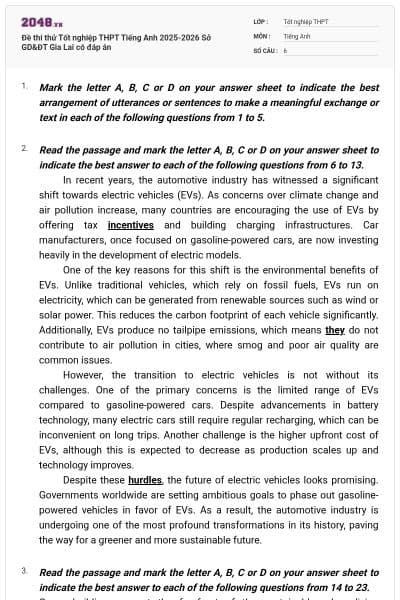
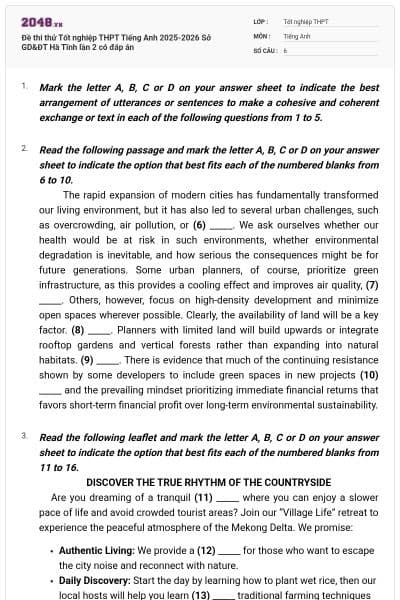
Cities often feel noticeably hotter than the surrounding countryside, a phenomenon known as the urban heat island (UHI). An urban heat island is a metropolitan area that becomes significantly warmer than nearby rural regions, largely because concrete, asphalt, and buildings absorb and retain heat. In such environments, waste heat, generated by cars, public transport, factories, homes, and even people themselves, (18) ____________. When buildings and paved surfaces are constructed close together, they trap heat, and this insulation effect, which slows the release of warmth, causes temperatures in the spaces between structures to remain high even after sunset.
At night, the contrast becomes especially clear. Surfaces such as roads, sidewalks, and parking lotsact like vast reservoirs of heat, preventing warmth from escaping into the cooler night sky. In a dense city core, skyscrapers and narrow streets restrict airflow, (19) ____________. The consequences are serious: poorer air quality develops because pollutants released by vehicles and industry cannot disperse easily, while local water systems are harmed when heated runoff enters streams and rivers, damaging aquatic species adapted to cooler conditions. Urban heat islands also place a heavy strain on energy networks, since residents increasingly rely on air conditioning during summer peaks, (20) ____________.
To reduce these effects, urban planners, policymakers, and architects are developing both modest and ambitious strategies. Green roofs, essentially gardens on rooftops, help cool buildings by absorbing sunlight and converting it into biomass rather than heat. (21) ____________. Expanding urban vegetation and creating more open layouts improves air circulation, allowing heat to dissipate. Though urban heat islands represent a modern challenge, thoughtful design and collective action can lessen their impact, (22) ____________.
(Adapted from https://education.nationalgeographic.org)
in addition to the rising temperatures
adds to the rising temperatures
which adds to the rising temperatures
with addition of the rising temperatures
Chủ ngữ của câu là “waste heat” (nhiệt thải). Cụm từ nằm giữa hai dấu phẩy “, generated by cars, public transport, factories, homes, and even people themselves,” chỉ là mệnh đề quan hệ rút gọn bổ nghĩa cho chủ ngữ. Vì vậy, vị trí (18) đang thiếu một Động từ chính (Main verb) cho toàn bộ câu.
A. in addition to the rising temperatures (Cụm giới từ - thiếu động từ)
B. adds to the rising temperatures (Động từ “adds” chia số ít khớp với chủ ngữ không đếm được “waste heat”)
C. which adds to the rising temperatures (Mệnh đề quan hệ - khiến câu văn bị thiếu động từ chính)
D. with addition of the rising temperatures (Cụm giới từ - thiếu động từ)
Phân tích:
Đáp án B là lựa chọn duy nhất cung cấp động từ chính để hoàn thiện cấu trúc ngữ pháp của câu S + V.
Chọn B.
→ In such environments, waste heat, generated by cars, public transport, factories, homes, and even people themselves, adds to the rising temperatures.
Dịch nghĩa: Trong những môi trường như vậy, nhiệt thải, được tạo ra bởi ô tô, phương tiện giao thông công cộng, nhà máy, nhà ở và thậm chí cả chính con người, làm tăng thêm tình trạng nhiệt độ ngày càng cao.
but heat trapped close to ground level lingers
so trapped heat lingers close to ground level
while heat lingers close to ground level that is trapped
in which trapping heat close to ground level lingers
Câu trước dấu phẩy “skyscrapers and narrow streets restrict airflow” (các tòa nhà chọc trời và đường phố chật hẹp hạn chế luồng không khí) là nguyên nhân. Vị trí (19) cần một mệnh đề chỉ kết quả của việc hạn chế luồng không khí này.
Dịch nghĩa:
linger (v): nấn ná, đọng lại, nán lại.
A. nhưng lượng nhiệt bị mắc kẹt gần mặt đất đọng lại (Dùng “but” sai logic vì đây không phải sự tương phản).
B. vì vậy lượng nhiệt bị mắc kẹt đọng lại ở gần mặt đất.
C. trong khi lượng nhiệt đọng lại gần mặt đất cái mà bị mắc kẹt (Mệnh đề quan hệ “that is trapped” đứng sau “ground level” là sai ngữ pháp và tối nghĩa).
D. trong cái mà việc bẫy nhiệt gần mặt đất đọng lại (Sai ngữ pháp hoàn toàn).
Phân tích:
Đáp án B dùng liên từ chỉ kết quả “so” (vì vậy) nối tiếp hoàn hảo quan hệ nhân quả: không khí bị cản trở → vì vậy nhiệt bị giữ lại.
Chọn B.
→ In a dense city core, skyscrapers and narrow streets restrict airflow, so trapped heat lingers close to ground level.
Dịch nghĩa: Ở trung tâm thành phố đông đúc, các tòa nhà chọc trời và đường phố chật hẹp hạn chế luồng không khí, vì vậy lượng nhiệt bị mắc kẹt đọng lại ở gần mặt đất.
with blackouts or power shortages leading to a surge in demand
but the demand for blackouts or power shortages may also surge
whereas blackouts or power shortages may also demand a surge
and this surge in demand may lead to blackouts or power shortages
Vế trước đề cập đến việc “residents increasingly rely on air conditioning” (cư dân ngày càng phụ thuộc vào điều hòa không khí) gây ra sự quá tải cho lưới điện. Chỗ trống (20) cần chỉ ra hậu quả trực tiếp của nhu cầu khổng lồ này.
Dịch nghĩa:
surge (n): sự tăng vọt, trào lên.
blackout (n): sự mất điện (diện rộng).
A. với việc cúp điện hoặc thiếu điện dẫn đến nhu cầu tăng vọt (Sai logic: cúp điện không dẫn đến nhu cầu tăng, mà ngược lại).
B. nhưng nhu cầu cúp điện hoặc thiếu điện cũng có thể tăng vọt (Sai logic: không ai có “nhu cầu” bị cúp điện).
C. trong khi cúp điện hoặc thiếu điện cũng có thể đòi hỏi sự tăng vọt (Sai logic).
D. và sự tăng vọt về nhu cầu này có thể dẫn đến tình trạng cúp điện hoặc thiếu điện.
Phân tích:
Đáp án D miêu tả đúng quy luật nhân quả thực tế: Nhu cầu dùng điều hòa tăng → Nhu cầu điện tăng vọt (surge in demand) → Dẫn đến cúp điện (blackouts).
Chọn D.
→ Urban heat islands also place a heavy strain on energy networks, since residents increasingly rely on air conditioning during summer peaks, and this surge in demand may lead to blackouts or power shortages.
Dịch nghĩa: Đảo nhiệt đô thị cũng đặt một gánh nặng lớn lên mạng lưới năng lượng, vì cư dân ngày càng phụ thuộc vào điều hòa không khí trong các đợt cao điểm mùa hè, và sự tăng vọt về nhu cầu này có thể dẫn đến tình trạng cúp điện hoặc thiếu điện.
Using lighter-coloured materials that reflect more solar radiation can also reduce warming
Reflecting lighter-coloured materials in order to reduce warming for more solar radiation
Lighter-coloured materials that reduce warming can be used to reflect more solar radiation
The reflection of lighter-coloured materials for more solar radiation can reduce warming
Đoạn văn đang liệt kê các chiến lược (strategies) để giảm tác động của đảo nhiệt. Câu trước nhắc đến “Green roofs” (Mái nhà xanh). Câu (21) cần đưa ra một chiến lược tiếp theo với cấu trúc tương đương và độc lập.
Dịch nghĩa:
A. Việc sử dụng các vật liệu sáng màu cái mà phản xạ nhiều bức xạ mặt trời hơn cũng có thể làm giảm sự nóng lên. (Cấu trúc V-ing làm chủ ngữ).
B. Phản xạ các vật liệu sáng màu để giảm sự nóng lên cho nhiều bức xạ mặt trời (Sai logic: người ta không “phản xạ vật liệu”).
C. Các vật liệu sáng màu làm giảm sự nóng lên có thể được sử dụng để phản xạ nhiều bức xạ mặt trời (Hơi ngược logic: mục đích chính là giảm sự nóng lên, cách làm là phản xạ bức xạ).
D. Sự phản xạ của các vật liệu sáng màu đối với nhiều bức xạ mặt trời có thể làm giảm sự nóng lên (Diễn đạt lủng củng).
Phân tích:
Đáp án A đưa ra chiến lược rõ ràng bắt đầu bằng danh động từ “Using...” (Việc sử dụng...), đồng thời cụm “can also reduce” (cũng có thể làm giảm) tạo sự nối tiếp hoàn hảo với câu trước.
Chọn A.
→ Green roofs, essentially gardens on rooftops, help cool buildings by absorbing sunlight and converting it into biomass rather than heat. Using lighter-coloured materials that reflect more solar radiation can also reduce warming.
Dịch nghĩa: Mái nhà xanh, về cơ bản là những khu vườn trên sân thượng, giúp làm mát các tòa nhà bằng cách hấp thụ ánh sáng mặt trời và chuyển hóa nó thành sinh khối thay vì nhiệt năng. Việc sử dụng các vật liệu sáng màu có khả năng phản xạ nhiều bức xạ mặt trời hơn cũng có thể làm giảm sự nóng lên.
so that a healthier city life becomes more unsustainable
whose health rests on the sustainability of city life
which sustaining the health of city life
making city life healthier and more sustainable
Mệnh đề chính là “thoughtful design and collective action can lessen their impact” (thiết kế chu đáo và hành động tập thể có thể làm giảm tác động của chúng). Vị trí (22) cần một cụm từ chỉ kết quả của toàn bộ hành động này. Cấu trúc V-ing rút gọn mệnh đề trạng ngữ chỉ kết quả (making...) là sự lựa chọn chính xác.
Dịch nghĩa:
A. để mà cuộc sống thành phố lành mạnh trở nên kém bền vững hơn (Sai logic từ “unsustainable”).
B. sức khỏe của cái nào đó dựa trên sự bền vững của cuộc sống thành phố (Sai cấu trúc mệnh đề quan hệ).
C. cái mà duy trì sức khỏe của cuộc sống thành phố (Sai ngữ pháp).
D. làm cho cuộc sống thành phố trở nên lành mạnh và bền vững hơn (Đúng cấu trúc “make + Object + Adj”).
Phân tích:
Việc giảm tác động của đảo nhiệt đô thị chắc chắn sẽ mang lại kết quả tích cực. Đáp án D miêu tả đúng kết quả tích cực đó bằng cấu trúc ngữ pháp chuẩn xác.
Chọn D.
→ Though urban heat islands represent a modern challenge, thoughtful design and collective action can lessen their impact, making city life healthier and more sustainable.
Dịch nghĩa: Mặc dù các đảo nhiệt đô thị là một thách thức hiện đại, nhưng thiết kế chu đáo và hành động tập thể có thể làm giảm tác động của chúng, làm cho cuộc sống thành phố trở nên lành mạnh và bền vững hơn.
Bài đọc hoàn chỉnh | Dịch bài đọc |
Cities often feel noticeably hotter than the surrounding countryside, a phenomenon known as the urban heat island (UHI). An urban heat island is a metropolitan area that becomes significantly warmer than nearby rural regions, largely because concrete, asphalt, and buildings absorb and retain heat. In such environments, waste heat, generated by cars, public transport, factories, homes, and even people themselves, adds to the rising temperatures. When buildings and paved surfaces are constructed close together, they trap heat, and this insulation effect, which slows the release of warmth, causes temperatures in the spaces between structures to remain high even after sunset. At night, the contrast becomes especially clear. Surfaces such as roads, sidewalks, and parking lots act like vast reservoirs of heat, preventing warmth from escaping into the cooler night sky. In a dense city core, skyscrapers and narrow streets restrict airflow, so trapped heat lingers close to ground level. The consequences are serious: poorer air quality develops because pollutants released by vehicles and industry cannot disperse easily, while local water systems are harmed when heated runoff enters streams and rivers, damaging aquatic species adapted to cooler conditions. Urban heat islands also place a heavy strain on energy networks, since residents increasingly rely on air conditioning during summer peaks, and this surge in demand may lead to blackouts or power shortages. To reduce these effects, urban planners, policymakers, and architects are developing both modest and ambitious strategies. Green roofs, essentially gardens on rooftops, help cool buildings by absorbing sunlight and converting it into biomass rather than heat. Using lighter-coloured materials that reflect more solar radiation can also reduce warming. Expanding urban vegetation and creating more open layouts improves air circulation, allowing heat to dissipate. Though urban heat islands represent a modern challenge, thoughtful design and collective action can lessen their impact, making city life healthier and more sustainable. | Các thành phố thường có cảm giác nóng hơn rõ rệt so với vùng nông thôn xung quanh, một hiện tượng được gọi là đảo nhiệt đô thị (UHI). Đảo nhiệt đô thị là một khu vực đô thị trở nên ấm hơn đáng kể so với các vùng nông thôn lân cận, phần lớn là do bê tông, nhựa đường và các tòa nhà hấp thụ và giữ nhiệt. Trong những môi trường như vậy, nhiệt thải, được tạo ra bởi ô tô, phương tiện giao thông công cộng, nhà máy, nhà ở và thậm chí cả chính con người, làm tăng thêm tình trạng nhiệt độ ngày càng cao. Khi các tòa nhà và các bề mặt lát đá được xây dựng gần nhau, chúng giữ nhiệt lại, và hiệu ứng cách nhiệt này (vốn làm chậm quá trình tỏa nhiệt) khiến nhiệt độ trong không gian giữa các cấu trúc vẫn ở mức cao ngay cả sau khi mặt trời lặn. Vào ban đêm, sự tương phản càng trở nên rõ ràng. Các bề mặt như đường sá, vỉa hè và bãi đậu xe hoạt động như những hồ chứa nhiệt khổng lồ, ngăn không cho hơi ấm thoát ra bầu trời đêm mát mẻ hơn. Ở trung tâm thành phố đông đúc, các tòa nhà chọc trời và đường phố chật hẹp hạn chế luồng không khí, vì vậy lượng nhiệt bị mắc kẹt đọng lại ở gần mặt đất. Hậu quả rất nghiêm trọng: chất lượng không khí trở nên kém hơn do các chất ô nhiễm thải ra từ các phương tiện giao thông và công nghiệp không thể phân tán dễ dàng, trong khi các hệ thống nước địa phương bị tổn hại khi dòng chảy bị nung nóng đổ vào các con suối và dòng sông, gây hại cho các loài thủy sinh vốn đã thích nghi với điều kiện mát mẻ hơn. Đảo nhiệt đô thị cũng đặt một gánh nặng lớn lên mạng lưới năng lượng, vì cư dân ngày càng phụ thuộc vào điều hòa không khí trong các đợt cao điểm mùa hè, và sự tăng vọt về nhu cầu này có thể dẫn đến tình trạng cúp điện hoặc thiếu điện. Để giảm thiểu những tác động này, các nhà quy hoạch đô thị, các nhà hoạch định chính sách và các kiến trúc sư đang phát triển cả những chiến lược khiêm tốn lẫn đầy tham vọng. Mái nhà xanh, về cơ bản là những khu vườn trên sân thượng, giúp làm mát các tòa nhà bằng cách hấp thụ ánh sáng mặt trời và chuyển hóa nó thành sinh khối thay vì nhiệt năng. Việc sử dụng các vật liệu sáng màu có khả năng phản xạ nhiều bức xạ mặt trời hơn cũng có thể làm giảm sự nóng lên. Việc mở rộng thảm thực vật đô thị và tạo ra các sơ đồ quy hoạch mở hơn giúp cải thiện sự lưu thông không khí, cho phép nhiệt phân tán. Mặc dù các đảo nhiệt đô thị là một thách thức hiện đại, nhưng thiết kế chu đáo và hành động tập thể có thể làm giảm tác động của chúng, làm cho cuộc sống thành phố trở nên lành mạnh và bền vững hơn. |
Read the passage and mark the letter A, B, C or D on your answer sheet to indicate the best answer to each of the following questions from 23 to 30.
Alison Wright has one of the most inspiring jobs in the world. As a photojournalist for National Geographic, she has travelled to countless countries, capturing powerful images of people, nature, and cultures. Her work is more than just photography - it is a way of telling human stories through her lens. Over the years, she has developed a deep love for exploration and adventure, which earned her the title of National Geographic Traveller of the Year in 2013. Yet, behind her achievements lies an unforgettable story of survival and courage.
While travelling through Laos several years ago, Alison experienced a horrendous accident that changed her life. The bus she was on collided with a truck and burst into flames. Two tourists managed to pull her from the wreckage and brought her to a nearby village. The local people did everything they could to help, but the situation was critical. There were no doctors or medical supplies, and Alison’s injuries were severe - many of her bones were broken, leaving her unable to move.
In the midst of this crisis, a man she had never met offered his help. Without hesitation, he drove her for eight long hours to a hospital in Thailand. There, Alison finally received the treatment she desperately needed. Her recovery was slow and painful, but she remained determined to regain her strength. Throughout the long months of healing, her goal of climbing Mount Kilimanjaro in Tanzania kept her motivated.
A few years later, Alison achieved that goal. Standing on the summit of Africa’s highest mountain, she felt not only triumph but deep gratitude for those who had helped her survive. To this day, she believes that she owes her life to the kindness of strangers. This lesson continues to shape both her outlook on life and her extraordinary work as a storyteller.
(Adapted from Look)
What is NOT indicated about Alison Wright in paragraph 1?
She gained recognition for her work in 2013.
She has travelled to different countries for her job.
She has a great passion for travelling.
She recently started a new job at a magazine.
Điều nào KHÔNG được chỉ ra về Alison Wright trong đoạn 1?
A. Cô đã được công nhận cho công việc của mình vào năm 2013. (Có nhắc đến: “earned her the title... in 2013”)
B. Cô đã đi đến nhiều quốc gia khác nhau vì công việc. (Có nhắc đến: “travelled to countless countries”)
C. Cô có niềm đam mê lớn với việc đi lại/du lịch. (Có nhắc đến: “deep love for exploration”)
D. Gần đây cô mới bắt đầu một công việc mới tại một tạp chí. (Không được nhắc đến)
Thông tin: Alison Wright has one of the most inspiring jobs in the world. As a photojournalist for National Geographic, she has travelled to countless countries, capturing powerful images of people, nature, and cultures. Her work is more than just photography - it is a way of telling human stories through her lens. Over the years, she has developed a deep love for exploration and adventure, which earned her the title of National Geographic Traveller of the Year in 2013. Yet, behind her achievements lies an unforgettable story of survival and courage.
(Alison Wright có một trong những công việc truyền cảm hứng nhất trên thế giới. Với tư cách là một phóng viên ảnh cho National Geographic, cô đã đi đến vô số quốc gia, ghi lại những bức ảnh mạnh mẽ về con người, thiên nhiên và các nền văn hóa. Công việc của cô không chỉ đơn thuần là nhiếp ảnh - đó là một cách kể lại những câu chuyện về con người qua ống kính của cô. Qua nhiều năm, cô đã nuôi dưỡng một tình yêu sâu sắc đối với khám phá và phiêu lưu, điều đã mang về cho cô danh hiệu Nhà du hành của năm của National Geographic vào năm 2013. Tuy nhiên, đằng sau những thành tựu của cô là một câu chuyện khó quên về sự sống sót và lòng dũng cảm.)
Chọn D.
puzzled
restricted
terrifying
negligible
Từ “horrendous” ở đoạn 2 có thể được thay thế tốt nhất bởi ____________.
horrendous (adj): kinh khủng, khủng khiếp.
A. puzzled (adj): bối rối
B. restricted (adj): bị hạn chế
C. terrifying (adj): kinh hoàng, đáng sợ
D. negligible (adj): không đáng kể
→ horrendous = terrifying
Thông tin: While travelling through Laos several years ago, Alison experienced a horrendous accident that changed her life.
(Trong khi đi du lịch qua Lào vài năm trước, Alison đã trải qua một tai nạn kinh hoàng làm thay đổi cuộc đời cô.)
Chọn C.
tourists
doctors
medical supplies
the local people
Từ “they” ở đoạn 2 chỉ ____________.
A. tourists: các du khách
B. doctors: các bác sĩ
C. medical supplies: vật tư y tế
D. the local people: người dân địa phương
Thông tin: The local people did everything they could to help...
(Người dân địa phương đã làm mọi thứ họ có thể để giúp đỡ...)
→ they = the local people.
Chọn D.
verification
willingness
reluctance
approval
Từ “hesitation” ở đoạn 3 TRÁI NGHĨA với ____________.
hesitation (n): sự do dự, chần chừ.
A. verification (n): sự xác minh
B. willingness (n): sự sẵn lòng (trái nghĩa)
C. reluctance (n): sự miễn cưỡng (đồng nghĩa)
D. approval (n): sự tán thành
→ hesitation >< willingness
Thông tin: Without hesitation, he drove her for eight long hours to a hospital in Thailand.
(Không chút do dự, anh đã lái xe chở cô suốt 8 tiếng đồng hồ ròng rã đến một bệnh viện ở Thái Lan.)
Chọn B.
Which of the following is TRUE about Alison according to the passage?
On the way to the hospital, she was seriously injured and unable to walk.
She called for help when she had a bus accident with two tourists in Laos.
Without the stranger’s help, she might not have received treatment in time.
She climbed Mount Kilimanjaro to give back to those who had helped her.
Theo bài đọc, câu nào sau đây là ĐÚNG về Alison?
A. Trên đường đến bệnh viện, cô bị thương nặng và không thể đi lại.
(Sai, cô bị thương do tai nạn trước khi trên đường đến bệnh viện).
B. Cô đã gọi người giúp đỡ khi gặp tai nạn xe buýt với hai du khách ở Lào.
(Sai, hai du khách đã nỗ lực kéo cô ra khỏi đống đổ nát chứ không phải cô gọi họ).
C. Nếu không có sự giúp đỡ của người lạ, cô có thể đã không được điều trị kịp thời.
(Đúng, nhờ người đàn ông lạ mặt lái xe 8 tiếng đưa sang Thái Lan cô mới được chữa trị).
D. Cô leo núi Kilimanjaro để đền đáp những người đã giúp đỡ mình.
(Sai, cô lấy việc leo núi làm mục tiêu để giữ động lực hồi phục trong quá trình chữa bệnh).
Thông tin (Đoạn 3): ...a man she had never met offered his help. Without hesitation, he drove her for eight long hours to a hospital in Thailand. There, Alison finally received the treatment she desperately needed.
(...một người đàn ông cô chưa từng gặp đã đề nghị giúp đỡ. Không chút do dự, anh đã lái xe chở cô suốt 8 tiếng đồng hồ ròng rã đến một bệnh viện ở Thái Lan. Tại đó, Alison cuối cùng cũng nhận được sự điều trị mà cô vô cùng cần thiết.)
Chọn C.
Which of the following best paraphrases the underlined sentence in paragraph 4?
“To this day, she believes that she owes her life to the kindness of strangers.”
She still believes that the compassion of strangers is the reason she survived.
She still believes that her kindness once saved the lives of several strangers.
She still believes that strangers survived thanks to the kindness she showed them.
She still believes that her survival proved how kind people can become strangers.
Câu nào diễn giải tốt nhất câu được gạch chân ở đoạn 4?
“To this day, she believes that she owes her life to the kindness of strangers.”
(Đến tận ngày nay, cô vẫn tin rằng cô nợ mạng sống của mình nhờ vào lòng tốt của những người xa lạ.)
Dịch nghĩa:
A. Cô vẫn tin rằng lòng trắc ẩn của những người xa lạ là lý do cô sống sót.
B. Cô vẫn tin rằng lòng tốt của mình từng cứu mạng vài người xa lạ.
C. Cô vẫn tin rằng những người lạ sống sót nhờ vào lòng tốt mà cô dành cho họ.
D. Cô vẫn tin rằng sự sống sót của mình chứng minh mọi người có thể trở nên xa lạ một cách tốt bụng như thế nào.
Đáp án A truyền tải đúng và trọn vẹn nhất ý nghĩa của câu gốc. Các đáp án còn lại đều bị sai lệch về mặt chủ thể tác động hoặc sai nghĩa.
Chọn A.
Paragraph 1
Paragraph 2
Paragraph 3
Paragraph 4
Đoạn nào đề cập đến một thành tựu đáng ngạc nhiên?
A. Đoạn 1
B. Đoạn 2
C. Đoạn 3
D. Đoạn 4
Thông tin (Đoạn 4): A few years later, Alison achieved that goal. Standing on the summit of Africa’s highest mountain...
(Vài năm sau, Alison đã đạt được mục tiêu đó. Đứng trên đỉnh ngọn núi cao nhất châu Phi...)
Việc leo lên đỉnh ngọn núi cao nhất châu Phi sau khi bị tai nạn gãy xương nghiêm trọng là một thành tựu vô cùng đáng kinh ngạc.
Chọn D.
Paragraph 1
Paragraph 2
Paragraph 3
Paragraph 4
Đoạn nào mô tả một tình huống tồi tệ/không mấy vui vẻ?
A. Đoạn 1
B. Đoạn 2
C. Đoạn 3
D. Đoạn 4
Thông tin (Đoạn 2): While travelling through Laos several years ago, Alison experienced a horrendous accident... The bus she was on collided with a truck and burst into flames.
(Trong khi đi du lịch qua Lào vài năm trước, Alison đã trải qua một tai nạn kinh hoàng... Chiếc xe buýt cô đi đã va chạm với một chiếc xe tải và bốc cháy dữ dội.)
Chọn B.
Dịch bài đọc:
Alison Wright có một trong những công việc truyền cảm hứng nhất trên thế giới. Với tư cách là một phóng viên ảnh cho National Geographic, cô đã đi đến vô số quốc gia, ghi lại những bức ảnh mạnh mẽ về con người, thiên nhiên và các nền văn hóa. Công việc của cô không chỉ đơn thuần là nhiếp ảnh - đó là một cách kể lại những câu chuyện về con người qua ống kính của cô. Qua nhiều năm, cô đã nuôi dưỡng một tình yêu sâu sắc đối với khám phá và phiêu lưu, điều đã mang về cho cô danh hiệu Nhà du hành của năm của National Geographic vào năm 2013. Tuy nhiên, đằng sau những thành tựu của cô là một câu chuyện khó quên về sự sống sót và lòng dũng cảm.
Trong khi đi du lịch qua Lào vài năm trước, Alison đã trải qua một tai nạn kinh hoàng làm thay đổi cuộc đời cô. Chiếc xe buýt cô đi đã va chạm với một chiếc xe tải và bốc cháy dữ dội. Hai du khách đã nỗ lực kéo cô ra khỏi đống đổ nát và đưa cô đến một ngôi làng gần đó. Người dân địa phương đã làm mọi thứ họ có thể để giúp đỡ, nhưng tình hình rất nguy kịch. Không có bác sĩ hay vật tư y tế, và vết thương của Alison rất nghiêm trọng - nhiều đoạn xương của cô bị gãy, khiến cô không thể cử động.
Giữa lúc khủng hoảng này, một người đàn ông cô chưa từng gặp đã đề nghị giúp đỡ. Không chút do dự, anh đã lái xe chở cô suốt 8 tiếng đồng hồ ròng rã đến một bệnh viện ở Thái Lan. Tại đó, Alison cuối cùng cũng nhận được sự điều trị mà cô vô cùng cần thiết. Quá trình hồi phục của cô diễn ra chậm chạp và đau đớn, nhưng cô vẫn quyết tâm lấy lại sức mạnh của mình. Trong suốt những tháng ngày dài chữa lành, mục tiêu leo lên đỉnh núi Kilimanjaro ở Tanzania đã giúp cô duy trì động lực.
Vài năm sau, Alison đã đạt được mục tiêu đó. Đứng trên đỉnh ngọn núi cao nhất châu Phi, cô không chỉ cảm thấy chiến thắng mà còn biết ơn sâu sắc đối với những người đã giúp cô sống sót. Đến tận ngày nay, cô vẫn tin rằng mình nợ mạng sống của mình nhờ vào lòng tốt của những người xa lạ. Bài học này tiếp tục định hình cả quan điểm sống và công việc kể chuyện phi thường của cô.
Read the passage and mark the letter A, B, C or D on your answer sheet to indicate the best answer to each of the following questions from 31 to 40.
Imagine the following scenario: on your way home, a so-called tourist approaches you in the street and politely asks you to take a photograph with their camera. You oblige, and afterwards they begin describing how they recently purchased the camera and how it happens to be on special offer. [I] This is the essence of stealth marketing. You may assume you have never encountered such a tactic, yet that assumption is precisely what makes it effective. In all probability, you already have. [II]
Unlike conventional advertising, stealth or so-called word-of-mouth marketing is not openly recognisable. We immediately identify advertisements on billboards or in glossy magazines, but stealth marketing is deliberately concealed; it relies on subtle manipulation. Globally, more than $500 billion is spent on advertising each year, yet compared with large-scale campaigns, stealth strategies are comparatively inexpensive and strikingly effective. How does this mechanism function in practice? Consider Company X. Hoping to launch a product aimed at teenagers, the company seeks to ensure that it appears cool and desirable. [III] To achieve this, they recruit young people to discreetly promote it. Seventeen-year-old Tanya Fulham is one such participant. As the campaign expanded online, Company X gradually took over several popular teen blogs without users realising they were being commercially influenced.
Tanya is attractive, athletic, and academically capable. She follows fashion, enjoys shopping, and listens to the latest music trends. With over 150 friends on her social media page, she exerts considerable influence over her peers’ opinions and choices. She is now engaged by an undercover marketing agency. Individuals like Tanya promote brands in blogs and across digital platforms. “It’s exciting to receive free samples of fashionable new products that my friends don’t yet know about,” Tanya remarks. “It makes me feel significant, as though I possess privileged, insider knowledge.” But do her friends realise she is financially compensated? “No, they don’t,” she admits, “but I don’t regard it as dishonest. If I genuinely like something, I share it. Payment does not change that fact.”
Perhaps Tanya is justified. After all, people frequently recommend a novel they are reading, a café they have discovered, or a device they have purchased. Moreover, in an age where we are continuously connected - bombarded with more than 3,000 advertisements a day - the difference may seem negligible.
[IV] Nonetheless, critics remain concerned. “We assume that a person is simply being helpful,” explains retail psychologist David Green, “yet it is entirely different when their comments are motivated by payment. Such practices erode authenticity, leaving us uncertain about whom to trust.” In reality, stealth marketers are already among us - and what makes the phenomenon so disquieting is that they are indistinguishable from everyone else.
(Adapted from Insight)
goes unnoticed by experts
lies in its invisibility
involves exploiting generosity
hides its true purpose
Như được nêu trong đoạn 1, tính hiệu quả của tiếp thị ngầm ____________.
A. không bị các chuyên gia chú ý đến
B. nằm ở sự vô hình của nó
C. bao gồm việc lợi dụng sự hào phóng
D. che giấu đi mục đích thực sự của nó
Bài đọc chỉ ra rằng chính việc bạn cho rằng mình chưa từng bắt gặp chiến thuật này (không nhìn thấy/không nhận ra nó) lại chính là yếu tố làm cho nó trở nên hiệu quả. Điều này đồng nghĩa với “sự vô hình” (invisibility).
Thông tin: “You may assume you have never encountered such a tactic, yet that assumption is precisely what makes it effective.” (Bạn có thể cho rằng mình chưa bao giờ bắt gặp một chiến thuật như vậy, thế nhưng giả định đó lại chính là thứ làm cho nó trở nên hiệu quả.)
Chọn B.
gained control of
replaced completely
copied the content of
took responsibility for
Cụm động từ “took over” ở đoạn 2 gần nghĩa nhất với ____________.
take over (v): tiếp quản, giành quyền kiểm soát
A. gained control of (v): giành quyền kiểm soát
B. replaced completely (v): thay thế hoàn toàn
C. copied the content of (v): sao chép nội dung của
D. took responsibility for (v): chịu trách nhiệm về
→ take over = gained control of
Thông tin: “...Company X gradually took over several popular teen blogs...” (...Công ty X dần dần giành quyền kiểm soát một số blog tuổi teen phổ biến...)
Chọn A.
delicate
noticeable
indirect
vague
Từ “subtle” ở đoạn 2 TRÁI NGHĨA với ____________.
subtle (adj): tinh tế, tinh vi, khó nhận thấy
A. delicate (adj): tinh tế, tế nhị
B. noticeable (adj): dễ nhận thấy, đáng chú ý
C. indirect (adj): gián tiếp
D. vague (adj): mơ hồ
→ subtle (tinh vi, khó nhận ra) >< noticeable (dễ dàng nhận thấy).
Thông tin: “...stealth marketing is deliberately concealed; it relies on subtle manipulation.” (...tiếp thị ngầm bị cố tình che giấu; nó dựa vào sự thao túng tinh vi/khó nhận thấy.)
Chọn B.
Which of the following best paraphrases the underlined sentence in paragraph 2?
“Globally, more than $500 billion is spent on advertising each year, yet compared with large-scale campaigns, stealth strategies are comparatively inexpensive and strikingly effective.”
Because stealth marketing is low-cost and efficient, the yearly global expenditure on advertising exceeds $500 billion, unlike conventional promotional campaigns.
Were traditional campaigns more affordable and impactful than stealth marketing, companies would not be spending over $500 billion a year on advertising worldwide.
Although more than $500 billion is invested in advertising globally each year, stealth marketing remains a less expensive and more successful alternative to standard campaigns.
Rarely is over $500 billion allocated to advertising annually in a traditional way without favouring economical and influential methods such as stealth marketing.
Câu nào sau đây diễn giải đúng nhất câu được gạch chân ở đoạn 2?
Globally, more than $500 billion is spent on advertising each year, yet compared with large-scale campaigns, stealth strategies are comparatively inexpensive and strikingly effective.
(Trên toàn cầu, hơn 500 tỷ đô la được chi cho quảng cáo mỗi năm, thế nhưng so với các chiến dịch quy mô lớn, các chiến lược tiếp thị ngầm lại tương đối rẻ và hiệu quả một cách đáng ngạc nhiên.)
A. Bởi vì tiếp thị ngầm có chi phí thấp và hiệu quả, mức chi tiêu hàng năm cho quảng cáo toàn cầu vượt quá 500 tỷ đô la, không giống như các chiến dịch thông thường. (Sai logic nhân quả).
B. Nếu các chiến dịch truyền thống có giá cả phải chăng và tác động mạnh hơn tiếp thị ngầm, các công ty sẽ không chi hơn 500 tỷ đô la một năm... (Sai ý nghĩa).
C. Mặc dù hơn 500 tỷ đô la được đầu tư vào quảng cáo trên toàn cầu mỗi năm, tiếp thị ngầm vẫn là một giải pháp thay thế ít tốn kém hơn và thành công hơn so với các chiến dịch tiêu chuẩn. (Đúng, thể hiện sự đối lập “yet” bằng “Although” và diễn đạt lại chính xác cấu trúc so sánh).
D. Hiếm khi có hơn 500 tỷ đô la được phân bổ cho quảng cáo hàng năm theo cách truyền thống mà không ưu ái các phương pháp tiết kiệm và có ảnh hưởng... (Sai ý nghĩa).
Chọn C.
Company X
stealth marketing
product
advertising
Từ “it” ở đoạn 2 chỉ ____________.
A. Company X (Công ty X)
B. stealth marketing (tiếp thị ngầm)
C. product (sản phẩm)
D. advertising (quảng cáo)
Đại từ “it” dùng để thay thế cho danh từ số ít được nhắc đến ở câu ngay trước đó.
Công ty muốn tung ra một “sản phẩm” (product), và họ tuyển dụng những người trẻ tuổi để quảng bá một cách kín đáo cho “nó” (chính là sản phẩm đó).
Thông tin: “Hoping to launch a product aimed at teenagers... To achieve this, they recruit young people to discreetly promote it.” (Với hy vọng tung ra một sản phẩm nhắm đến đối tượng thanh thiếu niên... Để đạt được điều này, họ tuyển dụng những người trẻ tuổi để quảng bá nó một cách kín đáo.)
Chọn C.
Which of the following best summarises paragraph 3?
Tanya enjoys fashion and music, shares product reviews, but refuses to tell her friends when she’s promoting something for money unless she is required to do so.
A marketing agency trained Tanya to advertise products she enjoys, and she often posts brand promotions on social media to gain attention from her friends.
Tanya promotes products online and influences her friends, but she doesn’t find that it makes any difference to her daily life.
Tanya is a popular teen who promotes brands online but doesn’t tell her friends she’s paid, which she has no issue with.
Câu nào sau đây tóm tắt đúng nhất đoạn 3?
A. Tanya thích thời trang và âm nhạc, chia sẻ các bài đánh giá sản phẩm, nhưng từ chối nói với bạn bè khi cô ấy quảng bá sản phẩm để kiếm tiền trừ khi bị bắt buộc.
(Sai, không có chi tiết “từ chối trừ khi bị bắt buộc”).
B. Một công ty tiếp thị đã đào tạo Tanya cách quảng cáo các sản phẩm mà cô ấy yêu thích, và cô ấy thường đăng tải các bài quảng bá thương hiệu trên mạng xã hội để thu hút sự chú ý từ bạn bè.
(Sai mục đích).
C. Tanya quảng bá sản phẩm trực tuyến và gây ảnh hưởng đến bạn bè, nhưng cô ấy thấy điều đó không tạo ra bất kỳ sự khác biệt nào trong cuộc sống hàng ngày của mình.
(Sai, cô ấy thấy mình trở nên “quan trọng” - significant).
D. Tanya là một thiếu niên nổi tiếng, quảng bá các thương hiệu trực tuyến nhưng không nói với bạn bè rằng mình được trả tiền, và cô ấy không có vấn đề gì với điều đó.
Đáp án D tóm tắt các ý chính của đoạn 3: Thông tin về Tanya (có sức ảnh hưởng) → Hành động (quảng bá nhãn hàng) → Sự thật bị che giấu (không nói cho bạn bè biết mình được trả tiền) → Quan điểm cá nhân (cho rằng điều đó không hề thiếu trung thực/không có vấn đề gì).
Chọn D.
Tanya’s friends are unaware of her getting paid to promote products, which is deemed dishonest.
Many companies today mainly choose young social media influencers to advertise and endorse their brands.
Tanya is not allowed to share with her friends the fact that she promotes products for payment.
Tanya considers it natural and acceptable not to tell her friends that she receives money to promote products.
Điều nào sau đây là ĐÚNG theo bài đọc?
A. Bạn bè của Tanya không biết cô ấy được trả tiền để quảng bá sản phẩm, điều này bị coi là không trung thực.
(Sai, Tanya tự nói rằng: “tôi không coi đó là thiếu trung thực”).
B. Nhiều công ty hiện nay chủ yếu chọn những người có tầm ảnh hưởng trên mạng xã hội trẻ tuổi để quảng cáo và chứng thực thương hiệu của họ.
(Sai, bài đọc chỉ lấy Công ty X làm ví dụ chứ không khẳng định “chủ yếu”).
C. Tanya không được phép chia sẻ với bạn bè việc cô ấy quảng bá sản phẩm để nhận tiền.
(Sai, bài đọc không nói là cô ấy “bị cấm” chia sẻ).
D. Tanya cho rằng việc không nói với bạn bè rằng mình nhận tiền để quảng bá sản phẩm là điều tự nhiên và chấp nhận được.
Thông tin: “But do her friends realise she is financially compensated? “No, they don’t,” she admits, “but I don’t regard it as dishonest. If I genuinely like something, I share it. Payment does not change that fact.” (Nhưng bạn bè cô ấy có nhận ra cô ấy được trả thù lao tài chính không? “Không, họ không biết,” cô thừa nhận, “nhưng tôi không coi đó là thiếu trung thực. Nếu tôi thực sự thích thứ gì đó, tôi sẽ chia sẻ nó. Việc trả tiền không làm thay đổi sự thật đó.”)
Chọn D.
Where in the passage does the following sentence best fit?
New acquaintance – or calculated deception?
[IV]
[II]
[I]
[III]
Câu sau đây phù hợp nhất với vị trí nào trong bài đọc?
New acquaintance – or calculated deception? (Một người quen mới – hay một sự lừa dối có tính toán?)
Vị trí [I] nằm ngay sau câu chuyện ví dụ mở đầu về việc một “du khách” nhờ bạn chụp ảnh rồi sau đó lại đi quảng cáo chiếc máy ảnh của họ cho bạn. Cụm “New acquaintance” (người quen mới) ám chỉ chính người du khách vừa bắt chuyện với bạn trên đường, và “calculated deception” (sự lừa dối có tính toán) chính là mục đích bán hàng ngầm của họ. Đặt câu hỏi này ở vị trí [I] tạo ra một bước đệm trước khi đi đến kết luận: “Đây chính là bản chất của tiếp thị ngầm.”
Thông tin: “...they begin describing how they recently purchased the camera and how it happens to be on special offer. [I] New acquaintance – or calculated deception? This is the essence of stealth marketing.”
Chọn C.
Which of the following can be inferred from the passage?
Stealth marketing is like an epidemic as it is deceptive, appealing, and hard to detect.
Stealth marketers can be ordinary people, which makes stealth marketing so effective.
We are constantly bombarded with ads, so we fail to realise the power of marketing.
Living in a modern society means we’ve lost our ability to distinguish real and fake ads.
Điều nào sau đây có thể được suy luận từ bài đọc?
A. Tiếp thị ngầm giống như một căn bệnh dịch vì nó có tính lừa dối, hấp dẫn và khó phát hiện.
(Không có cơ sở để ví với dịch bệnh).
B. Những người làm tiếp thị ngầm có thể là những người bình thường, điều này khiến tiếp thị ngầm trở nên rất hiệu quả.
C. Chúng ta liên tục bị dội bom bởi các quảng cáo, vì vậy chúng ta không nhận ra sức mạnh của tiếp thị. (Sai).
D. Sống trong xã hội hiện đại có nghĩa là chúng ta đã mất đi khả năng phân biệt quảng cáo thật và giả. (Quá tuyệt đối).
Ngay từ ví dụ về “khách du lịch” ở đoạn 1, cho đến cô nữ sinh “Tanya” ở đoạn 3, đều là những con người vô cùng bình thường trong đời sống. Chính nhà tâm lý học ở đoạn cuối cũng khẳng định sự đáng sợ của hiện tượng này nằm ở việc những người tiếp thị ngầm “không thể phân biệt được với bất kỳ ai khác” (indistinguishable from everyone else). Do đó, sự hiệu quả của nó đến từ việc người tiếp thị chính là những người bình thường xung quanh ta.
Thông tin: “...stealth marketers are already among us - and what makes the phenomenon so disquieting is that they are indistinguishable from everyone else.” (...những người làm tiếp thị ngầm đã ở ngay giữa chúng ta - và điều làm cho hiện tượng này trở nên đáng lo ngại là họ không thể phân biệt được với bất kỳ ai khác.)
Chọn B.
Which of the following best summarises the passage?
Stealth marketing uses ordinary people like Tanya to promote products online without clearly revealing they're paid, making it hard to tell advertising from friendly advice.
Young influencers like Tanya promote trendy products openly on social media, helping companies advertise more effectively than traditional campaigns like magazines or billboards.
Stealth marketing often involves influencers like Tanya sharing product recommendations with friends, making it an honest and affordable approach to advertising.
Tanya shares products she likes with friends online, and stealth marketing relies on teens’ opinions to spread excitement about new items.
Câu nào sau đây tóm tắt đúng nhất bài đọc?
A. Tiếp thị ngầm sử dụng những người bình thường như Tanya để quảng bá sản phẩm trực tuyến mà không tiết lộ rõ ràng rằng họ được trả tiền, khiến cho việc phân biệt giữa quảng cáo và lời khuyên thân thiện trở nên khó khăn.
B. Những người có tầm ảnh hưởng trẻ tuổi như Tanya công khai quảng bá các sản phẩm hợp thời trên mạng xã hội, giúp các công ty quảng cáo hiệu quả hơn các chiến dịch truyền thống như tạp chí hoặc bảng quảng cáo.
(Sai, “công khai - openly” là trái với bản chất của tiếp thị ngầm).
C. Tiếp thị ngầm thường liên quan đến việc những người có tầm ảnh hưởng như Tanya chia sẻ các đề xuất sản phẩm với bạn bè, biến nó thành một cách tiếp cận quảng cáo trung thực và tiết kiệm chi phí.
(Sai, “trung thực” chỉ là quan điểm phiến diện của Tanya, các nhà phê bình thì cho rằng nó làm xói mòn lòng tin).
D. Tanya chia sẻ các sản phẩm cô ấy thích với bạn bè trực tuyến, và tiếp thị ngầm dựa vào ý kiến của thanh thiếu niên để lan tỏa sự hào hứng về các mặt hàng mới.
(Thiếu đi tính bao quát toàn bài, đặc biệt là sự lo ngại của các nhà phê bình).
Đáp án A bao quát trọn vẹn và chính xác toàn bộ bài: Nêu được định nghĩa cốt lõi của tiếp thị ngầm (không tiết lộ việc được trả tiền), dẫn chứng (dùng người bình thường như Tanya), và hệ quả/quan ngại (làm mờ ranh giới giữa quảng cáo và lời khuyên thật lòng).
Chọn A.
Dịch bài đọc:
Hãy tưởng tượng kịch bản sau: trên đường về nhà, một người được cho là khách du lịch tiếp cận bạn trên đường và lịch sự nhờ bạn chụp một bức ảnh bằng máy ảnh của họ. Bạn nhận lời, và sau đó họ bắt đầu mô tả về việc họ mới mua chiếc máy ảnh này như thế nào và tình cờ là nó đang được khuyến mãi ra sao. Một người quen mới – hay một sự lừa dối có tính toán? Đây chính là bản chất của tiếp thị ngầm. Bạn có thể cho rằng mình chưa bao giờ bắt gặp một chiến thuật như vậy, thế nhưng giả định đó lại chính là thứ làm cho nó trở nên hiệu quả. Rất có khả năng là, bạn đã gặp rồi.
Không giống như quảng cáo thông thường, tiếp thị ngầm hay còn gọi là tiếp thị truyền miệng không thể được nhận diện một cách công khai. Chúng ta ngay lập tức nhận ra các quảng cáo trên biển quảng cáo hoặc trên các tạp chí bóng bẩy, nhưng tiếp thị ngầm lại bị cố tình che giấu; nó dựa vào sự thao túng tinh vi. Trên toàn cầu, hơn 500 tỷ đô la được chi cho quảng cáo mỗi năm, thế nhưng so với các chiến dịch quy mô lớn, các chiến lược tiếp thị ngầm lại tương đối rẻ và hiệu quả một cách đáng ngạc nhiên.
Cơ chế này hoạt động trong thực tế như thế nào? Hãy xem xét Công ty X. Với hy vọng tung ra một sản phẩm nhắm đến đối tượng thanh thiếu niên, công ty muốn đảm bảo rằng sản phẩm đó trông thật ngầu và đáng khao khát. Để đạt được điều này, họ tuyển dụng những người trẻ tuổi để quảng bá nó một cách kín đáo. Tanya Fulham, mười bảy tuổi, là một trong những người tham gia như vậy. Khi chiến dịch mở rộng trên mạng trực tuyến, Công ty X dần dần giành quyền kiểm soát một số blog tuổi teen phổ biến mà người dùng không hề nhận ra họ đang bị tác động vì mục đích thương mại.
Tanya là một cô gái hấp dẫn, có năng khiếu thể thao và học tập xuất sắc. Cô ấy theo dõi thời trang, thích mua sắm và lắng nghe các xu hướng âm nhạc mới nhất. Với hơn 150 người bạn trên trang mạng xã hội của mình, cô ấy có ảnh hưởng đáng kể đến ý kiến và sự lựa chọn của các bạn đồng trang lứa. Hiện tại, cô đang được một công ty tiếp thị ngầm thuê. Những cá nhân như Tanya quảng bá cho các nhãn hàng trên blog và trên khắp các nền tảng kỹ thuật số. “Thật thú vị khi nhận được các mẫu dùng thử miễn phí của những sản phẩm mới sành điệu mà bạn bè tôi chưa biết đến,” Tanya nhận xét. “Nó khiến tôi cảm thấy mình quan trọng, như thể tôi sở hữu những đặc quyền, những kiến thức nội bộ vậy.” Nhưng bạn bè cô có nhận ra cô được trả thù lao tài chính không? “Không, họ không biết,” cô thừa nhận, “nhưng tôi không coi đó là sự thiếu trung thực. Nếu tôi thực sự thích thứ gì đó, tôi sẽ chia sẻ nó. Việc được trả tiền không làm thay đổi sự thật đó.”
Có lẽ Tanya có lý. Rốt cuộc thì, mọi người vẫn thường xuyên giới thiệu một cuốn tiểu thuyết họ đang đọc, một quán cà phê họ mới khám phá ra, hoặc một thiết bị họ vừa mua. Hơn nữa, trong một thời đại mà chúng ta được kết nối liên tục - bị dội bom bởi hơn 3.000 quảng cáo mỗi ngày - sự khác biệt đó dường như không đáng kể.
Tuy nhiên, các nhà phê bình vẫn tỏ ra lo ngại. Nhà tâm lý học bán lẻ David Green giải thích: “Chúng ta cho rằng một người đơn giản chỉ đang tỏ ra nhiệt tình giúp đỡ, nhưng sẽ hoàn toàn khác khi những lời nhận xét của họ được thúc đẩy bởi tiền bạc. Những hành vi như vậy làm xói mòn tính xác thực, khiến chúng ta không chắc chắn về việc nên tin tưởng ai.” Trên thực tế, những người làm tiếp thị ngầm đã ở ngay giữa chúng ta - và điều làm cho hiện tượng này trở nên đáng lo ngại chính là họ không thể phân biệt được với bất kỳ ai khác.