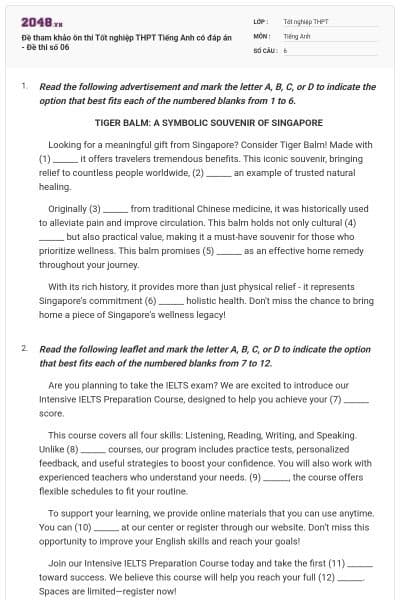
Đề tham khảo ôn thi Tốt nghiệp THPT Tiếng Anh có đáp án - Đề thi số 06
40 câu hỏi
Read the following advertisement and mark the letter A, B, C, or D to indicate the option that best fits each of the numbered blanks from 1 to 6.
TIGER BALM: A SYMBOLIC SOUVENIR OF SINGAPORE
Looking for a meaningful gift from Singapore? Consider Tiger Balm! Made with (1) ______ it offers travelers tremendous benefits. This iconic souvenir, bringing relief to countless people worldwide, (2) ______ an example of trusted natural healing.
Originally (3) ______ from traditional Chinese medicine, it was historically used to alleviate pain and improve circulation. This balm holds not only cultural (4) ______ but also practical value, making it a must-have souvenir for those who prioritize wellness. This balm promises (5) ______ as an effective home remedy throughout your journey.
With its rich history, it provides more than just physical relief - it represents Singapore's commitment (6) ______ holistic health. Don't miss the chance to bring home a piece of Singapore's wellness legacy!
potent herbal ingredients
ingredients herbal potent
herbal potent ingredients
herbal ingredients potent
Kiến thức về trật tự từ
- potent /'pəʊtnt/ (adj): mạnh mẽ, có tác dụng mạnh, hiệu quả
- herbal /'hɜ:bl/ (adj): thuộc về cây cỏ, thuộc về thảo mộc
- ingredients /ɪn'gri:diənt/ (n): thành phần, nguyên liệu
Ta có quy tắc tính từ đứng trước danh từ → danh từ ‘ingredients’ đứng cuối
Theo quy tắc trật tự tính từ: OpSASCOMP (Opinion → Size → Age → Shape → Color → Origin → Material → Purpose)
→ ‘Potent’ (opinion) đứng trước ‘herbal’ (material)
→ trật tự đúng: potent herbal ingredients
Dịch: Hãy thử Dầu cù là Con Hổ! Được làm từ các thành phần thảo dược mạnh mẽ, sản phẩm này mang lại nhiều lợi ích cho du khách.
Chọn A.
This iconic souvenir, bringing relief to countless people worldwide, (2) ______ an example of trusted natural healing.
makes
keeps
sets
puts
Kiến thức về cụm từ cố định
Ta có cụm từ: set an example of something – là dẫn chứng, minh họa cho cái gì
Dịch: Là một món quà nổi tiếng, đã giúp đỡ hàng triệu người trên khắp thế giới, Dầu cù là Con Hổ là biểu tượng của phương pháp chữa bệnh tự nhiên đáng tin cậy.
Chọn C.
develop
developed
developing
develops
Kiến thức về mệnh đề quá khứ phân từ
- Ta có cấu trúc dạng Vp2 ..., S+V: dùng để diễn tả hành động xảy ra liên tiếp, đồng thời hoặc diễn tả lý do cho một hành động chính. Cấu trúc này chỉ được sử dụng khi hai mệnh đề có cùng chủ ngữ.
- Ta rút gọn mệnh đề trạng ngữ trong câu bị động bằng cách lược bỏ chủ ngữ của mệnh đề trạng ngữ và bỏ trợ động từ, chuyển đổi động từ thành dạng quá khứ phân từ. → ‘developed’ là đáp án phù hợp để điền vào chỗ trống.
Dịch: Khởi nguồn từ y học cổ truyền Trung Quốc, Dầu cù là Con Hổ được sử dụng để giảm đau và cải thiện tuần hoàn.
Chọn B.
significant
significantly
significance
signify
Kiến thức về từ loại
A. significant /sɪg'nɪfɪkənt/ (adj): quan trọng, có ảnh hưởng lớn
B. significantly /sɪg'nɪfɪkəntli/ (adv): một cách quan trọng, có tác động rõ rệt
C. significance /sɪg'nɪfɪkəns/ (n): tầm quan trọng, ý nghĩa
D. signify /'sɪgnɪfaɪ/ (v): chỉ ra, báo hiệu, có nghĩa là
Ta có quy tắc tính từ đứng trước danh từ → chỗ trống cần điền là một danh từ sau tính từ ‘cultural’.
Dịch: Không chỉ mang giá trị văn hóa sâu sắc, sản phẩm này còn rất thiết thực, trở thành món quà không thể thiếu cho những ai coi trọng sức khỏe.
Chọn C.
This balm promises (5) ______ as an effective home remedy throughout your journey.
to serve
serving
to serving
serve
Kiến thức về động từ nguyên mẫu
Ta có cụm từ: promise to do something – hứa sẽ làm gì
Dịch: Dầu cù là Con Hổ hứa hẹn sẽ là phương thuốc hiệu quả suốt hành trình của bạn.
Chọn A.
to
at
for
with
Kiến thức về giới từ
Ta có cụm từ: a commitment to something/to do something – cam kết về điều gì/sẽ làm gì
Dịch: Với lịch sử lâu dài, nó không chỉ giúp bạn giảm đau mà còn thể hiện cam kết của Singapore đối với sức khỏe toàn diện.
Chọn A.
Bài hoàn chỉnh:
TIGER BALM: A SYMBOLIC SOUVENIR OF SINGAPORE
Looking for a meaningful gift from Singapore? Consider Tiger Balm! Made with potent herbal ingredients it offers travelers tremendous benefits. This iconic souvenir, bringing relief to countless people worldwide, sets an example of trusted natural healing.
Originally developed from traditional Chinese medicine, it was historically used to alleviate pain and improve circulation. This balm holds not only cultural significance but also practical value, making it a must-have souvenir for those who prioritize wellness. This balm promises to serve as an effective home remedy throughout your journey.
With its rich history, it provides more than just physical relief - it represents Singapore's commitment to holistic health. Don't miss the chance to bring home a piece of Singapore's wellness legacy!
Dịch bài đọc:
DẦU CÙ LÀ CON HỔ: MÓN QUÀ BIỂU TƯỢNG CỦA SINGAPORE
Bạn đang tìm kiếm một món quà ý nghĩa từ Singapore? Hãy thử Dầu cù là Con Hổ! Được làm từ các thành phần thảo dược mạnh mẽ, sản phẩm này mang lại nhiều lợi ích cho du khách. Là một món quà nổi tiếng, đã giúp đỡ hàng triệu người trên khắp thế giới, Dầu cù là Con Hổ là biểu tượng của phương pháp chữa bệnh tự nhiên đáng tin cậy.
Khởi nguồn từ y học cổ truyền Trung Quốc, Dầu cù là Con Hổ được sử dụng để giảm đau và cải thiện tuần hoàn. Không chỉ mang giá trị văn hóa sâu sắc, sản phẩm này còn rất thiết thực, trở thành món quà không thể thiếu cho những ai coi trọng sức khỏe. Dầu cù là Con Hổ hứa hẹn sẽ là phương thuốc hiệu quả suốt hành trình của bạn.
Với lịch sử lâu dài, nó không chỉ giúp bạn giảm đau mà còn thể hiện cam kết của Singapore đối với sức khỏe toàn diện. Đừng bỏ lỡ cơ hội mang về một phần di sản sức khỏe của Singapore!
Read the following leaflet and mark the letter A, B, C, or D to indicate the option that best fits each of the numbered blanks from 7 to 12.
Are you planning to take the IELTS exam? We are excited to introduce our Intensive IELTS Preparation Course, designed to help you achieve your (7) ______ score.
This course covers all four skills: Listening, Reading, Writing, and Speaking. Unlike (8) ______ courses, our program includes practice tests, personalized feedback, and useful strategies to boost your confidence. You will also work with experienced teachers who understand your needs. (9) ______, the course offers flexible schedules to fit your routine.
To support your learning, we provide online materials that you can use anytime. You can (10) ______ at our center or register through our website. Don’t miss this opportunity to improve your English skills and reach your goals!
Join our Intensive IELTS Preparation Course today and take the first (11) ______ toward success. We believe this course will help you reach your full (12) ______. Spaces are limited—register now!
target
aim
objective
ending
Kiến thức về từ vựng – từ cùng trường nghĩa
A. target /ˈtɑːɡɪt/ (n): mục tiêu, kết quả nhắm tới (một kết quả cụ thể mong muốn đạt được)
B. aim /eɪm/ (n): mục tiêu, ý định (tuyên bố chung về điều bạn muốn đạt được, mang tính dài hạn, bao quát và định hướng)
C. objective /əbˈdʒektɪv/ (n): mục tiêu, mục đích (kế hoạch hành động để thực hiện được dự định đề ra)
D. ending /ˈendɪŋ/ (n): sự kết thúc
Ta có: target score – điểm số mục tiêu.
Dịch: Chúng tôi rất vui mừng giới thiệu Khóa Luyện thi IELTS Chuyên sâu, được thiết kế để giúp bạn đạt được điểm số mục tiêu.
Chọn A.
another
other
the other
others
Kiến thức về lượng từ
A. another + N (đếm được số ít): một cái khác/người khác
B. other + N (không đếm được/đếm được số nhiều): những cái khác/người khác
C. the other + N (số ít): cái/người còn lại trong bộ hai cái/người
Hoặc: the other + N (số nhiều) = the others: những cái/người còn lại trong bộ nhiều cái/người
D. others: những cái khác/người khác, được sử dụng như đại từ, theo sau không có bất kì danh từ nào
- Loại D vì sau chỗ trống có danh từ ‘courses’.
- Xét danh từ ‘courses’ là danh từ số nhiều → loại A.
- Dựa vào ngữ cảnh, ta suy ra được ‘courses’ ở đây chỉ đến các khóa học khác nói chung, không phải tất cả các khóa học còn lại trừ ‘Intensive IELTS Preparation Course’. Do đó, ‘other’ là đáp án phù hợp.
Dịch: Khác với các khóa học khác, chương trình của chúng tôi bao gồm các bài kiểm tra thực hành, phản hồi cá nhân hóa và các chiến lược hữu ích để tăng cường sự tự tin của bạn.
Chọn B.
(9) ______, the course offers flexible schedules to fit your routine.
Therefore
For example
However
Moreover
A. Therefore: Vì vậy, do đó
B. For example: Ví dụ
C. However: Tuy nhiên
D. Moreover: Hơn nữa
Câu này muốn nói bổ sung những ưu điểm của khóa học và sự thuận tiện đem đến cho học viên. Do đó, ‘Moreover’ là đáp án phù hợp.
Dịch: Hơn nữa, khóa học cung cấp lịch học linh hoạt để phù hợp với lịch trình của bạn.
Chọn D.
figure out
come up
sign out
sign up
Kiến thức về cụm động từ
A. figure out (phr. v): tìm ra, hiểu ra
B. come up (phr. v): xảy ra, phát sinh, xuất hiện (vấn đề, sự việc bất ngờ)
C. sign out (phr. v): đăng xuất
D. sign up (phr. v): đăng ký, ghi danh
Dựa vào ngữ cảnh, ‘sign up’ là đáp án phù hợp.
Dịch: Bạn có thể đăng ký tại trung tâm của chúng tôi hoặc đăng ký qua trang web của chúng tôi.
Chọn D.
behavior
step
thought
move
Kiến thức về từ vựng – nghĩa của từ
A. behavior /bɪˈheɪvjə(r)/ (n): hành vi, thái độ
B. step /step/ (n): bước đi, bước chân
C. thought /θɔːt/ (n): suy nghĩ, tư tưởng
D. move /muːv/ (n): lượt, sự di chuyển, nước (cờ)
Ta có: take the first step – bắt đầu bước đầu tiên
Dịch: Tham gia Khóa Luyện thi IELTS Chuyên sâu của chúng tôi ngay hôm nay và bước những bước đầu tiên hướng tới thành công.
Chọn B.
potential
success
limit
possibility
Kiến thức về từ vựng – nghĩa của từ
A. potential /pəˈtenʃl/ (n): tiềm năng
B. success /səkˈses/ (n): thành công
C. limit /ˈlɪmɪt/ (n): giới hạn, ranh giới
D. possibility /ˌpɒsəˈbɪləti/ (n): khả năng, sự có thể, một điều gì đó có thể xảy ra hoặc trở thành sự thật
Ta có: reach one's full potential – đạt được tiềm năng tối đa
Dịch: Chúng tôi tin rằng khóa học này sẽ giúp bạn phát huy hết tiềm năng của mình.
Chọn A.
Bài hoàn chỉnh:
Are you planning to take the IELTS exam? We are excited to introduce our Intensive IELTS Preparation Course, designed to help you achieve your target score.
This course covers all four skills: Listening, Reading, Writing, and Speaking. Unlike other courses, our program includes practice tests, personalized feedback, and useful strategies to boost your confidence. You will also work with experienced teachers who understand your needs. Moreover, the course offers flexible schedules to fit your routine.
To support your learning, we provide online materials that you can use anytime. You can sign up at our center or register through our website. Don’t miss this opportunity to improve your English skills and reach your goals!
Join our Intensive IELTS Preparation Course today and take the first step toward success. We believe this course will help you reach your full potential. Spaces are limited—register now!
Dịch bài đọc:
Bạn đang có kế hoạch thi IELTS? Chúng tôi rất vui mừng giới thiệu Khóa Luyện thi IELTS Chuyên sâu, được thiết kế để giúp bạn đạt được điểm số mục tiêu.
Khóa học này bao gồm cả bốn kỹ năng: Nghe, Đọc, Viết và Nói. Khác với các khóa học khác, chương trình của chúng tôi bao gồm các bài kiểm tra thực hành, phản hồi cá nhân hóa và các chiến lược hữu ích để tăng cường sự tự tin của bạn. Bạn cũng sẽ được học với các giáo viên giàu kinh nghiệm, những người hiểu rõ nhu cầu của bạn. Hơn nữa, khóa học cung cấp lịch học linh hoạt để phù hợp với lịch trình của bạn.
Để hỗ trợ việc học của bạn, chúng tôi cung cấp tài liệu trực tuyến mà bạn có thể sử dụng bất cứ lúc nào. Bạn có thể đăng ký tại trung tâm của chúng tôi hoặc đăng ký qua trang web của chúng tôi. Đừng bỏ lỡ cơ hội này để cải thiện kỹ năng tiếng Anh và đạt được mục tiêu của bạn!
Tham gia Khóa Luyện thi IELTS Chuyên sâu của chúng tôi ngay hôm nay và bước những bước đầu tiên hướng tới thành công. Chúng tôi tin rằng khóa học này sẽ giúp bạn phát huy hết tiềm năng của mình. Số lượng chỗ có hạn—đăng ký ngay!
Mark the letter A, B, C, or D to indicate the best arrangement of utterances or sentences to make a meaningful exchange or text in each of the following questions from 13 to 17.
a. Robert: Hi, Ingrid. He canceledat the last minute.
b. Ingrid: Hi, Robert. Where'sPablo? I thought he was hanging out with us tonight.
c. Ingrid: Again? You put up witha lot from him.
(Adapted from Speak Now)
a-b-c
c-a-b
a-c-b
b-a-c
Kiến thức sắp xếp câu thành đoạn hội thoại
Thứ tự sắp xếp đúng:
b. Ingrid: Hi, Robert. Where's Pablo? I thought he was hanging out with us tonight.
a. Robert: Hi, Ingrid. He canceled at the last minute.
c. Ingrid: Again? You put up with a lot from him.
Dịch:
b. Ingrid: Chào Robert. Pablo đâu rồi? Tớ tưởng tối nay cậu ấy sẽ đi chơi với chúng ta chứ.
a. Robert: Chào Ingrid. Cậu ấy hủy vào phút chót rồi.
c. Ingrid: Lại nữa à? Cậu chịu đựng cậu ta nhiều lắm rồi đấy.
Chọn D.
a. Sophie: That’s wonderful! What will your role be there?
b. David: Yes, I did some work with rescue organisations in the past.
c. Sophie: Have you volunteered before?
d. David: I’ll be helping to care for the animals and assist with adoptions.
e. David: I’ll be volunteering at the animal shelter this summer.
d-a-b-c-e
d-c-e-a-b
e-a-d-c-b
e-c-b-a-d
Kiến thức sắp xếp câu thành đoạn hội thoại
Thứ tự sắp xếp đúng:
e. David: I’ll be volunteering at the animal shelter this summer.
a. Sophie: That’s wonderful! What will your role be there?
d. David: I’ll be helping to care for the animals and assist with adoptions.
c. Sophie: Have you volunteered before?
b. David: Yes, I did some work with rescue organisations in the past.
Dịch:
e. David: Mùa hè này tớ sẽ tham gia tình nguyện tại trại cứu hộ động vật.
a. Sophie: Tuyệt vời! Vai trò của cậu ở đó là gì?
d. David: Tớ sẽ giúp chăm sóc các động vật và hỗ trợ việc nhận nuôi.
c. Sophie: Cậu đã từng hoạt động tình nguyện trước đây chưa?
b. David: Có, tớ đã từng làm việc với các tổ chức cứu hộ trước đây.
Chọn C.
Hi Emma,
a. You were right about that documentary; it really opened my eyes to new perspectives.
b. I’ve been thinking a lot about what we discussed last time, especially about climate change.
c. I’ve already started researching more about the topic and how I can contribute.
d. Thanks again for recommending that documentary, I really appreciate it.
e. Let’s catch up soon to talk more about our ideas for community action.
Speak soon,
Olivia
b-a-c-d-e
d-a-b-e-c
b-d-a-c-e
a-b-d-c-e
Kiến thức sắp xếp câu thành một lá thư
Thứ tự sắp xếp đúng:
Hi Emma,
b. I’ve been thinking a lot about what we discussed last time, especially about climate change.
d. Thanks again for recommending that documentary, I really appreciate it.
a. You were right about that documentary; it really opened my eyes to new perspectives.
c. I’ve already started researching more about the topic and how I can contribute.
e. Let’s catch up soon to talk more about our ideas for community action.
Speak soon,
Olivia
Dịch:
Chào Emma,
b. Tớ đã suy nghĩ rất nhiều về những gì chúng mình thảo luận lần trước, đặc biệt là về biến đổi khí hậu.
d. Cảm ơn cậu một lần nữa vì đã giới thiệu bộ phim tài liệu đó, tớ thực sự rất trân trọng điều đó.
a. Cậu đã nói đúng về bộ phim tài liệu đó; nó thực sự đã mở ra cho tớ những góc nhìn mới.
c. Tớ đã bắt đầu nghiên cứu thêm về chủ đề này và cách tớ có thể đóng góp.
e. Chúng ta hãy gặp nhau sớm để nói thêm về những ý tưởng hành động cộng đồng nhé.
Hẹn sớm gặp lại cậu,
Olivia
Chọn C.
a. I've seen other neighborhoods thrive with similar projects, fostering both friendships and fresh produce.
b. Additionally, we can host workshops on gardening techniques and healthy eating.
c. Overall, I believe this initiative would bring our community closer together while promoting sustainability.
d. We could gather a group of volunteers to help with the planting and maintenance.
e. The idea of creating a community garden is exciting and could really enhance our neighborhood.
d-a-e-b-c
b-e-d-a-c
e-a-d-b-c
a-e-b-d-c
Kiến thức sắp xếp câu thành đoạn văn
Thứ tự sắp xếp đúng:
e. The idea of creating a community garden is exciting and could really enhance our neighborhood.
a. I've seen other neighborhoods thrive with similar projects, fostering both friendships and fresh produce.
d. We could gather a group of volunteers to help with the planting and maintenance.
b. Additionally, we can host workshops on gardening techniques and healthy eating.
c. Overall, I believe this initiative would bring our community closer together while promoting sustainability.
Dịch:
e. Ý tưởng tạo ra một khu vườn cộng đồng thật thú vị và có thể thực sự làm phong phú thêm khu phố của chúng ta.
a. Tôi đã thấy các khu phố khác phát triển với các dự án tương tự, thúc đẩy cả tình bạn và đem đến nguồn nông sản tươi ngon.
d. Chúng ta có thể tập hợp một nhóm tình nguyện viên giúp đỡ việc trồng trọt và chăm sóc.
b. Ngoài ra, chúng ta có thể tổ chức các buổi hội thảo về kỹ thuật làm vườn và ăn uống lành mạnh.
c. Nhìn chung, tôi tin rằng sáng kiến này sẽ gắn kết cộng đồng của chúng ta hơn, đồng thời thúc đẩy tính bền vững.
Chọn C.
a. These individuals often build large followings by sharing content that resonates with specific audiences.
b. The influence they wield can shape trends, drive consumer behavior, and even impact public opinion.
c. However, the pressure to maintain an online persona can be intense, as these influencers constantly seek to stay relevant and engaging.
d. Social media influencers have become a powerful force in today’s digital landscape.
e. Through platforms like Instagram and TikTok, influencers showcase products, lifestyles, and ideas to their followers.
d-b-c-a-e
d-e-b-c-a
d-a-b-e-c
d-c-e-a-b
Kiến thức sắp xếp câu thành đoạn văn
Thứ tự sắp xếp đúng:
d. Social media influencers have become a powerful force in today’s digital landscape.
a. These individuals often build large followings by sharing content that resonates with specific audiences.
b. The influence they wield can shape trends, drive consumer behavior, and even impact public opinion.
e. Through platforms like Instagram and TikTok, influencers showcase products, lifestyles, and ideas to their followers.
c. However, the pressure to maintain an online persona can be intense, as these influencers constantly seek to stay relevant and engaging.
Dịch:
d. Những người có sức ảnh hưởng trên mạng xã hội đã trở thành một thế lực mạnh mẽ trong bối cảnh kỹ thuật số hiện nay.
a. Những cá nhân này thường xây dựng lượng người theo dõi lớn bằng cách chia sẻ nội dung gây được tiếng vang với tệp khán giả cụ thể.
b. Sức ảnh hưởng mà họ nắm giữ có thể định hình xu hướng, thúc đẩy hành vi người tiêu dùng và thậm chí tác động đến dư luận.
e. Thông qua các nền tảng như Instagram và TikTok, những người có sức ảnh hưởng giới thiệu sản phẩm, lối sống và ý tưởng cho người theo dõi của họ.
c. Tuy nhiên, áp lực duy trì hình ảnh trực tuyến có thể rất lớn, vì những người có sức ảnh hưởng này liên tục tìm cách để được quan tâm và thu hút.
Chọn C.
Read the following passage and mark the letter A, B, C, or D to indicate the option that best fits each of the numbered blanks from 18 to 22.
WHAT HAPPENS WHEN YOU DRINK APPLE CIDER VINEGAR EVERY DAY?
Apple-cider vinegar, often referred to as ACV, (18) ______. It can be used as an acidic addition to salad dressings, sauces and so much more. And in the wellness world, some people tout apple cider vinegar as a natural Jack-of-all-trades remedy, (19) ______. Since being brought to market in the early 1900s by Dr. Paul C. Bragg, this vinegar's popularity in the wellness space has exploded in recent years.
This type of vinegar is made from the fermentation of apples. (20) ______. This transforms the sugars in the apple juice into alcohol, and then to vinegar. When consuming ACV, you take in a variety of flavonoid compounds, which may contribute to certain positive health outcomes.
Published in BMC Complementary Medicine and Therapies research, (21) ______. While results showed no impact of ACV on fasting insulin, the authors concluded that ACV is a safe natural supplement that may help control blood sugar. In addition to its potential role in blood sugar regulation, apple cider vinegar is often touted for its beneficial effects on digestive health. The "mother" in apple cider vinegar is a source of probiotics, which are beneficial bacteria that contribute to a healthy gut microbiome. (22) ______. The claim is based on the presence of acetic acid, which can suppress appetite. However, it is unlikely that adding this vinegar alone to the diet without other healthy lifestyle changes will make a major impact on one's weight.
(Adapted from Eating Well)
that serves as a key ingredient in kitchens thanks to its versatile uses
is a staple in many kitchens for its culinary properties
having widely used in cooking techniques for its diverse gastronomic attributes
in which this culinary stalwart is utilized in countless dishes
Kiến thức về cấu trúc câu
- Ta nhận thấy câu đã có chủ ngữ ‘Apple-cider vinegar’ và một mệnh đề quan hệ rút gọn để bổ nghĩa cho chủ ngữ, nhưng chưa có động từ chính.
→ Câu cần một động từ chính chia theo chủ ngữ ‘Apple-cider vinegar’ để tạo thành câu hoàn chỉnh.
- A, D sai vì đây là các mệnh đề quan hệ, không thể đóng vai trò làm động từ chính của câu.
- B đúng vì ‘is’ là động từ chia ở thì hiện tại đơn, phù hợp về mặt nghĩa và ngữ pháp.
- C sai vì ‘having used’ là dạng phân từ hoàn thành, không thể đóng vai trò làm động từ chính của câu.
Dịch: Giấm táo, thường được gọi là ACV, là một nguyên liệu thiết yếu trong nhiều gian bếp nhờ các đặc tính ẩm thực của nó.
Chọn B.
to which people often attribute their healing to a wide range of health concerns
provides relief from a variety of health issues, including digestive disorders and obesity
which can be a solution for many ailments, including digestive concerns, obesity, and more
offers a multi-functional treatment for diverse health issues, such as digestive and overweight issues
Kiến thức về mệnh đề quan hệ
- Căn cứ vào câu đã có một động từ chính được chia theo thì hiện tại đơn (tout), vì vậy chỗ trống ta cần một mệnh đề quan hệ hoặc động từ chia theo dạng rút gọn mệnh đề quan hệ. → loại B và D
- Ta thấy trong câu không có động từ hay danh từ nào đi với giới từ ‘to’ để dùng ‘to which’ → loại A
→ A đúng vì là một mệnh đề quan hệ hoàn chỉnh, có đại từ quan hệ ‘which’ phù hợp bổ nghĩa cho ‘apple cider vinegar’ ở đằng trước.
Dịch: Và trong cộng đồng chăm sóc sức khỏe, một số người ca ngợi giấm táo như một phương thuốc tự nhiên đa năng, có thể là một giải pháp cho nhiều căn bệnh, bao gồm các vấn đề tiêu hóa, béo phì và nhiều vấn đề khác.
Chọn C.
Once the apples are juiced, the liquid is fermented with bacterial and yeast cultures
After juiced from fresh apples, natural bacteria and yeasts are added to the fermentation process
Without the presence of bacterial and yeast cultures, the juiced apple liquid can still undergo fermentation
The fermentation begins with the apple juice, fostering the growth of bacterial and yeast cultures
Kiến thức về mệnh đề độc lập - nghĩa của câu
A. Sau khi táo được ép thành nước, chất lỏng này được lên men với vi khuẩn và nấm men
→ A đúng vì phù hợp về mặt ngữ nghĩa, miêu tả quá trình nước ép táo chuyển hóa thành giấm táo.
B. Sau khi ép từ những quả táo tươi, vi khuẩn tự nhiên và nấm men được thêm vào quá trình lên men.
→ B sai vì ‘natural bacteria and yeasts’ không phải là chủ ngữ của ‘After juiced from fresh apples’.
C. Ngay cả khi không có sự hiện diện của vi khuẩn và nấm men, nước ép táo vẫn có thể trải qua quá trình lên men
→ C sai vì quá trình lên men không thể diễn ra nếu không có vi khuẩn và nấm men.
D. Quá trình lên men bắt đầu từ nước ép táo, thúc đẩy sự phát triển của vi khuẩn và nấm men
→ D sai vì thiếu miêu tả về quá trình ép táo thành nước để kết nối với câu trước đó.
Dịch: Sau khi táo được ép thành nước, chất lỏng này được lên men với vi khuẩn và nấm men.
Chọn A.
a systematic review and meta-analysis evaluated nine studies to determine whether ACV may affect blood sugar management
researchers conducted a comprehensive review and meta-analysis of nine studies to assess the effect of ACV on glycemic levels
the relationship between ACV consumption and blood sugar management is investigated in an in-depth evaluation of nine studies
ACV was evaluated through a comprehensive analysis of nine studies to determine its potential to regulate blood sugar
Kiến thức về mệnh đề quá khứ phân từ
* Xét nghĩa các đáp án:
A. một đánh giá hệ thống và phân tích tổng hợp đã xem xét chín nghiên cứu để xác định liệu giấm táo (ACV) có thể ảnh hưởng đến việc kiểm soát lượng đường trong máu hay không
B. các nhà nghiên cứu đã tiến hành một cuộc khảo sát toàn diện và phân tích tổng hợp chín nghiên cứu để đánh giá tác động của giấm táo đối với mức đường huyết
C. mối quan hệ giữa việc tiêu thụ giấm táo và việc kiểm soát lượng đường trong máu được điều tra trong một đánh giá sâu rộng về chín nghiên cứu
D. giấm táo đã được đánh giá thông qua một phân tích toàn diện chín nghiên cứu để xác định khả năng điều hòa lượng đường trong máu của nó
Căn cứ vào mệnh đề ‘Published in BMC Complementary Medicine and Therapies research’ ta suy ra câu này dùng cấu trúc V-ed....., S + V mà điều kiện để dùng dạng này là hai mệnh đề phải đồng chủ ngữ.
- Xét về nghĩa, ‘researchers’, ‘the relationship between ACV consumption and blood sugar management’, ‘ACV’ không thể là chủ ngữ của vế ‘Published in BMC Complementary Medicine and Therapies research’. Do đó, ta loại B, C, D.
Dịch: Được công bố trong nghiên cứu của Tạp chí Y học Bổ sung và Điều trị BMC, một đánh giá hệ thống và phân tích tổng hợp đã xem xét chín nghiên cứu để xác định liệu giấm táo (ACV) có thể ảnh hưởng đến việc kiểm soát lượng đường trong máu hay không.
Chọn A.
Weight loss enthusiasts create apple cider vinegar as a potential aid
Consuming a great amount of apple cider vinegar can lead to increased weight
Apple cider vinegar is often cited as a natural tool for weight loss
Widely recommending as a natural remedy, apple cider vinegar is suggested to help slim down
Kiến thức về mệnh đề độc lập - nghĩa của câu
* Xét nghĩa các đáp án:
A. Những người đam mê giảm cân xem giấm táo như một sự hỗ trợ tiềm năng
→ A sai vì thiếu sự liên kết với câu sau, bởi câu sau có đề cập đến ‘the claim’, vì vậy câu trước đó cần phải là một nhận định.
B. Tiêu thụ một lượng lớn giấm táo có thể dẫn đến tăng cân
→ B sai vì nghĩa trái ngược với câu phía sau, đề cập đến việc giấm táo giúp ức chế cảm giác thèm ăn.
C. Giấm táo thường được nhắc đến như một công cụ tự nhiên để giảm cân
→ C đúng vì phù hợp về mặt ngữ nghĩa.
D. Giấm táo, được khuyến nghị rộng rãi như một phương thuốc tự nhiên, được đề xuất giúp giảm cân
→ D sai vì ‘recommend’ cần chia ở dạng bị động.
Dịch: Giấm táo thường được nhắc đến như một công cụ tự nhiên để giảm cân.
Chọn C.
Bài hoàn chỉnh:
WHAT HAPPENS WHEN YOU DRINK APPLE CIDER VINEGAR EVERY DAY?
Apple-cider vinegar, often referred to as ACV, is a staple in many kitchens for its culinary properties. It can be used as an acidic addition to salad dressings, sauces and so much more. And in the wellness world, some people tout apple cider vinegar as a natural Jack-of-all-trades remedy, which can be a solution for many ailments, including digestive concerns, obesity, and more. Since being brought to market in the early 1900s by Dr. Paul C. Bragg, this vinegar's popularity in the wellness space has exploded in recent years.
This type of vinegar is made from the fermentation of apples. Once the apples are juiced, the liquid is fermented with bacterial and yeast cultures. This transforms the sugars in the apple juice into alcohol, and then to vinegar. When consuming ACV, you take in a variety of flavonoid compounds, which may contribute to certain positive health outcomes.
Published in BMC Complementary Medicine and Therapies research, a systematic review and meta-analysis evaluated nine studies to determine whether ACV may affect blood sugar management. While results showed no impact of ACV on fasting insulin, the authors concluded that ACV is a safe natural supplement that may help control blood sugar. In addition to its potential role in blood sugar regulation, apple cider vinegar is often touted for its beneficial effects on digestive health. The "mother" in apple cider vinegar is a source of probiotics, which are beneficial bacteria that contribute to a healthy gut microbiome. Apple cider vinegar is often cited as a natural tool for weight loss. The claim is based on the presence of acetic acid, which can suppress appetite. However, it is unlikely that adding this vinegar alone to the diet without other healthy lifestyle changes will make a major impact on one's weight.
Dịch bài đọc:
GIẤM TÁO CÓ TÁC DỤNG GÌ KHI BẠN UỐNG MỖI NGÀY?
Giấm táo, thường được gọi là ACV, là một nguyên liệu thiết yếu trong nhiều gian bếp nhờ các đặc tính ẩm thực của nó. Nó có thể được sử dụng như một thành phần có tính axit trong các món gia vị cho salad, nước sốt và nhiều món khác. Và trong cộng đồng chăm sóc sức khỏe, một số người ca ngợi giấm táo như một phương thuốc tự nhiên đa năng, có thể là một giải pháp cho nhiều căn bệnh, bao gồm các vấn đề tiêu hóa, béo phì và nhiều vấn đề khác. Kể từ khi được đưa ra thị trường vào đầu những năm 1900 bởi Tiến sĩ Paul C . Bragg, sự phổ biến của giấm táo trong lĩnh vực chăm sóc sức khỏe đã tăng vọt trong những năm gần đây.
Loại giấm này được làm từ quá trình lên men táo. Sau khi táo được ép thành nước, chất lỏng này được lên men với vi khuẩn và nấm men. Điều này biến đường trong nước ép táo thành rượu, và sau đó thành giấm. Khi dùng giấm táo, bạn sẽ nạp vào một loạt các hợp chất flavonoid, có thể đem đến những lợi ích nhất định cho sức khỏe.
Được công bố trong nghiên cứu của Tạp chí Y học Bổ sung và Điều trị BMC, một đánh giá hệ thống và phân tích tổng hợp đã xem xét chín nghiên cứu để xác định liệu giấm táo (ACV) có thể ảnh hưởng đến việc kiểm soát lượng đường trong máu hay không. Mặc dù kết quả cho thấy không có tác động của giấm táo đối với insulin khi nhịn ăn, các tác giả kết luận rằng giấm táo là một thực phẩm bổ sung tự nhiên an toàn có thể giúp kiểm soát lượng đường trong máu. Ngoài vai trò tiềm năng trong việc điều hòa lượng đường trong máu, giấm táo còn được ca ngợi vì những tác dụng với sức khỏe tiêu hóa. "Mẹ" trong giấm táo là nguồn cung cấp probiotics, những vi khuẩn có lợi giúp duy trì hệ vi sinh đường ruột khỏe mạnh. Giấm táo thường được nhắc đến như một công cụ tự nhiên để giảm cân. Nhận định này dựa trên sự có mặt của axit axetic, có thể ức chế cảm giác thèm ăn. Tuy nhiên, việc chỉ thêm giấm táo vào chế độ ăn mà không có những thay đổi lối sống lành mạnh khác có thể sẽ không tạo ra ảnh hưởng lớn đến cân nặng của một người.
Read the following passage and mark the letter A, B, C, or D on your answer sheet to indicate the best answer to each of the following questions from 23 to 30.
In the nineteenth century, railways were built from the big industrial cities like Leeds and Manchester to seaside towns like Blackpool and Scarborough. For the first time, ordinary working people could visit the seaside. They used to take day trips on Sundays and special days like Bank holidays. Traditionally, people sat in deckchairs on the beach, swam in the sea, and ate fish and chips. Children could watch Punch and Judy shows, build sandcastles and ride donkeys on the beach.
In the 1950s, the first package holiday was introduced. Throughout the 60s and 70s, the British increasingly began to abandon the traditional seaside holiday in favour of sunshine and warmer seas in countries like Spain and Greece. Caravan and camping holidays also became popular in the 60s and 70s as car ownership increased.
In the 1990s, budget airlines like EasyJet slashed the cost of air tickets to many European destinations. Long-haul flights also came down in price, so holidays to exotic destinations in Australia and Asia became affordable to ordinary families. A growing number of people wanted to book their own flights and accommodation, and as a result, the package holiday market declined.
The holiday habits of the British continued to change into the new millennium. The internet changed the way people booked holidays and enabled them to find the best deals online. The growth of the budget airlines meant that families were able to afford a second holiday, often a short break in a European city. Concerns about climate change have grown in recent years but recent surveys suggest that people are aware that flying causes serious damage to the environment. More people are choosing not to fly nowadays, and many airlines are struggling to survive in the new economic climate.
Which of the following best paraphrases the underlined sentence in paragraph 1?
Ordinary working people were allowed to visit the seaside for the first time.
Ordinary working people had been to the seaside before.
The seaside was accessible to ordinary working people for the very first time.
Ordinary working people were restricted from visiting the seaside until now.
Kiến thức về paraphrasing
Câu nào sau đây diễn giải lại đúng nhất câu được gạch chân trong đoạn 1?
A. Những người lao động thông thường lần đầu tiên được phép đến bờ biển.
B. Những người lao động thông thường đã từng đến bờ biển trước đây.
C. Bờ biển lần đầu tiên trở nên dễ tiếp cận đối với những người lao động bình thường.
D. Những người lao động bình thường bị hạn chế đến bờ biển cho đến bây giờ.
Câu gạch chân: For the first time, ordinary working people could visit the seaside. (Lần đầu tiên, người lao động thông thường có thể đến thăm bờ biển.)
Chọn C.
The word ‘they’ in paragraph 1 refers to ______.
seaside towns
ordinary working people
day trips
package holidays
Kiến thức về từ quy chiếu
Từ ‘they’ trong đoạn 1 chỉ ______.
A. seaside towns (phr): thị trấn ven biển
B. ordinary working people (phr): người lao động thông thường
C. day trips (n): các chuyến đi chơi trong ngày
D. package holidays (n): kỳ nghỉ trọn gói
Thông tin: For the first time, ordinary working people could visit the seaside. They used to take day trips on Sundays and special days like Bank holidays. (Lần đầu tiên, người lao động thông thường có thể đến thăm bờ biển. Họ thường đi chơi trong ngày vào Chủ nhật và những ngày lễ đặc biệt như ngày nghỉ ngân hàng.)
→ Từ ‘they’ nhắc tới ‘ordinary working people’ ở phía trước.
Chọn B.
Traditional seaside holidays were expensive to take.
Hotels in Spain or Greece were built.
Children were more interested in Punch and Judy shows.
A lot of British people bought cars between 1960 and 1979.
Kiến thức về thông tin chi tiết
Theo đoạn 2, điều gì đã khiến kỳ nghỉ cắm trại trở nên phổ biến đối với người Anh?
A. Những kỳ nghỉ truyền thống ở bờ biển rất tốn kém.
B. Các khách sạn ở Tây Ban Nha hoặc Hy Lạp được xây dựng.
C. Trẻ em quan tâm nhiều hơn đến các buổi biểu diễn múa rối Punch and Judy.
D. Rất nhiều người Anh đã mua ô tô trong khoảng thời gian từ năm 1960 đến năm 1979.
Thông tin: Caravan and camping holidays also became popular in the 60s and 70s as car ownership increased. (Kỳ nghỉ bằng xe caravan và cắm trại cũng trở nên phổ biến vào những năm 60 và 70 khi số lượng người sở hữu ô tô tăng lên.)
Chọn D.
The word ‘slashed’ in paragraph 3 is OPPOSITE in meaning to ______.
destroyed
increased
betrayed
declined
Kiến thức về từ vựng trái nghĩa
Cụm từ ‘slashed’ trong đoạn 3 TRÁI NGHĨA với ______.
A. destroyed /dɪˈstrɔɪd/ (v-ed): phá hủy
B. increased /ɪnˈkriːst/ (v-ed): tăng lên
C. betrayed /bɪˈtreɪd/ (v-ed): phản bội
D. declined /dɪˈklaɪnd/ (v-ed): giảm đi
→ slashed /slæʃt/ (v-ed): giảm giá, cắt bớt >< increased /ɪnˈkriːst/ (v-ed): tăng lên
Thông tin: In the 1990s, budget airlines like EasyJet slashed the cost of air tickets to many European destinations. (Vào những năm 1990, các hãng hàng không giá rẻ như EasyJet đã giảm giá vé máy bay đến nhiều điểm đến ở châu Âu.)
Chọn B.
The word ‘damage’ in paragraph 4 could be best replaced by ______.
construction
advantage
improvement
impairment
Kiến thức về từ vựng gần nghĩa
Từ ‘damage’ ở đoạn 4 có thể được thay thế bằng từ ______.
A. construction /kənˈstrʌkʃn/ (n): sự xây dựng
B. advantage /ədˈvɑːntɪdʒ/ (n): sự thuận lợi, lợi thế
C. improvement /ɪmˈpruːvmənt/ (n): sự tiến bộ, sự cải thiện
D. impairment /ɪmˈpeəmənt/ (n): sự làm suy yếu, sự làm hư hại
→ damage /ˈdæmɪdʒ/ (n): sự thiệt hại, mối hại = impairment /ɪmˈpeəmənt/ (n): sự làm suy yếu, sự làm hư hại
Thông tin: Concerns about climate change have grown in recent years but recent surveys suggest that people are aware that flying causes serious damage to the environment. (Mối lo ngại về biến đổi khí hậu đã gia tăng trong những năm gần đây, nhưng các cuộc khảo sát gần đây cho thấy mọi người nhận thức được rằng việc đi máy bay gây ra thiệt hại nghiêm trọng cho môi trường.)
Chọn D.
Which of the following is true, according to the passage?
Fewer people are flying because of the impact on the environment.
Traditionally, water sports were the most popular holiday activity.
The package holiday is still popular among a few British families.
Some people have lost a lot of money when booking flight tickets online.
Kiến thức về thông tin đúng/sai
Điều nào sau đây là ĐÚNG theo như bài đọc?
A. Số người đi máy bay giảm do tác động đến môi trường.
B. Theo truyền thống, các môn thể thao dưới nước là hoạt động nghỉ dưỡng phổ biến nhất.
C. Các gói du lịch trọn gói vẫn còn phổ biến đối với một số gia đình người Anh.
D. Một số người đã mất rất nhiều tiền khi đặt vé máy bay trực tuyến.
Thông tin:
- More people are choosing not to fly nowadays, and many airlines are struggling to survive in the new economic climate. (Ngày càng có nhiều người chọn không đi máy bay và nhiều hãng hàng không đang phải vật lộn đế tồn tại trong bối cảnh kinh tế mới) → A đúng.
- B, C, D không có thông tin trong bài.
Chọn A.
Paragraph 1
Paragraph 2
Paragraph 3
Paragraph 4
Kiến thức về thông tin theo đoạn
Trong đoạn nào, tác giả giải thích tác động của các hãng hàng không giá rẻ đến lựa chọn kỳ nghỉ?
A. Đoạn 1 B. Đoạn 2 C. Đoạn 3 D. Đoạn 4
Thông tin: In the 1990s, budget airlines like EasyJet slashed the cost of air tickets to many European destinations. Long-haul flights also came down in price, so holidays to exotic destinations in Australia and Asia became affordable to ordinary families. (Vào những năm 1990, các hãng hàng không giá rẻ như EasyJet đã giảm giá vé máy bay đến nhiều điểm đến ở châu Âu. Các chuyến bay đường dài cũng giảm giá, vì vậy các kỳ nghỉ đến những điểm đến kỳ lạ ở Úc và châu Á trở nên phải chăng đối với các gia đình thông thường.)
Chọn C.
Paragraph 1
Paragraph 2
Paragraph 3
Paragraph 4
Kiến thức về thông tin theo đoạn
Trong đoạn nào, tác giả đề cập đến mối quan hệ nguyên nhân - kết quả ở hiện tại?
A. Đoạn 1 B. Đoạn 2 C. Đoạn 3 D. Đoạn 4
Thông tin: Concerns about climate change have grown in recent years but recent surveys suggest that people are aware that flying causes serious damage to the environment. More people are choosing not to fly nowadays, and many airlines are struggling to survive in the new economic climate. (Mối lo ngại về biến đổi khí hậu đã gia tăng trong những năm gần đây, nhưng các cuộc khảo sát gần đây cho thấy mọi người nhận thức được rằng việc đi máy bay gây ra thiệt hại nghiêm trọng cho môi trường. Ngày nay, nhiều người lựa chọn không đi máy bay hơn, và nhiều hãng hàng không đang phải vật lộn để tồn tại trong bối cảnh kinh tế mới.)
Chọn D.
Dịch bài đọc:
Vào thế kỷ 19, đường sắt được xây dựng từ các thành phố công nghiệp lớn như Leeds và Manchester đến các thị trấn ven biển như Blackpool và Scarborough. Lần đầu tiên, người lao động thông thường có thể đến thăm bờ biển. Họ thường đi chơi trong ngày vào Chủ nhật và những ngày lễ đặc biệt như ngày nghỉ ngân hàng. Theo truyền thống, mọi người ngồi trên ghế xếp trên bãi biển, bơi lội và ăn cá và khoai tây chiên. Trẻ em có thể xem các buổi biểu diễn múa rối Punch và Judy, xây lâu đài cát và cưỡi lừa trên bãi biển.
Vào những năm 1950, kỳ nghỉ trọn gói đầu tiên xuất hiện. Trong suốt những năm 60 và 70, người Anh dần từ bỏ kỳ nghỉ truyền thống bên bờ biển để chuyển sang những nơi có nắng ấm hơn ở các quốc gia như Tây Ban Nha và Hy Lạp. Kỳ nghỉ bằng xe caravan và cắm trại cũng trở nên phổ biến vào những năm 60 và 70 khi số lượng người sở hữu ô tô tăng lên.
Vào những năm 1990, các hãng hàng không giá rẻ như EasyJet đã giảm giá vé máy bay đến nhiều điểm đến ở châu Âu. Các chuyến bay đường dài cũng giảm giá, vì vậy các kỳ nghỉ đến những điểm đến kỳ lạ ở Úc và châu Á trở nên phải chăng đối với các gia đình thông thường. Ngày càng nhiều người muốn tự đặt vé máy bay và chỗ ở, và kết quả là thị trường du lịch trọn gói suy giảm.
Thói quen du lịch của người Anh tiếp tục thay đổi trong thiên niên kỷ mới. Internet đã thay đổi cách mọi người đặt kỳ nghỉ và cho phép họ tìm được những ưu đãi tốt nhất trực tuyến. Sự phát triển của các hãng hàng không giá rẻ đồng nghĩa với việc các gia đình có thể đủ khả năng chi trả cho một kỳ nghỉ thứ hai, thường là một kỳ nghỉ ngắn ngày ở một thành phố châu Âu. Mối lo ngại về biến đổi khí hậu đã gia tăng trong những năm gần đây, nhưng các cuộc khảo sát gần đây cho thấy mọi người nhận thức được rằng việc đi máy bay gây ra thiệt hại nghiêm trọng cho môi trường. Ngày nay, nhiều người lựa chọn không đi máy bay hơn, và nhiều hãng hàng không đang phải vật lộn để tồn tại trong bối cảnh kinh tế mới.
Read the following passage and mark the letter A, B, C, or D to indicate the best answer to each of the following questions from 31 to 40.
Vietnam is facing significant challenges in waste management, particularly due to the high volume of waste generated daily. [I] With around 60,000 tons of household waste produced each day, cities like Hanoi and Ho Chi Minh City contribute a large portion of this total. [II] Currently, most of the waste is sent to landfills, but only some of these sites meet national sanitary standards. [III] Landfilling, while a common solution, is costly and environmentally harmful if not properly managed. [IV]
One of the primary challenges in waste management is the complex permitting process for waste disposal projects. Investors face difficulties in navigating the required regulations and obtaining permits, particularly for hazardous waste management. There are also issues with overlapping legal documents, which complicates their decision-making. Another challenge is the lack of a comprehensive waste collection and sorting system. Without proper waste classification, recycling efforts are hindered, and valuable materials cannot be reused effectively.
Vietnam's waste management infrastructure is still developing, especially in rural areas. Limited access to proper treatment facilities and waste recycling infrastructure presents difficulties for investors. Additionally, the adoption of foreign waste treatment technologies has proven challenging, as these systems are often not well-suited to the specific needs of Vietnamese waste. To improve waste management, collaboration between the government, experts, and stakeholders needs to be strengthened to identify and implement suitable technologies.
Despite these challenges, there are significant opportunities for waste management in Vietnam. With rapid urbanization and industrialization, the demand for waste disposal solutions is growing. The market is projected to reach US$7.54 billion by 2028. Government initiatives, including the National Strategy on Integrated Solid Waste Management and Circular Economy Development Strategy, are encouraging sustainable waste management practices. Public-private partnerships are also being promoted to drive collaboration and attract investment in waste management projects. These efforts create a promising future for the industry.
Where in paragraph 1 does the following sentence best fit?
This amount is expected to grow by 10-16% by 2025.
[II]
[III]
[IV]
[I]
Kiến thức về điền câu phù hợp vào đoạn
Câu sau đây phù hợp nhất ở vị trí nào trong đoạn 1?
Con số này dự kiến sẽ tăng 10-16% vào năm 2025.
A. [II] B. [III] C. [IV] D. [I]
→ Câu trên phù hợp ở vị trí [II] vì nó liên kết mạch lạc và cung cấp dẫn chứng cho câu phía trước đề cập về lượng chất thải được thải ra hàng ngày.
Chọn A.
The word ‘contribute’ in paragraph 1 could be best replaced by ______.
carry on
clean up
make up
bring about
Kiến thức về từ vựng gần nghĩa
Từ ‘contribute’ ở đoạn 1 có thể được thay thế bằng từ ______.
A. carry on (phr. v): tiếp tục
B. clean up (phr. v): dọn dẹp vệ sinh
C. make up (phr. v): trang điểm, bịa đặt, làm hòa, cấu thành nên, dọn dẹp
D. bring about (phr. v): gây ra, dẫn đến
→ contribute /kənˈtrɪbjuːt/ (v): đóng góp, góp phần = make up (phr. v): cấu thành nên
Thông tin: With around 60,000 tons of household waste produced each day, cities like Hanoi and Ho Chi Minh City contribute a large portion of this total. (Với khoảng 60.000 tấn rác thải sinh hoạt mỗi ngày, các thành phố như Hà Nội và Thành phố Hồ Chí Minh đóng góp một phần lớn vào tổng số này.)
Chọn C.
cities’
investors’
permits’
documents’
Kiến thức về từ quy chiếu
Từ ‘their’ trong đoạn 2 chỉ ______.
A. cities’ → của các thành phố
B. investors’ → của các nhà đầu tư
C. permits’ → của giấy phép
D. documents’ → của các tài liệu
Thông tin: Investors face difficulties in navigating the required regulations and obtaining permits, particularly for hazardous waste management. There are also issues with overlapping legal documents, which complicates their decision-making. (Các nhà đầu tư gặp khó khăn trong việc nắm bắt các quy định cần thiết và xin giấy phép, đặc biệt là đối với việc quản lý chất thải gây nguy hại. Ngoài ra còn có các vấn đề về sự chồng chéo các văn bản pháp lý, làm phức tạp hóa quá trình ra quyết định của họ.)
→ Từ ‘their’ nhắc tới ‘investors’’ ở phía trước.
Chọn B.
Which of the following best paraphrases the underlined sentence in paragraph 2?
When waste is not classified correctly, recycling becomes less effective, and valuable materials cannot be reused.
Classifying waste requires effective recycling efforts while neglecting the use of invaluable materials.
If waste is sorted properly, reusing becomes more efficient and easier as valuable materials are already recycled.
To ensure the efficiency of waste classification, it is valuable to practice effective recycling and reuse of materials.
Kiến thức về paraphrasing
Câu nào sau đây diễn giải lại đúng nhất câu được gạch chân trong đoạn 2?
A. Khi rác thải không được phân loại đúng cách, việc tái chế sẽ kém hiệu quả hơn và các vật liệu có giá trị không thể được tái sử dụng.
B. Việc phân loại rác thải đòi hỏi nỗ lực tái chế hiệu quả trong khi bỏ qua việc sử dụng các vật liệu vô giá.
C. Nếu rác thải được phân loại đúng cách, việc tái sử dụng sẽ hiệu quả và dễ dàng hơn vì các vật liệu có giá trị đã được tái chế.
D. Để đảm bảo hiệu quả của việc phân loại rác thải, việc thực hành tái chế và tái sử dụng vật liệu hiệu quả là rất quan trọng.
Câu gạch chân: Without proper waste classification, recycling efforts are hindered, and valuable materials cannot be reused effectively. (Nếu không phân loại chất thải đúng cách, các nỗ lực trong việc tái chế sẽ bị cản trở và các vật liệu có giá trị không thể được tái sử dụng hiệu quả.)
Chọn A.
Limited proper treatment facilities
Lack of effective collaboration
Overuse of recycling technologies
Unsuitable foreign technologies
Kiến thức về thông tin chi tiết
Theo đoạn 3, điều nào sau đây KHÔNG phải là thách thức đối với cơ sở hạ tầng quản lý chất thải của Việt Nam?
A. Thiếu các cơ sở xử lý phù hợp B. Thiếu sự hợp tác hiệu quả
C. Lạm dụng công nghệ tái chế D. Công nghệ nước ngoài không phù hợp
Thông tin:
- Limited access to proper treatment facilities and waste recycling infrastructure presents difficulties for investors. (Việc thiếu tiếp cận với các cơ sở xử lý chất thải phù hợp và cơ sở hạ tầng tái chế chất thải gây khó khăn cho các nhà đầu tư.) → A được đề cập.
- To improve waste management, collaboration between the government, experts, and stakeholders needs to be strengthened to identify and implement suitable technologies. (Để cải thiện quản lý chất thải, cần tăng cường hợp tác giữa chính phủ, các chuyên gia và các bên liên quan để xác định và triển khai các công nghệ phù hợp.) → B được đề cập.
- Additionally, the adoption of foreign waste treatment technologies has proven challenging, as these systems are often not well-suited to the specific needs of Vietnamese waste. (Thêm vào đó, việc áp dụng các công nghệ xử lý chất thải nước ngoài gặp nhiều thách thức, vì các hệ thống này thường không phù hợp với nhu cầu cụ thể của chất thải Việt Nam.) → D được đề cập.
Chọn C.
The word ‘drive’ in paragraph 4 is OPPOSITE in meaning to ______.
upgrade
motivate
discourage
construct
Kiến thức về từ vựng trái nghĩa
Từ ‘drive’ trong đoạn 4 TRÁI NGHĨA với ______.
A. upgrade /ˌʌpˈɡreɪd/ (v): nâng cấp, cải tạo
B. motivate /ˈməʊtɪveɪt/ (v): thúc đẩy
C. discourage /dɪsˈkʌrɪdʒ/ (v): làm nản lòng, can ngăn
D. construct /kənˈstrʌkt/ (v): xây dựng
→ drive /draɪv/ (v): thúc đẩy >< discourage /dɪsˈkʌrɪdʒ/ (v): làm nản lòng, can ngăn
Thông tin: Public-private partnerships are also being promoted to drive collaboration and attract investment in waste management projects. (Quan hệ đối tác công tư cũng đang được xúc tiến để thúc đẩy hợp tác và thu hút đầu tư vào các dự án quản lý chất thải.)
Chọn C.
Which of the following best summarises paragraph 4?
Government strategies and public-private partnerships create promising opportunities in waste management.
The government is developing strategies to improve waste management through foreign partnerships.
Vietnam's waste management market will reach US$7.54 billion due to urbanization and industrialization.
Rapid urbanization and industrialization have increased the demand for waste disposal and exacerbated the situation.
Kiến thức về ý chính của đoạn
Câu nào sau đây tóm tắt đoạn 4 đúng nhất?
A. Các chiến lược của chính phủ và quan hệ đối tác công tư tạo ra những cơ hội đầy hứa hẹn trong quản lý chất thải.
B. Chính phủ đang xây dựng các chiến lược để cải thiện quản lý chất thải thông qua hợp tác với nước ngoài.
C. Thị trường quản lý chất thải của Việt Nam sẽ đạt 7,54 tỷ USD nhờ quá trình đô thị hóa và công nghiệp hóa.
D. Đô thị hóa và công nghiệp hóa nhanh chóng đã làm tăng nhu cầu xử lý chất thải và làm trầm trọng thêm tình hình.
Thông tin: Government initiatives, including the National Strategy on Integrated Solid Waste Management and Circular Economy Development Strategy, are encouraging sustainable waste management practices. Public-private partnerships are also being promoted to drive collaboration and attract investment in waste management projects. These efforts create a promising future for the industry. (Các sáng kiến của chính phủ, bao gồm Chiến lược quốc gia về quản lý chất thải rắn tích hợp và Chiến lược phát triển kinh tế tuần hoàn, đang khuyến khích các hoạt động quản lý chất thải bền vững. Quan hệ đối tác công tư cũng đang được xúc tiến để thúc đẩy hợp tác và thu hút đầu tư vào các dự án quản lý chất thải. Những nỗ lực trên đem lại một tương lai đầy hứa hẹn cho ngành công nghiệp này.)
→ Đoạn 4 đề cập đến các sáng kiến của chính phủ và quan hệ đối tác công tư về quản lý chất thải, hứa hẹn về những cơ hội phát triển trong tương lai của ngành công nghiệp này. Đáp án A thể hiện đúng trọng tâm này.
Chọn A.
Which of the following is TRUE according to the passage?
The amount of waste generated in Vietnam is expected to remain stable over the next few years.
The waste management issues in Vietnam are limited to rural areas where sanitary standards are unmet.
Governmental solutions to waste disposal aim to promote environmentally sustainable practices.
There is a high level of awareness among the Vietnamese population about waste sorting and recycling.
Kiến thức về thông tin đúng/sai
Điều nào sau đây là ĐÚNG theo như bài đọc?
A. Lượng chất thải phát sinh ở Việt Nam dự kiến sẽ ổn định trong vài năm tới.
B. Các vấn đề quản lý chất thải ở Việt Nam chỉ giới hạn ở khu vực nông thôn, nơi các tiêu chuẩn vệ sinh chưa được đáp ứng.
C. Các giải pháp của chính phủ đối với việc xử lý chất thải nhằm mục đích thúc đẩy các hoạt động bền vững về môi trường.
D. Người dân Việt Nam có nhận thức cao về việc phân loại và tái chế rác thải.
Thông tin:
- Vietnam is facing significant challenges in waste management, particularly due to the high volume of waste generated daily. With around 60,000 tons of household waste produced each day, cities like Hanoi and Ho Chi Minh City contribute a large portion of this total. This amount is expected to grow by 10-16% by 2025. (Việt Nam đang đối mặt với những thách thức đáng kể trong việc quản lý chất thải, đặc biệt là do lượng chất thải phát sinh hàng ngày rất lớn. Với khoảng 60.000 tấn rác thải sinh hoạt mỗi ngày, các thành phố như Hà Nội và Thành phố Hồ Chí Minh đóng góp một phần lớn vào tổng số này. Con số này dự kiến sẽ tăng 10-16% vào năm 2025.) → A sai vì lượng chất thải dự kiến sẽ tăng thêm chứ không ổn định.
- Vietnam's waste management infrastructure is still developing, especially in rural areas. (Cơ sở hạ tầng để quản lý chất thải của Việt Nam vẫn đang phát triển, đặc biệt là ở khu vực nông thôn.) → B sai vì vấn đề quản lý chất thải ở Việt Nam đáng chú ý hơn ở khu vực nông thôn chứ không chỉ giới hạn ở khu vực này.
- Government initiatives, including the National Strategy on Integrated Solid Waste Management and Circular Economy Development Strategy, are encouraging sustainable waste management practices. (Các sáng kiến của chính phủ, bao gồm Chiến lược quốc gia về quản lý chất thải rắn tích hợp và Chiến lược phát triển kinh tế tuần hoàn, đang khuyến khích các hoạt động quản lý chất thải bền vững.) → C đúng.
- D không có thông tin trong bài.
Chọn C.
Which of the following can be inferred from the passage?
Clearer regulations and collaboration between various parties are essential to address waste management challenges.
Waste management in Vietnam is primarily hindered by outdated technologies rather than social and administration issues.
Vietnam has already implemented all necessary measures to solve its waste management problems.
The waste management system in Vietnam was set up to handle both urban and rural needs effectively.
Kiến thức về thông tin suy luận
Câu nào sau đây có thể suy ra từ bài đọc?
A. Các quy định rõ ràng hơn và sự hợp tác giữa các bên liên quan là điều cần thiết để giải quyết những thách thức trong quản lý chất thải.
B. Quản lý chất thải ở Việt Nam chủ yếu bị cản trở bởi công nghệ lạc hậu hơn là các vấn đề xã hội và quản lý.
C. Việt Nam đã thực hiện tất cả các biện pháp cần thiết để giải quyết các vấn đề quản lý chất thải của mình.
D. Hệ thống quản lý chất thải ở Việt Nam được thiết lập để đáp ứng nhu cầu của cả khu vực thành thị và nông thôn một cách hiệu quả.
Thông tin:
- To improve waste management, collaboration between the government, experts, and stakeholders needs to be strengthened to identify and implement suitable technologies. (Để cải thiện quản lý chất thải, cần tăng cường hợp tác giữa chính phủ, các chuyên gia và các bên liên quan để xác định và triển khai các công nghệ phù hợp.)
→ A đúng.
- One of the primary challenges in waste management is the complex permitting process for waste disposal projects. (Một trong những thách thức chính trong quản lý chất thải là quy trình cấp phép phức tạp cho các dự án xử lý chất thải.)
→ B sai vì vấn đề về giấy tờ mới là vấn đề chính trong lĩnh vực quản lý chất thải.
- C sai vì không có thông tin trong bài đọc.
- Vietnam's waste management infrastructure is still developing, especially in rural areas. Limited access to proper treatment facilities and waste recycling infrastructure presents difficulties for investors. (Cơ sở hạ tầng để quản lý chất thải của Việt Nam vẫn đang phát triển, đặc biệt là ở khu vực nông thôn. Việc thiếu tiếp cận với các cơ sở xử lý chất thải phù hợp và cơ sở hạ tầng tái chế chất thải gây khó khăn cho các nhà đầu tư.)
→ D sai vì hệ thống quản lý chất thải ở Việt Nam vẫn chưa hoàn thiện và hoạt động hiệu quả.
Chọn A.
Which of the following best summarizes the passage?
The high volume of waste in Vietnam, combined with legal and regulatory obstacles, creates unresolved issues for society, and the private sector is making efforts to address these problems.
Urbanization and industrialization have caused a high volume of waste, and while there are challenges, the country’s situation is improving significantly through technological adoption.
Vietnam faces significant waste management challenges, including regulatory issues and infrastructure gaps, but government initiatives and collaboration offer promising solutions for the future.
Waste management in Vietnam is hindered by outdated technologies and a lack of infrastructure, while government strategies and foreign technologies are expected to solve the problems.
Kiến thức về ý chính toàn bài
Câu nào sau đây tóm tắt đúng nhất bài đọc?
A. Lượng rác thải lớn ở Việt Nam, kết hợp với các rào cản pháp lý và quy định, tạo ra những vấn đề chưa được giải quyết cho xã hội, và khu vực tư nhân đang nỗ lực giải quyết những vấn đề này.
B. Đô thị hóa và công nghiệp hóa đã gây ra lượng rác thải lớn, và mặc dù còn nhiều thách thức, tình hình của đất nước đang được cải thiện đáng kể thông qua việc áp dụng công nghệ.
C. Việt Nam đối mặt với những thách thức đáng kể trong quản lý chất thải, bao gồm các vấn đề về quy định và thiếu hụt cơ sở hạ tầng, nhưng các sáng kiến của chính phủ và sự hợp tác mang lại những giải pháp đầy hứa hẹn cho tương lai.
D. Lĩnh vực quản lý chất thải ở Việt Nam bị cản trở bởi công nghệ lạc hậu và thiếu cơ sở hạ tầng, trong khi các chiến lược của chính phủ và công nghệ nước ngoài được kỳ vọng sẽ giải quyết được các vấn đề này.
* Tóm tắt:
Đoạn 1: Việt Nam đang gặp nhiều thách thức về vấn đề quản lý chất thải với khối lượng lớn chất thải sinh hoạt khổng lồ được thải ra mỗi ngày.
Đoạn 2: Một trong những thách thức chính của vấn đề quản lý chất thải là quy trình cấp phép phức tạp, văn bản pháp lý chồng chéo và thiếu hệ thống phân loại rác thải toàn diện.
Đoạn 3: Hệ thống quản lý chất thải ở Việt Nam còn hạn chế, việc áp dụng công nghệ xử lý chất thải của nước ngoài gặp khó khăn vì hệ thống không phù hợp với nhu cầu chất thải ở Việt Nam.
Đoạn 4: Có nhiều cơ hội để phát triển lĩnh vực quản lý chất thải ở Việt Nam; các sáng kiến của chính phủ và hợp tác công-tư góp phần tạo nên tiềm năng cho ngành công nghiệp này trong tương lai.
→ C là lựa chọn chính xác và đầy đủ nhất.
* Xét các đáp án còn lại:
- A sai vì quan hệ hợp tác công-tư đang được khuyến khích thúc đẩy, không chỉ riêng tư nhân.
- B sai vì không có thông tin cho thấy lượng rác thải lớn thải ra là do đô thị hóa và công nghiệp hóa.
- D sai vì công nghệ nước ngoài được cho là không phù hợp và không đáp ứng được với nhu cầu xử lý chất thải ở Việt Nam.
Chọn C.
Dịch bài đọc:
Việt Nam đang đối mặt với những thách thức đáng kể trong việc quản lý chất thải, đặc biệt là do lượng chất thải phát sinh hàng ngày rất lớn. Với khoảng 60.000 tấn rác thải sinh hoạt mỗi ngày, các thành phố như Hà Nội và Thành phố Hồ Chí Minh đóng góp một phần lớn vào tổng số này. Con số này dự kiến sẽ tăng 10-16% vào năm 2025. Hiện nay, hầu hết rác thải được đưa đến các bãi chôn lấp, nhưng chỉ có một số bãi chôn lấp đáp ứng được các tiêu chuẩn vệ sinh quốc gia. Dù là giải pháp phổ biến, nhưng việc chôn lấp lại tốn kém và gây hại cho môi trường nếu không được quản lý đúng cách.
Một trong những thách thức chính trong quản lý chất thải là quy trình cấp phép phức tạp cho các dự án xử lý chất thải. Các nhà đầu tư gặp khó khăn trong việc nắm bắt các quy định cần thiết và xin giấy phép, đặc biệt là đối với việc quản lý chất thải gây nguy hại. Ngoài ra còn có các vấn đề về sự chồng chéo các văn bản pháp lý, làm phức tạp hóa quá trình ra quyết định của họ. Một thách thức khác là thiếu một hệ thống thu gom và phân loại chất thải toàn diện. Nếu không phân loại chất thải đúng cách, các nỗ lực trong việc tái chế sẽ bị cản trở và các vật liệu có giá trị không thể được tái sử dụng hiệu quả.
Cơ sở hạ tầng để quản lý chất thải của Việt Nam vẫn đang phát triển, đặc biệt là ở khu vực nông thôn. Việc thiếu tiếp cận với các cơ sở xử lý chất thải phù hợp và cơ sở hạ tầng tái chế chất thải gây khó khăn cho các nhà đầu tư. Thêm vào đó, việc áp dụng các công nghệ xử lý chất thải nước ngoài gặp nhiều thách thức, vì các hệ thống này thường không phù hợp với nhu cầu cụ thể của chất thải Việt Nam. Để cải thiện quản lý chất thải, cần tăng cường hợp tác giữa chính phủ, các chuyên gia và các bên liên quan để xác định và triển khai các công nghệ phù hợp.
Mặc cho những thách thức này, việc quản lý chất thải tại Việt Nam vẫn có những cơ hội đáng kể. Với tốc độ đô thị hóa và công nghiệp hóa nhanh chóng, nhu cầu về các giải pháp xử lý chất thải đang tăng lên. Thị trường dự kiến sẽ đạt 7,54 tỷ USD vào năm 2028. Các sáng kiến của chính phủ, bao gồm Chiến lược quốc gia về quản lý chất thải rắn tích hợp và Chiến lược phát triển kinh tế tuần hoàn, đang khuyến khích các hoạt động quản lý chất thải bền vững. Quan hệ đối tác công tư cũng đang được xúc tiến để thúc đẩy hợp tác và thu hút đầu tư vào các dự án quản lý chất thải. Những nỗ lực trên đem lại một tương lai đầy hứa hẹn cho ngành công nghiệp này.