Đề tham khảo ôn thi Tốt nghiệp THPT Tiếng Anh có đáp án - Đề thi số 02
40 câu hỏi
Read the following advertisement and mark the letter A, B, C, or D to indicate the option that best fits each of the numbered blanks from 1 to 6.
Take Control of Your Health with HealthMate
In today’s fast-paced world, staying on top of your health is more important than ever. With HealthMate, managing your well-being has never been easier. This user-friendly app offers personalized health tips, easy access to medical records, and a direct connection to healthcare (1) _______. You can (2) ______ appointments with just a few taps, track your fitness progress, and get reminders for important health check-ups.
With the app’s easy-to-navigate interface, you can enjoy peace of mind, (3) ______ your health is in good hands. Don’t let your health slip (4) ____ the cracks - take action today and make HealthMate your (5) __________. Download now for just $4.99/month and start your journey towards a healthier, happier you. It’s time (6) _____ charge of your health because you deserve it!
HealthMate: Health at your fingertips.
professionalism
professionally
professionals
profession
Kiến thức về từ loại
A. professionalism /prəˈfeʃənəlɪzəm/ (n): tính chuyên nghiệp, phẩm chất chuyên môn
B. professionally /prəˈfeʃənəli/ (adv): một cách chuyên nghiệp
C. professionals /prəˈfeʃənlz/ (n): chuyên gia
(adj): chuyên nghiệp
D. profession /prəˈfeʃn/ (n): nghề nghiệp
Ở trước chỗ trống có cụm từ ‘a connection to something’
→ Chỗ trống cần điền một danh từ có thể kết hợp với từ ‘healthcare’ tạo thành một cụm danh từ. Danh từ ‘professionals’ là đáp án phù hợp, bởi nó kết hợp với từ phía trước tạo thành cụm danh từ ‘healthcare professionals’ – các chuyên gia chăm sóc sức khỏe
Dịch: Ứng dụng thân thiện với người dùng này cung cấp các mẹo sức khỏe được cá nhân hóa, dễ dàng truy cập vào hồ sơ y tế và kết nối trực tiếp với các chuyên gia chăm sóc sức khỏe.
Chọn C.
accept
obtain
fix
book
Kiến thức về cụm từ cố định
Ta có cụm từ: book an appointment – đặt lịch hẹn
Dịch: Bạn có thể đặt lịch hẹn chỉ với vài thao tác, theo dõi tiến độ tập luyện và nhận lời nhắc cho các lần kiểm tra sức khỏe quan trọng.
Chọn D.
knowing
know
that knows
known
Kiến thức về mệnh đề hiện tại phân từ
Trong câu phức, khi hai mệnh đề có cùng chủ ngữ, ta có thể rút gọn mệnh đề phụ mang nghĩa chủ động thành mệnh đề hiện tại phân từ (-ing) để giúp câu ngắn gọn. Mệnh đề phụ thường bổ sung thông tin về trạng thái, nguyên nhân, hoặc kết quả cho mệnh đề chính.
Công thức: S + V..., + -ing clause
Khôi phục câu gốc: With the app’s easy-to-navigate interface, you can enjoy peace of mind as you know your health is in good hands.
→ Rút gọn chủ ngữ vế phụ: With the app’s easy-to-navigate interface, you can enjoy peace of mind, knowing your health is in good hands.
Dịch: Với giao diện dễ sử dụng, bạn có thể yên tâm khi biết rằng sức khỏe của mình đang được chăm sóc tốt.
Chọn A.
through
under
beneath
along
Kiến thức về thành ngữ
Ta có thành ngữ: slip through the cracks – bị xem nhẹ hoặc bỏ quên
Dịch: Đừng bỏ quên sức khỏe của bạn …
Chọn A.
personal assistant health
personal health assistant
health personal assistant
health assistant personal
Kiến thức về trật tự từ, cụm từ
Ta có cụm danh từ: health assistant – trợ lý sức khỏe
Ta có quy tắc tính từ đứng trước danh từ → tính từ ‘personal’ phải đứng trước cụm danh từ ‘health assistant’
→ trật tự đúng: personal health assistant
Dịch: Đừng bỏ quên sức khỏe của bạn - hãy hành động ngay hôm nay và biến HealthMate thành trợ lý sức khỏe cá nhân của bạn.
Chọn B.
took
to taking
taking
to take
Kiến thức về động từ nguyên mẫu
Cấu trúc: It’s time to V – đã đến lúc làm gì đó
Dịch: Đã đến lúc bạn làm chủ sức khỏe của mình bởi bạn xứng đáng với điều đó!
Chọn D.
Bài hoàn chỉnh:
Take Control of Your Health with HealthMate
In today’s fast-paced world, staying on top of your health is more important than ever. With HealthMate, managing your well-being has never been easier. This user-friendly app offers personalized health tips, easy access to medical records, and a direct connection to healthcare professionals. You can book appointments with just a few taps, track your fitness progress, and get reminders for important health check-ups.
With the app’s easy-to-navigate interface, you can enjoy peace of mind, knowing your health is in good hands. Don’t let your health slip through the cracks - take action today and make HealthMate your personal health assistant. Download now for just $4.99/month and start your journey towards a healthier, happier you. It’s time to take charge of your health because you deserve it!
HealthMate: Health at your fingertips.
Dịch bài đọc:
Làm chủ sức khỏe của bạn với HealthMate
Trong nhịp sống nhanh ngày nay, việc giữ gìn sức khỏe trở nên quan trọng hơn bao giờ hết. Với HealthMate, việc quản lý sức khỏe của bạn chưa bao giờ dễ dàng hơn thế. Ứng dụng thân thiện với người dùng này cung cấp các mẹo sức khỏe được cá nhân hóa, dễ dàng truy cập vào hồ sơ y tế và kết nối trực tiếp với các chuyên gia chăm sóc sức khỏe. Bạn có thể đặt lịch hẹn chỉ với vài thao tác, theo dõi tiến độ tập luyện và nhận lời nhắc cho các lần kiểm tra sức khỏe quan trọng.
Với giao diện dễ sử dụng, bạn có thể yên tâm khi biết rằng sức khỏe của mình đang được chăm sóc tốt. Đừng bỏ quên sức khỏe của bạn - hãy hành động ngay hôm nay và biến HealthMate thành trợ lý sức khỏe cá nhân của bạn. Tải xuống ngay chỉ với 4,99 đô la/tháng và bắt đầu hành trình hướng tới một cuộc sống khỏe mạnh và hạnh phúc hơn. Đã đến lúc bạn làm chủ sức khỏe của mình bởi bạn xứng đáng với điều đó!
HealthMate: Sức khỏe trong tầm tay bạn.
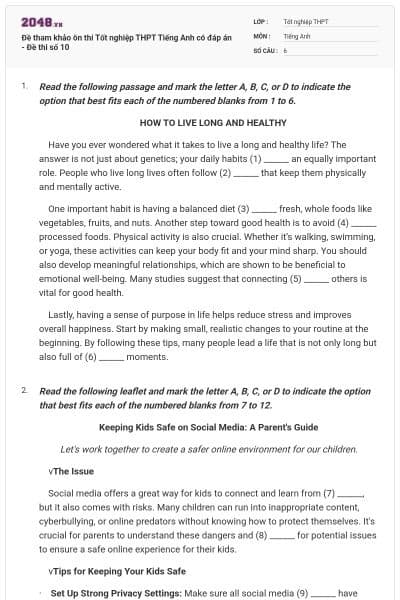
Read the following leaflet and mark the letter A, B, C or D to indicate the option that best fits each of the numbered blanks from 7 to 12.
Fostering Lifelong Learning at Home!
Let's (7) ______ strategies to promote lifelong learning among students at home.
Facts and figures:
Lifelong learning is crucial in today's rapidly changing world. (8) ______, only 30% of adults continue formal education after entering the (9) ______. Encouraging lifelong learning habits early can lead to a 50% increase in career advancement opportunities.
Positive action!
· Create a home library with diverse reading (10) ______ to encourage a love of learning.
· Set aside dedicated time (11) ______ week for family learning activities, such as exploring new topics or skills together.
· Encourage the use of online courses and educational (12) ______ to supplement traditional learning.
delve into
hold over
polish off
crop up
Kiến thức về cụm động từ
A. delve into: đi sâu vào, nghiên cứu kỹ lưỡng một vấn đề hoặc chủ đề
B. hold over: hoãn lại
C. polish off: hoàn thành nhanh chóng, ăn hết hoặc làm xong cái gì đó nhanh gọn
D. crop up: xảy ra bất ngờ, xuất hiện đột ngột
Dựa vào ngữ cảnh, ‘delve into’ là đáp án phù hợp.
Dịch: Hãy cùng khám phá những chiến lược để thúc đẩy thói quen học tập suốt đời cho học sinh tại nhà.
Chọn A.
Although
Otherwise
However
Therefore
Kiến thức về liên từ
A. Although: Mặc dù
B. Otherwise: Nếu không thì, mặt khác
C. However: Tuy nhiên
D. Therefore: Vì vậy, do đó
Câu phía trước chỗ trống đang nêu ra tầm quan trọng của việc học tập suốt đời, nhưng câu sau lại đưa số liệu chỉ có 30% người trưởng thành tiếp tục việc học tập chính quy sau khi đã tham gia thị trường lao động. Ta cần một từ nối để diễn tả sự tương phản.
→ ‘however’ là đáp án phù hợp về nghĩa và vị trí đứng trong câu.
Dịch: Tuy nhiên, chỉ có 30 % người trưởng thành tiếp tục học tập chính quy…
Chọn C.
horizon
workforce
pursuit
institution
Kiến thức về từ vựng – nghĩa của từ
A. horizon /hə'raɪzn/ (n): đường chân trời, tầm nhìn, triển vọng
B. workforce /'wɜ:rkfɔ:rs/ (n): lực lượng lao động
C. pursuit /pər'su:t/ (n): sự theo đuổi, hành động tìm kiếm hoặc tiếp tục một mục tiêu nào đó
D. institution /,ɪnstɪ'tu:ʃn/ (n): tổ chức lớn như trường đại học, ngân hàng
Dựa vào ngữ cảnh, ‘workforce’ là đáp án phù hợp.
Dịch: Tuy nhiên, chỉ có 30% người trưởng thành tiếp tục học tập chính quy sau khi bắt đầu đi làm.
Chọn B.
ingredients
elements
components
materials
Kiến thức về từ vựng – từ cùng trường nghĩa
A. ingredients /ɪn'gri:diənts/ (n): thành phần, nguyên liệu
B. elements /'elɪmənts/ (n): yếu tố, thành phần cơ bản
C. components /kəm'poʊnənts/ (n): thành phần, bộ phận (dùng để chí các phần cấu tạo nên một tổng thể)
D. materials /mə'tɪriəlz/ (n): nguyên liệu, vật liệu, tài liệu
Dựa vào ngữ cảnh, ‘materials’ là đáp án phù hợp.
Dịch: Tạo một thư viện tại nhà với nhiều tài liệu đọc đa dạng để khơi gợi niềm yêu thích học hỏi.
Chọn D.
other
much
all
each
Kiến thức về lượng từ
A. other + N (không đếm được/đếm được số nhiều): những cái khác/người khác
B. much + N (không đếm được): nhiều
C. all + N (không đếm được/đếm được số nhiều): tất cả
D. each + N (đếm được số ít): mỗi, từng
Chỗ trống đứng trước danh từ số ít ‘week’ và dựa vào ngữ cảnh. → ‘each’ là đáp án phù hợp.
Dịch: Dành thời gian cố định hàng tuần cho các hoạt động học tập gia đình, như khám phá những chủ đề hoặc kỹ năng mới cùng nhau.
Chọn D.
platforms
methods
technologies
processes
Kiến thức về từ vựng – nghĩa của từ
A. platforms /'plætfɔ:rmz/ (n): nền tảng (công nghệ hoặc tư tưởng)
B. methods /'meθədz/ (n): phương pháp, cách thức
C. technologies /tek'nɑ:lədʒiz/ (n): công nghệ
D. processes /'prɑ:sesɪz/ (n): quy trình, quá trình
Dựa vào ngữ cảnh, ‘platforms’ là đáp án phù hợp.
Dịch: Khuyến khích việc sử dụng các khóa học trực tuyến và nền tảng giáo dục để bổ sung cho việc học tập truyền thống.
Chọn A.
Bài hoàn chỉnh:
Fostering Lifelong Learning at Home!
Let's delve into strategies to promote lifelong learning among students at home.
Facts and figures:
Lifelong learning is crucial in today's rapidly changing world. However, only 30% of adults continue formal education after entering the workforce. Encouraging lifelong learning habits early can lead to a 50% increase in career advancement opportunities.
Positive action!
· Create a home library with diverse reading materials to encourage a love of learning.
· Set aside dedicated time each week for family learning activities, such as exploring new topics or skills together.
· Encourage the use of online courses and educational platforms to supplement traditional learning.
Dịch bài đọc:
Khơi dậy Tinh Thần Học Tập Suốt Đời Tại Nhà!
Hãy cùng khám phá những chiến lược để thúc đẩy thói quen học tập suốt đời cho học sinh tại nhà.
Sự thật và con số:
Học tập suốt đời là vô cùng quan trọng trong thế giới đang thay đổi nhanh chóng ngày nay. Tuy nhiên, chỉ có 30% người trưởng thành tiếp tục học tập chính quy sau khi bắt đầu đi làm. Việc khuyến khích thói quen học tập suốt đời từ sớm có thể dẫn đến cơ hội thăng tiến sự nghiệp tăng thêm 50%.
Hành động tích cực!
· Tạo một thư viện tại nhà với nhiều tài liệu đọc đa dạng để khơi gợi niềm yêu thích học hỏi.
· Dành thời gian cố định hàng tuần cho các hoạt động học tập gia đình, như khám phá những chủ đề hoặc kỹ năng mới cùng nhau.
· Khuyến khích việc sử dụng các khóa học trực tuyến và nền tảng giáo dục để bổ sung cho việc học tập truyền thống.
Mark the letter A, B, C, or D to indicate the best arrangement of utterances or sentences to make a meaningful exchange or text in each of the following questions from 13 to 17.
a. Peter: That sounds like a lot of fun! What games do you want to play?
b. Kevin: I was thinking of a mix of board games and card games for everyone.
c. Kevin: How about playing some games at my house tonight?
c-a-b
c-b-a
b-a-c
b-c-a
Kiến thức sắp xếp câu thành đoạn hội thoại
Thứ tự sắp xếp đúng:
c. Kevin: How about playing some games at my house tonight?
a. Peter: That sounds like a lot of fun! What games do you want to play?
b. Kevin: I was thinking of a mix of board games and card games for everyone.
Dịch:
c. Kevin: Tối nay cậu đến nhà tớ chơi vài trò chơi nhé?
a. Peter: Nghe vui đấy! Cậu muốn chơi trò gì?
b. Kevin: Tớ đang nghĩ đến việc kết hợp các trò chơi cờ bàn và bài để mọi người cùng chơi.
Chọn A.
a. Sophie: That's awesome! Have you found any teachers yet?
b. Oliver: Exactly! I can schedule lessons whenever I'm free.
c. Oliver: I'm considering taking lessons from someone online.
d. Sophie: That sounds good! Online courses offer great flexibility.
e. Oliver: I want to learn how to play the guitar this year.
c-a-e-d-b
e-d-b-a-c
c-d-b-a-e
e-a-c-d-b
Kiến thức sắp xếp câu thành đoạn hội thoại
Thứ tự sắp xếp đúng:
e. Oliver: I want to learn how to play the guitar this year.
a. Sophie: That's awesome! Have you found any teachers yet?
c. Oliver: I'm considering taking lessons from someone online.
d. Sophie: That sounds good! Online courses offer great flexibility.
b. Oliver: Exactly! I can schedule lessons whenever I'm free.
Dịch:
e. Oliver: Tớ muốn học chơi đàn guitar năm nay.
a. Sophie: Tuyệt vời! Cậu đã tìm được giáo viên nào chưa?
c. Oliver: Tớ đang cân nhắc đến việc học trực tuyến.
d. Sophie: Nghe hay đấy! Các khóa học trực tuyến rất linh hoạt.
b. Oliver: Chính xác! Tớ có thể sắp xếp lịch học bất cứ khi nào tớ rảnh.
Chọn D.
Dear Mr. Thompson,
a. The topics covered were quite insightful, focusing on time management and budgeting.
b. I would appreciate the chance to discuss how I can apply these skills.
c. I hope this message finds you well.
d. I believe the knowledge I gained could benefit our team's projects.
e. I am writing to share that I recently completed the online project management course.
I look forward to your response.
Best regards,
Thomas
c-a-d-b-e
c-e-a-d-b
c-d-a-b-e
e-a-d-c-b
Kiến thức sắp xếp câu thành lá thư
Thứ tự sắp xếp đúng:
Dear Mr. Thompson,
c. I hope this message finds you well.
e. I am writing to share that I recently completed the online project management course.
a. The topics covered were quite insightful, focusing on time management and budgeting.
d. I believe the knowledge I gained could benefit our team's projects.
b. I would appreciate the chance to discuss how I can apply these skills.
I look forward to your response.
Best regards,
Thomas
Dịch:
Kính gửi ông Thompson,
c. Tôi hy vọng ông vẫn khỏe.
e. Tôi viết thư này để chia sẻ rằng tôi vừa hoàn thành khóa học quản lý dự án trực tuyến.
a. Các chủ đề được đề cập khá bổ ích, tập trung vào kỹ năng quản lý thời gian và lập ngân sách.
d. Tôi tin rằng kiến thức mà tôi học được có thể đem lại lợi ích cho các dự án của nhóm chúng ta.
b. Tôi rất mong có cơ hội được thảo luận về cách tôi có thể áp dụng những kỹ năng này.
Tôi rất mong nhận được phản hồi của ông.
Trân trọng,
Thomas
Chọn B.
a. Many species are struggling to adapt to rapid changes in their environment.
b. The establishment of these reserves is crucial for the survival of endangered species.
c. However, it requires everyone's efforts to protect these important areas.
d. The local wildlife is facing significant threats due to habitat loss.
e. This situation has led conservationists to advocate for protected areas to preserve natural habitats.
a-d-b-c-e
d-a-c-b-e
d-c-a-e-b
d-a-e-b-c
Kiến thức sắp xếp câu thành đoạn văn
Thứ tự sắp xếp đúng:
d. The local wildlife is facing significant threats due to habitat loss.
a. Many species are struggling to adapt to rapid changes in their environment.
e. This situation has led conservationists to advocate for protected areas to preserve natural habitats.
b. The establishment of these reserves is crucial for the survival of endangered species.
c. However, it requires everyone's efforts to protect these important areas.
Dịch:
d. Động vật hoang dã địa phương đang đối mặt với những mối đe dọa lớn do bị mất môi trường sống.
a. Nhiều loài vật đang phải vật lộn để thích nghi với những thay đổi nhanh chóng trong môi trường.
e. Tình trạng này đã khiến các nhà bảo tồn lên tiếng ủng hộ việc thành lập các khu bảo tồn để bảo vệ môi trường sống tự nhiên.
b. Việc thành lập các khu bảo tồn này rất quan trọng cho sự sống còn của các loài có nguy cơ tuyệt chủng.
c. Tuy nhiên, việc bảo vệ những khu vực quan trọng này đòi hỏi nỗ lực của tất cả mọi người.
Chọn D.
a. Richard took time to research the market and create a clear plan for his project.
b. In the end, Richard's hard work and dedication are beginning to bring positive results for his business and help it grow.
c. For Richard, starting his own business has been an exciting but tough experience.
d. He also gathered a strong team to help him during the development process.
e. Since he had worked before, he understood the challenges and opportunities in this field.
c-b-a-d-e
a-d-b-c-e
c-e-a-d-b
c-a-d-b-e
Kiến thức sắp xếp câu thành đoạn văn
Thứ tự sắp xếp đúng:
c. For Richard, starting his own business has been an exciting but tough experience.
e. Since he had worked before, he understood the challenges and opportunities in this field.
a. Richard took time to research the market and create a clear plan for his project.
d. He also gathered a strong team to help him during the development process.
b. In the end, Richard's hard work and dedication are beginning to bring positive results for his business and help it grow.
Dịch:
c. Đối với Richard, việc khởi nghiệp là một trải nghiệm thú vị nhưng cũng đầy khó khăn.
e. Vì đã từng đi làm trước đây, anh ấy hiểu rõ những thách thức và cơ hội trong lĩnh vực này.
a. Richard đã dành thời gian nghiên cứu thị trường và lập kế hoạch rõ ràng cho dự án của mình.
d. Anh ấy cũng đã tập hợp được một đội ngũ mạnh mẽ để hỗ trợ trong quá trình phát triển.
b. Cuối cùng, sự chăm chỉ và tận tâm của Richard đang bắt đầu mang lại kết quả tích cực cho doanh nghiệp của anh ấy và giúp nó phát triển.
Chọn C.
Read the following passage and mark the letter A, B, C, or D to indicate the option that best fits each of the numbered blanks from 18 to 22.
In the year 2040, cities around the world will look drastically different from today. Advances in technology and urban planning (18) ______. For instance, smart homes equipped with energy-efficient systems will be commonplace, reducing energy consumption by up to 50%. Additionally, public transportation will rely on electric and autonomous vehicles, making commuting safer and more convenient.
One city that exemplifies this future is EcoVille (19) ______. By incorporating vertical gardens and solar panels, the city aims to become carbon neutral by 2045. Moreover, EcoVille will feature pedestrian-friendly walkways that encourage residents to walk or cycle, promoting a healthier lifestyle.
In this future city, technology will play a crucial role in everyday life. (20) ______ Furthermore, community centers equipped with virtual reality systems will offer residents unique learning opportunities and access to global resources.
Having embraced these advancements, (21) ______ and serve as a model for other cities around the globe. (22) ______. These strategies aim to ensure that EcoVille remains resilient and adaptable to changing circumstances.
which will reshape our environments to create more sustainable and efficient living spaces
in which our environments will be reshaped to create more sustainable and efficient living spaces
will reshape our environments to create more sustainable and efficient living spaces
reshaping our environments to create more sustainable and efficient living spaces
Kiến thức về cấu trúc câu
- Ta nhận thấy câu đã có chủ ngữ ‘Advances in technology and urban planning’ nhưng chưa có động từ chính.
→ Cần một động từ chính chia theo chủ ngữ ‘Advances in technology and urban planning’ để tạo thành câu hoàn chỉnh.
- A, B sai vì đây là các mệnh đề quan hệ, không thể đóng vai trò làm động từ chính của câu.
- C đúng vì ‘will reshape’ là động từ đang chia ở thì tương lai đơn, phù hợp về mặt nghĩa và ngữ pháp.
- D sai vì ‘reshaping’ là dạng phân từ hiện tại, không thể đóng vai trò làm động từ chính của câu.
Dịch: Vào năm 2040, các thành phố trên khắp thế giới sẽ trông khác biệt đáng kể so với ngày nay.
Chọn C.
whose innovative design focuses on green spaces and eco-friendly infrastructure
of which the focus on green spaces and eco-friendly infrastructure in its innovative design
focuses on green spaces and eco-friendly infrastructure for its innovative design
shows innovation in its design for green spaces and eco-friendly infrastructure
Kiến thức về mệnh đề quan hệ
- Căn cứ vào câu đã có một động từ chính được chia theo thì hiện tại đơn (exemplifies), vì vậy chỗ trống ta cần một mệnh đề quan hệ hoặc động từ chia theo dạng rút gọn mệnh đề quan hệ.
→ A đúng vì là một mệnh đề quan hệ hoàn chỉnh, có đại từ quan hệ ‘whose’ chỉ sự sở hữu, phù hợp bổ nghĩa cho danh từ ‘EcoVille’ ở đằng trước.
→ B sai vì là một mệnh đề quan hệ nhưng chưa có động từ chính, nên không phải mệnh đề hoàn chỉnh
→ Ta loại đáp án C và D. Vì ‘focuses’ và ‘shows’ là 2 động từ cùng chia theo thì của câu.
Dịch: Một thành phố minh họa cho tương lai này là EcoVille, với thiết kế sáng tạo tập trung vào không gian xanh và cơ sở hạ tầng thân thiện với môi trường.
Chọn A.
Continuously monitoring air quality and traffic patterns, the government will place smart sensors throughout the city
Monitoring air quality and traffic patterns throughout the city is the reason for continuous smart sensors
People working on air quality and traffic patterns continuously will create smart sensors throughout the city
Smart sensors will continuously monitor air quality and traffic patterns throughout the city
Kiến thức về mệnh đề độc lập - nghĩa của câu
A. Liên tục giám sát chất lượng không khí và lưu lượng giao thông, chính phủ sẽ đặt các cảm biến thông minh khắp thành phố
→ A sai vì không đồng chủ ngữ, ‘smart sensors’ mới thực hiện hành động giám sát chất lượng không khí và lưu lượng giao thông chứ không phải ‘the government’.
B. Giám sát chất lượng không khí và lưu lượng giao thông khắp thành phố là lý do cho các cảm biến thông minh liên tục
C. Những người làm việc về chất lượng không khí và lưu lượng giao thông liên tục sẽ tạo ra các cảm biến thông minh khắp thành phố
→ B và C sai vì thiếu liên kết với câu trước đó.
D. Các cảm biến thông minh sẽ liên tục giám sát chất lượng không khí và lưu lượng giao thông khắp thành phố
→ D đúng vì phù hợp về ngữ nghĩa, đưa ra những ví dụ về công nghệ được sử dụng ở EcoVille để kết nối với thông tin giới thiệu ở câu trước.
Dịch: Các cảm biến thông minh sẽ liên tục giám sát chất lượng không khí và lưu lượng giao thông khắp thành phố.
Chọn D.
its citizens will be provided a higher quality of life
residents living in EcoVille will receive a higher quality of life
the quality of life will be improved for EcoVille's residents
EcoVille will provide a higher quality of life for its citizens
Kiến thức về phân từ hoàn thành
* Xét nghĩa các đáp án:
A. người dân của thành phố sẽ được cung cấp chất lượng cuộc sống cao hơn
B. cư dân sống ở EcoVille sẽ nhận được chất lượng cuộc sống cao hơn
C. chất lượng cuộc sống sẽ được cải thiện cho cư dân của EcoVille
D. EcoVille sẽ cung cấp chất lượng cuộc sống cao hơn cho người dân
- Căn cứ vào mệnh đề ‘Having embraced these advancements’ ta suy ra câu này dùng cấu trúc: Having + Vp2..., S + V mà điều kiện để dùng dạng này là hai mệnh đề phải đồng chủ ngữ.
- Xét về nghĩa, ‘its citizens’, ‘residents living in EcoVille’, ‘the quality of life’ không thể là chủ ngữ của vế trước ‘Having embraced these advancements’. Do đó, ta loại A, B, C.
- Thành phố EcoVille mới là nơi áp dụng những tiến bộ công nghệ để đem lại chất lượng cuộc sống cao hơn. Chọn B.
Dịch: Đã áp dụng những tiến bộ này, EcoVille sẽ cung cấp chất lượng cuộc sống cao hơn cho người dân của mình và trở thành mô hình cho các thành phố khác trên toàn cầu.
Chọn D.
(22) ______. These strategies aim to ensure that EcoVille remains resilient and adaptable to changing circumstances.
Environmental challenges also emerge in the future so that city planners will develop comprehensive strategies
City planners have also developed comprehensive strategies in case environmental challenges arise in the future
Developing comprehensive strategies in the future, environmental challenges can also be resolved by city planners
As long as environmental challenges become worse in the future, city planners will also develop comprehensive strategies
Kiến thức về mệnh đề độc lập - nghĩa của câu
A. Các thách thức về môi trường cũng xuất hiện trong tương lai để các nhà quy hoạch thành phố sẽ phát triển các chiến lược toàn diện
→ A sai vì nghĩa không hợp lý.
B. Các nhà quy hoạch thành phố cũng đã phát triển các chiến lược toàn diện trong trường hợp các thách thức môi trường phát sinh trong tương lai
→ B đúng vì phù hợp với ngữ cảnh và có liên kết với câu sau.
C. Phát triển các chiến lược toàn diện trong tương lai, các thách thức môi trường cũng có thể được giải quyết bởi các nhà quy hoạch thành phố
→ C sai vì không đồng chủ ngữ, ‘environmental challenges’ không thể là chủ thể cho hành động ‘Developing comprehensive strategies in the future”.
D. Miễn là các thách thức môi trường trở nên tồi tệ hơn trong tương lai, các nhà quy hoạch thành phố cũng sẽ phát triển các chiến lược toàn diện
→ D sai vì không có sự liên kết tới câu trước đó.
Dịch: Các nhà quy hoạch thành phố cũng đã phát triển các chiến lược toàn diện trong trường hợp các thách thức môi trường phát sinh trong tương lai.
Chọn B.
Bài hoàn chỉnh:
In the year 2040, cities around the world will look drastically different from today. Advances in technology and urban planning will reshape our environments to create more sustainable and efficient living spaces. For instance, smart homes equipped with energy-efficient systems will be commonplace, reducing energy consumption by up to 50%. Additionally, public transportation will rely on electric and autonomous vehicles, making commuting safer and more convenient.
One city that exemplifies this future is EcoVille whose innovative design focuses on green spaces and eco-friendly infrastructure. By incorporating vertical gardens and solar panels, the city aims to become carbon neutral by 2045. Moreover, EcoVille will feature pedestrian-friendly walkways that encourage residents to walk or cycle, promoting a healthier lifestyle.
In this future city, technology will play a crucial role in everyday life. Smart sensors will continuously monitor air quality and traffic patterns throughout the city. Furthermore, community centers equipped with virtual reality systems will offer residents unique learning opportunities and access to global resources.
Having embraced these advancements, EcoVille will provide a higher quality of life for its citizens and serve as a model for other cities around the globe. City planners have also developed comprehensive strategies in case environmental challenges arise in the future. These strategies aim to ensure that EcoVille remains resilient and adaptable to changing circumstances.
Dịch bài đọc:
Vào năm 2040, các thành phố trên khắp thế giới sẽ trông khác biệt đáng kể so với ngày nay. Những tiến bộ trong công nghệ và quy hoạch đô thị sẽ định hình lại môi trường của chúng ta để tạo ra các không gian sống bền vững và hiệu quả hơn. Ví dụ, những ngôi nhà thông minh được trang bị các hệ thống tiết kiệm năng lượng sẽ trở nên phổ biến, giảm tiêu thụ năng lượng lên đến 50%. Ngoài ra, giao thông công cộng sẽ dựa vào các phương tiện điện và tự động, làm cho việc đi lại an toàn và thuận tiện hơn.
Một thành phố minh họa cho tương lai này là EcoVille, với thiết kế sáng tạo tập trung vào không gian xanh và cơ sở hạ tầng thân thiện với môi trường. Bằng cách kết hợp các tường cây và tấm pin mặt trời, thành phố đặt mục tiêu trở thành trung hòa carbon vào năm 2045. Hơn nữa, EcoVille sẽ có các lối đi thân thiện với người đi bộ, khuyến khích cư dân đi bộ hoặc đi xe đạp, thúc đẩy lối sống lành mạnh hơn.
Trong thành phố tương lai này, công nghệ sẽ đóng vai trò quan trọng trong cuộc sống hàng ngày. Các cảm biến thông minh sẽ liên tục giám sát chất lượng không khí và lưu lượng giao thông khắp thành phố. Hơn nữa, các trung tâm cộng đồng được trang bị hệ thống thực tế ảo sẽ cung cấp cho cư dân những cơ hội học tập độc đáo và truy cập vào các nguồn tài nguyên toàn cầu.
Đã áp dụng những tiến bộ này, EcoVille sẽ cung cấp chất lượng cuộc sống cao hơn cho dân của mình và trở thành mô hình cho các thành phố khác trên toàn cầu. Các nhà quy hoạch thành phố cũng đã phát triển các chiến lược toàn diện trong trường hợp các thách thức môi trường phát sinh trong tương lai. Những chiến lược này nhằm đảm bảo rằng EcoVille vẫn kiên cường và thích ứng với các hoàn cảnh thay đổi.
Read the following passage and mark the letter A, B, C, or D on your answer sheet to indicate the best answer to each of the following questions from 23 to 30.
Working from home has become increasingly common, providing employees with greater flexibility and control over their work environments. Without the need for long commutes, people have more time for family, personal interests, or simply to rest. A personalized workspace at home can also lead to higher productivity, as individuals can adjust their surroundings to suit their needs. Many companies now support remote work, recognizing its benefits for both employee well-being and business outcomes.
However, working from home does bring certain challenges. For example, while remote work can boost productivity, some people find it hard to stay focused without the structure of an office setting. There's also a risk of isolation, as virtual meetings don’t always fully replace face-to-face interactions. However, companies are increasingly devising creative strategies to mitigate these drawbacks, using sophisticated collaboration tools and arranging virtual social activities to preserve a sense of team cohesion.
Another difficulty with working from home is the blurred line between work and personal life. With workspaces merged into the home environment, the temptation to check emails or tackle tasks outside of regular hours can lead to an “always-on” mentality. Setting clear schedules and defining specific working hours is essential to ensure a healthy balance.
Looking forward, remote work is likely to remain a popular choice, supported by ever-advancing technology. Many companies are considering hybrid models, allowing employees to split their time between home and office. This flexible approach can balance the productivity of remote work with the social and collaborative benefits of in-person interactions. As remote work continues to evolve, it will reshape traditional work culture, requiring adaptation from both businesses and employees.
Difficulty focusing without office structure
Lack of technological support for remote work
Risk of isolation from lack of face-to-face contact
Temptation to work outside regular hours
Kiến thức về thông tin chi tiết
Theo văn bản, điều nào sau đây KHÔNG được đề cập như một thách thức của việc làm việc tại nhà?
A. Khó tập trung khi không có cấu trúc văn phòng
B. Thiếu hỗ trợ công nghệ cho công việc từ xa
C. Nguy cơ bị cô lập do thiếu tiếp xúc trực tiếp
D. Sự cám dỗ làm việc ngoài giờ làm việc bình thường
Thông tin:
- For example, while remote work can boost productivity, some people find it hard to stay focused without the structure of an office setting. (Ví dụ, dù làm việc từ xa có thể tăng năng suất, nhưng một số người thấy khó duy trì sự tập trung khi không ở trong môi trường văn phòng.) → A được đề cập.
- There's also a risk of isolation, as virtual meetings don't always fully replace face-to-face interactions. (Làm việc tại nhà cũng tiềm ẩn nguy cơ bị cô lập, vì các cuộc họp ảo không phải lúc nào cũng thay thế được các tương tác trực tiếp.) → C được đề cập.
- With workspaces merged into the home environment, the temptation to check emails or tackle tasks outside of regular hours can lead to an “always-on” mentality. (Với không gian làm việc và môi trường gia đình được hợp nhất, sự thôi thúc kiểm tra email hoặc giải quyết công việc ngoài giờ làm việc thông thường có thể dẫn đến trạng thái "luôn sẵn sàng làm việc".) → D được đề cập.
Chọn B.
The word ‘blurred’ in paragraph 3 is OPPOSITE in meaning to ______.
shrouded
obscured
defined
concealed
Kiến thức về từ vựng trái nghĩa
Từ ‘blurred’ trong đoạn 3 TRÁI NGHĨA với ______.
A. shrouded /ʃraʊdɪd/ (adj): bị che phủ, bị bao trùm
B. obscured /əbˈskjʊrd/ (adj): bị che khuất, bị làm mờ
C. defined /dɪˈfaɪnd/ (adj): được xác định, rõ ràng
D. concealed /kənˈsiːld/ (adj): bị giấu đi, bị che giấu
→ blurred /blɜːd/ (adj): mờ nhạt, không rõ nét >< defined /dɪˈfaɪnd/ (adj): được xác định, rõ ràng
Thông tin: Another difficulty with working from home is the blurred line between work and personal life. (Một khó khăn khác của việc làm việc tại nhà là ranh giới mờ nhạt giữa công việc và cuộc sống cá nhân.)
Chọn C.
The word ‘it’ in paragraph 4 refers to ______.
remote work
approach
productivity
work culture
Kiến thức về từ quy chiếu
Từ ‘it’ trong đoạn 4 chỉ ______.
A. remote work /rɪˌməʊt ˈwɜːk/ (n): việc làm từ xa
B. approach /əˈprəʊtʃ/ (n): cách tiếp cận
C. productivity /ˌprɒd.ʌkˈtɪv.ə.ti/ (n): hiệu suất
D. work culture /ˈwɜːk kʌl.tʃər/ (n): văn hóa làm việc
Thông tin: As remote work continues to evolve, itwill reshape traditional work culture, requiring adaptation from both businesses and employees. (Khi công việc từ xa tiếp tục phát triển, nó sẽ định hình lại văn hóa làm việc truyền thống, đòi hỏi sự thích nghi từ cả doanh nghiệp và nhân viên.)
→ Từ ‘it’ nhắc tới ‘remote work’ ở phía trước.
Chọn A.
The word ‘cohesion’ in paragraph 2 could be best replaced by ______.
detachment
fracture
unity
discord
Kiến thức về từ vựng gần nghĩa
Từ ‘cohesion’ ở đoạn 2 có thể được thay thế bằng ______.
A. detachment /dɪ'tætʃmənt/ (n): sự thờ ơ; sự dửng dưng
B. fracture /'fræktʃə(r)/ (n): sự gãy vỡ, sự nứt
C. unity /'ju:nəti/ (n): sự thống nhất, sự đoàn kết
D. discord /'dɪskͻ:d/ (n): sự bất hòa, mối bất hòa
→ cohesion /kəʊˈhiːʒn/ (n): sự dính liền, sự gắn kết = unity /'ju:nəti/ (n): sự thống nhất, sự đoàn kết
Thông tin: However, companies are increasingly devising creative strategies to mitigate these drawbacks, using sophisticated collaboration tools and arranging virtual social activities to preserve a sense of team cohesion. (Tuy nhiên, các công ty ngày càng nghĩ ra nhiều chiến lược sáng tạo để giảm thiểu những nhược điểm này, sử dụng các công cụ hợp tác tinh vi và sắp xếp các hoạt động xã hội ảo để duy trì cảm giác gắn kết nhóm.)
Chọn C.
Since workspaces have become more distinct from home environments, people find it easy to disconnect from work and avoid tasks after hours.
The integration of workspaces into home environments increases the likelihood that people will work beyond regular hours, fostering a mindset of constant availability.
Separating workspaces from home environments helps employees maintain a work-life balance and discourages the habit of working outside standard hours.
The division between work and home environments encourages employees to check emails only during regular hours, minimizing the need to be constantly available.
Kiến thức về paraphrasing
Câu nào sau đây diễn giải lại đúng nhất câu được gạch chân trong đoạn 3?
A. Vì không gian làm việc trở nên tách biệt hơn với môi trường gia đình, mọi người thấy dễ dàng tách bản thân khỏi công việc và tránh làm việc sau giờ làm.
B. Việc kết hợp không gian làm việc vào môi trường gia đình làm tăng khả năng mọi người sẽ làm việc ngoài giờ làm việc bình thường, tạo ra trạng thái luôn sẵn sàng làm việc.
C. Tách biệt không gian làm việc khỏi môi trường gia đình giúp nhân viên duy trì cân bằng giữa công việc và cuộc sống và ngăn chặn thói quen làm việc ngoài giờ chuẩn.
D. Sự phân chia giữa môi trường làm việc và gia đình khuyến khích nhân viên chỉ kiểm tra email trong giờ làm việc thông thường, giảm thiểu nhu cầu phải luôn sẵn sàng làm việc.
Câu gạch chân: With workspaces merged into the home environment, the temptation to check emails or tackle tasks outside of regular hours can lead to an “always-on” mentality.
(Với không gian làm việc và môi trường gia đình được hợp nhất, sự thôi thúc kiểm tra email hoặc giải quyết công việc ngoài giờ làm việc thông thường có thể dẫn đến trạng thái "luôn sẵn sàng làm việc".)
Chọn B.
The shift to remote work has resulted in a universal decrease in employee productivity across all sectors.
Companies are finding that virtual meetings are a complete substitute for in-person interactions.
Working from home is universally beneficial and eliminates all challenges associated with traditional office settings.
Employees who work remotely may experience a lack of focus due to the absence of an office structure.
Kiến thức về thông tin đúng/sai
Điều nào sau đây là ĐÚNG theo như bài đọc?
A. Việc chuyển sang làm việc từ xa đã dẫn đến giảm năng suất lao động trên diện rộng ở tất cả các lĩnh vực.
B. Các công ty nhận thấy rằng các cuộc họp ảo là sự thay thế hoàn toàn cho các tương tác trực tiếp.
C. Làm việc tại nhà mang lại lợi ích cho tất cả mọi người và loại bỏ mọi vấn đề liên quan đến môi trường văn phòng truyền thống.
D. Nhân viên làm việc từ xa có thể bị thiếu tập trung do không có cấu trúc văn phòng.
Thông tin:
- A personalized workspace at home can also lead to higher productivity, as individuals can adjust their surroundings to suit their needs. (Một không gian làm việc cá nhân tại nhà cũng có thể dẫn đến năng suất cao hơn, vì mỗi người có thể điều chỉnh môi trường xung quanh sao cho phù hợp với nhu cầu của mình.) → A sai vì làm việc từ xa là một yếu tố giúp tăng năng suất làm việc.
- There's also a risk of isolation, as virtual meetings don’t always fully replace face-to-face interactions. (Làm việc tại nhà cũng tiềm ẩn nguy cơ bị cô lập, vì các cuộc họp ảo không phải lúc nào cũng thay thế được các tương tác trực tiếp.) → B sai bởi những cuộc họp ảo không thể thay thế hoàn toàn các tương tác trực tiếp.
- For example, while remote work can boost productivity, some people find it hard to stay focused without the structure of an office setting… (Ví dụ, dù làm việc từ xa có thể tăng năng suất, nhưng một số người thấy khó duy trì sự tập trung khi không ở trong môi trường văn phòng.) → C sai vì hình thức làm việc từ xa cũng có những hạn chế mà làm việc tại văn phòng có thể khắc phục được.
- …some people find it hard to stay focused without the structure of an office setting. (…nhưng một số người thấy khó duy trì sự tập trung khi không ở trong môi trường văn phòng.) → D đúng.
Chọn D.
Paragraph 1
Paragraph 2
Paragraph 3
Paragraph 4
Kiến thức về thông tin theo đoạn
Trong đoạn nào, tác giả đề cập đến mối quan hệ nhượng bộ hiện tại?
A. Đoạn 1 B. Đoạn 2 C. Đoạn 3 D. Đoạn 4
Thông tin: For example, while remote work can boost productivity, some people find it hard to stay focused without the structure of an office setting. (Ví dụ, dù làm việc từ xa có thể tăng năng suất, nhưng một số người thấy khó duy trì sự tập trung khi không ở trong môi trường văn phòng.)
Chọn B.
Paragraph 1
Paragraph 2
Paragraph 3
Paragraph 4
Kiến thức về thông tin theo đoạn
Trong đoạn nào, tác giả thảo luận về một thách thức khác liên quan đến việc thiếu sự tách biệt giữa công việc và cuộc sống cá nhân?
A. Đoạn 1 B. Đoạn 2 C. Đoạn 3 D. Đoạn 4
Thông tin: Another difficulty with working from home is the blurred line between work and personal life. With workspaces merged into the home environment, the temptation to check emails or tackle tasks outside of regular hours can lead to an “always-on” mentality. Setting clear schedules and defining specific working hours is essential to ensure a healthy balance. (Một khó khăn khác của việc làm việc tại nhà là ranh giới mờ nhạt giữa công việc và cuộc sống cá nhân. Với không gian làm việc và môi trường gia đình được hợp nhất, sự thôi thúc kiểm tra email hoặc giải quyết công việc ngoài giờ làm việc thông thường có thể dẫn đến trạng thái "luôn sẵn sàng làm việc". Việc lập lịch trình rõ ràng và xác định giờ làm việc cụ thể là điều cần thiết để đảm bảo sự cân bằng lành mạnh.)
Chọn C.
Dịch bài đọc:
Làm việc tại nhà đã trở nên ngày càng phổ biến, mang lại cho nhân viên nhiều sự linh hoạt và kiểm soát hơn với môi trường làm việc của họ. Không cần phải di chuyển xa, mọi người có nhiều thời gian hơn cho gia đình, sở thích cá nhân hoặc đơn giản là để nghỉ ngơi. Một không gian làm việc cá nhân tại nhà cũng có thể dẫn đến năng suất cao hơn, vì mỗi người có thể điều chỉnh môi trường xung quanh sao cho phù hợp với nhu cầu của mình. Nhiều công ty giờ đây ủng hộ làm việc từ xa do nhận thấy lợi ích của nó đối với sức khỏe nhân viên và kết quả kinh doanh.
Tuy nhiên, làm việc tại nhà cũng mang lại một số thách thức nhất định. Ví dụ, dù làm việc từ xa có thể tăng năng suất, nhưng một số người thấy khó duy trì sự tập trung khi không ở trong môi trường văn phòng. Làm việc tại nhà cũng tiềm ẩn nguy cơ bị cô lập, vì các cuộc họp ảo không phải lúc nào cũng thay thế được các tương tác trực tiếp. Tuy nhiên, các công ty ngày càng nghĩ ra nhiều chiến lược sáng tạo để giảm thiểu những nhược điểm này, sử dụng các công cụ hợp tác tinh vi và sắp xếp các hoạt động xã hội ảo để duy trì cảm giác gắn kết nhóm.
Một khó khăn khác của việc làm việc tại nhà là ranh giới mờ nhạt giữa công việc và cuộc sống cá nhân. Với không gian làm việc và môi trường gia đình được hợp nhất, sự thôi thúc kiểm tra email hoặc giải quyết công việc ngoài giờ làm việc thông thường có thể dẫn đến trạng thái "luôn sẵn sàng làm việc". Việc lập lịch trình rõ ràng và xác định giờ làm việc cụ thể là điều cần thiết để đảm bảo sự cân bằng lành mạnh.
Trong tương lai, làm việc từ xa có khả năng vẫn là lựa chọn phổ biến, được hỗ trợ bởi công nghệ ngày càng tiên tiến. Nhiều công ty đang xem xét các mô hình kết hợp, cho phép nhân viên chia thời gian ở nhà và ở văn phòng. Cách tiếp cận linh hoạt này có thể cân bằng hiệu suất của công việc từ xa với lợi ích xã hội và hợp tác của các tương tác trực tiếp. Khi công việc từ xa tiếp tục phát triển, nó sẽ định hình lại văn hóa làm việc truyền thống, đòi hỏi sự thích nghi từ cả doanh nghiệp và nhân viên.
Read the following passage and mark the letter A, B, C, or D to indicate the best answer to each of the following questions from 31 to 40.
A Biography of Vincent Van Gogh (1853-1890)
[I] Vincent Van Gogh was one of history’s greatest painters, although he met only rejection and failure during his lifetime. Van Gogh was born in the Netherlands. [II] He was well educated in French and English but was shy and introverted as a child, lacking self-confidence. His greatest friend was his younger brother Theo, who supported him emotionally and financially all his life. [III] At 16, Van Gogh turned to religion and became a preacher in an impoverished mining district of Belgium. [IV] Van Gogh still stayed without pay because he was concerned about the suffering of the poor miners.
After his failure as a preacher, Van Gogh decided to devote his life to art. Although he had been drawing since childhood, his first major painting, “Potato Eaters”, was completed when he was in his late twenties. In 1886, Van Gogh briefly attended formal art school in Antwerp, where he discovered Japanese art, which inspired him to use bright, vibrant colors. For him, color was the key to communicating his emotions.
In 1887, Van Gogh visited Theo in Paris, where he met the Impressionists; he liked their use of natural light and color, although he regretted their lack of commitment to social causes. Van Gogh wanted his artworks to hang in poor people’s homes to bring them happiness through beauty. Unlike the Impressionists, he painted not what he saw but what he felt. His style of Expressionism opened the way to the modern, abstract art of the 20th century.
In 1888, Van Gogh moved to Arles, in the South of France. There, he spent most of the money Theo sent him on painting supplies, neglecting his health. Feeling lonely as a foreigner and an artist, he invited Paul Gauguin to found an artists’ colony, but the two soon quarreled. Suffering from severe depression, Van Gogh asked to be taken to a mental hospital, where he continued painting. He passed away in Auvers, near Paris, at the age of 37. His last words were, “The sadness will never end.” Theo died six months later and was buried next to his brother.
Where in paragraph 1 does the following sentence best fit?
He was dismissed by his church after six months.
[II]
[III]
[IV]
[I]
Kiến thức về điền câu phù hợp vào đoạn
Câu sau đây phù hợp nhất ở vị trí nào trong đoạn 1?
Ông bị nhà thờ sa thải sau sáu tháng.
A. [II] B. [III] C. [IV] D. [I]
→ Câu trên phù hợp ở vị trí [IV] vì nó liên kết mạch lạc với câu phía trước kể về sự kiện trong đời của Van Gogh ‘Van Gogh turned to religion and became a preacher’ (Van Gogh đã hướng về tôn giáo và trở thành một nhà thuyết giáo).
Chọn C.
The word ‘impoverished’ in paragraph 1 could be best replaced by ______.
poor
improved
industrial
wealthy
Kiến thức về từ vựng gần nghĩa
Từ ‘impoverished’ ở đoạn 1 có thể được thay thế bằng ______.
A. poor /pɔː(r)/ (adj): nghèo khó
B. improved /ɪmˈpruːvd/ (adj): tiến bộ, được cải thiện
C. industrial /ɪnˈdʌstriəl/ (adj): thuộc về công nghiệp
D. wealthy /ˈwelθi/ (adj): giàu có
→ impoverished /ɪmˈpɒvərɪʃt/ (adj): nghèo khổ, bần cùng = poor /pɔː(r)/ (adj): nghèo khó
Thông tin: At 16, Van Gogh turned to religion and became a preacher in an impoverished mining district of Belgium.(Năm 16 tuổi, Van Gogh tìm đến tôn giáo và trở thành một nhà thuyết giáo ở một khu mỏ nghèo khó của Bỉ.)
Chọn A.
The word ‘inspired’ in paragraph 2 is OPPOSITE in meaning to ______.
motivated
discouraged
expected
allowed
Kiến thức về từ vựng trái nghĩa
Cụm từ ‘inspired’ trong đoạn 2 TRÁI NGHĨA với ______.
A. motivated – motivate /ˈməʊtɪveɪt/ (v): thúc đẩy
B. discouraged – discourage /dɪsˈkʌrɪdʒ/ (v): làm chán nản, làm nản lòng
C. expected – expect /ɪkˈspekt/ (v): trông đợi, kỳ vọng
D. allowed – allow /əˈlaʊ/ (v): cho phép
→ inspired – inspire /ɪnˈspaɪə(r)/ (v): truyền cảm hứng >< discouraged – discourage /dɪsˈkʌrɪdʒ/ (v): làm chán nản, làm nản lòng
Thông tin: In 1886, Van Gogh briefly attended formal art school in Antwerp, where he discovered Japanese art, which inspired him to use bright, vibrant colors. For him, color was the key to communicating his emotions. (Năm 1886, Van Gogh theo học trường nghệ thuật chính quy ở Antwerp trong một thời gian ngắn. Ở nơi đây ông được biết đến nghệ thuật Nhật Bản, điều đã truyền cảm hứng cho ông sử dụng những màu sắc tươi sáng, rực rỡ. Đối với ông, màu sắc là chìa khóa để diễn tả cảm xúc của mình.)
Chọn B.
Which of the following best summarizes paragraph 2?
Van Gogh pursued a career as a preacher after discovering his talent for art and mastering Japanese artist techniques in his early years.
After abandoning preaching, Van Gogh pursued art, drawing inspiration from Japanese styles and using color to express emotions.
Van Gogh succeeded as a preacher in 1886 and went to art school in Antwerp, where he completed his first major Japanese painting.
Transitioning from preaching, Van Gogh embraced art as his true calling and created “Potato Eaters”, a Japanese-style major work of art.
Kiến thức về ý chính của đoạn
Câu nào sau đây tóm tắt đoạn 2 đúng nhất?
A. Van Gogh đi làm nhà thuyết giáo sau khi phát hiện ra tài năng hội họa và nắm vững kỹ thuật hội họa Nhật Bản từ những năm đầu.
B. Sau khi từ bỏ nghề thuyết giáo, Van Gogh theo đuổi hội họa, lấy cảm hứng từ phong cách Nhật Bản và sử dụng màu sắc để thể hiện cảm xúc.
C. Van Gogh thành công với nghề thuyết giáo vào năm 1886 và theo học trường nghệ thuật ở Antwerp, nơi ông hoàn thành bức tranh lớn đầu tiên theo phong cách Nhật Bản.
D. Chuyển từ nghề thuyết giáo, Van Gogh coi hội họa là tiếng gọi thực sự của mình và vẽ nên bức “Những người ăn khoai tây”, một tác phẩm nghệ thuật lớn theo phong cách Nhật Bản.
Thông tin: After his failure as a preacher, Van Gogh decided to devote his life to art. Although he had been drawing since childhood, his first major painting, “Potato Eaters”, was completed when he was in his late twenties. In 1886, Van Gogh briefly attended formal art school in Antwerp, where he discovered Japanese art, which inspired him to use bright, vibrant colors. For him, color was the key to communicating his emotions. (Sau thất bại khi làm nhà thuyết giáo, Van Gogh quyết định cống hiến cuộc đời mình cho nghệ thuật. Mặc dù ông đã vẽ từ thời thơ ấu, nhưng bức tranh lớn đầu tiên của ông, "Những người ăn khoai tây", được hoàn thành khi ông ở độ tuổi cuối hai mươi. Năm 1886, Van Gogh theo học trường nghệ thuật chính quy ở Antwerp trong một thời gian ngắn. Ở nơi đây ông được biết đến nghệ thuật Nhật Bản, điều đã truyền cảm hứng cho ông sử dụng những màu sắc tươi sáng, rực rỡ. Đối với ông, màu sắc là chìa khóa để diễn tả cảm xúc của mình.)
→ Đoạn 2 cung cấp thông tin Van Gogh quyết định theo đuổi nghệ thuật sau thất bại trong việc làm nghề thuyết giáo, sau đó được truyền cảm hứng bởi phong cách nghệ thuật Nhật Bản, sử dụng màu sắc để diễn tả cảm xúc. Đáp án B thể hiện đúng trọng tâm này.
Chọn B.
Which of the following best paraphrases the underlined sentence in paragraph 3?
Their utilization of natural light and color was appealing to him, but he felt that they should have been more invested in social concerns.
It was not until he felt disappointed in their lack of dedication to social problems that they utilized natural light and color.
Had they used more natural light and color in their paintings, he would have appreciated their social commitment.
Though he admired their dedication to social problems, he criticized their use of natural light and color in their paintings.
Kiến thức về paraphrasing
Câu nào sau đây diễn giải lại đúng nhất câu được gạch chân trong đoạn 3?
A. Việc họ sử dụng màu sắc và ánh sáng tự nhiên rất thu hút ông, nhưng ông cảm thấy họ nên quan tâm nhiều hơn đến các vấn đề xã hội.
B. Chỉ đến khi ông thất vọng về sự thiếu tận tâm của họ đối với các vấn đề xã hội, ông mới bắt đầu sử dụng màu sắc và ánh sáng tự nhiên.
C. Nếu họ sử dụng màu sắc và ánh sáng tự nhiên nhiều hơn trong các bức tranh của mình, ông sẽ đánh giá cao sự cống hiến của họ cho xã hội.
D. Mặc dù ông ngưỡng mộ sự tận tâm của họ đối với các vấn đề xã hội, nhưng ông đã chỉ trích việc họ sử dụng màu sắc và ánh sáng tự nhiên trong các bức tranh của mình.
Câu gạch chân: …he liked their use of natural light and color, although he regretted their lack of commitment to social causes. (Ông thích cách họ sử dụng màu sắc và ánh sáng tự nhiên, mặc dù ông thấy tiếc nuối vì họ thiếu sự cam kết với các vấn đề xã hội.)
Chọn A.
The word ‘them’ in paragraph 3 refers to ______.
the Impressionists
poor people
social causes
his artworks
Kiến thức về từ quy chiếu
Từ ‘them’ trong đoạn 3 chỉ ______.
A. the Impressionists (phr): các họa sĩ trường phái Ấn tượng
B. poor people (phr): người nghèo
C. social causes (phr): các vấn đề xã hội
D. his artworks (n): tác phẩm nghệ thuật của ông
Thông tin: Van Gogh wanted his artworks to hang in poor people’s homes to bring them happiness through beauty. (Van Gogh muốn các tác phẩm nghệ thuật của mình được treo trong nhà của người nghèo để mang lại cho họ niềm hạnh phúc thông qua vẻ đẹp.)
→ Từ ‘them’ nhắc tới ‘poor people’ ở phía trước.
Chọn B.
According to paragraph 4, which of the following places was NOT involved in Van Gogh’s life?
Arles
Auvers
France
Japan
Kiến thức về thông tin chi tiết
Theo đoạn 4, địa điểm nào sau đây KHÔNG liên quan đến cuộc đời của Van Gogh?
A. Arles B. Auvers C. Pháp D. Nhật Bản
Thông tin:
- In 1888, Van Gogh moved to Arles, in the South of France. (Năm 1888, Van Gogh chuyển đến Arles, miền Nam nước Pháp.) → A, C được đề cập.
- He passed away in Auvers, near Paris, at the age of 37. (Ông qua đời ở Auvers, gần Paris, ở tuổi 37.) → B, C được đề cập.
Chọn D.
Which of the following is TRUE according to the passage?
Van Gogh became a preacher at the age of 18.
Van Gogh’s final painting was “Potato Eaters”.
Van Gogh met the Impressionists in Paris.
Van Gogh died after his brother Theo.
Kiến thức về thông tin đúng/sai
Điều nào sau đây là ĐÚNG theo như bài đọc?
A. Van Gogh trở thành nhà thuyết giáo ở tuổi 18.
B. Bức tranh cuối cùng của Van Gogh là “Những người ăn khoai tây”.
C. Van Gogh gặp gỡ các họa sĩ trường phái Ấn tượng ở Paris.
D. Van Gogh qua đời sau em trai Theo.
Thông tin:
- At 16, Van Gogh turned to religion and became a preacher in an impoverished mining district of Belgium. (Năm 16 tuổi, Van Gogh tìm đến tôn giáo và trở thành một nhà thuyết giáo ở một khu mỏ nghèo khó của Bỉ.) → A sai vì Van Gogh trở thành nhà thuyết giáo vào năm ông 16 tuổi.
- Although he had been drawing since childhood, his first major painting, “Potato Eaters”, was completed when he was in his late twenties. (Mặc dù ông đã vẽ từ thời thơ ấu, nhưng bức tranh lớn đầu tiên của ông, "Những người ăn khoai tây", được hoàn thành khi ông ở độ tuổi cuối hai mươi.) → B sai vì “Những người ăn khoai tây” là bức tranh lớn đầu tiên mà ông hoàn thành.
- In 1887, Van Gogh visited Theo in Paris, where he met the Impressionists; he liked their use of natural light and color, although he regretted their lack of commitment to social causes. (Năm 1887, Van Gogh đến thăm Theo ở Paris, nơi ông gặp gỡ các họa sĩ trường phái Ấn tượng. Ông thích cách họ sử dụng màu sắc và ánh sáng tự nhiên, mặc dù ông thấy tiếc nuối vì họ thiếu sự cam kết với các vấn đề xã hội.) → C đúng.
- Theo died six months later and was buried next to his brother. (Theo qua đời sáu tháng sau đó và được chôn cất bên cạnh anh trai mình.) → D sai vì em trai Theo qua đời sau Van Gogh.
Chọn C.
Which of the following can be inferred from the passage?
Paul Gauguin consistently got along well with Van Gogh.
Van Gogh and the Impressionists shared the same interest in helping the poor.
Buying art supplies was more important to Van Gogh than his health.
Van Gogh was successful when working as a preacher in Belgium.
Kiến thức về thông tin suy luận
Câu nào sau đây có thể suy ra từ bài đọc?
A. Paul Gauguin luôn hòa thuận với Van Gogh.
B. Van Gogh và các họa sĩ trường phái Ấn tượng có chung mối quan tâm về việc giúp đỡ người nghèo.
C. Đối với Van Gogh, việc mua dụng cụ vẽ tranh quan trọng hơn sức khỏe.
D. Van Gogh đã thành công khi làm nhà thuyết giáo ở Bỉ.
Thông tin:
- Feeling lonely as a foreigner and an artist, he invited Paul Gauguin to found an artists’ colony, but the two soon quarreled. (Do cảm thấy cô đơn vì là người nước ngoài và là một nghệ sĩ, ông đã mời Paul Gauguin thành lập một khu định cư của các nghệ sĩ, nhưng hai người sớm xảy ra mâu thuẫn.)
→ A sai vì Paul Gauguin và Van Gogh đã xảy ra mâu thuẫn.
- In 1887, Van Gogh visited Theo in Paris, where he met the Impressionists; he liked their use of natural light and color, although he regretted their lack of commitment to social causes. (Năm 1887, Van Gogh đến thăm Theo ở Paris, nơi ông gặp gỡ các họa sĩ trường phái Ấn tượng. Ông thích cách họ sử dụng màu sắc và ánh sáng tự nhiên, mặc dù ông thấy tiếc nuối vì họ thiếu sự cam kết với các vấn đề xã hội.)
→ B sai vì các họa sĩ trường phái Ấn tượng thiếu sự quan tâm tới các vấn đề xã hội.
- In 1888, Van Gogh moved to Arles, in the South of France. There, he spent most of the money Theo sent him on painting supplies, neglecting his health. (Năm 1888, Van Gogh chuyển đến Arles, miền Nam nước Pháp. Ở đó, ông đã bỏ bê sức khỏe của mình mà tiêu phần lớn số tiền Theo gửi cho ông vào dụng cụ vẽ tranh.)
→ C đúng.
- After his failure as a preacher, Van Gogh decided to devote his life to art. (Sau thất bại khi làm nhà thuyết giáo, Van Gogh quyết định cống hiến cuộc đời mình cho nghệ thuật.)
→ D sai vì Van Gogh đã thất bại khi làm nhà thuyết giáo.
Chọn C.
Which of the following best summarizes the passage?
Vincent Van Gogh, a great painter, devoted his life to creating artworks with emotion-driven techniques that influenced modern abstract art despite his personal struggles, loneliness, and lack of recognition during his lifetime.
Vincent Van Gogh, a passionate artist, transitioned from failed preacher to create expressive paintings, pioneering modern Expressionism despite a life marked by rejection and profound personal loneliness.
Vincent Van Gogh, a misunderstood genius, revolutionized art with vibrant, emotion-filled works, aiming to convey raw human feeling despite facing poverty, mental illness, and critical indifference.
Vincent Van Gogh, a dedicated painter, crafted unique artworks blending Japanese art and Impressionism, reflecting his inner struggles and religious beliefs despite battling depression and enduring public criticism.
Kiến thức về ý chính toàn bài
Câu nào sau đây tóm tắt đúng nhất bài đọc?
A. Vincent Van Gogh, một họa sĩ vĩ đại, đã cống hiến cả cuộc đời mình để sáng tạo những tác phẩm nghệ thuật với kỹ thuật giàu cảm xúc, ảnh hưởng đến nghệ thuật trừu tượng hiện đại bất chấp những khó khăn, cô đơn và thiếu sự công nhận trong suốt cuộc đời.
B. Vincent Van Gogh, một nghệ sĩ đầy nhiệt huyết, đã từ thất bại trong công việc làm nhà thuyết giáo chuyển sang sáng tạo những bức tranh biểu cảm, tiên phong cho trường phái Biểu hiện hiện đại bất chấp cuộc đời đầy rẫy sự từ chối và nỗi cô đơn sâu sắc.
C. Vincent Van Gogh, một thiên tài bị hiểu lầm, đã cách mạng hóa nghệ thuật bằng những tác phẩm sống động, tràn đầy cảm xúc, nhằm truyền tải những cảm xúc chân thực của con người bất chấp nghèo đói, bệnh tâm thần và sự thờ ơ của giới phê bình.
D. Vincent Van Gogh, một họa sĩ tận tâm, đã tạo ra những tác phẩm nghệ thuật độc đáo pha trộn giữa nghệ thuật Nhật Bản và trường phái Ấn tượng, phản ánh những đấu tranh nội tâm và niềm tin tôn giáo của ông bất chấp việc phải chiến đấu với chứng trầm cảm và chịu đựng sự chỉ trích của công chúng.
* Tóm tắt:
Đoạn 1: Vincent Van Gogh là một trong những họa sĩ vĩ đại nhất, song cả đời ông chỉ toàn nhận lại sự từ chối và thất bại.
Đoạn 2: Van Gogh quyết định cống hiến cho nghệ thuật sau khi thất bại khi làm nhà thuyết giáo. Ông theo học trường nghệ thuật và khám phá ra cách sử dụng màu sắc để truyền tải cảm xúc.
Đoạn 3: Trường phái Biểu hiện của Van Gogh mở đường cho nghệ thuật trừu tượng hiện đại của thế kỷ 20.
Đoạn 4: Van Gogh mắc trầm cảm nặng và được đưa vào bệnh viện tâm thần. Ông qua đời ở tuổi 37.
→ A là lựa chọn chính xác và đầy đủ nhất.
* Xét các đáp án còn lại:
- B sai vì không có thông tin nào cho thấy ông là người tiên phong cho trường phái Biểu hiện.
- C sai vì không có thông tin nào cho thấy ông bị hiểu lầm và bị giới phê bình thờ ơ.
- D sai vì Van Gogh không vẽ theo trường phái Ấn tượng, và không có thông tin về việc ông thể hiện niềm tin tôn giáo thông qua tranh, cũng như gặp phải chỉ trích từ công chúng.
Chọn A.
Dịch bài đọc:
Tiểu sử về Vincent Van Gogh (1853-1890)
Vincent Van Gogh là một trong những họa sĩ vĩ đại nhất trong lịch sử, mặc dù ông chỉ toàn nhận lại sự từ chối và thất bại trong suốt cuộc đời. Van Gogh được sinh ra ở Hà Lan. Ông được giáo dục tốt về tiếng Pháp và tiếng Anh nhưng lại nhút nhát, thiếu tự tin và hướng nội khi còn nhỏ. Người bạn thân nhất của ông là em trai Theo, người đã hỗ trợ ông về mặt tinh thần và tài chính suốt cuộc đời. Năm 16 tuổi, Van Gogh tìm đến tôn giáo và trở thành một nhà thuyết giáo ở một khu mỏ nghèo khó của Bỉ. Ông bị nhà thờ sa thải sau sáu tháng. Van Gogh vẫn ở lại mà không nhận lương vì ông quan tâm đến nỗi khổ của những người thợ mỏ nghèo.
Sau thất bại khi làm nhà thuyết giáo, Van Gogh quyết định cống hiến cuộc đời mình cho nghệ thuật. Mặc dù ông đã vẽ từ thời thơ ấu, nhưng bức tranh lớn đầu tiên của ông, "Những người ăn khoai tây", được hoàn thành khi ông ở độ tuổi cuối hai mươi. Năm 1886, Van Gogh theo học trường nghệ thuật chính quy ở Antwerp trong một thời gian ngắn. Ở nơi đây ông được biết đến nghệ thuật Nhật Bản, điều đã truyền cảm hứng cho ông sử dụng những màu sắc tươi sáng, rực rỡ. Đối với ông, màu sắc là chìa khóa để diễn tả cảm xúc của mình.
Năm 1887, Van Gogh đến thăm Theo ở Paris, nơi ông gặp gỡ các họa sĩ trường phái Ấn tượng. Ông thích cách họ sử dụng màu sắc và ánh sáng tự nhiên, mặc dù ông thấy tiếc nuối vì họ thiếu sự cam kết với các vấn đề xã hội. Van Gogh muốn các tác phẩm nghệ thuật của mình được treo trong nhà của người nghèo để mang lại cho họ niềm hạnh phúc thông qua vẻ đẹp. Không giống như các họa sĩ trường phái Ấn tượng, ông không vẽ những gì ông nhìn thấy, ông vẽ những gì ông cảm nhận được. Trường phái Biểu hiện của ông đã mở đường cho nghệ thuật trừu tượng hiện đại của thế kỷ 20.
Năm 1888, Van Gogh chuyển đến Arles, miền Nam nước Pháp. Ở đó, ông đã bỏ bê sức khỏe của mình mà tiêu phần lớn số tiền Theo gửi cho ông vào dụng cụ vẽ tranh. Do cảm thấy cô đơn vì là người nước ngoài và là một nghệ sĩ, ông đã mời Paul Gauguin thành lập một khu định cư của các nghệ sĩ, nhưng hai người sớm xảy ra mâu thuẫn. Van Gogh bị trầm cảm nặng, ông yêu cầu được đưa đến một bệnh viện tâm thần, nơi ông tiếp tục vẽ tranh. Ông qua đời ở Auvers, gần Paris, ở tuổi 37. Những lời cuối cùng của ông là, "Nỗi buồn sẽ không bao giờ kết thúc." Theo qua đời sáu tháng sau đó và được chôn cất bên cạnh anh trai mình.