Đề tham khảo ôn thi Tốt nghiệp THPT Tiếng Anh có đáp án - Đề thi số 05
40 câu hỏi
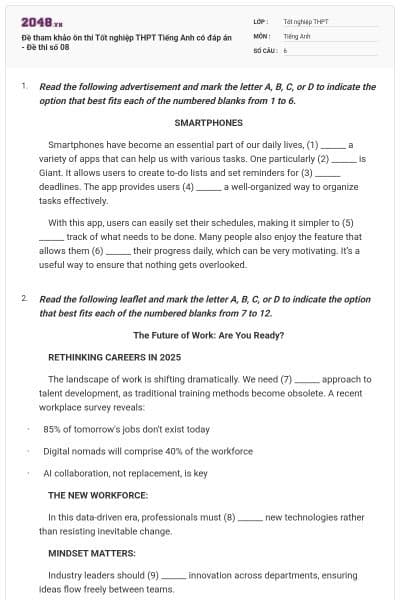
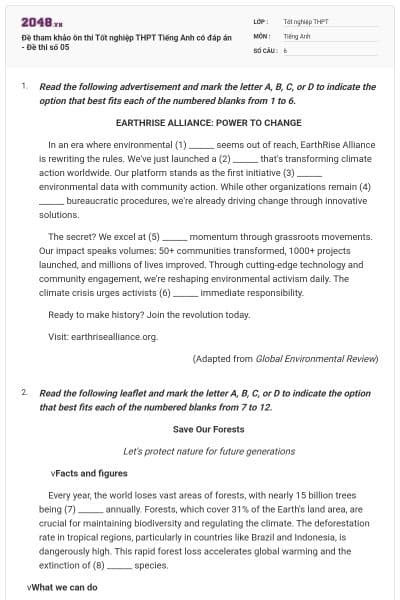
Read the following advertisement and mark the letter A, B, C, or D to indicate the option that best fits each of the numbered blanks from 1 to 6.
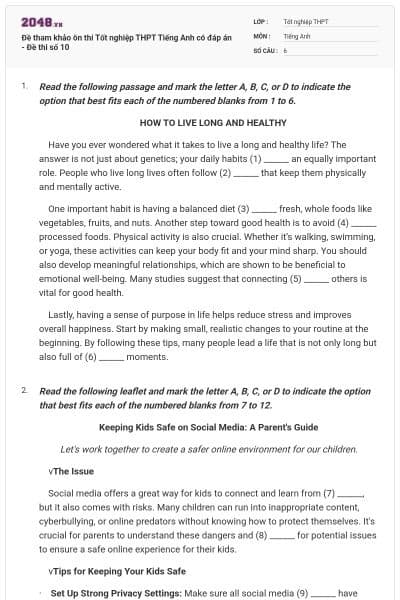
EARTHRISE ALLIANCE: POWER TO CHANGE
In an era where environmental (1) ______ seems out of reach, EarthRise Alliance is rewriting the rules. We've just launched a (2) ______ that's transforming climate action worldwide. Our platform stands as the first initiative (3) ______ environmental data with community action. While other organizations remain (4) ______ bureaucratic procedures, we're already driving change through innovative solutions.
The secret? We excel at (5) ______ momentum through grassroots movements. Our impact speaks volumes: 50+ communities transformed, 1000+ projects launched, and millions of lives improved. Through cutting-edge technology and community engagement, we're reshaping environmental activism daily. The climate crisis urges activists (6) ______ immediate responsibility.
Ready to make history? Join the revolution today.
Visit: earthrisealliance.org.
(Adapted from Global Environmental Review)
sustain
sustainability
sustainable
sustaining
Kiến thức về từ loại
A. sustainment /sə'steɪnm(ə)nt/ (n): sự chịu đựng, sự chấp nhận
B. sustainability /sə,steɪnə'bɪləti/ (n): sự bền vững, tính bền vững
C. sustainable /sə'steɪnəbl/ (adj): bền vững
D. sustaining /sə'steɪnɪŋ/ (n): sự chống đỡ
- Trước vị trí cần điền là tính từ ‘environmental’ → ở chỗ trống ta cần điền một danh từ.
Dịch: Trong thời đại mà sự bền vững về môi trường dường như nằm ngoài tầm với, EarthRise Alliance đang viết lại các quy tắc.
Chọn B.
breakthrough global campaign
campaign breakthrough global
global breakthrough campaign
campaign global breakthrough
Kiến thức về trật tự từ
Ta có cụm danh từ: breakthrough campaign - chiến dịch mang tính đột phá
- Ta có quy tắc tính từ đứng trước danh từ → tính từ ‘global’ phải đứng trước cụm danh từ ‘breakthrough campaign’
→ trật tự đúng: global breakthrough campaign (chiến dịch mang tính đột phá toàn cầu)
Dịch: Chúng tôi vừa phát động một chiến dịch mang tính đột phá toàn cầu nhằm thay đổi hành động vì khí hậu trên toàn thế giới.
Chọn C.
merge
merging
merged
to merge
Kiến thức về rút gọn mệnh đề quan hệ
- Ta thấy câu đã có cụm động từ chính ‘stands as’ để tạo thành mệnh đề hoàn chỉnh, nên chỗ trống cần một mệnh đề quan hệ/mệnh đề quan hệ rút gọn → loại A do ‘merge’ đang chia thì hiện tại đơn.
- Khi rút gọn mệnh đề quan hệ, nếu trước đại từ quan hệ có các cụm từ như: ‘the first’, ‘the second’, ‘the last’, ‘the only’ hoặc hình thức so sánh bậc nhất, ta lược bỏ đại từ quan hệ và trợ động từ, đưa động từ chính về dạng to V → loại B, C.
Dịch: Nền tảng của chúng tôi là sáng kiến đầu tiên kết hợp dữ liệu môi trường với hành động của cộng đồng.
Chọn D.
While other organizations remain (4) ______ bureaucratic procedures, we're already driving change through innovative solutions.
in
at
under
within
Kiến thức về giới từ
Ta có cụm từ: remain under something – tiếp tục ở trong một trạng thái hoặc tình trạng nhất định, hoặc tiếp tục chịu sự chi phối của cái gì.
Dịch: Trong khi các tổ chức khác vẫn tuân theo các thủ tục hành chính, chúng tôi đã và đang thúc đẩy sự thay đổi thông qua các giải pháp đổi mới.
Chọn C.
attaining
building
gathering
mounting
Kiến thức về cụm từ cố định
Ta có cụm từ: gather momentum – trở nên mạnh hơn, có được nhiều sự ủng hộ, quan tâm
Dịch: Bí quyết? Chúng tôi xuất sắc trong việc thu hút sự quan tâm thông qua các phong trào ở cơ sở.
Chọn C.
taking
to take
to taking
take
Kiến thức về danh động từ và động từ nguyên mẫu
Cấu trúc: urge somebody to do something – kêu gọi, thúc giục ai làm gì
Dịch: Cuộc khủng hoảng khí hậu thôi thúc các nhà hoạt động phải gánh vác trách nhiệm ngay lập tức.
Chọn B.
Bài hoàn chỉnh:
EARTHRISE ALLIANCE: POWER TO CHANGE
In an era where environmental sustainability seems out of reach, EarthRise Alliance is rewriting the rules. We've just launched a global breakthrough campaign that's transforming climate action worldwide. Our platform stands as the first initiative to merge environmental data with community action. While other organizations remain under bureaucratic procedures, we're already driving change through innovative solutions.
The secret? We excel at gathering momentum through grassroots movements. Our impact speaks volumes: 50+ communities transformed, 1000+ projects launched, and millions of lives improved. Through cutting-edge technology and community engagement, we're reshaping environmental activism daily. The climate crisis urges activists to take immediate responsibility.
Ready to make history? Join the revolution today.
Visit: earthrisealliance.org.
Dịch bài đọc:
LIÊN MINH TRÁI ĐẤT: SỨC MẠNH THAY ĐỔI
Trong thời đại mà sự bền vững về môi trường dường như nằm ngoài tầm với, EarthRise Alliance đang viết lại các quy tắc. Chúng tôi vừa phát động một chiến dịch đột phá toàn cầu nhằm thay đổi hành động vì khí hậu trên toàn thế giới. Nền tảng của chúng tôi là sáng kiến đầu tiên kết hợp dữ liệu môi trường với hành động của cộng đồng. Trong khi các tổ chức khác vẫn tuân theo các thủ tục hành chính, chúng tôi đã và đang thúc đẩy sự thay đổi thông qua các giải pháp đổi mới.
Bí quyết là gì? Chúng tôi xuất sắc trong việc thu hút sự quan tâm thông qua các phong trào ở cơ sở. Sức ảnh hưởng của chúng tôi nói lên nhiều điều: hơn 50 cộng đồng đã được chuyển đổi, hơn 1000 dự án được triển khai và hàng triệu cuộc sống được cải thiện. Thông qua công nghệ tiên tiến và sự tham gia của cộng đồng, chúng tôi đang định hình lại hoạt động vì môi trường hàng ngày. Cuộc khủng hoảng khí hậu thôi thúc các nhà hoạt động phải gánh vác trách nhiệm ngay lập tức.
Sẵn sàng để làm nên lịch sử? Hãy tham gia cuộc cách mạng ngay hôm nay.
Truy cập: Earthrisealliance.org.
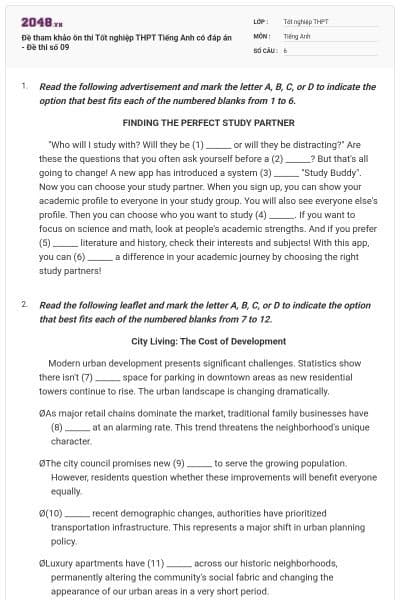
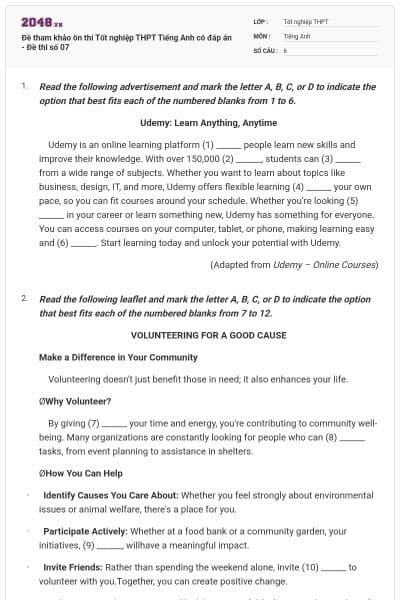
Read the following leaflet and mark the letter A, B, C, or D to indicate the option that best fits each of the numbered blanks from 7 to 12.
Save Our Forests
Let's protect nature for future generations
vFacts and figures
Every year, the world loses vast areas of forests, with nearly 15 billion trees being (7) ______ annually. Forests, which cover 31% of the Earth's land area, are crucial for maintaining biodiversity and regulating the climate. The deforestation rate in tropical regions, particularly in countries like Brazil and Indonesia, is dangerously high. This rapid forest loss accelerates global warming and the extinction of (8) ______ species.
vWhat we can do
· Reducing demand for products linked to deforestation, like palm oil and unsustainable paper, can help. Consumers can choose (9) ______ sustainable products to reduce their ecological footprint.
· Governments must pass stricter regulations to protect forests, such as enforcing land-use (10) ______ and penalizing illegal logging. Holding corporations accountable for environmental damage is crucial, (11) ______ it directly influences corporate behavior.
· Local communities should be given the tools and knowledge to protect their forests. Supporting indigenous groups and forest conservation (12) ______ is essential for long-term sustainability.
thrown away
cut down
pulled down
run out
Kiến thức về cụm động từ
A. thrown away - throw away (phr. v): vứt cái gì không cần nữa
B. cut down (phr. v): cắt giảm, giảm bớt
C. run out (phr. v): dùng hết sạch, cạn kiệt
D. pulled down - pull down (phr. v): phá hủy; kiếm tiền
- Dựa vào ngữ cảnh, ‘cut down’ là đáp án phù hợp.
Dịch: Mỗi năm, thế giới mất đi những khu vực rừng rộng lớn, với gần 15 tỷ cây bị chặt hạ hàng năm.
Chọn B.
This rapid forest loss accelerates global warming and the extinction of (8) ______ species.
each
much
many
little
Kiến thức về lượng từ
A. each + N (đếm được số ít): mỗi
B. much + N (không đếm được): nhiều
C. many + N (đếm được số nhiều): nhiều
D. little + N (không đếm được): rất ít, hầu như không có
Xét danh từ ‘species’ là danh từ đếm được số ít/số nhiều → loại B, D.
Dựa vào ngữ cảnh, ‘many’ là đáp án phù hợp.
Dịch: Sự mất rừng nhanh chóng này làm tăng tốc độ nóng lên toàn cầu và sự tuyệt chủng của nhiều loài sinh vật.
Chọn C.
· Consumers can choose (9) ______ sustainable products to reduce their ecological footprint.
certified
qualified
identified
verified
Kiến thức về từ vựng – nghĩa của từ
A. certified /ˈsɜːtɪfaɪd/ (adj): được chứng nhận, được chứng thực, được công nhận chính thức bởi một cơ quan có thẩm quyền (chứng tỏ cá nhân hoặc sản phẩm đạt một tiêu chuẩn, trình độ chuyên môn, hoặc chất lượng nhất định)
B. qualified /ˈkwɒlɪfaɪd/ (adj): đủ tư cách; đủ khả năng; đủ điều kiện; đạt tiêu chuẩn (mô tả một người có đủ trình độ, kỹ năng, hoặc phẩm chất để thực hiện một công việc nào đó)
C. identified /aɪˈdentɪfaɪd/ (adj): được nhận dạng, được xác định
D. verified /ˈverɪfaɪd/ (adj): được kiểm tra, chứng nhận, hoặc xác thực tính đúng đắn, chính xác và hợp lệ của thông tin, danh tính, hoặc đối tượng nào đó
Ta có: certified product – sản phẩm đã được chứng nhận đảm bảo.
Dịch: Người tiêu dùng có thể chọn các sản phẩm bền vững đã được chứng nhận để giảm dấu chân sinh thái của mình.
Chọn A.
properties
penalties
incentives
policies
Kiến thức về từ vựng – nghĩa của từ
A. properties - property /'prɒpəti/ (n): tài sản, của cải; đất đai, bất động sản
B. penalties - penalty /'penəlti/( n): hình phạt; cú phạt đền (bóng đá)
C. incentives - incentive /ɪn'sentɪv/ (n): sự khuyến khích, sự khích lệ
D. policies - policy /'pɒləsi/ (n): chính sách
Câu đang nói về việc chính phủ cần có những quy định, chính sách nghiêm ngặt hơn để bảo vệ rừng. Do đó, ‘policies’ là đáp án phù hợp.
Dịch: Chính phủ cần ban hành những quy định nghiêm ngặt hơn để bảo vệ rừng, chẳng hạn như thực thi các chính sách sử dụng đất và trừng phạt nạn khai thác gỗ bất hợp pháp.
Chọn D.
· Holding corporations accountable for environmental damage is crucial, (11) ______ it directly influences corporate behavior.
for fear that
given that
regardless of
instead of
Kiến thức về liên từ
A. for fear that: vì sợ rằng
B. given that: vì, xét rằng
C. regardless of: bất chấp, bất kể điều gì
D. instead of: thay vì
Câu này đang nói về việc khi các công ty buộc phải chịu trách nhiệm cho những tổn hại gây ra với môi trường, các công ty sẽ có sự thay đổi trong hành động. Hai ý được đưa ra có mối quan hệ nguyên nhân – kết quả với nhau. Do đó, ‘given that’ là đáp án phù hợp.
Dịch: Việc buộc các công ty chịu trách nhiệm về những tổn hại môi trường là điều rất quan trọng, vì nó ảnh hưởng trực tiếp đến hành vi của họ.
Chọn B.
· Supporting indigenous groups and forest conservation (12) ______ is essential for long-term sustainability.
initiatives
intimacies
indications
imitations
Kiến thức về từ vựng – nghĩa của từ
A. initiatives - initiative /ɪ'nɪʃətɪv/ (n): sáng kiến
B. intimacies - intimacy /'ɪntɪməsi/ (n): sự thân mật, sự gần gũi
C. imitations - imitation /,ɪmɪ'teɪʃn/ (n): sự bắt chước
D. indications - indication /,ɪndɪ'keɪʃn /(n): dấu hiệu; sự biểu thị
Câu này nói về việc hỗ trợ các nhóm người bản địa và các sáng kiến bảo tồn rừng sẽ đóng góp vào quá trình bền vững lâu dài. Do đó, ‘initiatives’ là đáp án phù hợp.
Dịch: Việc hỗ trợ các nhóm bản địa và các sáng kiến bảo tồn rừng là điều cần thiết để đảm bảo sự bền vững lâu dài.
Chọn A.
Bài hoàn chỉnh:
Save Our Forests
Let's protect nature for future generations
vFacts and figures
Every year, the world loses vast areas of forests, with nearly 15 billion trees being cut down annually. Forests, which cover 31% of the Earth's land area, are crucial for maintaining biodiversity and regulating the climate. The deforestation rate in tropical regions, particularly in countries like Brazil and Indonesia, is dangerously high. This rapid forest loss accelerates global warming and the extinction of many species.
vWhat we can do
· Reducing demand for products linked to deforestation, like palm oil and unsustainable paper, can help. Consumers can choose certified sustainable products to reduce their ecological footprint.
· Governments must pass stricter regulations to protect forests, such as enforcing land-use policies and penalizing illegal logging. Holding corporations accountable for environmental damage is crucial, given that it directly influences corporate behavior.
· Local communities should be given the tools and knowledge to protect their forests. Supporting indigenous groups and forest conservation initiatives is essential for long-term sustainability.
Dịch bài đọc:
Bảo vệ rừng của chúng ta
Hãy bảo vệ thiên nhiên cho các thế hệ tương lai
vSố liệu thực tế
Mỗi năm, thế giới mất đi những khu vực rừng rộng lớn, với gần 15 tỷ cây bị chặt hạ hàng năm. Rừng chiếm 31% diện tích đất của Trái Đất, nó rất quan trọng trong việc duy trì đa dạng sinh học và điều hòa khí hậu. Tỷ lệ phá rừng ở các vùng nhiệt đới, đặc biệt tại các quốc gia như Brazil và Indonesia, đang ở mức báo động. Sự mất rừng nhanh chóng này làm tăng tốc độ nóng lên toàn cầu và sự tuyệt chủng của nhiều loài sinh vật.
vNhững việc ta có thể làm
· Giảm nhu cầu sử dụng các sản phẩm có liên quan đến việc chặt phá rừng có thể giúp ích, như dầu cọ và giấy không bền vững. Người tiêu dùng có thể chọn các sản phẩm bền vững đã được chứng nhận để giảm dấu chân sinh thái của mình.
· Chính phủ cần ban hành những quy định nghiêm ngặt hơn để bảo vệ rừng, chẳng hạn như thực thi các chính sách sử dụng đất và trừng phạt nạn khai thác gỗ bất hợp pháp. Việc buộc các công ty chịu trách nhiệm về những tổn hại môi trường là điều rất quan trọng, vì nó ảnh hưởng trực tiếp đến hành vi của họ.
· Các cộng đồng địa phương cần được cung cấp công cụ và kiến thức để bảo vệ rừng. Việc hỗ trợ các nhóm bản địa và các sáng kiến bảo tồn rừng là điều cần thiết để đảm bảo sự bền vững lâu dài.
Mark the letter A, B, C, or D to indicate the best arrangement of utterances or sentences to make a meaningful exchange or text in each of the following questions from 13 to 17.
a. Grace: Almost! I just need to add a few final touches. It's been a fun but challenging project.
b. Alex: Have you finished your painting for the art exhibit?
c. Alex: I'm sure it'll turn out amazing. Your work always impresses us!
c-a-b
c-b-a
a-c-b
b-a-c
Kiến thức sắp xếp câu thành đoạn hội thoại
Thứ tự sắp xếp đúng:
b. Alex: Have you finished your painting for the art exhibit?
a. Grace: Almost! I just need to add a few final touches. It's been a fun but challenging project.
c. Alex: I'm sure it'll turn out amazing. Your work always impresses us!
Dịch:
b. Alex: Cậu đã hoàn thành bức tranh cho triển lãm nghệ thuật chưa?
a. Grace: Gần xong rồi! Tớ chỉ cần thêm một vài chi tiết cuối cùng nữa thôi. Đây là một dự án thú vị nhưng cũng đầy thử thách.
c. Alex: Tớ chắc chắn bức tranh sẽ rất đẹp. Tác phẩm của cậu luôn khiến chúng tớ ấn tượng!
Chọn D.
a. Janet: I feel more flexible, but some poses are still difficult.
b. Janet: I've been practising yoga for a month.
c. Janet: Not yet, but I will consider it.
d. Rachel: That's awesome! Have you noticed any differences so far?
e. Rachel: Why don't you join a class?
e-c-d-a-b
e-b-d-a-c
b-d-a-e-c
b-e-a-d-c
Kiến thức sắp xếp câu thành đoạn hội thoại
Thứ tự sắp xếp đúng:
b. Janet: I've been practising yoga for a month.
d. Rachel: That's awesome! Have you noticed any differences so far?
a. Janet: I feel more flexible, but some poses are still difficult.
e. Rachel: Why don't you join a class?
c. Janet: Not yet, but I will consider it.
Dịch:
b. Janet: Tớ đã tập yoga được một tháng rồi.
d. Rachel: Tuyệt đấy! Cậu có thấy sự khác biệt nào không?
a. Janet: Tớ cảm thấy dẻo dai hơn, nhưng một số tư thế vẫn còn khó.
e. Rachel: Sao cậu không tham gia một lớp học?
c. Janet: Chưa, nhưng tớ sẽ cân nhắc.
Chọn C.
Hey Kyle,
a. I've been looking forward to spending some time outdoors and relaxing by the campfire.
b. Can't wait to escape the city and enjoy nature with everyone!
c. I wanted to see if you're still planning that weekend camping trip next month.
d. I'll bring my guitar, so we can have some fun singing songs together.
e. Also, let me know if you need any help with the supplies or planning.
Talk soon,
Jordan
c-a-d-e-b
b-a-c-d-e
a-c-b-d-e
e-a-c-d-b
Kiến thức sắp xếp câu thành một lá thư
Thứ tự sắp xếp đúng:
Hey Kyle,
c. I wanted to see if you're still planning that weekend camping trip next month.
a. I've been looking forward to spending some time outdoors and relaxing by the campfire.
d. I'll bring my guitar, so we can have some fun singing songs together.
e. Also, let me know if you need any help with the supplies or planning.
b. Can't wait to escape the city and enjoy nature with everyone!
Talk soon,
Jordan
Dịch:
Chào Kyle,
c. Tớ muốn hỏi cậu xem liệu cậu còn dự định đi cắm trại cuối tuần tháng tới không.
a. Tớ rất mong được dành thời gian ở ngoài trời và thư giãn bên lửa trại.
d. Tớ sẽ mang theo đàn guitar để chúng ta có thể cùng nhau hát hò vui vẻ.
e. Ngoài ra, hãy cho tớ biết nếu cậu cần giúp đỡ gì về đồ dùng hoặc lên kế hoạch nhé.
b. Tớ rất háo hức được thoát khỏi thành phố và tận hưởng thiên nhiên cùng mọi người!
Nói chuyện sau nhé,
Jordan
Chọn A.
a. The rising demand for electricity raises concerns about possible shortages.
b. The summer heat has arrived earlier than usual this year.
c. Therefore, communities are discussing ways to promote energy efficiency in their homes.
d. This change has led to an increase in energy consumption for cooling.
e. Many people are experiencing higher temperatures than last summer.
b-e-d-a-c
d-e-a-c-b
a-d-e-b-c
e-c-d-b-a
Kiến thức sắp xếp câu thành đoạn văn
Thứ tự sắp xếp đúng:
b. The summer heat has arrived earlier than usual this year.
e. Many people are experiencing higher temperatures than last summer.
d. This change has led to an increase in energy consumption for cooling.
a. The rising demand for electricity raises concerns about possible shortages.
c. Therefore, communities are discussing ways to promote energy efficiency in their homes.
Dịch:
b. Mùa hè năm nay đến sớm hơn thường lệ.
e. Nhiều người đang trải qua nhiệt độ cao hơn so với mùa hè năm ngoái.
d. Sự thay đổi này đã dẫn đến việc tiêu thụ năng lượng cho việc làm mát tăng lên.
a. Nhu cầu điện năng tăng cao làm dấy lên lo ngại về khả năng thiếu hụt nguồn cung.
c. Do đó, các cộng đồng đang thảo luận về các cách thức để thúc đẩy tiết kiệm năng lượng trong nhà của họ.
Chọn A.
a. Although it was initially difficult to adjust, I've grown accustomed to the fast-paced work environment.
b. My team and I collaborate regularly to meet tight deadlines, which keeps me on my toes.
c. For instance, we're currently working on an important project that requires constant communication and creativity.
d. Since joining this company, I've gained a tremendous amount of experience in managing complex tasks.
e. Overall, I feel proud of the work we've accomplished and how far we've come as a team.
b-c-a-d-e
d-a-b-c-e
d-c-b-a-e
c-b-d-a-e
Kiến thức sắp xếp câu thành đoạn văn
Thứ tự sắp xếp đúng:
d. Since joining this company, I've gained a tremendous amount of experience in managing complex tasks.
a. Although it was initially difficult to adjust, I've grown accustomed to the fast-paced work environment.
b. My team and I collaborate regularly to meet tight deadlines, which keeps me on my toes.
c. For instance, we're currently working on an important project that requires constant communication and creativity.
e. Overall, I feel proud of the work we've accomplished and how far we've come as a team.
Dịch:
d. Kể từ khi làm việc tại công ty này, tôi đã tích lũy được rất nhiều kinh nghiệm trong việc quản lý các nhiệm vụ phức tạp.
a. Mặc dù ban đầu khá khó khăn để thích nghi, nhưng tôi đã quen với môi trường làm việc nhịp độ nhanh.
b. Tôi và nhóm của mình thường xuyên cộng tác để đáp ứng các thời hạn chặt chẽ, điều này giúp tôi luôn năng động.
c. Ví dụ, hiện tại chúng tôi đang thực hiện một dự án quan trọng đòi hỏi sự giao tiếp liên tục và tính sáng tạo.
e. Nhìn chung, tôi cảm thấy tự hào về những công việc chúng tôi đã hoàn thành và những tiến bộ mà cả nhóm đã đạt được.
Chọn B.
Read the following passage and mark the letter A, B, C, or D to indicate the option that best fits each of the numbered blanks from 18 to 22.
The Olympia Competition, an academic event, (18) ______. It has gained international recognition for bringing together the brightest students from across the globe. Participants are challenged with multiple rounds of rigorous academic tests, each designed to foster critical thinking, problem-solving, and innovation. (19) ______.
Utilizing sophisticated technology, (20) ______. This approach allows for a more dynamic evaluation process, ensuring that participants are assessed on a wide range of competencies.
As the competition continues to grow, there will be even greater opportunities for academic growth, (21) ______. Despite its merits, however, there are some drawbacks that we should take into account. (22) ______. Additionally, the competitive nature of the event can sometimes trigger an unhealthy atmosphere of rivalry, where students prioritize success over personal well-being. The logistical complexity of organizing the event on a large scale also raises concerns regarding accessibility for students from diverse educational backgrounds.
of which intellectual exploration and achievement were created through a platform
creates a platform for intellectual exploration and achievement
that created a platform for intellectual exploration and achievement
having been created as a platform for intellectual exploration and achievement
Kiến thức về cấu trúc câu
- Ta nhận thấy câu đã có chủ ngữ ‘The Olympia Competition’ nhưng chưa có động từ chính.
→ Câu cần một động từ chính chia theo chủ ngữ ‘The Olympia Competition’ để tạo thành câu hoàn chỉnh.
- A, C sai vì đây là các mệnh đề quan hệ, không thể đóng vai trò làm động từ chính của câu.
- B đúng vì ‘creates’ là động từ đang chia ở thì hiện tại đơn, phù hợp về mặt nghĩa và ngữ pháp.
- D sai vì ‘having been created’ là dạng bị động của phân từ hoàn thành, không thể đóng vai trò làm động từ chính của câu.
Dịch: Cuộc thi Olympia, một sự kiện học thuật, tạo ra cơ hội để khám phá và đạt được thành tựu trí tuệ.
Chọn B.
Participants are challenged with multiple rounds of rigorous academic tests, each designed to foster critical thinking, problem-solving, and innovation. (19) ______.
The passion for lifelong learning among its participants helps set Olympia's main goal
Inspiring a passion for lifelong learning among its participants, Olympia's main goal is set
The participants set Olympia's main goal to inspire a passion for lifelong learning
Olympia's main goal is to inspire a passion for lifelong learning among its participants
Kiến thức về mệnh đề độc lập - nghĩa của câu
A. Niềm đam mê học tập suốt đời của các thí sinh giúp xác định mục tiêu chính của Olympia.
→ A sai vì hai vế mục đích và kết quả bị ngược nhau.
B. Truyền cảm hứng cho niềm đam mê học tập suốt đời trong các thí sinh, mục tiêu chính của Olympia được thiết lập.
→ Loại B vì câu này chỉ mối quan hệ mục đích, trong khi cấu trúc: V-ing..., S + V dùng để diễn tả hành động xảy ra liên tiếp, đồng thời hoặc diễn tả mối quan hệ nhân quả.
C. Các thí sinh xác định mục tiêu chính của Olympia là truyền cảm hứng cho niềm đam mê học tập suốt đời.
→ C sai vì mục tiêu chính của Olympia phải được cuộc thi này đề ra, không phải do các thí sinh.
D. Mục tiêu chính của Olympia là truyền cảm hứng cho niềm đam mê học tập suốt đời trong các thí sinh.
→ D đúng vì phù hợp với ngữ cảnh.
Dịch: Mục tiêu chính của cuộc thi là khơi dậy niềm đam mê học tập suốt đời cho các thí sinh.
Chọn D.
the competition incorporates virtual and on-site rounds to track participants' progress in real-time
the progress of participants in real-time is incorporated during the competition
real-time tracking of participants' progress is allowed during the competition
the progress is tracked in real-time for participants during the competition
Kiến thức về phân từ hiện tại
* Xét nghĩa các đáp án:
A. cuộc thi kết hợp các vòng thi trực tuyến và trực tiếp, giúp theo dõi tiến độ của thí sinh trong thời gian thực
B. tiến độ của thí sinh được theo dõi theo thời gian thực trong suốt cuộc thi
C. việc theo dõi tiến độ của thí sinh theo thời gian thực được thực hiện trong cuộc thi
D. tiến độ được theo dõi theo thời gian thực đối với thí sinh trong suốt cuộc thi
- Căn cứ vào mệnh đề ‘Utilizing sophisticated technology’ ta suy ra câu này dùng cấu trúc: V-ing..., S + V mà điều kiện để dùng dạng này là hai mệnh đề phải đồng chủ ngữ.
- Xét về nghĩa, ‘the progress of participants in real-time’, ‘real-time tracking of participants' progress’, ‘the progress’ không thể là chủ ngữ của vế trước ‘Utilizing sophisticated technology’. Do đó, ta loại B, C, D.
- Chỉ có cuộc thi Olympia mới có thể ứng dụng các công nghệ tiên tiến. Chọn B.
Dịch: Sử dụng các công nghệ tiên tiến, cuộc thi kết hợp các vòng thi trực tuyến và trực tiếp, giúp theo dõi tiến độ của thí sinh trong thời gian thực.
Chọn A.
to empower students to unleash their creativity and make significant contributions to global advancements
having empowered students to unleash their creativity and make significant contributions to global advancements
which will empower students to unleash their creativity and make significant contributions to global advancements
who will empower students to unleash their creativity and make significant contributions to global advancements
Kiến thức về mệnh đề quan hệ
- Căn cứ vào câu đã có một động từ chính được chia theo thì tương lai đơn (will be), vì vậy chỗ trống ta cần một mệnh đề quan hệ hoặc động từ chia theo dạng rút gọn mệnh đề quan hệ → loại A, B.
→ C đúng vì là một mệnh đề quan hệ hoàn chỉnh, có đại từ quan hệ ‘which’ bổ nghĩa cho danh từ ‘opportunities’ ở đằng trước.
→ Loại D vì dùng đại từ ‘who’ dùng để chỉ người, không thay thế cho ‘there will be even greater opportunities for academic growth’.
Dịch: Khi cuộc thi ngày càng phát triển, sẽ có thêm nhiều cơ hội học thuật, giúp học sinh phát huy sáng tạo và đóng góp vào những tiến bộ toàn cầu.
Chọn C.
Many students always tend to prioritize their personal lives over academic performance, causing them to feel discouraged
For some students, the intense pressure and competitive environment may make them feel overwhelmed and lead to negative consequences
Some students might feel excluded from the competition, bolstering their self-esteem and motivation in the long term
Students will find it easier to cope with the competition's challenges by forming lasting connections with their peers
Kiến thức về mệnh đề độc lập - nghĩa của câu
A. Nhiều học sinh thường có xu hướng ưu tiên đời sống cá nhân hơn là kết quả học tập, khiến họ cảm thấy nản lòng
→ Loại A vì nói về việc ưu tiên cuộc sống cá nhân, không liên quan đến những hạn chế của cuộc thi Olympia.
B. Đối với một số học sinh, áp lực và môi trường cạnh tranh gay gắt có thể khiến các em cảm thấy căng thẳng, dẫn đến những ảnh hưởng tiêu cực.
→ B đúng vì liên kết tới câu trước, bàn luận về điểm hạn chế của cuộc thi.
C. Một số học sinh có thể cảm thấy bị loại trừ khỏi cuộc thi, điều này có thể giúp họ củng cố lòng tự trọng và động lực trong dài hạn
→ Loại C vì nói về cảm giác bị loại khỏi cuộc thi, không liên quan đến hạn chế mà câu trước đề cập đến.
D. Học sinh sẽ dễ dàng vượt qua các thử thách của cuộc thi hơn khi tạo dựng được những mối quan hệ lâu dài với bạn bè
→ Loại D vì không liên quan đến những hạn chế của cuộc thi Olympia.
Dịch: Đối với một số học sinh, áp lực và môi trường cạnh tranh gay gắt có thể khiến các em cảm thấy căng thẳng, dẫn đến những ảnh hưởng tiêu cực.
Chọn B.
Bài hoàn chỉnh:
The Olympia Competition, an academic event, creates a platform for intellectual exploration and achievement. It has gained international recognition for bringing together the brightest students from across the globe. Participants are challenged with multiple rounds of rigorous academic tests, each designed to foster critical thinking, problem-solving, and innovation. Olympia's main goal is to inspire a passion for lifelong learning among its participants.
Utilizing sophisticated technology, the competition incorporates virtual and on-site rounds to track participants' progress in real-time. This approach allows for a more dynamic evaluation process, ensuring that participants are assessed on a wide range of competencies.
As the competition continues to grow, there will be even greater opportunities for academic growth, which will empower students to unleash their creativity and make significant contributions to global advancements. Despite its merits, however, there are some drawbacks that we should take into account. For some students, the intense pressure and competitive environment may make them feel overwhelmed and lead to negative consequences. Additionally, the competitive nature of the event can sometimes trigger an unhealthy atmosphere of rivalry, where students prioritize success over personal well-being. The logistical complexity of organizing the event on a large scale also raises concerns regarding accessibility for students from diverse educational backgrounds.
Dịch bài đọc:
Cuộc thi Olympia, một sự kiện học thuật, tạo ra cơ hội để khám phá và đạt được thành tựu trí tuệ. Cuộc thi đã nhận được sự công nhận quốc tế nhờ vào việc quy tụ những học sinh xuất sắc từ khắp nơi trên thế giới. Các thí sinh đối mặt với nhiều vòng thi học thuật khắt khe, được thiết kế để phát triển tư duy phản biện, khả năng giải quyết vấn đề và sáng tạo. Mục tiêu chính của cuộc thi là khơi dậy niềm đam mê học tập suốt đời cho các thí sinh.
Sử dụng các công nghệ tiên tiến, cuộc thi kết hợp các vòng thi trực tuyến và trực tiếp, giúp theo dõi tiến độ của thí sinh trong thời gian thực. Phương pháp này cho phép đánh giá linh hoạt hơn, bảo đảm thí sinh được kiểm tra trên nhiều khía cạnh năng lực khác nhau.
Khi cuộc thi ngày càng phát triển, sẽ có thêm nhiều cơ hội học thuật, giúp học sinh phát huy sáng tạo và đóng góp vào những tiến bộ toàn cầu. Mặc dù có nhiều lợi ích, cuộc thi cũng đối mặt với một số thách thức cần được xem xét. Đối với một số học sinh, áp lực và môi trường cạnh tranh gay gắt có thể khiến các em cảm thấy căng thẳng, dẫn đến những ảnh hưởng tiêu cực. Hơn nữa, tính chất cạnh tranh của cuộc thi đôi khi tạo ra bầu không khí ganh đua không lành mạnh, nơi thành công được đặt lên trên sức khỏe tinh thần và thể chất. Ngoài ra, việc tổ chức sự kiện quy mô lớn cũng đặt ra vấn đề về khả năng tiếp cận đối với học sinh đến từ các nền tảng giáo dục khác nhau.
Read the following passage and mark the letter A, B, C, or D on your answer sheet to indicate the best answer to each of the following questions from 23 to 30.
Lisbon, which has been the capital of Portugal since 1252, is both beautiful and historic. Today, visitors can spend their time walking across Lisbon's beautiful squares, exploring the city's narrow streets and wide range of shopping opportunities - from high-end designer shops to market stalls. Or, they can simply sit in the wonderful cafés and restaurants which serve great local food.
Lisbon is rich in ancient cultural delights. Under the busy shopping area in the city centre, there is a hidden network of 2,000-year-old Roman rooms. If history is your passion, Lisbon certainly won't disappoint. There are many other places to visit: the Gulbenkian Museum, the 16th century Jeronimos Monastery, the Castle of St George, and the wonderful Alfama district, with its lively eateries and traditional Fado music.
If you are hoping to travel around and see more of the city, there are various options. You might like to jump on the old tram system, which has been in use from 1873, or go on a bike tour of the city or a river cruise. You could also visit the zoo, the modern Pavilion of Knowledge, which is Lisbon's own interactive science museum, or one of the largest indoor aquariums in Europe, the Oceanarium.
Lisbon is one of the few European cities lucky enough to be so close to sandy beaches, which are rarely overcrowded, except perhaps in August. However, it's not just a summer destination either. Lisbon has one of the mildest climates of any European cities, making it good to visit all year around.
The word ‘they’ in paragraph 1 refers to ______.
squares
shops
tourists
market stalls
Kiến thức về từ quy chiếu
Từ ‘they’ trong đoạn 1 chỉ ______.
A. squares (n): quảng trường
B. shops (n): cửa hàng
C. tourists (n): du khách
D. market stalls (n): quầy hàng chợ
Thông tin: Today, visitors can spend their time walking across Lisbon's beautiful squares, exploring the city's narrow streets and wide range of shopping opportunities - from high-end designer shops to market stalls. Or, they can simply sit in the wonderful cafés and restaurants which serve great local food. (Ngày nay, du khách có thể dành thời gian đi dạo quanh những quảng trường xinh đẹp của Lisbon, khám phá những con phố nhỏ hẹp và vô số cơ hội mua sắm - từ các cửa hàng thiết kế cao cấp đến các quầy hàng chợ. Hoặc, đơn giản là họ có thể ngồi trong những quán cà phê và nhà hàng tuyệt vời phục vụ các món ăn địa phương ngon miệng.)
→ Từ ‘they’ nhắc tới ‘visitors’ ở phía trước.
Chọn C.
According to paragraph 1, tourists can do all the following when visiting Lisbon EXCEPT ______.
browsing clothes stores
walking through beautiful squares
trying local dishes
watching parades in narrow streets
Kiến thức về thông tin chi tiết
Theo đoạn 1, khách du lịch có thể làm tất cả những điều sau đây khi đến thăm Lisbon, NGOẠI TRỪ ______.
A. dạo quanh các cửa hàng quần áo
B. đi bộ qua các quảng trường xinh đẹp
C. thử các món ăn địa phương
D. xem các cuộc diễu hành trên các con phố hẹp
Thông tin:
- Today, visitors can spend their time walking across Lisbon's beautiful squares, exploring the city's narrow streets and wide range of shopping opportunities - from high-end designer shops to market stalls. Or, they can simply sit in the wonderful cafés and restaurants which serve great local food. (Ngày nay, du khách có thể dành thời gian đi dạo quanh những quảng trường xinh đẹp của Lisbon, khám phá những con phố nhỏ hẹp và vô số cơ hội mua sắm - từ các cửa hàng thiết kế cao cấp đến các quầy hàng chợ. Hoặc, đơn giản là họ có thể ngồi trong những quán cà phê và nhà hàng tuyệt vời phục vụ các món ăn địa phương ngon miệng.)
→ A, B, C được đề cập.
Chọn D.
The word ‘delights’ in paragraph 2 mostly means ______.
features
habits
feelings
joys
Kiến thức về từ vựng gần nghĩa
Từ ‘delights’ ở đoạn 2 có thể được thay thế bằng từ ______.
A. features – feature /ˈfiːtʃə(r)/ (n): tính năng, đặc điểm
B. habits – habit /ˈhæbɪt/ (n): thói quen
C. feelings – feeling /ˈfiːlɪŋ/ (n): cảm xúc
D. joys – joy /dʒɔɪ/ (n): sự vui mừng, niềm vui
→ delights – delight /dɪˈlaɪt/ (n): sự vui thích, điều thích thú = joys – joy /dʒɔɪ/ (n): sự vui mừng, niềm vui
Thông tin: Lisbon is rich in ancient cultural delights. (Lisbon sở hữu nhiều di sản văn hóa cổ đại.)
Chọn D.
The word ‘various’ in paragraph 3 is OPPOSITE in meaning to ______.
top-rated
numerous
restricted
customary
Kiến thức về từ vựng trái nghĩa
Cụm từ ‘various’ trong đoạn 3 TRÁI NGHĨA với ______.
A. top-rated /ˌtɒp ˈreɪtɪd/ (adj): được đánh giá cao
B. numerous /ˈnjuːmərəs/ (adj): đông, nhiều
C. restricted /rɪˈstrɪktɪd/ (adj): bị hạn chế, có giới hạn
D. customary /ˈkʌstəməri/ (adj): thông thường, theo lệ thường
→ various /ˈveəriəs/ (adj): đa dạng, khác nhau >< restricted /rɪˈstrɪktɪd/ (adj): bị hạn chế, có giới hạn
Thông tin: If you are hoping to travel around and see more of the city, there are various options. (Nếu bạn muốn đi du lịch vòng quanh và khám phá thêm thành phố, có nhiều lựa chọn khác nhau.)
Chọn C.
Which of the following best paraphrases the underlined sentence in paragraph 4?
Lisbon’s mild climate, one of the most comfortable in Europe, makes it a great year-round destination.
Lisbon has one of Europe’s mildest climates, making it an ideal place to visit throughout the year.
Lisbon’s weather is known for its warmth, making it an attractive destination in every season.
Lisbon is pleasant all year due to its warm, mild weather that draws visitors from across Europe.
Kiến thức về paraphrasing
Câu nào sau đây diễn giải lại đúng nhất câu được gạch chân trong đoạn 4?
A. Khí hậu ôn hòa của Lisbon, một trong những khí hậu dễ chịu nhất ở châu Âu, khiến nơi đây trở thành điểm đến tuyệt vời quanh năm.
B. Lisbon có một trong những khí hậu ôn hòa nhất ở châu Âu, khiến nơi đây trở thành địa điểm lý tưởng để tham quan quanh năm.
C. Thời tiết ở Lisbon nổi tiếng với sự ấm áp, khiến nơi đây trở thành điểm đến hấp dẫn trong mọi mùa.
D. Lisbon dễ chịu quanh năm nhờ thời tiết ấm áp, ôn hòa thu hút du khách từ khắp châu Âu.
Câu gạch chân: Lisbon has one of the mildest climates of any European cities, making it good to visit all year around. (Lisbon có khí hậu ôn hòa nhất trong số các thành phố châu Âu, khiến nơi đây trở thành điểm đến lý tưởng quanh năm.)
Chọn B.
Which of the following is true according to the passage?
The Pavilion of Knowledge is the only interactive science museum in Lisbon.
Famous beaches in Lisbon hardly get overcrowded, especially in August.
2,000-year-old Roman rooms are located in busy shopping streets in Lisbon.
Lisbon offers a variety of transportation options for exploring the city.
Kiến thức về thông tin đúng/sai
Điều nào sau đây là ĐÚNG theo như bài đọc?
A. Bảo tàng Tri thức là bảo tàng khoa học tương tác duy nhất ở Lisbon.
B. Các bãi biển nổi tiếng ở Lisbon hiếm khi quá đông đúc, đặc biệt là vào tháng Tám.
C. Các căn phòng La Mã 2.000 năm tuổi nằm trên các con phố mua sắm sầm uất ở Lisbon.
D. Lisbon cung cấp nhiều lựa chọn phương tiện giao thông để khám phá thành phố.
Thông tin:
- You could also visit the zoo, the modern Pavilion of Knowledge, which is Lisbon's own interactive science museum, or one of the largest indoor aquariums in Europe, the Oceanarium. (Bạn cũng có thể ghé thăm sở thú, Bảo tàng Tri thức hiện đại, bảo tàng khoa học tương tác của Lisbon, hoặc một trong những thủy cung trong nhà lớn nhất châu Âu, Oceanarium.) → A sai vì không có thông tin nào về việc đây là bảo tàng khoa học tương tác duy nhất ở Lisbon.
- Lisbon is one of the few European cities lucky enough to be so close to sandy beaches, which are rarely overcrowded, except perhaps in August. (Lisbon là một trong số ít thành phố châu Âu may mắn nằm gần những bãi biển cát trắng, hiếm khi quá đông đúc, có lẽ ngoại trừ vào tháng Tám.) → B sai vì tháng Tám là lúc các bãi biển trở nên đông đúc.
- Under the busy shopping area in the city centre, there is a hidden network of 2,000-year-old Roman rooms. (Bên dưới khu mua sắm nhộn nhịp ở trung tâm thành phố, có một mạng lưới các phòng La Mã 2.000 năm tuổi được giấu kín.) → C sai vì các phòng La Mã nằm phía dưới khu mua sắm, không phải ở trên các con phố mua sắm.
- If you are hoping to travel around and see more of the city, there are various options. (Nếu bạn muốn đi du lịch vòng quanh và khám phá thêm thành phố, có nhiều lựa chọn khác nhau.) → D đúng.
Chọn D.
In which paragraph does the writer suggest some places for travelers who are keen on going back in time?
Paragraph 1
Paragraph 2
Paragraph 3
Paragraph 4
Kiến thức về thông tin theo đoạn
Trong đoạn nào, tác giả gợi ý một số địa điểm dành cho những du khách muốn quay ngược thời gian?
A. Đoạn 1 B. Đoạn 2 C. Đoạn 3 D. Đoạn 4
Thông tin: If history is your passion, Lisbon certainly won't disappoint. There are many other places to visit: the Gulbenkian Museum, the 16th century Jeronimos Monastery, the Castle of St George, and the wonderful Alfama district, with its lively eateries and traditional Fado music. (Nếu bạn đam mê lịch sử, Lisbon chắc chắn sẽ không làm bạn thất vọng. Có rất nhiều địa điểm khác để tham quan: Bảo tàng Gulbenkian, Tu viện Jeronimos thế kỷ 16, Lâu đài Thánh George và khu phố Alfama tuyệt vời, với những quán ăn sôi động và âm nhạc Fado truyền thống.)
Chọn B.
In which paragraph does the writer mention a contrast relationship?
Paragraph 1
Paragraph 2
Paragraph 3
Paragraph 4
Kiến thức về thông tin theo đoạn
Trong đoạn nào, tác giả đề cập đến mối quan hệ tương phản?
A. Đoạn 1 B. Đoạn 2 C. Đoạn 3 D. Đoạn 4
Thông tin: Lisbon is one of the few European cities lucky enough to be so close to sandy beaches, which are rarely overcrowded, except perhaps in August. However, it's not just a summer destination either. (Lisbon là một trong số ít thành phố châu Âu may mắn nằm gần những bãi biển cát trắng, hiếm khi quá đông đúc, có lẽ ngoại trừ vào tháng Tám. Tuy nhiên, Lisbon không chỉ là điểm đến vào mùa hè.)
Chọn D.
Dịch bài đọc:
Lisbon, thủ đô của Bồ Đào Nha từ năm 1252, vừa xinh đẹp vừa giàu lịch sử. Ngày nay, du khách có thể dành thời gian đi dạo quanh những quảng trường xinh đẹp của Lisbon, khám phá những con phố nhỏ hẹp và vô số cơ hội mua sắm - từ các cửa hàng thiết kế cao cấp đến các quầy hàng chợ. Hoặc, đơn giản là họ có thể ngồi trong những quán cà phê và nhà hàng tuyệt vời phục vụ các món ăn địa phương ngon miệng.
Lisbon sở hữu nhiều di sản văn hóa cổ đại. Bên dưới khu mua sắm nhộn nhịp ở trung tâm thành phố, có một mạng lưới các phòng La Mã 2.000 năm tuổi được giấu kín. Nếu bạn đam mê lịch sử, Lisbon chắc chắn sẽ không làm bạn thất vọng. Có rất nhiều địa điểm khác để tham quan: Bảo tàng Gulbenkian, Tu viện Jeronimos thế kỷ 16, Lâu đài Thánh George và khu phố Alfama tuyệt vời, với những quán ăn sôi động và âm nhạc Fado truyền thống.
Nếu bạn muốn đi du lịch vòng quanh và khám phá thêm thành phố, có nhiều lựa chọn khác nhau. Bạn có thể thử trải nghiệm hệ thống xe điện cổ, đã được sử dụng từ năm 1873, hoặc tham gia một tour xe đạp quanh thành phố hay một chuyến du ngoạn trên sông. Bạn cũng có thể ghé thăm sở thú, Bảo tàng Tri thức hiện đại, bảo tàng khoa học tương tác của Lisbon, hoặc một trong những thủy cung trong nhà lớn nhất châu Âu, Oceanarium.
Lisbon là một trong số ít thành phố châu Âu may mắn nằm gần những bãi biển cát trắng, hiếm khi quá đông đúc, có lẽ ngoại trừ vào tháng Tám. Tuy nhiên, Lisbon không chỉ là điểm đến vào mùa hè. Lisbon có khí hậu ôn hòa nhất trong số các thành phố châu Âu, khiến nơi đây trở thành điểm đến lý tưởng quanh năm.
Read the following passage and mark the letter A, B, C, or D to indicate the best answer to each of the following questions from 31 to 40.
[I] Urbanization is growing very quickly in developing countries, particularly in Africa, Asia, and Latin America, where millions of people are leaving rural areas to settle in cities. [II] Many of these people move because they hope to find better-paying jobs in factories, offices, or construction, which are often more available in urban areas. [III] Others come to cities for better education opportunities, like schools and universities, which can help their children have a brighter future. Access to healthcare is another big reason - cities usually have more hospitals and doctors than villages, making it easier for families to stay healthy. [IV]
Cities offer many opportunities. For example, in India, cities like Mumbai and Delhi have grown because they provide work in factories, offices, and technology companies. People also enjoy better schools, hospitals, and transportation, like buses and trains. However, this rapid growth creates big challenges. Many cities become overcrowded, and there aren’t enough houses for everyone. This leads to slums - poor areas with no clean water, electricity, or good roads. Traffic jams and pollution also get worse as more cars and factories fill the air with smoke and noise.
Another problem is how cities expand into rural areas. When cities grow, they often take over farmland, leaving less space for farming. This can make food more expensive and harder to find. For instance, in Nairobi, Kenya, urban areas have spread quickly, but not all neighborhoods have enough services like clean water or waste management. Some areas also face flooding because of poor planning and too much concrete, which stops rainwater from soaking into the ground.
Experts say urban planning is key to solving these problems. Governments need to build more affordable housing, improve roads, and create green spaces like parks. Using clean energy, such as solar power, can reduce pollution. In some cities, like Seoul, South Korea, officials have used land-use plans to manage growth carefully, balancing new buildings with nature. Community groups also play a role by mapping needs and working with leaders to provide better services.
Urbanization won’t stop, but it can be managed better. Cities should grow in a way that’s sustainable - meaning they’re good for people and the environment. If leaders plan well, urbanization can bring progress without harming the planet or leaving people behind. It’s a big challenge, but with the right actions, cities can become better places for everyone.
Where in paragraph 1 does the following sentence best fit?
This rapid movement is creating both exciting possibilities and big challenges for these growing urbanregions, as they try to support so many new residents.
[II]
[III]
[IV]
[I]
Kiến thức về điền câu phù hợp vào đoạn
Câu sau đây phù hợp nhất ở vị trí nào trong đoạn 1?
Sự thay đổi nhanh chóng này đang tạo ra cả những cơ hội thú vị và những thách thức lớn cho các khu vực đô thị đang phát triển này, khi họ cố gắng hỗ trợ một lượng lớn cư dân mới.
A. [II] B. [III] C. [IV] D. [I]
→ Câu trên phù hợp ở vị trí [IV] vì nó phù hợp làm câu kết đoạn và liên kết mạch lạc với những câu phía trước đề cập về những thay đổi mà đô thị hóa đem lại.
Chọn C.
The word ‘they’ in paragraph 2 refers to ______.
people
opportunities
cities
hospitals
Kiến thức về từ quy chiếu
Từ ‘they’ trong đoạn 2 chỉ ______.
A. people (n): con người
B. opportunities (n): cơ hội
C. cities (n): thành phố
D. hospitals (n): bệnh viện
Thông tin: For example, in India, cities like Mumbai and Delhi have grown because they provide work in factories, offices, and technology companies. (Ví dụ, ở Ấn Độ, các thành phố như Mumbai và Delhi phát triển vì các thành phố này đem đến việc làm trong các nhà máy, văn phòng và công ty công nghệ.)
→ Từ ‘they’ nhắc tới ‘cities’ ở phía trước.
Chọn C.
Loss of farmland
Increased food prices
More job opportunities
Flooding due to poor planning
Kiến thức về thông tin chi tiết
Theo đoạn 3, điều nào sau đây KHÔNG phải là vấn đề do sự mở rộng đô thị gây ra?
A. Mất đất nông nghiệp B. Giá lương thực tăng cao
C. Nhiều cơ hội việc làm hơn D. Lũ lụt do quy hoạch kém
Thông tin:
- When cities grow, they often take over farmland, leaving less space for farming. (Khi các thành phố phát triển, chúng thường chiếm dụng đất nông nghiệp, để lại ít không gian hơn cho nông nghiệp.) → A được đề cập.
- This can make food more expensive and harder to find. (Điều này có thể làm cho thực phẩm trở nên đắt đỏ hơn và khó tìm hơn.) → B được đề cập.
- Some areas also face flooding because of poor planning and too much concrete, which stops rainwater from soaking into the ground. (Một số khu vực cũng phải đối mặt với lũ lụt do quy hoạch kém và quá nhiều bê tông, khiến nước mưa không thể thấm vào lòng đất.) → D được đề cập.
Chọn C.
Which of the following best summarizes paragraph 2?
Cities provide many benefits, but rapid growth leads to problems like slums and pollution.
Rural areas are disappearing as cities expand quickly, but causing no problems to humans.
Traffic jams and pollution are the only problems caused by urbanization in developed countries.
Cities in developed countries do not experience urbanization issues, except environmental pollution.
Kiến thức về ý chính của đoạn
Câu nào sau đây tóm tắt đoạn 2 đúng nhất?
A. Các thành phố mang lại nhiều lợi ích, nhưng sự phát triển nhanh chóng dẫn đến các vấn đề như khu ổ chuột và ô nhiễm.
B. Khu vực nông thôn đang biến mất trong khi các thành phố mở rộng nhanh chóng, nhưng điều này không gây ra vấn đề gì cho con người.
C. Tắc nghẽn giao thông và ô nhiễm là những vấn đề duy nhất do đô thị hóa gây ra ở các nước phát triển.
D. Các thành phố ở các nước phát triển không gặp phải các vấn đề đô thị hóa, ngoại trừ ô nhiễm môi trường.
Thông tin: However, this rapid growth creates big challenges. Many cities become overcrowded, and there aren’t enough houses for everyone. This leads to slums - poor areas with no clean water, electricity, or good roads. Traffic jams and pollution also get worse as more cars and factories fill the air with smoke and noise. (Tuy nhiên, sự tăng trưởng nhanh chóng này cũng tạo ra những thách thức lớn. Nhiều thành phố trở nên quá tải dân số, và không có đủ nhà ở cho tất cả mọi người. Điều này dẫn đến sự hình thành các khu ổ chuột - những khu vực nghèo khó không có nước sạch, điện hoặc đường sá tốt. Tình trạng tắc nghẽn giao thông và ô nhiễm cũng trở nên tồi tệ hơn khi ngày càng nhiều xe cộ và nhà máy thải ra khói và tiếng ồn.)
→ Đoạn 2 liệt kê những cơ hội mà thành phố đem lại, song cũng chỉ ra rằng quá trình tăng trưởng nhanh đã dẫn đến các vấn đề như hình thành khu ổ chuột và ô nhiễm. Đáp án A thể hiện đúng trọng tâm này.
Chọn A.
grow
shrink
rise
spread
Kiến thức về từ vựng trái nghĩa
Từ ‘expand’ trong đoạn 3 TRÁI NGHĨA với ______.
A. grow /ɡrəʊ/ (v): phát triển, lớn lên
B. shrink /ʃrɪŋk/ (v): co lại, thu hẹp lại
C. rise /raɪz/ (v): tăng lên, lớn lên
D. spread /spred/ (v): lan truyền
→ expand /ɪkˈspænd/ (v): mở rộng >< shrink /ʃrɪŋk/ (v): co lại, thu hẹp lại
Thông tin: Another problem is how cities expand into rural areas. (Một vấn đề khác là cách các thành phố mở rộng vào các khu vực nông thôn.)
Chọn B.
city destruction
city organization
rural development
economic planning
Kiến thức về từ vựng gần nghĩa
Cụm từ ‘urban planning’ ở đoạn 4 có thể được thay thế bằng ______.
A. sự phá hủy thành phố B. tổ chức thành phố
C. phát triển nông thôn D. quy hoạch kinh tế
→ urban planning: quy hoạch đô thị = city organization: tổ chức thành phố
Thông tin: Experts say urban planning is key to solving these problems. (Các chuyên gia cho rằng quy hoạch đô thị là chìa khóa để giải quyết những vấn đề này.)
Chọn B.
Urbanization happens only in rich countries.
All cities in Africa manage their growth well.
Poor urban planning can lead to flooding.
The world’s urban population is decreasing.
Kiến thức về thông tin đúng/sai
Điều nào sau đây là ĐÚNG theo như bài đọc?
A. Đô thị hóa chỉ xảy ra ở các nước giàu có.
B. Tất cả các thành phố ở châu Phi đều quản lý tốt sự phát triển của mình.
C. Quy hoạch đô thị kém có thể dẫn đến lũ lụt.
D. Dân số đô thị trên thế giới đang giảm.
Thông tin:
- Urbanization is growing very quickly in developing countries, particularly in Africa, Asia, and Latin America, where millions of people are leaving rural areas to settle in cities. (Quá trình đô thị hóa đang diễn ra rất nhanh ở các nước đang phát triển, đặc biệt là ở châu Phi, châu Á và Mỹ Latinh, nơi hàng triệu người rời bỏ vùng nông thôn để định cư ở thành phố.) → A, D sai vì đô thị hóa không hề giảm, và đang diễn ra nhanh ở các nước đang diễn ra.
- For instance, in Nairobi, Kenya, urban areas have spread quickly, but not all neighborhoods have enough services like clean water or waste management. (Ví dụ, ở Nairobi, Kenya, các khu vực đô thị đã lan rộng nhanh chóng, nhưng không phải tất cả các khu dân cư đều có đủ các dịch vụ như nước sạch hoặc quản lý chất thải.) → B sai vì có một số thành phố ở châu phi chưa quản lý tốt được các khu vực đô thị.
- Some areas also face flooding because of poor planning and too much concrete, which stops rainwater from soaking into the ground. (Một số khu vực cũng phải đối mặt với lũ lụt do quy hoạch kém và quá nhiều bê tông, khiến nước mưa không thể thấm vào lòng đất.) → C đúng.
Chọn C.
Which of the following best paraphrases the underlined sentence in paragraph 5?
Urbanization will continue, but it needs to be controlled for sustainability.
Urbanization should be stopped completely to protect the environment.
Most cities around the world must stop growing to prevent pollution.
Urbanization is a temporary issue that will disappear in the next century.
Kiến thức về paraphrasing
Câu nào sau đây diễn giải lại đúng nhất câu được gạch chân trong đoạn 5?
A. Đô thị hóa sẽ tiếp tục diễn ra, nhưng cần được kiểm soát để đảm bảo tính bền vững.
B. Đô thị hóa cần được dừng lại hoàn toàn để bảo vệ môi trường.
C. Hầu hết các thành phố trên thế giới phải ngừng phát triển để ngăn ngừa ô nhiễm.
D. Đô thị hóa là một vấn đề tạm thời và sẽ biến mất trong thế kỷ tới.
Câu gạch chân: Urbanization won’t stop, but it can be managed better. (Đô thị hóa sẽ không dừng lại, nhưng nó có thể được quản lý tốt hơn.)
Chọn A.
Which of the following can be inferred from the passage?
Governments play a key role in making urbanization sustainable.
Most cities in Africa and Asia have no urbanization challenges.
Urbanization in developing countries will stop in the next 50 years.
The process of expanding cities does not affect the environment.
Kiến thức về thông tin suy luận
Câu nào sau đây có thể suy ra từ bài đọc?
A. Chính phủ đóng vai trò quan trọng trong việc đảm bảo quá trình đô thị hóa bền vững.
B. Hầu hết các thành phố ở châu Phi và châu Á không gặp phải thách thức nào về đô thị hóa.
C. Quá trình đô thị hóa ở các nước đang phát triển sẽ dừng lại trong 50 năm tới.
D. Quá trình mở rộng thành phố không ảnh hưởng đến môi trường.
Thông tin:
- If leaders plan well, urbanization can bring progress without harming the planet or leaving people behind. (Nếu các nhà lãnh đạo có kế hoạch tốt, quá trình đô thị hóa có thể mang lại tiến bộ mà không gây hại cho hành tinh hay bỏ lại người dân phía sau.)
→ A đúng.
- B sai vì không có thông tin trong bài đọc.
- Urbanization won’t stop, but it can be managed better. (Đô thị hóa sẽ không dừng lại, nhưng nó có thể được quản lý tốt hơn.)
→ C sai vì trong bài đề cập đến việc đô thị hóa sẽ không dừng lại. Ngoài ra, không có thông tin nào về việc đô thị hóa sẽ chững lại sau bao lâu.
- However, this rapid growth creates big challenges… Traffic jams and pollution also get worse as more cars and factories fill the air with smoke and noise. (Tuy nhiên, sự tăng trưởng nhanh chóng này cũng tạo ra những thách thức lớn… Tình trạng tắc nghẽn giao thông và ô nhiễm cũng trở nên tồi tệ hơn khi ngày càng nhiều xe cộ và nhà máy thải ra khói và tiếng ồn.)
→ D sai vì quá trình đô thị hóa gây ô nhiễm môi trường.
Chọn A.
Which of the following best summarizes the passage?
Cities are growing rapidly, resulting in opportunities and problems, so proper urban planning and sustainability measures are needed.
Urbanization is only a problem in poor countries, and developed nations do not face any challenges related to city expansion.
People are moving to cities in search of better jobs, and governments are implementing sustainable urbanization practices to prevent pollution.
Many cities are expanding into rural areas, but this trend causes no negative effects on the environment as well as people's lives.
Kiến thức về ý chính toàn bài
Câu nào sau đây tóm tắt đúng nhất bài đọc?
A. Các thành phố đang phát triển nhanh chóng, dẫn đến cả cơ hội và vấn đề, vì vậy cần có kế hoạch quy hoạch đô thị hợp lý và các biện pháp bền vững.
B. Đô thị hóa chỉ là vấn đề ở các nước nghèo, còn các nước phát triển không gặp phải bất kỳ thách thức nào liên quan đến sự mở rộng thành phố.
C. Người dân đang di chuyển đến các thành phố để tìm kiếm việc làm tốt hơn, và chính phủ đang thực hiện các biện pháp đô thị hóa bền vững để ngăn ngừa ô nhiễm.
D. Nhiều thành phố đang mở rộng vào các khu vực nông thôn, nhưng xu hướng này không gây ra tác động tiêu cực nào đến môi trường cũng như cuộc sống của người dân.
* Tóm tắt:
Đoạn 1: Đô thị hóa đang diễn ra nhanh chóng ở các nước đang phát triển.
Đoạn 2: Những cơ hội cũng như những thách thức, vấn đề ở thành phố.
Đoạn 3: Những vấn đề khi thành phố mở rộng tới khu vực nông thôn.
Đoạn 4: Quy hoạch đô thị là giải pháp cho những vấn đề mà đô thị hóa gây ra.
Đoạn 5: Đô thị hóa có thể được quản lý tốt hơn và phát triển một cách bền vững.
→ A là lựa chọn chính xác và đầy đủ nhất.
* Xét các đáp án còn lại:
- B sai vì không có thông tin trong bài đọc.
- C sai vì mới chỉ đề cập đến mục đích người dân chuyển đến sống ở thành phố và biện pháp ngăn ngừa ô nhiễm, là những ý nhỏ trong bài, chứ chưa nêu ra ý chính là những cơ hội và thách thức mà thành phố đem lại.
- D sai vì quá trình đô thị hóa có gây ra những ảnh hưởng đến môi trường và cuộc sống của người dân, như ô nhiễm, ùn tắc giao thông, hình thành các khu ổ chuột,…
Chọn A.
Dịch bài đọc:
Quá trình đô thị hóa đang diễn ra rất nhanh ở các nước đang phát triển, đặc biệt là ở châu Phi, châu Á và Mỹ Latinh, nơi hàng triệu người rời bỏ vùng nông thôn để định cư ở thành phố. Nhiều người đi vì hy vọng tìm được việc làm có mức lương cao hơn trong các nhà máy, văn phòng hoặc ngành xây dựng, những công việc thường có nhiều hơn ở đô thị. Những người khác đến thành phố để có cơ hội giáo dục tốt hơn, như trường học và đại học, giúp con cái họ có một tương lai tươi sáng hơn. Việc tiếp cận dịch vụ chăm sóc sức khỏe cũng là một lý do quan trọng khác - các thành phố thường có nhiều bệnh viện và bác sĩ hơn các làng quê, giúp các gia đình dễ dàng giữ gìn sức khỏe hơn. Sự thay đổi nhanh chóng này đang tạo ra cả những cơ hội thú vị và những thách thức lớn cho các khu vực đô thị đang phát triển này, khi họ cố gắng hỗ trợ một lượng lớn cư dân mới.
Các thành phố mang lại nhiều cơ hội. Ví dụ, ở Ấn Độ, các thành phố như Mumbai và Delhi phát triển vì các thành phố này đem đến việc làm trong các nhà máy, văn phòng và công ty công nghệ. Người dân cũng được hưởng lợi từ các trường học, bệnh viện và phương tiện giao thông tốt hơn, như xe buýt và tàu hỏa. Tuy nhiên, sự tăng trưởng nhanh chóng này cũng tạo ra những thách thức lớn. Nhiều thành phố trở nên quá tải dân số, và không có đủ nhà ở cho tất cả mọi người. Điều này dẫn đến sự hình thành các khu ổ chuột - những khu vực nghèo khó không có nước sạch, điện hoặc đường sá tốt. Tình trạng tắc nghẽn giao thông và ô nhiễm cũng trở nên tồi tệ hơn khi ngày càng nhiều xe cộ và nhà máy thải ra khói và tiếng ồn.
Một vấn đề khác là cách các thành phố mở rộng vào các khu vực nông thôn. Khi các thành phố phát triển, chúng thường chiếm dụng đất nông nghiệp, để lại ít không gian hơn cho nông nghiệp. Điều này có thể làm cho thực phẩm trở nên đắt đỏ hơn và khó tìm hơn. Ví dụ, ở Nairobi, Kenya, các khu vực đô thị đã lan rộng nhanh chóng, nhưng không phải tất cả các khu dân cư đều có đủ các dịch vụ như nước sạch hoặc quản lý chất thải. Một số khu vực cũng phải đối mặt với lũ lụt do quy hoạch kém và quá nhiều bê tông, khiến nước mưa không thể thấm vào lòng đất.
Các chuyên gia cho rằng quy hoạch đô thị là chìa khóa để giải quyết những vấn đề này. Chính phủ cần xây dựng thêm nhà ở giá rẻ, cải thiện đường sá và tạo ra các không gian xanh như công viên. Sử dụng năng lượng sạch, chẳng hạn như năng lượng mặt trời, có thể giảm ô nhiễm. Ở một số thành phố, như Seoul, Hàn Quốc, các quan chức đã sử dụng các kế hoạch sử dụng đất để quản lý sự tăng trưởng một cách cẩn thận, cân bằng giữa các tòa nhà mới với thiên nhiên. Các nhóm cộng đồng cũng đóng một vai trò bằng cách lập bản đồ nhu cầu và làm việc với các nhà lãnh đạo để cung cấp các dịch vụ tốt hơn.
Đô thị hóa sẽ không dừng lại, nhưng nó có thể được quản lý tốt hơn. Các thành phố nên phát triển theo cách bền vững - nghĩa là tốt cho con người và môi trường. Nếu các nhà lãnh đạo có kế hoạch tốt, quá trình đô thị hóa có thể mang lại tiến bộ mà không gây hại cho hành tinh hay bỏ lại người dân phía sau. Đây là một thách thức lớn, nhưng với những hành động đúng đắn, thành phố có thể trở thành nơi tốt đẹp hơn cho tất cả mọi người.