Đề tham khảo ôn thi Tốt nghiệp THPT Tiếng Anh có đáp án - Đề thi số 01
40 câu hỏi
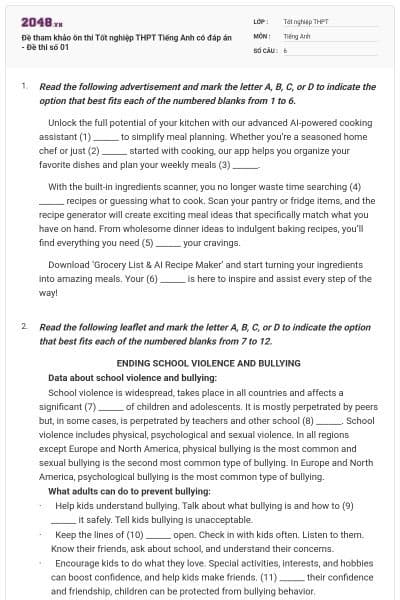
Read the following advertisement and mark the letter A, B, C, or D to indicate the option that best fits each of the numbered blanks from 1 to 6.
Unlock the full potential of your kitchen with our advanced AI-powered cooking assistant (1) ______ to simplify meal planning. Whether you’re a seasoned home chef or just (2) ______ started with cooking, our app helps you organize your favorite dishes and plan your weekly meals (3) ______.
With the built-in ingredients scanner, you no longer waste time searching (4) ______ recipes or guessing what to cook. Scan your pantry or fridge items, and the recipe generator will create exciting meal ideas that specifically match what you have on hand. From wholesome dinner ideas to indulgent baking recipes, you’ll find everything you need (5) ______ your cravings.
Download ‘Grocery List & AI Recipe Maker’ and start turning your ingredients into amazing meals. Your (6) ______ is here to inspire and assist every step of the way!
design
which designs
designing
designed
Kiến thức về rút gọn mệnh đề quan hệ
- Ta thấy câu đã có động từ chính ‘Unlock’, nên chỗ trống cần một mệnh đề quan hệ/mệnh đề quan hệ rút gọn để bổ nghĩa cho danh từ ‘assistant’. → loại A do ‘design’ đang chia thì hiện tại đơn.
- Căn cứ vào ngữ nghĩa, động từ ‘design’ cần chia ở dạng bị động → loại B, C.
Dịch: Khai phá tối đa tiềm năng căn bếp của bạn với trợ lý nấu ăn tiên tiến hỗ trợ bởi trí tuệ nhân tạo, được thiết kế để đơn giản hóa việc lên kế hoạch bữa ăn.
Chọn D.
getting
making
doing
trying
Kiến thức về cụm từ cố định
Ta có cụm từ: get started – bắt đầu làm một việc gì đó
Dịch: Cho dù bạn là một đầu bếp gia đình dày dạn kinh nghiệm hay chỉ mới bắt đầu nấu nướng, …
Chọn A.
Whether you’re a seasoned home chef or just (2) ______ started with cooking, our app helps you organize your favorite dishes and plan your weekly meals (3) ______.
effortless
effortlessness
effortlessly
effort
Kiến thức về từ loại
A. effortless /ˈefətləs/ (adj): dễ dàng, không cần cố gắng nhiều
B. effortlessness /ˈefətləsnəs/ (n): sự dễ dàng, không cần cố gắng nhiều
C. effortlessly /ˈefətləsli/ (adv): một cách dễ dàng
D. effort /ˈefət/ (n): sự cố gắng, sự nỗ lực
Ta thấy chỗ trống nằm ở cuối câu, sau các động từ ‘organize’ và ‘plan’.
→ Chỗ trống cần điền một trạng từ để bổ nghĩa cho động từ ‘organize’ và ‘plan’. Trạng từ ‘effortlessly’ là đáp án phù hợp, chỉ sự dễ dàng và thuận tiện mà ứng dụng đem lại trong việc sắp xếp và lập kế hoạch bữa ăn.
Dịch: Cho dù bạn là một đầu bếp gia đình dày dạn kinh nghiệm hay chỉ mới bắt đầu nấu nướng, ứng dụng của chúng tôi sẽ giúp bạn sắp xếp các món ăn yêu thích và lên kế hoạch bữa ăn hàng tuần một cách dễ dàng.
Chọn C.
for
to
with
at
Kiến thức về giới từ
Ta có cụm từ: search for somebody/something – tìm kiếm ai/điều gì
Dịch: Với máy quét nguyên liệu tích hợp, bạn sẽ không còn lãng phí thời gian tìm kiếm công thức nấu ăn hoặc nghĩ xem nên nấu món gì.
Chọn A.
From wholesome dinner ideas to indulgent baking recipes, you’ll find everything you need (5) ______ your cravings.
satisfying
to satisfy
to satisfying
satisfy
Kiến thức về động từ nguyên mẫu
Cấu trúc: need to V – cần làm gì
Dịch: Từ những ý tưởng bữa tối bổ dưỡng đến những công thức làm bánh hấp dẫn, bạn sẽ tìm thấy mọi thứ cần thiết để thỏa mãn cơn thèm ăn của mình.
Chọn B.
Your (6) ______ is here to inspire and assist every step of the way!
personalized culinary assistant
culinary assistant personalized
assistantpersonalized culinary
personalized assistant culinary
Kiến thức về trật tự từ, cụm từ
- Ta có cụm danh từ: culinary assistant – trợ lý ẩm thực
- Ta có quy tắc tính từ đứng trước danh từ → tính từ ‘personalized’ phải đứng trước cụm danh từ ‘culinary assistant’
→ trật tự đúng: personalized culinary assistant
Dịch: Trợ lý ẩm thực cá nhân hóa của bạn luôn sẵn sàng truyền cảm hứng và hỗ trợ bạn trên mọi bước đường!
Chọn A.
Bài hoàn chỉnh:
Unlock the full potential of your kitchen with our advanced AI-powered cooking assistant designed to simplify meal planning. Whether you’re a seasoned home chef or just getting started with cooking, our app helps you organize your favorite dishes and plan your weekly meals effortlessly.
With the built-in ingredients scanner, you no longer waste time searching for recipes or guessing what to cook. Scan your pantry or fridge items, and the recipe generator will create exciting meal ideas that specifically match what you have on hand. From wholesome dinner ideas to indulgent baking recipes, you’ll find everything you need to satisfy your cravings.
Download ‘Grocery List & AI Recipe Maker’ and start turning your ingredients into amazing meals. Your personalized culinary assistant is here to inspire and assist every step of the way!
Dịch bài đọc:
Khai phá tối đa tiềm năng căn bếp của bạn với trợ lý nấu ăn tiên tiến hỗ trợ bởi trí tuệ nhân tạo, được thiết kế để đơn giản hóa việc lên kế hoạch bữa ăn. Cho dù bạn là một đầu bếp gia đình dày dạn kinh nghiệm hay chỉ mới bắt đầu nấu nướng, ứng dụng của chúng tôi sẽ giúp bạn sắp xếp các món ăn yêu thích và lên kế hoạch bữa ăn hàng tuần một cách dễ dàng.
Với máy quét nguyên liệu tích hợp, bạn sẽ không còn lãng phí thời gian tìm kiếm công thức nấu ăn hoặc nghĩ xem nên nấu món gì. Chỉ cần quét các nguyên liệu trong tủ đựng thức ăn hoặc tủ lạnh của bạn, và công cụ tạo công thức sẽ cho ra những ý tưởng bữa ăn hấp dẫn phù hợp chính xác với những gì bạn có sẵn. Từ những ý tưởng bữa tối bổ dưỡng đến những công thức làm bánh hấp dẫn, bạn sẽ tìm thấy mọi thứ cần thiết để thỏa mãn cơn thèm ăn của mình.
Tải xuống 'Danh sách mua sắm & Công thức nấu ăn AI' và bắt đầu biến các nguyên liệu của bạn thành những bữa ăn tuyệt vời. Trợ lý ẩm thực cá nhân hóa của bạn luôn sẵn sàng truyền cảm hứng và hỗ trợ bạn trên mọi bước đường!
Read the following leaflet and mark the letter A, B, C, or D to indicate the option that best fits each of the numbered blanks from 7 to 12.
ENDING SCHOOL VIOLENCE AND BULLYING
Data about school violence and bullying:
School violence is widespread, takes place in all countries and affects a significant (7) ______ of children and adolescents. It is mostly perpetrated by peers but, in some cases, is perpetrated by teachers and other school (8) ______. School violence includes physical, psychological and sexual violence. In all regions except Europe and North America, physical bullying is the most common and sexual bullying is the second most common type of bullying. In Europe and North America, psychological bullying is the most common type of bullying.
What adults can do to prevent bullying:
· Help kids understand bullying. Talk about what bullying is and how to (9) ______ it safely. Tell kids bullying is unacceptable.
· Keep the lines of (10) ______ open. Check in with kids often. Listen to them. Know their friends, ask about school, and understand their concerns.
· Encourage kids to do what they love. Special activities, interests, and hobbies can boost confidence, and help kids make friends. (11) ______ their confidence and friendship, children can be protected from bullying behavior.
· By treating (12) ______ with kindness and respect, adults show the kids in their lives that there is no place for bullying. Kids will learn from adults' actions.
level
amount
number
quality
Kiến thức về lượng từ
A. level /'levl/ (n): mức độ, cấp độ, trình độ (thường dùng với các khái niệm trừu tượng)
B. amount /ə'maʊnt/ (n): lượng (dùng với danh từ không đếm được)
C. number /'nʌmbər/ (n): số, số lượng (dùng với danh từ số nhiều)
Ngoài ra, ta có cụm “a number of” nghĩa là “nhiều”.
D. quality /'kwɒləti/ (n): chất lượng; tính chất, đặc điểm
Căn cứ vào các danh từ số nhiều (chỉ người) ‘children’ và ‘adolescents’ đằng sau chỗ trống, ‘number’ là đáp án phù hợp.
Dịch: Bạo lực học đường diễn ra phổ biến, xảy ra ở tất cả các quốc gia và ảnh hưởng đến nhiều trẻ em và thanh thiếu niên.
Chọn C.
staff
member
employer
director
Kiến thức về từ vựng – từ cùng trường nghĩa
A. staff /stɑ:f/ (n): nhân viên, đội ngũ nhân sự (nhóm người làm việc cho một tổ chức, công ty)
B. member /'membə(r)/ (n): thành viên (một người thuộc về một nhóm, tổ chức)
C. employer /ɪm'plɔɪə(r)/ (n): người sử dụng lao động, chủ (người hoặc công ty thuê người khác làm việc)
D. director /də'rektə(r)/ (n): giám đốc, người điều hành hoặc quản lý trong một tổ chức hoặc công ty
Câu này nói về những đối tượng có khả năng gây ra các vụ bạo lực học đường, gồm các bạn đồng trang lứa, giáo viên hoặc nhân viên nhà trường. Do đó, ‘staff’ là đáp án phù hợp.
Dịch: Phần lớn hành vi này do bạn bè cùng trang lứa gây ra, nhưng trong một số trường hợp, nó được thực hiện bởi giáo viên và nhân viên nhà trường.
Chọn A.
come up with
stand up to
put up with
look up to
Kiến thức về cụm động từ
A. come up with (phr. v): nghĩ ra, đưa ra (một ý tưởng, giải pháp, kế hoạch, …)
B. stand up to (phr. v): chống lại, đối mặt với (thường là một người hoặc tình huống khó khăn)
C. put up with (phr. v): chịu đựng, chấp nhận điều gì không thoải mái hoặc khó chịu
D. look up to (phr. v): ngưỡng mộ, kính trọng ai đó
Dựa vào ngữ cảnh, ‘stand up to’ là đáp án phù hợp.
Dịch: Nói chuyện với trẻ về việc bắt nạt là gì và cách đối phó an toàn với nó.
Chọn B.
communication
speech
diplomacy
translation
Kiến thức về từ vựng – nghĩa của từ
Ta có cụm từ: line of communication – cách thức, phương thức giao tiếp
Dịch: Duy trì giao tiếp cởi mở.
Chọn A.
(11) ______ their confidence and friendship, children can be protected from bullying behavior.
According to
Thanks to
Apart from
Despite
Kiến thức về giới từ
A. Despite: Mặc dù, bất chấp
B. Thanks to: Nhờ vào
C. Apart from: Ngoại trừ
D. According to: Theo đó, dựa vào
Câu này đang muốn nói về những điều có thể bảo vệ trẻ khỏi những hành vi bắt nạt. Ta cần một từ nối để nhấn mạnh rằng nhờ có những điều đó mà trẻ sẽ được bảo vệ. Do đó, ‘Thanks to’ là đáp án phù hợp.
Dịch: Nhờ sự tự tin và tình bạn, trẻ em có thể được bảo vệ khỏi hành vi bắt nạt.
Chọn B.
others
other
the others
another
Kiến thức về đại từ bất định
A. others: những cái khác/người khác, được sử dụng như đại từ, theo sau không có bất kì danh từ nào
B. other + N (không đếm được/đếm được số nhiều): những cái khác/người khác
C. the others: những cái còn lại hoặc những người còn lại trong một nhóm có nhiều thứ hoặc nhiều người, được sử dụng như đại từ, theo sau không có bất kì danh từ nào
D. another + N (đếm được số ít): một cái khác/người khác.
Chỗ trống cần một từ chỉ mọi người xung quanh, những người mà người lớn đối xử với sự tôn trọng và lòng tốt, không chỉ một cá nhân cụ thể. Sau từ ‘treating’ ta cần điền một tân ngữ chỉ người → đại từ ‘others’ là đáp án phù hợp.
Dịch: Bằng cách đối xử tử tế và sự tôn trọng người khác, người lớn sẽ làm gương cho trẻ em thấy rằng không có chỗ cho hành vi bắt nạt.
Chọn A.
Bài hoàn chỉnh:
ENDING SCHOOL VIOLENCE AND BULLYING
Data about school violence and bullying:
School violence is widespread, takes place in all countries and affects a significant number of children and adolescents. It is mostly perpetrated by peers but, in some cases, is perpetrated by teachers and other school staff. School violence includes physical, psychological and sexual violence. In all regions except Europe and North America, physical bullying is the most common and sexual bullying is the second most common type of bullying. In Europe and North America, psychological bullying is the most common type of bullying.
What adults can do to prevent bullying:
· Help kids understand bullying. Talk about what bullying is and how to stand up to it safely. Tell kids bullying is unacceptable.
· Keep the lines of communication open. Check in with kids often. Listen to them. Know their friends, ask about school, and understand their concerns.
· Encourage kids to do what they love. Special activities, interests, and hobbies can boost confidence, and help kids make friends. Thanks to their confidence and friendship, children can be protected from bullying behavior.
· By treating others with kindness and respect, adults show the kids in their lives that there is no place for bullying. Kids will learn from adults' actions.
Dịch bài đọc:
CHẤM DỨT BẠO LỰC HỌC ĐƯỜNG VÀ BẮT NẠT
Dữ liệu về bạo lực học đường và bắt nạt:
Bạo lực học đường diễn ra phổ biến, xảy ra ở tất cả các quốc gia và ảnh hưởng đến nhiều trẻ em và thanh thiếu niên. Phần lớn hành vi này do bạn bè cùng trang lứa gây ra, nhưng trong một số trường hợp, nó được thực hiện bởi giáo viên và nhân viên nhà trường. Bạo lực học đường bao gồm bạo lực thể chất, tâm lý và tình dục. Ở tất cả các khu vực ngoại trừ Châu Âu và Bắc Mỹ, bắt nạt bằng bạo lực thể chất là phổ biến nhất và bắt nạt tình dục là loại bắt nạt phổ biến thứ hai. Ở Châu Âu và Bắc Mỹ, bắt nạt tâm lý là loại bắt nạt phổ biến nhất.
Người lớn có thể làm gì để ngăn chặn bắt nạt:
· Giúp trẻ hiểu về bắt nạt. Nói chuyện với trẻ về việc bắt nạt là gì và cách đối phó an toàn với nó. Nói với trẻ rằng bắt nạt là việc không thể chấp nhận được.
· Duy trì giao tiếp cởi mở. Thường xuyên hỏi thăm trẻ. Lắng nghe chúng. Tìm hiểu bạn bè của trẻ, hỏi về trường học và hiểu những lo lắng của chúng.
· Khuyến khích trẻ làm những gì chúng yêu thích. Các hoạt động, sở thích và thú vị đặc biệt có thể giúp tăng sự tự tin và giúp trẻ kết bạn. Nhờ sự tự tin và tình bạn, trẻ em có thể được bảo vệ khỏi hành vi bắt nạt.
· Bằng cách đối xử tử tế và sự tôn trọng người khác, người lớn sẽ làm gương cho trẻ em thấy rằng không có chỗ cho hành vi bắt nạt. Trẻ em sẽ học hỏi từ hành động của người lớn.
Mark the letter A, B, C, or D to indicate the best arrangement of utterances or sentences to make a meaningful exchange or text in each of the following questions from 13 to 17.
a. Laura: Hi! How's everything going with you lately?
b. Laura: That sounds nice! I've been good, just keeping busy with some new projects.
c. Ben: Hello! I've been doing well, thanks. Just got back from a short vacation. And you?
a-c-b
b-a-c
c-b-a
a-b-c
Kiến thức sắp xếp câu thành đoạn hội thoại
Thứ tự sắp xếp đúng:
a. Laura: Hi! How's everything going with you lately?
c. Ben: Hello! I've been doing well, thanks. Just got back from a short vacation. And you?
b. Laura: That sounds nice! I've been good, just keeping busy with some new projects.
Dịch:
a. Laura: Chào! Dạo này cậu thế nào rồi?
c. Ben: Chào! Mình vẫn khỏe, cảm ơn cậu. Mình vừa mới đi nghỉ ngắn ngày về. Còn cậu thì sao?
b. Laura: Nghe tuyệt đấy! Mình cũng khỏe, chỉ đang bận rộn với một vài dự án mới thôi.
Chọn A.
a. David: That's good! What kind of work will you be doing?
b. Sophie: I'm a bit nervous but excited to take a new role.
d. Sophie: I'm about to start my internship next week.
c. David: Sounds like a fantastic opportunity! Are you feeling prepared?
e. Sophie: I'll be assisting in marketing and social media projects.
d-c-b-a-e
e-a-d-c-b
d-a-e-c-b
b-c-d-a-e
Kiến thức sắp xếp câu thành đoạn hội thoại
Thứ tự sắp xếp đúng:
d. Sophie: I'm about to start my internship next week.
a. David: That's good! What kind of work will you be doing?
e. Sophie: I'll be assisting in marketing and social media projects.
c. David: Sounds like a fantastic opportunity! Are you feeling prepared?
b. Sophie: I'm a bit nervous but excited to take a new role.
Dịch:
d. Sophie: Mình chuẩn bị công việc thực tập vào tuần tới.
a. David: Tốt quá! Cậu sẽ làm công việc gì vậy?
e. Sophie: Mình sẽ hỗ trợ các dự án tiếp thị và truyền thông xã hội.
c. David: Nghe có vẻ là một cơ hội tuyệt vời đấy! Cậu cảm thấy bản thân đã sẵn sàng chưa?
b. Sophie: Mình hơi lo lắng nhưng cũng rất hào hứng với công việc mới này.
Chọn C.
Hey Mark,
a. Hope you're well! I just wanted to let you know I began watching the series you recommended.
b. Let me know when you're available; I'd love to hear your thoughts on it!
c. Also, the characters are fascinating, and the plot twists keep surprising me.
d. It's really gripping, and I can't believe I waited so long to start it!
e. If you're free, we should binge-watch the next few episodes together!
Cheers,
Lucy
a-b-c-e-d
d-a-b-c-e
a-d-c-e-b
a-c-b-d-e
Kiến thức sắp xếp câu thành lá thư
Thứ tự sắp xếp đúng:
Hey Mark,
a. Hope you're well! I just wanted to let you know I began watching the series you recommended.
d. It's really gripping, and I can't believe I waited so long to start it!
c. Also, the characters are fascinating, and the plot twists keep surprising me.
e. If you're free, we should binge-watch the next few episodes together!
b. Let me know when you're available; I'd love to hear your thoughts on it!
Cheers,
Lucy
Dịch:
Chào Mark,
a. Hy vọng cậu vẫn khỏe! Tớ chỉ muốn báo cho cậu biết là tớ đã bắt đầu xem bộ phim cậu giới thiệu rồi.
d. Phim hay thật, tớ không thể tin là mình lại chờ lâu đến thế mới bắt đầu xem!
c. Các nhân vật cũng rất thú vị, và những tình tiết bất ngờ cứ làm tớ ngạc nhiên mãi.
e. Nếu cậu rảnh, mình nên xem liền một mạch mấy tập tiếp theo nhé!
b. Cho tớ biết khi nào cậu rảnh nhé; tớ rất muốn nghe ý kiến của cậu về phim!
Thân ái,
Lucy
Chọn C.
a. In addition to teaching, I participated in language exchange programs and helped organize cultural events for the local community.
b. Recently, I completed a six-month internship in France, where I taught English to students of various ages.
c. Looking back, I realise how much I've grown both personally and professionally during my time abroad.
d. This experience not only improved my teaching skills but also deepened my understanding of different cultures.
e. I've always been fascinated by languages, and my studies have taken me to several different countries.
d-c-a-b-e
e-b-d-a-c
e-c-b-d-a
c-d-e-b-a
Kiến thức sắp xếp câu thành đoạn văn
Thứ tự sắp xếp đúng:
e. I've always been fascinated by languages, and my studies have taken me to several different countries.
b. Recently, I completed a six-month internship in France, where I taught English to students of various ages.
d. This experience not only improved my teaching skills but also deepened my understanding of different cultures.
a. In addition to teaching, I participated in language exchange programs and helped organize cultural events for the local community.
c. Looking back, I realise how much I've grown both personally and professionally during my time abroad.
Dịch:
e. Tôi luôn say mê ngôn ngữ, và việc học tập đã đưa tôi đến nhiều quốc gia khác nhau.
b. Gần đây, tôi đã hoàn thành một kỳ thực tập sáu tháng tại Pháp, nơi tôi dạy tiếng Anh cho học sinh ở nhiều độ tuổi khác nhau.
d. Kinh nghiệm này không chỉ cải thiện kỹ năng giảng dạy của tôi mà còn giúp tôi hiểu sâu hơn về các nền văn hóa khác nhau.
a. Ngoài việc giảng dạy, tôi còn tham gia các chương trình trao đổi ngôn ngữ và giúp tổ chức các sự kiện văn hóa cho cộng đồng địa phương.
c. Nhìn lại, tôi nhận ra mình đã trưởng thành rất nhiều cả về phần cá nhân và chuyên môn trong thời gian ở nước ngoài.
Chọn B.
a. More and more companies are embracing this model since they have realised that it reduces operational costs and offers a better work-life balance for staff.
b. Despite its advantages, some challenges remain, such as maintaining team collaboration and ensuring clear communication.
c. It allows employees to work from anywhere, as long as they have an Internet connection, which increases flexibility and productivity.
d. However, remote work is still a great option and has the potential to change the labour market positively.
e. The rise of remote work has completely changed modern working environments and practices.
e-b-c-a-d
a-c-e-d-b
e-c-a-b-d
e-d-a-c-b
Kiến thức sắp xếp câu thành đoạn văn
Thứ tự sắp xếp đúng:
e. The rise of remote work has completely changed modern working environments and practices.
c. It allows employees to work from anywhere, as long as they have an Internet connection, which increases flexibility and productivity.
a. More and more companies are embracing this model since they have realised that it reduces operational costs and offers a better work-life balance for staff.
b. Despite its advantages, some challenges remain, such as maintaining team collaboration and ensuring clear communication.
d. However, remote work is still a great option and has the potential to change the labour market positively.
Dịch:
e. Sự gia tăng của hình thức làm việc từ xa đã hoàn toàn thay đổi môi trường và phương thức làm việc hiện đại.
c. Nó cho phép nhân viên làm việc từ bất cứ đâu, miễn là họ có kết nối Internet, điều này giúp tăng tính linh hoạt và năng suất.
a. Ngày càng nhiều công ty áp dụng mô hình này vì họ nhận ra rằng nó giúp giảm chi phí vận hành và mang lại sự cân bằng tốt hơn giữa công việc và cuộc sống cho nhân viên.
b. Mặc dù có nhiều ưu điểm, nhưng vẫn còn một số thách thức, chẳng hạn như duy trì hợp tác nhóm và đảm bảo giao tiếp rõ ràng.
d. Tuy nhiên, phương thức làm việc từ xa vẫn là một lựa chọn tuyệt vời và có tiềm năng thay đổi thị trường lao động theo hướng tích cực.
Chọn C.
Read the following passage and mark the letter A, B, C, or D to indicate the option that best fits each of the numbered blanks from 18 to 22.
All holidays involve some element of risk whether in the form of illness, bad weather, being unable to get what we want if we delay booking, or (18) ______. We ask ourselves what risks we would run if we went there, if there is a high likelihood of their occurrence, if the risks are avoidable and how significant the consequences would be.
Some tourists, of course, relish a degree of risk, as this gives an edge of excitement to the holiday, (19) ______. Others, however, are risk averse and will studiously avoid risk wherever possible. Clearly, the significance of the risk will be a key factor. (20) ______. The risk averse will book early, choose to return to the same resort and hotel they have visited, knowing its reliability, or book a package tour rather than travel independently.
(21) ______. There is evidence that much of the continuing reluctance shown by some tourists to seek information and make bookings through Internet providers can be attributed to, in part, the lack of face-to-face contact with a trusted – and, hopefully, expert – travel agent and, in part, (22) ______ in favour of the information provider.
for a certain product to be seen directly
what are the products we will be certainly seeing directly
until we certainly see its products directly
being uncertain about the product until seeing it directly
Kiến thức về cấu trúc song song
- Ta thấy trong câu có liên từ ‘or’ được dùng để liệt kê các rủi ro của việc đi du lịch. Dựa vào quy tắc nối các cụm từ cùng loại, trước ‘or’ là cụm ‘being unable to get what we want if we delay booking’, ta cần điền vào chỗ trống một cụm bắt đầu với V-ing.
Dịch: Các chuyến du lịch đều tiềm ẩn một số yếu tố rủi ro, có thể là bệnh tật, thời tiết xấu, không có được lựa chọn mình muốn nếu trì hoãn đặt phòng, hoặc không chắc chắn về sản phẩm cho đến khi tận mắt chứng kiến.
Chọn D.
but do not present any risks and barriers to tourism itself
if the barrier of tourism itself is not in the presence of risk
so the presence of risk is not in itself a barrier to tourism
and tourism itself does not present any barriers or risks
Kiến thức về quan hệ logic giữa hai mệnh đề
A. nhưng không gây ra bất kỳ rủi ro và rào cản nào đối với du lịch
→ A sai vì không phù hợp với ngữ cảnh của câu.
B. nếu rào cản của du lịch không nằm ở sự hiện diện của rủi ro
→ B sai vì nếu ‘if’ ở giữa câu thì không cần dùng dấu phẩy.
C. vì vậy, bản thân yếu tố rủi ro không phải là rào cản
→ C đúng vì phù hợp về mặt ngữ nghĩa.
D. và bản thân du lịch không gây ra bất kỳ rào cản hay rủi ro nào
→ D sai vì không phù hợp với ngữ cảnh của câu.
Dịch: Tất nhiên, một số du khách thích mạo hiểm ở một mức độ nào đó, vì điều này mang lại sự phấn khích cho chuyến du lịch, vì vậy, bản thân yếu tố rủi ro không phải là rào cản.
Chọn C.
As a result, there will be much less concern about the risk of poor weather than about the risk of crime
Similarly, the concern about the risk of poor weather will be much greater than that about the risk of crime
As earlier mentioned, the risk of crime will be of much greater concern to people than that of poor weather
People, by contrast, will be far less concerned about the risk of crime than about that of poor weather
Kiến thức về mệnh đề độc lập - nghĩa của câu
A. Do đó, lo ngại về rủi ro thời tiết xấu sẽ ít hơn nhiều so với rủi ro tội phạm
→ A đúng vì phù hợp về mặt ngữ nghĩa.
B. Tương tự, mối lo ngại về rủi ro thời tiết xấu sẽ lớn hơn nhiều so với rủi ro tội phạm
→ B sai vì không phù hợp về nghĩa, rủi ro thời tiết xấu ít nghiêm trọng hơn so với rủi ro tội phạm.
C. Như đã đề cập trước đó, rủi ro tội phạm sẽ là mối lo ngại lớn hơn nhiều đối với người dân so với rủi ro thời tiết xấu
→ C sai vì rủi ro tội phạm chưa được đề cập trước đó.
D. Ngược lại, mọi người sẽ ít lo ngại về rủi ro tội phạm hơn là rủi ro thời tiết xấu
→ D sai vì không phù hợp về nghĩa, rủi ro tội phạm đáng lo ngại hơn là rủi ro thời tiết xấu.
Dịch: Do đó, lo ngại về rủi ro thời tiết xấu sẽ ít hơn nhiều so với rủi ro tội phạm.
Chọn A.
Holidays are also booked after customers choose factors and methods without risk
Customers also book their holidays by choosing the methods without risky factors
Risk is also a factor in the methods chosen by customers to book their holidays
Also, the factors and methods customers choose to book their holidays are risky
Kiến thức về mệnh đề độc lập - nghĩa của câu
A. Khách hàng cũng đặt chuyến du lịch sau khi lựa chọn các yếu tố và cách không có rủi ro
→ A sai vì ngược nghĩa với câu đầu bài đọc, nêu rằng chuyến du lịch nào cũng có một số yếu tố rủi ro
B. Khách hàng cũng đặt chuyến du lịch bằng cách chọn các cách không có yếu tố rủi ro
→ B sai vì ngược nghĩa với câu đầu bài đọc, nêu rằng chuyến du lịch nào cũng có một số yếu tố rủi ro
C. Rủi ro cũng là một yếu tố trong số các cách mà khách hàng lựa chọn để đặt chuyến du lịch.
→ C đúng vì phù hợp về mặt ngữ nghĩa.
D. Ngoài ra, các yếu tố và cách mà khách hàng lựa chọn để đặt chuyến du lịch cũng tiềm ẩn rủi ro
→ D sai vì không phù hợp với ngữ cảnh của đoạn.
Dịch: Rủi ro cũng là một yếu tố trong số các cách mà khách hàng lựa chọn để đặt kỳ nghỉ.
Chọn C.
the suspicion that information received through the Internet will be biased
due to the Internet, through which biased and suspicious information is received
the biased information received through the Internet will be suspicious
thanks to the biased information received through the Internet with the suspicion
Kiến thức về cấu trúc song song
- Ta thấy trong câu có liên từ ‘and’ được dùng để các yếu tố làm du khách ngần ngại trong việc tìm kiếm thông tin và đặt phòng thông qua Internet. Dựa vào quy tắc nối các cụm từ cùng loại, trước ‘or’ là cụm danh từ ‘the lack of face-to-face contact with a trusted – and, hopefully, expert – travel agent’, ta cần điền vào chỗ trống một cụm danh từ. → loại B, D.
- Xét về mặt ngữ nghĩa, A là đáp án phù hợp.
Dịch: Có bằng chứng cho thấy phần nhiều sự do dự của một số du khách trong việc tìm kiếm thông tin và đặt chỗ thông qua các nhà cung cấp dịch vụ Internet một phần là do thiếu sự làm việc trực tiếp với một đại lý chuyên về du lịch đáng tin cậy - và một phần là nghi ngờ rằng thông tin tìm kiếm được qua Internet sẽ thiên vị nhà cung cấp thông tin.
Chọn A.
Bài hoàn chỉnh:
All holidays involve some element of risk whether in the form of illness, bad weather, being unable to get what we want if we delay booking, or being uncertain about the product until seeing it directly. We ask ourselves what risks we would run if we went there, if there is a high likelihood of their occurrence, if the risks are avoidable and how significant the consequences would be.
Some tourists, of course, relish a degree of risk, as this gives an edge of excitement to the holiday, so the presence of risk is not in itself a barrier to tourism. Others, however, are risk averse and will studiously avoid risk wherever possible. Clearly, the significance of the risk will be a key factor. As a result, there will be much less concern about the risk of poor weather than about the risk of crime. The risk averse will book early, choose to return to the same resort and hotel they have visited, knowing its reliability, or book a package tour rather than travel independently.
Risk is also a factor in the methods chosen by customers to book their holidays. There is evidence that much of the continuing reluctance shown by some tourists to seek information and make bookings through Internet providers can be attributed to, in part, the lack of face-to-face contact with a trusted – and, hopefully, expert – travel agent and, in part, the suspicion that information received through the Internet will be biased in favour of the information provider.
Dịch bài đọc:
Các chuyến du lịch đều tiềm ẩn một số yếu tố rủi ro, có thể là bệnh tật, thời tiết xấu, không có được lựa chọn mình muốn nếu trì hoãn đặt phòng, hoặc không chắc chắn về sản phẩm cho đến khi tận mắt chứng kiến. Chúng ta tự hỏi mình sẽ gặp phải những rủi ro nào nếu đến đó, liệu khả năng xảy ra rủi ro có cao không, liệu những rủi ro đó có thể tránh được không và hậu quả sẽ nghiêm trọng đến mức nào.
Tất nhiên, một số du khách thích mạo hiểm ở một mức độ nào đó, vì điều này mang lại sự phấn khích cho chuyến du lịch, vì vậy, bản thân yếu tố rủi ro không phải là rào cản. Tuy nhiên, những người khác lại e ngại rủi ro và sẽ cố gắng tránh bất cứ khi nào có thể. Rõ ràng, mức độ nghiêm trọng của rủi ro sẽ là một yếu tố then chốt. Do đó, lo ngại về rủi ro thời tiết xấu sẽ ít hơn nhiều so với rủi ro tội phạm. Những người không thích rủi ro sẽ đặt phòng sớm, chọn quay lại cùng một khu nghỉ dưỡng và khách sạn mà họ từng đến vì đã biết rõ độ tin cậy, hoặc đặt tour trọn gói thay vì tự đi du lịch.
Rủi ro cũng là một yếu tố trong số các cách mà khách hàng lựa chọn để đặt kỳ nghỉ. Có bằng chứng cho thấy phần nhiều sự do dự của một số du khách trong việc tìm kiếm thông tin và đặt chỗ thông qua các nhà cung cấp dịch vụ Internet một phần là do thiếu sự làm việc trực tiếp với một đại lý chuyên về du lịch đáng tin cậy - và một phần là nghi ngờ rằng thông tin tìm kiếm được qua Internet sẽ thiên vị nhà cung cấp thông tin.
Read the following passage and mark the letter A, B, C, or D on your answer sheet to indicate the best answer to each of the following questions from 23 to 30.
Helping children learn to judge their own work is a crucial skill that begins early in life.When a child learns to talk, they aren’t constantly corrected; instead, they observe and adjust their language by comparing it to those around them. This natural process allows them to improve independently. Similarly, children learn other skills like running, climbing, or riding a bicycle by observing others and refining their own efforts. To foster independence, children should be encouraged to evaluate their own work, whether it’s solving a math problem, writing a sentence, or completing a project. With guidance and peer collaboration, they can learn to identify and correct their mistakes.
In subjects like math or science, providing tools such as answer books can empower children to check their own work. This reduces the need for teachers to spend time on routine corrections and allows them to focus on supporting students who struggle with specific challenges. By encouraging self-assessment, children develop critical thinking and problem-solving skills. They learn to measure their own understanding and recognize gaps in their knowledge, which are essential skills for lifelong learning.
To support this process, teachers and parents should create an environment where children feel safe to make mistakes and learn from them. Instead of relying on grades or exams, which often discourage experimentation, children should be encouraged to explore and reflect on their progress. This approach helps them take ownership of their learning and builds confidence in their abilities.
Ultimately, the goal is to prepare children for a world that values adaptability and self-directed learning. By teaching them to judge their own work, we equip them with the tools to navigate challenges and acquire new knowledge independently. If they miss something essential, they’ll have the skills to learn it when needed, ensuring they thrive in an ever-changing world.
riding a bicycle
running
swimming
talking
Kiến thức về thông tin chi tiết
Kỹ năng nào sau đây KHÔNG được đề cập là kỹ năng trẻ em tự học?
A. Đi xe đạp B. Chạy C. Bơi D. Nói chuyện
Thông tin:
- Similarly, children learn other skills like running, climbing, or riding a bicycle by observing others and refining their own efforts. (Tương tự, trẻ em học các kỹnăng khác như chạy, leo trèo hoặc đi xe đạp bằng cách quan sát người khác và tự hoàn thiện bản thân.) → A, B được đề cập.
- When a child learns to talk, they aren’t constantly corrected; instead, they observe and adjust their language by comparing it to those around them. This natural process allows them to improve independently. (Khi trẻ học nói, trẻ không bị sửa lỗi liên tục; thay vào đó, trẻ quan sát và điều chỉnh ngôn ngữ của mình bằng cách so sánh với những người xung quanh. Quá trình tự nhiên này cho phép trẻ tự tiến bộ.) → D được đề cập.
Chọn C.
The word ‘refining’ in paragraph 1 is OPPOSITE in meaning to ______.
improving
damaging
developing
adjusting
Kiến thức về từ vựng trái nghĩa
Từ ‘refining’ trong đoạn 1 TRÁI NGHĨA với ______.
A. improving – improve /ɪmˈpruːv/ (v): cải thiện
B. damaging – damage /ˈdæmɪdʒ/ (v): làm hỏng, làm hư hại
C. developing – develop /dɪˈveləp/ (v): phát triển
D. adjusting – adjust /əˈdʒʌst/ (v): điều chỉnh
→ refine (v): trau chuốt, làm cho tốt hơn >< damage /ˈdæmɪdʒ/ (v): làm hỏng, làm hư hại
Thông tin: Similarly, children learn other skills like running, climbing, or riding a bicycle by observing others and refining their own efforts. (Tương tự, trẻ em học các kỹnăng khác như chạy, leo trèo hoặc đi xe đạp bằng cách quan sát người khác và tự hoàn thiện bản thân.)
Chọn B.
The word ‘them’ in paragraph 3 refers to ______.
teachers
children
mistakes
parents
Kiến thức về từ quy chiếu
Từ ‘them’ trong đoạn 3 chỉ ______.
A. teachers /ˈtiː.tʃərz/ (n): giáo viên
B. children /ˈtʃɪl.drən/ (n): trẻ em
C. mistakes /mɪˈsteɪks/ (n): lỗi sai
D. parents /ˈpeə.rənts/ (n): cha mẹ
Thông tin: Instead of relying on grades or exams, which often discourage experimentation, children should be encouraged to explore and reflect on their progress. This approach helps them take ownership of their learning and builds confidence in their abilities. (Thay vì dựa vào điểm số hoặc kỳ thi, những điều khiến trẻ ngại thử nghiệm, trẻ em nên được khuyến khích khám phá và suy ngẫm về tiến trình của mình. Cách tiếp cận này giúp trẻ tự chịu trách nhiệm về việc học tập của mình và xây dựng sự tự tin vào khả năng của bản thân.)
→ Từ ‘them’ nhắc tới ‘children’ ở phía trước.
Chọn B.
The word ‘empower’ in paragraph 2 could be best replaced by ______.
weaken
enable
discourage
restrict
Kiến thức về từ vựng gần nghĩa
Từ ‘empower’ ở đoạn 2 có thể được thay thế bằng ______.
A. weaken /ˈwiːkən/ (v): làm cho yếu đi
B. enable /ɪˈneɪbl/ (v): làm cho có thể, làm cho có khả năng
C. discourage /dɪsˈkʌrɪdʒ/ (v): làm chán nản, làm nản lòng
D. restrict /rɪˈstrɪkt/ (v): hạn chế, giới hạn
→ empower /ɪmˈpaʊə(r)/ (v): trao quyền, làm cho có thể = enable /ɪˈneɪbl/ (v): làm cho có thể, làm cho có khả năng
Thông tin: In subjects like math or science, providing tools such as answer books can empower children to check their own work. (Trong các môn học như toán hoặc khoa học, việc cung cấp các công cụ như sách lời giải có thể giúp trẻ tự kiểm tra bài làm của mình.)
Chọn B.
Which of the following best paraphrases the underlined sentence in paragraph 3?
Children should be assessed via exploration and self-reflection instead of grades or exams.
Children should avoid grades and exams to focus on creative experimentation and learning.
Teachers should ban grades and exams to encourage student progress and personal growth.
Reflection and exploration are far more important than grades and exams in education.
Kiến thức về paraphrasing
Câu nào sau đây diễn giải lại đúng nhất câu được gạch chân trong đoạn 3?
A. Trẻ em nên được đánh giá thông qua sự khám phá và phản tư thay vì điểm số hoặc thi cử.
B. Trẻ em nên tránh điểm số và thi cử để tập trung vào thử nghiệm sáng tạo và học tập.
C. Giáo viên nên cấm chấm điểm và thi cử để khuyến khích sự tiến bộ và phát triển cá nhân của học sinh.
D. Phản tư và khám phá quan trọng hơn nhiều so với điểm số và thi cử trong giáo dục.
Câu gạch chân: Instead of relying on grades or exams, which often discourage experimentation, children should be encouraged to explore and reflect on their progress. (Thay vì dựa vào điểm số hoặc kỳ thi, những điều khiến trẻ ngại thử nghiệm, trẻ em nên được khuyến khích khám phá và suy ngẫm về tiến trình của mình.)
Chọn A.
Which of the following is TRUE according to the passage?
Children should rely on teachers to correct all their mistakes.
Self-assessment helps children develop critical thinking skills.
Grades and exams are essential for building confidence.
Children cannot learn independently without constant correction.
Kiến thức về thông tin đúng/sai
Điều nào sau đây là ĐÚNG theo như bài đọc?
A. Trẻ em nên dựa vào giáo viên để sửa chữa mọi lỗi sai của mình.
B. Kỹ năng tự đánh giá giúp trẻ phát triển kỹ năng tư duy phản biện.
C. Điểm số và thi cử rất cần thiết để xây dựng sự tự tin.
D. Trẻ em không thể học tập độc lập nếu không được sửa lỗi liên tục.
Thông tin:
- To foster independence, children should be encouraged to evaluate their own work, whether it’s solving a math problem, writing a sentence, or completing a project. With guidance and peer collaboration, they can learn to identify and correct their mistakes. (Để khuyến khích tính tự lập, trẻ em nên được khuyến khích tự đánh giá phần việc của mình, cho dù đó là giải một bài toán, viết một câu hay hoàn thành một dự án.) → A sai vì trẻ được khuyến khích để tự đánh giá các phần việc thay vì dựa hoàn toàn vào giáo viên.
- By encouraging self-assessment, children develop critical thinking and problem-solving skills. (Bằng cách khuyến khích kỹ năng tự đánh giá, trẻ em phát triển tư duy phản biện và kỹ năng giải quyết vấn đề.) → B đúng.
- Instead of relying on grades or exams, which often discourage experimentation, children should be encouraged to explore and reflect on their progress. (Thay vì dựa vào điểm số hoặc kỳ thi, những điều khiến trẻ ngại thử nghiệm, trẻ em nên được khuyến khích khám phá và suy ngẫm về tiến trình của mình.) → C sai vì điểm số và thi cử là những điều khiến trẻ rụt rè, ngại thử nghiệm.
- Ultimately, the goal is to prepare children for a world that values adaptability and self-directed learning. By teaching them to judge their own work, we equip them with the tools to navigate challenges and acquire new knowledge independently. (Mục tiêu sau cùng là chuẩn bị cho trẻ em một thế giới coi trọng khả năng thích ứng và học tập tự định hướng. Bằng cách dạy trẻ cách tự đánh giá công việc của mình, chúng ta trang bị cho trẻ những công cụ để vượt qua thử thách và tiếp thu kiến thức mới một cách độc lập.) → D sai vì khả năng học tập độc lập có liên quan đến kỹ năng tự đánh giá công việc của bản thân, không phụ thuộc vào việc được sửa chữa liên tục.
Chọn B.
Paragraph 3
Paragraph 1
Paragraph 2
Paragraph 4
Kiến thức về thông tin theo đoạn
Trong đoạn nào, tác giả đề cập đến vai trò của giáo viên và phụ huynh trong việc tạo ra một môi trường mang tính hỗ trợ?
A. Đoạn 3 B. Đoạn 1 C. Đoạn 2 D. Đoạn 4
Thông tin: To support this process, teachers and parents should create an environment where children feel safe to make mistakes and learn from them. Instead of relying on grades or exams, which often discourage experimentation, children should be encouraged to explore and reflect on their progress. (Để hỗ trợ quá trình này, giáo viên và phụ huynh nên tạo ra một môi trường nơi trẻ cảm thấy an toàn khi mắc lỗi và học hỏi từ những lỗi đó. Thay vì dựa vào điểm số hoặc kỳ thi, những điều khiến trẻ ngại thử nghiệm, trẻ em nên được khuyến khích khám phá và suy ngẫm về tiến trình của mình.)
Chọn A.
Paragraph 2
Paragraph 1
Paragraph 4
Paragraph 3
Kiến thức về thông tin theo đoạn
Trong đoạn nào, tác giả đề cập đến tầm quan trọng của khả năng thích ứng và học tập tự định hướng?
A. Đoạn 2 B. Đoạn 1 C. Đoạn 4 D. Đoạn 3
Thông tin: Ultimately, the goal is to prepare children for a world that values adaptability and self-directed learning. By teaching them to judge their own work, we equip them with the tools to navigate challenges and acquire new knowledge independently. If they miss something essential, they’ll have the skills to learn it when needed, ensuring they thrive in an ever-changing world. (Mục tiêu sau cùng là chuẩn bị cho trẻ em một thế giới coi trọng khả năng thích ứng và học tập tự định hướng. Bằng cách dạy trẻ cách tự đánh giá công việc của mình, chúng ta trang bị cho trẻ những công cụ để vượt qua thử thách và tiếp thu kiến thức mới một cách độc lập. Nếu trẻ bỏ lỡ điều gì đó thiết yếu, trẻ sẽ có kỹ năng để học hỏi khi cần thiết, đảm bảo trẻ phát triển mạnh mẽ trong một thế giới luôn thay đổi.)
Chọn C.
Dịch bài đọc:
Giúp trẻ học cách tự đánh giá công việc của mình là một kỹ năng quan trọng cần được bắt đầu từ sớm. Khi trẻ học nói, trẻ không bị sửa lỗi liên tục; thay vào đó, trẻ quan sát và điều chỉnh ngôn ngữ của mình bằng cách so sánh với những người xung quanh. Quá trình tự nhiên này cho phép trẻ tự tiến bộ. Tương tự, trẻ em học các kỹ năng khác như chạy, leo trèo hoặc đi xe đạp bằng cách quan sát người khác và tự hoàn thiện bản thân. Để khuyến khích tính tự lập, trẻ em nên được khuyến khích tự đánh giá phần việc của mình, cho dù đó là giải một bài toán, viết một câu hay hoàn thành một dự án. Với sự hướng dẫn và hợp tác cùng bạn bè, chúng có thể học cách xác định và sửa chữa lỗi sai của mình.
Trong các môn học như toán hoặc khoa học, việc cung cấp các công cụ như sách lời giải có thể giúp trẻ tự kiểm tra bài làm của mình. Điều này làm giảm nhu cầu giáo viên phải dành thời gian cho việc sửa lỗi thường xuyên và cho phép giáo viên tập trung hỗ trợ những học sinh gặp khó khăn với những thách thức cụ thể. Bằng cách khuyến khích kỹ năng tự đánh giá, trẻ em phát triển tư duy phản biện và kỹ năng giải quyết vấn đề. Trẻ học cách đo lường sự hiểu biết của chính mình và nhận ra những lỗ hổng trong kiến thức, đây là những kỹ năng thiết yếu cho việc học tập suốt đời.
Để hỗ trợ quá trình này, giáo viên và phụ huynh nên tạo ra một môi trường nơi trẻ cảm thấy an toàn khi mắc lỗi và học hỏi từ những lỗi đó. Thay vì dựa vào điểm số hoặc kỳ thi, những điều khiến trẻ ngại thử nghiệm, trẻ em nên được khuyến khích khám phá và suy ngẫm về tiến trình của mình. Cách tiếp cận này giúp trẻ tự chịu trách nhiệm về việc học tập của mình và xây dựng sự tự tin vào khả năng của bản thân.
Mục tiêu sau cùng là chuẩn bị cho trẻ em một thế giới coi trọng khả năng thích ứng và học tập tự định hướng. Bằng cách dạy trẻ cách tự đánh giá công việc của mình, chúng ta trang bị cho trẻ những công cụ để vượt qua thử thách và tiếp thu kiến thức mới một cách độc lập. Nếu trẻ bỏ lỡ điều gì đó thiết yếu, trẻ sẽ có kỹ năng để học hỏi khi cần thiết, đảm bảo trẻ phát triển mạnh mẽ trong một thế giới luôn thay đổi.
Read the following passage and mark the letter A, B, C, or D to indicate the best answer to each of the following questions from 31 to 40.
Human populations have tended to increase over time. As more people were born, small groups of individuals found reasons to come together to form groups and, with the advent of agriculture, small sedentary communities. A small number of these settlements grew into what we now call cities. This kind of growth often corresponds with a shift from one way of organizing labor to another.
The world population has grown significantly and our economies have become more industrialized over the past few hundred years. As a result, many more people have moved into cities. This process is known as urbanization. Even after cities emerged, however, a large majority of people lived and worked in rural areas. It was not until large-scale industrialization began in the eighteenth century that cities really began to boom. Nearly half of all people now live in urban areas. They are attracted by jobs in manufacturing and the professions, as well as by increased opportunities for education and entertainment.
Urbanization is often discussed in reference to countries that are currently in the process of industrializing and urbanizing, but all industrialized nations have experienced urbanization at some point in their history. Moreover, urbanization is on the rise all over the globe.
[I] One effect of this huge increase in people living in urban areas is the rise of the megacity, which is a city that has more than 10 million inhabitants. [II] There are now cities with even more than that. [III] Another effect of urbanization is urban sprawl. [IV] Urban sprawl is when the population of a city becomes dispersed over an increasingly large geographical area. This movement from higher density urban cores to lower density suburbs means that as cities expand, they often begin to take up significant tracts of land formerly used for agriculture. Sprawl also increases the need for travel infrastructure, such as roads, because people’s homes are likely to be farther away from where they work and the amenities they enjoy.
As we move forward in the 21st century, the global population is likely to continue growing. Urban areas will continue to grow with the population. This continual growth presents complex challenges as we prepare for the cities of the future. How we choose to manage urbanization will have consequences for our world for many years to come.
Which of the following best paraphrases the underlined sentence in paragraph 2?
The world’s population has shrunk as industrialization spread.
Industrialization has led to population growth.
Industrialization has had little effect on the population.
Population growth has slowed in industrialized economies.
Kiến thức về paraphrasing
Câu nào sau đây diễn giải lại đúng nhất câu được gạch chân trong đoạn 2?
A. Dân số thế giới đã giảm khi quá trình công nghiệp hóa lan rộng.
B. Công nghiệp hóa đã dẫn đến sự tăng trưởng dân số.
C. Công nghiệp hóa có ít ảnh hưởng đến dân số.
D. Tốc độ tăng trưởng dân số đã chậm lại ở các nền kinh tế công nghiệp hóa.
Câu gạch chân: The world population has grown significantly and our economies have become more industrialized over the past few hundred years. (Dân số thế giới đã tăng lên đáng kể và nền kinh tế của chúng ta đã trở nên công nghiệp hóa hơn trong vài trăm năm qua.)
Chọn B.
The word ‘boom’ in paragraph 2 is OPPOSITE in meaning to ______.
decline
expand
develop
increase
Kiến thức về từ vựng trái nghĩa
Từ ‘boom’ trong đoạn 2 TRÁI NGHĨA với ______.
A. decline /dɪˈklaɪn/ (v): giảm xuống, suy tàn, từ chối
B. expand /ɪkˈspænd/ (v): mở rộng, phát triển
C. develop /dɪˈveləp/ (v): phát triển
D. increase /ɪnˈkriːs/ (v): tăng lên, lớn thêm
→ boom /buːm/ (v): bùng nổ >< decline /dɪˈklaɪn/ (v): giảm xuống, suy tàn, từ chối
Thông tin: It was not until large-scale industrialization began in the eighteenth century that cities really began to boom. (Mãi đến khi công nghiệp hóa quy mô lớn bắt đầu vào thế kỷ thứ mười tám thì các thành phố mới thực sự bắt đầu bùng nổ.)
Chọn A.
Which of the following best summarises paragraph 3?
Urbanization is exclusively observed in the modern era.
Urbanization occurs worldwide and has been a historical process.
Industrialized nations no longer experience urbanization.
Urbanization is mostly found in developing countries.
Kiến thức về ý chính của đoạn
Câu nào sau đây tóm tắt đoạn 3 đúng nhất?
A. Đô thị hóa chỉ được quan sát thấy trong thời hiện đại.
B. Đô thị hóa diễn ra trên toàn thế giới và là một quá trình lịch sử.
C. Các quốc gia công nghiệp hóa không còn trải qua quá trình đô thị hóa.
D. Đô thị hóa chủ yếu được tìm thấy ở các nước đang phát triển.
Thông tin: Urbanization is often discussed in reference to countries that are currently in the process of industrializing and urbanizing, but all industrialized nations have experienced urbanization at some point in their history. Moreover, urbanization is on the rise all over the globe. (Đô thị hóa thường được thảo luận liên quan đến các quốc gia hiện đang trong quá trình công nghiệp hóa và đô thị hóa, nhưng tất cả các quốc gia công nghiệp hóa đều đã trải qua đô thị hóa tại một thời điểm nào đó trong lịch sử của họ. Hơn nữa, quá trình đô thị hóa đang gia tăng trên toàn cầu.)
→ Đoạn 3 đề cập rằng quá trình đô thị hóa đã diễn ra trong quá khứ đối với các quốc gia phát triển, và hiện đang gia tăng trên toàn cầu. Đáp án B thể hiện đúng trọng tâm này.
Chọn B.
Which of the following is NOT TRUE according to the passage?
Cities have always been the most common places for people to live.
Urbanization progressively increases as economies undergo industrialization.
The process of urbanization has happened in all industrialized nations.
Megacities are cities characterized by over 10 million people.
Kiến thức về thông tin đúng/sai
Điều nào sau đây là KHÔNG ĐÚNG theo như bài đọc?
A. Các thành phố đã luôn là nơi sinh sống phổ biến nhất của con người.
B. Đô thị hóa tăng dần khi các nền kinh tế trải qua quá trình công nghiệp hóa.
C. Quá trình đô thị hóa đã diễn ra ở tất cả các quốc gia công nghiệp hóa.
D. Siêu đô thị là những thành phố có dân số trên 10 triệu người.
Thông tin:
- Even after cities emerged, however, a large majority of people lived and worked in rural areas. It was not until large-scale industrialization began in the eighteenth century that cities really began to boom. (Tuy nhiên, ngay cả sau khi các thành phố xuất hiện, phần lớn người dân vẫn sống và làm việc ở các vùng nông thôn. Mãi đến khi công nghiệp hóa quy mô lớn bắt đầu vào thế kỷ thứ mười tám thì các thành phố mới thực sự bắt đầu bùng nổ.) → A sai vì trước khi xảy ra quá trình đô thị hóa, con người chủ yếu sống ở vùng nông thôn.
- The world population has grown significantly and our economies have become more industrialized over the past few hundred years. As a result, many more people have moved into cities. This process is known as urbanization. (Dân số thế giới đã tăng lên đáng kể và nền kinh tế của chúng ta đã trở nên công nghiệp hóa hơn trong vài trăm năm qua. Kết quả là, đã có nhiều người chuyển đến các thành phố hơn. Quá trình này được gọi là đô thị hóa.) → B đúng.
- Urbanization is often discussed in reference to countries that are currently in the process of industrializing and urbanizing, but all industrialized nations have experienced urbanization at some point in their history. (Đô thị hóa thường được thảo luận liên quan đến các quốc gia hiện đang trong quá trình công nghiệp hóa và đô thị hóa, nhưng tất cả các quốc gia công nghiệp hóa đều đã trải qua đô thị hóa tại một thời điểm nào đó trong lịch sử của họ.) → C đúng.
- One effect of this huge increase in people living in urban areas is the rise of the megacity, which is a city that has more than 10 million inhabitants. (Một trong những hệ quả của sự gia tăng mạnh mẽ số người sống ở khu vực đô thị là sự nổi lên của các siêu đô thị, tức là những thành phố có hơn 10 triệu dân.) → C đúng.
Chọn A.
Where in paragraph 4 does the following sentence best fit?
Tokyo, Japan, for example, has nearly 40 million residents.
[I]
[II]
[III]
[IV]
Kiến thức về điền câu vào vị trí phù hợp trong đoạn
Câu sau đây phù hợp nhất ở vị trí nào trong đoạn 4?
Ví dụ, Tokyo, Nhật Bản, có gần 40 triệu cư dân.
A. [I] B. [II] C. [III] D. [IV]
→ Câu trên phù hợp ở vị trí [III] vì nó liên kết mạch lạc với câu phía trước đề cập về ‘city that has more than 10 million inhabitants’.
Chọn C.
The phrase ‘urban sprawl’ in paragraph 4 could be best replaced by ______.
the increase of public transport in cities
the uncontrolled expansion of urban areas
the reduction of city populations
the improvement of housing conditions
Kiến thức về từ vựng gần nghĩa
Cụm từ ‘urban sprawl’ ở đoạn 4 có thể được thay thế bằng ______.
A. Sự gia tăng giao thông công cộng ở các thành phố
B. Sự mở rộng không kiểm soát của các khu vực đô thị
C. Sự giảm dân số thành phố
D. Sự cải thiện điều kiện nhà ở
Thông tin: Another effect of urbanization is urban sprawl. Urban sprawl is when the population of a city becomes dispersed over an increasingly large geographical area. (Một hệ quả khác của đô thị hóa là sự bành trướng đô thị. Bành trướng đô thị là hiện tượng dân số của một thành phố phân tán trên một khu vực địa lý ngày càng rộng lớn.)
Chọn B.
The word ‘they’ in paragraph 4 refers to ______.
higher density
suburbs
cities
movement
Kiến thức về từ quy chiếu
Từ ‘they’ trong đoạn 4 chỉ ______.
A. higher density /haɪ.ər ˈden.sɪ.ti/ (phr): mật độ dân cư cao hơn
B. suburbs /ˈsʌb.ɜːbz/ (n): vùng ngoại ô
C. cities /ˈsɪt.iz/ (n): thành phố
D. movement /ˈmuːv.mənt/ (n): sự di chuyển
Thông tin: This movement from higher density urban cores to lower density suburbs means that as cities expand, they often begin to take up significant tracts of land formerly used for agriculture. (Sự dịch chuyển từ các trung tâm đô thị có mật độ dân cư cao sang các vùng ngoại ô có mật độ dân cư thấp hơn có nghĩa là khi các thành phố mở rộng, chúng thường bắt đầu chiếm dụng những vùng đất rộng lớn trước đây được sử dụng cho nông nghiệp.)
→ Từ ‘they’ nhắc tới ‘cities’ ở phía trước.
Chọn C.
According to paragraph 4, which of the following is NOT a consequence of urban sprawl?
The expansion of cities into agricultural land
An increase in the need for transportation infrastructure
A notable rise in population density within city centers
The movement of people from city centers to suburbs
Kiến thức về thông tin chi tiết
Theo đoạn 4, điều nào sau đây KHÔNG phải là hậu quả của sự bành trướng đô thị?
A. Sự mở rộng của các thành phố vào đất nông nghiệp
B. Sự gia tăng nhu cầu về cơ sở hạ tầng giao thông
C. Sự gia tăng đáng kể mật độ dân số trong các trung tâm thành phố
D. Sự di chuyển của người dân từ trung tâm thành phố ra vùng ngoại ô
Thông tin:
- This movement from higher density urban cores to lower density suburbs means that as cities expand, they often begin to take up significant tracts of land formerly used for agriculture. (Sự dịch chuyển từ các trung tâm đô thị có mật độ dân cư cao sang các vùng ngoại ô có mật độ dân cư thấp hơn có nghĩa là khi các thành phố mở rộng, chúng thường bắt đầu chiếm dụng những vùng đất rộng lớn trước đây được sử dụng cho nông nghiệp.) → A, D được đề cập.
- Sprawl also increases the need for travel infrastructure, such as roads, because people’s homes are likely to be farther away from where they work and the amenities they enjoy. (Sự bành trướng cũng làm tăng nhu cầu về cơ sở hạ tầng giao thông, chẳng hạn như đường sá, bởi vì nhà cửa của người dân có thể ở xa hơn nơi làm việc và các tiện ích mà họ được hưởng.) → B được đề cập.
Chọn C.
Which of the following can be inferred from the passage?
Poorly managed urbanization can cause problems.
Urban sprawl makes cities more sustainable.
The world’s population will stop growing soon.
Transport development does not affect urbanization.
Kiến thức về thông tin suy luận
Câu nào sau đây có thể suy ra từ bài đọc?
A. Đô thị hóa quản lý kém có thể gây ra nhiều vấn đề.
B. Sự mở rộng đô thị khiến các thành phố bền vững hơn.
C. Dân số thế giới sẽ sớm ngừng tăng trưởng.
D. Phát triển giao thông không ảnh hưởng đến đô thị hóa.
Thông tin:
- This continual growth presents complex challenges as we prepare for the cities of the future. How we choose to manage urbanization will have consequences for our world for many years to come. (Các khu vực đô thị sẽ tiếp tục phát triển cùng với dân số. Sự tăng trưởng liên tục này đặt ra những thách thức phức tạp khi chúng ta chuẩn bị cho các thành phố của tương lai. Cách chúng ta lựa chọn quản lý đô thị hóa sẽ có những hậu quả đối với thế giới của chúng ta trong nhiều năm tới.)
→ A đúng.
- As we move forward in the 21st century, the global population is likely to continue growing. (Khi chúng ta tiến vào thế kỷ 21, dân số toàn cầu có khả năng sẽ tiếp tục tăng trưởng.)
→ D sai vì dân số thế giới dự kiến sẽ tiếp tục tăng trong tương lai.
- B, D không có thông tin trong bài đọc.
Chọn A.
Which of the following best summarises the passage?
Urbanization is ongoing, bringing both opportunities and challenges.
Cities are steadily shrinking as more people relocate to rural regions.
Industrialization does not significantly influence the process of urbanization.
Urban sprawl actually contributes to preserving existing agricultural land.
Kiến thức về ý chính toàn bài
Câu nào sau đây tóm tắt đúng nhất bài đọc?
A. Quá trình đô thị hóa đang diễn ra, mang lại cả cơ hội và thách thức.
B. Các thành phố đang dần thu hẹp lại khi ngày càng nhiều người chuyển đến các vùng nông thôn.
C. Công nghiệp hóa không ảnh hưởng đáng kể đến quá trình đô thị hóa.
D. Sự bành trướng đô thị thực chất góp phần bảo tồn đất nông nghiệp hiện có.
* Tóm tắt:
Đoạn 1: Sự hình thành nên các thành phố.
Đoạn 2: Khái niệm quá trình đô thị hóa và sự bùng nổ dân số ở các thành phố.
Đoạn 3: Tất cả các quốc gia công nghiệp hóa đều đã từng trải qua quá trình đô thị hóa, và hiện tại đô thị hóa đã lan ra toàn cầu.
Đoạn 4: Sự bành trướng đô thị và những ảnh hưởng tích cực lẫn tiêu cực của nó.
Đoạn 5: Dự đoán dân số thế giới sẽ tiếp tục tăng.
→ A là lựa chọn chính xác và đầy đủ nhất.
* Xét các đáp án còn lại:
- B sai vì các thành phố không thu hẹp lại, mà mở rộng lan ra các khu vực khác.
- C sai vì quá trình công nghiệp hóa và đô thị hóa có sự liên quan đến nhau.
- D sai vì sự bành trướng đô thị chiếm mất đất dùng cho mục đích nông nghiệp.
Chọn A.
Dịch bài đọc:
Dân số loài người có xu hướng tăng lên theo thời gian. Khi có ngày càng nhiều người được sinh ra, những nhóm nhỏ người tìm thấy lý do để tập hợp lại thành các nhóm và, với sự ra đời của nông nghiệp, các cộng đồng định cư nhỏ. Một số ít các khu định cư này đã phát triển thành cái mà ngày nay ta gọi là thành phố. Loại tăng trưởng này thường tương ứng với sự chuyển đổi từ một cách tổ chức lao động này sang một cách khác.
Dân số thế giới đã tăng lên đáng kể và nền kinh tế của chúng ta đã trở nên công nghiệp hóa hơn trong vài trăm năm qua. Kết quả là, đã có nhiều người chuyển đến các thành phố hơn. Quá trình này được gọi là đô thị hóa. Tuy nhiên, ngay cả sau khi các thành phố xuất hiện, phần lớn người dân vẫn sống và làm việc ở các vùng nông thôn. Mãi đến khi công nghiệp hóa quy mô lớn bắt đầu vào thế kỷ thứ mười tám thì các thành phố mới thực sự bắt đầu bùng nổ. Gần một nửa số người hiện nay sống ở khu vực đô thị. Họ bị thu hút bởi các công việc trong ngành sản xuất và các ngành nghề chuyên nghiệp, cũng như bởi các cơ hội về giáo dục và giải trí ngày càng tăng.
Đô thị hóa thường được thảo luận liên quan đến các quốc gia hiện đang trong quá trình công nghiệp hóa và đô thị hóa, nhưng tất cả các quốc gia công nghiệp hóa đều đã trải qua đô thị hóa tại một thời điểm nào đó trong lịch sử của họ. Hơn nữa, quá trình đô thị hóa đang gia tăng trên toàn cầu.
Một trong những hệ quả của sự gia tăng mạnh mẽ số người sống ở khu vực đô thị là sự nổi lên của các siêu đô thị, tức là những thành phố có hơn 10 triệu dân. Hiện nay, thậm chí có những thành phố còn có dân số nhiều hơn thế. Ví dụ, Tokyo, Nhật Bản, có gần 40 triệu cư dân. Một hệ quả khác của đô thị hóa là sự bành trướng đô thị. Bành trướng đô thị là hiện tượng dân số của một thành phố phân tán trên một khu vực địa lý ngày càng rộng lớn. Sự dịch chuyển từ các trung tâm đô thị có mật độ dân cư cao sang các vùng ngoại ô có mật độ dân cư thấp hơn có nghĩa là khi các thành phố mở rộng, chúng thường bắt đầu chiếm dụng những vùng đất rộng lớn trước đây được sử dụng cho nông nghiệp. Sự bành trướng cũng làm tăng nhu cầu về cơ sở hạ tầng giao thông, chẳng hạn như đường sá, bởi vì nhà cửa của người dân có thể ở xa hơn nơi làm việc và các tiện ích mà họ được hưởng.
Khi chúng ta tiến vào thế kỷ 21, dân số toàn cầu có khả năng sẽ tiếp tục tăng trưởng. Các khu vực đô thị sẽ tiếp tục phát triển cùng với dân số. Sự tăng trưởng liên tục này đặt ra những thách thức phức tạp khi chúng ta chuẩn bị cho các thành phố của tương lai. Cách chúng ta lựa chọn quản lý đô thị hóa sẽ có những hậu quả đối với thế giới của chúng ta trong nhiều năm tới.