Đề minh họa tốt nghiệp THPT Tiếng Anh có đáp án (Đề số 43)
39 câu hỏi
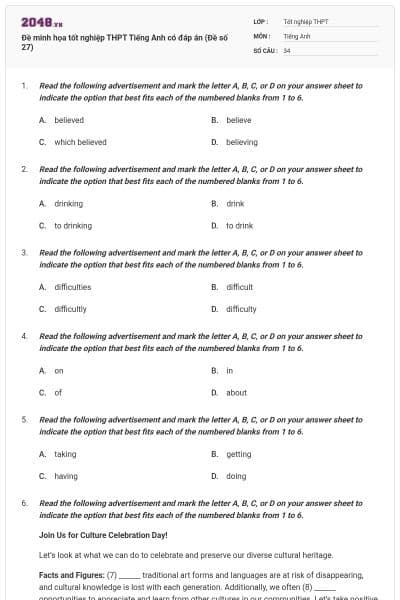
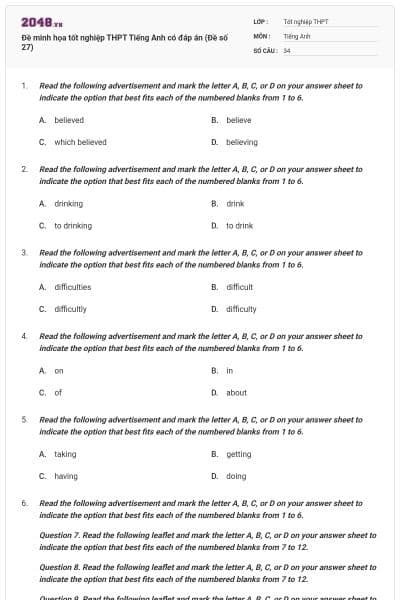
Read the following advertisement and mark the letter A, B, C, or D on your answer sheet to indicate the option that best fits each of the numbered blanks from 1 to 6.
dining fresh experience
fresh experience dining
fresh dining experience
experience fresh dining
Read the following advertisement and mark the letter A, B, C, or D on your answer sheet to indicate the option that best fits each of the numbered blanks from 1 to 6.
inspiring
are inspired
which inspire
inspired
Read the following advertisement and mark the letter A, B, C, or D on your answer sheet to indicate the option that best fits each of the numbered blanks from 1 to 6.
for
to
with
on
Read the following advertisement and mark the letter A, B, C, or D on your answer sheet to indicate the option that best fits each of the numbered blanks from 1 to 6.
entertainment
entertaining
entertainingly
entertain
Read the following advertisement and mark the letter A, B, C, or D on your answer sheet to indicate the option that best fits each of the numbered blanks from 1 to 6.
to take
taking
to taking
take
Read the following advertisement and mark the letter A, B, C, or D on your answer sheet to indicate the option that best fits each of the numbered blanks from 1 to 6.
make
book
save
create
Read the following announcement mark the letter A, B, C, or D on your answer sheet to indicate the option that best fits each of the numbered blanks from 7 to 12.
class
group
variety
club
Read the following announcement mark the letter A, B, C, or D on your answer sheet to indicate the option that best fits each of the numbered blanks from 7 to 12.
workshops
conferences
anniversaries
interviews
Read the following announcement mark the letter A, B, C, or D on your answer sheet to indicate the option that best fits each of the numbered blanks from 7 to 12.
care about
arrange for
depend on
respond to
Read the following announcement mark the letter A, B, C, or D on your answer sheet to indicate the option that best fits each of the numbered blanks from 7 to 12.
another
the other
each other
one another
Read the following announcement mark the letter A, B, C, or D on your answer sheet to indicate the option that best fits each of the numbered blanks from 7 to 12.
values
units
customs
ideas
Read the following announcement mark the letter A, B, C, or D on your answer sheet to indicate the option that best fits each of the numbered blanks from 7 to 12.
although
though
yet
since
Jane: Watch out! You’re too close and will burn yourself!
Jane: Hi, Nga. Is that a coal-burning stove?
Nga: Hi. Yes, my dad bought it last week. It heats up our home very quickly. Let me put in some more coal.
c-a-b
b-c-a
c-b-a
a-c-b
Ben: Yes, I’ve decided to join the debate club.
Ben: It helps improve my public speaking skills, and I enjoy discussing current issues.
Mia: Are you planning to join any extracurricular activities this year?
Mia: Why did you choose the debate club?
Mia: That sounds interesting! I think I’ll join you and give it a try.
c-a-d-b-e
d-a-c-b-e
d-b-c-a-e
c-b-e-a-d
Hi Jane,
Look forward to hearing from you.
Best wishes,
Michael
But I believe you’ll soon get accustomed to this new chapter.
I’ve just heard about your new job, so I want to check in and see how it is going.
But remember to take breaks and not overwhelm yourself with too much duty at once.
Besides work, making friends with colleagues is also very important.
Entering a new environment is a big adjustment, isn’t it?
b-a-e-c-d
e-b-c-a-d
b-e-a-d-c
b-c-a-e-d
Another outcome of climate change is the threat it poses to agriculture, as farmers struggle with unpredictable weather that disrupts harvests.
Its clearest consequence is the increase in extreme weather events, such as hurricanes and droughts, which can now occur in any country.
These climate-related challenges highlight the urgent need for sustainable practices, requiring changes from both governments and individuals.
If ignored, these issues may severely impact future generations and biodiversity as a whole.
Climate change, causing changes in weather patterns, is negatively affecting human life.
e-a-c-b-d
e-d-a-c-b
e-c-d-b-a
e-b-a-c-d
Firstly, it broadens our horizons by exposing us to new cultures, traditions, and perspectives.
Travelling offers a multitude of benefits that enrich our lives in various ways.
Overall, travelling goes far beyond mere sightseeing, providing transformative experiences that positively shape our lives.
Through experiencing different customs and interacting with diverse communities, we become more open-minded and tolerant individuals.
Moreover, travel fosters personal growth and self-discovery. It pushes us out of our comfort zones, promoting self-confidence and independence as we navigate unfamiliar territories.
b-d-e-a-c
a-d-b-e-c
b-a-d-e-c
c-a-e-d-b
Read the following passage about traditional medicineand mark the letter A, B, C, or D on your answer sheet to indicate the option that best fits each of the numbered blanks from 18 to 22.
that date back thousands of years to its rural villages
having dated back thousands of years to its rural villages
trace their origins back thousands of years to its rural villages
of which origins are traced back thousands of years to its rural villages
Read the following passage about traditional medicineand mark the letter A, B, C, or D on your answer sheet to indicate the option that best fits each of the numbered blanks from 18 to 22.
Their preparation processes bear some similarities
These ingredients differ for each medicine
The key similarity lies in preparation methods
The main difference is in their preparation
Read the following passage about traditional medicineand mark the letter A, B, C, or D on your answer sheet to indicate the option that best fits each of the numbered blanks from 18 to 22.
whose preparation is less complicated
has a more complicated preparation
being prepared with more complication
is prepared less complicatedly
Read the following passage about traditional medicineand mark the letter A, B, C, or D on your answer sheet to indicate the option that best fits each of the numbered blanks from 18 to 22.
Compared to the use in treating diabetes of Vietnamese bitter melon (mướp đắng or khổ qua), lá vông is more efficient in helping better sleep.
In spite of mướp đắng or khổ qua (Vietnamese bitter melon) helping treat diabetes, lá vông is the better choice to improve sleep quality.
While Vietnamese bitter melon (mướp đắng or khổ qua) is used in diabetes treatment, lá vông can help people sleep better.
Unlike the use of mướp đắng or khổ qua (Vietnamese bitter melon) in diabetes treatment, lá vông is believed to improve sleep quality.
Read the following passage about traditional medicineand mark the letter A, B, C, or D on your answer sheet to indicate the option that best fits each of the numbered blanks from 18 to 22.
Many people prefer these remedies over visiting hospitals for serious illnesses.
These treatments are widely recognized as being safer than modern medicine.
This ensures that the ancient practice continues to thrive in modern times.
This highlights the government’s efforts to preserve traditional cultural values.
The word ‘hazardous’ in paragraph 1 is OPPOSITE in meaning to ______.
harmful
secure
risky
severe
The word ‘them’ in paragraph 2 refers to ______.
streets
places
cities
towns
Which of the following best paraphrases underlined sentence in paragraph 3?
People only leave their buildings when the sidewalks and streets are less crowded.
Buildings are designed to keep people away from the noise and danger of traffic.
People prefer to stay indoors because the streets are too busy and unsafe.
Staying inside helps people avoid getting lost in the city’s crowded streets.
The word ‘permits’ in paragraph 4 could best be replaced by ______.
licenses
restrictions
fines
warnings
Which of the following is NOT mentioned as a method cities use to improve pedestrian safety?
Adding more traffic lights on busy streets.
Increasing the number of bicycle lanes.
Expanding sidewalks to reduce crowding.
Restricting certain vehicles in historic areas.
All of the following are true according to the passage EXCEPT ______.
Question 29. In which paragraph does the writer mention Engwicht’s efforts to change attitudes toward streets and neighborhoods?
As people retreat indoors, they lose opportunities to connect with neighbors.
Lower speed limits in residential areas are necessary to protect pedestrians.
Streets used to be lively public spaces for everyone back in the day.
The main purpose of walking is to get from one place to another.
Paragraph 1
Paragraph 2
Paragraph 4
Paragraph 5
In which paragraph does the writer draw a promising picture of the issue being discussed?
Paragraph 6
Paragraph 5
Paragraph 4
Paragraph 3
The word ‘emerged’ in paragraph 1 is OPPOSITE in meaning to ______.
vanished
exposed
rejected
ruined
The word ‘them’ in paragraph 1 refers to ______.
cities
rivers
people
crops
Which of the following best paraphrases the underlined sentence in paragraph 2?
Cities became appealing as they provided chances for commerce, learning, and employment.
Cities developed rapidly as people focused on expanding trade, education, and industries.
Many people moved to cities because rural areas lacked basic services like trade and education.
People were attracted and moved to cities for better farming and travel opportunities.
Which of the following best summarises paragraph 1?
Early cities appeared near rivers, enabling stable communities and trade growth.
Early cities were set up quickly as rural areas were preferred for farming.
Rivers were primarily used for transportation, not essential to urban development.
The rise of early cities caused the start of traditional farming communities.
The phrase ‘by leaps and bounds’ in paragraph 3 could be best replaced by ______.
very differently
very successfully
very slowly
very strongly
Where in paragraph 3 does the following sentence best fit?
London, therefore, went from a population of 1 million in 1800 to over 6 million in ten years.
[I]
B. [II]
C. [III]
D. [IV]
Which of the following is NOT mentioned as one of the megacities?
New York City
Mesopotamia
Sao Paulo
Delhi
Which of the following is TRUE according to the passage?
The urbanization trend is showing signs of slowing down.
The vast majority of people still resided in the countryside a century ago.
The Industrial Revolution contributed significantly to urbanisation trends.
Tokyo lost its position as the largest megacity in the 1950s.
Which of the following can be inferred from the passage?
Urbanisation has caused rural populations to completely disappear over time.
Improvements in infrastructure and opportunities continue to drive urbanisation.
Megacities with more than 10 million people are a phenomenon exclusive to Asia.
Rural areas are predicted to become more attractive than cities due to overpopulation.
Which of the following best summarises the passage?
Urbanisation has been a negative trend throughout human history, driven by farming, trade, and technological innovation.
Cities have transformed over time, growing from small farming communities to modern megacities thanks to industrialisation and other developments.
The rise of megacities highlights the consequences of urbanisation, including population growth and challenges in rural areas.
Urbanisation is a recent phenomenon caused by the Industrial Revolution and is expected to slow down in the near future.
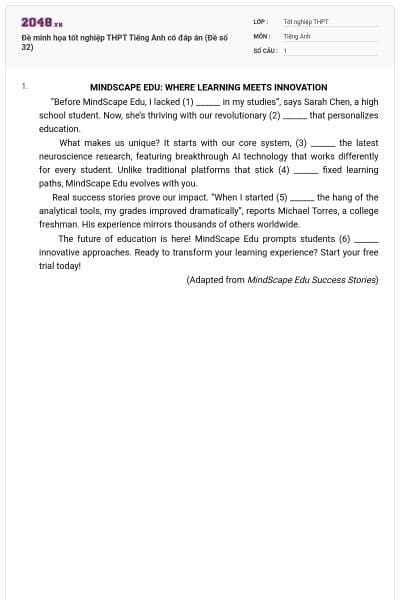
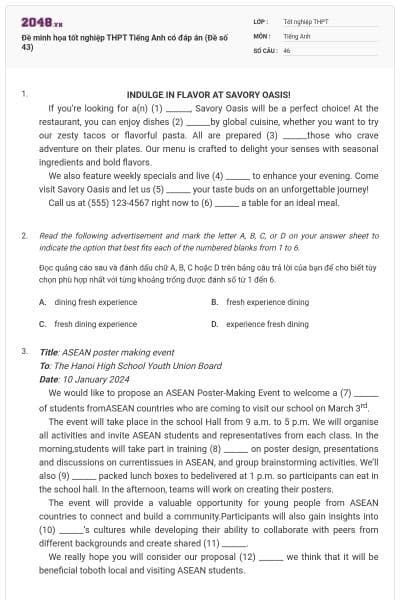
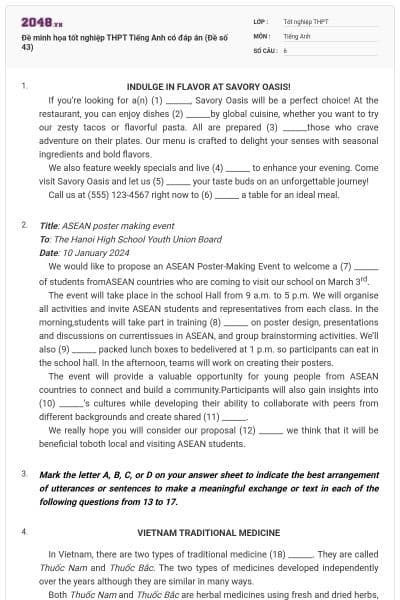
INDULGE IN FLAVOR AT SAVORY OASIS!
If you’re looking for a(n) (1) ______, Savory Oasis will be a perfect choice! At the restaurant, you can enjoy dishes (2) ______by global cuisine, whether you want to try our zesty tacos or flavorful pasta. All are prepared (3) ______those who crave adventure on their plates. Our menu is crafted to delight your senses with seasonal ingredients and bold flavors.
We also feature weekly specials and live (4) ______ to enhance your evening. Come visit Savory Oasis and let us (5) ______ your taste buds on an unforgettable journey!
Call us at (555) 123-4567 right now to (6) ______ a table for an ideal meal.
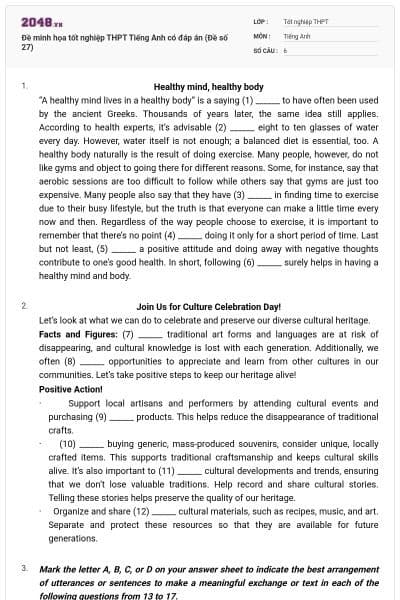
Title: ASEAN poster making event
To: The Hanoi High School Youth Union Board
Date: 10 January 2024
We would like to propose an ASEAN Poster-Making Event to welcome a (7) ______ of students fromASEAN countries who are coming to visit our school on March 3rd.
The event will take place in the school Hall from 9 a.m. to 5 p.m. We will organise all activities and invite ASEAN students and representatives from each class. In the morning,students will take part in training (8) ______ on poster design, presentations and discussions on currentissues in ASEAN, and group brainstorming activities. We’ll also (9) ______ packed lunch boxes to bedelivered at 1 p.m. so participants can eat in the school hall. In the afternoon, teams will work on creating their posters.
The event will provide a valuable opportunity for young people from ASEAN countries to connect and build a community.Participants will also gain insights into (10) ______’s cultures while developing their ability to collaborate with peers from different backgrounds and create shared (11) ______.
We really hope you will consider our proposal (12) ______ we think that it will be beneficial toboth local and visiting ASEAN students.
Mark the letter A, B, C, or D on your answer sheet to indicate the best arrangement of utterances or sentences to make a meaningful exchange or text in each of the following questions from 13 to 17.
VIETNAM TRADITIONAL MEDICINE
In Vietnam, there are two types of traditional medicine (18) ______. They are called Thuốc Nam and Thuốc Bắc. The two types of medicines developed independently over the years although they are similar in many ways.
Both Thuốc Nam and Thuốc Bắc are herbal medicines using fresh and dried herbs, and plants. (19) ______. Thuốc Nam uses different herbs that are simply chopped or ground before using. Thuốc Bắc, however, (20) ______, and often involves brewing and boiling
the herbs to create medicinal mixtures.
The two forms of traditional medicine are rooted in similar beliefs, particularly the idea of Khíor energy that flows through our bodies. One well-known remedyis from a plant called lá lốt whose leaves help treat arthritis and backache. Herbslike mint are commonly used for colds and the flu. (21) ______.
Today, both traditional medicines remain highlypopular in Vietnam. There are many herbal remedy shops where people can find treatments for almost any medical problem. Students can pursue studies in this field at Vietnam University Of Traditional Medicineand the government operates institutes where patients can receive traditional treatments.(22) ______.
Read the following passage about safer streets and mark the letter A, B, C, or D on your answer sheet to indicate the best answer to each of the following questions from 23 to 30.
Walking is a great way to get around. For short trips, for exercise, or just for fun, walking can be better than driving or riding. But in many cities, walking can also be hazardous. Cars, trucks, and motorcycles are a danger to pedestrians, and sometimes there are accidents.
David Engwicht, an urban thinker from Brisbane, Australia, wants to do something about this. His book, Reclaiming Our Cities and Towns, has a simple message: We need to take back our streets and make them better places for walking.
In the past, Engwicht says, streets belonged to everybody. Children played there, and people walked freely to work or to stores. But today, most city engineers design streets for vehicles. People stay inside buildings to get away from the crowded sidewalks, the noisy streets, and the dangerous traffic. Unfortunately, this gives them less contact with their neighbors.
Many cities are working to make their streets safer for pedestrians. There are new crosswalks on the streets and more traffic lights and bicycle lanes. The city of Florence, Italy, only allows cars and buses with special permits to drive on its historic city streets. In Boston, US, the Slow Streets Program gives some neighborhoods more stop signs and a 20 mph (32 kph) speed limit.
Engwicht travels the world, helping people think differently about pedestrians, streets, and neighborhoods. Whether we live in a small town or a city with a population in the millions, he says we should think of streets as our “outdoor living room”. Changing the traffic is just the beginning.
If cities continue these efforts, the future may bring pedestrian-friendly streets where walking will be an even better form of transportation than it is now.
Read the following passage and mark the letter A, B, C, or D on your answer sheet to indicate the best answer to each of the following questions from 31 to 40.
The first cities emerged around ten thousand years ago in areas with good farmland near rivers such as in Mesopotamia and Egypt. This is because when people started to grow crops, they could live in communities in one place instead of moving around to find food. The rivers also allowed them to trade with other communities.
People became attracted to cities because they offered trade, education and work opportunities. However, urbanisation was still a new thing. Until 250 years ago, 90% of people lived in rural areas. The huge cities of Mesopotamia have disappeared, but other cities have grown. For example, Cairo in Egypt today has a population of 22 million people.
The main reason behind the rapid urbanisation we see today was the Industrial Revolution of the mid-1800s, which started in England and then spread to Europe and America. [I] People started moving from the countryside to the cities to work in the factories, which made the city population grow by leaps and bounds. [II] Advances in infrastructure, transit, education and entertainment still keep attracting more people to move to big cities. [III] Today, more than half of the world’s population lives in urban areas and experts predict that it will increase to two-thirds by 2050. [IV]
The first megacities with populations of more than 10 million people were New York City and Tokyo in the 1950s. There are 33 megacities around the world today. Tokyo is still the biggest with 37.3 million residents, but there are lots of cities with populations of more than 20 million such as Delhi, Shanghai, Dhaka, Sao Paulo and Mexico City. Experts predict there will be 41 megacities by the year 2030.