Chuyên đề 2: Grammar (Verb Forms) có đáp án
21 câu hỏi
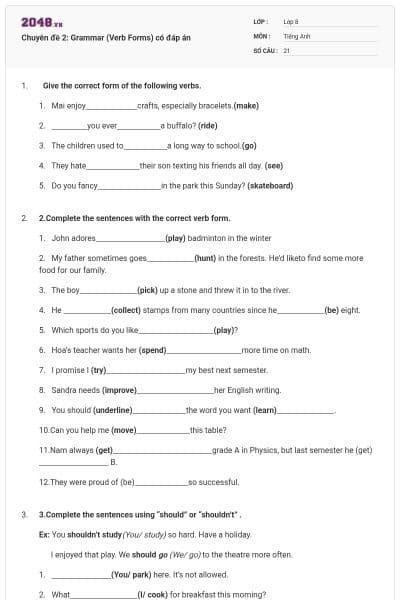
Give the correct form of the following verbs.
1. Mai enjoy crafts, especially bracelets.(make)
2. you ever a buffalo? (ride)
3. The children used to a long way to school.(go)
4. They hate their son texting his friends all day. (see)
5. Do you fancy in the park this Sunday? (skateboard)
1. making 2. Have – ridden 3. go
4. seeing/ tosee 5. skateboarding
2.Complete the sentences with the correct verb form.
1. John adores (play) badminton in the winter
2. My father sometimes goes (hunt) in the forests. He’d liketo find some more food for our family.
3. The boy (pick) up a stone and threw it in to the river.
4. He (collect) stamps from many countries since he (be) eight.
5. Which sports do you like (play)?
6. Hoa’s teacher wants her (spend) more time on math.
7. I promise I (try) my best next semester.
8. Sandra needs (improve) her English writing.
9. You should (underline) the word you want (learn) .
10.Can you help me (move) this table?
11.Nam always (get) grade A in Physics, but last semester he (get) B.
12.They were proud of (be) so successful.
1.playing 2. hunting 3. picked 4. collected - was
5. playing / to play 6. to spend 7. will try 8. to improve
9.underline - to learn 10. move/ to move 11. gets – got 12. being
3.Complete the sentences using “should” or “shouldn’t” .
Ex: You shouldn’t study(You/ study) so hard. Have a holiday.
I enjoyed that play. We should go (We/ go) to the theatre more often.
1. (You/ park) here. It’s not allowed.
2. What (I/ cook) for breakfast this morning?
3. (You/ wear) a raincoat. It’s raining outside.
4. (You/ smoke). It’s bad for you.
5 (We/ arrive) at the airport two hours before the flight.
6 (I/ send) now or later?
7. Do you think (I/ apply) for this post?
8. What do you think (I/ write) in this space on the form?
9. (I/ eat) cakes anymore. I’ve already eaten too much.
10.This food is awful. (We/ complain) to the manager.
11.Which dress do you think (I/ buy)?
1. You shouldn’t park 2. should I cook 3. You should wear
4.You shouldn’t smoke 5. We should arrive 6. Should I send
7. I should apply 8. I should write 9. I shouldn’t eat
10. We should complain 11. I should buy
4. Give the correct form of the following verbs
1. My mother always tells me that I have to home by 9 p.m. (be)
2. When I came, the whole family dinner around a big dinning table.(have)
3. Children should things from adults with both hands.(take)
4. In Australia, you mustn’t on a person’s accent. (comment)
5. Laura lives in a big city. If she (live) in the country, she (have) a dog.
6. I (learn) Italian for the past three years.
7. If I were you, I (not / buy) that book.
8. What the children (see) in the zoo yesterday?
9. They prefer (play) in a swimming pool all day.
10.The doctor will be ready in ten minutes. Take a seat while you . (wait)
1.be 2.was having 3. take 4. comment 5. lived/ would have
6. have learnt (have been learning) 7. wouldn’t buy
8. did (the children) see 9. playing 10. are waiting
5.Choose the correct answers.
1. Alice saw/ was seeing the accident when she was catching the bus.
2. What were you doing/ did you do when I called?
3. Ididn’t visit/ weren’t visiting my friends last summer holiday.
4. It rained/ was raining heavily last July.
5. While people were talking to each other, he read/ was reading his book.
6. My sister was eating/ ate hamburgers every weekend last month.
7. While we were running/ run in the park, Mary fell over.
8. Did you find/ Were you finding your keys yesterday?
9. Who was she dancing/ did she dance with at the party last night?
10.They were watching/ watched football on TV all day.
1. saw 2. were you doing 3. didn’t visit 4. rained
5. was reading 6. ate 7. were running 8. Did you find
9. did she dance 10. were watching
6.Put the correct verb form of the past tenses.
In my last holiday, I went to Hawaii. When I (go)1 ........................ to the beach forthe first time, something wonderful happened. I (swim) 2 ........................ in thesea while my mother was sleeping in the sun. My brother was building a castle andmy father (drink) 3 ........................ some water. Suddenly I (see) 4 ........................ a boy on the beach. His eyes were blue like the water in the sea and his hair (be) 5 ........................ beautiful black. He was very tall and thin and his face was brown.My heart (beat) 6 ........................ fast. I (ask) 7 ........................ him for his namewith a shy voice. He (tell) 8 ........................ me that his name was John. He (stay)9 ........................ with me the whole afternoon. In the evening, we met again. Weate pizza in a restaurant. The following days we (have) 10 ........................ a lot of funtogether. At the end of my holidays when I left Hawaii I said good-bye to John. We had tears in our eyes. He wrote to me a letter very soon and I answered him.
1. went 2. swam 3. was drinking 4. saw 5. was
6.beat 7. asked 8. told 9. stayed 10. had
7.Put the verb in correct tense or form.
1. Trung’s father (teach) him how (ride) a bicyclewhen he (be) twelve years old.
2. How your brother (go) to work everyday?
- He usually (drive).
3. We (go) to Ha Long Bay this weekend.
4. You (use) to play so much when you (live) in the countryside?
5. Yesterday Hoang (spend) two hours (repair) his computer set.
1. taught/to ride/was 2. do - go/ drives 3. are going to
4.Did you use to play/ lived 5. spent/ repairing

8. Write these sentences, putting one verb into the correct form of “used to” and the other into the past simple.
1. He (live) in London before he (go) abroad.
2. I (earn) a lot of money, but then I (lose) my job.
3. I’m surprised that they (join) the tennis dub. They (not/ like) tennis.
4. you (travel) a lot before you (become) a teacher?
5. That radio (work) before I (drop) it.
6. We (see) them every week, but then we (have) an argument.
7. She (play) tennis a lot before she (break) her leg.
8. She (drive) a lot before she (have) an accident.
9. We (have) a garden, but then we (move) to a different house.
1. used to live – went 2. used to earn – lost
3. joined – didn’t use to like 4. Did (you) use to travel – became
5.used to work – dropped 6. used to see – had
7. used to play – broke 8. used to drive – had
9. used to have – moved
9.Use the gerund of the verbs in the box to complete the sentences.
1. My sister enjoys aerobics in the morning.
2. Lucia fancies emails after dinner.
3. In his free time, Quang likes photographs.
4. Are you interested in handball, Peter?
5. Vinh’s brother loves foreign coins, doesn’t he?
6. David hates a bike to school on rainy days.
7. I prefer DVDs to going to cinema.
8. Nam detests the dishes every day.
9. We don’t mind to classical music.
10.The Robinsons adore Vietnamese food.
1. doing 2. writing 3. taking 4. playing 5. collecting
6. riding 7. watching 8. washing 9. listening 10. eating
10. Put the verbs in the brackets into infinitive (V/to V) or gerund (V-ing).
1. John dislikes (work) in front of a computer all day.
2. I’d like (visit) the Viet Nam Museum of Ethnology this weekend
3. I’d rather (make) crafts than listen to music.
4. Minh loves (help) her parents with DIY projects.
5. Quang hates (take) the dog for a walk.
6. We all adored (do) aerobics when we were young.
7. You should (play) sports to keep fit.
8. They don’t need (watch) that programme if they don’t like it.
9. Do you fancy (socialize) with friends?
10. My brother prefers (surf) the Internet.
1. working 2. to visit 3. make 4. helping 5. taking
6. doing 7. play 8. to watch 9. socializing 10. surfing
11. Complete the sentences. Put the verbs into the correct form. Affirmative or negative.
1. I knew Sarah was very busy, so I her. (disturb)
2. I was very tired, so I to bed early. (go)
3. The bed was very uncomfortable. I well.(sleep)
4. Sue wasn’t hungry, so she anything. (eat)
5. We went to Kate’s house but she at home. (be)
6. It was a funny situation but nobody . (laugh)
7. The window was open and a bird into the room. (fly)
8. The hotel wasn’t expensive. It very much.(cost)
9. I was in a hurry, so I time to phone you. (have)
10.It was hard carrying the bags. They very heavy. (be)
1. didn’t disturb 2. went 3. didn’t sleep 4. didn’t ate 5. wasn’t
6. laughed 7. flied 8. cost 9. didn’t have 10. were
12. Correct the verbs form to complete the sentences.
1. If you (go) away, please write to me.
2. If he (eat) another cake, he will be sick.
3. I (not do) that if I (be) you.
4. If he (take) my advice, everything can go well.
5. He never does homework. If he (do) his homework, he (not worry) about his exam.
6. What you (do) if she refuses your invitation?
7. If today (be) Sunday, we (go) to the beach.
8. Unless they (pass) their examinations, they would join the army.
9. You (be) ill if you drink that water.
10.If Tom (go) to bed earlier, he would not be so tired.
11.If it’s raining heavily, we (not go) for a donkey ride.
12.If he (try) hard, he’ll pass the examination.
13.I could understand the French teacher if she (speak) more slowly.
14.If I (finish) the work in time, I (go) to the football game.
15.If you (see) Mary today, please (ask) her to call me.
1. go 2. eats 3. wouldn’t do/ were 4.takes
5. did/ wouldn’t worry. 6. will....do7. were /would go
8. passed 9. will be 10.went 11. won’t go
12. tries 13. spoke 14. finish/ will go 15. see/ ask
13.Complete the sentences with the correct verb form in the bracket.
1. Ifsomeone offered to buy you one ofthose rings, whichyou (choose) ?
2. The flight may be cancelled if the fog (get) thick.
3. If the milkman (come) , tell him to leave two pints.
4. I (call) the office if I were you.
5. Someone (sit) on your glasses if you leave them there.
6. You would hear my explanation if you (not talk) so much.
7. What you (do) if you hear the burglar alarm?
8. If you (read) the instructions carefully, you wouldn’t haveanswered the wrong question.
9. If Mel (ask) her teacher, he’d have answered her questions.
10.I would repair the roof myself if I (have) a long ladder.
11.Unless they turn that radio off,I (go) mad.
12.If you were made redundant, what you (do) ?
13.We’ll have a long way to walk if we (run) out of petrol here.
14.If you shake that bottle of port, it (not be) fit to drink.
15.If you spoke louder, your classmates (understand) you.
16.I’ll probably get lost unless he (come) with me.
17.You (not have) so many accidents if you drove more slowly.
18.If you (wear) a false beard, nobody would have recognized you.
19.If she (leave) the fish here, the cat will eat it
20.You (have) no trouble at school if you had done your homework.
1. would you choose 2. gets 3. comes 4. would call
5. will sit 6. don’t talk 7. will you do 8. had read
9.had asked 10. had 11. will go 12. would you do
13.run 14. won’t be 15. would have understand
16. comes 17. wouldn’t have 18. had worn 19. leaves
20. would have had
14.Complete the sentences with the correct verb form in the bracket.
1. If we meet at 9:30, we (have) plenty of time.
2. If you (find) a pen in the cellar, don’t mention it to anyone.
3. The zookeeper would have punished her with a fine if she (feed) the animals.
4. If you pass your examination, we (have) a celebration.
5. Lisa would find the milk if she (look) for it in the fridge.
6. What (happen) if I press this button?
7. The door will be unlocked if you (press) the green button.
8. I should have voted for her if I (have) a vote then.
9. If you go to Paris, where you (stay) ?
10.If you (swim) in this lake, you’ll shiver from cold.
11.Unless you (tell) the truth, I won’t help you.
12.You’ll get pneumonia if you (not change) your wet clothes.
13.If I had known that you couldn’t eat octopus, I (not buy) it.
14.If they (hang) that picture lower, people would be able to see it.
15.She (be) able to walk faster if she didn’t have such high-heel shoes.
16.I(bring) you some beer if I had known that you were thirsty.
17.Ifyou had touched that electric cable, you (be) electrocuted.
18.If the story hadn’t been true, the newspaper (not print) it.
19.I (not buy) things on the installment system if I were you.
20.Dan (arrive) safe if he drove slowly.
1. will have
Giải thích:
Dựa vào động từ “meet” ở thì hiện tại đơn, xác định đây là câu điều kiện loại 1.
Dịch: Nếu chúng ta gặp nhau lúc 9:30, chúng ta sẽ có rất nhiều thời gian.
2. find
Giải thích:
Dựa vào cụm động từ mệnh lệnh “don’t mention”, xác định đây là câu điều kiện loại 1, với điều kiện có thể xảy ra trong tương lai.
Dịch: Nếu bạn tìm thấy một cây bút trong hầm, đừng nói với ai.
3. had fed
Giải thích:
Dựa vào "would have punished" trong mệnh đề chính, đây là câu điều kiện loại 3, diễn tả một tình huống không có thật trong quá khứ. Mệnh đề "if" cần dùng quá khứ hoàn thành (had + V3).
Dịch: Người giữ sở thú đã phạt cô ấy bằng một khoản tiền phạt nếu cô ấy đã cho thú ăn.
4. will have
Giải thích:
Dựa vào "If you pass..." ở thì hiện tại đơn, xác định đây là câu điều kiện loại 1. Mệnh đề chính sẽ dùng thì tương lai đơn "will have".
Dịch: Nếu bạn vượt qua kỳ thi, chúng ta sẽ có một buổi lễ ăn mừng.
5. looked
Giải thích:
Dựa vào cấu trúc "would find" trong mệnh đề chính, đây là câu điều kiện loại 2, diễn tả một tình huống không có thật ở hiện tại hoặc tương lai. Mệnh đề "if" dùng thì quá khứ đơn.
Dịch: Lisa sẽ tìm thấy sữa nếu cô ấy tìm kiếm nó trong tủ lạnh.
6. will happen
Giải thích:
Dựa vào mệnh đề “if” ở thì hiện tại đơn, xác định đây là câu điều kiện loại 1.
Dịch: Điều gì sẽ xảy ra nếu tôi nhấn nút này?
7. press
Giải thích:
Dựa vào cấu trúc "will be unlocked" trong mệnh đề chính, đây là câu điều kiện loại 1, mệnh đề "if" sử dụng thì hiện tại đơn.
Dịch: Cửa sẽ được mở nếu bạn nhấn nút xanh.
8. had had
Giải thích:
Dựa vào "should have voted" trong mệnh đề chính, đây là câu điều kiện loại 3, diễn tả một tình huống không có thật trong quá khứ. Mệnh đề "if" cần dùng quá khứ hoàn thành (had + V3).
Dịch: Tôi lẽ ra đã bầu cho cô ấy nếu tôi đã có quyền bỏ phiếu vào lúc đó.
9. will you stay
Giải thích:
Dựa vào mệnh đề “if” ở thì hiện tại đơn, xác định đây là câu điều kiện loại 1.
Dịch: Nếu bạn đi Paris, bạn sẽ ở đâu?
10. swim
Giải thích:
Dựa vào mệnh đề kết quả ở thì tương lai đơn, xác định đây là câu điều kiện loại 1.
Dịch: Nếu bạn bơi trong hồ này, bạn sẽ cảm thấy lạnh.
11. tell
Giải thích:
Dựa vào mệnh đề kết quả ở thì tương lai đơn, xác định đây là câu điều kiện loại 1.
Dịch: Trừ khi bạn nói sự thật, tôi sẽ không giúp bạn.
12. don’t change
Giải thích:
Dựa vào mệnh đề kết quả ở thì tương lai đơn, xác định đây là câu điều kiện loại 1.
Dịch: Bạn sẽ bị viêm phổi nếu bạn không thay quần áo ướt.
13. wouldn’t have bought
Giải thích:
Dựa vào mệnh đề điều kiện ở thì quá khứ hoàn thành, xác định đây là câu điều kiện loại 3.
Dịch: Nếu tôi đã biết rằng bạn không thể ăn bạch tuộc, tôi đã không mua nó.
14. hung
Giải thích:
Dựa vào mệnh đề kết quả ở dạng “would V”, xác định đây là câu điều kiện loại 2.
Dịch: Nếu họ đã treo bức tranh thấp hơn, mọi người sẽ có thể nhìn thấy nó.
15. would be
Giải thích:
Dựa vào mệnh đề điều kiện ở thì quá khứ đơn, xác định đây là câu điều kiện loại 2.
Dịch: Cô ấy sẽ có thể đi bộ nhanh hơn nếu cô ấy không mang giày cao gót.
16. would have brought
Giải thích:
Dựa vào mệnh đề điều kiện ở thì quá khứ hoàn thành, xác định đây là câu điều kiện loại 3.
Dịch: Tôi đã mang cho bạn bia nếu tôi đã biết rằng bạn khát.
17. would have been
Giải thích:
Dựa vào mệnh đề điều kiện ở thì quá khứ hoàn thành, xác định đây là câu điều kiện loại 3.
Dịch: Nếu bạn đã chạm vào dây điện đó, bạn đã bị điện giật.
18. wouldn’t have printed
Giải thích:
Dựa vào mệnh đề điều kiện ở thì quá khứ hoàn thành, xác định đây là câu điều kiện loại 3.
Dịch: Nếu câu chuyện không có thật, tờ báo đã không in nó.
19. wouldn’t buy
Giải thích:
Dựa vào "if I were you" trong mệnh đề đầu, đây là câu điều kiện loại 2, mệnh đề "if" sử dụng thì quá khứ đơn.
Dịch: Tôi sẽ không mua những thứ theo hình thức trả góp nếu tôi là bạn.
20. would arrive
Giải thích:
Dựa vào "if he drove slowly" trong mệnh đề "if", đây là câu điều kiện loại 2, mệnh đề "if" sử dụng thì quá khứ đơn.
Dịch: Dan sẽ đến nơi an toàn nếu anh ấy lái xe chậm.
15.Complete the sentences with the appropriate present tense of the verbs in brackets.
1. Each of the 50 states an official state flower so far. (adopt)
2. Since 1965, the maples tree with the leaves the most well- known Canadian symbol.(become)
3. At present, the National Cherry Blossom Festival in Washington, D.C. to celebrate spring’s arrival.(occur)
4. Maori recognized as an official language of New Zealand since the Maori Language Act of 1987. (be)
5. Canada made up of 10 provinces and 3 territories.(be)
6. Australia a range of different landscapes, including urbanareas, mountain ranges, desert and rain forests.(have)
7. Annually, the National Eisteddfod festival of Wales place foreight days at the start of August. (take)
8. The Statue of Liberty over 12 million immigrants entering theUSA through New York Harbor since 1900. (welcome)
1. has adopted
Câu này sử dụng thì hiện tại hoàn thành "has adopted" vì hành động (chấp nhận một loài hoa chính thức) đã hoàn thành và kéo dài đến hiện tại, với "so far" nhấn mạnh quá trình đó vẫn tiếp tục cho đến nay.
Dịch: Mỗi bang trong số 50 bang đã chọn một loài hoa chính thức cho đến nay.
2. have become
Câu này sử dụng thì hiện tại hoàn thành "has become" để chỉ một sự thay đổi diễn ra từ 1965 đến nay. "Since" chỉ mốc thời gian bắt đầu của hành động.
Dịch: Kể từ năm 1965, cây phong với những chiếc lá đã trở thành biểu tượng nổi tiếng nhất của Canada.
3. is occurring
Thì hiện tại tiếp diễn "is occurring" được dùng để mô tả hành động đang diễn ra ngay lúc này, trong trường hợp này là lễ hội hoa anh đào.
Dịch: Hiện tại, lễ hội hoa anh đào quốc gia đang diễn ra ở Washington, D.C. để chào đón mùa xuân.
4. has been
Câu này sử dụng thì hiện tại hoàn thành tiếp diễn "has been recognized" để chỉ một trạng thái bắt đầu từ quá khứ (1987) và kéo dài đến nay.
Dịch: Ngôn ngữ Maori đã được công nhận là một ngôn ngữ chính thức của New Zealand kể từ Luật Ngôn ngữ Maori năm 1987.
5. is
Thì hiện tại đơn "is" dùng để mô tả sự thật hiển nhiên và vĩnh viễn về cấu trúc của Canada.
Dịch: Canada được cấu thành từ 10 tỉnh và 3 lãnh thổ.
6. has
Thì hiện tại đơn "has" được dùng để chỉ sự sở hữu (Australia có nhiều loại hình cảnh quan khác nhau).
Dịch: Australia có nhiều loại hình cảnh quan khác nhau, bao gồm các khu đô thị, dãy núi, sa mạc và rừng mưa.
7. takes
Thì hiện tại đơn "takes" dùng để chỉ một sự kiện xảy ra đều đặn mỗi năm.
Dịch: Hằng năm, lễ hội Eisteddfod quốc gia của Wales diễn ra trong tám ngày vào đầu tháng Tám.
8. has welcomed
Thì hiện tại hoàn thành "has welcomed" để nói về một hành động đã xảy ra từ 1900 cho đến nay.
Dịch: Tượng Nữ thần Tự do đã chào đón hơn 12 triệu người nhập cư vào Hoa Kỳ qua Cảng New York kể từ năm 1900.
16. Fill in the correct verb form.
1. They (come) .......................... back home after they (finish).......................... their work.
2. She said that she (meet) .......................... Mr. Bean before.
3. Before he (go) .......................... to bed, he (read) .......................... a novel.
4. He told me he (not/wear)...................................... such kind of clothes before.
5. When I came to the stadium, the match (start) ......................................
6. After Nick (do) ............................ his homework, he (go) ............................ to bed last night.
7. Mai (live)............................ in Hai Phong for five years before she (move) ............................ to Ha Noi three years ago.
8. Phong (tell) .......................... me yesterday that he (learn) .......................... French for a year.
9. Ms. Hong (work) ............................ at our school for twenty years before she (retire) ............................ last June.
10.By the time I (get) ....................................... to Nick’s house, his party (already/ start) ................................................
11.When we (come)..................................... back to our home village last month, it(change) ............................ so much.
12.I couldn’t recognize my cousin because he (grow) ............................ a lot.
13.By the time the bus (come)............................ this morning, Duong (wait) ............................ for it for half an hour.
14.Before she (listen) ............................ to music, she (do) ............................ homework.
15.Last night, Peter (go) ...................... to the supermarket before he (go) ........................ home.
1. came/had finished 2. had met 3. went/ had read
4. hadn’t worn 5. had started 6. had done/ went
7. had lived/ moved 8. told/ had learned 9. had worked/ retired
10. got/ had already started 11. came/ had changed 12. had grown
13. came/ had waited 14. listened/ had done 15. had gone/ went
17.Correct the verb form of the sentences.
1. When I (come) ............................. there, they (leave) .............................
2. When I (get up) ............................. this morning, my father (leave) .............................
3. After the children (finish)........................... their homework, they (go) .......................... to bed.
4. I (do) ............................. it before he (come) .............................
5. I (meet) ............................. them after they (divorce) ............................. each other.
6. If I (not buy) ............................. this dress, I (have) ............................. money.
1. came - left 2. got up - had left 3. had finished - went
4.had done - come 5. met - had divorced 6. hadn’t bought-would had had
18.Put the verbs in brackets into the correct future tense.
1. We (implant) chips in the brain to control devices by the year 2050.
2. With commercial space travel, we (take) minerals from themoon at this time in 2030.
3. Universal translation (become) common in mobile devices.
4. We (create) a synthetic brain that functions like the real onein the year 2050.
5. Japan (build) a robotic moon base by 2020, built by robots,and for robots.
6. China (connect) Beijing to London with a high-speed railway soon.
7. Car-makers (design) self-driving cars to offer extremesafety and ease of transport.
8. The US military officials say that navy ships (run) on 50 percentof biofuels by 2020.
9. Your movies (help) you choose the best course for your aimsand goals.
10.What (I/ do) after the course?
1. will have implanted 2. will be taking 3. will become
4. will create 5. will have built 6. will connect
7. will design 8. will have run 9. will help
10. am I going to do
19. Put the verbs in brackets in the correct tenses.
1. By the end of this century, scientists (discover) intelligent life.
2. Beagle 2 - the first British spaceship to Mars - (look for) signsof aliens this time next month.
3. Astronauts (travel) to planets outside our solar system by 2050.
4. I expect your English (improve) a lot by the time you getback from England.
5. NASA (develop) new aircraft to replace space shuttles by theend of this decade.
6. The four planets closet to the sun - Mercury, Venus, Earth, and Mars - (be) called the terrestrial planets because they have solid, rocky surfaces.
7. Our grandparents (come) to stay with us next weekend.
8. People (wonder) for ages whether we are alone in the universe.
9. This time next week, we (take) an English test.
10.By the end of this year, I (learn) English for 6 years.
1. will have discovered 2. will be looking for 3. will have travelled
4. will have improved 5. will have developed 6. are
7. will come 8. have wondered 9. will be taking
10. will have learned
20. Correct the verbs form to complete the sentences.
1. Be quiet! The baby ......................................... (sleep)
2. The sun ......................................... (set) in the West.
3. Mr Green always ......................................... (go) to work by bus.
4. It ......................................... (not rain) in the dry season.
5. They ......................................... (have) lunch in the cafeteria now.
6. My little sister ......................................... (drink) milk every day.
7. The doctor sometimes ......................................... (return) home late.
8. He......................................... (write) a long novel at present.
9. Look! The bus ......................................... (come).
10.The earth ......................................... (move) around the sun.
11. Sometime ......................................... (smell) good in the kitchen now.
12.His uncle ......................................... (teach) English in our school five years ago.
13.The old man ......................................... (fall) as he ......................................... (get) into the bus.
14.When I saw him, he ......................................... (sit) asleep in a chair.
15. There ......................................... (be) a lot of noise at the fair yesterday.
16.It......................................... (take) me 5 minutes to walk to school last year.
17.They ......................................... (not speak) to each other since they quarreled
18........................... (try) to learn English for years, but I ................................ (not succeed) yet.
19.I ......................................... (not see) her since last week.
20.John ......................................... (do) his homework already.
21.The train ......................................... (start) before we arrived at the station.
22.There ......................................... (be) an English class in this room tomorrow evening.
23.The film already ......................................... (begin) when we got to the cinema.
24.You ......................................... (stay) at home tonight?
25.I ......................................... (be) twenty years old next June.
26.Where are you? - I’m upstairs. I ......................................... (have) a bath.
27.All of them ......................................... (sing) when I ......................................... (came).
28.What you ......................................... (do) at 7 p.m yesterday?
29.Where you ......................................... (spend) your holiday last year?
30.Why didn’t you listen while I ......................................... (speak) to you?
1. is sleeping
Giải thích: Câu có dấu hiệu "Be quiet!" → hành động đang diễn ra ngay lúc nói → dùng thì hiện tại tiếp diễn (am/is/are + V-ing).
Dịch: Hãy yên lặng! Em bé đang ngủ ở phòng bên.
2. sets
Giải thích: Sự thật hiển nhiên, quy luật tự nhiên → dùng thì hiện tại đơn.
Dịch: Mặt trời lặn ở hướng Tây.
3. goes
Giải thích: "Always" là trạng từ tần suất → dùng hiện tại đơn để diễn tả thói quen.
Dịch: Ông Green luôn đi làm bằng xe buýt.
4. does not rain
Giải thích: Diễn tả một sự thật hiển nhiên → dùng hiện tại đơn (do/does + not + V).
Dịch: Trời không mưa vào mùa khô.
5. are having
Giải thích: "Now" là dấu hiệu của hiện tại tiếp diễn → am/is/are + V-ing.
Dịch: Hiện giờ họ đang ăn trưa trong căng tin.
6. drinks
Giải thích: "Every day" chỉ thói quen → dùng hiện tại đơn. Chủ ngữ "my little sister" (số ít) → thêm "s".
Dịch: Em gái tôi uống sữa mỗi ngày.
7. returns
Giải thích: "Sometimes" chỉ tần suất → dùng thì hiện tại đơn. Chủ ngữ số ít nên thêm "s".
Dịch: Bác sĩ đôi khi về nhà muộn.
8. is writing
Giải thích: "At present" là dấu hiệu của hiện tại tiếp diễn → am/is/are + V-ing.
Dịch: Hiện tại anh ấy đang viết một tiểu thuyết dài.
9. is coming
Giải thích: "Look!" là dấu hiệu hành động đang diễn ra ngay lúc nói → hiện tại tiếp diễn.
Dịch: Nhìn kìa! Xe buýt đang đến.
10. moves
Giải thích: Sự thật hiển nhiên, quy luật tự nhiên → hiện tại đơn.
Dịch: Trái đất quay quanh mặt trời.
11. is smelling
Giải thích: "Now" là dấu hiệu hiện tại tiếp diễn → am/is/are + V-ing.
Dịch: Có mùi gì đó đang thơm trong bếp lúc này.
12. taught
Giải thích: "Five years ago" là dấu hiệu của thì quá khứ đơn → V2.
Dịch: Chú của anh ấy đã dạy tiếng Anh ở trường chúng ta cách đây năm năm.
13. fell – was getting
Giải thích: Hai hành động quá khứ: một hành động đang diễn ra (was getting) thì hành động khác xen vào (fell) → quá khứ tiếp diễn và quá khứ đơn.
Dịch: Người đàn ông già bị ngã khi ông ấy đang bước lên xe buýt.
14. was sitting
Giải thích: Một hành động đang diễn ra ở quá khứ (sitting) khi hành động khác xảy ra (saw) → dùng quá khứ tiếp diễn.
Dịch: Khi tôi nhìn thấy anh ấy, anh ấy đang ngồi ngủ trên ghế.
15. was
Giải thích: "Yesterday" là dấu hiệu thì quá khứ đơn → dùng "was" (danh từ số ít "a lot of noise").
Dịch: Hôm qua có nhiều tiếng ồn ở hội chợ.
16. took
Giải thích: "Last year" là dấu hiệu quá khứ đơn → V2 của "take" là "took".
Dịch: Năm ngoái tôi mất 5 phút để đi bộ đến trường.
17. have not spoken
Giải thích: "Since they quarreled" → hành động xảy ra từ quá khứ đến hiện tại → hiện tại hoàn thành.
Dịch: Họ đã không nói chuyện với nhau kể từ khi cãi nhau.
18. have tried – have not succeeded
Giải thích: "For years" → dùng hiện tại hoàn thành để nói về hành động kéo dài → have/has + V3.
Dịch: Tôi đã cố gắng học tiếng Anh trong nhiều năm, nhưng vẫn chưa thành công.
19. have not seen
Giải thích: "Since last week" → hành động kéo dài từ quá khứ đến hiện tại → hiện tại hoàn thành.
Dịch: Tôi chưa gặp cô ấy kể từ tuần trước.
20. has done
Giải thích: "Already" → dấu hiệu hiện tại hoàn thành → has/have + V3.
Dịch: John đã làm xong bài tập về nhà rồi.
21. had started
Giải thích: Hành động "start" xảy ra trước "we arrived" → dùng quá khứ hoàn thành (had + V3).
Dịch: Tàu đã khởi hành trước khi chúng tôi đến ga.
22. will be
Giải thích: "Tomorrow evening" → dấu hiệu tương lai → will + V.
Dịch: Tối mai sẽ có một lớp học tiếng Anh trong phòng này.
23. had begun
Giải thích: Hành động "the film began" xảy ra trước "we got" → dùng quá khứ hoàn thành.
Dịch: Phim đã bắt đầu khi chúng tôi đến rạp.
24. Are you staying
Giải thích: Hỏi kế hoạch cho tương lai gần → dùng hiện tại tiếp diễn mang nghĩa tương lai.
Dịch: Tối nay bạn sẽ ở nhà chứ?
25. will be
Giải thích: "Next June" là dấu hiệu tương lai → will + V.
Dịch: Tôi sẽ 20 tuổi vào tháng Sáu tới.
26. am having
Giải thích: Hành động đang diễn ra lúc nói → hiện tại tiếp diễn.
Dịch: Tôi đang tắm.
27. were singing – came
Giải thích: Hành động đang diễn ra (were singing) thì hành động khác xen vào (came) → quá khứ tiếp diễn + quá khứ đơn.
Dịch: Tất cả họ đang hát khi tôi đến.
28. were you doing
Giải thích: "At 7 p.m yesterday" → hành động đang xảy ra tại một thời điểm cụ thể trong quá khứ → quá khứ tiếp diễn.
Dịch: Lúc 7 giờ tối qua bạn đang làm gì?
29. did you spend
Giải thích: "Last year" → thì quá khứ đơn → Did + S + V.
Dịch: Năm ngoái bạn đã đi nghỉ ở đâu?
30. was speaking
Giải thích: Hành động "speak" đang diễn ra khi hành động khác xen vào → dùng quá khứ tiếp diễn.
Dịch: Tại sao bạn không lắng nghe khi tôi đang nói chuyện với bạn?
21.Complete the sentences with the appropriate present tense of the verbs in brackets.
1. Since its beginning more than a century ago, the slouch hat one of the most distinctive items of Australian clothing.(become)
2. For over 130 years, Akubra hats its legendary stories inAustralia.(make)
3. Aberdeen in Scotland an important centre for the oil industrysince the finding of oil in the North Sea. (become)
4. Canada the longest land border in the world with the United States.(share)
5. Ireland the Eurovision Song Contest seven times.(win)
6. In Canada you should maintain eye contact while you hands.(shake)
7. In Canada, New Year’s Day a long tradition of celebration.(have)
8. First names used more frequently in Australia than in other countries. (be)
9. Recently, many places in New Zealand called with two names – one English, and one Maori. (be)
10.Maori people the hongi – touching noses – to greet peoplethey safe and familiar with. (use - feel)
1. has become 2. have made 3. has become 4. shares 5. has won
6. are shaking 7. has 8. are 9. has been 10 use/ feel