Bài tập Tiếng Anh lớp 8 Unit 7 có đáp án
Đề thi

Bài tập Tiếng Anh lớp 8 Unit 7 có đáp án

A
Admin
Tiếng AnhLớp 881 lượt thi
41 câu hỏi
1. Trắc nghiệm
1 điểm

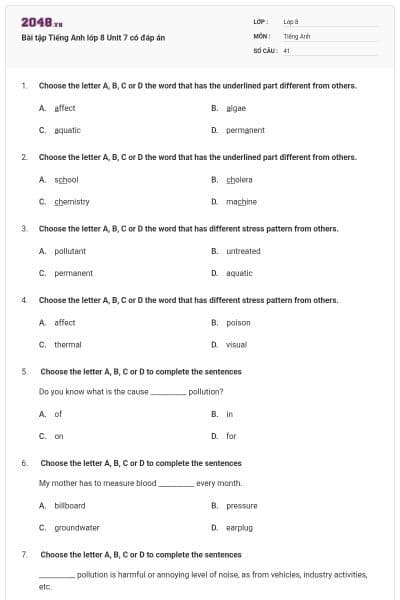
Choose the letter A, B, C or D the word that has the underlined part different from others.

affect

algae

aquatic

permanent

Xem đáp án

Đáp án B

Giải thích: Đáp án B phát âm là /æ/ các đáp án còn lại phát âm là /ə/

2. Trắc nghiệm
1 điểm

Choose the letter A, B, C or D the word that has the underlined part different from others.

school

cholera

chemistry

machine

Xem đáp án

Đáp án D

Giải thích: Đáp án D phát âm là /ʃ/ các đáp án còn lại phát âm là /k/

3. Trắc nghiệm
1 điểm

Choose the letter A, B, C or D the word that has different stress pattern from others.

pollutant

untreated

permanent

aquatic

Xem đáp án

Đáp án C

Giải thích: Đáp án C trọng âm thứ 1, các đáp án còn lại trọng âm thứ 2

4. Trắc nghiệm
1 điểm

Choose the letter A, B, C or D the word that has different stress pattern from others.

affect

poison

thermal

visual

Xem đáp án

Đáp án A

Giải thích: Đáp án A trọng âm thứ 2, các đáp án còn lại trọng âm thứ 1

5. Trắc nghiệm
1 điểm

Choose the letter A, B, C or D to complete the sentences

Do you know what is the cause __________ pollution?

of

in

on

for

Xem đáp án

Đáp án A

Giải thích: cụm từ “cause of st”: nguyên nhân dẫn đến cái gì

Dịch: Bạn có biết nguyên nhân gây ô nhiễm là gì không?

6. Trắc nghiệm
1 điểm

Choose the letter A, B, C or D to complete the sentences

My mother has to measure blood __________ every month.

billboard

pressure

groundwater

earplug

Xem đáp án

Đáp án B

Giải thích: cụm từ “blood pressure”: huyết áp

Dịch: Mẹ tôi phải đi đo huyết áp mỗi tháng.

7. Trắc nghiệm
1 điểm

Choose the letter A, B, C or D to complete the sentences

__________ pollution is harmful or annoying level of noise, as from vehicles, industry activities, etc.

light

visual

soil

noise

Xem đáp án

Đáp án D

Giải thích: noise pollution: ô nhiễm tiếng ồn

Dịch: Ô nhiễm tiếng ồn là mức độ có hại của tiếng ồn, ví dụ như tiếng ồn từ phương tiện giao thông, hay các hoạt động công nghiệp.

8. Trắc nghiệm
1 điểm

Choose the letter A, B, C or D to complete the sentences

Parents should teach children not to __________ wastes on the road.

litter

poison

cause

measure

Xem đáp án

Đáp án A

Giải thích: cụm từ “litter waste”: vứt rác

Dịch: Các bậc phụ huynh nên dạy con trẻ đừng vứt rác trên đường.

9. Trắc nghiệm
1 điểm

Choose the letter A, B, C or D to complete the sentences

I can’t hear your voice __________ I’m wearing an earplug.

although

due

however

because

Xem đáp án

Đáp án D

Giải thích: because + mệnh đề: bởi vì

Dịch: Tôi chẳng nghe bạn nói gì vì tôi đang đeo cái bịt tai.

10. Trắc nghiệm
1 điểm

Choose the letter A, B, C or D to complete the sentences

His grandfather made him __________ hard when he was small

study

to study

studying

studied

Xem đáp án

Đáp án A

Giải thích: cấu trúc: “make sb V”: bắt ai làm gì

Dịch: Bố mẹ bắt anh ấy học hành vất vả hồi nhỏ.

11. Trắc nghiệm
1 điểm

Choose the letter A, B, C or D to complete the sentences

This picture __________ the contamination of ground water.

illustrate

illustrating

illustrates

illustrated

Xem đáp án

Đáp án C

Giải thích: Chủ ngữ số ít (this picture) + động từ thêm đuôi s/es

Dịch: Bức tranh này minh hoạ ô nhiễm nước ngầm.

12. Trắc nghiệm
1 điểm

Choose the letter A, B, C or D to complete the sentences

Could you list some non-point source __________?

pollution

pollutants

polluting

polluted

Xem đáp án

Đáp án A

Giải thích: non-point pollution: ô nhiễm không nguồn

Dịch: Bạn có thể kể tên vài ô nhiễm không nguồn được không?

13. Trắc nghiệm
1 điểm

Read the passage below and decide whether the statements are TRUE or FALSE?

Light pollution is the excessive, misdirected or invasive use of artificial outdoor lighting. Mismanaged lighting affects the environment, energy resources, wildlife, humans and astronomy research.

Light pollution is not a new phenomenon. Over the last 50 years, as countries became affluent and urbanized, demand for outdoor lighting increased and light pollution sprawled beyond the city limits and into suburban and rural areas. This form pollution is now prevalent in Asia, Europe, and North America, particularly in cities like Los Angeles, New York and Washington D.C. In 2008, National Geographic magazine named Chicago the most light-polluted city in the United States.

However, the most light-polluted spot in the world is Hong Kong, China. In March 2013, the University of Hong Kong named the city the most light polluted in the world. A study by the university found the night sky in Tsim Sha Tsui, an urban neighborhood in southern Kowloon, Hong Kong, to be 1,200 times brighter than a normal urban city sky. Luminous pollution of this magnitude is on the rise worldwide. In a 2010 article from the Ecology and Society Journal, Hölker and others stated the use of artificial lighting increases by 20% each year, depending on the region, and noted there is an urgent need for light pollution policies that surpass energy efficiency to include humans, animals and the environment.

Question: Light pollution is the excessive, misdirected or invasive use of artificial outdoor lighting.

True

False

Xem đáp án

Đáp án A

Giải thích: Dựa vào câu: “Light pollution is the excessive, misdirected or invasive use of artificial outdoor lighting.”.

Dịch: Ô nhiễm ánh sáng là việc sử dụng điện nhân tạo ngoài trời quá mức, sai hướng, hoặc quá nhiều

14. Trắc nghiệm
1 điểm

Read the passage below and decide whether the statements are TRUE or FALSE?

Light pollution is the excessive, misdirected or invasive use of artificial outdoor lighting. Mismanaged lighting affects the environment, energy resources, wildlife, humans and astronomy research.

Light pollution is not a new phenomenon. Over the last 50 years, as countries became affluent and urbanized, demand for outdoor lighting increased and light pollution sprawled beyond the city limits and into suburban and rural areas. This form pollution is now prevalent in Asia, Europe, and North America, particularly in cities like Los Angeles, New York and Washington D.C. In 2008, National Geographic magazine named Chicago the most light-polluted city in the United States.

However, the most light-polluted spot in the world is Hong Kong, China. In March 2013, the University of Hong Kong named the city the most light polluted in the world. A study by the university found the night sky in Tsim Sha Tsui, an urban neighborhood in southern Kowloon, Hong Kong, to be 1,200 times brighter than a normal urban city sky. Luminous pollution of this magnitude is on the rise worldwide. In a 2010 article from the Ecology and Society Journal, Hölker and others stated the use of artificial lighting increases by 20% each year, depending on the region, and noted there is an urgent need for light pollution policies that surpass energy efficiency to include humans, animals and the environment.

Question: Light pollution sprawled beyond the city limits and into suburban and rural areas.”

True

False

Xem đáp án

Đáp án A

Giải thích: Dựa vào câu: “Over the last 50 years, as countries became affluent and urbanized, demand for outdoor lighting increased and light pollution sprawled beyond the city limits and into suburban and rural areas.”.

Dịch: Trong vòng 50 năm vừa qua, khi các đất nước trở nên giàu có và đô thị hoá, nhu cầu thắp sáng ngoài trời tăng lên và ô nhiễm ánh sáng vượt ra khỏi giới hạn các thành phố, lan ra vùng ngoại ô và cả nông thôn.

15. Trắc nghiệm
1 điểm

Read the passage below and decide whether the statements are TRUE or FALSE?

Light pollution is the excessive, misdirected or invasive use of artificial outdoor lighting. Mismanaged lighting affects the environment, energy resources, wildlife, humans and astronomy research.

Light pollution is not a new phenomenon. Over the last 50 years, as countries became affluent and urbanized, demand for outdoor lighting increased and light pollution sprawled beyond the city limits and into suburban and rural areas. This form pollution is now prevalent in Asia, Europe, and North America, particularly in cities like Los Angeles, New York and Washington D.C. In 2008, National Geographic magazine named Chicago the most light-polluted city in the United States.

However, the most light-polluted spot in the world is Hong Kong, China. In March 2013, the University of Hong Kong named the city the most light polluted in the world. A study by the university found the night sky in Tsim Sha Tsui, an urban neighborhood in southern Kowloon, Hong Kong, to be 1,200 times brighter than a normal urban city sky. Luminous pollution of this magnitude is on the rise worldwide. In a 2010 article from the Ecology and Society Journal, Hölker and others stated the use of artificial lighting increases by 20% each year, depending on the region, and noted there is an urgent need for light pollution policies that surpass energy efficiency to include humans, animals and the environment.

Question: Chicago is the most light-polluted city in the world.

True

False

Xem đáp án

Đáp án B

Giải thích: Dựa vào câu: “In 2008, National Geographic magazine named Chicago the most light-polluted city in the United States.”.

Dịch: Vào năm 2008, tờ tạp chí Địa lý Quốc gia nêu tên Chicago là thành phố bị ô nhiễm ánh sáng nặng nề nhất nước Mỹ.

16. Trắc nghiệm
1 điểm

Read the passage below and decide whether the statements are TRUE or FALSE?

Light pollution is the excessive, misdirected or invasive use of artificial outdoor lighting. Mismanaged lighting affects the environment, energy resources, wildlife, humans and astronomy research.

Light pollution is not a new phenomenon. Over the last 50 years, as countries became affluent and urbanized, demand for outdoor lighting increased and light pollution sprawled beyond the city limits and into suburban and rural areas. This form pollution is now prevalent in Asia, Europe, and North America, particularly in cities like Los Angeles, New York and Washington D.C. In 2008, National Geographic magazine named Chicago the most light-polluted city in the United States.

However, the most light-polluted spot in the world is Hong Kong, China. In March 2013, the University of Hong Kong named the city the most light polluted in the world. A study by the university found the night sky in Tsim Sha Tsui, an urban neighborhood in southern Kowloon, Hong Kong, to be 1,200 times brighter than a normal urban city sky. Luminous pollution of this magnitude is on the rise worldwide. In a 2010 article from the Ecology and Society Journal, Hölker and others stated the use of artificial lighting increases by 20% each year, depending on the region, and noted there is an urgent need for light pollution policies that surpass energy efficiency to include humans, animals and the environment.

Question: A city in Hong Kong is more than two hundred times brighter than a normal one.

True

False

Xem đáp án

Đáp án B

Giải thích: Dựa vào câu: “A study by the university found the night sky in Tsim Sha Tsui, an urban neighborhood in southern Kowloon, Hong Kong, to be 1,200 times brighter than a normal urban city sky.”.

Dịch: Một nghiên cứu thực hiện bởi trường đại học này cho hay bầu trời ở thành phố Tsim Sha Tsui ở nam Kowloon, Hồng Kông sáng hơn 1200 lần một thành phố thông thường.

17. Trắc nghiệm
1 điểm

Read the passage below and decide whether the statements are TRUE or FALSE?

Light pollution is the excessive, misdirected or invasive use of artificial outdoor lighting. Mismanaged lighting affects the environment, energy resources, wildlife, humans and astronomy research.

Light pollution is not a new phenomenon. Over the last 50 years, as countries became affluent and urbanized, demand for outdoor lighting increased and light pollution sprawled beyond the city limits and into suburban and rural areas. This form pollution is now prevalent in Asia, Europe, and North America, particularly in cities like Los Angeles, New York and Washington D.C. In 2008, National Geographic magazine named Chicago the most light-polluted city in the United States.

However, the most light-polluted spot in the world is Hong Kong, China. In March 2013, the University of Hong Kong named the city the most light polluted in the world. A study by the university found the night sky in Tsim Sha Tsui, an urban neighborhood in southern Kowloon, Hong Kong, to be 1,200 times brighter than a normal urban city sky. Luminous pollution of this magnitude is on the rise worldwide. In a 2010 article from the Ecology and Society Journal, Hölker and others stated the use of artificial lighting increases by 20% each year, depending on the region, and noted there is an urgent need for light pollution policies that surpass energy efficiency to include humans, animals and the environment.

Question: Luminous pollution of this magnitude is on the rise worldwide.

True

False

Xem đáp án

Đáp án A

Giải thích: Dựa vào câu: “Luminous pollution of this magnitude is on the rise worldwide.”.

Dịch: Ô nhiễm dạ quang ở mức độ này đang tăng lên trên khắp thế giới.

18. Trắc nghiệm
1 điểm

Choose the letter A, B, C or D to complete the passage below

Water pollution happens __________ (6) toxic substances enter water bodies such as lakes, rivers, oceans and so on, getting dissolved in them, lying suspended in the water or depositing on the bed. This degrades the quality of water. Not __________ (7) does this spell disaster for aquatic ecosystems, the pollutants also seep through and reach the groundwater, which might end up in our households as contaminated water we use in our daily activities, including drinking.

Water pollution can be __________ (8) in a number of ways, one of the most polluting being city sewage and industrial waste discharge. Indirect sources __________ (9) water pollution include contaminants that enter the water supply from soils or groundwater systems and from the atmosphere via rain. Soils and groundwater contain __________ (10) residue of human agricultural practices and also improperly disposed of industrial wastes.

Pollutants can be of varying kinds: organic, inorganic, radioactive and so on. In fact, the list of possible water contaminants is just too vast to be listed here.

Question 6:

what

when

why

while

Xem đáp án

Đáp án B

Giải thích: when + mệnh đề: khi mà…

Dịch: Ô nhiễm nước diễn ra khi mà các chất độc hại đi vào trong các phần nước như ao hồ, sông suối, đại dương, vân vân…

19. Trắc nghiệm
1 điểm

Choose the letter A, B, C or D to complete the passage below

Water pollution happens __________ (6) toxic substances enter water bodies such as lakes, rivers, oceans and so on, getting dissolved in them, lying suspended in the water or depositing on the bed. This degrades the quality of water. Not __________ (7) does this spell disaster for aquatic ecosystems, the pollutants also seep through and reach the groundwater, which might end up in our households as contaminated water we use in our daily activities, including drinking.

Water pollution can be __________ (8) in a number of ways, one of the most polluting being city sewage and industrial waste discharge. Indirect sources __________ (9) water pollution include contaminants that enter the water supply from soils or groundwater systems and from the atmosphere via rain. Soils and groundwater contain __________ (10) residue of human agricultural practices and also improperly disposed of industrial wastes.

Pollutants can be of varying kinds: organic, inorganic, radioactive and so on. In fact, the list of possible water contaminants is just too vast to be listed here.

Question 7:

both

only

well

either

Xem đáp án

Đáp án B

Giải thích: cấu trúc “not only… (but)…also…”: không những…mà còn…

Dịch: Không những điều này gây ra thảm hoạ cho hệ sinh thái dưới nước, chất thải còn lắng xuống và gây ô nhiễm nước ngầm.

20. Trắc nghiệm
1 điểm

Choose the letter A, B, C or D to complete the passage below

Water pollution happens __________ (6) toxic substances enter water bodies such as lakes, rivers, oceans and so on, getting dissolved in them, lying suspended in the water or depositing on the bed. This degrades the quality of water. Not __________ (7) does this spell disaster for aquatic ecosystems, the pollutants also seep through and reach the groundwater, which might end up in our households as contaminated water we use in our daily activities, including drinking.

Water pollution can be __________ (8) in a number of ways, one of the most polluting being city sewage and industrial waste discharge. Indirect sources __________ (9) water pollution include contaminants that enter the water supply from soils or groundwater systems and from the atmosphere via rain. Soils and groundwater contain __________ (10) residue of human agricultural practices and also improperly disposed of industrial wastes.

Pollutants can be of varying kinds: organic, inorganic, radioactive and so on. In fact, the list of possible water contaminants is just too vast to be listed here.

Question 8:

cause

caused

causing

causes

Xem đáp án

Đáp án B

Giải thích: be caused: được tạo ra, bị gây ra

Dịch: Ô nhiễm nước có thể được tạo ra từ nhiều cách, một trong những tác nhân lớn nhất là nước thải đô thị, và chất thải công nghiệp.

21. Trắc nghiệm
1 điểm

Choose the letter A, B, C or D to complete the passage below

Water pollution happens __________ (6) toxic substances enter water bodies such as lakes, rivers, oceans and so on, getting dissolved in them, lying suspended in the water or depositing on the bed. This degrades the quality of water. Not __________ (7) does this spell disaster for aquatic ecosystems, the pollutants also seep through and reach the groundwater, which might end up in our households as contaminated water we use in our daily activities, including drinking.

Water pollution can be __________ (8) in a number of ways, one of the most polluting being city sewage and industrial waste discharge. Indirect sources __________ (9) water pollution include contaminants that enter the water supply from soils or groundwater systems and from the atmosphere via rain. Soils and groundwater contain __________ (10) residue of human agricultural practices and also improperly disposed of industrial wastes.

Pollutants can be of varying kinds: organic, inorganic, radioactive and so on. In fact, the list of possible water contaminants is just too vast to be listed here.

Question 9:

of

in

at

for

Xem đáp án

Đáp án A

Giải thích: cụm từ source of st: nguồn gốc của cái gì

Dịch: Các nguồn không trực tiếp của ô nhiễm nước bao gồm các chất ô nhiễm mà lẫn vào nguồn nước từ đất hay hệ thống nước ngầm và từ không khí qua mưa.

22. Trắc nghiệm
1 điểm

Choose the letter A, B, C or D to complete the passage below

Water pollution happens __________ (6) toxic substances enter water bodies such as lakes, rivers, oceans and so on, getting dissolved in them, lying suspended in the water or depositing on the bed. This degrades the quality of water. Not __________ (7) does this spell disaster for aquatic ecosystems, the pollutants also seep through and reach the groundwater, which might end up in our households as contaminated water we use in our daily activities, including drinking.

Water pollution can be __________ (8) in a number of ways, one of the most polluting being city sewage and industrial waste discharge. Indirect sources __________ (9) water pollution include contaminants that enter the water supply from soils or groundwater systems and from the atmosphere via rain. Soils and groundwater contain __________ (10) residue of human agricultural practices and also improperly disposed of industrial wastes.

Pollutants can be of varying kinds: organic, inorganic, radioactive and so on. In fact, the list of possible water contaminants is just too vast to be listed here.

Question 10: 

a

an

the

x

Xem đáp án

Đáp án C

Giải thích: the N of N: the đứng trước các danh từ đã xác định.

Dịch: Đất và nước ngầm chứa dư lượng chất thải nông nghiệp của con người và các chất thải công nghiệp xả thải bừa bãi ra môi trường.

23. Trắc nghiệm
1 điểm

Choose the letter A, B, C or D to answer these following questions

There are many causes that lead to water pollution. One main cause of this issue is waste water coming from many factories and then being directly pulled out into water bodies, especially into rivers or seas without any treatment because this is the most convenient way of disposing waste water. Industrial waste consists of some kinds of chemical substances such as sulphur, which is harmful for marine life. Lead is known as the main reason for cancer disease. Cancer has become a popular disease in several communes which are called “cancer villages”. Another cause is the awareness of citizens, people always use water for many purposes and then they dump waste water or garbage directly into rivers, canals and ponds and so on. In 2004, because of a bird flu outbreak in Viet Nam, people threw poultry to water body that made water highly polluted.

Question: How many causes of water pollutions are listed in the passage?

one

two

three

four

Xem đáp án

Đáp án B

Giải thích: Dựa vào câu: “One main cause of this issue is waste water coming from many factories… Another cause is the awareness of citizens…”.

Dịch: Một nguyên nhân chính của vấn đề này là nước thải đến từ nhà máy… Một nguyên nhân khác là ý thức của người dân.

24. Trắc nghiệm
1 điểm

Choose the letter A, B, C or D to answer these following questions

There are many causes that lead to water pollution. One main cause of this issue is waste water coming from many factories and then being directly pulled out into water bodies, especially into rivers or seas without any treatment because this is the most convenient way of disposing waste water. Industrial waste consists of some kinds of chemical substances such as sulphur, which is harmful for marine life. Lead is known as the main reason for cancer disease. Cancer has become a popular disease in several communes which are called “cancer villages”. Another cause is the awareness of citizens, people always use water for many purposes and then they dump waste water or garbage directly into rivers, canals and ponds and so on. In 2004, because of a bird flu outbreak in Viet Nam, people threw poultry to water body that made water highly polluted.

Question: Is the sewage from factories treated before dumping into water bodies?

Yes, it is

No, it isn’t

Xem đáp án

Đáp án B

Giải thích: Dựa vào câu: “One main cause of this issue is waste water coming from many factories and then being directly pulled out into water bodies, especially into rivers or seas without any treatment…”.

Dịch: Một nguyên nhân chính của vấn đề này là nước thải đi ra từ các nhà máy sau đó bị thải trực tiếp vào các vùng nước, đặc biệt là các đại dương khi chưa được xử lý.

25. Trắc nghiệm
1 điểm

Choose the letter A, B, C or D to answer these following questions

There are many causes that lead to water pollution. One main cause of this issue is waste water coming from many factories and then being directly pulled out into water bodies, especially into rivers or seas without any treatment because this is the most convenient way of disposing waste water. Industrial waste consists of some kinds of chemical substances such as sulphur, which is harmful for marine life. Lead is known as the main reason for cancer disease. Cancer has become a popular disease in several communes which are called “cancer villages”. Another cause is the awareness of citizens, people always use water for many purposes and then they dump waste water or garbage directly into rivers, canals and ponds and so on. In 2004, because of a bird flu outbreak in Viet Nam, people threw poultry to water body that made water highly polluted.

Question: What is the main reason for cancer disease?

rice

rain

lead

food

Xem đáp án

Đáp án C

Giải thích: Dựa vào câu: “Lead is known as the main reason for cancer disease.”.

Dịch: Chì được biết đến là nguyên nhân chính gây ra ung thư.

26. Trắc nghiệm
1 điểm

Choose the letter A, B, C or D to answer these following questions

There are many causes that lead to water pollution. One main cause of this issue is waste water coming from many factories and then being directly pulled out into water bodies, especially into rivers or seas without any treatment because this is the most convenient way of disposing waste water. Industrial waste consists of some kinds of chemical substances such as sulphur, which is harmful for marine life. Lead is known as the main reason for cancer disease. Cancer has become a popular disease in several communes which are called “cancer villages”. Another cause is the awareness of citizens, people always use water for many purposes and then they dump waste water or garbage directly into rivers, canals and ponds and so on. In 2004, because of a bird flu outbreak in Viet Nam, people threw poultry to water body that made water highly polluted.

Question: What is cancer called when it has become a popular disease in several communes?

cancer grounds

cancer offices

cancer pollutions

cancer villages

Xem đáp án

Đáp án D

Giải thích: Dựa vào câu: “Cancer has become a popular disease in several communes which are called “cancer villages”.”.

Dịch: Ung thư đã và đang trở thành một căn bênh phổ biến ở nhiều cộng đồng và khi đó nó được gọi là những ngôi làng ung thư.

27. Trắc nghiệm
1 điểm

Choose the letter A, B, C or D to answer these following questions

There are many causes that lead to water pollution. One main cause of this issue is waste water coming from many factories and then being directly pulled out into water bodies, especially into rivers or seas without any treatment because this is the most convenient way of disposing waste water. Industrial waste consists of some kinds of chemical substances such as sulphur, which is harmful for marine life. Lead is known as the main reason for cancer disease. Cancer has become a popular disease in several communes which are called “cancer villages”. Another cause is the awareness of citizens, people always use water for many purposes and then they dump waste water or garbage directly into rivers, canals and ponds and so on. In 2004, because of a bird flu outbreak in Viet Nam, people threw poultry to water body that made water highly polluted.

Question: What did Vietnamese do in 2004?

They bought dead poultry.

They ate dead poultry.

They threw dead poultry into water.

They dig dead poultry under ground.

Xem đáp án

Đáp án C

Giải thích: Dựa vào câu: “In 2004, because of a bird flu outbreak in Viet Nam, people threw poultry to water body that made water highly polluted.”.

Dịch: Vào năm 2004, vì một dịch cúm gà ở Việt Nam, người dân đã ném các con gia cầm bị chết xuống nước, làm nước ô nhiễm nghiêm trọng.

28. Trắc nghiệm
1 điểm

Choose the letter A, B, C or D to complete the sentences with given words

If/ people/ breath/ contaminate/ air, they/ have/ breathing problems.

If people breathed contaminated air, they had breathing problems.

If people breathed contaminated air, they would have breathing problems.

If people breath contaminated air, they have breathing problems.

If people breath contaminated air, they will have breathing problems.

Xem đáp án

Đáp án D

Giải thích: câu điều kiện loại 1 “If + S V(s/es), S will V”

Dịch: Nếu mọi người hít thở không khí ô nhiễm, họ sẽ có vấn đề về hô hấp.

29. Trắc nghiệm
1 điểm

Choose the letter A, B, C or D to complete the sentences with given words

Many/ people/ this area/ have/ cholera/ because/ they/ drink/ untreat/ water.

Many people in this area have cholera because they drink untreated water.

Many people on this area have cholera because they drink untreated water.

Many people on this area have cholera because they drink untreating water.

Many people in this area have cholera because they drink untreating water.

Xem đáp án

Đáp án A

Giải thích: in + địa điểm: ở nơi nào

Have cholera: bị bệnh tả

Untreated water: nước thải chưa qua xử lý

Dịch: Nhiều người ở khu vực này bị bênh tả vì uống nước chưa qua xử lý.

30. Trắc nghiệm
1 điểm

Choose the letter A, B, C or D to complete the sentences with given words

The street/ not/ look/ attractive/ because/ there/ be/ a lot of/ rubbish.

The street not look attractive because there’s a lot of rubbish.

The street not look attractive because there’re a lot of rubbish

The street doesn’t look attractive because there’s a lot of rubbish.

The street don’t look attractive because there’re a lot of rubbish.

Xem đáp án

Đáp án C

Giải thích: Chủ ngữ số ít (this picture) + động từ thêm đuôi s/es

Dịch: Con đường trông chẳng đẹp vì có nhiều rác quá.

31. Trắc nghiệm
1 điểm

Choose the letter A, B, C or D to complete the sentences with given words

The music club/ be/ make/ so/ much noise/ that/ the residents/ require/ them/ turn/ the music/ down.

The music club is making so much noise that the residents require them to turn the music down.

The music club is make so much noise that the residents require them to turn the music down.

The music club be make so much noise that the residents require them to turn the music down.

The music club be making so much noise that the residents require them to turn the music down.

Xem đáp án

Đáp án A

Giải thích: cấu trúc “be + so + adj + that + S V”: quá…đến nỗi mà…

Require sb to V: yêu cầu ai làm gì

Dịch: Câu lạc bộ âm nhạc làm ồn quá đến nỗi mà cư dân phải yêu cầu họ nhỏ tiếng lại.

32. Trắc nghiệm
1 điểm

Choose the letter A, B, C or D to complete the sentences with given words

Visual/ pollution/ prevent/ us/ see/ far/ away.

Visual pollution prevents us from seeing far away.

Visual pollution prevents us with seeing far away.

Visual pollution prevents us on seeing far away.

Visual pollution prevents us of seeing far away.

Xem đáp án

Đáp án A

Giải thích: cấu trúc “prevent sb from doing st”: ngăn ai khỏi việc làm gì

Dịch: Ô nhiễm tầm nhìn khiến chúng ta khó khăn trong việc nhìn xa.

33. Trắc nghiệm
1 điểm

Rearrange the sentences to make meaningful sentences

What/ pollution/ to/ is/ types/ the/ of/ most/ human/ harmful?

What pollution of types is the most harmful to human?

What types of pollution is the most harmful to human?

What the most types of pollution is harmful to human?

What is types of pollution harmful the most to human?

Xem đáp án

Đáp án B

Giải thích: cụm từ “type of N”: loại gì

Be harmful to sb: có hại với ai

Câu so sánh nhất với tính từ dài: “Be the most + adj dài”

Dịch: Loại ô nhiễm nào có hại nhất đối với con người?

34. Trắc nghiệm
1 điểm

Rearrange the sentences to make meaningful sentences

poison/ Sewages/ lakes/ from/ such/ and/ water/ factories/ bodies/ as/ rivers.

Sewages as rivers from factories poison water bodies such and lakes.

Sewages and lakes from factories poison water bodies such as rivers.

Sewages from factories poison rivers and lakes such as water bodies.

Sewages from factories poison water bodies such as rivers and lakes.

Xem đáp án

Đáp án D

Giải thích: poison: gây độc, đầu độc

Dịch: Nước thải từ các nhà máy làm độc hại các vùng nước như hồ, sông,…

35. Trắc nghiệm
1 điểm

Rearrange the sentences to make meaningful sentences

of/ are/ Plastic/ of/ source/ the/ main/ bags/ one/ pollution.

Plastic bags are the one of main source of pollution.

Plastic bags are one of source of the main pollution.

Plastic bags are one of the main sources of pollution

Plastic of bags are one pollution of the main source.

Xem đáp án

Đáp án C

Giải thích: cấu trúc “one of the + Ns”: một trong những…

Dịch: Túi nilon là một trong những nguồn chính gây ô nhiễm

36. Trắc nghiệm
1 điểm

Rearrange the sentences to make meaningful sentences

in/ food/ Soil/ results/ contamination/ unsafe.

Soil food results in unsafe contamination.

Soil contamination results in unsafe food.

Soil unsafe results in food contamination.

Soil results in contamination unsafe food

Xem đáp án

Đáp án B

Giải thích: cụm từ “result in”: gây ra

Dịch: Ô nhiễm đất gây ra thực phẩm không đảm bảo an toàn.

37. Trắc nghiệm
1 điểm

Rearrange the sentences to make meaningful sentences

If there were more trees in the area, the air would be fresher.

The air would be fresher if there were more trees in the area.

If were there more trees in the area, the air would be fresher.

If there would be more trees in the area, the air were fresher.

If the air were more trees in the area, there would be fresher.

Xem đáp án

Đáp án A

Giải thích: cấu trúc there + be + N: có…

Câu điều kiện loại 2

Dịch: Nếu có nhiều cây hơn ở khu này, không khí sẽ trong lành hơn.

38. Trắc nghiệm
1 điểm

Rewrite sentences without changing the meaning

It’s very wasteful to apply lights in almost everything at night.

Applying lights in almost everything at night is very wasteful.

To apply lights in almost everything at night is not wasteful.

Almost everything is wasteful at night.

It’s interesting to apply lights in almost everything at night.

Xem đáp án

Đáp án A

Giải thích: cấu trúc “it’s + adj + to V”: thật là như thế nào khi làm gì

Dịch: Thật lãng phí khi lắp bòng đèn vào hầu hết mọi thứ vào buổi tối.

39. Trắc nghiệm
1 điểm

Rewrite sentences without changing the meaning

The soil is poisoned because farmers use too many pesticides and herbicides.

Famers use too many pesticides and herbicides, but the soil is poisoned.

Famers use too many pesticides and herbicides, for the soil is poisoned.

Famers use too many pesticides and herbicides, so the soil is poisoned.

Famers use too many pesticides and herbicides, or the soil is poisoned.

Xem đáp án

Đáp án C

Giải thích: so + mệnh đề: vì vậy

Dịch: Đất đai bị ô nhiễm vì nông dân dùng quá nhiều thuốc trừ sâu và diệt cỏ.

40. Trắc nghiệm
1 điểm

Rewrite sentences without changing the meaning

The polluted water results in the death of many aquatic animals and plants.

The polluted water causes in the death of many aquatic animals and plants.

The polluted water leads to the death of many aquatic animals and plants.

The polluted water causes to the death of many aquatic animals and plants.

The polluted water leads in the death of many aquatic animals and plants.

Xem đáp án

Đáp án B

Giải thích: lead to = result in = cause: gây ra cái gì

Dịch: Nước ô nhiễm gây ra cái chết của nhiều loài thuỷ sinh.

41. Trắc nghiệm
1 điểm

Rewrite sentences without changing the meaning

People use a lot of vehicles. The air is polluted.

If people don’t use too many vehicles, the air won’t be polluted.

If people won’t use too many vehicles, the air don’t be polluted.

If people wouldn’t use too many vehicles, the air didn’t be polluted.

If people didn’t use too many vehicles; the air wouldn’t be polluted.

Xem đáp án

Đáp án D

Giải thích: Câu điều kiện loại 2: If + S +Ved, S would V

Dịch: Nếu con người không dùng quá nhiều phương tiện giao thông, không khí sẽ không bị ô nhiễm.