15 câu hỏi
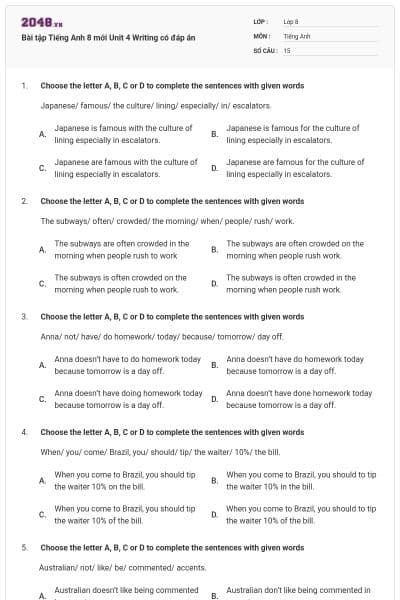
Japanese is famous with the culture of lining especially in escalators.
Japanese is famous for the culture of lining especially in escalators.
Japanese are famous with the culture of lining especially in escalators.
Japanese are famous for the culture of lining especially in escalators.
Đáp án: D
Giải thích: cấu trúc “be famous for N”: nổi tiếng về cái gì
Dịch: Người Nhật nổi tiếng về văn hoá xếp hàng, đặc biệt là khi đi thang cuốn.
The subways are often crowded in the morning when people rush to work
The subways are often crowded on the morning when people rush work.
The subways is often crowded on the morning when people rush to work.
The subways is often crowded in the morning when people rush work.
Đáp án: A
Giải thích: cấu trúc: “be crowded”: chật cứng
In the morning: vào buổi sáng
Rush to work: vội vã đi làm
Dịch: Tàu điện ngầm thường chật cứng vào buổi sáng khi mọi người vội vã đi làm
Anna doesn’t have to do homework today because tomorrow is a day off.
Anna doesn’t have do homework today because tomorrow is a day off.
Anna doesn’t have doing homework today because tomorrow is a day off.
Anna doesn’t have done homework today because tomorrow is a day off.
Đáp án: A
Giải thích: cấu trúc “have to V”: phải làm gì
Day off: ngày nghỉ
Dịch: Anna không phải làm bài tập về nhà hôm nay vì mai là ngày nghỉ.
When you come to Brazil, you should tip the waiter 10% on the bill.
When you come to Brazil, you should to tip the waiter 10% in the bill.
When you come to Brazil, you should tip the waiter 10% of the bill.
When you come to Brazil, you should to tip the waiter 10% of the bill.
Đáp án: C
Giải thích: động từ khuyết thiếu “should + V”: nên làm gì
Dịch: Khi đến Brazil, bạn nên boa tiền cho phục vụ bàn 10% hoá đơn.
Australian doesn’t like being commented in accents.
Australian don’t like being commented in accents.
Australian don’t like to be commented on accents.
Australian doesn’t like to be commented on accents.
Đáp án: C
Giải thích: câu bị động với động từ chỉ sự yêu thích “like + being/ to be + p2”: thích được làm gì
Be commented on st: bị nhận xét cái gì
Chủ ngữ “Australian” chỉ người Úc nói chung nên ta chia như chủ ngữ số nhiều
Dịch: Người Úc không thích bị nhận xét chất giọng
In my family, children have for permission to ask before leaving the table.
In my family leaving the table, children have to ask for permission before.
In my table, children have to ask for permission before leaving the family.
In my family, children have to ask for permission before leaving the table.
Đáp án: D
Giải thích: động từ khuyết thiếu “have to V” phải làm gì
Cụm từ ask for permission: hỏi xin phép
Dịch: Trong gia đình tôi, trẻ con phải xin phép trước khi rời bàn ăn.
Indian never use left hand when eating.
Indian never eating when use left hand
Indian hand when never use left eating.
Indian never use when left hand eating
Đáp án: A
Giải thích: when + Ving = when + S + V: khi…
Chủ ngữ “Indian” chỉ người Úc nói chung nên ta chia như chủ ngữ số nhiều
Dịch: Người Ấn Độ không bao giờ dùng tay trái để ăn

Học thông minh hơn mỗi ngày
Xem toàn bộ 15 câu hỏi và nhiều hơn nữa với tài khoản miễn phí
There’s a tradition of having British afternoon tea at 4 p.m.
There’s a 4 p.m of having afternoon tea at British tradition.
There’s a British tradition afternoon tea of having at 4 p.m.
There’s a British tradition of having afternoon tea at 4 p.m.
Đáp án: D
Giải thích: There is + N số ít: có…
Tradition of Ving: truyền thống làm gì
Dịch: Có một truyền thống của người Anh là uống trà chiều vào lúc 4h chiều.
In London, you have to drive your car on the left.
In London, you have your car to drive on the left.
In London, you have to your drive on the car left.
In London, your car have you to drive on the left.
Đáp án: A
Giải thích: động từ khuyết thiếu “have to + V”: phải làm gì
Dịch: Ở Luân Đôn, bạn phải lái xe bên trái.
Chung cake wrapping have the tradition of Vietnamese at Tet.
Vietnamese have the tradition of wrapping Chung cake at Tet.
Vietnamese have Chung cake of wrapping the tradition at Tet.
Tet at Vietnamese have the wrapping tradition of Chung cake.
Đáp án: B
Giải thích: cụm từ “have the tradition of Ving”: có truyền thống làm gì
Dịch: Người Việt có truyền thống gói bánh chưng vào dịp Tết.
We are not permitted to go home late.
We allow going home late.
We permit to go home late.
Going home late is allowed.
Đáp án: A
Giải thích: cấu trúc be allowed to V = be permitted to V: được cho phép làm gì
Dịch: Chúng tôi không được phép về nhà muộn.
You mustn’t wear astronaut outfits on Space Day.
You needn’t wear astronaut outfits on Space Day.
You can’t wear astronaut outfits on Space Day.
You couldn’t wear astronaut outfits on Space Day.
Đáp án: B
Giải thích: động từ khuyết thiếu “have to V”: phải làm gì
Dịch: Bạn không phải mặc đồ phi hành gia vào ngày lễ không gian
Custom is different from tradition
Custom is the same as tradition
Custom is like tradition
Custom is as similar as tradition.
Đáp án:A
Giải thích: cấu trúc “not similar to” = “different from”: khác với
Dịch: Phong tục thì khác với truyền thống
People to the next generations pass down tradition.
Next generations pass down tradition to people the next.
Passing down tradition is good.
Traditions are passed down to the next generations.
Đáp án: D
Giải thích: câu bị động thời hiện tại đơn: am/ is/ are + P2
Dịch: Truyền thống được truyền lại cho thế hệ sau.
Everyone know this custom but it’s popular.
It’s such a popular custom that everyone knows it.
Knowing this custom is for everyone.
That everyone knows this custom is popular.
Đáp án: B
Giải thích: chuyển đổi tương đương cấu trúc: “so + adj + that + S V” và “such + a/an + adj + N + that + S V”
Dịch: Phong tục này quá phổ biến đến độ ai cũng biết.
Bạn có thích hoạt động này không?
Ý kiến của bạn sẽ giúp chúng tôi đề xuất nội dung phù hợp hơn.
![[Năm 2022] Đề thi thử môn Vật lí THPT Quốc gia có lời giải - Đề số 21](/_next/image?url=https%3A%2F%2Fvideo.vietjack.com%2Fupload%2Fimages%2Fvj-image%2Fimage-3izficdefgfoel0s9j8s-1786772791.jpg&w=3840&q=75)
![[Năm 2022] Đề thi thử môn Vật lí THPT Quốc gia có lời giải - Đề số 20](/_next/image?url=https%3A%2F%2Fvideo.vietjack.com%2Fupload%2Fimages%2Fvj-image%2Fimage-emy0gtcksawvorajezvv-1786772460.jpg&w=3840&q=75)