12 bài tập Tìm giá trị lớn nhất, giá trị nhỏ nhất của biểu thức chứa căn bậc hai có lời giải
12 câu hỏi
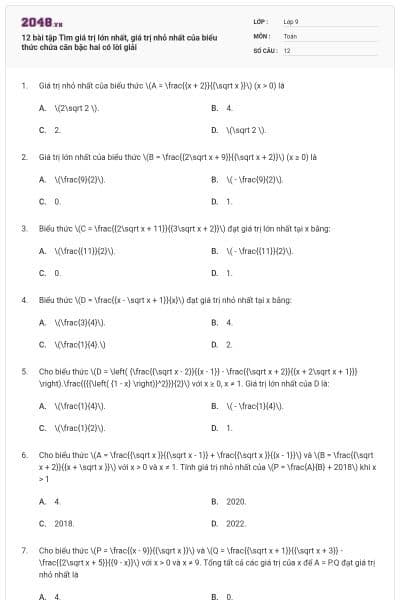
\(2\sqrt 2 \).
4.
2.
\(\sqrt 2 \).
Đáp án đúng là: A
Ta có: \(A = \frac{{x + 2}}{{\sqrt x }} = \sqrt x + \frac{2}{{\sqrt x }}\).
Với x > 0, áp dụng bất đẳng thức Cauchy, ta có:
\(\sqrt x + \frac{2}{{\sqrt x }} \ge 2\sqrt {\sqrt x \frac{2}{{\sqrt x }}} = 2\sqrt 2 \).
Dấu “=” xảy ra khi \(\sqrt x = \frac{2}{{\sqrt x }}\) hay x = 2.
Vậy GTNN của A = \(2\sqrt 2 \) khi x = 2.
\(\frac{9}{2}\).
\( - \frac{9}{2}\).
0.
1.
Đáp án đúng là: A
Ta có: \(B = \frac{{2\sqrt x + 9}}{{\sqrt x + 2}} = 2 + \frac{5}{{\sqrt x + 2}}\).
Với x ≥ 0, ta có: \(\sqrt x + 2 \ge 2\) suy ra \(\frac{5}{{\sqrt x + 2}} \le \frac{5}{2}\).
Do đó, 2 + \(\frac{5}{{\sqrt x + 2}} \le \frac{5}{2} + 2\) hay B ≤ \(\frac{9}{2}\).
Dấu “=” xảy ra khi x = 0.
Vật GTLN của B = \(\frac{9}{2}\) khi x = 0.
\(\frac{{11}}{2}\).
\( - \frac{{11}}{2}\).
0.
1.
Đáp án đúng là: C
Điều kiện: x ≥ 0.
Ta có: \(C = \frac{{2\sqrt x + 11}}{{3\sqrt x + 2}} = \frac{{2\left( {\sqrt x + \frac{2}{3}} \right) + \frac{{29}}{3}}}{{3\left( {\sqrt x + \frac{2}{3}} \right)}} = \frac{2}{3} + \frac{{29}}{{3\left( {3\sqrt x + 2} \right)}}\).
Với x ≥ 0, ta có: \(3\sqrt x + 2 \ge 2\) suy ra \(3\left( {3\sqrt x + 2} \right) \ge 6\).
Do đó, \(\frac{{29}}{{3\left( {3\sqrt x + 2} \right)}} \le \frac{{29}}{6}\) .
Suy ra \(\frac{2}{3} + \frac{{29}}{{3\left( {3\sqrt x + 2} \right)}} \le \frac{{11}}{2}\) hay C ≤ \(\frac{{11}}{2}\).
Dấu “=” xảy ra khi x = 0.
Vậy GTLN của C = \(\frac{{11}}{2}\) khi x = 0.
\(\frac{3}{4}\).
4.
\(\frac{1}{4}.\)
2.
Đáp án đúng là: A
Điều kiện xác định: x > 0.
Ta có: \(D = \frac{{x - \sqrt x + 1}}{x} = 1 - \frac{1}{{\sqrt x }} + \frac{1}{x} = \frac{3}{4} + \frac{1}{4} - 2.\frac{1}{2}\frac{1}{{\sqrt x }} + \frac{1}{x} = \frac{3}{4} + {\left( {\frac{1}{2} - \frac{1}{{\sqrt x }}} \right)^2}\).
Nhận thấy \({\left( {\frac{1}{2} - \frac{1}{{\sqrt x }}} \right)^2} \ge 0\) nên \(\frac{3}{4} + {\left( {\frac{1}{2} - \frac{1}{{\sqrt x }}} \right)^2} \ge \frac{3}{4}\) hay D \( \ge \frac{3}{4}\).
Dấu “=” xảy ra khi \(\frac{1}{2} - \frac{1}{{\sqrt x }} = 0\) suy ra \(\sqrt x = 2\) khi x = 4.
Vậy GTNN của của D = \(\frac{3}{4}\) khi x = 4.
\(\frac{1}{4}\).
\( - \frac{1}{4}\).
\(\frac{1}{2}\).
1.
Đáp án đúng là: A
Với x ≥ 0, x ≠ 1, ta có:
\(D = \left( {\frac{{\sqrt x - 2}}{{x - 1}} - \frac{{\sqrt x + 2}}{{x + 2\sqrt x + 1}}} \right).\frac{{{{\left( {1 - x} \right)}^2}}}{2}\)
\(D = \left[ {\frac{{\left( {\sqrt x - 2} \right){{\left( {\sqrt x + 1} \right)}^2}}}{{\left( {x - 1} \right){{\left( {\sqrt x + 1} \right)}^2}}} - \frac{{\left( {\sqrt x + 2} \right)\left( {x - 1} \right)}}{{\left( {x - 1} \right){{\left( {\sqrt x + 1} \right)}^2}}}} \right].\frac{{{{\left( {1 - x} \right)}^2}}}{2}\)
\(D = \left[ {\frac{{\left( {\sqrt x - 2} \right){{\left( {\sqrt x + 1} \right)}^2} - \left( {\sqrt x + 2} \right)\left( {x - 1} \right)}}{{\left( {x - 1} \right){{\left( {\sqrt x + 1} \right)}^2}}}} \right].\frac{{{{\left( {1 - x} \right)}^2}}}{2}\)
\(D = \frac{{\left[ {x\sqrt x + 2x + \sqrt x - 2x - 4\sqrt x - 2 - x\sqrt x + \sqrt x - 2x + 2} \right]}}{{{{\left( {\sqrt x + 1} \right)}^2}}}.\frac{{\left( {x - 1} \right)}}{2}\)
\(D = \frac{{\left( { - 2x - 2\sqrt x } \right)}}{{{{\left( {\sqrt x + 1} \right)}^2}}}.\frac{{\left( {x - 1} \right)}}{2} = \frac{{ - 2\sqrt x \left( {\sqrt x + 1} \right)}}{{{{\left( {\sqrt x + 1} \right)}^2}}}.\frac{{\left( {\sqrt x - 1} \right)\left( {\sqrt x + 1} \right)}}{2} = - \sqrt x \left( {\sqrt x - 1} \right)\).
Ta có: \(D = - \sqrt x \left( {\sqrt x - 1} \right) = - x + \sqrt x = - x + 2.\frac{1}{2}\sqrt x - \frac{1}{4} + \frac{1}{4} = - {\left( {\sqrt x - \frac{1}{2}} \right)^2} + \frac{1}{4}\).
Nhận thấy \( - {\left( {\sqrt x - \frac{1}{2}} \right)^2} \le 0\) nên \( - {\left( {\sqrt x - \frac{1}{2}} \right)^2} + \frac{1}{4} \le \frac{1}{4}\).
Dấu “=” xảy ra khi x = \(\frac{1}{4}\).
Vậy GTLN của D = \(\frac{1}{4}\) khi x = \(\frac{1}{4}\).
4.
2020.
2018.
2022.
Đáp án đúng là: D
Với x > 0 và x ≠ 1, ta có:
\(A = \frac{{\sqrt x }}{{\sqrt x - 1}} + \frac{{\sqrt x }}{{x - 1}} = \frac{{\sqrt x \left( {\sqrt x + 1} \right)}}{{\left( {\sqrt x - 1} \right)\left( {\sqrt x + 1} \right)}} + \frac{{\sqrt x }}{{\left( {\sqrt x - 1} \right)\left( {\sqrt x + 1} \right)}} = \frac{{x + 2\sqrt x }}{{\left( {\sqrt x - 1} \right)\left( {\sqrt x + 1} \right)}}\).
Có: \(P = \frac{A}{B} + 2018\) với x > 1.
\( = \frac{{x + 2\sqrt x }}{{\left( {\sqrt x - 1} \right)\left( {\sqrt x + 1} \right)}}:\frac{{\sqrt x + 2}}{{x + \sqrt x }} + 2018\)
\( = \frac{{\sqrt x \left( {\sqrt x + 2} \right)}}{{\left( {\sqrt x - 1} \right)\left( {\sqrt x + 1} \right)}}.\frac{{\sqrt x \left( {\sqrt x + 1} \right)}}{{\sqrt x + 2}} + 2018\)
\( = \frac{x}{{\sqrt x - 1}} + 2018\)
\( = \frac{{x - 1}}{{\sqrt x - 1}} + \frac{1}{{\sqrt x - 1}} + 2018\)
\( = \sqrt x + 1 + \frac{1}{{\sqrt x - 1}} + 2018\)
\( = \sqrt x - 1 + \frac{1}{{\sqrt x - 1}} + 2020\)
Với x > 1, áp dụng bất đẳng thức Cauchy, ta có:
\(\sqrt x - 1 + \frac{1}{{\sqrt x - 1}} \ge 2\sqrt {\left( {\sqrt x - 1} \right).\frac{1}{{\sqrt x - 1}}} = 2\)
Suy ra \(\sqrt x - 1 + \frac{1}{{\sqrt x - 1}} + 2020 \ge 2022\).
Dấu “=” xảy ra khi \(\sqrt x - 1 = \frac{1}{{\sqrt x - 1}}\) hay x = 4 (do x > 1).
Vậy GTNN của P = 2022 khi x = 4.
4.
0.
2.
\(2\sqrt 2 \).
Đáp án đúng là: D
Với x > 0, ta có:
\(Q = \frac{{\sqrt x + 1}}{{\sqrt x + 3}} - \frac{{2\sqrt x + 5}}{{9 - x}}\)
\(Q = \frac{{\left( {\sqrt x + 1} \right)\left( {\sqrt x - 3} \right)}}{{\left( {\sqrt x + 3} \right)\left( {\sqrt x - 3} \right)}} + \frac{{2\sqrt x + 5}}{{\left( {\sqrt x + 3} \right)\left( {\sqrt x - 3} \right)}}\)
\(Q = \frac{{x - 2\sqrt x - 3 + 2\sqrt x + 5}}{{\left( {\sqrt x + 3} \right)\left( {\sqrt x - 3} \right)}} = \frac{{x + 2}}{{\left( {\sqrt x + 3} \right)\left( {\sqrt x - 3} \right)}}\).
Có A = P.Q = \(\frac{{x - 9}}{{\sqrt x }}.\frac{{x + 2}}{{\left( {\sqrt x + 3} \right)\left( {\sqrt x - 3} \right)}} = \frac{{x + 2}}{{\sqrt x }} = \sqrt x + \frac{2}{{\sqrt x }}\)
Với x > 0, áp dụng bất đẳng thức Cauchy, ta có:
\(\sqrt x + \frac{2}{{\sqrt x }} \ge 2\sqrt {\sqrt x .\frac{2}{{\sqrt x }}} = 2\sqrt 2 \).
Dấu “=” xảy ra khi \(\sqrt x = \frac{2}{{\sqrt x }}\) hay x = 2 (thỏa mãn).
Vậy GTNN của A = \(2\sqrt 2 \) khi x = 2.
4.
5.
0.
1.
Đáp án đúng là: B
Với x ≥ 0, x ≠ 1, x ≠ \(\frac{1}{4}\), ta có:
\(B = \frac{{\sqrt x + 1}}{{\sqrt x - 1}} + \frac{{\sqrt x - 1}}{{\sqrt x + 1}} - \frac{{3\sqrt x + 1}}{{x - 1}}\)
\(B = \frac{{{{\left( {\sqrt x + 1} \right)}^2}}}{{\left( {\sqrt x - 1} \right)\left( {\sqrt x + 1} \right)}} + \frac{{{{\left( {\sqrt x - 1} \right)}^2}}}{{\left( {\sqrt x - 1} \right)\left( {\sqrt x + 1} \right)}} - \frac{{3\sqrt x + 1}}{{\left( {\sqrt x - 1} \right)\left( {\sqrt x + 1} \right)}}\)
\(B = \frac{{x + 2\sqrt x + 1 + x - 2\sqrt x + 1 - 3\sqrt x - 1}}{{\left( {\sqrt x - 1} \right)\left( {\sqrt x + 1} \right)}}\)
\(B = \frac{{2x - 3\sqrt x + 1}}{{\left( {\sqrt x - 1} \right)\left( {\sqrt x + 1} \right)}} = \frac{{\left( {\sqrt x - 1} \right)\left( {2\sqrt x - 1} \right)}}{{\left( {\sqrt x - 1} \right)\left( {\sqrt x + 1} \right)}} = \frac{{2\sqrt x - 1}}{{\sqrt x + 1}}\).
Ta có: M = A.B = \(\frac{{\sqrt x + 5}}{{2\sqrt x - 1}}.\frac{{2\sqrt x - 1}}{{\sqrt x + 1}} = \frac{{\sqrt x + 5}}{{\sqrt x + 1}}\).
Ta có: \(M = \frac{{\sqrt x + 5}}{{\sqrt x + 1}} = 1 + \frac{4}{{\sqrt x + 3}}\).
Nhận thấy với x ≥ 0 thì \(\sqrt x + 1 \ge 1\) suy ra \(\frac{4}{{\sqrt x + 1}} \le 4\).
Do đó, \(1 + \frac{4}{{\sqrt x + 1}} \le 1 + 4\) hay M ≤ \(5\).
Dấu “=” xảy ra khi x = 0 (thỏa mãn).
Vậy GTLN của M = 5 khi x = 0.
\(\frac{1}{3}\).
0.
\( - \frac{1}{3}\).
1.
Đáp án đúng là: A
Với x ≥ 0, x ≠ 4, x ≠ 9, ta có:
\(B = \left( {\frac{{3\sqrt x + 6}}{{x - 4}} + \frac{{\sqrt x }}{{\sqrt x - 2}}} \right):\frac{{x - 9}}{{\sqrt x - 3}}\)
\(B = \left[ {\frac{{\left( {3\sqrt x + 6} \right)}}{{\left( {\sqrt x - 2} \right)\left( {\sqrt x + 2} \right)}} + \frac{{\sqrt x \left( {\sqrt x + 2} \right)}}{{\left( {\sqrt x - 2} \right)\left( {\sqrt x + 2} \right)}}} \right].\frac{1}{{\sqrt x + 3}}\)
\(B = \frac{{3\sqrt x + 6 + x + 2\sqrt x }}{{\left( {\sqrt x - 2} \right)\left( {\sqrt x + 2} \right)}}.\frac{1}{{\sqrt x + 3}}\)
\(B = \frac{{x + 5\sqrt x + 6}}{{\left( {\sqrt x - 2} \right)\left( {\sqrt x + 2} \right)}}.\frac{1}{{\sqrt x + 3}}\)
\(B = \frac{{\left( {\sqrt x + 3} \right)\left( {\sqrt x + 2} \right)}}{{\left( {\sqrt x - 2} \right)\left( {\sqrt x + 2} \right)}}.\frac{1}{{\sqrt x + 3}}\)
\(B = \frac{1}{{\sqrt x - 2}}\).
Ta có: M = A.B = \(\frac{{\sqrt x - 2}}{{\sqrt x + 3}}.\frac{1}{{\sqrt x - 2}} = \frac{1}{{\sqrt x + 3}}\).
Vì x ≥ 0 nên \(\sqrt x \ge 0\) suy ra \(\sqrt x + 3 \ge 3\). Do đó \(\frac{1}{{\sqrt x + 3}} \le \frac{1}{3}\).
Dấu “=” xảy ra khi x = 0 (thỏa mãn).
Vậy GTLN của M = \(\frac{1}{3}\) khi x = 0.

Học thông minh hơn mỗi ngày
Xem toàn bộ 12 câu hỏi và nhiều hơn nữa với tài khoản miễn phí
\(3\sqrt 2 \).
\(2\sqrt 3 \).
0.
3.
Đáp án đúng là: B
Với x > 0 và x ≠ 4, ta có:
\(Q = \frac{{\sqrt x - 1}}{{\sqrt x + 2}} - \frac{{5\sqrt x - 2}}{{4 - x}}\)
\(Q = \frac{{\left( {\sqrt x - 1} \right)\left( {\sqrt x - 2} \right)}}{{\left( {\sqrt x + 2} \right)\left( {\sqrt x - 2} \right)}} + \frac{{5\sqrt x - 2}}{{\left( {\sqrt x + 2} \right)\left( {\sqrt x - 2} \right)}}\)
\(Q = \frac{{x - 3\sqrt x + 2 + 5\sqrt x - 2}}{{\left( {\sqrt x + 2} \right)\left( {\sqrt x - 2} \right)}}\)
\(Q = \frac{{x + 2\sqrt x }}{{\left( {\sqrt x + 2} \right)\left( {\sqrt x - 2} \right)}} = \frac{{\sqrt x \left( {\sqrt x + 2} \right)}}{{\left( {\sqrt x + 2} \right)\left( {\sqrt x - 2} \right)}} = \frac{{\sqrt x }}{{\sqrt x - 2}}\).
Ta có: \(\frac{P}{Q} = \frac{{x + 3}}{{\sqrt x - 2}}:\frac{{\sqrt x }}{{\sqrt x - 2}} = \frac{{x + 3}}{{\sqrt x - 2}}.\frac{{\sqrt x - 2}}{{\sqrt x }} = \frac{{x + 3}}{{\sqrt x }} = \sqrt x + \frac{3}{{\sqrt x }}\).
Do x > 0 nên áp dụng bất đẳng thức Cauchy, ta có:
\(\sqrt x + \frac{3}{{\sqrt x }} \ge 2\sqrt {\sqrt x \frac{3}{{\sqrt x }}} = 2\sqrt 3 \).
Dấu “=” xảy ra khi \(\sqrt x = \frac{3}{{\sqrt x }}\) suy ra x = 3 (thỏa mãn).
Vậy GTNN của \(\frac{P}{Q}\) bằng \(2\sqrt 3 \) khi x = 3.
a) A = x – 2\(\sqrt x \) = x – 2\(\sqrt x \) + 1 – 1 = (\(\sqrt x \) − 1)2 – 1.
Nhận thấy (\(\sqrt x \) − 1)2 ≥ 0 với x ≥ 0.
Suy ra (\(\sqrt x \) − 1)2 – 1 ≥ −1 với x ≥ 0 hay A ≥ −1 với x ≥ 0.
Vậy GTNN của A = −1 khi x = 1.
b) C = \(\frac{{2\sqrt x - 9}}{{\sqrt x + 1}}\)
Điều kiện: x ≥ 0.
Với x ≥ 0, ta có: \(\frac{{2\sqrt x - 9}}{{\sqrt x + 1}} \ge \frac{{2\sqrt 0 - 9}}{{\sqrt 0 + 1}} = - 9\).
Vậy GTNN của C = −9 khi x = 0.
c) \(D = \frac{{x + 4\sqrt x + 12}}{{\sqrt x + 3}}\)
Điều kiện: x ≥ 0.
Với x ≥ 0, ta có: \(\frac{{x + 4\sqrt x + 12}}{{\sqrt x + 3}} \ge \frac{{0 + 4.0 + 12}}{{0 + 3}} = 4\).
Dấu “=” xảy ra khi x = 0.
Vậy GTNN của D = 4 khi x = 0.a) \(A = \frac{3}{{2\sqrt x + 5}}\).
Điều kiện: x ≥ 0.
Với x ≥ 0 thì \(\sqrt x \) ≥ 0 suy ra \(2\sqrt x \ge 0\).
Do đó \(2\sqrt x + 5 \ge 5\), suy ra \(\frac{3}{{2\sqrt x + 5}} \le \frac{3}{5}\) hay A ≤ \(\frac{3}{5}\).
Vậy GTLN của A = \(\frac{3}{5}\) khi x = 0.
b) \(B = \frac{{\sqrt x + 5}}{{\sqrt x + 3}}\)
Điều kiện: x ≥ 0.
Ta có: \(B = \frac{{\sqrt x + 5}}{{\sqrt x + 3}} = 1 + \frac{2}{{\sqrt x + 3}}\).
Nhận thấy với x ≥ 0 thì \(\sqrt x + 3 \ge 3\) suy ra \(\frac{2}{{\sqrt x + 3}} \le \frac{2}{3}\).
Do đó, \(1 + \frac{2}{{\sqrt x + 3}} \le 1 + \frac{2}{3}\) hay B ≤ \(\frac{5}{3}\).
Dấu “=” xảy ra khi x = 0.
Vậy GTLN của B = \(\frac{5}{3}\) khi x = 0.
c) \(D = \frac{1}{{x - \sqrt x + 1}}\).
Điều kiện: x ≥ 0.
Ta có: \(x - \sqrt x + 1 = x - 2.\frac{1}{2}\sqrt x + \frac{1}{4} + \frac{3}{4} = {\left( {\sqrt x - \frac{1}{2}} \right)^2} + \frac{3}{4} \ge \frac{3}{4}\) với x ≥ 0.
Suy ra \(\frac{1}{{x - \sqrt x + 1}} \le \frac{1}{{\frac{3}{4}}} = \frac{4}{3}\).
Dấu “=” xảy ra khi \(\sqrt x - \frac{1}{2} = 0\) hay x = \(\frac{1}{4}\).
Vậy GTLN của D = \(\frac{4}{3}\) khi x = \(\frac{1}{4}\).
Bạn có thích hoạt động này không?
Hãy lưu hoặc chia sẻ nội dung này đến mọi người.
Gợi ý cho bạn

Ý tưởng của bạn, bài học của bạn
Tự thiết kế đề thi, bài giảng hoặc flashcard theo cách riêng.