Trắc nghiệm Tiếng Anh 9 Global Success Unit 7 Writing (có đáp án)
20 câu hỏi
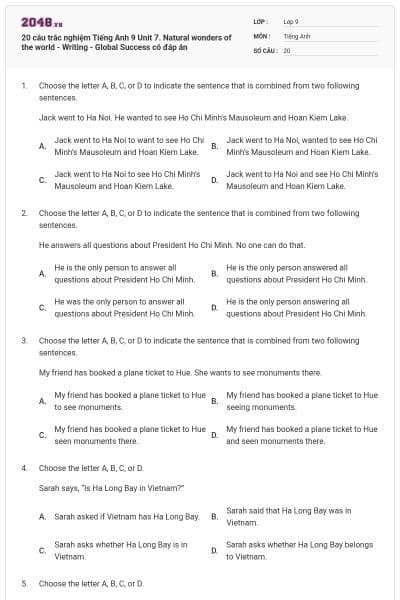
Jack went to Ha Noi to want to see Ho Chi Minh’s Mausoleum and Hoan Kiem Lake.
Jack went to Ha Noi, wanted to see Ho Chi Minh's Mausoleum and Hoan Kiem Lake.
Jack went to Ha Noi to see Ho Chi Minh's Mausoleum and Hoan Kiem Lake.
Jack went to Ha Noi and see Ho Chi Minh’s Mausoleum and Hoan Kiem Lake.
Đáp án đúng: C
Giải thích: Câu này dùng cấu trúc “to + V” để chỉ mục đích.
Dịch nghĩa: Jack đến Hà Nội để xem Lăng Chủ tịch Hồ Chí Minh và Hồ Hoàn Kiếm.
He is the only person to answer all questions about President Ho Chi Minh.
He is the only person answered all questions about President Ho Chi Minh.
He was the only person to answer all questions about President Ho Chi Minh.
He is the only person answering all questions about President Ho Chi Minh.
Đáp án đúng: A
Giải thích: Cấu trúc “the only person + to V” diễn tả “người duy nhất làm điều gì đó”.
Dịch nghĩa: Anh ấy là người duy nhất có thể trả lời tất cả các câu hỏi về Chủ tịch Hồ Chí Minh.
My friend has booked a plane ticket to Hue to see monuments.
My friend has booked a plane ticket to Hue seeing monuments.
My friend has booked a plane ticket to Hue seen monuments there.
My friend has booked a plane ticket to Hue and seen monuments there.
Đáp án đúng: A
Giải thích: Dùng “to + V” để chỉ mục đích hành động.
Dịch nghĩa: Bạn tôi đã đặt vé máy bay đến Huế để ngắm các di tích ở đó.
Sarah asked if Vietnam has Ha Long Bay.
Sarah said that Ha Long Bay was in Vietnam.
Sarah asks whether Ha Long Bay is in Vietnam.
Sarah asks whether Ha Long Bay belongs to Vietnam.
Đáp án đúng: C
Giải thích: Câu tường thuật ở hiện tại (says → asks) nên giữ thì hiện tại.
Dịch nghĩa: Sarah hỏi rằng Vịnh Hạ Long có ở Việt Nam không.
Sarah didn’t know how deep the Dead Sea was.
Sarah asked if they could swim in the Dead Sea.
Sarah asked if the Dead Sea was a good place for swimming.
Sarah said that swimming wasn’t allowed in the Dead Sea.
Đáp án đúng: B
Giải thích: Động từ wondered ở quá khứ → câu hỏi Yes/No gián tiếp, chuyển “can” → “could”.
Dịch nghĩa: Sarah tự hỏi liệu họ có thể bơi ở Biển Chết không.
Sarah wondered if the Great Barrier Reef was safe to swim in.
Sarah required me to swim in the Great Barrier Reef.
Sarah asked if I could swim in the Great Barrier Reef.
Sarah wanted to know if she could swim in the Great Barrier Reef.
Đáp án đúng: D
Giải thích: “exclaimed” ở đây diễn tả sự ngạc nhiên → chuyển thành “wanted to know if she could…”.
Dịch nghĩa: Sarah muốn biết liệu cô ấy có thể bơi ở Rạn san hô Great Barrier hay không.
The child asked if penguins were native to the Arctic.
The child wanted to know where penguins lived.
The child asked whether were the penguins native to the Arctic.
The child asked whether the penguins are native to the Arctic.
Đáp án đúng: A
Giải thích: Khi tường thuật, đảo ngược cấu trúc về dạng khẳng định: asked if penguins were...
Dịch nghĩa: Đứa trẻ hỏi liệu chim cánh cụt có nguồn gốc ở Bắc Cực không.
David wondered if there are any active volcanoes in Europe.
David informed me that there are active volcanoes in Europe.
David asked whether there were active volcanoes in Europe.
David wants to know whether there were any active volcanoes in Europe.
Đáp án đúng: A
Giải thích: Khi động từ chính là wants to know (hiện tại), ta không đổi thì → giữ are.
Dịch nghĩa: David muốn biết liệu châu Âu có núi lửa đang hoạt động không.
John asked if the Northern Lights appeared all year round.
John asked if the best time to see the Northern Lights was winter.
John wanted to know if the Northern Lights were dangerous.
John wondered if he knew when the Northern Lights appeared.
Đáp án đúng: A
Giải thích: Does ... appear? → tường thuật thành asked if ... appeared.
Dịch nghĩa: John hỏi liệu hiện tượng Cực quang có xuất hiện quanh năm không.

Học thông minh hơn mỗi ngày
Xem toàn bộ 20 câu hỏi và nhiều hơn nữa với tài khoản miễn phí
The teacher asked were there any active volcanoes in Hawaii.
The teacher explained that volcanoes could erupt in Hawaii.
The teacher asked if there were any active volcanoes in Hawaii.
The teacher asked to know the location of the volcanoes in Hawaii.
Đáp án đúng: C
Giải thích: Câu hỏi Yes/No → dùng if/ whether + S + V: asked if there were...
Dịch nghĩa: Giáo viên hỏi liệu ở Hawaii có núi lửa đang hoạt động không.
David asked where the highest waterfall Victoria Falls was located.
David asked if Victoria Falls was the highest waterfall in the world.
David wanted to know if they needed a visa to visit Victoria Falls.
David asked that was Victoria Falls the highest waterfall in the world?
Đáp án đúng: B
Giải thích: Câu hỏi Yes/No → asked if + S + V (đổi thì quá khứ).
Dịch nghĩa: David hỏi liệu thác Victoria có phải là thác nước cao nhất thế giới không.
Maria wanted to know if the Grand Canyon is a man-made wonder.
Maria asked whether the Grand Canyon is the biggest canyon.
Maria wondered if they could see the Grand Canyon that day.
Maria asked whether the Grand Canyon was a man-made wonder.
Đáp án đúng: D
Giải thích: asked whether + S + V (quá khứ) vì động từ chính “asked” ở thì quá khứ.
Dịch nghĩa: Maria hỏi liệu Grand Canyon có phải là kỳ quan nhân tạo không.
They wondered if someone had reached the bottom of the Mariana Trench.
They asked if anyone had ever reached the bottom of the Mariana Trench.
They asked whether someone ever reached the bottom of the Mariana Trench.
They asked whether anyone has ever reached the bottom of the Mariana Trench.
Đáp án đúng: B
Giải thích: Khi tường thuật, chuyển has + P.P → had + P.P.
Dịch nghĩa: Họ hỏi liệu đã có ai từng chạm đến đáy rãnh Mariana chưa.
The researcher reported the glacier looked beautiful.
The researcher explained how glaciers form on mountains.
The researcher happily announced the glacier’s growth.
The researcher expressed sadness about the glacier’s reduction.
Đáp án đúng: D
Giải thích: “Sadly stated” → diễn tả cảm xúc buồn → expressed sadness about... là cách diễn đạt tương đương.
Dịch nghĩa: Nhà nghiên cứu bày tỏ sự buồn bã về việc sông băng đang thu hẹp lại.
The travelers announced they had climbed the highest mountain in Europe.
The travelers boasted that we had climbed the highest mountain in Europe.
The travelers admitted they climbed the highest mountain in Europe.
The travelers inquired about climbing the highest mountain in Europe.
Đáp án đúng: A
Giải thích: Câu tường thuật ở quá khứ hoàn thành “had climbed”.
Dịch nghĩa: Những người du hành thông báo rằng họ đã leo lên ngọn núi cao nhất ở châu Âu.
The conservationist reported that the Great Barrier Reef was thriving.
The conservationist promised the Great Barrier Reef would be safe from pollution.
The conservationist warned that pollution threatened the Great Barrier Reef.
The conservationist explained the Great Barrier Reef is a beautiful underwater world.
Đáp án đúng: C
Giải thích: warned that ... due to pollution → diễn đạt tương đương pollution threatened....
Dịch nghĩa: Nhà bảo tồn cảnh báo rằng ô nhiễm đang đe dọa Rạn san hô Great Barrier.
The brochure offered tips on disrespecting Uluru’s sacredness.
The brochure described Uluru as a place of minimal cultural significance.
The brochure stated that Uluru was a sacred site for Aboriginal Australians.
The brochure announced that the Aboriginal Australians’ Uluru is a sacred site.
Đáp án đúng: C
Giải thích: Khi tường thuật, lùi thì “is → was”.
Dịch nghĩa: Tờ quảng cáo nói rằng Uluru là một địa điểm linh thiêng đối với người thổ dân Úc.
She explained that the stalagmites and stalactites in the cave are incredible.
She remarked that the stalagmites and stalactites in the cave were incredible.
She announced the discovery of stalagmites and stalactites in the cave.
She wanted to know the beauty of the cave’s stalagmites and stalactites.
Đáp án đúng: B
Giải thích: Câu tường thuật mang tính nhận xét → dùng “remarked that…” và lùi thì “are → were”.
Dịch nghĩa: Cô ấy nhận xét rằng những nhũ đá trong hang thật tuyệt vời.
She mentioned that the Grand Canyon had been formed millions of years before.
She said that the Grand Canyon formed was formed millions of years ago.
She mentioned that the Grand Canyon would be formed in millions of years.
She stated that the Grand Canyon’s formation needed millions of years ago to form.
Đáp án đúng: A
Giải thích: Khi tường thuật quá khứ đơn (was formed), lùi thì về quá khứ hoàn thành (had been formed).
Dịch nghĩa: Cô ấy nói rằng hẻm núi Grand Canyon đã được hình thành cách đây hàng triệu năm.
The tour guide stated that the Taj Mahal attracts millions of visitors every year.
The tour guide announced that the Taj Mahal had been attracting millions of visitors every year.
The tour guide explained that millions of visitors were building the Taj Mahal every year.
The tour guide mentioned that the Taj Mahal would attract a few visitors each year.
Đáp án đúng: A
Giải thích: Động từ “said proudly” → tường thuật mang tính tự hào, không cần lùi thì vì sự thật chung (general truth). Cấu trúc: stated that + S + V (hiện tại đơn) khi sự việc vẫn đúng ở hiện tại.
Dịch nghĩa: Hướng dẫn viên nói với niềm tự hào rằng Taj Mahal thu hút hàng triệu du khách mỗi năm.
Bạn có thích hoạt động này không?
Hãy lưu hoặc chia sẻ nội dung này đến mọi người.
Gợi ý cho bạn

Ý tưởng của bạn, bài học của bạn
Tự thiết kế đề thi, bài giảng hoặc flashcard theo cách riêng.