Trắc nghiệm Tiếng Anh 8 Global Success Unit 9 Reading (có đáp án)
20 câu hỏi
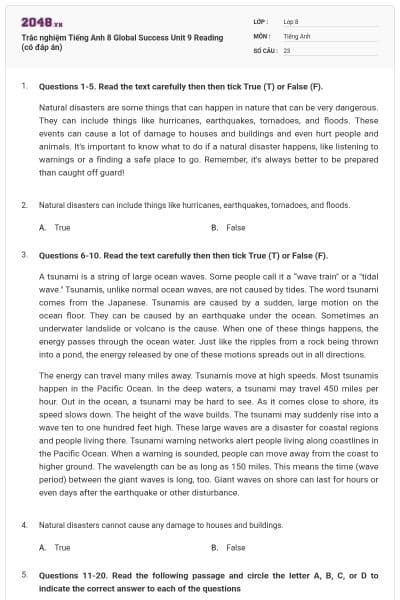
Questions 1-5. Read the text carefully then then tick True (T) or False (F).
Natural disasters are some things that can happen in nature that can be very dangerous. They can include things like hurricanes, earthquakes, tornadoes, and floods. These events can cause a lot of damage to houses and buildings and even hurt people and animals. It's important to know what to do if a natural disaster happens, like listening to warnings or a finding a safe place to go. Remember, it's always better to be prepared than caught off guard!
Natural disasters can include things like hurricanes, earthquakes, tornadoes, and floods.
True
False
Đáp án đúng: A
Giải thích:
Dựa vào câu: "They can include things like hurricanes, earthquakes, tornadoes, and floods." (Chúng có thể bao gồm những thứ như bão, động đất, lốc xoáy và lũ lụt)
Natural disasters cannot cause any damage to houses and buildings.
True
False
Đáp án đúng: B
Giải thích:
Dựa vào câu: "These events can cause a lot of damage to houses and buildings." (Những sự kiện này có thể gây ra rất nhiều thiệt hại cho nhà cửa và các tòa nhà)
Natural disasters can hurt people and animals.
True
False
Đáp án đúng: A
Giải thích:
Dựa vào câu: "These events can... even hurt people and animals." (Những sự kiện này có thể... thậm chí gây tổn thương cho con người và động vật)
It's not important to know what to do if a natural disaster happens.
True
False
Đáp án đúng: B
Giải thích:
Dựa vào câu: "It's important to know what to do if a natural disaster happens." (Điều quan trọng là phải biết phải làm gì nếu thảm họa thiên nhiên xảy ra)
Being prepared for a natural disaster is not necessary.
True
False
Đáp án đúng: B
Giải thích:
Dựa vào câu: "It's always better to be prepared than caught off guard!" (Luôn tốt hơn nếu chuẩn bị sẵn sàng hơn là bị bất ngờ!)
Dịch bài đọc:
Thảm họa thiên nhiên là một số điều có thể xảy ra trong tự nhiên và có thể rất nguy hiểm. Chúng có thể bao gồm những thứ như bão, động đất, lốc xoáy và lũ lụt. Những sự kiện này có thể gây ra rất nhiều thiệt hại cho nhà cửa và tòa nhà và thậm chí gây thương tích cho người và động vật. Điều quan trọng là phải biết phải làm gì nếu thảm họa thiên nhiên xảy ra, chẳng hạn như lắng nghe cảnh báo hoặc tìm nơi an toàn để đi. Hãy nhớ rằng, luôn tốt hơn là chuẩn bị trước hơn là bất ngờ!
Questions 6-10. Read the text carefully then then tick True (T) or False (F).
A tsunami is a string of large ocean waves. Some people call it a “wave train" or a "tidal wave." Tsunamis, unlike normal ocean waves, are not caused by tides. The word tsunami comes from the Japanese. Tsunamis are caused by a sudden, large motion on the ocean floor. They can be caused by an earthquake under the ocean. Sometimes an underwater landslide or volcano is the cause. When one of these things happens, the energy passes through the ocean water. Just like the ripples from a rock being thrown into a pond, the energy released by one of these motions spreads out in all directions.
The energy can travel many miles away. Tsunamis move at high speeds. Most tsunamis happen in the Pacific Ocean. In the deep waters, a tsunami may travel 450 miles per hour. Out in the ocean, a tsunami may be hard to see. As it comes close to shore, its speed slows down. The height of the wave builds. The tsunami may suddenly rise into a wave ten to one hundred feet high. These large waves are a disaster for coastal regions and people living there. Tsunami warning networks alert people living along coastlines in the Pacific Ocean. When a warning is sounded, people can move away from the coast to higher ground. The wavelength can be as long as 150 miles. This means the time (wave period) between the giant waves is long, too. Giant waves on shore can last for hours or even days after the earthquake or other disturbance.
"Wave train" or "tidal wave" is another term for tsunami.
True
False
Đáp án đúng: A
Giải thích:
Dựa vào câu: "Some people call it a 'wave train' or a 'tidal wave.'" (Một số người gọi nó là 'tàu sóng' hoặc 'sóng thủy triều')
Tsunamis often come from Japan.
True
False
Đáp án đúng: B
Giải thích: Bài nói từ "tsunami" có nguồn gốc từ tiếng Nhật, không phải sóng thần chỉ đến từ Nhật Bản.
A tsunami may be hard to see because it may travel 450 miles per hour.
True
False
Đáp án đúng: A
Giải thích: "In the deep waters, a tsunami may travel 450 miles per hour... a tsunami may be hard to see." (Ở vùng nước sâu, sóng thần có thể di chuyển với tốc độ 450 dặm một giờ... sóng thần có thể khó nhìn thấy)
Only people living along coastlines in the Pacific Ocean are alerted with tsunami warning networks.
True
False
Đáp án đúng: B
Giải thích: Hệ thống cảnh báo sóng thần không chỉ cảnh báo cho Thái Bình Dương mà cho tất cả các vùng ven biển.
Big waves on shore can last very long after the earthquake.
True
False
Đáp án đúng: A
Giải thích: "Giant waves on shore can last for hours or even days after the earthquake." (Sóng lớn trên bờ có thể kéo dài trong nhiều giờ hoặc thậm chí nhiều ngày sau trận động đất)
Dịch bài đọc:
Sóng thần là một chuỗi các con sóng lớn trên đại dương. Một số người gọi nó là "đoàn sóng" hoặc "sóng thủy triều". Sóng thần, không giống như sóng biển thông thường, không phải do thủy triều gây ra. Từ "tsunami" bắt nguồn từ tiếng Nhật. Sóng thần gây ra bởi chuyển động lớn, đột ngột trên đáy đại dương. Chúng có thể do động đất dưới đại dương gây ra. Đôi khi, lở đất dưới nước hoặc núi lửa là nguyên nhân. Khi một trong những điều này xảy ra, năng lượng sẽ truyền qua nước biển. Giống như gợn sóng từ một tảng đá được ném xuống ao, năng lượng giải phóng từ một trong những chuyển động này sẽ lan tỏa ra mọi hướng.
Năng lượng có thể truyền đi xa nhiều dặm. Sóng thần di chuyển với tốc độ cao. Hầu hết các cơn sóng thần xảy ra ở Thái Bình Dương. Ở vùng nước sâu, sóng thần có thể di chuyển với tốc độ 450 dặm một giờ. Ngoài đại dương, sóng thần có thể khó nhìn thấy. Khi đến gần bờ, tốc độ của nó chậm lại. Chiều cao của sóng tăng lên. Sóng thần có thể đột nhiên dâng lên thành một con sóng cao từ mười đến một trăm feet. Những con sóng lớn này là một thảm họa đối với các vùng ven biển và người dân sống ở đó. Các mạng lưới cảnh báo sóng thần cảnh báo những người sống dọc theo bờ biển ở Thái Bình Dương. Khi có cảnh báo, mọi người có thể di chuyển ra xa bờ biển đến vùng đất cao hơn. Bước sóng có thể dài tới 150 dặm. Điều này có nghĩa là thời gian (chu kỳ sóng) giữa các đợt sóng khổng lồ cũng dài. Sóng khổng lồ trên bờ có thể kéo dài trong nhiều giờ hoặc thậm chí nhiều ngày sau trận động đất hoặc các nhiễu động khác.
Questions 11-20. Read the following passage and circle the letter A, B, C, or D to indicate the correct answer to each of the questions
At the top of the list of the costliest natural disasters in the history of the United States is Hurricane Katrina. Hurricane Katrina was the third strongest hurricane ever to hit the U. S. It affected 90,000 square miles in Louisiana, Mississippi, Florida, and Alabama.
The hurricane formed over the Bahamas and turned into a Category 1 hurricane by the time it hit the southeastern tip of Florida. It got stronger as it traveled across the Gulf of Mexico. It made its second landfall off the coast of southeast Louisiana on Monday, August 29, 2005. It had become a category 4 hurricane by then. The storm surge that followed caused destruction from central Florida to Texas. New Orleans, Louisiana, experienced even more damage because its levees were breeched, letting water flood a large portion of the city.
The National Weather Service warned people of the tropical monster that was heading towards the southern coast. Residents were told to expect power outages. They were told they might lose their rooftops and to expect water shortages. The National Hurricane Director was very concerned. He personally called the governors of Louisiana and Mississippi. He even called President Bush at his ranch in Texas. He spoke directly with New Orleans mayor Ray Nagin. Nagin issued an evacuation order for his city. Most people left. About eighty percent of the population evacuated. The estimate was that around 100,000 people remained in the metro area. Some were stranded tourists; others did not own a car and had no way out. Those who were not able to leave were instructed to go to the New Orleans Convention Center and the Superdome.
What is the passage mainly about?
The history of the United States hurricanes.
A hurricane in the history of the United States.
Hurricanes in the world, especially in the United States.
What the United States does to prevent hurricanes.
Đáp án đúng: B
Giải thích: Bài đọc chủ yếu nói về Hurricane Katrina – một trận bão lớn trong lịch sử nước Mỹ.
According to the passage, what is NOT true about Hurricane Katrina?
It is the costliest natural disaster in the history of the United States.
It is the third strongest hurricane ever to hit the US.
It affected 90,000 square miles in Louisiana, Mississippi, Florida, and Alabama.
It formed over the Bahamas.
Đáp án đúng: A
Giải thích:
Dựa vào câu: "At the top of the list of the costliest natural disasters in the history of the United States is Hurricane Katrina." (Đứng đầu danh sách những thảm họa thiên nhiên gây thiệt hại lớn nhất trong lịch sử Hoa Kỳ là cơn bão Katrina)
What can be true from the passage about Hurricane Katrina when it hit the southeastern tip of Florida?
It was very weak.
It was very strong.
It was not as weak as it started.
It was not as strong as it started.
Đáp án đúng: D
Giải thích:
Dựa vào câu: "It got stronger as it traveled across the Gulf of Mexico." (Nó trở nên mạnh hơn khi di chuyển qua Vịnh Mexico)
What is NOT true about the National Hurricane Director?
He called the governors of Mississippi.
He called President Bush at his ranch in Texas.
He spoke directly with the New Orleans mayor.
He was very unconcerned.
Đáp án đúng: D
Giải thích:
Dựa vào câu: Trong bài có nói ông ấy rất quan tâm và đích thân gọi điện cho các quan chức cấp cao.
According to the passage, how many people were evacuated?
About 80,000 people.
About 80% of the population.
Around 100,000 people.
Around 20% of the population.
Đáp án đúng: B
Giải thích:
Dựa vào câu: "About eighty percent of the population evacuated." (Khoảng tám mươi phần trăm dân số đã di tản)
Where did Hurricane Katrina form?
Over the Atlantic Ocean
Over the Bahamas
Over the Gulf of Mexico
Over Louisiana
Đáp án đúng: B
Giải thích:
Dựa vào câu: "The hurricane formed over the Bahamas." (Cơn bão hình thành trên Bahamas)
Why did New Orleans experience even more damage?
Because the storm weakened near New Orleans
Because the city's levees broke, causing flooding
Because people did not evacuate
Because the storm never reached New Orleans
Đáp án đúng: B
Giải thích:
Dựa vào câu: "New Orleans experienced even more damage because its levees were breeched, letting water flood a large portion of the city." (New Orleans chịu thiệt hại thậm chí còn lớn hơn vì đê bị vỡ, khiến nước tràn vào một phần lớn thành phố.)
What was the second landfall of Hurricane Katrina?
In Florida
In Texas
In Louisiana
In Mississippi
Đáp án đúng: C
Giải thích:
Dựa vào câu: "It made its second landfall off the coast of southeast Louisiana on Monday, August 29, 2005." (Cơn bão này đổ bộ lần thứ hai vào bờ biển đông nam Louisiana vào thứ Hai, ngày 29 tháng 8 năm 2005.)
What did the National Weather Service warn people about?
Power outages and roof damage
Strong winds but no danger
That the hurricane would not hit the U.S.
That the hurricane would disappear quickly
Đáp án đúng: A
Giải thích:
Dựa vào câu: "Residents were told to expect power outages. They were told they might lose their rooftops and to expect water shortages." (Người dân được thông báo là sẽ mất điện. Họ được thông báo là có thể mất mái nhà và sẽ thiếu nước.)
Where were people instructed to go if they couldn't leave New Orleans?
Their homes
Neighboring cities
The Superdome and the Convention Center
The Gulf of Mexico
Đáp án đúng: C
Giải thích:
Dựa vào câu: "Those who were not able to leave were instructed to go to the New Orleans Convention Center and the Superdome." (Những người không thể rời đi được hướng dẫn đến Trung tâm Hội nghị New Orleans và Superdome)
Dịch bài đọc:
Đứng đầu danh sách các thảm họa thiên nhiên tốn kém nhất trong lịch sử Hoa Kỳ là Bão Katrina. Bão Katrina là cơn bão mạnh thứ ba từng đổ bộ vào Hoa Kỳ. Nó ảnh hưởng đến 90.000 dặm vuông ở Louisiana, Mississippi, Florida và Alabama.
Cơn bão hình thành trên quần đảo Bahamas và trở thành bão cấp 1 khi đổ bộ vào mũi phía đông nam của Florida. Nó trở nên mạnh hơn khi đi qua Vịnh Mexico. Nó đổ bộ lần thứ hai ngoài khơi bờ biển đông nam Louisiana vào thứ Hai, ngày 29 tháng 8 năm 2005. Vào thời điểm đó, nó đã trở thành bão cấp 4. Sóng lớn sau đó đã gây ra sự tàn phá từ miền trung Florida đến Texas. New Orleans, Louisiana, thậm chí còn chịu nhiều thiệt hại hơn vì đê bị vỡ, khiến nước tràn vào một phần lớn thành phố.
Cơ quan Thời tiết Quốc gia đã cảnh báo người dân về con quái vật nhiệt đới đang tiến về bờ biển phía nam. Người dân được thông báo rằng sẽ mất điện. Họ được thông báo rằng họ có thể mất mái nhà và sẽ thiếu nước. Giám đốc Bão Quốc gia rất lo lắng. Ông đích thân gọi điện cho các thống đốc của Louisiana và Mississippi. Ông thậm chí còn gọi cho Tổng thống Bush tại trang trại của ông ở Texas. Ông đã nói chuyện trực tiếp với thị trưởng New Orleans Ray Nagin. Nagin đã ban hành lệnh sơ tán cho thành phố của mình. Hầu hết mọi người đã rời đi. Khoảng tám mươi phần trăm dân số đã sơ tán. Ước tính có khoảng 100.000 người vẫn ở lại khu vực đô thị. Một số là khách du lịch bị mắc kẹt; những người khác không sở hữu ô tô và không có lối thoát. Những người không thể rời đi được hướng dẫn đến Trung tâm Hội nghị New Orleans và Superdome.