Trắc nghiệm Tiếng Anh 8 Global Success Unit 9 Kĩ năng đọc hiểu (có đáp án)
10 câu hỏi
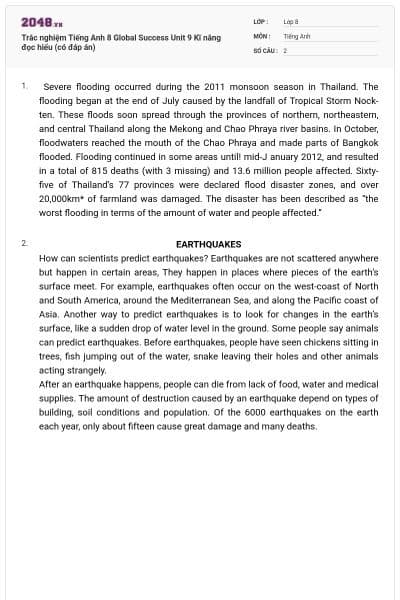
Severe flooding occurred during the 2011 monsoon season in Thailand. The flooding began at the end of July caused by the landfall of Tropical Storm Nock-ten. These floods soon spread through the provinces of northern, northeastern, and central Thailand along the Mekong and Chao Phraya river basins. In October, floodwaters reached the mouth of the Chao Phraya and made parts of Bangkok flooded. Flooding continued in some areas until! mid-J anuary 2012, and resulted in a total of 815 deaths (with 3 missing) and 13.6 million people affected. Sixty-five of Thailand’s 77 provinces were declared flood disaster zones, and over 20,000km* of farmland was damaged. The disaster has been described as “the worst flooding in terms of the amount of water and people affected.”
Read the passage carefully and choose the correct answer.
What is the cause of the 2011 flooding?
The landfall of Tropical Storm Nock-ten
The monsoon season
The Mekong and Chao Phraya river basins
The mouth of the Chao Phraya
Nguyên nhân của trận lụt năm 2011 là gì?
A.Sự đổ bộ của Bão nhiệt đới Nock-ten
B.Mùa gió mùa
C.Lưu vực sông Mê Kông và Chao Phraya
D.Cửa sông Chao Phraya
Thông tin: Severe flooding occurred during the 2011 monsoon season in Thailand. The flooding began at the end of July caused by the landfall of Tropical Storm Nock-ten.
Tạm dịch: Lũ lụt nghiêm trọng đã xảy ra trong suốt mùa gió mùa năm 2011 ở Thái Lan. Trận lụt bắt đầu vào cuối tháng 7 do trận bão nhiệt đới Nock-ten đổ bộ.
Đáp án cần chọn là: a
Read the passage carefully and choose the correct answer.
The floods occurred in some provinces except, ______.
Southern Thailand
Northern Thailand
Central Thailand
Northeastern Thailand
Lũ lụt xảy ra ở một số tỉnh ngoại trừ, ______.
A.Nam Thái Lan
B.Bắc Thái Lan
C.Trung tâm Thái Lan
D.Đông Bắc Thái Lan
Thông tin: These floods soon spread through the provinces of northern, northeastern, and central Thailand along the Mekong and Chao Phraya river basins.
Tạm dịch: Những trận lũ này nhanh chóng lan qua các tỉnh phía bắc, đông bắc và trung tâm Thái Lan dọc theo lưu vực sông Mê Kông và sông Chao Phraya.
Đáp án cần chọn là: a
Read the passage carefully and choose the correct answer.
When did the flooding end?
at the beginning of July, 2011
at the end of July, 2011
at the middle of January, 2012
at the end of January, 2012
Lũ lụt kết thúc khi nào?
A.vào đầu tháng 7 năm 2011
B.vào cuối tháng 7 năm 2011
C.vào giữa tháng 1 năm 2012
D.vào cuối tháng 1 năm 2012
Thông tin: Flooding continued in some areas until mid-J anuary 2012, and resulted in a total of 815 deaths (with 3 missing) and 13.6 million people affected.
Tạm dịch: Lũ lụt tiếp tục ở một số khu vực cho đến giữa tháng một năm 2012 và kết quả là có tổng cộng 815 người chết (với 3 người mất tích) và 13,6 triệu người bị ảnh hưởng.
Đáp án cần chọn là: c
Read the passage carefully and choose the correct answer.
Which of the following is true?
Floodwaters reached the mouth of the Mekong.
Parts of Bangkok flooded.
77 provinces in Thailand were declared flood disaster zones.
This flooding is considered the worst flooding in terms of property damage.
Điều nào sau đây là đúng?
A.Lũ lụt đã đến cửa sông Mê Kông.
B.Các phần của Bangkok bị ngập lụt.
C.77 tỉnh ở Thái Lan được tuyên bố là vùng thiên tai lũ lụt.
D.Lũ lụt này được coi là trận lụt tồi tệ nhất về thiệt hại tài sản.
Thông tin: In October, floodwaters reached the mouth of the Chao Phraya and made parts of Bangkok flooded.
Tạm dịch: Vào tháng 10, nước lũ đã đến cửa sông Chao Phraya và khiến các phần của Bangkok bị ngập lụt.
Đáp án cần chọn là: b
Read the passage carefully and choose the correct answer.
Which of the following is caused by the flooding?
815 died and went missing.
13.6 billion people were affected.
The Mekong and Chao Phraya river basins were damaged.
20,000km? of farmland was negatively destroyed.
Điều nào sau đây là do lũ lụt?
A.815 người chết và mất tích.
B.13,6 tỷ người bị ảnh hưởng.
C.Lưu vực sông Mê Kông và Chao Phraya bị hư hại.
D.20.000km đất nông nghiệp bị phá hủy một cách tiêu cực.
Thông tin: Flooding continued in some areas until mid-J anuary 2012, and resulted in a total of 815 deaths (with 3 missing) and 13.6 million people affected. Sixty-five of Thailand’s 77 provinces were declared flood disaster zones, and over 20,000km of farmland was damaged.
Tạm dịch: Lũ lụt tiếp tục ở một số khu vực cho đến giữa tháng một năm 2012 và kết quả là có tổng cộng 815 người chết (với 3 người mất tích) và 13,6 triệu người bị ảnh hưởng. 65 trong số 77 tỉnh của Thái Lan được tuyên bố là vùng thiên tai lũ lụt và hơn 20.000km đất nông nghiệp bị thiệt hại.
Xem Bài Dịch
Lũ lụt nghiêm trọng đã xảy ra trong suốt mùa gió mùa năm 2011 ở Thái Lan. Trận lụt bắt đầu vào cuối tháng 7 do trận bão nhiệt đới Nock-ten đổ bộ. Những trận lũ này nhanh chóng lan qua các tỉnh phía bắc, đông bắc và trung tâm Thái Lan dọc theo lưu vực sông Mê Kông và sông Chao Phraya. Vào tháng 10, nước lũ đã đến cửa sông Chao Phraya và khiến các phần của Bangkok bị ngập lụt. Lũ lụt tiếp tục ở một số khu vực cho đến giữa tháng một năm 2012 và kết quả là có tổng cộng 815 người chết (với 3 người mất tích) và 13,6 triệu người bị ảnh hưởng. 65 trong số 77 tỉnh của Thái Lan được tuyên bố là vùng thiên tai lũ lụt và hơn 20.000km đất nông nghiệp bị thiệt hại. Thảm họa đã được mô tả là trận lũ lụt tồi tệ nhất về lượng nước và số người bị ảnh hưởng.
Đáp án cần chọn là: a
EARTHQUAKES
How can scientists predict earthquakes? Earthquakes are not scattered anywhere but happen in certain areas, They happen in places where pieces of the earth’s surface meet. For example, earthquakes often occur on the west-coast of North and South America, around the Mediterranean Sea, and along the Pacific coast of Asia. Another way to predict earthquakes is to look for changes in the earth’s surface, like a sudden drop of water level in the ground. Some people say animals can predict earthquakes. Before earthquakes, people have seen chickens sitting in trees, fish jumping out of the water, snake leaving their holes and other animals acting strangely.
After an earthquake happens, people can die from lack of food, water and medical supplies. The amount of destruction caused by an earthquake depend on types of building, soil conditions and population. Of the 6000 earthquakes on the earth each year, only about fifteen cause great damage and many deaths.
Read the passage carefully and choose the correct answer.
Earthquakes happen in certain areas where _____.
the population is large
pieces of the earth’s surface meet
the soil conditions are stable
many buildings are built
Động đất xảy ra ở một số khu vực nhất định nơi có _____.
A.dân số đông
B.các mảnh của bề mặt Trái đất gặp nhau
C.điều kiện đất ổn định
D.nhiều tòa nhà được xây dựng
Thông tin: Earthquakes are not scattered anywhere but happen in certain areas. They happen in places where pieces of the earth’s surface meet.
Tạm dịch: Động đất không nằm rải rác ở bất cứ đâu mà xảy ra ở một số khu vực nhất định. Chúng xảy ra ở những nơi mà các mảnh của bề mặt Trái đất gặp nhau.
Đáp án cần chọn là: b
Read the passage carefully and choose the correct answer.
Earthquakes often happen along ______.
the east-coast of North America
the east-coast of South America
the Pacific coast of Asia
the coast of Australia
Động đất thường xảy ra dọc theo ______.
A.bờ biển phía đông của Bắc Mỹ
B.bờ biển phía đông của Nam Mỹ
C.bờ biển Thái Bình Dương của châu Á
D.bờ biển Úc
Thông tin: For example, earthquakes often occur on the west-coast of North and South America, around the Mediterranean Sea, and along the Pacific coast of Asia.
Tạm dịch: Ví dụ, động đất thường xảy ra ở bờ biển phía tây của Bắc Mỹ và Nam Mỹ, xung quanh biển Địa Trung Hải và dọc theo bờ biển Thái Bình Dương của Châu Á.
Đáp án cần chọn là: c
Read the passage carefully and choose the correct answer.
Looking for ____ can help predict earthquakes.
changes in the earth’s surface
water beneath the earth’s surface
drops of water
water currents
Tìm kiếm ____ có thể giúp dự đoán động đất.
A.những thay đổi trên bề mặt trái đất
B.nước bên dưới bề mặt Trái đất
C.giọt nước
D.dòng nước
Thông tin: Another way to predict earthquakes is to look for changes in the earth’s surface, like a sudden drop of water level in the ground.
Tạm dịch: Một cách khác để dự đoán động đất là tìm kiếm những thay đổi trên bề mặt Trái đất, như là mực nước giảm đột ngột trên mặt đất.
Đáp án cần chọn là: a
Read the passage carefully and choose the correct answer.
After an earthquake, as a result of _____ people may die.
lack of food
lack of corn
lack of money
lack of potatoes
Sau một trận động đất, kết quả là những người____ có thể chết.
A.thiếu thức ăn
B.thiếu ngô
C.thiếu tiền
D.thiếu khoai tây
Thông tin: After an earthquake happens, people can die from lack of food, water and medical supplies.
Tạm dịch: Sau khi một trận động đất xảy ra, mọi người có thể chết vì thiếu thực phẩm, nước và vật tư y tế.
Đáp án cần chọn là: a
Read the passage carefully and choose the correct answer.
The passage mainly discusses _____.
the damage caused by earthquakes
how strong earthquakes are
strange animal behaviors
how to predict earthquakes
Đoạn văn chủ yếu thảo luận về _____.
A.thiệt hại do động đất
B.trận động đất mạnh như thế nào
C.hành vi kỳ lạ của động vật
D.cách dự đoán động đất
Thông tin: How can scientists predict earthquakes?...Another way to predict earthquakes is…Some people say animals can predict earthquakes.
Tạm dịch: Làm thế nào các nhà khoa học có thể dự đoán được động đất?....Một cách khác để dự đoán động đất là.... Một số người nói rằng động vật có thể dự đoán được động đất.
Xem Bài Dịch
ĐỘNG ĐẤT
Làm thế nào các nhà khoa học có thể dự đoán được động đất? Động đất không nằm rải rác ở bất cứ đâu mà xảy ra ở một số khu vực nhất định. Chúng xảy ra ở những nơi mà các mảnh của bề mặt Trái đất gặp nhau. Ví dụ, động đất thường xảy ra ở bờ biển phía tây của Bắc Mỹ và Nam Mỹ, xung quanh biển Địa Trung Hải và dọc theo bờ biển Thái Bình Dương của Châu Á. Một cách khác để dự đoán động đất là tìm kiếm những thay đổi trên bề mặt Trái đất, như là mực nước giảm đột ngột trên mặt đất. Một số người nói rằng động vật có thể dự đoán được động đất. Trước các trận động đất, người ta đã thấy những con gà ngồi trên cây, cá nhảy lên khỏi mặt nước, rắn để lại những cái lỗ và những động vật khác hành động kỳ lạ.
Sau khi một trận động đất xảy ra, mọi người có thể chết vì thiếu thực phẩm, nước và vật tư y tế. Mức độ phá hủy do trận động đất phụ thuộc vào loại công trình, điều kiện đất đai và dân số. Trong số 6000 trận động đất trên Trái đất mỗi năm, chỉ có khoảng mười lăm trận gây ra thiệt hại lớn và nhiều người thiệt mạng.
Đáp án cần chọn là: d