Trắc nghiệm Tiếng Anh 8 Global Success Unit 3 Writing (có đáp án)
20 câu hỏi
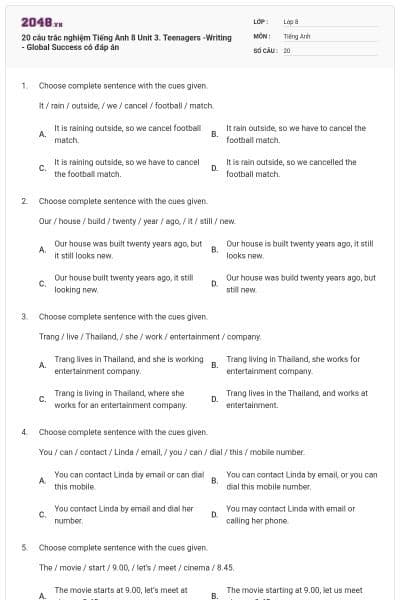
Choose complete sentence with the cues given.
It / rain / outside, / we / cancel / football / match.
It is raining outside, so we cancel football match.
It rain outside, so we have to cancel the football match.
It is raining outside, so we have to cancel the football match.
It is rain outside, so we cancelled the football match.
Đáp án đúng: C
Giải thích:
"It is raining" là thì hiện tại tiếp diễn, đúng với ngữ cảnh thời tiết hiện tại.
Các đáp án còn lại sai ngữ pháp (B dùng “rain” không chia, D dùng “is rain”, A thiếu "have to").
Dịch nghĩa: Trời đang mưa, vì vậy chúng tôi phải hủy trận bóng đá.
Choose complete sentence with the cues given.
Our / house / build / twenty / year / ago, / it / still / new.
Our house was built twenty years ago, but it still looks new.
Our house is built twenty years ago, it still looks new.
Our house built twenty years ago, it still looking new.
Our house was build twenty years ago, but still new.
Đáp án đúng: A
Giải thích:
Câu bị động ở thì quá khứ đơn: was built
Dịch nghĩa: Ngôi nhà của chúng tôi được xây cách đây hai mươi năm, nhưng trông vẫn còn mới.
Choose complete sentence with the cues given.
Trang / live / Thailand, / she / work / entertainment / company.
Trang lives in Thailand, and she is working entertainment company.
Trang living in Thailand, she works for entertainment company.
Trang is living in Thailand, where she works for an entertainment company.
Trang lives in the Thailand, and works at entertainment.
Đáp án đúng: C
Giải thích:
“is living” diễn tả hành động đang diễn ra (tạm thời).
“where she works for an entertainment company” là mệnh đề quan hệ chỉ nơi chốn.
"an entertainment company" cần có mạo từ "an".
Dịch nghĩa: Trang đang sống ở Thái Lan, nơi cô ấy làm việc cho một công ty giải trí.
Choose complete sentence with the cues given.
You / can / contact / Linda / email, / you / can / dial / this / mobile number.
You can contact Linda by email or can dial this mobile.
You can contact Linda by email, or you can dial this mobile number.
You contact Linda by email and dial her number.
You may contact Linda with email or calling her phone.
Đáp án đúng: B
Giải thích:
Cấu trúc “can… or can…” là đúng về ngữ pháp và liệt kê lựa chọn.
“by email” là giới từ phù hợp khi nói về phương tiện liên lạc.
“dial this mobile number” là cấu trúc đúng.
Dịch nghĩa: Bạn có thể liên hệ với Linda qua email hoặc gọi số điện thoại di động này.
Choose complete sentence with the cues given.
The / movie / start / 9.00, / let’s / meet / cinema / 8.45.
The movie starts at 9.00, let’s meet at cinema 8.45.
The movie starting at 9.00, let us meet cinema 8.45.
The movie starts at 9.00, so let’s meet at the cinema at 8.45.
Movie start 9.00, we meet cinema 8.45.
Đáp án đúng: C
Giải thích:
“starts at 9.00” là thì hiện tại đơn chỉ lịch trình.
“so let’s meet…” là lời đề nghị phù hợp.
“at the cinema” là cụm giới từ đúng.
Dịch nghĩa: Phim bắt đầu lúc 9 giờ, vậy nên hãy gặp nhau ở rạp lúc 8 giờ 45 nhé.
Choose complete sentence with the cues given.
The / weather / cold / outside; /I / wear / coat.
The weather is cold outside; I am wearing a coat.
The weather is cold outside; I wears a coat.
The weather cold outside; I wear coat.
The weather cold, so I wearing coat.
Đáp án đúng: A
Giải thích:
“is cold” là câu mô tả thời tiết đúng.
“I am wearing” là hiện tại tiếp diễn phù hợp hành động đang xảy ra.
Dịch nghĩa: Thời tiết bên ngoài lạnh, tôi đang mặc áo khoác.
Choose complete sentence with the cues given.
The food / this / fast-food / restaurant / cheap / delicious.
The food at this fast-food restaurant is cheap and delicious.
The food at fast-food restaurant cheap but delicious.
This fast-food restaurant food are cheap and delicious.
The food in this restaurant cheap, delicious.
Đáp án đúng: A
Giải thích:
“at this fast-food restaurant” là cụm giới từ chỉ địa điểm.
Dịch nghĩa: Thức ăn ở nhà hàng thức ăn nhanh này vừa rẻ vừa ngon.
Choose complete sentence with the cues given.
The students / must / study / hard / exam; / they / not / get / high / marks.
The students must study hard for exam, or they not get high marks.
Students must study hard for the exam, they don’t get marks.
The students must study hard for the exam, or they won’t get high marks.
Students study hard for exam, or they didn’t get marks.
Đáp án đúng: A
Giải thích:
“must study hard” là cấu trúc bắt buộc phải làm gì
“or they won’t get high marks” đúng thì tương lai phủ định.
Dịch nghĩa: Học sinh phải học chăm cho kỳ thi, nếu không sẽ không đạt điểm cao.
Choose complete sentence with the cues given.
I/ like / go / beach, /I / can’t / swim.
I like going to the beach, but I can’t swim.
I like go to beach, but I don’t swim.
I going beach, I no swim.
I like to beach, can’t swimming.
Đáp án đúng: A
Giải thích:
“like Ving” (thích làm gì)
Dịch nghĩa: Tôi thích đi biển, nhưng tôi không biết bơi.
Choose complete sentence with the cues given.
Tom / felt / tired; / he / try / finish / his / work.
Tom felt tired, but he tried finish his work.
Tom feels tired, but he tries to finished work.
Tom felt tired, but he still tried to finish his work.
Tom feel tired, tried to finished the work.
Đáp án đúng: C
Giải thích:
“felt tired” quá khứ đơn, “tried to V” đúng về ngữ pháp (cố gắng làm gì)
Dịch nghĩa: Tom cảm thấy mệt, nhưng anh ấy vẫn cố gắng hoàn thành công việc.
Use the conjunctions provided to connect the sentences.
My alarm didn’t go off this morning. I was late. (therefore)
My alarm didn’t go off this morning but I was late.
My alarm didn’t go off this morning because I was late.
My alarm didn’t go off this morning; therefore, I was late.
My alarm didn’t go off this morning; however, I was late.
Đáp án đúng: C
Giải thích: “Therefore” dùng để chỉ kết quả của một nguyên nhân ở câu trước.
Cấu trúc: [Mệnh đề 1]; therefore, [mệnh đề 2].
Dịch nghĩa: Chuông báo thức sáng nay không kêu; vì vậy, tôi đã bị trễ.
Use the conjunctions provided to connect the sentences.
Many people in my company think he is a good man. I think he is a really cruel one. (however)
Many people in my company think he is a good man and I think he is a really cruel one.
Many people in my company think he is a good man, so I think he is a really cruel one.
Many people in my company think he is a good man because I think he is a really cruel one.
Many people in my company think he is a good man; however, I think he is a really cruel one.
Đáp án đúng: D
Giải thích: “However” dùng để nêu ý trái ngược giữa 2 câu.
Cấu trúc: [Mệnh đề 1]; however, [mệnh đề 2].
Dịch nghĩa: Nhiều người trong công ty tôi nghĩ anh ta là người tốt; tuy nhiên, tôi nghĩ anh ta thực sự rất tàn nhẫn.
Use the conjunctions provided to connect the sentences.
We came to the party; however, the guests had gone home. (but)
We came to the party but the guests had gone home.
We came to the party, but the guests had gone home.
We came to the party and the guests had gone home.
We came to the party because the guests had gone home.
Đáp án đúng: B
Giải thích: “But” là liên từ chỉ sự đối lập nhẹ, nối trực tiếp hai mệnh đề không cần dấu chấm phẩy.
Dịch nghĩa: Chúng tôi đến bữa tiệc, nhưng các vị khách đã về nhà rồi.
Use the conjunctions provided to connect the sentences.
We can prepare a big meal for dinner. We can eat out in a French restaurant. (or)
We can prepare a big meal for dinner because we can eat out.
We can prepare a big meal for dinner, or we can eat out in a French restaurant.
We can prepare a big meal for dinner but eat out.
We can prepare a big meal for dinner; however, eat out in a French restaurant.
Đáp án đúng: B
Giải thích: “Or” dùng để đưa ra lựa chọn giữa 2 hành động.
Dịch nghĩa: Chúng ta có thể nấu một bữa tối lớn, hoặc có thể đi ăn ngoài ở một nhà hàng Pháp.
Use the conjunctions provided to connect the sentences.
You have to wear a helmet when riding a bike. You will be fined. (otherwise)
You have to wear a helmet when riding a bike; otherwise, you will be fined.
You have to wear a helmet when riding a bike and you will be fined.
You have to wear a helmet when riding a bike because you will be fined.
You have to wear a helmet when riding a bike, but you will be fined.
Đáp án đúng: A
Giải thích: “Otherwise” dùng để nói về hậu quả nếu không làm điều gì đó.
Dịch nghĩa: Bạn phải đội mũ bảo hiểm khi đi xe đạp; nếu không, bạn sẽ bị phạt.
Use the conjunctions provided to connect the sentences.
My sister follows a diet plan, but she can’t lose weight. (however)
My sister follows a diet plan; however, she can’t lose weight.
My sister follows a diet plan because she can’t lose weight.
My sister follows a diet plan and she can’t lose weight.
My sister follows a diet plan; however, she can’t lose weight.
Đáp án đúng: D
Giải thích: "However" được dùng để chỉ sự trái ngược với mong đợi.
Cấu trúc: [Mệnh đề 1]; however, [Mệnh đề 2].
Dịch nghĩa: Chị tôi theo một chế độ ăn kiêng; tuy nhiên, chị ấy vẫn không thể giảm cân.
Use the conjunctions provided to connect the sentences.
Jane was sick, so she missed all of the exams last week. (therefore)
Jane was sick; therefore, she missed all of the exams last week.
Jane was sick because she missed all of the exams.
Jane was sick but she missed all of the exams.
Jane was sick although she missed all of the exams.
Đáp án đúng: A
Giải thích: “Therefore” chỉ kết quả.
Cấu trúc: [Nguyên nhân]; therefore, [kết quả].
Dịch nghĩa: Jane bị ốm; vì vậy, cô ấy đã bỏ lỡ tất cả các kỳ thi tuần trước.
Use the conjunctions provided to connect the sentences.
This flat was extremely expensive. My father couldn’t buy it. (for)
My father couldn’t buy the flat, for it was extremely expensive.
My father couldn’t buy the flat, for it was extremely expensive.
My father couldn’t buy the flat although it was extremely expensive.
My father couldn’t buy the flat so it was extremely expensive.
Đáp án đúng: B
Giải thích: "For" mang nghĩa “bởi vì” (tương tự "because") khi nối hai mệnh đề.
Cấu trúc: [Kết quả], for [nguyên nhân].
Dịch nghĩa: Bố tôi không thể mua căn hộ đó vì nó quá đắt.
Use the conjunctions provided to connect the sentences.
Linda is the head of the photography club. She has a good relationship with all members. (so)
Linda is the head of the photography club so she has a good relationship with all members.
Linda is the head of the photography club because she has a good relationship with all members.
Linda is the head of the photography club, so she has a good relationship with all members.
Linda is the head of the photography club, and she has a good relationship although all members.
Đáp án đúng: C
Giải thích: “So” chỉ kết quả từ mệnh đề trước.
Cấu trúc: [Nguyên nhân], so [kết quả]
Dịch nghĩa: Linda là trưởng câu lạc bộ nhiếp ảnh, vì vậy cô ấy có mối quan hệ tốt với tất cả các thành viên.
Use the conjunctions provided to connect the sentences.
Jessy wanted to go to the concert. She couldn’t buy a ticket. (but)
Jessy wanted to go to the concert; however, she couldn’t buy a ticket.
Jessy wanted to go to the concert, but she couldn’t buy a ticket.
Jessy wanted to go to the concert, so she couldn’t buy a ticket.
Jessy wanted to go to the concert, for she couldn’t buy a ticket.
Đáp án đúng: B
Giải thích: “But” được dùng để chỉ sự đối lập nhẹ, nối 2 mệnh đề đối lập.
Dịch nghĩa: Jessy muốn đi buổi hòa nhạc, nhưng cô ấy không thể mua vé.