Trắc nghiệm Tiếng Anh 8 Global Success Unit 2 Reading (có đáp án)
20 câu hỏi
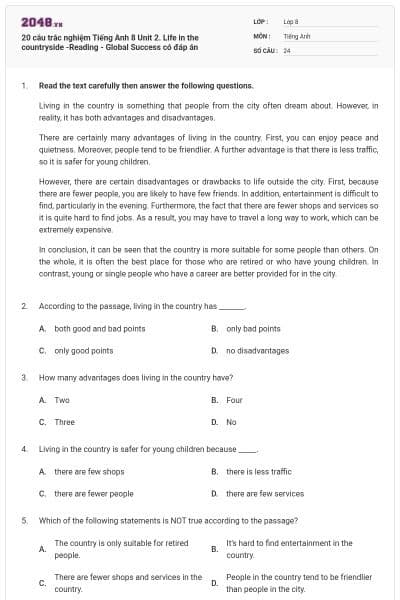
Read the text carefully then answer the following questions.
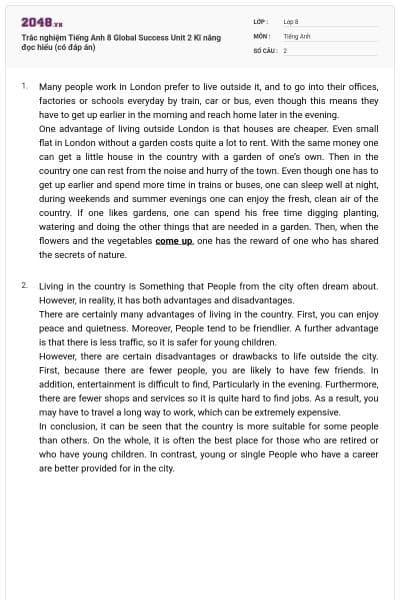
Living in the country is something that people from the city often dream about. However, in reality, it has both advantages and disadvantages.
There are certainly many advantages of living in the country. First, you can enjoy peace and quietness. Moreover, people tend to be friendlier. A further advantage is that there is less traffic, so it is safer for young children.
However, there are certain disadvantages or drawbacks to life outside the city. First, because there are fewer people, you are likely to have few friends. In addition, entertainment is difficult to find, particularly in the evening. Furthermore, the fact that there are fewer shops and services so it is quite hard to find jobs. As a result, you may have to travel a long way to work, which can be extremely expensive.
In conclusion, it can be seen that the country is more suitable for some people than others. On the whole, it is often the best place for those who are retired or who have young children. In contrast, young or single people who have a career are better provided for in the city.
According to the passage, living in the country has _______.
both good and bad points
only bad points
only good points
no disadvantages
Đáp án đúng: A
Giải thích:
Dựa vào câu: However, in reality, it has both advantages and disadvantages. (Tuy nhiên, trên thực tế, nó có cả ưu điểm và nhược điểm.)
How many advantages does living in the country have?
Two
Four
Three
No
Đáp án đúng: C
Giải thích:
Dựa vào câu: First, you can enjoy peace and quietness. Moreover, people tend to be friendlier. A further advantage is that there is less traffic, so it is safer for young children. (Thứ nhất, bạn có thể tận hưởng sự yên bình và tĩnh lặng. Hơn nữa, người dân ở đây thường thân thiện hơn. Một lợi thế nữa là ít xe cộ qua lại, nên an toàn hơn cho trẻ nhỏ..)
Living in the country is safer for young children because _____.
there are few shops
there is less traffic
there are fewer people
there are few services
Đáp án đúng: B
Giải thích:
Dựa vào câu: A further advantage is that there is less traffic, so it is safer for young children. (Một lợi thế nữa là ít phương tiện giao thông hơn, vì vậy an toàn hơn cho trẻ nhỏ..)
Which of the following statements is NOT true according to the passage?
The country is only suitable for retired people.
It’s hard to find entertainment in the country.
There are fewer shops and services in the country.
People in the country tend to be friendlier than people in the city.
Đáp án đúng: A
Giải thích:
Dựa vào câu: On the whole, it is often the best place for those who are retired or who have young children. (Nhìn chung, đây thường là nơi tốt nhất cho những người đã nghỉ hưu hoặc có con nhỏ.)
Having few friends is _____.
one of drawbacks to life in the country
the only disadvantage of living in the country
one of certain advantages to life outside the city
one of certain drawbacks to life outside the city
Đáp án đúng: D
Giải thích:
Dựa vào câu: However, there are certain disadvantages or drawbacks to life outside the city. First, because there are fewer people, you are likely to have few friends. (Tuy nhiên, cuộc sống bên ngoài thành phố cũng có một số bất lợi. Thứ nhất, vì ít người hơn, bạn có thể sẽ có ít bạn bè.)
Dịch bài đọc:
Sống ở nông thôn là điều mà người dân thành thị thường mơ ước. Tuy nhiên, trên thực tế, nó có cả ưu điểm và nhược điểm.
Chắc chắn có rất nhiều lợi thế khi sống ở nông thôn. Thứ nhất, bạn có thể tận hưởng sự yên bình và tĩnh lặng. Hơn nữa, người dân ở đây có xu hướng thân thiện hơn. Một lợi thế nữa là ít xe cộ hơn, vì vậy an toàn hơn cho trẻ nhỏ.
Tuy nhiên, cuộc sống ở ngoại ô cũng có một số nhược điểm. Thứ nhất, vì ít người hơn, bạn có thể có ít bạn bè. Ngoài ra, việc tìm kiếm các hoạt động giải trí rất khó khăn, đặc biệt là vào buổi tối. Hơn nữa, việc có ít cửa hàng và dịch vụ hơn nên việc tìm việc làm khá khó khăn. Kết quả là, bạn có thể phải đi một quãng đường dài để đến nơi làm việc, điều này có thể cực kỳ tốn kém.
Tóm lại, có thể thấy rằng nông thôn phù hợp với một số người hơn những người khác. Nhìn chung, đây thường là nơi tốt nhất cho những người đã nghỉ hưu hoặc có con nhỏ. Ngược lại, những người trẻ tuổi hoặc độc thân có sự nghiệp sẽ được chu cấp tốt hơn ở thành phố.
Read the text carefully then answer the following questions.
I live in a house near the sea. It’s an old house, about 100 years old, and it’s very small. There are two bedrooms upstairs but no bathroom. The bathroom is downstairs next to the kitchen and there’s a living room where there is a lovely old fireplace. There’s a garden in front of the house. The garden goes down to the beach and in spring and summer there are flowers everywhere. So, I have a lot of visitors. My city friends often stay with me.
I love my house for many reasons: the garden, the flowers in summer, the fire in winter, but the best thing is the view from my bedroom window.
Where does the author live?
near the sea
in the country
in the city
A & B
Đáp án đúng: A
Giải thích:
Dựa vào câu: I live in a house near the sea. (Tôi sống trong một ngôi nhà gần biển.)
How many rooms are there in his/ her house?
two
three
four
five
Đáp án đúng: D
Giải thích:
Dựa vào câu: There are two bedrooms upstairs but no bathroom. The bathroom is downstairs next to the kitchen and there’s a living room where there is a lovely old fireplace. (Có hai phòng ngủ ở tầng trên nhưng không có phòng tắm. Phòng tắm nằm ở tầng dưới cạnh bếp và có một phòng khách với lò sưởi cổ xinh xắn.)
How many rooms are there in his/ her house?
There’s a garden _____ the house.
before
behind
beside
beneath
Đáp án đúng: A
Giải thích:
Dựa vào câu: There’s a garden in front of the house. (Có một khu vườn ở phía trước nhà.)
The author loves the house because of _____
the garden
the flowers in summer
the fire in winter
all are correct
Đáp án đúng: D
Giải thích:
Dựa vào câu: I love my house for many reasons: the garden, the flowers in summer, the fire in winter, but the best thing is the view from my bedroom window. (Tôi yêu ngôi nhà của mình vì nhiều lý do: khu vườn, những bông hoa vào mùa hè, ngọn lửa vào mùa đông, nhưng điều tuyệt vời nhất là quang cảnh từ cửa sổ phòng ngủ.)
the lovely old fireplace
the garden
the view from his/ her bedroom window
the flowers in spring and summer
Đáp án đúng: C
Giải thích:
Dựa vào câu: … but the best thing is the view from my bedroom window (… nhưng điều tuyệt vời nhất là quang cảnh nhìn từ cửa sổ phòng ngủ của tôi.)
Dịch bài đọc:
Tôi sống trong một ngôi nhà gần biển. Đó là một ngôi nhà cổ, khoảng 100 năm tuổi, và rất nhỏ. Tầng trên có hai phòng ngủ nhưng không có phòng tắm. Phòng tắm nằm ở tầng dưới cạnh bếp, còn phòng khách thì có một lò sưởi cổ rất đẹp. Trước nhà có một khu vườn. Khu vườn trải dài xuống bãi biển, và vào mùa xuân và mùa hè, hoa nở rộ khắp nơi. Vì vậy, tôi có rất nhiều khách đến thăm. Bạn bè thành phố thường ở lại với tôi.
Tôi yêu ngôi nhà của mình vì nhiều lý do: khu vườn, hoa vào mùa hè, lò sưởi vào mùa đông, nhưng điều tuyệt vời nhất là quang cảnh từ cửa sổ phòng ngủ.
Read the text carefully then answer the following questions.
We live in Yorkshire, on a farm in the country. The farmhouse is quite an old building. It’s about 250 years old, I think. There aren’t many houses near us. There’s a pub in the village about three miles away, but we’re over twenty miles from the nearest town. That can be difficult for shopping, but we love it here. It’s very quiet, there’s no traffic, and the view is wonderful.
Our uncle’s family, however, don’t live in a house or a flat. They live on a houseboat. The boat looks small, but it’s quite big inside. Apart from the bathroom, it only has one room, so they have to do everything there – eat, cook, sleep, and watch TV.
The writer lives _________.
in the city
in an old house
in a flat
in a new farmhouse
Đáp án đúng: B
Giải thích:
Dựa vào câu: It’s about 250 years old, I think. (Tôi nghĩ nó khoảng 250 năm tuổi.)
How far is it from the writer’s village to the nearest town?
250 yards
3 miles
12 miles
20 miles
Đáp án đúng: D
Giải thích:
Dựa vào câu: There’s a pub in the village about three miles away, but we’re over twenty miles from the nearest town. (Có một quán rượu trong làng cách đó khoảng ba dặm, nhưng chúng tôi cách thị trấn gần nhất hơn hai mươi dặm.)
The writer likes his village because _________.
It’s quiet
There’s no traffic
The view is wonderful
A, B, C
Đáp án đúng: D
Giải thích:
Dựa vào câu: It’s very quiet, there’s no traffic, and the view is wonderful. (Nơi đây rất yên tĩnh, không có xe cộ và quang cảnh thì tuyệt đẹp.)
How many rooms are there in the writer’s uncle house?
1
2
3
4
Đáp án đúng: B
Giải thích:
Dựa vào câu: Apart from the bathroom, it only has one room (Ngoài phòng tắm ra, nó chỉ có một phòng)
Which of the following sentences is NOT true?
There are only a few houses near the writer’s
The writer’s village has a pub
The writer’s uncle lives in a big houseboat
The writer’s uncle’s family cook and sleep in one room
Đáp án đúng: C
Giải thích:
Dựa vào câu: They live on a houseboat. The boat looks small, but it’s quite big inside. (Họ sống trên một chiếc thuyền nhà. Chiếc thuyền trông có vẻ nhỏ, nhưng bên trong khá rộng rãi.)
Dịch bài đọc:
Chúng tôi sống ở Yorkshire, tại một trang trại ở vùng quê. Ngôi nhà ở trang trại là một công trình khá cũ. Tôi nghĩ nó khoảng 250 năm tuổi. Không có nhiều nhà gần chỗ chúng tôi. Có một quán rượu trong làng cách khoảng 3 dặm, nhưng chúng tôi cách thị trấn gần nhất hơn 20 dặm. Điều đó khiến việc mua sắm trở nên khó khăn, nhưng chúng tôi rất yêu nơi này. Nó rất yên tĩnh, không có giao thông và cảnh vật thì tuyệt đẹp.
Gia đình của chú tôi thì không sống trong một ngôi nhà hay căn hộ. Họ sống trên một ngôi nhà thuyền. Con thuyền trông nhỏ, nhưng bên trong khá rộng. Ngoài phòng tắm ra, nó chỉ có một phòng duy nhất, nên họ phải làm mọi thứ ở đó – ăn, nấu nướng, ngủ và xem TV.
Read the passage and decide whether the statements are TRUE (T) or FALSE (F).
When I was young, I used to spend the summer on my grandparents’ farm. I loved those days, so carefree and enjoyable. There were so many things to do and to sec that I was never bored. I would get up at sunrise and go for a walk around a meadow. I had a dog and together we wandered while the rest of the world was sleeping.
In the morning my grandmother fed the chickens and other farm animals and my grandfather turned out the cattle. Then together we went to a field to reap the harvest. We usually worked in the field until lunchtime but when it was too hot to work I picked currants, raspberries or fruit in the garden or went for a walk to a nearby forest and looked for birds’ nests. Later in the afternoon I would often go swimming or fishing in the river. When I felt lazy, I just lay in the sun and watched the birds and animals again and collect chickens’ eggs. I even learned to milk the cows and I was very proud of myself. My grandparents had a barn behind the house, and I used to spend the night there. I took my sleeping-bag and a torch and slept in hay. That was an unforgettable experience. After such holidays I always returned to town refreshed and healthy.
Now I do not spend the summer in the country any longer. My grandparents have grown old and they are not strong enough to work in the fields and look after cows, pigs and hens. I visited them last year but it was not the same. The village has grown and developed. You can no longer see horses in the fields but modern agricultural machines. The forest I loved so much has been cut and has lost its natural beauty.
The author lives in a town and his grandparents live in the country.
True
False
Đáp án đúng: A
Giải thích:
Dựa vào câu: “Now I do not spend the summer in the country any longer." và "After such holidays I always returned to town... (Bây giờ tôi không còn dành mùa hè ở nông thôn nữa." và "Sau những kỳ nghỉ như vậy, tôi luôn trở về thị trấn...)
The author enjoyed the activities on his grandparents’ farm.
True
False
Đáp án đúng: A
Giải thích:
Dựa vào câu: I loved those days, so carefree and enjoyable (Tôi yêu những ngày đó, thật vô tư và thú vị)
In his grandparents’ place, the author used to get up late in the morning.
True
False
Đáp án đúng: B
Giải thích:
Dựa vào câu: I would get up at sunrise and go for a walk around a meadow. (Tôi thường thức dậy lúc mặt trời mọc và đi dạo quanh đồng cỏ.)
The author usually looked for birds after picking fruits in the garden.
True
False
Đáp án đúng: A
Giải thích:
Dựa vào câu: I picked currants, raspberries or fruit in the garden or went for a walk to a nearby forest and looked for birds’ nests. (Tôi hái nho, mâm xôi hoặc trái cây trong vườn hoặc đi dạo đến khu rừng gần đó và tìm tổ chim.)
There’s a barn behind the grandparents’ house and the author used to sleep there.
True
False
Đáp án đúng: A
Giải thích:
Dựa vào câu: My grandparents had a barn behind the house, and I used to spend the night there. (Ông bà tôi có một cái chuồng ở phía sau nhà, và tôi thường ngủ qua đêm ở đó.)
Dịch bài đọc:
Hồi nhỏ, tôi thường dành mùa hè ở trang trại của ông bà. Tôi yêu những ngày tháng vô tư lự và thú vị ấy. Có rất nhiều việc để làm và để tận hưởng nên tôi chẳng bao giờ thấy chán. Tôi thường thức dậy lúc bình minh và đi dạo quanh đồng cỏ. Tôi có một chú chó và chúng tôi cùng nhau lang thang trong khi cả thế giới còn đang say ngủ.
Buổi sáng, bà tôi cho gà và các loài động vật khác ăn, còn ông tôi thì chăn thả gia súc. Sau đó, chúng tôi cùng nhau ra đồng gặt lúa. Chúng tôi thường làm việc trên đồng cho đến giờ ăn trưa, nhưng khi trời quá nóng, tôi lại hái nho, mâm xôi hoặc trái cây trong vườn hoặc đi dạo trong khu rừng gần đó để tìm tổ chim. Chiều muộn, tôi thường đi bơi hoặc câu cá dưới sông. Khi thấy lười, tôi lại nằm phơi nắng, ngắm chim muông và nhặt trứng gà. Tôi thậm chí còn học cách vắt sữa bò và tôi rất tự hào về bản thân mình. Ông bà tôi có một cái chuồng sau nhà, và tôi thường ngủ qua đêm ở đó. Tôi mang theo túi ngủ và đèn pin rồi ngủ trên cỏ khô. Đó là một trải nghiệm khó quên. Sau những kỳ nghỉ như vậy, tôi luôn trở về thị trấn với tinh thần sảng khoái và khỏe mạnh.
Giờ đây, tôi không còn dành mùa hè ở nông thôn nữa. Ông bà tôi đã già yếu, không còn đủ sức khỏe để làm việc đồng áng, chăm sóc bò, lợn, gà. Năm ngoái tôi đã về thăm ông bà nhưng mọi thứ đã khác. Ngôi làng đã phát triển và mở rộng. Bạn không còn thấy ngựa trên đồng nữa mà thay vào đó là những cỗ máy nông nghiệp hiện đại. Khu rừng mà tôi yêu quý đã bị chặt phá và mất đi vẻ đẹp tự nhiên của nó.